• About

Sacred Cow Chips

Sacred Cow Chips

Tag Archives: Matt Ridley

Anti-Glyphosate Goons and Gullibility

15 Sunday May 2016

Posted by Nuetzel in Agriculture, Regulation, Technology

≈ Leave a comment

Tags

Biology Fortified, Carcinogens, Christopher Portier, David Zaruk, Environmental Defense Fund, EPA, Farmer's Daughter, Glyphosate, IARC, International Agency for Research on Cancer, Julie Kelly, Kathryn Guyton, Matt Ridley, psuedoscience, Rational Optimist, Risk Monger, Roundup, Toxicity, WHO, World Health Organization
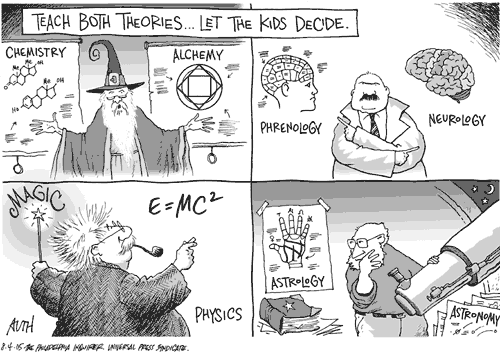
pseudociencia-a-saco

See the Postscript below.

A “roundup” of findings on the safety of glyphosate shows that the herbicide is very benign, highly unlikely to pose any real threat to humans, and far less toxic than many common household chemicals and even natural hazards in the environment. However, the debate over glyphosate is heavily politicized, as illustrated by the unsavory details surrounding a report issued last year by the International Agency for Research on Cancer (IARC), an arm of the World Health Organization (WHO). The IARC reclassified glyphosate as “probably carcinogenic to humans” based on a few cherry-picked, poorly-designed studies with weak statistical power. That finding is inconsistent with the vast preponderance research, which shows that glyphosate is not a significant threat to human health.

The Farmer’s Daughter provided a good summary of the issues shortly after the IARC’s ruling was announced last year. She offers the following quote from the U.S. Environmental Protection Agency (EPA):

“The U.S. EPA classified glyphosate as Group E, evidence of non-carcinogenicity in humans. The U.S. EPA does not consider glyphosate to be a human carcinogen based on studies of laboratory animals that did not produce compelling evidence of carcinogenicity.“

European regulators reached similar conclusions and are rather damning in their assessment of the IARC’s findings, though Brussels recently disregarded their findings and decided to ban the sale of glyphosate for gardening. In this post at Biology Fortified, Anastasia Bodnar discusses the low toxicity of glyphosate with links to several recent studies on its safety. And here is the Risk Monger blogs’s list of “ten reasons why glyphosate is the herbicide of the century“:

  1. Controlling invasive weeds leads to better agricultural yields
  2. Better yields = less land in production = more meadows and biodiversity
  3. Extremely low toxicity levels compared to (organic) alternatives
  4. Allows for no or low till farming – better for soil management
  5. Reduces CO2 emissions (compared to organic)
  6. Glyphosate saves lives
  7. It is much more affordable and effective than other options
  8. Glyphosate is off patent so no single company is profiting heavily from it
  9. Glyphosate-resistant crops allow for more ecological weed management practices
  10. There is overwhelming scientific evidence that glyphosate is safe for humans

How, then, did the IARC reach such a negative conclusion? Again from the Risk Monger, David Zaruk, the IARC hired just one external technical advisor, Christopher Portier, an activist previously employed by an NGO, the anti-pesticide Environmental Defense Fund (EDF). Portier has no technical background in toxicology, and the IARC apparently went to pains to avoid references to his affiliation with the EDF. Moreover, the IARC’s conclusion seems to have been preordained:

“The IARC study rejected thousands of documents on glyphosate that had industry involvement and based their decision on carcinogenicity on the basis of eight studies (rejecting a further six because they did not like their conclusions).“

The lead author of the report, Kathryn Guyton, gave a speech in 2014 in which she stated that herbicide studies slated for 2015 showed indications of a link to cancer. Just how did she know, so far ahead of time? And then there’s this revelation:

“According to the observer document, the glyphosate meeting started with the participants being told to rule out the possibility of classifying the substance as non-carcinogenic.“

Zaruk believes there is internal pressure for the IARC study to be retracted. The organization has suffered a great loss of credibility in the scientific community over the report. In addition, WHO has remained neutral thus far, but they are expected to address the issue this month.

Zaruk and Julie Kelly provide a more succinct summary of the issues in “The Facebook Age of Science at The World Health Organization” at National Review. The suggestion made in the title seems to be that WHO’s decision might be swayed by public pressure, measured by Facebook “likes” by the superstitious, such as unknowing David Wolfe devotees, rather than science:

“Environmentalists and organic companies tout phony studies claiming that glyphosate is found in everything from breast milk to bagels. … Meanwhile, farmers who use glyphosate to protect their crops and boost yields are caught in the crossfire. Even if glyphosate is banned, they will need to use another herbicide, probably more toxic, because the romantic notion of hand-weeding millions of acres of crops is promoted only by those who have never done it.“

I’ll keep using Monsanto’s Roundup, thanks! Or a competitive brand of glyphosate. To close, here’s a quote from Matt Ridley’s Rational Optimist blog on the embrace of pseudoscience at the IARC and elsewhere (including social media):

“Science, humanity’s greatest intellectual achievement, has always been vulnerable to infection by pseudoscience, which pretends to use the methods of science, but actually subverts them in pursuit of an obsession. Instead of evidence-based policymaking, pseudoscience specialises in policy-based evidence making. Today, this infection is spreading.“

Postscript: On May 16, WHO announced that glyphosate is “unlikely to cause cancer in people via dietary exposure.” Here is a Q&A from WHO regarding its assessment, explaining that it is based on risk as opposed to mere hazard, upon which the earlier IARC report was based. This is good news!


Those Halcyon Days of Desperation

18 Monday Jan 2016

Posted by Nuetzel in Capitalism, Markets, Poverty

≈ Leave a comment

Tags

Environmental Left, Human Progress, Julian Simon, Luc Sante, Matt Ridley, Minimalism, Nostalgie dela Boue, Profit Motive, Sarah Skwire, Sustainability, The Rational Optimist, Thomas Malthus, World Poverty

chickennostalgic

Nostalgia is hard to resist. Youth is fleeting, and for most of us, it seems more magical in hindsight than it might have been at the time. It’s also easy to imagine that certain historical eras were more interesting or romantic than the present. For example, my spouse tells me she’d love to have lived in the frontier days, yet she can’t tolerate the reality of a camping trip. We also tend to lionize certain leaders of the distant past, ascribing greatness based on history written by victors. Our objectivity may be obscured by narratives shaped over many years.

Today, some imagine and aggrandize the past in a different way: as a time when motives were “selfless”; when the world was inhabited by less acquisitive and more “minimalist” folk; when practices were more “sustainable”, or even “legitimate”. Despite the primitive conditions of that world, it was a better place for “free” human beings. So it is said, seriously!

Sarah Sqwire takes a look at these flights of fancy in “The Good Old Days of Poverty and Filth“. She dissects the views of one Luc Sante, a cultural historian, as an archetypical patron of primitivism. She invokes the French phrase “nostalgie de la boue, ‘longing for the mud,’ which means a romantic yearning for a primitive or degraded behavior or condition.” Here are some of Skwire’s colorful comments about the past:

“We don’t need every medieval romance novel to remind us that the heroine’s breath didn’t smell like cool mint Listerine. It’s probably for the best that the historical re-enactors at Colonial Williamsburg don’t actually use authentic colonial medical remedies for their health problems…. Any lover of history will occasionally find him or herself dreaming about attending a performance in the pit at Shakespeare’s Globe, or roughing it in the saloons and shacks of a gold rush town. … But a good student of history will acknowledge that the Globe was undoubtedly loud, smelly, crowded, and occasionally even dangerous for playgoers. And the rugged romance of the gold rush town is offset by the knowledge that you were probably far more likely to die of gangrene or cholera than you were to strike it even moderately rich. And those glorious 18th-century wigs? Heavy, hot, smelly, and prone to harboring bugs.“

She then quotes Sante:

“In the Paris I write about, people ran businesses to make a living, not to make a profit. Cafes, bars: they’re no longer public institutions or part of a community. There’s no possibility for eccentric self-determination amongst the shopkeepers.”

Skwire notes the odd distinction that Sante makes in the first sentence above, as if profit is not how proprietors ever made “a living”, or that they observed certain limits on their finances not imposed by market forces (i.e., their customers). She adds that businesses often seek to “create communities” as part of their business models, now in the era of social media more than ever, contrary to Sante’s presumption. Here’s Skwire’s verdict:

“Sante, though, has so much mud in his eyes that he is blind to the tangible and important progress that has been made in human wealth and welfare. His mucky nostalgia leads him to claim that our increasing wealth — which has given us more health, more discretionary income, more food, and more free time — is a danger more pernicious than terrorism.“

I am surprised that Skwire fails to mentions the environmental left in this context. It is, after all, the source of hysteria related to population and scarcity, and the source of so much criticism of modernity. As an antidote to such nonsense, I recommend the Human Progress web site. This recent entry on Julian Simon is instructive. I also recommend Matt Ridley’s Rational Optimist blog. Try this entry on “The Long Shadow of Malthus” for a start.

Skwire views Luc Sante’s infatuation with pre-modern life and lifestyles as an elitist’s prescription for “other” people. That may well be. It also fits the profile of many environmental elites. Whether or not Skwire’s characterization of Sante is accurate, he is at least ignorant of the great diffusion of prosperity taking place around the globe, fueled by markets and economic development. It seems awkward that anyone would bemoan economic progress when, in fact, world poverty is declining, yet that very misgiving is implied by many critiques of markets and modernity.

Climate Summit Success? Let’s Talk In Five Years

02 Wednesday Dec 2015

Posted by Nuetzel in Global Warming, Human Welfare

≈ 1 Comment

Tags

AGW, Benny Peisner, Carbon Emissions, Carbon Verification, Climate Alarmism, Climate and Terrorism, Climate Hysteria, Climate Summit, COP 21, global warming, IPCC, Joel Kotkin, Matt Ridley, Regressive Climate Policy

Moudakis Cartoon

Misplaced priorities are on full display in Paris for the next ten days at the climate conference known as COP-21 (“Conference of the Parties”). Joel Kotkin makes note of the hysteria in evidence among climate activists fostered by political opportunists, economic illiteracy and fraudulent climate research. Of course, climate alarmism offers handsome rewards for politician-cronyists and rent-seeking corporatists. With that seemingly in mind, President Barack Obama is playing the role of opportunist-in-chief, claiming that climate change is the biggest threat to U.S. security while blithely asserting that the climate is responsible for the growing danger from terrorism. Here is Kotkin on such tenuous claims:

“… this reflects the growing tendency among climate change activists to promote their cause with sometimes questionable assertions. Generally level-headed accounts, such as in the Economist and in harder-edge publications like the Daily Telegraph, have demonstrated that many claims of climate change activists have already been disproven or are somewhat exaggerated.“

“Somewhat exaggerated” is an understatement, given the scandals that have erupted in the climate research community, the miserable predictive record of carbon forcing models, and the questionable practices employed by NASA and NOAA researchers in adjusting surface temperature data (see below for links). When it comes to climate activism, the Orwellian aspect of Groupthink is palpable:

“Rather than address possible shortcomings in their models, climate change activists increasingly tend to discredit critics as dishonest and tools of the oil companies. There is even a move to subject skeptics to criminal prosecution for deceiving the public.“

This is thoroughly contrary to the spirit of scientific inquiry, to say nothing of free speech. As if to parody their questionable approach to an issue of science, climate-change devotees have come out in full force to attack the excellent Matt Ridley, a sure sign that they find his message threatening to the power of their mantra. Ridley and Benny Peiser have an op-ed in the Wall Street Journal this week entitled “Your Complete Guide to the Climate Debate” (should be ungated for now). The authors discuss the weakness of the scientific case for anthropomorphic global warming (AGW); the fact that they use findings of the Intergovernmental Panel on Climate Change (IPCC) to make this critique must be particularly galling to the alarmists. Ridley and Peisner cover the correspondingly flimsy case for draconian environmental policies to deal with the perceived threat of AGW. Also, they emphasize the regressive nature of the demands made by the environmental left, who are either ignorant or unfazed by the following truths:

“… there are a billion people with no grid electricity whose lives could be radically improved—and whose ability to cope with the effects of weather and climate change could be greatly enhanced—with the access to the concentrated power of coal, gas or oil that the rich world enjoys. Aid for such projects has already been constrained by Western institutions in the interest of not putting the climate at risk. So climate policy is hurting the poor.“

Finally, Ridley and Peisner explain the economic incentives that are likely to undermine any meaningful international agreement in Paris. Less developed countries have been asked to reduce their carbon emissions, which they can ill afford, and to agree to a verification framework. Those parties might agree if they view the framework as sufficiently easy to game (and it will be), and if they are compensated handsomely by the developed world. The latter will represent an insurmountable political challenge for the U.S. and other developed countries, who are already attempting to promulgate costly new restrictions on carbon emissions.

“Concerned about the loss of industrial competitiveness, the Obama administration is demanding an international transparency-and-review mechanism that can verify whether voluntary pledges are met by all countries. Developing countries, however, oppose any outside body reviewing their energy and industrial activities and carbon-dioxide emissions on the grounds that such efforts would violate their sovereignty.

… China, India and the ‘Like-Minded Developing Countries’ group are countering Western pressure by demanding a legally binding compensation package of $100 billion a year of dedicated climate funds, as promised by President Obama at the U.N. climate conference in Copenhagen in 2009.

However, developing nations are only too aware that the $100 billion per annum funding pledge is never going to materialize, not least because the U.S. Congress would never agree to such an astronomical wealth transfer. This failure to deliver is inevitable, but it will give developing nations the perfect excuse not to comply with their own national pledges.“

These conflicting positions may mean that the strongest point of accord at the Paris conference will be to meet again down the road.

“Expect an agreement that is sufficiently vague and noncommittal for all countries to sign and claim victory. Such an agreement will also have to camouflage deep and unbridgeable divisions while ensuring that all countries are liberated from legally binding targets a la Kyoto.“

This morning, an apparently sleepy and deluded President Obama spoke at the Paris conference before heading back to the U.S. He insisted again that the agreement he expects to come out of Paris will be a “powerful rebuke” to terrorists. Yeah, that’ll show ’em! Even a feeble agreement will be trumpeted as a great victory by the conference parties; Obama and the Left will attempt to wield it as a political cudgel, a brave accomplishment if it succeeds in any way, and a vehicle for blame if it is blocked by the principled opponents of climate alarmism. The media will play along without considering scientific evidence running contrary to the hysterical global warming narrative. Meanwhile, the frailty of the agreement will represent something of a win for humanity.

Here are some links to previous posts on this topic from Sacred Cow Chips:

Climate Negotiators To Discuss Economic Cannibalism

A Cooked Up Climate Consensus

Fitting Data To Models At NOAA

Carbon Farce Meets Negative Forcings

Subsidized Waste: The Renewable Irony

Manipulating Temperatures, People & Policy

Record Hot Baloney

Alluring Apocalypse Keeps Failing To Materialize

The Stench of Green Desperation

Cut CO2, But What About the Environment?

Live Long and Prosper With Fossil Fuels

Divesting of Human Well-Being


Government Economy; Government Science: You Wanted Growth?

28 Wednesday Oct 2015

Posted by Nuetzel in Central Planning, Regulation, Technology

≈ Leave a comment

Tags

Basic Science, economic growth, Innovation, John Cochrane, Matt Ridley, Productivity Growth, Public Funding of Science, regulation, Technological advance

science1

Economic growth allows us to enjoy an improving material existence and the wealth to pursue other goals as a society, such as a clean environment. Yet we often pursue other goals in ways that strangle growth, when in fact those goals and growth are fundamentally compatible.

Two articles that caught my attention today approach this issue from different but complementary perspectives. One is by John Cochrane of the University of Chicago, a lengthy piece called simply “Economic Growth“. At the outset, Cochrane asserts that the one, ultimate source of economic growth in the long-run is through advancing productivity. He notes, however, that the U.S. has been falling short in that department of late. Re-establishing growth should start with a clean-up of the many harmful public policies that have cluttered the economic landscape, especially over the last few decades. Unfortunately, politics makes this easier said than done:

“The golden rule of economic policy is: Do not transfer incomes by distorting prices or slowing competition and innovation. The golden rule of political economics seems to be: Transfer incomes by distorting prices and regulating away competition. Doing so attracts a lot less attention than on-budget transfers or subsidies. It takes great political leadership to force the political process to obey the economic rule.“

Cochrane’s discussion is wide ranging, covering a number of areas of public policy that require “weeding”, as he puts it: the regulatory arena (finance, health care, energy and the environment), tax policy, debt and deficits, the design of social programs and entitlements, labor law and regulation, immigration, education, agricultural policy, trade, and the process of infrastructure investment. There may be a year’s worth of blog posts to be drawn from Cochrane’s essay, but I think “weeding” understates the difficulty of the tasks outlined by Cochrane to reignite growth.

The second article that interested me today dealt with technological advance, which is a primary driver of productivity growth. Economists and pundits often prescribe policies that they believe will lead to transformational breakthroughs in technology. This usually manifests in advocacy for increased public funding for basic scientific research. This is a mistake, according to Matt Ridley’s great article, “The Myth of Basic Science“. In fact, one might say that he’s identified another government-nourished weed for Cochrane to pull. I found Ridley’s opening paragraph intriguing:

“Innovation is a mysteriously difficult thing to dictate. Technology seems to change by a sort of inexorable, evolutionary progress, which we probably cannot stop—or speed up much either. And it’s not much the product of science. Most technological breakthroughs come from technologists tinkering, not from researchers chasing hypotheses. Heretical as it may sound, “basic science” isn’t nearly as productive of new inventions as we tend to think.“

Ridley’s thesis (actually, he credits several others for formulating this line of thinking) is that technology growth is very much an independent process, impossible to push or steer effectively. He goes so far as to say that it can’t be stopped, but he also cites ways in which it can be inhibited.

This perspective on technology has implications for patent law, a subject that Ridley explores to some extent. It also reflects badly on government efforts to direct and stimulate advances by granting subsidies to favored technologies and more aggressive funding of  “basic science”. Government, in Ridley’s view, is largely impotent in spawning technological advance. By pushing technologies that are uneconomic, government distorts price signals, diverts resources from more productive investments, and embeds inferior technologies in the economy’s productive capital base.

But Ridley’s point has more to do with the futility of basic science as a driver of technological advance, and the strong possibility that causation often runs in the other direction:

“It is no accident that astronomy blossomed in the wake of the age of exploration. The steam engine owed almost nothing to the science of thermodynamics, but the science of thermodynamics owed almost everything to the steam engine. The discovery of the structure of DNA depended heavily on X-ray crystallography of biological molecules, a technique developed in the wool industry to try to improve textiles.

Technological advances are driven by practical men who tinkered until they had better machines; abstract scientific rumination is the last thing they do. As Adam Smith, looking around the factories of 18th-century Scotland, reported in ‘The Wealth of Nations’: ‘A great part of the machines made use in manufactures…were originally the inventions of common workmen,’ and many improvements had been made ‘by the ingenuity of the makers of the machines.’

It follows that there is less need for government to fund science: Industry will do this itself. Having made innovations, it will then pay for research into the principles behind them. Having invented the steam engine, it will pay for thermodynamics. This conclusion … is so heretical as to be incomprehensible to most economists, to say nothing of scientists themselves.“

It’s good to qualify that “industry will do this itself” only if it isn’t severely hamstrung by meddling politicians and regulators.

Ridley goes on to cite a few inconvenient historical facts that run counter to the narrative that public funding of science is a necessary condition for technical advance. He also cites empirical work suggesting that the return on publicly-funded R&D is paltry. In fact, he allows that government involvement in “basic science” may inhibit more economically viable advances and their adoption. There is no question that government often chooses unwisely without the discipline of market incentives. If it gets funded, then bad science, politically-driven “science” and ultimately nonproductive science might very well crowd-out better private science and innovation.

In a time of strained government budgets, public funding for basic science should be subjected to as much scrutiny as any other spending category. Like Ridley, I have much more faith in private tinkerers to choose wisely when it comes to the development of new technologies. Intimacy with actual markets and with the production process itself improve the odds that private developers and technologists will be more effective at boosting productivity.

Manipulating Temperatures, People & Policy

21 Friday Aug 2015

Posted by Nuetzel in Global Warming, Tyranny

≈ 2 Comments

Tags

Bob Tisdale, Climate fraud, crony capitalism, global warming, Matt Ridley, NASA, NOAA, Robert Brown, Ronald Bailey, Satellite Temperatures, Surface Temperatures, Temperature adjustments, UK Met Office, Werner Brozek

image

The heavily-manipulated global surface temperatures quoted by NOAA and NASA point to another “hottest month on record” in July, but the satellite temperature measurements do not agree. Nor do several other widely-followed global temperature series maintained elsewhere, such as the UK Meteorological Office (UK Met Office). I wrote about the manipulation of surface temperatures by NOAA and NASA in January in “Record Hot Baloney“, and in “Fitting Data To Models At NOAA” in June:

“If the facts don’t suit your agenda, change them! The 18-year “hiatus” in global warming, which has made a shambles of climate model predictions, is now said to have been based on “incorrect data”, according to researchers at National Oceanic and Atmospheric Administration (NOAA). Translation: they have created new data “adjustments” that tell a story more consistent with their preferred narrative, namely, that man-made carbon emissions are forcing global temperatures upward, more or less steadily.“

The last link provides detail on the nature of the manipulations. Perhaps surprisingly, rather large downward adjustments have been made to historical temperature data, reinforcing any upward trend in the late 20th century and hiding the current 18-year pause in that trend. Suffice it to say that the “adjustments” made by these agencies are at fairly detailed levels; some of the before-and-after comparisons shown by gifs at this link are rather astonishing. Some climate researchers have started to refer to the temperature series as “reconstructions” instead of “data”, out of respect for the legitimacy of actual data.

In the meantime, the “warmist” propaganda keeps flowing from NOAA and NASA, and it is hungrily swallowed and then regurgitated by media alarmists. The media love a good scare story. They are so complicit in reinforcing the warmist narrative they will ignore the revelation of a faulty temperature sensor at National Airport in Washington, D.C. (another hat tip to John Crawford). It has been recording temperatures averaging 1.7 degrees Fahrenheit too warm for the past 19 months. Now that the sensor has been changed, NOAA states that it will not make any adjustments to the past 19 months of recorded temperatures from the National weather station, despite the fact that they have routinely made many other changes, often without any real explanation.

Here is a recent opinion from Duke University Professor Robert Brown on the divergence of satellite and NASA/NOAA surface temperatures and the adjustments to the latter:

“The two data sets should not be diverging, period, unless everything we understand about atmospheric thermal dynamics is wrong. That is, I will add my “opinion” to Werner’s and point out that it is based on simple atmospheric physics taught in any relevant textbook. …

This does not mean that they cannot and are not systematically differing; it just means that the growing difference is strong evidence of bias in the computation of the surface record.“

Every new report issued by NOAA/NASA on record warm temperatures should be severely discounted. They are toiling in the service of a policy agenda; it will cost you dearly, and it will severely punish the less fortunate here and especially in less developed parts of the world; and it will reward the statist elite, bureaucrats and Green crony capitalists. Ronald Bailey in Reason recently weighed in on the consequences of this “apocalyptic anti-progress ideology“. Or read the wise words of Matt Ridley on “The recurrent problem of green scares that don’t live up to the hype“. Hey greens, relax! And don’t waste our resources and our well being on precautions against exaggerated risks.

A Cooked-Up Climate Consensus

14 Tuesday Jul 2015

Posted by Nuetzel in Global Warming

≈ 3 Comments

Tags

97% Consensus, AGW, Anthropomorphic Global Warming, Climate Change, Climate change consensus, Climate fraud, Ian Plimer, John Cook, Matt Ridley, Peer Review Process, Richard Tol, Scientism, University of Queensland

Settled-Science

Consensus: the world is flat; the science is settled. Consensus: the earth is at the center of the universe; the science is settled. Consensus: bloodletting can cure diseases; the science is settled. Did these ideas truly represent scientific consensus? They probably thought so at the time, but it’s more likely that they derived from long- and widely-held assumptions that had never been tested adequately via scientific methods. It might have been difficult, if not impossible, to test those propositions using the methods available at the time. There are certainly other examples of  “settled science” that were later revised, such as certain aspects of Newtonian physics.

The so-called “consensus” on climate change is similar to the first few “scientistic” assertions above, except that it’s a much less honest mistake. The most prominent claim about it is that 97% of climate scientists agree that humans have contributed to global warming. That is incorrect in several ways. Its genesis is a 2013 paper by John Cook of the University of Queensland. Richard Tol of the University of Sussex examines the facts surrounding the Cook paper in “Global warming consensus claim does not stand up“. The claim itself is a misrepresentation of Cook’s findings, according to Tol:

“The 97% refers to the number of papers, rather than the number of scientists. The alleged consensus is about any human role in climate change, rather than a dominant role….“

It is well known that the peer review process in the climate research community was fundamentally corrupt during the period covered by Cook’s examination of the literature. Papers submitted to academic journals by climate “dissenters” were often shut out, which would have biased Cook’s findings even if his review had been conducted honestly. Tol goes on to note the distortions introduced by Cook’s research, including a non-representative sample of papers:

“The sample was padded with irrelevant papers. An article about TV coverage on global warming was taken as evidence for global warming. In fact, about three-quarters of the papers counted as endorsements had nothing to say about the subject matter.“

It gets even worse:

“Cook enlisted a small group of environmental activists to rate the claims made by the selected papers. Cook claims that the ratings were done independently, but the raters freely discussed their work. There are systematic differences between the raters. Reading the same abstracts, the raters reached remarkably different conclusions – and some raters all too often erred in the same direction. Cook’s hand-picked raters disagreed what a paper was about 33% of the time. In 63% of cases, they disagreed about the message of a paper with the authors of that paper.“

On top of all that, Cook was uncooperative when asked to make his data available to other researchers. Apparently a hacker obtained the data, which revealed a highly questionable data collection process (and that Cook had lied regarding the existence of time stamps on the surveys):

“After collecting data for 8 weeks, there were 4 weeks of data analysis, followed by 3 more weeks of data collection. The same people collected and analysed the data. After more analysis, the paper classification scheme was changed and yet more data collected.“

In short, the Cook research upon which the 97% claim is based is trash. There are a number of points upon which climate researchers can largely agree in principle, including the fact that greenhouse gases would warm the planet, but only if ceteris paribus is invoked. There are many feedback effects and confounding influences that change the relationship, and the actual time span of data that can be brought to bear on the issue is strikingly short to justify bold conclusions. Unfortunately, the research environment is so politicized that even the data itself is subject to manipulation. Astonishingly, many assertions about the actual climate are, in fact, based on model output, not actual data!

There is strong disagreement at the highest levels of the scientific community regarding the balance of the evidence on climate change and whether it justifies radical policy change. Matt Ridley examines this issue in “The Climate Wars’ Damage To Science“:

“Today’s climate science, as Ian Plimer points out in his chapter in The Facts, is based on a ‘pre-ordained conclusion, huge bodies of evidence are ignored and analytical procedures are treated as evidence’. Funds are not available to investigate alternative theories. Those who express even the mildest doubts about dangerous climate change are ostracised, accused of being in the pay of fossil-fuel interests or starved of funds; those who take money from green pressure groups and make wildly exaggerated statements are showered with rewards and treated by the media as neutral.“

Ridley goes on to recount the litany of scandals that have erupted within the climate establishment over the past few years. It is well worth reading, but ultimately these developments can’t help but damage science, its reputation with the public, and its usefulness to mankind.

Green Hubris: The Flub of Rome

21 Sunday Jun 2015

Posted by Nuetzel in Global Warming

≈ 1 Comment

Tags

Brendan O'Neil, Club of Rome, Fr. Robert Sirico, Free Markets, Green Theology, IPCC, John Hinderaker, Limits to Growth, Matt Ridley, Papal encyclical, Patrick J. Michaels, Politics of Science, Prometheus, Thomas Malthus, Tim Ball

paleo hubris

The Papal Encyclical published last week has generated controversy for venturing into areas about which Pope Francis, and for that matter the Catholic Church, has absolutely no authority or expertise. Pope Francis has noble aims. His compassion for the poor is admirable and even poignant. Nevertheless, the Pope errs in his assessment of scientific, technological and economic issues, and he fails to reference or consider mountains of evidence that contradict the views that dominate this encyclical. It should come as no surprise that he has been swept along by the Leftist orthodoxy, of which he has long been a part.

On one hand, Pope Francis expresses a viewpoint that is almost universally shared: that we are stewards of the natural world and have a moral obligation to treat it well for the benefit of others now and in the future. However, he also believes in the unproven proposition of anthropomorphic global warming (AGW), that human activities are causing global temperatures to rise inexorably. He takes the questionable view that ongoing technological advances will benefit only the rich, leaving the poor behind in increasingly desperate circumstances. And he recklessly questions the morality of free markets and capitalism, asserting that they benefit only the rich and work against the interests of the broader masses.

One of the most interesting pieces of commentary on the Encyclical appeared in The Wall Street Journal, entitled “The Pope’s Green Theology“, written by Fr. Robert Sirico, a Catholic priest. (If the link doesn’t work, Google “wsj Sirico Green Theology”.)

“… capitalism has spurred the greatest reduction in global poverty in world history: The number of people living on $1.25 a day fell to 375 million in 2013 from 811 million in 1991, according to the International Labor Office. This is only one statistic among reams of evidence that vindicate capitalism. An honest debate among experts will lay this canard to rest.

The encyclical unwisely concedes too much to the secular environmental agenda, for example, by denigrating fossil fuels. But it also voices moral statements dismissing popular, ill-conceived positions. The repeated lie that overpopulation is harming the planet—expressed by even some of the advisers for the Vatican—is soundly rejected.“

Much of the evidence on global temperatures contradicts the Pope’s position, yet he sides with the groupthink of the environmental Left based on model predictions that have been consistently wrong over several decades. The models have drastically over-predicted global temperature trends, even before the “pause” in warming that began in the late 1990s.

It is rather early in the game for the Catholic Church to take such an unequivocal position on an issue as far afield from matters of religious faith as climate science. As Dr. Tim Ball notes, the Catholic Church has not always bet well on science, going back to its denunciation of Galileo almost 400 years ago. Apparently, any lessons learned from that episode about the process of scientific inquiry have been forgotten. Matt Ridley has a great (if lengthy) essay on the politics of science and the damage that politicized climate science has done to the cause of real understanding:

“Expertise, authority and leadership should count for nothing in science. The great Thomas Henry Huxley put it this way: ‘The improver of natural knowledge absolutely refuses to acknowledge authority, as such. For him, scepticism is the highest of duties; blind faith the one unpardonable sin.’ Richard Feynman was even pithier: ‘Science is the belief in the ignorance of experts.’”

Climate science is really in its infancy. Recorded history of the climate is in its infancy as well. The scant evidence of global warming during the 20th century is well within the range of natural variation estimated for the past 8,000 years, according to a study by a former lead author for the Intergovernmental Panel On Climate Change (IPCC). For the Pope, or anyone else, to make strong claims about “the science”, or to prescribe draconian limits on individual liberty in an effort to plan “the climate”, is hubris of the first order. That’s ironic given the Pope’s condemnation of what he characterizes as mankind’s Promethean hubris, as if making the world more livable was sinful. The Encyclical condemns technological progress, going so far as to denigrate the use of air conditioning. That attitude is driven by objections to energy use; nevertheless, the Pope reveals a deep mistrust of technology and betrays the soul of a Luddite.

Patrick J. Michaels of CATO’s Center for the Study of Science wrote about the Pope’s climate views and the morality of “dense energy” in April:

“Abundant and dependable energy frees mankind from a menial existence, allowing us to use our given talents for the greater good. The mental capital of the poor in the underdeveloped world is untapped without dense energy. The burning of dung for cooking is a major cause of early death from pulmonary disease. The massive deforestation that must occur without dense energy amplifies floods from ubiquitous tropical downpours.“

Here is a link to some very sarcastic commentary from Brendan O’Neil at Reason on the Pope’s “Dotty Green Theology“. O’Neil mentions the tyrannical fantasies dancing in the minds of some on the environmental Left:

“Christianity’s end-of-worldism is getting a new airing in the apocalypse obsession of greens, who warn of an eco-unfriendly End of Days. Its promise of Godly judgement for our wicked ways has been replaced by greens’ promise that we’ll one day be judged for our planetary destructiveness. A leading British green has fantasised about ‘international criminal tribunals’ for climate-change deniers, who will be ‘partially but directly responsible for millions of deaths.'”

Let’s hope the Pope isn’t on board with that, though he did propose that a worldwide governing body take charge of environmental issues. Please, no favors! John Hinderaker, in the context of the Encyclical, discusses the regressive impact of policies that raise energy prices. That’s consistent with the Pope’s green objectives. Hinderaker cites figures showing that those earning less than $30,000 per year in the U.S. spend 23% of their after-tax income on energy, compared to just 7% for those earning $50,000 or more.

It is extremely late in the game for the Pope to inveigh against capitalism, with all evidence pointing to the long-term success of free markets in lifting the poor from the depths of privation. In fact, the Encyclical is strongly reminiscent of the Malthusian “Limits to Growth” published by the Club of Rome. That “study” contained what has proven to be among the worst collections of prognostications of all time, and the Club persists in purveying doom and gloom to this day.

I have written before on Sacred Cow Chips about Pope Francis’ statist, anti-market inclinations. From that post:

“… it is not just the secular Left that fails to recognize the inherent conflict between big government and religious liberty. Pope Francis himself seems oblivious to the dangerous implications of big government for religious freedom. His apostolic exhortation for greater reliance on the state to care for the poor simultaneously embraces socialism and condemns capitalism. I take no issue in principle with the provision of a social safety net, but the Pope should be more results-oriented in assessing different forms of social organization and their impacts on poverty. Big government typically fails to achieve the kinds of humane objectives usually espoused by the Left. The sad ‘road to serfdom’ has played out too many times in the past.“

Human Achievement, Comfort and Joy

28 Saturday Mar 2015

Posted by Nuetzel in Human Welfare

≈ 1 Comment

Tags

Alex Epstein, Competitive Enterprise Institute, Earth Hour, Fossil fuels, Free Markets, Human Achievement Hour, International Dateline, Matt Ridley, Ronald Bailey, The Rational Optimist, Tonga

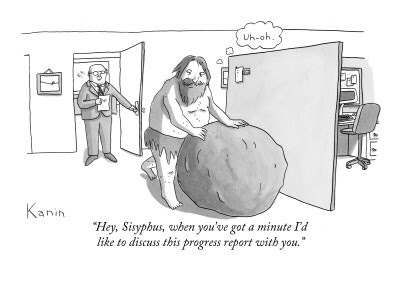
sisyphus-when-you-ve-got-a-minute

2015’s Human Achievement Hour (HAH) starts at 8:30 p.m. on Saturday, March 28. That’s tomorrow night! It starts at 8:30  p.m. in every time zone, so it’s a rolling celebration. But you can celebrate human achievement for a full 24 hours, starting Saturday at about 2:30 a.m. Central Daylight Time, when it will be 8:30 p.m. Saturday in Tonga, just over the international date line. It’s coming up soon! This will be my third year of celebrating HAH. To mark the occasion I just might start celebrating with the Tongans. Here is the Facebook event page for HAH. The Competitive Enterprise Institute is the sponsor of HAH. Here is the first part of their description, followed by their suggestion for how to celebrate.

“Observing Human Achievement Hour is about paying tribute to the human innovations that have allowed people around the globe to live better, fuller lives, while also defending the basic human right to use energy to improve the quality of life of all people.” “In order to celebrate with CEI and friends worldwide, we invite you to enjoy the benefits of energy, capitalism, and human innovation by utilizing your favorite innovation or human advancement…“

Once again this year, I will illuminate every lightbulb in my home to pay homage to the wonder of widely distributed electricity and the tremendous benefits derived from our ability to harness the power of fossil fuels. In a review of Alex Epstein’s The Moral Case for Fossil Fuels, Ronald Bailey of Reason says:

“As humanity burned more fossil fuels and increased carbon dioxide in the atmosphere, human lives dramatically improved. ‘Weather, climate, and climate change matter—but not nearly as much as they used to, thanks to technology,’ Epstein writes. For example, the death rate from extreme weather events has dropped 98 percent since 1920. Indeed, the chief benefit of burning fossil fuels has been longer and healthier human lives. The central idea of Epstein’s book is that ‘more energy means more ability to improve our lives; less energy mean less ability—more helplessness, more suffering, and more death.’“

Matt Ridley adds his thoughts on the benefits of fossil fuels at The Rational Optimist blog. Both Ridley and Bailey are confident that humans will one day achieve such efficiencies in the production of energy from renewable sources as to be competitive with fossil fuels. That will be worth celebrating. We are not there yet, however, and we do ourselves no favor in attempting to restrict fossil fuel consumption in the meantime. In fact, the risks of anthropomorphic global warming are far less severe than climate activists insist. Moreover, a warmer climate would not be unambiguously bad for people.

It is no accident that HAH is scheduled to coincide with Earth Hour, a “celebration” that stands in stark contrast to HAH in its antipathy for free market institutions and its condemnation of humankind’s relatively recent success in adapting to our planet’s environment. But there is no doubt that our progress in reducing poverty has hinged on the complementary nature of human ingenuity and the free market, the latter being a fairly recent (on historical scales) and most powerful innovation for promoting voluntary human cooperation and enrichment. Here is a recent Ridley post in which he elaborates on reasons for continued optimism. A quote:

“For 200 years, pessimists have had all the headlines-even though optimists have far more often been right. There is immense vested interest in pessimism. No charity ever raised money by saying things are getting better. No journalist ever got the front page writing a story about how disaster was now less likely. Pressure groups and their customers in the media search even the most cheerful statistics for glimmers of doom. Don’t be browbeaten-dare to be an optimist!“

Let’s celebrate for the right reasons. The flourishing of human welfare in the face of a harsh natural environment is real achievement.

Put Consumers In Charge

25 Wednesday Feb 2015

Posted by Nuetzel in Markets

≈ Leave a comment

Tags

Comparative advantage, competition, Consumer Sovereignty, Contrived Scarcity, Free trade, Legalized Restraint of Trade, Markets, Matt Ridley, regulation, rent seeking, Richard Ebeling, Transatlantic Trade and Investment Partnership

Washington

The interests of consumers should always be placed first. That’s what happens in a free market economy, with the consent of competitive producers, and that is how public policy should be crafted.  Too often, however, regulations and the laws on which they are based are  written primarily with producer interests in mind. Don’t be cowed by the appealing names given to pieces of legislation or their ostensible purposes. These may be couched in terms of consumer protections, but more often than not they create barriers to entry, stifle innovation and confer advantages to big players, thus restricting competition. A case in point is occupational licensing, which inflates prices by preventing the entry of innovative and less costly competitors. In this political exchange, consumers gain “protections” that are often of questionable value, especially when incentives for improved service are blunted by the licensing rules.

Consumer primacy is of value in a general sense, as Richard Ebeling explains in “Consumers’ Sovereignty and Natural Vs. Contrived Scarcities“. When consumers are sovereign in their ability to decide for themselves among competing alternatives, including their own personal comparison of value to price, they essentially take charge of the flow of resources into and out of various uses. And they capture a positive gap between value and price as a personal gain in any transaction to which they are (by definition) a voluntary party. At the same time, producers must reckon with real costs, which reflect natural scarcities. But, by virtue of competition, it is in the interests of producers to deliver the best values to consumers at the lowest prices compatible with costs. Here is part of Ebeling’s introduction:

“One of the great myths about the capitalist system is the presumption that businessmen make profits at the expense of the consumers and workers in society. Nothing could be further from the truth. … In the free market, consumers are the sovereign rulers who determine what gets produced, and with what qualities and features. … The ‘captains of industry’ are not the businessmen, but the buying public who steer the directions into which production is taken.”

Ebeling gives a number of good examples demonstrating the ways in which this efficient market process is compromised by the hand of government. Regulations, mandates, licensure, price floors and ceilings, taxes and subsidies all act to distort the normal workings of the market, creating direct and indirect scarcities. The perverse effect is to generate a flow of economic rents to producer interests at the expense of consumers (and taxpayers). And that is why is those same producer interests are often inclined to seek market interventions. The successful rent-seeking effort ends in legally-sanctioned restraint of trade.

An example of contrived scarcity given by Ebeling results from protectionist trade policy, which ostensibly “protects” domestic producers and workers from “cutthroat” foreign competition. The plight of workers seems to be an easy sell to the public, though historically protectionism has inured to the benefit of relatively highly-paid workers, often unionized, who have an interest in restricting competition. Consistent with Ebeling’s point of view, Matt Ridley writes that trade policy should be driven by the benefits to domestic consumers, rather than producers. Ridley focuses on the UK’s interests in negotiating a free trade agreement between the United States and the European Union: the Transatlantic Trade and Investment Partnership. The following thoughts from Ridley should be taken to heart by anyone with an interest in trade policy, and especially those who fancy themselves liberal:

“The argument for free trade is paradoxical and much misunderstood. Free trade benefits consumers because it is the scourge of expensive or monopolistic national suppliers. It benefits both sides: yet it works unilaterally. Your citizens benefit if you let them buy cheap goods from abroad, while foreigners are punished if their government does not reciprocate. This creates more demand for local services and hence more growth and jobs in the importing country. 

Contrary to what most people think, therefore, it is imports that bring the greatest benefit, not exports — which are the price we have to pay to get the imports. At the centre of the debate lies David Ricardo’s beautiful yet counterintuitive idea of comparative advantage — that it will always pay a country (or a person) to import some goods from another, even if the first country or person is better at making everything. Truly free trade cannot be a predatory phenomenon.“

The EU Opts For Agro-Federalism

14 Wednesday Jan 2015

Posted by Nuetzel in Uncategorized

≈ Leave a comment

Tags

Biotechnology, EU, European Union, Federalism, GE crops, genetic engineering, GMOs, Green Movement, Matt Ridley, Organics, The Times

MOHR-europe-law

An opinion piece by Matt Ridley in The Times (UK) alerted me to the European Union’s imminent decision to allow member states to adopt their own rules regarding the planting and cultivation of genetically modified crops. The measure was approved overwhelmingly by the EU Parliament today. The talking points released by the EU emphasize that a member country can ban a GM crop even if it has been approved by the EU’s food safety authority. And the rules state:

“While cultivation is recognised to be an issue with strong national or local dimensions, current EU legislation on GMOs offers limited possibilities to Member State to decide on GMO cultivation on their territory.”

It is likely that the additional flexibility for members to impose their own bans will lead to more flexibility in the process of authorizing new varieties at the centralized level. Contrary to much of the reporting offered by Greens, who would have us believe that GE crops are all but prohibited in Europe, there are many varieties of GE crops that are already authorized by the EU. If you don’t believe it, this database may convince you.

Ridley provides an interesting account of the politicking that led to the legislation. Among EU members, the UK and Spain are the most eager to expand cultivation of GE crops, while other nations supported the measure since it seems to enhance their own sovereignty on an important agricultural issue. Nevertheless, critics of the legislation complain that it is poorly worded. Greens are unhappy because they see it as an entry for GE crops through the “back-door.” One biotech group complained that the law allows members to ban GE crops on “non-scientific grounds.”

Ridley also emphasizes some changes in thinking among traditional opponents of GE in Europe. The Greens are aware that the use of pesticides might be curtailed by the use of GE varieties. The yield-challenged organic movement also has much to gain via adoption of GE crops, and Ridley points out the inherent fallacy at the root of their past opposition:

“Ironically, the organic movement happily uses crops whose genetic material has been modified in a much less careful way — by gamma rays or chemical mutagens — for these are categorised as ‘conventional’ crops and lightly regulated. Golden Promise barley, used by organic brewers, for example, was made in a nuclear reactor.”

Federalism is a good way to promote the union of sovereign entities with disparate views on a range of issues, such as agricultural practices. However, sustaining a federalist approach requires a determination to restrain central government bureaucrats and busy-bodies who cannot control their urges to control others. For the good of humanity, let’s hope the EU can succeed in this instance.

← Older posts
Newer posts →
Follow Sacred Cow Chips on WordPress.com

Recent Posts

  • The Case Against Interest On Reserves
  • Immigration and Merit As Fiscal Propositions
  • Tariff “Dividend” From An Indigent State
  • Almost Looks Like the Fed Has a 3% Inflation Target
  • Government Malpractice Breeds Health Care Havoc

Archives

  • January 2026
  • December 2025
  • November 2025
  • October 2025
  • September 2025
  • August 2025
  • July 2025
  • June 2025
  • May 2025
  • April 2025
  • March 2025
  • February 2025
  • January 2025
  • December 2024
  • November 2024
  • October 2024
  • September 2024
  • August 2024
  • July 2024
  • June 2024
  • May 2024
  • April 2024
  • March 2024
  • February 2024
  • January 2024
  • December 2023
  • November 2023
  • August 2023
  • July 2023
  • June 2023
  • May 2023
  • April 2023
  • March 2023
  • February 2023
  • January 2023
  • December 2022
  • November 2022
  • October 2022
  • September 2022
  • August 2022
  • July 2022
  • June 2022
  • May 2022
  • April 2022
  • March 2022
  • February 2022
  • January 2022
  • December 2021
  • November 2021
  • October 2021
  • September 2021
  • August 2021
  • July 2021
  • June 2021
  • May 2021
  • April 2021
  • March 2021
  • February 2021
  • January 2021
  • December 2020
  • November 2020
  • October 2020
  • September 2020
  • August 2020
  • July 2020
  • June 2020
  • May 2020
  • April 2020
  • March 2020
  • February 2020
  • January 2020
  • December 2019
  • November 2019
  • October 2019
  • September 2019
  • August 2019
  • July 2019
  • June 2019
  • May 2019
  • April 2019
  • March 2019
  • February 2019
  • January 2019
  • December 2018
  • November 2018
  • October 2018
  • September 2018
  • August 2018
  • July 2018
  • June 2018
  • May 2018
  • April 2018
  • March 2018
  • February 2018
  • January 2018
  • December 2017
  • November 2017
  • October 2017
  • September 2017
  • August 2017
  • July 2017
  • June 2017
  • May 2017
  • April 2017
  • March 2017
  • February 2017
  • January 2017
  • December 2016
  • November 2016
  • October 2016
  • September 2016
  • August 2016
  • July 2016
  • June 2016
  • May 2016
  • April 2016
  • March 2016
  • February 2016
  • January 2016
  • December 2015
  • November 2015
  • October 2015
  • September 2015
  • August 2015
  • July 2015
  • June 2015
  • May 2015
  • April 2015
  • March 2015
  • February 2015
  • January 2015
  • December 2014
  • November 2014
  • October 2014
  • September 2014
  • August 2014
  • July 2014
  • June 2014
  • May 2014
  • April 2014
  • March 2014

Blogs I Follow

  • Passive Income Kickstart
  • OnlyFinance.net
  • TLC Cholesterol
  • Nintil
  • kendunning.net
  • DCWhispers.com
  • Hoong-Wai in the UK
  • Marginal REVOLUTION
  • Stlouis
  • Watts Up With That?
  • Aussie Nationalist Blog
  • American Elephants
  • The View from Alexandria
  • The Gymnasium
  • A Force for Good
  • Notes On Liberty
  • troymo
  • SUNDAY BLOG Stephanie Sievers
  • Miss Lou Acquiring Lore
  • Your Well Wisher Program
  • Objectivism In Depth
  • RobotEnomics
  • Orderstatistic
  • Paradigm Library
  • Scattered Showers and Quicksand

Blog at WordPress.com.

Passive Income Kickstart

OnlyFinance.net

TLC Cholesterol

Nintil

To estimate, compare, distinguish, discuss, and trace to its principal sources everything

kendunning.net

The Future is Ours to Create

DCWhispers.com

Hoong-Wai in the UK

A Commonwealth immigrant's perspective on the UK's public arena.

Marginal REVOLUTION

Small Steps Toward A Much Better World

Stlouis

Watts Up With That?

The world's most viewed site on global warming and climate change

Aussie Nationalist Blog

Commentary from a Paleoconservative and Nationalist perspective

American Elephants

Defending Life, Liberty and the Pursuit of Happiness

The View from Alexandria

In advanced civilizations the period loosely called Alexandrian is usually associated with flexible morals, perfunctory religion, populist standards and cosmopolitan tastes, feminism, exotic cults, and the rapid turnover of high and low fads---in short, a falling away (which is all that decadence means) from the strictness of traditional rules, embodied in character and inforced from within. -- Jacques Barzun

The Gymnasium

A place for reason, politics, economics, and faith steeped in the classical liberal tradition

A Force for Good

How economics, morality, and markets combine

Notes On Liberty

Spontaneous thoughts on a humble creed

troymo

SUNDAY BLOG Stephanie Sievers

Escaping the everyday life with photographs from my travels

Miss Lou Acquiring Lore

Gallery of Life...

Your Well Wisher Program

Attempt to solve commonly known problems…

Objectivism In Depth

Exploring Ayn Rand's revolutionary philosophy.

RobotEnomics

(A)n (I)ntelligent Future

Orderstatistic

Economics, chess and anything else on my mind.

Paradigm Library

OODA Looping

Scattered Showers and Quicksand

Musings on science, investing, finance, economics, politics, and probably fly fishing.

  • Subscribe Subscribed
    • Sacred Cow Chips
    • Join 128 other subscribers
    • Already have a WordPress.com account? Log in now.
    • Sacred Cow Chips
    • Subscribe Subscribed
    • Sign up
    • Log in
    • Report this content
    • View site in Reader
    • Manage subscriptions
    • Collapse this bar
 

Loading Comments...