• About

Sacred Cow Chips

Sacred Cow Chips

Tag Archives: Overton Window

Warsh and Fed Confront a Crossroads On Policies

01 Monday Jun 2026

Posted by Nuetzel in Federal Reserve, Monetary Policy

≈ Leave a comment

Tags

Ample Reserves, David Beckworth, Fed Balance Sheet, FOMC, Inflation Expectations, Interest on Bank Reserves, Iran Conflict, Jai Kadia, Jerome Powell, Judy Shelton, Kevin Warsh, Milton Friedman, Monetization, Nominal GDP Growth, Norbert Michel, Oil Prices, Overton Window, PCE Deflator, Quantitative Easing, Quantitative Tightening, Rules vs. Discretion, Scarce Reserves, Sound Money, Strait of Hormuz, Treasury-Fed Accord

A lot has changed since Kevin Warsh was nominated by President Trump to replace Jerome Powell as chairman of the Federal Reserve Board. Most notably that includes the war in Iran, the run-up in oil prices, and a bond market increasingly nervous about inflation as it attempts to digest massive supplies of new Treasury debt. Tariffs have also contributed to the updraft in measured inflation since then, which (in addition to oil prices) represents another impingement on the economy’s supply side.

Change and Change Itself

By the time Warsh was sworn in as chairman, expectations for Fed rate cuts had swung to expectations of a quarter-point increase in the federal funds rate target, if not at the mid-June meeting of the Federal Open Market Committee (FOMC) then in July. It’s not clear that Warsh is on board with that, and the status of the Iranian conflict, oil supplies, and the bond market could change dramatically before the June meeting.

Short-term inflation expectations have risen, so a rate hike by the Fed might seem reasonable if not for the possibility that current inflation is transitory (but I use that term guardedly). In terms of money growth, policy seems roughly neutral to slightly restrictive. M2 growth from a year earlier was 4.7% in April. Nominal (current dollar) GDP grew at a slightly faster 5.1% clip in the first quarter, and it might accelerate in Q2. Real GDP advanced 1.6% from a year ago in the first quarter, but the Atlanta Fed’s forecast for real GDP in Q2 is a stronger 3.2%. Meanwhile, core PCE inflation (the Fed’s preferred gauge) was 3.1% in the first quarter and 3.3% in April. If the numbers roughly follow the same track going forward, nominal GDP in Q2 could be up by about 6% – 6.5% from a year ago. Slowing the rate of M2 growth much from its recent pace might be an overreaction.

Moreover, it might be premature to raise the funds rate when a peaceful resolution to the Iran conflict is still possible. Again, we might know by the time the FOMC convenes in June. In that case, market rates could ease quickly. I am skeptical, however, that Iran will prove to be a reliable partner to any peace agreement. I’ll be surprised if the blockade on the Strait of Hormuz ends any time soon, and a few air strikes have already been renewed. Still, I expect the FOMC to defer any rate hike until at least the July meeting. In fact, I’ll be surprised to see one at all.

Sound Money or Monetary Madness

Many describe Warsh as a “sound money” guy, having been greatly influenced by Milton Friedman. He’s been critical of quantitative easing (QE): the Fed’s purchases of securities for its own balance sheet to provide liquidity to the markets and banking system. If the hostilities continue in Iran, Warsh is more likely to favor quantitative tightening (QT) in the short-term than rate hikes. QT would involve reductions holdings of securities on the Fed’s balance sheet, which Warsh has long advocated.

On the other hand, Warsh has been undaunted in insisting that the AI revolution will be a dramatic deflationary force. That’s a longer-term proposition, but it reinforces his preference for lower rates. So Warsh is for “sound money” and would like to see QT, but he also prefers lower rates and apparently believes that AI might justify a more expansionary monetary posture. So where does that leave us?

Squaring the Circle

A few months ago I described a coherent policy agenda for the Fed under Kevin Warsh, given his policy preferences. It might have lacked realism in terms of Fed politics, but it was motivated by the question of whether lower rates are compatible with QT. The discussion did not anticipate the Iran conflict and its economic and financial consequences.

Lower rates and QT would be compatible if the Fed enables and incentivizes commercial banks to hold more securities and lend more aggressively. This would require regulatory changes as well as reductions in interest on bank reserves (IOR) held at the Fed.

Judy Shelton in the Wall Street Journal has made the same point, characterizing such a policy shift as “pro-market”. That’s because it would allow banks to invest in relatively safe assets, would eliminate a subsidy masquerading as a price (IOR – though fully administered), and would mean a transition from the Fed’s emphasis on maintaining ample bank reserves to scarce bank reserves. The latter would restore activity in the market for overnight loans of reserves (federal funds), which would then trade at a price corresponding to their degree of scarcity. That would provide an important signal to other markets, not to mention the Fed itself. Today, that signal is distorted by the Fed’s provision of ample reserves (repo rates notwithstanding). Jai Kadia and Norbert Michel have made a similar argument, along with advocating for rules-based monetary policy, rather than frequently destabilizing discretionary actions.

Momentum

In April, David Beckworth noted that momentum is building in influential circles for this change, which he describes as a “demand driven” approach, as opposed to the “supply driven”, ample reserve operating procedure now in force. This is the more common at many foreign central banks, and it has received prominent mention in recent speeches and statements by Fed officials. As Beckworth puts it in the title of his post, “The Fed’s Overton Window Is Shifting”.

Beckworth also mentions Warsh’s desire to establish a new Treasury-Fed Accord. The original 1951 Accord established the Fed’s independence from Treasury financing operations. Today’s ample reserves approach has made it far too easy for the Fed to succumb to pressures to monetize deficits and intervene in capital markets to manipulate longer rates. Warsh would surely like to re-establish the Fed’s monetary authority as a separate and independent function from Treasury financing.

The Fed Board of Governors (BoG) must approve changes in interest on reserves (IOR). (Better yet, an act of Congress would be required to prohibit IOR.) But Warsh, who is said to have good relations with the Fed staff and other Fed governors, is less likely to get a majority on the BoG than even the FOMC. For now, he’ll have to be persuasive to gain the support of a majority of either body.

Summary

Kevin Warsh is likely to argue strenuously for reductions in the size of the Fed’s balance sheet, and would almost certainly be happy for the FOMC to defer any rate hikes pending more clarity on a resolution to the Iran conflict. He will also argue for creating greater incentives for banks themselves to invest in Treasury debt, including reformed regulations on bank asset holdings and reduced interest on reserves held at the Fed. Ultimately, that would pave the way for lower rates on a variety of assets. But the Fed should be probably be cautious and gradual in the implementation: the changes to IOR and bank regulations must be well coordinated with QT and money growth must be calibrated to meet the Fed’s inflation target (or better yet, a nominal GDP target — see Part 2 of this post).

Stagflation and the Supply of Bad Public Policy

20 Wednesday Oct 2021

Posted by Nuetzel in Inflation

≈ 2 Comments

Tags

Anthony B. Kim, Breakeven Inflation Rate, Brian Dunn, Consumer Price Index, Core CPI, corporate taxes, Cost-Push Inflation, Dunkin’ Donuts, Energy Policy, Federal Reserve, Jen Psaki, Joe Biden, Labor Force Participation, Mark Theisen, Median CPI, Non-Pharmaceutical interventions, Overton Window, Patrick Tyrell, Semiconductors, Stagflation, Supply Chains, Trimmed CPI, Unemployment By State, Vaccine Mandate, Work Disincentives

Price inflation is getting more attention now than it has in many years, but not everyone is convinced it will persist, most conspicuously bond investors. The Biden Administration’s initial narrative was plausible even if there were seeds of doubt: a price spike was to be expected relative to the low-ebb of price changes during the pandemic. However, the inflation data has come in strong since the spring, and events point to continuing price pressures and the potential for expected inflation to drive escalations in contract pricing. Once embedded like that, the phenomenon broadens and gets harder to squeeze out.

Broadening Price Hikes

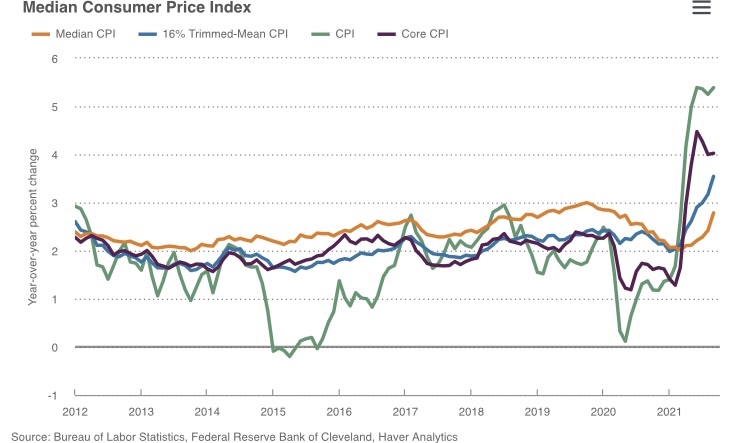
The evidence at hand is never enough to take much comfort in predictions, and the uncertainties now are similar to those I discussed in June. At the time, the price moves had been pronounced only in the prior month or so, and there was no evidence of any breadth. Now, it’s at least clear that increases in the so-called “core” Consumer Price Index (CPI), which excludes food and energy prices, have escalated. In addition, the growth in the median component of the CPI basket reported by the Federal Reserve Bank of Cleveland has begun to jump. So has the “trimmed CPI”, which excludes the most extreme 8% of prices changes in both directions within the index. The chart below shows one-month changes in these gauges:

So the recent upward price trends have expanded in breadth, and their persistence is making it a little harder to argue that the changes are transitory rebounds from pandemic weakness.

Bond Investors Still Nonchalant

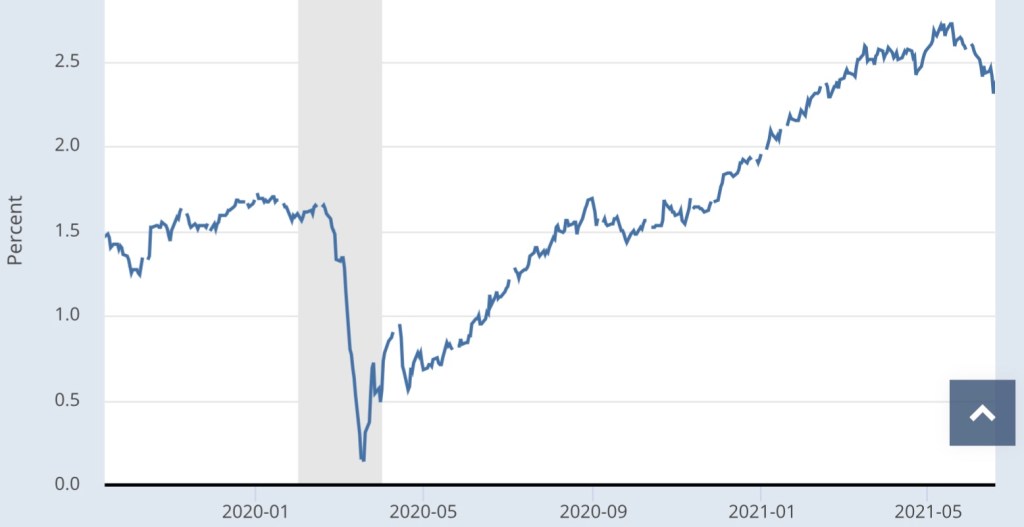
Investors are by no means convinced that the recent price pressures will persist. They have an incentive to bid-up bond yields to compensate for expected inflation, so these yields can be used to infer inflation expectations. The chart below from the Federal Reserve Bank of St. Louis shows the five-year “breakeven” inflation rate, which is derived from inflation-indexed versus unindexed Treasury securities.

The pattern does not suggest that a meaningful change in inflation expectations has taken place. In fact, the implied five-year inflation forecast has edged down a bit. Of course, we’re still worrying about a fairly short period of high month-to-month changes in prices, and five years is a long time in that context.

This “casual” reaction of interest rates to the inflation spike undoubtedly reflects investors’ belief that the Federal Reserve will tighten policy in an effort to contain inflation. Some of us have strong doubts about the Fed’s inflation-fighting resolve, however. There is little the Fed can do to relieve supply-side problems, and many would argue that the Fed should take an accommodative stance in an attempt to minimize output and job losses, but that would reinforce the inflationary effects. There is no easy way out. Risks loom in both directions, and though I might regret it, at recent yields, I’m not buying Treasury bonds.

Sources of Price Pressure

Economists have tended to divide price pressures into those driven by demand and those driven by supply. Sometimes the terms “demand-pull” and “cost-push” inflation are used for shorthand. The former is usually associated with economic growth, where rising prices indicate that demand is outpacing gains in capacity. With cost-push inflation, however, rising prices indicate that production snd supply is somehow impeded. You get higher prices and lower output. This is so-called “stagflation”. Today we seem to have a combination of those inflationary forces in play: demand has rebounded from the pandemic lows of 2020, while breakdowns in the supply chain have choked production, with a consequent need for more severe price rationing. If the latter forces win out, we will have entered a stagflationary episode.

Unfortunately, administration policies are exacerbating supply-side inflationary pressures. Officials first insisted that the jump in inflation measures would be transitory. More recently they’ve said that it really only hurts “the rich”, an assertion that is decidedly false. Biden flaks are doing their level best to put lipstick on a pig. “Peppermint” Psaki says it shows that people just want to buy things! On the other hand, the Washington Post encourages us to “lower our expectations”. Um, yeah… I think we’re there!

Burning Energy Producers and Consumers

Energy policy is an obvious case: while a hurricane moving through the Gulf of Mexico took a big bite out of domestic oil production, Biden took several steps to hamstring the domestic fossil fuel industry at a time when the economy was still recovering from the pandemic. This included revoking permits for the Keystone pipeline, a ban on drilling on federal lands and federally-controlled waters in the Gulf, shutting down production on some private lands on the pretext of enforcing the Endsngered Species Act, and capping methane emissions by oil and gas producers. And all that was apparently just a start.

As Mark Theisen notes, when you promise to destroy a particular industry, as Joe Biden has, by taxing and regulating it to death, who wants to invest in or even maintain production facilities? Some leftists with apparent influence on the administration are threatening penalties against the industry up to and including prosecution for “crimes against humanity”! This is moronic, of course, but perhaps these extremists are just trying to move the Overton Window. Fossil fuels have been and still are a miracle in terms of human well-being, and renewable (but intermittent) energy sources are simply not capable of replacing the lost power, as Germans, Californians, and Texans are learning. Furthermore, the effort to kill fossil fuels amounts to a war on the poor. Americans are facing steep increases in their utility bills and blackouts during the times when power is needed most. Now, Biden is actively trying to wheedle more oil production out of OPEC, as if it’s okay for those nations to extract it, but not for us to do so!

Labor Shortage

Have you heard it’s hard to get help these days? You’ll notice it pretty fast if you have regular occasion to deal with service establishments. Goods are getting scarce on the shelves as well. Food and paper goods are getting pricier. The semiconductor shortage has been prominent, impacting production and pricing of electronics, computers, and new cars, with a big cross-effect on the used car and rental car markets. Everywhere you look, sellers seem short of inventory. This year it might be tough to fill the space under the Christmas tree for lack of availability.

This isn’t just about cargo ships unable to unload at the ports, although that’s significant. Patrick Tyrell and Anthony B. Kim note the difficulty of overcoming the supply chain breakdowns even with 24/7 operations at the ports. Tyrell snd Kim offer this quite from the Financial Times:

“The US is facing a shortage of warehouse space and truck drivers, and shifting to 24/7 operation will require enormous co-ordination between the publicly operated ports and private sector groups, including large retailers and freight companies.”

There are several reasons for the labor shortage: a few workers and businesses might still be living in fear of COVID, especially in “blue” states and urban areas where the fear factor seems to have been more palpable. That’s where the high unemployment is. There has also been an apparent wave of retirements among late baby-boomers who were already on the cusp of hanging up their skates. However, the Biden Administration has instigated a set of ill-advised policies that blunt work incentives, leading to reduced labor force participation: the repeated extensions of pandemic-related unemployment benefits; increased child and dependent care tax benefits; the moratorium on evictions from rental property; the elimination of work requirements for expanded Medicaid coverage; and increased EBT and SNAP benefits. This is not hard to understand: if you pay people to stay home, they will stay home, even as you suffer through an interminable wait for your fast food. But there might not be a wait at Dunkin’ Donuts, because they’ve been running short on donuts due to “supply chain issues”!

Destructive Public Policy

COVID policy contributed to the early plunge in demand in 2020. Economic output declined, and ramping-up production is not always a simple thing. In this case, it was hindered by repeated non-pharmaceutical interventions and confused messaging from public health authorities. These are issues I’ve felt compelled to address too many times on my blog over the past 18 months. The negative economic effects of these policies continue to linger, and it should surprise no one.

The Democrats’ so-called “social infrastructure” bill, which looks mercifully unlikely to pass without major curtailments in scale and scope, would exacerbate many of the problems cited above. As I’ve noted recently, it’s more of an “infra-shackle” bill for the private economy than an infrastructure bill. For $3.5 trillion (an understatement based on budget gimmickry), we get heavy regulation and taxes, particularly on fossil fuels, subsidies for uneconomic technologies, assorted entitlements with no means testing, wage- and job-killing (and inflationary) hikes in corporate taxes, and other tax disincentives to private investment. The bill would represent a huge reallocation from the private to the public sector via coercion and public competition for scarce resources.

As if that wasn’t bad enough, now Biden has issued his legally dubious vaccine mandate, which has been met with outrage among many workers, from Chicago cops and other public servants, health care workers, truckers and workers at such corporate giants as Boeing, Southwest Airlines, and many others. Unions are furious. People are walking out. This represents a negative “supply shock”, an unexpected event that hinders production and boosts prices. Joe Biden looks to be well on his way to earning the title of “The Stagflation President”.

I’ll leave you with this gem from Brian Dunn:

Follow Sacred Cow Chips on WordPress.com

Recent Posts

  • Warsh and Fed Confront a Crossroads On Policies
  • Isotopes Point To Natural CO2 Origins
  • Is “Global Temperature” a Fiction?
  • ESG Contortions: Virtue, Returns, and Politics
  • Grading Trump II, So Far

Archives

  • June 2026
  • May 2026
  • April 2026
  • March 2026
  • February 2026
  • January 2026
  • December 2025
  • November 2025
  • October 2025
  • September 2025
  • August 2025
  • July 2025
  • June 2025
  • May 2025
  • April 2025
  • March 2025
  • February 2025
  • January 2025
  • December 2024
  • November 2024
  • October 2024
  • September 2024
  • August 2024
  • July 2024
  • June 2024
  • May 2024
  • April 2024
  • March 2024
  • February 2024
  • January 2024
  • December 2023
  • November 2023
  • August 2023
  • July 2023
  • June 2023
  • May 2023
  • April 2023
  • March 2023
  • February 2023
  • January 2023
  • December 2022
  • November 2022
  • October 2022
  • September 2022
  • August 2022
  • July 2022
  • June 2022
  • May 2022
  • April 2022
  • March 2022
  • February 2022
  • January 2022
  • December 2021
  • November 2021
  • October 2021
  • September 2021
  • August 2021
  • July 2021
  • June 2021
  • May 2021
  • April 2021
  • March 2021
  • February 2021
  • January 2021
  • December 2020
  • November 2020
  • October 2020
  • September 2020
  • August 2020
  • July 2020
  • June 2020
  • May 2020
  • April 2020
  • March 2020
  • February 2020
  • January 2020
  • December 2019
  • November 2019
  • October 2019
  • September 2019
  • August 2019
  • July 2019
  • June 2019
  • May 2019
  • April 2019
  • March 2019
  • February 2019
  • January 2019
  • December 2018
  • November 2018
  • October 2018
  • September 2018
  • August 2018
  • July 2018
  • June 2018
  • May 2018
  • April 2018
  • March 2018
  • February 2018
  • January 2018
  • December 2017
  • November 2017
  • October 2017
  • September 2017
  • August 2017
  • July 2017
  • June 2017
  • May 2017
  • April 2017
  • March 2017
  • February 2017
  • January 2017
  • December 2016
  • November 2016
  • October 2016
  • September 2016
  • August 2016
  • July 2016
  • June 2016
  • May 2016
  • April 2016
  • March 2016
  • February 2016
  • January 2016
  • December 2015
  • November 2015
  • October 2015
  • September 2015
  • August 2015
  • July 2015
  • June 2015
  • May 2015
  • April 2015
  • March 2015
  • February 2015
  • January 2015
  • December 2014
  • November 2014
  • October 2014
  • September 2014
  • August 2014
  • July 2014
  • June 2014
  • May 2014
  • April 2014
  • March 2014

Blogs I Follow

  • Passive Income Kickstart
  • OnlyFinance.net
  • TLC Cholesterol
  • Nintil
  • kendunning.net
  • DCWhispers.com
  • Hoong-Wai in the UK
  • Marginal REVOLUTION
  • Stlouis
  • Watts Up With That?
  • American Elephants
  • The View from Alexandria
  • The Gymnasium
  • A Force for Good
  • Notes On Liberty
  • troymo
  • SUNDAY BLOG Stephanie Sievers
  • Miss Lou Acquiring Lore
  • Your Well Wisher Program
  • Objectivism In Depth
  • RobotEnomics
  • Orderstatistic
  • Paradigm Library
  • Scattered Showers and Quicksand
  • Jam Review

Blog at WordPress.com.

Passive Income Kickstart

OnlyFinance.net

TLC Cholesterol

Nintil

To estimate, compare, distinguish, discuss, and trace to its principal sources everything

kendunning.net

The Future is Ours to Create

DCWhispers.com

Hoong-Wai in the UK

A Commonwealth immigrant's perspective on the UK's public arena.

Marginal REVOLUTION

Small Steps Toward A Much Better World

Stlouis

Watts Up With That?

The world's most viewed site on global warming and climate change

American Elephants

Defending Life, Liberty and the Pursuit of Happiness

The View from Alexandria

In advanced civilizations the period loosely called Alexandrian is usually associated with flexible morals, perfunctory religion, populist standards and cosmopolitan tastes, feminism, exotic cults, and the rapid turnover of high and low fads---in short, a falling away (which is all that decadence means) from the strictness of traditional rules, embodied in character and inforced from within. -- Jacques Barzun

The Gymnasium

A place for reason, politics, economics, and faith steeped in the classical liberal tradition

A Force for Good

How economics, morality, and markets combine

Notes On Liberty

Spontaneous thoughts on a humble creed

troymo

SUNDAY BLOG Stephanie Sievers

Escaping the everyday life with photographs from my travels

Miss Lou Acquiring Lore

Gallery of Life...

Your Well Wisher Program

Attempt to solve commonly known problems…

Objectivism In Depth

Exploring Ayn Rand's revolutionary philosophy.

RobotEnomics

(A)n (I)ntelligent Future

Orderstatistic

Economics, chess and anything else on my mind.

Paradigm Library

OODA Looping

Scattered Showers and Quicksand

Musings on science, investing, finance, economics, politics, and probably fly fishing.

Jam Review

"If you get confused, listen to the music play."

  • Subscribe Subscribed
    • Sacred Cow Chips
    • Join 128 other subscribers
    • Already have a WordPress.com account? Log in now.
    • Sacred Cow Chips
    • Subscribe Subscribed
    • Sign up
    • Log in
    • Report this content
    • View site in Reader
    • Manage subscriptions
    • Collapse this bar

Loading Comments...