• About

Sacred Cow Chips

Sacred Cow Chips

Tag Archives: rent seeking

OTC Birth Control vs. State Control

09 Tuesday Jun 2015

Posted by Nuetzel in Big Government

≈ Leave a comment

Tags

Before It's News, Cory Gardner, Jillian Kay Melchior, Obamacare, OTC birth control, Over-the-counter birth control, Planned Parenthood, Prescription requirements, rent seeking, World Health Organization

cartoon_dancing

Why would the Progressive Left oppose over-the-counter birth control? Let us count the reasons…

Senator Cory Gardner (R-CO) has proposed a bill to eliminate the federal requirement that a doctor’s prescription is needed to obtain birth control. According to Gardner,

“Most other drugs with such a long history of safe and routine use are available for purchase over the counter, and contraception should join them.”

Six other Republicans have signed-on as co-sponsors. The change is sensible on many levels, from improving access to birth control to reducing health care costs, yet the Left and some so-called women’s advocates have reacted with horror. Most of what follows is discussed in two articles, “Why Liberals Oppose Over-the-Counter Birth Control“, by Jillian Kay Melchior, and “Republicans Push For Over-The-Counter Birth Control, Liberals Immediately Oppose The Plan“, from Before It’s News (BIN).

  1. “Free” birth control was offered under Obamacare. The Left claims that the OTC proposal is a conspiracy to eliminate federal funding of birth control and shift the cost burden back to women. Yet the bill does not change the coverage requirement in any way.
  2. The Left claims that the change to OTC will increase the cost of birth control. On one level, this is the same as #1. However, some have argued that the change will actually drive up the cost of contraception, and that’s a whole different level of delusional economics. Filling prescriptions involves much greater use resources than OTC, particularly the time of the physician and staff, the pharmacist, and the buyer. OTC would also remove a barrier to competition in the provision of birth control, which would reduce costs.
  3. Some physicians require an examination and even tests before they’ll write a birth control prescription, which can run into hundreds of dollars. Naturally, many of them would like to retain this flow of business, yet according to Melchior, “…the World Health Organization and the American Congress of Obstetricians and Gynecologists have confirmed that doctors can safely prescribe the pill without a full examination.” Freeing women of the need for a doctor’s blessing would  improve access unambiguously.
  4. Melchior also reports that “Planned Parenthood alone makes around $1.2 billion each year from contraceptive services.” Naturally, Planned Parenthood would like to protect that flow of revenue, but the availability of OTC birth control would expose it to competition.

What nonsense people spout in defense of their political agenda, not to mention their rents! The proposal for OTC birth control should be a slam-dunk liberalization, one that no self-respecting Liberal or Libertarian should oppose. But apparently, for the Progressives, helping women is secondary to preserving state control and the “statist quo”.

Put Consumers In Charge

25 Wednesday Feb 2015

Posted by Nuetzel in Markets

≈ Leave a comment

Tags

Comparative advantage, competition, Consumer Sovereignty, Contrived Scarcity, Free trade, Legalized Restraint of Trade, Markets, Matt Ridley, regulation, rent seeking, Richard Ebeling, Transatlantic Trade and Investment Partnership

Washington

The interests of consumers should always be placed first. That’s what happens in a free market economy, with the consent of competitive producers, and that is how public policy should be crafted.  Too often, however, regulations and the laws on which they are based are  written primarily with producer interests in mind. Don’t be cowed by the appealing names given to pieces of legislation or their ostensible purposes. These may be couched in terms of consumer protections, but more often than not they create barriers to entry, stifle innovation and confer advantages to big players, thus restricting competition. A case in point is occupational licensing, which inflates prices by preventing the entry of innovative and less costly competitors. In this political exchange, consumers gain “protections” that are often of questionable value, especially when incentives for improved service are blunted by the licensing rules.

Consumer primacy is of value in a general sense, as Richard Ebeling explains in “Consumers’ Sovereignty and Natural Vs. Contrived Scarcities“. When consumers are sovereign in their ability to decide for themselves among competing alternatives, including their own personal comparison of value to price, they essentially take charge of the flow of resources into and out of various uses. And they capture a positive gap between value and price as a personal gain in any transaction to which they are (by definition) a voluntary party. At the same time, producers must reckon with real costs, which reflect natural scarcities. But, by virtue of competition, it is in the interests of producers to deliver the best values to consumers at the lowest prices compatible with costs. Here is part of Ebeling’s introduction:

“One of the great myths about the capitalist system is the presumption that businessmen make profits at the expense of the consumers and workers in society. Nothing could be further from the truth. … In the free market, consumers are the sovereign rulers who determine what gets produced, and with what qualities and features. … The ‘captains of industry’ are not the businessmen, but the buying public who steer the directions into which production is taken.”

Ebeling gives a number of good examples demonstrating the ways in which this efficient market process is compromised by the hand of government. Regulations, mandates, licensure, price floors and ceilings, taxes and subsidies all act to distort the normal workings of the market, creating direct and indirect scarcities. The perverse effect is to generate a flow of economic rents to producer interests at the expense of consumers (and taxpayers). And that is why is those same producer interests are often inclined to seek market interventions. The successful rent-seeking effort ends in legally-sanctioned restraint of trade.

An example of contrived scarcity given by Ebeling results from protectionist trade policy, which ostensibly “protects” domestic producers and workers from “cutthroat” foreign competition. The plight of workers seems to be an easy sell to the public, though historically protectionism has inured to the benefit of relatively highly-paid workers, often unionized, who have an interest in restricting competition. Consistent with Ebeling’s point of view, Matt Ridley writes that trade policy should be driven by the benefits to domestic consumers, rather than producers. Ridley focuses on the UK’s interests in negotiating a free trade agreement between the United States and the European Union: the Transatlantic Trade and Investment Partnership. The following thoughts from Ridley should be taken to heart by anyone with an interest in trade policy, and especially those who fancy themselves liberal:

“The argument for free trade is paradoxical and much misunderstood. Free trade benefits consumers because it is the scourge of expensive or monopolistic national suppliers. It benefits both sides: yet it works unilaterally. Your citizens benefit if you let them buy cheap goods from abroad, while foreigners are punished if their government does not reciprocate. This creates more demand for local services and hence more growth and jobs in the importing country. 

Contrary to what most people think, therefore, it is imports that bring the greatest benefit, not exports — which are the price we have to pay to get the imports. At the centre of the debate lies David Ricardo’s beautiful yet counterintuitive idea of comparative advantage — that it will always pay a country (or a person) to import some goods from another, even if the first country or person is better at making everything. Truly free trade cannot be a predatory phenomenon.“

Subsidies Are For Suckled Statists

07 Sunday Dec 2014

Posted by Nuetzel in Uncategorized

≈ Leave a comment

Tags

Externalities, Free Beacon, George Soros, Government Failure, Koch Brothers, Michael Bloomberg, Political contributions, public subsidies, rent seeking, Tom Steyer

ethanol-corn-money

Who told Congress the following? “We oppose ALL subsidies, whether existing or proposed, including programs that benefit us, which are principally those that are embedded in our economy, such as mandates.”

And this? “[We don’t] view these as ‘benefits’ even if they are in industries we’re in. They are wasteful and market distorting, and allow other firms to run businesses that aren’t making money any other way.”

This principled stand against one major type of crony capitalism was taken by none other than Koch Industries. According to this Free Beacon article:

“The company owned by billionaire philanthropists Charles and David Koch, as well as groups frequently associated with the fraternal libertarians, are pushing Congress to let 55 tax breaks expire, including several that provide billions in tax relief for corporations such as Koch Industries.”

They are similarly opposed to regulatory cronyism that restrains competition and the sort of public largess favoring lucrative contract awards for large corporate entities. These are the same Koch brothers typically demonized by the Left (but not always), as if their political contributions were an effort to garner public subsidies. Clearly that is not the case. Moreover, Left-leaning billionaires such as Tom Steyer, Michael Bloomberg and George Soros are far more prolific political contributors than the Koch brothers. And what do these corporatists want for their money? Surely not a smaller government; they’d like a big fat administrative state from which their many corporate interests can suckle.

Some kinds of subsidies are transparently wasteful, such as tax breaks for already-profitable businesses or bailouts to firms that have made bad decisions, or to firms in dying industries. More fundamentally, all public subsidies circumvent the unforgiving cost-benefit calculus imposed by the market, misdirecting resources via signals distorted by the visible fists of government. This often allows activity to continue that would otherwise be judged wasteful or unsustainable, or excessive investment of resources into particular activities. Self-interested politicians and public officials, however, often justify these subsidies by asserting the existence of external benefits unrecognized by market valuations. Too often, these assertions rely on value judgements. Regardless, the supposed benefits are never easily measured. Our experience with pervasive cronyism and waste in government should always lead us to insist on a skeptical evaluation of proposed subsidies. Rent-seeking behavior is usually at the root of such initiatives.

Well-Intentioned Souls For Sale

04 Thursday Dec 2014

Posted by Nuetzel in Uncategorized

≈ Leave a comment

Tags

Ayn Rand Institute, Big government, incentives, Inequality, John Cochrane, Police Power, Political contributions, Redistribution, rent seeking, statism, Steve Simpson, Thomas Piketty, Wall Street Journal

Paint_the_town_red_1885

Most would agree that power corrupts. Some believe that greater wealth begets power, yet they cling to a naive hope that larger government can protect against “evil” private accretion. These well-intentioned souls forget that those holding power in government will not always have preferences that match their own. More importantly, they fail to account for the real-world implications of concentrating power in the public sector, conveniently forgetting that “control” itself is a problematic solution to the perceived “problem” of private power. They would grant ever more controlling authority to an entity possessing the police power, managed by politicians, employees and technocrats with their own incentives for accretion. Public administrative power is often exercised by rule-making, asserting more control over private affairs. It usually results in the granting of favors and favorable treatment, compensable in various ways, to certain private parties. Big government begets big rent seeking and the subjugation of market discipline in favor of privilege. It’s a devil’s playground.

The confusion of the statists, if I can be so charitable, now extends to the desire for control over the related issues of wealth inequality and political contributions. John Cochrane, an economist from the University of Chicago, has an interesting piece on these topics on wsj.com entitled “What the Inequality Warriors Really Want” (if this is gated, try googling the author and title). He points out some of the obvious hypocrisies of those calling for more government control, including limits on political spending:

“… the inequality warriors want the government to confiscate wealth and control incomes so that wealthy individuals cannot influence politics in directions they don’t like. Koch brothers, no. Public-employee unions, yes. This goal, at least, makes perfect logical sense. And it is truly scary.”

The presumption that redistribution of income and wealth can be achieved at low cost ignores the terrible incentives that such policies create for both the nominal losers and winners. In the real world, redistribution is not zero-sum; it is negative sum with compounding. Steve Simpson of the Ayn Rand Institute has some further thoughts on Cochrane’s piece as well as the work of Thomas Piketty, the new intellectual light of the redistributive statists.

Negative Net Taxes For Most Is Not A Good Sign

18 Tuesday Nov 2014

Posted by Nuetzel in Uncategorized

≈ Leave a comment

Tags

Carpe Diem, CBO, Corporate tax, Cronyism, Inequality, Mark Perry, OECD, Progressive Taxes, rent seeking, Senate Budget Committee

IRS Spider

Carpe Diem (Mark Perry) reports on a new CBO study showing that nearly all net federal taxes (taxes net of transfer payments received) are paid by households in the highest income quintile. The fourth quintile pays a small, positive amount of net taxes, but the lowest 60% of  households pay negative net taxes, with average tax rates on market income plus transfers ranging from -13.7% for the middle income quintile to -35% for the lowest quintile. From Perry:

“The second-highest income quintile basically just barely covers its transfer payments, so it’s really the top 20% of “net payer” households that are financing transfer payments to the entire bottom 60% AND financing the non-financed operations of the entire federal government.”

A heavy concentration of taxes at one end of the income distribution is not a healthy development for a democracy when it comes to fiscal responsibility.

In a second post, Perry uses the same study to show that adjusting market income for net taxes reduces income inequality by almost 50%. Advocates for greater income equality always focus on market income alone because it tends to show a more dramatic gap between rich and poor. This distortion understates the extent to which policies already in place reduce income inequality and amplifies the unabating contention that more must be done. In addition, standard measures of income inequality tend to distort trends, as SCC has noted in the past.

At the same time, OECD data reveal that the U.S. has the most progressive tax system in the industrialized world. The author of the OECD post cited the data in testifying before the Senate Budget Committee:

“This prompted one Senator to point out that if the richest 10% of taxpayers earn the most of any OECD country, shouldn’t it make sense that they bear the largest tax burden of any country?”

The Senator’s premise was false, as there are countries with higher or similar income shares earned by the top decile, but the tax burden on that decile in the U.S. is the highest. In addition, the U.S. has the highest corporate tax rate in the industrialized world, a point on which SCC has posted before.

The ongoing debate over inequality is counterproductive. Calls for higher taxes will certainly do nothing to encourage economic growth and job creation. Quite the opposite. And inequality, in principle, is not in any way synonymous with decreasing standards of living. However, I certainly agree that inequality can be harmful when it is induced by rent-seeking activity and cronyism, which become a way of life with growth in the public sector.

Locavoracious Rent-Seeking

07 Tuesday Oct 2014

Posted by Nuetzel in Uncategorized

≈ 1 Comment

Tags

Alberta Farmer, Don Boudreaux, Locavorism, Pierre Desrochers, rent seeking, Sustainability, the Locavore's Dilemma, transportation costs

eat weeds

Nothing sets my BS detector on high alert quite like admonitions to “buy local” in the interests of “sustainability” and protecting the environment. I like to support local merchants and producers as much as anyone, but in the end, one should buy what they like without guilt, regardless of its place of origin. The notion that local production is always better for the environment is based on faulty logic and a simple ignorance of actual production costs. The bad economics of locavorism is exposed in a recent Don Boudreaux column, “‘Sustainable’ and Superficial:”

“… transportation consumes only a small portion of the resources required to feed us. Labor, fuel, water, irrigation equipment, tractors and other farm tools, fertilizers, pesticides, packaging and (of course) land must also be used. … the amount of resources required to eat only locally grown foods would be stupendous. Some lands and local environments are better suited than are other lands and local environments to growing particular kinds of crops.”

The following Alberta Farmer post from 2010 illustrates the kind of ignorance cloaked in snobbery that typifies the locavorism:

“With their simplistic focus on food miles, locavores ignore other factors of sustainability. I was in a very chic restaurant in Tucson, Ariz., where the smug chef righteously proclaimed that all his ingredients were locally grown. He was quite offended when I asked him about the environmental and other costs of importing all that fresh water to grow that food in the Arizona desert.”

The author notes correctly that “the locavore fad is primarily restricted to the foodie elite …” who are often willing to pay premium prices to eat fungus and roughage scrounged from local woods and creek beds. (Oh, yum!) That fact is made abundantly clear in a post referenced by Boudreaux: Pierre Desrochers, author of The Locavore’s Dilemma, describes locavorism as “famine food”. His subtitle: “Middle-class foodies are paying a fortune to eat what peasants once lived on.”

“Not surprisingly, as soon as they could do it, our ancestors tried to supplement their local fare with imports from distant places. In time, non-perishable commodities like wheat, wine, olive oil, cod, sugar, coffee, coffee, cocoa, tea, spices, frozen meat and canned vegetables, produced in the most suitable agricultural locations rather than in close vicinity to final consumers, became increasingly plentiful and affordable.”

Our ancestors sensibly embraced these new opportunities to balance and improve their diets. The reactionary mindset of today’s locavores prevents them from understanding the true nature of “sustainability,” which is best promoted by markets and a willingness to engage in trades that are mutually beneficial. In a sense, locavores promote the sort of provincialism that is characteristic of many protectionist anti-trade arguments. That kind of rhetoric often supports monopoly rents for local producers.

More Obamacare Follies

31 Thursday Jul 2014

Posted by Nuetzel in Uncategorized

≈ Leave a comment

Tags

ACA, adverse selection, crony capitalism, Don Boudreaux, Medicare, Megan McArdle, Obamacare, rent seeking

follies
Disconcerting news regarding the administration of the ACA just keeps on coming. The so-called “risk corridors” represent a bailout for health insurers for whom Obamacare premium revenue proves inadequate. Sure enough, but more interesting is how the Obama administration attempted to manipulate several provisions of the law on reimbursement in order to keep insurers happy after other changes with negative implications for their risk pools. In addition, when insurers expressed alarm about the “budget neutrality” of the corridors, the administration backtracked on that position. “… the administration had a choice: provide a bailout, or face the unpleasant prospect of having insurers price their products honestly.” The unfolding of these events is detailed in Emails Show Cozy Government- Insurer Alliance….

Don’t get too excited about the improvement in Medicare’s finances under the ACA. The chief actuary for the Centers for Medicaid and Medicare Services says that the ACA’s Medicare changes aren’t sustainable. Reimbursement rates under the ACA are inadequate barring “an unprecedented change in health care delivery systems and payment mechanisms.” In other words, an unlikely advance in productivity will be necessary in order to make Medicare’s finances work.

A few days ago, I posted about the Halbig vs. Sebelius District Court decision here, highlighting Jonathan Gruber’s one-time defense of the ACA’s rules that premium subsidies could be paid only on policies purchased on state exchanges. More recently, he claimed that the rule was not the intent of the legislation. Here are some further thoughts from Don Boudreaux on Gruber’s memory lapse, in which he links to a piece by Megan McArdle. Boudreaux:

The very claim that such a simple “mistake” infects the ACA calls into question the competence (or the incentives, or both) of elites, both political and intellectual, who seek ever more power for government.

The Parasite In Our Midst

09 Wednesday Jul 2014

Posted by Nuetzel in Uncategorized

≈ Leave a comment

Tags

Bureaucracy, crony capitalism, federal bureaucracy, Glenn Reynolds, Public Choice, regulation, rent seeking, Revolving Door

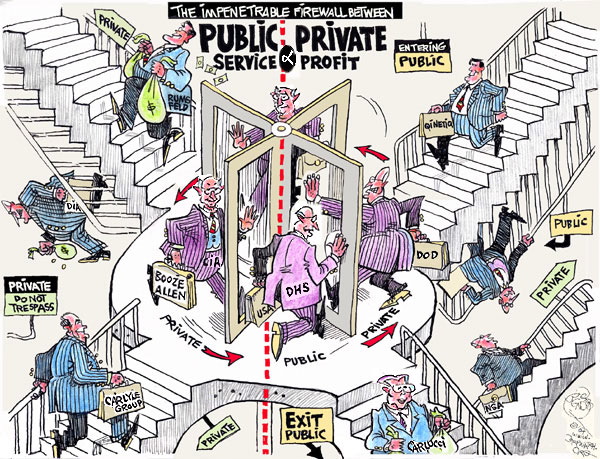
Revolving-Door

The administrative state is costly in many ways. It not only creates obstacles to economic growth. In promulgating and complying with its dictates, it absorbs vast amounts of resources within both the public and the private sectors. It also provides an avenue through which private elites can curry favor via lucrative contracts and favorable regulatory treatment, often gaining competitive advantages and even monopoly status. The opportunities for graft are legion, of course. The infamous revolving door in and out of government service reinforces the rent seeking potential afforded by this “fourth branch” of government. It is a prime example of the dangers of being governed by men rather than laws. Bureaucrats seem to become self-empowered to make wide-ranging and arbitrary decisions regarding matters not anticipated by any enabling legislation.

In “Bled Dry By The New Class,” Glenn Reynolds offers some insightful remarks regarding the sociological phenomenon that is the administrative state. He provides a telling quote from a frustrated Greek entrepreneur, which should be taken as a warning for us: “I, like thousands of others trying to start businesses, learned that I would be at the mercy of public employees who interpreted the laws so they could profit themselves.”

Pro-Business or Pro-Market?

10 Thursday Apr 2014

Posted by Nuetzel in Uncategorized

≈ Leave a comment

Tags

Corporatism, Free Market, Jonah Goldberg, rent seeking

Image

There is a big difference. The GOP can’t have it both ways anymore. The Grand Old Party would be ever so much grander if they’d shutter the rents dispensary (well, and a few other roles they favor for big government). Dolling out favors to politically-connected business elites really douses my libertarian lamp. That includes bailouts and escapades into regulation that only business behemoths can withstand.

Playing Favorites?

13 Thursday Mar 2014

Posted by Nuetzel in Uncategorized

≈ Leave a comment

Tags

bailout, crony capitalism, rent seeking

Image

The consequences of government bailouts may include efforts to assist management via “friendly” regulation. In this case, that process was encouraged by politicians seeking to make hay over their bailout heroics, and one competitor may have been harmed by regulators as well. The GM bailout was unnecessary. The assets could have been sold at a discount sufficient to make continued operation profitable. Did the Obama White House Protect GM?

Newer posts →
Follow Sacred Cow Chips on WordPress.com

Recent Posts

  • The Case Against Interest On Reserves
  • Immigration and Merit As Fiscal Propositions
  • Tariff “Dividend” From An Indigent State
  • Almost Looks Like the Fed Has a 3% Inflation Target
  • Government Malpractice Breeds Health Care Havoc

Archives

  • January 2026
  • December 2025
  • November 2025
  • October 2025
  • September 2025
  • August 2025
  • July 2025
  • June 2025
  • May 2025
  • April 2025
  • March 2025
  • February 2025
  • January 2025
  • December 2024
  • November 2024
  • October 2024
  • September 2024
  • August 2024
  • July 2024
  • June 2024
  • May 2024
  • April 2024
  • March 2024
  • February 2024
  • January 2024
  • December 2023
  • November 2023
  • August 2023
  • July 2023
  • June 2023
  • May 2023
  • April 2023
  • March 2023
  • February 2023
  • January 2023
  • December 2022
  • November 2022
  • October 2022
  • September 2022
  • August 2022
  • July 2022
  • June 2022
  • May 2022
  • April 2022
  • March 2022
  • February 2022
  • January 2022
  • December 2021
  • November 2021
  • October 2021
  • September 2021
  • August 2021
  • July 2021
  • June 2021
  • May 2021
  • April 2021
  • March 2021
  • February 2021
  • January 2021
  • December 2020
  • November 2020
  • October 2020
  • September 2020
  • August 2020
  • July 2020
  • June 2020
  • May 2020
  • April 2020
  • March 2020
  • February 2020
  • January 2020
  • December 2019
  • November 2019
  • October 2019
  • September 2019
  • August 2019
  • July 2019
  • June 2019
  • May 2019
  • April 2019
  • March 2019
  • February 2019
  • January 2019
  • December 2018
  • November 2018
  • October 2018
  • September 2018
  • August 2018
  • July 2018
  • June 2018
  • May 2018
  • April 2018
  • March 2018
  • February 2018
  • January 2018
  • December 2017
  • November 2017
  • October 2017
  • September 2017
  • August 2017
  • July 2017
  • June 2017
  • May 2017
  • April 2017
  • March 2017
  • February 2017
  • January 2017
  • December 2016
  • November 2016
  • October 2016
  • September 2016
  • August 2016
  • July 2016
  • June 2016
  • May 2016
  • April 2016
  • March 2016
  • February 2016
  • January 2016
  • December 2015
  • November 2015
  • October 2015
  • September 2015
  • August 2015
  • July 2015
  • June 2015
  • May 2015
  • April 2015
  • March 2015
  • February 2015
  • January 2015
  • December 2014
  • November 2014
  • October 2014
  • September 2014
  • August 2014
  • July 2014
  • June 2014
  • May 2014
  • April 2014
  • March 2014

Blogs I Follow

  • Passive Income Kickstart
  • OnlyFinance.net
  • TLC Cholesterol
  • Nintil
  • kendunning.net
  • DCWhispers.com
  • Hoong-Wai in the UK
  • Marginal REVOLUTION
  • Stlouis
  • Watts Up With That?
  • Aussie Nationalist Blog
  • American Elephants
  • The View from Alexandria
  • The Gymnasium
  • A Force for Good
  • Notes On Liberty
  • troymo
  • SUNDAY BLOG Stephanie Sievers
  • Miss Lou Acquiring Lore
  • Your Well Wisher Program
  • Objectivism In Depth
  • RobotEnomics
  • Orderstatistic
  • Paradigm Library
  • Scattered Showers and Quicksand

Blog at WordPress.com.

Passive Income Kickstart

OnlyFinance.net

TLC Cholesterol

Nintil

To estimate, compare, distinguish, discuss, and trace to its principal sources everything

kendunning.net

The Future is Ours to Create

DCWhispers.com

Hoong-Wai in the UK

A Commonwealth immigrant's perspective on the UK's public arena.

Marginal REVOLUTION

Small Steps Toward A Much Better World

Stlouis

Watts Up With That?

The world's most viewed site on global warming and climate change

Aussie Nationalist Blog

Commentary from a Paleoconservative and Nationalist perspective

American Elephants

Defending Life, Liberty and the Pursuit of Happiness

The View from Alexandria

In advanced civilizations the period loosely called Alexandrian is usually associated with flexible morals, perfunctory religion, populist standards and cosmopolitan tastes, feminism, exotic cults, and the rapid turnover of high and low fads---in short, a falling away (which is all that decadence means) from the strictness of traditional rules, embodied in character and inforced from within. -- Jacques Barzun

The Gymnasium

A place for reason, politics, economics, and faith steeped in the classical liberal tradition

A Force for Good

How economics, morality, and markets combine

Notes On Liberty

Spontaneous thoughts on a humble creed

troymo

SUNDAY BLOG Stephanie Sievers

Escaping the everyday life with photographs from my travels

Miss Lou Acquiring Lore

Gallery of Life...

Your Well Wisher Program

Attempt to solve commonly known problems…

Objectivism In Depth

Exploring Ayn Rand's revolutionary philosophy.

RobotEnomics

(A)n (I)ntelligent Future

Orderstatistic

Economics, chess and anything else on my mind.

Paradigm Library

OODA Looping

Scattered Showers and Quicksand

Musings on science, investing, finance, economics, politics, and probably fly fishing.

  • Subscribe Subscribed
    • Sacred Cow Chips
    • Join 128 other subscribers
    • Already have a WordPress.com account? Log in now.
    • Sacred Cow Chips
    • Subscribe Subscribed
    • Sign up
    • Log in
    • Report this content
    • View site in Reader
    • Manage subscriptions
    • Collapse this bar
 

Loading Comments...