• About

Sacred Cow Chips

Sacred Cow Chips

Tag Archives: Student Loan Forgiveness

Big Spending, Explosive Debt, and the Inflation Tax

07 Tuesday May 2024

Posted by Nuetzel in Deficits, Fiscal policy, Inflation

≈ Leave a comment

Tags

American Rescue Plan, CBO, Child Tax Credit, CHIPS Act, Debt to GDP, Discretionary Spending, Donald Trump, Emergency Spending, entitlements, Eric Boehm, Inflation Premium, Inflation tax, Infrastructure Investment and Jobs Act, Joe Biden, John Cochrane, Medicare, OMB, Promise to Address Comprehensive Toxics Act, Social Security, Soft Default, Student Loan Forgiveness, Supreme Court, Treasury Debt
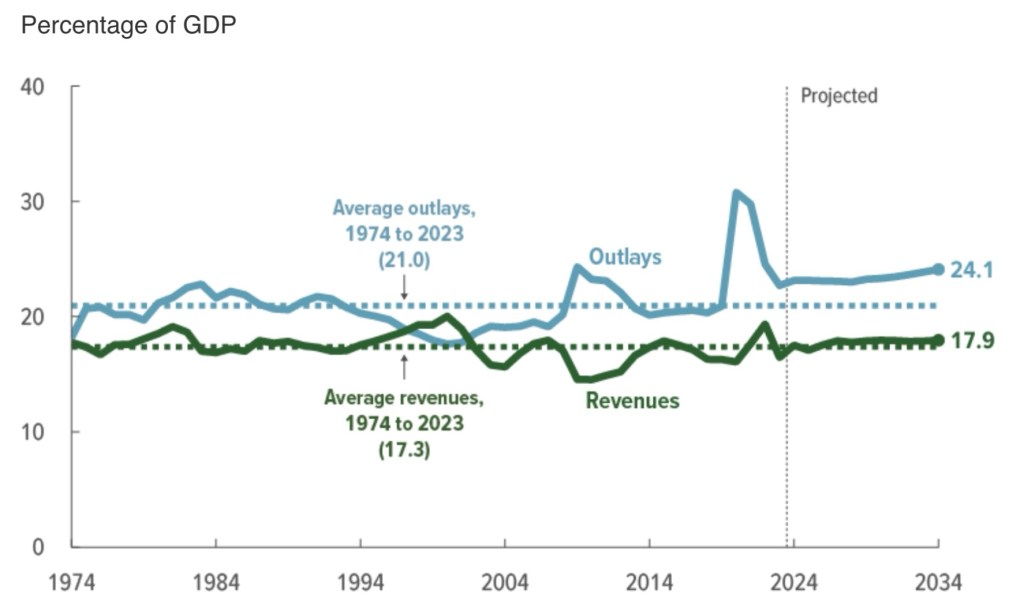
The chart above makes a convincing case that we have a spending problem at the federal level. Really, we’ve had a spending problem for a long time. But at least tax revenue today remains reasonably well-aligned with its 50-year historical average as a share of GDP. Not spending. Even larger deficits opened up during the pandemic and they haven’t returned to pre-pandemic levels.

We’ve seen Joe Biden break spending records. His initiatives, often with questionable merit, have included the $1.8 trillion American Rescue Plan and the nearly $0.8 trillion Infrastructure Investment and Jobs Act, along with several other significant spending initiatives such as the Promise to Address Comprehensive Toxics Act and the subsidy-laden CHIPS Act. Meanwhile, emergency spending has become a regular occurrence on Biden’s watch. More recently, he’s made repeated efforts to forgive massive amounts of student loans despite the Supreme Court’s clear ruling that such gifts are unconstitutional.

Indeed, while Biden keeps pretty busy spinning tales of his days driving an 18-wheeler, cannibals devouring his Uncle Bosie Finnegan, his upbringing in black churches, synagogues, or in the Puerto Rican community, he still finds time to dream up ways for the government to spend money it doesn’t have. Or his kindly puppeteers do.

Biden’s New Budget

Eric Boehm expressed wonderment at Biden’s fiscal 2025 budget not long after its release in March. He was also mystified by the gall it took to produce a “fact sheet” in which the White House congratulated itself on fiscal responsibility. That’s how this Administration characterizes deficits projected at $16 trillion over the next ten years. No joke!

Furthermore, the Administration says the record spending will be “paid for”. Well, yes, with tax increases and lots of borrowing! There are a great many fabulist claims made by the White House about the budget. This link from the Office of Management and Budget includes a handy list of propaganda sheets they’ve managed to produce on the virtues of their proposal.

The Congressional Budget Office (CBO) projects ten-year deficits under current law that are $3 trillion higher than Biden’s proposed budget. That’s the basis of the White House’s boast of fiscal restraint. But the difference is basically paid for with a couple of accounting tricks (see below). More charitably, one could say it’s paid for with higher taxes, aided by the assumption of slightly faster economic growth. The latter will be a good trick while undercutting incentives and wages with a big boost to the corporate tax rate.

The revenue projected by the While House from those taxes does not come anywhere close to eliminating the gap shown in the CBO’s chart above. Federal spending under Biden’s budget grows at about 4% annually, just a bit slower than nominal GDP. Thus, the federal share of GDP remains roughly constant and only slightly higher than the CBO’s current projection for 2034. Nevertheless, spending relative to GDP would continue at an historically high rate. Over the next decade, it would average more than 3% higher than its 50-year average. That would be about $1.3 trillion in 2034!

Meanwhile, the ratio of tax revenue to GDP under Biden’s proposal, as they project it, would average slightly higher than its 50-year average, reaching a full percentage point above by 2034 (and higher than the CBO baseline). That’s probably optimistic.

There is little real effort in this budget to reduce federal deficits, with Treasury borrowing rates now near 15-year highs. Interest expense has grown to an alarming share of spending. In fact, it’s expected to exceed spending on defense in 2024! Perhaps not coincidentally, the White House assumes a greater decline in interest rates than CBO over the next 10 years.

Treats or Tricks?

The situation is likely worse than the White House depicts, given that its budget incorporates assumptions that look generous to their claim of fiscal restraint. First, they frontload nondefense discretionary spending, allowing Biden to make extravagant promises for the near-term while pushing off steep declines in budget commitments to the out-years. The sharp reductions in this category of spending pares more than $2 trillion from the 10-year deficit. From the link above:
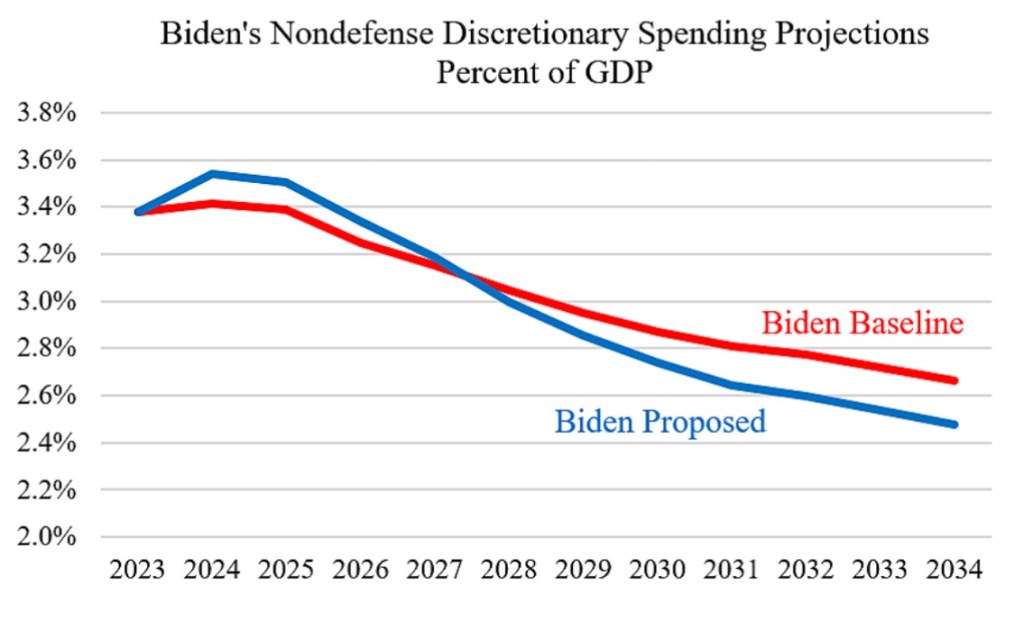
Biden also proposes to restore the expanded the child tax credit — for one year! How handy from a budget perspective: heroically call for an expanded credit (for a year) while avoiding, for the time being, the addition of a couple of trillion to the 10-year deficit.

Code Red

So where does this end? The ratio of federal debt to GDP will resume its ascent after a slight decline from the pandemic high. Here is the CBO’s projection:
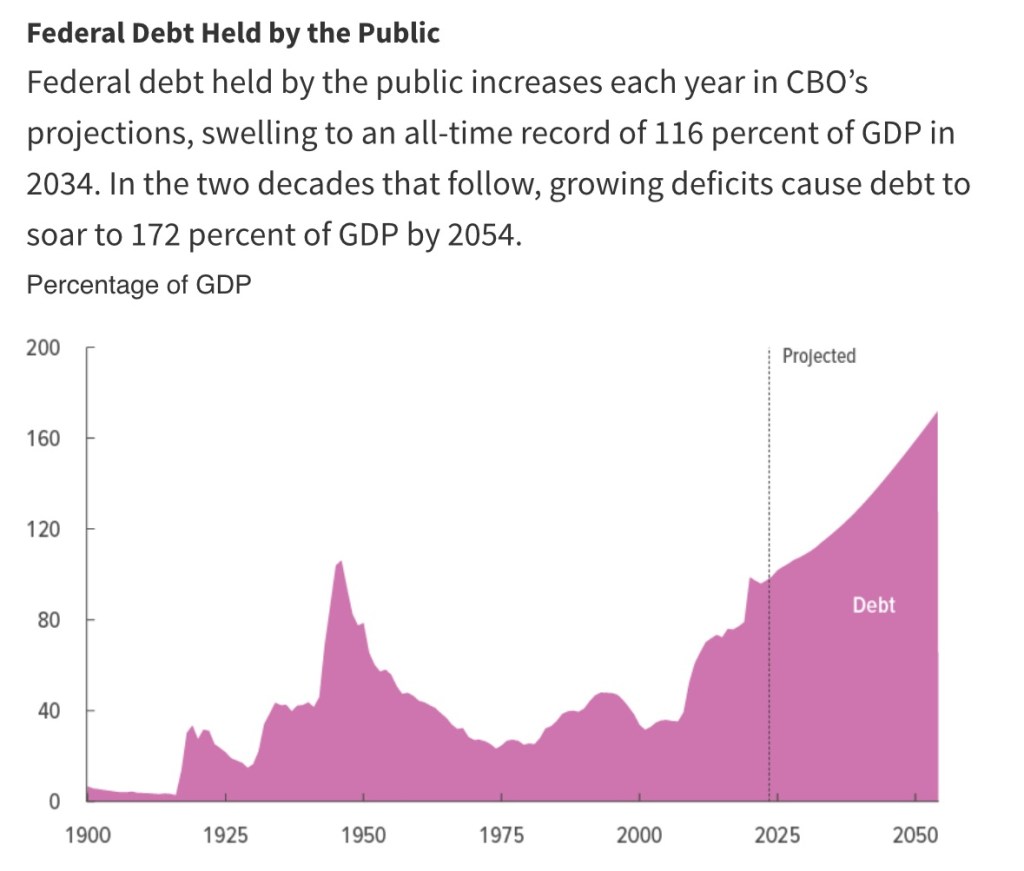
The Biden budget shows a relatively stable debt to GDP ratio through 2034 due to the assumptions of slightly faster GDP growth, lower Treasury borrowing rates, and the aforementioned “fiscal restraint”. But don’t count on it!

The government’s growing dominance over real resources will have negative consequences for growth in the long-term. Purely as a fiscal matter, however, it must be paid for in one of three ways: revenue from explicit taxes, federal borrowing, or an implicit tax on the public more commonly known as the inflation tax. The last two are intimately related.

Bond investors always face at least a small measure of default risk even when lending to the U.S. Treasury. There is almost no chance the government would ever default outright by failing to pay interest or principal when due. However, investors hold an expectation that the value of their bonds will erode in real terms due to inflation. To compensate, they demand an “inflation premium” in the interest rate they earn on Treasury bonds. But an upside surprise to inflation would constitute a “soft default” on the real value of their bonds. This occurred during and after the pandemic, and it was triggered by a burgeoning federal deficit.

Brief Mechanics

John Cochrane has explained the mechanism by which acts of fiscal profligacy can be transmitted to the price of goods. The real value of outstanding federal debt cannot exceed the expected real value of future surpluses (a present value summed across positive and negative surpluses). If expected surpluses are reduced via some emergency or shock such that repayment in real terms is less likely, then the real value of government debt must fall. That means either interest rates or the price level must rise, or some combination of the two.

The Federal Reserve can prevent interest rates from rising (by purchasing bonds and increasing the money supply), but that leaves a higher price level as the only way the real value of debt can come into line. In other words, an unexpected increase in the path of federal deficits would be financed by money printing and an inflation tax. The incidence of this unexpected “implicit” tax falls not only to bondholders, but also on the public at large, who suffer an unexpected decline in the purchasing power of their nominal assets and incomes. This in turn tends to free-up real resources for government absorption.

Government Debt Is Risky

It appears that investors expect the future deficits now projected by the CBO (and the White House) to be paid down someday, to some extent, by future surpluses. That might seem preposterous, but markets apparently aren’t surprised by the projected deficits. After all, fiscal policy decisions can change tremendously over the course of a few years. But it still feels like excessive optimism. Whatever the case, Cochrane cautions that the next fiscal emergency, be it a new pandemic, a war, a recession, or some other crisis, is likely to create another huge expansion in debt and a substantial increase price level. Joe Biden doesn’t seem inclined to put us in a position to deal with that risk very effectively. Unfortunately, it’s not clear that Donald Trump will either. And neither seems inclined to seriously address the insolvencies of Social Security and Medicare. If unaddressed, those mandatory obligations will become real crises over the next decade.

Anatomy of a Scam on Taxpayers: Biden Plumps Up IDRs

29 Monday Aug 2022

Posted by Nuetzel in Federal Budget, rent seeking, Student Loans

≈ Leave a comment

Tags

Alex Tabarrok, Biden Student Loan Plan, IDRs, Income Driven Repayments, Legal Standing, Loan Repayment Assistance Programs, LRAPs, Matt Bruenig, Penn-Wharton Budget Model, Public Service Loan Forgiveness, Student Loan Forgiveness

In my last post I discussed the difficulty faced by potential challengers to President Biden’s student loan forgiveness program in establishing legal standing in court. I also mentioned an estimate of the cost of the plan to taxpayers of around $600 billion over ten years. That was from the Penn-Wharton Budget Model, but now the model’s estimate ranges to more than $1 trillion! The difference is a reassessment of the changes to increasingly popular income-driven repayment (IDR) plans and uncertainty around behavioral assumptions like plan uptake over the ten-year budget window. The changes to IDRs are separate from the $10,000 – $20,000 short-term loan forgiveness component of Biden’s plan, and they are a perfect basis for a legal scam on taxpayers.

IDRs are not new. Under these plans, a borrower pays 10% of their income toward the outstanding balance of their student loans for a period of 10 to 20 years, depending on the plan, after which any remaining balance is forgiven. This may or may not make sense for borrowers with high student loan payments relative to income. In fact, there are some who warn that IDRs are a ripoff. However, only income above 150% of the poverty line is subject to IDR payments. For some students borrowing heavily, IDRs can make tuition hikes irrelevant beyond a certain loan balance: just borrow it! Living expenses can be borrowed as well! These plans almost completely eliminate price sensitivity among consumers of college educations, and it may make sense for certain students to borrow as much as possible. It’s also a prescription for escalating tuition.

Law graduates who work in the public sector have long received favorable treatment via IDRs: they pay 10% of their discretionary income for only 10 years. The so-called Public Service Loan Forgiveness (PSLF) program is leveraged by law schools, which offer deals for students called Loan Repayment Assistance Programs (LRAP). For an explanation, I’ll defer to Matt Bruenig and his interesting post on the topic (with hat tip to Alex Tabarrok):

“The LRAP schemes work as follows:

  1. The school increases their tuition.
  2. The student takes out federal loans to cover the tuition increase.
  3. The school squirrels away the debt-financed tuition increase into an LRAP fund.
  4. The school disburses money from the LRAP fund to cover PSLF repayments.

Through this roundabout process, the law schools effectively use student debt to pay off student debt and make their schools free or nearly free, at least for these particular students.”

The school knows the student’s debt payments are limited by income. Tuition hikes can be paid with additional loans, and the LRAPs future obligations are limited by the student’s income after graduation. Not only is the tuition hike “free” to the student, but the school might be able to pocket a share of the new loan and invest the whole nut for returns in the interim. That’s the gist of Tabarrok’s simple example. Needless to say, IDRs and PSLF create some very bad incentives! Farewell to cost control!

Biden’s plan extends IDRs in ways that make them far more attractive to students, including undergraduates. Here are the changes, again from Bruenig:

“The IDR changes are four-fold:

  1. Increase the amount of income not subject to IDR from 150 percent of the federal poverty line to 225 percent of the federal poverty line.
  2. Eliminate any accrual of interest on IDR-enrolled loans.
  3. For undergraduate debt, reduce the IDR rate from 10 percent of income beyond the threshold in (1) to 5 percent of income beyond the threshold in (1).
  4. For IDR-enrolled debts with original loan balances below $12,000, reduce the repayment period from 20 years to 10 years.”

Smaller payments and zero interest! This is what led to Penn-Wharton’s revision in the high-side cost estimates of Biden’s student loan forgiveness plan:

“‘Depending on future details of the actual IDR program and concomitant behavioral changes, the IDR program could add another $450 billion or more,’ the analysis found. ‘Thereby raising total plan costs to over $1 trillion.’”

The incentives are for schools to offer LRAPs more broadly, and to abuse them. Rent-seeking vendors have lined up to design and manage these programs. Students and even parents are encouraged to borrow up to the maximum limits, which conceivably allows the loan proceeds to be used outside of the ostensible educational purpose of the loan, potentially for investment gains. See Tabarrok’s post for some links to creative schemes to which part of the loan proceeds might be put by borrowers.

This is a huge scam! It’s hard to square the Administration’s action with any effort to apply economic logic to program design. But that’s not really the point of the student loan forgiveness program. Instead, it’s designed to warm the hearts of Biden’s political base among students and young college graduates. And it will further enrich the heavily endowed universities that can be counted upon to inculcate students with leftist dogma. Apparently, the rest of us, who lack standing to formally challenge these schemes, can just suck it.

Harms Dismissed In “Standing Dead Zone” of Executive Action

26 Friday Aug 2022

Posted by Nuetzel in Checks and Balances, Executive Authority, Student Loans

≈ Leave a comment

Tags

Antonin Scalia, CDC, Department of Education, Executive Action, Federal Reserve, HEROES Act, Higher Education Act, Inflation Reduction Act, Jack V. Hoover, Joe Biden, Legal Standing, Lujan v. Defenders of Wildlife, Pandemic, Paycheck Protection Program, regressivity, Remain in Mexico, Standing Dead Zone, Student Loan Forgiveness, Supreme Court, Virginia Law Review

I hate to contribute to the deluge of ink spilled over Joe Biden’s latest executive action, which forgives massive amounts of federal student loan debt, but there’s an angle that hasn’t received adequate treatment. Of course, Biden’s action is an abridgment of taxpayer rights, a violation of the separation of powers, and an affront to borrowers who already paid off their student loans, but it will be nearly impossible for any challenger(s) to show that they have standing in court. Writing in the Virginia Law Review earlier this year, Jack V. Hoover says this kind of action lies within what he calls a “standing dead zone” created by the courts.

I’ll start with a few preliminaries. Note that student loan forgiveness was NOT legislated, unlike the Paycheck Protection Program, which the Administration keeps referencing in defense of the action. And I’d be remiss if I failed to mention that Biden’s action looks like a pathetic attempt to salvage votes ahead of what some democrats fear could be a disastrous midterm election. In addition, the action is regressive, with benefits weighted heavily toward high-income debtors with graduate degrees. The cost (write down, loss) to the federal government was originally said to be near $300 billion, depending on uptake, but independent estimates now put the full cost at $600 billion. This wipes out the hoped-for deficit reduction in the ridiculous but much ballyhooed “Inflation Reduction Act”, and yes, student loan forgiveness may well be inflationary. At a minimum, it makes the Fed’s job of restraining inflation by tamping down demand that much harder. Loan forgiveness will not solve the underlying problem of runaway cost escalation in higher education. In fact, it will exacerbate the problem by encouraging non-payment and additional borrowing, while tuition to colleges and universities will escalate all the more. So this is really bad policy all the way around!

Biden’s action is clearly a huge stretch on statutory grounds. In particular, the Administration invoked the HEROES Act, which authorizes the Secretary of Education to waive loan requirements during periods of national emergency. In this case, the Administration appeals to hardships caused by the pandemic for individuals with student debt. Of course, just two weeks ago, the CDC rolled back their emergency pandemic guidelines on social distancing and quarantines, so the “emergency” seems to be over, officially. Also, the Administration recently ended the “return to Mexico” policy at the border on the pretext that it had only been necessary because of the pandemic! Pardon my incredulity, but playing the “pandemic card” at this point is both dishonest and hypocritical.

“Standing” in the legal sense can’t be found in the text of the Constitution. It was itself created by the courts. Even so, why do taxpayers, Congress, or past borrowers lack standing to challenge the action on student loans through the judicial system? How can that be when the harms are so obvious? Well, courts tend to avoid interfering with the executive branch, and they’d rather leave such disputes up to the political system to hash out. That doesn’t seem like a terribly effective way to practice the game of “checks and balances”. Nevertheless, for many years the courts have relied on a strict test for establishing plaintiff standing promulgated in the Supreme Court decision in Lujan v. Defenders of Wildlife. In that majority opinion, Justice Antonin Scalia laid out a three-part test, which Hoover describes thusly:

“… (1) injury in fact that is actual, concrete, and particularized; (2) a causal connection between the injury and the conduct complained of; and (3) a likelihood that exercise of judicial power will redress the injury.28 The Court furthermore differentiated between cases in which government regulation targets the plaintiff and cases where the plaintiff complains about ‘unlawful regulation (or lack of regulation) of someone else,’ in which case “much more is needed” for standing to exist.29 The Court has regularly reaffirmed this formulation of its standing requirements.3”

Hoover discusses the executive’s authority to cancel debt under the Higher Education Act (HEA) of 1965. In terms of the impregnability of Biden’s action to legal challenge, Hoover implies that the president might just as well have fallen back on HEA as HEROES. However, the Department of Education (DOE) opined last year that it lacked the power to forgive debt. Here’s what the DOE said in 2021:

“… the Secretary does not have statutory authority to provide blanket or mass cancellation, compromise, discharge, or forgiveness of student loan principal balances, and/or materially modify the repayment amounts or terms thereof, whether due to the COVID-19 pandemic or for any other reason.”

Hoover seems to be saying that it is all but impossible to challenge Biden’s bald assertion of extra-legal power in forgiving student loans. Hoover goes on to discuss all classes of potential litigants who might challenge student loan forgiveness: taxpayers, former borrowers, Congress, state governments, and loan servicers. He is skeptical of all those, citing various reasons for their lack of standing, but I’ll focus on only the first three classes.

Taxpayers: The logic of denying taxpayers standing is at least two-fold. First, taxpayers cannot show direct harm from the action, though they are likely to pay a higher inflation tax over time as a consequence. Second, Congress appropriated funds for student loans, but it did so as an entitlement, and it did not restrict loan amounts nor the executive’s ability to waive “the government’s claim that borrowers must return the funds to the Treasury”. Hoover believes that the courts would defer to the political branches of government in settling such issues. The whole thing sounds rather thin to my ears, but precedent will probably hold sway unless the Supreme Court revisits its position on standing.

Congress: The standing of Congress is another matter. If, in the view of the legislature, an executive agency has exceeded its statutory authority, the matter might reflect as much on Congress as elsewhere, in failing to provide adequate limitations, guideposts, or oversight. However, in this case:,

“Congress duly appropriated funds for student loans,83 and the Executive is responsible for the funding’s disbursement. This means that any claim of standing due to institutional injury from compromising Congress’s control of the federal purse would fail.”

Here again, it will be left to settle by the political branches of government. To avoid such conflicts, it is up to the legislature to write laws that bind the discretion of the executive to varying degrees. Unrestrained entitlements are a damn good way to cede control of the “keys to the Treasury”.

Other borrowers who’ve managed their student loan debt responsibly will also lack standing, according to Hoover. Like taxpayers, they cannot show any direct harm or injury. In addition, standing is difficult to establish when an action or inaction by an executive agency pertains to someone else.

It’s my hope that a court challenge will be brought all the way to the Supreme Court, and at some level a court will define a new standard or test under which plaintiffs can attempt to establish standing against executive or agency actions. This is sorely needed as a check on the explosive growth of the administrative state. Furthermore, the “standing dead zone” allows all sorts of politically-motivated mischief by the executive branch, and the Biden Administration seems more than willing to push executive authority to extremes. However, I’m not too optimistic about the possibility of a new test for standing. Before all is said and done, Biden is likely to expand student loan forgiveness well beyond $20,000 per borrower. Federal finance is looking more precarious with Biden’s every step, and many of those steps cannot be walked back by Congress, no matter who holds the majority.

Social Insurance, Trust Fund Runoff, and Federal Debt

28 Thursday Apr 2022

Posted by Nuetzel in Deficits, Social Security

≈ 1 Comment

Tags

Anti-Deficiency Act, Charles Blahous, Deficits, DI, Disability Income, Discretionary Budget, entitlements, Federal Reserve, Fiscal Inflation, Fiscal Tiger, Hospitalization Insurance, Joe Biden, Mandatory Spending, Medicaid, Medicare Part A, Medicare Part B, Medicare Part D, Medicare Reform, Medicare Trust Fund, Monetization, OASI, Old Age and Survivorship Income, Pay-As-You-Go, payroll taxes, SMI, Social Security Reform, Social Security Trust Fund, Student Loan Forgiveness, Supplementary Medical Insurance

The Social Security and Medicare trust funds are starting to shrink, but as they shrink something else expands in tandem, roughly dollar-for-dollar: government debt. There is a widespread misconceptions about these entitlement programs and their trust funds. Many seem to think the trust funds are like “pots of gold” that will allow the government to meet its mandatory obligations to beneficiaries. But, in fact, the government will have to borrow the exact amounts of any “assets” that are “cashed out” of the trust funds, barring other reforms or legislative solutions. So how does that work? And why did I put the words “assets” and “cashed out” in quote marks?

The Trust Funds

First, I should note that there are two Social Security trust funds: one for old age and survivorship income (OASI) and one for disability income (DI). Occasionally, for summary purposes, the accounts for these funds are combined in presentations. There are also two Medicare trust funds: one for hospitalization insurance (HI – Part A) and one for Supplementary Medical Insurance (SMI – Parts B and D). The first three of these trust funds are represented in the chart at the top of this post, which is from the Summary of the 2021 Annual Reports by the Boards of Trustees. It plots a measure of financial adequacy: the ratio of trust fund assets at the start of each year to the annual cost. The funds are all projected to be depleted, HI and OASI much sooner than DI.

Fund Accumulation

The first step in understanding the trust funds requires a clearing up of another misconception: the payroll taxes that workers “contribute” to these systems are not invested specifically for each of those workers. These programs are strictly “pay-as-you-go”, meaning that the payroll taxes (and premiums in the case of Medicare) paid this year by you and/or your employer are generally distributed directly to current beneficiaries.

Back when demographics of the American population were more favorable for these programs, with a larger number of workers relative to retirees, payroll taxes (and premiums) exceeded benefits. The excess was essentially loaned by these programs to the U.S. Treasury to cover other forms of spending. So the trust funds accumulated U.S. Treasury IOUs for many years, and the Treasury pays interest to the trust funds on that debt. On the upside, that meant the Treasury had to borrow less from the public to cover its deficits during those years. So the government spent the excess payroll tax proceeds and wrote IOUs to the trust funds.

Draining the Funds

The demographic profile of the population is no longer favorable to these entitlement programs. The number of retirees has increased so that benefit levels have grown more quickly than program revenue. Benefits now exceed the payroll taxes and premiums collected, so the trust funds must be drawn down. Current estimates are that the Social Security Trust Fund will be depleted in 2034, while the Medicare Trust Fund will last only to 2026. These dates are reflected in the chart above. It is the mechanics of these draw-downs that get to the heart of the first “pot of gold” misconception cited above.

To pay for the excess of benefits over revenue collected, the trust funds must cash-in the IOUs issued to them by the Treasury. And where does the Treasury get the cash? It will almost certainly be borrowed from the public, but the government could hike other forms of taxes or reduce other forms of spending. So, while the earlier accumulation of trust fund assets meant less federal borrowing, the divestment of those assets generally means more federal borrowing and growth in federal debt held by the public.

Given these facts, can you spot the misconception in this quote from Fiscal Tiger? It’s easy to miss:

“In the cases of Social Security, Medicare, and Medicaid, payroll taxes provide some revenue. Social Security also has trust funds that cover some of the program costs. However, when the government is short on funds for these programs after getting the revenue from taxes and trust funds, it must borrow money, which contributes to the deficit.”

This kind of statement is all too common. The fact is the government has to borrow in order to pay off the IOUs as the trust funds are drawn down, roughly dollar-for-dollar.

A second mistake in the quote above is that federal borrowing to pay excess benefits after the trust funds are fully depleted is not really assured. At that time, the Anti-deficiency Act prohibits further payments of benefits in excess of payroll taxes (and premiums), and there is no authority allowing the trust funds to borrow from the general fund of the Treasury. Either benefits must be reduced, payroll taxes increased, premiums hiked (for Medicare), or more radical reforms will be necessary, any of which would require congressional action. In the case of Social Security (combining OASI and DI), the projected growth of “excess benefits” is such that the future, cumulative shortfall represents 25% of projected benefits!

Again, the mandatory entitlement spending programs are technically insolvent. Charles Blahous discusses the implications of closing the funding gap, both in terms of payroll tax increases or benefit cuts, either of which will be extremely unpopular:

“How likely is it that lawmakers would immediately cut benefits by 25% for everyone, rich and poor, retiring next year and beyond? More likely, lawmakers would phase in reforms gradually, necessitating much larger eventual benefit changes for those affected—perhaps 30% or 40%. And if we want to spare lower-income individuals from reductions, they’d need to be still greater for everyone else.”

It should be noted that Medicaid is also a budget drain, though the cost is shared with state governments.

Discretionary vs. Mandatory Budgets

When it comes to federal budget controversies, discretionary budget proposals receive most of the focus. The federal deficit reached unprecedented levels in 2020 and 2021 as pandemic support measures led to huge increases in spending. Even this year (2022), the projected deficit exceeds the 2019 level by over $160 billion. Joe Biden would like to spend much more, of course, though the loss of proceeds from his student loan forgiveness giveaway does not even appear in the Administration’s budget proposal. Biden proposes to pay for the spending with a corporate tax hike and a minimum tax on very high earners, including an unprecedented tax on unrealized capital gains. Those measures would be disappointing in terms of revenue collection, and they are probably worse for the economy and society than bigger deficits. None of that is likely to pass Congress, but we’ll still be running huge deficits indefinitely..

In a further complication, at this point no one really believes that the federal government will ever pay off the mounting public debt. More likely is that the Federal Reserve will make further waves of monetization, buying government bonds in exchange for monetary assets. (Of course, money is also government debt.) The conviction that ever increasing debt levels are permanent is what leads to fiscal inflation, which taxes the public by devaluing the public debt, including (or especially) monetary assets. The insolvency of the trust funds is contributing to this process and its impact is growing..

Again, the budget discussions we typically hear involve discretionary components of the federal budget. Mandatory outlays like Social Security, Medicare, and Medicaid are nearly three times larger. Here is a good primer on the mandatory spending components of the federal budget (which includes interest costs). Blahous notes elsewhere that the funding shortfall in these programs will ultimately dwarf discretionary sources of budgetary imbalance. The deficit will come to be dominated by the borrowing required to fund mandatory programs, along with the burgeoning cost of interest payments on the public debt, which could reach nearly 50% of federal revenues by 2050.

Conclusion

It would be less painful to address these funding shortfalls in mandatory programs immediately than to continue to ignore them. That would enable a more gradual approach to changes in benefits, payroll taxes, and premiums. Politicians would rather not discuss it, however. Any discussion of reforms will be controversial, but it’s only going to get worse over time.

Political incentives being what they are, current workers (future claimants) are likely to bear the brunt of any benefit cuts, rather than retirees already enrolled. Payroll tax hikes are perhaps a harder sell because they are more immediate than trimming benefits for future retirees. Other reforms like self-directed Social Security contributions would create better tradeoffs by allowing investment of contributions at competitive (but more risky) returns. Medicare has premiums as an extra lever, but there are other possible reforms.

Again, the time to act is now, but don’t expect it to happen until the crisis is upon us. By then, our opportunities will have become more hemmed in, and something bad is more likely to be promulgated in the rush to save the day.

Follow Sacred Cow Chips on WordPress.com

Recent Posts

  • The Case Against Interest On Reserves
  • Immigration and Merit As Fiscal Propositions
  • Tariff “Dividend” From An Indigent State
  • Almost Looks Like the Fed Has a 3% Inflation Target
  • Government Malpractice Breeds Health Care Havoc

Archives

  • January 2026
  • December 2025
  • November 2025
  • October 2025
  • September 2025
  • August 2025
  • July 2025
  • June 2025
  • May 2025
  • April 2025
  • March 2025
  • February 2025
  • January 2025
  • December 2024
  • November 2024
  • October 2024
  • September 2024
  • August 2024
  • July 2024
  • June 2024
  • May 2024
  • April 2024
  • March 2024
  • February 2024
  • January 2024
  • December 2023
  • November 2023
  • August 2023
  • July 2023
  • June 2023
  • May 2023
  • April 2023
  • March 2023
  • February 2023
  • January 2023
  • December 2022
  • November 2022
  • October 2022
  • September 2022
  • August 2022
  • July 2022
  • June 2022
  • May 2022
  • April 2022
  • March 2022
  • February 2022
  • January 2022
  • December 2021
  • November 2021
  • October 2021
  • September 2021
  • August 2021
  • July 2021
  • June 2021
  • May 2021
  • April 2021
  • March 2021
  • February 2021
  • January 2021
  • December 2020
  • November 2020
  • October 2020
  • September 2020
  • August 2020
  • July 2020
  • June 2020
  • May 2020
  • April 2020
  • March 2020
  • February 2020
  • January 2020
  • December 2019
  • November 2019
  • October 2019
  • September 2019
  • August 2019
  • July 2019
  • June 2019
  • May 2019
  • April 2019
  • March 2019
  • February 2019
  • January 2019
  • December 2018
  • November 2018
  • October 2018
  • September 2018
  • August 2018
  • July 2018
  • June 2018
  • May 2018
  • April 2018
  • March 2018
  • February 2018
  • January 2018
  • December 2017
  • November 2017
  • October 2017
  • September 2017
  • August 2017
  • July 2017
  • June 2017
  • May 2017
  • April 2017
  • March 2017
  • February 2017
  • January 2017
  • December 2016
  • November 2016
  • October 2016
  • September 2016
  • August 2016
  • July 2016
  • June 2016
  • May 2016
  • April 2016
  • March 2016
  • February 2016
  • January 2016
  • December 2015
  • November 2015
  • October 2015
  • September 2015
  • August 2015
  • July 2015
  • June 2015
  • May 2015
  • April 2015
  • March 2015
  • February 2015
  • January 2015
  • December 2014
  • November 2014
  • October 2014
  • September 2014
  • August 2014
  • July 2014
  • June 2014
  • May 2014
  • April 2014
  • March 2014

Blogs I Follow

  • Passive Income Kickstart
  • OnlyFinance.net
  • TLC Cholesterol
  • Nintil
  • kendunning.net
  • DCWhispers.com
  • Hoong-Wai in the UK
  • Marginal REVOLUTION
  • Stlouis
  • Watts Up With That?
  • Aussie Nationalist Blog
  • American Elephants
  • The View from Alexandria
  • The Gymnasium
  • A Force for Good
  • Notes On Liberty
  • troymo
  • SUNDAY BLOG Stephanie Sievers
  • Miss Lou Acquiring Lore
  • Your Well Wisher Program
  • Objectivism In Depth
  • RobotEnomics
  • Orderstatistic
  • Paradigm Library
  • Scattered Showers and Quicksand

Blog at WordPress.com.

Passive Income Kickstart

OnlyFinance.net

TLC Cholesterol

Nintil

To estimate, compare, distinguish, discuss, and trace to its principal sources everything

kendunning.net

The Future is Ours to Create

DCWhispers.com

Hoong-Wai in the UK

A Commonwealth immigrant's perspective on the UK's public arena.

Marginal REVOLUTION

Small Steps Toward A Much Better World

Stlouis

Watts Up With That?

The world's most viewed site on global warming and climate change

Aussie Nationalist Blog

Commentary from a Paleoconservative and Nationalist perspective

American Elephants

Defending Life, Liberty and the Pursuit of Happiness

The View from Alexandria

In advanced civilizations the period loosely called Alexandrian is usually associated with flexible morals, perfunctory religion, populist standards and cosmopolitan tastes, feminism, exotic cults, and the rapid turnover of high and low fads---in short, a falling away (which is all that decadence means) from the strictness of traditional rules, embodied in character and inforced from within. -- Jacques Barzun

The Gymnasium

A place for reason, politics, economics, and faith steeped in the classical liberal tradition

A Force for Good

How economics, morality, and markets combine

Notes On Liberty

Spontaneous thoughts on a humble creed

troymo

SUNDAY BLOG Stephanie Sievers

Escaping the everyday life with photographs from my travels

Miss Lou Acquiring Lore

Gallery of Life...

Your Well Wisher Program

Attempt to solve commonly known problems…

Objectivism In Depth

Exploring Ayn Rand's revolutionary philosophy.

RobotEnomics

(A)n (I)ntelligent Future

Orderstatistic

Economics, chess and anything else on my mind.

Paradigm Library

OODA Looping

Scattered Showers and Quicksand

Musings on science, investing, finance, economics, politics, and probably fly fishing.

  • Subscribe Subscribed
    • Sacred Cow Chips
    • Join 128 other subscribers
    • Already have a WordPress.com account? Log in now.
    • Sacred Cow Chips
    • Subscribe Subscribed
    • Sign up
    • Log in
    • Report this content
    • View site in Reader
    • Manage subscriptions
    • Collapse this bar
 

Loading Comments...