• About

Sacred Cow Chips

Sacred Cow Chips

Category Archives: Environment

Pruitt Out At EPA; So Is Eco-Absolutism

13 Friday Jul 2018

Posted by Nuetzel in Environment, Regulation

≈ Leave a comment

Tags

Andrew Wheeler, Clean Air Act, Clean Power Plan, Clean Water Act, Compliance Costs, Endangerment Finding, Environmental Justice, Environmental Protection Agency, EPA, Ledyard King, Navigable Waters, Paris Climate Accord, Scott Pruitt, Social Cost of Carbon, Sue and Settle, Superfund, Transparent Science

Green munchkins celebrated the fall of a house of cronyism earlier this month when it crashed right on top of EPA chief Scott Pruitt. Not that the Environmental Protection Agency has ever been free of cronyism and wicked warlocks, but Pruitt stumbled into an awkward appearance of coziness with industry representatives and was seemingly too fond of his expense account. The munchkins, however, will be sorely disappointed to learn that Andrew Wheeler, Pruitt’s replacement on at least an interim basis, will press forward with the same deregulatory agenda. They might imagine Wheeler as the surviving Warlock of the West, but the munchkins are incapable of understanding the deeper nature of wickedness at the EPA.

The agency took an expansive role during the Obama Administration (see this note on “environmental justice”, and this on the use of the “social cost of carbon” in rulemaking, and this on water regulation). Aggressive action was directed at emissions of carbon, a trace greenhouse gas (four parts per 10,000), but one that is necessary for life. In 2009, the EPA reached its “endangerment finding” that greenhouse gases, including carbon, pose a threat to humanity that must be addressed under the powers conferred upon the agency by the Clean Air Act. The Obama Administration viewed this finding as a regulatory carte blanche, ushering in a series of draconian, high-cost measures to reduce U.S. carbon emissions. Unfortunately, the environmental lobby is notorious for its inability to see beyond first-order effects. It cannot come to grips with the fact that green policies often waste more resources than they save, undermine the economy, infringe on liberty, and have their greatest negative impact on the poor.

President Obama also pushed for American participation in the Paris Climate Accord, which would have required transfers of billions of dollars of wealth to the often-corrupt governments of less developed countries for alternative energy projects. Beyond green energy objectives, this was presumably restitution for our past carbon sins. Whatever shortcomings Pruitt might have had, I valued his leadership in opposition to the Paris Accord and his role in dismantling the EPA’s overzealous regulatory model.

Pruitt might have earned praise from the green lobby in at least one area. He placed particular emphasis on streamlining Superfund site remediation, including a radioactive waste site in the St. Louis area. It is one of the so-called “top-10” sites that have been given high priority by the EPA. But there are 1,300 Superfund sites across the country, so Andrew Wheeler will have to be creative to succeed with more than just a few of these cleanups.

Ledyard King discusses the likely course of Scott Pruitt’s legacy under Wheeler, including continued opposition to the Paris Accord, reversing or deemphasizing renewable power mandates, reduced staffing and fewer enforcement actions. The Clean Power Plan is slated for replacement with rules that are not prohibitive to coal-fired power. Emissions from coal-burning are already heavily regulated, and CO2 and its unproven harms do not offer a valid pretext for a wholesale shutdown of the coal industry. Actions under the endangerment finding, if there are any, are likely to be more circumspect going forward. However, there are disconcerting reports that the Trump Administration may seek to subsidize or protect coal interests from more cost-effective alternatives, like natural gas.

According to King, Wheeler will continue Pruitt’s effort to balance representation on EPA advisory boards between academicians and business and state interests, include more geographic diversity on these boards, and end grant awards to members. Wheeler will continue to push for EPA rule-making based on fully-transparent science, rather than studies relying on private data. There are also likely to be efforts to stop “sue-and-settle” actions used by partisans to gain court-ordered consent decrees, which subvert public participation in the regulatory process.

The endangerment finding combined with the dubious and notoriously uncertain “social cost of carbon” gave EPA regulators almost unbridled power to control private activity. This ranged from questionable efficiency standards, uneconomic mandates on energy sources, and prohibitive emissions standards. The EPA also promulgated an expansive definition of “navigable waters” as an excuse to regulate virtually any puddle, or sometimes puddle, as wetland under the Clean Water Act. This overzealousness is a consequence of over-application of the precautionary principle, under which any prospective risk to humanity or the environment provides a rationale for regulation, taxation, or prohibition of an activity. It is also a consequence of refusing to recognize that government regulation, when it offers any benefit, has diminishing returns. The compliance costs of EPA regulations have been estimated to exceed $350 billion annually, a substantial impediment to economic growth that imposes cruel penalties on business, workers, and consumers. It is all the worse that these effects are strongly regressive in their impacts across income levels. Scott Pruitt may have been his own worst enemy, but his departure at this point might well advance the much-needed deregulatory agenda, as it is now that it is in the competent hands of Andrew Wheeler.
Electric Cars: EPA Serves Up Green Kool-Aid To Pair With Subsidies

03 Tuesday Oct 2017

Posted by Nuetzel in Environment, Subsidies, Technology

≈ Leave a comment

Tags

Coyote Blog, Electric Cars, Energy Efficiency, Energy Losses, Environmental Protection Agency, EPA, Eric Schmidt, Fossil fuels, MPG Conversion Factor, MPGe, Storage Density, Tesla, Transmission Losses, Warren Meyer

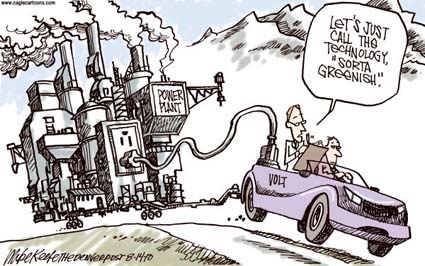
Electric cars don’t save much energy over gas-burners if at all, at least for now. Warren Meyer’s recent Coyote Blog post on this topic is aptly titled “Why Is It So Hard To Get Even Smart People To Think Clearly On Electric Vehicle Efficiency“. Meyer begins by quoting the following tweet from Google smarty Eric Schmidt, which typifies the general level of public awareness regarding the supposed energy savings from electric cars produced by Tesla and many others:

“Electric motors are the unsung hero of clean energy – the latest are 97% efficient, vs. 45% for internal combustion.“

Meyer emphasizes these major points:

  1. the efficiency with which source fuels are converted to physical work via electric and gas-burning cars is more comparable than Schmidt’s tweet suggests;
  2. differences in energy density weigh heavily in favor of fuel-burning vehicles.
  3. the so-called miles-per-gallon equivalent (MPGe) calculated by the U.S. Environmental Protection Agency (EPA) is a sham.

First, Schmidt’s tweet is accurate only if the discussion is confined to simple conversion of energy to physical work performed by the respective engines. The tweet ignores energy losses that occur prior to that conversion: electricity must be generated with far less than 100% efficiency, mainly by burning coal and natural gas. In an earlier Forbes article, Meyer compares this situation to a distorted comparison of two refrigerator installers:

“In both cases the customer lives in a fourth floor walkup. The first installer finds the refrigerator has been left on the street. He has to … haul the appliance up four flights of stairs. After that, relatively speaking, the installation is a breeze. The second installer finds his refrigerator has thoughtfully been delivered right to the customer’s door on the fourth floor. He quickly brings the unit inside and completes the installation. So who is a better installer?“

The fact is that both gas-burning and electric vehicles rely heavily on fossil fuels. And, in addition to losses in the generation process, there are other losses of energy attributable to electric cars: transmission of power involves a significant energy loss, as does charging batteries and storage itself. Meyer considers only the extra losses from production and transmission of electricity in the following comparison:

“We take 97% times 90% transmission efficiency times 50% electricity production efficiency equals 43.6%.  This is actually less than his 45% figure.  By his own numbers, the electric motor is worse….“

Meyer qualifies this comparison, as some of his assumptions are of the “best outcome” variety, but contrary to Schmidt’s assertion, gasoline and electric engines are reasonably comparable in terms of energy efficiency.

Some contend, however, that power losses in electricity transmission are much larger than the 10% Meyer assumes (see the comments on his post). Battery charging involves a loss of perhaps 20%. And a replacement for a Tesla battery, post 8-year warranty, is $8,000 – $12,000, an additional storage “cost” that is virtually non-existent for gas-powered vehicles. Beyond a certain point in its life, that cost will have an impact on a Tesla’s resale value. Moreover, some contend that the production of electric vehicles is more energy-intensive, putting them in an energy efficiency hole right from the get-go.

Meyer then takes up the notion of storage density as an explanation for why early experiments with electric cars were essentially abandoned:

“15 gallons of gasoline weighs 90 pounds and takes up 2 cubic feet. This will carry a 40 mpg car 600 miles. The Tesla Model S 85kwh battery pack weighs 1200 pounds and will carry the car 265 miles (from this article the cells themselves occupy about 4 cubic feet if packed perfectly but in this video the whole pack looks much larger). We can see that even with what Musk claims is twice the energy density of other batteries, the Tesla gets  0.22 miles per pound of fuel/battery while the regular car can get 6.7. More than an order of magnitude, that is simply an enormous difference…“

Meyer notes in the Forbes article that the EPA calculates its MPG conversion factor for electric vehicles by dividing BTU’s in a gallon of gas by the BTUs in a kilowatt hour: 33.7 KwH per gallon. Thus, the EPA multiplies an electric car’s miles per KwH by 33.7 to arrive at the so-called MPG equivalent: MPGe. But as we’ve seen above, the conversion factor ignores the generation and transmission of electricity required at the front end, and the associated energy losses that occur before a single KwH is released by a Tesla battery.

Despite what we hear from the EPA, Tesla, and other interests today, electric cars have not really overcome these disadvantages, at least not yet. The EPA’s MPGe estimates are vastly inflated. Perhaps if they were accurate, these vehicles would not have to rely so heavily on taxpayer subsidies to be competitive. By extension, the presumed environmental benefits of electric cars are nonexistent at this stage of development. I’m certain that Eric Schmidt and many other smart people are capable of understanding these nuances, but they might be too busy tripping over their politics to bother.

The Taxing Logic of Carbon Cost Guesswork

11 Saturday Mar 2017

Posted by Nuetzel in Environment, Taxes, Uncategorized

≈ 1 Comment

Tags

Anthopomorphic, Carbon Dividend, Carbon Tax, Climate Leadership Council, Corrective Taxation, External costs and benefits, Fossil fuels, Greg Mankiw, Martin Feldstein, Paul Driessen, Roger Besdek, Ronald Bailey, Ted Halstead, Universal Basic Inome, Watt's Up With That?

An article by three prominent economists* in the New York Times this week summarized the Climate Leadership Council’s Conservative Case for Climate Action“. The “four pillars” of this climate plan include (1) a revenue-neutral tax on carbon emissions, which are used to fund… (2) quarterly “carbon dividend” payments to all Americans; (3) border tax adjustments to account for carbon emissions and carbon taxes abroad; (4) eliminating all other regulations on emissions of carbon. The “Case” is thus a shift from traditional environmental regulation to a policy based on tax incentives, then wrapped around a redistributive universal income mechanism.

I’ll dispense with the latter “feature” by referencing my recent post on the universal basic income: bad idea! The economists advocate for the carbon dividend sincerely, but also perhaps as a political inducement to the left and confused centrists.

The Limits of Our Knowledge

The most interesting aspect of the “Case” is how it demonstrates uncertainty around the wisdom of carbon restrictions of any kind: traditional regulations, market-oriented trading, or tax incentives. Those all involve assumptions about the extent to which carbon emissions should be restricted, and it’s not clear that any one form of restriction is more ham-handed than another. Traditional regulation may restrict output in various ways. For example, standards on fuel efficiency are an indirect way of restricting output. A carbon market, with private trading in assigned “rights” to emit carbon, is more economically efficient in the sense that a tradeoff is involved for any decision having carbon implications at the margin. However, the establishment of a carbon market ultimately means that a limit must be imposed on the total quantity of rights available for trading.

A carbon tax imputes a cost of carbon emissions to society. It also imposes tradeoffs, so it is similar to carbon trading in being more economically efficient than traditional regulation. A producer can attempt to adjust a production process such that it emits less carbon, and the incidence of the tax falls partly on final consumers, who adjust the carbon intensity of their behavior accordingly. For our purposes here, a tax is more illuminating in the sense that we can assess inputs to the cost imputation. Even a cursory examination shows that the cost estimate can vary widely given reasonable differences in the inputs. So, in a sense, a tax helps to reveal the weakness of the case against carbon and the carbon-based rationale for allowing a coercive environmental authority to sclerose the arteries of the market system.

The three economists propose an initial tax of $40 per metric ton of emitted carbon. The basis for that figure is the so-called “social cost of carbon” (SCC), a theoretical construct that is not readily measured. Economists have long subscribed to the theory of social costs, or negative externalities, and to the legitimacy of government action to force cost causers to internalize social costs via corrective taxation. However, the wisdom of allowing the state to intrude upon markets in this way depends on our ability to actually measure specific external costs.

Fatuous Forecasts

The SCC is based on the presumed long-run costs of an incremental ton of carbon in the environment. I do not use the word “presumed” lightly. The $40 estimate subsumes a variety of speculative assumptions about the climate’s response to carbon emissions, the future economic impact of that response, and the rate at which society should be willing to trade those future costs against present costs. The figure only counts costs, without considering the huge potential benefits of warming, should it actually occur.

Ronald Bailey at Reason illustrates the many controversies surrounding the calculation of the SCC. He notes the tremendous uncertainty surrounding an Obama Administration estimate of $36 a ton in 2007 dollars. It used an outdated climate sensitivity figure much higher than more recent estimates, which would bring the calculated SCC down to just $16.

A discount rate of 3% was applied to projected future carbon costs to produce an SCC in present value terms. The idea is that today’s “collective” would be indifferent between paying this cost today and suffering the burden of future costs inflicted by carbon emissions. This presumes that 3% is the expected return society can earn for the future by investing resources today. Unfortunately, the SCC is tremendously sensitive to the discount rate. Together with the more realistic estimate of climate sensitivity, a discount rate of 7% (the Office of Management and Budget’s regulatory guidance) would actually make the SCC negative!

Another U.S. regulatory standard, according to Bailey, is that calculations of social cost are confined to costs borne domestically. However, the SCC attempts to encompass global costs, inflating the estimate by a factor of 4 to 14 times. The justification for the global calculation is apparent righteousness in owning up to the costs we cause as a nation, and also for the example it sets for other countries in crafting their own carbon policies. Unfortunately, it also magnifies the great uncertainties inherent in this messy calculation.

Lack of Evidence

This guest essay on the Watts Up With That? web site by Paul Driessen and Roger Bezdek takes a less gracious view of the SCC than Bailey, if that is possible. As they note, in addition to climate sensitivity, the SCC must come to grips with the challenge of measuring the economic damage caused by each degree of warming. This includes factors far into the future that simply cannot be projected with any confidence. We are expected to place faith in distant cost estimates of heat-related deaths, widespread crop failures, severe storm damage, coastal flooding, and many other calamities that are little more than scare stories. For example, the widely reported connection between atmospheric carbon concentration and severe weather is demonstrably false, as are reports that Pacific islands have been swallowed by the sea due to global warming.

Ignoring the Benefits

The SCC makes no allowance for the real benefits of burning fossil fuels, which have been a powerful engine of economic growth and still hold the potential to lift the underdeveloped world out of poverty and environmental  distress. The benefits of carbon also include fewer cold-related deaths, higher agricultural output, and a greener environment. It isn’t surprising that these benefits are ignored in the SCC calculation, as any recognition of that promise would undermine the narrative that fossil fuels are unambiguously evil. Indeed, an effort to calculate only the net costs of carbon emissions would likely expose the entire exercise as a sham.

The “four pillars” of the Climate Leadership Council‘s case for climate action rest upon an incredibly flimsy foundation. Like anthropomorphic climate change itself, appropriate measurement of a social cost of carbon is an unsettled issue. Its magnitude is far too uncertain to use as a tool of public policy: as either a tax or a rationale for carbon regulation of any kind. And let’s face it, taxation and regulation are coercive acts that better be undertaken with respect for the distortions they create. In this case, it’s not even clear that carbon emissions should be treated as an external cost in many applications, as opposed to an external benefit. So much for the corrective wisdom of authorities. The government is not well-equipped to centrally plan the economy, let alone the environment.

  • The three economists are Martin Feldstein, Ted Halstead and Greg Mankiw.

Markets, Ingenuity and Genuine Sustainability

22 Thursday Dec 2016

Posted by Nuetzel in Environment, Markets, Scarcity

≈ 1 Comment

Tags

Atmospheric CO2, Decoupling, Factor Productivity, Global Greening, Human Ingenuity, James Ward, Jesse Ausubel, Malthusian, Reason.com, Resource Efficiency, Ronald Bailey, Sustainability, Technical Change, Technology Diffusion, Thomas Malthus

img_3778

Will mankind drain the world of resources and ruin the environment? Must we curtail economic growth in order to ensure our long-term survival? Only if we give up on markets and give-in to central economic direction and control. Ronald Bailey at Reason.com covers the technical assumptions underlying a recent piece of neo-Malthusian “research” purporting to demonstrate the impossibility of environmentally-sustainable economic growth. Bailey’s article makes a great follow-up to my last post, “The Greening-Carbon Nexus“, in which I discussed the bloom in vegetation taking place around the globe attributable to greater levels of atmospheric CO2.

Bailey describes the concept of “decoupling” resource use from economic growth as fundamental to long-term environmental sustainability. This is another twist on good old-fashioned growth in factor productivity. In the new research cited by Bailey, Australian hydrologist James Ward and his co-authors assert that population growth and consumption will eventually overwhelm technological advance. However, it has long been recognized by demographers that freedom from need and growth in material comfort reduces fertility. Bailey notes that world population growth has been decelerating for many years, and the global population is likely to stabilize within a couple of decades.

Ward, et al lean heavily on assumptions about how various classes of resources are not substitutable, and that mankind will run-up against hard production requirements for minimum resource use, a point at which many tradeoffs become impossible. Bailey summarizes their results:

“They crank the notion that there are nonsubstitutable physical limits on material and energy resources through their equations until 2100, and they find that eventually consumption of both rise at the same rate as economic growth. QED: Economic growth is unsustainable. Or as they report, ‘Permanent decoupling (absolute or relative) is impossible for essential, non-substitutable resources because the efficiency gains are ultimately governed by physical limits.’“

Bailey proceeds to pick apart the assumptions made by Ward and his co-authors. First, even if true, those assumptions would apply with much more force to physical outputs, as opposed to service outputs. The latter are likely to continue on a path garnering an increasing share of world output over time. More fundamentally, Ward, et al give short-shrift to the limitless potential of human ingenuity. A few specific examples of the physical limits they contemplate are already verifiably false, having been overcome by technological breakthroughs. This includes agricultural productivity related to enhancements in plant photosynthesis, new manufacturing methods requiring dramatically fewer raw materials, and methods of energy production that are already available, if not yet heavily relied upon. A glaring assumption made by Ward, et al is that the use of fossil fuels will continue to grow through at least the year 2100. In fact, existing alternatives such as nuclear power might well be more economical. Ironically, greater adoption of nuclear power is held hostage by the political resistance of groups who oppose the burning of fossil fuels.

Bailey also cites the work of Jesse Ausubel, whom I cited at length in a post on “rewilding” in 2015. Ausubel’s work shows that Americans’ use of a variety of productive inputs already has “decoupled absolutely” from production, or is approaching that point. That includes farmland, water, timber, plastics, aluminum and steel. Our use of all of those things has peaked and is now in decline. Ausubel’s work implies that “decoupling” is just a matter of time for many other resources for which use is growing at rates declining relative to production. These trends will spread overseas with continued economic development.

Efficiencies like these are a direct effect of technological advance, but the process of technical change is dependent on incentives, which are, in turn, dependent on market prices, profit opportunities, and secure property rights. First, the funding of research into new techniques and methods is driven in large part by market incentives. That’s the real mechanism at play when we marvel that “necessity is the mother of invention”. Necessity, of course, is often manifest in scarcity of existing productive inputs and high input prices.

New technologies present profit opportunities by promising lower input costs, greater production, or other competitive advantages. The adoption of a new technology nearly always entails short-run costs and long-term rewards, both of which are driven by market prices. As the pace of adoption accelerates, the costs of new technologies tend to decrease along with scale economies and sheer experience, reinforcing the process of diffusion. The driving force in all cases is the competitive market and freedom to trade for one’s own benefit. The increasing efficiency of resource use embodied in the “decoupling” phenomena is dependent on the existence of accurate market incentives and secure rights to the rewards that efficiencies in production can bring.

And what if government responds to political pressure by imposing bureaucratically-established production limits, market quotas, efficiency standards, process rules, regulatory reporting, and tax penalties. Apart from direct confiscation and the additional confiscatory risk these actions entail, compliance requires producers to ignore market incentives to one degree or another. These measures force adoption of  less efficient technologies than the market would dictate and add resource costs that would otherwise be absent. The inescapable fact is that market incentives are blunted or destroyed in the process; the consequent waste of resources prevents the kind of natural improvements in factor productivity that lead to decoupling and sustainability.

Sadly, such regulatory actions are often borne out of private rent-seeking efforts. Dominant market players believe that smaller competitors will struggle under the compliance burden created by regulation, so they work with government officials in an effort to have these rules promulgated. This adds a greater degree of market concentration and monopoly power, which implies an efficiency loss relative to competition. Under the protection of regulators, dominant players can survive for too long using wasteful techniques and inputs. Fortunately, with time, new technologies often outpace even these dominant players and the outmoded regulatory rules they rely upon.

Just as wasteful are authoritarian efforts to promote new technologies before the market is ready to adopt them. Picking technological winners and losers is fraught with peril for society. The government usually lacks the foresight possessed by the market, forcibly redirecting resources from one use to another with little consequence for failure except at the taxpayer’s expense. The premature investment is prone to burdening society with stale or defective early versions of new technology. This is not a reliable way to achieve efficiency in resource use. One of the sure signs that such efforts entail waste is the propensity for insiders to be awarded subsidies for promoting politically-favored technologies. Government is invariably drawn to such opportunities for graft.

I conclude with a quote of my earlier post on Ausubel’s work (linked above):

“It’s worth emphasizing that the nature rebound already taking place in the developed world is largely a product of free market capitalism and the growth in wealth and technology they have made possible. A great benefit of secure property rights for society, and for the environment, is that owners have powerful incentives to husband their resources. Likewise, the profit motive gives producers strong incentives to reduce waste and improve productivity. As economic development becomes more widespread, these incentives are promoting a healthier balance between man and nature.“


The Greening-Carbon Nexus

17 Saturday Dec 2016

Posted by Nuetzel in Environment, Global Warming

≈ 2 Comments

Tags

Atmospheric Carbon Concentration, Climate Change, Climate Consensus, David Henderson, Global Greening, global warming, Harrison H. Schmitt, Matt Ridley, Pollution, Rand Paul, Rodney W. Nichols, Roy Spencer, Thomas Malthus

carbon_sequestration

Satellite records show that our world is experiencing a remarkable “greening” in the 21st century, to the seeming chagrin of the environmental left. There is now more vegetation than two decades ago, and greener vegetation, across as much as 50% of the Earth’s vegetated surface area. That area is expanding as well, and the creeping greenery has improved soil moisture levels in some drylands. This bodes well for agricultural productivity, putting another nail in Malthus’ coffin. The satellite studies have concluded that most of the enhanced vegetation is attributable to greater concentration of CO2 in the atmosphere, as opposed to warming or other possible causes. An interesting feedback is that the enhanced vegetation increases natural absorption of CO2, providing an enhanced carbon sink. This, in turn, has caused a pause in the growth of atmospheric carbon cencentration.

The environmental left knows these developments tend to undermine their preferred narrative that human emissions of CO2 must be reduced — at any cost. In fact, already there are warnings that global greening will “outgrow its benefit” as the greater volume of plants begins to decay, releasing carbon. You just can’t make some people happy! But not all of the carbon release from plant decay adds to atmospheric carbon — some is soil-bound — so the greening should provide a fairly durable carbon sink.

Global greening was one of the major motifs in Matt Ridley’s 2016 Global Warming Policy Foundation Lecture. Ridley covered various evidence of greening, but he also discussed the failure of a large contingent of climate researchers to follow a legitimate scientific approach to the study of climate change. Instead, they have politicized their field of study, committing a few noteworthy frauds along the way:

“It is irresponsible not to challenge the evidence properly, especially if the policies pursued in its name are causing suffering. Increasingly, many people would like to outlaw, suppress, prosecute and censor all discussion of what they call ‘the science’ rather than engage in debate. …

No wonder that I talk frequently to scientists who are skeptical, but dare not say so openly. That is a ridiculous state of affairs. We’re told that it’s impertinent to question “the science” and that we must think as we are told. But arguments from authority are the refuge of priests. Thomas Henry Huxley put it this way: ‘The improver of natural knowledge absolutely refuses to acknowledge authority, as such. For him, scepticism is the highest of duties; blind faith the one unpardonable sin’. 

What keeps science honest, what stops it from succumbing entirely to confirmation bias, is that it is decentralized, allowing one lab to challenge another.“

It is all too true that policies advanced in the interests of curbing a slight warming trend cause real suffering, and the pain is heavily concentrated on the most impoverished. The presumed benefits of activist climate-change policies are speculative, at best. They have little chance of reversing atmospheric carbon concentration on their own.

Ridley makes note of the substantial evidence that sensitivity of the climate to airborne carbon concentration is low. This has become increasingly evident with the unfolding of a consistent record of over-forecasts of global temperatures by climate forcing models. Roy Spencer provides insights about these models in a recent discussion of global warming and “dodgy science” on his blog.

There is a widespread myth that 97 percent of climate scientists believe human activity is the main cause of global warming. In fact, that claim was based on a paper counting citations, not scientists; the methods used in the study and the citations themselves were also questionable. I have reviewed that evidence here on Sacred Cow Chips. David Henderson reviewed it here. A large number of studies find fault with so-called “consensus” pronouncements. They should always be viewed with suspicion.

There is also a lively debate underway over whether CO2 should be considered a pollutant! I exhale, therefore I pollute? To the extent that fecal matter is considered a pollutant, is it fair that to say that CO2 is, too? After all, both are anthropogenic. No, they are not even close in terms of an immediate threat to human health. As a philosophical matter, the idea that anything done by man is “unnatural” denies the fact that we are a very part of nature. Obviously, CO2 is not in the same class as pollutants like sulfur dioxide, ammonia, carbon monoxide or toxic metals. Today, these pollutants are very common in many parts of the world, and they are very threatening to human life. Effective mitigation technologies are available, but instead, in the developed West, we fixate on an increase in CO2 concentration of 100 parts per million over many decades, the climate implications of which are de minimis.

Rand Paul’s Facebook page has an ungated link to a WSJ.com commentary by Rodney W. Nichols and Harrison H. Schmitt on “The Phony War Against CO2”. Their commentary provokes questions as to the motives of the environmental left, and certain members of the research community, in shilling for the cause. That we would fight the greening of the globe, and the potential agricultural benefit it could bring, is bizarre. To devote enormous resources to an endeavor that is largely futile is a waste and a tragedy.


Tonight! Let It Shine For Human Achievement Hour

19 Saturday Mar 2016

Posted by Nuetzel in Capitalism, Environment, Human Welfare

≈ Leave a comment

Tags

Earth Hour, Human Achievement Hour, Malthus

image

Tonight, Saturday March 19th, celebrate Human Achievement Hour (HAH). From 8:30 to 9:30 p.m., let all of your lights burn brightly to commemorate the great victory of human ingenuity, liberty and capitalism over darkness, discomfort, poverty, pestilence, disease and early mortality.

Yes, HAH coincides with Earth Hour, when hard-core Malthusians collectively demonstrate their guilt and inner goodness by sitting in darkness in crude emulation of the conditions suffered by their primitive forebears. Needless to say, I haven’t the slightest guilt about thumbing my nose at the bogus spirituality and economic ignorance embodied in Earth Hour. Better to maintain an accurate perspective on the amazing extent of human progress. We should celebrate! And so I say: hooray for HAH!


The Wind, The Sun, and a Load of Subsidies

17 Thursday Mar 2016

Posted by Nuetzel in Environment, Renewable Energy, Subsidies

≈ Leave a comment

Tags

Abandoned Wind Turbines, Baseline Capacity, Cronyism, Decarbonization, Energiewende, Federal Energy Regulatory Commission, Intermittency, Investor Intel, John Peterson, Peaking Capacity, Power Storage, Renewable energy, Rooftop Solar, Seeker Blog, Solar Reimbursement Rates

image


Renewable energy sources are not economically viable without subsidies, and they can impose some ugly external costs. Taxpayer subsidies for renewables like solar and wind projects are rationalized on the grounds that adoption will reduce carbon emissions and bring declining costs, ultimately saving resources by virtue of “free inputs”: the sun and the wind. But the cost of carbon emissions is highly uncertain, even speculative, and subsidies usually manage to get wasteful projects off the ground that are all too often run by political cronies. Despite the free variable inputs, these projects entail substantial resource costs that are conveniently overlooked by supporters. No wonder so many renewable outputs cannot be sustained without a continuing flow of aid.

What happens when the subsidies reach their sunset? There are thousands of abandoned wind turbines littering the U.S. (and a number of abandoned solar farms, too). There are several thousand turbines at one abandoned wind farm north of Los Angeles and another east of the Bay Area. There are many more in Hawaii, Iowa, Maine, Texas and other states. Attorneys often warn landowners that lease agreements with wind developers are risky. There are a number of ways that crony wind developers impose “external costs” on landowners. Eventual disposal is a risk, as the developers might just be inclined to take the subsidies and run.

Again, wind’s big advantages, aside from the subsidies, are that wind itself is free and produces no carbon, but other resources needed to make use of wind energy are not renewable, and producing those inputs produces CO2. To build and install the windmills requires materials (including steel and scarce rare-earth materials used in the electronic components), machinery, and of course labor and land costs. There is also a substantial investment in connecting windmills to the power grid. Ultimate disposal is a certainty, and it is not cheap. Then there is a controversial cost in terms of slaughtered avian life. Increasingly, wind turbines are thought to create health issues for people living nearby.

Solar power has the same advantages as wind in terms of a free input and no direct carbon output. In addition, the cost of solar panels has declined precipitously. Rooftop solar installations have allowed consumers to sell power back to electric utilities at certain times. In fact, without those “reimbursements” on top of the subsidies, installed on-site solar power would not be economically viable for many households and businesses. Reimbursement rates are therefore a huge controversy. Solar advocates have insisted that consumers should be reimbursed at the retail price of electricity. That is difficult to square with the fact that utilities could produce that power themselves for much less. It is especially difficult to square with the fact that the excess solar generation is often mismatched with the timing of power demand.

This brings us to the achilles heel of wind and solar power: wind and sunshine are intermittent, and not just on a daily basis, but over weeks, whole seasons and even years. This risk can be diversified geographically, but only to an extent, and effective power storage options do not presently exist and will not exist for some time, even with massive subsidies. Intermittent energy production requires the availability of other reliable power sources that are costly to turn on and off as needs dictate. It requires other “peaking” capacity to fill the “valleys” in wind and solar output, and baseline capacity is needed to provide for the less variable components of demand. Baseline capacity relies on nuclear power (which many solar advocates abhor) and carbon-emitting fossil fuels. Peaking capacity is typically provided by oil and natural gas generators. Hydro-electric power can be used as baseline or dialed back as needed, but hydro capacity is generally limited.

Renewable energy activists speak of replacing traditional power sources with wind and solar power. It is difficult enough, however, for wind and solar to replace peaking capacity, let alone baseline capacity. Peak wind and solar power production is not well-aligned with peak power demand in many areas (see the second chart at this link). The extra resources required to provide redundant facilities are significant, with ratepayers picking up the tab.

Given the current state of technology, pushing renewable energy goals even further, to the replacement of baseline capacity, is misguided at best. Yet it has been tried, with unintended but easily foreseeable consequences. Germany’s Energiewende program seeks to “decarbonize” power production without nuclear power. The costs have been very high:

“The report gives enough detail that you can see why Germany’s nuclear ban leads to a shocking cost of avoidance of $300 [/mt CO2]. … J.P. Morgan modeled a balanced deep decarbonization strategy, which using 35% nuclear, costs only $84/mt CO2. Note that the $300 is a bare-bones estimate – none of the cost of the additional transmission infrastructure required by high-renewables is included in the analysis. Even so the baseline Energiewende plan will double already second-highest in Europe current costs from $108 to $203/MWhr.“

California officials apparently want to go in the same direction. John Peterson reinforces the difficulties of integrating renewable energy capacity into the power grid in a recent post at InvestorIntel:

“The disadvantages [of intermittent power sources] include:

  • Intermittent power sources must have conventional backup for frequent periods when the wind and sun aren’t feeling particularly cooperative;
  • Cannibalization of peaking plant revenue streams results in higher electric costs for all because interest, depreciation, overhead and other fixed operating expenses must be recovered from fewer units of production;
  • When utilities pay premium prices for renewables, that indirectly increases electricity prices for all; and
  • When Federal, State and local treasuries subsidize the construction and operation of intermittent power sources, they indirectly increase everyone’s tax burden.“

The U.S. Federal Energy Regulatory Commission (FERC) is currently investigating the risk of intermittent energy sources to the reliability of the power grid.

“Power demand is relatively predictable and conventional power plants, like nuclear plants and natural gas, can adjust output accordingly. Solar and wind power, however, cannot easily adjust output. Peak power demand also occurs in the evenings, when solar power is going offline. Adding green power which only provide power at intermittent and unpredictable times [and stopping or even retiring other capacity], makes the power grid more fragile.“

Given decreasing costs, solar energy is likely to play an increasing role in power production in the future; wind production to a lesser extent. Both will depend on advances in the technology of power storage. However, there are still tremendous diseconomies that make current, widespread adoption of both wind and solar power a “Renewable Irony“. Like other attempts to centrally plan economic activity, the intentions are well and good, but execution requires mandated behavior and artificial inducements that impose heavy costs on society. Renewables should not be forced on us prematurely. They will happen voluntarily and naturally if we let them, guided by market signals as technology matures and resource scarcities evolve.


When Is Recycling Not Wasteful?

17 Wednesday Feb 2016

Posted by Nuetzel in Environment, Government, Markets

≈ 1 Comment

Tags

Benefits of Recycling, Daniel K. Benjamin, Hazardous Waste, Landfill Space, Mandatory Recycling, Mobro 4000, Packaging, Property and Environmental Research Center, Rubbish, Scarcity, Scavenging, Sustainabilty, Voluntary Recycling

Recycle

Recycling is not wasteful when it makes economic sense to recycle, without government force brought to bear in the form of mandates, taxes or subsidies. The argument that private parties undertake recycling to a less-than-optimal extent is based on the notion that there are external benefits of recycling that go unrecognized. According to this line of thinking, government must mandate recycling and must tax or impose fees to provide recycling infrastructure. It must demand that producers of goods utilize a certain percentage of recycled materials. Children must be taught the sustainability, goodness, and sanctity of recycling. These positions are ill-founded and misdirect resources toward excessive, and yes, sometimes wasteful recycling.

In 2010, The Property and Environment Research Center (PERC) published an excellent paper by Daniel K. Benjamin entitled “Recycling Myths Revisited“. Benjamin begins by offering “a brief history of rubbish”, which recalls the great extent to which recycling efforts have always been made out of sheer self-interest. Scavenging is as old as civilization, and recycling efforts have generated inputs to production from the start of the industrial age. Some older recycling activities have become obsolete for various reasons; others have been spawned by new technology.

Benjamin’s history of rubbish recounts the history of landfill usage and development. He discusses one seminal event in the history of rubbish: the Mobro 4000 garbage barge from New York City. Rumors of hazardous waste  aboard the Mobro led to it’s rejection at various rubbish “ports of call”. However, inaccurate reports circulated that the issue was a shortage of landfill space, a narrative that certain parties were only too happy to encourage, including the EPA and certain trade groups. The episode is a fascinating example of rumor, misinformation and manipulation.

“Although the physical availability of landfill space was not an issue, that was not how the situation played out in the press. The Mobro, said a reporter on a live TV feed from the barge itself, “really dramatizes the nationwide crisis we face with garbage disposal”. A strange cast of characters went on to turn Mobro’s miseries into a national cause.    …

The result of this steady drumbeat of expressed concern was a growing fear that America was running out of places to put its garbage and that yesterday’s household trash could somehow become tomorrow’s toxic waste. By 1995, surveys revealed that Americans thought trash was the number one environmental problem, and 77 percent reported that increased recycling of household rubbish was the solution. Yet these claims and fears were based on errors and misinformation— myths of recycling.“

From there, Benjamin proceeds with an excellent discussion of eight recycling-related myths, which I attempt to summarize below:

  1. We are running out of space for our trash: no, the capacity of landfills in the U.S. has outpaced growth in refuse for years. At 500 feet deep, a century’s worth of trash in the U.S. would fit into an area of five square miles. There is no shortage at all.
  2. Trash threatens our health and ecosystem: actually, the EPA estimates that health dangers posed by landfills are close to zero. Older landfills sited on wetlands or containing any hazardous industrial waste are the only real threat, which has nothing to do with recycling today. Benjamin describes the superior design features of modern landfills.
  3. Packaging is our problem: packaging “amounts to about 30 percent of what goes into landfills, down from 36 percent in 1970“. Thanks to innovations, the thickness and weight of almost every kind of packaging has declined significantly over the years. Moreover, packaging actually reduces waste in many instances by minimizing breakage and spoilage. For example, with packaging you deal with much less waste in your kitchen every time you buy chicken. The producer is able to recycle the useable waste more efficiently than you ever could.
  4. Trade in trash is wasteful: no, trade in trash allows it to be placed where it costs the least, including dumping fees and transportation costs. Both parties to a trash transaction are likely to benefit, including those in areas that import trash by virtue of the local fees and taxes paid by landfills.
  5. We are running out of resources: no we’re not, but it’s not that the total stock of earthbound resources is infinite (though many resources like forests are renewable). Instead, as Benjamin asserts, it’s that proven reserves of many resources keep growing, and the effective known stocks of nonrenewable resources are continually stretched by human ingenuity. Even land! Within a few decades, some resources are likely be mined on extraterrestrial bodies, but only if it makes economic sense. This is not to deny that scarcity is real, but prices in well-functioning markets always convey the degree of scarcity, the value of conservation, the cost of substitutes, the value of  new exploration, and the value of new technological efficiencies. Right now, the world is awash in many commodities, and their prices reflect a relative lack of scarcity.
  6. Recycling always protects the environment: this is nonsense. “Recycling is a manufacturing process, and therefore it too has an environmental impact. … over the past 25 years, a large body of literature devoted to life-cycle analyses of products from their birth to death has repeatedly found that recycling can increase pollution as well as decrease it (EPA 2006, 2010).” Benjamin notes that curbside recycling may well have a negative environmental impact due to the resource costs of the extra trucks, fuel, and exhaust required to collect it. The point is that tradeoffs exist and should not be ignored.
  7. Recycling saves resources: not if the recycled material is inferior to virgin material, with attendant inefficiencies and lower-valued final products; not if the process absorbs more resources than it saves. These kinds of decisions are best left to rational market participants, for whom the question of recycling is a matter of self-interest. “Commercial and industrial recycling is a vibrant, profitable market that turns discards and scraps into marketable products. But collecting from consumers is far more costly, and it results in the collection of items that are far less valuable.” When low-value recycling is mandated or subsidized, the true cost of the activity is hidden.
  8. Without recycling mandates, there wouldn’t be recycling: “Another force behind mandatory recycling is ignorance about the extent of recycling in the private sector. Private sector recycling is as old as trash itself. For as long as humans have been discarding rubbish, other humans have sifted through it for items of value. Indeed, … scavenging may well be the oldest profession.” Recycling must make economic sense. If it doesn’t, it simply should not happen.

Benjamin’s paper is loaded with great illustrations of all these points. Here’s one of my own: Some years ago, a local municipality was revealed to be sending recyclables to a landfill due to the low market value of the material. Net of the costs of sorting, selling and transporting the materials to buyers, it was apparently better to pay the fees for normal waste disposal. Residents were justifiably furious, but the reality is that recycled materials have a value that fluctuates. That value reflects the real resources the recycled materials can save, if any. However, the value may not always cover the variable cost of collecting the recyclables, let alone the fixed costs of the process. That’s to say nothing of the costs imposed on individuals by mandates.

The eight points above demonstrate that there is little in the way of external benefits from recycling. There is nothing mystical here to justify government coercion. Recycling must make economic sense and it must be voluntary. When we allow government to force the decision, the sure result is an overallocation of resources to an endeavor presumed by its adherents to save resources. There is no paradox. It’s just more waste.

Newer posts →
Follow Sacred Cow Chips on WordPress.com

Recent Posts

  • The Case Against Interest On Reserves
  • Immigration and Merit As Fiscal Propositions
  • Tariff “Dividend” From An Indigent State
  • Almost Looks Like the Fed Has a 3% Inflation Target
  • Government Malpractice Breeds Health Care Havoc

Archives

  • January 2026
  • December 2025
  • November 2025
  • October 2025
  • September 2025
  • August 2025
  • July 2025
  • June 2025
  • May 2025
  • April 2025
  • March 2025
  • February 2025
  • January 2025
  • December 2024
  • November 2024
  • October 2024
  • September 2024
  • August 2024
  • July 2024
  • June 2024
  • May 2024
  • April 2024
  • March 2024
  • February 2024
  • January 2024
  • December 2023
  • November 2023
  • August 2023
  • July 2023
  • June 2023
  • May 2023
  • April 2023
  • March 2023
  • February 2023
  • January 2023
  • December 2022
  • November 2022
  • October 2022
  • September 2022
  • August 2022
  • July 2022
  • June 2022
  • May 2022
  • April 2022
  • March 2022
  • February 2022
  • January 2022
  • December 2021
  • November 2021
  • October 2021
  • September 2021
  • August 2021
  • July 2021
  • June 2021
  • May 2021
  • April 2021
  • March 2021
  • February 2021
  • January 2021
  • December 2020
  • November 2020
  • October 2020
  • September 2020
  • August 2020
  • July 2020
  • June 2020
  • May 2020
  • April 2020
  • March 2020
  • February 2020
  • January 2020
  • December 2019
  • November 2019
  • October 2019
  • September 2019
  • August 2019
  • July 2019
  • June 2019
  • May 2019
  • April 2019
  • March 2019
  • February 2019
  • January 2019
  • December 2018
  • November 2018
  • October 2018
  • September 2018
  • August 2018
  • July 2018
  • June 2018
  • May 2018
  • April 2018
  • March 2018
  • February 2018
  • January 2018
  • December 2017
  • November 2017
  • October 2017
  • September 2017
  • August 2017
  • July 2017
  • June 2017
  • May 2017
  • April 2017
  • March 2017
  • February 2017
  • January 2017
  • December 2016
  • November 2016
  • October 2016
  • September 2016
  • August 2016
  • July 2016
  • June 2016
  • May 2016
  • April 2016
  • March 2016
  • February 2016
  • January 2016
  • December 2015
  • November 2015
  • October 2015
  • September 2015
  • August 2015
  • July 2015
  • June 2015
  • May 2015
  • April 2015
  • March 2015
  • February 2015
  • January 2015
  • December 2014
  • November 2014
  • October 2014
  • September 2014
  • August 2014
  • July 2014
  • June 2014
  • May 2014
  • April 2014
  • March 2014

Blogs I Follow

  • Passive Income Kickstart
  • OnlyFinance.net
  • TLC Cholesterol
  • Nintil
  • kendunning.net
  • DCWhispers.com
  • Hoong-Wai in the UK
  • Marginal REVOLUTION
  • Stlouis
  • Watts Up With That?
  • Aussie Nationalist Blog
  • American Elephants
  • The View from Alexandria
  • The Gymnasium
  • A Force for Good
  • Notes On Liberty
  • troymo
  • SUNDAY BLOG Stephanie Sievers
  • Miss Lou Acquiring Lore
  • Your Well Wisher Program
  • Objectivism In Depth
  • RobotEnomics
  • Orderstatistic
  • Paradigm Library
  • Scattered Showers and Quicksand

Blog at WordPress.com.

Passive Income Kickstart

OnlyFinance.net

TLC Cholesterol

Nintil

To estimate, compare, distinguish, discuss, and trace to its principal sources everything

kendunning.net

The Future is Ours to Create

DCWhispers.com

Hoong-Wai in the UK

A Commonwealth immigrant's perspective on the UK's public arena.

Marginal REVOLUTION

Small Steps Toward A Much Better World

Stlouis

Watts Up With That?

The world's most viewed site on global warming and climate change

Aussie Nationalist Blog

Commentary from a Paleoconservative and Nationalist perspective

American Elephants

Defending Life, Liberty and the Pursuit of Happiness

The View from Alexandria

In advanced civilizations the period loosely called Alexandrian is usually associated with flexible morals, perfunctory religion, populist standards and cosmopolitan tastes, feminism, exotic cults, and the rapid turnover of high and low fads---in short, a falling away (which is all that decadence means) from the strictness of traditional rules, embodied in character and inforced from within. -- Jacques Barzun

The Gymnasium

A place for reason, politics, economics, and faith steeped in the classical liberal tradition

A Force for Good

How economics, morality, and markets combine

Notes On Liberty

Spontaneous thoughts on a humble creed

troymo

SUNDAY BLOG Stephanie Sievers

Escaping the everyday life with photographs from my travels

Miss Lou Acquiring Lore

Gallery of Life...

Your Well Wisher Program

Attempt to solve commonly known problems…

Objectivism In Depth

Exploring Ayn Rand's revolutionary philosophy.

RobotEnomics

(A)n (I)ntelligent Future

Orderstatistic

Economics, chess and anything else on my mind.

Paradigm Library

OODA Looping

Scattered Showers and Quicksand

Musings on science, investing, finance, economics, politics, and probably fly fishing.

  • Subscribe Subscribed
    • Sacred Cow Chips
    • Join 128 other subscribers
    • Already have a WordPress.com account? Log in now.
    • Sacred Cow Chips
    • Subscribe Subscribed
    • Sign up
    • Log in
    • Report this content
    • View site in Reader
    • Manage subscriptions
    • Collapse this bar
 

Loading Comments...