• About

Sacred Cow Chips

Sacred Cow Chips

Category Archives: Health Care

Perspective on U.S. Health Care Spending & Outcomes

05 Sunday Aug 2018

Posted by Nuetzel in Health Care, Health Insurance

≈ Leave a comment

Tags

Bernie Sanders, Charles Blahous, John Cochrane, Joseph Walker, Life Expectancy, Mahdi Barakat, Medicare For All, Mercatus Center, Obesity, Random Critical Analysis, SwedenCare
The U.S. spends a lot on health care, and our health care system is frequently criticized for poor health outcomes. The chart below is an example of evidence used to buttress this argument. It shows combinations of health care spending and life expectancy over time for the OECD countries. The U.S. appears to be a severe outlier and inferior to the other countries. A variation on this chart appeared on the home page of The Wall Street Journal this week. It accompanied (but was not part of) a good article by Joseph Walker in which he used 12 other charts in an effort to explain why the U.S. spends so much on health care. (Sorry, this link is probably gated.) Walker discusses several important cost factors, including third-party payments, tax treatment, and the deployment of expensive technology in the U.S. However, the claim that the U.S. is really an outlier is worth examining on other grounds.
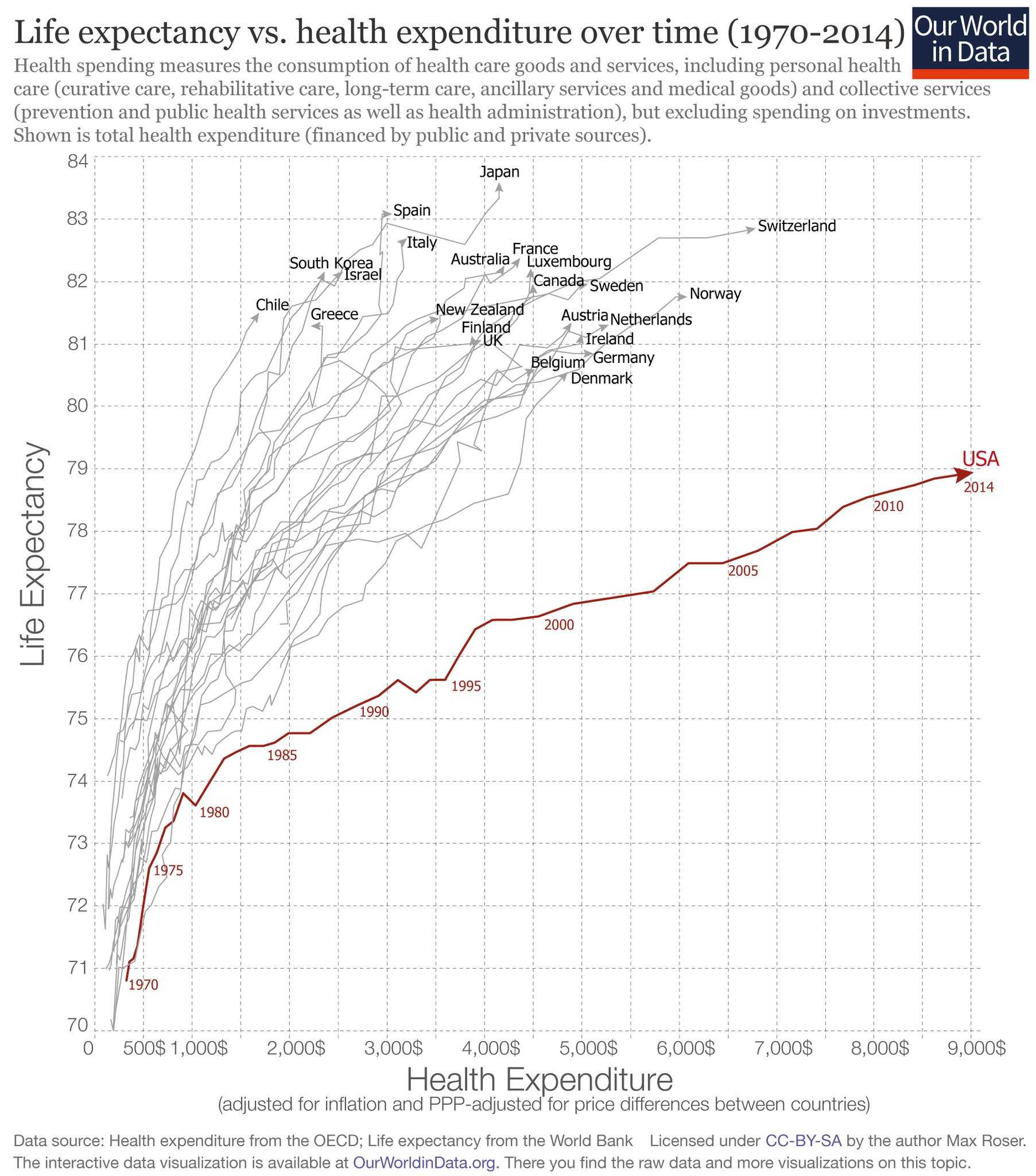
The chart’s construction suggests that a reliable link should exist between health care spending and life expectancy, but there are several reasons to question whether that is the case. U.S. life expectancy has been held down historically by high rates of smoking, but reduced smoking rates should help moderate the U.S. life expectancy gap in coming years. Obesity in the U.S. is a more persistent problem, especially for the poor, and an even bigger contributor to low U.S. life expectancy than smoking at present. (See this report for evidence on the contributions of smoking and obesity to shorter life expectancy for older adults.) Other contributors to low life expectancy in the U.S. include high motor-vehicle deaths and homicides, the latter attributable in large part to the war on drugs. All of these factors contribute to higher health care spending and directly reduce life expectancy.

The status of the U.S. as an outlier in terms of health care spending is questioned on the Random Critical Analysis blog (RCA). The author’s detailed analysis includes the following points among many others of interest:

  • Health care is a superior good: as income rises, spending on health care rises faster;
  • The U.S. has a much higher standard of living than any of its peer nations;
  • U.S. consumption spending relative to GDP is an “outlier”, like health care spending relative to GDP;
  • Consumption is a stronger predictor of health care spending than income;
  • Relative to consumption, health care spending in the U.S. is not an outlier, nor is spending on pharmaceuticals, physician/nursing compensation, and the levels of health price indices.

Take a look at the following sequence from the RCA blog linked above (the animation might not be visible on a phone):
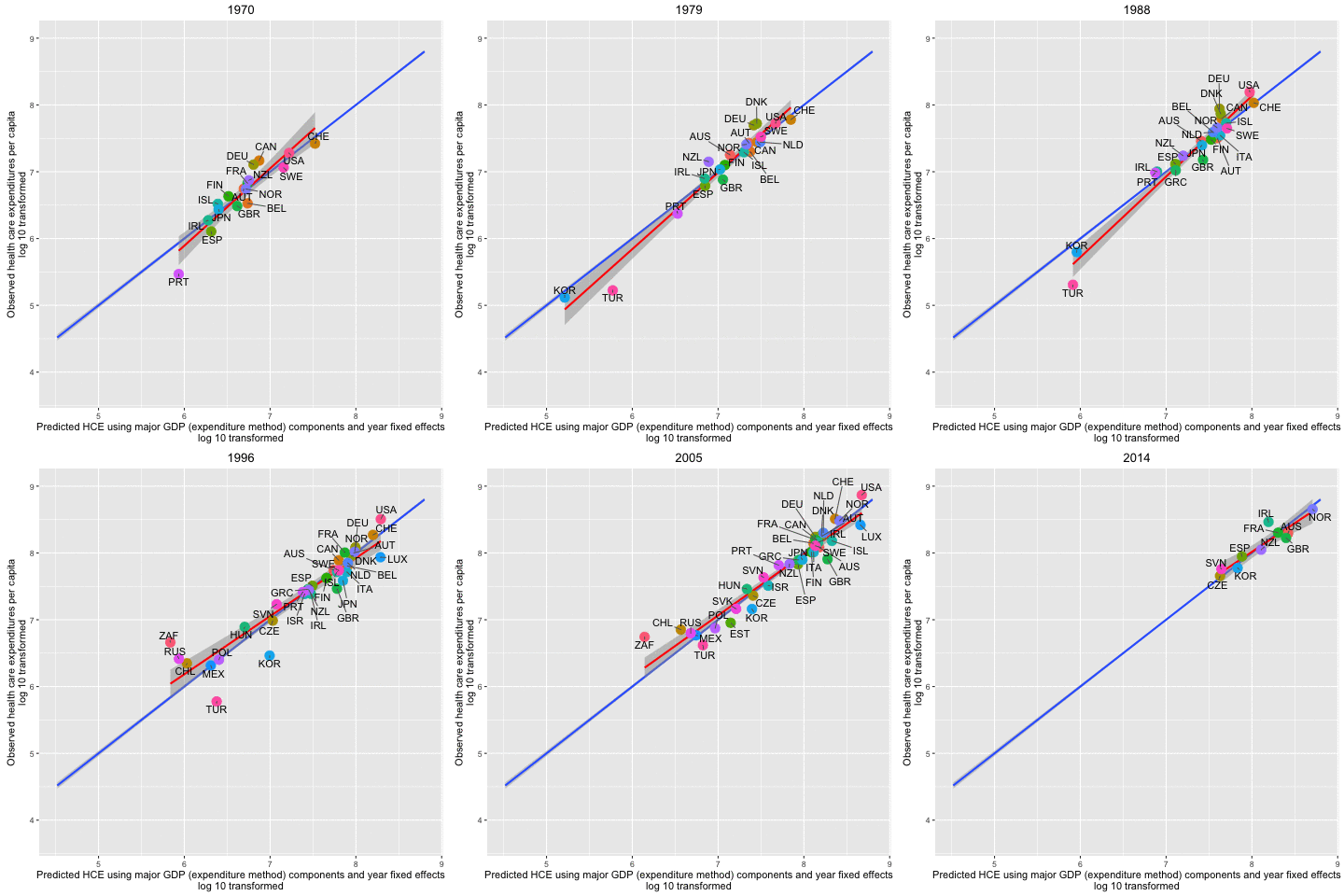
So the argument that the U.S. health care system is inferior to peer countries based on cross-county spending comparisons and life expectancy, to the extent that it holds up at all, is subject to strong qualifications. Inferior lifestyle choices, diets, and lack of exercise might be problematic in the U.S., but the healthcare system cannot be faulted based on spending levels relative to other OECD countries.

In fact, the superiority of the U.S. health care system in many areas is not even in dispute. As Mahdi Barakat points out, wait times for care, cancer survival rates, and stroke mortality are all clearly better in the U.S. than in many peer countries:

“Lives are indeed saved by the many types of superior medical outcomes that are often unique to the US. This is not to mention the innumerable lives saved each year around the world due to medical innovations that are made possible through vibrant US markets.”

Barakat compares dubious progressive claims that up to 45,000 American lives are lost each year due to a lack of insurance with the likely incremental lives lost if various performance measures in the U.S. were equivalent to those in other countries:

  • 25,000 additional female deaths per year with Canada’a wait times for care (no estimate for additional male deaths is given by Mahdi’s source);
  • 64,000 additional stroke deaths each year with the UK’s overall stroke mortality;
  • 72,000 additional cancer deaths each year with the UKs survival rates.

Theoretically, the national spending figures could be adjusted for the cost of queuing, i.e. wait times. While Obamacare certainly increased wait times in the U.S., the adjustment would likely reduce or eliminate the spending advantages that several OECD countries appear to have over the U.S.

The performance of health care systems in many countries with single-payer systems or universal care is subject to challenge, as some of the statistics offered by Barakat demonstrate. In “The Truth About SwedenCare“, Klaus Bernpaintner expresses his dismay at the romanticized view of health care in Sweden among so many Americans. His effort to convey the truth about Sweden’s stultifying health care bureaucracy is illuminating. There are few private physician practices in Sweden. Care is generally rationed and waits are lengthy, and it is delivered by disinterested, centrally-assigned providers.

“For non-emergency cases in Sweden, you must go to the public ‘Healthcare Central.’ This is always the starting point for anything from the common flu to brain tumors. You must go to your assigned Central, according to your healthcare district. Admission is by appointment only. Usually they have a 30-minute window every morning, when you call to claim one of the budgeted slots. Make sure to call early or they run out. Rarely will you get an appointment for the same day. You will be assigned a general practitioner, probably one you have never met before; likely one who does not speak fluent Swedish; and very likely one who hates his job. If you have a serious condition, you will be started on a path of referrals to experts. This process can take months.”

Bernpaintner calls this Sweden’s health care “bread line”, where people go to die. He mentions several other nightmarish features of health care in Sweden that Americans should hope to avoid. In particular, we should resist calls for a single-payer system, like Bernie Sanders’ Medicare-For-All proposal. An analysis by Charles Blahous of the Mercatus Center at George Mason University has shown that it would increase federal spending by $32.6 trillion over ten years. This estimate is basically in-line with others mentioned by Blahous. Much of the additional federal spending would represent a transition away from private spending, a process that would be massively disruptive. However, the study gives the plan the benefit of several doubts by accepting the assumptions made by Sanders: 1) a huge saving in prescription drug costs; 2) a huge saving in administrative costs; 3) providers will happily accept Medicare reimbursement levels; and 4) new immigrants will not be attracted by an essentially free health care program. Fat chance. But given all of these questionable assumptions, total health care spending would fall even as the government takes on the massive new outlays. Take away just fantasy #3 and total national health care spending would rise, a swing of $700 billion by 2031.

John Cochrane makes a useful distinction between two conceptions of universally-accessible coverage: one that all must use vs. one that all can use. (He calls them both forms of single-payer systems, though that usage sounds a bit awkward to me.) The voluntary form is preferable for several reasons: it can preserve choice in terms of coverage and providers; while the public-payer’s share must be funded, it demands little or nothing in the way of cross-subsidized pricing; and it does not imply that government must act as a single “price setter”. Cochrane warns of the possible consequences of a universally-mandated single payer:

“Not only is there some sort of single easy to access health care and insurance scheme for poor or unfortunate people, but you and I are forbidden to escape it, to have private doctors, private hospitals, or private insurance outside the scheme. Doctors are forbidden to have private cash paying customers. That truly is a nightmare, and it will mean the allocation of good medical care by connections and bribes.”

The presumption that universal health care will improve quality and save lives is unsupported by any real evidence. Its proponents incorrectly assume that the uninsured do not get care at all. Providers might go uncompensated, but the uninsured can often get needed care with more immediacy than they could with the lengthy wait times typical of many single-payer systems. The quality of care is likely to deteriorate under a single-payer system given the stresses placed on providers, the highly regulated conditions under which they would be forced to operate, and restricted treatment options. And of course a single-payer system would suspend the price mechanism and any semblance of competition in the health care marketplace.

The health care system in the U.S. has massive problems, but they were created and exacerbated by a series of governmental intrusions on the marketplace over many years. A flourishing market requires choice for consumers and competition between providers—in both health care delivery and insurance coverage. It also requires a roll-back of regulation on providers and insurers. But as Cochrane emphasizes, such a marketplace can exist apart from a voluntary, tax-funded payer-of-last-resort.

Deconstructing the Health Care Administrative State

14 Monday Aug 2017

Posted by Nuetzel in Health Care, Obamacare

≈ Leave a comment

Tags

ACA, Accountable Care Organizations, Affordable Care Act, Community Rating, Coverage Mandate, Donald Trump, Guaranteed Issue, Heartland Institute, Michael Tanner, Obamacare, Repeal and Replace, Robert Laszewski, Tim Huelskamp, Tom Price

A leftist friend chided me early this year for my foolish optimism about repeal and replacement of Obamacare. I have to give her credit. She said the GOP did not have a viable plan — I’m sure she meant that both as a matter of policy and politics. I pointed to the several “plans” that were extant at the time, and even some that I thought might soon be formalized as legislation. I wrote off her skepticism as a failure on her part to understand an approach to health care policy less statist than the Affordable Care Act (ACA). Like so many on the left, she probably has trouble conceiving of any plan not relying on centralized control. Apparently, quite a few Republicans share that blind spot. Nevertheless, I was certainly naive about the prospects of getting anything through Congress quickly.

But the battle is not lost, even now. It should be obvious to everyone, as Michael Tanner notes, that the health care debate is far from over. The individual insurance market is in bad shape, reeling from the unfavorable balance of risks created by community rating, mandated coverage and guaranteed issue. As Robert Laszewski notes, the attrition in the individual market is dominated by individuals not eligible for Obamacare subsidies. While legislation is a much longer shot than I imagined back in January, there remain a variety of ways in which Obamacare’s most deleterious provisions can be neutralized and replaced to create a more market-oriented environment. And though it’s too bad that it might come to this, as the situation continues to devolve, new legislation might gain viability.

Tanner mentions a variety of administrative decisions sitting squarely in the hands of the Trump Administration: insurance company subsidies? congressional exemption from Obamacare? promotion of open enrollment? enforcing the individual mandate? And there are many others. Tim Huelskamp provides a link to The Heartland Institute‘s “complete healthcare reform toolbox“. He says:

“During congressional testimony in March, my former House colleague and HHS Secretary Tom Price pointed out that the law offers him multiple opportunities to do just that: ‘Fourteen hundred and forty-two times … the secretary ‘shall’ or the secretary ‘may” make changes to the Affordable Care Act. The Price is right! Under Obamacare, he has tremendous power and latitude not only to dismantle the ACA but to replace it with health care options that enhance individual freedom.

Let Americans pick their doctors, choose a ‘skinny’ health insurance plan, or even purchase a plan from a company based in another state. The Trump administration can waive penalties on individuals and businesses who simply can’t afford Obama’s mandates.  HHS can give a green light to any state that wants to begin restoring choice and freedom for their citizens without federal bureaucrat interference.“

Another productive avenue is deregulation of health care providers themselves. One of the worst aspects of the ACA is its reliance on so-called Accountable Care Organizations (ACOs), which were intended to encourage greater cooperation and efficiency among providers. The reality is that the ACO rules imposed by HHS are leading to higher costs, greater financial risk and increased concentration in the provision of medical care. Patients, also, are often penalized by the monopolizing effects, and because they might not be able to continue seeing the doctor of their choice under the limits of the health plans available. Moreover, the ACA infringes upon the doctor-patient relationship by restricting the doctor’s authority and the patient’s choices about tests and treatments that can be provided. Many of these rules and restrictions can be undone by administrative action.

Finally, before we completely dismiss the possibility of a legislative solution, there is a new Republican health care bill to consider in the Senate. However, it is just as limited in its reforms, or more, than the bill that passed in the House and the one that failed in the Senate. It’s unlikely to go anywhere soon. There could be later opportunities to consider various pieces of reform legislation, especially if the Trump Administration makes good on its promises to roll back administrative rules put in place to implement the ACA. Sadly, for now we wait in vain for legislators and President Trump to overcome the intellectual failure at the root of the inaction on ending Obamacare. The lesson is that in human affairs, central planning doesn’t work!

Good Profits and Bad Profits

18 Thursday May 2017

Posted by Nuetzel in Health Care, Profit Motive

≈ Leave a comment

Tags

ACA, Affordable Care Act, Big government, Corporatism, Cronyism, Economic Rents, Health Insurance, Opportunity cost, Profit Motive, Regulatory Capture, Reinsurance, rent seeking, Risk corridors, Supra-Normal Profit

Toles-on-Regulatory-Capture

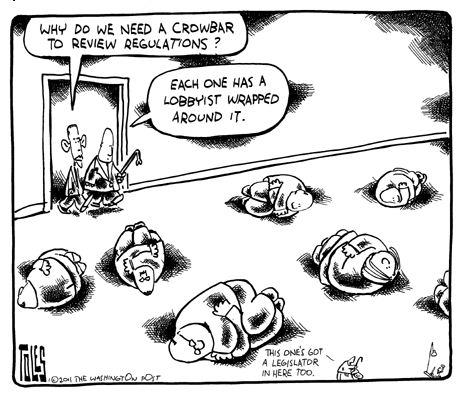
There are two faces of profit. It’s always the fashion on the left to denigrate profits and the profit motive generally, as if it serves no positive social function. This stems partly from a failure to examine the circumstances under which profits are earned: is it through competitive performance, innovation, hard-won customer loyalty, and the skill or even luck to spot an underpriced asset? Such a “good” profit might even exceed what economists call a “normal profit”, or one that just covers the opportunity cost of the owners’ capital. On the other hand, profit can be derived from what economists call “rent seeking”. That’s the dark side, but the unrecognized spirit of rent seeking seems to lurk within many discussions, as if the word profit was exclusively descriptive of evil. The “rent” in rent seeking derives from “economic rent”, which traditionally meant profit in excess of opportunity cost, or a “supra-normal” profit. But it’s impossible to know exactly how much of any given profit is extracted by rent seeking; a high profit in and of itself is not prima facie evidence of rent seeking, even though we might argue the social merits of a firm’s dominant market position.

Rent seeking takes many forms. Collusion between ostensible competitors is one, as is any predatory attempt to monopolize a market, but the term is most often associated with cronyism in government. For example, lobbying efforts might involve favors to individuals in hopes of swaying votes on regulatory matters or lucrative government contracts. Sometimes, a rent seeker wants lighter regulation. At others, a rent seeker might work the political system for more regulation in the knowledge that smaller competitors will be incapable of surviving the heavy compliance costs. Government administrators also have the authority to change fortunes with their rulings, and they are subject to the same temptations as elected officials. In fact, in the aggregate, administrative rule-making and even enforcement might outweigh prospective legislation as attractors of intense rent-seeking.

Rent seeking is big-time and it is small-time. It takes place at all levels of government, from attempts to influence zoning decisions, traffic patterns, contract awards, and even protection from law enforcement. When it’s big time, rent seeking is the very essence of what some call corporatism and more generally fascism: the enlistment of coercive government power for private gain. A pretty reliable rule is that where there’s government, there is rent-seeking behavior.

Otherwise, the profit motive serves a valuable and massive social function: resources are attracted to profitable uses because they signal the desires of potential buyers. In this way, profits assure that resources are drawn into the most-valued uses. The market interactions between new competitors, drawn by the prospect of profits, and willing buyers leads to a self-correction: supra-normal profits get competed away over time. In this way, the spontaneous actions of voluntary market participants lead to a great achievement: all mutually beneficial trades are exhausted. Profit makes this possible in the short-run and it assures that trades evolve optimally with changes in tastes, technology and resource availability. By comparison, government fares poorly when it attempts to plan outcomes in the short- or the long-run. Rent seeking is an attempt to influence and even encourage such planning, and the profits it enables impose costs on society.

Good and Bad Profits In Health Insurance

I’ve written a few posts about health insurance reform recently (see the left margin). Health care is scarce. If relying on government is the preferred alternative to private insurance, don’t count on better access to care: you won’t get it unless you’re connected. Profits earned by health insurance carriers are roundly condemned by the left. It is as if private capital utilized in arranging coverage and carrying the risk on pools of customers deserves zero compensation, that only public capital raised by coercive taxation is morally acceptable for this purpose. But aside from this obvious hogwash, is there a reason to question the insurers’ route to profitability based upon rent seeking?

The health insurers played a role in shaping the Affordable Care Act (ACA, i.e., Obamacare) and certainly had hoped to benefit from several of its provisions, even while sacrificing autonomy over product, price, coverage decisions, and payout ratios. The individual and employer mandates would force low-risk individuals to purchase extensive coverage, and essential benefits requirements would earn incremental margins. Sounds like a nice deal, but those policies were regarded by the ACA’s proponents as necessary for universal coverage, stabilizing risk, and promoting adequate coverage levels. There were other provisions, however, designed to safeguard the profitability of insurers. These included an industry risk adjustment mechanism, temporary reinsurance to help defray the cost of  covering high-risk patients, and so-called risk corridors (also temporary).

As it turned out, the ACA was not a great bet for insurers, as their risk pools deteriorated more than many expected. With the expiration of the temporary protections in Obamacare, it became evident that offering policies on the exchanges would not be profitable without large premium hikes. A number of carriers have stopped offering policies on the exchanges.

It should be no surprise that health insurance profitability has been anything but impressive over the past three years. The average industry return on equity was just 5.6% during that time frame, and it was a slightly better 6.2% in 2016, about 60% of the market-wide average. It’s difficult to conclude that insurers benefitted greatly from rent seeking activity with regard to the ACA’s passage, but perhaps that activity had a sufficient influence on policy to stabilize what otherwise might have been disastrous performance.

The critics of insurance profits are primarily interested in scapegoating as a means to promote a single-payer health care system. While some are aware of the favors granted to the industry in the design of the ACA, most are oblivious to the actual results. Even worse, they wish to throw-out the good with the bad.

The left is almost universally ignorant of the social function served by the profit motive. Profits stimulate supply, competition and innovation in virtually every area of economic life. To complain about profits in general is to wish for a primitive existence. Unfortunately, the potential for government to change the rules of the market makes it a ripe target for rent-seeking, and it creates a fog through which few discern the good from the bad.

Insurance Subsidies: Taxes vs. High Premiums

16 Tuesday May 2017

Posted by Nuetzel in Health Care, Subsidies, Taxes

≈ Leave a comment

Tags

Charity, Guaranteed Issue, Individual Mandate, Kevin Williamson, Managed Health Care, Megan McArdle, monopoly, Pre-Existing Conditions, Right To Health Care, Single-Payer, Voluntary Exchange, Woodrow Wilson

Here’s a question a friend posed: Why do we care whether health care coverage for high-risk individuals is subsidized by taxpayers versus premium payers via common (community) rating in a combined risk pool? For convenience, let’s call those two scenarios T and C. Under C there is no segmentation whatsoever, while T involves a division of individuals into two groups: standard and high risk. Both scenarios involve guaranteed issue, though T assumes that high-risk individuals must purchase their coverage in the appropriate market. I’ll tackle T first because separate treatment of the distinct risk archetypes yields results that are useful as a baseline.

Taxpayers Subsidize Pre-Existing Conditions

Under scenario T, suppose that all standard risks face the same expected outcome in each period. Everyone in that group pays based on their expected health care costs. In the end, some will have greater health care needs than others, but only a few will be truly unlucky, incurring extremely high health care expenses. On balance, the pooling of risk makes the arrangement sustainable. People enter into these contracts voluntarily because they are risk averse. No one forces them; they are capturing value from protection against financial ruin. The paid-in cash can be invested by the plan in the interim between premium and claims payments. The combination of premium payments and investment income must be enough to cover claims and allow the managers of the plan to defray their administrative costs and make a tidy profit. The profit matters because it attracts voluntary resources to bear on the problem of health-expense risk. Therefore, these insurance transactions are mutually beneficial to the insured and the owners of the insurer.

Conceivably, the smaller high-risk group could be handled the same way, as long as their aggregate health care expenses are predictable. Those expenses will be high, however, so the cost of coverage for individuals in such a pool might be prohibitive. One solution is to force taxpayers to subsidize coverage for this group. The transactions in this market are also mutually beneficial to the insureds and the insurers, just as in the market for standard risks. In both cases, the value to purchasers of coverage is no less than the cost of providing it, including compensation for any capital employed in the process.

In the simplified world of scenario T, we have an optimal insurance outcome for both standard and high-risk individuals. The downside is the cost of the subsidies to taxpayers, which distort a variety of incentives, including labor supply, saving and investment. These lead to misallocations, but they are spread across the economy rather than concentrated on the outcomes in a single market. Is this better than simply pooling all risks, as in Scenario C (common rating)?

Common (Community) Rating

Common rating means that all risks are combined into one pool and everyone is charged the same premium. High-risk individuals get to participate just as if they are standard risks. However, because the combined risk pool has greater expected health care costs on average than the standard risk population, the premium must be greater than the one charged to standard risks in Scenario T. Otherwise, the plan could not cover all expenses nor earn a profit. Worse yet, the standard risks now have an incentive to exit the market while high-risk individuals have every reason to leap in. This is called adverse selection, and it leads to the sort of insurance death spiral we’ve witnessed under Obamacare. And not only does the risk pool deteriorate: the incentive to offer coverage is diminished as well. Thus, an entire industry is rendered dysfunctional. Those who wish to pool together voluntarily in order to efficiently hedge their risks are, by law, prohibited from doing so. The next step might well be for government to mandate participation in an attempt to keep the plan afloat.

Those who favor forced redistribution (not my set) might have other reasons to prefer Scenario T, as it creates greater latitude for progressive tax funding of the subsidies. However, the subsidies themselves could be sensitive to income such that the risky but well-heeled pay more.

From a libertarian perspective, Scenario C has obvious drawbacks, starting with the coercion of insurers to provide coverage to the high-risk population at rates that do not compensate for risk. Then, too, the mis-pricing of risk places a burden on individuals of standard risk. With the pooling of all risks, community rating and coverage mandates result in individual and aggregate over-insurance against most types of risk, tying up scarce resources in insurance assets that could be invested more productively in other uses. In addition, resources are absorbed by compliance costs as authorities find it necessary to enforce the many rules made in hopes of proping-up an otherwise unsustainable arrangement.

Then There’s Single-Payer

It’s often argued that going beyond this point in Scenario C to a single-payer system will yield better outcomes at lower costs. Megan McArdle shreds this idea in a recent column: well over 40% of health care spending in the U.S. is paid by government already; the average growth of that share is even higher than private health care spending; the quality of care is often lower in the government health sector, and in any case, single payer systems around the world do not enjoy slower growth in costs. Rather, they started from lower levels of health care costs. Our relatively high level of costs in the U.S. evolved many years ago, before single-payer systems were adopted abroad. We have many more private and semi-private hospital rooms in the U.S., we often have greater availability of advanced technology, and waiting times for care tend to be significantly shorter.

The high standard of living in the U.S., i.e., our level of consumption, explains a lot of the gap in health care spending. Overall, our health care outcomes are good relative to other developed countries. Unfortunately, we’ve also pushed-up costs from the demand side by offering tax subsidies on employer-provided care, and government in the U.S. has had a role in “managing” health care since the time of the Woodrow Wilson Administration, largely to the detriment of cost control. Government control stultifies competition, creating monopoly-like conditions in both insurance and the provision of care. That manifests in higher profits, safer profits, or slovenly performance by organizations and agents that lack accountability to customers and market forces. Costs rise.

Liberty or Coercion

Libertarians will object to the tax in Scenario T, which like all taxation is coerced, but the taxes necessary to pay for adequate coverage for pre-existing conditions is minor relative to the potential costs of distorting the entire health insurance industry, repleat with the costs of government regulation and compliance that entails, and the potential for still more encroachment of government in health care.

Finally, the question posed by my friend about tax subsidies versus common insurance rating was prompted by a presumed “right to health care”. One must ask whether that right is legitimate. Kevin Williamson argues that scarcity interferes with any such claim. More to the point, in a free society, one cannot simply demand health care from another free individual. Our choices for distributing scarce health care fall into one of only two categories: voluntary and coerced. We should always prefer the former, which may take the form of charity or a mechanism under which care is provided via free exchange. The latter works very well when incentives are clear and pricing is efficient. For those who cannot participate in exchange for any reason, including pre-existing conditions that make coverage prohibitive, private charity is an alternative to government subsidies. At a minimum, charity should serve as an important relief valve for the burden on taxpayers. The Left, however, is always quick to condemn private charity as if it is somehow an illegitimate mechanism for solving social problems, but it is often superior to government action.

Musings II: Avik Roy on Health Insurance Reform

12 Friday May 2017

Posted by Nuetzel in Health Care, Obamacare

≈ 1 Comment

Tags

Actuarial Value, AHCA, American Health Care Act, Avik Roy, Benefit Mandates, CBO, Community Rating, Congressional Budget Office, Dylan Scott, Essential Benefits, Exchange Market, Interstate Competition, Medicaid, Risk corridors, Vox

IMG_4209

Vox carried an excellent Dylan Scott interview with Avik Roy this week. Roy is a health care policy expert for whom I have great respect. Among other health care issues, I have quoted him in the recent past on the faulty Congressional Budget Office (CBO) projections for Obamacare enrollment, which have consistently overshot actual enrollment. In this interview, Roy explains his current views on the health care insurance reform process and, in particular, the American Health Care Act (AHCA), the bill passed by the House of Representatives last month. The interview provides a good follow-up to my “musings” post on Sacred Cow Chips earlier this week.

Roy provides good explanations of some of the AHCA’s regulatory changes that have merit. These include:

  1. relaxation of Obamacare’s community rating standards, meaning that insurers have more flexibility to charge premia based on age and other risk factors, thus mitigating the pricing distortions caused by cross-subsidies on the individual market;
  2. a rollback in the required minimum actuarial value (AV) of an insurance plan (the ratio of plan-paid medical expenses to total medical expenses);
  3. elimination of federal essential benefits requirements.

Roy provides context for these proposed changes relative to Obamacare. For example, regarding AV, he says:

“[In] the old individual market, prior to Obamacare, the typical actuarial value of a plan was about 40 percent. Obamacare drives that up effectively to 70 percent. That has a corresponding effect on premiums; it makes premiums a lot more expensive. In the AHCA, those actuarial value mandates are repealed. Which should provide a lot more opportunity for plans to design more affordable insurance policies for individuals.“

Even with Obamacare’s high AV requirements, an insurer could make money by virtue of the law’s “risk corridors”, which were intended to cover losses for insurers as they adjusted to the new regulations and as the exchange market matured, but those bailouts were temporary, and development of the exchanges did not go exactly as hoped. Insurers have been ending their participation in the exchange market, leaving even less than the limited choices available under Obamacare and little competition to restrain pricing.

On essential benefits, Roy reminds us that every state has essential benefit regulations of its own. These mandates create an unfortunate obstacle to interstate competition, as I discussed in March in “Benefit Mandates Bar Interstate Competition“. Nevertheless, the federal mandates have created additional complexities and added costs to cover risks that a) are not common to the risk pool, or b) cover benefits that are not risk-related and therefore inappropriate as insurance.

Roy also defends the AHCA’s protection of individuals with pre-existing conditions. One fact often overlooked is that burdening the individual market with coverage of pre-existing conditions made Obamacare less workable from the start, simultaneously driving up premiums and sending insurers for the hills. These risks can and should be handled separately, and the AHCA offers subsidies that should be up to the task:

“… if you look at Obamacare, the mechanisms in Obamacare’s exchanges that served as a way to fund coverage for sick people, they were spending $8 billion a year on that program. If you look at it that way, if $8 billion was enough under Obamacare, then maybe $15 billion a year is enough. I really don’t think that’s the problem with this bill.“

Roy contends that the big weakness in the AHCA is inadequate assistance to the poor in arranging affordable coverage. While highly critical of the CBO’s wild estimate of lost coverage (24 million), he does believe that the AHCA, as it stands, would involve a loss. He favors means-tested subsidies as a way of closing the gap, but acknowledges the incentive problems inherent in means testing. With time and a growing economy, and if the final legislation (and the purported stages 2 and 3 of reform) is successful in reducing the growth of health care costs relative to income, the subsidies would constitute a smaller drain on taxpayers.

As for Medicaid reform, Roy defends the AHCA’s approach:

“You start with the fact that access to care under Medicaid and health outcomes under Medicaid are very poor, far underperforming other health insurance programs and certainly way underperforming private insurance. Why does that problem exist? It exists because states have very little flexibility in how they managed their Medicaid costs. They’re basically not able to do anything to keep Medicaid costs under control, except pay doctors and hospitals less money for the same amount of care. As a result of that, people have poor access. By moving to a system in which you put Medicaid on a clear budget and you give states more flexibility in how they manage their Medicaid costs, you actually can end up with much better access to care and much better coverage.“

One point that deserves reemphasis is that a final plan, should one actually pass in both houses of Congress, will be different from the AHCA. From my perspective, the changes could be more aggressive in terms of deregulation on both the insurance side and in health care delivery. The health care sector has been overwhelmed by compliance costs and incentives for consolidation under Obamacar. Nobody bends cost curves downward by creating monopolies.

I’ve hardly done justice to the points made by Roy in this interview, but do read the whole thing!

Musings On Health Insurance Reform

10 Wednesday May 2017

Posted by Nuetzel in Health Care, Obamacare

≈ 1 Comment

Tags

AHCA, American Health Care Act, Block Grants, Catastrophic Coverage, Congressional Budget Office, Cross Subsidies, Essential Benefit Requirements, Health Care Freeloaders, High-Risk Pools, Mandated Benefits, McArthur Amendment, Medicaid Reform, Obamacare, Pre-Existing Conditions, Right To Health Care, Tyler Cowan, Uncompensated care

An acquaintance of mine is a cancer patient who just made the following claim on Facebook: the only people complaining about Obamacare are hypocrites because they don’t have to purchase their health insurance on the exchanges. That might be her experience. It certainly isn’t mine. I know several individuals who purchase their coverage on the exchanges and complain bitterly about Obamacare. But her assertion reveals its own bit of hypocrisy: it’s apparently okay to defend Obamacare if you are a net beneficiary, but you may not complain if you are a net payer. Of course, I would never begrudge this woman the care she needs, but it is possible to arrange for that care without destroying the health care industry and insurance markets in the process. Forgive me for thinking that Obamacare was designed with the cynical intent to do exactly that! Well, at least insurance markets. The damage to the health care industry was brought on by simple buffoonery and rent seeking.

Depending on developments in Congress over the next few months (3? 6? 9?), Obamacare could be a thing of the past. We’ve all probably heard hyperbolic claims that the new health care bill “will kill people”, which is another absurdity given the law’s dislocations. That was the subject of “Death By Obamacare“, posted in January on Sacred Cow Chips. AHCA detractors base their accusations of murderous intent on a fictitious notion of reduced access to care under the plan, as well as a Congressional Budget Office (CBO) report that viewed the future of Obamacare through rose-colored glasses. I discussed the CBO report at greater length in “The CBO’s Obamacare Fantasy Forecast“.

Before anyone gets too excited about what they like or dislike about the health care bill passed by the House of Representatives last week, remember that a final health care bill, should one actually get through Congress, is unlikely to bear a close resemblance to the House bill. The next step will be the drafting of a Senate bill, which might be assembled from parts of the House’s American Health Care Act (AHCA) and other ideas, or it might take a different form. It could take a while. Then, the House and Senate will attempt to shape a compromise in conference committee and bring it to a vote in both houses. President Trump, looking for a “win”, is likely to sign whatever gets through, even if he has to bargain with democrats to win votes.

So relax! If your legislators are democrats, tell them to participate in the shaping of new policies, rather than throwing petulant barbs from the sidelines. First, of course,  you’ll have to face up to the fact that Obamacare is a failed policy.

Another recent post on Sacred Cow Chips, “Cleaving the Health Care Knot… Or Not“, covered some of the most important provisions of the AHCA. By the time of the vote, a few new provisions had been added to the House bill. The McArthur Amendment allows states to waive the Obamacare essential benefits requirements. Fewer mandated benefits would allow insurance companies to offer simpler policies covering truly insurable health care events, as opposed to predictable health maintenance costs. Let’s face it: if you must have insurance coverage for your annual checkup, then it is not really insurance against risk; either the premium or the deductible must rise to cover the expenses, ceteris paribus.

The other change in the AHCA is an additional $8 billion dollars allocated to state high-risk pools for pre-existing conditions, for a total of $138 billion. These risks are too high to blend with standard risks in a well-functioning insurance market. (In a perfect insurance market, there would be no cross-subsidies between groups on an ex ante basis.) As a separate risk pool, these high-risk individuals would face very high premia, so the idea is to allow states the latitude to subsidize their health care costs in ways they see fit. This is a federalist approach to the problem of subsidizing coverage for pre-existing conditions, and it has the advantage of restoring the ability of insurers to underwrite standard risks at reasonable rates, correcting one of Obamacare’s downfalls. However, some GOP senators are advocating a combination of standard risks and those with pre-existing conditions, which obviously distorts the efficient pricing of risk and exaggerates the need for broader subsidies.

And what about the uninsured poor? A major focus of health care insurance reform, now and in the past, has been to find a way for the poor to afford coverage. Obamacare fell far short of its goals in this respect, as any enthusiasm for subsidized (though high) premia was dampened by shockingly high deductibles. This week, Tyler Cowan reported on some research suggesting that low-income individuals place a low value on insurance. Their responsiveness to subsidies is so low that few are persuaded to pay anything close to the premium required. Cowan quotes the authors as saying that even 90% subsidies for these individuals would leave about 25% of this population unwilling to pay for the balance. Cowen quotes the study’s authors:

“‘We conclude that the size of uncompensated care for low-income populations provides a plausible explanation for their low [willingness-to-pay].’ In other words, many of the poor do not value health insurance nearly as much as many planners feel they ought to, in large part because they are already getting some health care.“

This has several implications. First, these individuals are not without health care, regardless of their coverage status. One of the great misapprehensions among Obamacare supporters is that the poor had no access to care before the law’s passage. Never mind that emergency room utilization is still quite high. Uninsured individuals can go to a public hospital and get treatment in the emergency room and get admitted if that is deemed medically necessary. If the illness causes a loss of income, the individual might qualify for Medicaid if they hadn’t before, and Medicaid has no exclusion for pre-existing conditions. In fact, I’m told the hospital staff might even help you apply right there at the hospital! So who needs insurance before a health crisis?

Many of the poor have continued to do what they did before: go without coverage. Obamacare’s complex system of subsidies is almost beside the point, as is almost any other effort to sign up everyone prior to the onset of major health care needs. Eventual enrollment in Medicaid will pay some of the hospital bills, though it’s true that not all can qualify for the program. Either way, the hospital will swallow a share of the cost — that is, the taxpayer will. Providers would rather not rely on low Medicaid reimbursement rates or perform charity work. This coalition will grapple with the failure of many low-income individuals to arrive at their emergency room doors with coverage as long as we rely on direct subsidies as an inducement to purchase insurance. Unfortunately, a policy offering a separate guarantee of financial health for providers would create another set of awful incentives.

The unfortunate truth is that Medicaid is unsustainable at current funding levels. The AHCA would convert the federal share of the program to one of block grants to states, wnich have always managed the program under federal mandates. The AHCA would free the states to manage the program more flexibly, but caps on the grants would create pressure to manage costs. It is not yet clear whether the Senate will offer a different approach to Medicaid reform, but it was the primary driver of increased health care coverage under Obamacare.

Finally, there are certain individuals with higher incomes who can afford to pay for coverage but prefer to freeload. Those who experience catastrophic health problems will be a burden to others, not necessarily through distortions in insurance pricing, but via taxes and deficits. To an extent, the situation is a classic problem of the commons. In this case, the “commons” is an invention of government and the presumed “right to health care”: there is no solution to the freeloader problem faced by taxpayers short of denying the existence of that right to those who can afford catastrophic coverage but would refuse to pay. Only then would the burdens be internalized to the cost-causes. Charity can and should go partway to relieving individuals of the consequences of their bad decisions, but EMS will still arrive if called, providers will render care, and a chunk of the costs will be on the public dime.


Benefit Mandates Bar Interstate Competition

30 Thursday Mar 2017

Posted by Nuetzel in competition, Health Care

≈ 1 Comment

Tags

Benefit Mandates, Cherry-Picking, Commerce Clause, Federalism, Foundation for Economic Education, Health Insurance, Interstate Competition, John Seiler, Legacy Carriers, McCarran-Ferguson Act, Restraint of Trade, Robert Laszewski, Steve Esack, Teresa Miller

The lack of interstate competition in health insurance does not benefit consumers, but promoting that kind of competition requires steps that are not widely appreciated. Most of those steps must take place at the state level. In fact, it is not well known that it is already legal for states to jointly create interstate “compacts” under Obamacare, though none have done so.

The chief problem is that states regulate insurance carriers and the policies they offer in a variety of ways. Coverage mandates vary from state to state, as do rules governing the coverage of pre-existing conditions, renewability, dependents, costs, and risk rating. John Seiler, writing at the Foundation for Economic Education, offers a great perspective on the fractured character of state regulations. Incumbent insurers within a state have natural advantages due to their existing relationships with local providers. Between the difficulty of forming a new network and the costs of customizing policies and obtaining approval in multiple states, there are significant barriers to entry at state lines.

Federalism is a principle I often support, but state benefit mandates and other regulations are perverse examples because they restrict the otherwise voluntary and victimless choices available to a state’s consumers. Well, victimless except perhaps for in-state monopolists and their cronyist protectors in state government. Many powers are reserved to states under the Constitution, while the powers of the federal government are strictly limited. That’s well and good unless state governments infringe on the rights of individuals protected by the Constitution. In particular, the Commerce Clause prohibits state governments from obstructing the flow of interstate commerce.

Here is a bit of history surrounding the evolution of state versus federal control over insurance markets, as told by Pennsylvania Insurance Commissioner Teresa Miller (as quoted by reporter Steve Esack):

“Since the 1800s, the U.S. Supreme Court held individual states, not Congress, had the power to regulate insurance companies. The high court overturned that precedent, however, in a 1944 ruling, United States v. South-Eastern Underwriters, that said insurance sales constituted interstate trade and Congress could regulate insurance under the U.S. Constitution’s Commerce Clause.

But states cried foul. In response, Congress passed and President Harry S. Truman in 1945 signed the McCarran-Ferguson Act to grant a limited anti-trust provision so states could keep regulating insurance carriers. The law does not preclude cross-border sales. It means insurance companies must abide by different sets of rules and regulations and laws in 50 states.“

Congress obviously recognized that state regulation of health insurance would create monopoly power and restrain trade, even if states place bridles on insurers and impose ostensible consumer protections. The solution was to exempt health insurers from broad federal regulation and anti-trust prosecution by the Department of Justice.

Last week, the House of Representatives passed a bill that would repeal McCarran-Ferguson for health insurers. However, that would do little to encourage cross-border competition as long as the tangle of state mandates and other regulations remain in place. The regulatory landscape would have to change under this kind of federal legislation, but how that would happen is an open question. Could court challenges be brought against state regulators and coverage mandates as anti-competitive? Would anti-trust actions be brought against incumbent carriers?

Robert Laszewski has strong objections to any new law that would allow interstate sales of health insurance as long as state benefit mandates remain in place for “local legacy” carriers. In particular, he believes it would encourage “cherry picking” of the best risks by market entrants who would be free of the mandates. Many of the healthiest individuals would jump at the chance to purchase stripped down, catastrophic coverage. That would leave the legacy carriers under the burden of mandates and deteriorating risk pools. Would states do this to their incumbent insurers without prodding by the courts? Would they simply drop the mandates? I doubt it.

No matter the end-state, there is likely to be a contentious transition. Promoting interstate competition in the health insurance market is a laudable goal, but it is not as simple as some health-care reformers would have us believe. Real competition requires action by states to eliminate or liberalize regulations on benefit mandates, risk-rating and pre-existing conditions. Ultimately, the cost of coverage for high-risk individuals might have to be subsidized, whether means-tested or not, through a combination of support from the states, the federal government, and private charities. And of course, interstate competition really does requires repeal of the health insurance provisions of McCarran-Ferguson.

Governments at any level can act against the well-being of consumers, despite the acknowledged benefits of decentralized governance over central control. Benefit mandates, whether imposed at the federal or state levels, are inimical to consumer choice, competition, efficient pricing, and often to the very concept of insurance. Those aren’t the sort of purposes federalism was intended to serve.

The CBO’s Obamacare Fantasy Forecast

28 Tuesday Mar 2017

Posted by Nuetzel in Health Care, Obamacare

≈ 4 Comments

Tags

American Health Care Act, Avik Roy, CATO Institute, CBO, Congressional Budget Office, Exchange Enrollment, Individual Mandate, Medicaid enrollment, Obamacare, Trump Administration

The Congressional Budget Office (CBO) is still predicting strong future growth in the number of insured individuals under Obamacare, despite their past, drastic over-predictions for the exchange market and slim chances that the Affordable Care Act’s expansion of Medicaid will be adopted by additional states. Now that Republican leaders have backed away from an unpopular health care plan they’d hoped would pass the House and meet the Senate’s budget reconciliation rules, it will be interesting to see how the CBO’s predictions pan out. The “decremental” forecasts it made for the erstwhile American Health Care Act (AHCA) were based on its current Obamacare “baseline”. A figure cited often by critics of the GOP plan was that 24 million fewer individuals would be insured by 2026 than under the baseline.

It was fascinating to see many supporters of the AHCA accept this “forecast” uncritically. With the AHCA’s failure, however, we’ve been given an opportunity to witness the distortion in what would have been a CBO counterfactual. What a wonderful life! We’re stuck with Obamacare for the time being, but this glimpse into the CBO’s delusions will be one of several silver linings for me.

Again, the projected 24 million loss in the number of insured under the AHCA was based on an actual predicted loss of about 5 – 6 million and the absence of an Obamacare gain of 18 – 19 million. Those figures are from an excellent piece by Avik Roy in Forbes. I drew on that article extensively in my post on the AHCA prior to its demise. Here are some key points I raised then, which I’ve reworded slightly to put more emphasis on the Obamacare forecasts:

  1. The CBO has repeatedly erred by a large margin in its forecasts of Obamacare exchange enrollment, overestimating 2016 enrollment by over 100% as recently as 2014.
  2. The AHCA changes relative to Obamacare were taken from CBO’s 2016 forecast, which is likely to over-predict Obamacare enrollment on the exchanges by at least 7 million, according to Roy.
  3. The CBO also assumes that all states will opt to participate in expanded Medicaid under Obamacare going forward. That is highly unlikely, and Roy estimates its impact on the CBO’s forecast at about 3 million individuals.
  4. The CBO believes that the Obamacare individual mandate has encouraged millions to opt for insurance. Roy says that assumption accounts for as much as 9 million of total enrollment across the individual and employer markets, as well as Medicaid.

Thus, Roy believes the CBO’s estimate of the coverage loss of 24 million individuals under the AHCA was too high by about 19 million!

In truth, Obamacare will be watered down by regulatory and other changes instituted by the Trump Administration, which has said it will not enforce Obamacare’s individual mandate. Coverage under the “new” Obamacare will devolve quickly if the CBO is correct about the impact of the individual mandate.

The CBO’s job is to “score” proposed legislation relative to current law; traditionally, it made no attempt to account for dynamic effects that might arise from the changed incentives under a law. The results show it, and the Obamacare projections are no exception. In the case of Obamacare, however,  the CBO seems to have applied certain incentive effects selectively. The supporters of the AHCA might have helped their case by focusing on the flaws in the CBO’s baseline assumptions. We should keep that in mind in the future with respect to any future health care legislation, not to mention tax reform!


Risks, Costs and the Sharing Kind

23 Thursday Mar 2017

Posted by Nuetzel in Abortion, Health Care, Subsidies

≈ Leave a comment

Tags

Charlie Martin, Collectivism, Diffuse Costs, Fertility, Insurable Event, Insurable Risks, NARAL, National Association for the Repeal of Abortion Laws, Planned Pregnancy, Shared Risk, Trumpcare, Unplanned Pregnancy

Of all the health care buffoonery we’ve witnessed since the Affordable Care Act (ACA, or Obamacare) was first introduced in Congress in 2009, one of the most egregious is the strengthening of the notion that health insurance should cover a variety of wholly predictable, and strictly speaking, non-insurable events. Charlie Martin recently posted some interesting comments on insurance and why it works, and why public perceptions and public policy are often at odds with good insurance practices. He says that “Insurance Is Always Just Gambling“. True, real insurance is like any other rational hedge against risk, and that can be called a gamble. Unfortunately, public policy often interferes with our ability to hedge these risks efficiently.

Hedged Risk Or Prepaid Expenses?

To begin with, insurance is a mechanism for individuals to manage the financial impact of events that are unpredictable and potentially costly. These are insurable risks. But if an event recurs regularly, like an annual physical exam, a breast exam, or a pap smear, or if an event is largely within the individual’s control, like whether an ugly mole should be removed, then it is not an insurable risk. Paying for such “coverage” through a third-party insurer amounts to prepaying for services for which you’d otherwise pay directly when the time comes. We’ve essentially adopted this prepayment scheme on a national scale through Obamacare’s mandated benefits: we get broad coverage of non-insurable events in exchange for premiums and/or deductibles high enough to cover the prepayments! Big win, huh?

The rationale for a broad coverage mandate is that it will induce healthy behaviors like, well… getting an annual checkup. Therefore, it is said to be in the interests of insurers to include such benefits in basic coverage. That might well be, but the insurers don’t do it for free! Indeed, a combination of premiums and deductibles are correspondingly higher as a result, and the mandate introduces a “middle man”, the insurer, who adds cost to the process of executing a relatively simple transaction.

Unlike these prepaid health care expenses, real insurance is really a sort of gamble. An insurer makes a bet that you won’t have a major, unanticipated health care need, and you put up the “premium” as your bet that you will have such a need. If you are healthy, then the odds are low, so it’s a fairly cheap bet for you, but you have to put up a little extra to pay for your insurer’s administrative costs. Down the road, if you need acute care, your bet pays off. Yippee! You’ll be covered.

But who knows the odds that you’ll need expensive care? And why would an insurer take the risk of losing big if you get sick?

The insurer can estimate those odds via actuarial data and experience, and they can assume your risk by playing the law of large numbers: if they make similar bets with many individuals, their actual losses will be more than covered by premium revenue (most of the time… as Martin explains, it’s possible for an insurer to make a bet with a so-called reinsurer as a hedge against the small risk of a huge loss on its book of business, beyond some threshold).

Shared Risk Or Shared Cost?

Martin objects to the use of the term “shared risk” in this context. Many individuals make similar bets, which makes the insurer’s aggregate payout more predictable. That allows them to offer such bets on reasonable monetary terms, and they are all voluntary contracts sought out by people facing risks of the same character. If an individual seeks to insure against a demonstrably heightened risk, an insurer might or might not agree to the “bet” voluntarily, but if it does, the risk is not truly “shared” by individuals who face lower risks. The high-risk bet is reasonable for the insurer only to the extent that: (1) the premium is actuarially fair in conjunction with a larger pool of high-risk bets, or (2) it can be cross-subsidized by more profitable lines of coverage. If the answer is (2), then premiums for healthy individuals must rise to cover risks they do not share. That is one basis under which Obamacare operates and it is a subtle aspect of Martin’s argument against the notion of “shared risks”. Perhaps we can avoid the semantic difficulty by speaking of “sharing the costs of risks that are not shared”.

A more obvious aspect of Martin’s objection to “shared risk” relates to the expectation that predictable medical costs must be “covered” by health insurance, as discussed above. If so, no risk is shared because there is no risk! Yet we often speak of health insurance “needs” as if they combine a variety of such things, and as if all those “needs” embody risks that are shared. They are not.

Sharing the Cost of Prenatal Care

In another post, Martin tackles the question of whether certain people should be expected to pay a premium that includes the cost of prenatal care. Martin was prompted by a tweet from the National Association for the Repeal of Abortion Laws (NARAL), which read:

“WOW. The #GOP’s reason to object to insurance covering prenatal care? ‘Why should men pay for it?’ #Trumpcare #ProtectOurCare”

There was a link in the tweet to a video, which was captioned by NARAL as follows:

“The GOP reasoning to object to prenatal insurance
Two male Republicans object to prenatal care coverage under the ACA because—while it ensures women have healthy pregnancies—it means men pay *a tiny bit more* for insurance. WOW.”

To the extent that pregnancy can be considered a risk, it is certainly not shared by seniors, gays and lesbians, and infertile individuals, let alone unattached males. And from an insurance perspective, an obvious difficulty with NARAL’s point is that many pregnancies are planned. As such, they are not insurable events (though complications of pregnancy clearly are insurable). Yet people speak as though others must “share” the costs. That is fundamentally unfair and economically inefficient. Subsidies for couples who might wish to have children lead to greater rates of fertility than those couples can otherwise afford, saddling society with the medical bill. Incentives are no joke.

There are also unplanned pregnancies among singles and married couples, however. That sounds more like an insurable event, but it’s usually impossible for a third party to determine whether a pregnancy is planned or unplanned, so moral hazard is an issue (except in extreme circumstances like rape or incest). The risk of pregnancy is confined to a subset of the population, so sharing these costs more broadly is inefficient to the extent that it subsidizes some pregnancies (oops!) that individuals cannot otherwise afford. Individuals and couples who face pregnancy risk must manage that risk in any way they chose, and they might wish to purchase a form of coverage that will help them smooth the cost of pregnancies over their fertile years. It’s not clear that coverage of that nature is better for the prospective parent(s) than a line of credit, but it is a form of insurance only because of the “unplanned” component, and at least it allows them to spread the cost ex ante as well as ex post.

Sharing Costs of Common Risks 

The basic point here is that sharing a risk across all individuals, whether they do or do not actually face the risk, is not a natural characteristic of private insurance. In fact, the idea that this cost should be shared broadly is a collectivist notion. The major flaws are that 1) individuals and couples at risk are not financially responsible for certain cost-causing decisions they might make; and 2) it forces individuals and couples not at risk to pay for others’ risks, which is an act of coercion. NARAL feels that individuals who subscribe to these sound principles are worthy of rebuke. And NARAL asserts that “men pay a tiny bit more“, without providing quantification. Of course, it’s not just men, but this is a variation on the old statist argument that diffuse costs are not meaningful and should be disregarded, ad infinitum.

Public Aid Dressed As Insurance

There are segments of society that are often depicted as incapable of managing risks like pregnancy and unable to afford the consequences of mistakes. Subsidizing those individuals is a second collectivist front for “risk sharing”. Those subsidies can and do take the form of “family planning”, as well as prenatal care and childbirth. That’s part of the social safety net, and while it is perhaps more tolerable as aid, it entails the same kinds of bad incentives as discussed earlier.

The welfare state has seldom been praised for its impact on incentives. Most studies have found a link between public aid and higher fertility, and mixed effects on the dissolution of marriage (see here and here, and for international evidence, see here). But aid for health care expenses should not interfere with the sound operation of the insurance market. Vouchers for catastrophic coverage would be far preferable, and that aid could even cover some regularly recurring health care costs, despite their non-insurable nature, but that would be a compromise.

The misgivings voiced by Martin are partly driven by two fundamental issues: guaranteed issue and community rating. The former means that an insurer must take your bet regardless of the risks you present; the latter means that the insurer cannot charge premiums commensurate with the risk inherent in the various bets it takes. As David Henderson writes, both underpin the ACA. In other words, the ACA imposes cost sharing. Here is Henderson:

“As I wrote over 20 years ago, the combination of guaranteed issue and community rating, a key feature of Obamacare, leads to the destruction of insurance markets. No one would advocate forcing insurance companies to issue house insurance policies to people whose houses are burning, at premiums equal to those paid by others whose houses aren’t burning. And the twin requirements would cause more and more people to refrain from buying insurance until their houses are on fire. Insurance companies, knowing this, would charge astronomically high premiums.“

Cleaving the Health Care Knot… Or Not

18 Saturday Mar 2017

Posted by Nuetzel in Health Care, Obamacare

≈ 2 Comments

Tags

AHCA, American Health Care Act, Avik Roy, Budget Reconciliation, CBO, Community Rating, Congressional Budget Office, John C. Goodman, Medicaid Reform, Michael Cannon, Michael Tanner, Obamacare, Patient Freedom Act, Rand Paul, Refundable Tax Credits, Rep. Pete Sessions, Se. Bill Cassidy, Universal Basic Income, Yuval Levin

IMG_3957

Republican leadership has succeeded in making their health care reform plans in 2017 even more confusing than the ill-fated reforms enacted by Congress and signed by President Obama in 2010. A three-phase process has been outlined by Republican leaders in both houses after the initial rollout of the American Health Care Act (AHCA), now billed as “Phase 1”. The AHCA was greeted with little enthusiasm by the GOP faithful, however.

As a strictly political matter, there is a certain logic to the intent of “three-phase plan”: limiting the provisions of the AHCA to issues having an impact on the federal budget. That would allow the bill to be addressed under “budget reconciliation” rules requiring only 51 votes for passage in the Senate. Phase 2 would involve regulatory rule-making, or rule-rescinding, as the case may be. The putative Phase 3 would require additional legislation to address such unfinished business as allowing health insurance competition across state lines, eliminating anti-trust protection for insurers, and medical tort reform. How the sponsors will get 60 Senate votes for Phase 3 reforms is an unanswered question.

Legislative Priorities

Yuval Levin wrote a great analysis of the AHCA last week In which he described the structure of the House bill as a paranoid reaction to the demands of an “imaginary parliamentarian”. By that he means that the reforms in the bill conform to a rigid and potentially flawed interpretation of Senate budget reconciliation rules. Levin’s view is that the House should not twist itself up over what might be negotiated prior to a Senate vote. In other words, the House should concern itself at this stage with passing a bill that at least makes sense as reform, without bowing to any of the awful legacy provisions in Obamacare.

Medicaid reform is one piece of the proposed legislation and is reasonably straightforward. It imposes caps on federal funding to states after 2020, but it grants more flexibility to the states in managing the program. It also involves a tradeoff by allowing Medicaid funding to increase over the first few years, in line with the expansion under Obamacare, in exchange for capped growth later. The expectation is that long-term costs of the program will be reduced through a combination of the caps and better management at the state level.

The more complex aspects of the AHCA attempt to effect changes in the individual market. Levin offers a good perspective on these measures. First, he describes the general character of earlier Republican reform proposals from which the AHCA descends:

“Those various proposals all involved bringing premium costs down by enabling insurers to sell catastrophic coverage plans (along with more comprehensive plans) and enabling everyone in the individual market to afford at least those catastrophic coverage plans. This would enable far greater competition and let anyone not otherwise covered by insurance enter the individual market as a consumer.  …

The House proposal bears a clear resemblance to this approach. It involves some deregulation from Obamacare, it includes a refundable tax credit for coverage, it gestures toward incentives for continuous coverage. But it is also fundamentally different from this approach, because it functions within the core insurance rules established by Obamacare, which means it can’t really achieve most of the key aims of the conservative reforms it is modeled on.”

The rules established by Obamacare to which Levin refers include the form of community rating, which is merely loosened somewhat by the AHCA. However, the AHCA would impose a 30% penalty for those who fail to enroll while still healthy. This is a poorly designed incentive meant to substitute for Obamacare’s individual mandate, and it is likely to backfire. Levin is clear that this feature could have been avoided by scrapping the old rules and introducing a new form of community rating available only to the continuously insured.

The AHCA also fails to cap the tax benefits of employer-provided coverage, which retains a potential imbalance between the incentives for employer versus individual coverage. Levin believes, however, that some of these shortcomings can be fixed through a negotiation process in either the House or the Senate, if and when the bill goes there.

The CBO’s Report

As it is, the bill was “scored” by the Congressional Budget Office (CBO) with results that are widely viewed as unsatisfactory. The CBO’s report states that the AHCA would reduce the federal budget deficit, but the ugly headline is that relative to Obamacare, it woud cause 24 million people to lose their coverage by 2024. That number is drastically inflated, as Avik Roy demonstrated in his Forbes column this week. Here are the issues laid out by Roy:

  1. The CBO has repeatedly erred by a large margin in its forecasts of Obamacare exchange enrollment, overestimating 2016 enrollment by over 100% as recently as 2014.
  2. The AHCA changes relative to Obamacare are taken from CBO’s 2016 forecast, which still appears to over-predict Obamacare enrollment substantially. Roy estimates that this difference alone would shave at least 7 million off the 24 million loss of coverage quoted by the CBO.
  3. The CBO also assumes that all states will opt to participate in expanded Medicaid going forward. That is highly unlikely, and it inflates CBO’s estimate of the AHCA’s negative impact on coverage by another 3 million individuals, according to Roy.
  4. Going forward, the CBO expects the Obamacare individual mandate to encourage millions more to opt for insurance than would under the AHCA. Roy estimates that this assumptions adds as much as 9 million to the CBO’s estimate of lost coverage across the individual and employer markets, as well as Medicaid.

Thus, Roy believes the CBO’s estimate of lost coverage for 24 million individuals is too high by about 19 million! And remember, these hypothetical losses are voluntary to the extent that individuals refuse to avail themselves of AHCA tax credits to purchase catastrophic coverage, or to enroll in Medicaid. The latter will be no less generous under the AHCA than it is today. The tax credits are refundable, which means that you qualify regardless of your pre-credit tax liability.

Fixes

Despite Roy’s initial skepticism about the AHCA, he thinks it can be fixed, in part by means-testing the tax credits, rather than the flat credit in the bill. He also believes the transition away from the individual mandate should be more gradual, allowing more time for markets to being premiums down, but I find this position rather puzzling given Roy’s skepticism that the mandate has a strong impact on enrollment. Perhaps gradualism would convince the CBO to score the bill more favorably, but that’s a bad reason to make such a change.

It’s impossible to say how the bill will evolve, but certainly improvements can be made. It is also impossible to know whether Phases 2 and 3 will ultimately bring a more complete set of cost-reducing regulatory and competitive reforms. Phase 3, of course, is a political wild card.

Michael Tanner notes a few other advantages to the AHCA. Even the CBO says the cost of health insurance would fall, and the AHCA will bring greater choice to the individual market. It also promises over $1 trillion in tax cuts and lower federal deficits.

Alternatives

The GOP faced alternatives that should have received more consideration, but those alternatives might not be politically viable at this point. Some of them contain features that might be negotiated into the final legislation. Rand Paul’s plan has not attracted many advocates. Paul took the courageous position that there should be no entitlements in a reform plan (i.e., subsidies); instead, he insisted, with liberalized market forces, premium costs would decline sufficiently to allow affordable coverage to be purchased by a broad cross-section of Americans. Paul is obviously unhappy about the widespread support in the GOP for refundable tax credits as a replacement for existing Obamacare subsidies.

John C. Goodman has advocated a much simpler solution: take every federal penny now dedicated to health care and insurance subsidies, including every penny of taxes now avoided via tax deductions on employer-provided coverage, and pay it out to households as a tax credit contingent on the purchase of health insurance or health care expenses. This is essentially the plan put forward by Rep. Pete Sessions and Sen. Bill Cassidy in the Patient Freedom Act, described here. While I admire the simplicity of one program to replace the existing complexities in the federal funding of health care coverage, my objection is that a health care “dividend” of this nature resembles the flat tax credit in the AHCA. Neither is means-tested, amounting to a “Universal Basic Health Insurance Benefit”. Regular readers will recall my recent criticism of the Universal Basic Income, which is the sort of program that smacks of “universal state dependency”. But let’s face it: we’re already in a state of federal health care dependency. In this case, there is no incremental cost to taxpayers because the credit would replace existing outlays and tax expenditures. In that sense, it would eliminate many of the distortions currently embedded in federal health care policy.

A more drastic approach, at this point, is to simply repeal Obamacare, perhaps with a lengthy phase-out, and attempt to replace it later in the hope that support will coalesce around a reasonable set of measures leveraging market forces, and with accommodations for high-risk individuals and the economically disadvantaged. Michael Cannon writes that CBO estimated a simple repeal would increase the number of uninsured by 23 million over ten years, slightly less than the 24 million estimate for the AHCA! Of course, neither of these estimates is likely to be remotely accurate, as both are distorted by the CBO’s rosy assumptions about the future of Obamacare.

Where To Go?

Tanner reminds us that the real alternative to Republican legislation, whatever form it might take, is not a health care utopia. It is Obamacare, and it is collapsing. That plan cannot be effectively reformed with additional subsidies for insurers and consumers, or we’d find ourselves in a continuing premium spiral. The needed reforms to Obamacare would resemble changes contemplated in some of the GOP proposals. While I cannot endorse that AHCA legislation in its current form, or as a standalone reform, I believe it can be improved, and the later phases of reform we are told to anticipate might ultimately vindicate the approach taken by GOP leadership. I am most skeptical about the promise of subsequent legislation in Phase 3. I’ll have to keep my fingers crossed that by then, the path to additional reforms will be more attractive to democrats.

← Older posts
Newer posts →
Follow Sacred Cow Chips on WordPress.com

Recent Posts

  • The Case Against Interest On Reserves
  • Immigration and Merit As Fiscal Propositions
  • Tariff “Dividend” From An Indigent State
  • Almost Looks Like the Fed Has a 3% Inflation Target
  • Government Malpractice Breeds Health Care Havoc

Archives

  • January 2026
  • December 2025
  • November 2025
  • October 2025
  • September 2025
  • August 2025
  • July 2025
  • June 2025
  • May 2025
  • April 2025
  • March 2025
  • February 2025
  • January 2025
  • December 2024
  • November 2024
  • October 2024
  • September 2024
  • August 2024
  • July 2024
  • June 2024
  • May 2024
  • April 2024
  • March 2024
  • February 2024
  • January 2024
  • December 2023
  • November 2023
  • August 2023
  • July 2023
  • June 2023
  • May 2023
  • April 2023
  • March 2023
  • February 2023
  • January 2023
  • December 2022
  • November 2022
  • October 2022
  • September 2022
  • August 2022
  • July 2022
  • June 2022
  • May 2022
  • April 2022
  • March 2022
  • February 2022
  • January 2022
  • December 2021
  • November 2021
  • October 2021
  • September 2021
  • August 2021
  • July 2021
  • June 2021
  • May 2021
  • April 2021
  • March 2021
  • February 2021
  • January 2021
  • December 2020
  • November 2020
  • October 2020
  • September 2020
  • August 2020
  • July 2020
  • June 2020
  • May 2020
  • April 2020
  • March 2020
  • February 2020
  • January 2020
  • December 2019
  • November 2019
  • October 2019
  • September 2019
  • August 2019
  • July 2019
  • June 2019
  • May 2019
  • April 2019
  • March 2019
  • February 2019
  • January 2019
  • December 2018
  • November 2018
  • October 2018
  • September 2018
  • August 2018
  • July 2018
  • June 2018
  • May 2018
  • April 2018
  • March 2018
  • February 2018
  • January 2018
  • December 2017
  • November 2017
  • October 2017
  • September 2017
  • August 2017
  • July 2017
  • June 2017
  • May 2017
  • April 2017
  • March 2017
  • February 2017
  • January 2017
  • December 2016
  • November 2016
  • October 2016
  • September 2016
  • August 2016
  • July 2016
  • June 2016
  • May 2016
  • April 2016
  • March 2016
  • February 2016
  • January 2016
  • December 2015
  • November 2015
  • October 2015
  • September 2015
  • August 2015
  • July 2015
  • June 2015
  • May 2015
  • April 2015
  • March 2015
  • February 2015
  • January 2015
  • December 2014
  • November 2014
  • October 2014
  • September 2014
  • August 2014
  • July 2014
  • June 2014
  • May 2014
  • April 2014
  • March 2014

Blogs I Follow

  • Passive Income Kickstart
  • OnlyFinance.net
  • TLC Cholesterol
  • Nintil
  • kendunning.net
  • DCWhispers.com
  • Hoong-Wai in the UK
  • Marginal REVOLUTION
  • Stlouis
  • Watts Up With That?
  • Aussie Nationalist Blog
  • American Elephants
  • The View from Alexandria
  • The Gymnasium
  • A Force for Good
  • Notes On Liberty
  • troymo
  • SUNDAY BLOG Stephanie Sievers
  • Miss Lou Acquiring Lore
  • Your Well Wisher Program
  • Objectivism In Depth
  • RobotEnomics
  • Orderstatistic
  • Paradigm Library
  • Scattered Showers and Quicksand

Blog at WordPress.com.

Passive Income Kickstart

OnlyFinance.net

TLC Cholesterol

Nintil

To estimate, compare, distinguish, discuss, and trace to its principal sources everything

kendunning.net

The Future is Ours to Create

DCWhispers.com

Hoong-Wai in the UK

A Commonwealth immigrant's perspective on the UK's public arena.

Marginal REVOLUTION

Small Steps Toward A Much Better World

Stlouis

Watts Up With That?

The world's most viewed site on global warming and climate change

Aussie Nationalist Blog

Commentary from a Paleoconservative and Nationalist perspective

American Elephants

Defending Life, Liberty and the Pursuit of Happiness

The View from Alexandria

In advanced civilizations the period loosely called Alexandrian is usually associated with flexible morals, perfunctory religion, populist standards and cosmopolitan tastes, feminism, exotic cults, and the rapid turnover of high and low fads---in short, a falling away (which is all that decadence means) from the strictness of traditional rules, embodied in character and inforced from within. -- Jacques Barzun

The Gymnasium

A place for reason, politics, economics, and faith steeped in the classical liberal tradition

A Force for Good

How economics, morality, and markets combine

Notes On Liberty

Spontaneous thoughts on a humble creed

troymo

SUNDAY BLOG Stephanie Sievers

Escaping the everyday life with photographs from my travels

Miss Lou Acquiring Lore

Gallery of Life...

Your Well Wisher Program

Attempt to solve commonly known problems…

Objectivism In Depth

Exploring Ayn Rand's revolutionary philosophy.

RobotEnomics

(A)n (I)ntelligent Future

Orderstatistic

Economics, chess and anything else on my mind.

Paradigm Library

OODA Looping

Scattered Showers and Quicksand

Musings on science, investing, finance, economics, politics, and probably fly fishing.

  • Subscribe Subscribed
    • Sacred Cow Chips
    • Join 128 other subscribers
    • Already have a WordPress.com account? Log in now.
    • Sacred Cow Chips
    • Subscribe Subscribed
    • Sign up
    • Log in
    • Report this content
    • View site in Reader
    • Manage subscriptions
    • Collapse this bar
 

Loading Comments...