• About

Sacred Cow Chips

Sacred Cow Chips

Category Archives: Obamacare

Health Care Devolution and Monopoly

02 Thursday Jun 2016

Posted by Nuetzel in Health Care, monopoly, Obamacare

≈ Leave a comment

Tags

Accountable Care Organizations, Adverse Risk Pools, Affordable Care Act, Bend the Cost Curve, Bronze Plan, Death Spiral, ER Utlization, Health Care Monopolization, Insurer Attrition, Insurer Consolidation, Non-Profit Monopoly, Obamacare, Provider Consolidation, Risk corridors, Subsidies, United Health Care

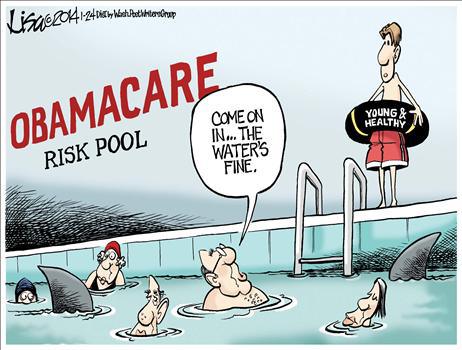
Risk Pool

Obamacare and its boosters are trying to come to grips with several new blows. Last month, United Health Care (UHC) announced that it would not participate in the Obamacare exchanges in the 2017 plan year. The announcement offers confirmation that the Affordable Care Act (ACA) is plagued by adverse selection on the exchanges it authorized, and the spiral will only get worse. This is emphasized in “Five Things ACA Supporters Don’t Want You To Know“: other carriers are struggling and will be forced to accept UHC’s adverse risk pool;  premiums must increase; more carriers will bail out; and quality of coverage will continue to decline because the ACA effectively punishes more comprehensive coverage.

Those insurers would have bailed sooner if not for subsidies they’ve been receiving from the federal government on individuals with incomes up to various multiples of the poverty line. However, the funding of a portion of those subsidies was ruled unconstitutional in federal appeals court in May. A deposition from a senior IRS official indicates that the Obama Administration was warned in early 2014 that it had no authority to make the payments, advice that it summarily dismissed. That’s on top of new lawsuits by insurers who say they were shorted by a wide margin on “risk corridor” payments owed to them by the federal government under Obamacare. The risk corridors, which supposedly cover a portion of aggregate losses on health exchange business, will expire after this year, just one the reasons to expect large premium hikes for next year.

As insurers drop out of the Obamacare exchanges, consumers will be forced to deal with a less competitive landscape. About half of the so-called coops on the exchanges had failed by the end of last year. A consequence of this attrition is that the range of coverage available to consumers will shrink:

“One BlueCross BlueShield subsidiary in Virginia has already filed plans to get out of the bronze plan, according to Inside Health Policy, and other insurers will follow suit if BCBS succeeds. That will destabilize the markets further, as one analyst told Leslie Small at Fierce Health Payer, because most of the younger and healthier participants in these risk pools have chosen bronze plans – and would likely bail out rather than pay higher premiums for insurance that they hardly ever use.“

Obamacare also fosters monopolization in the delivery of medical care. A pernicious effect is that local health-care markets are increasingly dominated by a single so-called “non-profit” hospital organization:

“Researchers at Johns Hopkins and Washington and Lee Universities report that seven of America’s 10 most profitable hospitals are officially not for profit. … That status entitles them to huge state and federal tax breaks — whose value has doubled in recent years — for ‘charity care and community benefit.’ …  A for-profit outlet will pay taxes and returns to investors. Nonprofits wind up paying huge sums to executives — and plowing cash into gaining more market share.“

Non-profit status does not preclude monopolistic behavior. These institutions possess:

“… enormous leverage when setting prices and negotiating reimbursement from private insurers — whose hands are tied because they need those hospitals to be part of their network to attract paying customers. … As Dr. Marty Makary of Johns Hopkins wrote in The Wall Street Journal back in 2014: ‘When you’re the only game in town, you call the shots.’“

It’s no coincidence that Obamacare rewards consolidation of health care providers through so-called Accountable Care Organizations (ACOs). That’s helped to drive the disappearance of independent physician practices in recent years. Those physicians are Increasingly employed by hospitals at which they can meet standardized quality measures more easily. The medical establishment maintains that ACOs will “bend the cost curve”… someday. But in the meantime, it’s not happening: the quality measures don’t provide good measures of health outcomes, and they inhibit innovation.

“For one thing, outcomes themselves are not easy to measure. An 80-year-old goes to the doctor with back pain. What is the best outcome? No pain? That’s probably impossible to achieve with even the highest quality care. Less pain? Maybe. But what does that mean and how do you measure it from patient to patient?

Then there is the matter of adjusting those scores for the severity of the disease and the social and economic status of the patient. This matters because low-income patients often struggle to manage their follow-up care or may be unable to afford medications. Such ‘risk adjustment’ is even harder to do with older adults with multiple chronic conditions.“

Even worse, while Obamacare seeks to broaden the market for health care to include those for whom good health coverage is otherwise out of reach, there is evidence that it is not truly improving access to health care. First, the kinds of policies that have been mandated provide relatively “thin” coverage, with high deductibles and copayment rates. Even when subsidized on the exchanges, many of the insured find actual health care payments to be prohibitive. Little wonder that emergency room utilization (where care must be provided regardless of ability to pay) has climbed under Obamacare, contrary to the early assertions of proponents. Second, many of the newly insured are covered by Medicaid, but low physician reimbursement rates have diminished the number of physicians willing to serve that market. Finally, while Obamacare increases the demand for provider services, it does not bring forth its own supply. A provider shortage is expected to continue to grow more severe over the next ten years.

The dual markets for health coverage and health care itself are becoming less competitive under Obamacare. The central planning inherent in the law effectively tossed the most potent forces available for reducing health care costs and expanding coverage: market competition and innovation. Higher prices represent only one avenue for the release of pressures created by mandates; shortfalls in access and the quality of care are others. While the medical establishment and regulators insist that safeguards are in place, it’s a safe bet that monopoly and central planning will have their usual dire effects.

What Does Government Give Your Gig?

28 Saturday May 2016

Posted by Nuetzel in Labor Markets, Obamacare

≈ Leave a comment

Tags

ACA, Affordable Care Act, Bending the Cost Curve, Contractor or Employee, Employee Status, Employer Mandate, Federal Health Care Exchange, Health Care Tax Credit, High Deductible, Individual Mandate, Labor Market Distortions, Obamacare, Obamacare Subsidies, United Health Care

image

An “employee” is different than a “contractor”, but those designations are often not very different in terms of job function. Are they different enough that large government subsidies and penalties  should depend on the distinction? Economist John C. Goodman explains why that question deserves a resounding “NO”!

Here’s an example: consider two individuals who perform the same job function and earn an identical wage of $13 per hour. One is an employee and the other is an independent worker under contract to the same company. The employee faces a high premium on the minimum health insurance policy mandated by Obamacare, which can carry a deductible of over $13,000 for a young, healthy family. The employee can pay the premium using pre-tax dollars, which provides some savings. The taxes saved are a subsidy, but an employee refusing coverage must pay a tax penalty under Obamacare. The contractor, on the other hand, might well qualify for subsidies on the Obamacare exchange, saving about 95% of the cost of the policy. Both individuals are subsidized, but the contractor gets considerably more in this case.

Now consider two individuals who earn $40 per hour, again an employee and a contractor. They are in a relatively high tax bracket. The contractor earns too much to qualify for Obamacare subsidies on the exchange but faces a tax penalty without coverage. The employee gets health coverage, albeit with a high deductible, paying pre-tax dollars at a significant discount. This time, the employee gets a big subsidy.

So essentially identical individuals are treated much differently. As Goodman says, that is terrible policy. Today, the distinction between employees and contractors is increasingly flimsy in terms of the services performed, and it is often a matter of convenience for employers and employees alike. Moreover:

“… even though the main purpose of the health reform was to insure the uninsured, the law in many ways encourages a great many people to be uninsured – the fine is often much less than the cost of very unattractive insurance. …  current policy encourages everyone to game the system: Stay uninsured when healthy and then rearrange your work relationships if you get sick.“

As Goodman notes, health coverage isn’t the only area in which this antiquated definition of the work relationship matters. His solution is to do away with the distinction between employees and non-employee workers altogether, eliminate the deductibility of health premiums for employees, end the Obamacare exchange subsidies, and instead provide a straight tax credit to every individual for the purchase of private health coverage. Loath as I am to admit any role for government in providing subsidies to other than the destitute, Goodman’s idea would at least level the subsidies without arbitrary distinctions and gaming of the system.

Similar considerations apply to arbitrary rules governing the distinction between full-time and part-time workers. The Obamacare employer mandate includes requirements on both the number of “employees” at a firm and an employee’s hours worked. Incentives are such that a change in the number of hour per week can dramatically alter the obligations of an employer and the government benefits available to workers (not to mention penalties to both), distorting economic outcomes in the productive sector of the economy. Limit the number of employees on your payroll and limit their hours if you want to avoid obligations. The negative impact on growth is particularly damaging to the self-sufficiency of low-income individuals. Again, government should remain neutral and stay out of regulating private labor transactions.

Obamacare is a mess on its own terms. Recall that it was to allow Americans with health insurance coverage to “keep their plans” if they chose to; it was to “bend the cost curve” in health care and insurance costs; and it was to provide coverage for the uninsured. Instead, Obamacare has disrupted insurance coverage for millions of Americans; created incentives for employers to reduce hours and employees; led to higher health care and insurance costs, created an adverse selection problem on the health care exchanges that threatens their sustainability; and more than 30 million Americans remain uninsured. The crucial role assigned by Obamacare to the formal relationship of workers to their hiring organizations has created perverse results.

Government should remain neutral in defining economic relationships. Allowing private actors to make their own informal arrangements or formal contracts is preferable both in terms of efficiency and fairness. Only they know the true economic realities “on the ground”. The distortions imposed by detached external rulemakers governing the  assignment of benefits are damaging and make adjustment to those realities more costly for everyone.


ObumbleCare & The Adverse Selectors

11 Wednesday Nov 2015

Posted by Nuetzel in Obamacare

≈ Leave a comment

Tags

adverse selection, Death Spiral, Emergency room utilization, Exchange-based plans, Medicaid expansion, Mercatus Center, Michael Tanner, Non-market solutions, Obamacare, Obamacare enrollment

Risk Pool

“… out in the real world, the bad news keeps coming, drop by drop, drip by drip, until we are seeing a virtual flood of Obamacare awfulness.“

That’s from Michael D. Tanner in “What’s Wrong With Obamacare?” Tonight, I offer  you a list of some of the drippings:

  • Flat enrollment, expected to be less than half of the original projection for 2016;
  • Almost all (97%) newly insureds under Obamacare are enrolled under expanded Medicaid, unaided by the many complexities introduced by Obamacare;
  • 12 of 23 federal health care insurance coops have failed as of Nov. 3;
  • High medical loss ratios are threatening the viability of insurers in 27 states, a result of adverse selection by relatively sick enrollees;
  • With unfavorable risk pools, premiums for all 2016 exchange-based plans are rising 20.3%, well above the 7.5% figure quoted by HHS for “Silver” plans;
  • Health insurance does not guarantee health care, and many of the newly insured are finding that providers are scarce, given reimbursement rates;
  • Emergency rooms utilization is up, as patients know they can get care there;
  • Rationing of care is increasingly a matter of waiting time, as it is in other countries that rely on non-market solutions to health care;
  • As many as 700,000 low-income enrollees are at risk of losing their coverage because they did not file tax returns;
  • For many, the penalty for not having coverage ($695 next year) is lower than the premium they would pay for coverage;
  • More than 5 million individuals lost their coverage under Obamacare, generally policies that were preferred over the new alternatives;
  • Poor incentives and burdensome provider requirements are pushing costs up.
  • Employers are attempting to minimize the cost of Obamacare. The law makes hiring more expensive and leads to substitution of part-time for full-time workers;

The “death spiral” might not be far-off for Obamacare. Here is Tanner’s assessment:

“The young and healthy simply haven’t signed up for Obamacare in the same numbers as those who are older and sicker. The only way for insurers to offset their skyrocketing [Medical Loss Ratios] is to hike premiums still further. … premiums in the worst states could have to rise by an average of 34 percent, and possibly as much as 52 percent. But premium hikes of that magnitude would almost certainly further discourage younger and healthier Americans from buying insurance.“

There is no question that Obamacare will have to be replaced or changed substantially.  Unfortunately, Obamacare apologists simply can’t come to grips with the reality of the law’s failure. They would do well to start focusing on new solutions to the problems that Obamacare was intended to solve. To that end, the Mercatus Center commissioned a collection of seven essays on how best to deal with the problem of pre-existing conditions, now published on the Mercatus web site. Market-based solutions are needed to encourage competition among insurers, incentivize innovation and cost control, and reestablish the primacy of the patient-provider relationship.

Obamacare’s Left-Handed Monkey Wrench

20 Tuesday Oct 2015

Posted by Nuetzel in Central Planning, Obamacare

≈ Leave a comment

Tags

ACA, Accountable Care Organizations, Bending the Cost Curve, central planning, David Henderson, Exchange Enrollment, Ezra Klein, John C. Goodman, Medicare Advantage, Megan McArdle, Michael Schaus, Obamacare, Obamacare Coops, Obamacare Replacement, Pay For Performance, Risk corridors, Wharton ACA Study

ACA Zombies

Distorted overtures celebrating the great success of Obamacare continue, but no one who cares about the facts is buying the blather. Megan McArdle reminds us that even if we stipulate that the 9.9 million now enrolled on the exchanges have gained something, Obamacare has delivered far less than promised. McArdle also notes the high-risk skew of the population within the risk pools. That’s why insurers are losing money on Obamacare coverage, though their losses have been covered via government “risk corridors” thus far. In “Obamacare Bear Market” at wsj.com (links to a Google search result to get around the paywall — or just search “wsj Obamacare Bear”), we hear about the dismal financial performance of the Obamacare coops, which sell plans on the exchanges. The WSJ also reflects on a new working paper from Wharton economists:

“They conclude that, ‘even under the most optimistic assumptions,’ half of the formerly uninsured take on both a higher financial burden and lower welfare, and on net ‘average welfare for the uninsured population would be estimated to decline after the ACA [Affordable Care Act] if all members of that population obtained coverage.’

In other words, ObamaCare harms the people it is supposed to help. This is not a prescription for a healthy, durable program.“

Health economist John C. Goodman gives more detail on the Wharton study in “Obamacare is bad for the middle class“. Even Ezra Klein admits that the health plan is a failure. Whether Klein really gets it or not, the result is just another failure of central planning. Here’s a quote from Michael Schaus from the last link:

“The same people who failed miserably at launching a website will soon be regulating the sophisticated day-to-day decisions of hospitals, insurers and doctors.“

Anticipating another year of disappointing enrollments ahead, the White House now is low-balling its enrollment target for 2016. This an apparent attempt to present a better face to the public when the bad numbers roll in.

Another piece by Goodman explains that “bending the cost curve” with Obamacare was always a fool’s errand. Again, it has a lot to do with the folly of central planning:

“In a normal market, the entrepreneurs wake up every morning and ask themselves: How can I make costs lower, quality higher, and access to my product better today?

But in a bureaucratic system – where revenues are determined not by customer satisfaction, but by complicated payment formulas – they tend to wake up and ask: How can I get more money out of the payment formulas today?“

Goodman explains that an insurance firm providing coverage through Medicare Advantage would have nothing to gain by introducing cost-saving innovations: all of the extra profit would be turned over to Medicare. Incentives matter, but bureaucrats often fail to understand incentives and their power to improve performance. Goodman also describes the poor results of the so-called Accountable Care Organizations, the futile pilot programs and demonstration projects related to the practice of medicine, and the gaming that has taken place within the hospital “pay-for-performance” program. Ironically, the most certain outcome of any attempt to impose central planning on an industry is that there will be unintended and undesirable consequences.

Goodman has written a book proposing an Obamacare replacement, entitled “A Better Choice: Healthcare Solutions For America“. Here is David Henderson’s favorable review, in which he focuses on the negative labor market effects of Obamacare, including poor incentives for employers and work effort, among other things. To close, here’s an excerpt from Henderson’s introduction:

“If you think that the Patient Protection and affordable Care act (ACA, also known as Obamacare) is bad because of its expense, the distortions it causes in the labor market, its failure to provide people what they really want, and its highly unequal treatment of people in similar situations, wait until you read John C. Goodman’s A Better Choice: Healthcare Solutions for America. You will likely conclude that the ACA is even worse than you thought.

That’s the bad news. The good news is that Goodman … proposes reforms that would do more for the uninsured than the ACA does, and at lower cost, and also would make things better for the currently insured. and it would do all this while avoiding mandates, creating more real competition among insurers, and making the health care sector more responsive to consumers….“

White House Spins Weak Obamacare Enrollments

24 Monday Aug 2015

Posted by Nuetzel in Markets, Obamacare

≈ Leave a comment

Tags

ACA, ACA Exchange enrollment, ACA premium increases, Cronyism, Death Spiral, Heartland Institute, HHS Inspector General report, Insurer subsidies, Marco Rubio, Medicaid enrollment, Obamacare, Open enrollment, Rand Corporation, Reason Magazine, Robert Laszewski, Scott Walker, Slate, Somewhat Reasonable blog, Special enrollment period, Verification of eligibility

obamacare-humor-Screw

The Obama Administration is trying desperately to burnish the record of the President’s signature “achievement”, the Affordable Care Act (ACA), a.k.a. Obamacare.  That’s a tall order, unless the subject is the ACA’s remarkable triumph for excellence in high cronyism. Otherwise, little wonder that they tell only part of the Obamacare story. Robert Laszewski recently examined ACA’s enrollment in more detail and found the record rather dismal. He notes the following:

“… the Obama administration is just reporting the good news and a good share of the press appears to be happy to pass these numbers along–albeit in a technically correct but hardly complete way.“

Here are two examples provided by Laszewski:

  • The Rand Corporation reported that a net total of 16.9 million people were newly enrolled through February 2015. This was picked up by the press, which attributed the increase to Obamacare. But only 4.1 million of those newly insured came from the individual marketplaces (as noted by Rand). Most of those eligible for coverage through the marketplaces have not enrolled. Most of those who have enrolled were qualified for subsidies. Another 6.5 million came from Medicaid, which is free to those who qualify for that program. 9.6 million came from employer-provided plans, which has much to do with improved hiring over the past two years, as opposed to the ACA.
  • There were almost 950,000 new enrollees during the “special enrollment period” (after open enrollments ended) this year. This was heralded by the media, but little was said about the 1.3 million who dropped off the Obamacare rolls by the end of March. That number will grow once the administration comes clean on the number who have dropped coverage since then.

From Laszewski:

“The Obamacare insurance exchanges aren’t enrolling anywhere near the number of people they were supposed to. And, there is no proof Obamacare has grown since the close of open enrollment. In fact the anecdotal and historical evidence would suggest it is now shrinking.“

Going forward, the prospects for ACA enrollment are not good. As Slate belatedly reported last month, substantial premium increases are expected for 2016. The Heartland Institute‘s “Somewhat Reasonable” blog reports that “Millions of Americans Refuse to Buy Obamacare, Prefer to Pay Penalty“. The total who have refused is 7.5 million, much more than expected, while another 12 million people have claimed that they are exempt from the ACA’s requirements. Obamacare pricing and subsidies contain perverse incentives. It remains to be seen whether the insurers dominating the exchanges will have a sufficient number of young, healthy individuals enrolled and paying inflated premiums to offset the claims of more heavily-subsidized, high-risk enrollees.

There are many other problems plaguing Obamacare, including limited access to health care providers for many enrollees. Reason.com recently asked whether Obamacare is simply too complex to work, a question based largely on the findings of an HHS Inspector General’s report. There are massive issues related to verification of eligibility for subsidies and back-end payment systems for compensating insurers:

“Think of it this way: Before Obamacare, the U.S. health system was like a giant tangled knot. If you’ve ever tried to untangle a big knot, you know that it can take a while, and that the trick is to patiently loosen one bit at a time.

Obamacare’s designers, in contrast, saw that they couldn’t undo the knot, so they added more string, and tied it into the knot that was already there. Now it’s an even bigger mess.“

The so-called Obamacare success story is wishful thinking and shameless propaganda. It has failed to accomplish its goals in terms of coverage and especially cost, it has resulted in lost coverage to millions in the individual market who “liked their plans”, and it has caused millions of others who “liked their doctors” to lose their doctors. Things are not looking any rosier as we approach the implementation of the employer mandate (which was delayed twice) in 2016.

There are many ideas in play for improving health care coverage and access post-Obamacare. Here are summaries of the plans floated so far by Republican Presidential candidates Scott Walker and Marco Rubio. Though neither plan is a detailed as I’d like, some of the proposed high-level features are promising, at least relative to the ACA. There will be more proposals from other candidates before long. I’m hopeful that they will all remember to let markets work.

Trump Tower of Babble

09 Sunday Aug 2015

Posted by Nuetzel in Big Government, Marketplace of Ideas, Obamacare

≈ 2 Comments

Tags

Andrew Popkin, Bankruptcy, Brett Baier, crony capitalism, Donald Trump, eminent domain, GOP Debate, Hillary Clinton, Megyn Kelly, Obamacare, Peter Suderman, Rand Paul, single-payer plan, Vox

Presidential candidate, Donald Trump, has been critical of fellow Replubicans including Sen. John McCain. Some voters are curious about his "daffy" behavior.

Here’s a post-debate follow-up on Donald Trump the Shape Shifter: I’m surprised to hear anyone praising his performance after that debacle. He came off as a dick, and that’s really The Donald. I thought so before I heard that he suggested Megyn Kelly was menstruating that evening. Megan was tough, but please…. Trump is a loud-mouthed, offensive, and often incoherent bully.

Two Trump moments that I thought were amazing were his exchange with Brett Baier about political donations and his dust-up with Rand Paul over a single-payer health care system.

On donations, Trump seemed to take satisfaction in the fact that Hillary Clinton “had no choice” but to attend his wedding after he gave to her Senate campaign. He then made the following statement, which made me laugh:

“I will tell you that our system is broken. I gave to many people. Before this, before two months ago, I was a businessman. I give to everybody. When they call, I give. And you know what? When I need something from them, two years later, three years later, I call them. They are there for me. And that’s a broken system.“

Should I love him or hate him for that statement? He admits with no shame that he participates in crony capitalism, and he realizes that it’s corrupt. Andrew Popkin at Vox has a good analysis:

“Something Trump identifies that doesn’t always get mentioned is the way transactional politics transcend partisanship and ideology. Trump gave to Democrats and he gave to Republicans. He didn’t care what they believed. He cared what they could do for him. He wasn’t supporting them — he was buying them, and that’s completely different.“

It’s convenient for Trump to brag that he doesn’t need donations from others when campaigning. When he’s on the other side of the table, he’s happy to participate in the corruption. Did Trump buy the politicians who helped him arrange eminent domain actions against property owners who were in the way of his developments? He’s also quite proud of his use of bankruptcy laws allowing him to stiff lenders and investors in his enterprises. By the way, in comparing his four corporate bankruptcies to the many “deals” he’s executed over the years, he’d have you believe that the “deal” is always the relevant unit for a bankruptcy proceeding. That’s loose and misleading jargon.

I have said that Trump’s supporters really don’t know what their getting. Perhaps he won’t tell anyone because he’d lose “leverage”. A prime example of Trump’s shiftiness was his response to the following question on single-payer health care systems, including his attempt to embarrass Rand Paul:

Baier: “Now, 15 years ago, you called yourself a liberal on health care. You were for a single-payer system, a Canadian-style system. Why were you for that then and why aren’t you for it now?“

As Peter Suderman noted, Trump’s response to this question about health care began with his views on the war in Iraq. Donald’s rules…. But eventually, he addressed the health care question with a stream of words that thinking people might have been tempted to process logically in order to divine a coherent “Trump” position on the issue, but that would have been a mistake:

“As far as single payer, it works in Canada. It works incredibly well in Scotland. It could have worked in a different age, which is the age you’re talking about here.

What I’d like to see is a private system without the artificial lines around every state. I have a big company with thousands and thousands of employees. And if I’m negotiating in New York or in New Jersey or in California, I have like one bidder. Nobody can bid. You know why? Because the insurance companies are making a fortune because they have control of the politicians, of course, with the exception of the politicians on this stage. But they have total control of the politicians. They’re making a fortune.“

This is not a great moment of clarity for Trump. We still don’t know what he has in mind. He demonstrates that he doesn’t quite understand the inherent flaws in single-payer. If his complaint is with consolidation of the health insurance industry, single-payer would imply an even greater consolidation, indeed, a monopoly. A “private system” does not rule out single-payer. While the insurance companies have undoubtedly influenced politicians, just as Trump has, why is he complaining about a lack of choice, having just asserted that single-payer could work so well? And artificial lines have to do with non-price rationing, a typical feature of government intervention in markets. Thus far, the profits of under-pricing insurers have been protected by so-called “risk corridors” built into Obamacare. Would Trump allow health care providers and insurers to reprice in order to eliminate “artificial lines”? Trump’s words did not settle any questions about his position.

The end of Trump’s response is this:

“And then we have to take care of the people that can’t take care of themselves. And I will do that through a different system.“

So… was Trump still talking about single-payer or not? I forgive Rand Paul for imagining that he was. It was the only solid statement that one could cling to in Trump’s ramble.

Here is Suderman’s summary of Trump’s response with an account of the exchange with Rand Paul that followed:

“What matters is that [Trump] would be different. Different how? So very, very different—and definitely not a moron/loser/dummy/incompetent (pick one) like this other guy.

This is how Trump responds to almost everything: By not answering the question, by babbling out some at-best semi-relevant references, by promising to somehow be different and better without explaining how or why, and then by lobbing an insult.

An insult is how Trump finishes the Obamacare exchange as well. After Trump finishes answering the question, Sen. Rand Paul cuts in, saying, ‘News flash, the Republican Party’s been fighting against a single-payer system for a decade. So I think you’re on the wrong side of this if you’re still arguing for a single-payer system.’ [SCC’s bolding]

Trump’s comeback: ‘I’m not—I’m not are—I don’t think you heard me. You’re having a hard time tonight.’

The gist, as always, is that someone else—indeed, practically everyone else—is a dummy, a loser, a politician. Trump is the only one who really gets it, whatever it is.“

While I thought Rand Paul’s interjectory approach to debating was unwise, his comment to Trump was on-target, and he even qualified it. Trump responded with snark. Trump has yet to take a real position on health care in this campaign, but he has supported single-payer in the past. He doesn’t want to go to the trouble of deciding or revealing a specific plan just yet. Perhaps he’s “maintaining leverage”, keeping his options open, because he’s such a smart businessman. If you want to treat politics like a business deal, fine, but smart voters should be your partners, and they will expect you to reveal your terms.

Borkians Preserve Federal Obamacare Subsidies

29 Monday Jun 2015

Posted by Nuetzel in Obamacare

≈ Leave a comment

Tags

ACA, Administrative State, Affordable Care Act, Chief Justice Roberts, Damon Root, Ilya Shapiro, Judicial Activism, Judicial Restraint, King vs. Burwell, Obamacare, Randy Barnett, Robert Bork, Robert Laszlewski, SCOTUS, SCOTUSblog, Tyler Cowen

ACA Supremes cartoon

I have mixed feelings about the Supreme Court’s King vs. Burwell decision upholding federal subsidies for health insurance purchased in states that did not establish their own exchanges. My biggest concerns are that the decision gives a pass to the unchecked exercise of executive fiat as well as congressional carelessness (“lassitude”, to use Justice Scalia’s term), and the smearing of the separation of legislative and judicial powers. I admit that I was eager to see the exchanges unravel under the weight of their own lousy economics. However, the economics remain lousy even with the ruling, which will become more evident as major subsidies to health insurers expire over the next 18 months. It will be interesting to watch as the process of escalating premia plays out. I’m relieved that the Obamacare opposition in Congress (primarily Republicans) is now off the hook. These legislators never coalesced around an alternative and would have received a good portion of the blame for any further disruptions in the insurance “market” had the decision gone the other way. Probably their best approach would have been to extend the subsidies to all exchanges, at least for the remainder of Obama’s term. As Tyler Cowen notes, an extension would have occurred:

“… only after a lot of political stupidity and also painful media coverage. So on net I take this to be good news, although arguably it is bad news that it is good news.“

On the merits of health care policy, given the failure to put forward a better plan, what would have been gained over the next 18 months from a ruling for the plaintiffs? Not much.

Cowen links to a Robert Laszlewski post emphasizing the fragile economic and political condition of Obamacare:

“Obamacare has only enrolled about 40% of the subsidy eligible market in two years worth of open enrollments. That level of consumer support does not make Obamacare either financially sustainable or politically sustainable. The surveys say the 40% who have enrolled like their plans. Of course they do, they are the poorest with the biggest subsidies and the lowest deductibles. The working and middle-class have most often not signed up for Obamacare because it costs too much and delivers too little.

That Obamacare is not financially sustainable is evidenced by the first wave of big 2016 rate increases by so many large market share insurers. The next wave of rate increases a year from now will also be large and will be in the middle of the 2016 election.“

The SCOTUS decision flies in the face of the roles and responsibilities assigned to the branches of government by the Constitution. The implication of the ruling is that a law means whatever the executive branch says it means, even when it says the opposite unambiguously. This goes too far in granting executive power to “reimagine” legislation, and the Left may well come to regret it as a precedent. Executive rulings in implementing laws is nothing new, but one hopes for the courts to keep a tight rein on this discretion in an era when the regulatory environment is growing increasingly complex.

A Randy Barnett post at SCOTUSblog quotes Chief Justice Roberts’ opinion:

“Congress passed the Affordable Care Act to improve health insurance markets, not to destroy them. If at all possible, we must interpret the Act in a way that is consistent with the former, and avoids the latter.“

Improve health care markets? Not destroy them? Wait… I’m confused! But seriously, at this point in the process, Justice Roberts must be confused about actual outcomes. An objective assessment of Obamacare would include an accounting for the many individuals whose policies were cancelled against their wishes, premium escalation, and the fact that the ACA has fallen well short of expectations for reducing the number of uninsured; the law has certainly not improved markets. Barnett describes Roberts’ apparent philosophy on this point thusly:

“... the Chief Justice seems to be telling us that he is once again putting a thumb on the scale for the government here as he did in his solo opinion in NFIB. Rather than assessing the constitutionality of the law as written – or enforcing it according to its terms – the court will rewrite the law to suit the government.” 

This is not merely “legislative deference”, it is legislative rescue and a rewriting of the law. And Barnett points out that the Courts should provide a check on bad legislation, not serve as enablers.

Damon Root offers an excellent clarification of Roberts’ thinking: the strand of conservative judicial philosophy calling for deference to legislative intent is often attributed to Robert Bork. This obviously conflicts with the notion that conservatives are judicial activists. I discussed judicial activism here a few months ago, including Randy Barnett’s assertion that the term seems to be invoked as a pejorative almost any time someone doesn’t like a court decision. If it means preserving the Constitution, then count me as an activist.

Ilya Shapiro sums up the “intent” of the legislation and the “deferential” position taken by the court in King vs. Burwell:

“Roberts explains his transmogrification by finding it ‘implausible that Congress meant the Act to operate in this manner,’ to deny subsidies to millions of people as part of legislation intended to expanded coverage. But it’s hardly implausible to think that legislation that still says that states ‘shall’ set up exchanges—the drafters forgot to fix this bit after lawyers pointed out that Congress can’t command states to do anything—would effectively give states an offer nobody thought they’d refuse. It was supposed to be a win-win: states rather than the federal government would run health care exchanges (yay federalism!) and all those who need subsidies to afford Obamacare policies would get them (yay universal healthcare!).

But a funny thing happened on the way to utopia, and only 14 states (plus D.C.) took that too-tempting offer, perhaps having been burned too many times before by the regulations that accompany any pots of “free” federal money. And that’s why we ended up with King v. Burwell: Obamacare the reality doesn’t accomplish Obamacare the dream.“

We’ll watch to see how badly Obamacare fares over the next two years. And we’ll hope that eventually Congress can fashion a new health care plan that creates more choice, reduces taxes, increases competition and reduces coercive rules and regulatory burdens.

More Unpleasant Obamacare Arithmetic

15 Monday Jun 2015

Posted by Nuetzel in Obamacare, Uncategorized

≈ Leave a comment

Tags

adverse selection, Affordable Care Act, Death Spiral, Expanded Medicaid eligibility, Forbes, Obamacare, Political Calculations, Reinsurance program, Risk corridors, Robert Laszewski

How-the-ACA-Works

States with expanded Medicaid eligibility may be more vulnerable to adverse selection, hastening the death spiral of their Obamacare insurance exchanges relative to states without expanded Medicaid. This is because 1) the expanded, eligible Medicaid population is young, and 2) pricing (net of subsidies) and benefits on the exchanges encourage sicker individuals to purchase plans with richer benefits. The Political Calculations blog presents this case in “How Medicaid’s Expansion Tips the Scales Against Obamacare“:

“… we observe that the states that did not expand their Medicaid programs have a much larger share of their ACA-enrollment occurring in the lower-tier metal plans that would tend to be favored by healthier individuals. Meanwhile, in the states that expanded the enrollment of their Medicaid programs under the law, we find that a significantly larger portion of their ACA enrollments were in the plans that would be favored by less healthy individuals.

In fact, we see that in Medicaid expansion states, 13.2% of their ACA enrollment occurred in the highest-tier Gold and Platinum level plans, while non-Medicaid expansion states saw 7.7% of their enrollment for these highest tiers of health insurance coverage.

The seemingly small 5.5% difference between these two figures becomes exceptionally significant when you consider how extremely concentrated health care expenditures are in the United States, where just 5% of U.S. patients are responsible for generating 50% of all health care spending in the nation.“

It will be difficult to confirm this hypothesis using data on premium increases, or actual exchange failure, until the temporary risk corridors and transitional reinsurance program expire. However, this year, several of the states in which proposed premium increases are the largest have expanded Medicaid eligibility. Robert Laszewski has a good discussion about some the reasons for the large premium increases in Forbes. It’s early and there are signs that it will get worse.

As noted last week on this blog, Medicaid itself does not stack up well in terms of how highly it is valued by recipients and the moral hazard inherent in the program. Here we see an additional bug: expanded Medicaid appears to siphoning away younger potential enrollees from the exchanges in those states, worsening the problem of adverse selection, which will negatively affect their claims experience.

Medicaid and Value Mislaid

12 Friday Jun 2015

Posted by Nuetzel in Obamacare

≈ 1 Comment

Tags

Amy Finkelstein, Earned Income Tax Credit, Erzo F.P. Luttmer, Implicit insurance, Marginal Revolution, Medicaid, Megan McArdle, Moral Hazard, Nathaniel Hendren, Obamacare, Oregon Health Insurance Experiment, Redistribution, Relative Value Units, Uncompensated care, Welfare value

Medicaid-Agency-Cartoon

A new paper on the MIT Econ department web site finds that the “welfare benefit to recipients from Medicaid per dollar of government spending range from $0.2 to $0.4, depending on the framework ….” Those estimates are from “The Value of Medicaid: Interpreting Results from the Oregon Health Insurance Experiment” by Amy Finkelstein, Nathaniel Hendren, and Erzo F.P. Luttmer (Hat Tips: Marginal Revolution, John Crawford). A major share of the increase in the number of insured individuals under Obamacare stems from Medicaid enrollments, so the efficacy of the program is of great interest as the nation considers possible changes to the health care law.

The value of Medicaid to recipients is low in part because the coverage is incremental to the uncompensated medical care they would have received without coverage. So perhaps it’s not too surprising that if “… Medicaid recipients had to pay the government’s average cost of Medicaid, they would rather be uninsured.” That’s why I think some of the commentary on this result is a little unfair, such as the way it’s presented by Megan McArdle. There are clearly other reasons why Medicaid receives a low valuation by recipients, however. For example, the authors find that the program entails substantial costs of moral hazard, which may mean that recipients are in poor health relative to reimbursement levels, take risks that they would avoid in the absence of coverage, or simply over-utilize services for which they would be unwilling to pay, even if the cash were made directly available. While it doesn’t receive much focus from the authors, low reimbursement rates discourage providers from accepting Medicaid patients. That would certainly reduce one’s willingness to pay for the coverage.

Finkelstein, Hendren and Luttmer estimate that 40% to 80% of Medicaid’s welfare value derives from “a transfer component, as opposed to its ability to move resources across states of the world.” The transfers go to providers who, in the absence of Medicaid coverage, would offer “implicit insurance” in the form of uncompensated care. As noted above, that’s a good thing. Providers should be compensated rather than relied upon as a charities, though there are strong indications that compensation is inadequate.

The authors also estimate the value of Medicaid as a “redistribution tool” relative to the earned income tax credit (EITC). At best, they find that recipients would slightly prefer Medicaid cuts to equivalent reductions in the EITC (though the comparison suffers from some conceptual shortcomings). Unsurprisingly, the outcome depends upon how highly the “transfers” to health care providers are valued by enrollees. So the program seems to do poorly in the eyes of recipients, who would likely prefer outright transfers of cash. I would speculate that many recipients would prefer a voucher with which they could purchase coverage levels of their choice, retaining any excess not spent.

The “Value of Medicaid” study suggests that the program is unsuccessful in delivering value to recipients and taxpayers. Obamacare reform should include fundamental changes to the Medicaid program, measures that restore individual choice and the private market for health coverage, and provisions to increase competition in the health care and insurance markets. Eliminating prohibitions on the sale of health insurance across state lines would be a good start. Reforms should also combat excessive regulation of health care providers, such as eliminating the electronic health records mandate and reforming the inflexible system of compensation based on relative value units. Market-oriented reforms and competition can reduce costs and make health care more affordable, aiding in the delivery of greater benefits to all segments of society.

Heal, You Dogs!

26 Tuesday May 2015

Posted by Nuetzel in Obamacare, Shortage, The Road To Serfdom

≈ Leave a comment

Tags

Band the cost curve, Classical Values, Death Spiral, federal subsidies, Joel Winberg, King v. Burwell, Medicaid reimbursement, Obamacare, Rand Paul, Risk corridors, SCOTUS, Shortage

Doctor-shortage

In bondage to the State: The Classical Values blog has this interesting quote from Dr. Rand Paul:

“With regard to the idea of whether or not you have a right to healthcare, you have to realize what that implies….I’m a physician, that means you have a right to come to my house and conscript me, it means you believe in slavery. It means you’re going to enslave not only me, but the janitor at my hospital, the assistants, the nurses…There’s an implied threat of force, do you have a right to beat down my door with the police, escort me away, and force me to take care of you? That’s is ultimately what the right to free healthcare would be.”

It would be “free” only in nominal terms to the patient, and greatly degraded. The gap between the need for health care and the available supply cannot be solved via “conscription” of providers. And caring for the sick is one thing, but granting a “right” to well-care or health maintenance makes the gap much larger. Inadequate compensation to providers is an important subtext here, and it goes to the heart of the conflict. Basic economics tells us that the gap in access will expand if buyers are subsidized and providers are penalized by artificially low prices. The expanded eligibility for Medicaid in many states under Obamacare only exacerbates shortages, as physician reimbursements remain generally low.

Obamacare may have improved access to health care for a small minority of individuals, but only at the expense of penalizing many others, including providers. The program has fallen far short of its goal of covering the uninsured and has failed to “bend the cost curve” (despite false claims to the contrary, which attempt to take credit away from the Great Recession for slowing costs). Obamacare still looks to be unsustainable, as many have predicted. Insurers are now seeking large rate increases in many states, and going forward, they will not have the cushion of government-funded “risk corridors” when premiums fail to cover claims.

A Supreme Court ruling in the King v. Burwell case is due next month. The case has been discussed on this blog twice this spring. The plaintiffs have challenged federal subsidies in states relying on federal insurance exchanges in direct contradiction to the “plain language of the law”. The subsidies were intended to be an inducement to states to set up their own exchanges, but a number of states chose not to do so. A ruling for the plaintiffs would severely damage the Obamacare program, since the subsidies are key to making the relatively extravagant mandated coverage affordable to low-income individuals. However, Joel Zinberg insists that ending federal subsidies will not cause a death spiral.

Still, such a ruling would seem to give Congress and the Republicans an opportunity to craft legislation to replace Obamacare with a more viable program. Republicans seem have been unable to craft a strategy for dealing with this contingency, but their best strategy might be to wait, pass an extension of subsidies until 2017, and dare Obama not to sign it into law.

← Older posts
Newer posts →
Follow Sacred Cow Chips on WordPress.com

Recent Posts

  • The Case Against Interest On Reserves
  • Immigration and Merit As Fiscal Propositions
  • Tariff “Dividend” From An Indigent State
  • Almost Looks Like the Fed Has a 3% Inflation Target
  • Government Malpractice Breeds Health Care Havoc

Archives

  • January 2026
  • December 2025
  • November 2025
  • October 2025
  • September 2025
  • August 2025
  • July 2025
  • June 2025
  • May 2025
  • April 2025
  • March 2025
  • February 2025
  • January 2025
  • December 2024
  • November 2024
  • October 2024
  • September 2024
  • August 2024
  • July 2024
  • June 2024
  • May 2024
  • April 2024
  • March 2024
  • February 2024
  • January 2024
  • December 2023
  • November 2023
  • August 2023
  • July 2023
  • June 2023
  • May 2023
  • April 2023
  • March 2023
  • February 2023
  • January 2023
  • December 2022
  • November 2022
  • October 2022
  • September 2022
  • August 2022
  • July 2022
  • June 2022
  • May 2022
  • April 2022
  • March 2022
  • February 2022
  • January 2022
  • December 2021
  • November 2021
  • October 2021
  • September 2021
  • August 2021
  • July 2021
  • June 2021
  • May 2021
  • April 2021
  • March 2021
  • February 2021
  • January 2021
  • December 2020
  • November 2020
  • October 2020
  • September 2020
  • August 2020
  • July 2020
  • June 2020
  • May 2020
  • April 2020
  • March 2020
  • February 2020
  • January 2020
  • December 2019
  • November 2019
  • October 2019
  • September 2019
  • August 2019
  • July 2019
  • June 2019
  • May 2019
  • April 2019
  • March 2019
  • February 2019
  • January 2019
  • December 2018
  • November 2018
  • October 2018
  • September 2018
  • August 2018
  • July 2018
  • June 2018
  • May 2018
  • April 2018
  • March 2018
  • February 2018
  • January 2018
  • December 2017
  • November 2017
  • October 2017
  • September 2017
  • August 2017
  • July 2017
  • June 2017
  • May 2017
  • April 2017
  • March 2017
  • February 2017
  • January 2017
  • December 2016
  • November 2016
  • October 2016
  • September 2016
  • August 2016
  • July 2016
  • June 2016
  • May 2016
  • April 2016
  • March 2016
  • February 2016
  • January 2016
  • December 2015
  • November 2015
  • October 2015
  • September 2015
  • August 2015
  • July 2015
  • June 2015
  • May 2015
  • April 2015
  • March 2015
  • February 2015
  • January 2015
  • December 2014
  • November 2014
  • October 2014
  • September 2014
  • August 2014
  • July 2014
  • June 2014
  • May 2014
  • April 2014
  • March 2014

Blogs I Follow

  • Passive Income Kickstart
  • OnlyFinance.net
  • TLC Cholesterol
  • Nintil
  • kendunning.net
  • DCWhispers.com
  • Hoong-Wai in the UK
  • Marginal REVOLUTION
  • Stlouis
  • Watts Up With That?
  • Aussie Nationalist Blog
  • American Elephants
  • The View from Alexandria
  • The Gymnasium
  • A Force for Good
  • Notes On Liberty
  • troymo
  • SUNDAY BLOG Stephanie Sievers
  • Miss Lou Acquiring Lore
  • Your Well Wisher Program
  • Objectivism In Depth
  • RobotEnomics
  • Orderstatistic
  • Paradigm Library
  • Scattered Showers and Quicksand

Blog at WordPress.com.

Passive Income Kickstart

OnlyFinance.net

TLC Cholesterol

Nintil

To estimate, compare, distinguish, discuss, and trace to its principal sources everything

kendunning.net

The Future is Ours to Create

DCWhispers.com

Hoong-Wai in the UK

A Commonwealth immigrant's perspective on the UK's public arena.

Marginal REVOLUTION

Small Steps Toward A Much Better World

Stlouis

Watts Up With That?

The world's most viewed site on global warming and climate change

Aussie Nationalist Blog

Commentary from a Paleoconservative and Nationalist perspective

American Elephants

Defending Life, Liberty and the Pursuit of Happiness

The View from Alexandria

In advanced civilizations the period loosely called Alexandrian is usually associated with flexible morals, perfunctory religion, populist standards and cosmopolitan tastes, feminism, exotic cults, and the rapid turnover of high and low fads---in short, a falling away (which is all that decadence means) from the strictness of traditional rules, embodied in character and inforced from within. -- Jacques Barzun

The Gymnasium

A place for reason, politics, economics, and faith steeped in the classical liberal tradition

A Force for Good

How economics, morality, and markets combine

Notes On Liberty

Spontaneous thoughts on a humble creed

troymo

SUNDAY BLOG Stephanie Sievers

Escaping the everyday life with photographs from my travels

Miss Lou Acquiring Lore

Gallery of Life...

Your Well Wisher Program

Attempt to solve commonly known problems…

Objectivism In Depth

Exploring Ayn Rand's revolutionary philosophy.

RobotEnomics

(A)n (I)ntelligent Future

Orderstatistic

Economics, chess and anything else on my mind.

Paradigm Library

OODA Looping

Scattered Showers and Quicksand

Musings on science, investing, finance, economics, politics, and probably fly fishing.

  • Subscribe Subscribed
    • Sacred Cow Chips
    • Join 128 other subscribers
    • Already have a WordPress.com account? Log in now.
    • Sacred Cow Chips
    • Subscribe Subscribed
    • Sign up
    • Log in
    • Report this content
    • View site in Reader
    • Manage subscriptions
    • Collapse this bar
 

Loading Comments...