• About

Sacred Cow Chips

Sacred Cow Chips

Category Archives: Socialism

Suspending the Economic Problem With Free Stuff

27 Saturday Aug 2016

Posted by Nuetzel in Central Planning, Socialism, Subsidies

≈ Leave a comment

Tags

Bernie Sanders, central planning, Confiscation, Contrived Scarcity, Don Boudreaux, Free Stuff, Hillary Clinton, incentives, Jeffrey Tucker, Nonprice Rationing, Overuse of Resources, Property Rights, Redistribution, Scarcity Deniers, Socialism

denial

When things are scarce, they can’t be free. That’s an iron law of economics. It’s true of everything we ever wish for and almost everything we take for granted. Things are naturally scarce, but when we are told that things can be free, it always comes from likes of whom Jeffrey Tucker calls “scarcity deniers”. Bernie Sanders and Hillary Clinton have told America that a college education should be free, and a large number of people take that seriously. They are scarcity deniers. On one level, the Sanders/Clinton claim is like any other promise that simply cannot be met at the stated cost — a rather garden-variety phenomenon among politicians. These promises are not harmless, as such initiatives usually involve budget overruns, compromised markets, underproduction and wasted resources.

The Sanders/Clinton claim, however, is a form of scarcity-denial that comes almost exclusively from the political left. That is really the point of Tucker’s article:

“This claim seems to confirm everything I’ve ever suspected about socialism. It’s rooted in a very simple error, one so fundamental that it denies a fundamental feature of the world. It denies the existence and the persistence of scarcity itself. That is to say, it denies that producing and allocating is even a problem. If you deny that, it’s hardly surprising that you have no regard for economics as a discipline of the social sciences.“

Our socialist friends (who otherwise claim to be defenders of science) contend that free things can be offered to a broad swath of the population with little consequence. The least cynical among them (perhaps including Sanders) believe that the costs can be shouldered by the wealthy and/or big corporations and banks. Others (including Clinton) know that the cost of “free things” must be met by higher taxes on a broader share of the population. Doesn’t that mean they recognize scarcity? Only superficially, because they fail to grasp the dynamics of resource allocation, the subtle forms in which costs are imposed, and the true magnitude of those costs.

If a thing is scarce, available supplies must be balanced against demand. The reward to suppliers at the margin must match the willingness of buyers to pay. That means there is no surplus and waste, nor any loss attendant to shortage and non-price rationing. The price creates an incentive for consumers to conserve and an incentive for producers to bring additional supplies to market when they are demanded.

A crucial prerequisite for this to work is the establishment of secure property rights. Then, absent coercion, one can’t overuse what isn’t theirs. One can’t simply take a thing from those who create it without a mutually agreeable payment. Creators cannot be forced to respond on demand without compensation. No one can be required to husband resources for others to simply take. No one can be asked to pay for a thing that will be commandeered by others. The establishment of property rights serves these purposes. Incentives become meaningful because they can be internalized by all actors — those consuming and those producing. And the incentives solve the problem of scarcity by balancing the availability of things with needs and desires, and balance them against all other competing uses of resources. Then, the market-clearing price of a thing reflects its degree of scarcity relative to other goods.

The socialist bluster holds that all this is nonsense. Would-be central planners propose that more of a thing be produced because they deem it to be of high value. Furthermore, it must be made available to buyers at a price the planners deem acceptable, or quite possibly for free to their intended constituency! Property rights are violated here in several ways: first, the owner/producer’s authority over their own resources is declared void; second, the owner has no incentive to care for their resources in a responsible and sustainable way; third, a confiscation of resources from others is required to pay at least some of the costs; fourth, the beneficiaries overuse and degrade the resource.

We know a scarce thing cannot be provided for free. Here are some consequences of trying:

  • Overuse of resources. When the buffet is free, the food disappears.
  • The “free thing” will be over-allocated to those who benefit and value it the least. (Example: the education of students for whom there are better alternatives.)
  • Supplies will evaporate unless producers are fully compensated. Otherwise, quality and quantity will deteriorate. This is a form of “contrived scarcity” (HT: Don Boudreaux).
  • If supplies dwindle, new forms of rationing will be necessary. This might involve time-consuming queues, arbitrary allocations, bribes, side payments and favoritism.
  • If suppliers are compensated, someone must pay. That means taxes, public borrowing or money printing.
  • Taxes weaken productive incentives and chase resources away. The consequent deterioration in productive capacity undermines the original goal of providing  something “for free” and inflicts costs on the outcomes of all other markets. This creates more contrived scarcity.
  • So-called progressive taxes tend to hit the most productive classes with the greatest negative force.
  • Government borrowing to fund “free stuff” today inflicts costs on future taxpayers. More fundamentally, it misallocates resources toward the present and away from the future.
  • Printing money to pay for a “free thing” might well cause a general rise in prices. This is a classic, hidden inflation tax, and it may involve the distortion of interest rates, leading to an inter-temporal misallocation of resources.

Scarcity denial is a carrot, but it inevitably becomes a stick. To voters, and to naive shoppers in the marketplace of ideas, the indignant assertion that things can and should be free is powerful rhetoric. Producers, too, might happily accept “free-stuff” policies if they expect to be fully compensated by the government, and they might be pleased to have the opportunity to serve more customers if they think they can do so profitably. However, serving all takers of “free stuff” will escalate costs and is likely to compromise quality. It is also likely to create unpleasant circumstances for customers, such as long waiting times and unfulfilled orders. The stick, on the other hand, will be brandished by the state, blaming and penalizing suppliers for their failure to meet expectations that were unrealistic from the start. The fault for contrived conditions of scarcity lies with the policy itself, not with producers, except to the extent that they allowed themselves to be duped by scarcity deniers. Tucker notes the following:

“Things can be allocated by arbitrary decision backed by force, or they can be allocated through agreement, trading, and gifting. The forceful way is what socialism has always become.“

Politicians and would-be planners with the arrogance to claim that naturally scarce things should be free are dangerous to your welfare. These scarcity deniers cannot provide for human needs more effectively than the free market, and ultimately their efforts will make you subservient and poor.

Bernie, Breadlines and Bumpkins

05 Tuesday Apr 2016

Posted by Nuetzel in Capitalism, Socialism

≈ Leave a comment

Tags

Bernie Sanders, Breadlines, Chronic Shortages, First Amendment, Food Rationing, Free College Tuition, Free Markets, Gains From Trade, Living Wage, Matt Welch, Medicare, Press Crackdown, Reason.com, Sandanistas, Scandinavia, Totalitarian Regimes, Universal Pre-K

12923208_223278574701995_2096558007828525663_n

For sheer stupidity, you can’t top the remarks made in this video by Bernie Sanders, uttered as an adult, praising the fact that consumers in socialist countries must stand in line to receive food rations! Here is his distorted logic:

“It’s funny, sometimes American journalists talk about how bad a country is, that people are lining up for food. That is a good thing! In other countries people don’t line up for food: the rich get the food and the poor starve to death.“

I try to avoid derogation of individuals in favor of demonstrating the weakness of their words or ideas. I must admit that it’s hard to maintain both ends of that policy in Mr. Sanders’ case. He’s never availed himself of the well-known laws of economics that invalidate his primitive views. For example, he doesn’t grasp that the price system in a market economy provides incentives for conservation and for extra production when supplies are short. In Sanders’ mind, that mechanism is unacceptable because it means someone will profit. Of course, the cooperative nature of markets and voluntary exchange is lost on Sanders. Part of that cooperation is the willingness of buyers to reward able sellers, giving them the incentive to meet future demands. And they do!

Sanders doesn’t understand the universal tendency of government to waste resources. The state’s command over resources derives from coercive power, and it lacks the discipline and incentives for efficiency that are always present in markets. Sanders has not reflected on the shackles the regulatory state places on the productive, private sector. He imagines that government can be trusted because good-hearted people, like him, will always be in charge under a socialist state, and they will design the way forward. Yes, with the aid of their coercive power.

As for breadlines, Sanders has never assimilated the fact that the widespread, plentiful food supplies available in capitalist societies are unprecedented historically. Or that socialist systems have always been typified by chronic shortages of food and other consumer goods. Those are simply empirical facts, on one hand, but they are not accidents. Sanders hasn’t noticed these “details”, remaining immersed in a wild fantasy that prosperity is possible under socialism. Don’t point to Scandinavia as a counterargument, as Sanders supporters are wont to do. There, democratic socialism has wrongly been credited for prosperity that owes more to wealth created under capitalism, before those countries began to feed on themselves.

Bread lines are awful, but they aren’t the worst of it. Mr. Sanders has also praised certain tyrannical regimes, as well as the crackdown on the press under the communist Sandinista regime in Nicaragua. Here is a quote in Reason from Michael Moynihan, a former Reason editor who has uncovered a treasure trove of material on Sanders’ past pronouncements:

“When challenged on the Sandinistas’ incessant censorship, Sanders had a disturbing stock answer: Nicaragua was at war with counterrevolutionary forces, funded by the United States, and wartime occasionally necessitated undemocratic measures.“

Well, the First Amendment may be passe, and the revolution is at hand, eh?

Another Reason article by Matt Welch covers ten of “Bernie’s Bad Ideas“, most of which are grounded in an understanding of economics that can only be described as child-like: the “living” wage, free college tuition, universal pre-K education, opposition to international trade, and Medicare for all are just a few of Sanders’ nitwitted plans. I’ve written about many of these topics on Sacred Cow Chips in the past (a few of those posts are linked in the last sentence). Sanders’ supporters are seduced by the falsehood that government can reward the “deserving” justly for something, in some way, by some miracle, without destroying the incredible font of (under-appreciated) prosperity that is the market economy.

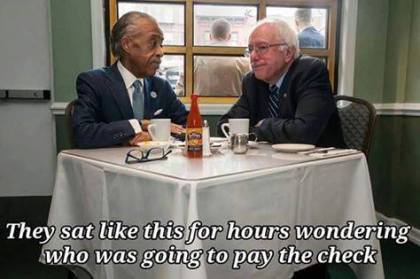
To end on a high note, as it were, here’s a fun Facebook page called “Bernie Sanders Bread Line” with some interesting takes on the lunatic ravings of the socialist candidate. All of those memes ring true, including the one at the top of this post.


Evil Force Multiplication

15 Tuesday Mar 2016

Posted by Nuetzel in Liberty, Socialism, Tyranny

≈ Leave a comment

Tags

Banality of Evil, Bookworm Room, Force Multiplier, Gary Johnson, Genocide, Johan Norberg, Nordic Nirvana, Social Democracy, Ted Cruz, Welfare State

big-govt compassion

Following up on “Socialism Is Concentrated Power“, check out “Because government is a force multiplier for evil, a vote for the small government candidate is a vote for good” from the Bookworm Room. I’m four days late making my 2nd anniversary post on Sacred Cow Chips, so this is it. I’ll try to keep it brief so I can get it out before bedtime on a school night.

I don’t agree with everything in Bookworm’s analysis, but I certainly agree with the general thrust:

“The problem with government is that, as it grows, no matter the original good intentions behind it, it invariably becomes a force multiplier for evil. Thus, once government power passes a certain point, government becomes the equivalent of a bull in a china shop, with its every motion causing massive damage. Incidentally, the china in that shop is always you — the individual.“

Bookworm discusses two major forms of force multiplication of evil by the state: money and death. Governments are incredible graft machines and resource wastrels. More tragically, the many genocidal acts over the course of history would not have been possible without government as the machine of authority and “legitimization”. Fear of the government’s police power may ultimately spur normal people to participate in “banal” acts of unspeakable evil. And here, Bookworm points out a few ironies about the “nice” people who root for state control:

“A compassionate government will talk itself into euthanizing people who, because they are very old or sick, use up more than their fair share of medical care. This has already happened under England’s National Health Service, which kills off old, sick people, and whose ‘ethicists’ advocate even more killings (out of ‘compassion’ of course).

A compassionate government dedicated to efficiency will convince itself that individuals or organizations that stand in the way of efficiency must be controlled and, if they won’t be controlled, must be destroyed. After all, without mandated efficiency, people will suffer.

A compassionate government dedicated to “fairness” (usually thought of in economic terms), will quickly conclude that it’s entirely unfair that one distinct group or another is wealthier or healthier than the rest. That group must be brought to heel and, failing that, destroyed.

A compassionate government dedicated to national purity will naturally have to kill the impure within its borders and, once that’s done, it would be even more compassionate to extend that purity throughout the world.

Even the most murderous theocracies will argue that compassion guides them. Their tortures, executions, and Holy Wars are meant to bring people closer to God, which is the highest form of human existence. Isn’t that a nice, compassionate thing to do?“

Bookworm offers praise to the genius of the U.S. founding fathers in crafting governing principles designed to limit government power. And Bookworm recognizes Senator Ted Cruz as the only major party candidate to consistently stand for small government and constitutional principles. I’m not all in on this endorsement, as Cruz has taken stands and aligned himself with individuals not supportive of civil liberties such as gay marriage. However, in many important ways, Cruz recognizes the danger of government power. Bookworm might have mentioned Gary Johnson, the likely Libertarian Party nominee, as the most consistent critic of big government among the names likely to appear on presidential ballots in the fall.

Some might object to Bookworm’s discussion of the many failed experiments with government domination of society by noting that he never mentions the alleged success of European social democracies, particularly the Nordic states. Sweden and Denmark are the most cited examples. However, Europe is not an economic success story, with median incomes comparable to states with the lowest incomes in the U.S. Moreover, the “Nordic Nirvana” is something of a myth. In “How Laissez-Faire Made Sweden Rich“, Johan Norberg gives a detailed history of Sweden’s political and economic evolution:

“It was not socialist policies that turned Sweden into one of the world’s richest countries. When Sweden got rich, it had one of the most open and deregulated economies in the world, and taxes were lower than in the United States and most other western countries. The Social Democrats kept most of those policies intact until the 1970s, when they thought that those excellent foundations—unprecedented wealth, a strong work ethic, an educated work force, world-class exports industries, and a relatively honest bureaucracy—were so stable that the government could tax and spend and build a generous cradle-to-grave welfare state on them.

They couldn’t. At least not without costs. Because that welfare state began to erode the conditions that had made the model viable in the first place. And the fourth richest country became the 14th richest within three decades.“

Fortunately, for more than 70 years, Western Europe has avoided the kind of dire, genocidal consequences that often flow from a dominant state, but Europe has stagnated economically. Hazards await them as a growing and increasingly diverse population competes for diminished economic gains; government control is a dead-weight on their prospects. I hope we can avoid that fate in the U.S., though we’re already far down the road. Like the Bookworm says, vote for small government!


Bernie, Donald and Ignatius?

29 Friday Jan 2016

Posted by Nuetzel in Immigration, Socialism, Uncategorized

≈ Leave a comment

Tags

Bernie Sanders, BK Marcus, Corporatism, Donald Trump, eminent domain, fascism, Godwin's Law, Immigration, Individual Liberty, Mark Forsyth, National Socialism, National Socialist German Workers’ Party, Nationalism, Nazi Etymology, Private Markets, Socialism, State's Rights, Steve Horwitz, The Freeman, Trade Policy

BernieTrump

We have candidates vying for the nominations of both major U.S. political parties with tendencies toward nationalism: Bernie Sanders and Donald Trump. They both oppose liberalized immigration and they are both anti-trade, playing on economic fears in articulating their views. Sanders has attempted to soften his rhetoric on immigration since last summer, when he alleged that it harms U.S. workers.

There are differences between Sanders and Trump on the treatment of existing illegal immigrants. Despite Trump’s protests to the contrary, his nationalism has had ethnic overtones.

Trump’s positions on immigration and trade protectionism are not necessarily at odds with Republican tradition, which is a mixed bag, but they are consistent with a faith in big government and central planning. An anti-immigration and anti-trade platform is certainly no contradiction for Sanders, because central planning is integral to his avowed socialism.

Sanders has been called a “socialist with nationalistic tendencies”. He favors government provision of free health care and higher education, heavy redistribution, and severe restrictions on property rights via high taxation. Trump, on the other hand, has been called a “nationalist with socialist tendencies.” He too has called for nationalized health care, increasing certain transfer payments, as well as compromises to state rights. It would probably be more accurate to describe Trump as a corporatist, a system under which large business entities both serve and control government for their own benefit. For example, Trump has used and favors eminent domain to secure land for private projects, generous bankruptcy laws to eliminate business risks, and “deal-making” between government and private enterprise in order to “get things done.” Corporatism is a flavor of fascism, and it is perfectly consistent with a statist agenda.

Thus, each party has candidates who are by degrees both nationalist and socialist. In using these labels, however, I plead innocent to a violation of Godwin’s Law. Of course they are not Nazis, but they are nationalistic socialists. The distinction is explained nicely by B.K Marcus in The Freeman. Both candidates take positions that are consistent with the platform of the National Socialist German Workers Party, circa 1920.

As an aside, Marcus provides some fascinating etymology of the word “Nazi”, quoting Steve Horwitz:

“The standard butt of German jokes at the beginning of the twentieth century were stupid Bavarian peasants. And just as Irish jokes always involve a man called Paddy, so Bavarian jokes always involved a peasant called Nazi. That’s because Nazi was a shortening of the very common Bavarian name Ignatius. This meant that Hitler’s opponents had an open goal. He had a party filled with Bavarian hicks and the name of that party could be shortened to the standard joke name for hicks.“

Marcus also quotes Mark Forsyth on this topic:

“To this day, most of us happily go about believing that the Nazis called themselves Nazis, when, in fact, they would probably have beaten you up for saying the word.“

Back on point, I’ve written about both of these candidates before: Trump here and here; Sanders here. To keep things even, here is one more interesting take on Bernie.

“His family managed to send him to the University of Chicago. Despite a prestigious degree, however, Sanders failed to earn a living, even as an adult. It took him 40 years to collect his first steady paycheck — and it was a government check.”

Read the whole thing!

It’s difficult for me to take these two candidates seriously because they do not take individual liberty seriously, nor do they understand the power of private markets to promote human welfare. I also have strong reservations about their understanding of constitutional principles, and I suspect that either would have few qualms about taking Mr. Obama’s cue in stretching executive authority.

Instead of the headline above, it would have been more accurate to say “Bernie, Donald and Ignoramus!” Unfortunately, one of these guys could be our next president. Well, it won’t be Sanders.

Bernie Sanders Wants To Deal… Your Property

18 Sunday Oct 2015

Posted by Nuetzel in Socialism, The Road To Serfdom

≈ Leave a comment

Tags

Angus Deaton, Bernie Sanders, Chelsea German, Dierdre McCloskey, Fixed Pie Fallacy, Free Stuff, Gary Burtless, Hillary Clinton, HumanProgress.org, Scandinavia, Socialism, Student Loans, The Brookings Institution, The Great Escape

Fall In Hole giphy

Bernie Sanders is very sincere in his beliefs, and yet he is profoundly ignorant regarding economic growth in the U.S. and the futility of socialism as form of economic organization. Chelsea German, at the HumanProgress blog, presents some simple facts that contradict a few of the Senator’s favorite assertions. In “Senator Sanders and the Fixed Pie Fallacy“, German quotes a line that Sanders has been using for at least 41 years: “The rich are getting richer and the poor are getting poorer.” Granted, his first utterance of that expression might have been in a recession, but aside from those relatively brief episodes, he’s been wrong for the duration. Apparently, Sanders cannot fathom the widespread gains made possible by capitalism and economic growth. Only a “fixed pie” (or worse) would necessarily imply that gains must come at the expense of others, as he seems to believe. (H.T. to Ken DeVaughn on the brilliant gif above.)

One chart in German’s post shows that after-tax income grew in every quintile of the U.S. income distribution from 1979 (pre-recession) to 2010 (post-recession). The chart is taken from CBO data used by Gary Burtless in a piece published by Brookings. Sanders should have a look. However, it’s also important to note that people generally don’t remain in the same strata of the distribution over time. A second chart, from Angus Deaton’s “The Great Escape“, shows that U.S. poverty rates have generally declined over time. Finally, German shows that with a few interruption, GDP has grown over time. All of these facts might be something of a surprise to Sanders. German quotes the great Deirdre McCloskey:

“The rich got richer, true. But millions more have gas heating, cars, smallpox vaccinations, indoor plumbing, cheap travel, rights for women, lower child mortality, adequate nutrition, taller bodies, doubled life expectancy, schooling for their kids, newspapers, a vote, a shot at university, and respect.“

Sanders showcases his lack of familiarity with economic principles almost every time he opens his mouth, or his Twitter account. He recently opined that rates of interest on student loans should be lower than rates on loans for autos and mortgages. Of course, both auto loans and mortgages are secured by valuable collateral and have much lower default rates. It’s a good thing for Sanders that he didn’t pursue a career in lending.

Recently, Hillary Clinton has been unable to restrain herself from chasing Sanders off the rhetorical cliff. Clinton is offering the public lots of “free stuff“, like Sanders, in a transparent attempt to buy votes with promises of future largess. Neither candidate has offered a credible plan for funding their promises. Higher taxes on “Wall Street” and other top earners are the supposed answer, but those measures would be woefully inadequate. Look out, middle class!

By the way, another recent Brookings study shows that increasing the top marginal income tax rate, a policy of which Sanders would approve, would do little to reduce the degree of income inequality.

Of course, Sanders seems just as unfamiliar with the great failures of socialism over the past century as he is with the successes of capitalism in eliminating poverty. He thinks the U.S. should adopt the socialist policies in Scandanavia, but the truth is that socialism has served to inhibit the continued success of capitalism in those countries (also see here). Perhaps that’s why Denmark is scaling back its redistributionist policies.

The Left, including Bernie Sanders, are burdened by a naive utopianism so powerful that they can rationalize the confiscation of private property to support their personal preferences and those of the political class. The aristocratic Left, like Hillary, differ only in the power they hold to influence policy. Perhaps a few suffer from a strong sense of guilt regarding their own circumstances. No, not Hillary. But both Bernie and Hillary are guilty of gross social and economic misdiagnosis. Politicians, heal thyselves!

Francis Pontiff-icates In His Fallible Zone

24 Thursday Sep 2015

Posted by Nuetzel in Capitalism, Global Warming, Poverty, Socialism

≈ Leave a comment

Tags

Anti-Capitalism, Bono and Capitalism, Cafe Hayek, Don Boudreaux, economic growth, Karl Marx, Matters of Faith, Opiate of the Masses, Papal infallibility, Pope Francis, Raul Castro, Reason.com, Stephanie Slade, World Poverty

Francis Politics

Pope Francis dispenses guidance in matters of faith from his heart. In matters of economics and science, his guidance doesn’t come from a well-informed mind. I’ve devoted two posts to Francis’ political follies this year: “Green Hubris: The Flub of Rome“, and “Francis’ Statist Vision Not Shared By Venezuelan Clergy“. While foreswearing ideology in the pulpit, he nevertheless promotes leftist economic ideology and denigrates capitalism, the single-best form of social organization for lifting mankind from privation. He ignores mountains of evidence demonstrating that his hopes for humanity are best served by free markets and liberty. Francis further confuses the issue of church teachings versus personal ideology by claiming that his views are longstanding views of the Church.

A dark theory of the Pope’s anti-capitalist rhetoric occurred to me. It has to do with an ecclesiastical variant on statism: just as statist elites like President Obama seem to prefer widespread dependence on the state, so too does the Pope wish for widespread dependence on the Church for spiritual nourishment. Karl Marx is often quoted as having said “Religion is the opiate of the masses.” However, the full quote is the following:

“Religion is the sigh of the oppressed creature, the heart of a heartless world, and the soul of soulless conditions. It is the opium of the people.“

Perhaps the Pope understands this all too well. An impoverished world may well be a more pious world, and his condemnation of capitalism might help to lead us there. Is such an ulterior motive too Machiavellian to describe the kind-hearted pontiff? Probably. Perhaps the Devil made me think of it!

Like most on the Left, the Pope does the world’s poor no favor by way of blindly accepting the global warmist agenda, which is based on a hypothesis “proven” only in the sense that a certain class of climate models predict a directional outcome. Those models have accumulated a long track record of bad forecasts. Not only that: the surface temperature records reported by U.S. Government agencies and the media as “evidence” of global warming are not supported by satellite records, and trends have been heavily manipulated via downward adjustments to past temperatures. But even if we stipulate that the carbon-forcing models and the surface temperature records are correct, there are major questions regarding the severity of the outcome and whether it poses a two-sided risk to human welfare. Mediation of this hypothetical risk is extremely costly, requiring diversion of vast quantities of resources, and that takes a real human toll. This is why the policy prescriptions of the warmist community lack internal consistency. For example, they wish to restrict power production from fossil fuels in the developing world, forcing populations to deforest and rely on unhealthy wood burning — indoors! — to meet basic needs like heating and cooking.

Here is the full text of a letter from Don Boudreaux to the Washington Post:

“On the opening page of your website today you ask readers to register their agreement or disagreement with this statement of Pope Francis: ‘This is our sin: Exploiting the Earth and not allowing her to give us what she has within her.’

This claim is laughable. History testifies unmistakably that the earth is extremely stingy in volunteering to humans ‘what she has within her.’ Indeed, what the earth has within her are mere raw materials, by themselves useless unless and until human creativity discovers not only how to transform them into actual resources and outputs that improve human well-being (Ever try fueling your jet with crude oil?) but also how to ‘exploit’ the earth so that she releases her materials to us at a reasonable cost.

The Pope is vocal about helping the world’s poor. I believe that he’s sincere. So I sincerely hope that he comes to realize that the greatest sin of all against humanity would be the suppression of those capitalist institutions that have proven to be the only practical means of transforming what the earth has within her into a bounty of goods and services that allows the masses, for the first time in history, to live lives of material abundance and dignity upon her.“

A few of the comments that follow Boudreaux’s post on Cafe Hayek are good, too.

Stephanie Slade has an excellent piece in Reason entitled “If Pope Francis Wants to Help the Poor, He Should Embrace Capitalism“. Here are some samples addressing the power of markets and capitalism to improve human welfare and eradicate poverty:

“Pope Francis thinks free marketeers have been deluded by a ‘myth of unlimited material progress.’ If we have, it’s because we’ve seen for ourselves the wonders that economic development and technological advancement can bring—from modern medicine stopping diseases that were the scourge of civilizations for centuries, to buildings more able to withstand natural disasters than at any time before, to ever-widening access to the air conditioning he wishes us to use less of.“

“‘Entrepreneurial capitalism takes more people out of poverty than aid.’ With those 10 words, spoken to an audience at Georgetown University in 2013, philanthropist rock star Bono demonstrated a keener understanding of economic reality than the leader of global Catholicism.

The U2 frontman clearly has it right—and Pope Francis is wrong to suggest that poverty is growing, or that capitalism, free markets, and globalization are fueling the (non-existent) problem. In just two decades, extreme poverty has been reduced by more than 50 percent. ‘In 1990, almost half of the population in developing regions lived on less than $1.25 a day,’ reads a 2014 report from the United Nations. ‘This rate dropped to 22 per cent by 2010, reducing the number of people living in extreme poverty by 700 million.’

How was this secular miracle achieved? The bulk of the answer is through economic development, as nascent markets began to take hold in large swaths of the world that were until recently desperately poor. A 2013 editorial from The Economist noted that… ‘Most of the credit… must go to capitalism and free trade, for they enable economies to grow—and it was growth, principally, that has eased destitution.’“

As Slade explains, far from a scourge on the environment, capitalism is and has been a great blessing:

“Both the economics and the history are clear: The more prosperous the developing world becomes, the more it too will be able to demand and achieve livable conditions. If your goal is to move the world to concern for the preservation of biodiversity, the answer is economic growth. If you want to increase access to clean water, the solution is to increase global wealth, and the consumer power that comes with it. Studies have shown that deforestation reverses when a country’s annual GDP reaches about $3,000 per capita. While some environmental indicators do get worse during the early stages of industrialization, the widely accepted Environmental Kuznets Curve hypothesis convincingly argues that they quickly reverse themselves when national income grows beyond a certain threshold. If the pope wants a cleaner world, the best way to get there is by creating a richer world—something Pope Francis’ own policy recommendations will make more difficult.“

A theme in Slade’s essay is that Francis is simply confused. On one level, he seems to know that technological advance is of great benefit to mankind, yet he is extremely wary of economic growth and believes that less production and consumption is better. That would make the job of alleviating conditions for the world’s poor much more challenging, if not impossible! He acknowledges that the environment has improved drastically in some parts of the world, but he seems unaware that the same areas are the most economically developed, and have the most well-developed markets. Like most on the Left, he also seems confused about the real meaning of capitalism. And the Pope “often blurs the line between public and private action.”

Slade concludes with some messages for Catholics. First, the Pope’s opinions on matters of faith are said to be infallible, according to Catholic doctrine. But opinions on topics like capitalism and the environment are outside his sphere of infallibility. Second, Slade is rightly offended by the Pope’s attitude that libertarianism and a belief in the efficacy of free markets is not compatible with Christianity.

Thus far during the Pope’s visit to Cuba and the U.S., he has thrilled the murderous Castro brothers and spoken out in favor of Obama’s climate agenda. Raul Castro is so happy about the Pope’s opinions on capitalism “that he might ‘start praying again’ and rejoin the church“. I truly hope that members of the Catholic flock, or any others,  don’t take the Pope’s political exhortations too seriously.

Bernie Sanders: Just a Regular Looter

17 Thursday Sep 2015

Posted by Nuetzel in Free markets, Poverty, Socialism

≈ 1 Comment

Tags

Bernie Sanders, Capital-Labor Substitution, Citizens United, Donald Trump, Economic illiteracy, Ed Krayewski, Energy Policy, Feel the Bern, infrastructure, Kevin D. Williamson, Minimum Wage, Police Brutality, Poverty, Racial exclusion, Socialism, Universal Health Care, War on Drugs

Bernie

Economic illiteracy is getting to be a central theme in the early stages of the 2016 presidential race. The two candidates with whom the public and media are most fascinated at the moment are Bernie Sanders and Donald Trump. Both are veritable case studies in delusional economic reasoning. I have already devoted two posts to Trump, the current frontrunner for the Republican nomination (both posts appear at the link in reverse order). At the time of the second of those posts, I recall hoping desperately that someone or something would rescue my blog from him. I have managed, since then, to resist devoting more attention to his campaign. In this post, I’ll focus on Senator Bernie Sanders of Vermont, currently the top rival to Hillary Clinton for the Democrat nomination.

It’s ironic that Sanders, a self-proclaimed socialist, shares several areas of acute economic illiteracy with Donald Trump. There is a strong similarity between Sanders and Trump on foreign trade (and both candidates are pro-Second Amendment). Like Trump, Sanders demonstrates no understanding of the reasons for trade, as Kevin Williamson notes:

“The incessant reliance on xenophobic (and largely untrue) tropes holding that the current economic woes of the United States are the result of scheming foreigners, especially the wicked Chinese, “stealing our jobs” and victimizing his class allies…. He describes the normalization of trade relations with China as “catastrophic” — Sanders and Jesse Helms both voted against the Clinton-backed China-trade legislation — and heaps scorn on every other trade-liberalization pact. That economic interactions with foreigners are inherently hurtful and exploitative is central to his view of how the world works.“

Sanders lacks an understanding of trade’s real function: allowing consumers and businesses to freely engage in mutually beneficial exchanges with partners abroad, and vice versa. Trade thereby allows our total consumption and standard of living to expand. It is not based on “beating” your partners, as Sanders imagines. It is cooperative behavior.

Opposition to free trade nearly always boils down to one thing: avoiding competition. That goes for businesses seeking to protect or gain some degree of monopoly power and for unions wishing to keep wages, benefits and work rules elevated above levels that can otherwise be justified by productivity. The result is that consumers pay higher prices, have access to fewer goods and less variety, and have a lower standard of living. It is no accident that trade wars deepened the severity of the Great Depression domestically and globally. But Sanders, like Trump, has failed to learn from the historical record.

Another area of Sanders’ deep economic ignorance is his position on wage controls. He advocates a mandatory $15 federal minimum wage with no recognition of the potential damage of such a change. Kevin Williamson has this to say:

“Prices [and wages] in markets are not arbitrary — they are reflections of how real people actually value certain goods and services in the real world. Arbitrarily changing the dollar numbers attached to those preferences does not change the underlying reality any more than trimming Cleveland off a map of the United States actually makes Cleveland disappear.“

The minimum wage was the subject of a recent post on Sacred Cow Chips. A higher minimum is a favorite policy of well-meaning leftists and social justice warriors, but they fail to address the realities that the least-skilled suffer adverse employment effects, that a higher minimum wage hastens the substitution of capital for unskilled labor, and that the policy often benefits non-primary workers from middle and upper-income households. It’s a lousy way to help the impoverished. Moreover, minimum wages were originally conceived as a tool of racial exclusion and in all likelihood still act that way. Most of the research supporting minimum wage increases focuses on short-run effects or on sectors that are less capital-intensive. Findings about long-run effects are much more negative (see here, too). It’s a given that Sanders understands none of this.

Other elements of Sanders’ platform are essentially freebies for all: universal health care (see the first link from this Bing search), free college tuition for all, and expanded social security benefits. And of course there is a promise to rebuild our crumbling infrastructure, taking full advantage of the myth that our infrastructure is so decrepit that it must be replaced now. All of these ideas are costly, to say the least, and there is nothing adequate in Sanders’ platform to pay for them. He’ll raise taxes on the 1%, he says. Just watch the capital fly away. Ed Krayewski of Reason discusses Sander’s rich promises and the lack of resources to pay for them in “Bernie Sanders, the 18 Trillion Dollar Man“:

“The Wall Street Journal spoke with an economist at the liberal Center on Budget and Policy Priorities, who acknowledged taxes would have to go up for the middle class too to pay for Sanders programs.“

Middle class tax hikes would undoubtedly be accompanied by a lot more public debt, and ultimately inflation. Freebies for whom? As Krayewski says, Sanders “wants taxpayers to ‘feel the Bern’“.

In fairness, Sanders suggests that some of the needed revenue can be diverted from military spending. Possibly, but the military budget has already been reduced significantly, and it is not clear that much fat remains for Sanders to cut. There will certainly be demands for greater military spending given the significant threats we are likely to face from rogue states.

Sanders’ promise to transform our energy system is another one that will come with high costs. What Sanders imagines is a widespread fallacy that green energy can be produced at little cost. However, we know that renewables carry relatively high distributed costs and their contributions to load are intermittent, requiring base load backup from more traditional sources like fossil fuels or nuclear energy. Like President Obama, Sanders would impose new costs on fossil fuels, but the poor will suffer the most without offsetting assistance. And subsidies are also required to incent greater adoption of expensive alternatives like home solar and electric vehicles. Sanders would authorize this massive diversion of resources for the purpose of mitigating a risk based on carbon-forcing climate models with consistent track records of poor accuracy.

If free speech is your hot button, then Sanders’ promise to “overturn” Citizen’s United won’t make you happy. Why should an association of individuals, like a union or a corporation, be denied the right to use pooled resources for the purpose of expressing views that are important to their mission? Sanders is proposing an outright abridgment of liberty. From the first Kevin Williamson link above:

“… criminalizing things is very much on Bernie’s agenda, beginning with the criminalization of political dissent. At every event he swears to introduce a constitutional amendment reversing Supreme Court decisions that affirmed the free-speech protections of people and organizations filming documentaries, organizing Web campaigns, and airing television commercials in the hopes of influencing elections or public attitudes toward public issues.“

It is hard to take issue with Sanders’ call for an end to police brutality without a clear sense of his attitude toward law enforcement. I believe all fair-minded people wish for zero police brutality, but critics often minimize the difficulty of police work. No doubt there are gray areas in the practice of law enforcement; some police officers take their powers too far, which cannot be condoned. If institutional reforms can help, so much the better. But the police must be given the latitude to do a difficult job without fear of unreasonable legal reprisal.

On a related note, Sanders advocates an end to the war on drugs, a reform that I wholeheartedly support. Go you Bernie!

Finally, here is a more general illustration of Bernie Sanders’ backward views on economics. It is a Sanders quote I repeat from the second Kevin Willamson link above:

“You don’t necessarily need a choice of 23 underarm spray deodorants or of 18 different pairs of sneakers when children are hungry in this country. I don’t think the media appreciates the kind of stress that ordinary Americans are working on.“

Sanders’ complaint about the plethora of choices in consumer goods fails to recognize that they reflect real differences in consumer preferences, as well as an economy dynamic enough to provide for those preferences. Far from causing hunger and poverty, that dynamism has lifted standards of living over the years across the entire income distribution, even among the lowest income groups, to levels that would astonish our forebears. And it created the wealth that enables our society to make substantial transfers of resources to low income groups. Unfortunately, those very transfer programs are rife with incentives that encourage continued dependency. Other government interventions such as the minimum wage have diminished opportunities for work for individuals with little experience and skills. Meanwhile, regulation and high business and personal taxes undermine the continued growth and dynamism of the economy that could otherwise lift more families out of dependency. Sanders would do better to study the history of socialism in practice, and to look in his own socialist mirror to identify the reasons for persistently high levels of poverty.

Statists and Stasis: The Dismal Solutions of Anti-Capitalists

26 Wednesday Aug 2015

Posted by Nuetzel in Capitalism, Markets, Socialism, Tyranny

≈ Leave a comment

Tags

A. Barton Hinkle, Administered Prices, Anti-Capitalism, Asymmetric Information, Bernie Sanders, central planning, Chris Edwards, Coercive Power, Coyote Blog, Dead Weight Loss, External Effects, Foundation for Economic Education, Fred Foldvary, Jonathan Newman, Mercatus Center, Progressivism, Reason, Robert P. Murphy, Socially useless, Statism and Stasis, The Freeman, Warren Meyer

Thought Hanging

The anti-capitalist Left is quick to condemn private businesses of unfair practices and even unethical behavior. In their estimation, certain prices are not just and profits are somehow undeserved rewards to private property, risk-taking and entrepreneurial sweat. They somehow imagine that meeting market demands is an easy matter, or worse, that market demands are not “socially useful”. Few have ever attempted to run a business, or if they have, they were unsuccessful and resent it. They also cannot grasp the social function served by private markets, to which we owe our standard of living and much of our culture.

What alternatives do these deep thinkers suggest? A socialist utopia? Jonathan Newman discusses the many practical problems presented by socialism and why it always fails to achieve success comparable to societies that rely on free markets. Newman’s treatment covers the inability of administered pricing to convey accurate information and effective incentives, the waste induced by queuing, neglect of comparative advantage, waste induced by production quotas, retarded innovation and technological development, and a deeply embedded stasis in the face of changing conditions. Little wonder that poverty is a consequence.

Warren Meyer at Coyote Blog has written of the stasis seemingly promoted by the progressives. They are quite protective of the status quo. Ironically, and quite rightly, Meyer calls them “deeply conservative”, too conservative to accept the dynamism of a capitalistic society. From Meyer:

“Progressives want comfort and certainty. They want to lock things down the way they are. They want to know that such and such job will be there tomorrow and next decade, and will always pay at least X amount. Which is why, in the end, progressives are all statists, because only a government with totalitarian powers can bring the order and certainty and control of individual decision-making that they crave..

Progressive elements in this country have always tried to freeze commerce, to lock this country’s economy down in its then-current patterns. Progressives in the late 19th century were terrified the American economy was shifting from agriculture to industry. They wanted to stop this, to cement in place patterns where 80-90% of Americans worked on farms.“

Freezing the diffusion of technology and often the state of technology itself is a consequence of socialist policy. And technology may well be the enemy of the Left in another sense: An interesting twist is provided by Fred Foldvary of the Mercatus Center in “Government Intervention Is Becoming Obsolete“. He writes that technology is undermining all of the usual economic rationales for intervention: asymmetric information, external effects, public goods, and monopoly. The article is brief, but he refers the reader to more extensive treatments.

A good example of socialism’s perverse appeal is the rhetoric of Senator Bernie Sanders, now a candidate for the Democrat Presidential nomination. Sanders has criticized the “the dizzying (and socially useless) number of products in the deodorant category….” At Reason.com, A. Barton Hinkle wondered what Sanders might consider the appropriate number of deodorant choices in our society. Would he wish to dictate a limited number as a matter of policy? And what other “socially useless” choices might he choose to limit in his failure to grasp that these choices reflect the incredible health and vibrancy of a market economy. Here’s Hinkle:

“… central planners think they can allocate economic resources better than the unguided hand of individual free choice. Like any good scientific experiment, this one is easily replicated, and has been time and again. See, for example, Venezuela, which has now run out of toilet paper, tampons, and other basic necessities because some people there think they should make all the choices for other people. And yet for many, the repeated lesson still has not sunk in. In an unintentionally hilarious essay about Cuba not so long ago, one writer noted that “the people are hungry here. There are severe food shortages. I do not understand why a tropical island would lack fruits and vegetables . . . and my only assumption is that maybe they have to export it all.”

Never forget that government can only pursue policy objectives via coercive power. I don’t think socialists have forgotten at all. Without the power to coerce, nothing proposed or done by the state can be accomplished and enforced. This is the course that progressive, anti-capitalists must follow to achieve their collectivist vision. But Chris Edwards reminds us that “Coercion Is Bad Economics” with the following points about government:

  • When it “uses coercion, its actions are based on guesswork.“
  • Its “actions often destroy value because they [arbitrarily] create winners and losers.“
  • Its “activities fail to create value because the funding comes from a compulsory source: taxes.”
  • Its “programs often fail to generate value because the taxes to support them create “deadweight losses” or economic damage.“

By arranging voluntary, mutually beneficial trades, market forces avoid all of these problems. As Robert P Murphy explains in The Freeman, “Capitalists Have a Better Plan“.

The anti-capitalists do not hesitate to saddle private businesses with confiscatory tax and regulatory burdens in the name of their own vision of society. Want to live in a bleak world of decline? Then here’s your prescription, courtesy of the anti-capitalist Left: regulate heavily, monitor transactions, impose wage and price controls, dismantle markets, tax at punitive levels, confiscate property, censor “offensive” speech, extend dependence on the state, absorb private savings and crowd out private investment with government borrowing, and inflate the money stock. Smells like a crappy “utopia”.

Will ET Be a Socialist?

19 Wednesday Aug 2015

Posted by Nuetzel in Capitalism, Socialism, Space Travel

≈ 1 Comment

Tags

B.K. Marcus, Capitalism, Carl Sagan, central planning, Colonizing Mars, Elon Musk, Enrico Fermi, Extraterrestrials, F.A. Hayek, Fermi Paradox, Huffington Post, Interstellar Travel, io9, Large Hadron Collider, NASA, Neil deGrasse Tyson, Planned Society, Private Space Exploration, Public goods, Self-Replicating Machines, SETI, Socialism, SpaceX, The Freeman, The Great Filter, Tim Urban

image

If we are ever visited or contacted by agents from an extraterrestrial civilization, what kind of society will they come from? The issue is given scant attention, if any, in discussions of extraterrestrial life, at least according to this interesting piece in The Freeman by B.K. Marcus. The popular view, and that of many scientists, seems to be that the alien society will be dominated by an authoritarian central government. Must that be the case? Marcus notes the negative views taken by such scientific authorities as Neil deGrasse Tyson toward laissez faire capitalism, and even Carl Sagan “… could only imagine science funded by government.” Of course, Tyson and Sagan cannot be regarded as authorities on economic affairs. However, I admit that I have fallen into the same trap regarding extraterrestrial visitors: that they will come from a socialist society with strong central command. On reflection, like Marcus, I do not think this view is justified.

One explanation for the default view that extraterrestrial visitors will be socialists is that people uncritically accept the notion that an advanced society is a planned society.  This runs counter to mankind’s experience over the past few centuries: individual freedom, unfettered trade, capitalism and a spontaneous social order have created wealth and advancement beyond the wildest dreams of earlier monarchs. Anyone with a passing familiarity with data on world economic growth, or with F.A. Hayek, should know this, but it Is often overlooked. Central planners cannot know the infinitely detailed and dynamic information on technologies, resource availability, costs and preferences needed to plan a society with anything close to the success of one arranged through the voluntary cooperation of individual actors.

Many of us have a strong memory of government domination of space exploration, so we tend to think of such efforts as the natural province of government. Private contractors were heavily involved in those efforts, but the funding and high-level management of space missions (NASA in the U.S.) was dominated by government. Today, private space exploration is a growth industry, and it is likely that some of the greatest innovations and future space endeavors will originate in the private sector.

Another explanation for the popular view is the daunting social challenges that would be faced by crews in interstellar travel (IST). Given a relatively short life span, a colonizing mission would have to involve families and perhaps take multiple generations to reach its destination. There is a view that the mini-society on such a ship would require a command and control structure. Perhaps, but private property rights and a certain level of democratization would be advantageous. In any case, that carries no implication about the society on the home planet nor the eventual structure of a colony.

A better rationale for the default view of socialist ETs involves a public goods argument. The earth and mankind face infrequent but potentially catastrophic hazards, such as rogue asteroids and regions of strong radiation as the sun orbits the center of the Milky Way galaxy. These risks are shared, which implies that technological efforts to avert such hazards, or to perpetuate mankind by colonizing other worlds, are pure public goods. That means government has a classic role in providing for such efforts, as long as the expected benefits outweigh the costs. The standard production tradeoff discussed in introductory economics classes is “guns versus butter”, or national defense (a pure public good) versus private consumption. IST by an alien civilization could well require such a massive diversion of resources to the public sector that only an economically dominant central government could manage it. Or so it might seem.

As already noted, private entrepreneurs have debunked the presumed necessity that government must dominate space exploration. In fact, Elon Musk and his company SpaceX hope to colonize Mars. His motives sound altruistic, and in some sense the project sounds like the private provision of a public good. Here is an interpretation by Tim Urban quoted at the link (where I have inserted a substitute for the small time-scale analog used by the author):

“Now—if you owned a hard drive with an extraordinarily important Excel doc on it, and you knew that the hard drive pretty reliably tended to crash [from time to time] … what’s the very obvious thing you’d do?
You’d copy the document onto a second hard drive.
That’s why Elon Musk wants to put a million people on Mars.”

Musk has other incentives, however. The technology needed to colonize Mars will also pay handsome dividends in space mining applications. Moreover, if they are successful, there will come a time when Mars is a destination commanding a fare. Granted, this is not IST, but as technology advances through inter-planetary travel and colonization, there is a strong likelihood that future Elon Musks will be involved in the first steps outside of our solar system.

While SpaceX has raised its capital from private sources, it receives significant revenue from government contracts, so there is a level of dependence on public space initiatives. However, the argument made by Marcus at the first link above, that IST by ETs is less likely (or impossible) if they live under a socialist regime, is not based primarily on recent experience with private entrepreneurial efforts like Musk’s. Instead, it has to do with the inability of socialist regimes to generate wealth, especially the massive wealth necessary to accomplish IST.

Discussions of ETs (or the lack thereof) often center around a question known as the  Fermi Paradox, after the physicist Enrico Fermi. He basically asked: if the billions and billions of star systems, even in our own galaxy, are likely to harbor a respectable number of advanced civilizations, where are they? Why haven’t we heard from them? My friend John Crawford objects that this is no paradox at all, given the vastness of space and the difficulty and likely expense of IST. There may be advanced civilizations in the cosmos that simply have not been able to tackle the problem, at least beyond their own stellar neighborhood. No doubt about it, IST is hard!

I have argued to Crawford that there should be civilizations covering a wide range of development at any point in time. In only the past hundred years, humans have increased the speed at which they travel from less than 50 miles per hour (mph) to at least 9,600 mph. The speed of light is approximately 270,000 times faster that that! At our current top speed, it would take almost 50% longer to reach our nearest neighboring star, Alpha Centauri, than the entire span of human existence to-date. With that kind of limitation, there is no paradox at all! But I would not be surprised if, over the next 1,000 years, advances in propulsion technology bring our top speed to within one-tenth of the speed of light, and perhaps much more, making IST a more reasonable proposition, at least in our “neighborhood”. There may be civilizations that have already done so.

Answers to the Fermi Paradox often involve a concept called the Great Filter. This excellent HuffPo article by Tim Urban on the Fermi Paradox provides a good survey of theories on the Great Filter. The idea is that there are significant factors that prevent civilizations from advancing beyond certain points. Some of these are of natural origin, such as asteroids and radiation exposure. Others might be self-inflicted, such as a thermonuclear catastrophe or some other kind of technology gone bad. Some have suggested that the Large Hadron Collider in Switzerland could be a major hazard to our existence, though physicists insist otherwise. Another example is the singularity, when artificial intelligence overtakes human intelligence, creating a possibility that evil machines will do us in. The point of these examples is that some sudden or gradual development could prevent a civilization from surviving indefinitely. These kinds of filters provide an explanation for the Fermi Paradox.

More broadly, there could be less cataclysmic impediments to development that prevent a society from ever reaching an advanced stage. These would also qualify as filters of a sort. Perhaps the smart ETs lack, or failed to evolve, certain physical characteristics that are crucial for advancement or IST. Or their home planet might be light on certain kinds of resources. Or perhaps an inferior form of social organization has limited development, with inadequate wealth creation and technologies to transcend the physical limitations imposed by their world. On a smaller than planetary scale, we have witnessed such an impediment in action many times over: socialism. The inefficiencies of central planning place limits on economic growth, and while high authorities might dictate a massive dedication of resources toward science, technology and capital-intensive space initiatives, the shift away from personal consumption would come at a greater and greater cost. The end game may involve a collapse of production and a primitive existence. So the effort may be unsustainable and could lead to social upheaval; a more enlightened regime would attempt to move the society toward a more benign allocation of resources. Whether they can ever accomplish IST is at least contingent on their ability to create wealth.

Socialism is a filter on the advancement of societies. ETs capable of interstellar travel could not be spawned by a society dominated by socialism and central planning. While government might play a significant role in a successful ET civilization, one capable of IST, only a heavy reliance on free-market capitalism can improve the odds of advancing beyond a certain primitive state. Capitalism is a relatively easy ticket to the wealth required for an advanced and durable civilization, and conceivably to the reaches of the firmament.

Unfortunately, there is absolutely no guarantee that capitalistic ETs will be friendly  toward competing species, or that they will respect our property rights. They might be big, smart cats and find us mouse-like and quite tasty. Their children might make us perform circuses, like fleas. In any case, if ETs get this far, it’s probably because they want our world and our resources. My friend Crawford says that they won’t get here in any case. He believes that the difficulty of IST will force them to focus on their own neighborhood. Maybe, but on long enough time scales, who knows?

I would add a caveat to conclusions about the strength of the filters discussed above. A capitalistic society might reach a point at which it could send artificially intelligent, self-replicating machines into space to harvest resources. Those machines might well survive beyond the end of the civilization that created them. Conceivably, those machines could act autonomously or they could take coordinated action. But we haven’t heard from them either!

For a little more reading, here is SETI‘s description of the Fermi Paradox, and here is a post from io9 on the Great Filter.

Newer posts →
Follow Sacred Cow Chips on WordPress.com

Recent Posts

  • The Case Against Interest On Reserves
  • Immigration and Merit As Fiscal Propositions
  • Tariff “Dividend” From An Indigent State
  • Almost Looks Like the Fed Has a 3% Inflation Target
  • Government Malpractice Breeds Health Care Havoc

Archives

  • January 2026
  • December 2025
  • November 2025
  • October 2025
  • September 2025
  • August 2025
  • July 2025
  • June 2025
  • May 2025
  • April 2025
  • March 2025
  • February 2025
  • January 2025
  • December 2024
  • November 2024
  • October 2024
  • September 2024
  • August 2024
  • July 2024
  • June 2024
  • May 2024
  • April 2024
  • March 2024
  • February 2024
  • January 2024
  • December 2023
  • November 2023
  • August 2023
  • July 2023
  • June 2023
  • May 2023
  • April 2023
  • March 2023
  • February 2023
  • January 2023
  • December 2022
  • November 2022
  • October 2022
  • September 2022
  • August 2022
  • July 2022
  • June 2022
  • May 2022
  • April 2022
  • March 2022
  • February 2022
  • January 2022
  • December 2021
  • November 2021
  • October 2021
  • September 2021
  • August 2021
  • July 2021
  • June 2021
  • May 2021
  • April 2021
  • March 2021
  • February 2021
  • January 2021
  • December 2020
  • November 2020
  • October 2020
  • September 2020
  • August 2020
  • July 2020
  • June 2020
  • May 2020
  • April 2020
  • March 2020
  • February 2020
  • January 2020
  • December 2019
  • November 2019
  • October 2019
  • September 2019
  • August 2019
  • July 2019
  • June 2019
  • May 2019
  • April 2019
  • March 2019
  • February 2019
  • January 2019
  • December 2018
  • November 2018
  • October 2018
  • September 2018
  • August 2018
  • July 2018
  • June 2018
  • May 2018
  • April 2018
  • March 2018
  • February 2018
  • January 2018
  • December 2017
  • November 2017
  • October 2017
  • September 2017
  • August 2017
  • July 2017
  • June 2017
  • May 2017
  • April 2017
  • March 2017
  • February 2017
  • January 2017
  • December 2016
  • November 2016
  • October 2016
  • September 2016
  • August 2016
  • July 2016
  • June 2016
  • May 2016
  • April 2016
  • March 2016
  • February 2016
  • January 2016
  • December 2015
  • November 2015
  • October 2015
  • September 2015
  • August 2015
  • July 2015
  • June 2015
  • May 2015
  • April 2015
  • March 2015
  • February 2015
  • January 2015
  • December 2014
  • November 2014
  • October 2014
  • September 2014
  • August 2014
  • July 2014
  • June 2014
  • May 2014
  • April 2014
  • March 2014

Blogs I Follow

  • Passive Income Kickstart
  • OnlyFinance.net
  • TLC Cholesterol
  • Nintil
  • kendunning.net
  • DCWhispers.com
  • Hoong-Wai in the UK
  • Marginal REVOLUTION
  • Stlouis
  • Watts Up With That?
  • Aussie Nationalist Blog
  • American Elephants
  • The View from Alexandria
  • The Gymnasium
  • A Force for Good
  • Notes On Liberty
  • troymo
  • SUNDAY BLOG Stephanie Sievers
  • Miss Lou Acquiring Lore
  • Your Well Wisher Program
  • Objectivism In Depth
  • RobotEnomics
  • Orderstatistic
  • Paradigm Library
  • Scattered Showers and Quicksand

Blog at WordPress.com.

Passive Income Kickstart

OnlyFinance.net

TLC Cholesterol

Nintil

To estimate, compare, distinguish, discuss, and trace to its principal sources everything

kendunning.net

The Future is Ours to Create

DCWhispers.com

Hoong-Wai in the UK

A Commonwealth immigrant's perspective on the UK's public arena.

Marginal REVOLUTION

Small Steps Toward A Much Better World

Stlouis

Watts Up With That?

The world's most viewed site on global warming and climate change

Aussie Nationalist Blog

Commentary from a Paleoconservative and Nationalist perspective

American Elephants

Defending Life, Liberty and the Pursuit of Happiness

The View from Alexandria

In advanced civilizations the period loosely called Alexandrian is usually associated with flexible morals, perfunctory religion, populist standards and cosmopolitan tastes, feminism, exotic cults, and the rapid turnover of high and low fads---in short, a falling away (which is all that decadence means) from the strictness of traditional rules, embodied in character and inforced from within. -- Jacques Barzun

The Gymnasium

A place for reason, politics, economics, and faith steeped in the classical liberal tradition

A Force for Good

How economics, morality, and markets combine

Notes On Liberty

Spontaneous thoughts on a humble creed

troymo

SUNDAY BLOG Stephanie Sievers

Escaping the everyday life with photographs from my travels

Miss Lou Acquiring Lore

Gallery of Life...

Your Well Wisher Program

Attempt to solve commonly known problems…

Objectivism In Depth

Exploring Ayn Rand's revolutionary philosophy.

RobotEnomics

(A)n (I)ntelligent Future

Orderstatistic

Economics, chess and anything else on my mind.

Paradigm Library

OODA Looping

Scattered Showers and Quicksand

Musings on science, investing, finance, economics, politics, and probably fly fishing.

  • Subscribe Subscribed
    • Sacred Cow Chips
    • Join 128 other subscribers
    • Already have a WordPress.com account? Log in now.
    • Sacred Cow Chips
    • Subscribe Subscribed
    • Sign up
    • Log in
    • Report this content
    • View site in Reader
    • Manage subscriptions
    • Collapse this bar
 

Loading Comments...