• About

Sacred Cow Chips

Sacred Cow Chips

Category Archives: Subsidies

Government Malpractice Breeds Health Care Havoc

02 Sunday Nov 2025

Posted by Nuetzel in Health Care, Subsidies

≈ Leave a comment

Tags

000 Mules, 340B Program, Affordable Care Act, Community Pricing, Continuing Resolution, Cross Subsidies, Federal Medical Assistance Percentages, Gender-Affirming Care, Government Shutdown, Guaranteed Renewability, Health Status Insurance, Jane Menton, John Cochrane, Medicaid, Medicare, Michael Cannon, Nationalized Health Care, Obamacare, Obamacare Expanded Subsidies, Obamacare Tax Credits, One Big Beautiful Bill Act, Peter G. Peterson Foundation, Portability, Pre-Existing Conditions, Right To Health Care, Tax Cuts and Jobs Act, Third-Party Payers
The impasse at the heart of the seemingly unending government shutdown revolves around health care subsidies.

First, there is disagreement about whether to extend the expanded Obamacare subsidies promulgated during the COVID pandemic. That expansion allowed individuals earning more than four times the federal poverty level (the original limit under the Affordable Care Act (ACA)) to receive tax credits for the purchase of health coverage on the exchange “marketplace”. Republicans find this highly objectionable. Many of them also object that the subsidies help pay for “essential health benefits” under the ACA that include so-called gender-affirming care.

Democrats and the insurance lobby would very much like to reinstate or retain the tax credits. The ten-year cost of extending them is more than $400 billion. Incredibly, it turns out that roughly 40% of individuals taking those tax credits did not file a medical claim in 2024. It was pure cash for insurers at the expense of taxpayers.

Second, the One Big Beautiful Bill Act (OBBB), among other things, restricts access to Medicaid by imposing work or job search requirements for overall eligibility. It also formally denies coverage to illegal aliens. This, of course, is opposed by Democrats, who insist that those requirements be rescinded.

Health Care Central Planning

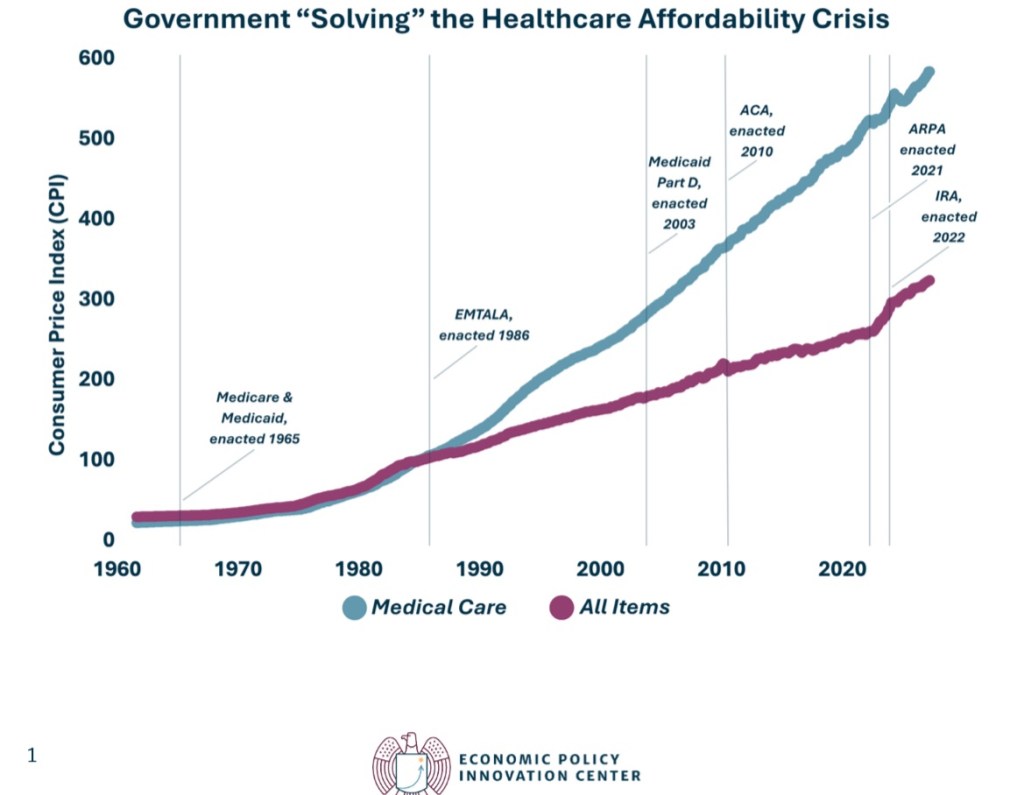
These issues are part of a much larger debate over government dominance of the health care system. Almost every institutional arrangement in health care coverage and delivery is dictated by rules and practices imposed by government, and it would seem they are intentionally designed to escalate costs and compromise the delivery of care. The chart at the top of this post illustrates, in a high-level way, the futility of these efforts.

Medicare and Medicaid dominate government health care spending, as this report from the Peter G. Peterson Foundation shows. However, that strict budgetary view greatly understates the control government now exerts on the health care sector.

Medical Free Market Myth

Michael Cannon recently emphasized the irony of the persistent myth of a U.S. free market in health care:

“… government controls a larger share of health spending in the United States than in 27 out of 38 OECD-member nations, including the United Kingdom (83%) and Canada (73%), each of which has an explicitly socialized health-care system. When it comes to government control of health spending, the United States is closer to communist Cuba (89%) than the average OECD nation (75%).

“Nor does the United States have market prices for health care. Direct government price-setting, price floors, and price ceilings determine prices for more than half of U.S. health spending, including virtually all health-insurance premiums.“

ObamaSnare

Government “control” takes a variety of forms, including regulatory intrusions under the aegis of Obamacare. The Affordable Care Act (ACA), as its name implies, was sold as a way to keep health care and health insurance costs affordable. And it was billed as a way to extend individual health care coverage to the previously uninsured population. It failed badly on the first count and met with only limited success on the second.

One leg upon which the ACA stood was kicked away in 2017: the penalty for violating the Act’s individual mandate for health coverage was eliminated by the Tax Cuts and Jobs Act (TCJA). The penalty was arguably unconstitutional as a tax on non-commerce, or the non-purchase of insurance on the exchange. However, the Supreme Court had ruled narrowly in favor of the penalty in 2012, claiming that it was within the scope of Congress’ taxing power. Following passage of the TCJA, however, the toothlessness of the mandate caused the risk pool to deteriorate. This was aggravated by the ACA’s insistence on comprehensive coverage, which applies not just to policies sold on the Obamacare exchange, but to almost all private health insurance sold in the U.S.

A well-functioning marketplace would instead have promoted the availability of more moderately-priced coverage options. Ultimately, subsidies were all that prevented a broad exit from the marketplace. But they did nothing to slow the escalation in coverage costs and deteriorating quality of coverage and care:

“The result has been a race to the bottom in terms of the quality of insurance coverage for the sick. …individual-market provider networks [have] narrow[ed] significantly… They have eroded coverage through ‘poor coverage for the medications demanded by [the sick]’ … higher deductibles and copayments; mandatory drug substitutions and coverage exclusions for certain drugs; more frequent and tighter preauthorization requirements; highly variable coinsurance requirements; inaccurate provider directories; and exclusions of top specialists, high-quality hospitals, and leading cancer centers from their networks. ….

“The healthy suffer, too. … ‘currently healthy consumers cannot be adequately insured against the negative shock of transitioning to one of the poorly covered chronic disease states.’ A coalition of dozens of patient groups has complained that this dynamic ‘completely undermines the goal of the [Affordable Care Act].’”

Price Distortions

Cannon emphasizes another persistent myth: that government sets prices at levels that would prevail in a free market. Here is one baffling aspect of the many prices set by government for individual services under the Medicare and Medicaid programs.

“One of the more striking indications of widespread mispricing is that Medicare routinely sets different prices for identical items depending solely on who owns the facility.“

For example, ambulatory surgical centers are compensated much less for the same services as hospitals. The same is true of compensation for skilled nursing facilities vs. long-term care hospitals, and there appears to be no economic rationale for the differences. Furthermore, it’s an open secret that Medicare sets higher prices for lower-cost providers (and treatment of lower-cost patients). As Cannon notes, this explains the rapid growth of specialty hospitals owned by physicians.

Cannon provides much more detail on Medicare and Medicaid mis-pricing, including the blunting of patients’ price-sensitivity and the shifting of costs to private payers.

Divorcing Risk and Insurance

The price of insurance and insurer reimbursements are also prescribed by government. Cannon’s discussion includes the ACA’s abolition of risk-based insurance pricing, which is an astonishing case of economic malpractice. Depending on one’s health status, “community pricing” acts as either a price ceiling or a price floor. This creates perverse incentives for both the healthy and the unhealthy. Premiums fall short of the cost of caring for the sick.

The federal government attempts to compensate by subsidizing insurers based on the health status of individuals in their risk pool, but that falls short in terms of the quality of coverage for unhealthy individuals. Thus, both the healthy and taxpayers must shoulder an ever-increasing cost burden of insuring the unhealthy.

Circular Scam

As for Medicaid, certain arrangements drive up the cost of the program to taxpayers. For example, last March I wrote about this apparent scam allowing state governments to inflate their Medicaid costs, qualifying for hundreds of billions of federal matching funds:

“Here’s the gist of it: increases in state Medicaid reimbursements qualify for a federal match at a rate known as the Federal Medical Assistance Percentage (FMAPs). First, increases in Medicaid reimbursements must be funded at the state level. To do this, states tax Medicaid providers, but then the revenue is kicked back to providers in higher reimbursements. The deluge of matching federal dollars follows, and states are free to use those dollars in their general budgets.“

Unfortunately, FMAP reform is not directly addressed in the “clean” Continuing Resolution before Congress, though reduced funding levels might lead to reductions in FMAP percentages.

And Another Circular Scam

John Cochrane is largely in agreement with Cannon’s piece, but he focuses first on cross subsidies flowing to “eligible” hospitals dispensing prescription drugs to low-income patients. These hospitals get the drugs from pharmaceutical companies at a steep discount mandated by the so-called 340B program, but the hospitals then bill insurers (or Medicare and Medicaid), a significant markup over their acquisition cost. The Medicaid expansion under the ACA led to an increase in the number of hospitals eligible for the drug discounts.

But that’s not the end of the story. This arrangement creates an obvious incentive for the drug companies to raise their pre-discounted prices. Another unintended outcome cited by Cochrane is that eligible hospitals do not use the proceeds of their mark-ups to offer better care (or care at a lower cost) to low-income consumers. Instead, the funds tend to be directed to investment accounts. The program also creates another incentive for hospital consolidation.

Someone Else’s Money

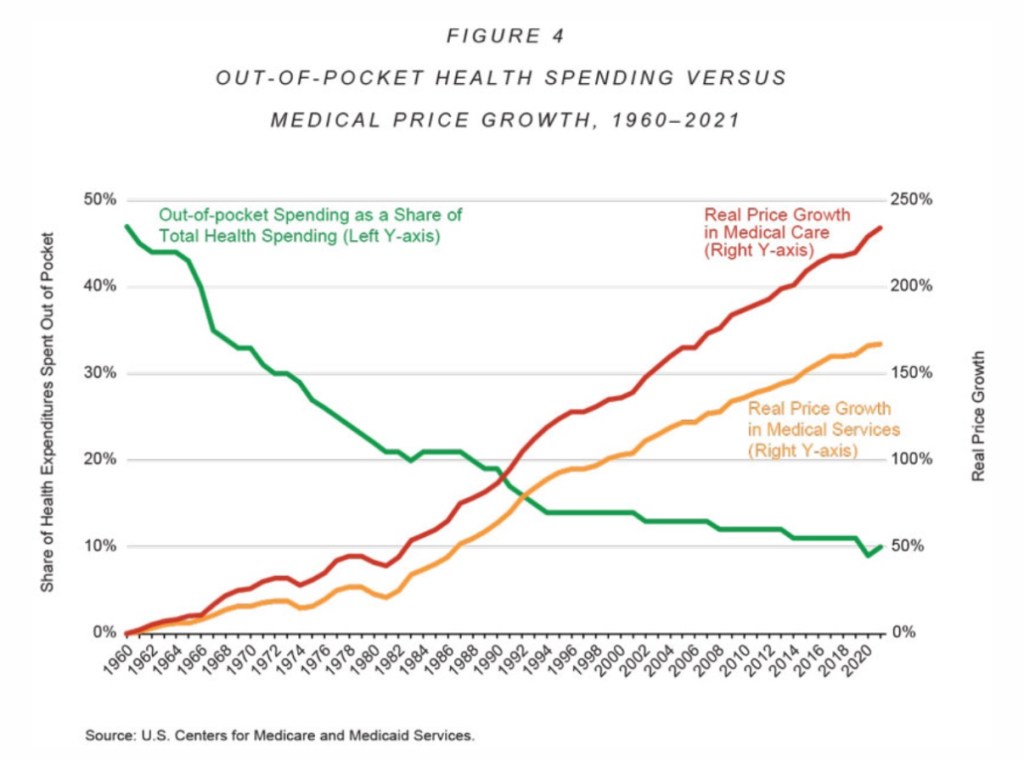
Unfortunately, the dysfunction in health care goes deeper than Obamacare, Medicare, and Medicaid. The third-party payment system itself has been at the root of cost escalation. It largely relieves consumers of their sovereignty over purchasing decisions, rendering them much less sensitive to variations in price. This can be seen clearly in one of Cannon’s charts, reproduced below:
In addition, the disparate income tax treatment of employer-provided health coverage exacerbates cost escalation. Obviously, employees receiving this deduction can afford higher-quality and more comprehensive coverage. This exemption has acted to drive up the cost of all health care and insurance coverage over the almost nine decades of its existence..

What To Do?

The claim that the U.S. health care system operates within a free market ecosystem is obviously absurd. Together, the Cochrane and Cannon pieces represent something of a gripe session, but it is well deserved. Both authors devote sections to reforms, however. They don’t break new ground in the debate, but the overarching theme of the suggested reforms is to give consumers authority over their health care spending. That means keeping government out of health care in all the myriad ways it now intrudes. It also means that insurers should not have authority to dictate how health care is priced. The key is to allow competition to flourish among health care providers and insurers.

Ending FMAPs and the tax exemption for employer-provided coverage is one thing, but it’s another to contemplate dismantling Medicare, Medicaid, and the many rules and pricing arrangements enforced under Obamacare.

Cochrane takes an accommodating approach to the health care needs of seniors and those in need of a safety net. He calls for Medicare and Medicaid to be replaced with the issuance of vouchers (rather than cash) toward the purchase of affordable private health care plans. Then, health coverage can be provided in a lightly regulated, competitive market without all the distortions and sneaky opportunities for graft embedded in our current entitlements.

Conflicting Rights and Reality

And what of the argument that health care is a human right? That notion is, of course, very popular on the left. The idea subtly shifts a meaningful portion of the responsibility for one’s health onto others, including providers and taxpayers. But smokers, heavy drinkers, reckless drivers, hard drug users, and the avoidably obese should not be led to expect a free ride for risky behaviors.

Of course, it’s not a basic human right to demand, by force of government, involuntary service of health care workers, or that taxpayers give alms, but Cochrane answers with this:

“Yes! It is a basic human right that I should be free to offer my money to a willing physician or hospital, in a brutally competitive and innovative market.”

“Willing” is a key word, and to that we should add “able”, but those are qualifying conditions that markets help facilitate.

Jane Menton has discussed the notion of a human right to health care, wisely explaining that conditions are not always compatible with fulfilling such a right. Her primary concern is the future supply of medical personnel, and an acute shortage of nurses.

“In our current political environment, young people seem to think that claiming something as an entitlement means someone will inevitably show up to do the work.“

To codify a right to health care would be an ill-fared call for a nationalized solution. It would be a prescription for still higher costs and lower quality care. As in any other sector, centralized decision-making leads to misallocated resources, higher costs, and inferior outcomes for patients. Our current mess gives a strong hint of the kind of over-regulated dysfunction that nationalization would bring.

Insurance On Insurability

Pre-existing conditions motivate much of the discussion surrounding a presumed right to health care. Individual portability of group health coverage goes partway in addressing coverage for pre-existing conditions. Portability is mandated by the Health Insurance Portability and Accountability Act of 1996, but like community rating, it shifts costs to others. That is, the cost of covering pre-existing conditions becomes the responsibility of employers in general, group insurers, and ultimately healthy (and younger) workers.

Given time, the debate over a right to health care can be rendered moot via market processes. Cochrane has long supported the concept of health status insurance. Such policies would allow healthy consumers to guarantee their insurability against the risk of future health contingencies. Guaranteed renewability is a limited form of this type of coverage. General availability of health status insurance contracts, offered regardless of current coverage, could allow for a range of future insurability options at affordable prices. Then, pre-existing conditions would cease to be such a huge driver of cross subsidies.

State Aesthetics: Taxes for Art and Dogma

07 Tuesday Jan 2025

Posted by Nuetzel in Art & Politics, Subsidies

≈ Leave a comment

Tags

Agitprop, Americans for the Arts, Arts Education, Arts Funding, Corporation for Public Broadcasting, crowding out, DOGE, Exclusivity, Externalities, National Endowment for the Arts, Propaganda, Public goods, Public Radio, Samuel Andreyev, Subsidies, Thomas Jefferson

In a post a few years ago entitled “The National Endowment for Rich Farts”, I discussed a point that should be rather obvious: federal funding of the arts too often subsidizes the upper class, catering to their artistic tastes and underwriting a means through which they conduct social and professional networking. The topic is back in the news, with reports that the incoming Trump Administration, at the recommendation of the Department of Government Efficiency (DOGE), will attempt to eliminate funding for the Corporation for Public Broadcasting.

Great Big Stuff and Crowding Out

To opponents of federal arts funding, public radio is probably the bête noire of arts organizations due to its left-wing political orientation and the general affluence of its subscriber base. However, public arts funding goes way beyond subsidies for public radio.

Large nonprofits receive the bulk of government arts funding. Despite claims to the contrary, these organizations won’t go broke without the gravy provided by public funding. The federal government contributes about 3% of the revenue taken in by non-profit arts organizations, according to Americans For the Arts. These organizations are already heavily subsidized: their surpluses are tax exempt and private contributions are tax deductible. Tax deductions are worth more to those in high income-tax brackets, and involvement in such visible organizations is highly prized by elites.

Furthermore, there is no evidence that additional government funding “multiplies” private giving. If anything, increases in public funding reduce private giving (and see here).

Public Funds for Private Gain

It’s often argued that government should subsidize the arts because art has the qualities of a public good, but that’s a false premise. A good can be classified as “public” only when its consumption is non-exclusive and non-rivalrous. Can individuals be excluded from enjoying music? Of course. Can they be excluded from viewing a theatrical performance, a film, or any other piece of visual art? Generally yes, and art exhibitions and artistic performances are nearly always subject to paid and limited attendance.

In some contexts art is, or can be made, less excludable. Architecture can be admired (or detested) by anyone on the street. So can public monuments and street art. A concert or play can be performed free of charge, perhaps at a large, outdoor venue. Amplification and large video monitors can make a big difference in terms of non-exclusion. Museums can offer admission to the general public at no charge. And we can broaden the definition of a work to include copies or reproductions that might be available via public display or broadcast (on NPR!).

All these steps will help increase exposure to the arts. But you can’t make it mandatory. People will always self-exclude because they can. So, in which cases should taxpayers bear the costs of art, and of making it less exclusive? On the spectrum of legitimate functions of government, it’s hard to rank this sort of activity highly.

A claim less absurd than the public goods argument is that art has some positive spillover effects, or externalities. It should therefore be subsidized or underwritten with public funds lest it be underprovided. Unfortunately, the spillover effects of a piece of art (where relevant) are not always positive. After all, tastes vary considerably. One man’s art can be another man’s annoyance or provocation. This undermines the case for public funding, at least for art that is controversial in nature.

Perhaps a better interpretation of art externalities is that exposure to the arts has positive spillover effects. Thus, additional art confers benefits to society above and beyond the edification of those exposed to it. Perhaps it makes us nicer and more interesting, but that’s a highly speculative rationale for public funding.

Less questionably, more art and more exposure to the arts does enrich society in ways that have nothing to do with external benefits. Culture and arts are by-products of normal social interactions between private individuals. The benefits of art exposure (and art education) are largely accrued privately. When artistic knowledge is shared to nourish or broaden one’s network, the benefits flow from private social interactions that arise naturally, rather than as a consequence of phantom external benefits.

Public Funding and Agitprop

The selection of recipients and projects for government grants or subsidies is especially prone to influence by entrenched political interests. That is indeed the case when it comes to federal agencies that offer grants for the arts.

The same danger looms when government provides a venue or manages aspects of a presentation of art, including curation of content. It’s an avenue through which art can become politicized. The problem, however, is not so much that a particular work might have political implications. As Samuel Andreyev, a Canadian composer says:

“Like any other subject, it is possible for political subjects to be handled sensitively by an artist, provided there is a strong enough element of abstraction and symbolism so that the work does not become merely journalistic.”

Andreyev makes a good point, but government funding and direction can create incentives to politicize art, encouraging more blatant expressions of political viewpoints at the expense of taxpayers.

I’ve certainly admired art despite subtle political implications with which I differed. One can hardly imagine a treatment of the human condition that would not invite tangential political commentary. Still, politicization of art should always be left as a private exercise, not one over which the government of a free society wields influence.

Do Markets Undervalue Art?

What about the artists themselves? The premise that artists deserve subsidies relies on the questionable presumption that the value of their work exceeds its commercial or market value. Thus, taxpayers are asked to pay handsomely for art that is not valued as highly by private buyers.

Artists who benefit from government arts funding are often well established professionally. Less fortunate artists scrape by, finding what market they can while working side gigs. In fact, many less celebrated artists work at their craft on a part-time basis while earning most of their income from day jobs. Should the government support these artists, or artists having few opportunities to promote their work?

It’s not clear that public funding should override the private market’s basis of valuation for established or unestablished artists. However, some government funding finds its way into less celebrated corners of the art world. This report uses data at the census tract level to show that arts organizations located in low income tracts, while receiving less, still get a disproportionate share of federal grant dollars relative to their share of the population. This finding should be viewed cautiously, as data at this level of aggregation has limitations. The findings do not imply that “starving artists” receive a disproportionate share of those dollars. Nor do they prove that federal grants benefit low-income individuals disproportionately via improved access to the arts. Again, the findings are based on the location of organizations. And again, large organizations receive the bulk of these grants.

Drawing the Line

So where do we draw the line on taxpayer subsidies for the arts? The standard, public-goods justification is false. While externalities may exist, they are not always positive, and it is hardly the state’s proper role to fund art that “challenges” notions about good and bad art. In that vein, just as law tends to be ineffective when it lacks consensus, public arts funding breeds dissent when the art is controversial.

The legitimacy of public arts funding ultimately depends on whether the art itself has a true public purpose. To varying degrees, this might include the architecture and interior design of public buildings, landscaping of parks, as well as certain monuments and statuary. Even within these disciplines, the selection of form, content, and the artists who will execute the work can be controversial. That might be unavoidable, though controversy will be minimized when the content of publicly-funded art remains within cultural norms.

Beyond those limited purposes, funding art at the federal level is difficult to justify. That role simply does not fall within the constitutionally-enumerated powers of the federal government. The tenuous rationale for subsidies implies that art is undervalued, despite the existence of a vibrant private ecosystem for art, including private support foundations and markets. To the extent that public subsidies line the pockets of elites or support art that would otherwise fail a market test, they represent a wasteful misallocation of resources.

Funding art might seem less troublesome at lower levels of government, where elected representatives and policymakers are in more intimate contact with voters and taxpayers. Still, the same economic reservations apply. At local levels, institutions like community orchestras and concerts series might be broadly supported. Publicly-funded museums, theatrical venues, and other facilities might be accepted by voters as well. If parents have educational choices and expect schools to teach art, it should be funded at public schools, so long as the content stays within cultural norms and is age-appropriate. Of course, all of these matters are up to local voters.

The greatest danger of public funding for the arts is that it tends to be utilized as a tool of political propaganda. Having the state select winners and losers in the arts invites politicization, undermining freedom and our system of government. On that point, Thomas Jefferson once made this observation:

“To compel a man to furnish contributions of money for the propagations of opinions which he disbelieves and abhors, is sinful and tyrannical.“

Electric Cars: EPA Serves Up Green Kool-Aid To Pair With Subsidies

03 Tuesday Oct 2017

Posted by Nuetzel in Environment, Subsidies, Technology

≈ Leave a comment

Tags

Coyote Blog, Electric Cars, Energy Efficiency, Energy Losses, Environmental Protection Agency, EPA, Eric Schmidt, Fossil fuels, MPG Conversion Factor, MPGe, Storage Density, Tesla, Transmission Losses, Warren Meyer

Electric cars don’t save much energy over gas-burners if at all, at least for now. Warren Meyer’s recent Coyote Blog post on this topic is aptly titled “Why Is It So Hard To Get Even Smart People To Think Clearly On Electric Vehicle Efficiency“. Meyer begins by quoting the following tweet from Google smarty Eric Schmidt, which typifies the general level of public awareness regarding the supposed energy savings from electric cars produced by Tesla and many others:

“Electric motors are the unsung hero of clean energy – the latest are 97% efficient, vs. 45% for internal combustion.“

Meyer emphasizes these major points:

  1. the efficiency with which source fuels are converted to physical work via electric and gas-burning cars is more comparable than Schmidt’s tweet suggests;
  2. differences in energy density weigh heavily in favor of fuel-burning vehicles.
  3. the so-called miles-per-gallon equivalent (MPGe) calculated by the U.S. Environmental Protection Agency (EPA) is a sham.

First, Schmidt’s tweet is accurate only if the discussion is confined to simple conversion of energy to physical work performed by the respective engines. The tweet ignores energy losses that occur prior to that conversion: electricity must be generated with far less than 100% efficiency, mainly by burning coal and natural gas. In an earlier Forbes article, Meyer compares this situation to a distorted comparison of two refrigerator installers:

“In both cases the customer lives in a fourth floor walkup. The first installer finds the refrigerator has been left on the street. He has to … haul the appliance up four flights of stairs. After that, relatively speaking, the installation is a breeze. The second installer finds his refrigerator has thoughtfully been delivered right to the customer’s door on the fourth floor. He quickly brings the unit inside and completes the installation. So who is a better installer?“

The fact is that both gas-burning and electric vehicles rely heavily on fossil fuels. And, in addition to losses in the generation process, there are other losses of energy attributable to electric cars: transmission of power involves a significant energy loss, as does charging batteries and storage itself. Meyer considers only the extra losses from production and transmission of electricity in the following comparison:

“We take 97% times 90% transmission efficiency times 50% electricity production efficiency equals 43.6%.  This is actually less than his 45% figure.  By his own numbers, the electric motor is worse….“

Meyer qualifies this comparison, as some of his assumptions are of the “best outcome” variety, but contrary to Schmidt’s assertion, gasoline and electric engines are reasonably comparable in terms of energy efficiency.

Some contend, however, that power losses in electricity transmission are much larger than the 10% Meyer assumes (see the comments on his post). Battery charging involves a loss of perhaps 20%. And a replacement for a Tesla battery, post 8-year warranty, is $8,000 – $12,000, an additional storage “cost” that is virtually non-existent for gas-powered vehicles. Beyond a certain point in its life, that cost will have an impact on a Tesla’s resale value. Moreover, some contend that the production of electric vehicles is more energy-intensive, putting them in an energy efficiency hole right from the get-go.

Meyer then takes up the notion of storage density as an explanation for why early experiments with electric cars were essentially abandoned:

“15 gallons of gasoline weighs 90 pounds and takes up 2 cubic feet. This will carry a 40 mpg car 600 miles. The Tesla Model S 85kwh battery pack weighs 1200 pounds and will carry the car 265 miles (from this article the cells themselves occupy about 4 cubic feet if packed perfectly but in this video the whole pack looks much larger). We can see that even with what Musk claims is twice the energy density of other batteries, the Tesla gets  0.22 miles per pound of fuel/battery while the regular car can get 6.7. More than an order of magnitude, that is simply an enormous difference…“

Meyer notes in the Forbes article that the EPA calculates its MPG conversion factor for electric vehicles by dividing BTU’s in a gallon of gas by the BTUs in a kilowatt hour: 33.7 KwH per gallon. Thus, the EPA multiplies an electric car’s miles per KwH by 33.7 to arrive at the so-called MPG equivalent: MPGe. But as we’ve seen above, the conversion factor ignores the generation and transmission of electricity required at the front end, and the associated energy losses that occur before a single KwH is released by a Tesla battery.

Despite what we hear from the EPA, Tesla, and other interests today, electric cars have not really overcome these disadvantages, at least not yet. The EPA’s MPGe estimates are vastly inflated. Perhaps if they were accurate, these vehicles would not have to rely so heavily on taxpayer subsidies to be competitive. By extension, the presumed environmental benefits of electric cars are nonexistent at this stage of development. I’m certain that Eric Schmidt and many other smart people are capable of understanding these nuances, but they might be too busy tripping over their politics to bother.

Tragic Harvey Flooding Was a Known Risk

31 Thursday Aug 2017

Posted by Nuetzel in Flood Insurance, Global Warming, Subsidies, Uncategorized

≈ Leave a comment

Tags

Climate Change, David Conrad, Federal Flood Insurance, Houston, Hurricane Frequency, Hurricane Harvey, Landfalling Hurricanes, Michael Grunwald, National Wildlife Federation, Roger Pielke Jr., Roy Spencer

Houston-flood-1935

The photo above is downtown Houston during the flood of 1935, which I lifted from a post on Roy Spencer’s blog. The rate of rainfall from Hurricane Harvey in Houston is not unprecedented, according to Spencer. The geographic breadth and duration of the heavy rainfall might be, but ready comparisons are difficult on that basis, even for the 100 years of recorded rainfall in East Texas. The tragic severity of the flood damage is probably unprecedented as well, though the full tally won’t be in for some time. The severity is a consequence of four factors: the breadth of the rainfall, its duration, the growth of the Houston metro area, and the unnecessary development of low-lying areas that can no longer provide effective drainage and absorption of rainfall due to impervious cover.

Harvey was (and is) a big storm, but an unusual aspect of Harvey was the way it stalled after making landfall:

“The exact same tropical system moving at, say, 15 mph might have produced the same total amount of rain, but it would have been spread over a wide area, maybe many states, with no flooding disaster. This is usually what happens with landfalling hurricanes. … Instead, Harvey stalled after it came ashore and so all of the rain has been concentrated in a relatively small portion of Texas around the Houston area. In both cases, the atmosphere produced the same amount of rain, but where the rain lands is very different.“

Spencer also notes that Harvey is in no way evidence of global warming, as many in the media have implied:

“Roger Pielke Jr. has pointed out that the U.S. has had only four Category 4 (or stronger) hurricane strikes since 1970, but in about the same number of years preceding 1970 there were 14 strikes. So we can’t say that we are experiencing more intense hurricanes in recent decades. … Going back even earlier, a Category 4 hurricane struck Galveston in 1900, killing between 6,000 and 12,000 people. That was the greatest natural disaster in U.S. history. … And don’t forget, we just went through an unprecedented length of time – almost 12 years – without a major hurricane (Cat 3 or stronger) making landfall in the U.S.“

As for the role of development in the severity of the flooding, Spencer says:

“Major floods are difficult to compare throughout history because the ways in which we alter the landscape. For example, as cities like Houston expand over the years, soil is covered up by roads, parking lots, and buildings, with water rapidly draining off rather than soaking into the soil. The population of Houston is now ten times what it was in the 1920s. The Houston metroplex area has expanded greatly and the water drainage is basically in the direction of downtown Houston.”

Short memories and inaccurate assessments of flood potential might have encouraged excessive building in low-lying areas in and around Houston. However, the profligate extension of federal flood insurance to properties in those areas played a large role. Here is Michael Grunwald:

“Nearly two decades before the storm’s historic assault on homes and businesses along the Gulf Coast of Texas this week, the National Wildlife Federation released a groundbreaking report about the United States government’s dysfunctional flood insurance program, demonstrating how it was making catastrophes worse by encouraging Americans to build and rebuild in flood-prone areas.“

Houston played a noteworthy role in the report quoted by Grunwald:

“‘Houston, we have a problem,’ declared the report’s author, David Conrad. The repetitive losses from even modest floods, he warned, were a harbinger of a costly and potentially deadly future. ‘We haven’t seen the worst of this yet,’ Conrad said.

Climate alarmists would be well-advised to read Spencer’s piece on Harvey. It offers  excellent historical and climatological context. It’s also interesting to read some of the venomous ad hominem sprayed in Spencer’s direction by alarmist trolls in the comments section. Spencer knows too well, however, that “floods aren’t just due to the weather“. Let’s hope that the Houston area won’t be encouraged to rebuild in low-lying areas by prospective subsidies from a federal flood insurance program in need of drastic reform.

The Renewable Energy Jobs Hoax

30 Tuesday May 2017

Posted by Nuetzel in Renewable Energy, Subsidies, Uncategorized

≈ Leave a comment

Tags

Fossil fuels, Government Subsidies, infrastructure, James Taylor, Job Creation, Jobs Objective, Marginal cost, Mark Zuckerberg, Renewable energy, Renewable Energy Subsidies, Tariffs, Tim Worstall

James Taylor at Forbes reveals the dishonest math behind the claim that renewable energy generates more jobs than “conventional energy”, i.e., fossil fuels. It’s a simple trick, as Taylor explains:

“… renewable energy advocates create the broadest possible definition of workers ‘supported’ by the solar power industry, falsely claim that the solar power industry ’employed’ all these workers, and then compare that to the narrowest possible definition of just a single segment of workers ‘directly’ employed in the ‘extraction’ component of the much larger natural gas industry.“

Taylor notes that, “In reality, renewable energy isn’t even in the same universe of job creation as conventional energy.” He goes on to cite the report on which these claims are based and picks it apart. The renewable energy job assertions are obviously self-intereseted, as rent seeking lobbyists know that the political class is dominated by easy marks for renewable energy wonder-stories.

Of course Taylor is correct that the claims about renewable energy jobs are false in the aggregate sense. However, it might or might not be true in the marginal sense, and that’s clearly the sense in which the claim is intended to be taken, despite the fact that the data used is not marginal in nature. If true, it’s not a selling point for renewable energy subsidies because “more jobs” represents a greater marginal cost.

And that brings us to an even more critical issue missed by Taylor: public policy should not be based on the objective of direct job creation. Jobs are a cost, not a benefit. We value the finished goods, not the inputs required to produce them. If you don’t quite get that, imagine two bids for the construction of new kitchen in your home. Same plans, same completion date, similarly brilliant customer reviews of the competing contractors. Without knowing the actual bids, if one contractor tells you it’s a three-man job and the other says it’s a four-man job, you’ll be pretty certain which bid you’ll want to accept.

Ah, but you say, that’s not a fair comparison, because I’m paying for it. Yes you are, just as taxpayers (and more generally society) must pay for the subsidies that lobbyists wheedle out of politicians. Or you say, Ah, but we want more renewable jobs because we want renewable energy, ’cause it’s just right. Maybe, maybe not, but if that’s so, then the idea that the cost is higher because more jobs are required per unit of energy is not a good rationale.

It’s often the case that public policy aimed at “creating jobs” is not accompanied by higher output, lower prices, or even… more jobs! For example, tariffs on foreign goods give an advantage to American producers, but at the cost of job losses in import industries and higher domestic prices that harm consumers more broadly, and thereby reduce jobs. When certain industries or firms are subsidized by the government, the taxpayer is harmed directly, not to mention suppliers of alternatives. This is true at the local and national levels: politicians love to talk about job creation when they offer incentives for new facilities or relocations to their jurisdictions, but these subsidies may put other local firms at a competitive disadvantage and leave taxpayers holding the bag for public services supplied to the recipient firm. When government undertakes large taxpayer-funded infrastructure projects, which might or might not boost productivity, the taxes are damaging and the projects are often poorly planned and lack effective cost controls. Jobs are not a reason to support such projects.

Similar points have been discussed in the past here on Sacred Cow Chips, with links to articles emphasizing the distinction between direct jobs created and economic welfare like this one. “Jobs” should never be a policy objective in and of itself. As Tim Worstall explains in a brief review of Mark Zuckerberg’s recent commencement address at Harvard, jobs simply are not the point! Policy must have a better rationale than the high cost of the labor input!

Insurance Subsidies: Taxes vs. High Premiums

16 Tuesday May 2017

Posted by Nuetzel in Health Care, Subsidies, Taxes

≈ Leave a comment

Tags

Charity, Guaranteed Issue, Individual Mandate, Kevin Williamson, Managed Health Care, Megan McArdle, monopoly, Pre-Existing Conditions, Right To Health Care, Single-Payer, Voluntary Exchange, Woodrow Wilson

Here’s a question a friend posed: Why do we care whether health care coverage for high-risk individuals is subsidized by taxpayers versus premium payers via common (community) rating in a combined risk pool? For convenience, let’s call those two scenarios T and C. Under C there is no segmentation whatsoever, while T involves a division of individuals into two groups: standard and high risk. Both scenarios involve guaranteed issue, though T assumes that high-risk individuals must purchase their coverage in the appropriate market. I’ll tackle T first because separate treatment of the distinct risk archetypes yields results that are useful as a baseline.

Taxpayers Subsidize Pre-Existing Conditions

Under scenario T, suppose that all standard risks face the same expected outcome in each period. Everyone in that group pays based on their expected health care costs. In the end, some will have greater health care needs than others, but only a few will be truly unlucky, incurring extremely high health care expenses. On balance, the pooling of risk makes the arrangement sustainable. People enter into these contracts voluntarily because they are risk averse. No one forces them; they are capturing value from protection against financial ruin. The paid-in cash can be invested by the plan in the interim between premium and claims payments. The combination of premium payments and investment income must be enough to cover claims and allow the managers of the plan to defray their administrative costs and make a tidy profit. The profit matters because it attracts voluntary resources to bear on the problem of health-expense risk. Therefore, these insurance transactions are mutually beneficial to the insured and the owners of the insurer.

Conceivably, the smaller high-risk group could be handled the same way, as long as their aggregate health care expenses are predictable. Those expenses will be high, however, so the cost of coverage for individuals in such a pool might be prohibitive. One solution is to force taxpayers to subsidize coverage for this group. The transactions in this market are also mutually beneficial to the insureds and the insurers, just as in the market for standard risks. In both cases, the value to purchasers of coverage is no less than the cost of providing it, including compensation for any capital employed in the process.

In the simplified world of scenario T, we have an optimal insurance outcome for both standard and high-risk individuals. The downside is the cost of the subsidies to taxpayers, which distort a variety of incentives, including labor supply, saving and investment. These lead to misallocations, but they are spread across the economy rather than concentrated on the outcomes in a single market. Is this better than simply pooling all risks, as in Scenario C (common rating)?

Common (Community) Rating

Common rating means that all risks are combined into one pool and everyone is charged the same premium. High-risk individuals get to participate just as if they are standard risks. However, because the combined risk pool has greater expected health care costs on average than the standard risk population, the premium must be greater than the one charged to standard risks in Scenario T. Otherwise, the plan could not cover all expenses nor earn a profit. Worse yet, the standard risks now have an incentive to exit the market while high-risk individuals have every reason to leap in. This is called adverse selection, and it leads to the sort of insurance death spiral we’ve witnessed under Obamacare. And not only does the risk pool deteriorate: the incentive to offer coverage is diminished as well. Thus, an entire industry is rendered dysfunctional. Those who wish to pool together voluntarily in order to efficiently hedge their risks are, by law, prohibited from doing so. The next step might well be for government to mandate participation in an attempt to keep the plan afloat.

Those who favor forced redistribution (not my set) might have other reasons to prefer Scenario T, as it creates greater latitude for progressive tax funding of the subsidies. However, the subsidies themselves could be sensitive to income such that the risky but well-heeled pay more.

From a libertarian perspective, Scenario C has obvious drawbacks, starting with the coercion of insurers to provide coverage to the high-risk population at rates that do not compensate for risk. Then, too, the mis-pricing of risk places a burden on individuals of standard risk. With the pooling of all risks, community rating and coverage mandates result in individual and aggregate over-insurance against most types of risk, tying up scarce resources in insurance assets that could be invested more productively in other uses. In addition, resources are absorbed by compliance costs as authorities find it necessary to enforce the many rules made in hopes of proping-up an otherwise unsustainable arrangement.

Then There’s Single-Payer

It’s often argued that going beyond this point in Scenario C to a single-payer system will yield better outcomes at lower costs. Megan McArdle shreds this idea in a recent column: well over 40% of health care spending in the U.S. is paid by government already; the average growth of that share is even higher than private health care spending; the quality of care is often lower in the government health sector, and in any case, single payer systems around the world do not enjoy slower growth in costs. Rather, they started from lower levels of health care costs. Our relatively high level of costs in the U.S. evolved many years ago, before single-payer systems were adopted abroad. We have many more private and semi-private hospital rooms in the U.S., we often have greater availability of advanced technology, and waiting times for care tend to be significantly shorter.

The high standard of living in the U.S., i.e., our level of consumption, explains a lot of the gap in health care spending. Overall, our health care outcomes are good relative to other developed countries. Unfortunately, we’ve also pushed-up costs from the demand side by offering tax subsidies on employer-provided care, and government in the U.S. has had a role in “managing” health care since the time of the Woodrow Wilson Administration, largely to the detriment of cost control. Government control stultifies competition, creating monopoly-like conditions in both insurance and the provision of care. That manifests in higher profits, safer profits, or slovenly performance by organizations and agents that lack accountability to customers and market forces. Costs rise.

Liberty or Coercion

Libertarians will object to the tax in Scenario T, which like all taxation is coerced, but the taxes necessary to pay for adequate coverage for pre-existing conditions is minor relative to the potential costs of distorting the entire health insurance industry, repleat with the costs of government regulation and compliance that entails, and the potential for still more encroachment of government in health care.

Finally, the question posed by my friend about tax subsidies versus common insurance rating was prompted by a presumed “right to health care”. One must ask whether that right is legitimate. Kevin Williamson argues that scarcity interferes with any such claim. More to the point, in a free society, one cannot simply demand health care from another free individual. Our choices for distributing scarce health care fall into one of only two categories: voluntary and coerced. We should always prefer the former, which may take the form of charity or a mechanism under which care is provided via free exchange. The latter works very well when incentives are clear and pricing is efficient. For those who cannot participate in exchange for any reason, including pre-existing conditions that make coverage prohibitive, private charity is an alternative to government subsidies. At a minimum, charity should serve as an important relief valve for the burden on taxpayers. The Left, however, is always quick to condemn private charity as if it is somehow an illegitimate mechanism for solving social problems, but it is often superior to government action.

Risks, Costs and the Sharing Kind

23 Thursday Mar 2017

Posted by Nuetzel in Abortion, Health Care, Subsidies

≈ Leave a comment

Tags

Charlie Martin, Collectivism, Diffuse Costs, Fertility, Insurable Event, Insurable Risks, NARAL, National Association for the Repeal of Abortion Laws, Planned Pregnancy, Shared Risk, Trumpcare, Unplanned Pregnancy

Of all the health care buffoonery we’ve witnessed since the Affordable Care Act (ACA, or Obamacare) was first introduced in Congress in 2009, one of the most egregious is the strengthening of the notion that health insurance should cover a variety of wholly predictable, and strictly speaking, non-insurable events. Charlie Martin recently posted some interesting comments on insurance and why it works, and why public perceptions and public policy are often at odds with good insurance practices. He says that “Insurance Is Always Just Gambling“. True, real insurance is like any other rational hedge against risk, and that can be called a gamble. Unfortunately, public policy often interferes with our ability to hedge these risks efficiently.

Hedged Risk Or Prepaid Expenses?

To begin with, insurance is a mechanism for individuals to manage the financial impact of events that are unpredictable and potentially costly. These are insurable risks. But if an event recurs regularly, like an annual physical exam, a breast exam, or a pap smear, or if an event is largely within the individual’s control, like whether an ugly mole should be removed, then it is not an insurable risk. Paying for such “coverage” through a third-party insurer amounts to prepaying for services for which you’d otherwise pay directly when the time comes. We’ve essentially adopted this prepayment scheme on a national scale through Obamacare’s mandated benefits: we get broad coverage of non-insurable events in exchange for premiums and/or deductibles high enough to cover the prepayments! Big win, huh?

The rationale for a broad coverage mandate is that it will induce healthy behaviors like, well… getting an annual checkup. Therefore, it is said to be in the interests of insurers to include such benefits in basic coverage. That might well be, but the insurers don’t do it for free! Indeed, a combination of premiums and deductibles are correspondingly higher as a result, and the mandate introduces a “middle man”, the insurer, who adds cost to the process of executing a relatively simple transaction.

Unlike these prepaid health care expenses, real insurance is really a sort of gamble. An insurer makes a bet that you won’t have a major, unanticipated health care need, and you put up the “premium” as your bet that you will have such a need. If you are healthy, then the odds are low, so it’s a fairly cheap bet for you, but you have to put up a little extra to pay for your insurer’s administrative costs. Down the road, if you need acute care, your bet pays off. Yippee! You’ll be covered.

But who knows the odds that you’ll need expensive care? And why would an insurer take the risk of losing big if you get sick?

The insurer can estimate those odds via actuarial data and experience, and they can assume your risk by playing the law of large numbers: if they make similar bets with many individuals, their actual losses will be more than covered by premium revenue (most of the time… as Martin explains, it’s possible for an insurer to make a bet with a so-called reinsurer as a hedge against the small risk of a huge loss on its book of business, beyond some threshold).

Shared Risk Or Shared Cost?

Martin objects to the use of the term “shared risk” in this context. Many individuals make similar bets, which makes the insurer’s aggregate payout more predictable. That allows them to offer such bets on reasonable monetary terms, and they are all voluntary contracts sought out by people facing risks of the same character. If an individual seeks to insure against a demonstrably heightened risk, an insurer might or might not agree to the “bet” voluntarily, but if it does, the risk is not truly “shared” by individuals who face lower risks. The high-risk bet is reasonable for the insurer only to the extent that: (1) the premium is actuarially fair in conjunction with a larger pool of high-risk bets, or (2) it can be cross-subsidized by more profitable lines of coverage. If the answer is (2), then premiums for healthy individuals must rise to cover risks they do not share. That is one basis under which Obamacare operates and it is a subtle aspect of Martin’s argument against the notion of “shared risks”. Perhaps we can avoid the semantic difficulty by speaking of “sharing the costs of risks that are not shared”.

A more obvious aspect of Martin’s objection to “shared risk” relates to the expectation that predictable medical costs must be “covered” by health insurance, as discussed above. If so, no risk is shared because there is no risk! Yet we often speak of health insurance “needs” as if they combine a variety of such things, and as if all those “needs” embody risks that are shared. They are not.

Sharing the Cost of Prenatal Care

In another post, Martin tackles the question of whether certain people should be expected to pay a premium that includes the cost of prenatal care. Martin was prompted by a tweet from the National Association for the Repeal of Abortion Laws (NARAL), which read:

“WOW. The #GOP’s reason to object to insurance covering prenatal care? ‘Why should men pay for it?’ #Trumpcare #ProtectOurCare”

There was a link in the tweet to a video, which was captioned by NARAL as follows:

“The GOP reasoning to object to prenatal insurance
Two male Republicans object to prenatal care coverage under the ACA because—while it ensures women have healthy pregnancies—it means men pay *a tiny bit more* for insurance. WOW.”

To the extent that pregnancy can be considered a risk, it is certainly not shared by seniors, gays and lesbians, and infertile individuals, let alone unattached males. And from an insurance perspective, an obvious difficulty with NARAL’s point is that many pregnancies are planned. As such, they are not insurable events (though complications of pregnancy clearly are insurable). Yet people speak as though others must “share” the costs. That is fundamentally unfair and economically inefficient. Subsidies for couples who might wish to have children lead to greater rates of fertility than those couples can otherwise afford, saddling society with the medical bill. Incentives are no joke.

There are also unplanned pregnancies among singles and married couples, however. That sounds more like an insurable event, but it’s usually impossible for a third party to determine whether a pregnancy is planned or unplanned, so moral hazard is an issue (except in extreme circumstances like rape or incest). The risk of pregnancy is confined to a subset of the population, so sharing these costs more broadly is inefficient to the extent that it subsidizes some pregnancies (oops!) that individuals cannot otherwise afford. Individuals and couples who face pregnancy risk must manage that risk in any way they chose, and they might wish to purchase a form of coverage that will help them smooth the cost of pregnancies over their fertile years. It’s not clear that coverage of that nature is better for the prospective parent(s) than a line of credit, but it is a form of insurance only because of the “unplanned” component, and at least it allows them to spread the cost ex ante as well as ex post.

Sharing Costs of Common Risks 

The basic point here is that sharing a risk across all individuals, whether they do or do not actually face the risk, is not a natural characteristic of private insurance. In fact, the idea that this cost should be shared broadly is a collectivist notion. The major flaws are that 1) individuals and couples at risk are not financially responsible for certain cost-causing decisions they might make; and 2) it forces individuals and couples not at risk to pay for others’ risks, which is an act of coercion. NARAL feels that individuals who subscribe to these sound principles are worthy of rebuke. And NARAL asserts that “men pay a tiny bit more“, without providing quantification. Of course, it’s not just men, but this is a variation on the old statist argument that diffuse costs are not meaningful and should be disregarded, ad infinitum.

Public Aid Dressed As Insurance

There are segments of society that are often depicted as incapable of managing risks like pregnancy and unable to afford the consequences of mistakes. Subsidizing those individuals is a second collectivist front for “risk sharing”. Those subsidies can and do take the form of “family planning”, as well as prenatal care and childbirth. That’s part of the social safety net, and while it is perhaps more tolerable as aid, it entails the same kinds of bad incentives as discussed earlier.

The welfare state has seldom been praised for its impact on incentives. Most studies have found a link between public aid and higher fertility, and mixed effects on the dissolution of marriage (see here and here, and for international evidence, see here). But aid for health care expenses should not interfere with the sound operation of the insurance market. Vouchers for catastrophic coverage would be far preferable, and that aid could even cover some regularly recurring health care costs, despite their non-insurable nature, but that would be a compromise.

The misgivings voiced by Martin are partly driven by two fundamental issues: guaranteed issue and community rating. The former means that an insurer must take your bet regardless of the risks you present; the latter means that the insurer cannot charge premiums commensurate with the risk inherent in the various bets it takes. As David Henderson writes, both underpin the ACA. In other words, the ACA imposes cost sharing. Here is Henderson:

“As I wrote over 20 years ago, the combination of guaranteed issue and community rating, a key feature of Obamacare, leads to the destruction of insurance markets. No one would advocate forcing insurance companies to issue house insurance policies to people whose houses are burning, at premiums equal to those paid by others whose houses aren’t burning. And the twin requirements would cause more and more people to refrain from buying insurance until their houses are on fire. Insurance companies, knowing this, would charge astronomically high premiums.“

National Endowment for Rich Farts

08 Wednesday Mar 2017

Posted by Nuetzel in Big Government, Charity, Subsidies

≈ Leave a comment

Tags

Cliches of Progressivism, Constitutional convention, Grant Multiplier, Heritage Foundation, Identity Politics, Jeff Jacoby, Lawrence Reed, National Bureau of Economic Research, National Endowment for the Arts, National Public Radio, Politicized Art, Public Arts Funding, Stuart Butler

Wailing has begun over the possible defunding and demise of the National Endowment for the Arts (NEA). How could those cretins propose to eliminate an institution so very critical to promoting artistic expression? If that’s your reaction, you haven’t thought much about the main beneficiaries of federal sinkholes like the NEA. Granted, at $146 million annually, it is not a major federal budget item, but I’d rather not stoop to defend a lousy program because it’s small. So what’s my beef with the NEA, you ask? Read on.

First, any implication that the NEA is the lifeblood of the arts is laughable. No, the arts won’t die if federal funding is denied. Jeff Jacoby quotes figures suggesting that grants from the NEA represented less than 1% of all support for the arts and culture in the U.S. in 2015. Great art was created prior to the establishment of the NEA in 1965. Without the NEA, such bungles as “Piss Christ” would have met with less acclaim. As such a minor funding vehicle, eliminating the NEA won’t make much difference to artists, but it will end a subsidy for wealthy patrons, who can and do provide support for worthy projects, but also derive essentially private benefits from the federal arts spigot.

A large share of NEA grant money goes to non-profit organizations that are already subsidized to the extent that they are not taxed. (Let’s face it: the term “non-profit” itself is often a term of art.) Large arts organizations, which receive a significant share of NEA grants, often have highly-paid administrators and sumptuous facilities. Contributions to those organizations are tax-deductible for the donors. And few of those organizations provide art to the public for free or at a discount. Indeed, as noted at the last link, they often charge significant prices for attendance, and their audiences include a disproportionate percentage of high-income patrons.

Lawrence Reed argues persuasively that government need not subsidize the arts in an article in his series on the Cliches of Progressivism. Here are the highlights:

  • “Government funding of the arts… carries with it all the downsides of dependence on politics.
  • Claims that arts spending is magically “multiplied” are specious and usually self-serving, and never look at alternative uses of the same money.
  • Culture arises naturally and spontaneously among people who chose to interact with each other. Art is part of that, but it also competes with all sorts of other things people choose to do with their time and money.
  • If art is truly important, then the last thing we should want to do is politicize it or divert it toward those things that people with power think we should see or hear.”

Reed’s comment regarding “multipliers” might need some explanation in this context. The NEA’s defenders often claim that each dollar of NEA grant money results in multiple additional grants from other sources, but there is absolutely no evidence to support this claim except for a requirement that NEA grants be matched at the state level (not to mention a requirement for a state-level arts agency). Obviously, that represents another cost to taxpayers. It is quite possible, in fact, that the NEA and matching state grants act as substitutes for, and depress, private arts giving. See this piece in Forbes for more background. This NBER research utilized a large panel data set on individual charities and found only mixed support for the proposition that government grants encourage private contributions. In fact, the estimated effect was ambiguous for individual categories of charitable giving (which did not explicitly address the arts as a category). In any case, a positive cross-sectional effect of government grants on private giving for individual charities is consistent with a negative effect on other charities that do not receive public grants.

In a 20-year-old report from the Heritage Foundation, Stuart Butler offered a list of reasons to defund the NEA, which have held up well. Here, I provide eight that seem relevant:

  1. The arts will have more than enough support without the NEA: See above.
  2. Welfare for cultural elitists: See above. NEA grants fund a number of big and very elite organizations, but they would have you believe that it’s a veritable welfare program for the arts. That is a huge distortion. There is no question that the distribution of patrons of these organizations skews to the wealthy.
  3. Discourages charitable gifts to the arts: See above. Is the award of an NEA grant the equivalent of establishing a credit record to an arts organization? This might hold up for a few small organizations with projects the NEA has funded, but again, the support for this proposition is anecdotal and self-serving, and the numbers are small. And is there an implied stain on the legitimacy of any organization unable to win such a grant?
  4. Lowers the quality of American art: Committee decisions and central planning are not conducive to the spirit of creativity. Public institutions are often guided by political agendas, and government-sanctioned art stands in sharp contradiction to the ideal of free expression. Butler quotes Ralph Waldo Emerson: “Beauty will not come at the call of the legislature…. It will come, as always, unannounced, and spring up between the feet of brave and earnest men.”
  5. Funds pornography: this is not my hot button… it’s an issue only to the extent that public funds should not be used for purposes only flimsily in the public interest that many taxpayers find morally repugnant.
  6. Promotes politically correct art: See #4 above. The merits are then judged on the basis of criteria like race, ethnicity, and gender identity, not the quality of the art itself.
  7. Wastes resources: Butler offers a few examples of the waste at the NEA, a shortcoming common to all bureaucracies. The NEA funds organizations that behave as non-profit cronyists, engaging in lobbying efforts for more support. Butler also cites evidence that recipients of government grants in the UK hire more administrative staff than non-recipients, and tend not to reduce ticket prices.
  8. Funding the NEA disturbs the U.S. tradition of limited government: I suppose this goes without saying….

The federal government in the U.S. was granted a set of enumerated powers in the Constitution, and promoting the arts was not one of them. It wasn’t as if the subject didn’t come up at the Constitutional Convention. It did, and it was voted down. Today, entrenched interests at organizations like the NEA and National Public Radio distort the character of the constituencies they serve. In reality, those constituencies  are heavily concentrated among the cultural and economic elite. The NEA and NPR also promote the fiction that they are all that stand between access to the arts and culture and a bleak, artless dystopia. Give them credit for creating a fantasy about which the political left readily suspends disbelief.

The Vagina Subsidies

08 Wednesday Feb 2017

Posted by Nuetzel in Health Care, Subsidies

≈ Leave a comment

Tags

Abortion, Carl Anderson, Elective Abortions, Essential Benefits, Family Planning, Gender Rating, Generaal Accounting Office, Hadley Heath, Hyde Amendment, Identity Politics, Insurance Mandates, Maternity Care, Medicaid, Obamacare, Planned Parenthood, Public Health Service Act, Reproductive rights, Title X Grants, Women's March on Washington

img_3898

Many believe that women are entitled to taxpayer subsidies by virtue of “reproductive rights”, or simply gender disparities in health care costs. Is this reasonable from an economic perspective? Is it fair? Some components of this claim on public resources are highly controversial. I discussed these issues last week in the following post, originally titled “Spite and the ‘Right’ To Subsidies”:

The Women’s March on Washington on January 21st was not precise in communicating its real objectives. But the costumes were cute, and some critics felt that more of the men in attendance should have worn them. Anyway, the leaders and organizers fell short in terms of articulating a coherent agenda. Unless, of course, you just “got it”. These women were angry, but it’s not as contagious as they think: a great many circumspect women recognize the unmatched freedoms, privileges, and prosperity enjoyed by women (and men) in the U.S. The inherent divisiveness of identity politics is simply not appealing to everyone.

There are a number of reasons why those marching unfortunates might feel put upon, and it must have felt cathartic to wail and gnash teeth. The dissatisfaction is mostly related to the fact that Donald Trump is the president, but if I had to guess, I’d say a quarter of the marchers weren’t registered to vote. Probably a third of the remainder did not vote, despite their registration.

All that aside, what sort of policy purpose did the marchers hope to achieve? For one thing, they do not want to lose federal funding and cross-subsidies for support of women’s health issues, including reproductive rights or family planning (terms of art for preventing pregnancies). That’s a passable translation of “stay away from my vagina!” There are several avenues through which the federal government arranges payments or subsidies for women’s health services such as childbirth, maternity care, and birth-prevention products and services:

  1. Medicaid reimbursements account for the bulk of direct federal funding for family planning services; states are responsible for a major share of reimbursements as well.
  2. Federal funding also occurs under Title X, the Public Health Service Act of 1970, which authorizes federal grants for family planning services.
  3. Indirect funding occurs through cross-subsidies inherent in the structure of the Affordable Care Act (ACA), or Obamacare:
    • The ACA requires health insurance to include a set of “essential benefits”. Premium payments from those for whom such benefits are superfluous subsidize those who require those benefits.
    • The ACA prohibits “gender rating”, so that men effectively subsidize the higher cost of care and coverage for women (up to roughly middle age).
  4. Those purchasing coverage on the Obamacare exchanges may be eligible for federal subsidies on their premium payments.

Both Medicaid and Title X grants are intended to serve the family-planning needs of low-income women. Likewise, the federal subsidies (#4) for insurance covering family planning services, including contraceptives, are designed to assist low-income women. The cross-subsidies inherent in the structure of Obamacare premia confer family planning benefits (and penalties) across a broad range of incomes.

Reproductive Rights and Family Planning

Many taxpayers object to the use of tax dollars to pay for contraceptive services on religious or moral grounds. This is unrelated to a woman’s right to use contraceptives; it has to do with coerced payment for anyone’s contraceptives. The Supreme Court’s Hobby Lobby decision relieved private employers of the obligation to pay for abortifacients on religious grounds, however.

Even more controversial is the idea that federal tax dollars might be used to fund abortions. In fact, that is outlawed by the Hyde Amendment, a temporary provision routinely attached to budget appropriation bills each year. This amendment restricts the use of federal and state funds for abortion to cases of rape, incest, and when the mother’s life is in danger. Elective abortions, however, are not eligible for taxpayer funding. Unfortunately, Hyde and a related executive order issued by President Obama have not been wholly effective at preventing premium cross-subsidies and taxpayer subsidies from paying for elective abortions. That’s because of the limited choices of insurance plans available in many states and the failure of insurers and public authorities to monitor compliance. Carl Anderson in National Review explained these issues in “Obamacare’s Taxpayer-Funded Abortions“. Anderson points to the findings of a 2014 report from the federal General Accounting Office (GAO):

“Twenty-eight states have a legal environment that allows insurance plans within these exchanges to cover abortion. Among these 28 states, they found that 1,036 plans include abortion coverage, including every plan in New Jersey, Connecticut, Vermont, Rhode Island, and Hawaii. More than 95 percent of the plans in Massachusetts, New York, and California also cover abortion.

… The GAO report makes clear that those who want to find a plan that does not cover abortion will have a very difficult time. In some cases, the information is available in the Summary of Benefits. In other cases, it is only available on the insurer’s website. In other cases, the information is available only by calling the insurer.”

The ACA also required insurers to account and bill separately for abortion coverage, but compliance is spotty:

“… the GAO found that, of the 18 insurers it investigated, none of them charged separately for abortion coverage, and none of them even itemized the coverage on their bills.”

Planned Parenthood

It’s also quite likely that Title X grants and even Medicaid are funding abortions, despite prohibition by the Hyde Amendment. Medicaid is rife with mismanagement, with tens of billions of dollars of improper payments each year. Title X grants, if not tied to specific procedures, are used to cover overhead costs, some of which undoubtedly support the abortion practices of certain health service providers. Planned Parenthood (PP) is the largest abortion practice in the country, in furtherance of Margaret Sanger’s eugenic vision. Abortions have been declining nationwide in recent years, but PP’s abortion count has been fairly stable. Between 2009 and 2014, several other prominent PP services declined by half to two-thirds, such as cancer screenings, breast exams/breast care, and pap smears, while PP’s total income grew.

PP has aborted more than 300,000 pregnancies every year since 2007, yet the organization claims that those procedures account for only 3% of its activity. The 3% figure is derived by treating an abortion as the equivalent of a pregnancy test, or an STD test, or a breast exam, a PAP smear, or any other “discrete clinical interaction”. This renders the 3% claim meaningless, or much worse, a deception. Abortion is a costly procedure relative to most of the other services counted by PP as equivalent. “Prenatal care” services can be complex, but the small count of such services delivered (about 19,000 annually) indicates that it does not account for a major part of PP’s budget.

It is difficult to find information on PP’s fee revenue by service; one analysis concluded that abortions accounted for about 52% of PP’s fee income in 2010. But it is impossible to know exactly how the organization allocates public funds. Of course, fees from some services might cross-subsidize others. But almost half of PP’s annual budget is funded by taxpayers. Therefore, at a minimum, PP should be required to provide more auditable information on the question of how it allocates taxpayer funds.

Gender Rating

Another major source of cross subsidies is the absence of gender rating in insurance coverage under Obamacare and other law. Health care costs are higher for women than men for a variety of reasons: First, of course, there is childbirth and maternity care. Women also tend to utilize clinical services at higher rates than men. Perhaps women are more careful about attending to their health needs, as they are more likely than men to have regular checkups. They tend to have more stress fractures and other musculo-skeletal injuries. And they live longer than men, creating higher costs in their senior years. In the past, gender rating by insurers in the individual market led to premium disparities between women and men of 25%-85%. Some states have prohibited or restricted gender rating for years, however, and employer plans nationally have been prohibited from gender rating since 1978.

Prohibitions against gender rating, like other forms of community rating, are ill-founded from an economic perspective. Hadley Heath put it well in 2013 in “Women Should Pay More for Health Insurance“:

“Pregnancy and childbearing aside, women seek preventive care and visit doctors more often. But these additional screenings cost money, and the person receiving the care should pay for it, not other members of her insurance pool (community-rated or not). After all, women may reap the benefits of this behavior by living longer lives; they should also take on the costs. …

A better, more equitable solution would be for both men and women to pay for more noncatastrophic health expenditures outside an insurance plan. This is the only way to ensure that individuals — not pools of people — pay for what they consume. … If our premiums don’t reflect our risk, our claims or our costs, then some people will be overcharged and others undercharged. The overcharged parties will underinsure, and the undercharged parties will overinsure, perpetuating the problems in our current system.”

Those who over-insure, or who have access to services at prices below cost by virtue of mandates and cross subsidies, will over-utilize scarce health care resources. Eliminating the prohibition on gender rating would not foreclose the opportunity to obtain reasonably-priced health care coverage, however. In fact, eliminating over-charges to men would give them an incentive to remain in the risk pool, which would restrain pricing in age ranges through which women experience higher costs. The elimination of cross subsidies to women would ease cost pressure in the delivery of services as well. And interstate competition among insurers would give women a better set of choices and prices. Heterosexual married couples would split the difference in gender-rated premium levels, of course, but lesbian couples would probably bear higher costs. In general, allowing choice in selecting coverage levels would focus costs on cost-causers, a requirement for economic efficiency. For example, to the extent that many pregnancies are intended, maternity care actually fails to meet the definition of an insurable risk. Requiring others to pay those costs creates an incredibly arbitrary and unfair burden, though insuring against complications is a different matter.

Assisting Low-Income Women

Again, much of the federal funding at issue is directed at low-income women. This includes Medicaid, Title X grants, and Obamacare subsidies on policies purchased through the state exchanges. Current discussions regarding an ACA replacement plan would subsidize low-income individuals via refundable tax credits, which are free of the nasty incentive effects of coverage mandates combined with cross subsidies. While some contend that Medicaid is under threat, the most “extreme” plans discussed thus far are limited to replacing current federal funding practices with block grants to the states, who manage the program. The grants might be frozen at current funding levels. In view of the Medicaid waste identified by the GAO, there is a need to create incentives for states to manage the program more effectively.

The rules prohibiting taxpayer-funded abortion payments are unlikely to change, though they might be given a more permanent form than by Hyde, and compliance efforts might be tightened. It is mistaken to argue in this context that denying funds to a poor woman for an abortion is the equivalent of burdening society with more dependency. One error is in thinking that somehow life is for sale by taxpayers. It is not. The second is in assigning a negative value to a person with untold potential. Those individuals should be thought of as sentient human assets to be nurtured under policies that promote family stability, effective educational institutions and incentives for self-reliance. The third mistake is in selling short the charitable motives of pro-lifers, most of whom know that true charity has nothing to do with the state.

Your Vagina, My Money

The marchers on the 21st of January were motivated in part by possible changes in the availability of federal tax money for women’s health care under the Trump Administration. There are several avenues through which that support is provided as aid to low-income women. The funding mechanisms and management of these programs must be improved, and they must be made more accountable to taxpayers. Moreover, subsidies to women are provided through the structure of premiums under Obamacare, which distort economic incentives, misallocate resources, and undermine the stability of health care costs and insurance premia. An end to “one-side-fits-all” insurance mandates and gender rating would go far in improving the efficiency and equity of health insurance.

The marchers’ concern also revolves around subsidized access to contraceptives and federal support for organizations that provide abortion services. Even complete removal of that support would have no bearing on fundamental “rights” in any true sense. It has nothing to do with the existence of a right to abort children, only the question of who pays. Ultimately, your reproductive decisions, and your non-reproductive decisions, should be your own financial responsibility, your insurer’s, or that of others who might wish to assist you. Private donors give many millions of dollars to Planned Parenthood every year, and presumably could give more. Don’t ask for taxpayers to be involved with your vagina in any way.

Spite and the “Right” to Subsidies

02 Thursday Feb 2017

Posted by Nuetzel in Health Care, Subsidies

≈ Leave a comment

Tags

Abortion, Carl Anderson, Elective Abortions, Essential Benefits, Family Planning, Gender Rating, Generaal Accounting Office, Hadley Heath, Hyde Amendment, Identity Politics, Insurance Mandates, Maternity Care, Medicaid, Obamacare, Planned Parenthood, Public Health Service Act, Reproductive rights, Title X Grants, Women's March on Washington

img_3898

The Women’s March on Washington on January 21st was not precise in communicating its real objectives. But the costumes were cute, and some critics felt that more of the men in attendance should have worn them. Anyway, the leaders and organizers fell short in terms of articulating a coherent agenda. Unless, of course, you just “got it”. These women were angry, but it’s not as contagious as they think: a great many circumspect women recognize the unmatched freedoms, privileges, and prosperity enjoyed by women (and men) in the U.S. And the inherent divisiveness of identity politics is simply not appealing to everyone.

There are a number of reasons why those marching unfortunates might feel put upon, and it must have felt cathartic to wail and gnash teeth. The dissatisfaction is mostly related to the fact that Donald Trump is the president. But if I had to guess, I’d say a quarter of the marchers weren’t registered to vote. Probably a third of the remainder did not vote, despite their registration.

All that aside, what sort of policy purpose did the marchers hope to achieve? For one thing, they do not want to lose federal funding and cross-subsidies for support of women’s health issues, including reproductive rights or family planning (terms of art for preventing pregnancies). That’s a passable translation of “stay away from my vagina!” There are several avenues through which the federal government arranges payments or subsidies for women’s health services such as childbirth, maternity care, and birth-prevention products and services:

  1. Medicaid reimbursements account for the bulk of direct federal funding for family planning services; states are responsible for a major share of reimbursements as well.
  2. Federal funding also occurs under Title X, the Public Health Service Act of 1970, which authorizes federal grants for family planning services.
  3. Indirect funding occurs through cross-subsidies inherent in the structure of the Affordable Care Act (ACA), or Obamacare:
    • The ACA requires health insurance to include a set of “essential benefits”. Premium payments from those for whom such benefits are superfluous subsidize those who require those benefits.
    • The ACA prohibits “gender rating”, so that men effectively subsidize the higher cost of care and coverage for women (up to roughly middle age).
  4. Those purchasing coverage on the Obamacare exchanges may be eligible for federal subsidies on their premium payments.

Both Medicaid and Title X grants are intended to serve the family-planning needs of low-income women. Likewise, the federal subsidies (#4) for insurance covering family planning services, including contraceptives, are designed to assist low-income women. The cross-subsidies inherent in the structure of Obamacare premia confer family planning benefits (and penalties) across a broad range of incomes.

Reproductive Rights and Family Planning

Many taxpayers object to the use of tax dollars to pay for contraceptive services on religious or moral grounds. This is unrelated to a woman’s right to use contraceptives; it has to do with coerced payment for anyone’s contraceptives. The Supreme Court’s Hobby Lobby decision relieved private employers of the obligation to pay for abortifacients on religious grounds, however.

Even more controversial is the idea that federal tax dollars might be used to fund abortions. In fact, that is outlawed by the Hyde Amendment, a temporary provision routinely attached to budget appropriation bills each year. This amendment restricts the use of federal and state funds for abortion to cases of rape, incest, and when the mother’s life is in danger. Elective abortions, however, are not eligible for taxpayer funding. Unfortunately, Hyde and a related executive order issued by President Obama have not been wholly effective at preventing premium cross-subsidies and taxpayer subsidies from paying for elective abortions. That’s because of the limited choices of insurance plans available in many states and the failure of insurers and public authorities to monitor compliance. Carl Anderson in National Review explained these issues in “Obamacare’s Taxpayer-Funded Abortions“. Anderson points to the findings of a 2014 report from the federal General Accounting Office (GAO):

“Twenty-eight states have a legal environment that allows insurance plans within these exchanges to cover abortion. Among these 28 states, they found that 1,036 plans include abortion coverage, including every plan in New Jersey, Connecticut, Vermont, Rhode Island, and Hawaii. More than 95 percent of the plans in Massachusetts, New York, and California also cover abortion.

… The GAO report makes clear that those who want to find a plan that does not cover abortion will have a very difficult time. In some cases, the information is available in the Summary of Benefits. In other cases, it is only available on the insurer’s website. In other cases, the information is available only by calling the insurer.”

The ACA also required insurers to account and bill separately for abortion coverage, but compliance is spotty:

“… the GAO found that, of the 18 insurers it investigated, none of them charged separately for abortion coverage, and none of them even itemized the coverage on their bills.”

Planned Parenthood

It’s also quite likely that Title X grants and even Medicaid are funding abortions, despite prohibition by the Hyde Amendment. Medicaid is rife with mismanagement, with tens of billions of dollars of improper payments each year. Title X grants, if not tied to specific procedures, are used to cover overhead costs, some of which undoubtedly support the abortion practices of certain health service providers. Planned Parenthood (PP) is the largest abortion practice in the country, in furtherance of Margaret Sanger’s eugenic vision. Abortions have been declining nationwide in recent years, but PP’s abortion count has been fairly stable. Between 2009 and 2014, several other prominent PP services declined by half to two-thirds, such as cancer screenings, breast exams/breast care, and pap smears, while PP’s total income grew.

PP has aborted more than 300,000 pregnancies every year since 2007, yet the organization claims that those procedures account for only 3% of its activity. The 3% figure is derived by treating an abortion as the equivalent of a pregnancy test, or an STD test, or a breast exam, a PAP smear, or any other “discrete clinical interaction”. This renders the 3% claim meaningless, or much worse, a deception. Abortion is a costly procedure relative to most of the other services counted by PP as equivalent. “Prenatal care” services can be complex, but the small count of such services delivered (about 19,000 annually) indicates that it does not account for a major part of PP’s budget.

It is difficult to find information on PP’s fee revenue by service; one analysis concluded that abortions accounted for about 52% of PP’s fee income in 2010. But it is impossible to know exactly how the organization allocates public funds. Of course, fees from some services might cross-subsidize others. But almost half of PP’s annual budget is funded by taxpayers. Therefore, at a minimum, PP should be required to provide more auditable information on the question of how it allocates taxpayer funds.

Gender Rating

Another major source of cross subsidies is the absence of gender rating in insurance coverage under Obamacare and other law. Health care costs are higher for women than men for a variety of reasons: First, of course, there is childbirth and maternity care. Women also tend to utilize clinical services at higher rates than men. Perhaps women are more careful about attending to their health needs, as they are more likely than men to have regular checkups. They tend to have more stress fractures and other musculo-skeletal injuries. And they live longer than men, creating higher costs in their senior years. In the past, gender rating by insurers in the individual market led to premium disparities between women and men of 25%-85%. Some states have prohibited or restricted gender rating for years, however, and employer plans nationally have been prohibited from gender rating since 1978.

Prohibitions against gender rating, like other forms of community rating, are ill-founded from an economic perspective. Hadley Heath put it well in 2013 in “Women Should Pay More for Health Insurance“:

“Pregnancy and childbearing aside, women seek preventive care and visit doctors more often. But these additional screenings cost money, and the person receiving the care should pay for it, not other members of her insurance pool (community-rated or not). After all, women may reap the benefits of this behavior by living longer lives; they should also take on the costs. …

A better, more equitable solution would be for both men and women to pay for more noncatastrophic health expenditures outside an insurance plan. This is the only way to ensure that individuals — not pools of people — pay for what they consume. … If our premiums don’t reflect our risk, our claims or our costs, then some people will be overcharged and others undercharged. The overcharged parties will underinsure, and the undercharged parties will overinsure, perpetuating the problems in our current system.”

Those who over-insure, or who have access to services at prices below cost by virtue of mandates and cross subsidies, will over-utilize scarce health care resources. Eliminating the prohibition on gender rating would not foreclose the opportunity to obtain reasonably-priced health care coverage, however. In fact, eliminating over-charges to men would give them an incentive to remain in the risk pool, which would restrain pricing in age ranges through which women experience higher costs. The elimination of cross subsidies to women would ease cost pressure in the delivery of services as well. And interstate competition among insurers would give women a better set of choices and prices. Heterosexual married couples would split the difference in gender-rated premium levels, of course, but lesbian couples would probably bear higher costs. In general, allowing choice in selecting coverage levels would focus costs on cost-causers, a requirement for economic efficiency. For example, to the extent that many pregnancies are intended, maternity care actually fails to meet the definition of an insurable risk. Requiring others to pay those costs creates an incredibly arbitrary and unfair burden, though insuring against complications is a different matter.

Assisting Low-Income Women

Again, much of the federal funding at issue is directed at low-income women. This includes Medicaid, Title X grants, and Obamacare subsidies on policies purchased through the state exchanges. Current discussions regarding an ACA replacement plan would subsidize low-income individuals via refundable tax credits, which are free of the nasty incentive effects of coverage mandates combined with cross subsidies. While some contend that Medicaid is under threat, the most “extreme” plans discussed thus far are limited to replacing current federal funding practices with block grants to the states, who manage the program. The grants might be frozen at current funding levels. In view of the Medicaid waste identified by the GAO, there is a need to create incentives for states to manage the program more effectively.

The rules prohibiting taxpayer-funded abortion payments are unlikely to change, though they might be given a more permanent form than by Hyde, and compliance efforts might be tightened. It is mistaken to argue in this context that denying funds to a poor woman for an abortion is the equivalent of burdening society with more dependency. One error is in thinking that somehow life is for sale by taxpayers. It is not. The second is in assigning a negative value to a person with untold potential. Those individuals should be thought of as sentient human assets to be nurtured under policies that promote family stability, effective educational institutions and incentives for self-reliance. The third mistake is in selling short the charitable motives of pro-lifers, most of whom know that true charity has nothing to do with the state.

Your Vagina, My Money

The marchers on the 21st of January were motivated in part by possible changes in the availability of federal tax money for women’s health care under the Trump Administration. There are several avenues through which that support is provided as aid to low-income women. The funding mechanisms and management of these programs must be improved, and they must be made more accountable to taxpayers. Moreover, subsidies to women are provided through the structure of premiums under Obamacare, which distort economic incentives, misallocate resources, and undermine the stability of health care costs and insurance premia. An end to “one-side-fits-all” insurance mandates and gender rating would go far in improving the efficiency and equity of health insurance.

The marchers’ concern also revolves around subsidized access to contraceptives and federal support for organizations that provide abortion services. Even complete removal of that support would have no bearing on fundamental “rights” in any true sense. It has nothing to do with the existence of a right to abort children, only the question of who pays. Ultimately, your reproductive decisions, and your non-reproductive decisions, should be your own financial responsibility, your insurer’s, or that of others who might wish to assist you. Private donors give many millions of dollars to Planned Parenthood every year, and presumably could give more. Don’t ask for taxpayers to be involved with your vagina in any way.

← Older posts
Follow Sacred Cow Chips on WordPress.com

Recent Posts

  • Immigration and Merit As Fiscal Propositions
  • Tariff “Dividend” From An Indigent State
  • Almost Looks Like the Fed Has a 3% Inflation Target
  • Government Malpractice Breeds Health Care Havoc
  • A Tax On Imports Takes a Toll on Exports

Archives

  • December 2025
  • November 2025
  • October 2025
  • September 2025
  • August 2025
  • July 2025
  • June 2025
  • May 2025
  • April 2025
  • March 2025
  • February 2025
  • January 2025
  • December 2024
  • November 2024
  • October 2024
  • September 2024
  • August 2024
  • July 2024
  • June 2024
  • May 2024
  • April 2024
  • March 2024
  • February 2024
  • January 2024
  • December 2023
  • November 2023
  • August 2023
  • July 2023
  • June 2023
  • May 2023
  • April 2023
  • March 2023
  • February 2023
  • January 2023
  • December 2022
  • November 2022
  • October 2022
  • September 2022
  • August 2022
  • July 2022
  • June 2022
  • May 2022
  • April 2022
  • March 2022
  • February 2022
  • January 2022
  • December 2021
  • November 2021
  • October 2021
  • September 2021
  • August 2021
  • July 2021
  • June 2021
  • May 2021
  • April 2021
  • March 2021
  • February 2021
  • January 2021
  • December 2020
  • November 2020
  • October 2020
  • September 2020
  • August 2020
  • July 2020
  • June 2020
  • May 2020
  • April 2020
  • March 2020
  • February 2020
  • January 2020
  • December 2019
  • November 2019
  • October 2019
  • September 2019
  • August 2019
  • July 2019
  • June 2019
  • May 2019
  • April 2019
  • March 2019
  • February 2019
  • January 2019
  • December 2018
  • November 2018
  • October 2018
  • September 2018
  • August 2018
  • July 2018
  • June 2018
  • May 2018
  • April 2018
  • March 2018
  • February 2018
  • January 2018
  • December 2017
  • November 2017
  • October 2017
  • September 2017
  • August 2017
  • July 2017
  • June 2017
  • May 2017
  • April 2017
  • March 2017
  • February 2017
  • January 2017
  • December 2016
  • November 2016
  • October 2016
  • September 2016
  • August 2016
  • July 2016
  • June 2016
  • May 2016
  • April 2016
  • March 2016
  • February 2016
  • January 2016
  • December 2015
  • November 2015
  • October 2015
  • September 2015
  • August 2015
  • July 2015
  • June 2015
  • May 2015
  • April 2015
  • March 2015
  • February 2015
  • January 2015
  • December 2014
  • November 2014
  • October 2014
  • September 2014
  • August 2014
  • July 2014
  • June 2014
  • May 2014
  • April 2014
  • March 2014

Blogs I Follow

  • Passive Income Kickstart
  • OnlyFinance.net
  • TLC Cholesterol
  • Nintil
  • kendunning.net
  • DCWhispers.com
  • Hoong-Wai in the UK
  • Marginal REVOLUTION
  • Stlouis
  • Watts Up With That?
  • Aussie Nationalist Blog
  • American Elephants
  • The View from Alexandria
  • The Gymnasium
  • A Force for Good
  • Notes On Liberty
  • troymo
  • SUNDAY BLOG Stephanie Sievers
  • Miss Lou Acquiring Lore
  • Your Well Wisher Program
  • Objectivism In Depth
  • RobotEnomics
  • Orderstatistic
  • Paradigm Library
  • Scattered Showers and Quicksand

Blog at WordPress.com.

Passive Income Kickstart

OnlyFinance.net

TLC Cholesterol

Nintil

To estimate, compare, distinguish, discuss, and trace to its principal sources everything

kendunning.net

The Future is Ours to Create

DCWhispers.com

Hoong-Wai in the UK

A Commonwealth immigrant's perspective on the UK's public arena.

Marginal REVOLUTION

Small Steps Toward A Much Better World

Stlouis

Watts Up With That?

The world's most viewed site on global warming and climate change

Aussie Nationalist Blog

Commentary from a Paleoconservative and Nationalist perspective

American Elephants

Defending Life, Liberty and the Pursuit of Happiness

The View from Alexandria

In advanced civilizations the period loosely called Alexandrian is usually associated with flexible morals, perfunctory religion, populist standards and cosmopolitan tastes, feminism, exotic cults, and the rapid turnover of high and low fads---in short, a falling away (which is all that decadence means) from the strictness of traditional rules, embodied in character and inforced from within. -- Jacques Barzun

The Gymnasium

A place for reason, politics, economics, and faith steeped in the classical liberal tradition

A Force for Good

How economics, morality, and markets combine

Notes On Liberty

Spontaneous thoughts on a humble creed

troymo

SUNDAY BLOG Stephanie Sievers

Escaping the everyday life with photographs from my travels

Miss Lou Acquiring Lore

Gallery of Life...

Your Well Wisher Program

Attempt to solve commonly known problems…

Objectivism In Depth

Exploring Ayn Rand's revolutionary philosophy.

RobotEnomics

(A)n (I)ntelligent Future

Orderstatistic

Economics, chess and anything else on my mind.

Paradigm Library

OODA Looping

Scattered Showers and Quicksand

Musings on science, investing, finance, economics, politics, and probably fly fishing.

  • Subscribe Subscribed
    • Sacred Cow Chips
    • Join 128 other subscribers
    • Already have a WordPress.com account? Log in now.
    • Sacred Cow Chips
    • Subscribe Subscribed
    • Sign up
    • Log in
    • Report this content
    • View site in Reader
    • Manage subscriptions
    • Collapse this bar
 

Loading Comments...