• About

Sacred Cow Chips

Sacred Cow Chips

Category Archives: Vaccinations

Harbingers of COVID Fade, But Not the Pretense for Hysteria

17 Thursday Dec 2020

Posted by Nuetzel in Coronavirus, Pandemic, Vaccinations

≈ Leave a comment

Tags

@Humble_Analysis (PLC), CLI, COVID Vaccines, Covid-19, COVID-Like Illness, Date of Death, False Positives, Herd Immunity, ILI, Influenza-Like Illness, Justin Hart, PCR Tests, Reported Deaths

My pre-Thanksgiving optimism about a crest in the fall wave of the coronavirus has been borne out for the Midwest and Mountain states in the U.S. These regions were the epicenter of the fall wave through October and most of November, but new cases in those states have continued to decline. Cases in a number of other states began to climb in November, however, contributing to a continuing rise in total new cases nationally. Some of these states are still in the throes of this wave, with the virus impacting subsets of the population that were relatively unscathed up till now.

My disclaimer: COVID is obviously a nasty virus. I don’t want to get it. However, on the whole, it is not a cataclysm on the order of many pandemics of the past. In fact, excess deaths this year will add just over 10% to projections of total deaths based on a five-year average. That level puts us in line with average annual deaths of about twenty years ago. And many of those excess deaths have been caused by our overreaction to the pandemic, not by the virus itself. As my endocrinologist has said, this is the greatest overreaction in all medical history. Unfortunately, a fading pandemic does not mean we can expect an end to the undue panic, or pretense for panic, on the part of interventionists.

This post will focus largely on trends in newly diagnosed COVID cases. I have been highly critical of our testing regime and COVID case counts because the most prominent diagnostic test (PCR) falsely identifies a large number of uninfected individuals as COVID-positive. However, case numbers are widely tracked and it’s fairly easy to find information across geographies for comparison. Deflate all the numbers by 30% if you want, or by any other factor, but please indulge me because I think the trends are meaningful, even if the absolute level of cases is inflated.

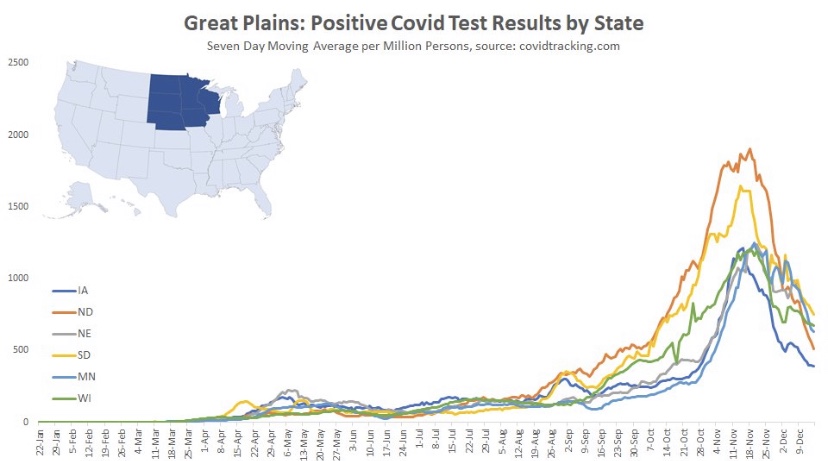
I’ll start with the good news and work my way down to states in which cases are still climbing (all of the following charts are from @Humble_Analysis (PLC)). The first chart is for the Great Plains, where cases peaked a little before Thanksgiving and have continued to fall since then. That peak came about six weeks after it began in earnest and cases have faded over the last four weeks.
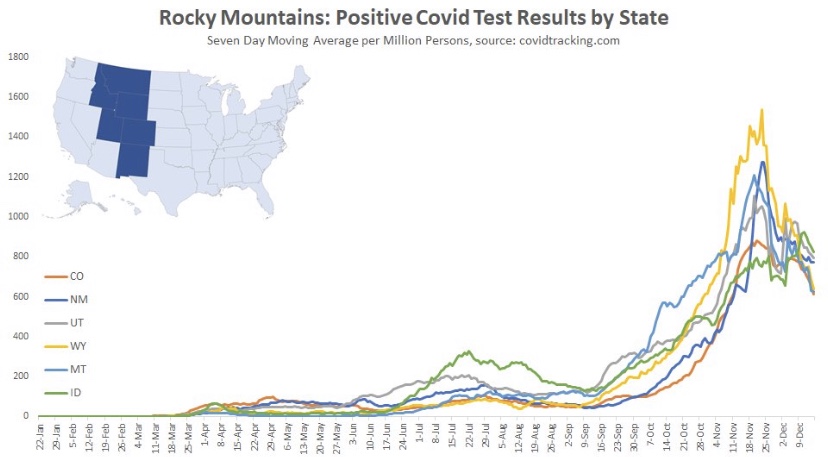
Next we have the Mountain states, where again, cases peaked around Thanksgiving, though Idaho saw a rebound after the holiday. You’ll see below that a number of states had a distinct drop in new cases during the week of Thanksgiving. There was somewhat of a pause in testing during that week, so the subsequent rebounds are largely due to a “catch-up” at testing sites, rather than some kind of Thanksgiving-induced spike in infections.

Back to the Mountain region, the peak came an average of about six or seven weeks into the wave, but the duration of the wave appears to have been longer in Montana and Wyoming.
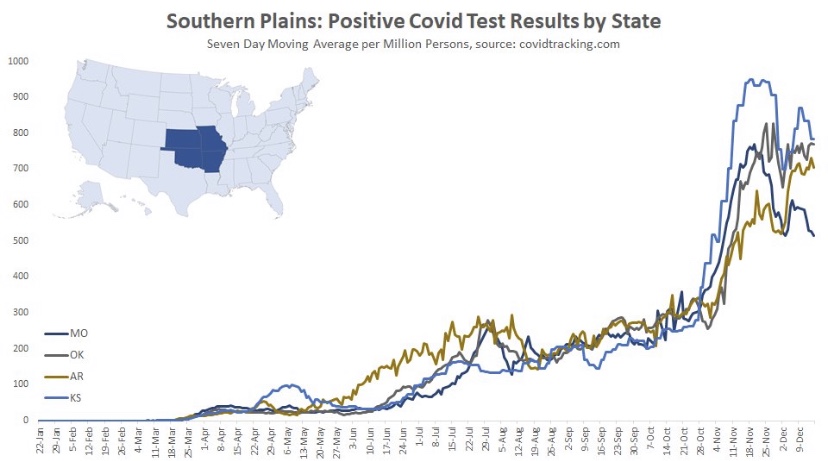
Here are the Southern Plain states, where cases plateaued around Thanksgiving (though cases in Missouri have clearly declined from their peak). In this region, case counts accelerated in October after a slow climb over the summer.
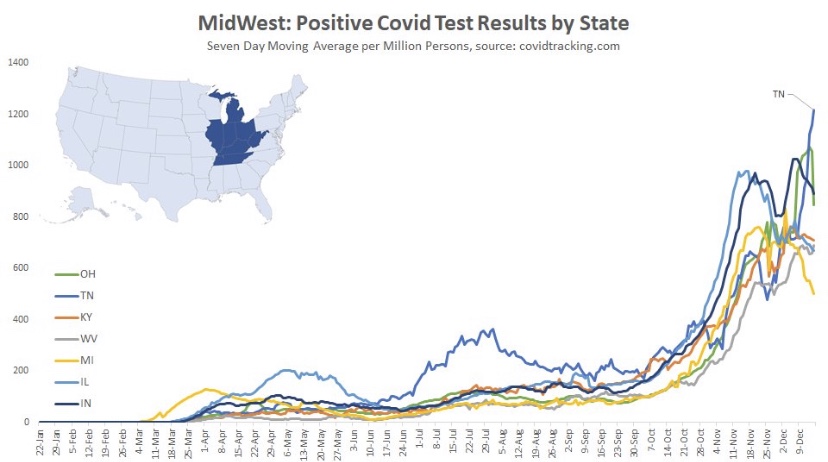
The situation is somewhat similar in the Midwest. where cases have generally plateaued. There were some post-Thanksgiving rebounds in several states, especially Tennessee. The wave began a little later in this region, in mid- to late October, and it is now seven to eight weeks into the wave, on average.
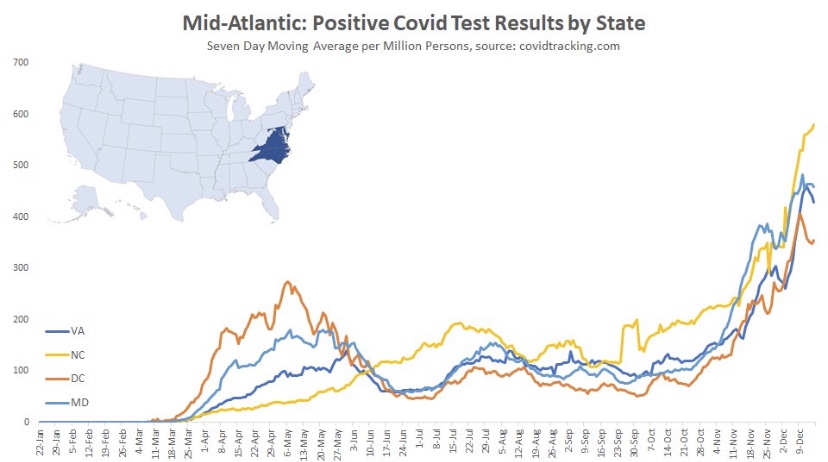
Here are the Mid-Atlantic states, which may be showing signs of a peak, though North Carolina has had the greatest caseload and is still climbing. These states are about seven weeks into the wave, on average.
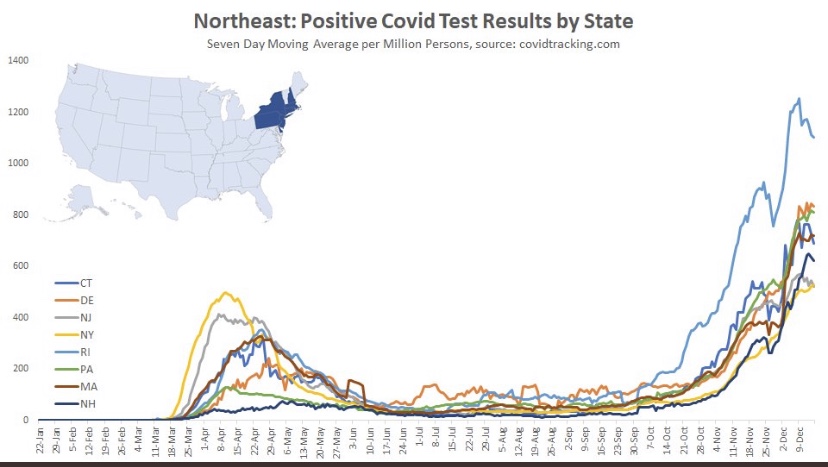
The Northeast also shows signs of a possible peak and is about seven weeks into the wave, except for Rhode Island, which saw an earlier onset and the most severe wave among these states.
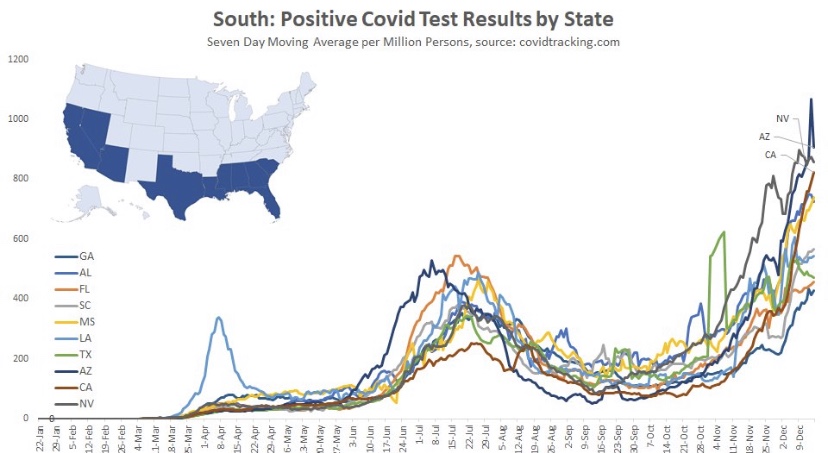
And finally we have the South, which is defined quite broadly in PLC’s construction. It’s a mixed bag, with a few states showing signs of a peak after about seven weeks. However, cases are still climbing in several states, notably California and Florida, among a few others.
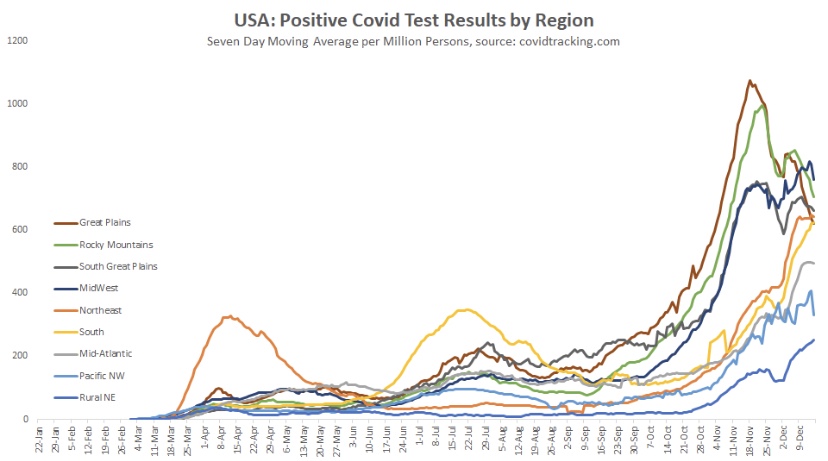
Oregon and Washington were skipped, but they appear as the Pacific NW in the following chart, along with aggregations for all the other regions. Maine is Part of the “Rural NE”, which was also skipped. The fall wave can be grouped roughly into two sets of regions: those in which waves began in late September or early October, and those where waves began in early to mid-November. The first group has moved beyond a peak or at least has plateaued. The latter group may be reaching peaks now or one hopes very soon. It seems to take about seven weeks to reach the peak of these regional waves, so a late December peak for the latter group would be consistent.
Justin Hart has a take on the duration of these waves, but he does so in terms of the share of emergency room (ER) visits in which symptoms of COVID-like illness (CLI) are presented. CLI tends to precede case counts slightly. Hart puts the duration of these waves at eight to ten weeks, but that’s a judgement call, and I might put it a bit longer using caseloads as a guide. Still, this color-coded chart from Hart is interesting.
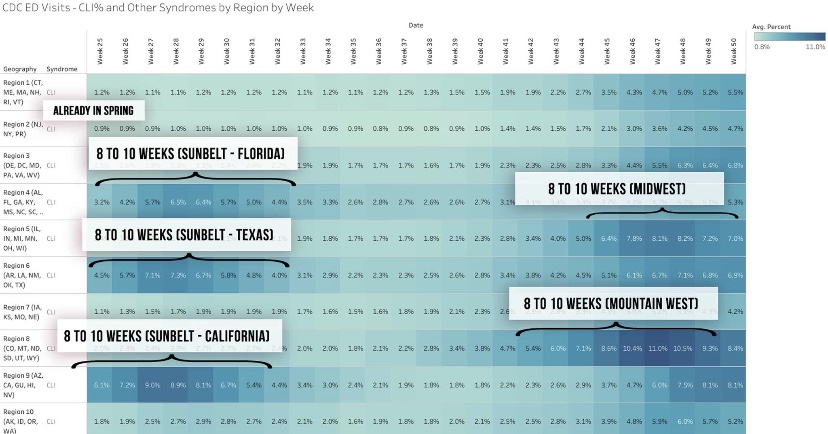
If this sort of cyclical duration holds up, it’s consistent with the view that cases in many of the still “hot” states should be peaking this month.

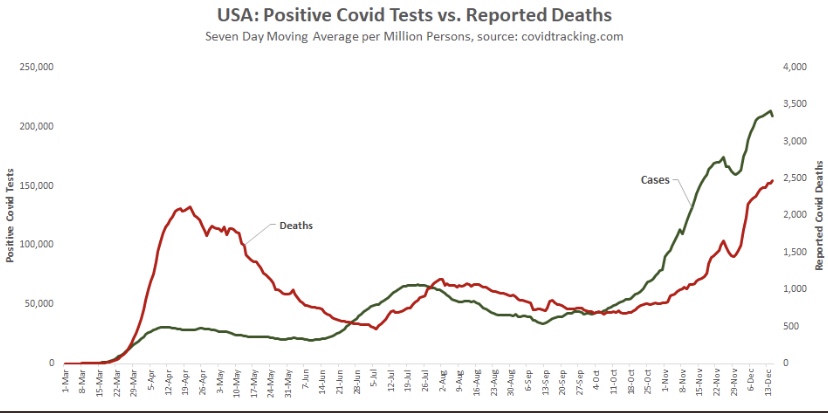
Aggregate cases for the U.S. appear below. The growth rate of new cases has slowed, and the peak is likely to occur soon. However, because it combines all of the regional waves, the duration of the wave nationwide will appear to be greater than for the individual regions. COVID-attributed deaths are also plotted, but they are reported deaths, not by date of death (DOD) or actual deaths, as I sometimes call them. Deaths by DOD are available only with a lag. As always, some of the reported deaths shown below occurred weeks before their reported date. Actual deaths were still rising as of late November, and are likely still rising. However, another indicator suggests they should be close to a peak.
A leading indicator of actual deaths I’ve discussed in the past now shows a more definitive improvement than it did just after Thanksgiving, as the next chart shows. This is the CLI share discussed above. An even better predictor of COVID deaths by actual DOD is the sum of CLI and the share of ER patients presenting symptoms of influenza-like illness (ILI), but ILI has been fairly low and stable, so it isn’t contributing much to changes in trend at the moment. There has been about a three-week lead between movements in CLI+ILI and COVID deaths by DOD.

(The reason the sum, CLI+ILI, has been a better predictor than CLI alone is because for some individuals, there are similarities in the symptoms of COVID and the flu.)
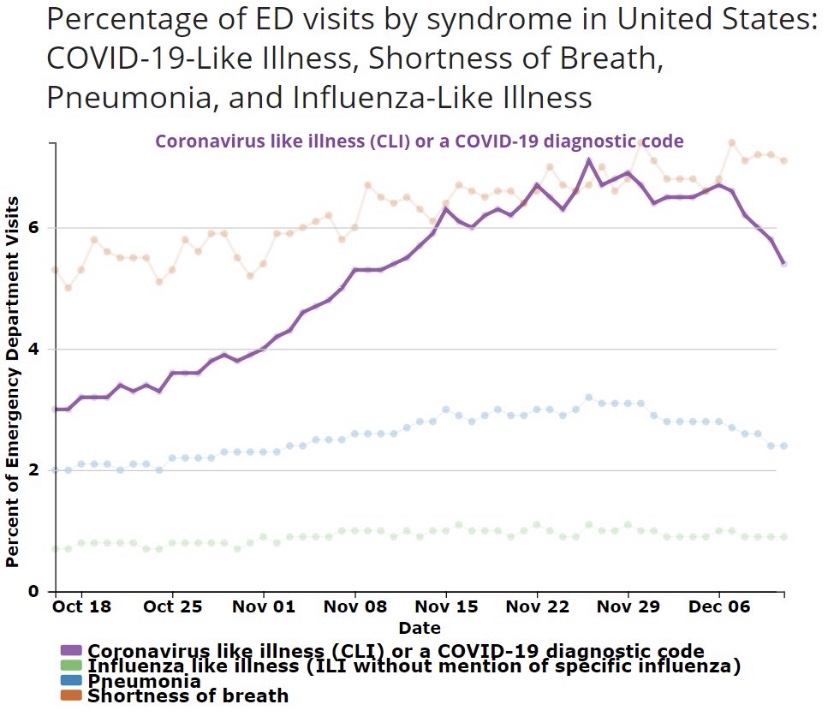
The chart shows that CLI peaked right around the Thanksgiving holiday (and so did CLI+ILI), but it remained on something of a plateau through the first week of December before declining. Some of the last few days on this chart are subject to revision, but the recent trend is encouraging. Allowing for a three-week lead, this indicates that peak deaths by DOD should occur around mid-December, but we won’t know exactly until early to mid-January. To be conservative, we might say the latter half of December will mark the peak in actual deaths.

The regional COVID waves this summer and fall seem to have run their course within 10 – 12 weeks. Several former hot spots have seen cases drop since Thanksgiving after surges of six to seven weeks. However, there are several other regions with populous states where the fall wave is still close to “mid-cycle”, as it were, showing signs of possible peaks after roughly seven weeks of rising cases. The national CLI share peaked around Thanksgiving, but it did not give up much ground until early December. That suggests that actual deaths (as opposed to reported deaths), at least in some regions, will peak around the time of the winter solstice. Let’s hope it’s sooner.

Successive waves within a region seem to reach particular subsets of the population with relatively few reinfections. The 10 – 12 week cycle discussed above is sufficient to achieve an effective herd immunity within these subsets. But once again, a large share of the vulnerable, and a large share of COVID deaths, are still concentrated in the elderly, high-risk population and in care homes. The vaccine(s) currently being administered to residents of those homes are likely to hasten the decline in COVID deaths beginning sometime in January, perhaps as early as mid-month. By then, however, we should already see a decline underway as this wave of the virus finally burns itself out. As vaccines reach a larger share of the population through the winter and spring, the likelihood of additional severe waves of the virus will diminish.

Lest there be any misunderstanding, the reasons for the contagion’s fade to come have mostly to do with reaching the effective herd immunity threshold within afflicted subsets of the population (sub-herds). Social distancing certainly plays a role as well. Nearly all of that is voluntary, though it has been encouraged by panicked pronouncement by certain public officials and the media. Direct interventions or lockdown measures are in general counter-productive, however, and they create a death toll of their own. Unfortunately, the fading pandemic might not rein-in the curtailment of basic liberties we’ve witnessed this year.

Post-Script: Let’s hope the side effects of the vaccines are not particularly severe in the elderly. That’s a little uncertain, because that sub-population was not tested in very high numbers.

The FDA Can Put Virus Behind Us, Sans Vaccine

19 Wednesday Aug 2020

Posted by Nuetzel in Liberty, Pandemic, Vaccinations

≈ 1 Comment

Tags

Alex Tabarrok, Anti-Vaxers, Coronavirus, COVID Screening, Covid-19, E25Bio, Emergency Use Authorization, False Positive, Falze Negative, FDA, Harvard, Infectious vs Infected, John Cochrane, National Basketball Players Association, NBA, Paper Tests, Rapid Tests, Regulatory Failure, SalivaDirect, Self-Quarantine, Test Accuracy, Tracing, Transmission Chain, Vaccine Development, Vaccine Supply Chain, Wyss Institute for Biologically Inspired Engineering, Yale, Zach Lowe

Most of the news about COVID vaccine development is positive, but there are still huge doubts about 1) whether an effective vaccine(s) will ever be available; 2) when it will be available; 3) in what quantities (supply chains for vaccines present issues that most lay persons would never imagine) ; 4) the best approaches to allocation across young/healthy vs. old/vulnerable; 5) how long it will provide protection (the news is good on lasting immunity as well); and 6) whether people will actually take it. Given all these uncertainties, it’s worth considering an approach to stanching the coronavirus that won’t require a vaccine while still allowing a return to normalcy: cheap, rapid tests available to consumers on a daily basis in their homes or in businesses.

The full benefits of cheap, rapid tests can take people a while to wrap their heads around. In fact, there are skeptics who’s views on any and all testing are colored by suspicions that increased testing is some sort of conspiracy to spread fear and keep the economy hobbled. It’s true that increased testing drove much of the increase in COVID cases this summer, which caused the mainstream media to delight in spinning alarmist narratives. Fair enough, but that misses the point, which I’ll try to elucidate below. I credit a John Cochrane post for bringing this to my attention.

A successful vaccine breaks the so-called “transmission chain”, but so does frequent testing to identify infectious individuals on an ongoing basis so they can self-quarantine. As Alex Tabarrok has emphasized, we should worry about identifying infectious individuals, as opposed to infected individuals. They are not the same. Cheap, rapid, and easy-to-administer tests have already proven to be fairly accurate during the infectious stage. The idea is for individuals to self-test every day and stay home if they are positive. Or, employers can test workers every day and send them home if they are positive. Frequent testing also makes it simpler to trace the source of an infection and may reduce the importance of tracing.

To those who say this represents an affront to personal liberty, and I’m very touchy on that subject myself, recall that even now people are being screened in their workplaces using thermometers, questionnaires, or on the basis of any frogginess perceived by supervisors and co-workers. Those “tests” are far less accurate in identifying COVID-19 contagiousness than the kinds of cheap tests at issue here, and they are certainly no less intrusive. Then there are the many businesses facing restrictions on their operations: how “accurate” is it to keep everyone at home by locking down places of business? How intrusive is that? Those restrictions are indefensible, and especially with the advent and diffusion of cheap, rapid tests.

Of course, people might cheat and not report positives. Tests could be administered at workplaces to avoid that possibility, or at points of admission to businesses and facilities, but a few minutes of delay would be necessary. I would not support a centralized database of daily test results. If nothing else, relying on the good faith of individuals in reporting their results would be a giant leap forward in breaking the transmission chain now, rather than counting on the possibility of a successful virus in the indefinite future. And we might then avoid the whole pro-vax/anti-vax imbroglio that already foments, which raises major questions bearing on individual liberty.

Then there is the question of positive tests within multi-person households. Should the entire family or household self-quarantine? I say no, not if the others are negative, but then the others should test twice before going out, which dramatically reduces the probability of a false negative, and they should probably test more frequently, perhaps several times a day.

There are other important details to address: Who will pay for the tests? Will workers be paid to stay home if they test positive? How long will they be required to stay home? How will repeated tests be treated? I don’t want to get into detail on all of these points, but cheap, fast tests can help overcome many of these difficulties, and I believe many of the details can and should be worked out privately.

Unfortunately, the FDA has approved only two rapid tests, and they are not very rapid and not cheap enough. Only one had been approved up until last weekend because the FDA found the accuracy to be lacking … compared to PCR tests! But the FDA finally issued an Emergency Use Authorization for a saliva-based test (SalivaDirect) developed at Yale, partly funded by the NBA and the Players Association. The test still requires processing at a lab, so it’s really not convenient enough and not fast enough. Here is Zach Lowe on the cost:

“The cost per sample could be as low as about $4, though the cost to consumers will likely be higher than that — perhaps around $15 or $20 in some cases, according to expert sources.”

Not bad, but it’s much higher than more rapid, paper tests developed by Harvard’s Wyss Institute for Biologically Inspired Engineering and a company called E25Bio. Both of those are expected to cost about $1 per sample and can be completed anywhere. That’s a price that can work. And there are other promising candidates.

The benefits of tests that are rough, ready, and cheap will be huge. Such tests will also enable retesting, which helps to overcome the dilemmas of false positives and negatives. False negatives might be of greater concern to the FDA, but again, false negatives are less likely during the contagious stage of an infection, and the tests will be accurate enough that transmission risk will be drastically reduced.

The FDA needs to move beyond its stodgy insistence on achieving laboratory levels of accuracy. It’s unlikely that a single test source will be adequate to stanch the transmission chain, so the agency should rush to approve as many cheap, rapid tests as possible, with as many advisories and patient warnings regarding test results and follow-up instructions as it deems necessary. Remember, these tests are much better than thermometers!

Statists Might Like To Vaccinate Against Many Things

25 Monday Nov 2019

Posted by Nuetzel in Vaccinations

≈ Leave a comment

Tags

Anti-Vaxxers, Community Protection Threshold, Contagion, Contra-Indications, Externality, Federaalism, Herd Immunity, Immunization, Jeffrey Singer, Lancet, Measles, Mercury, Michigan Vaccine Law, Post Hoc Ergo Propter Hoc, Precautionary Principle, Price Discrimination, Private Governance, Vaccine Hesitancy, Vaccine Preservatives, Vaccine Resistors, Whooping Cough

The vaccine debate illustrates a widespread misunderstanding about the meaning of an “advanced society”. It does not mean that difficult social problems must be dealt with always and everywhere in a uniform way, as supporters of vaccine mandates seem to assume. Instead, it often means that society can respect differences in the preferences of individuals by allowing varied approaches to problem-solving across jurisdictions, as well as across public and private institutions. This latter notion of advancement respects individual freedom and facilitates experiential social learning. But is that varied approach wise in a world of communicable diseases?

One standard of “community” protection assumes that vaccines work with a high degree of certainty within groups of individuals, especially with a second booster. The share of the population vaccinated against most common childhood diseases is fairly high. In fact, these shares mostly exceed their respective “community protection thresholds” — the percentage required to prevent a particular disease from spreading. That means achieving so-called “herd immunity”. Of course, that will not be true across many local subgroups. Nevertheless, if one accepts this standard, a runaway contagion in the U.S. is an extremely remote possibility, affording some flexibility for respecting preferences for and against vaccination.

My Friend, the Vaccine Resistor

One of my best friends is a passionate vaccine resistor (VR). I won’t say he’s “vaccine hesitant” because that doesn’t come close to his position. I won’t call him an “anti-vaxxer” because he doesn’t mind if others avail themselves of vaccines (and besides, the term has taken on such derogatory connotation. He’s a fine fellow, very smart, lots of fun to be with, and we have plenty of mutual interests. We’ve argued about vaccinations before, and a few other medical and nutritional issues, but we mostly stay out of each others’ ways on these topics.

But I recently witnessed my pal get into a “debate” on social media with a mutual acquaintance and some of her connections. She happens to be a nurse. She’d posted a photo of an attractive young woman in a t-shirt imprinted, “Vaccines Cause Adults”. My buddy spoke up and said “Not for everyone!’, and he posted a link to an article that he felt supported his position. Of course, a number of barbed responses came his way. Okay, some of those were fair debate points, though barbed, but others were quite derisive, ad hominem attacks on him. He responded by posting links to more articles and research, which might not have been productive. It’s usually a waste of time to argue with people on social media. But to his great credit he maintained his equanimity. The episode made me feel a bit sad. People can be such assholes on social media. I was put off by the nurse’s refusal to moderate . That’s a typical pattern: posters allow their other friends to hurl terrible insults at anyone who disagrees, even when it’s an old friend. Mind you, I stayed on the sidelines in this case, except that I originally “liked” the nurse’s meme.

Later, I had a private exchange with my friend. I’m on board with vaccinations. I believe that widespread immunization contributes to public health, but I told him there are certain points on which I can sympathize with VRs. Without knowing the details, he encouraged me to write a blog post on the subject. I’m not sure he’ll like the results. However, as noted above, I’m willing to make a few concessions to my buddy’s side of the argument, and I wish we could identify a path that would settle the debate.

My Standpoint

This is one part my pal won’t like. Are VRs anti-science? First, VR’s come in several varieties. Some might resist only some vaccines and not others. But VRs do not disavow empiricism, as they claim their own set of empirical findings to support their position, however one might regard the research quality. 

I believe many VRs are misled by a serious post hoc ergo propter hoc fallacy: after this, therefore because of this. For example, for many observers, the purported link between autism and the measles, mumps and rubella vaccine was put to rest when the British medical journal Lancet retracted the original article supporting that claim as faulty. That doesn’t wash with more radical VRs, many of whom seem to have someone on the autism spectrum in their own families. They are understandably sensitive, but please forgive me: that suggests a need to find some external explanation, a source of blame not related to genetics.

Radical VRs are selective proponents of the precautionary principle: any risk of harm from a vaccine delivered in any amount is too great a risk. They seem reluctant to acknowledge the reality of a dose-response relationship, which bears on the risks of exposure to certain compounds often present in vaccine formulations. VRs will not acknowledge that vaccines present a manageable risk. And then there are the misleading references to disease incidence counts, as opposed to disease incidence rates, that are all too common (though my friend is almost certainly innocent on this count).

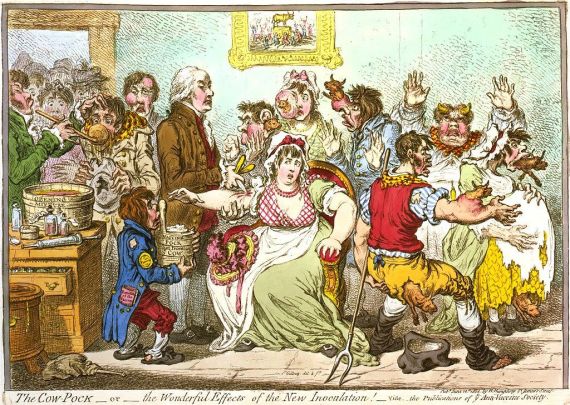
Vaccine resistance is not a new phenomenon, as the cartoon above from 1802 illustrates. Certain people will always find the idea of injecting germs into their systems deeply unsettling. Of course, that’s a very natural basis of resistance. A person’s body is their own property, after all. My default position is that an individual’s control over their own body is inviolable, and parents should always be the first authority over decisions about their children. The real issue, however, is the question of whether unvaccinated children inflict external costs on others.

Points of Contention

The major objections of VRs fall into several categories: 1) preservatives; 2) multiple viruses; 3) vulnerable infants; 4) contra-indications; 5) inefficacy; and 6) free choice. There may be others, but I’ll go with those.

Preservatives: Some vaccines still use a form of mercury, but a much more innocuous variant than the one VRs found so objectionable a few decades ago. Still, they object. And they object to many other compounds used in minute quantities as preservatives, such as formaldehyde, which occurs naturally in our bodies. I think the following test is helpful: if it were proposed that VRs take new versions of the vaccines that had zero preservatives, many would still refuse, especially if they were asked to pay the additional cost of providing them in that form. Thus, preservatives are revealed to be something of a side show.

Multiple Viruses: VRs object to the administration of vaccines that inoculate against several viruses in one dose or within a short window of time. This objection has some plausibility, since an injection of several different “bugs’ at once might place excessive stress on the body, even if the risk is still small. But again, would VRs volunteer to take single strain vaccines in a schedule over a lengthier period of time? Probably not.

Vulnerable Infants: VRs say it’s too risky to vaccinate infants in their first few months of life. This too is a plausible objection, and it would seem like a relatively easy concession to make in the interests of compromise … except, it won’t ever be good enough. Radical VRs will not agree to having their children vaccinated at any age.

Contra-Indications: There are undoubtedly genetic factors that pre-dispose certain individuals to an adverse reaction to certain vaccines. These might be rare, so an effort to compromise by requiring a thorough genetic profile before vaccination would be costly. I believe profiling is a reasonable demand for individuals to make, however, provided they pay the cost themselves.

Inefficacy: My friend posted an intriguing article about the drastic declines that occurred in the incidence of various diseases before the introduction of vaccines to prevent those diseases. This might not be the same link, but it makes the same argument. That doesn’t mean vaccines don’t work, of course. There is a vast literature that shows that they do. Bing it! And in cases such as smallpox, the use of “folk applications” of puss to a small scratch in the skin were in use long before the vaccine was available. Nevertheless, the VRs contend that the historical rates of disease incidence provide evidence against vaccinating. They also contend that diseases like measles are not serious enough to warrant precautions like vaccines. Measles can be deadly, though not as deadly as the flu.

Free Choice: This is the point on which I’m most sympathetic to VRs. Again, we own our own bodies and should have authority over our own minor children, yet communicable diseases seem to be a classic case of externality. Susceptible individuals may inflict a cost on others by refusing vaccination or segregation. Other people own their bodies too, and they have a right to avoid exposure. They too can isolate themselves or take precautions as they deem necessary. If both parties wish to participate in society, then both hold rights they allege to be threatened by the other. That complicates the task of reconciling these interests in private, voluntary ways, and yet they often are reconciled privately.

Solutions?

The debate today often revolves around mandatory vaccination, which would be an extreme measure relying on the coercive power of the state. The rationale is that even a vaccinated majority would be subject to an unnecessarily high risk of infection when in frequent contact with an unvaccinated minority. It’s difficult to endorse such broad intrusiveness when we’re dealing with a negative externality of such minute probability. And such a policy is not at all defensible without exceptions for individuals for whom a vaccine is contra-indicated.

Tolerating differences in vaccination rules across cities, school districts, or even states, may be a reasonable approach to settling the debate in the long run. These variations allow empirical evidence to accumulate on the efficacy of different vaccine regimes. It also allows individuals and families to “vote with their feet”, migrating to jurisdictions that best suit their preferences. These are the basic foundations of federalism, a principle of great usefulness in preserving freedoms while addressing regional differences of opinion on contentious issues.

Michigan has a policy allowing unvaccinated children to attend schools, but a waiver must be obtained requiring the child’s parents to attend a vaccine education program. The policy is credited with increasing vaccination rates. The problem is that VRs tend to view this requirement as an infringement on their rights. Advocates of the policy might argue that the situation should be viewed as an arms-length, voluntary exchange between two parties, in this case a family and a public entity. The vaccine education program is just the price one must pay in lieu of vaccination. The exchange is not arms length, however, as it would be if the school were a private entity. The VR parents who refuse the waiver are not rebated for taxes paid for local schools. In fact, like all taxes, the payment is coerced.

It’s not always necessary to appeal to some form of government action, even at local levels. For example, private schools may require vaccination among enrollees, and private businesses, especially health care providers, may require staff to be vaccinated. Life and health insurers may wish to price risk differently for the unvaccinated. VRs might object that they are subject to discrimination by institutions requiring immunization, or who price discriminate in favor of the immunized, but VRs are free to form competitive institutions, even on small scales or as mutual companies. To the extent that such private rules are unjustified, the institutions who discriminate are likely to learn or lose eventually. That’s the beauty of market solutions. In these ways, non-coercive private governance is far preferable to action by the state.

Dr. Jeffrey Singer is an advocate of immunization who opposes mandatory vaccine laws, as he explained a few years ago in “Vaccination and Free Will“. He suggested elsewhere, in “Seeking Balance In Vaccination Laws“, that schools, instead of requiring immunization, could mitigate the risk of a contagion by insisting that unvaccinated children be held out of school when a particular threat arises and remain out until it passed. That’s a reasonable idea, but I suspect many pro-vax parents would fear that it doesn’t go far enough in protecting against the introduction of a disease by an unvaccinated child.

Conclusion

Recent increases in the incidence of diseases such as measles, mumps and whooping cough are extremely troubling. Whether these outbreaks bear any relationship to patterns of vaccination in the population is certainly a valid question. To the extent that more families and individuals wish to be immunized, and that private institutions wish to take action to increase vaccination rates within their sphere of influence, I’m all for it. Vaccination laws are a different matter.

Political action at the local level might mean that school districts and other public entities will require vaccinations or vaccine education programs. Alternatives exist for those refusing to vaccinate, but broad mandatory vaccination is too coercive. Such measures carry significant costs, not least of which is a loss of liberty and normalization of losses of liberty. It’s not clear that a vaccination mandate at the national level, or even a state vaccination mandate, can offer benefits sufficient to justify those costs. Nudges are irritating and may be costly, but forcible intrusions are way out-of-bounds. Unfortunately, there are parties that simply can’t resist the temptations of behavioral control, and that’s worthy of resistance. Let’s continue to muddle through with an essentially federalist approach to vaccination policy. I regard that as a hallmark of an advanced society.


Newer posts →
Follow Sacred Cow Chips on WordPress.com

Recent Posts

  • The Case Against Interest On Reserves
  • Immigration and Merit As Fiscal Propositions
  • Tariff “Dividend” From An Indigent State
  • Almost Looks Like the Fed Has a 3% Inflation Target
  • Government Malpractice Breeds Health Care Havoc

Archives

  • January 2026
  • December 2025
  • November 2025
  • October 2025
  • September 2025
  • August 2025
  • July 2025
  • June 2025
  • May 2025
  • April 2025
  • March 2025
  • February 2025
  • January 2025
  • December 2024
  • November 2024
  • October 2024
  • September 2024
  • August 2024
  • July 2024
  • June 2024
  • May 2024
  • April 2024
  • March 2024
  • February 2024
  • January 2024
  • December 2023
  • November 2023
  • August 2023
  • July 2023
  • June 2023
  • May 2023
  • April 2023
  • March 2023
  • February 2023
  • January 2023
  • December 2022
  • November 2022
  • October 2022
  • September 2022
  • August 2022
  • July 2022
  • June 2022
  • May 2022
  • April 2022
  • March 2022
  • February 2022
  • January 2022
  • December 2021
  • November 2021
  • October 2021
  • September 2021
  • August 2021
  • July 2021
  • June 2021
  • May 2021
  • April 2021
  • March 2021
  • February 2021
  • January 2021
  • December 2020
  • November 2020
  • October 2020
  • September 2020
  • August 2020
  • July 2020
  • June 2020
  • May 2020
  • April 2020
  • March 2020
  • February 2020
  • January 2020
  • December 2019
  • November 2019
  • October 2019
  • September 2019
  • August 2019
  • July 2019
  • June 2019
  • May 2019
  • April 2019
  • March 2019
  • February 2019
  • January 2019
  • December 2018
  • November 2018
  • October 2018
  • September 2018
  • August 2018
  • July 2018
  • June 2018
  • May 2018
  • April 2018
  • March 2018
  • February 2018
  • January 2018
  • December 2017
  • November 2017
  • October 2017
  • September 2017
  • August 2017
  • July 2017
  • June 2017
  • May 2017
  • April 2017
  • March 2017
  • February 2017
  • January 2017
  • December 2016
  • November 2016
  • October 2016
  • September 2016
  • August 2016
  • July 2016
  • June 2016
  • May 2016
  • April 2016
  • March 2016
  • February 2016
  • January 2016
  • December 2015
  • November 2015
  • October 2015
  • September 2015
  • August 2015
  • July 2015
  • June 2015
  • May 2015
  • April 2015
  • March 2015
  • February 2015
  • January 2015
  • December 2014
  • November 2014
  • October 2014
  • September 2014
  • August 2014
  • July 2014
  • June 2014
  • May 2014
  • April 2014
  • March 2014

Blogs I Follow

  • Passive Income Kickstart
  • OnlyFinance.net
  • TLC Cholesterol
  • Nintil
  • kendunning.net
  • DCWhispers.com
  • Hoong-Wai in the UK
  • Marginal REVOLUTION
  • Stlouis
  • Watts Up With That?
  • Aussie Nationalist Blog
  • American Elephants
  • The View from Alexandria
  • The Gymnasium
  • A Force for Good
  • Notes On Liberty
  • troymo
  • SUNDAY BLOG Stephanie Sievers
  • Miss Lou Acquiring Lore
  • Your Well Wisher Program
  • Objectivism In Depth
  • RobotEnomics
  • Orderstatistic
  • Paradigm Library
  • Scattered Showers and Quicksand

Blog at WordPress.com.

Passive Income Kickstart

OnlyFinance.net

TLC Cholesterol

Nintil

To estimate, compare, distinguish, discuss, and trace to its principal sources everything

kendunning.net

The Future is Ours to Create

DCWhispers.com

Hoong-Wai in the UK

A Commonwealth immigrant's perspective on the UK's public arena.

Marginal REVOLUTION

Small Steps Toward A Much Better World

Stlouis

Watts Up With That?

The world's most viewed site on global warming and climate change

Aussie Nationalist Blog

Commentary from a Paleoconservative and Nationalist perspective

American Elephants

Defending Life, Liberty and the Pursuit of Happiness

The View from Alexandria

In advanced civilizations the period loosely called Alexandrian is usually associated with flexible morals, perfunctory religion, populist standards and cosmopolitan tastes, feminism, exotic cults, and the rapid turnover of high and low fads---in short, a falling away (which is all that decadence means) from the strictness of traditional rules, embodied in character and inforced from within. -- Jacques Barzun

The Gymnasium

A place for reason, politics, economics, and faith steeped in the classical liberal tradition

A Force for Good

How economics, morality, and markets combine

Notes On Liberty

Spontaneous thoughts on a humble creed

troymo

SUNDAY BLOG Stephanie Sievers

Escaping the everyday life with photographs from my travels

Miss Lou Acquiring Lore

Gallery of Life...

Your Well Wisher Program

Attempt to solve commonly known problems…

Objectivism In Depth

Exploring Ayn Rand's revolutionary philosophy.

RobotEnomics

(A)n (I)ntelligent Future

Orderstatistic

Economics, chess and anything else on my mind.

Paradigm Library

OODA Looping

Scattered Showers and Quicksand

Musings on science, investing, finance, economics, politics, and probably fly fishing.

  • Subscribe Subscribed
    • Sacred Cow Chips
    • Join 128 other subscribers
    • Already have a WordPress.com account? Log in now.
    • Sacred Cow Chips
    • Subscribe Subscribed
    • Sign up
    • Log in
    • Report this content
    • View site in Reader
    • Manage subscriptions
    • Collapse this bar
 

Loading Comments...