Pay and Productivity

Tags

, , , , , , , , , , , ,

allaboutproductivity

Remember, the real minimum wage is zero, and state-imposed unemployment is not justice. In the private economy, wages rise with productivity, and that’s true across workers at any point in time, for workers over time, and for workers in different industries over time. Don’t think so? Contrary to the blithe pronouncements of Barack Obama and reports by the union-backed Economic Policy Institute (EPI), there has been no divergence in productivity and pay since the early 1970s. This is shown convincingly by James Sherk in “Workers’ Compensation: Growing Along With Productivity“. Sherk’s work shows that hourly productivity increased by 81% since 1973, while average employee compensation increased 78%. In contrast, the EPI has claimed that productivity grew 91% since 1973, but  employee compensation grew just 10%.

How did the EPI (and Obama) reach such a faulty conclusion? Sherk breaks the error into three major parts: 1) comparing the pay of a subset of workers to the productivity of all workers; 2) excluding the pay growth of the self-employed; and 3) inconsistent adjustments of pay and productivity for inflation.

The link between wages and productivity is immutable in a market economy. The state can attempt to short-circuit the relationship, but such intervention comes at the cost of dislocations in resource utilization and damage to well-being. Veronique de Rugy discusses Sherk’s findings and emphasizes the folly in thinking that the government can somehow divorce the pay of workers from their underlying contribution to the value of output:

One of the assets of the American economic model is a relatively flexible labor market, especially when compared with labor markets in many European countries. It explains some of the consistently lower U.S. unemployment rates and higher economic growth. Unfortunately, this flexibility is increasingly threatened by government policies that would increase the cost of employing workers.

Populists and statists share some destructive tendencies, such as a fixation on increasing the cost of labor to employers. The current debate over a “living wage” of $15 per hour involves more than doubling the minimum wage in many parts of the country. This is so far out of line with the productivity of low-skilled workers as to make absurd claims that it won’t have a serious impact on their employment. There are employers who won’t be able to survive under those circumstances. There are others who will have to scale back operations. Employers having access to capital in industries such as car washes and fast food know that automation is more than viable as a substitute for low-skilled labor. And new labor-saving innovations are inevitable when creative entrepreneurs are confronted with an obstacle like high-cost labor: necessity is the mother of invention. But premature automation is not an obvious consequence to living-wage advocates. And that’s to say nothing of the futures destroyed when low-skilled workers are denied opportunities for work experience.

The connection between wages and productivity is part of a well-functioning economy and it is just as alive and well in today’s economy as ever. The “right” wage cannot be determined by central planners, bureaucrats or legislators apart from productive reality, and the adverse consequences of their attempts to do so cannot be wished away. Only markets that price the real value of productive contributions can put resources such as low-skilled labor to their best use, avoiding the waste inherent in regulation that is always ignorant of dynamic preferences and resource availability.


Health Care Devolution and Monopoly

Tags

, , , , , , , , , , , , , , ,

Risk Pool

Obamacare and its boosters are trying to come to grips with several new blows. Last month, United Health Care (UHC) announced that it would not participate in the Obamacare exchanges in the 2017 plan year. The announcement offers confirmation that the Affordable Care Act (ACA) is plagued by adverse selection on the exchanges it authorized, and the spiral will only get worse. This is emphasized in “Five Things ACA Supporters Don’t Want You To Know“: other carriers are struggling and will be forced to accept UHC’s adverse risk pool;  premiums must increase; more carriers will bail out; and quality of coverage will continue to decline because the ACA effectively punishes more comprehensive coverage.

Those insurers would have bailed sooner if not for subsidies they’ve been receiving from the federal government on individuals with incomes up to various multiples of the poverty line. However, the funding of a portion of those subsidies was ruled unconstitutional in federal appeals court in May. A deposition from a senior IRS official indicates that the Obama Administration was warned in early 2014 that it had no authority to make the payments, advice that it summarily dismissed. That’s on top of new lawsuits by insurers who say they were shorted by a wide margin on “risk corridor” payments owed to them by the federal government under Obamacare. The risk corridors, which supposedly cover a portion of aggregate losses on health exchange business, will expire after this year, just one the reasons to expect large premium hikes for next year.

As insurers drop out of the Obamacare exchanges, consumers will be forced to deal with a less competitive landscape. About half of the so-called coops on the exchanges had failed by the end of last year. A consequence of this attrition is that the range of coverage available to consumers will shrink:

One BlueCross BlueShield subsidiary in Virginia has already filed plans to get out of the bronze plan, according to Inside Health Policy, and other insurers will follow suit if BCBS succeeds. That will destabilize the markets further, as one analyst told Leslie Small at Fierce Health Payer, because most of the younger and healthier participants in these risk pools have chosen bronze plans – and would likely bail out rather than pay higher premiums for insurance that they hardly ever use.

Obamacare also fosters monopolization in the delivery of medical care. A pernicious effect is that local health-care markets are increasingly dominated by a single so-called “non-profit” hospital organization:

Researchers at Johns Hopkins and Washington and Lee Universities report that seven of America’s 10 most profitable hospitals are officially not for profit. … That status entitles them to huge state and federal tax breaks — whose value has doubled in recent years — for ‘charity care and community benefit.’ …  A for-profit outlet will pay taxes and returns to investors. Nonprofits wind up paying huge sums to executives — and plowing cash into gaining more market share.

Non-profit status does not preclude monopolistic behavior. These institutions possess:

… enormous leverage when setting prices and negotiating reimbursement from private insurers — whose hands are tied because they need those hospitals to be part of their network to attract paying customers. … As Dr. Marty Makary of Johns Hopkins wrote in The Wall Street Journal back in 2014: ‘When you’re the only game in town, you call the shots.’

It’s no coincidence that Obamacare rewards consolidation of health care providers through so-called Accountable Care Organizations (ACOs). That’s helped to drive the disappearance of independent physician practices in recent years. Those physicians are Increasingly employed by hospitals at which they can meet standardized quality measures more easily. The medical establishment maintains that ACOs will “bend the cost curve”… someday. But in the meantime, it’s not happening: the quality measures don’t provide good measures of health outcomes, and they inhibit innovation.

For one thing, outcomes themselves are not easy to measure. An 80-year-old goes to the doctor with back pain. What is the best outcome? No pain? That’s probably impossible to achieve with even the highest quality care. Less pain? Maybe. But what does that mean and how do you measure it from patient to patient?

Then there is the matter of adjusting those scores for the severity of the disease and the social and economic status of the patient. This matters because low-income patients often struggle to manage their follow-up care or may be unable to afford medications. Such ‘risk adjustment’ is even harder to do with older adults with multiple chronic conditions.

Even worse, while Obamacare seeks to broaden the market for health care to include those for whom good health coverage is otherwise out of reach, there is evidence that it is not truly improving access to health care. First, the kinds of policies that have been mandated provide relatively “thin” coverage, with high deductibles and copayment rates. Even when subsidized on the exchanges, many of the insured find actual health care payments to be prohibitive. Little wonder that emergency room utilization (where care must be provided regardless of ability to pay) has climbed under Obamacare, contrary to the early assertions of proponents. Second, many of the newly insured are covered by Medicaid, but low physician reimbursement rates have diminished the number of physicians willing to serve that market. Finally, while Obamacare increases the demand for provider services, it does not bring forth its own supply. A provider shortage is expected to continue to grow more severe over the next ten years.

The dual markets for health coverage and health care itself are becoming less competitive under Obamacare. The central planning inherent in the law effectively tossed the most potent forces available for reducing health care costs and expanding coverage: market competition and innovation. Higher prices represent only one avenue for the release of pressures created by mandates; shortfalls in access and the quality of care are others. While the medical establishment and regulators insist that safeguards are in place, it’s a safe bet that monopoly and central planning will have their usual dire effects.

What Does Government Give Your Gig?

Tags

, , , , , , , , , , , , ,

image

An “employee” is different than a “contractor”, but those designations are often not very different in terms of job function. Are they different enough that large government subsidies and penalties  should depend on the distinction? Economist John C. Goodman explains why that question deserves a resounding “NO”!

Here’s an example: consider two individuals who perform the same job function and earn an identical wage of $13 per hour. One is an employee and the other is an independent worker under contract to the same company. The employee faces a high premium on the minimum health insurance policy mandated by Obamacare, which can carry a deductible of over $13,000 for a young, healthy family. The employee can pay the premium using pre-tax dollars, which provides some savings. The taxes saved are a subsidy, but an employee refusing coverage must pay a tax penalty under Obamacare. The contractor, on the other hand, might well qualify for subsidies on the Obamacare exchange, saving about 95% of the cost of the policy. Both individuals are subsidized, but the contractor gets considerably more in this case.

Now consider two individuals who earn $40 per hour, again an employee and a contractor. They are in a relatively high tax bracket. The contractor earns too much to qualify for Obamacare subsidies on the exchange but faces a tax penalty without coverage. The employee gets health coverage, albeit with a high deductible, paying pre-tax dollars at a significant discount. This time, the employee gets a big subsidy.

So essentially identical individuals are treated much differently. As Goodman says, that is terrible policy. Today, the distinction between employees and contractors is increasingly flimsy in terms of the services performed, and it is often a matter of convenience for employers and employees alike. Moreover:

… even though the main purpose of the health reform was to insure the uninsured, the law in many ways encourages a great many people to be uninsured – the fine is often much less than the cost of very unattractive insurance. …  current policy encourages everyone to game the system: Stay uninsured when healthy and then rearrange your work relationships if you get sick.

As Goodman notes, health coverage isn’t the only area in which this antiquated definition of the work relationship matters. His solution is to do away with the distinction between employees and non-employee workers altogether, eliminate the deductibility of health premiums for employees, end the Obamacare exchange subsidies, and instead provide a straight tax credit to every individual for the purchase of private health coverage. Loath as I am to admit any role for government in providing subsidies to other than the destitute, Goodman’s idea would at least level the subsidies without arbitrary distinctions and gaming of the system.

Similar considerations apply to arbitrary rules governing the distinction between full-time and part-time workers. The Obamacare employer mandate includes requirements on both the number of “employees” at a firm and an employee’s hours worked. Incentives are such that a change in the number of hour per week can dramatically alter the obligations of an employer and the government benefits available to workers (not to mention penalties to both), distorting economic outcomes in the productive sector of the economy. Limit the number of employees on your payroll and limit their hours if you want to avoid obligations. The negative impact on growth is particularly damaging to the self-sufficiency of low-income individuals. Again, government should remain neutral and stay out of regulating private labor transactions.

Obamacare is a mess on its own terms. Recall that it was to allow Americans with health insurance coverage to “keep their plans” if they chose to; it was to “bend the cost curve” in health care and insurance costs; and it was to provide coverage for the uninsured. Instead, Obamacare has disrupted insurance coverage for millions of Americans; created incentives for employers to reduce hours and employees; led to higher health care and insurance costs, created an adverse selection problem on the health care exchanges that threatens their sustainability; and more than 30 million Americans remain uninsured. The crucial role assigned by Obamacare to the formal relationship of workers to their hiring organizations has created perverse results.

Government should remain neutral in defining economic relationships. Allowing private actors to make their own informal arrangements or formal contracts is preferable both in terms of efficiency and fairness. Only they know the true economic realities “on the ground”. The distortions imposed by detached external rulemakers governing the  assignment of benefits are damaging and make adjustment to those realities more costly for everyone.


Costco Labor Productivity Drives Its Wages

Tags

, , , , , , , , , , , , , , , , ,

image

Buyer beware: various memes promoting a higher minimum wage, or a mandated “living wage” of $15, cite Costco as “proof” that a higher wage floor does not imply that product prices must rise. In fact, Costco pays relatively high wages to its hourly workers and it is a discount retailer, but it is highly misleading to treat these facts in isolation or to suggest that they imply anything about cost-price causality and the consequences of changes in costs. A higher wage floor would add cost pressure to any business employing low-skilled labor and even some employing more skilled workers like Costco. Many of these firms would have to raise prices to remain viable.

Costco says that it pays an average wage of $17 plus benefits. A quick glance at Glassdoor.com shows starting pay rates well below that average, which is no surprise. Costco recently increased its lowest pay rates for the first time in eight years, to $13 and $13.50 an hour from $11.50 and $12. However, there may be some slight-of-hand used to support other quotes of Costco’s average wage. It’s been claimed elsewhere that the company pays an average wage of $20, and President Obama asserted that Costco’s average wage is $21. Typically, quotes of hourly wages do not include the value of benefits. One blogger suggests that these higher figures may have been calculated by averaging across job classifications, rather than dividing the company’s total hourly wage bill by the number of worker-hours. One other qualification is that roughly 10% of the workers in a typical Costco warehouse store dispense free samples but are not employed by Costco. The average hourly wage of “workers at Costco” would likely be lower than $17 if they were included.

Nevertheless, it’s true that Costco pays a relatively high wage rate to its hourly workers. How can they afford to do so? As it happens, Costco has relatively few workers relative to other retail operations, and its average revenue per transaction is high. According to Megan McArdle at Bloomberg, in 2013, Costco’s average square-feet of floor space per employee was almost twice WalMart’s; according to MarketWatch, Costco’s average revenue per employee is now nearly three times the comparable figure for WalMart (enter COST and WMT). Obviously, Costco employees are highly productive in terms of revenue, and that is closely associated with higher wages.

The high productivity at Costco is not an accident. While a good wage is certainly a motivating factor, the productivity of Costco’s work force starts with screening during the hiring process, where the company is known to prefer significant retail experience. They also emphasize the demanding physical requirements of certain jobs, and given their thin staffing, a relatively high level of responsibility for a retail worker. Newcomers are said to be under a watchful eye, and effective performers are rewarded. It takes four to five years to reach the top of the wage scale in a job category. Many of those categories involve specialized skills, such as licensed opticians, butchers, cake decorators, forklift drivers, licensed hearing aid dispensers, and registered pharmacists (these categories drive up the average wage). The company provides training opportunities in various areas, and average employee turnover is low, which reduces costs. The Costco warehouse stores are without typical retail amenities; they are bare-bones with goods sitting on pallets rather than displayed on shelves. This also lowers costs, giving the company additional leeway in shaping its generous wage policy.

Returning to the question of pricing, Costco’s example cannot be generalized. First, it might not be such a good example of price restraint in the face of higher wages to begin with. To bolster earnings, Costco is expected to raise its membership fees by about 9% in 2017; undoubtedly there is also room for retail margins to increase. Time will tell. Second, again, Costco’s wage policy works fairly well because its business model rests largely on high labor productivity. Basic economics teaches us that higher productivity drives higher wages. Workers who earn less than Costco wages are, in general, less productive. This is a consequence of more limited skill sets, less experience, and sometimes weak desire. Those earning at the minimum wage are handicapped by an inability to contribute at high levels, or an inability to demonstrate that they can at their hiring date. Thus, they work in jobs that do not require developed skills. For their employers, higher wages are not a path to profitability.

Mandating an increase in the wage floor is not possible without other market adjustments. First, like anything else, the demand curve for low-skilled labor slopes downward, so a higher wage floor reduces the desired labor input. Job losses befall the least skilled in such a scenario. This consequence has greater breadth in a world in which opportunities for automation are plentiful. Another possible adjustment is an increase in the price charged to customers, which might be a reflexive response among business operators. However, they must compromise when confronted with the competitive effects of passing along an increase in costs. There could be other cost-reducing changes in job structure, benefits, break times, and any number of other conditions and circumstances of employment. Finally, some business owners might accept a lower level of profitability, depending on their disposition and the competitive tenor of the markets in which they operate. Some Costco shareholders believe that might be the case, as the company’s earnings have softened recently.

The final outcome is likely to be a combination of the adjustments described above. Unfortunately for proponents of a higher wage floor, the economy cannot and will not transform itself into a community of Costco clones. With limited skills, the motivational power of higher wages goes only so far. All price floors create excess supply, in this context unemployment. Excess supplies tend to consist of the most marginal units, in this case, the least productive workers. Perhaps sheer ignorance causes agitators for wage mandates to overlook this inevitable marginalization. The real minimum wage is zero.

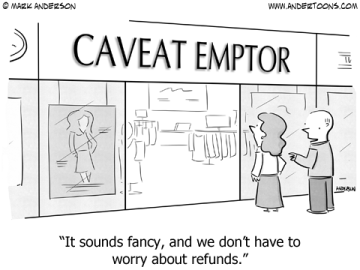
A note on the cartoon above: It reminded me of an amusing passage in Margaret Mitchell’s “Gone With The Wind” when Rhett Butler, in a sardonic moment, suggests to Scarlett O’Hara that she change the name of Kennedy’s General Store in Atlanta to “Caveat Emptorium, assuring her that it would be a title most in keeping with the type of goods sold in the store. She thought it had an imposing sound and even went so far as to have the sign painted….” Later, Rhett learns that she actually had the sign made, but an embarrassed Ashley Wilkes clued her in to the meaning. She is furious, and Rhett laughs hysterically.

Obama’s On-The-Clock Undertime Rule

Tags

, , , , , , , , , , , , , , , , ,

obama-unemployment-2

Hurting the ones you love: one of the Obama Administration’s calling cards is a penchant for misguided economic policy; the change in an overtime rule announced Wednesday by the Department of Labor (DOL) is a classic example. The DOL has amended the rule, which requires payments of time-and-a-half to workers who exceed 40 hours per week, by doubling the threshold at which salaried employees are exempt from overtime to $47,500 annually. This affects almost 5 million workers earning between the old threshold of $23,660 and the new threshold. While the media heralds Obama for “lifting the wages of millions of workers”, those with a grasp of economic reality know that it is a destructive policy.

The rule change is unambiguously bad for employers, many of which are small businesses. That should not be too difficult to understand. Most private employers operate in competitive markets and do not earn lavish profits at the expense of their employees. They need good employees, especially those in positions of responsibility, and they must pay them competitively. By imposing higher costs on these businesses, the rule puts them in a position of greater vulnerability in the marketplace. The higher costs also include extra record keeping to stay in compliance with the rule. The impact on new business formation is likely to be particularly damaging:

We might be told that the answer for a startup is simply to ‘go and raise more money.’ But — aside from diluting the founders who are paying for the company with their sweat in exchange for the hope of a payoff that comes in years, if ever — raising capital is the single most difficult thing I do as a startup entrepreneur. I would invite anyone not in our field to give it a shot before he endorses a regulation that will impose greater capital costs on us.

Regulators often act as though they cannot imagine a world where a few hundred or a few thousand dollars can make the difference between success and failure. If you raise our costs even modestly, you will put some of us out of business.

Shutting down, or not starting up, is a bad outcome, but that will be a consequence in some cases. However, there are other margins along which employers might respond. First, a lucky few well-placed managers might be rewarded with a small salary bump to lift them above the new exemption threshold. More likely, employers will reduce the base salaries of employees to accommodate the added overtime costs, leaving total compensation roughly unchanged.

Many other salaried employees with pay falling between the old and new thresholds are likely to lose their salaried status. Their new hourly wage might be discounted to allow them to work the hours to which they’re accustomed, as demotivating as that sounds. If their employers limit their hours, it is possible that a few extra workers could be hired to fill the gap. Perhaps that is what the administration hopes when it claims that an objective of the new rule is to create jobs. Unfortunately, those few lucky hires will owe their jobs to the forced sacrifice of hours by existing employees.

A change from a salary to hourly pay will have other repercussions for employees. Their relationships to their employers will be fundamentally transformed. Ambitious “hourly” managers might not have the opportunity to work extra hours in order to demonstrate their commitment to the business and a job well done. When the rule change was first proposed last June, I paraphrased a businessman who is one of my favorite bloggers, Warren Meyer (also see Meyer’s follow-ups here and here):

As [Meyer] tells it, the change will convert ambitious young managers into clock-punchers. In case that sounds too much like a negative personality change, a more sympathetic view is that many workers do not mind putting in extra hours, even as it reduces their effective wage. They have their reasons, ranging from the non-pecuniary, such as simple work ethic, enjoyment and pride in their contribution to reward-driven competitiveness and ambition.

As hourly employees, these workers might have to kiss goodbye to bonus payments, certain benefits, and flexible work arrangements, not to mention prestige. The following quotes are from a gated Wall Street Journal article but are quoted by James Pethokoukis in his piece at the AEIdeas blog of the American Enterprise Institute:

Jason Parker, co-founder of K-9 Resorts, a franchiser of luxury dog hotels based in Fanwood, N.J., said the chain will reduce starting pay for newly hired assistant managers to about $35,000 from the $40,000 it pays now. That will absorb the overtime pay he expects he would have to give them, he said. …

Terry Shea, co-owner of two Wrapsody gift shops in Alabama, would prefer to keep her store managers exempt from the overtime-pay requirement as they are now. But raising their salaries above the new threshold to ensure that would be too big of a jump for those jobs in her region, she said. Instead, she’ll convert the managers to hourly employees and try to limit their weekly hours to as close to 40 as possible. She’ll also have to stop giving them a comp day when their weekly hours exceed 46, a benefit she said they like as working moms.

‘I will be demoted,’ said one of her store managers Bridget Veazey, who views the hourly classification as a step backward. ‘Being salaried means I have the flexibility to work the way I want,’ including staying an extra 30 minutes to perfect a window display or taking work home, she said. She is particularly concerned Ms. Shea might stop taking the managers on out-of-town trips to buy goods from retail markets, an experience she said would help her résumé but includes long days.

Here is some other reading on the rule change: Nick Gillespie in Reason  agrees that it’s a bad idea. Andy Puzder in Forbes weighs in on the negative consequences for workers.  John Cochrane explores the simple economic implications of mandated wage increases, of which the overtime rule is an example. As he shows, only when the demand for labor hours is perfectly insensitive to wages can a mandated wage avoid reducing labor input.

This is another classic example of progressive good intentions gone awry. Government is singularly incapable of managing the private economy to good effect via rules and regulations. Private businesses hire employees to meet their needs in serving customers. The private compensation arrangements they make are mutually beneficial to businesses and their employees and are able to accommodate a variety of unique employee life-circumstances. Good employees are rewarded with additional compensation and more responsibility. By and large, salaried workers like being salaried! Hard work pays off, but the Obama Administration seems to view that simple, market truism as a defect. Please, don’t try to help too much!

The Broken-Climate Canard

Tags

, , , , , , , , , , , , , , ,

MovieDisaster

In the imagination of the climate alarmist, almost everything portends an approaching catastrophe. A hurricane? Tornado? Draught? Warm spell? Cold spell? Blizzard? Bad harvest? To their way of thinking, these are all signs that CO2 is damaging the climate. Obviously, these are weather events that imply nothing in the absence of corroborating evidence, though you wouldn’t know it from listening to the precaution pols. Warren Meyer at Coyote Blog has posted another in his series of essays on this topic, this time called “Are We Already Seeing Climate Change?” He provides links to the earlier installments — all interesting. In this installment, he covers five topics under the heading “Manufacturing A Sense that the Climate Is Broken”, which I think would have made a better title for his post. I’ll try to summarize the five points briefly, but do read the whole thing:

Publication Bias:  This quote speaks for itself: “Every single tail-of-the-distribution weather event from around the world is breathlessly reported, leaving the impression among viewers that more such events are occurring, even when there is in fact no such trend. Further, since weather events can drive media ratings, there is an incentive to make them seem scarier.

Claiming a Trend From One Data Point: This is the kind of error to which I alluded in the first paragraph. Think of Al Gore’s reaction to Hurricane Katrina. The charts offered by Meyer in this section are very nice. There is no upward trend in any of the following: hurricane energy; severe tornadic activity; the incidence of draughts or draught severity; heat waves; extremely hot days; and there is no abatement in the upward trend in crop yields. In fact, there is no trend in high temperature records in the U.S. The upward trend in average surface temperatures in the U.S. is entirely due to warmer nighttime temperatures.

Measurement Technology Bias: We now have the technology to measure various aspects of the climate from space. We can track polar ice extent with much more precision. Doppler radar technology and weather chasers have helped to identify more small tornados than we’d have known of 50 years ago. But when events seem noteworthy to alarmists, they draw extreme conclusions. To their great chagrin, these phenomena are often products of our enhanced ability to measure things.

What Is Normal?: This is related to measurement bias. Our detailed records on surface temperatures go back about 150 years, which is an extremely short slice of history. Temperature proxies from earlier eras, such as ice cores and fossilized tree rings, tell us that the recent past is not all that unusual. Moreover, we also know that glacier melting and sea level increases have been happening for much longer than the buildup of CO2. Those trends began near the end of the “Little Age Age”, around 1800. And there is evidence that these types of developments have happened before. Alarmists, however, assume that what we’ve witnessed in the recent past is unprecedented.

Collapsing Causality in a Complex System To a Single Variable:  “With all the vast complexity of the climate, are we really to believe that every unusual weather event is caused by a 0.013 percentage point change (270 ppm to 400 ppm) in the concentration of one atmospheric gas?” Not likely! Here Meyer helps put the recent temperature trends in perspective: they are tiny relative to their annual variation, which occurs both across seasons and within days.

The public seems to regard the co-called climate catastrophe with more skepticism today than perhaps ten years ago. Not only do the facts contradict the dire predictions of carbon-forcing climate models and alarmist scare stories, but people also recognize that the costs of attempting to avoid a global warming trend are massive and, well, probably not worth it. Moreover, they rightly suspect unworthy political motives in the alarmist community. If some carbon-induced warming is an eventuality, and that’s an “if”, it might well prove to be beneficial for people and the planet. Relax!


Willing Exchange With Capitalists

Tags

, , , , , , , , , , , , , , , , , , , ,

marx1

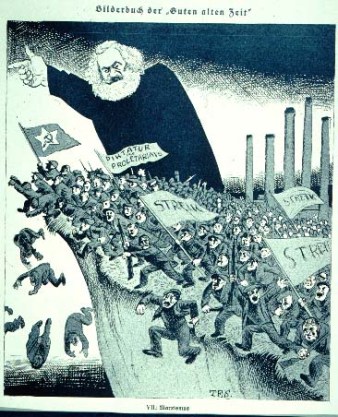
Now and then I’m inspired to blog on the misshapen language of political discourse. I recently wrote about the misuse of words by the American left, including their use of the term “liberalism”. This time, the particular word in play is “capitalism”, which I use to describe the ideal laissez faire economic order. I have always viewed it as a force for good. Real capitalism means free markets, consumer choice, strong private property rights, rewards to private initiative, and competition among producers. Even under conditions of concentrated market power, capitalism is preferable to government monopoly. Nevertheless, Gary Galles writes at The Beacon that capitalism is an inferior description of the laissez-faire ideal than”willing exchange“, or alternatively, unforced or voluntary exchange. Perhaps he has a point.

Capital and labor are the primary factors of production and both must be compensated. Labor earns a wage and capital earns a profit. Generally, the more capital a worker has available on the job, the greater the worker’s productivity and the greater the worker’s wage. However, any profit or return to capital is viewed by the left as an undeserved rent. The question of compensation is quite aside from the valuable social role profits play in directing resources to their most valued uses. Robert Murphy’s drives this home in an excellent recent essay entitled “There’s No Such Thing As Excessive Profits“. Here, here! In another post related to the crucial social role played by capital and profit, Patrick Barron explains “Why We Need Private Property To Deal With Scarce Resources“.

Again, any return to capital, normal or extra-normal, is seen by the left as a reward that should flow to labor in a just world. That is the upshot of Karl Marx’s labor theory of value. Thus, owners of capital are characterized as “takers”. Galles notes the belief that Marx coined the term “capitalism” in order to:

“…falsely imply that the system benefited capitalists at others’ expense, when, in fact, workers have been the greatest gainers from all the productivity enhancements the system has generated.

He quotes Leonard Read on the value of “willing versus unwilling exchange” as an effective way to delineate and contrast the positions of adherents of laissez faire and statism:

Standing for willing exchange, on the one hand, or for unwilling exchange, on the other, more nearly accents our ideological differences than does the employment of the terms in common usage…there is a minimum of verbal facade to hide behind.

Willing exchange…has not yet been saddled with emotional connotations …Further, its antithesis, unwilling exchange…no one, not even a protagonist, proudly acknowledges he favors that; it does offense to his idealism.

If we cut through all the verbiage used to report and analyze political and economic controversy…much of it boils down to a denial of willing and the insistence upon unwilling exchange. …

The concept of willing exchange unseats Napoleonic behavior—all forms of authoritarianism—and enthrones the individual. The consumer becomes king. Individual freedom of choice rules economic affairs… [It] is for me, and a willing seller, to decide; it is no one else’s business!

The hallmark of the state as an actor is coercion. After all, it derives its power via “legitimized” coercion. Individuals are bound under its authority to participate in involuntary exchanges and to make do with a constrained set of willing exchanges. As much as we might amuse ourselves with the notion that our Constitution keeps the state in check, it grows and grows, and where it stops, nobody knows. One wonders how strongly the demonization of so-called “capitalists” plays into this process.

I often refer to voluntary exchange in one form or another. The term recommends itself by virtue of its implication of mutual benefit among parties. Nevertheless, I would have a difficult time abandoning the term “capitalism” in my writing. Here’s the thing: capitalism and free markets have had tremendous success over the last two centuries in improving material conditions and ending human poverty around the globe. Meanwhile, Marxism as a philosophy, and collectivism as a form of social organization, have done nothing to recommend themselves to humankind. So the joke’s on Marx, though we haven’t heard the last of the efforts to besmirch capitalism.

Anti-Glyphosate Goons and Gullibility

Tags

, , , , , , , , , , , , , , , , , , ,

pseudociencia-a-saco

See the Postscript below.

A “roundup” of findings on the safety of glyphosate shows that the herbicide is very benign, highly unlikely to pose any real threat to humans, and far less toxic than many common household chemicals and even natural hazards in the environment. However, the debate over glyphosate is heavily politicized, as illustrated by the unsavory details surrounding a report issued last year by the International Agency for Research on Cancer (IARC), an arm of the World Health Organization (WHO). The IARC reclassified glyphosate as “probably carcinogenic to humans” based on a few cherry-picked, poorly-designed studies with weak statistical power. That finding is inconsistent with the vast preponderance research, which shows that glyphosate is not a significant threat to human health.

The Farmer’s Daughter provided a good summary of the issues shortly after the IARC’s ruling was announced last year. She offers the following quote from the U.S. Environmental Protection Agency (EPA):

The U.S. EPA classified glyphosate as Group E, evidence of non-carcinogenicity in humans. The U.S. EPA does not consider glyphosate to be a human carcinogen based on studies of laboratory animals that did not produce compelling evidence of carcinogenicity.

European regulators reached similar conclusions and are rather damning in their assessment of the IARC’s findings, though Brussels recently disregarded their findings and decided to ban the sale of glyphosate for gardening. In this post at Biology Fortified, Anastasia Bodnar discusses the low toxicity of glyphosate with links to several recent studies on its safety. And here is the Risk Monger blogs’s list of “ten reasons why glyphosate is the herbicide of the century“:

  1. Controlling invasive weeds leads to better agricultural yields
  2. Better yields = less land in production = more meadows and biodiversity
  3. Extremely low toxicity levels compared to (organic) alternatives
  4. Allows for no or low till farming – better for soil management
  5. Reduces CO2 emissions (compared to organic)
  6. Glyphosate saves lives
  7. It is much more affordable and effective than other options
  8. Glyphosate is off patent so no single company is profiting heavily from it
  9. Glyphosate-resistant crops allow for more ecological weed management practices
  10. There is overwhelming scientific evidence that glyphosate is safe for humans

How, then, did the IARC reach such a negative conclusion? Again from the Risk Monger, David Zaruk, the IARC hired just one external technical advisor, Christopher Portier, an activist previously employed by an NGO, the anti-pesticide Environmental Defense Fund (EDF). Portier has no technical background in toxicology, and the IARC apparently went to pains to avoid references to his affiliation with the EDF. Moreover, the IARC’s conclusion seems to have been preordained:

The IARC study rejected thousands of documents on glyphosate that had industry involvement and based their decision on carcinogenicity on the basis of eight studies (rejecting a further six because they did not like their conclusions).

The lead author of the report, Kathryn Guyton, gave a speech in 2014 in which she stated that herbicide studies slated for 2015 showed indications of a link to cancer. Just how did she know, so far ahead of time? And then there’s this revelation:

“According to the observer document, the glyphosate meeting started with the participants being told to rule out the possibility of classifying the substance as non-carcinogenic.

Zaruk believes there is internal pressure for the IARC study to be retracted. The organization has suffered a great loss of credibility in the scientific community over the report. In addition, WHO has remained neutral thus far, but they are expected to address the issue this month.

Zaruk and Julie Kelly provide a more succinct summary of the issues in “The Facebook Age of Science at The World Health Organization” at National Review. The suggestion made in the title seems to be that WHO’s decision might be swayed by public pressure, measured by Facebook “likes” by the superstitious, such as unknowing David Wolfe devotees, rather than science:

Environmentalists and organic companies tout phony studies claiming that glyphosate is found in everything from breast milk to bagels. … Meanwhile, farmers who use glyphosate to protect their crops and boost yields are caught in the crossfire. Even if glyphosate is banned, they will need to use another herbicide, probably more toxic, because the romantic notion of hand-weeding millions of acres of crops is promoted only by those who have never done it.

I’ll keep using Monsanto’s Roundup, thanks! Or a competitive brand of glyphosate. To close, here’s a quote from Matt Ridley’s Rational Optimist blog on the embrace of pseudoscience at the IARC and elsewhere (including social media):

Science, humanity’s greatest intellectual achievement, has always been vulnerable to infection by pseudoscience, which pretends to use the methods of science, but actually subverts them in pursuit of an obsession. Instead of evidence-based policymaking, pseudoscience specialises in policy-based evidence making. Today, this infection is spreading.

Postscript: On May 16, WHO announced that glyphosate is “unlikely to cause cancer in people via dietary exposure.Here is a Q&A from WHO regarding its assessment, explaining that it is based on risk as opposed to mere hazard, upon which the earlier IARC report was based. This is good news!


Who Brought the Melting Pot To the Pow Wow?

Tags

, , , , , , , , , , , , , , , , , , , , , , , , , ,

Chris Rock

I ran into a Chinese colleague in a break room at work and mentioned that I’d seen her engaged in a “pow wow” with a senior staffer, and she asked, “Pow wow?” I tried to explain the Native American origins of the term for a gathering or meeting, and I think she liked that, but I joked that my use of the term might represent “cultural appropriation” (CA). A second colleague who’d entered the kitchen glanced at me with a raised eyebrow. Knowing them well, I’m not sure either of them knew what I meant. As it happens, describing the pow wow as a celebration is more accurate, so my use of the term to describe a meeting was too narrow. In fact, in modern usage by Native Americans, it is a celebration of culture, but meetings take place at these events as well.

CA occurs when aspects of one culture are used in some way by others. It is criticized for trivializing the traditions or symbols of the source culture or because it robs it’s members of intellectual property (IP) rights. I can think of examples of cultural trivialization, such as the “Ugg-a-Wugg” song from the musical Peter Pan. Such complaints strike me as hyper-sensitive, but perhaps the umbrage taken by Native Americans to this song is understandable. Nevertheless, I stand more strongly behind the right of free expression. This song, which is rarely performed today out of respect for Native Americans, was part of a larger Neverland fantasy that has great appeal. And after all, the Indians were good guys in the story!

Works such as Peter Pan and Huckleberry Finn are historical and reflect the times in which they were created. As such, some argue that they should be left in their original form. And I agree, in general. However, in the case of a musical that is performed publicly again and again by various professional and amateur groups, I am sympathetic to the notion that potentially offensive elements can be excised if the changes do not do great damage to the story. If it is not in the public domain, the owners of the story’s rights have the final say.

The IP argument is flawed to the extent that IP arguments are always flawed: ideas are non-rivalrous and non-exclusive. Moreover, even IP rights recognized under U.S. law are limited to individual “property”; they do not extend to the traditions and symbols of various cultures that coexist in society.

Another area emphasized by critics of CA has to do with historical grievances against a dominant culture, often without regard to current circumstances. Apparently, such grievances place the minority culture off-limits. Under this view, cultural exchange is fundamentally bad, which is fundamentally absurd. It has the faint ring of “separate but equal” — paradoxical given the avowed desire among critics of CA for an end to racial and social division.

While European colonialists certainly exploited the native inhabitants in many lands, today’s liberal order in the West is attractive to members of different cultures around the globe.They adopt similar institutions and practices at home, and some of them bring their cultures to us. We all gain in the exchange.

Strong condemnation of CA has been all the rage on college campuses over the past few years (see several of the links here). It reflects a hyper-sensitivity about the normal mixing of cultures. Cultural exchange tends to elevate appealing aspects of all cultures into the larger society. Should we really condemn any of the following harmless activities?

  • Yoga classes at the Jewish Community Center?
  • Cinco de Mayo celebrations by non-Mexicans?
  • Caucasians celebrating the Chinese New Year or Moon Festival?
  • St. Patrick’s Day celebrations by non-Irish, non-Catholics?
  • Flower Drum Song or The King and I?
  • Caucasians playing Delta Blues?
  • African American Mardi Gras Indians?
  • Caucasians watching Bollywood movies?
  • The Grateful Dead at the Pyramids?
  • Caucasians cooking “ethnic” foods?

I grant that respect dictates avoiding use of another group’s sacred symbols. Beyond that, it is difficult to conceive of any objections to activities like those above. They are all forms of cultural cross-pollination, even if they seem to trivialize in some cases. This sometimes  involves cultural interpretation by “others” that might not be accurate, but that is always the case when cultures mix. People incorporate or adapt features of other cultures that they enjoy, which is hardly a sin.

Curious about pow wow, I found the following qualification in the Wikipedia entry for pow-wow:

…the term has also been used by non-Natives to describe any gathering of Native Americans, or to refer to any type of meeting among non-Natives (such as military personnel). However, such use may be viewed as cultural appropriation, and disrespectful to Native peoples.

Well, well, well! Pow wow is used in conversational english to lend an air of informality or lightness to certain proceedings. It may simultaneously convey a serious diplomatic purpose and an opportunity to resove differences. Sometimes, non-Natives might even use the term to sound clever, like using the French term soirée rather than “party”. Or perhaps they are amused by the image of corporate managers seated akimbo around a camp fire, passing a peace pipe. Or any pipe. Trivial? Maybe, but if that possibility outrages Native Americans, it strikes me as an over-reaction. After all, the joke is partly on “the suits”, and there isn’t much the Indians can do about it under the law.

I have always been fascinated by American Indian history and culture. I do not use the term pow-wow in disrespect. I use it because it’s colorful and I like it. The cross-pollination of language and culture is borne out of the utility of a particular word or practice. It can hardly be bad that a few shards of Native American language and culture are incorporated into broader American society.

My sister has a beautiful scarf bearing the profile of an American Indian in full head dress. She has always had an interest in the art and culture of the American southwest, which has benefitted from the heavy influence of Indians who are native to that region. So it was unsurprising to me that she would be drawn to the beauty of the scarf. It is a work of art and she does not wear it out of disrespect for American Indians.

Certain acts of CA are thought to intersect with racism, however. How about the Washington Redskins football team name? The team logo and merchandise use Native American symbols. The same goes for the Atlanta Braves and other teams. However, the term Redskin almost certainly has overtly racist origins as a description of an enemy thought to be savage, much as “Nips” was a derogative used by Allied soldiers in World War II as a term for the Japanese.  Defenders of the team claim that “Redskin” is not meant to trivialize or denigrate Native Americans, but instead to recognize their honor and ferocity in battle. The team owner and many fans insist that the tradition of the team name should continue in tribute to American Indians. Nevertheless, the name is understandably objectionable to Native Americans today as a crude description of their genealogy. My friend John Crawford tells me of a proposal to change the team logo to a red-skinned potato, but apparently the idea was rejected by the U.S. Patent Office.

In all of these matters, free speech outweighs all other considerations. While cultural appropriation is sometimes regarded with hostility, that does not give the aggrieved special rights to prevent it. The same is true of racism, however regrettable it is. Even so-called hate speech is protected under the U.S. Constitution, short of “fighting words”. Critics of cultural appropriation can seek to educate, influence, boycott and to shame those believed to have run afoul of their standards. In most cases, however, I think the best advice is to chill out.


Math Made Him Seem So Calculating

Tags

, , , , , , , , , , , ,

rational and real numbers

So good I just have to post it: “Economist Removed from American Airlines Flight for Doing Math“. University of Pennsylvania econ professor Guido Menzio fell victim to a non-mathmetician’s vigilance. From Catherine Rampell at WaPo:

Maybe it was code, or some foreign lettering, possibly the details of a plot to destroy the dozens of innocent lives aboard American Airlines Flight 3950. She may have felt it her duty to alert the authorities just to be safe. The curly-haired man was, the agent informed him politely, suspected of terrorism.

The first post linked above also has this little anecdote from 2003:

At Heathrow Airport today, an individual, later discovered to be a school teacher, was arrested trying to board a flight while in possession of a compass, a protractor, and a graphical calculator. …  Authorities believe she is a member of the notorious al-Gebra movement. She is being charged with carrying weapons of math instruction.

Mathematics has always seemed a little threatening to many people, but apparently social justice “educators” at Teach For America are telling minorities that “Math is the ‘Domain of Old, White Men’“. That is from David Huber at The College Fix. Huber quotes a story from EAG News.org:

 “Radical Math was created by educator Jonathan Osler several years ago while teaching at El Puenta Academy in New Jersey. Osler taught Radical Math along-side Cathy Wilkerson, a former member of the Weather Underground Organization (with Bill Ayers) who once participated in a plot to detonate a nail bomb at a dance for military personnel at Fort Dix.

Radical Math provides hundreds of social justice math lessons obviously meant to indoctrinate. For example, lesson titles include ‘Sweatshop Accounting,’ ‘Racism and Stop and Frisk,’ ‘When Equal Isn’t Fair,’ ‘The Square Root of a Fair Share’ and ‘Home Buying While Brown or Black.’

Huber sums things up thusly:

I cannot think of a better way to keep minorities ignorant of mathematics than by turning the subject into yet another showcase for historical grievances.