Would You Tax Coastal Development?

Tags

, , , , , , , , , , , , , , , ,

Sea Level

If sea levels are truly rising due to climate change, then public policy should stop encouraging new development in coastal areas. Stipulating that this threat is real for the moment, serious and damaging encroachment of the seas might be 50 years away or more. By that time, many of today’s coastal buildings will be gone, or at least candidates for replacement, under realistic assumptions about the average lives of structures. A relatively low-cost approach to the threat of rising seas would be to stop building along the most vulnerable coasts right now and move new development inland. Yet no one wants to do that, least of all coastal property owners. But there is little discussion of this alternative even among the true believers of a coming global warming apocalypse. Why not?

This and related questions have been asked recently by several writers, including Glenn Reynolds and economist Robin Hanson. There are alternatives to discouraging new construction along coasts. Other expensive abatement projects can be pursued, now and later, such as sea walls or even adding land mass excavated from the sea floor or inland. In fact, the prospect of damming the Strait of Gibraltar to protect Mediterranean coastlines has been discussed. The expense of such an unprecedented public works project is what prompted Hanson’s post. To the extent that such remedial projects are not funded privately, they represent social costs arising from coastal development.

The federal government still subsidizes flood insurance on many coastal properties, though efforts to phase-out this FEMA program have been underway for a few years. However, governments seem only too willing to undertake the investment in public infrastructure and ongoing maintenance made necessary by new coastal development. And like other development projects, tax abatements and other subsidies are still granted for coastal development. Why do these policies escape notice from coastal green elites?  Public outlays with private beneficiaries along threatened coasts are an immediate drain on resources, relieving private developers and property buyers of shoreline risk.

Reynolds (perhaps tongue-in-cheek) and Hanson suggest that new development should be taxed in coastal areas. That, and ending subsidies for development along coasts, is an economically and ecologically defensible alternative to the public expense of ubiquitous sea walls. However, a coastal tax might not be in the immediate interests of elites  who claim that mankind faces an insurmountable global warming problem. Better to put off these sorts of remedial measures, especially while you can tax and regulate fossil fuels, and maybe live on the coast!

The position of the warmist community is that carbon emitters must cease and desist, in the hope that the seas will stop rising. They are willing to destroy entire industries (fossil fuels) in pursuit of their goals, but are unlikely to achieve them without inflicting drastic economic harm. If greens are so amenable to central control of economic activity and individual behavior (so long as they are at the controls), it would be prudent to take precautions now that will help to minimize the damage later. Discouraging coastal development with taxes and denial of subsidies is the sort of classic intervention that any Pigouvian planner should love. There is even evidence that sea levels have been much higher at times in the past. An earnest central planner might say that coastal development should always be discouraged to mitigate the risk of destruction.

I am skeptical of alarmist claims, including those related to rising sea levels. In fact, the connection between carbon emissions, global temperatures and sea levels is not well established, and whether sea levels are rising due to human activity is a matter of some dispute. Furthermore, global sea ice extent is not declining dramatically, if at all, and the storied glacier melts have been greatly exaggerated. Climate activists pursue their agenda despite the gross inaccuracy of past carbon-forcing forecasts, the gaping uncertainty surrounding model predictions going forward, and the crushing expense of the measures they advocate. The expense, however, is not one that activists expect to compromise their own standard of living. They either assume that it will be borne by others or that their draconian prescriptions will usher in an era of “sustainability”, powered by new, renewable energy sources. Not many of these alarmists would boast that their policies can quickly reverse the sea level rises they’ve told us to fear, but they dare not suggest taxes on coastal development until they see more convincing evidence. At least that much is sensible, if ironic!

FCC Net Neutering Vs. Technological Potency

Tags

, , , , , , , , , , , , , ,

160194_600-2

A court challenge to the FCC’s “net neutrality” rules may go a long way in preventing inflated costs, degraded service, stifled innovation and abridgment of freedoms that the rules would foist on the public. The rules are based on treating internet service providers (ISPs) as common carriers under the Title II provisions of the Telecommunications Act of 1934. The uncertain and potentially severe regulatory environment this creates has already led to reduced capital investment by service providers, limiting capacity needed to accommodate the usage demanded by consumers and businesses. The first arguments in the case, U.S. Telecom Association v. FCC, were heard last week in the U.S. Court of Appeals for DC.

A primary argument of proponents of net neutrality is their objection to unrestricted pricing of Internet traffic. The fear is that big carriers will discriminate against smaller users and content providers, shutting them out, despite the fact that the diffusion of internet services throughout society has taken place at a breakneck pace, and despite the existence of network externalities benefitting ISPs that encourage diffusion. In fact, some of the largest content providers have pushed for net neutrality with designs on avoiding the long-run marginal costs of network expansion required by their services, thus to gain a cost advantage over smaller competitors. This is a typical regulatory play: an entrenched private interest seeks to protect its market position, and its technologies, against new and potentially more innovative competitors via supplication to government rule-makers.

L. Gordon Crovitz discussed the U.S. Telecom case in the Wall Street Journal in “Obamanet Goes To Court” (gated — but Google it). Already, the FCC has cast a watchful eye on a competitive, “zero-rating” video service from T-Mobile under its “general conduct rule”. Zero-rating services are of great value to consumers who prefer low-cost access to specific internet features, like video streaming (see this Newscopia piece). Corvitz says:

T-Mobile’s Binge On benefits consumers by giving them low-priced unlimited access to 24 video services, including Netflix, HBO and ESPN. This package is aimed at cost-conscious people who don’t have broadband. Net neutrality absolutists hate the idea, known as ‘zero rating.’ Susan Crawford, a former Obama special assistant for science, technology, and innovation policy, has written that it ‘is pernicious; it’s dangerous; it’s malignant.’

Say what? Are consumers no longer capable of judging value against price, as they typically must in their day-to-day affairs? Do we need Big Brother to hem-in competitors in the marketplace who desire more than anything to meet a need in the market, thereby attracting buyers?

Crovitz discusses the legal issues facing the Court, most importantly the FCC’s authority to decide what is “fair” and “reasonable” under the Telecommunications Act of 1996:

… the agency’s new ‘Internet conduct standard’ is so vague it exceeds the agency’s authority; … the White House’s intervention violated separation of powers and the notice period for new regulations; and the rules violate First Amendment protections for free speech by letting regulators decide what content broadband providers can and can’t make available…. in its rush to adopt Obamanet, the FCC failed to conduct even a cursory review of the costs of treating the Internet as a utility.

Make no mistake, many of the complaints received by the FCC are from commercial interests attempting to strong-arm other players. “BlackBerry even asked regulators to force Netflix to stream videos on its unpopular phones.” Net neutrality amounts to a vehicle for croney capitalists to seek rents at each others’ expense through government regulatory action. That’s not how the internet has grown to become the tremendous communication, entertainment and transactional apparatus that it is today.

Rep. Marsha Blackburn (R-TN) is a vocal critic of the FCC’s rules, leads a group of 22 legislators who filed a brief in the case “arguing that Congress never granted the FCC the statutory authority to reclassify an industry on its own.” She is also one of 50 cosponsors of the Internet Freedom Act, which would make explicit the FCC’s lack of statutory authority to regulate the internet under Title II rules.

Blackburn believes that net neutrality rules represent a first move by the federal government to control content on the Internet. That could include political speech as well as central direction of internet resources, redirecting opportunities to favored “winners” (content and service providers, technology developers, and geographies) and away from players less favored by the political class.

Another consequence of the FCC’s new rules is likely to be the imposition of a “Backdoor Internet Tax” on users. That is the universal service fee that eventually would amount to $7.25 per month at today’s average broadband bill. Many younger users have no experience with that tax, having rejected landline telephone service in favor of wireless technology and voice-over-internet.

The cartoon at the top of this post is inaccurate in one important respect: it doesn’t come close to indicating the dead weight that government regulation will impose on the future development of the Internet. The FCC was not needed to promote the amazing growth we have witnessed to date. Its intervention is already creating burdens on providers and users. The likelihood of restricted choice and other freedoms, and distortions to an otherwise healthy market mechanism for allocating technological resources, should not be tolerated. We will never know the true potential of the internet if we allow the it to be tampered and hampered by a government bureaucracy.

Gun Bans Are “Stupid, Unconstitutional, and Unpopular”

Tags

, , , , , , , , , , , , ,

Poster_Obama_Children_Guns

The terrorist attack this week in San Bernadino is not a rational argument for gun control. The anti-gun left has fixated on the tragedy for the wrong reason: to push their agenda to compromise gun rights. This topic was not prominent in the commentary after the recent massacre in Paris. That might be because France has strict gun laws that did not stop the terrorists. Similarly, the guns used in the San Bernardino attack were acquired legally despite the fact that California law requires background checks and bans so-called “assault weapons”.

President Obama’s ridiculous claim that mass shootings are an experience known only in the U.S. is obviously false (and see here). In fact, the barrage of misinformation regarding growth in mass shootings in the U.S. is based on severely distorted definitions.

Furthermore, there is no causal evidence that imposing stronger gun prohibitions reduces homicides and violent crime rates, and much evidence to the contrary. See this interesting 2007 study in the Harvard Journal of Law and Public Policy, “Would Banning Firearms Reduce Murder and Suicide?” And NYU Law Professor James Jacobs’ adds his thoughts on the inefficacy of gun control.

A compelling reason to reject the anti-gun narrative is that gun violence has been declining for years, despite continuing increases in gun ownership. That makes sense given the value of gun ownership as a crime deterrent. Even relatively conservative estimates of defensive gun uses (DGUs) put their number above, even far above, statistics on gun crime, and deterrence is an additional benefit over and above actual DGUs. Gun prohibition is often counterproductive because it forecloses the opportunity for deterrence and DGUs, much as signs announcing “gun-free zones” offer effective advertising for soft targets.

International comparisons of homicide rates and gun death rates which purport to show that the U.S. ranks poorly are distorted along several lines, but one glaring reason is that European governments exclude terrorist killings while the U.S. does not. Furthermore, reports of U.S. murder rates relative to other “developed” or “advanced” countries often involve arbitrary definitions that tend to distort the comparisons.

Australia has been adopted as something of a poster child on social media for the purported success of their gun “ban” (which was not really a ban at all). The results have been greatly exaggerated. In fact, “success” is a poor choice of words. Here are a few notes on Australian homicide rates after the gun “ban”. The video here is also illuminating, and the following link has more information on the “Australian Gun Ban Conceit“.

Finally, as the New York Times and other outlets have inadvertently demonstrated, the anti-gun argument rests on a poor understanding of constitutional principles. The Times states that “No right is unlimited and immune from reasonable regulation.” That is a testament in support of tyranny, and it is false under any conception of natural rights. The statement is either a complete misunderstanding of the intent of the U.S. Constitution or an open call to rip it to shreds. The Constitution is clear in establishing limits on government power and in leaving nearly all individual rights presumed and unenumerated. However, it clearly establishes the right to bear arms because the nation’s founders considered the right of self-defense against aggression so fundamental, including defense against aggression by a tyrannical state.

Note: the title of this post includes a post from Glenn Reynolds.

Pundits Get Played But Earn Rents From the Trade

Tags

, , , , , , ,

pundits-under-my-bed

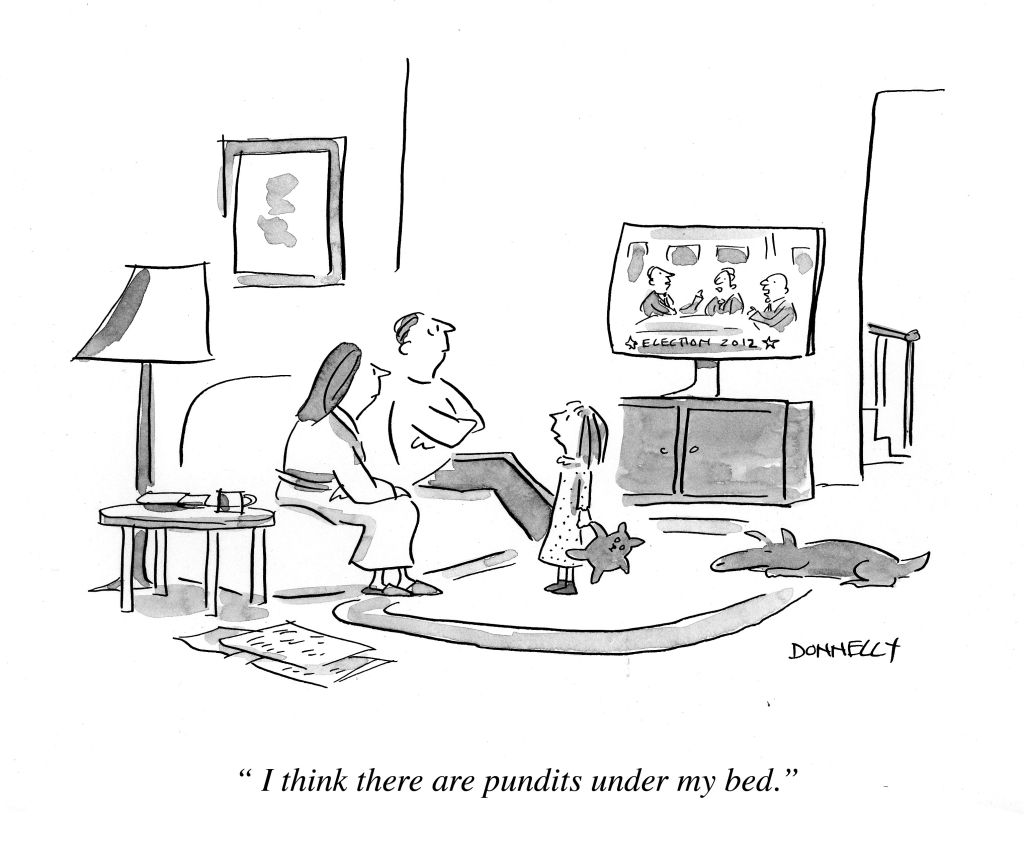
Powerful officials often seek to influence “thinkers” and pundits by flattering them with access and requesting advice that ultimately is treated as superfluous. That is the upshot of this interesting post from Jeremy Shapiro at The Brookings Institution: “Who Influences Whom? Reflections on U.S. Government Outreach to Think Tanks“.

These relationships are of a different character than the symbioses often existing between government officials (elected and unelected) and private corporations and unions. The corporatist relationships that most often come to mind are infamous for bleeding taxpayers, distorting the economy and using the power of government to advance private interests. The nexus highlighted by Shapiro between officialdom and think-tank experts, as well as influencers in the media and academia, is a different corner of the rent-seeking world, but it is rent seeking nevertheless.

Shapiro, himself a former government official, describes a sequence of events that might be experienced by an outside expert leading up to an “important” meeting with a high government official. Such experts have a strong interest in their areas of study and naturally hope to promote their own views and analyses. An opportunity to provide input to a policymaker is obviously attractive to such a person. Interactions with officials also confer status on experts, who can then trade on the impressive access they’ve been granted. Invitations to meetings like these, in and of themselves, represent successful rent-seeking by policy experts, regardless of whether their policy advice is given serious consideration by public officials.

While outside experts are often called upon for real policy advice, the government official is frequently after something else; in all likelihood, the official already has a policy position:

The government official desperately wants the thinkers to give him the benefit of the doubt when his inevitably flawed policy comes up for critical examination, as they are an important source of its ultimate evaluation by the Congress and the public. The briefings therefore tend to take place before important diplomatic meetings or foreign trips that will predictably occasion a round of media coverage on the policy in question.

So the official hopes to engineer mutually beneficial trades with outside experts. Trades of this kind may have no real value to anyone outside of the direct parties. Shapiro’s example relates to foreign policy, but the same dynamic takes place in almost every area of government policymaking:

The thinkers are the validators. They will write op-eds, give pithy quotes to important newspapers, and appear on network news programs.

As Shapiro tells it, an intriguing aspect of this process is that the experts are often well aware of the circumstances. Usually, they can be counted upon to pay for their access and the esteem it bestows by offering at least subtle forms of support for the official’s policy initiative:

The meetings, their grandeur and secrecy, are intended to foster a sense that the thinkers have been listened to and thus are somehow complicit in the policy—the illusion of inclusion. A meeting that seems to the thinker to be an opportunity to persuade is actually an opportunity to be persuaded. It doesn’t always work, of course. Fundamental positions are rarely altered and many of the supposed validators will remain fierce critics. But the biggest secret of all is that, even if the thinker does understand the real purpose, it often works at least at the margins.

Large numbers of tremendously talented, well-compensated people are engaged in charades like this on a regular basis. We know there are beneficiaries and there are real costs, but who pays for the largess? Obviously taxpayers, but private parties pay in other ways: Media time devoted to pundits is often paid by advertisers and, ultimately, consumers. Private think tanks are supported by private contributors who expect their own views to be validated by analyses and promoted in policy debates. The activity described by Shapiro may subvert those intentions. The real cost to society, however, is the value of resources diverted from productive, private activity to support the circle of rent-jerking. The bigger the government, the bigger the circle.

Climate Summit Success? Let’s Talk In Five Years

Tags

, , , , , , , , , , , , ,

Moudakis Cartoon

Misplaced priorities are on full display in Paris for the next ten days at the climate conference known as COP-21 (“Conference of the Parties”). Joel Kotkin makes note of the hysteria in evidence among climate activists fostered by political opportunists, economic illiteracy and fraudulent climate research. Of course, climate alarmism offers handsome rewards for politician-cronyists and rent-seeking corporatists. With that seemingly in mind, President Barack Obama is playing the role of opportunist-in-chief, claiming that climate change is the biggest threat to U.S. security while blithely asserting that the climate is responsible for the growing danger from terrorism. Here is Kotkin on such tenuous claims:

… this reflects the growing tendency among climate change activists to promote their cause with sometimes questionable assertions. Generally level-headed accounts, such as in the Economist and in harder-edge publications like the Daily Telegraph, have demonstrated that many claims of climate change activists have already been disproven or are somewhat exaggerated.

Somewhat exaggerated” is an understatement, given the scandals that have erupted in the climate research community, the miserable predictive record of carbon forcing models, and the questionable practices employed by NASA and NOAA researchers in adjusting surface temperature data (see below for links). When it comes to climate activism, the Orwellian aspect of Groupthink is palpable:

Rather than address possible shortcomings in their models, climate change activists increasingly tend to discredit critics as dishonest and tools of the oil companies. There is even a move to subject skeptics to criminal prosecution for deceiving the public.

This is thoroughly contrary to the spirit of scientific inquiry, to say nothing of free speech. As if to parody their questionable approach to an issue of science, climate-change devotees have come out in full force to attack the excellent Matt Ridley, a sure sign that they find his message threatening to the power of their mantra. Ridley and Benny Peiser have an op-ed in the Wall Street Journal this week entitled “Your Complete Guide to the Climate Debate” (should be ungated for now). The authors discuss the weakness of the scientific case for anthropomorphic global warming (AGW); the fact that they use findings of the Intergovernmental Panel on Climate Change (IPCC) to make this critique must be particularly galling to the alarmists. Ridley and Peisner cover the correspondingly flimsy case for draconian environmental policies to deal with the perceived threat of AGW. Also, they emphasize the regressive nature of the demands made by the environmental left, who are either ignorant or unfazed by the following truths:

… there are a billion people with no grid electricity whose lives could be radically improved—and whose ability to cope with the effects of weather and climate change could be greatly enhanced—with the access to the concentrated power of coal, gas or oil that the rich world enjoys. Aid for such projects has already been constrained by Western institutions in the interest of not putting the climate at risk. So climate policy is hurting the poor.

Finally, Ridley and Peisner explain the economic incentives that are likely to undermine any meaningful international agreement in Paris. Less developed countries have been asked to reduce their carbon emissions, which they can ill afford, and to agree to a verification framework. Those parties might agree if they view the framework as sufficiently easy to game (and it will be), and if they are compensated handsomely by the developed world. The latter will represent an insurmountable political challenge for the U.S. and other developed countries, who are already attempting to promulgate costly new restrictions on carbon emissions.

Concerned about the loss of industrial competitiveness, the Obama administration is demanding an international transparency-and-review mechanism that can verify whether voluntary pledges are met by all countries. Developing countries, however, oppose any outside body reviewing their energy and industrial activities and carbon-dioxide emissions on the grounds that such efforts would violate their sovereignty.

… China, India and the ‘Like-Minded Developing Countries’ group are countering Western pressure by demanding a legally binding compensation package of $100 billion a year of dedicated climate funds, as promised by President Obama at the U.N. climate conference in Copenhagen in 2009.

However, developing nations are only too aware that the $100 billion per annum funding pledge is never going to materialize, not least because the U.S. Congress would never agree to such an astronomical wealth transfer. This failure to deliver is inevitable, but it will give developing nations the perfect excuse not to comply with their own national pledges.

These conflicting positions may mean that the strongest point of accord at the Paris conference will be to meet again down the road.

Expect an agreement that is sufficiently vague and noncommittal for all countries to sign and claim victory. Such an agreement will also have to camouflage deep and unbridgeable divisions while ensuring that all countries are liberated from legally binding targets a la Kyoto.

This morning, an apparently sleepy and deluded President Obama spoke at the Paris conference before heading back to the U.S. He insisted again that the agreement he expects to come out of Paris will be a “powerful rebuke” to terrorists. Yeah, that’ll show ’em! Even a feeble agreement will be trumpeted as a great victory by the conference parties; Obama and the Left will attempt to wield it as a political cudgel, a brave accomplishment if it succeeds in any way, and a vehicle for blame if it is blocked by the principled opponents of climate alarmism. The media will play along without considering scientific evidence running contrary to the hysterical global warming narrative. Meanwhile, the frailty of the agreement will represent something of a win for humanity.

Here are some links to previous posts on this topic from Sacred Cow Chips:

Climate Negotiators To Discuss Economic Cannibalism

A Cooked Up Climate Consensus

Fitting Data To Models At NOAA

Carbon Farce Meets Negative Forcings

Subsidized Waste: The Renewable Irony

Manipulating Temperatures, People & Policy

Record Hot Baloney

Alluring Apocalypse Keeps Failing To Materialize

The Stench of Green Desperation

Cut CO2, But What About the Environment?

Live Long and Prosper With Fossil Fuels

Divesting of Human Well-Being


The Virtue of Libertarian Consistency

Tags

, , , , , , , , , , , ,

Libertarians

Many on the Right of the political spectrum sincerely believe that they hold libertarian views. They might be close on some economic matters, but only some, and not on a host of social issues. Fewer on the Left make the same mistake, but it happens. Some uninformed lefties might imagine that the American Civil Liberties Union (ACLU) is representative of libertarianism, and occasionally the ACLU does take positions consistent with libertarian views. Many of these individuals, left and right, probably self-identify as libertarian only because they think it “sounds good”. After all, the root “liberty” might ring a compelling (if distant) bell, but perhaps I’m congratulating myself.

Jonah Goldberg, the conservative senior editor of National Review, wrote an interesting article a few weeks ago called “Fusionism, 60 Years Later“. In it, he describes the historical relationship between libertarianism and conservatism. Fusionism, Goldberg says, is the longstanding effort to find common ground between these two camps. He contends that most support for libertarian ideas comes from Conservatives:

In other words, conservatives tend to be libertarian, but libertarians tend not to be conservative. …libertarians want to have their own identity, separate and distinct from that of conservatism. They’re a bit like the Canadians you meet abroad who go to almost obsessive lengths to show everyone that they aren’t American.

I got a laugh out of that quote because it contains a grain of truth, but Goldberg knows all too well that there are substantive differences between Libertarians and Conservatives on the role of government. There are not-so-subtle departures on the basic role of government in regulating personal behavior. Libertarians, of course, believe that government almost never has a legitimate role in that area, with exceptions for the prevention and redress of various forms of aggression. Another difference is that Conservatives, like the political Left (not a typo), often favor government promotion of private business objectives, including protectionist anti-trade legislation, policies which Libertarians consistently oppose. And unlike Libertarians, Conservatives make a glaring exception to their avowed dedication to small government in their support for massive military outlays and foreign incursions in the name of protecting vital U.S. interests, which usually amount to safeguarding private economic interests abroad.

Nevertheless, Goldberg contends that Libertarians and Conservatives are all classical liberals, defined broadly:

The Founding Fathers were all classical liberals, but … they were largely conservative in manners, morals, and faith. Their conservatism was not labeled as such because it suffused the culture and was simply taken for granted. …

Until the middle of the 20th century, the conservative side of the classical-liberal tradition in America was not cultivated the way the libertarian side was, in large part because no one thought it needed to be cultivated.

That may be, but it does not diminish the differences that exist. Insofar as “conservatism” is about the preservation of certain institutions, such as private property, free speech, and other individual liberties, then there are areas of commonality between Conservatives and Libertarians, but full “fusion” is impossible if Conservatives cannot consistently recognize the appropriate limits of government. The power of government derives from its police power, or “legitimized” aggression to accomplish public objectives. That power must be restrained by adherence to the kinds of checks embodied in the U.S. Constitution.

Here is a quote from Goldberg’s piece giving just a bit too much relative credit to Conservatives on the subject of morality:

… conservatives borrowed heavily from the libertarian tradition, but they also borrowed from the religious, patriotic, and moral arsenals of the Founders. That is why the libertarians have stood apart like Coptic Christians, who claim a lineage and authenticity that needs no sanction from the larger, more powerful, and more syncretic Catholic Church.

The libertarian philosophy is grounded in two moral principles to which I’ve already referred: liberty and non-aggression (or non-coercion). The liberty of individuals is sacrosanct (as it was to the Founders) but does not extend to physically aggressive actions, including any form of theft. Liberty includes freedom of speech (the notion of “micro-aggression” is unlikely to carry much (if any) weight with most libertarians) and the freedom to defend oneself. Defined properly, aggression includes the imposition of external costs on others, such as unchecked pollution of the environment.

Ideally, “legitimized” aggression or coercion by the state extends only to preventing aggression by private parties or foreign aggressors, and to the revenue collection necessary to provide public goods desired by the polity. Defining strict limits on aggression by private and public parties provides a direct mapping to the broad extent of liberty. In other words, non-aggression itself implies liberty.

The libertarian philosophy provides a moral framework that exists comfortably alongside a wide range of religious beliefs as well as atheism. However, it cannot be denied that differing religious beliefs among libertarians often inform different positions when the rights of individuals stand in conflict.

There is no reason to assume that Libertarians lack patriotism, as Goldberg comes close to implying. However, patriotism should never be used to justify aggression, whether that involves limiting expression or unnecessarily entering into conflicts abroad. So Goldberg is stretching when he credits Conservatives with a better grip on moral or patriotic principles than Libertarians.

Goldberg ends his piece with misgivings about the potential for Donald Trump to hijack the conservative movement, and in this I am sympathetic. About Trump, he says:

He makes little or no effort to celebrate conservatism as a defense of the American tradition of liberty. He never talks about the Constitution, nor plausibly about religion. He makes scant mention of freedom. Instead, he taps into deep reservoirs of resentment and a kind of nationalism that has little to do with patriotism rightly understood.

Goldberg’s piece serves as a reminder of Friedrich Hayek’s great essay, “Why I Am Not a Conservative“. While not referencing this essay explicitly, Goldberg mentions that Hayek and other European political philosophers have known a different kind of conservatism than what we know in the U.S. In Europe, conservatives:

“... sought to conserve the absolute rule of Church and Throne. The American Founders sought to overthrow even the partial rule of Church and Throne. And therein lies all the difference. In Europe, conservatism was understood as the opposite of classical liberalism. The reverse was the case in America, as Friedrich Hayek observed: ‘What in Europe was called ‘liberalism’ was here the common tradition on which the American polity had been built: thus the defender of the American tradition was a liberal in the European sense.’

Point well taken, and Hayek understood that difference all too well. His essay focuses on certain unflattering aspects of conservatism that ring true of the American version as well, including certain nationalistic and authoritarian tendencies, and a penchant for government involvement when it suits them:

… neither moral nor religious ideals are proper objects of coercion, while both conservatives and socialists recognize no such limits. I sometimes feel that the most conspicuous attribute of [classical] liberalism that distinguishes it as much from conservatism as from socialism is the view that moral beliefs concerning matters of conduct which do not directly interfere with the protected sphere of other persons do not justify coercion.

My attraction to libertarian philosophy has much to do with the simple appeal of liberty and the ugliness of aggression. However, I think my original attraction to libertarianism was strongly related to the superiority of market forces as a form of social organization. Market forces cannot operate very effectively without liberty, and the healthy maintenance of liberty is facilitated by the superior resource allocation made possible by market forces. What a beautiful symbiosis!

In Praise of Refugee Aid and Precautions

Tags

, , , , , , , , , , , , , , , , , ,

118792_600

Libertarians differ from conservatives on the Syrian refugee issue and on immigration policy in general. I’m in favor of liberalized immigration because it confers powerful economic advantages. That does not imply, however, a willingness to sacrifice border security and control over the flow of immigrants. Border security is critical to the notion of U.S. sovereignty, and though I am loath to do so, I will credit Donald Trump for asking two pertinent questions: “Do we have a country? Or do we not have a country?” This is all the more important in an age when terror on the scale of a 9/11, Paris, or terrorist use of WMDs is a threat.

One of the few legitimate functions of government is national security, and the U.S. Constitution sought to assure that security would be provided without compromising the liberties of individual citizens. I’d like outsiders to feel welcome to join us and partake of those liberties, but only subject to precautions related to security. Given current threats, it is reasonable to insist on deliberation and caution in admitting new immigrants and refugees. That should include a careful vetting process and possibly post-entry safeguards such as mandatory touch-points with immigration and security officials.

Recent commentary on both sides of the Syrian refugee debate has featured conservatives waxing enthusiastic over police-state security measures and cavalier dismissal of security concerns by the Left, including a moment of apparent delusion from The Daily Kos when it weighed-in on refugees and certain principles of religious ethics, probably not that outlet’s strong suit. The Left’s usual approach to commentary on social media amounts to an exercise in “virtue signaling” (HT: Glenn Reynolds) without much critical thought, and this is no exception.

Refugees or asylum-seekers may need expedited initial handling for their own safety and protection. The tumultuous experience of fleeing a hostile regime without adequate planning, and possibly involving the loss of loved ones and possessions, suggests a need for greater assistance for refugees than for typical immigrants. The expense of a large influx of refugees is likely to be high. A solution used successfully by Canada involves private sponsorship of refugees, and there are apparently a large number of Americans willing to serve as sponsors. It is possible to vet the sponsors, of course, and might provide more reliable follow-up with the refugees themselves.

Certain classes of immigrants may be considered high-risk, though refugees have not been high-risk historically. This is one of several points made by Davis Bier at the Foundation for Economic Education in “Six Reasons To Welcome Refugees“. Bier provides a good perspective, but I don’t accept all of his assertions. He says (italicized):

  • The Paris attackers were not refugees: No, but at least one of them seems to have taken advantage of the European refugee process.
  • U.S. refugees don’t become terrorists: You can certainly vouch for this in the past tense, but it’s less certain going forward. The complete lack of documentation of many Syrian refugees complicates the vetting process.
  • Other migration channels are easier to exploit: Probably true, if the claimed thoroughness of the refugee vetting process is to be believed. Also, the resettlement from temporary camps can take two years or more, but that kind of delay is not required.
  • ISIS sees Syrian refugees as traitors: This reinforces the need to protect refugees, but it strikes me as irrelevant to the question of terrorist infiltration. A better question is whether ISIS is capable of passing-off one of their own as a refugee.
  • Turning away allies will make us less safe: It certainly won’t win us friends.
  • We should demonstrate moral courage: Helping legitimate refugees is certainly an honorable thing to do. The author points to American resistance to accepting Jewish refugees prior to World War II for fear they might be German spies. This is addressed in more detail below.

A different perspective is given in “There Are Serious, Unbigoted Reasons to Be Wary of a Flood of Syrian Refugees“, by Ian Tuttle in National Review. He asserts that the comparison of current Syrian refugees to Jewish refugees prior to WWII is inappropriate, and I largely agree. The infiltration of German spies into the Jewish refugee population was a perceived threat, but no one thought the Jews represented a risk of terror on our shores. There is nothing incompatible about feeling regret for the attitude many took toward the Jewish refugees of that era while exercising caution in the face of new risks.

Tuttle cites a recent Pew Research poll of Muslims in various countries finding that 4% to 14% of respondents approve of ISIS. Can you imagine a similar level of support for terrorism in the U.S.? This is an unfortunate social malignancy that should give us pause. Another Pew Research poll of Muslims in various countries found that the minority who believe that suicide bombing was justified ranges from 3% to 45%. It is therefore difficult to argue with Tuttle when he says:

A non-trivial minority of refugees who support a murderous, metastatic caliphate is a reason for serious concern.

Tuttle notes that Syrian refugees will not arrive on our shores directly from Syria.  Thus, the urgency of accepting those refugees comes into question. It is curious that such wealthy middle eastern countries as Kuwait and Saudi Arabia have not accepted refugees from Syria.

Given the immediacy of terrorist threats, the lack of even basic documents for many Syrian refugees, and the Obama Administration’s record of failure in the Middle East, it is reasonable to question their assurances as to the adequacy of the refugee vetting process. Indeed, as this article warns:

The director of the National Counterterrorism Center admitted that terrorist groups are very interested in using refugee programs to slip operatives into Europe and the United States. … 

The director of Homeland Security had no answer when asked if the “vetting” process amounted to anything more than asking refugees to fill out an application, asking them a few questions in a verbal interview, and assuming they answer honestly….

FBI Director James Comey famously admitted last month that the U.S. government has no real way to conduct background checks on refugees.”

A substantial majority of American voters oppose the administration’s plan to accept Syrian refugees, at least under the current process. Last week, the U.S. House of Representatives passed a bill requiring that:

… the heads of the FBI, Homeland Security Department and the Office of the Director of National Intelligence certify that each refugee being admitted would not pose a threat.

It would be nice to have our security agencies accept some accountability for, well,  national security. The House bill would put the ball in their court with respect to high-risk refugees.

I concur with the general position of Libertarians who support a more open U.S. immigration policy and acceptance of refugees. I also believe that private sponsorship of refugees should be legalized in the U.S. to reduce their fiscal impact. And I believe we should welcome Syrian refugees provided that they can be thoroughly vetted. In the parlance of economics, transacting with refugees may involve severely asymmetric information. It is not advisable to make risky “trades” when due diligence is impossible. Short-cuts in the vetting process do not help to assure a mutually beneficial outcome. We must therefore temper our humanitarian impulse. Under the present circumstances, including an acceptance of terrorism by a “nontrivial minority” of Muslins, it is reasonable to proceed with caution, and only with caution.

Climate Negotiators To Discuss Economic Cannibalism

Tags

, , , , , , , , , , , , , , ,

globalwarming_vodka_500

There is virtually zero chance that the coming round of international talks on climate change will produce a substantive agreement. The United Nations’ 21st Conference of the Parties (COP 21) on Climate Change is scheduled will be held in Paris, France from November 30 to December 11. The failure of earlier conferences to produce a meaningful pact informs us of the low odds of success: this conference, like the others, will be unproductive in any real sense. As in the past, there are severely conflicting objectives among the parties. Oren Cass explains the reasons in a recent report from the Manhattan Institute, “Leading Nowhere: The Futility and Farce of Global Climate Negotiations“:

“… there is no plausible path to an agreement premised on collective action or compensation: developing nations that must bear the brunt of emissions reductions in any successful scenario cannot achieve those reductions while pursuing rapid economic growth; developed nations cannot sufficiently compensate developing ones for forgoing such growth. Evidence from recent negotiations, as well as preparations for the next round of talks, reinforces this conclusion. … [A] third path to an agreement—coercion—has received little attention. No group of nations appears prepared to employ the approach and risk subsequent conflict.

Even the President of the Foundation For a Positive Planet asks, “What Purpose Does COP 21 Still Serve?

It’s worth emphasizing that the the developing world will account for 79% of the world’s cumulative carbon emissions by 2100 under a moderate growth scenario developed by the Intergovernmental Panel on Climate Change (IPCC). Cass points out that even if the world’s developed countries ceased all carbon emissions immediately, developing countries would face an impossible task in cutting emissions sufficiently to stay within the IPCC’s estimated “safe carbon budget” for the globe. The best that can be said is that the IPCC might be trying to set the bar high for negotiators, although that would make claims of success at COP 21 difficult. Perhaps that’s fine for activists, because they’ll have an ongoing “crisis” to meet their insatiable need for doomsaying.

Relatively impoverished developing countries will not wish to sacrifice their own economic growth at the altar of climate worship without compensation. In fact, redistribution might be a better description than compensation, which just might be the real point of the conference for many developing countries. Promises of carbon reductions are not guarantees in any case. Future compensation to the developing world, if any, should be contingent on actual results. But no matter the outcome of the negotiations, the importance of cheap words will be exaggerated.

The magnitude of any negotiated reductions in carbon emissions will be inadequate to put much of a dent in actual, climate outcomes, but they will be costly. Writing in the Wall Street Journal, Bjorn Lomborg describes estimates of lost global output due to proposed carbon cutbacks of $1 – $2 trillion each year by 2030 and beyond. That’s roughly 1% – 2% of projected real GDP. of course, there is considerable uncertainty around those estimates and even more around the magnitude of the possible climate effects. Lomborg estimates a best-case outcome amounting to a reduction in global temperatures of a fraction of a degree Fahrenheit. That difference could easily be swamped by natural climate effects. Worth it?

Indeed, imposed limits on economic growth will compound the difficulty of improving carbon efficiency and would consign third-world populations to an impoverished existence in both economic and environmental terms.

President Obama has promised significant carbon reduction in the U.S. However, the COP 21 negotiations do not fall under the “fast-track” authority that Obama was granted by Congress last May over trade agreements. Instead, the hoped-for climate agreement has been characterized as an update to a 1992 treaty to avoid a Congressional ratification process. In addition, Obama has already issued executive orders to push forward the climate measures he has promised to other parties to COP 21. So much for the separation of powers. However, a number of states are not taking it lying down. In fact, 24 states and others have filed suit against the new regulations, asking the D.C. Circuit Court to stay the regulatory plan while the case moves through the courts.

Anthropomorphic global warming (AGW) has been a preoccupation of the alarmist left since the late 20th century, when surface temperatures trended upward for a few decades. Climate change (10 posts at this link), on the other hand, is and always has been a fact of life, but the satellite temperature record has been trendless since the mid 1990s, while the alarmist climate models have predicted significant warming. Beyond the predictions themselves, there is little to suggest that some warming would constitute a disaster for mankind, and perhaps it would be a boon.

Nevertheless, even if we stipulate that carbon emissions must be reduced, there is an innocuous alternative to government regulatory intrusions and taxes for achieving that end: the enhanced carbon efficiency and technological innovation that economic growth makes possible. One of my favorite bloggers, economist Don Boudreaux, explains the logic of this alternative in this excellent post: “Economic Growth and Pollution Abatement“. He takes a “broad view” of pollution, not simply carbon or other industrial pollutants, because there are many forms of “natural” pollution that inflict greater misery than carbon ever will. With that in mind, Boudreaux appeals to the following relationships between pollution and income (or production):

Pollution Chart

Here is his description of the chart:

The red curve in the nearby graph is the standard environmental Kuznets curve. This red curve shows the relationship between per-capita income and industrial pollutants. The blue curve shows the relationship between per-capita income and what we might, as a short-hand, call “naturally occurring pollutants” (that is, filth such as bacteria, mud on indoor floors, and rodent and bird droppings from the ceiling of one’s home).

The red curve implies that a cleaner environment is a “luxury good”. I would also point out that the ascent of the red line at relatively low income levels will be muted by the substitution of cleaner fuels for primitive forms such as dung- and wood-burning, often burned indoors. This is consistent with Boudreaux’s point, though in a way that is not directly addressed by his explanation of the chart:

… my hypothesis – which I believe is borne out by the historical record – is that people almost immediately start to consume greater cleanliness as they become wealthier.

The combination of the two lines in the chart shows that economic growth is not unambiguously “bad” for the environment. It has certainly proven to be a good thing in terms of human health and welfare. As a consequence, developing countries should not be so foolish as to sacrifice economic growth for immediate carbon reductions. On the other hand, they may well make “promises” in exchange for massive compensation.

Neither should the world be singularly focused on immediate carbon reductions, because economic growth will be accompanied by improvements in carbon efficiency and the development of technologies far superior to today’s wasteful renewables. The activists attending COP 21 hope to improve the world, but they would saddle humanity with unnecessary burdens. I pity the denizens of countries whose leaders force costly authoritarian energy policies upon them in an effort to set, or comply with, a radical agenda. Oh, wait, that might be us! But I am optimistic that any agreement reached in Paris, if there is any, won’t hold or won’t matter.

Rent Seeking For Social Justice At Mizzou

Tags

, , , , , , , , , , , , , , , , , , , ,

Mizzou

Pre-blog postscript: In the wake of the tumultuous week discussed below, tonight Mizzou’s football team, which has struggled on the field this year, defeated a very good squad from Brigham Young University. Despite my strong misgivings about the actions of team members last week, tonight I am very proud of Mizzou, white, black and gold. Go Tigers!

~~~~~~~~~~~~~~~~~~~~~~~~~~~~~~~~~~~~~~~~~~~~~~~~~

There is weak justification at best for the uproar over supposed racism and social injustice at Mizzou (the University of Missouri’s main campus in Columbia, MO). A protest highlighted by a hunger strike by one graduate student, a boycott by football players, and the threat of a walkout by faculty in nine academic departments led to the resignation last week of the university system’s president and the Mizzou chancellor, who were accused of inadequate sensitivity to the grievances of African-American students. The broader context for the protest is a nationwide assault on free speech, especially on college campuses, with demands for “safe spaces” and “trigger warnings” to protect students from words and acts that they might find offensive. This sensitivity is unbounded, and there is no limit to the censorship and fascism it brings forth in its proponents. From such sentiments are book-burners made.

It is a shame to see a great university like Mizzou reduced to groveling at the feet of petulant children who, ostensibly, have come to be educated, and often with financial support from the school. Full disclosure: Mizzou is my alma mater, so I am especially saddened by these developments. At the end of this post, I provide details on incidents that occurred at Mizzou over nearly three months leading up to the protest. Several of the incidents involved unproven and even false claims by the protestors.

Like it or not, speech outside the classroom by students at public universities has broad protection under the First Amendment. According to Eugene Volokh:

Most clearly, students generally may not be expelled, suspended, or otherwise disciplined for what they say in student newspapers, at demonstrations, in out-of-class conversations, and the like… even if it’s offensive, wrongheaded, racist, contemptuous, anti-government, or anti-administration. Of course, it’s not protected from university criticism. The university is itself free to publicly speak to condemn student statements that university officials find to be unsound or improper.

There are exceptions to this protection in the case of “fighting words” and “incitement”, but that kind of offense must be proven before an individual can be punished. It is absurd to demand that a university engage in unconstitutional restrictions on speech. Even if that were legal, it is unreasonable to expect a university to effectively police all speech on campus.

The Mizzou administration did take action this semester in the only case in which an individual engaging in racist speech was identified. The offender was intoxicated and disrupted an organization’s private rehearsal (see below). Whether he used “fighting words” is unknown, but a “conduct process” is still underway in his case. In addition, mandatory diversity training for students and faculty was announced by the chancellor in early October. It appears that the president, responsible for four campuses, may have delegated responsibility for managing the controversies in Columbia to the chancellor, but the failure of the president to respond directly was taken as dismissive. But in fact, Mizzou already had processes in place to address diversity issues, and the chancellor was active in communicating the administration’s concerns and support to minority students via social media. Still, the protestors assert that they were ignored and that no action was taken, among other falsehoods (see below).

In addition to an apology and removal of the University System president for “inaction”, the protestors demanded that the University meet a number of other conditions. These included a “racial awareness and inclusion curriculum throughout all campus departments” to be vetted by “students, staff, and faculty of color.” The protesters also demanded: “an increase the percentage of black faculty and staff campus-wide to 10%“; a 10-year strategic plan to improve retention of “marginalized students“; increased funding “for the purpose of hiring additional mental health professionals — particularly those of color“; and increased “funding and personnel for the social justice centers on campus for the purpose of hiring additional professionals, particularly those of color…

The demands of the student protestors (and their faculty supporters) represent an exercise in rent seeking. They are attempting to commandeer resources at the cost of academic and educational efforts not explicitly dedicated to the theme of diversity and inclusion. If all of the demands are met, damage will be sustained by nearly all fields of study at Mizzou.

One of my frequent complaints about the Left is their inability to understand that rewards in a market economy are not zero-sum. Instead, they are earned by creating new value to be used in trade and enjoyed by others. The rent-seeking process disrupts that flow of benefits by using the power of government to extract resources from others for one’s private benefit, which then yields a negative-sum outcome for society. However, the resources sought by the Mizzou protestors must come from a public educational system for which funding is scarce. Funds provided to Mizzou by the state of Missouri have fallen significantly over the years, yet state law prohibits tuition increases for undergraduate residents exceeding the growth in the CPI. While the protestors might view their demands as reparation for past and ongoing injustices, many are already subsidized by an institution of higher learning that is strapped, and one that is already at their disposal for purposes of building their human capital. They should avail themselves of that opportunity so they can use that capital later in positive sum activities.

I also think the protests at Mizzou are symptomatic of misplaced priorities on the Left. I highly recommend this excellent essay by Jason Whitlock, an African-American sports journalist who notes that the protests at Mizzou have been given rapt attention by the Left, while the far more serious problem of black-on-black violence receives proportionately little play.

Much like other demands for “social justice”, the Mizzou protestors do not recognize the counterproductive nature of their activities and the measures they advocate. Merit will always be relied upon as as a standard by which people judge others. In a market system, it is a fairly objective standard at that. To a truly neutral observer, diversity is fine, but it is beside the point, and forced diversity often leads to suspicions of unfair play and resentment.

I find the attitude of the protestors appalling on several levels: the lies and the rent-seeking behavior, the damage they will inflict on Mizzou and their fellow students, and their rejection of good-faith efforts to address their concerns. To cap it all off, please read the childish posts shown in this article, in which the Mizzou protestors selfishly complain that the terrorist attacks in Paris have taken attention away from them, going so far as to characterize as “racist” the relative balance of coverage. Simply disgusting!

Sadly, there have been threats of violence on campus in the wake of recent developments. This week, a white teen in Rolla, Missouri, 100 miles from Columbia, was arrested and is being held without bond for making posts on social media that threatened black students at Mizzou. At the same time, hostility and threats toward campus greeks led to a lock-down at fraternities and sororities. As to racism, there is no doubt that it exists, but Mizzou is not exceptional in that regard. On campus, I believe that more racial tension is borne out of agitation from protestors than by any racist sentiments held by others. When the protestors acknowledge examples of apparently neutral, non-racist behavior by others, they insist that the racism they are fighting at Mizzou is systemic. Appeasing these complainants requires a ongoing series of reparations in the form of financial support, control over hiring, quotas and mandatory indoctrination. But here’s a clue: the social justice rap will never win the rewards and respect that arise naturally from hard work.

MIZ – ZOU!

~~~~~~~~~~~~~~~~~~~~~~~~~~~~~~~~~~~~~~~~~~~~~~~~~

Here are key events or claims that led up to the present brouhaha at Mizzou, along with my editorial comments:

August 14: The university announced that it would no longer offer direct subsidies to graduate assistants for the purchase of health insurance. The reason? Obamacare prohibits the kind of low-cost, “individual market” policies (per IRS interpretation) offered by many schools. Mizzou, however, promised to provide a one-time fellowship to cover the economic loss suffered by grad students in the fall semester. When students threatened a walk-out, the university reinstated the subsidies, but with the proviso that a later review would be necessary. This incident had nothing to do with racism, but it inflamed passions. An African-Americam grad student named Jonathan Butler was very upset, even though his family is quite affluent and more than capable of affording his coverage.

August – September 2015: Mizzou cancelled contracts with Planned Parenthood (PP) clinics in the wake of the release of videos showing PP officials discussing the sale of fetal “tissue”. There was pressure on the school’s administration to cut ties with PP and revoke the “refer and follow” privileges of an abortion surgeon from St. Louis. These developments were very upsetting to the campus Left, and while gender-equality activists probably thought they had a legitimate gripe, the action should not be conflated with racism. Nevertheless, Jonathan Butler listed this issue as one of his grievances, and it helped to broaden support for his cause among the student Left.

October 3: The President of the Missouri Student Association, Payton Head, claimed that several men riding in the back of a pickup truck screamed racial slurs as he walked across campus. That is awful, but unless he can identify the individuals or the truck, nothing can be done about that particular incident. It was featured in Butler’s grievance letter to the university. Presumably, the school needs to racially-sensitize anyone with access to campus.

October 6: A white student, apparently drunk, interrupts a rehearsal of the Royalty Court of the Legion of Black Collegians with racial epithets. The student was identified the next day and removed from campus by the Office of Student Conduct pending the outcome of an ongoing disciplinary procedure.

October 10: The Homecoming parade is interrupted when University System President Tim Wolfe’s car is surrounded by students from an organization called Concerned Student 1950. (1950 was the first year that black students were admitted to Mizzou.) Wolfe instructs his driver to back away from the students. With more space between the car and the protestors, the driver attempts to proceed slowly to the right around the group. In this video, Jonathan Butler can then be seen rushing toward the moving car and planting his knees into the bumper. He later accused Wolfe and his driver of running into him. As the narrator on the video states, if this were an insurance case, that sort of fraud might get Butler arrested. After a short blank segment on the video, a so-called “townie” and a few other Mizzou football fans step forward to act as a barrier between Wolfe’s car and the protesters. Ultimately, Wolfe asked police to remove the protestors from the parade route. That was characterized as evidence of neglect on Wolfe’s part. Andrew McCarthy notes the following about Jonathon Butler:

By the way, the racism is apparently so bad at Mizzou that Mr. Butler has chosen to pursue his Master’s degree (in education) there after attending the university as an undergraduate. Now in his eighth year at Mizzou, he hopes, according to NBC News, ‘to become an advocate and ‘social entrepreneur.””

October 24, 2015: Human feces is discovered on the floor of a restroom in a university residence hall; it had been used to smear a swastika on the wall. This is now confirmed by a campus police report, though no photographs of the “poop swastika” have been produced. (Apparently, a one-year-old photo of similar graffiti was circulated by protestors). The “poopetrator” has not been identified. The act could have been inspired by anti-Semitism, white supremism, simple pranksterism (albeit viciously expressed) , or quite possibly fraudulent agitation meant to incite fears on campus. The incident really did incite fears when it was communicated on social media by Residence Halls Association President Billy Donley. The poop swastika was taken as additional evidence of a bad racial climate at Mizzou, though the affair is suspect.

November 3: Butler begins a hunger strike in an impromptu “tent city” on campus. A student boycott of classes is announced the next day. I have strong doubts about Butler’s credibility (see below) and whether the hunger strike was authentic. He did not look or act like a hungry man before he ate his first post-strike sandwich, but I could be wrong.

November 8: Black football players announce their support of Butler by refusing to practice or play until President Wolfe apologizes and resigns. The next day, Coach Gary Pinkel tweets his support for the black players, and the athletic director agrees. Many of the white players also express support for the player boycott by appearing in a group photo, but it has been reported that not all of them agreed. (I personally believe that the whole lot of the boycotters were played by Butler and his organization.) On November 13, Coach Pinkel resigns, effective December 31, but the reason is a recent diagnosis of non-Hodgkins lymphoma (non-fatal). Some things are simply more important than in-fighting at the university. Coach Pinkel’s announcement, as sad as it is, may well help to defuse the immediate tensions.

November 10: President Wolfe and Chancellor R. Bowen Loftin resign. Butler ends his hunger strike with a sandwich as his friends urge him on with the expression “Yay N—–“, an utterance that may strike some as hypocritical. The football player boycott ends the next day.

On the evening of November 10 at about 11 p.m., Payton Head, the student body president, posted the following on Facebook:

Students please take precaution. Stay away from windows in residence halls. The KKK has been confirmed to be cited on campus. I’m working with the MUPD, the state trooper [sic], and the National Guard.

The news spread quickly. Head deleted the post by 11:30 and later apologized and accepted blame for spreading false information. Good for his accountability. His advice at that time was to trust only the @MUalert system, which had posted: “There is no immediate threat to campus. Please do not spread rumors…” 19 minutes before Head’s KKK post.

ObumbleCare & The Adverse Selectors

Tags

, , , , , , , , ,

Risk Pool

… out in the real world, the bad news keeps coming, drop by drop, drip by drip, until we are seeing a virtual flood of Obamacare awfulness.

That’s from Michael D. Tanner in “What’s Wrong With Obamacare?” Tonight, I offer  you a list of some of the drippings:

  • Flat enrollment, expected to be less than half of the original projection for 2016;
  • Almost all (97%) newly insureds under Obamacare are enrolled under expanded Medicaid, unaided by the many complexities introduced by Obamacare;
  • 12 of 23 federal health care insurance coops have failed as of Nov. 3;
  • High medical loss ratios are threatening the viability of insurers in 27 states, a result of adverse selection by relatively sick enrollees;
  • With unfavorable risk pools, premiums for all 2016 exchange-based plans are rising 20.3%, well above the 7.5% figure quoted by HHS for “Silver” plans;
  • Health insurance does not guarantee health care, and many of the newly insured are finding that providers are scarce, given reimbursement rates;
  • Emergency rooms utilization is up, as patients know they can get care there;
  • Rationing of care is increasingly a matter of waiting time, as it is in other countries that rely on non-market solutions to health care;
  • As many as 700,000 low-income enrollees are at risk of losing their coverage because they did not file tax returns;
  • For many, the penalty for not having coverage ($695 next year) is lower than the premium they would pay for coverage;
  • More than 5 million individuals lost their coverage under Obamacare, generally policies that were preferred over the new alternatives;
  • Poor incentives and burdensome provider requirements are pushing costs up.
  • Employers are attempting to minimize the cost of Obamacare. The law makes hiring more expensive and leads to substitution of part-time for full-time workers;

The “death spiral” might not be far-off for Obamacare. Here is Tanner’s assessment:

“The young and healthy simply haven’t signed up for Obamacare in the same numbers as those who are older and sicker. The only way for insurers to offset their skyrocketing [Medical Loss Ratios] is to hike premiums still further. … premiums in the worst states could have to rise by an average of 34 percent, and possibly as much as 52 percent. But premium hikes of that magnitude would almost certainly further discourage younger and healthier Americans from buying insurance.

There is no question that Obamacare will have to be replaced or changed substantially.  Unfortunately, Obamacare apologists simply can’t come to grips with the reality of the law’s failure. They would do well to start focusing on new solutions to the problems that Obamacare was intended to solve. To that end, the Mercatus Center commissioned a collection of seven essays on how best to deal with the problem of pre-existing conditions, now published on the Mercatus web site. Market-based solutions are needed to encourage competition among insurers, incentivize innovation and cost control, and reestablish the primacy of the patient-provider relationship.