Pawning Growth For Redistribution

Tags

, , , , , , , , , , , , , , , , , , , ,

govt here to help

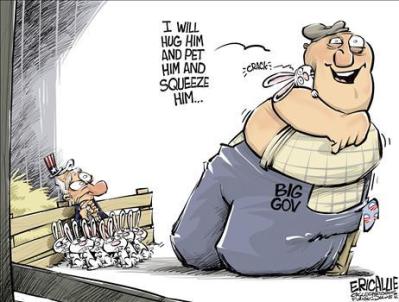
The following is no mystery: if you want prosperity, steer clear of policies that inhibit production and physical investment. This too: if you want to lift people out of poverty and dependency, don’t promote policies that discourage hiring and work incentives. Yet those are exactly the implications of policies repeatedly advocated by so-called redistributionists. The ignorance flows, in large part, from a distraction, a mere byproduct of economic life that has no direct relation to economic welfare, but upon which followers of Bernie Sanders are absolutely transfixed: income and wealth inequality. Attempts to manipulate the degree of inequality via steeply progressive taxes, transfers and market intervention is a suckers game of short-termism. It ultimately reduces the value of the economy’s capital stock, chases away productive activity, destroys jobs, and leaves us all poorer.

Absolute income growth is a better goal, and encouraging production is the best way to raise incomes in the long-run. Unless envy is your thing, income inequality is largely irrelevant as a policy goal. In “Why and How We Care About Inequality“, John Cochrane emphasizes that inequality may be a symptom of other problems, or perhaps no problem at all. His point is that treating a symptom won’t fix the underlying problem:

A segment of America is stuck in widespread single motherhood … terrible early-child experiences, awful education, substance abuse, and criminality. 70% of male black high school dropouts will end up in prison, hence essentially unemployable and poor marriage prospects. Less than half are even looking for legal work.

This is a social and economic disaster. And it has nothing to do with whether hedge fund managers fly private or commercial. It is immune to floods of Government cash, and, as Casey Mulligan reminded us, Government programs are arguably as much of the problem as the solution. So are drug laws….

The writers of the center-left Third Way blog give some details on income growth that might disappoint some progressives. They agree that the emphasis on redistribution is misplaced. Solving economic problems requires a different approach:

From 1980 to 2010, income gains (after taxes and government transfers are included) favored the wealthy but were still spread across all income brackets: a 53% increase for the bottom quintile; a 41% increase for the next two; a 49% increase for the 4th; and a 90% increase for the richest fifth. Thus, while income inequality may offend our sense of justice, its actual impact on the middle class may be small.

With a singular focus on income inequality, the left’s main solutions are greater re-distribution and a re-writing of the rules to ‘un-rig’ the system. But, however well motivated, some of the biggest ideas into which they are directing their energy do not remotely address the underlying ‘Kodak’ conundrum—how do Americans find their place in a rapidly changing world? In fact, some would actually make the task of increasing shared prosperity significantly harder.

The hubbub over inequality and redistribution is fueled by misconceptions. One is that the rich face low tax burdens, often lower than the middle class, a mistaken notion that Alan D. Viard debunks using 2013 data from a report from the Congressional Budget Office. The CBO report accounts for double taxation of dividends and capital gains at the corporate level and at the personal level (though capital gains are taxed to individuals now, while the anticipated corporate income is taxed later). The CBO study also accounts for employers’ share of payroll taxes (because it reduces labor income) so as to avoid exaggerating the tax system’s progressivity. Before accounting for federal benefits, which offset the tax burden, the middle 20% of income earners paid an average tax rate of less than 15%, while “the 1%” paid more than 29%. However, after correcting for federal benefits, the middle quintile paid a negative average tax rate, while the top 1% still paid almost 29%. That is a steeply graduated impact.

Rising income inequality in the U.S. is more a matter of changes in household structure than in the distribution of rewards. This conclusion is based on the fact that income inequality has risen steadily over the past 50 years for households, but there has been no change in inequality across individuals. An increasing number of single-person households, primarily women over the age of 65, accounts for rising inequality at the household level. The greedy corporate CEOs of the “occupier” imagination are really not to blame for this trend, though I won’t defend corporate rent-seeking activities intended to insulate themselves from competition.

Measures of income inequality hide another important fact: one’s position in the income distribution is not static. Chelsea German notes that Americans have a high degree of economic mobility. According to a Cornell study, only 6% of individuals in the top 1% in a given year remain there in the following year. German adds that over half of income earners in the U.S. find themselves in the top 10% for at least one year of their working lives.

There are several reasons why redistributionist policies fail to meet objectives and instead reduce opportunities for the presumed beneficiaries to prosper. Dan Mitchell covers several of these issues, citing work on: the rational response of upper-income taxpayers to  punitive taxes; the insufficiency of funding an expanded welfare state by merely taxing “the rich”; the diversion of most anti-poverty funds to service providers (rather than directly to the poor); the meager valuation of benefits from recipients of Medicaid, and the fact that the program lacks any favorable impact on mortality and health measures. Mitchell features the “First Theorem of Government” in a sidebar:

Above all else, the public sector is a racket for the enrichment of insiders, cronies, bureaucrats and interest groups.

A few years back, the great Thomas Sowell explained “The Fallacy of Redistribution” thusly:

You can only confiscate the wealth that exists at a given moment. You cannot confiscate future wealth — and that future wealth is less likely to be produced when people see that it is going to be confiscated.

That future wealth can and should be enjoyed across the income spectrum, but punitive taxes destroy productive capital and jobs.

A great truth about poverty comes from Angela Ranchidi of the American Enterprise Institute: low wages are not at the root of poverty; it’s a lack of jobs. She quotes a Gallup report on this point, relative to the working-age poor in 2014:

Census data show that, 61.7% did not work at all and another 26.6% worked less than full-time for the entire year. Only 11.7% of poor working-age adults worked full-time for the entire year in 2014. Low wages are not the primary cause of poverty; low work rates are. And if Gallup is correct, the full-time work rate may already be peaking.

More than 88.3% of the working-age poor were either unemployed or underemployed! And here’s the kicker: redistributionists clamor for policies that would place an even higher floor on wage rates, yet the floor already in place has succeeded in compromising the ability of low-skilled workers to find full-time work.

Cochrane sums up the inequality debate by noting the obvious political motives of progressive redistributionists:

Finally, why is “inequality” so strongly on the political agenda right now? Here I am not referring to academics. … All of economics has been studying various poverty traps for a generation…. 

[The] answer seems pretty clear. Because [the politicians and pundits] don’t want to talk about Obamacare, Dodd-Frank, bailouts, debt, the stimulus, the rotten cronyism of energy policy, denial of education to poor and minorities, the abject failure of their policies to help poor and middle class people, and especially sclerotic growth. Restarting a centuries-old fight about “inequality” and “tax the rich,” class envy resurrected from a Huey Long speech in the 1930s, is like throwing a puppy into a third grade math class that isn’t going well. You know you will make it to the bell.

That observation, together with the obvious incoherence of ideas the political inequality writers bring us leads me to a happy thought that this too will pass, and once a new set of talking points emerges we can go on to something else.

Gagging On Campaign Finance Reform

Tags

, , , , , , , , , , , , , , , , , , , , , , , , ,

campaign-finance-reform

Campaign finance is an area of internal conflict for some libertarians. On one hand, they do not believe in restrictions of any kind on freedom of expression. That implies no limits on what an individual can spend in support of a political cause, by themselves or in association with others, and whether it merely promotes a point of view or supports a political candidate. At the same time, libertarians are strongly opposed to rent-seeking activity, or efforts to use government power to promote private interests. Political spending is seen by many as an avenue for rent seeking, which suggests to them a need for limits on campaign contributions.

In fact, full-throated support of free speech and opposition to campaign limits do not stand in conflict. The reasons are: 1) such limits are an assault on free speech; 2) campaign contributions represent “small change” in the larger scheme of rent-seeking pursuits; 3) contributions seldom represent direct efforts to influence policy; and 4) imposed limits have a detrimental effect on the ability of elected officials to do their jobs.

Speech

Free speech, long interpreted by the courts more broadly as free expression, is protected by the First Amendment to the U.S. Constitution. This includes political expression, but traditionally it included campaign contributions as well, the latter being an obvious mechanism by which one can express views. However, the Supreme Court has upheld statutory limits on individual contributions to specific campaigns, as well as disclosure rules, on the grounds that they prevent corruption (Buckley v. Valeo and more recently McCutcheon v. Federal Election Commission(FEC)). I view the contribution limits as a contravention of the First Amendment, denying an enumerated right on the grounds that it “might” lead to corruption. If preventing corruption is the sole rationale for these limits, then government itself should be sharply limited, as it most certainly leads to graft and corruption at the expense of relatively powerless taxpayers.

Citizens United

A well-known Supreme Court case decided in 2010 involved independent political speech, as opposed to expression of political preference revealed by campaign spending. This was Citizens United v FEC, in which the Court ruled that political speech cannot be restricted on any basis other than corruption. As described by Ilya Shapiro, the case is widely misunderstood. One point of interest here is that the case related to speech by an organization rather than an individual. The Court ruled that a corporation (a nonprofit in the case) could not be prevented from airing a film critical of Hillary Clinton, striking down provisions of the Bipartisan Campaign Reform Act of 1990 (McCain-Feingold) under the First Amendment.

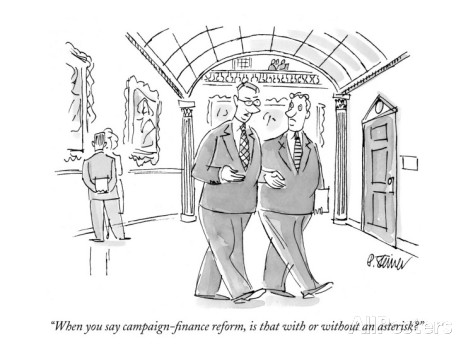
The Citizens United decision was NOT about campaign contributions. As an interesting aside, in a search of cartoons related to campaign finance, a great many imply that the Supreme Court abolished such limits in Citizens United. It did not. Even given some level of disaffection, it is hard to account for the near-complete lack of understanding about the case.

More informed critics of the decision bemoan that fact that it allows speech by corporations (and unions and other associations) to go unlimited, though they don’t seem to mind the absence of limits on political speech by media corporations. (See Eugene Volokh’s view in the Brown Daily Herald and Michael McConnell’s reinterpretation of Citizen’s United as a Press Clause case in the Yale Law Journal.) The critics also fail to recognize that corporations are associations of individuals, who are otherwise subject to no restrictions on independent speech or on what they can spend to speak independent of any political candidate (as established in Speechnow.org v. FEC in 2010). The technical treatment of a corporation as a “person”, which many find objectionable, is beside the point. Only by distorting the meaning of the First Amendment can any limitation be placed on the freedom of individuals to speak in association with others.

Jacob Sullum covers the confused legal thinking of leading Democrats Hillary Clinton and Bernie Sanders on campaign finance reform, and on Citizens United in particular. Jeb Bush is no better. Most of the opposition to the decision centers around the notion of “balancing” speech, but Sullum offers a piece of wisdom from a 1996 quote of future Supreme Court Justice Elena Kagan: “the government may not restrict the speech of some to enhance the speech of others.

Corporate Campaign Spending

Another point raised by Ilya Shapiro is that corporate spending growth has neither accelerated nor decelerated in the wake of Citizens United. Moreover, restrictions on direct campaign contributions are still in place. However, campaign contributions are a relatively small percentage of corporate “influence spending”, averaging roughly 10% of the total between 2007 and 2012 for 200 large “politically active” corporations. Thus, direct campaign contributions are unlikely to be the primary avenue for rent-seeking activity. They might help buy “access” to politicians, but they may not be especially effective in influencing policy. These points are supported by University of Missouri economist Jeffrey Milyo in “Politics Ain’t Broke, So Reforms Won’t Fix It“. Milyo marshals empirical evidence that should make us skeptical of campaign finance reform efforts.

Incapacitated Legislators

Jonathan Adler of Case Western emphasizes the legislative dysfunction created by campaign finance reforms. McCain-Feingold places limits on funds candidates can receive from their political parties and other sources, forcing them to spend a large proportion of their time on fundraising (and placing incumbents at a distinct advantage). If there is a shred of sincerity in the populist insistence that members of Congress be subject to tighter term limits, or that Congress is woefully unproductive, then full repeal of these limitations should be a priority.

Visibility Versus Effectiveness

The chief advantage of combatting corruption through regulating campaign finance is that it is a visible target. However, it is a target too rich with free speech implications. Disclosure requirements are one thing (through arguments can be made against infringements on the privacy of contributors as well). Limiting forms of expression outright is draconian, and reformers are unlikely to be satisfied until campaigns are funded entirely by taxpayers. Attacking “corruption” via limits on campaign contributions presumes a need to protect both contributor and recipient from their own guilt. Even if contributions help gain better access to an elected representative, it does not imply that the representative will act on motives counter to the perceived public merits of an issue. Moreover, the argument that limits on direct contributions to candidates “keep money out of politics” is flawed. Limits simply change the distribution of political spending, increasing the reliance on bundlers and organizations like Super PACs, and shifting the tables in favor of incumbents.

There are far better ways to combat corruption among legislators and others in government, some with more severe drawbacks than others. Term limits are one possibility, but would deny voters of legitimate choices. Another option is to allow candidates to have unrestricted access to campaign funds through central organizations, rather than forcing them to rely on independent Super PACs, which cannot always be relied upon to craft a candidate’s preferred messages. Immediate disclosure of contributors and amounts would help to bring more transparency to the campaign finance process. Stiffer disclosure requirements for “bundlers” would also help. Perhaps elected executives could be prohibited from appointing bundlers to positions of authority, though a precise definition of “bundler” might become contentious. There are other reform possibilities related to limiting permissible lobbying activity.

The libertarian’s dilemma with respect to campaign finance is easily resolved once the focus is placed squarely on protecting individual rights. In the end, the best defense of individual rights and against corruption in government is to limit government. It’s wise to place strong reigns on an institution that operates by virtue of coercive authority. The danger was well-acknowledged by the limits on government power enshrined in the Constitution.

Omnibusted: Make Congress Stick To Single-Subject Bills

Tags

, , , , , , ,

Omnibus-Bill

Here’s a great idea for making the federal government more transparent and accountable: force Congress to stick to single-subject legislation. Every bill should focus on a single issue with a clear statement of that issue. There would be no last-minute, unrelated amendments to legislation, and no omnibus bills as thick as several phone directories. This is the purpose of a three-page bill to be introduced by Representative Mia Love (R-UT). Glenn Reynolds explains the bill in more detail in “Want To Know Why Voters Are So Mad? Mia Love Has The Answer“. I’ll quote Reynolds at length, but do read the whole thing:

A bill that’s so long that nobody can read it is, naturally, pretty likely to escape scrutiny. With thousands of pages and hundreds or thousands of provisions in the bill, what’s the chance that any particular provision will be noticed or criticized?

And even if a few provisions are criticized, when they’re tied to a bill that rewards literally hundreds of constituencies, there’s not much chance they’ll be shot down. Legislators, and special interests, have a vested interest in sticking together and being sure that the whole bill passes. Individually, most of these lousy provisions wouldn’t pass, but when banded together for mutual protection they can.   .

Often, most of the provisions are written by lobbyists and inserted by tame members of Congress. The public isn’t really represented at all. That’s not an accident — it’s by design.

No wonder the federal government and the public debt have grown to outrageous proportions. Reynolds would prefer a constitutional amendment on this issue similar to some state constitutions, but he supports Love’s bill as a second-best solution. The bill would also enable judicial review of potentially unrelated provisions of legislation, should they be challenged as such. Reynolds notes that cronyism often relies on the ability to sneak provisions into legislation to avoid scrutiny. Love’s bill might even encourage a return to the older congressional practice of subjecting appropriations to more thorough review in committee before going to the floor.

The tendency for legislation to grow seemingly misplaced appendages is also one of the reasons for the confusing accusations heard in the debates for the presidential nominations. Apparently, it’s possible for sponsors of legislation to be unaware of certain provisions attached to their bills. At the very least, it facilitates a less transparent form of political “horse trading”: I’ll vote for your bill if you allow me to attach an unrelated  provision that won’t be noticed.

The Love single-issue bill is a great idea, but there is likely to be strong resistance given the extenuatory pressures faced by many members of Congress, and their predictable reluctance to change the status quo. Hmm, perhaps Love can get her bill attached to another piece of legislation. Wouldn’t that be sweet irony!

Leftist Ad Hominid Species Screams “White Racists!”

Tags

, , , , , , , , , , , , , , , , ,


Lately I hear that all white people are racists, and I feel compelled to examine the intellectual grounding of such an inflamatory claim. Consciousness of race is not racism, as some would suggest. Indeed, solutions to racial division offered by activists usually require that we bear race in mind as a primary differentiator. Insofar as one must consider the worth of another person in any context, people of good faith simply do not care about a person’s race. Rather, they care about traits that count, such as honesty, skills, work ethic and perhaps affability. Should they somehow care more? What would vindicate them?

Inflammatory Claims

There are probably several motives for the charge of universal white racism. On one level, it represents political agitation. Posts carrying the charge on social media always involve a measure of “virtue signaling” to like-minded friends, or perhaps before the Gods. (I’m sure the posters will be forgiven.) Such posts might represent acts of social contrition to allay deep-seated feelings of guilt. The posters might fancy that they are raising the consciousness of others, proudly imagining the important lesson they are teaching. The bad news for them is that most people of good faith are rightly skeptical of proselytization like this. In fact, the agitation probably does more to breed skepticism than anything else.

Voluntary Sorting Behavior

What some view as racial division is often an innocent consequence of voluntary sorting based upon the shared subcultures most compelling to individuals at a given time. There are many subcultures into which a person might fit: work, school, profession, sports, music, religion, politics, hobbies, geography, ancestry, ethnicity and race. And there are micro-cultures within all of these categories. These cultural segments differ in many respects, and they may overlap in many cases. The extent of sub-cultural overlap may be viewed as a gauge of assimilation.

In any given context, people tend to voluntarily sort themselves into the sub-culture they find most compelling. This voluntary sorting does not yield a fixed social distribution of individuals across groups. Individuals can choose to associate with different sub-cultures to which they belong on a day-to-day basis.

There is a pronounced tendency for sorting to occur within larger “populations”, such as cafeteria-goers in a large office or in a large school. People from particular work groups might sit together: there is some sorting by age, by gender, and by race. African-Americans often sit together. There is mixing of members of these subgroups as well. People are brought together by work or school, but the shared work or school culture is frequently less compelling to individuals in their choice of a lunch table than other sub-cultures to which they belong.

Isolation or Assimilation

Assimilation does not mean that cultural differences must disappear, but it does mean that subcultures must at least be tolerant of others. A key question is whether one subgroup would welcome a member of another subgroup to join them. There might be reasons to refuse in some circumstances, such as a group of accountants who wish to avoid economists. Lol. However, a group of Caucasians who prefer to remain exclusive, making African Americans feel unwelcome, are guilty of racism, and vice-versa. As for the converse, an African American individual who prefers not to join a group of Caucasians, and vice versa, there is usually a good rationale for presuming the individual to be innocent of racism: they are simply choosing a more compelling sub-culture.

Certain sub-cultures may be especially amenable to selection from across sub-groups. For example, team sports often foster racial mixing, as do music and various professions. Religion and economic stratum can be powerful shared sub-cultures, drawing members across racial groups. In other words, mixing of sub-cultures will occur when a compelling sub-culture is shared. That is a form of successful assimilation.

When voluntary sorting takes place, the parties seek commonalities. That’s a form of discrimination that may be quite healthy and not racist in any way. On the other hand, accepting diversity implies respect for other cultures and subcultures. Voluntary sorting allows those cultures to function, but it does not necessarily imply exclusion of others who might be curious and wish to learn and take part in a culture’s traditions, or who might even wish to become a part of a different community.

Counterproductive Compulsion

The insistence that racism is widespread is often an expression of support for compelled remedies or paying reparations of some kind to alleged victims. In a free society, the kind of voluntary sorting discussed above will always be a reality; any attempt to prevent it would require extreme coercion. Reparations for historical injustices, legal or economic, raise ethical questions about the treatment of those who must bear the costs. They also carry high administrative costs and tend to breed resentment and division. There are well-known downsides to quotas in hiring and in school admissions. Not only do quotas lead to reverse discrimination, they also can place the intended beneficiaries into situations of vulnerability to failure.

Markets Are Not Racist

Then there is the allegation that private markets are a source of “systemic racism”, having “disparate impacts” on certain minorities. However, it should be noted that the market mechanism tends to penalize racism. A consumer who chooses to avoid sellers of a different race will tend to pay a higher price for the privilege. An employer with a “taste for discrimination” must choose from a smaller labor pool and may lose the opportunity to hire the best talent. In other words, racists must pay for their preference. They also forego the creative benefits that diverse organizations tend to enjoy.

Certain minorities have struggled to achieve success in the private economy, but there are much better explanations for that difficulty than market forces, which provide the best opportunity for growth and assimilation. There is no question that institutional obstacles have had extremely harsh effects on groups starting from lower rungs of the socioeconomic ladder. A few examples: the failed public education has been especially burdensome for urban and rural minorities; various public policies have effectively excluded minorities from markets, including Jim Crow laws, the minimum wage and the Davis-Bacon Act; the so-called social safety net is rife with features that penalize work and reward fragmentation of families, making it as much a trap as a net; the drug war creates illicit market opportunities which present catastrophic but unappreciated risks for both the participants and their families; rent controls, zoning laws and restrictions on new construction limit the stock of affordable housing; heavy regulation makes starting a business difficult for those without the financial and legal resources to deal with it; and the ugly tradition of cronyism tends to reduce social mobility by entrenching privilege rather than rewarding economic value. The deck is stacked in many ways against economic mobility by public policy, and racial minirities have borne much of the burden.

Immigration Hotspot

Another controversy is whether racism is manifest in the negative views of many Americans toward immigrants. These claims allege ethnic and religious discrimination, including the hatred of Muslims. No doubt there are Americans who harbor racist attitudes toward immigrants. Some of this is grounded in unreasonable economic fears. There are also fears that terrorists may be among new immigrant populations, especially refugees, but that fear is hardly unreasonable given the recent experience of Europe and the difficulty of establishing reliable background information on some of these individuals.

Sharing Freedom

Racism still exists and it will never go away entirely. However, our dedication to freedom compels us to protect speech as long as it is not threatening. Racial discrimination by participants in markets can be difficult to detect, but racists must pay an economic price imposed by the market mechanism, and there are often legal remedies if racial discrimination in markets can be proven. Fortunately, racism today is not as widespread as the agitators would have you believe. The best policy for assimilation and acceptance is to promote a shared culture of freedom and economic opportunity.

Authoritarian Designs

Tags

, , , , , , , , , , , , , , , ,

eugenics certificate

Why condemn today’s progressives for their movement’s early endorsement of eugenics? Kevin Drum at Mother Jones thinks this old association is now irrelevant. He furthermore believes that eugenics is not an important issue in the modern world. Drum’s remarks were prompted by Jonah Goldberg’s review of Illiberal Reformers, a book by Thomas Leonard on racism and eugenicism in the American economics profession in the late 19th century. Tyler Cowen begs to differ with Drum on both counts, but for reasons that might not have been obvious to Drum. Eugenics is not a bygone, and its association with progressivism is a reflection of the movement’s broader philosophy of individual subservience to the state and, I might add, the scientism that continues to run rampant among progressives.

Cowen cites John Stewart Mill, one of the great social thinkers of the 19th century, who was an advocate for individual liberty and a harsh critic of eugenics. Here is a great paragraph from Cowen:

The claim is not that current Progressives are evil or racist, but rather they still don’t have nearly enough Mill in their thought, and not nearly enough emphasis on individual liberty. Their continuing choice of label seems to indicate they are not much bothered by that, or maybe not even fully aware of that. They probably admire Mill’s more practical reform progressivism quite strongly, or would if they gave it more thought, but they don’t seem to relate to the broader philosophy of individual liberty as it surfaced in the philosophy of Mill and others. That’s a big, big drawback and the longer history of Progressivism and eugenics is perhaps the simplest and most vivid way to illuminate the point. This is one reason why the commitment of the current Left to free speech just isn’t very strong.

Eugenics is not confined to the distant past, as Cowen notes, citing more recent “progressive” sterilization programs in Sweden and Canada, as well as the potential use of DNA technologies like CRISPR in “designing” offspring. That’s eugenics. So is the child quota system practiced in China, sex-selective abortion, and the easy acceptance of aborting fetuses with congenital disorders. Arguably, Obamacare “effectiveness research” guidelines cut close to eugenicism by proscribing certain treatments to individuals based upon insufficient “average benefit”, which depends upon age, disability, and stage of illness. Obamacare authorizes that the guidelines may ultimately depend on gender, race and ethnicity. All of these examples illustrate the potential for eugenics to be practiced on a broader scale and in ways that could trample individual rights.

Jonah Goldberg also responded to Drum in “On Eugenics and White Privilege“. (You have to scroll way down at the link to find the section with that title.) Goldberg’s most interesting points relate to the racism inherent in the minimum wage and the Davis-Bacon Act, two sacred cows of progressivism with the same original intent as eugenics: to weed out “undesirables”, either from the population or from competing in labor markets. It speaks volumes that today’s progressives deny the ugly economic effects of these policies on low-skilled workers, yet their forebears were counting on those effects.

Scientism is a term invoked by Friedrich Hayek to describe the progressive fallacy that science and planning can be used by the state to optimize the course of human affairs. However, the state can never command all the information necessary to do so, particularly in light of the dynamism of information relating to scarcity and preferences; government has trouble enough carrying out plans that merely match the static preferences of certain authorities. Historically, such attempts at planning have created multiple layers of tragedy, as individual freedoms and material well-being were eroded. Someone should tell Bernie Sanders!

Eugenics fit nicely into the early progressive view, flattering its theorists with the notion that the human race could be made… well, more like them! Fortunately, eugenics earned its deservedly bad name, but it continues to exist in somewhat more subtle forms today, and it could take more horrific forms in the future.

Two earlier posts on Sacred Cow Chips dealt at least in part with eugenics: “Child Quotas: Family as a Grant of Privilege“, and “Would Heterosexuals Select For Gay Genes?“.


.

Bernie, Donald and Ignatius?

Tags

, , , , , , , , , , , , , , , , , , ,

BernieTrump

We have candidates vying for the nominations of both major U.S. political parties with tendencies toward nationalism: Bernie Sanders and Donald Trump. They both oppose liberalized immigration and they are both anti-trade, playing on economic fears in articulating their views. Sanders has attempted to soften his rhetoric on immigration since last summer, when he alleged that it harms U.S. workers.

There are differences between Sanders and Trump on the treatment of existing illegal immigrants. Despite Trump’s protests to the contrary, his nationalism has had ethnic overtones.

Trump’s positions on immigration and trade protectionism are not necessarily at odds with Republican tradition, which is a mixed bag, but they are consistent with a faith in big government and central planning. An anti-immigration and anti-trade platform is certainly no contradiction for Sanders, because central planning is integral to his avowed socialism.

Sanders has been called a “socialist with nationalistic tendencies”. He favors government provision of free health care and higher education, heavy redistribution, and severe restrictions on property rights via high taxation. Trump, on the other hand, has been called a “nationalist with socialist tendencies.” He too has called for nationalized health care, increasing certain transfer payments, as well as compromises to state rights. It would probably be more accurate to describe Trump as a corporatist, a system under which large business entities both serve and control government for their own benefit. For example, Trump has used and favors eminent domain to secure land for private projects, generous bankruptcy laws to eliminate business risks, and “deal-making” between government and private enterprise in order to “get things done.” Corporatism is a flavor of fascism, and it is perfectly consistent with a statist agenda.

Thus, each party has candidates who are by degrees both nationalist and socialist. In using these labels, however, I plead innocent to a violation of Godwin’s Law. Of course they are not Nazis, but they are nationalistic socialists. The distinction is explained nicely by B.K Marcus in The Freeman. Both candidates take positions that are consistent with the platform of the National Socialist German Workers Party, circa 1920.

As an aside, Marcus provides some fascinating etymology of the word “Nazi”, quoting Steve Horwitz:

The standard butt of German jokes at the beginning of the twentieth century were stupid Bavarian peasants. And just as Irish jokes always involve a man called Paddy, so Bavarian jokes always involved a peasant called Nazi. That’s because Nazi was a shortening of the very common Bavarian name Ignatius. This meant that Hitler’s opponents had an open goal. He had a party filled with Bavarian hicks and the name of that party could be shortened to the standard joke name for hicks.

Marcus also quotes Mark Forsyth on this topic:

To this day, most of us happily go about believing that the Nazis called themselves Nazis, when, in fact, they would probably have beaten you up for saying the word.

Back on point, I’ve written about both of these candidates before: Trump here and here; Sanders here. To keep things even, here is one more interesting take on Bernie.

His family managed to send him to the University of Chicago. Despite a prestigious degree, however, Sanders failed to earn a living, even as an adult. It took him 40 years to collect his first steady paycheck — and it was a government check.”

Read the whole thing!

It’s difficult for me to take these two candidates seriously because they do not take individual liberty seriously, nor do they understand the power of private markets to promote human welfare. I also have strong reservations about their understanding of constitutional principles, and I suspect that either would have few qualms about taking Mr. Obama’s cue in stretching executive authority.

Instead of the headline above, it would have been more accurate to say “Bernie, Donald and Ignoramus!” Unfortunately, one of these guys could be our next president. Well, it won’t be Sanders.

Horizons Lost To Coercive Intervention

Tags

, , , , , , , , , , , , ,

ceiling prices

Every action has a cost. When you’re on the hook, major decisions are obviously worth pondering. But major societal decisions are often made by agents who are not on the hook, with little if any accountability for long-term consequences. They have every incentive to discount potential downside effects, especially in the distant future. Following Frederic Bastiat, Don Boudreaux writes of three levels of “What Is Not Seen” as a consequence of human decisions, which I summarize here:

  1. Immediate foregone alternatives: Possession, use and enjoyment of X is not seen if you buy Y.
  2. Resources not directed to foregone alternatives: The reduction in X inventory is not seen, compensating production of X is not seen, and extra worker hours, capital use and flow of raw materials needed for X production are not seen.
  3. The future implied by foregone alternatives: Future impacts can take many forms. X might have been a safer or healthier alternative, but those benefits are unseen. X might have been lower quality, so the potential frustration and repairs are unseen. X might have been less expensive, but the future benefits of the money saved are unseen. All of these “unseens” have implications for the future world experienced by the decision-maker and others.

These effects take on much more significance in multiples, but (2) and (3) constitute extended unseen implications for society at large. In multiples, the lost (unseen) X production and X labor-hours, capital and raw materials are more obvious to the losers in the X industry than the winners in the Y industry, but they matter. In the future, no vibrant X industry will not be seen; the resources diverted to meet Y demand won’t be seen at new or even old X factories. X might well vanish, leaving only nontransformable detritus as a token of its existence.

Changes in private preferences or in production technologies create waves in the course of the “seen” reality and the “unseen” world foregone. Those differences are caused by voluntary, private choice, so gains are expected to outweigh losses relative to the “road not traveled”. That’s not a given, however, when decisions are imposed by external authorities with incentives unaligned with those in their thrall. For that reason, awareness of the unseen is of great importance in policy analysis, which is really Boudreaux’s point. Here is an extreme example he offers in addressing the far-reaching implications of government intrusions:

Suppose that Uncle Sam in the early 20th century had, with a hypothetical Ludd Act, effectively prohibited the electrification of American farms, businesses, and homes. That such a policy would have had a large not-seen element is evident even to fans of Bernie Sanders. But the details of this not-seen element would have been impossible today even to guess at with any reliability. Attempting to quantify it econometrically would be an exercise in utter futility. No one in a 2015 America that had never been electrified could guess with any sense what the Ludd Act had cost Americans (and non-Americans as well). The not-seen would, in such a case, loom so large and be so disconnected to any known reality that it would be completely mysterious.

Price regulation provides more familiar examples. Rent controls intended to “protect” the public from landlords have enormous “unintended” consequences. Like any price regulation, rent controls stifle exchange, reducing the supply and quality of housing. Renters are given an incentive to remain in their units, and property owners have little incentive to maintain or upgrade their properties. Deterioration is inevitable, and ultimately displacement of renters. The unseen, lost world would have included more housing, better housing, more stable neighborhoods and probably less crime.

A price floor covered by Boudreaux is the minimum wage. The fully predictable but unintended consequences include immediate losses in some combination of jobs, hours, benefits, and working conditions by the least-skilled class of workers. Higher paid workers feel the impact too, as they are asked to perform more (and less complex) tasks or are victimized by more widespread substitution of capital for labor. Consumers also feel some of the pain in higher prices. The net effect is a reduction in mutually beneficial trade that continues and may compound with time:

As the time span over which obstructions to certain economic exchanges lengthens, the exchanges that would have, but didn’t, take place accumulate. The businesses that would have been created absent a minimum wage – but which, because of the minimum wage, are never created – grow in number and variety. The instances of on-the-job worker training that would have occurred – but, because of the minimum wage, didn’t occur – stack up increasingly over time.

Regulation and taxation of all forms have such destructive consequences, but policy makers seldom place a heavy weight on the unobserved counterfactual. Boudreaux emphasizes the futility of quantifying the “unseen” effects these policies:

… those who insist that only that which can be measured and quantified with numerical data is real must deny, as a matter of their crabbed and blinding scientism, that such long-term effects … are not only not-seen but also, because they are not-seen, not real.

The trade and welfare losses of coercive interventions of all types are not hypothetical. They are as real as the losses caused by destruction of property by vandals. Never again can the owners enjoy the property as they once had. Future pleasures are lost and cannot be observed or measured objectively. Even worse, when government disrupts economic activity, the cumulative losses condemn the public to a backward world that they will find difficult to recognize as such.


Minority Politics and The Redistributionist Honey Trap

Tags

, , , , , , , , , , , , ,

obama-zombie-hope-change

Minorities are not well-served by political, big-government solutions to social and economic advancement. Joel Kotkin weighs in on this point in “What’s the Best Way Up For Minorities?” He discusses the experiences of African Americans and Hispanics with two starkly different approaches to moving up:

Throughout American history, immigrants and minorities have had two primary pathways to success. One, by using the political system, seeks to redirect resources to a particular group and also to protect it from majoritarian discrimination, something particularly necessary in the case of the formerly enslaved African Americans.

The other approach, generally less well-covered, has defined social uplift through such things as education, hard work and familial values. This path was embraced by early African American leaders such as Booker T. Washington and Marcus Garvey. Today, the most successful ethnic groups – Koreans, Middle Easterners, Jews, Greeks and Russians – demonstrate the validity of this method through high levels of both entrepreneurial and educational achievement.

Minorities have largely succeeded in achieving political stature, and minority politicians garnering the most support from minority constituencies have advocated statist solutions, as opposed to emphasizing individual initiative. A leader advocating for public provision of transfers or any form of “economic justice” is undoubtedly attractive to many disadvantaged voters. Unfortunately, those policies offer little more than support. They are incapable of lifting the disadvantaged out of poverty.

From 2007-13, African Americans have experienced a 9 percent drop in incomes, far worse than the 6 percent decline for the rest of the population. In 2013, African American unemployment remained twice that of whites, and, according to the Urban League, the black middle class has conceded many of the gains made over the past 30 years. Concentrated urban poverty – on the decline in the booming 1990s – now appears to be growing.

Kotkin notes that blacks are in worsening economic straits in cities that are considered “exemplars of black political power and redistributionist politics”, and even in more affluent but “progressive” coastal cities. And paradoxically, according to Kotkin, African Americans have achieved greater economic gains in the “old Confederacy”, and that is where they are moving. The same is true of Hispanics, though most of their population growth in the south is from immigration. African Americans are reversing an older pattern of migration to the north.

Kotkin cites statistics on minority homeownership and educational performance in the south relative to northern cities, and he compares results for Texas and California. The south wins convincingly. He emphasizes the role of education and housing policies in helping minorities overcome disadvantages, but he is rightly critical of housing subsidies and affirmative action. Bad housing policies, such as rent control and zoning ordinances, hurt minorities by limiting the stock of good housing, ultimately raising its cost. The public education system, usually shielded from competitive pressures in urban areas, has often failed minorities and the urban poor.

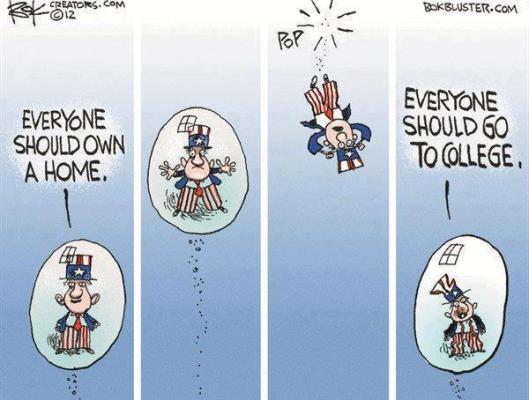
Unfortunately, calls to expand government support extend well beyond the optimal size and scope of the social safety net: free college education, subsidized home ownership, proportional representation in virtually any occupation, and “living wage” demands are very much a part of the economic justice narrative. Supporters of these policies among the poor, convinced that they are deserving, cannot be expected to understand the implications of Reynolds’ Law, named by The View From Alexandria blog after Instapundit‘s Glenn Reynolds:

Subsidizing the markers of status doesn’t produce the character traits that result in that status; it undermines them.

Higher education is not a birthright. It is for those who demonstrate sufficient learning skills, and it is often free to the most promising students. The value of education provides a powerful incentive to those possessing the “trait” of prescience. Homeownership is a choice that should follow from resources earned by hard work or from one’s long-term prospects. Representation in certain occupational categories, and higher pay, reflect “traits” (skills, effort and reliability) that must be developed or demonstrated. As Reynolds says, subsidies destroy incentives by creating the illusion of  success, a thin simulacrum revealed by long-term dependency. Subsidies do not create self-sustaining success. They do not create the real thing. And the resources confiscated to pay for subsidies punish those those bearing the most positive traits.

Minority voters, especially African Americans, placed great hope in the Obama Administration to improve their economic success. Unfortunately, Obama favors the political route to minority material gains, not the economic route. The results have been dismal (and see this) in terms of poverty, dependency, labor force participation, wages, income, and wealth:

On every leading economic issue, in the leading economic issues Black Americans have lost ground in every one of those leading categories. So in the last ten years it hasn’t been good for black folk. This is the president’s most loyal constituency that didn’t gain any ground in that period.

The answer to promoting economic gains for minorities lies in encouraging market opportunities, freedom and the rule of law. This includes wage and price flexibility, labor rights, choice in schools, even-handed law enforcement and criminal justice, secure property rights, low taxes, and ending prohibitions that promote black markets and crime. The political route to success undermines the vibrancy of the economy, opportunities faced by minorities, and their ability to capitalize on them.

Those Halcyon Days of Desperation

Tags

, , , , , , , , , , , ,

chickennostalgic

Nostalgia is hard to resist. Youth is fleeting, and for most of us, it seems more magical in hindsight than it might have been at the time. It’s also easy to imagine that certain historical eras were more interesting or romantic than the present. For example, my spouse tells me she’d love to have lived in the frontier days, yet she can’t tolerate the reality of a camping trip. We also tend to lionize certain leaders of the distant past, ascribing greatness based on history written by victors. Our objectivity may be obscured by narratives shaped over many years.

Today, some imagine and aggrandize the past in a different way: as a time when motives were “selfless”; when the world was inhabited by less acquisitive and more “minimalist” folk; when practices were more “sustainable”, or even “legitimate”. Despite the primitive conditions of that world, it was a better place for “free” human beings. So it is said, seriously!

Sarah Sqwire takes a look at these flights of fancy in “The Good Old Days of Poverty and Filth“. She dissects the views of one Luc Sante, a cultural historian, as an archetypical patron of primitivism. She invokes the French phrase “nostalgie de la boue, ‘longing for the mud,’ which means a romantic yearning for a primitive or degraded behavior or condition.” Here are some of Skwire’s colorful comments about the past:

We don’t need every medieval romance novel to remind us that the heroine’s breath didn’t smell like cool mint Listerine. It’s probably for the best that the historical re-enactors at Colonial Williamsburg don’t actually use authentic colonial medical remedies for their health problems…. Any lover of history will occasionally find him or herself dreaming about attending a performance in the pit at Shakespeare’s Globe, or roughing it in the saloons and shacks of a gold rush town. … But a good student of history will acknowledge that the Globe was undoubtedly loud, smelly, crowded, and occasionally even dangerous for playgoers. And the rugged romance of the gold rush town is offset by the knowledge that you were probably far more likely to die of gangrene or cholera than you were to strike it even moderately rich. And those glorious 18th-century wigs? Heavy, hot, smelly, and prone to harboring bugs.

She then quotes Sante:

In the Paris I write about, people ran businesses to make a living, not to make a profit. Cafes, bars: they’re no longer public institutions or part of a community. There’s no possibility for eccentric self-determination amongst the shopkeepers.

Skwire notes the odd distinction that Sante makes in the first sentence above, as if profit is not how proprietors ever made “a living”, or that they observed certain limits on their finances not imposed by market forces (i.e., their customers). She adds that businesses often seek to “create communities” as part of their business models, now in the era of social media more than ever, contrary to Sante’s presumption. Here’s Skwire’s verdict:

Sante, though, has so much mud in his eyes that he is blind to the tangible and important progress that has been made in human wealth and welfare. His mucky nostalgia leads him to claim that our increasing wealth — which has given us more health, more discretionary income, more food, and more free time — is a danger more pernicious than terrorism.

I am surprised that Skwire fails to mentions the environmental left in this context. It is, after all, the source of hysteria related to population and scarcity, and the source of so much criticism of modernity. As an antidote to such nonsense, I recommend the Human Progress web site. This recent entry on Julian Simon is instructive. I also recommend Matt Ridley’s Rational Optimist blog. Try this entry on “The Long Shadow of Malthus” for a start.

Skwire views Luc Sante’s infatuation with pre-modern life and lifestyles as an elitist’s prescription for “other” people. That may well be. It also fits the profile of many environmental elites. Whether or not Skwire’s characterization of Sante is accurate, he is at least ignorant of the great diffusion of prosperity taking place around the globe, fueled by markets and economic development. It seems awkward that anyone would bemoan economic progress when, in fact, world poverty is declining, yet that very misgiving is implied by many critiques of markets and modernity.

Enduring A Dead-Weight Dominion

Tags

, , , , , , , , , , , , , , , , , , , , ,

government-intervention

If you hope for government to solve economic problems, try to maintain some perspective: the state has unique abilities to botch it, and its power to distort and degrade the economy in the process of “helping” is vast. Government spending at all levels copped about 18% of the U.S.  economy’s final output in 2014, but the public sector’s impact is far more pervasive than that suggests. Private fixed investment in new structures and equipment accounted for only about 16% of Gross Domestic Product (GDP); the nonresidential portion of fixed investment was less than 13% of GDP. I highlight these two components of GDP because no one doubts the importance of capital investment as a determinant of the economy’s productive capacity. But government is a larger share of spending, it can divert saving away from investment, and it creates a host of other impediments to productivity and efficient resource allocation.

The private economy is remarkable in its capacity to satisfy human wants. The market is a manifestation of spontaneous order, lacking the conscious design of any supreme authority. It is able to adjust to dynamic shifts in desires and resource constraints; it provides reliable feedback in the form of changing prices to modulate and guide the responses of participants through all stages of production. Most forms of government activity, however, are not guided by these signals. Instead, the state imposes binding and sometimes immediate constraints on the decisions of market participants. The interference takes a number of forms, including price controls, but they all have the power to damage the performance and outcomes of markets.

The productive base at each stage of the market process is a consequence of the interplay of perceived business opportunities and acts of saving or deferred consumption. The available flow of saving depends on its rewards, which are heavily influenced by taxes and government intervention in financial markets. It’s worth noting here that the U.S. has the highest corporate tax rates in the developed world, as well as double taxation of corporate income paid out to owners. In addition, the tax system is used as a tool to manipulate the allocation of resources, drawing them into uses that are politically favored and punishing those in disfavor. The damaging impact is compounded by the fact that changes in taxes are often unknown ex ante. This adds a degree of political risk to any investment decision, thus discouraging capital spending and growth in the economy’s productive base.

The government is also a massive and growing regulator of economic activity. Over 100,000 new regulatory restrictions were added to the Code of Federal Regulations between 2008 and 2012. Regulation can have prohibitive compliance costs and may forbid certain efficiencies, often based on flimsy or nonexistent cost/benefit comparisons. It therefore damages the value and returns on embedded capital and discourages new investment. It is usually uneven in its effects across industries and it typically reduces the level of competition in markets because small firms are less capable of surviving the costs it imposes. Innovation is stifled and prices are higher as a result.

From a philosophical perspective, even the best cost/benefit comparisons are suspect as tools for evaluating government intervention. Don Boudreaux quotes Anthony de Jasay’s The State on this point:

What could be more innocuous, more unexceptional than to refrain from intervening unless the cost-benefit comparison is favourable? Yet it treats the balancing of benefits and costs, good and bad consequences, as if the logical status of such balancing were a settled matter, as if it were technically perhaps demanding but philosophically straightforward. Costs and benefits, however, stretch into the future (problems of predictability) and benefits do not normally or exclusively accrue to the same persons who bear the costs (problems of externality). … Treating it as a pragmatic question of factual analysis, one of information and measurement, is tacitly taking the prior and much larger questions as having been somehow, somewhere resolved. Only they have not been.

Poorly-executed and inappropriate stabilization policy is another way in which government distorts decisions at all stages of production. There are many reasons why these policies tend to be ineffective and potentially destructive, especially in the long run. Keynesian economics, based on ideas articulated by John Maynard Keynes, offers prescriptions for government action during times of instability. That means “expansionary” policy when the economy is weak and “contractionary” policy when it is strong.  At least that is the intent. This framework relies on the notion that components of aggregate demand determine the economy’s output, prices and employment.

The major components of GDP in the National Income and Product Accounts are consumer spending, private investment, government spending, and net foreign spending. In a Keynesian world, these are treated as four distinct parts of aggregate “demand”, and each is governed by particular kinds of assumed behavior. Supply effects are treated with little rigor, if at all, and earlier stages of production are considered only to the extent that their value added is included, and that the finished value of  investment (including new inventories) is one of the components of aggregate demand.

Final spending on goods and services (GDP) may be convenient because it corresponds to GDP, but that is simply an accounting identity. In fact, GDP represents less than 45% of all transactions. (See the end note below.) In other words, intermediate transactions for raw materials, business-to-business (B2B) exchange of services and goods in a partly fabricated state, and payments for distributional services are not counted, but they exceed GDP. They are also more variable than GDP over the course of the business cycle. Income is generated and value is added at each stage of production, not only in final transactions. To say that “value-added” is counted across all stages is a restatement of the accounting identity. It does not mean that those stages are treated behaviorally. Technology, capital, employees, and complex decision-making are required at each stage to meet demands in competitive markets. Aggregation at the final goods level glosses over all this detail.

The focus of the media and government policymakers in a weak economy is usually on “underconsumption”. The claim is often heard that consumer spending represents “over two-thirds of the economy”, but it is only about one-third of total transactions at all levels. It is therefore not as powerful an engine as many analysts assert. Government efforts to stimulate consumption are often thwarted by consumers themselves, who behave in ways that are difficult for models to capture accurately.

Government spending to combat weakness is another typical prescription, but such efforts are usually ill-timed and are difficult to reverse as the economy regains strength. The value of most government “output” is not tested in markets and it is not subject to competitive pressure, so as the government absorbs additional resources, the ability of the economy to grow is compromised. Programmatic ratcheting is always a risk when transfer payments are expanded. (Fixed programs that act as “automatic stabilizers”, and that are fiscally neutral over the business cycle, are less objectionable on these grounds, but only to the extent that they are not manipulated by politicians or subject to fraud.) Furthermore, any measure that adds to government deficits creates competition for the savings available for private capital investment. Thus, deficits can reduce the private economy’s productive capacity.

Government investment in infrastructure is a common refrain, but infrastructure spending should be tied to actual needs, not to the business cycle. Using public infrastructure spending for stabilization policy creates severe problems of timing. Few projects are ever “shovel-ready”, and rushing into them is a prescription for poor management, cost overruns and low quality.

Historically, economic instability has often been a consequence of poorly-timed monetary policy actions. Excessive money growth engineered by the Federal Reserve has stimulated excessive booms and inflation in the prices of goods and assets. These boom episodes were followed by market busts and recessions when the Fed attempted to course-correct by restraining money growth. Booms tend to foster misjudgments about risk that end in over-investment in certain assets. This is especially true when government encourages risk-taking via implicit “guarantees” (Fannie Mae and Freddie Mac) and “too-big-to-fail” promises, or among individuals who can least afford it, such as low-income homebuyers.

Given a boom-and-bust cycle inflicted by monetary mismanagement, attempts to stimulate demand are usually the wrong prescription for a weak economy. Unemployed resources during recessions are a direct consequence of the earlier malinvestment. It is better to let asset prices and wages adjust to bring them into line with reality, while assisting those who must transition to new employment. The best prescription for instability is a neutral stance toward market risks combined with stable policy, not more badly-timed countercyclical efforts. The best prescription for economic growth is to shrink government’s absorption of resources, restoring their availability to those with incentives to use them optimally.

The more that central authorities attempt to guide the economy, the worse it gets. The torpid recovery from the last recession, despite great efforts at stimulus, demonstrates the futility of demand-side stabilization policy. The sluggishness of the current expansion also bears witness to the counterproductive nature of government activism. It’s a great credit to the private market that it is so resilient in the face of long-standing government economic and regulatory mismanagement. A bureaucracy employing a large cadre of technocrats is a “luxury” that only a productive, dynamic economy can afford. Or can it?

~~~~~~~~~~~~~~~~~~~~~~~~~~~~~~~~~~~~~~~~~~~~~~~~~~~~~~~~~~~~~~~~~~~~

A Note On Output Measures

More complete aggregations of economic activity than GDP are gross output (GO) and gross domestic expenditures (GDE). These were developed in detail by economist Mark Skousen in his book “The Structure of Production“, published in 1990. GO includes all final transactions plus business-to-business (B2B) transactions, while GDE adds the costs of wholesale and retail distribution to GO. Or as Skousen says in this paper:

GDE is defined as the value of all transactions (sales) in the production of new goods and services, both finished and unfinished, at all stages of production inside a country during a calendar year.

GO and GDE show the dominance of business transactions in economic activity. GDE is more than twice as large as GDP, and B2B transactions plus business investment are twice the size of consumer spending. According to Skousen, GDE varies with the business cycle much more than GDP. Many economic indicators focus on statistics at earlier stages of production, yet real final spending is often assumed to be the only measure of transactions that matters.