• About

Sacred Cow Chips

Sacred Cow Chips

Tag Archives: Administrative State

Courts and Their Administrative Masters

04 Tuesday Apr 2017

Posted by Nuetzel in Big Government, Regulation

≈ 1 Comment

Tags

Administrative Law, Administrative State, Chevron Deference, Chevron USA, Clyde Wayne Crews, Competitive Enterprise Institute, Ilya Somin, Jonathan Adler, Kent Jordan, Natural Resources Defense Council, Neil Gorsuch, Philip Hamburger, Regulatory Dark Matter, Separation of Powers

IMG_4007

Supreme Court nominee Neil Gorsuch says the judicial branch should not be obliged to defer to government agencies within the executive branch in interpreting law. Gorsuch’s  opinion, however, is contrary to an established principle guiding courts since the 1984 Supreme Court ruling in Chevron USA vs. The Natural Resources Defense Council. In what is known as Chevron deference, courts apply a test of judgement as to whether the administrative agency’s interpretation of the law is “reasonable”, even if other “reasonable” interpretations are possible. This gets particularly thorny when the original legislation is ambiguous with respect to a certain point. Gorsuch believes the Chevron standard subverts the intent of Constitutional separation of powers and judicial authority, a point of great importance in an age of explosive growth in administrative rule-making at the federal level.

Ilya Somin offers a defense of Gorsuch’s position on Chevron deference, stating that it violates the text of the Constitution authorizing the judiciary to decide matters of legal dispute without ceding power to the executive branch. The agencies, for their part, seem to be adopting increasingly expansive views of their authority:

“Some scholars argue that in many situations, agencies are not so much interpreting law, but actually making it by issuing regulations that often have only a tenuous basis in congressional enactments. When that happens, Chevron deference allows the executive to usurp the power of Congress as well as that of the judiciary.”

Jonathan Adler quotes a recent decision by U.S. Appeals Court Judge Kent Jordan in which he expresses skepticism regarding the wisdom of Chevron deference:

Deference to agencies strengthens the executive branch not only in a particular dispute under judicial review; it tends to the permanent expansion of the administrative state. Even if some in Congress want to rein an agency in, doing so is very difficult because of judicial deference to agency action. Moreover, the Constitutional requirements of bicameralism and presentment (along with the President’s veto power), which were intended as a brake on the federal government, being ‘designed to protect the liberties of the people,’ are instead, because of Chevron, ‘veto gates’ that make any legislative effort to curtail agency overreach a daunting task.

In short, Chevron ‘permit[s] executive bureaucracies to swallow huge amounts of core judicial and legislative power and concentrate federal power in a way that seems more than a little difficult to square with the Constitution of the [F]ramers’ design.’

The unchecked expansion of administrative control is a real threat to the stability of our system of government, our liberty, and the health of our economic system. It imposes tremendous compliance costs on society and often violates individual property rights. Regulatory actions are often taken without performing a proper cost-benefit analysis, and the decisions of regulators may be challenged initially only within a separate judicial system in which courts are run by the agencies themselves! I covered this point in more detail one year ago in “Hamburger Nation: An Administrative Nightmare“, based on Philip Hamburger’s book “Is Administrative Law Unlawful?“.

Clyde Wayne Crews of the Competitive Enterprise Institute gives further perspective on the regulatory-state-gone-wild in “Mapping Washington’s Lawlessness: An Inventory of Regulatory Dark Matter“. He mentions some disturbing tendencies that may go beyond the implementation of legislative intent: agencies sometimes choose to wholly ignore some aspects of legislation; agencies tend to apply pressure on regulated entities on the basis of interpretations that stretch the meaning of such enabling legislation as may exist; and as if the exercise of extra-legislative power were not enough, administrative actions have a frequent tendency to subvert the price mechanism in private markets, disrupting the flow of accurate information about resource-scarcity and the operation of incentives that give markets their great advantages. All of these behaviors fit Crews’ description of “regulatory dark matter.”

Chevron deference represents an unforced surrender by the judicial branch to the exercise of power by the executive. As Judge Jordan notes in additional quotes provided by Adler at a link above, this does not deny the usefulness or importance of an agency’s specialized expertise. Nevertheless, the courts should not abdicate their role in reviewing an agency’s developmental evidence for any action, and the reasonability of an agency’s applications of evidence relative to alternative courses of action. Nor should the courts abdicate their role in ruling on the law itself. Judge Gorsuch is right: Chevron deference should be re-evaluated by the courts.
Hamburger Nation: An Administrative Nightmare

04 Friday Mar 2016

Posted by Nuetzel in Big Government, Judicial Branch, Legislative Branch, Regulation

≈ 4 Comments

Tags

Administrative Law, Administrative State, Constitutional convention, Delegated Powers, Due Process, Extralegal Powers, Fourth Branch, George Akerlof, Glenn Reynolds, Ham Sandwich Nation, Ilya Somin, IRS Targeting, Ivan Carrino, Joseph Postell, Marginal Revolution, Mia Love, Michael Ramsey, Philip Hamburger, Richard Epstein, Robert Shiller, Rule of Consent, Takings, The Originalism Blog, Volokh Conspiracy

nanny-state

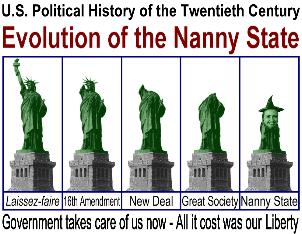
By what authority do unelected bureaucrats in administrative agencies increasingly make laws, enforce those laws and adjudicate violations? The fact that all of these activities take place within the executive branch of government appears to be an obvious contradiction of the separation of powers required by the first three articles of the Constitution, the principle of “Rule By Consent” of the governed, and protections of individual liberty. In a strong sense, the regulatory apparatus has grown so unwieldy that the powers routinely exercised by administrative agencies today seem beyond even the reach of elected executives. The rules promulgated by this “fourth branch” of government are essentially extralegal, a point discussed at length in Philip Hamburger’s “Is Administrative Law Unlawful“. He has also explained these issues at the Volokh Conspiracy blog in “Extralegal power, delegation, and necessity“, and “The Constitution’s repudiation of extralegal power“.

Hamburger examines the assertion that rule-making must be delegated by Congress to administrative agencies because legislation cannot reasonably be expected to address the many details and complexities encountered in the implementation of new laws. Yet this is a delegation of legislative power. Once delegated, this power has a way of metastasizing at the whim of agency apparatchiks, if not at the direction of the chief executive. If you should want to protest an administrative ruling, your first stop will not be a normal court of law, but an administrative review board or a court run by the agency itself! You’ll be well advised to hire an administrative attorney to represent you. Eventually, and at greater expense, an adverse decision can be appealed to the judicial branch proper.

This adds up to a dangerous lack of accountability and power. Marginal Revolution points out that critics of Hamburger’s book overlook the potential for harm that could be done by a “vindictive” president. But we should not lose sight of the fact that bureaucrats themselves, at any level, can be vindictive, as the IRS targeting scandal has shown. But that is only one motive for abuse of power; another motive may be more pervasive: the ability to reward those in a position to promote the self-interests of those who populate the administrative state. These are dangers that are endemic to big government. In a post entitled “Are Government Regulators More Virtuous than Everyone Else” (No!), Ivan Carrino highlights the weakness of arguments like those made by George Akerlof and Robert Shiller in “Phishing For Phools“, who call for greater government regulation on the grounds that consumers are vulnerable to manipulation by businesses. Carrino says:

“One can’t help but notice the central contradiction in this analysis. On the one hand, it is assumed that markets fail because of ‘normal human weakness.’ On the other hand, it is assumed that regulation, which must necessarily be implemented by human beings with equal or greater ‘weaknesses,’ will somehow solve the problem.

Akerlof and Shiller simultaneously demonize human beings who operate in the private sector while idealizing human beings who operate in the public sector.“

Glenn Reynolds has been a prominent critic of the administrative state. As a consequence of the vast and growing body of regulatory rules, it’s become increasingly difficult for individuals, acting on their own or as businesspeople, to know whether they are in acting in violation of administrative law. Reynolds discusses regulatory crime and over-criminalization in “You May Be Breaking The Law Right Now“, and in his great paper “Ham Sandwich Nation: Due Process When Everything is a Crime” (free download).

Hamburger’s main position is that law should be made by elected representatives, not by bureaucrats who lack direct accountability to voters. Ilya Somin believes that with time, Hamburger will have great influence on legal theorists in this regard. He compares Hamburger’s insights on administrative law to Richard Epstein’s work on takings. Epstein insisted that “almost all regulations that restrict property rights should be considered ‘takings’ that require compensation under the Fifth Amendment.” Somin notes that Epstein’s position, despite harsh criticism from certain quarters, has influenced legal thinking in a dramatic way over the years.

What’s to be done? Can a line reasonably be drawn between constitutional legislative power and delegated rule-making authority? Somin is skeptical that absolute restrictions on lawmaking by the administrative state are practical, in the sense that there will always be details that cannot be addressed in enabling legislation. Others have suggested practical paths forward: Joseph Postell attempts to give a roadmap in “From Administrative State to Constitutional Government“. A recent Glenn Reynolds op-ed, “Blow Up The Administrative State“, gives a qualified defense of Texas Governor Greg Abbot’s proposed amendments to the Constitution. Among other things, Abbot proposes to:

“–Prohibit administrative agencies … from creating federal law.
  –Prohibit administrative agencies … from preempting state law.
  –Give state officials the power to sue in federal court when … officials overstep their bounds.
  –Allow a two-thirds majority of the states to override a federal law or regulation.”

I would add that administrative review and adjudication should be independent of the agencies themselves. Also, Representative Mia Love (R-UT) has proposed legislation that would restrict Congress to bills focused on points directly related to a single issue (i.e., no omnibus bills), which would help to check the growth of the administrative state.

All of these measures seem consistent with Hamburger’s views. Reynolds is fully cognizant of the dangers of a constitutional convention. Nevertheless, he recognizes that Abbot’s proposals would impose harder limits on the size of government, and defends them in colorful fashion:

“A smaller government would mean fewer phony-baloney jobs for college graduates with few marketable skills but demonstrated political loyalty. It would mean fewer opportunities for tax dollars to be directed to people and entities with close ties to people in power. It would mean less ability to engage in social engineering and ‘nudges’ aimed at what are all-too-often seen as those dumb rubes in flyover country. The smaller the government, the fewer the opportunities for graft and self-aggrandizement — and graft and self-aggrandizement are what our political class is all about.“

For further reading, Michael Ramsey at The Originalism Blog posts links to several other essays by Hamburger at The Volokh Conspiracy, where he acted as a guest-blogger.


Borkians Preserve Federal Obamacare Subsidies

29 Monday Jun 2015

Posted by Nuetzel in Obamacare

≈ Leave a comment

Tags

ACA, Administrative State, Affordable Care Act, Chief Justice Roberts, Damon Root, Ilya Shapiro, Judicial Activism, Judicial Restraint, King vs. Burwell, Obamacare, Randy Barnett, Robert Bork, Robert Laszlewski, SCOTUS, SCOTUSblog, Tyler Cowen

ACA Supremes cartoon

I have mixed feelings about the Supreme Court’s King vs. Burwell decision upholding federal subsidies for health insurance purchased in states that did not establish their own exchanges. My biggest concerns are that the decision gives a pass to the unchecked exercise of executive fiat as well as congressional carelessness (“lassitude”, to use Justice Scalia’s term), and the smearing of the separation of legislative and judicial powers. I admit that I was eager to see the exchanges unravel under the weight of their own lousy economics. However, the economics remain lousy even with the ruling, which will become more evident as major subsidies to health insurers expire over the next 18 months. It will be interesting to watch as the process of escalating premia plays out. I’m relieved that the Obamacare opposition in Congress (primarily Republicans) is now off the hook. These legislators never coalesced around an alternative and would have received a good portion of the blame for any further disruptions in the insurance “market” had the decision gone the other way. Probably their best approach would have been to extend the subsidies to all exchanges, at least for the remainder of Obama’s term. As Tyler Cowen notes, an extension would have occurred:

“… only after a lot of political stupidity and also painful media coverage. So on net I take this to be good news, although arguably it is bad news that it is good news.“

On the merits of health care policy, given the failure to put forward a better plan, what would have been gained over the next 18 months from a ruling for the plaintiffs? Not much.

Cowen links to a Robert Laszlewski post emphasizing the fragile economic and political condition of Obamacare:

“Obamacare has only enrolled about 40% of the subsidy eligible market in two years worth of open enrollments. That level of consumer support does not make Obamacare either financially sustainable or politically sustainable. The surveys say the 40% who have enrolled like their plans. Of course they do, they are the poorest with the biggest subsidies and the lowest deductibles. The working and middle-class have most often not signed up for Obamacare because it costs too much and delivers too little.

That Obamacare is not financially sustainable is evidenced by the first wave of big 2016 rate increases by so many large market share insurers. The next wave of rate increases a year from now will also be large and will be in the middle of the 2016 election.“

The SCOTUS decision flies in the face of the roles and responsibilities assigned to the branches of government by the Constitution. The implication of the ruling is that a law means whatever the executive branch says it means, even when it says the opposite unambiguously. This goes too far in granting executive power to “reimagine” legislation, and the Left may well come to regret it as a precedent. Executive rulings in implementing laws is nothing new, but one hopes for the courts to keep a tight rein on this discretion in an era when the regulatory environment is growing increasingly complex.

A Randy Barnett post at SCOTUSblog quotes Chief Justice Roberts’ opinion:

“Congress passed the Affordable Care Act to improve health insurance markets, not to destroy them. If at all possible, we must interpret the Act in a way that is consistent with the former, and avoids the latter.“

Improve health care markets? Not destroy them? Wait… I’m confused! But seriously, at this point in the process, Justice Roberts must be confused about actual outcomes. An objective assessment of Obamacare would include an accounting for the many individuals whose policies were cancelled against their wishes, premium escalation, and the fact that the ACA has fallen well short of expectations for reducing the number of uninsured; the law has certainly not improved markets. Barnett describes Roberts’ apparent philosophy on this point thusly:

“... the Chief Justice seems to be telling us that he is once again putting a thumb on the scale for the government here as he did in his solo opinion in NFIB. Rather than assessing the constitutionality of the law as written – or enforcing it according to its terms – the court will rewrite the law to suit the government.” 

This is not merely “legislative deference”, it is legislative rescue and a rewriting of the law. And Barnett points out that the Courts should provide a check on bad legislation, not serve as enablers.

Damon Root offers an excellent clarification of Roberts’ thinking: the strand of conservative judicial philosophy calling for deference to legislative intent is often attributed to Robert Bork. This obviously conflicts with the notion that conservatives are judicial activists. I discussed judicial activism here a few months ago, including Randy Barnett’s assertion that the term seems to be invoked as a pejorative almost any time someone doesn’t like a court decision. If it means preserving the Constitution, then count me as an activist.

Ilya Shapiro sums up the “intent” of the legislation and the “deferential” position taken by the court in King vs. Burwell:

“Roberts explains his transmogrification by finding it ‘implausible that Congress meant the Act to operate in this manner,’ to deny subsidies to millions of people as part of legislation intended to expanded coverage. But it’s hardly implausible to think that legislation that still says that states ‘shall’ set up exchanges—the drafters forgot to fix this bit after lawyers pointed out that Congress can’t command states to do anything—would effectively give states an offer nobody thought they’d refuse. It was supposed to be a win-win: states rather than the federal government would run health care exchanges (yay federalism!) and all those who need subsidies to afford Obamacare policies would get them (yay universal healthcare!).

But a funny thing happened on the way to utopia, and only 14 states (plus D.C.) took that too-tempting offer, perhaps having been burned too many times before by the regulations that accompany any pots of “free” federal money. And that’s why we ended up with King v. Burwell: Obamacare the reality doesn’t accomplish Obamacare the dream.“

We’ll watch to see how badly Obamacare fares over the next two years. And we’ll hope that eventually Congress can fashion a new health care plan that creates more choice, reduces taxes, increases competition and reduces coercive rules and regulatory burdens.

Federal Strings and Executive Puppeteers

28 Thursday May 2015

Posted by Nuetzel in Big Government, Federalism, Regulation

≈ Leave a comment

Tags

Administrative State, Cooperative federalism, Executive federalism, Federalism, Michael S. Greve, Nullification, Tenth Amendment

federal bribes

We often think of government bureaucracy as a force of stasis, but it is unlikely to promote stability. At all levels, government administrative organs have a way of growing, absorbing increasing levels of resources and constricting private activity by imposing increasingly complex rules. A large administrative apparatus tends to calcify the economy, undermining growth or even a sustained level of economic activity. The negative consequences of the administrative state were treated twice on this blog last year.

Federalism, on the other hand, is usually viewed as a check on federal power relative to state governments. That was the perspective of “Nullifying the Federal Blob” last year on SCC. However, in “The Rise of Executive Federalism“, Michael S. Greve discusses forms of federalism that can serve as adjuncts or even alternatives to the exercise of federal legislative power. First, he discusses “cooperative federalism”, whereby lower levels of government receive federal funds and in turn administer federal programs:

“With very few exceptions…, virtually all federal domestic programs are administered by state and local governments, often under one of over 1,100 federal funding statutes (such as Medicaid or NCLB). Since its inception under the New Deal, this ‘cooperative’ federalism has proven stupendously successful in doing what it was supposed to do: expand government at all levels.“

Greve draws a connection between political and economic developments over recent decades, the coincident decline of cooperative federalism and the rise of a more aggressive “executive federalism”. These developments include constraints on funding at both the federal and state levels, a decline in the willingness of states to cooperate on certain programs, and a divided Congress. No funding, no federal-state cooperation and no federal legislative direction leaves a vacuum to be filled by federal executive initiative:

“Thus, to make federal programs ‘work’ under current conditions, agencies rewrite statutes, issue expansive waivers, and negotiate deals with individual states on a one-off basis. That is how the ACA is being ‘administered.’ That is how Secretary of Health and Human Services Sylvia Burwell is trying to expand Medicaid. That is how No Child Left Behind is run. And that is how Environmental Protection Agency is trying to impose its Clean Power Plan: ‘stakeholder meetings’ and assurances of regulatory forbearance for cooperating states; unveiled threats against holdout states. This brand of federalism knows neither statutory compliance nor even administrative regularity. It is executive federalism.“

It does not bode well that this perverse form of federalism “is robust to partisan politics.” Greve notes that certain aspects of executive federalism were initiated by the Reagan Administration.

Greve’s advice on combating this trend is to make federalism “less cooperative, one program at a time.” While he’s a little short on specifics, he advises that initiatives such as block grants to states are likely to be counterproductive in restoring traditional federalism. One point on which I part company with Greve is his disparaging reference to “state’s rights” as a battle of “yesterday”. I suspect his underlying objection (which I do not share) is drug legalization at the state level, or any other measure that he might find morally objectionable. Otherwise, I have no issue with what I take to be his favored approach, which seems to involve any assault on the exercise of federal administrative power and rule-making, whether that is through the courts or the exercise of nullification by the states. It is promising that so many states are resisting the imposition of additional administrative and funding burdens attendant to expansive federal sweeteners and control.

Life’s Bleak When Your Goal Is Compliance

08 Wednesday Oct 2014

Posted by Nuetzel in Uncategorized

≈ 2 Comments

Tags

Administrative State, Asset Forfeiture, Banana Republic, Compliance Costs, DOE, FDA, Fines and Taxes, Michael Greve, Regulatory State, Richard Rahn

compliant_with_the_universe

Don’t underestimate the danger and cost of giving it up to the regulatory state. It’s ability to impel behavior in the absence of any legislative mandate, and apparently without accountability to the judicial branch or any other authority, is explored by Michael Greve in “Prescription for a Banana Republic.” He does this mostly in the context of the Department of Education, but he also mentions the FDA’s practice of issuing “draft” guidance, frequently with perverse consequences. I know from my own experience in the financial industry that the problem is more general. Here’s one snippet from Greve’s article:

“Why do we permit agencies to proceed in this underhanded, unreviewable fashion? The general idea is that in choosing to proceed by “guidance” rather than formal, reviewable regulation, the agency is giving something up: the legally binding effect of its rulings. It’s not really coercing anybody, and so why bother the courts? That answer, however, wildly underestimates government’s ingenuity in giving real-world effect to supposedly informal documents.”

Richard Rahn had a piece yesterday on the closely related topic of fines and asset forfeitures imposed by regulators without any court proceeding, let alone a conviction. He quotes two former directors of the DOJ’s Asset Forfeiture and Money Laundering Office:

“Civil asset forfeiture and money-laundering laws are gross perversions of the status of government amid a free citizenry. The individual is the font of sovereignty in our constitutional republic, and it is unacceptable that a citizen should have to ‘prove’ anything to the government. If the government has probable cause of a violation of law, then let a warrant be issued. And if the government has proof beyond a reasonable doubt of guilt, let that guilt be proclaimed by 12 peers.”

Greve mentions the strong influence exerted by regulators issuing so-called “Dear Colleague” letters containing “suggested” steps that might be taken “voluntarily” to avoid falling out of compliance with often ill-defined requirements:

“Whereupon compliance officers across the country can be heard clearing their throats: I can help…. Replicate the m.o. across the full range of government services and regulation: it takes a ton of money to escape. Once you start adopting Juan Peron’s legal model, social patterns will follow. We’re well on our way.”

Nudge me when it’s over. Oh, wait!

Your Administrative Master With Police Power

20 Wednesday Aug 2014

Posted by Nuetzel in Uncategorized

≈ Leave a comment

Tags

Administrative State, Ben Domenech, Federalism, Mercatus Center, Regulatory State, Sinestro, The Federalist

sinestro

The administrative / regulatory state just grows and grows, as this tool from the Mercatus Center shows. As it does so, the bureaucracy becomes less accountable to the people in its sway, and seemingly less responsive to the checks and balances among the branches of government defined in the constitution. Rules are made by unelected bureaucrats, and their application is often uneven and arbitrary. In “The Sinestro Theory of The Administrative State,” Ben Domenech explores the link between this type of governance and declining “faith” in government itself. The danger posed by the administrative state is captured here by Domenech:

“In the era of the Administrative State, big government has been giving out too many rings to too many would-be Sinestros. And when it comes to trust in Washington, it’s the fact that this power is centralized in the Administrative State, rather than localized via federalism, which creates the special class of modern ringbearers. It allows them to work together in common purpose, as the progressives intended, as opposed to balancing and checking each other, as the Founders always understood to be essential.” [Sinestro link in original]. 

It may be too late, but left unchecked, the administrative state will be an ongoing and increasing drag on the economy and personal freedom. It must be rolled back. 

Newer posts →
Follow Sacred Cow Chips on WordPress.com

Recent Posts

  • The Case Against Interest On Reserves
  • Immigration and Merit As Fiscal Propositions
  • Tariff “Dividend” From An Indigent State
  • Almost Looks Like the Fed Has a 3% Inflation Target
  • Government Malpractice Breeds Health Care Havoc

Archives

  • January 2026
  • December 2025
  • November 2025
  • October 2025
  • September 2025
  • August 2025
  • July 2025
  • June 2025
  • May 2025
  • April 2025
  • March 2025
  • February 2025
  • January 2025
  • December 2024
  • November 2024
  • October 2024
  • September 2024
  • August 2024
  • July 2024
  • June 2024
  • May 2024
  • April 2024
  • March 2024
  • February 2024
  • January 2024
  • December 2023
  • November 2023
  • August 2023
  • July 2023
  • June 2023
  • May 2023
  • April 2023
  • March 2023
  • February 2023
  • January 2023
  • December 2022
  • November 2022
  • October 2022
  • September 2022
  • August 2022
  • July 2022
  • June 2022
  • May 2022
  • April 2022
  • March 2022
  • February 2022
  • January 2022
  • December 2021
  • November 2021
  • October 2021
  • September 2021
  • August 2021
  • July 2021
  • June 2021
  • May 2021
  • April 2021
  • March 2021
  • February 2021
  • January 2021
  • December 2020
  • November 2020
  • October 2020
  • September 2020
  • August 2020
  • July 2020
  • June 2020
  • May 2020
  • April 2020
  • March 2020
  • February 2020
  • January 2020
  • December 2019
  • November 2019
  • October 2019
  • September 2019
  • August 2019
  • July 2019
  • June 2019
  • May 2019
  • April 2019
  • March 2019
  • February 2019
  • January 2019
  • December 2018
  • November 2018
  • October 2018
  • September 2018
  • August 2018
  • July 2018
  • June 2018
  • May 2018
  • April 2018
  • March 2018
  • February 2018
  • January 2018
  • December 2017
  • November 2017
  • October 2017
  • September 2017
  • August 2017
  • July 2017
  • June 2017
  • May 2017
  • April 2017
  • March 2017
  • February 2017
  • January 2017
  • December 2016
  • November 2016
  • October 2016
  • September 2016
  • August 2016
  • July 2016
  • June 2016
  • May 2016
  • April 2016
  • March 2016
  • February 2016
  • January 2016
  • December 2015
  • November 2015
  • October 2015
  • September 2015
  • August 2015
  • July 2015
  • June 2015
  • May 2015
  • April 2015
  • March 2015
  • February 2015
  • January 2015
  • December 2014
  • November 2014
  • October 2014
  • September 2014
  • August 2014
  • July 2014
  • June 2014
  • May 2014
  • April 2014
  • March 2014

Blogs I Follow

  • Passive Income Kickstart
  • OnlyFinance.net
  • TLC Cholesterol
  • Nintil
  • kendunning.net
  • DCWhispers.com
  • Hoong-Wai in the UK
  • Marginal REVOLUTION
  • Stlouis
  • Watts Up With That?
  • Aussie Nationalist Blog
  • American Elephants
  • The View from Alexandria
  • The Gymnasium
  • A Force for Good
  • Notes On Liberty
  • troymo
  • SUNDAY BLOG Stephanie Sievers
  • Miss Lou Acquiring Lore
  • Your Well Wisher Program
  • Objectivism In Depth
  • RobotEnomics
  • Orderstatistic
  • Paradigm Library
  • Scattered Showers and Quicksand

Blog at WordPress.com.

Passive Income Kickstart

OnlyFinance.net

TLC Cholesterol

Nintil

To estimate, compare, distinguish, discuss, and trace to its principal sources everything

kendunning.net

The Future is Ours to Create

DCWhispers.com

Hoong-Wai in the UK

A Commonwealth immigrant's perspective on the UK's public arena.

Marginal REVOLUTION

Small Steps Toward A Much Better World

Stlouis

Watts Up With That?

The world's most viewed site on global warming and climate change

Aussie Nationalist Blog

Commentary from a Paleoconservative and Nationalist perspective

American Elephants

Defending Life, Liberty and the Pursuit of Happiness

The View from Alexandria

In advanced civilizations the period loosely called Alexandrian is usually associated with flexible morals, perfunctory religion, populist standards and cosmopolitan tastes, feminism, exotic cults, and the rapid turnover of high and low fads---in short, a falling away (which is all that decadence means) from the strictness of traditional rules, embodied in character and inforced from within. -- Jacques Barzun

The Gymnasium

A place for reason, politics, economics, and faith steeped in the classical liberal tradition

A Force for Good

How economics, morality, and markets combine

Notes On Liberty

Spontaneous thoughts on a humble creed

troymo

SUNDAY BLOG Stephanie Sievers

Escaping the everyday life with photographs from my travels

Miss Lou Acquiring Lore

Gallery of Life...

Your Well Wisher Program

Attempt to solve commonly known problems…

Objectivism In Depth

Exploring Ayn Rand's revolutionary philosophy.

RobotEnomics

(A)n (I)ntelligent Future

Orderstatistic

Economics, chess and anything else on my mind.

Paradigm Library

OODA Looping

Scattered Showers and Quicksand

Musings on science, investing, finance, economics, politics, and probably fly fishing.

  • Subscribe Subscribed
    • Sacred Cow Chips
    • Join 128 other subscribers
    • Already have a WordPress.com account? Log in now.
    • Sacred Cow Chips
    • Subscribe Subscribed
    • Sign up
    • Log in
    • Report this content
    • View site in Reader
    • Manage subscriptions
    • Collapse this bar
 

Loading Comments...