• About

Sacred Cow Chips

Sacred Cow Chips

Tag Archives: Child Tax Credit

Big Spending, Explosive Debt, and the Inflation Tax

07 Tuesday May 2024

Posted by Nuetzel in Deficits, Fiscal policy, Inflation

≈ Leave a comment

Tags

American Rescue Plan, CBO, Child Tax Credit, CHIPS Act, Debt to GDP, Discretionary Spending, Donald Trump, Emergency Spending, entitlements, Eric Boehm, Inflation Premium, Inflation tax, Infrastructure Investment and Jobs Act, Joe Biden, John Cochrane, Medicare, OMB, Promise to Address Comprehensive Toxics Act, Social Security, Soft Default, Student Loan Forgiveness, Supreme Court, Treasury Debt
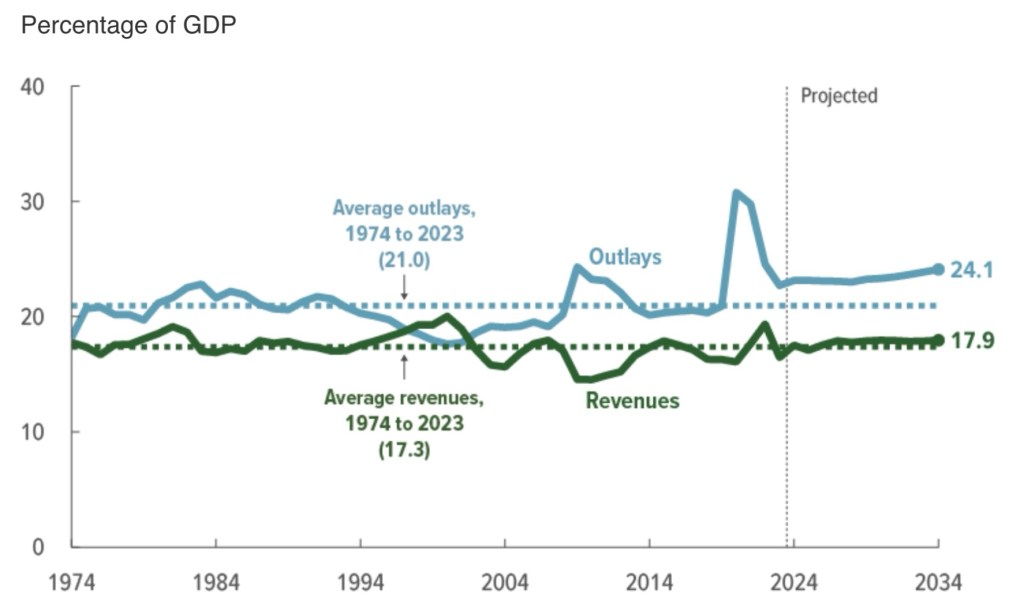
The chart above makes a convincing case that we have a spending problem at the federal level. Really, we’ve had a spending problem for a long time. But at least tax revenue today remains reasonably well-aligned with its 50-year historical average as a share of GDP. Not spending. Even larger deficits opened up during the pandemic and they haven’t returned to pre-pandemic levels.

We’ve seen Joe Biden break spending records. His initiatives, often with questionable merit, have included the $1.8 trillion American Rescue Plan and the nearly $0.8 trillion Infrastructure Investment and Jobs Act, along with several other significant spending initiatives such as the Promise to Address Comprehensive Toxics Act and the subsidy-laden CHIPS Act. Meanwhile, emergency spending has become a regular occurrence on Biden’s watch. More recently, he’s made repeated efforts to forgive massive amounts of student loans despite the Supreme Court’s clear ruling that such gifts are unconstitutional.

Indeed, while Biden keeps pretty busy spinning tales of his days driving an 18-wheeler, cannibals devouring his Uncle Bosie Finnegan, his upbringing in black churches, synagogues, or in the Puerto Rican community, he still finds time to dream up ways for the government to spend money it doesn’t have. Or his kindly puppeteers do.

Biden’s New Budget

Eric Boehm expressed wonderment at Biden’s fiscal 2025 budget not long after its release in March. He was also mystified by the gall it took to produce a “fact sheet” in which the White House congratulated itself on fiscal responsibility. That’s how this Administration characterizes deficits projected at $16 trillion over the next ten years. No joke!

Furthermore, the Administration says the record spending will be “paid for”. Well, yes, with tax increases and lots of borrowing! There are a great many fabulist claims made by the White House about the budget. This link from the Office of Management and Budget includes a handy list of propaganda sheets they’ve managed to produce on the virtues of their proposal.

The Congressional Budget Office (CBO) projects ten-year deficits under current law that are $3 trillion higher than Biden’s proposed budget. That’s the basis of the White House’s boast of fiscal restraint. But the difference is basically paid for with a couple of accounting tricks (see below). More charitably, one could say it’s paid for with higher taxes, aided by the assumption of slightly faster economic growth. The latter will be a good trick while undercutting incentives and wages with a big boost to the corporate tax rate.

The revenue projected by the While House from those taxes does not come anywhere close to eliminating the gap shown in the CBO’s chart above. Federal spending under Biden’s budget grows at about 4% annually, just a bit slower than nominal GDP. Thus, the federal share of GDP remains roughly constant and only slightly higher than the CBO’s current projection for 2034. Nevertheless, spending relative to GDP would continue at an historically high rate. Over the next decade, it would average more than 3% higher than its 50-year average. That would be about $1.3 trillion in 2034!

Meanwhile, the ratio of tax revenue to GDP under Biden’s proposal, as they project it, would average slightly higher than its 50-year average, reaching a full percentage point above by 2034 (and higher than the CBO baseline). That’s probably optimistic.

There is little real effort in this budget to reduce federal deficits, with Treasury borrowing rates now near 15-year highs. Interest expense has grown to an alarming share of spending. In fact, it’s expected to exceed spending on defense in 2024! Perhaps not coincidentally, the White House assumes a greater decline in interest rates than CBO over the next 10 years.

Treats or Tricks?

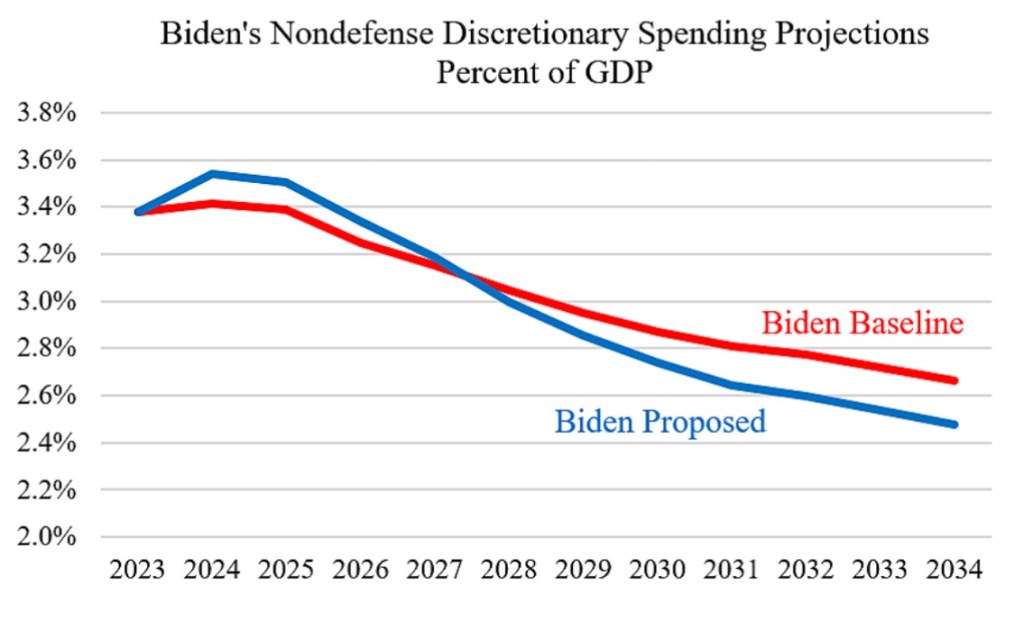
The situation is likely worse than the White House depicts, given that its budget incorporates assumptions that look generous to their claim of fiscal restraint. First, they frontload nondefense discretionary spending, allowing Biden to make extravagant promises for the near-term while pushing off steep declines in budget commitments to the out-years. The sharp reductions in this category of spending pares more than $2 trillion from the 10-year deficit. From the link above:
Biden also proposes to restore the expanded the child tax credit — for one year! How handy from a budget perspective: heroically call for an expanded credit (for a year) while avoiding, for the time being, the addition of a couple of trillion to the 10-year deficit.

Code Red

So where does this end? The ratio of federal debt to GDP will resume its ascent after a slight decline from the pandemic high. Here is the CBO’s projection:
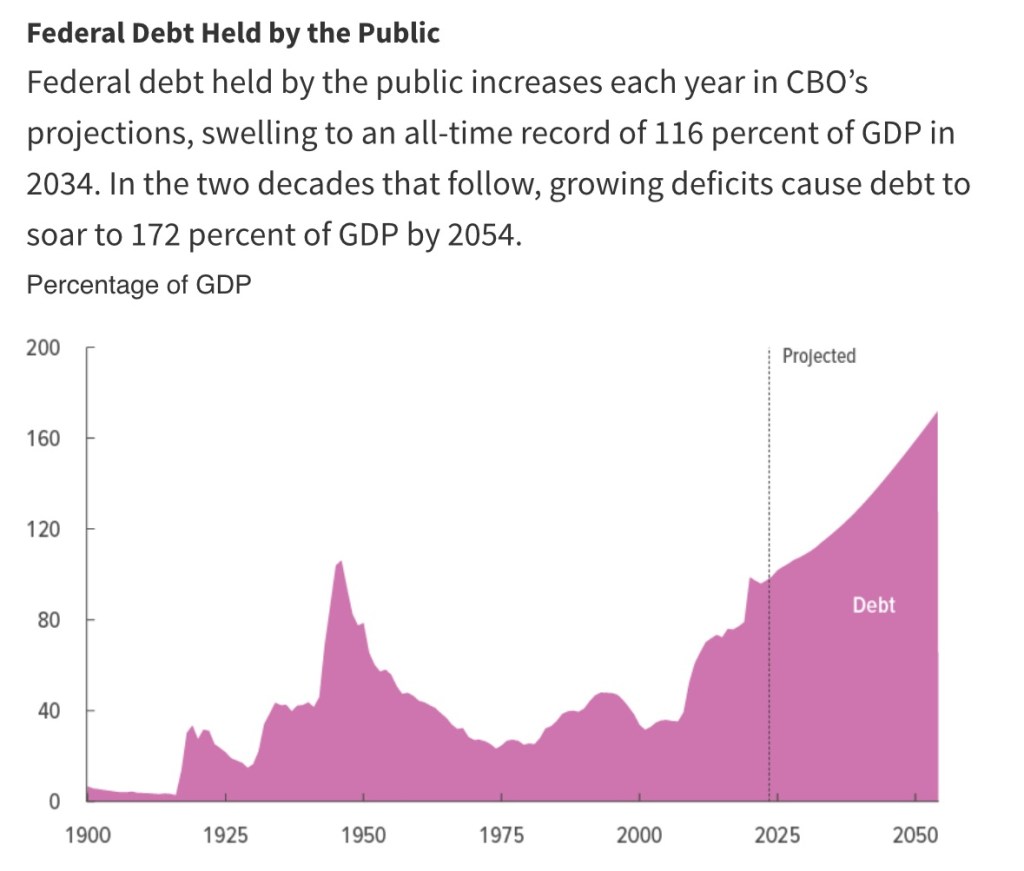
The Biden budget shows a relatively stable debt to GDP ratio through 2034 due to the assumptions of slightly faster GDP growth, lower Treasury borrowing rates, and the aforementioned “fiscal restraint”. But don’t count on it!

The government’s growing dominance over real resources will have negative consequences for growth in the long-term. Purely as a fiscal matter, however, it must be paid for in one of three ways: revenue from explicit taxes, federal borrowing, or an implicit tax on the public more commonly known as the inflation tax. The last two are intimately related.

Bond investors always face at least a small measure of default risk even when lending to the U.S. Treasury. There is almost no chance the government would ever default outright by failing to pay interest or principal when due. However, investors hold an expectation that the value of their bonds will erode in real terms due to inflation. To compensate, they demand an “inflation premium” in the interest rate they earn on Treasury bonds. But an upside surprise to inflation would constitute a “soft default” on the real value of their bonds. This occurred during and after the pandemic, and it was triggered by a burgeoning federal deficit.

Brief Mechanics

John Cochrane has explained the mechanism by which acts of fiscal profligacy can be transmitted to the price of goods. The real value of outstanding federal debt cannot exceed the expected real value of future surpluses (a present value summed across positive and negative surpluses). If expected surpluses are reduced via some emergency or shock such that repayment in real terms is less likely, then the real value of government debt must fall. That means either interest rates or the price level must rise, or some combination of the two.

The Federal Reserve can prevent interest rates from rising (by purchasing bonds and increasing the money supply), but that leaves a higher price level as the only way the real value of debt can come into line. In other words, an unexpected increase in the path of federal deficits would be financed by money printing and an inflation tax. The incidence of this unexpected “implicit” tax falls not only to bondholders, but also on the public at large, who suffer an unexpected decline in the purchasing power of their nominal assets and incomes. This in turn tends to free-up real resources for government absorption.

Government Debt Is Risky

It appears that investors expect the future deficits now projected by the CBO (and the White House) to be paid down someday, to some extent, by future surpluses. That might seem preposterous, but markets apparently aren’t surprised by the projected deficits. After all, fiscal policy decisions can change tremendously over the course of a few years. But it still feels like excessive optimism. Whatever the case, Cochrane cautions that the next fiscal emergency, be it a new pandemic, a war, a recession, or some other crisis, is likely to create another huge expansion in debt and a substantial increase price level. Joe Biden doesn’t seem inclined to put us in a position to deal with that risk very effectively. Unfortunately, it’s not clear that Donald Trump will either. And neither seems inclined to seriously address the insolvencies of Social Security and Medicare. If unaddressed, those mandatory obligations will become real crises over the next decade.

Fiscal Inflation Is Simple With This One Weird Trick

03 Thursday Feb 2022

Posted by Nuetzel in Fiscal policy, Inflation

≈ 2 Comments

Tags

Alexandria Ocasio-Cortez, Bernie Sanders, Build Back Better, Child Tax Credit, Congressional Budget Office, Deficits, Federal Reserve, Fiscal policy, Fiscal Theory of the Price Level, Helicopter Drop, Inflation tax, infrastructure, Joe Biden, John Cochrane, Median CPI, Modern Monetary Theory, Monetary policy, Pandemic Relief, Seigniorage, Stimulus Payments, Student Loans, Surpluses, Trimmed CPI, Universal Basic Income

I’ll get to the weird trick right off the bat. Then you can read on if you want. The trick really is perverse if you believe in principles of sound credit and financial stability. To levy a fiscal inflation tax, all the government need do is spend like a drunken sailor and undermine its own credibility as a trustworthy borrower. One way to do that: adopt the policy prescriptions of Modern Monetary Theory (MMT).

A Theory of Deadbeat Government

That’s right! Run budget deficits and convince investors the debt you float will never be repaid with future real surpluses. That doesn’t mean the government would literally default (though that is never outside the realm of possibility). However, given such a loss of faith, something else must give, because the real value government debt outstanding will exceed the real value of expected future surpluses from which to pay that debt. The debt might be in the form of interest-bearing government bonds or printed money: it’s all government debt. Ultimately, under these circumstances, there will be a revised expectation that the value of that debt (bonds and dollars) will be eroded by an inflation tax.

This is a sketch of “The Fiscal Theory of the Price Level” (FTPL). The link goes to a draft of a paper by John Cochrane, which he intends as an introduction and summary of the theory. He has been discussing and refining this theory for many years. In fairness to him, it’s a draft. There are a few passages that could be written more clearly, but on the whole, FTPL is a useful way of thinking about fiscal issues that may give rise to inflation.

Fiscal Helicopters

Cochrane discusses the old allegory about how an economy responds to dollar bills dropped from a helicopter — free money floating into everyone’s yard! The result is the classic “too much money chasing too few goods” problem, so dollar prices of goods must rise. We tend to think of the helicopter drop as a monetary policy experiment, but as Cochrane asserts, it is fiscal policy.

We have experienced something very much like the classic helicopter drop in the past two years. The federal government has effectively given money away in a variety of pandemic relief efforts. Our central bank, the Federal Reserve, has monetized much of the debt the Treasury issued as it “loaded the helicopter”.

In effect, this wasn’t an act of monetary policy at all, because the Fed does not have the authority to simply issue new government debt. The Fed can buy other assets (like government bonds) by issuing dollars (as bank reserves). That’s how it engineers increases in the money supply. It can also “lend” to the U.S. Treasury, crediting the Treasury’s checking account. Presto! Stimulus payments are in the mail!

This is classic monetary seigniorage, or in more familiar language, an inflation tax. Here is Cochrane description of the recent helicopter drop:

“The Fed and Treasury together sent people about $6 trillion, financed by new Treasury debt and new reserves. This cumulative expansion was about 30% of GDP ($21,481) or 38% of outstanding debt ($16,924). If people do not expect that any of that new debt will be repaid, it suggests a 38% price-level rise. If people expect Treasury debt to be repaid by surpluses but not reserves, then we still expect $2,506 / $16,924 = 15% cumulative inflation.”

FTPL, May I Introduce You To MMT

Another trend in thought seems to have dovetailed with the helicopter drop , and it may have influenced investor sentiment regarding the government’s ever-weakening commitment to future surpluses: that would be the growing interest in MMT. This “theory” says, sure, go ahead! Print the money government “must” spend. The state simply fesses-up, right off the bat, that it has no intention of running future surpluses.

To be clear, and perhaps more fair, economists who subscribe to MMT believe that deficits financed with money printing are acceptable when inflation and interest rates are very low. However, expecting stability under those circumstances requires a certain level of investor confidence in the government fisc. Read this for Cochrane’s view of MMT.

Statists like Bernie Sanders, Alexandria Ocasio-Cortez, and seemingly Joe Biden are delighted to adopt a more general application of MMT as intellectual cover for their grandiose plans to remake the economy, fix the climate, and expand the welfare state. But generalizing MMT is a dangerous flirtation with inflation denialism and invites economic disaster.

If This Goes On…

Amid this lunacy we have Joe Biden and his party hoping to find avenues for “Build Back Better”. Fortunately, it’s looking dead at this point. The bill considered in the fall would have amounted to an additional $2 trillion of “infrastructure” spending, mostly not for physical infrastructure. Moreover, according to the Congressional Budget Office, that bill’s cost would have far exceeded $2 trillion by the time all was said and done. There are ongoing hopes for separate passage of free community college, an extended child tax credit for all families, a higher cap for state and local income tax deductions, and a host of other social and climate initiatives. The latter, relegated to a separate bill, is said to carry a price tag of over $550 billion. In addition, the Left would still love to see complete forgiveness of all student debt and institute some form of universal basic income. Hey, just print the money, right? Warm up the chopper! But rest easy, cause all this appears less likely by the day.

Are there possible non-inflationary outcomes from ongoing helicopter drops that are contingent on behavior? What if people save the fresh cash because it’s viewed as a one-time windfall (i.e., not a permanent increase in income)? If you sit on such a windfall it will erode as prices rise, and the change in expectations about government finance won’t be too comforting on that score.

There are many aspects of FTPL worth pondering, such as whether bond investors would be very troubled by yawning deficits with MMT noisemakers in Congress IF the Fed refused to go along with it. That is, no money printing or debt monetization. The burgeoning supply of debt would weigh heavily on the market, forcing rates up. Government keeps spending and interest costs balloon. It is here where Cochrane and critics of FTPL have a sharp disagreement. Does this engender inflation in the absence of debt monetization? Cochrane says yes if investors have faith in the unfaithfulness of fiscal policymakers. Excessive debt is then every bit as inflationary as printing money.

Real Shocks and FTPL

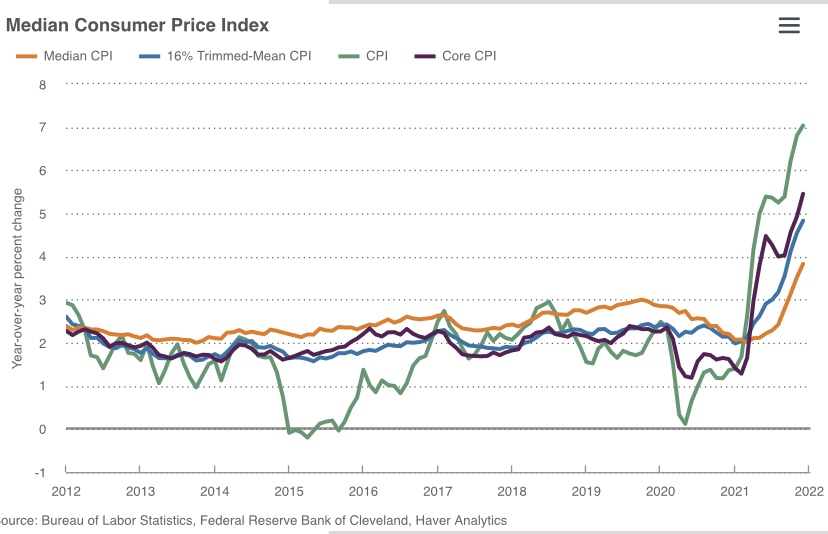
It’s natural to think supply disruptions are primarily responsible for the recent acceleration of inflation, rather than the helicopter drop. There’s no question about those price pressures in certain markets, much of it inflected by wayward policymakers, and some of those markets involve key inputs like energy and labor. Even the median component of the CPI has escalated sharply, though it has lagged broader measures a bit.

Broad price pressures cannot be sustained indefinitely without accommodating changes in the supply of money, which is the so-called “numeraire” in which all goods are priced. What does this have to do with FTPL or the government’s long-term budget constraint? The helicopter drop certainly led to additional money growth and spending, but again, FTPL would say that inflation follows from the expectation that government will not produce future surpluses needed for long-term budget balance. The creation of either new money or government debt, loaded the chopper as it were, is sufficient to accommodate broad price pressures over some duration.

Conclusion

Whether or not FTPL is a fully accurate description of fiscal and monetary phenomena, few would argue that a truly deadbeat government is a prescription for hyperinflation. That’s an extreme, but the motivation for FTPL is the potential abandonment of good and honest governing principles. Pledging an inflation tax is not exactly what anyone means by the full faith and credit of the U.S. government.

Poverty Maintenance Is Not A Win

01 Wednesday Apr 2015

Posted by Nuetzel in Poverty, Uncategorized

≈ 2 Comments

Tags

AFDC, CATO Institute, Child Tax Credit, Christopher Jencks, Earned Income Tax Credit, Food Stamps, Lyndon Johnson, Malinvestment, Marginal tax rates, Martha Bailey, Poverty, Private charity, Sheldon Danziger, Supplemental Security Income, TANF, War on Poverty, Welfare reform, work incentives

obama-new-normal

Merely keeping a patient alive is inferior to curing the disease. Likewise, merely allowing the impoverished to live under tolerable conditions is inferior to eliminating the underlying causes of poverty. Evidence for the former is used by Harvard Professor Christopher Jencks to proclaim the war on poverty a success. That is the upshot of his recent article in The New York Review of Books. But does the maintenance of a permanent dependent class constitute success? I believe that our goals should be loftier, and President Johnson’s original goals for the War on Poverty went much farther than Jencks suggests.

Ostensibly a review of other work by Martha Bailey and Sheldon Danziger, Professor Jencks devotes most of his essay to arguing that the official poverty rate published by the Census Bureau is distorted, and that a “corrected” measure has declined since the “war” was initiated by Johnson in the 1960s. The official rate has fluctuated in a range of 11-15% since the mid-1960s. Jencks corrects the 2013 rate of 14.5% for 1) the value of non-cash benefits received by certain program recipients (-3%); 2) the omission of refundable tax credits from the official incomes of employed individuals below the poverty line (-3%); and 3) a change in the price index used to adjust the official poverty thresholds over time to one that does not overstate changes in the cost of living (-3.7%). These three adjustments would reduce the poverty rate in 2013 to just 4.8%.

Taken at face value, that reduction is impressive, but the third adjustment is not directly attributable to antipoverty programs. It could also be due to economic growth or other factors. Jencks notes the following:

“Both liberals and conservatives tend to resist the idea that poverty has fallen dramatically since 1964, although for different reasons. Conservatives’ resistance is easy to understand. They have argued since the 1960s that the federal government’s antipoverty programs were ineffective, counterproductive, or both. 

Liberals hear the claim that poverty has fallen quite differently, although they do not like it any better than conservatives do. Anyone, liberal or conservative, who wants the government to solve a problem soon discovers that it is easier to rally support for such an agenda by saying that the problem in question is getting worse than by saying that although the problem is diminishing, more still needs to be done.”

For my own part, I believe that many antipoverty programs succeed only as palliatives. They have not succeeded in breaking the cycle of poverty and dependence on the state. In other words, successful programs must foster self-sufficiency, which is a superior goal from a humanitarian and a Libertarian perspective. Jencks plans a follow-up on the “successes and failures specific anti-poverty programs”, but merely paying alms to the poor establishes a very low threshold for success.

In fairness to Jencks, anti-poverty programs serve a large number of individuals who are incapable of providing for themselves for a variety of reasons such as age, physical and mental disabilities. While it is beyond the scope of this post, some argue that private charities are more effective at providing for these individuals as well as the able poor. A greater role for charity could even be facilitated via public funding, but in any case, a larger role for private charity should always be on the menu of policy options.

A basic failing of many welfare programs is an incentive problem: able recipients perceive a penalty for work effort (additional hours or even kinds of employment) if rising earned income is associated with reduction or elimination of program benefits. This means that participants face a very high effective marginal tax rate on earned income.

This article from The CATO Institute contains a good overview of the federal welfare system, which consists of 126 separate programs. The article contains somewhat more detailed on the largest anti-poverty programs, such as Refundable Tax Credits (the Earned Income Tax Credit (EITC), and Child Tax Credit (CTC)), Supplemental Security Income (SSI – for aged, blind and disabled), SNAP (food stamps), housing subsidies, child nutrition (WIC), Temporary Assistance For Needy Families (TANF) and unemployment insurance. Social Security is also included since it pays benefits to many low income seniors.

The CATO analysis shows that by one measure, refundable tax credits are by far the most cost efficient at lifting people out of poverty at a point in time, at least among the large programs, followed by SSI and using subsidies. In-kind programs such as SNAP and WIC tend to be less targeted and less effective by this measure. There is fairly widespread agreement that the tax credits have better incentives for work effort, but there are still high marginal tax rates in the phase-out range, a marriage penalty, and the credits are paid only once a year as tax refunds. Some contend that the phase-out of the EITC discourages labor supply even more than the credit increases labor supply at lower incomes. Still others believe that adding certain work requirements would make the EITC a more effective measure:

“The [EITC] clearly does reduce poverty, but it raises work levels far less than some of the statistical studies of the past decade claim, and it appears to do so by encouraging working people to keep working, rather than driving the non-working poor toward jobs. If we wish the credit to promote work as well as raise incomes, we … must add other suasions to promote and enforce work, such as those found in the more successful work-incentive experiments…. These include mandating participation in work programs and setting some threshold of working hours that claimants have to achieve to get benefits.”

The incentive effects of other programs are more negative than the tax credits. This paper found that the food stamp program reduces employment and hours worked. The TANF program, which was the successor to Aid To Families With Dependent Children (AFDC), also exposes recipients to high marginal tax rates. While CATO has been criticized for analyzing the combined impact on marginal tax rates of up to eight different programs, there is little question that the incentive problem is compounded for participants in multiple programs.

There are many different approaches that can be explored for eliminating poverty, supporting those who can’t work and ending dependency for those who can. Certainly, the work incentives of existing anti-poverty programs can be improved in a number of ways. More inventive approaches can be tested at the state level. However, programs such as guaranteed incomes should be eschewed, as they tend to aggravate the incentive problem and encourage dependency.

There are many other approaches to attacking poverty and its causes that do not strictly qualify as “welfare reform.” These include measures that would improve education and employment prospects, including apprenticeship and other training programs. School choice is a fundamental reform with enormous potential to improve the quality of education among poor children. Transitioning to market-based health care reform, including competition among health insurers, would reduce medical costs across the board. Eliminating costly regulation of business can encourage economic growth, which is basic to lifting the incomes of the working poor. Minimum wage legislation should be avoided as it simply eliminates opportunities for the least productive members of society and it is not well-targeted at the poor. Tax reform that encourages saving and investment, including corporate tax reform, will increase the economy’s long-term growth potential, as would a general reduction in the size of the public sector. An end to wasteful subsidies to “privileged” industries can minimize malinvestment and release resources to uses that pass a true market test, leading to a more general prosperity.

Follow Sacred Cow Chips on WordPress.com

Recent Posts

  • The Case Against Interest On Reserves
  • Immigration and Merit As Fiscal Propositions
  • Tariff “Dividend” From An Indigent State
  • Almost Looks Like the Fed Has a 3% Inflation Target
  • Government Malpractice Breeds Health Care Havoc

Archives

  • January 2026
  • December 2025
  • November 2025
  • October 2025
  • September 2025
  • August 2025
  • July 2025
  • June 2025
  • May 2025
  • April 2025
  • March 2025
  • February 2025
  • January 2025
  • December 2024
  • November 2024
  • October 2024
  • September 2024
  • August 2024
  • July 2024
  • June 2024
  • May 2024
  • April 2024
  • March 2024
  • February 2024
  • January 2024
  • December 2023
  • November 2023
  • August 2023
  • July 2023
  • June 2023
  • May 2023
  • April 2023
  • March 2023
  • February 2023
  • January 2023
  • December 2022
  • November 2022
  • October 2022
  • September 2022
  • August 2022
  • July 2022
  • June 2022
  • May 2022
  • April 2022
  • March 2022
  • February 2022
  • January 2022
  • December 2021
  • November 2021
  • October 2021
  • September 2021
  • August 2021
  • July 2021
  • June 2021
  • May 2021
  • April 2021
  • March 2021
  • February 2021
  • January 2021
  • December 2020
  • November 2020
  • October 2020
  • September 2020
  • August 2020
  • July 2020
  • June 2020
  • May 2020
  • April 2020
  • March 2020
  • February 2020
  • January 2020
  • December 2019
  • November 2019
  • October 2019
  • September 2019
  • August 2019
  • July 2019
  • June 2019
  • May 2019
  • April 2019
  • March 2019
  • February 2019
  • January 2019
  • December 2018
  • November 2018
  • October 2018
  • September 2018
  • August 2018
  • July 2018
  • June 2018
  • May 2018
  • April 2018
  • March 2018
  • February 2018
  • January 2018
  • December 2017
  • November 2017
  • October 2017
  • September 2017
  • August 2017
  • July 2017
  • June 2017
  • May 2017
  • April 2017
  • March 2017
  • February 2017
  • January 2017
  • December 2016
  • November 2016
  • October 2016
  • September 2016
  • August 2016
  • July 2016
  • June 2016
  • May 2016
  • April 2016
  • March 2016
  • February 2016
  • January 2016
  • December 2015
  • November 2015
  • October 2015
  • September 2015
  • August 2015
  • July 2015
  • June 2015
  • May 2015
  • April 2015
  • March 2015
  • February 2015
  • January 2015
  • December 2014
  • November 2014
  • October 2014
  • September 2014
  • August 2014
  • July 2014
  • June 2014
  • May 2014
  • April 2014
  • March 2014

Blogs I Follow

  • Passive Income Kickstart
  • OnlyFinance.net
  • TLC Cholesterol
  • Nintil
  • kendunning.net
  • DCWhispers.com
  • Hoong-Wai in the UK
  • Marginal REVOLUTION
  • Stlouis
  • Watts Up With That?
  • Aussie Nationalist Blog
  • American Elephants
  • The View from Alexandria
  • The Gymnasium
  • A Force for Good
  • Notes On Liberty
  • troymo
  • SUNDAY BLOG Stephanie Sievers
  • Miss Lou Acquiring Lore
  • Your Well Wisher Program
  • Objectivism In Depth
  • RobotEnomics
  • Orderstatistic
  • Paradigm Library
  • Scattered Showers and Quicksand

Blog at WordPress.com.

Passive Income Kickstart

OnlyFinance.net

TLC Cholesterol

Nintil

To estimate, compare, distinguish, discuss, and trace to its principal sources everything

kendunning.net

The Future is Ours to Create

DCWhispers.com

Hoong-Wai in the UK

A Commonwealth immigrant's perspective on the UK's public arena.

Marginal REVOLUTION

Small Steps Toward A Much Better World

Stlouis

Watts Up With That?

The world's most viewed site on global warming and climate change

Aussie Nationalist Blog

Commentary from a Paleoconservative and Nationalist perspective

American Elephants

Defending Life, Liberty and the Pursuit of Happiness

The View from Alexandria

In advanced civilizations the period loosely called Alexandrian is usually associated with flexible morals, perfunctory religion, populist standards and cosmopolitan tastes, feminism, exotic cults, and the rapid turnover of high and low fads---in short, a falling away (which is all that decadence means) from the strictness of traditional rules, embodied in character and inforced from within. -- Jacques Barzun

The Gymnasium

A place for reason, politics, economics, and faith steeped in the classical liberal tradition

A Force for Good

How economics, morality, and markets combine

Notes On Liberty

Spontaneous thoughts on a humble creed

troymo

SUNDAY BLOG Stephanie Sievers

Escaping the everyday life with photographs from my travels

Miss Lou Acquiring Lore

Gallery of Life...

Your Well Wisher Program

Attempt to solve commonly known problems…

Objectivism In Depth

Exploring Ayn Rand's revolutionary philosophy.

RobotEnomics

(A)n (I)ntelligent Future

Orderstatistic

Economics, chess and anything else on my mind.

Paradigm Library

OODA Looping

Scattered Showers and Quicksand

Musings on science, investing, finance, economics, politics, and probably fly fishing.

  • Subscribe Subscribed
    • Sacred Cow Chips
    • Join 128 other subscribers
    • Already have a WordPress.com account? Log in now.
    • Sacred Cow Chips
    • Subscribe Subscribed
    • Sign up
    • Log in
    • Report this content
    • View site in Reader
    • Manage subscriptions
    • Collapse this bar
 

Loading Comments...