• About

Sacred Cow Chips

Sacred Cow Chips

Tag Archives: Consumer Price Index

Biden OMB Suggests Minimal Discounts of Future Benefits

28 Wednesday Jun 2023

Posted by Nuetzel in Big Government, Risk, Tradeoffs

≈ Leave a comment

Tags

Administrative State, Certainty Equivalent, Consumer Price Index, Discount Rate, John Cochrane, Joshua Rauh, MIT, Modernizing Regulatory Review, Office of Management and Budget, Present Value, Real Interest Rate, Regulatory Impact Analysis, Risk-Free Rate, TIPS, Tradeoffs, Treasury Bonds, Unintended Consequences
Tweaks to the projected costs and benefits of prospective regulations or programs can be a great way to encourage domination of resources and society by the state. Of course, public policy ideas will never receive serious consideration unless their “expected” benefits exceed costs. It’s therefore critical that the validity of cost and benefit estimates — to say nothing of their objectivity — are always subject to careful review. By no means does that ensure that the projections are reasonable, however.

Traditionally less scrutinized is the rate at which the future costs and benefits of a program or regulation are discounted into present value terms. The discount rate can have a tremendous impact on the comparison of costs and benefits when their timing differs significantly, which is usually the case.

Intertemporal Tradeoffs

People generally aren’t willing to forsake present pleasure without at least a decent prospect of future gain. Thus, we observe that the deferral of $1 of consumption today generally brings a reward of more than $1 of future consumption. That’s made possible by the existence of productive opportunities for the use of resources. These opportunities, and the freedom to exploit them, allow a favorable tradeoff at which we transform resources across time for the benefit of both our older selves and our progeny. The interaction of savers and investors in such opportunities results in an equilibrium interest rate balancing the supply and demand for saving.

We can restate the tradeoff to demonstrate the logic of discounting. That is, the promise of $1 in the future induces the voluntary deferral of less than $1 of consumption today. To arrive at the amount of the deferral, the promised $1 in the future is discounted at the consumer’s rate of time preference. The promised $1 must cover the initial deferral of consumption plus the consumer’s perceived opportunity cost of lost consumption in the present, or else the “trade” won’t happen.

Discounting practices are broadly embedded in the economy. They provide a rational basis of evaluating inter-temporal tradeoffs. The calculation of net present values (NPVs) and internal rates of return (the discount rate at which NPV = 0) are standard practices for capital budgeting decisions in the private sector. Public-sector cost-benefit analysis often makes use of discounting methodology as well, which is unequivocally good as long as the process is not rigged.

Government Discounting

The Office of Management and Budget (OMB) provides guidance to federal agencies on matters like cost-benefit analysis. As part of a recent proposal that was prompted by executive orders on “Modernizing Regulatory Review” from the Biden Administration, the OMB has recommended revisions to a 2003 Circular entitled “Regulatory Analysis”. A major aspect of the proposal is a downward adjustment to recommended discount rates, largely dressed up as an update for “changes in market conditions”.

Since 2003, the OMB’s guidance on discount rates called for use of a historical average rate on 10-year government bonds. Before averaging, the rate was converted to a “real rate” in each period by subtracting the rate of increase in the Consumer Price Index (CPI). The baseline discount rate of 3% was taken from the average of that real rate over the 30 years ending in 2002. There has been an alternative discount rate of 7% under the existing guidance intended as a nod to the private costs of capital, but it’s not clear how seriously agencies took this higher value.

The new proposal seeks to update the calculation of recommended discount rates by using more recent data on Treasury rates and inflation. One aspect of the proposal is to utilize the rate on 10-year inflation-indexed Treasury bonds (TIPS) for the years in which it is available (2003-2022). The first ten years of the “new” 30-year average would use the previous methodology. However, the proposal gives examples of how other methods would change the resulting discount rate and requests comments on the most appropriate method of updating the calculation of the 30-year average.

The new baseline discount rate proposed by OMB is 1.7%, and it is lower still for very distant flows of benefits. This is intended as a real, after-tax discount rate on Treasury bonds. It represents an average (and ex post) risk-free rate on bonds held to maturity over the historical period in question, calculated as described by OMB. However, like the earlier guidance, it is not prospective in any sense. And of course it is quite low!

Our Poor Little Rich Ancestors

The projected benefits of regulations or other public initiatives can be highly dubious in the first place. Unintended consequences are the rule rather than the exception. Furthermore, even modest economic growth over several generations will leave our ancestors with far more income and wealth than we have at our disposal today. That means their ability to adapt to changes will be far superior, and they will have access to technologies making our current efforts seem quaint.

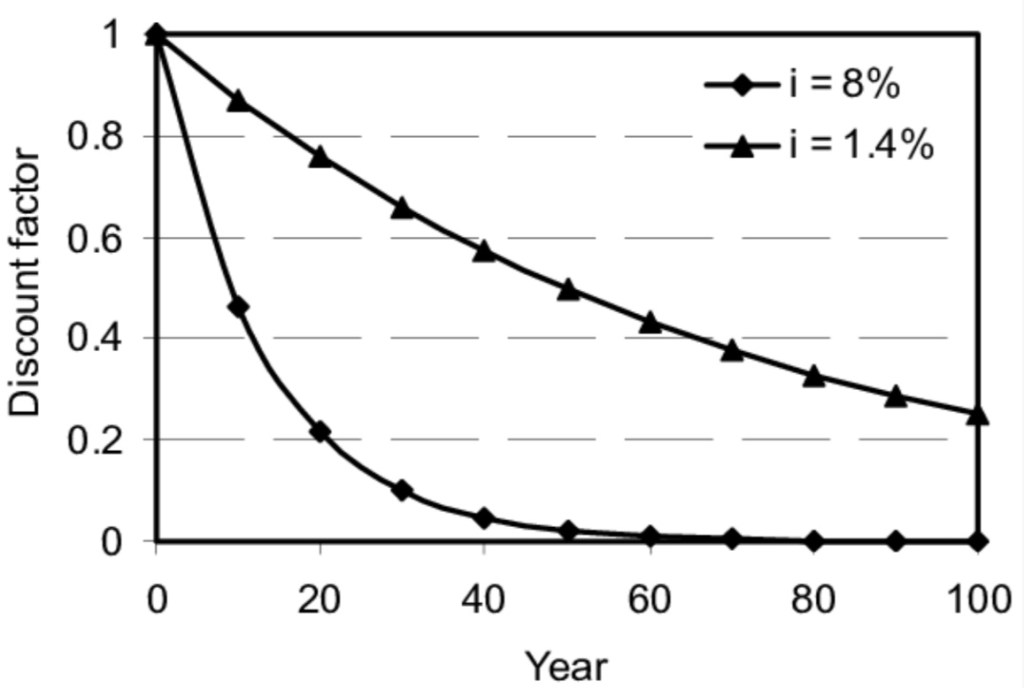
Now here’s the thing: discounting the presumed benefits of government intervention at a low rate would drastically inflate their present value. John Cochrane uses an extreme case to illustrate the point. Suppose a climate policy is projected to avoid costs equivalent to 5% of GDP 100 years from now. Those avoided costs would represent a gigantic sum! By then, at just 2% growth, real GDP will be over seven times larger than this year’s output. Cochrane calculates that 5% of real GDP in 2123 is equivalent to 37% of 2023 real GDP. And the presumed cost saving goes on forever.

We can calculate the present value of the climate policy’s benefits to determine whether it’s greater than the proposed cost of the policy. Let’s choose a fairly low discount rate like … oh, say zero. In that case, the present value is infinite, and it is infinite at any discount rate below 2% (such as 1.7%). That’s because the benefits grow at 2% (like real GDP) and go on forever! That’s faster than the diminishing effect of discounting on present value. In mathematical terms, the series does not converge. Of course, this is not discounting. It is non-discounting. Cochrane’s point, however, is that if you take these calculations seriously, you’d be crazy not to implement the policy at any finite cost! You shouldn’t mind the new taxes at all! Or the inflation tax induced by more deficit spending! Or higher regulatory costs passed along to you as a consumer! So just stop your bitching!

Formal Comments to OMB

If Cochrane’s example isn’t enough to convince you of the boneheadedness of the OMB proposal, there are several theoretical reasons to balk. Cochrane provides links to a couple of formal comments submitted to OMB. Joshua Rauh of the Stanford Business School details a few fundamental objections. His first point is that a regulatory impact analysis (RIA), or the evaluation of any other initiative, “should be based on market conditions that prevail at the time of the RIA”. In other words, the choice of a discount rate should not rely on an average over a lengthy historical period. Second, it is unrealistic to assume that the benefits and costs of proposed regulations are risk-free. In fact, unlike Treasury securities, these future streams are quite risky, and they are not tradable, and they are not liquid.

Rauh also notes that the OMB’s proposed decline in discount rates to be applied to benefits or cash flows in more distant periods has no reliable empirical basis. He believes that results based on a constant discount rate should at least be reported. Moreover, agencies should be required to offer justification for their choice of a discount rate relative to the risks inherent in the streams of costs and benefits on any new project or rule.

Rauh is skeptical of recommendations that agencies should add a theoretical risk premium to a risk-free rate, however, despite the analytical superiority of that approach. Instead, he endorses the simplicity of the OMB’s previous guidance for discount rates of 3% and 7%. But he also proposes that RIAs should always include “the complete undiscounted streams of both benefits and costs…”. If there are distributions of possible cost and benefit streams, then multiple streams should be included.

Furthermore, Rauh says that agencies should not recast streams of benefits in the form of certainty equivalents, which interpose various forms of objective functions in order to calculate a “fair guarantee”, rather than a range of actual outcomes. Instead, Rauh insists that straightforward expected values should be used, This is for the sake of transparency and to enable independent assessment of RIAs.

Another comment on the OMB proposal comes from a group of economists at MIT. They have fewer qualms than Rauh regarding the use of risk-adjusted discount rates by government agencies. In addition, they note that risk in the private sector can often be ameliorated by diversification, whereas risks inherent in public policy must be absorbed by changes in taxes, government spending, or unintended costs inflicted on the private sector. Taxpayers, those having stakes in other programs, and the general public bear these risks. Using Treasury rates for discounting presumes that bad outcomes have no cost to society!

Conclusion

Discounting the costs and benefits of proposed regulations and other government programs should be performed with discount rates that reflect risks. Treasury rates are wholly inappropriate as they are essentially risk-free over time horizons often much shorter than the streams of benefits and costs to be discounted. The OMB proposal might be a case of simple thoughtlessness, but I doubt it. To my mind, it aligns a little too neatly with the often expansive agenda of the administrative state. It would add to what is already a strong bias in favor of regulatory action and government absorption of resources. Champions of government intervention are prone to exaggerate the flow of benefits from their pet projects, and low discount rates exaggerate the political advantages they seek. That bias comes at the expense of the private sector and economic growth, where inter-temporal tradeoffs and risks are exploited only at more rational discounts and then tested by markets.
Fueled, Ignored, Misdiagnosed in DC, Inflation Broadens

18 Monday Jul 2022

Posted by Nuetzel in Inflation

≈ Leave a comment

Tags

Cleveland Fed, Consumer Price Index, Consumer Sentiment, David Beckworth, infrastructure, Joe Biden, Joe Manchin, Median CPI, Pandemic Emergency Powers, Price Controls, Trimmed CPI, Vladimir Putin, Wholesale Price Index

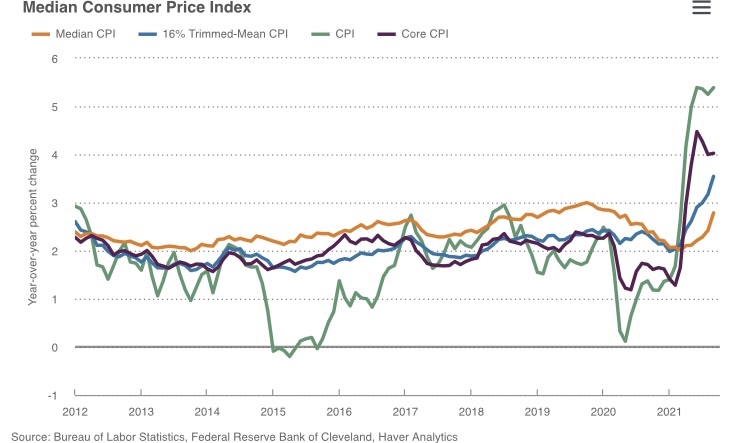
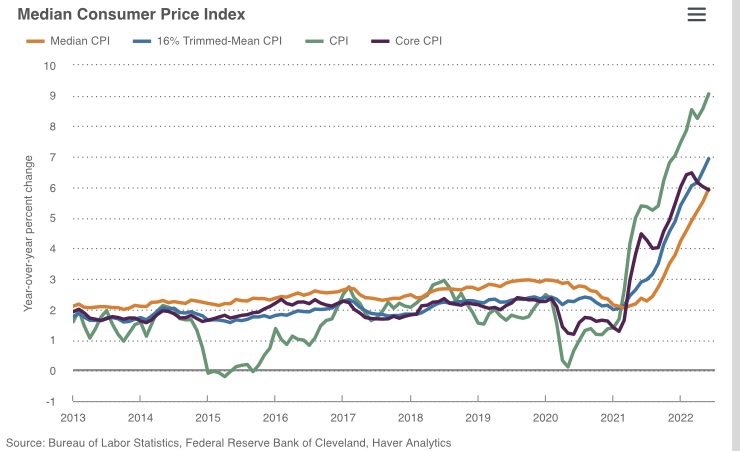
Inflation accelerated at the consumer level in June and the advances continued to broaden. That’s confirmed by the median item in the Consumer Price Index (CPI) and a measure of the CPI that “trims” out items with the largest and smallest price hikes (see chart above from the Cleveland Fed). Wholesale inflation also picked up in June. At this point, there’s a very real danger that increasing expectations of future inflation are getting embedded into current pricing decisions. Once that happens, the cycle is very hard to break. And wage rates are not keeping pace, so inflation is reducing real incomes for many workers. The sad fact is that inflation takes its greatest toll on the well being of low income earners.

And why did inflation accelerate from 1.4% in January 2021 to 9.2% in June? Don’t ask Joe Biden, at least not if you want a straight answer. He’s been changing his tune almost every month, with a rotating cast of the characters coming in for blame. First, the story was that higher inflation was just transitory; then too, the Administration said it only hurt the rich, a wholly preposterous assertion; the blame then shifted to the oil companies; then to Putin; and then big corporations generally; more recently, it’s independent gas retailers! Nothing is said about Biden’s early pledge to shut down fossil fuels. Nothing is said about the federal government’s profligate spending and the money printing that paid for it. Nothing is said about the extended payment of unemployment benefits, which pinched labor supply. More generally, nothing is said about the extension of Biden’s pandemic emergency powers, which allows continued Medicaid and food stamp benefits to many who are otherwise ineligible. The federal spigot has been wide open!

So here’s a quick synopsis of events leading to our inflationary surge: demand strengthened as pandemic restrictions were lifted across the country. Unfortunately, businesses were not ready to meet that level of demand. Operations had been sharply curtailed during the pandemic all along business supply chains. Hiring staff was next to impossible for many firms, especially given the Biden Administration’s ineptitude with respect to labor incentives. The Administration also set out to starve the fossil fuel industry of capital and to shut down drilling and refining operations through restrictions and binding regulations. The price of oil began to soar early in the Administration, which has been working its way into the prices of other goods and services, including food and transportation. Reinforcing these ill effects was the broader regulatory onslaught instigated at many agencies by Biden, actions which tend to increase costs while limiting competition in many industries.

Most of the factors just listed were limitations on supply. However, the price pressure was accelerated on the demand side by government stimulus payments. And in fact, none of this inflation would be sustainable without easy monetary policy — and monetization of government debt.

Later, of course, Vladimir Putin’s invasion of Ukraine exacerbated worldwide energy and food shortages. Meanwhile, Democrat efforts to push through additional social spending, née “infrastructure”, were unrelenting. They are still pushing for more climate change regulation, not to mention funding “investments” intended to improve the “equity” of highways! Thank God for Joe Manchin for shutting it down, though even he seems intent on imposing drug price controls. Biden now says he’ll impose green energy policy via executive order.

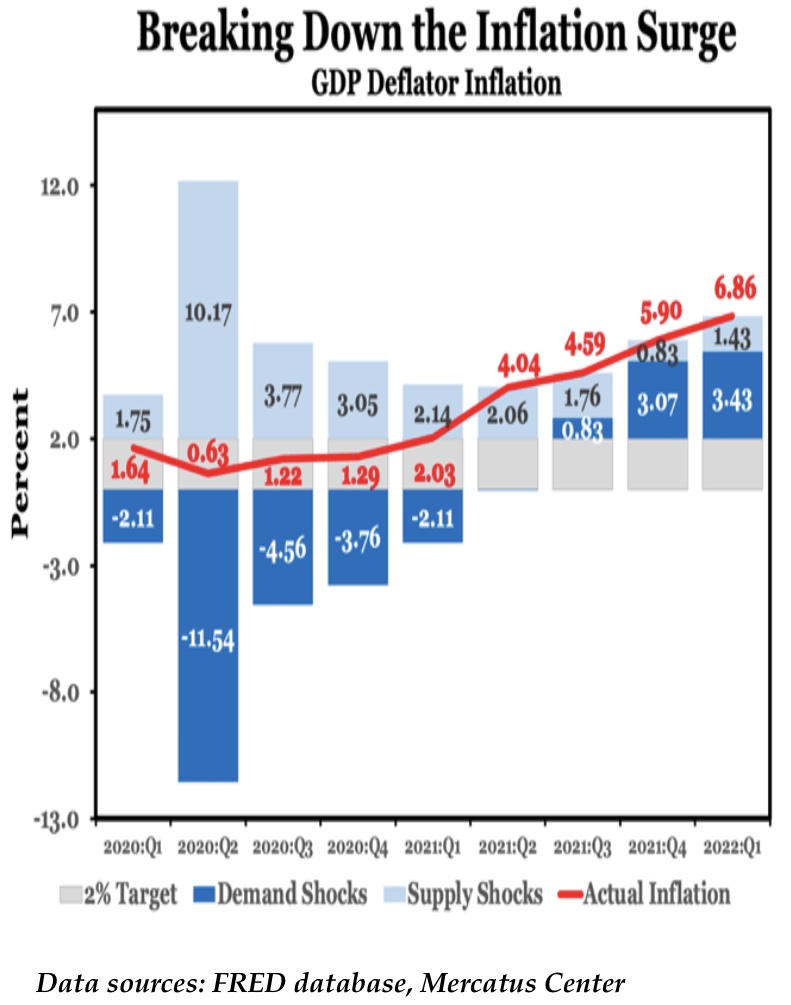
Until about March of this year, Federal Reserve policy remained extremely accommodative, despite the central bank having completely missed its so-called inflation target rate of 2% well before that. Take another look at the chart at the top of this post. CPI inflation shot above 2% in early 2021. The Fed did not really react until March 2022. The chart below shows that growth in the GDP deflator was slightly more muted than the CPI, but it too was above 2% in the first quarter of 2021 and accelerated from there. It’s as if there had been no Fed target at all!

The story, again, was “not to worry, it’s transitory”. Moreover, the Fed was convinced the inflation was driven entirely by supply problems. In fairness, it’s true that tighter monetary policy won’t stop inflation from supply shocks without great cost in terms of lost output. But monetary accommodation, which is what happened in 2021, simply validates inflation and runs the risk of allowing inflation expectations to become embedded in pricing. And again, that’s hard to undo.

Despite the dominance of supply-side inflation pressures early in 2021, it’s no wonder that a different kind of pressure has cropped up since then. The following chart from David Beckworth is helpful:

We now have primarily demand-side inflation fueled by the earlier accommodation of supply constraints and the monetization of government deficits. Sure, there remain significant supply constraints, whether induced by the actions of Russia, Biden, or lingering pandemic dysfunctions. But supply-side inflation cannot sustain without monetary accommodation. An early reading for the second-quarter GDP deflator will be available in late July, but it may well show accelerating pressures from both the demand side and the supply side.

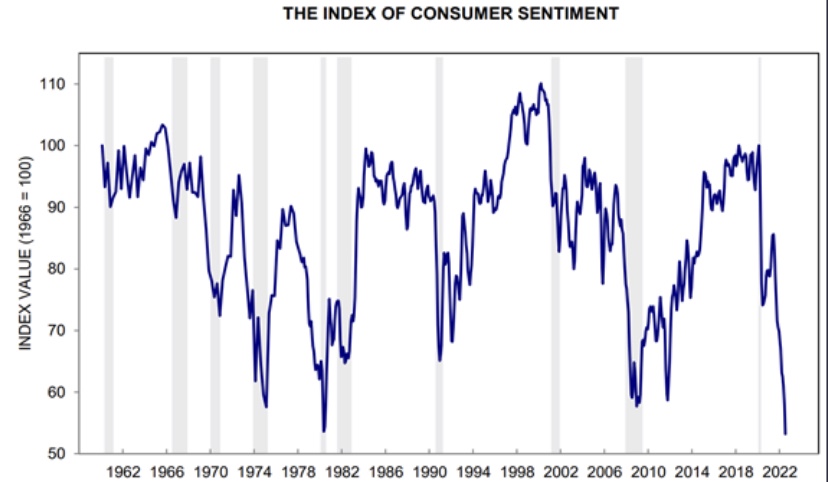
There is no way to eliminate the inflation surge without curtailing the growth of liquidity. Unfortunately, the risk that monetary tightening by the Fed will induce a recession is already very high, even a likelihood at this point. A fairly reliable signal of recession is an inversion of the yield curve, and we now see two-year Treasury debt yielding 15 – 20 basis points more than 10-year bonds. Again, real wages are declining. Real retail sales are down two months in a row and down from a year ago. Here’s a chart showing the most recent dismal reading on the index of consumer sentiment:

Whether a recession has already begun is not clear, but inflation certainly hasn’t abated, and the Fed is expected to continue tightening, albeit belatedly. Meanwhile, the Biden Administration and key Democrats don’t seem to want to make the Fed’s job any easier. They simply don’t comprehend the reality and their role in fostering the upward price trends we’re experiencing. They still cling to hopes of another big spending package that would add to deficits and the inflation tax, despite contemplating tax hikes on private employers, but so far Manchin has put the kabash on that. Still, we’re nowhere close to putting our fiscal and monetary houses in order.

Stagflation and the Supply of Bad Public Policy

20 Wednesday Oct 2021

Posted by Nuetzel in Inflation

≈ 2 Comments

Tags

Anthony B. Kim, Breakeven Inflation Rate, Brian Dunn, Consumer Price Index, Core CPI, corporate taxes, Cost-Push Inflation, Dunkin’ Donuts, Energy Policy, Federal Reserve, Jen Psaki, Joe Biden, Labor Force Participation, Mark Theisen, Median CPI, Non-Pharmaceutical interventions, Overton Window, Patrick Tyrell, Semiconductors, Stagflation, Supply Chains, Trimmed CPI, Unemployment By State, Vaccine Mandate, Work Disincentives

Price inflation is getting more attention now than it has in many years, but not everyone is convinced it will persist, most conspicuously bond investors. The Biden Administration’s initial narrative was plausible even if there were seeds of doubt: a price spike was to be expected relative to the low-ebb of price changes during the pandemic. However, the inflation data has come in strong since the spring, and events point to continuing price pressures and the potential for expected inflation to drive escalations in contract pricing. Once embedded like that, the phenomenon broadens and gets harder to squeeze out.

Broadening Price Hikes

The evidence at hand is never enough to take much comfort in predictions, and the uncertainties now are similar to those I discussed in June. At the time, the price moves had been pronounced only in the prior month or so, and there was no evidence of any breadth. Now, it’s at least clear that increases in the so-called “core” Consumer Price Index (CPI), which excludes food and energy prices, have escalated. In addition, the growth in the median component of the CPI basket reported by the Federal Reserve Bank of Cleveland has begun to jump. So has the “trimmed CPI”, which excludes the most extreme 8% of prices changes in both directions within the index. The chart below shows one-month changes in these gauges:

So the recent upward price trends have expanded in breadth, and their persistence is making it a little harder to argue that the changes are transitory rebounds from pandemic weakness.

Bond Investors Still Nonchalant

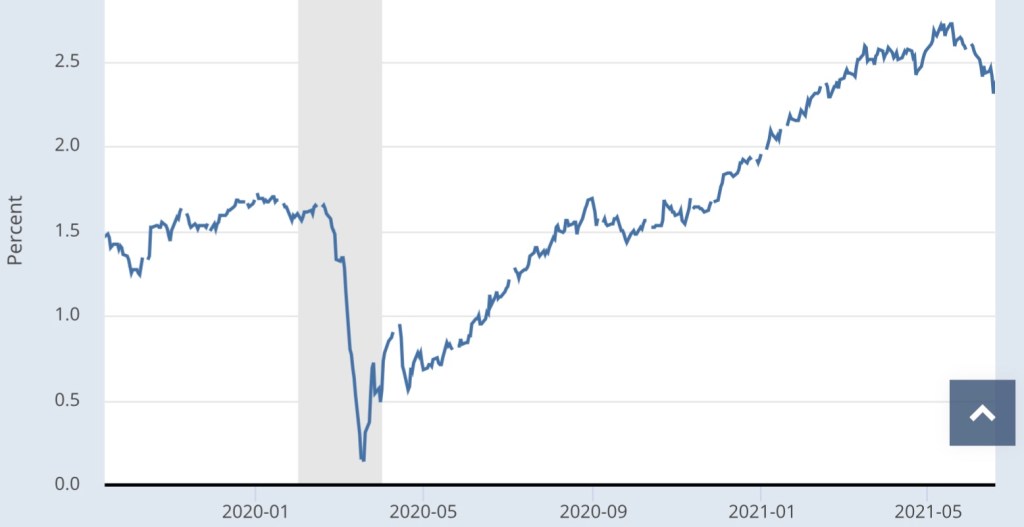
Investors are by no means convinced that the recent price pressures will persist. They have an incentive to bid-up bond yields to compensate for expected inflation, so these yields can be used to infer inflation expectations. The chart below from the Federal Reserve Bank of St. Louis shows the five-year “breakeven” inflation rate, which is derived from inflation-indexed versus unindexed Treasury securities.

The pattern does not suggest that a meaningful change in inflation expectations has taken place. In fact, the implied five-year inflation forecast has edged down a bit. Of course, we’re still worrying about a fairly short period of high month-to-month changes in prices, and five years is a long time in that context.

This “casual” reaction of interest rates to the inflation spike undoubtedly reflects investors’ belief that the Federal Reserve will tighten policy in an effort to contain inflation. Some of us have strong doubts about the Fed’s inflation-fighting resolve, however. There is little the Fed can do to relieve supply-side problems, and many would argue that the Fed should take an accommodative stance in an attempt to minimize output and job losses, but that would reinforce the inflationary effects. There is no easy way out. Risks loom in both directions, and though I might regret it, at recent yields, I’m not buying Treasury bonds.

Sources of Price Pressure

Economists have tended to divide price pressures into those driven by demand and those driven by supply. Sometimes the terms “demand-pull” and “cost-push” inflation are used for shorthand. The former is usually associated with economic growth, where rising prices indicate that demand is outpacing gains in capacity. With cost-push inflation, however, rising prices indicate that production snd supply is somehow impeded. You get higher prices and lower output. This is so-called “stagflation”. Today we seem to have a combination of those inflationary forces in play: demand has rebounded from the pandemic lows of 2020, while breakdowns in the supply chain have choked production, with a consequent need for more severe price rationing. If the latter forces win out, we will have entered a stagflationary episode.

Unfortunately, administration policies are exacerbating supply-side inflationary pressures. Officials first insisted that the jump in inflation measures would be transitory. More recently they’ve said that it really only hurts “the rich”, an assertion that is decidedly false. Biden flaks are doing their level best to put lipstick on a pig. “Peppermint” Psaki says it shows that people just want to buy things! On the other hand, the Washington Post encourages us to “lower our expectations”. Um, yeah… I think we’re there!

Burning Energy Producers and Consumers

Energy policy is an obvious case: while a hurricane moving through the Gulf of Mexico took a big bite out of domestic oil production, Biden took several steps to hamstring the domestic fossil fuel industry at a time when the economy was still recovering from the pandemic. This included revoking permits for the Keystone pipeline, a ban on drilling on federal lands and federally-controlled waters in the Gulf, shutting down production on some private lands on the pretext of enforcing the Endsngered Species Act, and capping methane emissions by oil and gas producers. And all that was apparently just a start.

As Mark Theisen notes, when you promise to destroy a particular industry, as Joe Biden has, by taxing and regulating it to death, who wants to invest in or even maintain production facilities? Some leftists with apparent influence on the administration are threatening penalties against the industry up to and including prosecution for “crimes against humanity”! This is moronic, of course, but perhaps these extremists are just trying to move the Overton Window. Fossil fuels have been and still are a miracle in terms of human well-being, and renewable (but intermittent) energy sources are simply not capable of replacing the lost power, as Germans, Californians, and Texans are learning. Furthermore, the effort to kill fossil fuels amounts to a war on the poor. Americans are facing steep increases in their utility bills and blackouts during the times when power is needed most. Now, Biden is actively trying to wheedle more oil production out of OPEC, as if it’s okay for those nations to extract it, but not for us to do so!

Labor Shortage

Have you heard it’s hard to get help these days? You’ll notice it pretty fast if you have regular occasion to deal with service establishments. Goods are getting scarce on the shelves as well. Food and paper goods are getting pricier. The semiconductor shortage has been prominent, impacting production and pricing of electronics, computers, and new cars, with a big cross-effect on the used car and rental car markets. Everywhere you look, sellers seem short of inventory. This year it might be tough to fill the space under the Christmas tree for lack of availability.

This isn’t just about cargo ships unable to unload at the ports, although that’s significant. Patrick Tyrell and Anthony B. Kim note the difficulty of overcoming the supply chain breakdowns even with 24/7 operations at the ports. Tyrell snd Kim offer this quite from the Financial Times:

“The US is facing a shortage of warehouse space and truck drivers, and shifting to 24/7 operation will require enormous co-ordination between the publicly operated ports and private sector groups, including large retailers and freight companies.”

There are several reasons for the labor shortage: a few workers and businesses might still be living in fear of COVID, especially in “blue” states and urban areas where the fear factor seems to have been more palpable. That’s where the high unemployment is. There has also been an apparent wave of retirements among late baby-boomers who were already on the cusp of hanging up their skates. However, the Biden Administration has instigated a set of ill-advised policies that blunt work incentives, leading to reduced labor force participation: the repeated extensions of pandemic-related unemployment benefits; increased child and dependent care tax benefits; the moratorium on evictions from rental property; the elimination of work requirements for expanded Medicaid coverage; and increased EBT and SNAP benefits. This is not hard to understand: if you pay people to stay home, they will stay home, even as you suffer through an interminable wait for your fast food. But there might not be a wait at Dunkin’ Donuts, because they’ve been running short on donuts due to “supply chain issues”!

Destructive Public Policy

COVID policy contributed to the early plunge in demand in 2020. Economic output declined, and ramping-up production is not always a simple thing. In this case, it was hindered by repeated non-pharmaceutical interventions and confused messaging from public health authorities. These are issues I’ve felt compelled to address too many times on my blog over the past 18 months. The negative economic effects of these policies continue to linger, and it should surprise no one.

The Democrats’ so-called “social infrastructure” bill, which looks mercifully unlikely to pass without major curtailments in scale and scope, would exacerbate many of the problems cited above. As I’ve noted recently, it’s more of an “infra-shackle” bill for the private economy than an infrastructure bill. For $3.5 trillion (an understatement based on budget gimmickry), we get heavy regulation and taxes, particularly on fossil fuels, subsidies for uneconomic technologies, assorted entitlements with no means testing, wage- and job-killing (and inflationary) hikes in corporate taxes, and other tax disincentives to private investment. The bill would represent a huge reallocation from the private to the public sector via coercion and public competition for scarce resources.

As if that wasn’t bad enough, now Biden has issued his legally dubious vaccine mandate, which has been met with outrage among many workers, from Chicago cops and other public servants, health care workers, truckers and workers at such corporate giants as Boeing, Southwest Airlines, and many others. Unions are furious. People are walking out. This represents a negative “supply shock”, an unexpected event that hinders production and boosts prices. Joe Biden looks to be well on his way to earning the title of “The Stagflation President”.

I’ll leave you with this gem from Brian Dunn:

Inflation Doomsayers and Downplayers

25 Friday Jun 2021

Posted by Nuetzel in Inflation, Monetary Policy

≈ 2 Comments

Tags

Consumer Price Index, Core CPI, Cryptocurrencies, Deficits, Energy Policy, Federal Reserve, Financial Velocity, Fisher Effect, Helicopter Money, Housing Costs, Import Prices, Inflation, Inflation Premium, Irving Fisher, M1, Median CPI, Monetary policy, Monetization, Shrinkflation, Trading Volume, Trimmed CPI, Velocity of Money

There’s a big disconnect between recent news about escalating inflation and market expectations of inflation. In fact, there’s a big disconnect between market expectations and what we’re hearing from some conservative economists. The latter are predicting more inflation based on the recent spurt in prices and the expansionary policy of the Federal Reserve. Can these disparate views be reconciled?

Market Predictions

Market interest rates are considered pretty good predictors of inflation, at least relative to surveys and macroeconomic models. That’s because a fixed interest return is eroded by inflation, and fixed income investors will bid up interest rates to incorporate a premium to compensate for perceptions of increased inflation risk. This is known as the Fisher Effect, after the economist Irving Fisher. In fact, investors should bid rates up more than one-for-one with expected inflation, because the inflation premium will be taxed. A higher return must compensate for both higher expected inflation and taxes on the increased inflation premium.

After rising by about 1.2% from last summer through mid-March, interest rates on Treasury notes have declined slightly. The earlier run-up anticipated a strengthening economy, but if the increase was due to higher expected inflation, we could say it represented an added premium of about 1%, and that’s roughly in-line with changes in some other market-based gauges of expected inflation (ignoring pandemic lows).

Recent Inflation News

Meanwhile, measured inflation certainly has increased in 2021. I say “measured” because 1) “true” price changes are measured imperfectly, and 2) there is a difference between real inflation, which is a continuing process, and month-to-month changes in prices. Here, we’re really talking about the latter and hoping it doesn’t turn into a bad case of the former!

The green line in the chart below is the percent change in the consumer price index (CPI) from a year earlier. After declining during the pandemic, it rebounded sharply this year to almost 5% in May. The purple line is the increase in the CPI excluding food and energy prices, otherwise known as the “core” CPI. The jumps shown in the chart are well in excess of the market’s assessment of inflation trends.  

Both versions of the CPI have jumped in the past few months, but it turns out that durable goods like washing machines, TVs, and (probably) Pelotons have jumped the most sharply. Most of the weakness in prices during the pandemic was in non-durable goods, which stands to reason because so many activities away from home were curtailed. Also noteworthy about these price movements: when measured over a span of two years, prices excluding food and energy have risen at an annualized rate of only 2.6%. 

There are two other lines in the chart above that demonstrate much less alarming changes in prices: the orange line is so-called “median” inflation, which is the price change in the median component of the CPI. That is, half of all price components included in the CPI rose faster and half rose slower than the median. It has barely accelerated this year and stood at only about 2.1% higher in May than a year earlier. The blue line is the so-called “trimmed” CPI, or the average price change of the middle 84% of all CPI components. While it has accelerated in 2021, the year-over-year increase was only 2.6% in May. 

Thus, the breadth of the jump in prices was limited. The Federal Reserve and a lot of market participants insist that the uptick is narrow and temporary — a transitional phenomenon related to the sluggish recovery of supplies in the post-pandemic environment.

But again, the accuracy of price measures is always in question. For example, the housing cost component of the CPI was up only 2.2% in May from a year ago, but it is calibrated to actual survey data only twice a year, the survey is a weak data source, and we know home prices and rents have risen aggressively. Quality and quantity adjustments are always in question as well. An old approach for businesses dealing with rising costs is to reduce package size, which has been called “shrinkflation”. It seems to be back in vogue.

Inflation Drivers

It’s not yet clear how much wage pressure is occurring now. The economy-wide average hourly earnings data has been distorted over the past 15 months by the changing mix of employment, first shifting toward greater concentration in high-wage (work-at-home) occupations and now shifting back toward lower-wage jobs as the economy reopens. But we know many employers are facing a labor shortage, due in large part to extended unemployment benefits and other pandemic-related aid, so this puts upward pressure on wages. In 2021, minimum wage rates are undergoing substantial increases in 17 states, and a number of large employers such as Amazon have increased their minimum pay rates. That creates competitive pressure for smaller employers to boost pay as well.

The fundamental cause of an “honest-to-goodness” inflation is “too much money chasing too few goods”. The Federal Reserve has certainly given us enough to worry about in that regard. The basic money stock (M1) increased by four-fold in the late winter and early spring of 2020, just as the pandemic was spreading. Today, it is almost five times greater than in early 2020, so growth in the money stock remains quite fast even as the recovery proceeds. No wonder: the U.S. Treasury is issuing about $1 trillion of new debt every four-to-six weeks, and the Fed is essentially monetizing these deficits by purchasing a huge chunk of that debt.

That’s a lot of “helicopter” money… new money! But are there too few goods for it to chase? Or is it really chasing anything? Is it just sitting idle? First, GDP is likely to exceed its pre-pandemic level in the second quarter, despite the fact that private payrolls are still down by about 7 million employees. Of course, that doesn’t eliminate the ostensible imbalance between money and goods, and one might expect a veritable explosion in price inflation under these circumstances.

So far that seems unlikely. The so-called velocity of money (its rate of turnover) has plunged since the start of the pandemic, with no discernible rebound through the first quarter of 2021. That means a lot of the cash is not being used in transactions for real goods, but financial transaction volume has been quite strong in 2020-21. Daily stock trading volume was up by more than 50% in 2020 from 2019, and in the first quarter of 2021 it stood another 34% higher than the 2020 average (though volume tapered in April). This is to say nothing of the increased frenzy in cryptocurrency trading. So, while some money is turning over, the expansion of the money stock remains daunting and pressure might well spill-over into goods prices.

Caution Is a Virtue

So long as the Fed keeps printing money, and assuring investors that it will keep printing money, the equity markets are likely to remain strong. There are mixed signals coming from Fed officials, but the over-riding message is that the recent uptick in prices is largely temporary and limited in scope. That is, they assert that certain prices are being squeezed temporarily by rebounding demand for goods while suppliers play catch-up. 

Market expectations of inflation seem to agree with that view, but I have strong trepidations. There are cash reserves held in the private sector to support more aggressive spending. Large companies, consumers, and banks are still holding significant amounts of cash. The Biden Administration is doing its best to spend hand-over-fist. This administration’s energy policy is causing fuel bills to escalate. Home prices and rents are strong. The dollar is down somewhat from pre-pandemic levels, which increases import prices. Finally, the Fed is reluctant to reverse the huge increase in the money supply it engineered during the pandemic. If the recent surge in prices continues, and if higher inflation embeds itself into expectations, it will be all the more difficult for the Fed to correct. 

The market and the Fed might be correct in predicting that the spike in measured inflation is temporary. The recent data show that these worrisome price trends have not been broad. Just the same, I don’t want to hold fixed income investments right now: if higher expectations of inflation cause market interest rates to rise, the value of those assets will fall. Stock values should generally keep pace with inflation barring stronger signals of tightening by the Fed. Unfortunately, however, many would suffer in an inflationary environment as wages, fixed assets, and benefits are devalued by rising prices.

Follow Sacred Cow Chips on WordPress.com

Recent Posts

  • Immigration and Merit As Fiscal Propositions
  • Tariff “Dividend” From An Indigent State
  • Almost Looks Like the Fed Has a 3% Inflation Target
  • Government Malpractice Breeds Health Care Havoc
  • A Tax On Imports Takes a Toll on Exports

Archives

  • December 2025
  • November 2025
  • October 2025
  • September 2025
  • August 2025
  • July 2025
  • June 2025
  • May 2025
  • April 2025
  • March 2025
  • February 2025
  • January 2025
  • December 2024
  • November 2024
  • October 2024
  • September 2024
  • August 2024
  • July 2024
  • June 2024
  • May 2024
  • April 2024
  • March 2024
  • February 2024
  • January 2024
  • December 2023
  • November 2023
  • August 2023
  • July 2023
  • June 2023
  • May 2023
  • April 2023
  • March 2023
  • February 2023
  • January 2023
  • December 2022
  • November 2022
  • October 2022
  • September 2022
  • August 2022
  • July 2022
  • June 2022
  • May 2022
  • April 2022
  • March 2022
  • February 2022
  • January 2022
  • December 2021
  • November 2021
  • October 2021
  • September 2021
  • August 2021
  • July 2021
  • June 2021
  • May 2021
  • April 2021
  • March 2021
  • February 2021
  • January 2021
  • December 2020
  • November 2020
  • October 2020
  • September 2020
  • August 2020
  • July 2020
  • June 2020
  • May 2020
  • April 2020
  • March 2020
  • February 2020
  • January 2020
  • December 2019
  • November 2019
  • October 2019
  • September 2019
  • August 2019
  • July 2019
  • June 2019
  • May 2019
  • April 2019
  • March 2019
  • February 2019
  • January 2019
  • December 2018
  • November 2018
  • October 2018
  • September 2018
  • August 2018
  • July 2018
  • June 2018
  • May 2018
  • April 2018
  • March 2018
  • February 2018
  • January 2018
  • December 2017
  • November 2017
  • October 2017
  • September 2017
  • August 2017
  • July 2017
  • June 2017
  • May 2017
  • April 2017
  • March 2017
  • February 2017
  • January 2017
  • December 2016
  • November 2016
  • October 2016
  • September 2016
  • August 2016
  • July 2016
  • June 2016
  • May 2016
  • April 2016
  • March 2016
  • February 2016
  • January 2016
  • December 2015
  • November 2015
  • October 2015
  • September 2015
  • August 2015
  • July 2015
  • June 2015
  • May 2015
  • April 2015
  • March 2015
  • February 2015
  • January 2015
  • December 2014
  • November 2014
  • October 2014
  • September 2014
  • August 2014
  • July 2014
  • June 2014
  • May 2014
  • April 2014
  • March 2014

Blogs I Follow

  • Passive Income Kickstart
  • OnlyFinance.net
  • TLC Cholesterol
  • Nintil
  • kendunning.net
  • DCWhispers.com
  • Hoong-Wai in the UK
  • Marginal REVOLUTION
  • Stlouis
  • Watts Up With That?
  • Aussie Nationalist Blog
  • American Elephants
  • The View from Alexandria
  • The Gymnasium
  • A Force for Good
  • Notes On Liberty
  • troymo
  • SUNDAY BLOG Stephanie Sievers
  • Miss Lou Acquiring Lore
  • Your Well Wisher Program
  • Objectivism In Depth
  • RobotEnomics
  • Orderstatistic
  • Paradigm Library
  • Scattered Showers and Quicksand

Blog at WordPress.com.

Passive Income Kickstart

OnlyFinance.net

TLC Cholesterol

Nintil

To estimate, compare, distinguish, discuss, and trace to its principal sources everything

kendunning.net

The Future is Ours to Create

DCWhispers.com

Hoong-Wai in the UK

A Commonwealth immigrant's perspective on the UK's public arena.

Marginal REVOLUTION

Small Steps Toward A Much Better World

Stlouis

Watts Up With That?

The world's most viewed site on global warming and climate change

Aussie Nationalist Blog

Commentary from a Paleoconservative and Nationalist perspective

American Elephants

Defending Life, Liberty and the Pursuit of Happiness

The View from Alexandria

In advanced civilizations the period loosely called Alexandrian is usually associated with flexible morals, perfunctory religion, populist standards and cosmopolitan tastes, feminism, exotic cults, and the rapid turnover of high and low fads---in short, a falling away (which is all that decadence means) from the strictness of traditional rules, embodied in character and inforced from within. -- Jacques Barzun

The Gymnasium

A place for reason, politics, economics, and faith steeped in the classical liberal tradition

A Force for Good

How economics, morality, and markets combine

Notes On Liberty

Spontaneous thoughts on a humble creed

troymo

SUNDAY BLOG Stephanie Sievers

Escaping the everyday life with photographs from my travels

Miss Lou Acquiring Lore

Gallery of Life...

Your Well Wisher Program

Attempt to solve commonly known problems…

Objectivism In Depth

Exploring Ayn Rand's revolutionary philosophy.

RobotEnomics

(A)n (I)ntelligent Future

Orderstatistic

Economics, chess and anything else on my mind.

Paradigm Library

OODA Looping

Scattered Showers and Quicksand

Musings on science, investing, finance, economics, politics, and probably fly fishing.

  • Subscribe Subscribed
    • Sacred Cow Chips
    • Join 128 other subscribers
    • Already have a WordPress.com account? Log in now.
    • Sacred Cow Chips
    • Subscribe Subscribed
    • Sign up
    • Log in
    • Report this content
    • View site in Reader
    • Manage subscriptions
    • Collapse this bar
 

Loading Comments...