• About

Sacred Cow Chips

Sacred Cow Chips

Tag Archives: corporate income tax

Infrastructure Or Infra-Stricture? The Democrats’ $3.5 Trillion Reconciliation Bill

16 Thursday Sep 2021

Posted by Nuetzel in Big Government, Central Planning, infrastructure, Uncategorized

≈ 3 Comments

Tags

Antonia Ocasio-Cortez, Bernie Sanders, Biden Administration, Budget Reconcilation Bill, Capital Gains, Civilian Climate Corps, Clean Energy, corporate income tax, dependency, Federal Reserve, Fossil fuels, Green Cards, infrastructure, Joe Manchin, Legal Permanent Residency, Paid Family Leave, Physical Investment, Productivity Growth, Social Infrastructure, Tax the Rich, Tragedy of the Commons, Universal Pre-School, Welfare State

The Socialist Party faithful once known as Democrats are pushing a $3.5 trillion piece of legislation they call an “infrastructure” bill. They hope to pass it via budget reconciliation rules with a simple majority in the Senate. The Dems came around to admitting that the bill is not about infrastructure in the sense in which we usually understand the term: physical installations like roads, bridges, sewer systems, power lines, canals, port facilities, and the like. These kinds of investments generally have a salutary impact on the nation’s productivity. Some “traditional” infrastructure, albeit with another hefty wallop of green subsidies, is covered in the $1.2 trillion “other” infrastructure bill already passed by the Senate but not the House. The reconciliation bill, however, addresses “social infrastructure”, which is to say it would authorize a massive expansion in the welfare state.

What Is Infrastructure?

Traditionally, public and private infrastructure are underlying assets that facilitate production or consumption in one way or another, consistent with the prefix “infra”, meaning below or within. For example, a new factory requires physical access by roads and/or rail, as well as sewer service, water, gas and/or electric supply. All of the underlying physical components that enable that factory to operate may be thought of as private infrastructure, which has largely private benefits. Therefore, it is often privately funded, though certainly not always.

Projects having many beneficiaries, such as highways, municipal sewers, water, gas and electrical trunk lines, canals, and ports may be classified as public infrastructure, though they can be provided and funded privately. Pure public infrastructure provides services that are non-rivalrous and non-excludable, but examples are sparse. Nevertheless, the greater the public nature of benefits, the greater the rationale for government involvement in their provision. In practice, a great deal of “public” infrastructure is funded by user fees. In fact, a failure to charge user fees for private benefits often leads to a tragedy of the commons, such as the overuse of free roads, imposing a heavier burden on taxpayers.

The use of the term “infrastructure” to describe forms of public support is not new, but the scope of government interventions to which the term is applied has mushroomed during the Biden Administration. Just about any spending program you can think of is likely to be labeled “infrastructure” by so-called progressives. The locution is borrowed somewhat questionably, seemingly motivated by the underlying structure of political incentives. More bluntly, it sounds good as a sales tactic!

$3.5 Trillion and Chains

Among other questionable items, the so-called budget reconciliation “infrastructure” bill allocates funds toward meeting:

“… the President’s climate change goals of 80% clean electricity and 50% economy-wide carbon emissions by 2030, while advancing environmental justice and American manufacturing. The framework would fund:
• Clean Energy Standard
• Clean Energy and Vehicle Tax Incentives
• Civilian Climate Corps
• Climate Smart Agriculture, Wildfire Prevention and Forestry
• Federal procurement of clean technologies
• Weatherization and Electrification of Buildings
• Clean Energy Accelerator
”

The resolution would also institute “methane reduction and polluter import fees”. Thus, we must be prepared for a complete reconfiguration of our energy sector toward a portfolio of immature and uneconomic technologies. This amounts to an economic straightjacket.

Next we have a series of generous programs and expansions that would encourage dependence on government:

“• Universal Pre-K for 3 and 4-year old children
• High quality and affordable Child Care
•
[free] Community College, HBCUs and MSIs, and Pell Grants
• Paid Family and Medical Leave
• Nutrition Assistance
• Affordable Housing
”

If anything, pre-school seems to have cognitive drawbacks for children. Several of these items, most obviously the family leave mandate, would entail significant regulatory and cost burdens on private businesses.

There are more generous provisions on the health care front, which are good for further increasing the federal government’s role in directing, regulating, and funding medical care:

“• new Dental, Vision, and Hearing benefit to Medicare
• Home and Community-Based Services expansion
• Extend the Affordable Care Act Expansion from the ARP
• Close the Medicaid “Coverage Gap” in the States that refused to expand
• Reduced patient spending on prescription drugs
”

Finally, we have a series of categories intended to “help workers and communities across the country recover from the COVID-19 pandemic and reverse trends of economic inequality.”

“• Housing Investments
• Innovation and R & D Upgrades
• American Manufacturing and Supply Chains Funding
• LPRs for Immigrants and Border Mangt. • Pro-Worker Incentives and Penalties
• Investment in Workers and Communities • Small Business Support

I might suggest that a recovery from the pandemic would be better served by getting the federal government out of everyone’s business. The list includes greater largess and more intrusions by the federal government. The fourth item above, grants of legal permanent residency (LPR) or green cards, would legalize up to 8 million immigrants, allowing them to qualify for a range of federal benefits. It would obviously legitimize otherwise illegal border crossings and prevent any possibility of eventual deportation.

Screwing the Pooch

How many of those measures really sound like infrastructure? This bill goes on for more than 10,000 pages, so the chance that lawmakers will have an opportunity to rationally assess all of its provisions is about nil! And the reconciliation bill doesn’t stop at $3.5T. There are a few budget gimmicks being leveraged that could add as much as $2T of non-infrastructure spending to the package. One cute trick is to add certain provisions affecting revenue or spending years from now in order to cut the bill’s stated price tag.

A number of the bill’s generous giveaways will have negative effects on productive incentives. It’s also clear that some items in the bill will supplement the far Left’s educational agenda, which is seeped in critical theory. And the bill will increase the dominance of the federal government over not only the private sector, but state and local sovereignty as well. This is another stage in the metastasis of the federal bureaucracy and the dependency fostered by the welfare state.

Taxing the Golden Goose

But here’s the really big rub: the whole mess has to be paid for. The flip side of our growing dependency on government is the huge obligation to fund it. Check this out:

“American ‘consumer units,’ as BLS calls them, spent a net total of $17,211.12 on taxes last year while spending only $16,839.89 on food, clothing, healthcare and entertainment combined,”

Democrats continue to dicker over the tax provisions of the bill, but the most recent iteration of their plan is to cover about $2.9 trillion of the cost via tax hikes. Naturally, the major emphasis is on penalizing corporations and “the rich”. The latest plan includes:

  • increasing the corporate income tax from 21% to 26.8%;
  • increasing the top tax rate on capital gains from 20% to 25%;
  • an increase in the tax rate for incomes greater than $400,000 ($450,000 if married filing jointly)
  • adding a 3% tax surcharge for those with adjusted gross incomes in excess of $5 million;
  • Higher taxes on tobacco and nicotine products;
  • halving the estate and gift tax exemption;
  • limiting deductions for executive compensation;
  • changes in rules for carried interest and crypto assets.

There are a few offsets, including the promise of tax reductions for individuals earning less than $200,000 and businesses earning less than $400,000. We’ll see about that. Those cuts would expire by 2027, which reduces their “cost” to the government, but it will be controversial when the time comes.

The Dem sell job includes the notion that corporate income belongs to the “rich”, but as I’ve noted before, the burden of the corporate income tax falls largely on corporate workers and consumers. Lower wages and higher prices are almost sure to follow. This would deepen the blade of the Democrats’ political hari-kari, but they pin their hopes on the power of alms. Once bestowed, however, those will be difficult if not impossible to revoke, and the Dems know this all too well.

The assault on the “rich” in the reconciliation bill is both ill-advised and unlikely to yield the levels of revenue projected by Democrats. Like it or not, the wealthy provide the capital for most productive investment. Taxing their returns and their wealth more heavily can only reduce incentive to do so. Those investors will seek out more tax-advantaged uses for their funds. That includes investments in non-productive but federally-subsidized alternatives. Capital gains can often be deferred, of course. These penalties also ensure that more resources will be consumed in compliance and tax-avoidance efforts. The solutions offered by armies of accountants and tax attorneys will tend to direct funds to uses that are suboptimal in terms of growth in economic capacity.

What isn’t funded by new taxes will be borrowed by the federal government or simply printed by the Federal Reserve. Thus, the federal government will not only compete with the private sector for additional resources, but the monetary authority will provide fuel for more inflation.

Fracturing Support?

Fortunately, a few moderate Democrats in both the House and the Senate are balking at the exorbitance of the reconciliation bill. Senator Joe Manchin of West Virginia has said he would like to see a package of no more than $1.5 trillion. That still represents a huge expansion of government, but at least Manchin has offered a whiff of sanity. Equally welcome are threats from radical Democrats like Senator Bernie Sanders and Rep. Antonia Ocasio-Cortez that a failure to pass the full reconciliation package will mean a loss of their support for the original $1.2 trillion infrastructure bill, much of which is wasteful. We should be so lucky! But that’s a lot of pork for politicians to walk away from.

Infra-Shackles

The so-called infrastructure investments in the reconciliation bill represent a range of constraints on economic growth and consumer well being. Increasing the government’s dominance is never a good prescription for productivity, whether due to regulatory and compliance costs, bureaucratization of decision-making, minimizing the role of price signals, pure waste through bad incentives and graft, and public vs. private competition for resources. The destructive tax incentives for funding the bill are an additional layer of constraints on growth. Let’s hope the moderate Democrats hold firm, or even better, that the tantrum-prone radical Democrats are forced to make good on their threats.
The Dirt On the Corporate Income Tax

23 Tuesday Mar 2021

Posted by Nuetzel in Fiscal policy, Tax Incidence

≈ 2 Comments

Tags

Alan D. Viard, Biden Administration, Compliance Costs, corporate income tax, Edward Lane, Investment Incentives, Joseph Sullivan, L. Randall Wray, Milton Friedman, Off-Shoring, Peggy Musgrave, Physical Capital, Pricing Power, Regressive Tax, Richard Musgrave, Shifting the Burden, Tax Avoidance, Tax Foundation, Transfer Pricing, Transparency

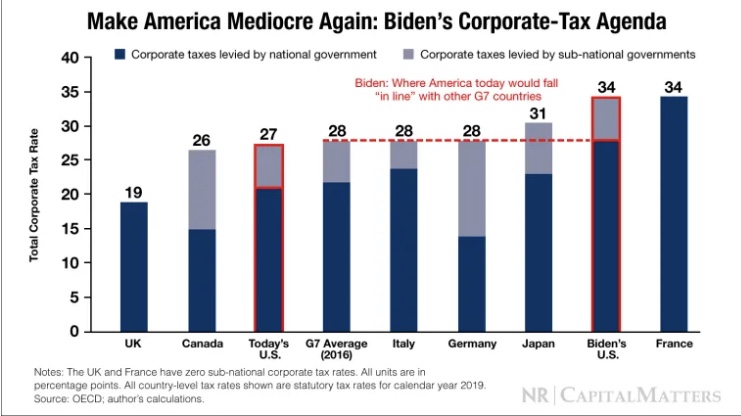
The Biden Administration is proposing a substantial increase in the corporate income tax rate from 21% to 28%. This is another case of a self-destructive policy that serves as a virtue signal to the progressive Left. See? We’re taxing the rich and their powerful corporations! What none of them realize is that the tax on corporate income is actually a regressive tax on consumers and workers; it is a disincentive to the formation of productive capital; and it is a highly wasteful tax due to compliance costs and the impact of avoidance. And the Biden proposal would make the U.S. less competitive internationally, as the chart above from Joseph Sullivan demonstrates. Maybe some of the proponents realize it, but they still like it because it sounds so good to their base!

It’s not as if all these unhealthy characteristics of the corporate tax are new findings. Milton Friedman explained some of the basics in 1971 when he said:

“The elementary fact is that ‘business’ does not and cannot pay taxes. Only people can pay taxes. Corporate officials may sign the check, but the money that they forward to Internal Revenue comes from the corporation’s employees, customers or stockholders. A corporation is a pure intermediary through which its employees, customers and stockholders cooperate for their mutual benefit.”

In 1984, two giants of public finance economics, Richard and Peggy Musgrave, investigated how the corporate tax was shifted to households. Here’s a description of their findings from a recent paper by Edward Lane and L. Randall Wray:

“… the bottom quintile pays 4.6–5.5 percent of its income toward the corporate profits tax, the top decile pays 2.5–3.7 percent of its income, and the ninth decile pays 2.4–2.9 percent of its income. They conclude that the corporate profits tax is largely regressive while the federal personal income tax is progressive.”

The incidence of the corporate tax rate falls primarily on workers in the form of lower wages and lost jobs, and on consumers in the form of higher prices. Lane and Wray cite several influential studies over the years showing a substantial negative association between corporate taxes and wages. As the authors note, major corporations often have pricing power in both product and labor markets, at least relative to their power in capital markets where they must raise capital. Capital markets are highly competitive, so they don’t provide much opportunity for shifting the burden of the tax to owners of equity and debt. There are limits on a firm’s ability to pass the tax along to customers and workers as well, of course, but shareholders are relatively well-insulated from the burden of the tax.

There are still other reasons to avoid increasing the corporate income tax rate. It currently raises about $200 billion annually for the U.S. Treasury, or about 7% of estimated federal tax revenue for the 2021 fiscal year. It also has extremely high compliance costs. Lane and Wray quote a 2016 Tax Foundation estimate that U.S. businesses face tax compliance costs on the order of $193 billion a year. Not all of that figure applies to corporations, and not all of it is for federal tax compliance, but a great deal of it is. There are also a number of ways the tax can be avoided, such as off-shoring operations and using overstated transfer prices of inputs obtained from units overseas. This is not an economically efficient way to generate tax revenue.

Moreover, the corporate income tax creates perverse incentives. When new investment in productive, physical capital is penalized at the margin, you can expect less capital investment, lower wages, and fewer jobs. Alan D. Viard explains that the dynamics of this mechanism take time to play out, but the longer-run decay in the capital stock is perhaps the most damaging aspect of a high corporate tax rate. And indeed, while there are probably short-run effects, the reduction in the incentive to invest is the real mechanism linking a higher corporate tax to reduced wages and higher prices, not to mention reduced economic growth.

Finally, there is a pernicious political-economic aspect of the corporate income tax owing to the difficulty for the general public in identifying its true incidence. This was also discussed by Milton Friedman:

“… Indirect effects make it difficult to know who ‘really’ pays any tax. But this difficulty is greatest for taxes levied on business. That fact is at one and the same time the chief political appeal of the corporation income tax, and its chief political defect. The politician can levy taxes, as it appears, on no one, yet obtain revenue. The result is political irresponsibility. Levying most taxes directly on individuals would make it far clearer who pays for government programs.

If the government intends to tax the owners of corporate wealth (a significant share of which is held in retirement savings accounts), it should be honest about doing so. That would mean taxing capital income in a more consolidated way, as Lane and Wray put it, at the individual level. That kind of transparency might be too much to hope for because the politics of doing so are much less favorable.

Meanwhile, the Biden Administration wants to have it all: higher corporate taxes and higher taxes on relatively high-earning individuals. But a significant burden of the corporate tax increase ultimately is shifted to individual workers and consumers. It is a regressive tax, and it is an inefficient tax with outrageously high compliance costs. It is a destructive tax because it undermines the economy’s growth in productive capacity. And it offers tax revenue to politicians who have little budgetary resolve, and with little political consequence.

The House GOP Tax Plan’s Disparate Treatment of Income Sources

09 Thursday Nov 2017

Posted by Nuetzel in Taxes

≈ 2 Comments

Tags

Bernie Sanders, Bubble Tax, corporate income tax, Double Taxation, FICA Tax, House GOP Tax Plan, Investment Incentives, Obamacare Surtax, Pass-Through Income, Scott Sumner, Tax Burden, Tax Incentives

Update: In writing the following post, I neglected to devote sufficient attention to the rules that would govern taxation of pass-through income under the House GOP tax plan. Those rules significantly alter some of the conclusions below. Those rules are discussed in a later post: Stumbling Through Pass-Through Tax Reform.

Double taxation of corporate income is a feature of the U.S. income tax code that is partially addressed in the tax reform bill proposed by the House GOP. Corporate income is taxed to the firm and again to owners on their receipt of dividends or when a company’s growth results in capital gains. Ultimately, the total rate of taxation matters more than whether it is implemented as single or double taxation of income flows. However, there is an unfortunate tendency to view corporate taxes as if they are levied on entitites wholly separate from their owners, so double taxation carries a stench of politically sneakiness. It also creates multiple distortions in the decisions of investors and the separately managed firms they own.

Non-corporate income taxation is reduced by the House plan even more substantially than the cut in taxes on corporate-derived income. However, the plan does not reduce taxes on high-earning professionals, many of whom are situated similarly to successful business owners and investors from an economic perspective.

Tax Burdens and Distortions

The federal corporate tax is not borne 100% by shareholders, as discussed in the previous post on Sacred Cow Chips. Some part of the burden is borne by labor via reduced wages. It is difficult to correct for this distortion in terms of calculating an effective marginal tax rate on corporate income. For example, suppose a new 35% tax would reduce corporate income from $100 to $65. The firm finds, however, that it can reduce wage payments by half of the expected tax payment, or $17.50. The firm would now earn $117.50 before tax and $76.38 after tax. Relative to the new level of pre-tax income, the tax rate is still 35%. It is no less than that by way of the reduction in wages, though the impact on the firm’s pre-tax income is mitigated.

The discussion here of tax rates, and even double taxation, is not intended as commentary on tax fairness. It might or might not be fair that the burden of the tax is shared with labor. Instead, the issue is the magnitude of the economic distortions caused by taxes. Tax rates themselves are a reasonable starting point for such a discussion, and they are easy to measure. Lower tax rates beget fewer distortions in economic outcomes than high tax rates. Low rates provide greater incentives to save and invest in productive assets, which enhances labor productivity, wages, and economic growth. Indeed, businesses go to great lengths to avoid taxes altogether, if possible, but typically those are non-productive uses of resources, which demonstrates the very distortions at issue.

Current and Proposed Marginal Tax Rates

Under current law, the top personal income tax rate on dividends is 20%. It is 23.8% if we include the Obamacare surtax. Adding that to the corporate rate yields the effective top tax rate paid by shareholders: 23.8% + 35% = 58.8%. The GOP bill does not alter the 23.8% top rate on dividends or capitals gains. By virtue of the corporate tax reduction, however, the plan would reduce the overall top rate on shareholders to 23.8% + 20% = 43.8%.

The income earned by investors in pass-through entities like proprietorships, partnerships and S-corporations is taxed as personal income under current law at rates ranging from 15% to 39.6% (43.4% at the top, including the surtax). Thus, under present law, the owner of a pass-through company is taxed less heavily at the top rate than the owner of a public company (43.4% vs. 58.8%). (I am ignoring the 15.3% FICA payroll tax owed by self-emloyed individuals in proprietorships or partnerships on incomes up to $127,200, and 2.9% above that level. The combined tax rates would be almost equal even if we include the FICA tax.)

The tax on pass-through business income would be reduced under the GOP bill via a cap of 25% on federal business income taxes. Presumably, this cap would nullify the House plan’s “bubble tax” of 6% on personal income between $1.2 million and $1.6 million of income, as well as the Obamacare surtax. Thus, the tax advantage for pass-through entities over corporations would be somewhat wider under the House plan than under current law (25% vs. 43.4%). (The FICA tax on owners of proprietorships and partnerships would not quite equalize the overall marginal tax rates over a certain income range.)

In addition, the House plan rewards the owners of pass-through businesses relative to individuals earning high levels of wage and salary income. If anything, the bill would penalize these individuals. For example, while the owner of a high-earning pass-through would face a 25% tax rate, a high-earning professional or corporate employee would pay the top marginal rate (39.6%) plus the surtax (3.8%) and possibly the bubble tax (6%). This is one reason why Scott Sumner says it looks as if the House plan was designed by Bernie Sanders!

The Upshot

The tax system should be neutral across different sources of income. Divergent effective tax rates on owners of corporations, pass-throughs, and high wage-earning individuals is undesirable and introduces arbitrary elements into private decision-making. If anything, the House GOP tax plan exacerbates those differences. By cutting marginal tax rates, it would reduce the magnitude of business tax distortions both for corporate and pass-through organizations and their owners, but the relative advantage of pass-throughs would increase relative to corporations, and owners of corporations and pass-throughs benefit relative to high-earning individuals. Let’s hope this is fixed as the bill evolves, but more balanced reductions in rates would require higher rates on business owners than contemplated in the current plan.

Labor Shares the Burden of the Corporate Income Tax

03 Friday Nov 2017

Posted by Nuetzel in Taxes

≈ 4 Comments

Tags

Alex Tabarrok, corporate income tax, Greg Mankiw, John Cochrane, Lawrence Summers, monopoly, Monopsony, Pass-Through Income, Paul Krugman, Tax Burden, Tax Discounting, Tax Incidence, Tax Reform

As expected, a reduction of the corporate income tax rate from 35% to 20% is included in the GOP’s tax reform bill, a summary of which was released today. That rate cut would be a welcome development for workers, consumers, and corporate shareholders. It should be no surprise that the burden of the U.S. corporate income tax is not borne exclusively by owners of capital. In fact, it might hurt workers and consumers substantially while imposing relatively little burden on shareholders.

John Cochrane’s post on the incidence of the tax on corporate income is very interesting, though by turns it rambles and may be too technical for some tastes. He notes that the incidence of the corporate tax can fall on only three different groups: shareholders, workers and customers:

“As an accounting matter, every cent [of taxes] corporations pay comes from higher prices, lower wages, or lower payments to shareholders. The only question is which one.“

Cochrane quotes Lawrence Summers and Paul Krugman, both of whom are of the belief that the incidence of the corporate tax must fall primarily on capital and not on labor. That’s consistent with their view that a reduction in corporate taxes amounts to a gift to shareholders. But Cochrane isn’t at all convinced:

“The usual principle is that he or she bears the burden who can’t get out of the way. So, how much room do companies, as a whole, have to raise prices, lower wages, lower interest payments, or lower dividends?”

In fact, owners of capital can get out of the way. Capital is very mobile relative to labor. Here’s a counterfactual exercise Cochrane steps through in order to illustrate the implications of ownership bearing the incidence of the tax: if equity markets are efficient, share prices reflect all available information about the firm. If wages and product prices are unchanged after the imposition of the tax, then shareholders would suffer an immediate loss. Once the tax is discounted into share prices, there would be no further impact on current or future shareholders. Thus, future buyers of shares would escape the tax burden entirely. As a first approximation, the share price must fall to the point at which the ongoing return on the stock is restored to its value prior to imposition of the tax.

Cochrane notes that evidence on the reaction of stock prices to corporate tax changes is mixed at best, which implies that the incidence of corporate taxation falls more weakly on shareholders than many believe. That leaves consumers or workers to bear a significant part of the burden. Workers and consumers are mostly one and the same: economy-wide, higher prices mean lower real wages; lower wages also mean lower real wages. So I’ll continue to speak as if the incidence of the tax falls on either labor or capital, and we can leave aside consumers as a separate category. Cochrane says:

“It used to be thought that it was easy to lower payments to shareholders — ‘the supply of savings is inelastic’ — so that’s where the tax would come from. The newer consensus is that companies as a whole have very little power to pay less to investors, … so the corporate tax comes from lower wages or, equivalently, higher prices. Then, indirectly, reducing the corporate tax would increase capital, which would result in higher wages.”

Cochrane’s post and another on his blog were prompted by an earlier piece by Greg Mankiw showing that real wages, in an open economy, will have a strong negative response to a corporate tax increase. Here is the reasoning: the tax reduces the return earned from invested capital in the short run. Ideally, capital is deployed only up to the point at which its return no longer exceeds the opportunity cost needed to attract it. Given time to adjust, less capital must be deployed after the imposition of the tax in order to force the return on a marginal unit of capital back up to the given opportunity cost. That means less capital deployed per worker, and that, in turn, reduces labor productivity and wages.

Another issue addressed by Cochrane has to do with assertions that monopoly power in the corporate sector is a good rationale for a high tax on corporate income. You can easily convince me that the “average” firm in the corporate sector earns a positive margin over marginal cost. However, a microeconomic analysis of monopoly behavior by the entire corporate sector would be awkward, to say the least. Despite all that, Cochrane notes that monopolists have more power than firms in competitive sectors to raise prices, and monopsonists have more power to reduce wages. Therefore, the “tax the monopolists” line of argument does not suggest that labor will avoid a significant burden of a corporate tax. A safer bet is that firms in the U.S. corporate sector are price-takers in capital markets, but to some degree may be price-makers in product and labor markets.

Cochrane also emphasizes the inefficiency of the corporate tax as a redistributional mechanism, even if shareholders bear a significant share of its burden. It is still likely to harm workers via lost productivity, as discussed above. It is also true that many workers hold corporate equities in their retirement funds, so a corporate tax harms them directly in their dual role as owners of capital.

The cut in the corporate tax rate is but one element of many in the GOP bill, but a related provision is that so-called “pass-through” income, of the type earned via many privately-owned businesses, would be taxed at a maximum rate of 25%. These businesses generate more income than C-corporations. Currently, pass-through income is taxed as ordinary income, so capping the top rate at 25% represents a very large tax cut. As Alex Tabarrok points out at the last link, tax treatment should be neutral with respect to the form of business organization, but under the GOP bill, the effective gap between the top rate for pass-throughs versus corporate income would be even larger than it is now.

Critics of a reduction in corporate taxes should bear in mind that its incidence falls at least partly on labor, perhaps mainly on labor. The U.S. has the highest corporate tax rate in the industrialized world. That undermines U.S. competitiveness, as does the complexity of corporate tax rules. Tax planning and compliance burn up massive resources while drastically reducing the tax “take”, i.e., the revenue actually collected. The corporate income tax is something of a “show” tax that exists to appease populist and leftist elements in the electorate who consistently fail to recognize the unexpectedly nasty consequences of their own advocacy.


Do Not Rot Productive Capital

21 Saturday Feb 2015

Posted by Nuetzel in Taxes

≈ Leave a comment

Tags

Capital Gains Tax, corporate income tax, Dividend tax Rate, Double Taxation, Inflation tax, Kim Henry, stepped-up basis, The Freeman, Triple Taxation

TrapDoorFail_8008

Dividend and capital gains income are taxed at lower rates than regular wage and salary income. That such income is taxed lightly strikes progressives as offensive, but the intent and effects of these lower rates is not to redistribute income to rentiers. Rather, relatively low dividend and capital gains tax rates are in place because they limit double-taxation, minimize taxation of inflationary “gains”, and reward successful risk-taking.

Dividends, and ultimately capital gains, derive from corporate earnings. Corporate income in the U.S. is taxed at the highest rate in the OECD, with a top federal rate of 38% (though the rate drops to 35% above a certain level of earnings). Dividends may or may not be paid to shareholders from corporate income, but if so, they are subsequently taxed again as personal income. If dividends were taxed as regular income to individuals, the combined federal taxes (corporate and individual) on that marginal income in upper brackets would be in excess of 75%. With state corporate and personal income taxes added on, the after-tax dividend received by an individual shareholder from each dollar of pre-tax corporate income could then be less than 10 cents in some states.

The top federal tax rate on dividends is 20%, versus 39.6% for regular income. One reason that dividend income is taxed at lower rates than wage and salary income is recognition of the confiscatory nature of double taxation, as illustrated above. Realized capital gains are taxed at the same rate as dividends for the same reason. A capital gain is the increase in the value of an asset over time. Such gains are taxed only when an asset is sold, when the gain is realized. The low tax rate on gains from the sale of corporate stock also limits double taxation (and even triple taxation).

Stock prices tend to rise along with the expected stream of future after-tax corporate earnings and dividends. A prospective buyer of shares knows they will incur taxes on future dividends, which limits the price they are willing to pay for the shares. So, higher future earnings will be taxed to the corporation when they occur, higher future dividends will be taxed to the buyer of shares when dividends are eventually paid, and the resulting gain in the share price received by the seller today is taxed as a capital gain to the seller. Triple (and anticipatory) taxation! A relatively low tax rate on capital gains at least helps to limit the damage from the awful incentives created by multiple taxation of the same income.

Another important reason for taxing capital gains more lightly than wages and salaries is that the tax, in the presence of inflation, diminishes the real value of an asset. As an example, compare the following situations in which the price level increases by 20% over five years: Worker Joe earns $10 an hour to start with and $12 an hour at the end of year 5; Saver Dev earns $1 dividends per share of the Prophet Corp (which he plans to hold indefinitely) to start with and $1.20 at the end of year 5; Retiree Cap buys one share of Gaines Corp worth $100 at the start and sells it for $120 at the end of year 5. On a pre-tax basis, these three individuals all keep pace with inflation. The real value of their pre-tax earnings, or the share value in Cap’s case, is unchanged after five years. Cap keeps pace by virtue of a $20 capital gain, so the real value of his share is unchanged.

If all three types of income are taxed at the same rate, Joe and Dev both keep pace with inflation on an after-tax basis as well. But what about Cap? After taxes, the proceeds of his stock sale are $115. Cap’s after-tax gain is only 15%, less than the inflation that occurred, so the real value of his investment was diminished by the combination of inflation and the capital gains tax. The same would be true for farmland, artwork, or any other kind of asset. It is one matter to tax flows of income that change with inflation. It is another to tax changes in property value that would otherwise keep pace with inflation. This is truly a form of wealth confiscation, and it provides a further rationale for taxing capital gains more lightly than wage and salary income, or not at all.

There are further complexities that influence the results. For one thing, all three individuals would suffer real losses if inflation pushed them into higher tax brackets. This is why bracket thresholds are indexed for inflation. Another wrinkle is the “stepped-up basis at death”, by which heirs incur taxable gains only on increases in value that occur after the death of their benefactor. This aspect of the tax code was recently discussed on Sacred Cow Chips here.

The third rationale for taxing capital gains more lightly than wage and salary income is an attempt to improve the risk-return tradeoff: larger rewards, ex ante and ex post, are typically available only with acceptance of higher risk of loss or complete failure. This is true for private actors and from a societal point of view. It is hoped that lighter taxes on contingent rewards will encourage savings and their deployment into promising ventures that may entail high risk.

This post was prompted by a article in The Freeman entitled “A Loophole For the Wealthy? Demystifying Capital Gains“, by Dr. Kim Henry. I was somewhat surprised to learn that Dr. Henry is a dentist. His theme is of interest from a public finance perspective, and he provides a good discussion of the advantages of maintaining a low tax rate on capital gains. My only complaint is with the first of these two points:

“[The capital gains tax rate] is lower for two important reasons:
1. Although the gain is realized in one year, it actually took place over more than one year. The wine did not increase in value just in the year it was sold. It took 30 years to achieve its higher price.
2. Capital gains are not indexed to inflation. …”

To be fair, Dr. Henry’s point relative to the time required to achieve a gain probably has more to do with the riskiness of an asset or venture’s returns, rather than the passage of time per se. If an asset’s value increases by 4% per year, the three points raised above (multiple taxation, taxing of inflationary gains, and rewarding successful risk-taking) would be just as valid after year 1 as they are after year 5.

Taxing income from capital is fraught with dangers to healthy investment incentives, which are primary drivers of employment and income growth. Double taxation of corporate income is not helpful. Capital gains taxes suffer from the same defect and others. But capital income is a ripe target for those who wish to score political points by inflaming envy. It’s a dark art.

Punitive Taxes Chase Off a Rational King

28 Thursday Aug 2014

Posted by Nuetzel in Uncategorized

≈ Leave a comment

Tags

Burger King, consumption tax, corporate desertion, corporate income tax, economic patriotism, Greg Mankiw, Learned Hand, Megan McArdle, tax inversions

burger-king-fireplace 

The counterproductive U.S. corporate tax code was a major incentive for Burger King’s prospective merger with the Canadian doughnut chain Tim Hortons. The merger will allow BK to change its domicile to Canada, thereby reducing its tax bill. This is known as a corporate “tax inversion.” Canada’s tax system is less punishing because its corporate tax rate is lower than in the U.S., and Canadian taxes are based on territorial earnings, rather than global earnings as in the U.S. Megan McArdle explains that the latter is the more important consideration: “If we’re worried about inversion, then the U.S. government should follow the lead of other developed countries, and move to territorial taxation.”

The corporate income tax represents double taxation of income paid out as dividends and imposes, at least partly, a double tax burden on shareholders even when earnings are retained. Greg Mankiw believes that the corporate income tax should be abolished.

“The burden of the corporate tax is ultimately borne by people — some combination of the companies’ employees, customers and shareholders. After recognizing that corporations are mere conduits, we can focus more directly on the people.”

On the topic of “economic patriotism” and so-called “corporate desertion,” Mankiw quotes Learned Hand:

“Anyone may arrange his affairs so that his taxes shall be as low as possible; he is not bound to choose that pattern which best pays the treasury. There is not even a patriotic duty to increase one’s taxes.”

Mankiw also proposes a consumption tax as a replacement for federal income taxation, which has great merit, but it is a very ambitious plan and probably at odds with current political realities.

Follow Sacred Cow Chips on WordPress.com

Recent Posts

  • Immigration and Merit As Fiscal Propositions
  • Tariff “Dividend” From An Indigent State
  • Almost Looks Like the Fed Has a 3% Inflation Target
  • Government Malpractice Breeds Health Care Havoc
  • A Tax On Imports Takes a Toll on Exports

Archives

  • December 2025
  • November 2025
  • October 2025
  • September 2025
  • August 2025
  • July 2025
  • June 2025
  • May 2025
  • April 2025
  • March 2025
  • February 2025
  • January 2025
  • December 2024
  • November 2024
  • October 2024
  • September 2024
  • August 2024
  • July 2024
  • June 2024
  • May 2024
  • April 2024
  • March 2024
  • February 2024
  • January 2024
  • December 2023
  • November 2023
  • August 2023
  • July 2023
  • June 2023
  • May 2023
  • April 2023
  • March 2023
  • February 2023
  • January 2023
  • December 2022
  • November 2022
  • October 2022
  • September 2022
  • August 2022
  • July 2022
  • June 2022
  • May 2022
  • April 2022
  • March 2022
  • February 2022
  • January 2022
  • December 2021
  • November 2021
  • October 2021
  • September 2021
  • August 2021
  • July 2021
  • June 2021
  • May 2021
  • April 2021
  • March 2021
  • February 2021
  • January 2021
  • December 2020
  • November 2020
  • October 2020
  • September 2020
  • August 2020
  • July 2020
  • June 2020
  • May 2020
  • April 2020
  • March 2020
  • February 2020
  • January 2020
  • December 2019
  • November 2019
  • October 2019
  • September 2019
  • August 2019
  • July 2019
  • June 2019
  • May 2019
  • April 2019
  • March 2019
  • February 2019
  • January 2019
  • December 2018
  • November 2018
  • October 2018
  • September 2018
  • August 2018
  • July 2018
  • June 2018
  • May 2018
  • April 2018
  • March 2018
  • February 2018
  • January 2018
  • December 2017
  • November 2017
  • October 2017
  • September 2017
  • August 2017
  • July 2017
  • June 2017
  • May 2017
  • April 2017
  • March 2017
  • February 2017
  • January 2017
  • December 2016
  • November 2016
  • October 2016
  • September 2016
  • August 2016
  • July 2016
  • June 2016
  • May 2016
  • April 2016
  • March 2016
  • February 2016
  • January 2016
  • December 2015
  • November 2015
  • October 2015
  • September 2015
  • August 2015
  • July 2015
  • June 2015
  • May 2015
  • April 2015
  • March 2015
  • February 2015
  • January 2015
  • December 2014
  • November 2014
  • October 2014
  • September 2014
  • August 2014
  • July 2014
  • June 2014
  • May 2014
  • April 2014
  • March 2014

Blogs I Follow

  • Passive Income Kickstart
  • OnlyFinance.net
  • TLC Cholesterol
  • Nintil
  • kendunning.net
  • DCWhispers.com
  • Hoong-Wai in the UK
  • Marginal REVOLUTION
  • Stlouis
  • Watts Up With That?
  • Aussie Nationalist Blog
  • American Elephants
  • The View from Alexandria
  • The Gymnasium
  • A Force for Good
  • Notes On Liberty
  • troymo
  • SUNDAY BLOG Stephanie Sievers
  • Miss Lou Acquiring Lore
  • Your Well Wisher Program
  • Objectivism In Depth
  • RobotEnomics
  • Orderstatistic
  • Paradigm Library
  • Scattered Showers and Quicksand

Blog at WordPress.com.

Passive Income Kickstart

OnlyFinance.net

TLC Cholesterol

Nintil

To estimate, compare, distinguish, discuss, and trace to its principal sources everything

kendunning.net

The Future is Ours to Create

DCWhispers.com

Hoong-Wai in the UK

A Commonwealth immigrant's perspective on the UK's public arena.

Marginal REVOLUTION

Small Steps Toward A Much Better World

Stlouis

Watts Up With That?

The world's most viewed site on global warming and climate change

Aussie Nationalist Blog

Commentary from a Paleoconservative and Nationalist perspective

American Elephants

Defending Life, Liberty and the Pursuit of Happiness

The View from Alexandria

In advanced civilizations the period loosely called Alexandrian is usually associated with flexible morals, perfunctory religion, populist standards and cosmopolitan tastes, feminism, exotic cults, and the rapid turnover of high and low fads---in short, a falling away (which is all that decadence means) from the strictness of traditional rules, embodied in character and inforced from within. -- Jacques Barzun

The Gymnasium

A place for reason, politics, economics, and faith steeped in the classical liberal tradition

A Force for Good

How economics, morality, and markets combine

Notes On Liberty

Spontaneous thoughts on a humble creed

troymo

SUNDAY BLOG Stephanie Sievers

Escaping the everyday life with photographs from my travels

Miss Lou Acquiring Lore

Gallery of Life...

Your Well Wisher Program

Attempt to solve commonly known problems…

Objectivism In Depth

Exploring Ayn Rand's revolutionary philosophy.

RobotEnomics

(A)n (I)ntelligent Future

Orderstatistic

Economics, chess and anything else on my mind.

Paradigm Library

OODA Looping

Scattered Showers and Quicksand

Musings on science, investing, finance, economics, politics, and probably fly fishing.

  • Subscribe Subscribed
    • Sacred Cow Chips
    • Join 128 other subscribers
    • Already have a WordPress.com account? Log in now.
    • Sacred Cow Chips
    • Subscribe Subscribed
    • Sign up
    • Log in
    • Report this content
    • View site in Reader
    • Manage subscriptions
    • Collapse this bar
 

Loading Comments...