I’m too lazy to check the archives right now, but I’m sure I’ve said this once before: I resolve to mix in more brief posts in the new year. My blogging hours (sometimes minutes) are limited on a day-to-day basis, so it’s taking too many days to wrap-up posts. My son says I should break them into parts. Maybe, but that won’t reduce the time I spend on a given topic.
Another motive for my resolution: I see so many items I’d like to share here, but I put them off in order to get back to a draft. I have to go where the whiffs of inspiration take me in a given session. But then… I either forget the short items or something else comes along to excite my long-windedness.
So, here is my first “short-form” blog share of 2020, from the Babylon Bee in early 2017:
The piece reminded me of when poor Kellyanne Conway was castigated by the Left for using the expression “alternative facts” in reference to attendance at Trump’s inauguration. She’ll be fine, of course, but the photo comparison favored by the Left used an early pre-ceremony photo for Trump in 2017 and a peak-crowd photo for Obama in 2009. The Obama crowd was almost certainly larger than the real Trump crowd, but the whole thing was sort of a big “so what?”, especially given the well known political leanings of the local population.
Both Left and Right have been selectively reporting and distorting news (and editing photos) for a long time, the rise of so-called “fact checkers” notwithstanding. Alternative “facts” indeed! But our leftist friends are constant champions of relativism, often to the point of kookiness, while blissfully unaware that their “truths” and “facts” are severely shaded.
This was supposed to be short! Gah! More fake news! With that, here are some choice quotes from the Bee:
“One Oregon man, who rejects the idea that humanity can even be sure the universe exists in any meaningful sense, was nonetheless disturbed by the idea that websites could publish completely false information, for anyone in the world to read. …
Tech conglomerates such as Facebook and Google have vowed to meet the trend head-on, assuring the public that they are taking bold steps to filter out any news that contradicts the version of truth that they decide is acceptable.”
To avoid defections in their ranks, House Democrats had to pare back so much on the counts for impeaching Donald Trump that they laid bare the raw political motives for bringing the action. Not that their motives needed clarification. They’ve been dying to find grounds on which to impeach Trump since the day of his election. They also know the Senate will not remove Trump from office. Now, the real point is to stain the President as he seeks re-election, and that should strike anyone as an illegitimate purpose.
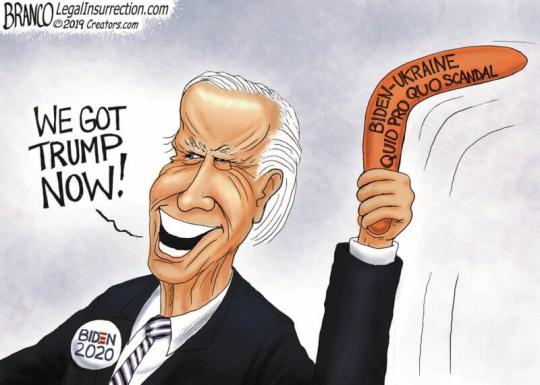
The two impeachment counts, abuse of power and obstruction of Congress, are flimsy. Proof of the first would require infallible mind-reading skills. It’s doubtful that the Democrats are any better at that than their inability to follow the simple facts of the case. During the controversial phone call with Ukrainian President Zelensky, Trump clearly expressed interest in whether the Ukraine would investigate possible interference in the 2016 U.S. presidential election, and whether the Bidens had been involved, given their involvement with Ukrainian organizations that may have had connections to the Steele dossier. That’s a fair question and a legitimate area of inquiry for the chief executive. It can’t be helped that Joe Biden happens to be running for the Democrat presidential nomination in 2020, as if running for office was enough to absolve one of crime.
The second impeachment count against Trump relies on vacating the constitutional privileges accorded to the chief executive, privileges to which President Obama, and others before him, generously availed themselves (also see here).
House Speaker Nancy Pelosi now has opted to delay transmitting the impeachment articles to the Senate. She said it was important for the House to wrap up their proceedings quickly, so much so that her party could not be bothered to bring a court challenge against Trump’s assertion of executive privilege. But now, Pelosi insists that she must be assured the Senate trial will be conducted “fairly”, as if the proceedings in the House were remotely fair to the President.
One of the House Democrats’ own expert witnesses asserts that the President’s impeachment is not official until the articles are transmitted to the Senate. That might be, but he overlooks the Supreme Court’s 1993 ruling in Nixon vs. the United States in which the Court said that no trial is required for the Senate to acquit anyone impeached by the House, and it may do so without judicial review. So, the Senate can acquit the President now, without a trial and without waiting for Speaker Pelosi to transmit the “charges”, should Senate Majority Leader Mitch McConnell decide to bring it to a vote. Of course, he might not want to as a matter of optics as well as pressure from an incensed Trump to air all of the laundry.
Like the misguided impeachment itself, Pelosi’s motive for holding the transmittal in abeyance is political. Democrats, quite possibly unaware of the Senate’s power under Nixon, and facing their comeuppance, might hope the public forgets the charade that took place in the House and blame Republicans for an “unfair” Senate process that would let Trump off the hook. Or, Pelosi might be hoping for a weakening of Republican resolve on establishing rules for a trial in the Senate, but even that calculation is chancy. It’s even possible Pelosi imagines she can delay the transfer through the 2020 election, hoping to use the House impeachment again and again as a cudgel with which to batter Trump’s re-election chances. Fat chance!
Or is the delay a form of damage control? Does it have something to do with Joe Biden’s vulnerability? He is perhaps at greater risk under a Senate impeachment trial of Trump than Trump himself. Biden is the one who gloated publicly of how he cowed the Ukrainians into dropping an investigation of Burisma, the gas company for which his son Hunter was a board member, by threatening to withhold loan guarantees. Quid Pro Joe!
Biden’s has stated that he would not comply with a subpoena to appear before the Senate in the matter of the Trump impeachment, apparently confusing Trump’s status as the executive with privilege with his own status as an out-of-office candidate for the Democrat nomination.Oh, wait! Now Biden says he would appearafter all! Is the contrast between Trump’s phone conversation with the Ukrainian President and Biden’s gloating admission pertinent? You bet!
Or perhaps Pelosi believes it’s unwise to hand the impeachment counts over to the Senate with John Durham’s investigation still hanging in the balance. Durham is looking into the efforts of U.S. intelligence agencies to spy on the Trump campaign in 2016. An ill-timed and damaging outcome for the Obama Administration could make the impeachment trial into a catastrophic event for Biden and other Democrats.
The Democrats’ have brought their longstanding lust for impeaching Trump to fruition only to find that they’ve miscalculated. First, Trump is practically guaranteed an acquittal, so the whole effort was and is a waste of time. Second, public opinion is far from rallying to the Dems cause. According to Gallup, Trump’s approval now is higher than Obama’s at the same point in his presidency, and support for impeachment hasn’t responded as the Democrats had hoped. In fact, if anything, support has eroded, especially in swing states, and the effort has strengthened Trump’s base of support. I would argue that it’s much worse for Democrats than the polls show. Many anti-Democrats, like me, actively avoid participating in polls. That’s partly because the framing of questions is often biased, and partly because I don’t want to be bothered. Finally, the Democrats seem not to fathom the political risks they face with impeachment: 28 Democrat representatives from districts Trump won in 2016 may now face stiffer odds against reelection in 2020, having cast their votes for impeachment. More critically, there are severe risks of a Senate trial to the Bidens, potentially other Obama Administration officials, and the Clintons.
Note: An acknowledgement goes to the Legal Insurrection blog and A.F. Branco for the cartoon at the top.
Listen, President Trump drives me crazy. His policy instincts often strike me as dangerous: trade protectionist, inflationist, and cronyist. I’m still suspicious that he might play ball with statists left and right on critical issues, when and if he perceives a political advantage in doing so. And Trump is hopelessly inarticulate and belligerent. Nevertheless, I will almost certainly vote for him in 2020 for several reasons, not least because the feasible alternatives are completely unacceptable. That view is reinforced by the behavior of the Democrat party in their effort to fabricate “high crimes and misdemeanors” on Trump’s part. That effort is not just dishonest, it is foolish, and they have a lot to lose. Their machinations are likely to blow up in their faces.
For one thing, the Democrats don’t seem to have much of a case. This time they are focused on a May 2019 phone conversation that took place between Trump and the recently-elected Ukrainian President Volodymyr Zelenskiy. The Democrats contend that Trump held up military aid in order to pressure Zelenskiy to investigate the Biden family’s activities in the Ukraine, a charge flatly denied by Zelenskiy. In fact, at the time of the call, the Ukrainians has no idea that military aid had been suspended, a fact first reported by The New York Times.
The Trump Administration released a transcript of the Zelenskiy call, which offers no evidence that a quid pro quo was offered by Trump. Even the text messages released this morning fail to support the claim. Joe Biden’s name came up during the call in connection with potential interference by the Ukraine in the 2016 U.S. presidential campaign. That’s reasonable in light of the events reported to have taken place, and it is certainly within the scope of presidential powers, as were Trump’s efforts to discuss election interference with Australia, the U.K., and other countries.
If you don’t know it already, a successful impeachment in the House of Representatives will not remove Trump from office. It will constitute a referral of charges to the Senate, which is controlled by Republicans, and a conviction requires a two-thirds majority. Ain’t gonna happen.
In the meantime, there really is no formal “impeachment” underway, despite what you think you’ve heard. This is a “proceeding” that House Speaker Nancy Pelosi really had no authority to initiate, and there is no set of rules or procedures guiding the spectacle. An impeachment investigation requires a House vote, but Democrats voted to table a resolution calling for such a vote because they really don’t want one, not yet anyway. Why? Because it would force them to go on record before they’re quite sure they want to, but more importantly it would demand due process for the accused. A House vote for an impeachment investigation would give House Republicans subpoena powers, something Democrats don’t want to take a chance on.
Again, the whole effort by the Democrats will ultimately be futile, and the trial proceedings in the Senate might be very ugly for them as well. It is likely to shed light on several matters that offer unflattering context for the impeachment effort and might well lead to criminal charges against prominent Democrats and their operatives:
Who authorized the change in requirements for whistleblower referrals from first-hand information to second-hand information, or hearsay? And when? Despite denials from left-wing fact-checkers, the Intelligence Community Inspector General’s narrative here doesn’t quite hang together. They gave the operative the wrong form? It’s been claimed that the operative provided first-hand information after all, but where is it?
Did members of Congress know about the operative’s complaint before it was formally referred to Congress? Apparently Adam Schiff, Chairman of the House Intelligence Committee, knew before the complaint was drafted, and he lied about it. Was there collaboration with the operative?
These are all troubling questions that should be investigated. We may or may not get to the bottom of it before the impeachment vote in the House, if it ever occurs. Senate Republicans will undoubtedly be interested in pursuing many of these areas of inquiry, and Joe Biden will not come out of this unscathed. There is likely considerable evidence to support claims that he used political influence to gain his son Hunter favor in the Ukraine and China.
This month, DOJ Inspector General Michael Horowitz is expected to release his report on the origins and conduct of the Russia investigation into Trump’s 2016 presidential campaign. including potential corruption of the FISA process. His report will reflect the findings of two U.S. attorneys conducting separate inquiries into various aspects of the matter. These reports are a potential disaster for Democrats. Perhaps the distraction of impeachment theatre seems desirable to them, but the longer they continue the fruitless effort to “get Trump”, which began well before he was elected, the more incompetent they look. They don’t seem to have noticed that the whole spectacle is strengthening Trump’s base of support.
Which brings me back to Trump’s belligerence, which I briefly decried above. And it’s true, I often wince, but then I often laugh out loud as well. His political opponents and the media are constantly aghast at his every unapologetic response to their attacks. I will readily admit that it’s deeply satisfying to witness him hurling the crap right back at them, right on the schnoz. In the case of the impeachment drama, his base of support and many others in the middle know the Dems richly deserve it.
Not long ago I wrote about how Snopes.com, the alleged “fact-checking” site, had become so politicized that its staff was rating posts on The Babylon Bee as false. Those posts were plainly written as satire. A related issue came to mind last weekend when I saw a meme on social media attributing the following statement to President Trump: “My crimes can’t be investigated while I’m president“. The meme used quote marks, but there was no link to a source.
It’s well known that Trump’s legal team contends that certain statements and actions he might take are protected by executive privilege and immunity. Given Trump’s frequent clumsy use of the language, I thought there was an outside chance that he DID say something like that! My uncertainty was ironic in the wake of my Snopes post! So I did a quick search and found an article in Vanity Fair headlined: Trump:My crimes can’t be investigated while I’m president, without quote marks. The opinion piece that followed was indeed a characterization of the Trump team’s legal strategy. The headline was obviously sarcasm and of course there was no attribution. Trump did not make any admission of criminal activity, contrary to the meme’s implication.
I knew the poster of the meme, whom I’ll call Dan, to be an individual who regards Trump with contempt, and certainly not the sort of guy who would bother to investigate the veracity of such a claim. Against my better judgement, I decided to tweak him a little. I asked if he could provide a source for the quote. He didn’t respond until late afternoon the next day, and not before one of his pals had attacked me for asking the question.
The crux of their defense was this: “It’s a meme! Don’t you know what a meme is?” There were other choice words from Dan’s pal… insults that is. The idea seems to be that memes can say anything and it’s okay if we say so. After all, they must think, people should know that such a misquote is fine because it illustrates the wrongheadedness of the Trump legal strategy… and Trump… via satire.
Do people know that it’s satire? No link. No source. Quote marks added. It was clearly intended to influence people, and I think it was intended to deceive as well. I’m not a Trump hater — more a critic of leftism having little choice other than Trump — but even I had to check on the quote! I’m pretty sure that lots of Trump haters and many non-haters would be duped. Not too many would bother to check, but at least a few did: I was surprised and delighted that Snopes rated the claim as false on Monday, and in a relatively straightforward way. Well, bully for Snopes!
Okay, the ridiculousness of it all! The idea that Trump would take ownership of alleged crimes, as in “my crimes”, an admission of guilt, is kind of funny, but mostly because it sounds like the kind of sloppy language he might have used. And of course people with a jaded view of Trump’s assertion of presidential powers might find the “quote” apropos. They should have their fun, but many of them know little about executive privilege, which is intended to protect the confidentiality necessary to carry out many presidential duties, or they give it short shrift, at least when a republican is in the White House. Less informed Trump detractors might be ready to accept the quote as fact without question.
What’s the difference between satire of the sort produced by The Babylon Bee and the fake quote? Again, posts from the Bee always link to its site, allowing immediate investigation for those who find the headline plausible. The story at the link always adds additional satire, usually so ridiculous that anyone should get the idea. But in case that’s not enough, the Bee clearly promotes itself as “Your Trusted Source For Christian News Satire“. Yes, the Bee has an edge and it is often political. It is designed to get a laugh, provoke thought, poke fun, and influence people. Some of the humor might be too close to the truth to suit observers on the Left, but perhaps that’s why it annoys them so much. Nevertheless, it is satire and it says so.
Humor has long been used as a political tool, but does good faith require some form of demarcation between purported facts and… the joke? The problem is that many such distinctions must be understood from context, or at least from experience with the source. Cartoons are readily interpreted as humorous commentary. A comedian’s audience is generally under no misapprehension about the “facts” presented during the set. Parody and satire might or might not be billed as such. Much like a comedy club, the audience is probably uninterested in fact-checks. But what about internet memes? They often lack the context provided by a source. It’s still a relatively new form of commentary and an extremely effective means of spreading messages… and misinformation. People have an irrational tendency to believe things they see in print. Quote marks are meaningful, and they should lend legitimacy to a retelling of someone’s words.
Was the “quote” so outrageous that I should have known it was merely a sarcastic meme? Maybe not when the subject is Trump! Anyway, my real objective was to make sure before taking a little dig at Dan, the poster. I quickly concluded the intent of the meme’s creator involved deceit, and I still think so. It’s all too common, which is too bad, but let the social media user beware!
Snopes.com began as an investigator of urban legends and rumors, exposing myths in an exercise that was useful and often fascinating. More recently, despite its founder’s weak argument to the contrary, Snopes has fully revealed its bias against certain political viewpoints, along with a tendency to avoid reporting some actual facts as facts when it suits itself. Lately this has reached a pathetic level, with the site drawing amused reaction to its confusion over the satiric nature of The Babylon Bee. The Bee is a truly funny site similar to The Onion, but it bills itself as “Christian Satire”. If you find that off-putting or think it means the humor must be cornpone, think again. Of course, there is no doubt that the Bee’s humor often pokes fun at the Left, which probably explains Snopes’ motives.
Snopes itself has not been above a bit of fibbing. Its “political fact-checker”, Kim Lacapria, is a former leftist blogger, known to have maligned the Tea Party as “Teahadists”, a funny mischaracterization of the unquestionably peaceful movement as violent. She’s not exactly a person you’d trust as an impartial arbiter of political “fact”. Linda Sue Grimes wrote an informative article with several prominent examples of bias by Snopes. There have also been reports of sordid personal and financial exploits by one of Snopes’ founders, much of which stands up to scrutiny.
In its latest misadventure in fact-weaving, Snopes’ has charged that the Bee published a story “intended to deceive” readers, and it claimed the Bee had done so in the past. The story was entitled “Georgia Lawmaker Claims Chick-Fil-A Employee Told Her To Go Back To Her Country, Later Clarifies He Actually Said ‘My Pleasure“. It was inspired by an incident in which the same Georgia lawmaker apparently had too many items in the express checkout at a Publix grocery store. She claimed that an angry white man told her to “go back to where you came from”. However, the Publix clerk with whom she had the altercation, who happens to be Cuban, denies having said any such thing, though he did admit to calling her a bitch. The lawmaker’s allegation seems suspiciously coincidental, having come in the immediate wake of Donald Trump’s controversial tweet that the quartet of federal lawmakers known as “The Squad” should “go back to where they came from”.
Apparently, the humor in the Bee’s article was just a bit too subtle for Snopes, whose “woke” employees have particularly vivid imaginations. The Bee article was funny precisely because it ridiculed those who hear racial “dog whistles” everywhere. The idea that a Chinese employee working a drive-through at Chick-Fil-A would say such a thing is unlikely to say the least. Anyone who has ever visited a Chick-Fil-A knows it. Too many of those with whistles in their ears haven’t had the pleasure.
Has the Bee intended to deceive its readers in the past? Perhaps Snopes was referring to an article entitled “CNN Purchases Industrial-Sized Washing Machine to Spin News Before Publication“. Snopes went to the trouble of calling that story false and bringing it to Facebook’s attention. Facebook actually issued a warning to the Bee (for which FB later apologized). But here’s the thing, in Grimes’ words:
“Debunking a piece of satire renders the debunker as functionally illiterate, appearing too ignorant to understand that a piece of satire does not function to relay information as a news report would.”
It’s actually much worse than that. If Snopes wants to to assess the objective truth of claims, that’s one thing, but it has drifted into the assessment of literary and authorial intent. That’s ominous for the cause of free discourse, especially to the extent that social media sites rely on Snopes as a filter to deplatform certain voices or silence points of view. Snopes has no business attempting to draw distinctions between satire and “fake news” or any intent to deceive, because it’s bound to get it wrong and already has. They might as well fact-check stand-up comics whose routines might confuse a few dimwitted members of the public, and Snopes just might do so if the comic doesn’t support its preferred political narrative. Snopes’ role is not to protect the unsophisticated from satire, and apparently its fact-checkers feel no compulsion to debunk the satire produced by The Onion, for example. The Bee’s pointed satire often serves the purpose of exposing the Left for its congenital stupidity, but that is anything but an effort to deceive, as much as Snopes might wish it was so.
What are you, a racist? To avoid that charge, apparently you must support fully open borders with absolutely no restrictions on crossings. The basis of that bizarre claim is that most immigrants are not of the ethnic majority, or rather most illegal immigrants are not of the ethnic majority. Thus, if you favor border controls of any kind, you must hate ethnic minorities. You are a racist! This hasty generalization is commonly made by reactionary minions of the Left, and it is standard rhetoric of leftist propaganda.
As many have noted, the U.S. benefitted for many years from a relatively liberal immigration regime, but policy became increasingly restrictive over a period of six or seven decades starting in the 1870s, sometimes in ways that were racially motivated. A few reforms began to take place in the 1940s, though various quotas remained a fixture. More recently, the threat of terrorism prompted restrictions, and the large population of illegal immigrants in the country, including immigrant children, stimulated debate over deportation vs. a path to citizenship.
Disparate Impacts
A real outcome of border controls takes the form of a “disparate impact”, a phenomenon prominent in areas of the law such as employment, fair lending, and fair housing. For example, standards like degree requirements or minimum credit scores tend to disqualify minority or “protected class” applicants disproportionately. Those standards, however, are not targeted explicitly at any class of individuals. Likewise, minorities represent a disproportionate share of those disqualified under immigration quotas. And minorities represent a vastly disproportionate share of illegal entrants apprehended by ICE because, as a practical matter, most border controls are targeted at country of origin, but not at specific minorities. Almost all illegal U.S. immigrants are members of populations that are ethnic minorities within the U.S. The top 10 countries of birth for all U.S. immigrants also have predominantly Hispanic or Asian population. Thesecountries accounted for roughly 57% of legal immigrants in 2017.
The courts have generally ruled that business standards having a disparate impact are defensible based on business necessity and the absence of effective alternatives having less disparate impact. So the issue here is whether border controls meet a compelling need having nothing to do with racial or ethnic preferences, and whether any adverse impact on protected classes can be minimized.
The simple fact is that most Americans opposing illegal immigration simply want those entrants to go through a liberalized legal process, which would of course reduce the disparate impact of tight border controls. So the worst that can be said about a preference for legal over illegal immigration is that it might have a disparate impact on prospective minority entrants, and that is uncertain under a liberalized regime of legal immigration. This preference is not racist, and it is not racist to demand that all entrants be vetted and identified, whether you believe it is economically sensible or that immigrants are more or less likely to engage in criminal or even terrorist activity.
Public Resources
Again, there are strong rationales for controlling immigration and enforcing the border that have nothing to do with racial preference. Borders are a critical aspect of national sovereignty, of course, including taxpayer sovereignty. There is no question that large numbers of immigrants strain scarce public resources in a variety of ways including public aid, education, law enforcement, housing, and other public services. In fact, the mere existence of aid programs provides incentives that encourage immigration, especially as activists push for broader accessibility of program benefits. The consequent strain on public resources escalates costs to taxpayers and compromises the quality of public programs for the qualified citizen-beneficiaries for whom they are intended. There is nothing racist about asserting that those strains should be minimized for the benefit of taxpayers and beneficiaries. Indeed, a recent poll found that a majority of Hispanics favor controls on immigration, including a border wall.
A further consequence is that citizens might perceive an unhealthy opportunism or exploitation by illegal immigrants availing themselves of what might seem like very generous public benefits. Rightly or wrongly, that perception tends to encourage forms of “otherism”. This is an example of how public policy can undermine social cohesion and the successful assimilation of immigrants.
The Labor Force
In general, immigration is a positive economic force. At a macro level, it supplements the growth of the labor force, traditionally a major driver of output gains. At the more fundamental micro level, it represents a movement of productive resources in response to incentives guiding them to higher-valued uses. The most productive workers tend to migrate away from low-wage economies toward high-wage economies. Again, however, low-productivity workers are attracted by the bundle of public benefits available, including our minimum wage laws. Those immigrants do not contribute to output gains at all if their productivity is less than the minimum wage. They will, however, attempt to compete for jobs at the minimum wage or even below that wage if their employers are willing to cheat.
Obviously, the legal minimum wage does not adjust to market conditions such as excess supplies of labor. The development of such a surplus would mean unemployment, including job losses among low-skilled legal residents. That is unfortunate not just for those losing jobs, but because these effects create more fertile ground for racism among both groups. This is another example of how public policy can create barriers to social cohesion.
So Who’s a Racist, Anyway?
Those casting aspersions of racism are often guilty of of losing historical perspective, and sometimes worse. A recent example is the refusal of democrats to deal with “the racist” Trump on the DACA bill he proposed in early 2018. That bill would have offered amnesty and a path to citizenship for 1.8 million Dreamers, individuals who arrived in the U.S. as undocumented child immigrants. How easy it is for progressives to forget that President Obama dithered away four years during which he could have proposed legislation to end the prosecution of Dreamers.
A more cogent example of selective memory among progressives is the history of the Democrat Party as one of racism, Jim Crow, and eugenics. The contention that the Republican Party has a history of racism is categorically false. We constantly hear that Republicans are guilty of using “dog whistles” to appeal to racist sentiment, but Mark Steyn provides a marvelous quote of James Taranto in which he gets at the truth of these divisive claims: “… if you can hear the whistle, you’re the dog.” There is great truth in that statement.
No one should forget that immigrants attempting to enter the country illegally are exposed to real dangers, and it should be discouraged. Natural conditions are harsh along the southern U.S. border, and many of those wishing to cross must contract for the services of guides who are often dangerous and untrustworthy. The risks for families and children should not be trivialized by those who would encourage massive flows of illegal entrants as a tool of policy change.
Border security is important to Americans because of the risks inherent in an uncontrolled border. These risks span national security, drug policy, taxpayer sovereignty, and other economic concerns. While racists might hate most immigrants, opposition to illegal immigration is often paired with support for liberalized legal immigration. That fact does not square with accusations of racism. Perhaps most importantly, encouraging an uncontrolled flow of immigrants in defiance of existing law creates harsh risks for the immigrants themselves, and especially the children who become innocent human collateral in the process. That the same shortsighted individuals who encourage such flows make a blanket charge of racism against those who demand a more rational and even liberalized process is grotesque and an affront to decency.
The Mueller Report effectively put to rest allegations of collusion between the Trump campaign and Russia to influence the 2016 election, despite lingering wails from crestfallen Trump haters. But Trump lovers and haters alike might agree that the report should have settled much more, including whether there was evidence on which a charge of obstruction of justice could be brought against Trump. Robert Mueller demurred from that responsibility as a prosecutor, but he left a few tempting but ultimately dangerous crumbs for those still obsessed with toppling Trump.
Mueller’s statement last Wednesday wavered around the suggestion that Trump might be guilty of obstruction, a connotation colored more by politics than evidence. My conclusions, gleaned from both the report and a few other sources, are the following:
There was no evidence of collusion between the Trump campaign and Russia.
The original allegations were an attempted set-up of Trump. The scheme relied in part on the fraudulent Christopher Steele dossier, which was financed by the Clinton campaign, as well as a series of misrepresentations and suspicious contacts arranged by high-level officials at the Department of Justice and the FBI. That the entire investigation might have been compromised by such a conspiracy was not addressed by Mueller in the report, but we will learn more very soon when the DOJ’s Inspector General issues his findings. The IG will be interviewing Steele himself in the UK before long.
Mueller probably knew there was no collusion early in the investigation, but he persisted in “investigating” for two years. In my view, that created the appearance of an effort to entrap an angry Trump on obstruction charges.
Trump reacted to the collusion charges with a kind of raving petulance. Of course, it’s hard to blame him for his anger, and Mueller more-or-less acknowledged that. Trump did and said things that surely sounded intemperate, though some were within his prerogative (e.g., firing James Comey). Certain impulsive statements and actions might have risen to the level of obstruction had he not “changed his mind”, or had he bothered to follow-up on execution by aides. And Trump made statements (not under oath) that we’re intended to influence public opinion and possibly the willingness of certain witnesses to cooperate with investigators, but that sort of intent is hard to prove.
Of the ten instances of possible obstruction listed by Mueller in his report, two came dangerously close to qualifying as obstruction, two others were more of a stretch, and the rest were readily explained by motives other than an intent to obstruct, as Mueller sometimes indicated in the report.
Several of the possible obstruction issues were mitigated by Trump’s apparent willingness to cooperate with the investigation, including the provision to Mueller’s office of a huge volume of emails and documents, and by allowing members of the administration to be interviewed, some at great length.
Jonathan Turley has expressed his dismay at three underhanded actions taken by Mueller, one in the report itself and two in the wake of its delivery to his superiors at the DOJ (Attorney General William Barr and Deputy AG Rod Rosenstein). The first was an omission: Mueller chose not to identify grand jury material that had to be redacted before release to the public. This was contrary to instructions and with knowledge that the omission would delay the report’s release to the public and reflect badly on Barr.
The second action noted by Turley was a letter sent by Mueller to Barr complaining about the “impression” created by Barr’s summary of the report, despite the fact that Barr had invited Mueller to review the summary in advance. The letter also asked Barr to “release uncleared portions of the report”, which Mueller knew was prohibited. This also seems to have been intended to reflect badly on Barr.
Turley’s third point is Mueller’s legally incoherent statement that “he would have cleared Trump if he could have” but chose not to draw a conclusion. Mueller invoked an opinion from the DOJ’s Office of Legal Council (OLC), which he claimed prohibited the indictment of a sitting president. But over a period of two years, he failed to seek further guidance on the question from the OLC, his superiors, or the Inspector General.
A more obvious explanation for Mueller’s failure to seek an indictment is that he knew that no grand jury would indict on the evidence as described in the ten instances of possible obstruction he listed in the report.
Essentially Mueller left the ball in Barr’s court to decide whether to seek an indictment of Trump on obstruction changes, and Barr decided that the evidence did not support it.
However, the very idea of obstruction is moot, or should be, given the first three points above. And apparently Mueller never intended to seek an indictment on collusion, as he stated again last Wednesday.
Mueller strayed outside the role of a prosecutor and potentially subverted the cause of justice in stating that he could not exonerate the president of obstruction. There is no such thing as “exoneration” of an accused in U.S. criminal law. Mueller’s role as a prosecutor was to make a determination as to whether he should recommend an indictment against Trump. It was not his role to determine Trump’s guilt and certainly not his innocence, and innocence must always be the presumption.
The Mueller report could provide Congress with a “roadmap” for impeachment of Trump on charges of obstruction. If House Democrats decide to take that road, it would very likely be a prescription for their electoral suicide.
No matter how aggravating and uncouth you find Trump, and no matter how unwise his policies might prove to be, he was elected fair and square. Nevertheless, his opponents in Congress and on the campaign trail can’t easily give up the impeachment rhetoric without angering their leftist base. But not all congressional Democrats are voicing support for impeachment proceedings, and House Majority Leader Nancy Pelosi is doing her best to manage the division without making a commitment either way. The Senate will never go along with impeachment, of course. Now, a House vote to merely censure Donald Trump is mentioned as a possible “exit-ramp” to compromise that would let the hard-line impeachers down easy. Whatever they do, however, some Democrats might hope to drag out the process in an attempt to inflict maximal damage to Trump’s reelection prospects. And that, too, is probably ill-advised, because people are getting tired of all this.
It’s a constitutional crisis! Or so claim congressional Democrats, but at this point it looks more like a one-party panic attack. They keep sniffing the trailing fumes of the Mueller investigation, which turned up nothing on the President, or at least nothing worth prosecuting. There is also an ongoing dispute over the President’s tax returns, which he has chosen not to make public. Last week, House Ways and Means Committee Chairman Richard Neal subpoenaed the IRS for six years of Trump’s tax returns, but that is likely to be ignored. There is no law or requirement that Trump release the returns, and the IRS would be under no obligation to comply with the subpoena if it has “no legislative purpose”, as Treasury Secretary Steve Mnuchin said of an earlier request by Neal. For his part, Trump has falsely claimed to the public that an ongoing audit prevents him from releasing his tax documents, but he is fully within his legal rights to withhold his returns, at least for now. His decision is, no doubt, political and it may be wise to that extent. Nevertheless, the suspicion that Trump is a tax cheat is fueled by his very reluctance to make the returns public.
Constitutional Protection
The legality of Trump’s refusals to make the returns public is established in the Constitution, according to law professor Adam Grewal of the University of Iowa:
“Though a federal statute seemingly compels the IRS to furnish, on request, anyone’s tax returns to some congressional committees, a statute cannot transcend the constitutional limits on Congress’s investigative authority. Congress enjoys a near-automatic right to review a President’s tax returns only in the impeachment context.”
If explicit action is taken to impeach the President, justifiably or not, then presumably he or the IRS would be forced to turn over his tax returns to Congress. Even then, however, it would probably become the subject of a protracted court fight.
Partisan Charges
It’s not surprising that Trump has engaged expensive tax experts for the Trump organization and his personal taxes. Of course he has! Anyone in his position would be crazy not to. Minimizing taxes is a complex undertaking even for those having far less wealth and business complexity than a Donald Trump. There is no reason why he should have foregone any tax advantages for which he or his business was entitled. And in fact, he was entitled to use losses on a number of failed enterprises over the years to offset other income for tax purposes. Under these circumstances, a tax liability of zero is not terribly surprising.
Specific claims that Trump is a tax cheat are as yet unfounded. As Jeffrey Carter explains, there is an array of tax provisions intended to provide incentives to businesses precisely because tax law has been crafted to encourage business activity; real estate development is no exception. The idea is that businesses encourage employment, income, incremental tax revenue, and eventually more development. While I generally oppose tax provisions that impinge on specific kinds of human activity, there is nothing illegal or even immoral about taking advantage of tax rules that exist. In fact, there are legal tax maneuvers that can allow a successful real estate development business to generate continuing tax losses.
There are allegations that the Trump organization used fraudulent appraisals to understate values of buildings as a means of minimizing taxes. A variety of appraisal techniques are used in commercial real estate, each involving a series of assumptions and possible adjustments. Appraisals might be especially difficult for complex properties such as large, high-end gambling developments. Perhaps reviews of appraisals are part of the ongoing IRS audit to which Trump referred. There’s little doubt that Trump’s tax advisors would have sought to use the most advantageous techniques and assumptions that would pass scrutiny by the IRS and other tax authorities. However, it is unlikely that he was intimately involved in the appraisal process himself. The audit should determine whether their methods were excessive, not a swarm of politicians and leftist journalists. The penalties for any past understatement of taxes might be financially significant, but his presidency would almost certainly survive such a finding.
Again, Trump may be wise to withhold his tax returns. In today’s political environment, every deduction, credit, and loss carry-forward would be characterized by Democrats and the media as an affront to the American people. In fact, most American taxpayers attempt to minimize their taxes, as well they should. In a world with a simple, sane tax code, a simple definition of taxable income, and a competent IRS, there would be little reason for the clamor over public disclosure of tax data by public officials or candidates for office.
Universal Tax Disclosure? No
That brings me to the subject of a rather striking proposal: Robin Hanson believes that all tax returns should be made publicly available: yours, mine and Donald Trump’s. That change was made in the U.S. in 1924, but soon reversed, according to Hanson. It is done today in Norway, though the identity of anyone seeking that information on a taxpayer is made available to the taxpayer. Without the latter condition, the idea seems like an invitation to voyeurism, or worse. The several rationales offered by Hanson all tend to fall under the rubric that “transparency is good”. He includes critical remarks from Tyler Cowan on the proposal, dismissing them all on various grounds. But I happen to agree with Cowan that not all transparency is good. In fact, my first reaction is that the proposal would be an unnecessary extension of the intrusion into private affairs made by government taxation of income.
Universal tax disclosure might have some value in discouraging tax evasion, and perhaps the IRS could create a schedule of buy-off rates by income level at which tax information would be kept private. However, I’m skeptical of the other benefits cited by Hanson. For one thing, if the identity of the inquirer is revealed, many of the purported benefits would be nullified by discouraging the queries. To the extent that transparency has value, many credit transactions or credit payment mechanisms already require verification of income. Insurance underwriting is also sometimes dependent on proof of income. I am skeptical that the ability of workers to collect information from the tax returns of other individuals would greatly improve the efficiency of labor markets. The value of income data to counter-parties in other kinds of relationships, such as prospective marriage, would seem to be balanced by the value of privacy. Hanson says that people don’t place a high value on privacy, but it clearly has value, and I’m not sure his Twitter poll with a single price point is a valid test of the proposition. And again, with the simple tax code we should have, the benefits of acquiring the tax returns of politicians would boil down to an opportunity for shaming the rich and “tax pinchfists” (successful tax minimizers), which is what some of this is about anyway.
Conclusion
Donald Trump’s tax returns are a prize that his detractors hope will reveal an abundance of classist political fodder and perhaps even evidence of misdeeds. They can only hope. Unless Articles of Impeachment are drafted in the House of Representatives, the Constitution protects President Trump’s tax returns from congressional scrutiny. Trump is probably wise to resist disclosure of his taxes, since the returns would be picked over by the Left and criticized for any whiff of tax management, legal or otherwise. Trump’s businesses hired experts to aggressively minimize tax liabilities, but there is no evidence that they engineered any illegal maneuvers.
Finally, to suggest that all tax returns be made publicly accessible is to support a massive invasion of privacy. Then again, the very imposition of our complex income tax code is a massive invasion of privacy, and one that creates a substantial compliance burden on all income earners.
So lacking is the average American’s knowledge of civics that they often react in shock to the suggestion that the United States was never intended to be a pure democracy. But unchecked democracy is not a system that can be counted upon to maintain stability, something the founders knew when they fashioned the country as a constitutional republic. This point bears emphasis given the recent calls to abolish the Electoral College (EC) by such Democrat luminaries as Elizabeth Warren and Beto O’Rourke. Others, like Socialist-cum-Democrat Bernie Sanders, say they want to “assess” the EC.
Jon Gabriel describes the EC as one of a series of stabilizing checks and balances embedded in our system of government. It served the purpose of balancing interests across diverse regional economies and sub-cultures:
“By distributing our presidential choice among 51 individual elections, nominees must appeal to a wide variety of voters with a wide variety of interests. Farmers in Wisconsin are important, as are retirees in Florida, factory workers in Pennsylvania, and shopkeepers in Arizona. White Evangelicals need to be courted in Charlotte, as do Latino Catholics in Mesa.
If the Electoral College were abandoned, party frontrunners would camp out exclusively in urban areas. The pancake breakfasts in Des Moines and Denver would be replaced with mammoth rallies in Los Angeles and New York City.”
So diverse were these interests in the late 1700s that it’s reasonable to assume that the Constitutional Convention would have failed without the creation of the EC. Today, no less, our country would be unlikely to survive the EC’s elimination. Why, for example, would voters in Missouri wish to allow the preferences of east and west coast voters to dominate federal policy-making?
Gabriel provides some interesting history giving emphasis to the notion of a tyranny of the majority under pure democracy:
“The world’s first democracy was ancient Athens, which allowed around 30,000 free adult male citizens to choose their leaders. They made up less than 15 percent of the population, but it was the most egalitarian political innovation to date.
Athen’s unbridled democracy, however, led to the very extremes that sowed its decline and defeat at the hands of enemies. This note from Edward Conway on Quora is instructive (his is the third commentary at the link; most of the others are helpful, but his is most succinct):
“… ancient Athenian democracy was purely a matter of votes: if you wanted to win a court case, or pass a law, or tax a group, or go to war, or massacre a large number of people, the only check was whether you could convince a majority of the citizens to vote in your favor. While there were means of checking individual people (see: Ostracon), this did nothing to check the power of the crowds, as it only removed one focus of this power.
Thus Athenian democracy never moved beyond the initial ‘UNLIMITED POWER!’ stage. Anyone who could convince the crowd to follow them had unchecked authority until they lost control of the crowd.
This led, predictably, to excesses: ‘Let’s attack Sparta!’, ‘Let’s invade Sicily!’, ‘Let’s ostracize our best general!’, etc.“
It’s interesting that the Athenian military was staffed by plebeians who found imperialistic actions to be profitable. Naturally, they voted to devote more resources to military incursions… until they were defeated. Allowing a large faction to vote on their own pay, and the taxes on others necessary to pay for it, can be a glaring defect of democracy. We see manifestations of the same phenomenon today in congressional pay raises and expansion of federal benefits for large segments of the population who pay no taxes.
Back to Gabriel:
As the saying goes, democracy is four wolves and a lamb voting on what to have for lunch. The Founders looked to Athens less as a political model than an object lesson in what not to do.
The EC was a stroke of political genius: It allowed the delegates at the Constitutional Convention to reach a consensus, something that would probably be just as difficult to accomplish today as it was then. The EC transforms one federal election into 51 local elections, reducing the feasibility of tampering by the party in power at the federal level. It also reduces the incentive for electoral fraud in a national race because a greater margin of victory within a state cannot gain the votes of additional electors.
The noise regarding the EC is coming from just one side of the political aisle: Donald Trump’s electoral victory in 2016, and his reasonably good prospects for reelection in 2020, have inflamed the passions of Democrats, who are now grasping at any and all ways in which they might tilt the playing field their way. Relative to electoral votes, popular votes are heavily concentrated in the coastal “blue” states. Such a change in the rules of the game would certainly stand to benefit Democrats. Therefore, the debate looks suspiciously like it has nothing to do with “good governance” and electoral integrity, and everything to do with raw politics.
It’s useful to remember that the EC was an essential incentive for gaining the buy-in of smaller states to join the Union. It remains vitally important to states whose interests would likely be neglected if presidential politics was dominated by the coastal states. Fortunately, the founders invested the EC with durability: rescinding it would require a constitutional amendment. That could happen if two-thirds of the state legislatures agree to convene a constitutional convention. Or, it could be proposed by a two-thirds majority in both houses of Congress, then ratified by three-fourths of the state legislatures. Ain’t gonna happen.
We can lament the tragic forest fires burning in California, but a discussion of contributing hazards and causes is urgent if we are to minimize future conflagrations. The Left points the finger at climate change. Donald Trump, along with many forestry experts, point at forest mismanagement. Whether you believe in climate change or not, Trump is correct on this point. However, he blames the state of California when in fact a good deal of the responsibility falls on the federal government. And as usual, Trump has inflamed passions with unnecessarily aggressive rhetoric and threats:
“There is no reason for these massive, deadly and costly forest fires in California except that forest management is so poor. Billions of dollars are given each year, with so many lives lost, all because of gross mismanagement of the forests. Remedy now or no more Fed payments.”
Trump was condemned for his tone, of course, but also for the mere temerity to discuss the relationship between policy and fire hazards at such a tragic moment. Apparently, it’s a fine time to allege causes that conform to the accepted wisdom of the environmental Left, but misguided forest management strategy is off-limits.
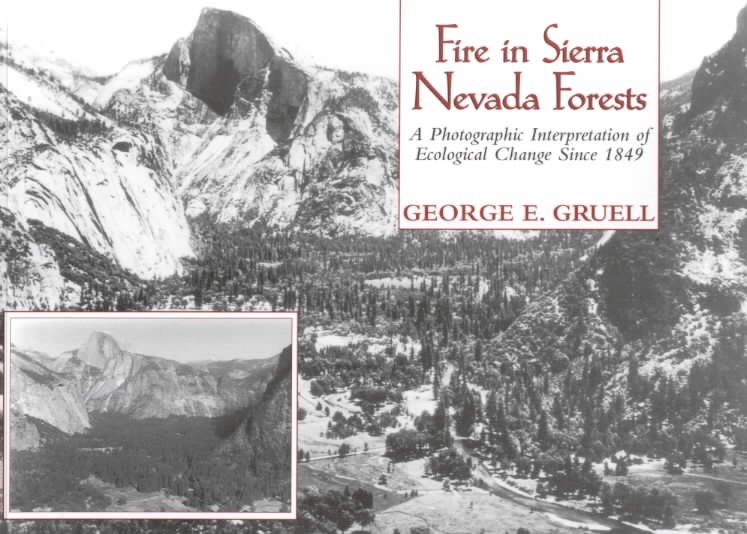
The image at the top of this post is from the cover of a book by wildlife biologist George E. Gruell, published in 2001. The author includes hundreds of historical photos of forests in the Sierra Nevada range from as early as 1849. He pairs them with photos of the same views in the late 20th century, such as the photo inset on the cover shown above. The remarkable thing is that the old forests were quite thin by comparison. The following quote is from a review of the book on Amazon:
“Even the famed floor of Yosemite is now mostly forested with conifers. I myself love conifers but George makes an interesting point that these forests are “man made” and in many ways are unhealthy from the standpoint that they lead to canopy firestorms that normally don’t exsist when fires are allowed to naturally burn themselves out. Fire ecology is important and our fear of forest fires has led to an ever worsening situation in the Sierra Nevada.”
I posted this piece on forest fires and climate change three months ago. There is ample reason to attribute the recent magnitude of wildfires to conditions influenced by forest management policy. The contribution of a relatively modest change in average temperatures over the past several decades (but primarily during the 1990s) is rather doubtful. And the evidence that warming-induced drought is the real problem is weakened considerably by the fact that the 20th century was wetter than normal in California. In other words, recent dry conditions represent something of a return to normal, making today’s policy-induced overgrowth untenable.
Wildfires are a natural phenomenon and have occurred historically from various causes such as lightning strikes and even spontaneous combustion of dry biomass. They are also caused by human activity, both accidental and intentional. In centuries past, Native Americans used so-called controlled or prescribed burns to preserve and restore grazing areas used by game. In the late 19th and early 20th centuries, fire suppression became official U.S. policy, leading to an unhealthy accumulation of overgrowth and debris in American forests over several decades. This trend, combined with a hot, dry spell in the 1930s, led to sprawling wildfires. However, Warren Meyer says the data on burnt acreage during that era was exaggerated because the U.S. Forest Service insisted on counting acres burned by prescribed burns in states that did not follow its guidance against the practice.
The total acreage burned by wildfires in the U.S. was minimal from the late 1950s to the end of the century, when a modest uptrend began. In California, while the number of fires continued to decline over the past 30 years, the trend in burnt acreage has been slightly positive. Certainly this year’s mega-fires will reinforce that trend. So the state is experiencing fewer but larger fires.
The prior success in containing fires was due in part to active logging and other good forest management policies, including prescribed burns. However, the timber harvest declined through most of this period under federal fire suppression policies, California state policies that increased harvesting fees, and pressure from environmentalists. The last link shows that the annual “fuel removed” from forests in the state has declined by 80% since the 1950s. But attitudes could be changing, as both the state government and environmentalists (WSJ, link could be gated) are beginning to praise biomass harvesting as a way to reduce wildfire risk. Well, yes!
The reason wildfire control ever became a priority is the presence of people in forest lands, and human infrastructure as well. Otherwise, the fires would burn as they always have. Needless to say, homes or communities surrounded by overgrown forests are at great risk. In fact, it’s been reported that the massive Camp Fire in Northern California was caused by a PG&E power line. If so, it’s possible that the existing right-of-way was not properly maintained by PG&E, but it may also be that rights-of-way are of insufficient width to prevent electrical sparks from blowing into adjacent forests, and that’s an especially dangerous situation if those forests are overgrown.
Apparently Donald Trump is under the impression that state policies are largely responsible for overgrown and debris-choked forests. In fact, both federal and state environmental regulations have played a major role in discouraging timber harvesting and prescribed burns. After all, the federal government owns about 57% of the forested land in California. Much of the rest is owned privately or is tribal land. Trump’s threat to withhold federal dollars was his way of attempting to influence state policy, but the vast bulk of federal funds devoted to forest management is dedicated to national forests. A relatively small share subsidizes state and community efforts. Disaster-related funding is and should be a separate matter, but Trump made the unfortunate suggestion that those funds are at issue. Nevertheless, he was correct to identify the tremendous fire hazard posed by overgrown forests and excessive debris on the forest floor. Changes to both federal and state policy must address these conditions.
For additional reading, I found this article to give a balanced treatment of the issues.
In advanced civilizations the period loosely called Alexandrian is usually associated with flexible morals, perfunctory religion, populist standards and cosmopolitan tastes, feminism, exotic cults, and the rapid turnover of high and low fads---in short, a falling away (which is all that decadence means) from the strictness of traditional rules, embodied in character and inforced from within. -- Jacques Barzun





 Sacred Cow Chips