• About

Sacred Cow Chips

Sacred Cow Chips

Tag Archives: Donald Trump

The Disastrous Boomerang Effect of Fire Suppression

15 Thursday Nov 2018

Posted by Nuetzel in Environment, Wildfires

≈ Leave a comment

Tags

Biomass Harvesting, Camp Fire, Climate Change, Donald Trump, Fire Suppression, Forest Fires, Forest Management, George E. Gruell, PG&E, Prescribed Burns, Sierra Nevada, Spontaneous Combustion, Timber Harvest, U.S. Forest Service, Warren Meyer, Wildfires

We can lament the tragic forest fires burning in California, but a discussion of contributing hazards and causes is urgent if we are to minimize future conflagrations. The Left points the finger at climate change. Donald Trump, along with many forestry experts, point at forest mismanagement. Whether you believe in climate change or not, Trump is correct on this point. However, he blames the state of California when in fact a good deal of the responsibility falls on the federal government. And as usual, Trump has inflamed passions with unnecessarily aggressive rhetoric and threats:

“There is no reason for these massive, deadly and costly forest fires in California except that forest management is so poor. Billions of dollars are given each year, with so many lives lost, all because of gross mismanagement of the forests. Remedy now or no more Fed payments.”

Trump was condemned for his tone, of course, but also for the mere temerity to discuss the relationship between policy and fire hazards at such a tragic moment. Apparently, it’s a fine time to allege causes that conform to the accepted wisdom of the environmental Left, but misguided forest management strategy is off-limits.

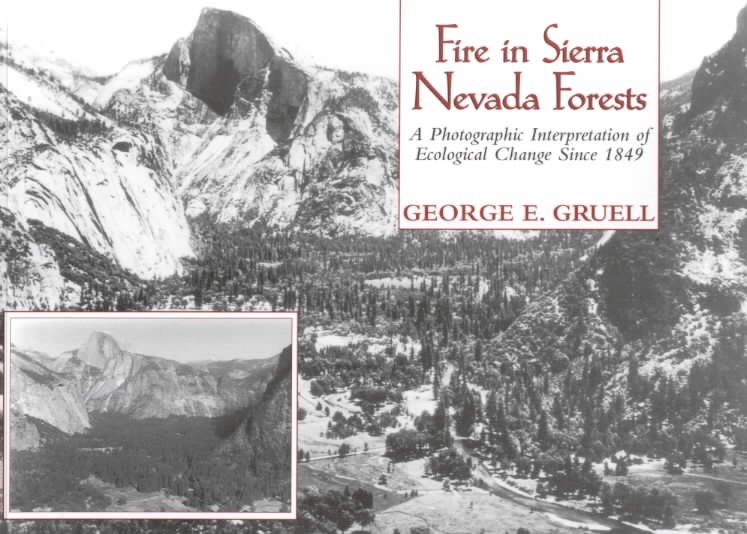
The image at the top of this post is from the cover of a book by wildlife biologist George E. Gruell, published in 2001. The author includes hundreds of historical photos of forests in the Sierra Nevada range from as early as 1849. He pairs them with photos of the same views in the late 20th century, such as the photo inset on the cover shown above. The remarkable thing is that the old forests were quite thin by comparison. The following quote is from a review of the book on Amazon:

“Even the famed floor of Yosemite is now mostly forested with conifers. I myself love conifers but George makes an interesting point that these forests are “man made” and in many ways are unhealthy from the standpoint that they lead to canopy firestorms that normally don’t exsist when fires are allowed to naturally burn themselves out. Fire ecology is important and our fear of forest fires has led to an ever worsening situation in the Sierra Nevada.”

I posted this piece on forest fires and climate change three months ago. There is ample reason to attribute the recent magnitude of wildfires to conditions influenced by forest management policy. The contribution of a relatively modest change in average temperatures over the past several decades (but primarily during the 1990s) is rather doubtful. And the evidence that warming-induced drought is the real problem is weakened considerably by the fact that the 20th century was wetter than normal in California. In other words, recent dry conditions represent something of a return to normal, making today’s policy-induced overgrowth untenable.

Wildfires are a natural phenomenon and have occurred historically from various causes such as lightning strikes and even spontaneous combustion of dry biomass. They are also caused by human activity, both accidental and intentional. In centuries past, Native Americans used so-called controlled or prescribed burns to preserve and restore grazing areas used by game. In the late 19th and early 20th centuries, fire suppression became official U.S. policy, leading to an unhealthy accumulation of overgrowth and debris in American forests over several decades. This trend, combined with a hot, dry spell in the 1930s, led to sprawling wildfires. However, Warren Meyer says the data on burnt acreage during that era was exaggerated because the U.S. Forest Service insisted on counting acres burned by prescribed burns in states that did not follow its guidance against the practice.

The total acreage burned by wildfires in the U.S. was minimal from the late 1950s to the end of the century, when a modest uptrend began. In California, while the number of fires continued to decline over the past 30 years, the trend in burnt acreage has been slightly positive. Certainly this year’s mega-fires will reinforce that trend. So the state is experiencing fewer but larger fires.

The prior success in containing fires was due in part to active logging and other good forest management policies, including prescribed burns. However, the timber harvest declined through most of this period under federal fire suppression policies, California state policies that increased harvesting fees, and pressure from environmentalists. The last link shows that the annual “fuel removed” from forests in the state has declined by 80% since the 1950s. But attitudes could be changing, as both the state government and environmentalists (WSJ, link could be gated) are beginning to praise biomass harvesting as a way to reduce wildfire risk. Well, yes!

The reason wildfire control ever became a priority is the presence of people in forest lands, and human infrastructure as well. Otherwise, the fires would burn as they always have. Needless to say, homes or communities surrounded by overgrown forests are at great risk. In fact, it’s been reported that the massive Camp Fire in Northern California was caused by a PG&E power line. If so, it’s possible that the existing right-of-way was not properly maintained by PG&E, but it may also be that rights-of-way are of insufficient width to prevent electrical sparks from blowing into adjacent forests, and that’s an especially dangerous situation if those forests are overgrown.

Apparently Donald Trump is under the impression that state policies are largely responsible for overgrown and debris-choked forests. In fact, both federal and state environmental regulations have played a major role in discouraging timber harvesting and prescribed burns. After all, the federal government owns about 57% of the forested land in California. Much of the rest is owned privately or is tribal land. Trump’s threat to withhold federal dollars was his way of attempting to influence state policy, but the vast bulk of federal funds devoted to forest management is dedicated to national forests. A relatively small share subsidizes state and community efforts. Disaster-related funding is and should be a separate matter, but Trump made the unfortunate suggestion that those funds are at issue. Nevertheless, he was correct to identify the tremendous fire hazard posed by overgrown forests and excessive debris on the forest floor. Changes to both federal and state policy must address these conditions.

For additional reading, I found this article to give a balanced treatment of the issues.

The Master Negotiator: I’ll Beat Myself Till You Accept My Terms!

07 Wednesday Mar 2018

Posted by Nuetzel in Free Trade, Tariffs, Trump Administration

≈ Leave a comment

Tags

Balance of Trade, Chinese Trade Policy, Coyote Blog, Cronyism, Donald Trump, Dumping, NAFTA, National Security, Panda Blog, Peter Navarro, Pierre Lenieux, Protectionism, Stephen Mihm, Tariffs, Trade Retaliation, Trade War, Warren Meyer, Wilbur Ross

As if you needed more evidence that governments are incompetent, look no further than trade policy: public officials the world over are almost universally ignorant regarding the effects of international trade and trade imbalances. In this sense, the Trump Administration’s new tariffs on imported steel and aluminum are in keeping with the long history of public sector foibles on trade. This phenomenon stems from an unhealthy and obsessive focus on the well-being of producers without regard to the implications of policy for consumers. Warren Meyer of Coyote Blog offers an evaluation of Chinese trade policy, which he mischievously (I believe) claims was written by a Chinese blogger on a “sister blog” called “Panda Blog“. Despite Meyer’s playfulness, the post is instructive:

“Our Chinese government continues to pursue a policy of export promotion, patting itself on the back for its trade surplus in manufactured goods with the United States. The Chinese government does so through a number of avenues, … each and every one of these government interventions subsidizes US citizens and consumers at the expense of Chinese citizens and consumers. A low yuan makes Chinese products cheap for Americans but makes imports relatively dear for Chinese. So-called ‘dumping’ represents an even clearer direct subsidy of American consumers over their Chinese counterparts. And limiting foreign exchange re-investments to low-yield government bonds has acted as a direct subsidy of American taxpayers and the American government, saddling China with extraordinarily low yields on our nearly $1 trillion in foreign exchange. Every single step China takes to promote exports is in effect a subsidy of American consumers by Chinese citizens.“

The very idea of a trade deficit is often used to intimate a threat to a nation’s economic health. Conversely, a trade surplus is used to suggest that a nation is achieving great economic success. Both contentions are nonsense. Here is more from “Panda Blog“:

“We at Panda Blog believe it is insane for our Chinese government to continue to chase the chimera of ever-growing foreign exchange and trade surpluses. These achieved nothing lasting for Japan and they will achieve nothing for China. In fact, the only thing that amazes us more than China’s subsidize-Americans strategy is that the Americans seem to complain about it so much. They complain about their trade deficits, which are nothing more than a reflection of their incredible wealth. … They complain about China buying their government bonds, which does nothing more than reduce the costs of their Congress’s insane deficit spending. They even complain about dumping, which is nothing more than a direct subsidy by China of lower prices for American consumers.

And, incredibly, the Americans complain that it is they that run a security risk with their current trade deficit with China! This claim is so crazy, we at Panda Blog have come to the conclusion that it must be the result of a misdirection campaign by CIA-controlled American media. After all, the fact that China exports more to the US than the US does to China means that by definition, more of China’s economic production is dependent on the well-being of the American economy than vice-versa.“

By the way, those “quotes” from “Panda Blog” appeared on Coyote Blog 12 years ago!

All nations tend to play these trade games to one extent or another. But protectionist actions always harm a nation’s consumers more than they help producers, a proposition that is easy to demonstrate using a simple supply and demand diagram. While the class of consumers is broader than the class of producers, ultimately “producer” and “consumer” are different roles played by the same individuals. So protectionism is always harmful to a nation, on balance. Furthermore, retaliation against another nation for its dim-witted trade barriers also harms the retaliating nation’s consumers more than it helps its producers, and that’s true regardless of whether retaliation begets reciprocal actions.

Of course, producers are generally in a better position than consumers to grease the political skids in their favor. In a separate post, Meyer notes that protectionist trade policies are rooted in cronyism. The costs to society are very real, but they tend to be diffuse and therefore less obvious to most consumers.

“A lot of the media seems to believe the biggest reason they are bad is that they will incite retaliatory tariffs from other countries, which they almost certainly will.  But even if no one retaliated, even if the tariffs were purely unilateral, they would still be bad. In case after case, they are justified as increasing the welfare of a certain number of workers in targeted industries, but they hurt the welfare of perhaps 100x more people who consume or work for companies that consume the targeted products. Prices will rise for everyone and choices will be narrowed.“

A couple of points deserve emphasis in relation to my last post on Trump’s tariff action:

  • In terms of jobs, the tariffs announced by President Trump present a very poor risk-reward tradeoff (WSJ article is gated):

“The policy point is that Mr. Trump’s tariffs are trying to revive a world of steel production that no longer exists. He is taxing steel-consuming industries that employ 6.5 million and have the potential to grow more jobs to help a declining industry that employs only 140,000.“

  • Stephen Mihm discusses ways in which the U.S. steel industry squandered its superiority in the post-World War II era. Much of Mihm’s article is devoted to the industry’s failure to upgrade to new production technologies. Interestingly, however, it fails to mention the damaging role played by unions in the process. “Dumping” had very little to do with it.
  • Finally, Pierre Lemieux takes a closer look at the national security argument for trade barriers. He concludes that it is fallacious. Of course, it is an excuse for cronyism. Protectionism harms the competitiveness of the protected industries, which actually undermines national security. And protectionism is usually unnecessary on close examination. In the case of steel, for example, national defense and homeland security use only about 3% of American steel production. Beyond that simple fact, the argument is dangerously open-ended. Almost anything can be represented as critical to national security: steel, food, clothing, and many other categories. Even human resources.

Today, Trump announced that Canada and Mexico will be exempt from the new tariffs while a renegotiation of the North American Free Trade Agreement (NAFTA) is underway. That’s better, but this carve-out exempts only 25% of U.S. steel imports. Perhaps Australia will be granted an exemption as well, but additional carve-outs will prompt further increases in tariffs on non-exempt imports. Trump also said that U.S. flexibility in applying the new tariffs to allies will depend on their commitments for military spending!

Thus, rather than maintaining the pretense that trade relationships are about economics, the administration has conceded that the tariffs and the exemption process will be transparently political, never a prescription for efficient resource allocation. Moreover, U.S. trading partners are likely to be reluctant to test the politics of modifying their own trade manipulations at home. Indeed, the politics may dictate retaliation, rather than concessions. In any case, the governments of our trading partners are as clueless on trade as Trump, his Commerce Secretary Wilbur Ross, and his economic advisor Peter Navarro, or they would never intervene in private trade decisions to begin with.

Slam the Damn Brakes on the Regulatory Potentate

28 Saturday Oct 2017

Posted by Nuetzel in Regulation

≈ Leave a comment

Tags

Administrative State, Barry Brownstein, Corn Ethanol, crony capitalism, DARPA, Deregulation, Donald Trump, Drug Review, EPA, FCC, FDA, Greg Ip, Industrial Policy, Mercatus Center, NASA, Net Neutrality, Paris Climate Accord, Patrick McLaughlin, Puerto Rico, Renewable Fuel Standards, Steve Bannon, The Brookings Institution, Two-For-One Regulatory Order

The stock market’s recent gains have at least three plausible explanations: corporate earnings growth, the prospect of tax reform, and deregulation. Tax reform and deregulation are stated priorities of the Trump Administration and have the potential to lift the economy and generate additional earnings. Investors obviously like that prospect, though regulation itself is a tool used subversively by crony capitalists to stifle competition in their markets. Conceivably, some of the large firms that dominate major stock indices could suffer from deregulation. And I have to wonder whether the economic threat of Trumpian trade protectionism is not taken seriously by the equity markets. Let’s hope they’re right.

It’s no mystery that high taxes and tax complexity can inhibit economic growth. Let’s face it: when it comes to productive effort, we can all think of better things to do than tax planning, crony capitalist or not. The same is true of regulation: the massive diversion of resources into non-productive compliance activities stifles innovation, growth, and even the stability of the status quo. Regulation creates obstacles to activities like new construction and the diffusion of telecommunications services. And it discourages the creation of new products and services like potentially life-saving drugs and slows their introduction to market. The sheer number of federal regulations is so spectacular that one wonders how anything productive ever gets done! Patrick McLaughlin of The Mercatus Center and several coauthors tell of “The Impossibility of Comprehending, or Even Reading, All Federal Regulations“.

Regulation is more than a mere economic burden. It is the product of an administrative apparatus that is not subject to the checks and balances that are at the very heart of our system of constitutional government. That is a threat to basic liberties. Barry Brownstein offers an instructive case study of “The Tyranny of Administrative Power” involving violations of property rights in New Hampshire. The case involves the administrative machinations surrounding an installation of high-power lines.

Governmental efforts to spur innovation ordinarily take the form of spending on research, subsidies for certain technologies or favored industries (e.g., alternative energy), and large government programs dedicated to the achievement of various technological goals (e.g., NASA, DARPA). Together with regulatory rules that influence the allocation of resources, these governmental efforts are called industrial policy. An unfortunate recent example is Trump’s decision to retain the renewable fuel standard (RFS), but on the whole, industrial policy does not seem central to Trump’s effort to stimulate innovation.

It’s clear that a deregulatory effort is well underway: the so-called “deconstruction of the administrative state” hailed by Steve Bannon not long after Trump took office. First came Trump’s 2-for 1 executive order (also see here) requiring the elimination (or modification) of two rules for every new rule. In the Wall Street Journal, Greg Ip writes about changes at the FDA and the FCC that could dramatically alter the pace of innovation in the pharmaceutical and telecom industries. (If the link is gated, you access the article on the WSJ’s Facebook page.) Speedier and less burdensome reviews of new drugs will greatly benefit consumers. An end to net neutrality rules will support greater investment in broadband infrastructure and access to innovative services. There is a new emphasis at the FCC on enabling innovative solutions to communications problems, such as Google’s effort to provide cell phone service in Puerto Rico by flying balloons over the island. The Trump Administration is also reining-in an aggressive EPA, the source of many questionable rules that weaken property rights and inhibit growth. (Again, the RFS is a disappointing exception.) Health care reform could offer much needed relief from overzealous insurance regulation and high compliance costs for physicians and other providers.

But deconstructing the administrative state is hard. Regulations just seem to metastasize, so deregulatory gains are offset by continued rule-making. This is partly from new legislation, but it is also a consequence of the incentives facing self-interested regulators. With that in mind, it’s impressive that regulation has not grown, on balance, thus far into Trump’s first year in office. According to Patrick McLaughlin, zero regulatory growth has been unusual going back at least to the Carter Administration. In quoting McLaughlin, The Weekly Standard says that Trump might well earn the mantle of “King of Deregulation“, but he has a long way to go. Brookings has this interactive tool to keep track of his deregulatory progress. One item on the Brookings list is the President’s intention to withdraw from the Paris Climate Accord. That represents a big save in terms of avoiding future regulatory burdens.

I can’t help but be wary of other avenues through which the Trump Administration might regulate activity and undermine economic growth. Chief among these is Trump’s negative attitude toward foreign trade. Government interference with our freedom to freely engage in transactions with the rest of the world is costly in terms of both foreign and domestic prices. With something of a history as a crony capitalist himself, Trump is not immune to pressure from private economic interests, as illustrated by his recent cow-tow to the ethanol lobby. Nevertheless, I’m mostly encouraged by the administration’s deregulatory efforts, and I hope they continue. The equity market apparently expects that to be the case.

Choice, Federal Exchange Failure, and a Path to Health Insurance Reform

25 Wednesday Oct 2017

Posted by Nuetzel in Health Insurance, Markets, Obamacare

≈ Leave a comment

Tags

Association Health Plans, Avik Roy, Barack Obama, Bill Cassidy, Cost-Sharing Subsidies, Donald Trump, Exchange Markets, Health Status Insurance, Insurer subsidies, Jeffrey Tucker, John C. Goodman, John Cochrane, John McCain, Medicaid, Medicare, Obamacare, Patient Freedom Act, Pete Sessions, Pre-Existing Conditions, Short-Term Policies, Tax-Credit Subsidies, Universal Health Allowance

“… a government program that is ruined by permitting more choice is not sustainable.“

That’s Jeffrey Tucker on Obamacare. Conversely, coercive force is incompatible with a free society. Tucker, no fan of President Donald Trump, writes that the two recent executive orders on health coverage are properly framed as liberalization. The orders in question: 1a) eliminate federal restrictions on the sale of so-called association health insurance plans, including their availability across state lines; 1b) remove the three-month limitation on coverage offered under temporary policies; and 2) end insurer cost-sharing subsidies for policies sold to low-income (non-Medicaid) segments of the individual market.

The most immediately impactful of the three points above might be 1b. These temporary policies became quite popular after Obamacare took effect, at least until the Obama Administration placed severe restrictions on their duration and renewal in 2016 (see Avik Roy’s post in Forbes on this point). Trump’s first order rescinds that late-term Obama order. The short-term policies are likely to become popular once again, as things stand. Small employers can avoid many of the Obamacare rules and save significantly on premiums using temporary policies.

Association plans are already sold to small businesses having a “commonality of interest”, but Trump’s order would expand the allowable common interests and permit association plans to be sold across state lines. Avik Roy doubts that this will have a large impact, but to the extent that association plans avoid both state and federal benefit mandates, they could prove to be another important source of more affordable coverage for employees than the Obamacare exchanges. In any case, as Tucker says:

“In the words of USA Today: the executive order permits a greater range of choice ‘by allowing more consumers to buy health insurance through association health plans across state lines.’  … The key word here is ‘allowing’– not forcing, not compelling, not coercing. Allowing.

Why would this be a problem? Because allowing choice defeats the core feature of Obamacare, which is about forcing risk pools to exist that the market would otherwise never have chosen. … The tenor of the critics’ comments on this move is that it is some sort of despotic act. But let’s be clear: no one is coerced by this executive order. It is exactly the reverse: it removes one source of coercion. It liberalizes, just slightly, the market for insurance carriers.“

The elimination of insurer cost-sharing subsidies might sound like the most draconian aspect of the orders. Those subsidies were designed to keep the cost of coverage low for consumers with low incomes, but the subsidies are illegal because the allocation of funds was never authorized by Congress. And contrary to what has been alleged, eliminating the insurer subsidies will have virtually no impact on low-income consumers. First, a large percentage of them are on Medicaid to begin with, not the exchanges. Second, tax-credit subsidies for low-income consumers are still in place for exchange plans, and they will scale based on the premium charged for the “silver” plan (also see Avik Roy’s link above). Taxpayers will be on the hook for those increased subsidies, as they were for the insurer cost-sharing payments.

The exchange market will be weakened by the executive orders, but it has been in a prolonged decline since its inception. Relatively healthy consumers will have opportunities to buy more competitive coverage through short-term policies or association plans, so they are now more likely to exit the risk pool. Higher-income, unsubsidized consumers are likely to pay more for coverage on the exchanges, particularly those with pre-existing conditions. As premiums rise, some of the healthy will simply forego coverage, paying the penalty instead (if it is enforced). Of course, the exchange risk pool was already risky, coverage options have thinned, and premiums have been rising, but the deterioration of conditions on the exchanges will likely be hastened under Trump’s executive orders.

Dismantling some of the restrictions on health insurance choice, which were imposed by executive order under President Obama, could prove to have been a stroke of genius on Trump’s part. As a negotiating ploy, Trump just might have maneuvered Republicans and Democrats into a position from which they can agree … on something. The new orders certainly give emphasis to the deterioration of the exchange markets. The insurers probably viewed the cost-sharing subsidies as a better deal for themselves than having to recoup costs via risky and controversial rate increases, so they are likely to pressure Congress for relief. And higher-income consumers with pre-existing conditions will face higher premiums but won’t have new choices. They will be a vocal constituency.

Democrats just don’t have any ideas with legs, however: single-payer and Medicare-for-all are increasingly viewed as politically unacceptable alternatives by most observers. As John C. Goodman notes at the last link, Medicare is already an actuarial and financial nightmare. Another program of the like to replace existing coverage that most voters would like to keep is not a position likely to win elections. Here is Goodman:

“So, the Democrats’ dilemma is: (1) they are not getting any electoral advantage from Obamacare, (2) they can’t afford to criticize it for fear of upsetting their base and (3) they don’t have an acceptable solution in any event.“

So perhaps we have conditions that might foster a compromise, at least one that could win enough votes to fix the insurance markets. Goodman contends that a plan originally attributable to John McCain, and now in the form of the Pete Sessions/Bill Cassidy-sponsored Patient Freedom Act, could be the answer. It would create something like a Universal Basic Health Allowance, in the form of a tax credit, funded by eliminating all current federal spending on health care (excluding Medicare and Medicaid). Those with pre-existing conditions would purchase coverage the same way as others, but the plan would give insurers a strong incentive to retain them. According to Goodman, a “health status risk adjustment” would assure actuarially-fair pricing by forcing an existing insurer to pay the adjustment to a new insurer when sick individuals change their insurance plans.

The Sessions/Cassidy plan (and Goodman) describes a particular implementation of a more general concept called health status insurance, a good explanation of which is offered by John Cochrane:

“Market-based lifetime health insurance has two components: medical insurance and health-status insurance. Medical insurance covers your medical expenses in the current year, minus deductibles and copayments. Health-status insurance covers the risk that your medical insurance premiums will rise. If you get a long-term condition that moves you into a more expensive medical insurance premium category, health-status insurance pays you a lump sum large enough to cover your higher medical insurance premiums, with no change in out-of-pocket expenses.“

It would be a miracle if Congress can successfully grapple with the complexities of health care reform in the current legislative session. However, Trump’s executive orders have improved the odds that some kind of agreement can be negotiated to address the dilemma of the failing exchanges and coverage for pre-existing conditions. Let’s hope whatever they negotiate will leverage consumer choice and free markets. Trump’s orders are a step, but only one step, in reestablishing the patient/insured as a key decision maker in the allocation of health care resources.

Our Homicidal Drug War

17 Tuesday Oct 2017

Posted by Nuetzel in Prohibition, War On Drugs

≈ 4 Comments

Tags

Britigne Shaffer, CATO Institute, Controlled Substances Act, Dan Kahan, DEA, Donald Trump, Drug War, Jeff Sessions, Jeffrey Miron, Mandatory Minimum Sentences, Michael Owen, Milton Friedman, On the Banks, Prohibition, Scott Sumner

Drug prohibition and the war on drugs are destructive policies and most burdensome to communities that can least afford it: impoverished and often minority neighborhoods. Drug laws and their enforcement likely account for the bulk of homicides that occur there, directly or indirectly. A post on SacredCowChips last week discussed the violence that frequently beleaguers communities that are home to unassimilated minorities. Drug prohibition compounds the tragedy in several ways: deadly rivalry among supplier organizations; violent confrontations with law enforcement; user criminality; drug-related incarceration; degraded user productivity; and tainted supplies that exacerbate health risks for users.

Ultimately, bad laws are distinguished by their failure to achieve broad compliance. The thing is, people who want to do drugs will do so regardless of their legality. Most recreational users are sufficiently imbued with a survival instinct and the self-control to govern their use effectively, without ostensible harm. Nearly all recreational users believe they are engaging in a harmless activity, and most of them are right. That is, quite simply, why the drug war just doesn’t work, and it won’t ever work. It doesn’t work for pot, LSD, cocaine, or anything else, including opioids and heroin. (Also see this.)

Prohibition, however, delivers the drug trade into the hands of gangs and mobsters. The supply side of the business attracts individuals having few legitimate market opportunities, who happen to be concentrated in economically depressed neighborhoods. The drug trade’s illegality transforms it into a risky and violent enterprise, and efforts to enforce prohibition magnify those dangers and expose law enforcement to great risk as well. Then, there are the effects of mass incarceration on individuals and their home communities. The situation is self-reinforcing, adding to the instability of these struggling areas.

There is ample evidence that drug prohibition is a driver of crime and responsible for a large number of homicides in the U.S. A Chicago prosecutor was quoted by HuffPo in 2013 as saying that 80% of homicides in the city were gang-related, and therefore primarily drug-related. Economist Jeffrey Miron has linked drug prohibition to international differences in violent crime rates. Scott Sumner has this take on the drug war and crime rates, including a brief analysis of the drop in homicides (40%) after alcohol prohibition was repealed. In 1991, Milton Friedman stated that the repeal of drug laws would eliminate about 10,000 U.S. homicides every year, which at the time would have been about a 40% reduction. And here is Yale’s Dan Kahan on the subject of drug laws and homicide:

“The weight of the evidence pretty convincingly shows that drug-related homicides generated as a consequence of drug prohibition are tremendously high and account for much of the difference in the homicide rates in the U.S. and those in comparable liberal market societies.“

In my last post on the U.S. homicide rate, I drew on Britigne Shaffer’s On the Banks blog post entitled “Michael Owen Nails the Gun Debate“. As log as we have prohibition and a drug war, the U.S. homicide rate is likely to exceed most other industrialized countries:

“We have a system in place where the government subsidizes poverty in urban areas, imposes economic blight in those same areas through heavy taxes and regulations, renders the residents permanently unemployable via the ‘criminal justice’ (sic) system, and creates a lucrative black market in drugs by restricting supply (not to mention increasing demand as people are desperate to escape their circumstances by getting high), meaning the only game in town is often entering the drug trade. The drug trade is violent because those in it have no access to courts to settle disputes. Powerful industries lobby to keep the drug war going; the top spenders are law enforcement unions, the prison industry, big alcohol, tobacco, and pharma.“

The CATO Institute‘s Handbook for Policymakers, Issue #23, advocates the following: repeal of the Controlled Substances Act; allowing states to pursue their own initiatives without federal interference; complete repeal of mandatory minimum sentences; and termination of the Drug Enforcement Administration (DEA). These actions would allow the federal government to focus its resources on real threats, rather than fighting an unending war with an underworld empowered by those very laws, and with Americans who wish to exercise freedom over their use of drugs for medicinal or recreational use. From the CATO Handbook:

“Repeal of prohibition would take the astronomical profits out of the drug business and destroy the drug kingpins who terrorize parts of our cities. It would reduce crime even more dramatically than did the repeal of alcohol prohibition. Not only would there be less crime: reform would also free federal agents to concentrate on terrorism and espionage and would free local police agents to concentrate on robbery, burglary, and violent crime. … The war on drugs has lasted longer than Prohibition, longer than the Vietnam War. Prohibition has failed, again, and should be repealed, again.”

Despite the destructive effects of prohibition, a great many Americans—and politicians—base their opinions about drug laws on flawed moral reasoning that somehow it is more “wrong” or more “dangerous” to do drugs than to drink alcohol, itself a drug posing great danger to abusers, but a legal one. Responsible drug use, like responsible drinking, is a victimless act, or would be without the engagement of underworld suppliers. But it’s clear that President Donald Trump and Attorney General Jeff Sessions are committed to a continuation of the failed drug war, as are a majority of both Democrats and Republicans in Congress. The drug-related killings will continue, as will the ongoing damage to so many American families and communities. The refusal to end the drug war is a tragedy of many tragedies past and future.

Deconstructing the Health Care Administrative State

14 Monday Aug 2017

Posted by Nuetzel in Health Care, Obamacare

≈ Leave a comment

Tags

ACA, Accountable Care Organizations, Affordable Care Act, Community Rating, Coverage Mandate, Donald Trump, Guaranteed Issue, Heartland Institute, Michael Tanner, Obamacare, Repeal and Replace, Robert Laszewski, Tim Huelskamp, Tom Price

A leftist friend chided me early this year for my foolish optimism about repeal and replacement of Obamacare. I have to give her credit. She said the GOP did not have a viable plan — I’m sure she meant that both as a matter of policy and politics. I pointed to the several “plans” that were extant at the time, and even some that I thought might soon be formalized as legislation. I wrote off her skepticism as a failure on her part to understand an approach to health care policy less statist than the Affordable Care Act (ACA). Like so many on the left, she probably has trouble conceiving of any plan not relying on centralized control. Apparently, quite a few Republicans share that blind spot. Nevertheless, I was certainly naive about the prospects of getting anything through Congress quickly.

But the battle is not lost, even now. It should be obvious to everyone, as Michael Tanner notes, that the health care debate is far from over. The individual insurance market is in bad shape, reeling from the unfavorable balance of risks created by community rating, mandated coverage and guaranteed issue. As Robert Laszewski notes, the attrition in the individual market is dominated by individuals not eligible for Obamacare subsidies. While legislation is a much longer shot than I imagined back in January, there remain a variety of ways in which Obamacare’s most deleterious provisions can be neutralized and replaced to create a more market-oriented environment. And though it’s too bad that it might come to this, as the situation continues to devolve, new legislation might gain viability.

Tanner mentions a variety of administrative decisions sitting squarely in the hands of the Trump Administration: insurance company subsidies? congressional exemption from Obamacare? promotion of open enrollment? enforcing the individual mandate? And there are many others. Tim Huelskamp provides a link to The Heartland Institute‘s “complete healthcare reform toolbox“. He says:

“During congressional testimony in March, my former House colleague and HHS Secretary Tom Price pointed out that the law offers him multiple opportunities to do just that: ‘Fourteen hundred and forty-two times … the secretary ‘shall’ or the secretary ‘may” make changes to the Affordable Care Act. The Price is right! Under Obamacare, he has tremendous power and latitude not only to dismantle the ACA but to replace it with health care options that enhance individual freedom.

Let Americans pick their doctors, choose a ‘skinny’ health insurance plan, or even purchase a plan from a company based in another state. The Trump administration can waive penalties on individuals and businesses who simply can’t afford Obama’s mandates.  HHS can give a green light to any state that wants to begin restoring choice and freedom for their citizens without federal bureaucrat interference.“

Another productive avenue is deregulation of health care providers themselves. One of the worst aspects of the ACA is its reliance on so-called Accountable Care Organizations (ACOs), which were intended to encourage greater cooperation and efficiency among providers. The reality is that the ACO rules imposed by HHS are leading to higher costs, greater financial risk and increased concentration in the provision of medical care. Patients, also, are often penalized by the monopolizing effects, and because they might not be able to continue seeing the doctor of their choice under the limits of the health plans available. Moreover, the ACA infringes upon the doctor-patient relationship by restricting the doctor’s authority and the patient’s choices about tests and treatments that can be provided. Many of these rules and restrictions can be undone by administrative action.

Finally, before we completely dismiss the possibility of a legislative solution, there is a new Republican health care bill to consider in the Senate. However, it is just as limited in its reforms, or more, than the bill that passed in the House and the one that failed in the Senate. It’s unlikely to go anywhere soon. There could be later opportunities to consider various pieces of reform legislation, especially if the Trump Administration makes good on its promises to roll back administrative rules put in place to implement the ACA. Sadly, for now we wait in vain for legislators and President Trump to overcome the intellectual failure at the root of the inaction on ending Obamacare. The lesson is that in human affairs, central planning doesn’t work!

Infrastructure: Public Waste & Private Rationality

25 Tuesday Jul 2017

Posted by Nuetzel in infrastructure, Privatization

≈ Leave a comment

Tags

American Society of Civil Engineers, Border Wall, capital costs, Donald Trump, infrastructure, Infrastructure Tax Credits, Jeffrey Harding, Milton Friedman, P3s, Private Benefits, Public benefits, Public-Private Partnerships, Reason Foundation, Underpricing, User Charges

The exaggerated deterioration of American infrastructure is the basis of a perfect bipartisan spending coalition. Proposed public spending on capital such as roads, bridges, high-speed rail, locks, dams, and water and wastewater systems is of obvious value to those who would build it, but the benefits for the public are not always beyond question. As Jeffrey Harding notes at the link, the American Society of Civil Engineers (ASCE) rates U.S. infrastructure as seriously deficient, but it is in their interests to do so. The news media finds the kind of horror story promoted by ASCE hard to resist:

“What they don’t tell you is that if you look at transportation issues over time, things have been getting better, not worse. … The Reason Foundation’s studies on state-owned highways (they are widely recognized as being leaders in this field) and other studies on highways and bridges reveal that there have been significant improvements of infrastructure measures like road and bridge quality and fatalities over the past 20 or 30 years. The facts are that, on the state level, overall spending on highways doubled during that period, and overall measures of highway transportation have improved.“

The point of building new infrastructure is the future flow of service it can offer. Creating construction jobs is not the point. If it were, the government could hire workers to dig holes with spoons, to paraphrase Milton Friedman. Nor should the timing of infrastructure investment be dependent on employment conditions. Unworthy projects are not made worthy by high unemployment. Politicians often attempt to sell projects to the public on exactly that basis, yet as Harding points out, increases in public spending on infrastructure seldom happen in a timely manner, and they often fail to create jobs in any case. This is partly due to the regulatory morass that must be navigated to get approval for new infrastructure, and also because the skilled labor required to repair or add infrastructure is usually occupied already, even when the jobless rate is elevated. In addition, expensive infrastructure projects are vulnerable to graft, which is compounded by the many layers of approval that are typically required.

Harding questions the ASCE’s insistence that inadequacy of our infrastructure is inhibiting U.S. productivity growth. If there is any truth to this assertion, it is probably more strongly related to how infrastructure is priced to users than to the state of the facilities themselves. For example, road congestion in certain areas is a chronic problem that can only be solved via efficient pricing, not by endless attempts to expand capacity. Not only does efficient pricing ease congestion, it enhances the profitability of improvements as well as other modes of transportation. A proposal to add infrastructure that is destined to be mis-priced to users is a plan to waste resources.

Donald Trump conveniently bought into and re-sold the notion that America’s infrastructure is unsound, and he is likely to garner support for an infrastructure initiative on both sides of the aisle. He would undoubtedly include the proposed wall at the Mexican border as an infrastructural need, but we’ll leave the wisdom (and payback) of that project aside for purposes of this discussion. As I’ve discussed before on Sacred Cow Chips, President Trump has at least learned that infrastructure is not and should not be the exclusive domain of the public sector. Trump’s infrastructure proposal calls for tax credits for “public-private partnerships” (Harding’s acronym: P3s). As Harding says:

“P3s let private companies design, build, and operate new infrastructure projects. According to Bob Poole, the Reason Foundation’s expert on privatization, P3s will result in projects that will be more economically productive (no bridges to nowhere) and would be much more cost effective. … These projects would be based on privatized systems which generate an income stream, and are financed by revenue bonds. Thus, the risks of these projects are shifted to private companies rather than to taxpayers.“

P3s solve several problems: they allocate private resources toward facilities for which developers expect high demand and user willingness to pay; they avoid higher levels of general taxation, instead allocating costs to the cost causers (i.e., the users); they give users a more accurate measure of opportunity costs when considering alternatives; and they avoid overuse. Too often, users of public infrastructure pay nothing, or at most they pay enough to cover operating costs with very little contribution to capital costs. Ultimately, that makes the quality and service level delivered by the infrastructure unsustainable. Private developers are unlikely to invest in such boondoggles as long as taxpayers are not obliged to subsidize them.

The P3 tax credits in the Administration’s proposal would certainly represent a public contribution to the funding of a project, but the incentive provided by those credits helps avoid a much more substantial committment of public funds. Moreover, the credits do not create the degree of forced economic stimulus that publicly executed projects often do. Rather, the availability of credits means that projects will be initiated when and if they are economically viable and profitable to do so. We can therefore dispense with the nonsensical goal of “job creation” and focus on the real problems that infrastructure investment can solve.

Some would argue that many types of infrastructure are too public in nature to be left to P3s. In other words, projects with pure public benefits would be under-provided by P3s due an unwillingness to pay by users of “the commons”. Yet there is no rule limiting the public role in the design of a public-private partnership, whether that refers to physical development, operation, or funding. Presumably, the more “public” (and non-exclusive) the benefits, the greater the share of development and maintenance costs that should be funded by government. Whether a piece of true public infrastructure should be funded is a standard question of public finance. Assuming it should, there is likely to be a significant role for private builders and operators. Finally, P3’s do not eliminate the potential for graft. Public review and ongoing regulation would still be demanded. In a sense, P3s are all formalized corporatist efforts, but a key difference relative to current practice is the use and risk of private capital rather than public funds. Ultimately, that won’t matter if failed developments are bailed out by public “partners”. The assets of a failed infrastructure project must be sold off to the highest bidder, presumably at a steep discount.

The standard narrative is that America suffers from substandard infrastructure is highly misleading. There are certainly needs that should be met, many with urgency, and there will always be a series of worthwhile repairs and replacements that require funding. Using P3s to accomplish these objectives demands recognition that 1) users typically derive significant private benefits from infrastructure; and 2) use is often underpriced, especially with respect to allocating capital costs. Infrastructure development can be encouraged by inducing private firms to put “skin in the game”. High-risk but potentially valuable projects might have trouble attracting private funds, of course, and that is as it should be. Politicians might ask taxpayers to fund such a project rather than shopping it to private developers. It therefore behooves voter/taxpayers to evaluate the benefits and sustainability of the project with the utmost skepticism.

Postscript: The image at the top of this post prompts me to reflect on whether a starship is infrastructure. It is certainly a transportation system. Is it a public good? In a large sense, the diversification offered by spreading humanity across multiple worlds can be viewed as a benefit to mankind in the future. But rides on the starship would offer private benefits, depending on one’s sense of adventure as well as the prospects for the home planet. Those private benefits, and the voluntary payments they induce, just might get it done.

Paris Climate Dance: a Concon

07 Wednesday Jun 2017

Posted by Nuetzel in Global Warming, Redistribution, Uncategorized

≈ Leave a comment

Tags

AGW, Anthropomorphic Global Warming, Axial Tilt, Barack Obama, Carbon Concentration, Carbon Forcing Models, Carbon Intensity, Climate Feedbacks, Dementors, Donald Trump, Green Climate Fund, Harry Potter, Jeffrey Tucker, Paris Climate Accord, Paris Climate Summit, Steven Allen

Ah, Paris, we bid you adieu. For both scientific and economic reasons, the Paris Climate Accord is pure numbskullery. We should all be grateful that President Trump has decided to revoke the expensive promises made by Barack Obama under the agreement in a willful effort to appease the world’s rent seekers.

From a scientific perspective, the accord’s prescriptions are premised on a partial effect: absent any feedbacks, carbon emissions would raise the atmospheric temperature slightly. But feedback effects are massively important, as anyone familiar with the climate models’ terrible track record of predictive performance might guess. Water vapor, cloud formation, wind currents, and the response of the Earth’s biomass are just some of the effects that impinge on the relationship between atmospheric carbon and temperatures. In addition, carbon forcings are relatively minor compared to the energy impulses delivered by natural sources, including solar activity and the Earth’s varying axial tilt. Paleoclimate data shows that the world has been this warm before, and warmer.

The economic case against the Paris Accord is even stronger. The very idea that authorities would impose huge material sacrifices on mankind in an effort to prevent a threat for which the evidence is so weak should give pause to any rational individual. Beyond that, however, the real function of the accord was not so much carbon mitigation as it was a shift in the distribution of wealth. This quote of Steven Allen, in a scathing assessment of the agreement, is instructive (forgive his mid-sentence switch to sarcasm):

“Mainly, it’s about taking money from taxpayers and consumers and businesspeople and electricity ratepayers and giving it to crony capitalists, and taking money from people in relatively successful countries and giving that money to rich people in poor countries, to the benefit of members of governing elites who support the Paris deal for the good of humanity and not at all because they expect to line their pockets with it.“

World carbon emissions were expected to keep rising at least through 2030 under the agreement. The subsidies it promised to crony capitalists in the renewable energy industry were to generously fund technologies that are not economically viable without government support, to the detriment of relatively clean-burning fossil fuels, not to mention nuclear power. The U.S. promised to reduce absolute carbon emissions, but the world’s greatest emitter of carbon dioxide, China, promised only to seek to limit emissions per unit of GDP, but not until sometime down the road. That means China’s level of emissions might not reverse, given the rapid growth of the Chinese economy. India’s commitment is similar. And Russia promised a reduction relative to a depressed 1990 level of emissions, which means they have plenty of room for growth.

As for the U.S., where absolute carbon emissions have been decreasing since 2007, the Paris Accord relied on so-called “voluntary” limits to be imposed by federal mandates. Financial demands were made by developing countries under the deal: $100 billion per year. And who would pay for that? Taxpayers in the developed countries, of course. One can only imagine the lust of unaccountable third-world officialdom for those funds. Thus far, the U.S. has paid only $1 billion into the so-called Green Climate Fund, and at least half of that was taken from a State Department account from which disbursal did not require Congressional approval.

Jeffrey Tucker, who is anything but a fan of Donald Trump, minced no words in his assessment of the Paris “treaty”. Here are a few selected quotes:

“The Paris Agreement is a ‘voluntary’ agreement because its architects knew it would never pass the US Senate as a treaty. Why? Because the idea of the agreement is that the US government’s regulatory agencies would impose extreme mandates on its energy sector: how it should work, what kinds of emissions it should produce, the best ways to power our lives (read: not fossil fuels), and hand over to developing world regimes billions and even trillions of dollars in aid, a direct and ongoing forcible transfer of wealth from American taxpayers to regimes all over the world, at the expense of American freedom and prosperity. …

The exuberant spokespeople talked about how ‘the United States’ had ‘agreed’ to ‘curb its emissions’ and ‘fund’ the building of fossil-free sectors all over the world. It was strange because the ‘United States’ had not in fact agreed to anything: not a single voter, worker, owner, or citizen. Not even the House or Senate were involved. This was entirely an elite undertaking to manage property they did not own and lives that were not theirs to control. …

The Paris Agreement is no different in its epistemological conceit than Obamacare, the war on drugs, nation-building, universal schooling, or socialism itself. They are all attempts to subvert the capacity of society to manage itself on behalf of the deluded dreams of a few people with power and their lust for controlling social and economic outcomes.“

The popular fascination with climate scare stories has provided a useful channel of influence for would-be central planners and redistributionists. These social dementors reject the proposition that science is a process of continuing challenge and testing, thereby subverting the very notion of scientific inquiry. They make the laughable claim that 170 years of temperature data, much of which is quite sketchy, is sufficient to draw strong conclusions about the trends and dynamics of the climate on a four billion year-old planet.

Even worse, the climate alarmists insist that they have a monopoly on scientific knowledge, despite a significant share of skeptics in the climate science community. But in pursuit of that monopoly, the alarmists have gone so far as to undermine the integrity of the peer review process in the climate literature and to manipulate temperature data to exaggerate recent records. They have promoted the false claims that cyclonic storm energy has increased with carbon concentration and that sea levels are rising at an increasing rate. (Coastal property values don’t seem to reflect those concerns.) They would have us confuse actual climate data with model predictions, and they continue to offer prescriptions based on carbon-forcing models after many years of terrible forecast performance. They claim that a small increment (one part per 10,000) to the concentration of a trace atmospheric gas will dominate other forces exerting far greater variations in energy. They ignore the benefits that an increase in nourishing carbon dioxide and warming can provide. And they make the anthropocentric claim that a costly sacrifice by mankind, in an attempt to reduce that trace gas slightly if at all, will pay off reliably by reducing global temperatures, despite the very modest claims on those grounds by the Paris Accord itself.

Here is a link to 17 earlier posts on Sacred Cow Chips having to do with the hypothesis of anthropomorphic global warming, including this one written in late 2015, at the time of the Paris Climate Summit.

Trump Versus the Holocaust Trivializers

13 Monday Mar 2017

Posted by Nuetzel in anti-Semitism, Identity Politics

≈ Leave a comment

Tags

A Tale of Three Cities, Adolf Hitler, Anti-Defamation League, anti-Semitism, Anti-Zionism, City Journal, David Bernstein, Donald Trump, Fake Hate Crime, Fiddler On the Roof, George Mason University, Godwin's Law, Holocaust, Jewish Community Centers, Jewish Journal, Kevin Williamson, Rob Eshman, Shylock, Stefan Kanfer, Steve Bannon, Volokh Conspiracy, Washington Post

trump-tallit

George Mason University Law Professor David Bernstein observed this week that many in the American Jewish community are panicked by Donald Trump’s election because they perceive Trump and his followers as anti-Semitic. That perception was seemingly reinforced by recent anti-Semitic acts, such as bomb threats at Jewish Community Centers and the desecration of graves at Jewish cemeteries in St. Louis, MO and Philadelphia, PA. Bernstein, who is Jewish and not a Trump supporter, wrote a piece entitled “The Great Anti-Semitism Panic of 2017“, which appeared in the Volokh Conspiracy blog sponsored by the Washington Post.

Like Bernstein, I’ve seen a number of indignant posts by Jewish friends connecting Trump and anti-Semitism, complete with comparisons to Adolf Hitler. My quick reaction is that such comparisons are not only irresponsible, they are idiotic. The ghastly implication is that Trump might entertain the idea of exterminating Jews, or any other opposition group, and it is complete nonsense.

Taking a step back, perhaps all this is related to Trump’s nationalism and his views on border security. That includes “extreme vetting” of refugees, deportation of illegal immigrants, and even the dubious argument for a border wall. While that’s not about Jews, those policies appeal to certain fringe, racist elements on the extreme right where anti-Semitism is commonplace. However, those policies also appeal to a much broader and diverse audience of voters who harbor anxieties about economic and national security, and who are neither racists nor anti-Semites.

Bernstein takes progressive Jews to task for tying any of this to anti-Semitism on the part of Trump, his Administration, or his broader base of support:

“…  the origins of the fear bear only a tangential relationship to the actual Trump campaign. For example, I’ve lost track of how many times Jewish friends and acquaintances in my Facebook feed have asserted, as a matter of settled fact, that Bannon’s website Breitbart News is a white-supremacist, anti-Semitic site. I took the liberty of searching for every article published at Breitbart that has the words Jew, Jewish, Israel or anti-Semitism in it, and can vouch for the fact that the website is not only not anti-Semitic, but often criticizes anti-Semitism (though it is quite ideologically selective in which types of anti-Semitism it chooses to focus on). I’ve invited Bannon’s Facebook critics to actually look at Breitbart and do a similar search on the site, and each has declined, generally suggesting that it would be beneath them to look at such a site, when they already know it’s anti-Semitic.

There is .. a general sense among Jews, at least liberal Jews, that Trump’s supporters are significantly more anti-Semitic than the public at large. I have many times asked for empirical evidence that supports this proposition, and have so far come up empty. I don’t rule out the possibility that it’s true, but there doesn’t seem to be any survey or other evidence supporting it. Given that American subgroups with the highest proportions of anti-Semites — African Americans, first-generation Hispanic immigrants, Muslims and high school dropouts — are strong Democratic constituencies (though the latter group appears to have gone narrowly for Trump this time), one certainly can’t simply presume that Trump has a disproportionate number of anti-Semitic supporters.“

Bernstein goes on to discuss the hostility to Trump from groups like the Anti-Defamation League (ADL), hostility which he characterizes as essentially opportunistic:

“The ADL’s reticent donors are no longer reticent in the age of Trump, with the media reporting that donations have been pouring in since Trump’s victory. It’s therefore hardly in the ADL’s interest to objectively assess the threat from Trump and his supporters. Indeed, I’m almost impressed that an ADL official managed just the other day to link the JCC bomb threats to emboldened white supremacists, even though the only suspect caught so far is an African American leftist.“

He also notes the irony that progressive Jews have been shunned by many leftists, who almost uniformly condemn Zionism. Now, progressive Jews hope to renew common cause with those whose political purposes are defined by membership in groups with a history of marginalized treatment, and who now believe they are threatened by Trump. Will they be happy together? Bernstein attests that many Jews privately acknowledge the danger of “changing demographics”:

“… which is a euphemism for a growing population of Arab migrants to the United States. Anti-Semitism is rife in the Arab world, with over 80 percent of the public holding strongly anti-Semitic views in many countries.“

As a non-Jew, some would say I lack the bona fides to comment on how Jews “should” feel about Donald Trump. I was raised Catholic, but I attended a high school at which over 60% of the student population was Jewish. I was a member of a traditionally Jewish fraternity in college, where I witnessed occasional anti-Semitism from certain members of non-Jewish fraternities, and I felt victimized by it to some degree. My late brother married a Jewish woman, and he was buried according to Jewish custom. I was once stunned by a brief anti-Semitic wisecrack I overheard in the restroom at a community theatre production of the great musical Fiddler On the Roof!

So, I am connected and strongly sympathetic to the Jewish community. I am also well acquainted with white Gentiles who have had much less interaction with Jews. Those individuals span the political spectrum, and there is no doubt that racists and anti-Semites reside at both ends. I will state unequivocally that among this population, I have observed as much racism and denigration of Jews from the left as from the right. It partly reflects anti-Zionism, but there have been leftists in my acquaintance who seem to regard Jews as Shylockian, as greedy moneychangers and crooked lawyers, or as “hopelessly bourgeois”. Jews should not be blind to the hatred that still exists for them in certain quarters on the left, even if it’s easier to pretend that right-wing religious nuts are their only enemies.

Bernstein’s column was met with outrage by some Jewish progressives. In the Jewish Journal, Rob Eshman accused Bernstein of making apologies for Trumpian anti-Semitic behavior. Here is Bernstein’s response, in which he castigates Eshman for distorting both his thesis and the reaction of the Jewish community to Trump. He also notes that Eshman assigns guilt for the recent spate of anti-Semitic acts to Trump supporters where no evidence exists. That implication is a constant refrain from certain Jewish friends on my Facebook news feed. But there is ample evidence of “fake” hate crimes by progressives, as documented last week by Kevin Williamson.

Finally, it is hard to square the idea that Trump and his leadership team (which includes his Jewish son-in-law) are anti-Semitic with other evidence, such as the unequivocal support they have pledged to Israel, and their hard stand on vetting refugees from nations that are avowed enemies of the Jewish people. Yes, Bernstein is well aware of the anti-Semitic, fringe-right elements that have supported Trump, but those are not the sentiments of anyone serving in the administration, including Steve Bannon. The left has become quite blithe about observing Godwin’s Law, which states that all political opponents will eventually be called out as Nazis. Progressive Jews have taken the cue without much thought: the frequent comparisons of Donald Trump to Hitler are awful and are not compatible with healthy discourse. As Stefan Kanfer writes in City Journal in his review of the book “A Tale of Three Cities” (my emphasis added):

“… those who persist in comparing Adolf Hitler with any U.S. politician reveal themselves as members of a group just to the side of the Holocaust denier—the Holocaust trivializer. There are no lower categories.“

Fraud-Free Voting Fallacy

26 Thursday Jan 2017

Posted by Nuetzel in Democracy, Voter Fraud

≈ 1 Comment

Tags

ACORN, DiscoverTheNetworks.org, Donald Trump, Ed Driscoll, Electoral College, Electoral Studies, Fake News, Glenn Reynolds, Hillary Clinton, Immigration policy, Instapundit, Pew Center on the States, Voter Fraud, Voter ID


acorn-voter-fraud

I posted the following on December 1, 2016. It seems timely today. The bottom line: voter fraud is very unlikely to have swung the popular vote in favor of Hillary Clinton, but it is all too common.

Democrats have long asserted that voter fraud is rare. Recently, we heard from them that questioning the results of an election would “undermine democracy”. In fact, voter fraud is routinely characterized by the left as “fake news“, and even worse, as a racist narrative! How convenient. But in the wake of the Donald Trump victory, we’ve been hearing about electronic voter fraud from the same crowd that’s been imagining Ruskiis under their beds for months (to steal a phrase from Glenn Reynolds). Fear not: voting machines are not connected to the internet!

This week, however, Donald Trump stirred the pot once again by tweeting that he would have won the popular vote if not for the “millions” of illegal votes for Hillary Clinton. Hilarity ensued, and not only on the left. All the pundits say that Trump has no data to support his claim. He probably never looked for it, and he probably doesn’t care. As Ed Driscoll notes at Instapundit, perhaps “stray voltage” is simply part of his plan.

Trump’s claim really does sound outrageous, but a review of the recent history of actual and potential election fraud shows that it might not be as radically far-fetched as we’ve been told. DiscovertheNetworks.org (DTN) provides a three-part compilation of voter fraud research and cases spanning the last 30 years. Pertinent detail on each case or finding is provided, and each item is sourced. The cases span the country and include fraudulent voter registration efforts, dead and ineligible voters (including pets) on the rolls, multiple registrations across jurisdictions, homeless voters casting multiple votes, fraudulent absentee ballots, vote buying, voter impersonation, and failure to provide absentee ballots to deployed military personnel. ACORN, by the way, is well-represented on the list.

Many of the cases on DTN’s list involve anywhere from a handful of fraudulent votes to several hundred. Of course, it’s likely that only a small percentage of fraudulent votes are ever detected. But there are cases on the list of fraudulent registrations numbering in the thousands, and counts of ineligible voters appearing on voter rolls numbering in the hundreds of thousands and even millions.

One of the studies cited by DTN was commissioned by The Pew Center on the States, published in 2012. It found that there were 24 million invalid or “significantly inaccurate” voter registrations in the U.S. And just before every election, said the report, election officials are inundated with a flood of new and often questionable registrations.

Another study cited by DTN appeared in the journal Electoral Studies in 2014. It said “… based upon extrapolations from the portion of the sample with a verified vote … 6.4 percent of non-citizens voted in 2008 ….” The authors admit that there are reasons to think 6.4% is an under-estimate. That’s especially true given the focus on immigration policy in this year’s presidential campaign. But if that percentage was repeated in this year’s election, and given 24 million non-citizen residents in the U.S. (legal and illegal), then roughly 1.4 million non-citizen votes would be included to the 2016 popular vote total. The researchers acknowledge that this group tends to vote heavily for democrats. The overlap between these votes and those arising from the other kinds of voter fraud by Pew is certainly not complete, so the fraudulent vote total is likely to be well north of 1.4 million.

The electoral college was designed to discourage voter fraud in states dominated by a single party. Vote margins beyond a simple majority provide no incremental reward in the electoral college, the reasoning goes. That doesn’t mean election fraud doesn’t occur in those states or that it isn’t motivated in part by presidential politics. Moreover, state and local races can still be contested in so-called “one-party” states and may be subject to manipulative efforts. In such cases, presidential votes might well ride on the coattails of candidates for state and local offices.

The recent tide of republican success in congressional races and at the state level does not suggest that election fraud is benefitting democrats in more highly contested states. Perhaps it goes the other way or is roughly balanced between the parties in those states. But most people who believe Trump’s tweet would probably say that fraud must be concentrated in heavily “blue” states like California and New York. If so, it would be unbalanced fraud.

The magnitude of voter fraud in the presidential election is plausibly in the range of 1 – 2 million and it could be even higher based on the research and other information cited above. That total, however, is split between the parties. For the sake of argument, if 2 million fraudulent ballots are cast and republicans garner 30%, or 600,000 fraudulent votes, then the contribution to the democrat vote margin is just 800,000 (1,400,000 – 600,000). Hillary Clinton’s popular vote margin was 2.9 million (less than the margin in California alone). Given that total, Trump’s claim is a real stretch, but his “guess” at the number of fraudulent votes is probably well within an order of magnitude. That might be surprising to some detractors.

What should be obvious is that voter fraud is a major problem in the U.S., and it undoubtedly swings some races at state and local levels. I have been lukewarm with respect to voter ID laws, but I am persuaded that they are a necessary step in the quest for electoral integrity. (Whether IDs must be government-issued is a separate matter.) The argument that these laws are discriminatory is true to the extent that we wish to prevent ineligible individuals from voting. That’s a good thing. The argument that it is racist is sheer stupidity: citizenship should bring privileges. That is not a position on immigration policy. Voter ID laws place a simple burden on citizens to prove that they are legitimately entitled to full participation in the democratic process. If you can’t be troubled to identify yourself, you should expect multiple obstacles to sharing in the fruits of modern society.

Postscript: I just ran across this post, which makes some of the same points I’ve discussed above, but it says that there are roughly 20 million adult non-citizens in the U.S. today.

← Older posts
Newer posts →
Follow Sacred Cow Chips on WordPress.com

Recent Posts

  • ESG Contortions: Virtue, Returns, and Politics
  • Grading Trump II, So Far
  • A Warsh Policy Scenario At the Federal Reserve
  • The Coexistence of Labor and AI-Augmented Capital
  • The Case Against Interest On Reserves

Archives

  • April 2026
  • March 2026
  • February 2026
  • January 2026
  • December 2025
  • November 2025
  • October 2025
  • September 2025
  • August 2025
  • July 2025
  • June 2025
  • May 2025
  • April 2025
  • March 2025
  • February 2025
  • January 2025
  • December 2024
  • November 2024
  • October 2024
  • September 2024
  • August 2024
  • July 2024
  • June 2024
  • May 2024
  • April 2024
  • March 2024
  • February 2024
  • January 2024
  • December 2023
  • November 2023
  • August 2023
  • July 2023
  • June 2023
  • May 2023
  • April 2023
  • March 2023
  • February 2023
  • January 2023
  • December 2022
  • November 2022
  • October 2022
  • September 2022
  • August 2022
  • July 2022
  • June 2022
  • May 2022
  • April 2022
  • March 2022
  • February 2022
  • January 2022
  • December 2021
  • November 2021
  • October 2021
  • September 2021
  • August 2021
  • July 2021
  • June 2021
  • May 2021
  • April 2021
  • March 2021
  • February 2021
  • January 2021
  • December 2020
  • November 2020
  • October 2020
  • September 2020
  • August 2020
  • July 2020
  • June 2020
  • May 2020
  • April 2020
  • March 2020
  • February 2020
  • January 2020
  • December 2019
  • November 2019
  • October 2019
  • September 2019
  • August 2019
  • July 2019
  • June 2019
  • May 2019
  • April 2019
  • March 2019
  • February 2019
  • January 2019
  • December 2018
  • November 2018
  • October 2018
  • September 2018
  • August 2018
  • July 2018
  • June 2018
  • May 2018
  • April 2018
  • March 2018
  • February 2018
  • January 2018
  • December 2017
  • November 2017
  • October 2017
  • September 2017
  • August 2017
  • July 2017
  • June 2017
  • May 2017
  • April 2017
  • March 2017
  • February 2017
  • January 2017
  • December 2016
  • November 2016
  • October 2016
  • September 2016
  • August 2016
  • July 2016
  • June 2016
  • May 2016
  • April 2016
  • March 2016
  • February 2016
  • January 2016
  • December 2015
  • November 2015
  • October 2015
  • September 2015
  • August 2015
  • July 2015
  • June 2015
  • May 2015
  • April 2015
  • March 2015
  • February 2015
  • January 2015
  • December 2014
  • November 2014
  • October 2014
  • September 2014
  • August 2014
  • July 2014
  • June 2014
  • May 2014
  • April 2014
  • March 2014

Blogs I Follow

  • Passive Income Kickstart
  • OnlyFinance.net
  • TLC Cholesterol
  • Nintil
  • kendunning.net
  • DCWhispers.com
  • Hoong-Wai in the UK
  • Marginal REVOLUTION
  • Stlouis
  • Watts Up With That?
  • American Elephants
  • The View from Alexandria
  • The Gymnasium
  • A Force for Good
  • Notes On Liberty
  • troymo
  • SUNDAY BLOG Stephanie Sievers
  • Miss Lou Acquiring Lore
  • Your Well Wisher Program
  • Objectivism In Depth
  • RobotEnomics
  • Orderstatistic
  • Paradigm Library
  • Scattered Showers and Quicksand
  • Jam Review

Blog at WordPress.com.

Passive Income Kickstart

OnlyFinance.net

TLC Cholesterol

Nintil

To estimate, compare, distinguish, discuss, and trace to its principal sources everything

kendunning.net

The Future is Ours to Create

DCWhispers.com

Hoong-Wai in the UK

A Commonwealth immigrant's perspective on the UK's public arena.

Marginal REVOLUTION

Small Steps Toward A Much Better World

Stlouis

Watts Up With That?

The world's most viewed site on global warming and climate change

American Elephants

Defending Life, Liberty and the Pursuit of Happiness

The View from Alexandria

In advanced civilizations the period loosely called Alexandrian is usually associated with flexible morals, perfunctory religion, populist standards and cosmopolitan tastes, feminism, exotic cults, and the rapid turnover of high and low fads---in short, a falling away (which is all that decadence means) from the strictness of traditional rules, embodied in character and inforced from within. -- Jacques Barzun

The Gymnasium

A place for reason, politics, economics, and faith steeped in the classical liberal tradition

A Force for Good

How economics, morality, and markets combine

Notes On Liberty

Spontaneous thoughts on a humble creed

troymo

SUNDAY BLOG Stephanie Sievers

Escaping the everyday life with photographs from my travels

Miss Lou Acquiring Lore

Gallery of Life...

Your Well Wisher Program

Attempt to solve commonly known problems…

Objectivism In Depth

Exploring Ayn Rand's revolutionary philosophy.

RobotEnomics

(A)n (I)ntelligent Future

Orderstatistic

Economics, chess and anything else on my mind.

Paradigm Library

OODA Looping

Scattered Showers and Quicksand

Musings on science, investing, finance, economics, politics, and probably fly fishing.

Jam Review

"If you get confused, listen to the music play."

  • Subscribe Subscribed
    • Sacred Cow Chips
    • Join 128 other subscribers
    • Already have a WordPress.com account? Log in now.
    • Sacred Cow Chips
    • Subscribe Subscribed
    • Sign up
    • Log in
    • Report this content
    • View site in Reader
    • Manage subscriptions
    • Collapse this bar
 

Loading Comments...