You can expect dysfunction when government intervenes in markets, and health care markets are no exception. The result is typically over-regulation, increased industry concentration, lower-quality care, longer waits, and higher costs to patients and taxpayers. The pharmaceutical industry is one of several tempting punching bags for ambitious politicians eager to “do something” in the health care arena. These firms, however, have produced many wonderful advances over the years, incurring huge research, development, and regulatory costs in the process. Reasonable attempts to recoup those costs often means conspicuously high prices, which puts a target on their backs for the likes of those willing to characterize return of capital and profit as ill-gotten.
Biden Flunks Econ … Again
Lately, under political pressure brought on by escalating inflation, Joe Biden has been talking up efforts to control the prices of prescription drugs for Medicare beneficiaries. Anyone with a modicum of knowledge about markets should understand that price controls are a fool’s errand. Price controls don’t make good policy unless the goal is to create shortages.
“Prescription drug price reform to lower prices, including Medicare negotiation of drug prices for certain drugs (starting at 10 by 2026, more than 20 by 2029) and rebates from drug makers who price gouge… .”
“The law contains provisions that cap insulin costs at $35/month and will cap out-of-pocket drug costs at $2,000 for people on Medicare, among other provisions.”
Unpacking the Blather
“Price gouging”, of course, is a well-worn term of art among anti-market propagandists. In this case it’s meaning appears to be any form of non-compliance, including those for which fees and rebates are anticipated.
The insulin provision is responsive to a long-standing and misleading allegation that insulin is unavailable at reasonable prices. In fact, insulin is already available at zero cost as durable medical equipment under Medicare Part B for diabetics who use insulin pumps. Some types and brands of insulin are available at zero cost for uninsured individuals. A simple internet search on insulin under Medicare yields several sources of cheap insulin. GoodRx also offers brands at certain pharmacies at reasonable costs.
As for the cap on out-of-pocket spending under Part D, limiting the patient’s payment responsibility is a bad way to bring price discipline to the market. Excessive third-party shares of medical payments have long been implicated in escalating health care costs. That reality has eluded advocates of government health care, or perhaps they simply prefer escalating costs in the form of health care tax burdens.
Negotiated Theft
The Act’s adoption of the term “negotiation” is a huge abuse of that word’s meaning. David R. Henderson and Charles Hooper offer the following clarification about what will really happen when the government sits down with the pharmaceutical companies to discuss prices:
“Where CMS is concerned, ‘negotiations’ is a ‘Godfather’-esque euphemism. If a drug company doesn’t accept the CMS price, it will be taxed up to 95% on its Medicare sales revenue for that drug. This penalty is so severe, Eli Lilly CEO David Ricks reports that his company treats the prospect of negotiations as a potential loss of patent protection for some products.”
The first list of drugs for which prices will be “negotiated” by CMS won’t take effect until 2026. However, in the meantime, drug companies will be prohibited from increasing the price of any drug sold to Medicare beneficiaries by more than the rate of inflation. Price control is the correct name for these policies.
Death and Cost Control
Henderson and Hooper chose a title for their article that is difficult for the White House and legislators to comprehend: “Expensive Prescription Drugs Are a Bargain“. The authors first note that 9 out of 10 prescription drugs sold in the U.S. are generics. But then it’s easy to condemn high price tags for a few newer drugs that are invaluable to those whose lives they extend, and those numbers aren’t trivial.
Despite the protestations of certain advocates of price controls and the CBO’s guesswork on the matter, the price controls will stifle the development of new drugs and ultimately cause unnecessary suffering and lost life-years for patients. This reality is made all too clear by Joe Grogan in the Wall Street Journal in “The Inflation Reduction Act Is Already Killing Potential Cures” (probably gated). Grogan cites the cancellation of drugs under development or testing by three different companies: one for an eye disease, another for certain blood cancers, and one for gastric cancer. These cancellations won’t be the last.
Big Pharma Critiques
The pharmaceutical industry certainly has other grounds for criticism. Some of it has to do with government extensions of patent protection, which prolong guaranteed monopolies beyond points that may exceed what’s necessary to compensate for the high risk inherent in original investments in R&D. It can also be argued, however, that the FDA approval process increases drug development costs unreasonably, and it sometimes prevents or delays good drugs from coming to market. See here for some findings on the FDA’s excessive conservatism, limiting choice in dire cases for which patients are more than willing to risk complications. Pricing transparency has been another area of criticism. The refusal to release detailed data on the testing of Covid vaccines represents a serious breach of transparency, given what many consider to have been inadequate testing. Big pharma has also been condemned for the opioid crisis, butrestrictions on opioid prescriptions were never a logical response to opioid abuse. (Also see here, including some good news from the Supreme Court on a more narrow definition of “over-prescribing”.)
Bad policy is often borne of short-term political objectives and a neglect of foreseeable long-term consequences. It’s also frequently driven by a failure to understand the fundamental role of profit incentives in driving innovation and productivity. This is a manifestation of the short-term focus afflicting many politicians and members of the public, which is magnified by the desire to demonize a sector of the economy that has brought undeniable benefits to the public over many years. The price controls in Biden’s Inflation Reduction Act are a sure way to short-circuit those benefits. Those interventions effectively destroy other incentives for innovation created by legislation over several decades, as Joe Grogan describes in his piece. If you dislike pharma pricing, look to reform of patenting and the FDA approval process. Those are far better approaches.
A recent academic paper seeks to explain the Fermi Paradox by asserting that all civilizations must either collapse or reach a point of homeostasis. The paper cites tensions between population growth, resource scarcity, limits to technical innovation, and ultimately political resistance to growth. The Fermi Paradox (FP) is the observation that by now, we should have detected or heard from an alien civilization if the universe has so much potential for intelligent life. But if those civilizations fail to advance beyond a certain level, they don’t develop the technical prowess to explore outside their own stellar neighborhoods or even become detectable from great distances.
The new paper, by Michael L. Wong and Stuart Bartlett (WB), says these outcomes might be the result of “asymptotic burnout” — followed by either civilizational collapse or a “homeostatic awakening”. Never has “get woke, go broke” been so palpable! Certain sections of the WB paper read like an encyclopedia of leftist apocalyptic speculation, dressed up in mathematics and assumed to generalize to any civilization of intelligent beings in the universe. The incredible vastness of outer space suggests that it might never be possible for us to detect these kinds of homebound, low-tech civilizations, whether constrained by scarcities and moribund technologies or hamstrung by their own politics. Similarly, they might not be able to detect us.
Great Filters
There are other, similar explanations of FP. All of those fall under the heading of “Great Filters”, and I’m not sure WB have come up with anything new in that regard except for the “woke” spin. Great filters can be extinction events, such as intra-planetary hostilities culminating in the reckless use of weapons of mass destruction. Or unfortunate collisions with massive asteroids, which are a matter of time. Malthusian outcomes have been discussed in the context of great filters as well. In the past, I’ve discussed the limitations imposed by collectivist social structures on a civilization’s potential to achieve interstellar travel. I’m not the only one. The kind of “awakening” posited by WB would certainly demand the centralization of economic decision-making, though they envision conditions under which the “awakening” is a rational and enlightened decision.
Grabby Civilizations
A bit of a digression here: one of the most interesting explanations for FP that I’ve heard is from economist Robin Hanson and several co-authors. Hanson, by the way, wrote the original paper on great filters. His more recent insight is the likelihood of an earth-bound selection bias: there must be reasons why we haven’t seen alien activity in earth’s backward light cone, assuming they exist. The light cone defines an area of space-time we have observed, or could have observed had we been looking. To have been within our light cone, an event coordinate’s distance from us in space must have been less than or equal to the time it takes for its light to arrive here. For example, we can see what happened on the surface of the Sun fifteen minutes ago because at the Sun’s distance, it takes just ten minutes for its light to reach us. However, an event on the Sun that occurred five minutes ago is still outside our backward light cone. Likewise, if a star is 100,000 light years away, we cannot see events that occurred there within the past 99,999 years.
Hanson and his co-authors focus on the timescales and “hard steps”, or critical evolutionary transitions, necessary for intelligent life to develop in a solar system. They construct a probability model suggesting that the birth of human civilization was likely on the early end of the time distribution of civilizational beginnings in the universe. That means there probably aren’t many distant civilizations we could possibly have seen in our light cone. We’d be more likely to detect them if they are sufficiently advanced to be so-called “grabby” civilizations, but that kind of technological development takes a long time. “Grabby” civilizations (or their machines) are capable of expanding their reach across the stars at high speed, some significant fraction of the speed of light. They can be expected to visibly alter the volume of space they control by settling, mining, building large structures, etc…. An interesting (and perhaps counterintuitive) result is that the faster such a civilization expands, the lesslikely we’d have seen them in our backward light cone. And we haven’t, which argues for a higher speed of alien conquest, all else equal.
In another post, Hanson estimates that the time until we meet another grabby civilization centers on about 1 billion years if we expand. So grabby civilizations are quite rare if they exist. That doesn’t rule out the possibility that we might detect or encounter a much less technically advanced civilization. Nevertheless, Hanson strongly believes in the reality of Great Filters and believes that human civilization is likely to encounter certain filters that we cannot even anticipate.
The explanation for FP offered by Hanson, et al is nuanced, and it is my favorite, given my fascination with the possibility of extraterrestrial life. Even if the development of human civilization is not especially “early”, the number of interstellar civilizations, grabby or not, is probably still quite small at this juncture. And no doubt space travel is tough! These civilizations and their interstellar pioneers might not endure long enough to cover the distances necessary to reach us. Even more pertinent is that we’ve really only been “looking” in earnest for maybe ten decades at the most, and without complete coverage or much precision. Alien origins or spatial conquests within the last 100 years at distances exceeding 100 light years would not yet be visible to us. And again, it’s remotely possible that there is a grabby civilization whose expansion will intersect with us sometime in the near future, but it is still too distant to be within our backward light cone. If closing on us fast enough, it could have been within a single light year six months ago and we would not yet know it!
Do Civilizations Scale Like Cities?
Now let’s return to the kind of great filter put forward by WB. They first appeal to the observation that cities scale superlinearly. That is, in cross-sectional data, the relationship between city population and various measures of income or output (and other metrics) are linear in logs with a coefficient greater than 1. That means a city with twice the population of another would generate more than twice as much income.
There are reasons why we’d expect city size to be associated with greater productivity, such as an abundance of collaborative opportunities and economies of agglomeration. However, WB assert that it is impossible for a city to sustain a superlinear growth relationship over time, requiring “unbounded growth”, without periodic bursts of innovation. Otherwise, a city encounters a growth “singularity”. WB maintain that the inability of innovation to sustain unbounded growth manifests in a cascade of failure in such a city, or at least homeostasis.
WB go on from there to claim that a civilization, as it advances, will become so interconnected via technology that it can be treated analytically like a single super-city. This assumption, that whole worlds scale like cities, offers WB an analytical convenience. They assume that population growth outstrips the supply of finite resources with an inadequate pace of innovation. WB further propose that civilizations confronting these barriers might undergo “awakenings” under which zero growth is accepted as a goal.
Of course, the growth of a city will stagnate when its size overwhelms its ability to meet demands. A city might be under severe resource constraints. There are external phenomena that can cause a city to languish. All this depends upon the unique vulnerabilities of individual cities. Certainly a widespread dearth of innovation could do the trick. A planetary civilization might be subject to similar constraints or limiting events. Some planets might be resource poor or have especially hostile natural environments. Aliens unfortunate enough to be there will not and cannot become “grabby”. But WB’s hypothesis amounts to the assertion that no civilization can hope to achieve “grabbiness”.
Faults In the Clouds of Delusion
The WB argument is misguided on several levels. First, there is only limited evidence that the scaling of cities is time invariant — that the relationships hold up as cities grow over time —no singularity required! After all, the super-linear relationship referenced by WB is based almost entirely on cross-sectional data. Moreover, the scaling assertion is atheoretic. Rationales are offered based on human social connections and presumed, fixed technical relationships between city population and such things as energy use and infrastructure requirements. However, the discussion is completely devoid of the equilibrating processes found in market economies and the guidance of the price mechanism. Instead, growth simply rages on until the pace of innovation and limited resources can no longer support it.
WB appear to assume that a planet’s finite pool of resources places a hard limit on the advancement of civilization. This is more than a bit reminiscent of the Club of Rome and it’s “Limits to Growth”, or the popular understanding of Thomas Malthus’ writings. That understanding is based on a purely biological model of human needs. which was spectacularly wrong in its prediction of worldwide famine. But that was only a starting point for Malthus, who believed in the power of markets. And even in primitive markets, the very scarcity with which biological needs conflict is what incentivizes greater efficiencies and substitutes. When something gets especially scarce, the market signals to users that they must conserve, on one hand, and it also incentivizes those able to commandeer resources. The latter act to fill the need with greater supplies, close substitutes, or inventive alternatives. Again, these kinds of equilibrating tendencies don’t seem to be of any consequence to WB.
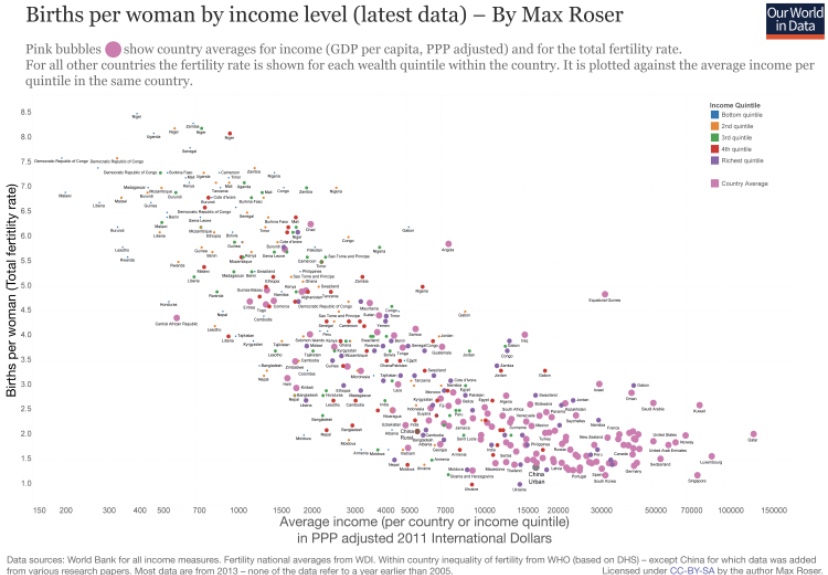
The focus on super-linearity and the relationship between population and economic and other metrics obscures another reality: global fertility rates have been declining for decades and are now below replacement levels in many parts of the world. In addition, we know that birth rates tend to decline as income rises, which directly undermines WB’s concern about super-linearity. The unsustainable population growth envisioned by WB is unlikely to occur, much less overwhelm the ability of resources and innovation to provide for growth in human well-being. WB also ignore the fact that in-migration to cities is a primary contributor to their population growth, whereas in-migration has not been observed at the global level… at least that we’re aware!
What is never in short supply is human ingenuity, if we allow it to work. It enables us to identify and extract new reserves of resources previously hidden to us, and every new efficiency increases the effective reserves of resources already available. Mankind is now on the cusp of an era in which mining of scarce materials from the moon, asteroids, and other planets will be possible.
WB are correct that there are obstacles to urban growth, but they seem only dimly aware of the underlying reasons. Cities must provide myriad services to their residents. Many of those services will experience meager productivity gains relative to goods production, and consequently increased costs of services over time. This is an old problem known among economists as Baumol’s disease, after William Baumol. While it is not limited to cities, it can be especially acute in urban areas. The cost escalation may be severe for services such as education, health care, law enforcement, and the judicial system, which are certainly critical to the economic viability of cities. However, there will be future innovations and even automation of some of these services that boost productivity. Still, they are bound to mostly rise in cost relative to sectors with high average growth in productivity, such as manufacturing. Baumol’s disease is unlikely to tank the world economy. It is simply a fact of economic evolution: relative prices change, and low productivity sectors will suffer cost escalation.
The kind of “awakening” WB anticipate would only occur if individuals are willing sacrifice their liberties en masse, or if elites coerce them to do so. Perhaps there are beings who never imagine the kinds of liberties humans expect, or at least wish for. If so, I’d wager their average intelligence is too low to accomplish space travel anyway. We’ve learned from theory and history that socialism imposes severe constraints on growth. That’s why I once proposed that civilizations capable of interstellar travel will have avoided those chains.
Conclusion
Wong and Bartlett attempt to explain the Fermi Paradox based on the “asymptotic burnout” of civilizations. That is, they believe it’s extremely unlikely that any civilization can ever advance to interstellar travel, or as Hanson would put it, to be “grabby”. WB rely on an analogy between the so-called super-linearity of city scales and the scales of planetary civilizations. They generalize super-linearity to the time domain. In other words, WB make the heroic assumptions that the economic aggregates of planetary civilizations scale over time as cities scale cross-sectionally.
WB then claim that civilizations will confront limits to advancement based on their inability to sustain their pace of innovation. This amounts to Malthusian pessimism writ large. Today, human civilization, while not without its problems, is nowhere near the limits of its growth, and we are nearly ready to reach out beyond the confines of our planet for access to new stocks of resources. There are vast stores of unexploited energy even here on earth, and there are a number of relatively new energy technologies that are either available now or still in development. And there will be much more. Like the Club of Rome, WB lack an adequate appreciation for the power of markets and incentives to solve economic problems, which includes spurring innovation.
Finally, WB make the wholly unsupported conjecture that some civilizations will undergo “awakenings”, choosing to adopt homeostasis rather than growth. WB might or might not realize it, but this implies an abandonment of market institutions in favor of centrally-planned stagnation, and not a little coercion. Perhaps we should view WB’s hypothesis as a cautionary tale: get woke, go broke! Certainly, a homeostatic civilization that relies upon the ignorance of central planners will never develop the capacity for interstellar travel. It simply cannot generate the wealth or expertise necessary to do so. In fact, they are more likely to suffer bouts of mass starvation than any sort of middling prosperity. We probably haven’t seen other civilizations yet, and maybe we’re “early” on the development time-scale for civilizations, but when and if aliens arrive, it won’t be thanks to socialist “awakenings”. WP are at least correct in that regard.
President Obama is a believer in centralized social and economic management, despite the repeated disasters that have befallen societies whose leaders have applied that philosophy in the real world. Those efforts have often taken the form of socialism, with varying degrees of government ownership of resources and productive capital. However, it is not necessary for government to own the means of production in order to attempt central planning. You can keep your capital as long as you take direction from the central authority and pay your “fair share” of the public sector burden.
A large government bureaucracy can coexist with heavily regulated, privately-owned businesses, who are rewarded by their administrative overlords for expending resources on compliance and participating in favored activities. The rewards can take the form of rich subsidies, status-enhancing revolving doors between industry and powerful government appointments, and steady profits afforded by monopoly power, as less monied and politically-adept competitors drop out of the competition for customers. We often call this “corporatism”, or “crony capitalism”, but it is classic fascism, as pioneered by Benito Mussolini’s government in Italy in the 1920s. Here is Sheldon Richman on the term’s derivation:
“As an economic system, fascism is socialism with a capitalist veneer. The word derives from fasces, the Roman symbol of collectivism and power: a tied bundle of rods with a protruding ax.“
“Back in the 1920s, however, when fascism was a new political development, it was widely — and correctly — regarded as being on the political left. Jonah Goldberg’s great book ‘Liberal Fascism’ cites overwhelming evidence of the fascists’ consistent pursuit of the goals of the left, and of the left’s embrace of the fascists as one of their own during the 1920s. …
It was in the 1930s, when ugly internal and international actions by Hitler and Mussolini repelled the world, that the left distanced themselves from fascism and its Nazi offshoot — and verbally transferred these totalitarian dictatorships to the right, saddling their opponents with these pariahs.“
The Obama Administration has essentially followed the fascist playbook by implementing policies that both regulate and reward large corporations, who are only too happy to submit. Those powerful players participate in crafting those policies, which usually end up strengthening their market position at the expense of smaller competitors. So we have transformational legislation under Obama such as Obamacare and Dodd-Frank that undermine competition and encourage concentration in the insurance, health care, pharmaceutical and banking industries. We see novel regulatory interpretations of environmental laws that destroy out-of-favor industries, while subsidies are lavished on favored players pushing economically questionable initiatives. Again, the business assets are owned by private cronies, but market forces are subjugated to a sketchy and politically-driven central plan designed jointly by cronies inside and outside of government. That is fascism, and that’s the Obama approach. He might be a socialist, and that might even be the end-game he hopes for, but he’s a fascist in practice.
As Sowell points out, Obama gains some crucial advantages from this approach. For starters, he gets a free pass on any claim that he’s a socialist. And however one might judge his success as a policymaker, the approach has allowed him to pursue many of his objectives with the benefit of handy fall-guys for failures along the way:
“… politicians get to call the shots but, when their bright ideas lead to disaster, they can always blame those who own businesses in the private sector. Politically, it is heads-I-win when things go right, and tails-you-lose when things go wrong. This is far preferable, from Obama’s point of view, since it gives him a variety of scapegoats for all his failed policies, without having to use President Bush as a scapegoat all the time.
Thus the Obama administration can arbitrarily force insurance companies to cover the children of their customers until the children are 26 years old. Obviously, this creates favorable publicity for President Obama. But if this and other government edicts cause insurance premiums to rise, then that is something that can be blamed on the “greed” of the insurance companies.The same principle, or lack of principle, applies to many other privately owned businesses. It is a very successful political ploy that can be adapted to all sorts of situations.“
Obama’s most ardent sycophants are always cooing that he’s the best president EVAH, or the coolest, or something. But the economy has limped along for much of his presidency; labor force participation is now at its lowest point since the late 1970s; and median income has fallen on his watch. He has Federal Reserve policy to thank for stock market gains that are precarious, at least for those companies not on the fascist gravy train. Obama’s budgetary accomplishments are due to a combination of Republican sequestration (though he has taken credit) and backloading program shortfalls for his successors to deal with later. Obamacare is a disaster on a number fronts, as is Dodd-Frank, as is the damage inflicted by questionable environmental and industrial policy, often invoked via executive order. (His failures in race relations and foreign policy are another subject altogether.)
Fascism is not a prescription for rapid economic growth. It is a policy of regression, and it is fundamentally anti-innovation to the extent that government policymakers create compliance burdens and are poor judges of technological evolution. Fascism is a policy of privilege and is regressive, with rewards concentrated within the political class. That’s what Obama has wrought.
This interactive chart from the McKinsey Global Institute (not the one above, as good as it is…) shows occupations at risk of automation, and it should give warning to those asserting that a substantial increase in the minimum wage is in the interests of low-wage workers. It shows the extent to which various jobs can be automated under existing technology. The salient facts here are that a large number of workers earn less than $15 per hour, that most of those workers perform jobs that can be automated, and that further advances in technology will increase the potential for automation beyond what’s shown in the chart.
A simple truth that must be understood is that wage rates are strongly associated with the skills and productivity required for particular jobs. Denial of that fundamental rule cannot help anyone, and will almost certainly harm many. Low skill requirements are less highly-compensated because they add little value and are easily satisfied.
As Don Boudreaux points out, innovation is often spurred by economic forces. A mandated wage minimum, which is a price floor creating artificial surplus conditions, magnifies incentives for greater innovation. In addition to the substitution away from low-skilled labor (or domestic labor) that can be expected, there are many other margins along which employers can economize in the face of such government edicts: higher expectations for productivity, fewer benefits, fewer breaks, fewer niceties in the workplace, and less flexibility over hours and days off. These things matter greatly to employees and employers. A wage law can make for an unpleasant work environment.
Those who suffer most from minimum wage decrees are the least skilled, whose jobs are the most vulnerable. Economist David Neumark notes that “The Evidence Is Piling Up That Higher Minimum Wages Kill Jobs“, despite claims to the contrary (gated… Google “wsj NeumarK”, select the December 15, 2015 link).
Lest anyone decry the technologies that could replace these workers, recall that the substitution of capital for labor over time has led to the great gains in productivity that have elevated wages and income over time. Many jobs that are commonplace today (and were not even imagined in earlier times) would not exist if not for advances in technology. Likewise, there will be jobs that are commonplace in the future that do not exist today, and we won’t have the power (nor will the government) to anticipate those jobs until the enabling technologies come to fruition and early adoption. These kinds of changes are never without difficulty, as workers bear significant costs of adjustment in the short run, including the acquisition of new skills. However, wage floors force an even earlier and contrived adoption of technologies, which harms low-wage workers most severely. Far better to allow an unfettered and natural process of free choice, technological diffusion, price adjustment, and growth to take place.
Economic growth allows us to enjoy an improving material existence and the wealth to pursue other goals as a society, such as a clean environment. Yet we often pursue other goals in ways that strangle growth, when in fact those goals and growth are fundamentally compatible.
Two articles that caught my attention today approach this issue from different but complementary perspectives. One is by John Cochrane of the University of Chicago, a lengthy piece called simply “Economic Growth“. At the outset, Cochrane asserts that the one, ultimate source of economic growth in the long-run is through advancing productivity. He notes, however, that the U.S. has been falling short in that department of late. Re-establishing growth should start with a clean-up of the many harmful public policies that have cluttered the economic landscape, especially over the last few decades. Unfortunately, politics makes this easier said than done:
“The golden rule of economic policy is: Do not transfer incomes by distorting prices or slowing competition and innovation. The golden rule of political economics seems to be: Transfer incomes by distorting prices and regulating away competition. Doing so attracts a lot less attention than on-budget transfers or subsidies. It takes great political leadership to force the political process to obey the economic rule.“
Cochrane’s discussion is wide ranging, covering a number of areas of public policy that require “weeding”, as he puts it: the regulatory arena (finance, health care, energy and the environment), tax policy, debt and deficits, the design of social programs and entitlements, labor law and regulation, immigration, education, agricultural policy, trade, and the process of infrastructure investment. There may be a year’s worth of blog posts to be drawn from Cochrane’s essay, but I think “weeding” understates the difficulty of the tasks outlined by Cochrane to reignite growth.
The second article that interested me today dealt with technological advance, which is a primary driver of productivity growth. Economists and pundits often prescribe policies that they believe will lead to transformational breakthroughs in technology. This usually manifests in advocacy for increased public funding for basic scientific research. This is a mistake, according to Matt Ridley’s great article, “The Myth of Basic Science“. In fact, one might say that he’s identified another government-nourished weed for Cochrane to pull. I found Ridley’s opening paragraph intriguing:
“Innovation is a mysteriously difficult thing to dictate. Technology seems to change by a sort of inexorable, evolutionary progress, which we probably cannot stop—or speed up much either. And it’s not much the product of science. Most technological breakthroughs come from technologists tinkering, not from researchers chasing hypotheses. Heretical as it may sound, “basic science” isn’t nearly as productive of new inventions as we tend to think.“
Ridley’s thesis (actually, he credits several others for formulating this line of thinking) is that technology growth is very much an independent process, impossible to push or steer effectively. He goes so far as to say that it can’t be stopped, but he also cites ways in which it can be inhibited.
This perspective on technology has implications for patent law, a subject that Ridley explores to some extent. It also reflects badly on government efforts to direct and stimulate advances by granting subsidies to favored technologies and more aggressive funding of “basic science”. Government, in Ridley’s view, is largely impotent in spawning technological advance. By pushing technologies that are uneconomic, government distorts price signals, diverts resources from more productive investments, and embeds inferior technologies in the economy’s productive capital base.
But Ridley’s point has more to do with the futility of basic science as a driver of technological advance, and the strong possibility that causation often runs in the other direction:
“It is no accident that astronomy blossomed in the wake of the age of exploration. The steam engine owed almost nothing to the science of thermodynamics, but the science of thermodynamics owed almost everything to the steam engine. The discovery of the structure of DNA depended heavily on X-ray crystallography of biological molecules, a technique developed in the wool industry to try to improve textiles.
Technological advances are driven by practical men who tinkered until they had better machines; abstract scientific rumination is the last thing they do. As Adam Smith, looking around the factories of 18th-century Scotland, reported in ‘The Wealth of Nations’: ‘A great part of the machines made use in manufactures…were originally the inventions of common workmen,’ and many improvements had been made ‘by the ingenuity of the makers of the machines.’
It follows that there is less need for government to fund science: Industry will do this itself. Having made innovations, it will then pay for research into the principles behind them. Having invented the steam engine, it will pay for thermodynamics. This conclusion … is so heretical as to be incomprehensible to most economists, to say nothing of scientists themselves.“
It’s good to qualify that “industry will do this itself” only if it isn’t severely hamstrung by meddling politicians and regulators.
Ridley goes on to cite a few inconvenient historical facts that run counter to the narrative that public funding of science is a necessary condition for technical advance. He also cites empirical work suggesting that the return on publicly-funded R&D is paltry. In fact, he allows that government involvement in “basic science” may inhibit more economically viable advances and their adoption. There is no question that government often chooses unwisely without the discipline of market incentives. If it gets funded, then bad science, politically-driven “science” and ultimately nonproductive science might very well crowd-out better private science and innovation.
In a time of strained government budgets, public funding for basic science should be subjected to as much scrutiny as any other spending category. Like Ridley, I have much more faith in private tinkerers to choose wisely when it comes to the development of new technologies. Intimacy with actual markets and with the production process itself improve the odds that private developers and technologists will be more effective at boosting productivity.
Lost opportunities can have far reaching consequences. Our society routinely destroys economic opportunities as a matter of policy. This includes immediate discouragement of economic activity via tax disincentives and regulatory obstacles as well as lost capital investment and innovation. And it includes actions that grant protected status for monopolists, a steady by-product of the regulatory state. Don Boudreaux at Cafe Hayek posts a letter from a reader and his own thoughts on these points. From the letter:
“California has 3,754 wineries and they provide good wines for customers, jobs for employees, profits for owners, and fun places to visit. Imagine if Prohibition had never ended or if regulations were such that a mere five wineries produced all the wine for the entire country. Who would have known what we would have been missing?”
The damage of such policies goes on and on, and the negative effects compound with the passage of time. But those effects are seldom visible when policies are made. We never observe the bounty of the counterfactual when a new plant or shop isn’t built, a new shift isn’t added, a new company isn’t formed, a price increase isn’t discouraged by competition, or when inventions and discoveries aren’t made. From Boudreaux:
“The unseen includes also, and more importantly, the greater and better and completely different goods and services, the newer and safer and less-resource-intensive ways of production, and the more full prospects for human flourishing and the heightened hopes and the improved and expanded life-style options that human creativity – unleashed by free markets and governed by open competition and private property rights – makes possible.”
Technology and the advance of knowledge is a process that builds upon itself. The achievements of recent decades were impossible for us to have imagined beforehand, but much more might have been possible. Looking forward, the opportunities lost to today’s stultifying policies will become more staggering as the decades pass, losses much greater than we can imagine today.
Matt Ridley has an nice essay emphasizing that The World’s Resources Aren’t Running Out. They won’t, and the reason is innovation. There is a phenomenon that strikes the environmental left as such an impossible paradox that they cannot see their way clear to understanding how the environmental problem has been and will be solved: economic growth brings wealth that allows us to afford the development of new, cleaner technologies, and those technologies in turn encourage more economic growth. To add a qualifier, it will be solved unless governments prevent markets from doing the work.
In advanced civilizations the period loosely called Alexandrian is usually associated with flexible morals, perfunctory religion, populist standards and cosmopolitan tastes, feminism, exotic cults, and the rapid turnover of high and low fads---in short, a falling away (which is all that decadence means) from the strictness of traditional rules, embodied in character and inforced from within. -- Jacques Barzun





 Sacred Cow Chips