• About

Sacred Cow Chips

Sacred Cow Chips

Tag Archives: John Cochrane

Hospital Price Insanity

15 Sunday Dec 2019

Posted by Nuetzel in Health Care, Health Insurance

≈ 2 Comments

Tags

Affordable Care Act, Allowable Amounts, Avik Roy, Certificate of Need, Chris Pope, Claims Repricing, Disproportionate Share Hospital Payments, Dr. Keith Smith, DSH Payments, EconTalk, First Amendment, John C. Goodman, John Cochrane, Mandated Price Transparency, Medicare, Robert Laszewski, Russ Roberts, Shoppable Sevices, Surgery Center of Oklahoma, Uncompensated care

Almost nothing is less transparent than hospital pricing. If you’re shopping for a procedure, you probably won’t hear about the negotiated prices worked out with large insurers…. you’re likely to be quoted something much higher. A high price is billed to an insurer, but the excess above their negotiated prices is “disallowed” via contractual adjustment. You and/or your small insurer might not get the same deal. As Robert Laszewski says:

“The chargemaster is complete nonsense that really doesn’t matter — unless you are an uninsured person and you’re getting these huge bills driving you toward bankruptcy. The biggest irony of the U.S. healthcare system is that only the uninsured — often people who don’t have a lot of money — are the only ones the hospital expects to pay these incredibly inflated prices!”

An uninsured patient might be billed at the higher rate, but of course few end up paying. But there is harm in this arrangement, and it extends well beyond the uninsured. You might not be surprised to learn that the government is right in the middle of it. Read on…

What a Racket!

There’s some slight of hand going on in hospital pricing that creates perverse incentives. Who has something to gain from a huge gap between the full price and the hospital’s allowable charge? The answer is both the hospital and insurers, and that’s true whether the hospital is for-profit or nonprofit. When the list price and the size of the discount increase, the insurer gets to brag to employer-plan sponsors about the great savings it negotiates. In an episode on EconTalk, Dr. Keith Smith, a partner in the ultra-competitive and cash-only Surgery Center of Oklahoma, says (only partly in jest) that the conversation between the insurer and hospital might go something like this:

“Now, what the insurers actually do is ask the hospital administrators, ‘Can you do a brother a favor and actually charge $200,000 for that, so that our percentage savings actually looks larger?‘”

This does two things for the insurer: it impresses employers as prospective plan sponsors, and it might also earn the insurer a bonus known as Claims Repricing, whereby the employer pays a commission on the discounts the insurer “negotiates”.

What about the hospitals? How do they benefit from this kind of arrangement? By inflating the “list price” of procedures, the hospital creates the appearance of a write-down or loss on a substantial share of the care it provides, despite the fact that its real costs are far below list prices and usually below the discounted “allowable amounts” negotiated with insurers as well. The appearance of loss serves to benefit the hospitals because they are compensated by the government on that basis through so-called Disproportionate Share Hospital (DSH) payments. These are, ostensibly, reimbursements for so-called uncompensated care.

This would not be such a travesty if the prices approximated real costs, but they don’t, and the arrangement creates incentives to inflate. The DSH payments to hospitals are used in a variety of ways, as Smith notes:

“Yeah; and before we get to feeling too sorry for the hospitals, all of the ones I know of claiming to go broke have a crane in front of them building onto their Emergency Room. …

So, I don’t know: again, the hospitals that are complaining about this, they are buying out physician practices, they’re buying out competitors. They seem to have a whole lot of money. They’re not suffering. Now, what they have done is used the situation you described–the legitimate non-payer–they’ve used that as a propaganda tool, I would argue, to develop a justification for cost shifting where they charge us all a whole lot more to make up for all the money that they’re losing. But they really need a lot of this red ink to maintain the fiction of their not-for-profit status.”

Non-profit hospitals are also entirely tax-exempt (income and property taxes), despite the fact that many use their “free cash flows” in ways similar to for-profit hospitals. The following describes a 2015 court ruling in New Jersey:

“The judge stated ‘If it is true that all non-profit hospitals operate like the hospital in this case… then for purposes of the property tax exemption, modern non-profit hospitals are essentially legal fictions.’ Judge Bianco found that the hospital ‘operated and used the property for a profit-making purpose’ by, in part, providing substantial loans, capital, and subsidies to for-profit entities, including physician groups.“

The bad incentives go beyond all this. Smith adds the following:

“Waste in a big hospital system is actually encouraged, many times because hospitals are paid based on what they use…. So, to the extent that the hospital uses a lot of supplies, that typically raises and increases the amount of revenue that they receive.”

Hospitals have been shielded from competition for years by the government. As Chris Pope explains, hospital pricing is designed “to accommodate rather than to constrain the growth of hospital costs“. This encourages hospitals that are inefficient in terms of costs, quality of care, and over-investment in equipment. Conversely, duplicated facilities and equipment simply add costs and don’t encourage competition given the cost-plus nature of hospital pricing and government efforts to prevent entry by more efficient operators. These restrictions include “Certificates of Need” for new entrants, and the ban on physician-owned hospitals in the Affordable Care Act (ACA). At the same time, the ACA encouraged hospital consolidation by rewarding the formation of so-called Accountable Care Organizations, which are basically exempt from anti-trust review. In the end, any reductions in administrative costs that consolidation might offer are swamped by the anti-consumer force of monopoly power.

Mandated Transparency?

The lack of price transparency really isn’t the root problem, in my view, but it is undesirable. Can government action to create transparency foster a more competitive market for the services hospitals offer? A recent Trump Administration Executive Order would require that hospitals publicly post prices for 300 “shoppable” services or procedures. The effective date of this order was recently delayed by a year, to January 2021. Hospital trade groups have challenged the order in court on the grounds that the First Amendment protects private businesses from being compelled to reveal details of privately-negotiated deals for complex services. While I try to be a faithful defender of constitutional rights, I find this defense rather cynicical. I’m not sure the First Amendment was intended to aid in concealing dishonest schemes for private benefit at the expense of taxpayers and consumers.

Avik Roy likes the price transparency rule. It would require the posting of gross charges for procedures as well as specific negotiated prices. The executive order would also require Medicare to pay no more to hospital-owned clinics than to independent clinics for the same procedure, which is laudable. Roy is sanguine about the ability of these rules to bring more competition to the market. He predicts a more level playing field for small insurers in negotiating discounts, and he thinks the order would spur development of on-line tools to assist consumers.

John C. Goodman is mildly skeptical of the benefits of a transparency mandate (also see here). Consumers with decent levels of coverage aren’t terribly motivated to make hospital price comparisons, especially if it means a delay in treatment. Also, Goodman points out a few ways in which hospitals try to “game” transparency requirements that already exist. John Cochrane worries about gaming of the rules as well. Competition and price discipline are better prescriptions for price transparency and might be better addressed by eliminating the incentives for third-party payment arrangements, like the unbalanced tax deductibility of health insurance premiums, but that kind of reform isn’t on the horizon. Goodman concedes that many procedures are “shoppable”, and he does not minimize the extent to which pricing varies within local hospital markets.

Conclusion

The most insane thing about hospital revenue generation is its reliance on fictitious losses. And hospitals, profit and non-profit, have a tendency to spend excess cash in ways that fuel additional growth in cost and prices. Sadly, beyond their opacity, hospital prices do not reflect the true value of the resources used by those institutions.

In my view, the value of price transparency does not hinge on whether the average health care consumer is sensitive to hospital prices, but on whether the marginal consumer is sensitive. That includes those willing to pay for services out-of-pocket, such as those who seek care at the Surgery Center of Oklahoma. Third-party payers lacking significant market power would undoubtedly prefer to have more information on pricing as well. Mandated price transparency won’t fix all of the dysfunctions in the delivery and payment for health care. That would require more substantial free-market reforms to the insurance and health care industries, which ideally would involve replacing price subsidies with direct payments to the uninsured. The transparency mandate itself might or might not intrude on domains over which privacy is protected by the Constitution, a question that has already been brought before the courts. Nonetheless, transparency would lead to better market information for all participants, which might help rationalize pricing and encourage competitive forces.


A Carbon Tax Would Be Fine, If Only …

01 Friday Mar 2019

Posted by Nuetzel in Environment, Global Warming, Taxes

≈ Leave a comment

Tags

A.C. Pigou, Carbon Dividend, Carbon Tax, Climate Change, Economic Development, External Cost, Fossil fuels, Green New Deal, IPCC, John Cochrane, Michael Shellenberger, Pigouvian Tax, Quillette, Renewable energy, Revenue Neutrality, Robert P. Murphy, Social Cost of Carbon, Warren Meyer, William D. Nordhaus

I’ve opposed carbon taxes on several grounds, but I admit that it might well be less costly as a substitute for the present mess that is U.S. climate policy. Today, we incur enormous costs from a morass of energy regulations and mandates, prohibitions on development of zero-carbon nuclear power, and subsidies to politically-connected industrialists investing in corn ethanol, electric cars, and land- and wildlife-devouring wind and solar farms. (For more on these costly and ineffective efforts, see Michael Shellenberger’s “Why Renewables Can’t Save the Planet” in Quillette.) Incidentally, the so-called Green New Deal calls for a complete conversion to renewables in unrealistically short order, but with very little emphasis on a carbon tax.

The Carbon Tax

Many economists support the carbon tax precisely because it’s viewed as an attractive substitute for many other costly policies. Some support using revenue from the tax to pay a flat rebate or “carbon dividend” to everyone each year (essentially a universal basic income). Others have pitched the tax as a revenue-neutral replacement for other taxes that are damaging to economic growth, such as payroll taxes or taxes on capital. Economic growth would improve under the carbon tax, or so the story goes, because the carbon tax is a tax on a “bad”, as opposed to taxes on “good” factors of production. I view these ideas as politically naive. If we ever get the tax, we’ll be lucky to get much regulatory relief in the bargain, and the revenue is not likely to be offset by reductions in other taxes.

But let’s look a little closer at the concept of the carbon tax, and I beg my climate-skeptic friends to stick with me for a few moments and keep a straight face. The tax is a way to attach an explicit price to the use of fuels that create carbon emissions. The emissions are said to inflict social or external costs on other parties, costs which are otherwise ignored by consumers and businesses in their many decisions involving energy use. The carbon tax is a so-called Pigouvian tax: a way to “internalize the externality” by making fossil fuels more expensive to burn. The tax itself involves no prohibitions on behavior of any kind. Certain behaviors are taxed to encourage more “desirable” behavior.

Setting the Tax

But what is the appropriate level of the tax? At what level will it approximate the true “social cost of carbon”? Any departure from that cost would be sub-optimal. Robert P. Murphy contrasts William D. Nordhaus’ optimal carbon tax with more radical levels, which Nordhaus believes would be needed to meet the goals of the United Nation’s Intergovernmental Panel on Climate Change (IPCC). Nordhaus won the 2018 Nobel Prize in economics for his work on climate change. Whatever one might think of the real risks of climate change, Nordhaus’ clearly recognizes the economic downsides to mitigating against those risks.

Nordhaus has estimated that the social cost of carbon will be $44/ton in 2025 (about $0.39 per gallon of gas). He claims that a carbon tax at that level would limit increases in global temperature to 3.5º Celsius by 2100. He purports to show that the costs of a $44 carbon tax in terms of reduced economic output would be balanced by the gains from limiting climate warming. Less warming would require a higher tax with fewer incremental rewards, and even more incremental lost output. The costs of the tax would then outweigh benefits. For perspective, according to Nordhaus, a stricter limit of 2.5º C implies a carbon tax equivalent to $2.50 per gallon of gas. The IPCC, however, prescribes an even more radical limit of 1.5º C. That would inflict a huge cost on humanity far outweighing the potential benefits of less warming.

A Carbon Tax, If…

Many economists have come down in favor of a carbon tax under certain qualifications: revenue-neutrality, a “carbon dividend”, or as a pre-condition to deregulation of carbon sources and de-subsidization of alternatives. John Cochrane discusses a carbon tax in the context of the “Economists’ Statement on Carbon Dividends” (Cochrane’s more recent thoughts are here):

“It’s short, sweet, and signed by, as far as I can tell, every living CEA chair, every living Fed Chair, both Democrat and Republican, and most of the living Nobel Prize winners. … It offers four principles 1. A carbon tax, initially $40 per ton. 2. The carbon tax substitutes for regulations and subsidies and (my words) the vast crony-capitalist green boondoggle swamp, which is chewing up money and not saving carbon. 3. Border adjustment like VAT have [sic] 4. ‘All the revenue should be returned directly to U.S. citizens through equal lump-sum rebates.'”

Rather than a carbon dividend, Warren Meyer proposes that a carbon tax be accompanied by a reduction in the payroll tax, an elimination of all subsidies, mandates, and prohibitions, development of more nuclear power-generating capacity, and contributions to a cleanup of Chinese and Asian coal-power generation. That’s a lot of stuff, and I think it exceeds Meyer’s normal realism with respect to policy issues.

My Opposition

Again, I oppose the adoption of a carbon tax for several reasons, despite my sympathy for the logic of Pigouvian taxation of externalities. At the risk of repeating myself, here I elaborate on my reasons for opposition:

Government Guesswork: First, Nordhaus’ estimates notwithstanding, we do not and cannot know the climate/economic tradeoffs with any precision. We can barely measure global climate, and the history of what measures we have are short and heavily manipulated. Models purporting to show the relationship between carbon forcing and global climate climate change are notoriously unreliable. So even if we can agree on the goal (1.5º, 2.5º, 3.5º), and we won’t, the government will get the tradeoffs wrong. I took the following from a comment on Cochrane’s blog, a quote from A.C. Pigou himself:

“It is not sufficient to contrast the imperfect adjustments of unfettered enterprise with the best adjustment that economists in their studies can imagine. For we cannot expect that any State authority will attain, or even wholeheartedly seek, that ideal. Such authorities are liable alike to ignorance, to sectional pressure, and to personal corruption by private interest. A loud-voiced part of their constituents, if organized for votes, may easily outweigh the whole.”

Political Hazards: Second, we won’t get the hoped-for political horse trade made explicit in the “Economists’ Statement …” discussed above. As a political matter, the setting of the carbon tax rate will almost assuredly get us a rate that’s too high. Experiences with carbon taxes in Australia, British Columbia, and France have been terrible thus far, sowing widespread dissatisfaction with the resultant escalation of energy prices.

Economic Growth: Neither is it a foregone conclusion that a revenue-neutral carbon tax will stimulate economic growth, and it might actually reduce output. As Robert P. Murphy explains in another post, the outcome depends on the structure of taxes prior to the change. The substitution of the carbon tax will increase output only if it replaces taxes on a factor of production (labor or capital) that is overtaxed prior to the change. That undermines a key selling point: that the carbon tax would necessarily produce a “double dividend”: a reduction in carbon emissions and higher economic growth. Nevertheless, I’d allow that revenue neutrality combined with elimination of carbon regulation and “green” subsidies would be a good bet from an economic growth perspective.

Overstated Risks: Finally, I oppose carbon taxes because I’m unconvinced that the risk and danger of global warming are as great as even Nordhaus would have it. In other words, the external costs of carbon don’t amount to much. Our recorded temperature history is extremely short and is therefore not a reliable guide to the long-term nature of the systemic relationships at issue. Even worse, temperature records are manipulated to exaggerate the trend in temperatures (also see here, here and here). There is no evidence of an uptrend in severe weather events, and the dangers of sea level rise associated with increasing carbon concentrations also have been greatly exaggerated. Really, at some point one must take notice of the number of alarming predictions and doomsday headlines from the past that have not been borne out even remotely. Furthermore, higher carbon concentrations and even warming itself would be of some benefit to humanity. In addition to a greener environment, the benefits include more rapid economic growth, improved agricultural yields, and a reduction in the salient danger of cold-weather deaths.

Economic Development: The use of fossil fuels has helped to enable strong growth in incomes in developed economies. It has also given us energy alternatives such as nuclear power as well as research into other alternatives, albeit with very mixed success thus far. And while a carbon tax would create an additional incentive to develop such alternatives, a U.S. tax would not accomplish much if any global temperature reduction. Such a tax would have to be applied on a global scale. Talk about a political long-shot! Increasing the price of carbon emissions also has enormous downsides for the less developed world. These fragile economies would benefit greatly from development of fossil fuel energy, enabling reductions in poverty and the income growth necessary to someday join in the prosperity of the developed economies. This, along with liberalization of markets, is the affordable way to bring economic success to these countries, which in turn will enable them to consider the energy alternatives that might come to fruition by that time. Fighting the war on fossil fuels in the underdeveloped world is nothing if not cruel.


Insuring Health Insurability

22 Saturday Dec 2018

Posted by Nuetzel in Health Insurance

≈ Leave a comment

Tags

Community Rating, Consumer Sovereignty, Death Spiral, Eugene Volokh, Health Insurance Options, Health Status Insurance, Individual Mandate, John C. Goodman, John Cochrane, Obamacare, Pre-Existing Conditions, Premium Subsidies, Tax Subsidies

The latest blow to Obamacare went down just before the holidays when a federal judge in Texas ruled that the individual mandate was unconstitutional. The decision will be appealed, so it will have no immediate impact on the health-care law or insurance markets. But as Eugene Volokh noted, the mandate itself became meaningless from an enforcement perspective after the repeal of the penalty tax for non-coverage in 2017, despite the fact that some individuals might still opt for coverage out of “respect for the law”. What will really matter, when and if the decision is upheld, is the nullification of the complex web of regulations created by Obamacare, officially known as the Affordable Care Act or ACA. Perhaps most important among these is the requirement that buyers in good health and those in poor health must be charged the same price for coverage. That is “community rating” and it is the chief reason for the escalation of insurance premiums under Obamacare.

One Size Misfits All

Community rating means that everyone pays the same premium regardless of health. Those in good health must pay higher than actuarially fair premiums to subsidize the sick or high-risk with premiums that are less than actuarially fair. Two provisions of the ACA were intended to make this work: first, the individual mandate required everyone to remain in the game (and paying the subsidies) rather than going uninsured and paying the “tax” penalty. But the penalty was so light that many preferred it to actually buying insurance. Now, of course, the penalty has been repealed. Second, individuals with incomes below 250% of poverty line receive premium subsidies from the federal government to offset the high cost of coverage. That means low-income buyers do not have to confront the high premiums, which was hoped to keep them in the game.

Community rating caused premiums in the individual insurance market to increase dramatically. This was compounded by the law’s minimum coverage requirements, which are more comprehensive than many consumers would have preferred. Lots of younger, healthier consumers opted out while the sick opted in, or even worse, opted in only when they became sick. This deterioration in the “risk pool” is the so-called insurance “death spiral”. The pool of insureds becomes increasingly risky, premiums escalate, more healthy consumers opt out, and the process repeats. At the root of it is the distortion in the way that risk is priced by community rating.

Tailored Coverage

The coverage and pricing of risk is better left to markets. That means consumers and insurers will reach agreement on policy provisions that are mutually beneficial ex ante. Insurers will offer to cover risks up to the point at which the expected marginal cost of underwriting is equal to value, or the buyer’s willingness to pay. An insurer who offers unattractive policies or charges too much will find its business undercut by competitors. But when risk is priced by government fiat and community rating, this natural form of market information discovery is impossible.

Tax vs. Premium Subsidies

Many in the high-risk population will be unable to afford coverage in the absence of community rating. There are only two general options: they pay what they can for care but otherwise go without insurance coverage, accepting charity care if they are willing; or, taxpayers pay, as under Medicaid. Most lack coverage because they simply cannot afford it, even when they earn too much to qualify for Medicaid.

That situation can be resolved in the long-term (as I’ll describe below), but an overhang of individuals with pre-existing conditions in need of subsidies will persist for a period of years. Under Obamacare, subsidies were paid by charging higher premia to healthy individuals through community rating. Again, that distorted signals about risk and value, creating unhealthy incentives among insurance buyers. The death spiral is the outcome. Subsidies funded by general taxation do not create these price distortions, however, and should be relied upon for assisting the high-risk population, at least those who are determined to qualify.

Health Status Insurance

The overhang of individuals with pre-existing conditions requiring subsidies can never be eliminated entirely—every day there are children born with critical, unanticipated health needs. However, the overhang can shrink drastically over time under certain conditions. A development that is already receiving meaningful attention in the market is the sale of health insurance options, as described by John Cochrane. I have written about this method of protecting future insurability here.

Cochrane raises the subject within the context of new HHS rules allowing insurance companies to offer “temporary” insurance coverage up to a year, but with guaranteed renewability through a total of 36 months of coverage. Unfortunately, if you get sick before the end of the 36th month, you’ll have to give up your policy and pay more elsewhere.  But Cochrane speculates:

“Unless, perhaps, they really are letting insurance companies offer the right to buy health insurance as a separate product, and that can have as long a horizon as you want? If they haven’t done that, I suggest they do so! I don’t think the ACA forbids the selling of options on health insurance of arbitrary duration.”

Cochrane links to this earlier article in which John C. Goodman discusses the ruling allowing the sale of temporary plans:

“The ruling pertains to ‘short-term, limited duration’ health plans. These plans are exempt from Obamacare regulations, including mandated benefits and a prohibition on pricing based on expected health expenses. Although they typically last up to 12 months, the Obama administration restricted them to 3 months and outlawed renewal guarantees that protect people who develop a costly health condition from facing a big premium hike on their next purchase.

The Trump administration has now reversed those decisions, allowing short-term plans to last up to 12 months and allowing guaranteed renewals up to three years. The ruling also allows the sale of a separate plan, call ‘health status insurance,’ that protects people from premium increases due to a change in health condition should they want to buy short-term insurance for another 3 years.”

That is far from permanent insurability, but the concept has nevertheless taken hold. An active market in health status insurance would reduce the pre-existing conditions problem to a bare minimum. The financial risks of deteriorating health would be underwritten in advance. Once stricken with illness, those unlucky individuals would then have coverage at standard rates by virtue of the earlier pooling of the risk of future changes in health status. At standard rates, relatively few high-risk individuals would require subsidies in order to afford coverage .

Will healthy, temporarily insured or uninsured individuals buy these options? Some, but not all, so subsidies will never disappear entirely. Still, the population of uninsured individuals with pre-existing conditions will shrink drastically. In the meantime, a healthy market for health insurance coverage should flourish, reestablishing the authority of the consumer over the kind of health care coverage they wish to purchase and the kinds of financial risks they are willing to bear.


Injecting Competition Into Health Care

12 Friday Oct 2018

Posted by Nuetzel in competition, Health Care, Uncategorized

≈ Leave a comment

Tags

Ameriflex, Anna Wilde Mathews, competition, Cross Subsidies, CVS, John C. Goodman, John Cochrane, MediBid, Medicaid, Medicare, MinuteClinic, Obamacare, Third-Party Payers, Transparent Pricing

Competitive pressures in U.S. health care delivery are weak to nonexistent, and their absence is among the most important drivers of our country’s high medical costs. Effective competition requires multiple providers and/or substitutes, transparent prices, and budget-conscious buyers, but all three are missing or badly compromised in most markets for health care services. This was exacerbated by Obamacare, but even now there are developments in “retail” health care that show promise for the future of competition in health care markets. The situation is not irreversible, but some basic policy issues must be addressed.

John Cochrane maintains that the question of “who will pay” for health care, while important, has distracted us from the matter of fostering more competition among providers:

“The discussion over health policy rages over who will pay — private insurance, companies, “single payer,” Obamacare, VA, Medicare, Medicaid, and so on — as if once that’s decided everything is all right — as if once we figure out who is paying the check, the provision of health care is as straightforward a service as the provision of restaurant food, tax advice, contracting services, airline travel, car repair, or any other reasonably functional market for complex services.”

We face a severe tradeoff in health care: how to provide for the needs of more patients (e.g., the uninsured, or a growing elderly population) without driving up the cost of care? As a policy matter, provider resources should not be viewed as fixed; their quantity and the efficiency with which those resources are utilized are responsive to forces that can be harnessed. Fixing the supply side of the health care market by improving the competitive environment is the one sure way to deliver more care at lower cost.

Fishy Hospital Contracts

Cochrane discusses some anti-competitive arrangements in health care delivery, quoting liberally from an article by Anna Wilde Mathews in The Wall Street Journal, “Behind Your Rising Health-Care Bills: Secret Hospital Deals That Squelch Competition“:

“Dominant hospital systems use an array of secret contract terms to protect their turf and block efforts to curb health-care costs. As part of these deals, hospitals can demand insurers include them in every plan and discourage use of less-expensive rivals. Other terms allow hospitals to mask prices from consumers, limit audits of claims, add extra fees and block efforts to exclude health-care providers based on quality or cost.”

Mathews’ article is gated, but Cochrane quotes enough of its content to convey the dysfunction described there. Also of interest is Cochrane’s speculation that the hospital contract arrangements are driven largely by cross subsidies mandated by government:

“The government mandates that hospitals cover indigent care, and medicare and medicaid below cost. The government doesn’t want to raise taxes to pay for it. So the government allows hospitals to overcharge insurance (i.e. you and me, eventually). But overcharges can’t withstand competition, so the government allows, encourages, and even requires strong limits on competition.”

The Role of Cross Subsidies

In this connection, Cochrane notes the perverse ways in which Medicare and Medicaid compensate providers, allowing large provider organizations to charge more than small  ones for the same services. Again, that helps the hospitals cover the costs of mandated care, regulatory costs, and the high administrative and physical costs of running large facilities. It also creates an obvious incentive to consolidate, reaping higher charges on an expanded flow of services and squelching potential competition. And of course the cross subsidies create incentives for large providers to lock-in business from insurers under restrictive contract agreements. Such acts restrain trade, pure and simple.

Cross subsidies, or building subsidies into the prices that buyers must pay, are thus an impediment to competition in health care, beyond the poor incentives they create for subsidized and non-subsidized buyers. So the “who pays” question rears it’s head after all. When subsidies are necessary to provide for those truly unable to pay for care, it is far better to compensate those individuals directly without distorting prices. That represents a huge policy change, but it would also help restore competition.

Competitive Sprouts

John C. Goodman provides a number of examples of how well competition in health care delivery can work. Most of them are about “retail medicine”, as it’s been called. This includes providers like MinuteClinic (CVS), LASIK and cosmetic surgery, concierge doctors, and “retail” surgical services. Goodman also mentions MediBid, a platform on which doctors bid to provide services for patients, and Ameriflex, which matches employers with concierge doctors. These services, which either bypass third-party payers or connect employer-payers with competitive providers, are having a real impact on the ability of patients to obtain care at a lower cost. Goodman says:

“I am often asked if the free market can work in health care. My quick reply is: That is the only thing that works. At least, it is the only thing that works well.”

Conclusion

Some of the most pernicious Obamacare cross subsidies have been dismantled via elimination of the individual mandate and allowing individuals to purchase short-term insurance. Nonetheless, U.S. health care delivery is still riddled with cross subsidies and excessive regulation of providers, including all the distortions caused by third-party payments and the tax code. Many buyers lack an incentive for price sensitivity. They face restrictions on their choice of providers, they don’t know the prices being charged, and they often don’t care because at the margin, someone else is paying. Fostering competition in health care delivery does not necessarily require an end to third-party payments, but the cross subsidies must go, employers should actively seek competitive solutions to controlling health care costs, price transparency must improve, and consumers must face incentives that encourage economies.

Perspective on U.S. Health Care Spending & Outcomes

05 Sunday Aug 2018

Posted by Nuetzel in Health Care, Health Insurance

≈ Leave a comment

Tags

Bernie Sanders, Charles Blahous, John Cochrane, Joseph Walker, Life Expectancy, Mahdi Barakat, Medicare For All, Mercatus Center, Obesity, Random Critical Analysis, SwedenCare

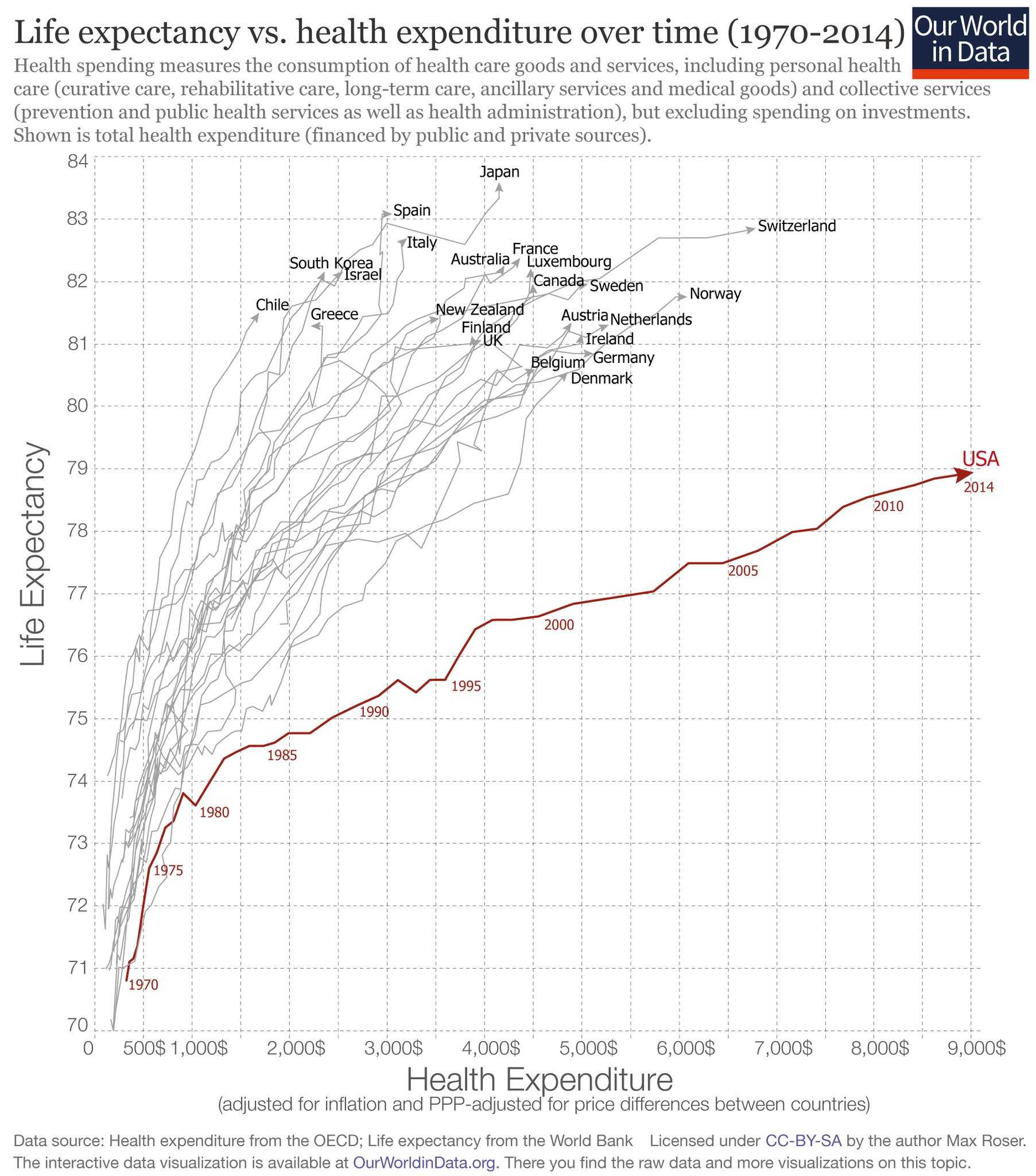
The U.S. spends a lot on health care, and our health care system is frequently criticized for poor health outcomes. The chart below is an example of evidence used to buttress this argument. It shows combinations of health care spending and life expectancy over time for the OECD countries. The U.S. appears to be a severe outlier and inferior to the other countries. A variation on this chart appeared on the home page of The Wall Street Journal this week. It accompanied (but was not part of) a good article by Joseph Walker in which he used 12 other charts in an effort to explain why the U.S. spends so much on health care. (Sorry, this link is probably gated.) Walker discusses several important cost factors, including third-party payments, tax treatment, and the deployment of expensive technology in the U.S. However, the claim that the U.S. is really an outlier is worth examining on other grounds.

The chart’s construction suggests that a reliable link should exist between health care spending and life expectancy, but there are several reasons to question whether that is the case. U.S. life expectancy has been held down historically by high rates of smoking, but reduced smoking rates should help moderate the U.S. life expectancy gap in coming years. Obesity in the U.S. is a more persistent problem, especially for the poor, and an even bigger contributor to low U.S. life expectancy than smoking at present. (See this report for evidence on the contributions of smoking and obesity to shorter life expectancy for older adults.) Other contributors to low life expectancy in the U.S. include high motor-vehicle deaths and homicides, the latter attributable in large part to the war on drugs. All of these factors contribute to higher health care spending and directly reduce life expectancy.

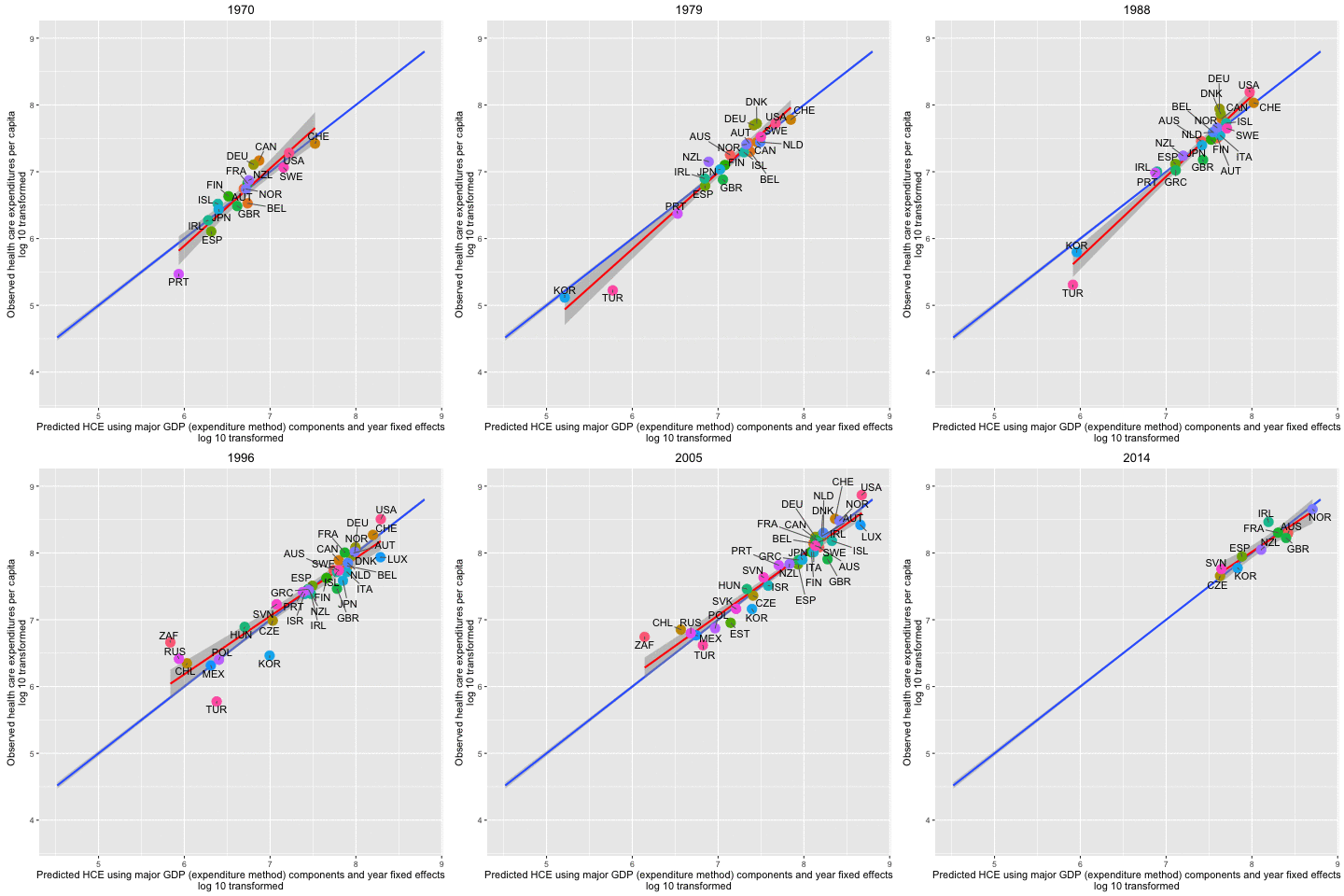
The status of the U.S. as an outlier in terms of health care spending is questioned on the Random Critical Analysis blog (RCA). The author’s detailed analysis includes the following points among many others of interest:

  • Health care is a superior good: as income rises, spending on health care rises faster;
  • The U.S. has a much higher standard of living than any of its peer nations;
  • U.S. consumption spending relative to GDP is an “outlier”, like health care spending relative to GDP;
  • Consumption is a stronger predictor of health care spending than income;
  • Relative to consumption, health care spending in the U.S. is not an outlier, nor is spending on pharmaceuticals, physician/nursing compensation, and the levels of health price indices.

Take a look at the following sequence from the RCA blog linked above (the animation might not be visible on a phone):

So the argument that the U.S. health care system is inferior to peer countries based on cross-county spending comparisons and life expectancy, to the extent that it holds up at all, is subject to strong qualifications. Inferior lifestyle choices, diets, and lack of exercise might be problematic in the U.S., but the healthcare system cannot be faulted based on spending levels relative to other OECD countries.

In fact, the superiority of the U.S. health care system in many areas is not even in dispute. As Mahdi Barakat points out, wait times for care, cancer survival rates, and stroke mortality are all clearly better in the U.S. than in many peer countries:

“Lives are indeed saved by the many types of superior medical outcomes that are often unique to the US. This is not to mention the innumerable lives saved each year around the world due to medical innovations that are made possible through vibrant US markets.”

Barakat compares dubious progressive claims that up to 45,000 American lives are lost each year due to a lack of insurance with the likely incremental lives lost if various performance measures in the U.S. were equivalent to those in other countries:

  • 25,000 additional female deaths per year with Canada’a wait times for care (no estimate for additional male deaths is given by Mahdi’s source);
  • 64,000 additional stroke deaths each year with the UK’s overall stroke mortality;
  • 72,000 additional cancer deaths each year with the UKs survival rates.

Theoretically, the national spending figures could be adjusted for the cost of queuing, i.e. wait times. While Obamacare certainly increased wait times in the U.S., the adjustment would likely reduce or eliminate the spending advantages that several OECD countries appear to have over the U.S.

The performance of health care systems in many countries with single-payer systems or universal care is subject to challenge, as some of the statistics offered by Barakat demonstrate. In “The Truth About SwedenCare“, Klaus Bernpaintner expresses his dismay at the romanticized view of health care in Sweden among so many Americans. His effort to convey the truth about Sweden’s stultifying health care bureaucracy is illuminating. There are few private physician practices in Sweden. Care is generally rationed and waits are lengthy, and it is delivered by disinterested, centrally-assigned providers.

“For non-emergency cases in Sweden, you must go to the public ‘Healthcare Central.’ This is always the starting point for anything from the common flu to brain tumors. You must go to your assigned Central, according to your healthcare district. Admission is by appointment only. Usually they have a 30-minute window every morning, when you call to claim one of the budgeted slots. Make sure to call early or they run out. Rarely will you get an appointment for the same day. You will be assigned a general practitioner, probably one you have never met before; likely one who does not speak fluent Swedish; and very likely one who hates his job. If you have a serious condition, you will be started on a path of referrals to experts. This process can take months.”

Bernpaintner calls this Sweden’s health care “bread line”, where people go to die. He mentions several other nightmarish features of health care in Sweden that Americans should hope to avoid. In particular, we should resist calls for a single-payer system, like Bernie Sanders’ Medicare-For-All proposal. An analysis by Charles Blahous of the Mercatus Center at George Mason University has shown that it would increase federal spending by $32.6 trillion over ten years. This estimate is basically in-line with others mentioned by Blahous. Much of the additional federal spending would represent a transition away from private spending, a process that would be massively disruptive. However, the study gives the plan the benefit of several doubts by accepting the assumptions made by Sanders: 1) a huge saving in prescription drug costs; 2) a huge saving in administrative costs; 3) providers will happily accept Medicare reimbursement levels; and 4) new immigrants will not be attracted by an essentially free health care program. Fat chance. But given all of these questionable assumptions, total health care spending would fall even as the government takes on the massive new outlays. Take away just fantasy #3 and total national health care spending would rise, a swing of $700 billion by 2031.

John Cochrane makes a useful distinction between two conceptions of universally-accessible coverage: one that all must use vs. one that all can use. (He calls them both forms of single-payer systems, though that usage sounds a bit awkward to me.) The voluntary form is preferable for several reasons: it can preserve choice in terms of coverage and providers; while the public-payer’s share must be funded, it demands little or nothing in the way of cross-subsidized pricing; and it does not imply that government must act as a single “price setter”. Cochrane warns of the possible consequences of a universally-mandated single payer:

“Not only is there some sort of single easy to access health care and insurance scheme for poor or unfortunate people, but you and I are forbidden to escape it, to have private doctors, private hospitals, or private insurance outside the scheme. Doctors are forbidden to have private cash paying customers. That truly is a nightmare, and it will mean the allocation of good medical care by connections and bribes.”

The presumption that universal health care will improve quality and save lives is unsupported by any real evidence. Its proponents incorrectly assume that the uninsured do not get care at all. Providers might go uncompensated, but the uninsured can often get needed care with more immediacy than they could with the lengthy wait times typical of many single-payer systems. The quality of care is likely to deteriorate under a single-payer system given the stresses placed on providers, the highly regulated conditions under which they would be forced to operate, and restricted treatment options. And of course a single-payer system would suspend the price mechanism and any semblance of competition in the health care marketplace.

The health care system in the U.S. has massive problems, but they were created and exacerbated by a series of governmental intrusions on the marketplace over many years. A flourishing market requires choice for consumers and competition between providers—in both health care delivery and insurance coverage. It also requires a roll-back of regulation on providers and insurers. But as Cochrane emphasizes, such a marketplace can exist apart from a voluntary, tax-funded payer-of-last-resort.

Bankers, Risk and the Rents of Slippery Skin

12 Monday Mar 2018

Posted by Nuetzel in Banking, rent seeking

≈ Leave a comment

Tags

Deposit Insurance, Fannie Mae. Freddie Mac, Fat Tails, FDIC, Fractional Reserves, Frank Hollenbeck, GSEs, Guatam Mukunda, Gvernment Sponsored Enterprises, Irving Fisher, It's a Wonderful Life, John Cochrane, Laurence Kotlikoff, Milton Friedman, Nassim Taleb, Ralph Musgrave, rent seeking, Skin in the Game, Too big to fail

Risk taking is important to the economic success of a nation. Creative energy demands it, and it is critical to achieving economic growth and wealth creation. But it’s obviously possible to take too much risk or risks that are ill-considered, and that is all the more likely when risk-takers are absolved of the consequences of their actions. That is, healthy risk-taking and responsibility are inextricably linked. One can’t truly be said to take a risk if the cost of failure is borne by another party. It’s easy to understand why risk-taking becomes excessive or misdirected when that is the case.

Risk Shifting

There are various ways in which a party can parlay risky undertakings into easy gains by shifting the risks to others. For example, any piece of merchandise comes with the risk that it will not perform as advertised. Some traders might be tempted to sell unreliable merchandise and shift risk to the buyer without recourse. This is an area in which we must rely on a bulwark of private governance: caveat emptor. On the other hand, government tends to subsidize risk-taking in various ways: limited liability under the corporate form of business organization, bank deposit insurance, bankruptcy laws, the implicit government guarantee on mortgage assets, and the “too-big-to-fail” mentality of government bailouts.

Whose Skin In the Game?

These are examples of what Nassim Taleb bemoans as the failure to have “skin in the game”. The quoted expression happens to be the title of his new book. I have both praised and castigated Taleb’s work in the past. He made an interesting contribution about the nature and risk of extreme events in his book “Black Swan”, such as his application of so-called “fat tails” in probability distributions, though some have claimed the ideas were anything but original. I was highly critical of Taleb’s alarmist hyperbole on the effects of GMOs. In the present case, however, he considers “the asymmetry of risk bearing” to be a major social problem, and I’m generally in agreement with the point. The most interesting part of the brief discussion at the link is the following:

“In Taleb’s universe, the fieriest circle of hell is reserved for bankers and neoconservatives. ‘The best thing that could happen to society is the bankruptcy of Goldman Sachs,’ he tells me. ‘Banking is rent-seeking of industrial proportions.’ Taleb, who became rich as a derivatives trader, is not a foe of capitalism but of ‘cronyism’. ‘If you’re taking risks, God bless you. This is why I accept inequality. I’ve seen people go from trader to cab driver and back again.’“

Banks are a prominent example of the risk-shifting phenomenon. First of all, banking institutions are not required to hold much capital against their assets. In fact, recently banks have had average equity of less than 6% of assets. That’s much higher than during the financial crisis of ten years ago, but it is still rather thin and hardly represents much “skin in the game”.

Fractional Reserves

It should come as no surprise that a bank’s assets are funded largely by account balances held by depositors (liabilities), and not by equity capital. But your bank balance is not kept as cash in the vault. Instead, it is loaned out to the bank’s credit clients or used to purchase securities. This is facilitated by “fractional reserve banking”, whereby banks need only keep a fraction of their depositors’ money on hand as cash (or in their own reserve deposit accounts with the Federal Reserve). This generally works well on a day-to-day basis because depositors seldom ask to redeem more than a small fraction of their money on a given day.

Reserve requirements are set by the Federal Reserve and range from 0-10%, depending on the size of a banks’ deposit account balances. At the upper figure, a dollar of new cash deposits would allow a bank to extend new loans of up to $0.90. This legal practice divides many in the economics profession. Some believe it represents fraud rather than sound banking. This article by Frank Hollenbeck at the Mises Canada web site states that it is improper for a bank to lend a depositor’s money to others:

“Suppose you lived in the 18th century and had 100 ounces of gold. It’s heavy and you do not live in a safe neighborhood, so you decide to bring it to a goldsmith for safekeeping. In exchange for this gold, the goldsmith gives you ten tickets where eachis clearly marked as claims against 10 ounces. …

… Quickly the goldsmith realizes there is an easy, fraudulent, way to get rich: just lend out the gold to someone else by creating another 10 tickets. Since the tickets are rarelyredeemed, the goldsmith figures he can run this scam for a very long time. Of course, it is not his gold, but since it is in his vault, he can act as though it is his money to use. This is fractional reserve banking with a voluntary reserve requirement of 50%. Today, modern US banks have a reserve requirement of between 0% and 10%. This is also how the banking systemcan create money out of thin air, or basically counterfeit money, and steal the purchasing power from others without actually having to produce real goods and services.”

Another aspect of the argument against fractional reserves is that it creates economic instability, fueling booms and busts as the quantity of money in circulation sometimes exceeds or falls short of the needs of the public. Many authorities have taken a negative view of fractional reserve banking through the years: Irving Fisher, Milton Friedman, John Cochrane, Ralph Musgrave, and Laurence Kotlikoff, to name a few prominent economists (see this recent paper by Musgrave).

In Defense of Fractional Reserves

Others have defended fractional reserves as a practice that has and would again arise in a free market environment. According to this view, depositors would accept the logic of allowing banks to lend a portion of the funds in their accounts in order to generate income, rather than charging larger fees for “storage” and administration. If the depositing public is aware of the risk and has competing choices among banks, then the argument that banks expose depositors to excessive risk via fractional reserves is moot. Fractional reserves can exist in a private money economy in which competitive pressures reward banks (and their privately circulating notes) having sound lending practices. In fact, some would say that the very idea of a 100% reserve requirement is an unacceptable government intrusion into the private relationship between banks and their customers. All of that is true.

Some have compared fractional reserve banking to the sale of insurance. Consumers buy insurance to take advantage of pooled risk, but they have no expectation of a refund unless they incur the kind of insured loss in question. Bank depositors, on the other hand, expect a return of their funds in-full. Yes, low risk is an attribute they desire, and pooling across the withdrawal needs of many depositors is one reason why banks can invest and pass a part of the return on to depositors, both in interest and reduced fees. So, despite the differing needs and expectations of their customers, there is some validity to the comparison of insurers to fractional-reserve bankers.

Amplification of Shifted Risks

Do fractional reserves allow banks to take risks without having skin in the game? Absolutely! With as little as 6% equity at risk, banks have relatively little to lose relative to depositors. Yes, banks pay the FDIC to insure deposits, and premiums are higher for riskier banks. However, not all deposits are insured by the FDIC. More importantly, at the end of 2017, the entire FDIC deposit insurance fund was about 0.7% of commercial bank assets. One big bank failure would wipe it out, or a few hundred small ones. That’s well within the realm of possibility and historical experience. So, where does that leave depositors? Their skin is very much in the game, and the game is about the risks taken by banks in investing depositors’ funds.

We now live in the era of “too-big-to-fail” (TBTF), whereby large banks (and sometimes industrial firms) are viewed as so “systemically important” that they cannot be allowed to fail. Taxpayers must bail them out in the event they become insolvent. Thus, taxpayers have skin in the game. Banks collect rents to the extent that their returns exceed those commensurate with the risks for which they are actually “on the hook”.

Another avenue through which banks off-load risk is the extent to which Fannie Mae and Freddie Mac are still presumed to have the federal government’s implicit guarantee against default on the mortgage debt they purchase from banks. That is beyond the scope of the present discussion, however. And I have not discussed the role of large investment banks in the capital markets. That’s a whole other dimension of the story. This article by Guatam Mukunda in the Harvard Business Review provides a perspective on rent seeking in investment banking.

Conclusion

The combination of deposit insurance, TBTF and other risk-insulating subsidies, layered on top of a fractional reserve banking system, places banks into Taleb’s “fieriest circle of hell”. These factors blunt bank incentives to manage risk effectively as well as consumer incentives to conduct adequate due diligence in their banking relationships. It means that risk is not priced properly, because banks are likely to ignore risks from which they are shielded. Therefore, banks may allocate resources into excessively risky uses. The consequences for depositors and taxpayers can be dramatic.

Fractional reserves are not “fraud” in the sense that the system has unsuspecting victims. Anyone who has watched “It’s a Wonderful Life” knows that banks lend your deposits to others. But fractional reserves magnify the risk-mitigating privileges conferred upon the banking industry by government through various mechanisms. This “risk-cleansing” is converted to rents and collected by banks for their shareholders, but the risks are still borne by society. To the extent that fractional reserves create instability, deposit insurance is viewed as a necessity, but banks should pay a market premium to an insurer to cover the actual risk inherent in the system. Too-big-to-fail should end, as should the implicit subsidy collected by banks through the government-sponsored enterprises.

Labor Shares the Burden of the Corporate Income Tax

03 Friday Nov 2017

Posted by Nuetzel in Taxes

≈ 4 Comments

Tags

Alex Tabarrok, corporate income tax, Greg Mankiw, John Cochrane, Lawrence Summers, monopoly, Monopsony, Pass-Through Income, Paul Krugman, Tax Burden, Tax Discounting, Tax Incidence, Tax Reform

As expected, a reduction of the corporate income tax rate from 35% to 20% is included in the GOP’s tax reform bill, a summary of which was released today. That rate cut would be a welcome development for workers, consumers, and corporate shareholders. It should be no surprise that the burden of the U.S. corporate income tax is not borne exclusively by owners of capital. In fact, it might hurt workers and consumers substantially while imposing relatively little burden on shareholders.

John Cochrane’s post on the incidence of the tax on corporate income is very interesting, though by turns it rambles and may be too technical for some tastes. He notes that the incidence of the corporate tax can fall on only three different groups: shareholders, workers and customers:

“As an accounting matter, every cent [of taxes] corporations pay comes from higher prices, lower wages, or lower payments to shareholders. The only question is which one.“

Cochrane quotes Lawrence Summers and Paul Krugman, both of whom are of the belief that the incidence of the corporate tax must fall primarily on capital and not on labor. That’s consistent with their view that a reduction in corporate taxes amounts to a gift to shareholders. But Cochrane isn’t at all convinced:

“The usual principle is that he or she bears the burden who can’t get out of the way. So, how much room do companies, as a whole, have to raise prices, lower wages, lower interest payments, or lower dividends?”

In fact, owners of capital can get out of the way. Capital is very mobile relative to labor. Here’s a counterfactual exercise Cochrane steps through in order to illustrate the implications of ownership bearing the incidence of the tax: if equity markets are efficient, share prices reflect all available information about the firm. If wages and product prices are unchanged after the imposition of the tax, then shareholders would suffer an immediate loss. Once the tax is discounted into share prices, there would be no further impact on current or future shareholders. Thus, future buyers of shares would escape the tax burden entirely. As a first approximation, the share price must fall to the point at which the ongoing return on the stock is restored to its value prior to imposition of the tax.

Cochrane notes that evidence on the reaction of stock prices to corporate tax changes is mixed at best, which implies that the incidence of corporate taxation falls more weakly on shareholders than many believe. That leaves consumers or workers to bear a significant part of the burden. Workers and consumers are mostly one and the same: economy-wide, higher prices mean lower real wages; lower wages also mean lower real wages. So I’ll continue to speak as if the incidence of the tax falls on either labor or capital, and we can leave aside consumers as a separate category. Cochrane says:

“It used to be thought that it was easy to lower payments to shareholders — ‘the supply of savings is inelastic’ — so that’s where the tax would come from. The newer consensus is that companies as a whole have very little power to pay less to investors, … so the corporate tax comes from lower wages or, equivalently, higher prices. Then, indirectly, reducing the corporate tax would increase capital, which would result in higher wages.”

Cochrane’s post and another on his blog were prompted by an earlier piece by Greg Mankiw showing that real wages, in an open economy, will have a strong negative response to a corporate tax increase. Here is the reasoning: the tax reduces the return earned from invested capital in the short run. Ideally, capital is deployed only up to the point at which its return no longer exceeds the opportunity cost needed to attract it. Given time to adjust, less capital must be deployed after the imposition of the tax in order to force the return on a marginal unit of capital back up to the given opportunity cost. That means less capital deployed per worker, and that, in turn, reduces labor productivity and wages.

Another issue addressed by Cochrane has to do with assertions that monopoly power in the corporate sector is a good rationale for a high tax on corporate income. You can easily convince me that the “average” firm in the corporate sector earns a positive margin over marginal cost. However, a microeconomic analysis of monopoly behavior by the entire corporate sector would be awkward, to say the least. Despite all that, Cochrane notes that monopolists have more power than firms in competitive sectors to raise prices, and monopsonists have more power to reduce wages. Therefore, the “tax the monopolists” line of argument does not suggest that labor will avoid a significant burden of a corporate tax. A safer bet is that firms in the U.S. corporate sector are price-takers in capital markets, but to some degree may be price-makers in product and labor markets.

Cochrane also emphasizes the inefficiency of the corporate tax as a redistributional mechanism, even if shareholders bear a significant share of its burden. It is still likely to harm workers via lost productivity, as discussed above. It is also true that many workers hold corporate equities in their retirement funds, so a corporate tax harms them directly in their dual role as owners of capital.

The cut in the corporate tax rate is but one element of many in the GOP bill, but a related provision is that so-called “pass-through” income, of the type earned via many privately-owned businesses, would be taxed at a maximum rate of 25%. These businesses generate more income than C-corporations. Currently, pass-through income is taxed as ordinary income, so capping the top rate at 25% represents a very large tax cut. As Alex Tabarrok points out at the last link, tax treatment should be neutral with respect to the form of business organization, but under the GOP bill, the effective gap between the top rate for pass-throughs versus corporate income would be even larger than it is now.

Critics of a reduction in corporate taxes should bear in mind that its incidence falls at least partly on labor, perhaps mainly on labor. The U.S. has the highest corporate tax rate in the industrialized world. That undermines U.S. competitiveness, as does the complexity of corporate tax rules. Tax planning and compliance burn up massive resources while drastically reducing the tax “take”, i.e., the revenue actually collected. The corporate income tax is something of a “show” tax that exists to appease populist and leftist elements in the electorate who consistently fail to recognize the unexpectedly nasty consequences of their own advocacy.


Choice, Federal Exchange Failure, and a Path to Health Insurance Reform

25 Wednesday Oct 2017

Posted by Nuetzel in Health Insurance, Markets, Obamacare

≈ Leave a comment

Tags

Association Health Plans, Avik Roy, Barack Obama, Bill Cassidy, Cost-Sharing Subsidies, Donald Trump, Exchange Markets, Health Status Insurance, Insurer subsidies, Jeffrey Tucker, John C. Goodman, John Cochrane, John McCain, Medicaid, Medicare, Obamacare, Patient Freedom Act, Pete Sessions, Pre-Existing Conditions, Short-Term Policies, Tax-Credit Subsidies, Universal Health Allowance

“… a government program that is ruined by permitting more choice is not sustainable.“

That’s Jeffrey Tucker on Obamacare. Conversely, coercive force is incompatible with a free society. Tucker, no fan of President Donald Trump, writes that the two recent executive orders on health coverage are properly framed as liberalization. The orders in question: 1a) eliminate federal restrictions on the sale of so-called association health insurance plans, including their availability across state lines; 1b) remove the three-month limitation on coverage offered under temporary policies; and 2) end insurer cost-sharing subsidies for policies sold to low-income (non-Medicaid) segments of the individual market.

The most immediately impactful of the three points above might be 1b. These temporary policies became quite popular after Obamacare took effect, at least until the Obama Administration placed severe restrictions on their duration and renewal in 2016 (see Avik Roy’s post in Forbes on this point). Trump’s first order rescinds that late-term Obama order. The short-term policies are likely to become popular once again, as things stand. Small employers can avoid many of the Obamacare rules and save significantly on premiums using temporary policies.

Association plans are already sold to small businesses having a “commonality of interest”, but Trump’s order would expand the allowable common interests and permit association plans to be sold across state lines. Avik Roy doubts that this will have a large impact, but to the extent that association plans avoid both state and federal benefit mandates, they could prove to be another important source of more affordable coverage for employees than the Obamacare exchanges. In any case, as Tucker says:

“In the words of USA Today: the executive order permits a greater range of choice ‘by allowing more consumers to buy health insurance through association health plans across state lines.’  … The key word here is ‘allowing’– not forcing, not compelling, not coercing. Allowing.

Why would this be a problem? Because allowing choice defeats the core feature of Obamacare, which is about forcing risk pools to exist that the market would otherwise never have chosen. … The tenor of the critics’ comments on this move is that it is some sort of despotic act. But let’s be clear: no one is coerced by this executive order. It is exactly the reverse: it removes one source of coercion. It liberalizes, just slightly, the market for insurance carriers.“

The elimination of insurer cost-sharing subsidies might sound like the most draconian aspect of the orders. Those subsidies were designed to keep the cost of coverage low for consumers with low incomes, but the subsidies are illegal because the allocation of funds was never authorized by Congress. And contrary to what has been alleged, eliminating the insurer subsidies will have virtually no impact on low-income consumers. First, a large percentage of them are on Medicaid to begin with, not the exchanges. Second, tax-credit subsidies for low-income consumers are still in place for exchange plans, and they will scale based on the premium charged for the “silver” plan (also see Avik Roy’s link above). Taxpayers will be on the hook for those increased subsidies, as they were for the insurer cost-sharing payments.

The exchange market will be weakened by the executive orders, but it has been in a prolonged decline since its inception. Relatively healthy consumers will have opportunities to buy more competitive coverage through short-term policies or association plans, so they are now more likely to exit the risk pool. Higher-income, unsubsidized consumers are likely to pay more for coverage on the exchanges, particularly those with pre-existing conditions. As premiums rise, some of the healthy will simply forego coverage, paying the penalty instead (if it is enforced). Of course, the exchange risk pool was already risky, coverage options have thinned, and premiums have been rising, but the deterioration of conditions on the exchanges will likely be hastened under Trump’s executive orders.

Dismantling some of the restrictions on health insurance choice, which were imposed by executive order under President Obama, could prove to have been a stroke of genius on Trump’s part. As a negotiating ploy, Trump just might have maneuvered Republicans and Democrats into a position from which they can agree … on something. The new orders certainly give emphasis to the deterioration of the exchange markets. The insurers probably viewed the cost-sharing subsidies as a better deal for themselves than having to recoup costs via risky and controversial rate increases, so they are likely to pressure Congress for relief. And higher-income consumers with pre-existing conditions will face higher premiums but won’t have new choices. They will be a vocal constituency.

Democrats just don’t have any ideas with legs, however: single-payer and Medicare-for-all are increasingly viewed as politically unacceptable alternatives by most observers. As John C. Goodman notes at the last link, Medicare is already an actuarial and financial nightmare. Another program of the like to replace existing coverage that most voters would like to keep is not a position likely to win elections. Here is Goodman:

“So, the Democrats’ dilemma is: (1) they are not getting any electoral advantage from Obamacare, (2) they can’t afford to criticize it for fear of upsetting their base and (3) they don’t have an acceptable solution in any event.“

So perhaps we have conditions that might foster a compromise, at least one that could win enough votes to fix the insurance markets. Goodman contends that a plan originally attributable to John McCain, and now in the form of the Pete Sessions/Bill Cassidy-sponsored Patient Freedom Act, could be the answer. It would create something like a Universal Basic Health Allowance, in the form of a tax credit, funded by eliminating all current federal spending on health care (excluding Medicare and Medicaid). Those with pre-existing conditions would purchase coverage the same way as others, but the plan would give insurers a strong incentive to retain them. According to Goodman, a “health status risk adjustment” would assure actuarially-fair pricing by forcing an existing insurer to pay the adjustment to a new insurer when sick individuals change their insurance plans.

The Sessions/Cassidy plan (and Goodman) describes a particular implementation of a more general concept called health status insurance, a good explanation of which is offered by John Cochrane:

“Market-based lifetime health insurance has two components: medical insurance and health-status insurance. Medical insurance covers your medical expenses in the current year, minus deductibles and copayments. Health-status insurance covers the risk that your medical insurance premiums will rise. If you get a long-term condition that moves you into a more expensive medical insurance premium category, health-status insurance pays you a lump sum large enough to cover your higher medical insurance premiums, with no change in out-of-pocket expenses.“

It would be a miracle if Congress can successfully grapple with the complexities of health care reform in the current legislative session. However, Trump’s executive orders have improved the odds that some kind of agreement can be negotiated to address the dilemma of the failing exchanges and coverage for pre-existing conditions. Let’s hope whatever they negotiate will leverage consumer choice and free markets. Trump’s orders are a step, but only one step, in reestablishing the patient/insured as a key decision maker in the allocation of health care resources.

Better Bids and No Bumpkins

18 Tuesday Apr 2017

Posted by Nuetzel in Air Travel, Property Rights, Secondary Markets

≈ Leave a comment

Tags

Bumping, Denied Boardings, Department of Transportation, Frequent Flier Miles, Involuntary Bumps, John Cochrane, Julian Simon, Secondary markets, TSA, United Airlines, Voluntary Bumps

United Airlines‘ mistreatment of a passenger last week in Chicago had nothing to do with overbooking, but commentary on the issue of overbooking is suddenly all the rage. The fiasco in Chicago began when four United employees arrived at the gate after a flight to Louisville had boarded. The flight was not overbooked, just full, but the employees needed to get to Louisville. United decided to “bump” four passengers to clear seats for the employees. They used an algorithm to select four passengers to be bumped based on factors like lowest-fare-paid and latest purchase. The four passengers were offered vouchers for a later flight and a free hotel night in Chicago. Three of the four agreed, but the fourth refused to budge. United enlisted the help of Chicago airport security officers, who dragged the unwilling victim off the flight, bloodying him in the process. It was a terrible day for United‘s public relations, and the airline will probably end up paying an expensive out-of-court settlement to the mistreated passenger.

Putting the unfortunate Chicago affair aside, is over-booking a big problem? Airlines always have cancellations, so they overbook in order to keep the seats filled. That means higher revenue and reduced costs on a per passenger basis. Passengers are rarely bumped from flights involuntarily: about 0.005% in the fourth quarter of 2016, according to the U.S. Department of Transportation. “Voluntarily denied boardings” are much higher: about 0.06%. Both of these figures seem remarkably low as “error rates”, in a manner of speaking.

Issues like the one in Chicago do not arise under normal circumstances because “bumps” are usually resolved before boarding takes place, albeit not always to everyone’s satisfaction. Still, if airlines were permitted (and willing) to bid sufficiently high rates of compensation to bumped ticket-holders, there would be no controversy at all. All denied boardings would be voluntary. There are a few other complexities surrounding the rules for compensation, which depend on estimates of the extra time necessary for a bumped traveler to reach their final destination. If less than an extra hour, for example, then no compensation is required. In other circumstances, the maximum compensation level allowed by the government is $1,300. These limits can create an impasse if a passenger is unwilling to accept the offer (or non-offer when only an hour is at stake). The only way out for the airline, in that case, is an outright taking of the passenger’s boarding rights. Of course, this possibility is undoubtedly in the airline’s “fine print” at the time of the original purchase.

No cap on a bumped traveler’s compensation was anticipated when economist Julian Simon first proposed such a scheme in 1968:

“The solution is simple. All that need happen when there is overbooking is that an airline agent distributes among the ticket-holders an envelope and a bid form, instructing each person to write down the lowest sum of money he is willing to accept in return for waiting for the next flight. The lowest bidder is paid in cash and given a ticket for the next flight. All other passengers board the plane and complete the flight to their destination.“

Today’s system is a simplified version of Simon’s suggestion, and somewhat bastardized, given the federal caps on compensation. If the caps were eliminated without other offsetting rule changes, would the airlines raise their bids sufficiently to eliminate most involuntary bumps? There would certainly be pressure to do so. Of course, the airlines already get to keep the fares paid on no-shows if they are non-refundable tickets.

John Cochrane makes another suggestion: limit ticket sales to the number of seats on the plane and allow a secondary market in tickets to exist, just as resale markets exist for concert and sports tickets. Bumps would be a thing of the past, or at least they would all be voluntary and arranged for mutual gain by the buyers and sellers. Some say that peculiarities of the airline industry argue that the airlines themselves would have to manage any resale market in their own tickets (see the comments on Cochrane’s post). That includes security issues, tickets with special accommodations for disabilities, meals, or children, handling transfers of frequent flier miles along with the tickets, and senior discounts.

Conceivably, trades on such a market could take place right up to the moment before the doors are closed on the plane. Buyers would still have to go through security, however, and you need a valid boarding pass to get through security. That might limit the ability of the market to clear in the final moments before departure: potential buyers would simply not be on hand.  Only those already through security, on layovers, or attempting to rebook on the concourse  could participate without changes in the security rules. Perhaps this gap could be minimized if last-minute buyers qualified for TSA pre-check. Also, with the airline’s cooperation, electronic boarding passes must be made changeable so that the new passenger’s name would match his or her identification. Clearly, the airlines would have to be active participants in arranging these trades, but a third-party platform for conducting trades is not out-of the question.

Could other concerns about secondary trading be resolved ion a third-party platform? Probably, but again, solutions would require participation by the airlines. Trading miles along with the ticket could be made optional (after all, the miles would have a market value), but the trade of miles would have to be recorded by the airline. The tickets themselves could trade just as they were sold originally by the airline, whether the accommodations are still necessary or not. The transfer of a discounted ticket might obligate the buyer to pay the airline a sum equal to the discount unless they qualified under the same discount program. All of these problems could be resolved.

Would the airlines want a secondary market in their tickets? Probably not. If there are gains to be made on resale, they would rather capture as much of it as they possibly can. The federal caps on compensation to bumped fliers give the airlines a break in that regard, and they should be eliminated in the interests of consumer welfare. Let’s face it, the airlines know the that a seat on an over-booked flight is a scarce resource; the owner (the original ticker buyer) should be paid fair market value if the airline wants to take their ticket for someone else. Airlines must increase their bids until the market clears, which means that fliers would never be bumped involuntarily. A secondary market in tickets, however, would obviate the practice of over-booking and allow fliers to capture the gain in exchange for surrendering their ticket. Once purchased, it belongs to them.

Sins of American Health Insurance

22 Wednesday Feb 2017

Posted by Nuetzel in Health Care

≈ 1 Comment

Tags

COBRA, competition, Cross Subsidies, Employer Coverage, Future Insurability Coverage, health care costs, High-Risk Pools, Individual Coverage, Insurability, John Cochrane, Medicaid, Obamacare, Portability, Tax Deductibility, Wage controls

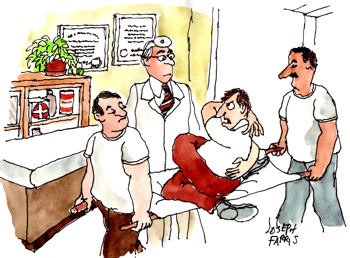
The advances in Health-Care seems to be putting some distance between the doctor and patient.

Health insurance in the U.S. suffers from many dysfunctions, but a couple of basic steps in its institutional evolution lie at the root of its worst shortcomings. I say this after coming across another great post by John Cochrane the other day, this time with some of his thoughts on fashioning an Obamacare replacement. He lays out a few basic principles, one of which is that “health insurance is not a payment plan for small expenses“, or shouldn’t be.

The best parts of Cochrane’s post, I think, relate to two longstanding features of the health insurance market in the U.S.:

“The original sin of American health insurance is the tax deduction for employer-provided group plans — but not, to this day, for employer contributions to portable individual insurance. ‘Insurance’ then became a payment plan, to maximize the tax deduction, and then horrendously inefficient as people were no longer spending their own money.

Worse, nobody who hopes to get a job with benefits then buys long-term individual insurance. This provision alone pretty much created the preexisting conditions problem.”

The last two sentences are insightful commentary on the inadequacy of coverage for pre-existing conditions, though “creating the pre-existing conditions problem” should probably read “foreclosed any easy solution to the pre-existing conditions problem“. During World War II, the government authorized the tax deduction for employer-provided health plans as a concession to labor interests frustrated by war-time wage controls. Cochrane should be forgiven for making this sound like a deal with the devil. Today, employer-provided coverage is almost always limited to one’s job tenure (plus 18 months under COBRA, since 1985). In the 1940s, the benefits might have been generous, but portability was probably the last thing on their minds, especially in light of the long job tenures of the day and the fact that many employers, at that time,  offered coverage to vested retirees. The dominance of employer-provided coverage after WW-II pretty much ruled out lifetime insurability in a world with relatively high job mobility.

The tax deduction also helped to institutionalize the faulty notion that “good” health insurance should cover a panoply of services involving small, recurring expenses that are properly considered normal health upkeep. Instead, insurance should cover large, unexpected expenses for services necessary to treat injuries or severe illness. In addition, the coverage and the premium should, at the buyer’s option, include a guarantee of future insurability at standard rates. This option should not be mandated, but a refusal to opt-in must come at the risk of potentially large future health care obligations.

Cochrane also says:

“Cross-subsidies are a second original sin. Our government doesn’t like taxing and spending on budget where we can see it. So it forces others to pay: It forces employers to provide health insurance. It forces hospitals to provide free care. It low-balls Medicare and Medicaid reimbursement.

The big problem: These patches and cross-subsidies cannot stand competition. Yet without supply competition, costs increase, the number of people needing subsidized care rises, and around we go.”

Competition and choice must exist in health care delivery and in the health insurance market to keep costs under control. But if person A is an identifiable health risk and person B is not, and if healthy B is forced to pay the same premium for health coverage as sickly A, then A is cross-subsidized by B. Competition will encourage B to bail out of the risk pool. If B is prohibited from doing so, costs will soar because the cross-subsidies create incentives for A to over-utilize services, even making allowance for A’s greater need. Thus, forcing A and B into the same risk pool ultimately exacerbates the plight of both A and B by raising costs. That’s where we find ourselves today.

Enabling competition and dismantling cross-subsidies can only occur if all consumers are able to purchase not just health insurance, but long-term health insurability. To avoid a painful transition, publicly-funded high-risk pools might be necessary for the existing type As of the world, who are already burdened by poor health and might not be able to afford the premium necessary for insurance. Going forward, those who refuse a future-insurability option must understand that if they fail to opt-in prior to developing a serious health condition, they will have to rely on Medicaid, private charity, or a risk-rated policy, if they can afford it.

Will Republicans abolish the ill-founded tax deduction? Almost certainly not. They are likely to extend it to the individual side of the market, despite the fact that this will have an additional inflating impact on health care costs. At least it will reduce the current advantage of employer-paid coverage, potentially broadening the market faced by individuals. Also, Republicans might take steps to restore choice, promote competition, and eliminate cross-subsidies. As Cochrane notes, there are also ideas in play to improve portability. Questions remain about many of the details, however, including Medicaid reforms. On the whole, I’m hopeful that we’ll see most of Obamacare’s short-sighted provisions and rules rolled back and replaced by legislation to encourage the development of the market for insurance coverage and for future insurability.

← Older posts
Newer posts →
Follow Sacred Cow Chips on WordPress.com

Recent Posts

  • A Warsh Policy Scenario At the Federal Reserve
  • The Coexistence of Labor and AI-Augmented Capital
  • The Case Against Interest On Reserves
  • Immigration and Merit As Fiscal Propositions
  • Tariff “Dividend” From An Indigent State

Archives

  • February 2026
  • January 2026
  • December 2025
  • November 2025
  • October 2025
  • September 2025
  • August 2025
  • July 2025
  • June 2025
  • May 2025
  • April 2025
  • March 2025
  • February 2025
  • January 2025
  • December 2024
  • November 2024
  • October 2024
  • September 2024
  • August 2024
  • July 2024
  • June 2024
  • May 2024
  • April 2024
  • March 2024
  • February 2024
  • January 2024
  • December 2023
  • November 2023
  • August 2023
  • July 2023
  • June 2023
  • May 2023
  • April 2023
  • March 2023
  • February 2023
  • January 2023
  • December 2022
  • November 2022
  • October 2022
  • September 2022
  • August 2022
  • July 2022
  • June 2022
  • May 2022
  • April 2022
  • March 2022
  • February 2022
  • January 2022
  • December 2021
  • November 2021
  • October 2021
  • September 2021
  • August 2021
  • July 2021
  • June 2021
  • May 2021
  • April 2021
  • March 2021
  • February 2021
  • January 2021
  • December 2020
  • November 2020
  • October 2020
  • September 2020
  • August 2020
  • July 2020
  • June 2020
  • May 2020
  • April 2020
  • March 2020
  • February 2020
  • January 2020
  • December 2019
  • November 2019
  • October 2019
  • September 2019
  • August 2019
  • July 2019
  • June 2019
  • May 2019
  • April 2019
  • March 2019
  • February 2019
  • January 2019
  • December 2018
  • November 2018
  • October 2018
  • September 2018
  • August 2018
  • July 2018
  • June 2018
  • May 2018
  • April 2018
  • March 2018
  • February 2018
  • January 2018
  • December 2017
  • November 2017
  • October 2017
  • September 2017
  • August 2017
  • July 2017
  • June 2017
  • May 2017
  • April 2017
  • March 2017
  • February 2017
  • January 2017
  • December 2016
  • November 2016
  • October 2016
  • September 2016
  • August 2016
  • July 2016
  • June 2016
  • May 2016
  • April 2016
  • March 2016
  • February 2016
  • January 2016
  • December 2015
  • November 2015
  • October 2015
  • September 2015
  • August 2015
  • July 2015
  • June 2015
  • May 2015
  • April 2015
  • March 2015
  • February 2015
  • January 2015
  • December 2014
  • November 2014
  • October 2014
  • September 2014
  • August 2014
  • July 2014
  • June 2014
  • May 2014
  • April 2014
  • March 2014

Blogs I Follow

  • Passive Income Kickstart
  • OnlyFinance.net
  • TLC Cholesterol
  • Nintil
  • kendunning.net
  • DCWhispers.com
  • Hoong-Wai in the UK
  • Marginal REVOLUTION
  • Stlouis
  • Watts Up With That?
  • Aussie Nationalist Blog
  • American Elephants
  • The View from Alexandria
  • The Gymnasium
  • A Force for Good
  • Notes On Liberty
  • troymo
  • SUNDAY BLOG Stephanie Sievers
  • Miss Lou Acquiring Lore
  • Your Well Wisher Program
  • Objectivism In Depth
  • RobotEnomics
  • Orderstatistic
  • Paradigm Library
  • Scattered Showers and Quicksand

Blog at WordPress.com.

Passive Income Kickstart

OnlyFinance.net

TLC Cholesterol

Nintil

To estimate, compare, distinguish, discuss, and trace to its principal sources everything

kendunning.net

The Future is Ours to Create

DCWhispers.com

Hoong-Wai in the UK

A Commonwealth immigrant's perspective on the UK's public arena.

Marginal REVOLUTION

Small Steps Toward A Much Better World

Stlouis

Watts Up With That?

The world's most viewed site on global warming and climate change

Aussie Nationalist Blog

Commentary from a Paleoconservative and Nationalist perspective

American Elephants

Defending Life, Liberty and the Pursuit of Happiness

The View from Alexandria

In advanced civilizations the period loosely called Alexandrian is usually associated with flexible morals, perfunctory religion, populist standards and cosmopolitan tastes, feminism, exotic cults, and the rapid turnover of high and low fads---in short, a falling away (which is all that decadence means) from the strictness of traditional rules, embodied in character and inforced from within. -- Jacques Barzun

The Gymnasium

A place for reason, politics, economics, and faith steeped in the classical liberal tradition

A Force for Good

How economics, morality, and markets combine

Notes On Liberty

Spontaneous thoughts on a humble creed

troymo

SUNDAY BLOG Stephanie Sievers

Escaping the everyday life with photographs from my travels

Miss Lou Acquiring Lore

Gallery of Life...

Your Well Wisher Program

Attempt to solve commonly known problems…

Objectivism In Depth

Exploring Ayn Rand's revolutionary philosophy.

RobotEnomics

(A)n (I)ntelligent Future

Orderstatistic

Economics, chess and anything else on my mind.

Paradigm Library

OODA Looping

Scattered Showers and Quicksand

Musings on science, investing, finance, economics, politics, and probably fly fishing.

  • Subscribe Subscribed
    • Sacred Cow Chips
    • Join 128 other subscribers
    • Already have a WordPress.com account? Log in now.
    • Sacred Cow Chips
    • Subscribe Subscribed
    • Sign up
    • Log in
    • Report this content
    • View site in Reader
    • Manage subscriptions
    • Collapse this bar
 

Loading Comments...