• About

Sacred Cow Chips

Sacred Cow Chips

Tag Archives: Minimum Wage

Authoritarian Designs

31 Sunday Jan 2016

Posted by Nuetzel in Progressivism, racism, Uncategorized

≈ Leave a comment

Tags

Bernie Sanders, Child Quotas, CRISPR, Davis Bacon Act, Eugenics, Friedrich Hayek, John Stewart Mill, Jonah Goldberg, Kevin Drum, Minimum Wage, Mother Jones, Obamacare Effectiveness Research, Progressivism, racism, Scientism, Sterilization, Tyler Cowen

eugenics certificate

Why condemn today’s progressives for their movement’s early endorsement of eugenics? Kevin Drum at Mother Jones thinks this old association is now irrelevant. He furthermore believes that eugenics is not an important issue in the modern world. Drum’s remarks were prompted by Jonah Goldberg’s review of Illiberal Reformers, a book by Thomas Leonard on racism and eugenicism in the American economics profession in the late 19th century. Tyler Cowen begs to differ with Drum on both counts, but for reasons that might not have been obvious to Drum. Eugenics is not a bygone, and its association with progressivism is a reflection of the movement’s broader philosophy of individual subservience to the state and, I might add, the scientism that continues to run rampant among progressives.

Cowen cites John Stewart Mill, one of the great social thinkers of the 19th century, who was an advocate for individual liberty and a harsh critic of eugenics. Here is a great paragraph from Cowen:

“The claim is not that current Progressives are evil or racist, but rather they still don’t have nearly enough Mill in their thought, and not nearly enough emphasis on individual liberty. Their continuing choice of label seems to indicate they are not much bothered by that, or maybe not even fully aware of that. They probably admire Mill’s more practical reform progressivism quite strongly, or would if they gave it more thought, but they don’t seem to relate to the broader philosophy of individual liberty as it surfaced in the philosophy of Mill and others. That’s a big, big drawback and the longer history of Progressivism and eugenics is perhaps the simplest and most vivid way to illuminate the point. This is one reason why the commitment of the current Left to free speech just isn’t very strong.“

Eugenics is not confined to the distant past, as Cowen notes, citing more recent “progressive” sterilization programs in Sweden and Canada, as well as the potential use of DNA technologies like CRISPR in “designing” offspring. That’s eugenics. So is the child quota system practiced in China, sex-selective abortion, and the easy acceptance of aborting fetuses with congenital disorders. Arguably, Obamacare “effectiveness research” guidelines cut close to eugenicism by proscribing certain treatments to individuals based upon insufficient “average benefit”, which depends upon age, disability, and stage of illness. Obamacare authorizes that the guidelines may ultimately depend on gender, race and ethnicity. All of these examples illustrate the potential for eugenics to be practiced on a broader scale and in ways that could trample individual rights.

Jonah Goldberg also responded to Drum in “On Eugenics and White Privilege“. (You have to scroll way down at the link to find the section with that title.) Goldberg’s most interesting points relate to the racism inherent in the minimum wage and the Davis-Bacon Act, two sacred cows of progressivism with the same original intent as eugenics: to weed out “undesirables”, either from the population or from competing in labor markets. It speaks volumes that today’s progressives deny the ugly economic effects of these policies on low-skilled workers, yet their forebears were counting on those effects.

Scientism is a term invoked by Friedrich Hayek to describe the progressive fallacy that science and planning can be used by the state to optimize the course of human affairs. However, the state can never command all the information necessary to do so, particularly in light of the dynamism of information relating to scarcity and preferences; government has trouble enough carrying out plans that merely match the static preferences of certain authorities. Historically, such attempts at planning have created multiple layers of tragedy, as individual freedoms and material well-being were eroded. Someone should tell Bernie Sanders!

Eugenics fit nicely into the early progressive view, flattering its theorists with the notion that the human race could be made… well, more like them! Fortunately, eugenics earned its deservedly bad name, but it continues to exist in somewhat more subtle forms today, and it could take more horrific forms in the future.

Two earlier posts on Sacred Cow Chips dealt at least in part with eugenics: “Child Quotas: Family as a Grant of Privilege“, and “Would Heterosexuals Select For Gay Genes?“.


.

Horizons Lost To Coercive Intervention

27 Wednesday Jan 2016

Posted by Nuetzel in Human Welfare, Price Controls, Regulation

≈ Leave a comment

Tags

Allocation of Resources, Don Boudreaux, Foregone Alternatives, Frederic Bastiat, Luddites, Minimum Wage, Opportunity Costs, Price Ceilings, Price Controls, Price floors, Rent Control, Scientism, Unintended Consequences, What is Not Seen

ceiling prices

Every action has a cost. When you’re on the hook, major decisions are obviously worth pondering. But major societal decisions are often made by agents who are not on the hook, with little if any accountability for long-term consequences. They have every incentive to discount potential downside effects, especially in the distant future. Following Frederic Bastiat, Don Boudreaux writes of three levels of “What Is Not Seen” as a consequence of human decisions, which I summarize here:

  1. Immediate foregone alternatives: Possession, use and enjoyment of X is not seen if you buy Y.
  2. Resources not directed to foregone alternatives: The reduction in X inventory is not seen, compensating production of X is not seen, and extra worker hours, capital use and flow of raw materials needed for X production are not seen.
  3. The future implied by foregone alternatives: Future impacts can take many forms. X might have been a safer or healthier alternative, but those benefits are unseen. X might have been lower quality, so the potential frustration and repairs are unseen. X might have been less expensive, but the future benefits of the money saved are unseen. All of these “unseens” have implications for the future world experienced by the decision-maker and others.

These effects take on much more significance in multiples, but (2) and (3) constitute extended unseen implications for society at large. In multiples, the lost (unseen) X production and X labor-hours, capital and raw materials are more obvious to the losers in the X industry than the winners in the Y industry, but they matter. In the future, no vibrant X industry will not be seen; the resources diverted to meet Y demand won’t be seen at new or even old X factories. X might well vanish, leaving only nontransformable detritus as a token of its existence.

Changes in private preferences or in production technologies create waves in the course of the “seen” reality and the “unseen” world foregone. Those differences are caused by voluntary, private choice, so gains are expected to outweigh losses relative to the “road not traveled”. That’s not a given, however, when decisions are imposed by external authorities with incentives unaligned with those in their thrall. For that reason, awareness of the unseen is of great importance in policy analysis, which is really Boudreaux’s point. Here is an extreme example he offers in addressing the far-reaching implications of government intrusions:

“Suppose that Uncle Sam in the early 20th century had, with a hypothetical Ludd Act, effectively prohibited the electrification of American farms, businesses, and homes. That such a policy would have had a large not-seen element is evident even to fans of Bernie Sanders. But the details of this not-seen element would have been impossible today even to guess at with any reliability. Attempting to quantify it econometrically would be an exercise in utter futility. No one in a 2015 America that had never been electrified could guess with any sense what the Ludd Act had cost Americans (and non-Americans as well). The not-seen would, in such a case, loom so large and be so disconnected to any known reality that it would be completely mysterious.“

Price regulation provides more familiar examples. Rent controls intended to “protect” the public from landlords have enormous “unintended” consequences. Like any price regulation, rent controls stifle exchange, reducing the supply and quality of housing. Renters are given an incentive to remain in their units, and property owners have little incentive to maintain or upgrade their properties. Deterioration is inevitable, and ultimately displacement of renters. The unseen, lost world would have included more housing, better housing, more stable neighborhoods and probably less crime.

A price floor covered by Boudreaux is the minimum wage. The fully predictable but unintended consequences include immediate losses in some combination of jobs, hours, benefits, and working conditions by the least-skilled class of workers. Higher paid workers feel the impact too, as they are asked to perform more (and less complex) tasks or are victimized by more widespread substitution of capital for labor. Consumers also feel some of the pain in higher prices. The net effect is a reduction in mutually beneficial trade that continues and may compound with time:

“As the time span over which obstructions to certain economic exchanges lengthens, the exchanges that would have, but didn’t, take place accumulate. The businesses that would have been created absent a minimum wage – but which, because of the minimum wage, are never created – grow in number and variety. The instances of on-the-job worker training that would have occurred – but, because of the minimum wage, didn’t occur – stack up increasingly over time.“

Regulation and taxation of all forms have such destructive consequences, but policy makers seldom place a heavy weight on the unobserved counterfactual. Boudreaux emphasizes the futility of quantifying the “unseen” effects these policies:

“… those who insist that only that which can be measured and quantified with numerical data is real must deny, as a matter of their crabbed and blinding scientism, that such long-term effects … are not only not-seen but also, because they are not-seen, not real.“

The trade and welfare losses of coercive interventions of all types are not hypothetical. They are as real as the losses caused by destruction of property by vandals. Never again can the owners enjoy the property as they once had. Future pleasures are lost and cannot be observed or measured objectively. Even worse, when government disrupts economic activity, the cumulative losses condemn the public to a backward world that they will find difficult to recognize as such.


Automate No Job Before Its Time

28 Monday Dec 2015

Posted by Nuetzel in Price Controls, Technology

≈ 6 Comments

Tags

Automation, Capital-Labor Sucstiturion, David Neumark, Don Boudreaux, Innovation, Living Wage, McKinsey Global Institute, Minimum Wage, Risk of Automation, Technological Diffusion

This interactive chart from the McKinsey Global Institute (not the one above, as good as it is…) shows occupations at risk of automation, and it should give warning to those asserting that a substantial increase in the minimum wage is in the interests of low-wage workers. It shows the extent to which various jobs can be automated under existing technology. The salient facts here are that a large number of workers earn less than $15 per hour, that most of those workers perform jobs that can be automated, and that further advances in technology will increase the potential for automation beyond what’s shown in the chart.

A simple truth that must be understood is that wage rates are strongly associated with the skills and productivity required for particular jobs. Denial of that fundamental rule cannot help anyone, and will almost certainly harm many. Low skill requirements are less highly-compensated because they add little value and are easily satisfied.

As Don Boudreaux points out, innovation is often spurred by economic forces. A mandated wage minimum, which is a price floor creating artificial surplus conditions, magnifies incentives for greater innovation. In addition to the substitution away from low-skilled labor (or domestic labor) that can be expected, there are many other margins along which employers can economize in the face of such government edicts: higher expectations for productivity, fewer benefits, fewer breaks, fewer niceties in the workplace, and less flexibility over hours and days off. These things matter greatly to employees and employers. A wage law can make for an unpleasant work environment.

Those who suffer most from minimum wage decrees are the least skilled, whose jobs are the most vulnerable. Economist David Neumark notes that “The Evidence Is Piling Up That Higher Minimum Wages Kill Jobs“, despite claims to the contrary (gated… Google “wsj NeumarK”, select the December 15, 2015 link).

Lest anyone decry the technologies that could replace these workers, recall that the substitution of capital for labor over time has led to the great gains in productivity that have elevated wages and income over time. Many jobs that are commonplace today (and were not even imagined in earlier times) would not exist if not for advances in technology. Likewise, there will be jobs that are commonplace in the future that do not exist today, and we won’t have the power (nor will the government) to anticipate those jobs until the enabling technologies come to fruition and early adoption. These kinds of changes are never without difficulty, as workers bear significant costs of adjustment in the short run, including the acquisition of new skills. However, wage floors force an even earlier and contrived adoption of technologies, which harms low-wage workers most severely. Far better to allow an unfettered and natural process of free choice, technological diffusion, price adjustment, and growth to take place.

Degrees of Poverty and The Social Safety Trap

01 Thursday Oct 2015

Posted by Nuetzel in Poverty

≈ 1 Comment

Tags

Anti-Poverty Programs, Census Bureau Report on Poverty, David Henderson, Family Disintegration, income inequality, James D. Agresti, Living Standards, Measuring Poverty, Minimum Wage, Poverty, Public education, Robert Rector, War on Drugs, War on Poverty

Income Dist Chart

The poor in the United States are extremely well-off by international standards. That is clear in the chart above, which David Henderson discusses in “The Role of Luck In The Income Distribution“. By luck, Henderson means that one’s country of birth has a huge impact on their ultimate place in the global income distribution. The chart compares positions in a single country’s income distribution with corresponding points in the global distribution (2008 data). For example, an individual in the 20th percentile of the U.S. income distribution (20 on the horizontal axis) is in roughly the 86th percentile of the global distribution (from the vertical axis). Those at the very bottom of the U.S. income distribution have a greater income than half of the individuals in the world. The average U.S. earner in the lowest 20% earns more than nearly 75% of all earners globally. Individuals across the entire income distribution in the U.S. have higher incomes than their counterparts elsewhere.

Within the U.S., we often use the term “impoverished” in a fairly parochial sense: compared to our compatriots, not to the rest of the world. Robert Rector discusses the living standards of the poor in America in “How Do America’s Poor Really Live? Examining the Census Poverty Report“. The actual census report released this month is discussed in The Atlantic here. Rector states the following:

“According to the government’s own reports, the typical American defined as poor by the Census Bureau has a car, air conditioning, and cable or satellite TV. Half of the poor have computers, 43 percent have Internet, and 40 percent have a wide-screen plasma or LCD TV. … Far from being overcrowded, poor Americans have more living space in their home than the average non-poor person in Western Europe.“

Rector notes that the Census Bureau’s measure of poverty is based on a flawed definition of income, one that is inconsistent with how income is defined in calculating official measures of poverty in other countries. The Census definition excludes most welfare benefits, and taxes aren’t always subtracted from income by other countries. The Rector post linked above contains an incorrect link to this recent article on international comparisons of poverty rates. When the measurement inconsistencies are corrected, the official U.S. poverty rate is similar to the advanced economies of Europe, and it is lower than Eurooean poverty rates based on a more inclusive definition preferred by many on the left. And again, the actual standard of living of those below the official poverty level in the U.S. is impressive compared to the rest of the world. It is also impressive from a historical perspective.

Rector discusses the failure of the welfare state and the War on Poverty to lift the impoverished out of dependency. This has been covered here on Sacred Cow Chips several times (see here and here). The terrible structure of incentives built into many anti-poverty programs is one of the primary causes, as well as the failure of public education. Also at fault are minimum wage legislation, the War on Drugs, tax policy and a regulatory regime that discourages job creation by punishing new capital investment and business creation.

The left often claims that the distribution of income in the U.S. is becoming increasingly skewed toward high-income households. In “Myths and Causes of Income Inequality“, James D. Agresti demonstrates that the real causes of this phenomenon are demographic. The splintering of families at low income levels has increased the number of low-income households and reduced average incomes among those households. At the level of individual earners, there is no discernible trend in income inequality. According to Agresti:

“… the rise of household income inequality stems from family disintegration driven by changing attitudes toward sex, marital fidelity, and familial responsibility.“

Agresti stops short of drawing a link between anti-poverty policies and the disintegration of the family, though there are reasons to suspect pernicious connections along those lines.

It is easy to exaggerate the extent and severity of poverty in the U.S.; doing so is of obvious value in promoting the leftist agenda. In reality, the poor in this country are provided with a standard of living through public assistance that is high relative to their counterparts across the globe, and it is similar to other advanced economies. In addition, when changes in the structure of households are neutralized, there has been no upward trend in income inequality, contrary to assertions from the left. Our long-term objective should be to lift able recipients out of dependency, consistent with President Johnson’s original goals for the War on Poverty. That will require major reforms to our anti-poverty efforts, public education and many other aspects of public policy. Most poor families in the U.S. receive support that is enviable to the poor elsewhere. Nevertheless, their plight of dependency has dispiriting and self-reinforcing effects.

Bernie Sanders: Just a Regular Looter

17 Thursday Sep 2015

Posted by Nuetzel in Free markets, Poverty, Socialism

≈ 1 Comment

Tags

Bernie Sanders, Capital-Labor Substitution, Citizens United, Donald Trump, Economic illiteracy, Ed Krayewski, Energy Policy, Feel the Bern, infrastructure, Kevin D. Williamson, Minimum Wage, Police Brutality, Poverty, Racial exclusion, Socialism, Universal Health Care, War on Drugs

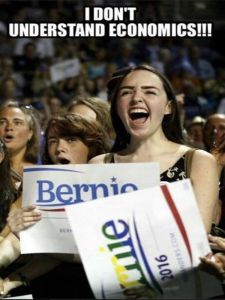
Bernie

Economic illiteracy is getting to be a central theme in the early stages of the 2016 presidential race. The two candidates with whom the public and media are most fascinated at the moment are Bernie Sanders and Donald Trump. Both are veritable case studies in delusional economic reasoning. I have already devoted two posts to Trump, the current frontrunner for the Republican nomination (both posts appear at the link in reverse order). At the time of the second of those posts, I recall hoping desperately that someone or something would rescue my blog from him. I have managed, since then, to resist devoting more attention to his campaign. In this post, I’ll focus on Senator Bernie Sanders of Vermont, currently the top rival to Hillary Clinton for the Democrat nomination.

It’s ironic that Sanders, a self-proclaimed socialist, shares several areas of acute economic illiteracy with Donald Trump. There is a strong similarity between Sanders and Trump on foreign trade (and both candidates are pro-Second Amendment). Like Trump, Sanders demonstrates no understanding of the reasons for trade, as Kevin Williamson notes:

“The incessant reliance on xenophobic (and largely untrue) tropes holding that the current economic woes of the United States are the result of scheming foreigners, especially the wicked Chinese, “stealing our jobs” and victimizing his class allies…. He describes the normalization of trade relations with China as “catastrophic” — Sanders and Jesse Helms both voted against the Clinton-backed China-trade legislation — and heaps scorn on every other trade-liberalization pact. That economic interactions with foreigners are inherently hurtful and exploitative is central to his view of how the world works.“

Sanders lacks an understanding of trade’s real function: allowing consumers and businesses to freely engage in mutually beneficial exchanges with partners abroad, and vice versa. Trade thereby allows our total consumption and standard of living to expand. It is not based on “beating” your partners, as Sanders imagines. It is cooperative behavior.

Opposition to free trade nearly always boils down to one thing: avoiding competition. That goes for businesses seeking to protect or gain some degree of monopoly power and for unions wishing to keep wages, benefits and work rules elevated above levels that can otherwise be justified by productivity. The result is that consumers pay higher prices, have access to fewer goods and less variety, and have a lower standard of living. It is no accident that trade wars deepened the severity of the Great Depression domestically and globally. But Sanders, like Trump, has failed to learn from the historical record.

Another area of Sanders’ deep economic ignorance is his position on wage controls. He advocates a mandatory $15 federal minimum wage with no recognition of the potential damage of such a change. Kevin Williamson has this to say:

“Prices [and wages] in markets are not arbitrary — they are reflections of how real people actually value certain goods and services in the real world. Arbitrarily changing the dollar numbers attached to those preferences does not change the underlying reality any more than trimming Cleveland off a map of the United States actually makes Cleveland disappear.“

The minimum wage was the subject of a recent post on Sacred Cow Chips. A higher minimum is a favorite policy of well-meaning leftists and social justice warriors, but they fail to address the realities that the least-skilled suffer adverse employment effects, that a higher minimum wage hastens the substitution of capital for unskilled labor, and that the policy often benefits non-primary workers from middle and upper-income households. It’s a lousy way to help the impoverished. Moreover, minimum wages were originally conceived as a tool of racial exclusion and in all likelihood still act that way. Most of the research supporting minimum wage increases focuses on short-run effects or on sectors that are less capital-intensive. Findings about long-run effects are much more negative (see here, too). It’s a given that Sanders understands none of this.

Other elements of Sanders’ platform are essentially freebies for all: universal health care (see the first link from this Bing search), free college tuition for all, and expanded social security benefits. And of course there is a promise to rebuild our crumbling infrastructure, taking full advantage of the myth that our infrastructure is so decrepit that it must be replaced now. All of these ideas are costly, to say the least, and there is nothing adequate in Sanders’ platform to pay for them. He’ll raise taxes on the 1%, he says. Just watch the capital fly away. Ed Krayewski of Reason discusses Sander’s rich promises and the lack of resources to pay for them in “Bernie Sanders, the 18 Trillion Dollar Man“:

“The Wall Street Journal spoke with an economist at the liberal Center on Budget and Policy Priorities, who acknowledged taxes would have to go up for the middle class too to pay for Sanders programs.“

Middle class tax hikes would undoubtedly be accompanied by a lot more public debt, and ultimately inflation. Freebies for whom? As Krayewski says, Sanders “wants taxpayers to ‘feel the Bern’“.

In fairness, Sanders suggests that some of the needed revenue can be diverted from military spending. Possibly, but the military budget has already been reduced significantly, and it is not clear that much fat remains for Sanders to cut. There will certainly be demands for greater military spending given the significant threats we are likely to face from rogue states.

Sanders’ promise to transform our energy system is another one that will come with high costs. What Sanders imagines is a widespread fallacy that green energy can be produced at little cost. However, we know that renewables carry relatively high distributed costs and their contributions to load are intermittent, requiring base load backup from more traditional sources like fossil fuels or nuclear energy. Like President Obama, Sanders would impose new costs on fossil fuels, but the poor will suffer the most without offsetting assistance. And subsidies are also required to incent greater adoption of expensive alternatives like home solar and electric vehicles. Sanders would authorize this massive diversion of resources for the purpose of mitigating a risk based on carbon-forcing climate models with consistent track records of poor accuracy.

If free speech is your hot button, then Sanders’ promise to “overturn” Citizen’s United won’t make you happy. Why should an association of individuals, like a union or a corporation, be denied the right to use pooled resources for the purpose of expressing views that are important to their mission? Sanders is proposing an outright abridgment of liberty. From the first Kevin Williamson link above:

“… criminalizing things is very much on Bernie’s agenda, beginning with the criminalization of political dissent. At every event he swears to introduce a constitutional amendment reversing Supreme Court decisions that affirmed the free-speech protections of people and organizations filming documentaries, organizing Web campaigns, and airing television commercials in the hopes of influencing elections or public attitudes toward public issues.“

It is hard to take issue with Sanders’ call for an end to police brutality without a clear sense of his attitude toward law enforcement. I believe all fair-minded people wish for zero police brutality, but critics often minimize the difficulty of police work. No doubt there are gray areas in the practice of law enforcement; some police officers take their powers too far, which cannot be condoned. If institutional reforms can help, so much the better. But the police must be given the latitude to do a difficult job without fear of unreasonable legal reprisal.

On a related note, Sanders advocates an end to the war on drugs, a reform that I wholeheartedly support. Go you Bernie!

Finally, here is a more general illustration of Bernie Sanders’ backward views on economics. It is a Sanders quote I repeat from the second Kevin Willamson link above:

“You don’t necessarily need a choice of 23 underarm spray deodorants or of 18 different pairs of sneakers when children are hungry in this country. I don’t think the media appreciates the kind of stress that ordinary Americans are working on.“

Sanders’ complaint about the plethora of choices in consumer goods fails to recognize that they reflect real differences in consumer preferences, as well as an economy dynamic enough to provide for those preferences. Far from causing hunger and poverty, that dynamism has lifted standards of living over the years across the entire income distribution, even among the lowest income groups, to levels that would astonish our forebears. And it created the wealth that enables our society to make substantial transfers of resources to low income groups. Unfortunately, those very transfer programs are rife with incentives that encourage continued dependency. Other government interventions such as the minimum wage have diminished opportunities for work for individuals with little experience and skills. Meanwhile, regulation and high business and personal taxes undermine the continued growth and dynamism of the economy that could otherwise lift more families out of dependency. Sanders would do better to study the history of socialism in practice, and to look in his own socialist mirror to identify the reasons for persistently high levels of poverty.

Prospective Professionals Don’t Snub Minimum Wage Waivers

01 Tuesday Sep 2015

Posted by Nuetzel in Free markets

≈ 1 Comment

Tags

Antony Davies, Automation, Bryan Caplan, Department of Labor, Food Service Robots, McDonald's wages, Mercatus Center, Minimum Wage, Union Wage Exemptions, Unpaid internships, Vocational training, Wage floor, Walmart wages, Wendy's wages

image

Are unpaid internships of any benefit to the student/intern? If not, then why do you suppose several hundred thousand smart students accept them each year? And there are many more internships for which the pay is nominal. Clearly these students have something to gain, though some would still argue that interns are exploited. They would like to be paid, of course, but they are sufficiently forward-thinking to recognize opportunities, even if they are unpaid gigs.

What’s really silly is the Department of Labor’s “tests” for whether an unpaid internship can be offered. In truth, it would be impossible to meet the DOL’s requirements, but that doesn’t seem to matter. Bryan Caplan is on very safe ground in arguing that “Every Unpaid Internship Is Illegal“. Apparently the rules are just for show, though again, some would like to see the practice ended. But here is the truth from Caplan:

“Internships are vocational education. If schools can educate students in exchange for their tuition, why can’t businesses educate students in exchange for their labor? No reason, just anti-market bigotry.“

Caplan’s description of the transaction is apt. From the firm’s point of view, bringing an intern into the office has disadvantages. With some introduction, the intern can perform various low-level tasks, but they absorb the time of paid staff because some degree of oversight is required. And there is some risk: an intern might prove capable of performing fairly complex tasks, but some don’t work out at all. The hope is that they can make a minor contribution to the work effort, add to the firm’s recruiting pipeline, and perhaps strengthen the firm’s ties to the student’s learning institution. In exchange, the intern gains valuable experience in an actual business environment and walks away with a stronger resume and some contacts. A mutually beneficial trade.

For the sake of intellectual consistency, proponents of the minimum wage should oppose unpaid or low-paying internships. The situations differ only in terms of the typical job description and its educational requirements. In both instances, opposition to the voluntary exchange of labor for training and experience would foreclose opportunities of which many are happy to avail themselves. The worst of it is that the minimum wage itself inflicts its damage on the least skilled, who need opportunities the most. This is harmful and foolish intervention, however well-intentioned.

The harm is vividly illustrated by responses to President Obama’s proposal to raise the minimum wage to $10.10 an hour from $7.25, and to various moves on the part of state and local governments to raise the minimum wage within their jurisdictions. The end-game will be higher prices, more automation, lower employment and reduced hours among low-skilled workers (and those with less work experience). This article about Wendy’s is pertinent. It also notes that McDonald’s is planning to automate. Apparently Walmart is cutting hours after responding to pressure to increase wages.

The jury is out on the damage from changes in the minimum wage in cities like Seattle, San Francisco and Los Angeles. Initial signs have indicated some negative employment effects, but the data is noisy and reported at a higher level of aggregation. Regardless, the least skilled will suffer negative consequences. Interestingly, unions backed the increases but have found ways to gain exemptions for their own contracts.

One of the most absurd assertions about wage floors comes from the DOL itself:

“…the DOL cites numerous studies to support its claim that higher wages are associated with higher levels of worker productivity, but the agency gets the causality reversed, among other errors of interpretation.“

The correct rationale for the DOL’s claim is with reference to the productivity of remaining workers near the margin, since less productive workers will have been canned. Too bad! The last link, from Antony Davies of the Mercatus Center, shows the positive relationship between unemployment and the minimum wage for less educated workers. Of course, this does not capture the negative effect on hours worked for those who remain employed following an increase in the wage floor.

Prohibition of unpaid internships would undoubtedly reduce the total number of internships offered to motivated students and others seeking vocational experience and training. The losers are prospective entrants to the knowledge work force who gain valuable experience and credibility as future job candidates by virtue of unpaid or low-paid gigs. But the consequences to would-be interns might not compare to the impact of lost training and experience already suffered by society’s least skilled as a consequence of the minimum wage. They are rendered unemployable by the state, and their alternatives are often limited to dependency or illegal activity.

Major Mistake: The Minimum Opportunity Wage

06 Saturday Jun 2015

Posted by Nuetzel in Price Controls

≈ 1 Comment

Tags

Alan Krueger, Brian Doherty, competition, Coyote Blog, David Card, Don Boudreaux, Economic justice, Fast food robots, Mark Perry, Minimum Wage, Monopsony, Reason Magazine, Rise of the Machines, Robert Reich, Robot replacements, Show-Me Institute, Steve Chapman, Substitutability, Tim Worstall, Unintended Consequences, Wage compression, Warren Meyer

government-problem

City leaders in St. Louis and Kansas City are the latest to fantasize that market manipulation can serve as a pathway to “economic justice”. They want to raise the local minimum wage to $15 by 2020, following similar actions in Los Angeles, Oakland  and Seattle. They will harm the lowest-skilled workers in these cities, not to mention local businesses, their own local economies and their own city budgets. Like many populists on the national level with a challenged understanding of market forces (such as Robert Reich), these politicians won’t recognize the evidence when it comes in. If they do, they won’t find it politically expedient to own up to it. A more cynical view is that the hike’s gradual phase-in may be a deliberate attempt to conceal its negative consequences.

There are many reasons to oppose a higher minimum wage, or any minimum wage for that matter. Prices (including wages) are rich with information about demand conditions and scarcity. They provide signals for owners and users of resources that guide them toward the best decisions. Price controls, such as a wage floor like the minimum wage, short-circuit those signals and are notorious for their disastrous unintended (but very predictable) consequences. Steve Chapman at Reason Magazine discusses the mechanics of such distortions here.

Supporters of a higher minimum wage usually fail to recognize the relationship between wages and worker productivity. That connection is why the imposition of a wage floor leads to a surplus of low-skilled labor. Those with the least skills and experience are the most likely to lose their jobs, work fewer hours or not be hired. In another Reason article, Brian Doherty explains that this is a thorny problem for charities providing transitional employment to workers with low-skills or employability. He also notes the following:

“All sorts of jobs have elements of learning or training, especially at the entry level. Merely having a job at all can have value down the line worth enormously more than the wage you are currently earning in terms of a proven track record of reliable employability or moving up within a particular organization.“

The negative employment effects of a higher wage floor are greater if the employer cannot easily pass higher costs along to customers. That’s why firms in highly competitive markets (and their workers) are more vulnerable. This detriment is all the worse when a higher wage floor is imposed within a single jurisdiction, such as the city of St. Louis. Bordering municipalities stand to benefit from the distorted wage levels in the city, but the net effect will be worse than a wash for the region, as adjustments to the new, artificial conditions are not costless. Again, it is likely that the least capable workers and least resourceful firms will be harmed the most.

The negative effects of a higher wage floor are also greater when substitutes for low-skilled labor are available. Here is a video on the robot solution for fast food order-taking. In fact, today there are robots capable of preparing meals, mopping floors, and performing a variety of other menial tasks. Alternatively, more experienced workers may be asked to perform more menial tasks or work longer hours. Either way, the employer takes a hit. Ultimately, the best alternative for some firms will be to close.

The impact of the higher minimum on the wage rates of more skilled workers is likely to be muted. A correspondent of mine mentioned the consequences of wage compression. From the link:

“In some cases, compression (or inequity) increases the risk of a fight or flee phenomonon [sic]–disgruntlement culminating in union organizing campaigns or, in the case of flee, higher turnover as the result of employees quitting. … all too often, companies are forced to address the problem by adjusting their entire compensation systems–usually upward and across-the-board. .. While wage adjustments may sound good for those who do not have to worry about profits and losses, the real impact for a company typically means it must either increase productivity or lay people off.“

For those who doubt the impact of the minimum wage hike on employment decisions, consider this calculation by Mark Perry:

“The pending 67% minimum wage hike in LA (from $9 to $15 per hour by 2020), which is the same as a $6 per hour tax (or $12,480 annual tax per full-time employee and more like $13,500 per year with increased employer payroll taxes…)….“

Don Boudreaux offers another interesting perspective, asking whether a change in the way the minimum wage is enforced might influence opinion:

“... if these policies were enforced by police officers monitoring workers and fining those workers who agreed to work at hourly wages below the legislated minimum – would you still support minimum wages?“

Proponents of a higher minimum wage often cite a study from 1994 by David Card and Alan Krueger purporting to show that a higher minimum wage in New Jersey actually increased employment in the fast food industry. Tim Worstall at Forbes discussed a severe shortcoming of the Card/Krueger study (HT: Don Boudreaux): Card and Krueger failed to include more labor-intensive independent operators in their analysis, instead focusing exclusively on employment at fast-food chain franchises. The latter were likely to benefit from the failure of independent competitors.

Another common argument put forward by supporters of higher minimum wages is that economic theory predicts positive employment effects if employers have monopsony power in hiring labor, or power to influence the market wage. This is a stretch: it describes labor market conditions in very few localities. Of course, any employer in an unregulated market is free to offer noncompetitive wages, but they will suffer the consequences of taking less skilled and less experienced hires, higher labor turnover and ultimately a competitive disadvantage. Such forces lead rational employers to offer competitive wages for the skills levels they require.

Minimum wages are also defended as an anti-poverty program, but this is a weak argument. A recent post at Coyote Blog explains “Why Minimum Wage Increases are a Terrible Anti-Poverty Program“. Among other points:

“Most minimum wage earners are not poor. The vast majority of minimum wage jobs are held as second jobs or held by second earners in a household or by the kids of affluent households. …

Most people in poverty don’t make the minimum wage. In fact, the typically [sic] hourly income of the poor appears to be around $14 an hour. The problem is not the hourly rate, the problem is the availability of work. The poor are poor because they don’t get enough job hours. …

Many young workers or poor workers with a spotty work record need to build a reliable work history to get better work in the future…. Further, many folks without much experience in the job market are missing critical skills — by these I am not talking about sophisticated things like CNC machine tool programming. I am referring to prosaic skills you likely take for granted (check your privilege!) such as showing up reliably each day for work, overcoming the typical frictions of working with diverse teammates, and working to achieve management-set goals via a defined process.”

Some of the same issues are highlighted by the Show-Me Institute, a Missouri think tank, in “Minimum Wage Increases Not Effective at Fighting Poverty“.

A higher minimum wage is one of those proposals that “sound good” to the progressive mind, but are counter-productive in the extreme. The cities of St. Louis and Kansas City would do well to avoid market manipulation that is likely to backfire.

Racism And Minimum Wage Fairy Tales

02 Saturday May 2015

Posted by Nuetzel in Markets, Price Mechanism, Regulation

≈ 2 Comments

Tags

Carrie Sheffield, David Henderson, Davis Bacon Act, Eugenics, John F. Kennedy, Minimum Wage, Progressive Rhetoric, Racial Discrimination, racism, Thomas Leonard, Thomas Sowell, Walter Williams

unintended-consequences

The real history of the minimum wage is an unsavory tale unknown to most current observers. The myth that it had honorable origins is widespread, with special currency among the progressive Left. Their uncritical support for a higher wage floor reflects a failure to grasp its pernicious economic effects on low-skilled labor and an ignorance of its historical context as a mechanism enabling racial discrimination. In fact, minimum wage legislation was often motivated by racist economic concerns, as Carrie Sheffield explained a year ago in this commentary in Forbes. She quotes, among others, the great Thomas Sowell, an African-American economist, from this opinion piece:

“In an earlier era, when racial discrimination was both legally and socially accepted, minimum-wage laws were often used openly to price minorities out of the job market.“

Sowell cites historical examples of minimum wage legislation intended to harm the employment prospects of Japanese, Chinese and blacks, including the following:

“Some supporters of the first federal minimum-wage law in the United States — the Davis-Bacon Act of 1931 — used exactly the same rationale, citing the fact that Southern construction companies, using non-union black workers, were able to come north and underbid construction companies using unionized white labor.

These supporters of minimum-wage laws understood long ago something that today’s supporters of such laws seem not to have bothered to think through. People whose wages are raised by law do not necessarily benefit, because they are often less likely to be hired at the imposed minimum-wage rate.“

Walter Williams, another well-known African-American economist, provides more evidence of these origins of the wage floor in “Mandated Wages and Discrimination“:

“During the legislative debate over the Davis-Bacon Act, which sets minimum wages on federally financed or assisted construction projects, racist intents were obvious. Rep. John Cochran, D-Mo., supported the bill, saying he had ‘received numerous complaints in recent months about Southern contractors employing low-paid colored mechanics getting work and bringing the employees from the South.’ Rep. Miles Allgood, D-Ala., complained: ‘That contractor has cheap colored labor that he transports, and he puts them in cabins, and it is labor of that sort that is in competition with white labor throughout the country.’ Rep. William Upshaw, D-Ga., spoke of the ‘superabundance or large aggregation of Negro labor.’ American Federation of Labor President William Green said, ‘Colored labor is being sought to demoralize wage rates.’ The Davis-Bacon Act, still on the books today, virtually eliminated blacks from federally financed construction projects when it was passed.“

An article by Thomas C. Leonard in the Journal of Economic Perspectives, “Eugenics and Economics in the Progressive Era“, reinforces the point:

“The progressive economists believed that the job loss induced by minimum wages was a social benefit as it performed the eugenic service ridding the labour force of the unemployable.”

And if that isn’t enough for you, David Henderson has this to say:

“Unions don’t support minimum wage increases because their own members are working at the minimum wage. Virtually all union employees–I’ve never heard of an exception–work at wages above the minimum. Northern unions and unionized firms, for example, have traditionally supported higher minimum wages to hobble their low-wage competition in the South… 

… In a 1957 Senate hearing, minimum-wage advocate Senator John F. Kennedy of Massachusetts, who just four years later would be President of the United States, stated,

‘Of course, having on the market a rather large source of cheap labor depresses wages outside of that group, too – the wages of the white worker who has to compete. And when an employer can substitute a colored worker at a lower wage – and there are, as you pointed out, these hundreds of thousands looking for decent work – it affects the whole wage structure of an area, doesn’t it?’“

One can claim that JFK was advocating for a higher wage floor to benefit all workers, but it’s hard to avoid the conclusion that “protecting” white workers was his priority. And it strains credulity to deny that JFK was aware of the other side of the coin: there would be negative repercussions for low-skilled black workers. What is painfully obvious about minimum wage legislation is that the real beneficiaries are generally not those competing for minimum wage jobs, but more entrenched labor interests.

It is an unfortunate reality that blacks make up a disproportionately large share of the unskilled labor force. According to another commentary by Walter Williams, unemployment among blacks was not a chronic problem in the first half of the 20th century, even among teens, and male labor force participation among blacks was higher than for whites. Over the past 50 years, however, black unemployment has averaged twice the rate for whites. Minimum wage legislation has encouraged this disparity.

Today’s advocates of a higher minimum wage are inadvertently rooting for a policy that compounds the disadvantages faced by the least skilled workers. The minimum wage contributes to a negative disparate impact on black labor market outcomes and prevents blacks from gaining valuable job experience. It is impossible to regulate wages without impinging on hiring decisions, and it is impossible to regulate both wages and hiring without impinging on the survival of employers. To help the unskilled, the best thing policymakers can do is allow them to trade their labor freely.

Unintended Consequences: Living (Without a) Wage

02 Thursday Oct 2014

Posted by Nuetzel in Uncategorized

≈ 1 Comment

Tags

Living Wage, Mark Perry, Market Intervention, Minimum Wage, Nick Gillespie, Transfer Payments, Unintended Consequences, Wage Floors

chickensalon

Nick Gillespie makes a good case for what should be obvious to any thinking person: to help the poor, direct transfers are a better alternative than raising the minimum wage. Most people would probably agree, regardless of their views of the appropriate role of government in society, that governments are better-suited to writing checks than to complex market interventions, and labor markets are no exception. State or federal wage floors,  minimum wages, or “living wages” — whatever politically expedient name happens to be in vogue, they are the same thing — diminish employment opportunities for the least skilled members of the labor force. These workers have the most to gain from employment experience. Hence, their losses extend beyond a mere loss of current income into lost opportunities to build human capital and future income.

Mark Perry puts a fine point on the folly of raising the wage floor: “Instead of $10.10 per hour, think of the proposed minimum wage as a $5,700 annual tax per full-time unskilled worker.”

Transfers can be targeted at the poor more effectively than a living wage. First, it is relatively easy to qualify households falling below poverty-level. Second, a significant share of low-wage earners are not members of low-income households. Third, as noted above, employers can respond to wage mandates by reducing employment, but also by cutting the hours of their low-skilled employees. Both actions tend to nullify an otherwise positive impact of a higher wage floor on income.

There are few who question the need for a safety net for those truly in need, but policy should be designed to limit the need for public support. Wage floors do not promote either of those goals. However, I’d also caution that some of the transfer programs mentioned by Gillespie (food stamps and housing subsidies) are, in fact, market interventions that have unintended consequences of their own, including price distortions. Cash transfers avoid these kinds of difficulties if they are crafted to minimize negative incentives on work effort and job search activity.

Newer posts →
Follow Sacred Cow Chips on WordPress.com

Recent Posts

  • A Warsh Policy Scenario At the Federal Reserve
  • The Coexistence of Labor and AI-Augmented Capital
  • The Case Against Interest On Reserves
  • Immigration and Merit As Fiscal Propositions
  • Tariff “Dividend” From An Indigent State

Archives

  • February 2026
  • January 2026
  • December 2025
  • November 2025
  • October 2025
  • September 2025
  • August 2025
  • July 2025
  • June 2025
  • May 2025
  • April 2025
  • March 2025
  • February 2025
  • January 2025
  • December 2024
  • November 2024
  • October 2024
  • September 2024
  • August 2024
  • July 2024
  • June 2024
  • May 2024
  • April 2024
  • March 2024
  • February 2024
  • January 2024
  • December 2023
  • November 2023
  • August 2023
  • July 2023
  • June 2023
  • May 2023
  • April 2023
  • March 2023
  • February 2023
  • January 2023
  • December 2022
  • November 2022
  • October 2022
  • September 2022
  • August 2022
  • July 2022
  • June 2022
  • May 2022
  • April 2022
  • March 2022
  • February 2022
  • January 2022
  • December 2021
  • November 2021
  • October 2021
  • September 2021
  • August 2021
  • July 2021
  • June 2021
  • May 2021
  • April 2021
  • March 2021
  • February 2021
  • January 2021
  • December 2020
  • November 2020
  • October 2020
  • September 2020
  • August 2020
  • July 2020
  • June 2020
  • May 2020
  • April 2020
  • March 2020
  • February 2020
  • January 2020
  • December 2019
  • November 2019
  • October 2019
  • September 2019
  • August 2019
  • July 2019
  • June 2019
  • May 2019
  • April 2019
  • March 2019
  • February 2019
  • January 2019
  • December 2018
  • November 2018
  • October 2018
  • September 2018
  • August 2018
  • July 2018
  • June 2018
  • May 2018
  • April 2018
  • March 2018
  • February 2018
  • January 2018
  • December 2017
  • November 2017
  • October 2017
  • September 2017
  • August 2017
  • July 2017
  • June 2017
  • May 2017
  • April 2017
  • March 2017
  • February 2017
  • January 2017
  • December 2016
  • November 2016
  • October 2016
  • September 2016
  • August 2016
  • July 2016
  • June 2016
  • May 2016
  • April 2016
  • March 2016
  • February 2016
  • January 2016
  • December 2015
  • November 2015
  • October 2015
  • September 2015
  • August 2015
  • July 2015
  • June 2015
  • May 2015
  • April 2015
  • March 2015
  • February 2015
  • January 2015
  • December 2014
  • November 2014
  • October 2014
  • September 2014
  • August 2014
  • July 2014
  • June 2014
  • May 2014
  • April 2014
  • March 2014

Blogs I Follow

  • Passive Income Kickstart
  • OnlyFinance.net
  • TLC Cholesterol
  • Nintil
  • kendunning.net
  • DCWhispers.com
  • Hoong-Wai in the UK
  • Marginal REVOLUTION
  • Stlouis
  • Watts Up With That?
  • Aussie Nationalist Blog
  • American Elephants
  • The View from Alexandria
  • The Gymnasium
  • A Force for Good
  • Notes On Liberty
  • troymo
  • SUNDAY BLOG Stephanie Sievers
  • Miss Lou Acquiring Lore
  • Your Well Wisher Program
  • Objectivism In Depth
  • RobotEnomics
  • Orderstatistic
  • Paradigm Library
  • Scattered Showers and Quicksand

Blog at WordPress.com.

Passive Income Kickstart

OnlyFinance.net

TLC Cholesterol

Nintil

To estimate, compare, distinguish, discuss, and trace to its principal sources everything

kendunning.net

The Future is Ours to Create

DCWhispers.com

Hoong-Wai in the UK

A Commonwealth immigrant's perspective on the UK's public arena.

Marginal REVOLUTION

Small Steps Toward A Much Better World

Stlouis

Watts Up With That?

The world's most viewed site on global warming and climate change

Aussie Nationalist Blog

Commentary from a Paleoconservative and Nationalist perspective

American Elephants

Defending Life, Liberty and the Pursuit of Happiness

The View from Alexandria

In advanced civilizations the period loosely called Alexandrian is usually associated with flexible morals, perfunctory religion, populist standards and cosmopolitan tastes, feminism, exotic cults, and the rapid turnover of high and low fads---in short, a falling away (which is all that decadence means) from the strictness of traditional rules, embodied in character and inforced from within. -- Jacques Barzun

The Gymnasium

A place for reason, politics, economics, and faith steeped in the classical liberal tradition

A Force for Good

How economics, morality, and markets combine

Notes On Liberty

Spontaneous thoughts on a humble creed

troymo

SUNDAY BLOG Stephanie Sievers

Escaping the everyday life with photographs from my travels

Miss Lou Acquiring Lore

Gallery of Life...

Your Well Wisher Program

Attempt to solve commonly known problems…

Objectivism In Depth

Exploring Ayn Rand's revolutionary philosophy.

RobotEnomics

(A)n (I)ntelligent Future

Orderstatistic

Economics, chess and anything else on my mind.

Paradigm Library

OODA Looping

Scattered Showers and Quicksand

Musings on science, investing, finance, economics, politics, and probably fly fishing.

  • Subscribe Subscribed
    • Sacred Cow Chips
    • Join 128 other subscribers
    • Already have a WordPress.com account? Log in now.
    • Sacred Cow Chips
    • Subscribe Subscribed
    • Sign up
    • Log in
    • Report this content
    • View site in Reader
    • Manage subscriptions
    • Collapse this bar
 

Loading Comments...