• About

Sacred Cow Chips

Sacred Cow Chips

Tag Archives: Obamacare

Insuring Health Insurability

22 Saturday Dec 2018

Posted by Nuetzel in Health Insurance

≈ Leave a comment

Tags

Community Rating, Consumer Sovereignty, Death Spiral, Eugene Volokh, Health Insurance Options, Health Status Insurance, Individual Mandate, John C. Goodman, John Cochrane, Obamacare, Pre-Existing Conditions, Premium Subsidies, Tax Subsidies

The latest blow to Obamacare went down just before the holidays when a federal judge in Texas ruled that the individual mandate was unconstitutional. The decision will be appealed, so it will have no immediate impact on the health-care law or insurance markets. But as Eugene Volokh noted, the mandate itself became meaningless from an enforcement perspective after the repeal of the penalty tax for non-coverage in 2017, despite the fact that some individuals might still opt for coverage out of “respect for the law”. What will really matter, when and if the decision is upheld, is the nullification of the complex web of regulations created by Obamacare, officially known as the Affordable Care Act or ACA. Perhaps most important among these is the requirement that buyers in good health and those in poor health must be charged the same price for coverage. That is “community rating” and it is the chief reason for the escalation of insurance premiums under Obamacare.

One Size Misfits All

Community rating means that everyone pays the same premium regardless of health. Those in good health must pay higher than actuarially fair premiums to subsidize the sick or high-risk with premiums that are less than actuarially fair. Two provisions of the ACA were intended to make this work: first, the individual mandate required everyone to remain in the game (and paying the subsidies) rather than going uninsured and paying the “tax” penalty. But the penalty was so light that many preferred it to actually buying insurance. Now, of course, the penalty has been repealed. Second, individuals with incomes below 250% of poverty line receive premium subsidies from the federal government to offset the high cost of coverage. That means low-income buyers do not have to confront the high premiums, which was hoped to keep them in the game.

Community rating caused premiums in the individual insurance market to increase dramatically. This was compounded by the law’s minimum coverage requirements, which are more comprehensive than many consumers would have preferred. Lots of younger, healthier consumers opted out while the sick opted in, or even worse, opted in only when they became sick. This deterioration in the “risk pool” is the so-called insurance “death spiral”. The pool of insureds becomes increasingly risky, premiums escalate, more healthy consumers opt out, and the process repeats. At the root of it is the distortion in the way that risk is priced by community rating.

Tailored Coverage

The coverage and pricing of risk is better left to markets. That means consumers and insurers will reach agreement on policy provisions that are mutually beneficial ex ante. Insurers will offer to cover risks up to the point at which the expected marginal cost of underwriting is equal to value, or the buyer’s willingness to pay. An insurer who offers unattractive policies or charges too much will find its business undercut by competitors. But when risk is priced by government fiat and community rating, this natural form of market information discovery is impossible.

Tax vs. Premium Subsidies

Many in the high-risk population will be unable to afford coverage in the absence of community rating. There are only two general options: they pay what they can for care but otherwise go without insurance coverage, accepting charity care if they are willing; or, taxpayers pay, as under Medicaid. Most lack coverage because they simply cannot afford it, even when they earn too much to qualify for Medicaid.

That situation can be resolved in the long-term (as I’ll describe below), but an overhang of individuals with pre-existing conditions in need of subsidies will persist for a period of years. Under Obamacare, subsidies were paid by charging higher premia to healthy individuals through community rating. Again, that distorted signals about risk and value, creating unhealthy incentives among insurance buyers. The death spiral is the outcome. Subsidies funded by general taxation do not create these price distortions, however, and should be relied upon for assisting the high-risk population, at least those who are determined to qualify.

Health Status Insurance

The overhang of individuals with pre-existing conditions requiring subsidies can never be eliminated entirely—every day there are children born with critical, unanticipated health needs. However, the overhang can shrink drastically over time under certain conditions. A development that is already receiving meaningful attention in the market is the sale of health insurance options, as described by John Cochrane. I have written about this method of protecting future insurability here.

Cochrane raises the subject within the context of new HHS rules allowing insurance companies to offer “temporary” insurance coverage up to a year, but with guaranteed renewability through a total of 36 months of coverage. Unfortunately, if you get sick before the end of the 36th month, you’ll have to give up your policy and pay more elsewhere.  But Cochrane speculates:

“Unless, perhaps, they really are letting insurance companies offer the right to buy health insurance as a separate product, and that can have as long a horizon as you want? If they haven’t done that, I suggest they do so! I don’t think the ACA forbids the selling of options on health insurance of arbitrary duration.”

Cochrane links to this earlier article in which John C. Goodman discusses the ruling allowing the sale of temporary plans:

“The ruling pertains to ‘short-term, limited duration’ health plans. These plans are exempt from Obamacare regulations, including mandated benefits and a prohibition on pricing based on expected health expenses. Although they typically last up to 12 months, the Obama administration restricted them to 3 months and outlawed renewal guarantees that protect people who develop a costly health condition from facing a big premium hike on their next purchase.

The Trump administration has now reversed those decisions, allowing short-term plans to last up to 12 months and allowing guaranteed renewals up to three years. The ruling also allows the sale of a separate plan, call ‘health status insurance,’ that protects people from premium increases due to a change in health condition should they want to buy short-term insurance for another 3 years.”

That is far from permanent insurability, but the concept has nevertheless taken hold. An active market in health status insurance would reduce the pre-existing conditions problem to a bare minimum. The financial risks of deteriorating health would be underwritten in advance. Once stricken with illness, those unlucky individuals would then have coverage at standard rates by virtue of the earlier pooling of the risk of future changes in health status. At standard rates, relatively few high-risk individuals would require subsidies in order to afford coverage .

Will healthy, temporarily insured or uninsured individuals buy these options? Some, but not all, so subsidies will never disappear entirely. Still, the population of uninsured individuals with pre-existing conditions will shrink drastically. In the meantime, a healthy market for health insurance coverage should flourish, reestablishing the authority of the consumer over the kind of health care coverage they wish to purchase and the kinds of financial risks they are willing to bear.


Injecting Competition Into Health Care

12 Friday Oct 2018

Posted by Nuetzel in competition, Health Care, Uncategorized

≈ Leave a comment

Tags

Ameriflex, Anna Wilde Mathews, competition, Cross Subsidies, CVS, John C. Goodman, John Cochrane, MediBid, Medicaid, Medicare, MinuteClinic, Obamacare, Third-Party Payers, Transparent Pricing

Competitive pressures in U.S. health care delivery are weak to nonexistent, and their absence is among the most important drivers of our country’s high medical costs. Effective competition requires multiple providers and/or substitutes, transparent prices, and budget-conscious buyers, but all three are missing or badly compromised in most markets for health care services. This was exacerbated by Obamacare, but even now there are developments in “retail” health care that show promise for the future of competition in health care markets. The situation is not irreversible, but some basic policy issues must be addressed.

John Cochrane maintains that the question of “who will pay” for health care, while important, has distracted us from the matter of fostering more competition among providers:

“The discussion over health policy rages over who will pay — private insurance, companies, “single payer,” Obamacare, VA, Medicare, Medicaid, and so on — as if once that’s decided everything is all right — as if once we figure out who is paying the check, the provision of health care is as straightforward a service as the provision of restaurant food, tax advice, contracting services, airline travel, car repair, or any other reasonably functional market for complex services.”

We face a severe tradeoff in health care: how to provide for the needs of more patients (e.g., the uninsured, or a growing elderly population) without driving up the cost of care? As a policy matter, provider resources should not be viewed as fixed; their quantity and the efficiency with which those resources are utilized are responsive to forces that can be harnessed. Fixing the supply side of the health care market by improving the competitive environment is the one sure way to deliver more care at lower cost.

Fishy Hospital Contracts

Cochrane discusses some anti-competitive arrangements in health care delivery, quoting liberally from an article by Anna Wilde Mathews in The Wall Street Journal, “Behind Your Rising Health-Care Bills: Secret Hospital Deals That Squelch Competition“:

“Dominant hospital systems use an array of secret contract terms to protect their turf and block efforts to curb health-care costs. As part of these deals, hospitals can demand insurers include them in every plan and discourage use of less-expensive rivals. Other terms allow hospitals to mask prices from consumers, limit audits of claims, add extra fees and block efforts to exclude health-care providers based on quality or cost.”

Mathews’ article is gated, but Cochrane quotes enough of its content to convey the dysfunction described there. Also of interest is Cochrane’s speculation that the hospital contract arrangements are driven largely by cross subsidies mandated by government:

“The government mandates that hospitals cover indigent care, and medicare and medicaid below cost. The government doesn’t want to raise taxes to pay for it. So the government allows hospitals to overcharge insurance (i.e. you and me, eventually). But overcharges can’t withstand competition, so the government allows, encourages, and even requires strong limits on competition.”

The Role of Cross Subsidies

In this connection, Cochrane notes the perverse ways in which Medicare and Medicaid compensate providers, allowing large provider organizations to charge more than small  ones for the same services. Again, that helps the hospitals cover the costs of mandated care, regulatory costs, and the high administrative and physical costs of running large facilities. It also creates an obvious incentive to consolidate, reaping higher charges on an expanded flow of services and squelching potential competition. And of course the cross subsidies create incentives for large providers to lock-in business from insurers under restrictive contract agreements. Such acts restrain trade, pure and simple.

Cross subsidies, or building subsidies into the prices that buyers must pay, are thus an impediment to competition in health care, beyond the poor incentives they create for subsidized and non-subsidized buyers. So the “who pays” question rears it’s head after all. When subsidies are necessary to provide for those truly unable to pay for care, it is far better to compensate those individuals directly without distorting prices. That represents a huge policy change, but it would also help restore competition.

Competitive Sprouts

John C. Goodman provides a number of examples of how well competition in health care delivery can work. Most of them are about “retail medicine”, as it’s been called. This includes providers like MinuteClinic (CVS), LASIK and cosmetic surgery, concierge doctors, and “retail” surgical services. Goodman also mentions MediBid, a platform on which doctors bid to provide services for patients, and Ameriflex, which matches employers with concierge doctors. These services, which either bypass third-party payers or connect employer-payers with competitive providers, are having a real impact on the ability of patients to obtain care at a lower cost. Goodman says:

“I am often asked if the free market can work in health care. My quick reply is: That is the only thing that works. At least, it is the only thing that works well.”

Conclusion

Some of the most pernicious Obamacare cross subsidies have been dismantled via elimination of the individual mandate and allowing individuals to purchase short-term insurance. Nonetheless, U.S. health care delivery is still riddled with cross subsidies and excessive regulation of providers, including all the distortions caused by third-party payments and the tax code. Many buyers lack an incentive for price sensitivity. They face restrictions on their choice of providers, they don’t know the prices being charged, and they often don’t care because at the margin, someone else is paying. Fostering competition in health care delivery does not necessarily require an end to third-party payments, but the cross subsidies must go, employers should actively seek competitive solutions to controlling health care costs, price transparency must improve, and consumers must face incentives that encourage economies.

The Destructive Pooling of Risks and Outcomes

29 Friday Jun 2018

Posted by Nuetzel in Health Insurance, Obamacare, Uncategorized

≈ 2 Comments

Tags

Benefit Mandates, Catastrophic Coverage, Death Spiral, Flood Planes, Free Riders, High-Risk Pool, Individual Mandate, Insurability Rider, Obamacare, Portability, Pre-Existing Conditions, Rate Regulation, Social Safety Net

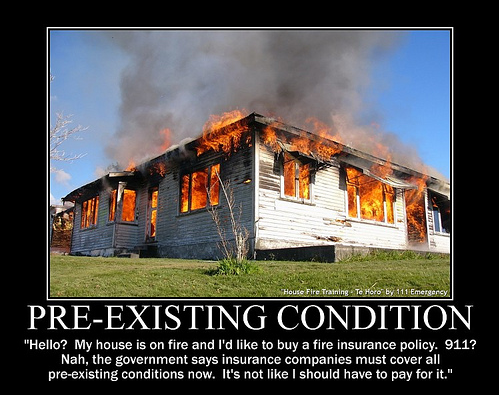
Forcing health insurers to cover pre-existing conditions at standard rates is like asking home insurers to cover homes in flood plains at standard rates. If the government says home insurers must do so, standard rates will rise as well as the cost of homeownership. Lenders generally won’t accept homes as collateral unless they are adequately insured against flooding, and by raising the cost of insurance, the government requirement that all must share in the burden of high flood risk would discourage homeownership generally. But you’ll get a break if you’re in a flood plain! Coercive government regulations like rate regulation and coverage mandates have destructive (but predictable) consequences.

The difference between flood plains and health conditions is that sooner or later, a lot of us will be burdened with the latter. The trick is to get underwritten for health insurance before that happens. If the government says that health insurers must offer standard rates to those already afflicted with serious health conditions, à la Obamacare, standard rates will rise, which will induce some potential buyers to opt out. In fact, it will lead the youngest and healthiest potential buyers to opt out. This is the genesis of the so-called insurance death spiral.

Some then ask why the government shouldn’t prevent opt-outs by requiring all individuals to carry health insurance… an individual mandate. Perhaps doubling down on government coercion via compelled coverage might rectify the ill effects of rate regulation. However, requiring low-risk individuals to pay rates that exceed their willingness to pay cross-subsidizes individuals who belong in a different risk pool. Aside from it’s doubtful constitutionality and infringement on individual liberty, this policy forces low-risk individuals to insure and pay as if they are high-risk, and high-risk individuals to pay as if they are low risk, and it leaves the task of pricing to the arbitrary decisions of bureaucrats. It may also lead to massive distortions in the use of medical resources.

Direct Subsidies Are Better

There is a better way to provide coverage for individuals with pre-existing conditions, one that does not destroy the risk-mitigating function of health insurance markets. High-risk individuals can be covered through a combination of self-paid standard premiums and a direct public subsidy that does not distort the market’s social function in pricing risk. Such a subsidy would be funded by individuals in their roles as taxpayers, not as premium payers. Now, I’m the last person to advocate big-government solutions to social and economic problems, but this approach requires only that government serve as a pass-through entity. Government need not play any role in providing or regulating health care, and it should not interfere with the pricing of risk in private markets for health insurance.

Insurability Protection

The high-risk segment’s reliance on subsidies can be minimized over time with certain innovations. In particular, healthy individuals should be able to purchase riders protecting their future insurability at standard rates. Their premium would include a component reflecting the discounted expected costs of developing health conditions in the future. The additional premium could even be structured as level payments over time. People will develop health conditions, of course, a few much sooner than others, but without an incremental impact on their future premiums, as the additional risk  would be covered by the cost of the rider for future insurability.

To see how the situation would evolve, suppose that the standard risk pool includes everyone free of pre-existing conditions, young and old, with guaranteed future insurability. The high-risk segment is already afflicted with conditions and mostly reliant on the direct subsidies discussed above, but that segment will shrink over time as the population ages and mortality takes its toll. Therefore, the proportion of individuals reliant on subsidies will decline. Meanwhile, the standard risk pool transforms into a combination of healthy and sick, but it is actuarily sustainable without subsidies. Of course, some fraction of individuals will always be born with serious health conditions, though one day prospective parents could conceivably purchase future insurability protection for their children at conception… well, perhaps just a little after. The point is that the initial level of subsidies should be transitional. For a permanently small share of individuals, however, it will be a part of the social safety net.

To extend the foregoing, there is considerable latitude in the composition of “standard risks” and the willingness of individual buyers to pay premiums that might reflect interpersonal differences. For example, individuals should be free to self-insure, foregoing participation in the insurance market altogether. If they do so, the insured risk pool will e of lower quality. Some people might prefer to purchase insurance covering catastrophic health events only, paying for health maintenance out-of-pocket as well as care for conditions less immediately threatening. Health maintenance is not really a risk anyway, but more of a constant, so excluding it from insurance contracts is sensible. In fact, less “comprehensive” insurance coverage keeps the cost of coverage down, encouraging wider participation and enhancing the quality of the risk pool.

Mandates

These insurability riders might not accomplish much under a regime of mandated comprehensive benefits. That would increase the cost of coverage as well as the cost of the insurability rider, making it more likely that healthy individuals would opt-out. That brings us back to the “elephant in the room”: whether a so-called individual mandate is required to ensure that 1) the “standard” risk pool is of high quality; and 2) the uninsured don’t “free-ride” by capturing the public subsidy once their health deteriorates for any reason. But again, the availability of less comprehensive coverage will keep premiums low and help to accomplish both objectives. Moreover, free-riders whose health fails could always be denied the public subsidy if they had been uninsured over a period of any length prior to their diagnosis. That would leave them with several less attractive alternatives: pay high-risk-pool premiums out of their own pockets, or rely on assistance from family, friends, charitable organizations and providers.

Dumb Intervention

Requiring insurers to cover pre-existing health conditions at standard rates is destructive to insurance markets. It imposes liabilities for more certain, costly events in a market for which sustainable operation depends on the pooling of events of similar risk. It harms consumers directly by increasing the cost of mitigating those risks. It worsens the uninsured free-rider problem, causing additional deterioration in the risk pool and adding more cost pressure. It also may lead to increases in out-of-pocket deductibles and copayment rates as insurers attempt to manage high claim levels. And it invites further regulatory intervention, as policymakers engage in misguided attempts to “fix” problems created by the original intervention (while blaming the market, of course).

A further question is whether the alternative I have outlined would involve federal subsidies or state outlays funded in part by federal block grants. I prefer the latter, but either way, it is less costly and distortionary to pay for insuring against the costs of pre-existing conditions via direct subsidies to needy individuals as part of the social safety net than by destroying insurance markets.

Liar-Left, Daft-Left Bellow: It’s the Unkindest Tax Cut of All

08 Friday Dec 2017

Posted by Nuetzel in Health Insurance, Taxes

≈ Leave a comment

Tags

Bernie Sanders, Bubble Tax, Cross Subsidies, David Harsanyi, Individual Mandate, Insurability, Jeffrey Tucker, Medical Expense Deduction, Medicare, Obamacare, Paygo, Penalty Tax, Progressive Left, Snopes, Standard Deduction, Tax Reform, Veronique de Rugy

A misapprehension of progressive leftists is that the tax reform bills under debate by the GOP will revoke something from the needy: the poor, cancer patients, the working class, the aged, you name it. Well, that is a misapprehension held by many earnest leftists, but it amounts to deceitful rhetoric from others. David Harsanyi, in an article about the Left’s penchant for corrupting the English language, attempts to set the record straight:

“Whenever the rare threat of a passable Republican bill emerges, we learn from Democrats that thousands, or perhaps millions, of lives are at stake. …

… the most obvious and ubiquitous of the Left’s contorted contentions about the tax bill deliberately muddles the concept of giving and the concept of not taking enough. This distortion is so embedded in contemporary rhetoric that I’m not sure most of the foot soldiers even think it’s odd to say anymore. …  Whatever you make of the separate tax bills the House and Senate have passed, though, the authors do not take one penny from anyone. In fact, no spending is being cut (unfortunately). Not one welfare program is being block-granted. Not one person is losing a subsidy. It’s just a wide-ranging tax cut without any concurrent spending cuts.“

The Left may have a basic math incompetency, or maybe they know better when they insist that the GOP plans will inflict a new burden on the middle class. The middle class actually receives larger reductions in taxes than higher strata. Veronique de Rugy highlighted this point recently:

“President Trump’s intention to give a real tax break to the middle class is counter-productive considering the middle class barely shoulders any of the income tax as it is. The top 10 percent of income earners—households making $133K [or more], not $1 million as most assume—currently pay more than 70 percent of all income tax revenue. The middle quintile pays, on average, 2.6 percent of the federal income tax.

And yet, in both the House and Senate plans the middle class receives the largest tax relief by reducing their marginal tax rates, increasing the child tax credit and doubling the standard deduction. The result is fewer taxpayers would be paying income tax at all, problematic from a small government perspective. It also means a more progressive income tax code than it already is.

The House plan also effectively jacks up the top marginal rate for some high earners by using a 39.6 percent bubble rate on the first $90K earned by single taxpayers making $1 million and married taxpayers making $1.2 million and a 12 percent rate like everyone else.“

I have listened to horror stories about school teachers who, in the past, were able to deduct supplies they purchased for their students. Now, the cruel GOP is trying to take that away! This argument neatly ignores the doubling of the standard deduction. Many teachers will find that it no longer makes sense to itemize deductions, and they will come out ahead. But for the sake of argument, suppose a teacher earning $50,000 itemizes and spends $2,500 on unreimbursed supplies for their students every year. At the Senate plan’s new rate in that bracket, the lost deduction will cost the teacher $550, but about $300 would be saved via rate reductions for every $10,000 of taxable income. The teacher is likely to come out ahead even if he unwisely passes on the improved standard deduction.

Liberal thought-whisperers have goaded their minions into believing that the GOP intends to cut Medicare funds by $25 billion a year going forward. The bills under discussion would do no such thing. However, in a rare gesture of fiscal responsibility, President Obama in 2010 signed the Statutory Pay-As-You-Go Act (Paygo), which may require automatic reductions in outlays when spending or tax changes lead to an increase in federal debt. The act has never been enforced, and Republican leadership in both houses insists that Paygo can and will be waived. Clearly, the GOP’s intent is not to allow the Paygo cuts to take place. Even the left-leaning Snopes.com is reasonably neutral on this point. But if Paygo takes hold, the lefties will have themselves to blame.

At the last link, Snopes also touches on one actual provision of the Senate tax plan, the repeal of the Obamacare individual mandate, or rather, the repeal of the “penalty tax” imposed by the IRS on uninsured individuals. The Supreme Court ruled that it is a tax in 2012, at the time giving rise to a mixture of delight and embarrassment on the Left. The ruling saved Obamacare, but the Left had been loath to call the penalty a tax. The supposed rub here is that repeal of the mandate will be greeted enthusiastically by many young and healthy individuals. Freed from coercion, many of them will elect to go without coverage, leading to a deterioration of the exchange risk pools and causing premiums paid by the remaining exchange buyers to rise. However, the critics conveniently ignore the fact that Obamacare individual subsidies will automatically ratchet upward with increases in the premium on the Silver Plan. So the panic related to this portion of the Senate tax bill is misplaced.

One other point about the mandate: because it coerces the payment of cross-subsidies by the young and healthy to higher-risk insurance buyers, the mandate distorts the pricing of risk, the incentives to insure, and the use of resources in the provision of health insurance and health care itself. This is how the proper function of a market is destroyed. And this is how resources are wasted. Good riddance to the mandate. The high-risk population should be subsidized directly, not through distorted pricing, at least until such time as a market for future insurability can be established. As Jeffrey Tucker has said, repeal of the mandate is a very good first step.

The loss of the medical expense deduction is not a done deal. While the House plan eliminates the deduction, the Senate plan reduces the minimum medical expense requirement from 10% to just 7.5% of qualified income, so it is more generous than under current law. I’ve seen bloggers commit basic misstatements of facts on this and other provisions, such as confusing this limit with a total limit on the amount of the medical deduction. This deduction tends to benefit higher-income individuals who itemize deductions, which will represent a higher threshold under the increased standard deduction. Of course, this deduction appeals to our sense of fairness, but like all the complexities in the tax code, it comes with costs: not only does it add to compliance costs and create a need for higher tax rates, but it subsidizes demand for medical care, much like the tax breaks available on employer-provided health care, and it therefore inflates health care costs for everyone. To the extent that these deductions and many others are still in play, the GOP plans fall short of real tax reform.

The GOP tax bills certainly have their shortcomings. I hope some of them are rectified in conference. The bills do not offer extensive simplification of the tax code, and they would not be truly historic: in real terms, an earlier version of the House bill would have been the fourth biggest cut in U.S. history relative to GDP, and I believe the version that passed the House is smaller. However, many of the arguments mounted by the Left against the bills are without merit and are often deceitful. The Left strongly identifies with the zero-sum philosophy inherent in collectivism, and the misleading arguments I’ve cited are plausible to the less-informed among that crowd. That brings me back to David Harsanyi’s point, discussed at the top of this post: “intellectuals” on the progressive Left find value in corrupting the meaning of words and phrases like “budget cuts”, “giving” and “taking”:

“Everyone tends to dramatize the consequences of policy for effect, of course, but a Democratic Party drifting towards Bernie-ism is far more likely to perceive cuts in taxation as limiting state control and thus an attack on all decency and morality.“

“There is a parallel explanation for the hysterics. With failure comes frustration, and frustration ratchets up the panic-stricken rhetoric. It’s no longer enough to hang nefarious personal motivations on your political opponents — although it certainly can’t hurt! — you have to corrupt language and ideas to imbue your ham-fisted arguments with some kind of basic plausibility.“

Choice, Federal Exchange Failure, and a Path to Health Insurance Reform

25 Wednesday Oct 2017

Posted by Nuetzel in Health Insurance, Markets, Obamacare

≈ Leave a comment

Tags

Association Health Plans, Avik Roy, Barack Obama, Bill Cassidy, Cost-Sharing Subsidies, Donald Trump, Exchange Markets, Health Status Insurance, Insurer subsidies, Jeffrey Tucker, John C. Goodman, John Cochrane, John McCain, Medicaid, Medicare, Obamacare, Patient Freedom Act, Pete Sessions, Pre-Existing Conditions, Short-Term Policies, Tax-Credit Subsidies, Universal Health Allowance

“… a government program that is ruined by permitting more choice is not sustainable.“

That’s Jeffrey Tucker on Obamacare. Conversely, coercive force is incompatible with a free society. Tucker, no fan of President Donald Trump, writes that the two recent executive orders on health coverage are properly framed as liberalization. The orders in question: 1a) eliminate federal restrictions on the sale of so-called association health insurance plans, including their availability across state lines; 1b) remove the three-month limitation on coverage offered under temporary policies; and 2) end insurer cost-sharing subsidies for policies sold to low-income (non-Medicaid) segments of the individual market.

The most immediately impactful of the three points above might be 1b. These temporary policies became quite popular after Obamacare took effect, at least until the Obama Administration placed severe restrictions on their duration and renewal in 2016 (see Avik Roy’s post in Forbes on this point). Trump’s first order rescinds that late-term Obama order. The short-term policies are likely to become popular once again, as things stand. Small employers can avoid many of the Obamacare rules and save significantly on premiums using temporary policies.

Association plans are already sold to small businesses having a “commonality of interest”, but Trump’s order would expand the allowable common interests and permit association plans to be sold across state lines. Avik Roy doubts that this will have a large impact, but to the extent that association plans avoid both state and federal benefit mandates, they could prove to be another important source of more affordable coverage for employees than the Obamacare exchanges. In any case, as Tucker says:

“In the words of USA Today: the executive order permits a greater range of choice ‘by allowing more consumers to buy health insurance through association health plans across state lines.’  … The key word here is ‘allowing’– not forcing, not compelling, not coercing. Allowing.

Why would this be a problem? Because allowing choice defeats the core feature of Obamacare, which is about forcing risk pools to exist that the market would otherwise never have chosen. … The tenor of the critics’ comments on this move is that it is some sort of despotic act. But let’s be clear: no one is coerced by this executive order. It is exactly the reverse: it removes one source of coercion. It liberalizes, just slightly, the market for insurance carriers.“

The elimination of insurer cost-sharing subsidies might sound like the most draconian aspect of the orders. Those subsidies were designed to keep the cost of coverage low for consumers with low incomes, but the subsidies are illegal because the allocation of funds was never authorized by Congress. And contrary to what has been alleged, eliminating the insurer subsidies will have virtually no impact on low-income consumers. First, a large percentage of them are on Medicaid to begin with, not the exchanges. Second, tax-credit subsidies for low-income consumers are still in place for exchange plans, and they will scale based on the premium charged for the “silver” plan (also see Avik Roy’s link above). Taxpayers will be on the hook for those increased subsidies, as they were for the insurer cost-sharing payments.

The exchange market will be weakened by the executive orders, but it has been in a prolonged decline since its inception. Relatively healthy consumers will have opportunities to buy more competitive coverage through short-term policies or association plans, so they are now more likely to exit the risk pool. Higher-income, unsubsidized consumers are likely to pay more for coverage on the exchanges, particularly those with pre-existing conditions. As premiums rise, some of the healthy will simply forego coverage, paying the penalty instead (if it is enforced). Of course, the exchange risk pool was already risky, coverage options have thinned, and premiums have been rising, but the deterioration of conditions on the exchanges will likely be hastened under Trump’s executive orders.

Dismantling some of the restrictions on health insurance choice, which were imposed by executive order under President Obama, could prove to have been a stroke of genius on Trump’s part. As a negotiating ploy, Trump just might have maneuvered Republicans and Democrats into a position from which they can agree … on something. The new orders certainly give emphasis to the deterioration of the exchange markets. The insurers probably viewed the cost-sharing subsidies as a better deal for themselves than having to recoup costs via risky and controversial rate increases, so they are likely to pressure Congress for relief. And higher-income consumers with pre-existing conditions will face higher premiums but won’t have new choices. They will be a vocal constituency.

Democrats just don’t have any ideas with legs, however: single-payer and Medicare-for-all are increasingly viewed as politically unacceptable alternatives by most observers. As John C. Goodman notes at the last link, Medicare is already an actuarial and financial nightmare. Another program of the like to replace existing coverage that most voters would like to keep is not a position likely to win elections. Here is Goodman:

“So, the Democrats’ dilemma is: (1) they are not getting any electoral advantage from Obamacare, (2) they can’t afford to criticize it for fear of upsetting their base and (3) they don’t have an acceptable solution in any event.“

So perhaps we have conditions that might foster a compromise, at least one that could win enough votes to fix the insurance markets. Goodman contends that a plan originally attributable to John McCain, and now in the form of the Pete Sessions/Bill Cassidy-sponsored Patient Freedom Act, could be the answer. It would create something like a Universal Basic Health Allowance, in the form of a tax credit, funded by eliminating all current federal spending on health care (excluding Medicare and Medicaid). Those with pre-existing conditions would purchase coverage the same way as others, but the plan would give insurers a strong incentive to retain them. According to Goodman, a “health status risk adjustment” would assure actuarially-fair pricing by forcing an existing insurer to pay the adjustment to a new insurer when sick individuals change their insurance plans.

The Sessions/Cassidy plan (and Goodman) describes a particular implementation of a more general concept called health status insurance, a good explanation of which is offered by John Cochrane:

“Market-based lifetime health insurance has two components: medical insurance and health-status insurance. Medical insurance covers your medical expenses in the current year, minus deductibles and copayments. Health-status insurance covers the risk that your medical insurance premiums will rise. If you get a long-term condition that moves you into a more expensive medical insurance premium category, health-status insurance pays you a lump sum large enough to cover your higher medical insurance premiums, with no change in out-of-pocket expenses.“

It would be a miracle if Congress can successfully grapple with the complexities of health care reform in the current legislative session. However, Trump’s executive orders have improved the odds that some kind of agreement can be negotiated to address the dilemma of the failing exchanges and coverage for pre-existing conditions. Let’s hope whatever they negotiate will leverage consumer choice and free markets. Trump’s orders are a step, but only one step, in reestablishing the patient/insured as a key decision maker in the allocation of health care resources.

Deconstructing the Health Care Administrative State

14 Monday Aug 2017

Posted by Nuetzel in Health Care, Obamacare

≈ Leave a comment

Tags

ACA, Accountable Care Organizations, Affordable Care Act, Community Rating, Coverage Mandate, Donald Trump, Guaranteed Issue, Heartland Institute, Michael Tanner, Obamacare, Repeal and Replace, Robert Laszewski, Tim Huelskamp, Tom Price

A leftist friend chided me early this year for my foolish optimism about repeal and replacement of Obamacare. I have to give her credit. She said the GOP did not have a viable plan — I’m sure she meant that both as a matter of policy and politics. I pointed to the several “plans” that were extant at the time, and even some that I thought might soon be formalized as legislation. I wrote off her skepticism as a failure on her part to understand an approach to health care policy less statist than the Affordable Care Act (ACA). Like so many on the left, she probably has trouble conceiving of any plan not relying on centralized control. Apparently, quite a few Republicans share that blind spot. Nevertheless, I was certainly naive about the prospects of getting anything through Congress quickly.

But the battle is not lost, even now. It should be obvious to everyone, as Michael Tanner notes, that the health care debate is far from over. The individual insurance market is in bad shape, reeling from the unfavorable balance of risks created by community rating, mandated coverage and guaranteed issue. As Robert Laszewski notes, the attrition in the individual market is dominated by individuals not eligible for Obamacare subsidies. While legislation is a much longer shot than I imagined back in January, there remain a variety of ways in which Obamacare’s most deleterious provisions can be neutralized and replaced to create a more market-oriented environment. And though it’s too bad that it might come to this, as the situation continues to devolve, new legislation might gain viability.

Tanner mentions a variety of administrative decisions sitting squarely in the hands of the Trump Administration: insurance company subsidies? congressional exemption from Obamacare? promotion of open enrollment? enforcing the individual mandate? And there are many others. Tim Huelskamp provides a link to The Heartland Institute‘s “complete healthcare reform toolbox“. He says:

“During congressional testimony in March, my former House colleague and HHS Secretary Tom Price pointed out that the law offers him multiple opportunities to do just that: ‘Fourteen hundred and forty-two times … the secretary ‘shall’ or the secretary ‘may” make changes to the Affordable Care Act. The Price is right! Under Obamacare, he has tremendous power and latitude not only to dismantle the ACA but to replace it with health care options that enhance individual freedom.

Let Americans pick their doctors, choose a ‘skinny’ health insurance plan, or even purchase a plan from a company based in another state. The Trump administration can waive penalties on individuals and businesses who simply can’t afford Obama’s mandates.  HHS can give a green light to any state that wants to begin restoring choice and freedom for their citizens without federal bureaucrat interference.“

Another productive avenue is deregulation of health care providers themselves. One of the worst aspects of the ACA is its reliance on so-called Accountable Care Organizations (ACOs), which were intended to encourage greater cooperation and efficiency among providers. The reality is that the ACO rules imposed by HHS are leading to higher costs, greater financial risk and increased concentration in the provision of medical care. Patients, also, are often penalized by the monopolizing effects, and because they might not be able to continue seeing the doctor of their choice under the limits of the health plans available. Moreover, the ACA infringes upon the doctor-patient relationship by restricting the doctor’s authority and the patient’s choices about tests and treatments that can be provided. Many of these rules and restrictions can be undone by administrative action.

Finally, before we completely dismiss the possibility of a legislative solution, there is a new Republican health care bill to consider in the Senate. However, it is just as limited in its reforms, or more, than the bill that passed in the House and the one that failed in the Senate. It’s unlikely to go anywhere soon. There could be later opportunities to consider various pieces of reform legislation, especially if the Trump Administration makes good on its promises to roll back administrative rules put in place to implement the ACA. Sadly, for now we wait in vain for legislators and President Trump to overcome the intellectual failure at the root of the inaction on ending Obamacare. The lesson is that in human affairs, central planning doesn’t work!

Trump Budget Facts and Falsehoods

02 Friday Jun 2017

Posted by Nuetzel in Federal Budget, Government, Trump Administration

≈ Leave a comment

Tags

Administrative State, Baseline Budget, Budget Reconciliation, Deficit Reduction, Double Counting, Dynamic Scoring, Lawrence Summers, Math Error, Obamacare, Office of Management and Budget, Repeal and Replace, Revenue Neutrality, Ryan McMaken, Spending Priorities, Static Scoring, Steve Bannon, Tax Reform, Trump Budget, Welfare reform

The innumerate left is unhappy over cuts in various categories of spending in the budget proposal submitted by the Trump Administration last week. However, they have adopted “talking points” that are incorrect in an effort to rail against the budget. There is no reduction in overall spending in the proposal. Instead, there is a reduction in the growth of total spending. Ryan McMaken calls the mistaken assertions about spending “the media version of ‘cuts’“. The budget plan calls for an increase in total spending of 41% ($1.7 trillion) by 2027, versus 63% ($2.6 trillion) under the baseline (based on current law). Many of the actual cuts and growth reductions are in so-called discretionary spending. However, in one key mandatory component, Medicaid, spending increases by 39% under the plan, or $146 billion, versus 82% under the baseline. That is not a spending cut.

Another issue over which the Trump budget has been attacked is the so-called “math error,” or “double counting” of economic growth, to which former Treasury Secretary Lawrence Summers alluded with apparent delight. The gist of it is that the proposal somehow double-counted the salutary effects of growth in eliminating the projected deficit over the next ten years. In other words, the tax cuts proposed by Trump would be not just revenue-neutral due to stronger growth; they would result in an increase in tax revenue sufficient to eliminate the deficit by 2027.

Thus far, the Trump tax reform plan has been revealed in only a one-page summary released in late April. In static terms, it implied a loss of revenue of $5 trillion over ten years, though the summary left many features unclear. There could be additional provisions to broaden the tax base that might bring the ten-year static revenue loss down to somewhere between $3 and $4 trillion. In dynamic terms, however, the impact of the tax cuts would be smaller. The cuts would stimulate the economy (yes, they would!), but the precise impact on growth is unknown. In the budget, economic growth is assumed to increase from 1.8% to 3.0% annually over most of the ten year period. That has been criticized as unrealistic, but such a boost would likely be enough to make the tax cuts revenue neutral.

Here is a summary of the budget from the Office of Management and Budget (OMB). The tables at the back of the document, on pages 27 and 29, provide enough information on the cumulative ten-year changes to evaluate Summers’ double-counting claim. Keep in mind that his claim applies to changes expressed relative to a baseline. The proposed budget shows a total ten-year deficit projection of $3.2 trillion, compared to baseline of $6.7 trillion. So the deficits are reduced by a total of $3.5 trillion over the full ten years.

Individual and corporate income tax receipts are virtually unchanged over the ten-year period. There’s our revenue neutrality. Other receipts are down by $0.9 trillion, however. Most of that decline is attributed to a $1 trillion “allowance for repeal and replacement of Obamacare”, presumably elimination of taxes on such things as medical devices, Cadillac insurance policies, and fines for failing to comply with insurance mandates. So increased tax revenues do not account for the decline in the budget deficit.

Total cumulative outlays are reduced by $4.6 trillion in the budget proposal relative to the baseline. That more than accounts for the ten-year deficit reduction. Like the policies or not, the decline in spending is sufficient, relative to the baseline, to fully explain the deficit reduction. Yes, the budget assumes that some of the spending reductions are afforded by the faster assumed rate of economic growth, such as welfare payments, but that is not double-counting.

Revenue neutrality of the tax cuts is certainly an assumption worth questioning, especially because the summary of the tax plan gave every impression of abandoning neutrality. Neutrality was probably imposed on the budget plan as a matter of convenience. In a sense, it made the job of presenting the Administration’s spending priorities (like them or not) a cleaner exercise. For another, while budget reconciliation rules do not require the tax plan to be revenue neutral, Senate leaders have stated their strong desire for neutrality. The Trump budget proposal thereby allows Congress’ budget process to get underway while deferring the introduction of a more detailed and potentially controversial tax plan, one that is obviously still in flux and is likely to involve a loss of revenue, even in a dynamic sense.

The assumed change in economic growth is not solely attributable to tax effects, however. It would be reasonable to expect some growth to be driven by deregulation and the “deconstruction of the administrative state“, as Steve Bannon described so eloquently. This intention is embodied in the budget proposal. In that sense, it was unnecessary for OMB to impose revenue neutrality of the tax plan to eliminate the budget deficit over ten years. The economic growth spurred by deregulation would generate some of the extra growth in tax revenue.

I happen to like many of the priorities expressed in the proposed budget, despite the document’s lack of specificity. This includes the deregulatory initiatives, Obamacare repeal and replacement (we’re waiting…), and some of the welfare reform proposals. I am not happy about the scale of the shift toward defense, and I am not happy that government continues to grow in the aggregate. And as for the still-incubating tax reform plan, I like many of the features originally described, though not all.

Many believe that the Administration’s economic growth assumptions are unrealistic, and many dislike the spending priorities. Those cannot be used as excuses for mischaracterizing the proposal, however. Reductions in some spending categories occur only relative to the baseline growth path. They are not real cuts in spending. Likewise, Summers’ double-counting allegation is false. The recovery of tax revenue via economic growth is not double counted, and there is no “math error”. The proposed reductions in spending relative to the baseline more than account for the deficit reduction. I suspect that Summers’ motives were strictly polemic and not grounded in a careful examination of the budget proposal. He is not innumerate. What’s worse, a number of economists swallowed the “double-counting” story hook, line, and sinker.

Musings On Health Insurance Reform

10 Wednesday May 2017

Posted by Nuetzel in Health Care, Obamacare

≈ 1 Comment

Tags

AHCA, American Health Care Act, Block Grants, Catastrophic Coverage, Congressional Budget Office, Cross Subsidies, Essential Benefit Requirements, Health Care Freeloaders, High-Risk Pools, Mandated Benefits, McArthur Amendment, Medicaid Reform, Obamacare, Pre-Existing Conditions, Right To Health Care, Tyler Cowan, Uncompensated care

An acquaintance of mine is a cancer patient who just made the following claim on Facebook: the only people complaining about Obamacare are hypocrites because they don’t have to purchase their health insurance on the exchanges. That might be her experience. It certainly isn’t mine. I know several individuals who purchase their coverage on the exchanges and complain bitterly about Obamacare. But her assertion reveals its own bit of hypocrisy: it’s apparently okay to defend Obamacare if you are a net beneficiary, but you may not complain if you are a net payer. Of course, I would never begrudge this woman the care she needs, but it is possible to arrange for that care without destroying the health care industry and insurance markets in the process. Forgive me for thinking that Obamacare was designed with the cynical intent to do exactly that! Well, at least insurance markets. The damage to the health care industry was brought on by simple buffoonery and rent seeking.

Depending on developments in Congress over the next few months (3? 6? 9?), Obamacare could be a thing of the past. We’ve all probably heard hyperbolic claims that the new health care bill “will kill people”, which is another absurdity given the law’s dislocations. That was the subject of “Death By Obamacare“, posted in January on Sacred Cow Chips. AHCA detractors base their accusations of murderous intent on a fictitious notion of reduced access to care under the plan, as well as a Congressional Budget Office (CBO) report that viewed the future of Obamacare through rose-colored glasses. I discussed the CBO report at greater length in “The CBO’s Obamacare Fantasy Forecast“.

Before anyone gets too excited about what they like or dislike about the health care bill passed by the House of Representatives last week, remember that a final health care bill, should one actually get through Congress, is unlikely to bear a close resemblance to the House bill. The next step will be the drafting of a Senate bill, which might be assembled from parts of the House’s American Health Care Act (AHCA) and other ideas, or it might take a different form. It could take a while. Then, the House and Senate will attempt to shape a compromise in conference committee and bring it to a vote in both houses. President Trump, looking for a “win”, is likely to sign whatever gets through, even if he has to bargain with democrats to win votes.

So relax! If your legislators are democrats, tell them to participate in the shaping of new policies, rather than throwing petulant barbs from the sidelines. First, of course,  you’ll have to face up to the fact that Obamacare is a failed policy.

Another recent post on Sacred Cow Chips, “Cleaving the Health Care Knot… Or Not“, covered some of the most important provisions of the AHCA. By the time of the vote, a few new provisions had been added to the House bill. The McArthur Amendment allows states to waive the Obamacare essential benefits requirements. Fewer mandated benefits would allow insurance companies to offer simpler policies covering truly insurable health care events, as opposed to predictable health maintenance costs. Let’s face it: if you must have insurance coverage for your annual checkup, then it is not really insurance against risk; either the premium or the deductible must rise to cover the expenses, ceteris paribus.

The other change in the AHCA is an additional $8 billion dollars allocated to state high-risk pools for pre-existing conditions, for a total of $138 billion. These risks are too high to blend with standard risks in a well-functioning insurance market. (In a perfect insurance market, there would be no cross-subsidies between groups on an ex ante basis.) As a separate risk pool, these high-risk individuals would face very high premia, so the idea is to allow states the latitude to subsidize their health care costs in ways they see fit. This is a federalist approach to the problem of subsidizing coverage for pre-existing conditions, and it has the advantage of restoring the ability of insurers to underwrite standard risks at reasonable rates, correcting one of Obamacare’s downfalls. However, some GOP senators are advocating a combination of standard risks and those with pre-existing conditions, which obviously distorts the efficient pricing of risk and exaggerates the need for broader subsidies.

And what about the uninsured poor? A major focus of health care insurance reform, now and in the past, has been to find a way for the poor to afford coverage. Obamacare fell far short of its goals in this respect, as any enthusiasm for subsidized (though high) premia was dampened by shockingly high deductibles. This week, Tyler Cowan reported on some research suggesting that low-income individuals place a low value on insurance. Their responsiveness to subsidies is so low that few are persuaded to pay anything close to the premium required. Cowan quotes the authors as saying that even 90% subsidies for these individuals would leave about 25% of this population unwilling to pay for the balance. Cowen quotes the study’s authors:

“‘We conclude that the size of uncompensated care for low-income populations provides a plausible explanation for their low [willingness-to-pay].’ In other words, many of the poor do not value health insurance nearly as much as many planners feel they ought to, in large part because they are already getting some health care.“

This has several implications. First, these individuals are not without health care, regardless of their coverage status. One of the great misapprehensions among Obamacare supporters is that the poor had no access to care before the law’s passage. Never mind that emergency room utilization is still quite high. Uninsured individuals can go to a public hospital and get treatment in the emergency room and get admitted if that is deemed medically necessary. If the illness causes a loss of income, the individual might qualify for Medicaid if they hadn’t before, and Medicaid has no exclusion for pre-existing conditions. In fact, I’m told the hospital staff might even help you apply right there at the hospital! So who needs insurance before a health crisis?

Many of the poor have continued to do what they did before: go without coverage. Obamacare’s complex system of subsidies is almost beside the point, as is almost any other effort to sign up everyone prior to the onset of major health care needs. Eventual enrollment in Medicaid will pay some of the hospital bills, though it’s true that not all can qualify for the program. Either way, the hospital will swallow a share of the cost — that is, the taxpayer will. Providers would rather not rely on low Medicaid reimbursement rates or perform charity work. This coalition will grapple with the failure of many low-income individuals to arrive at their emergency room doors with coverage as long as we rely on direct subsidies as an inducement to purchase insurance. Unfortunately, a policy offering a separate guarantee of financial health for providers would create another set of awful incentives.

The unfortunate truth is that Medicaid is unsustainable at current funding levels. The AHCA would convert the federal share of the program to one of block grants to states, wnich have always managed the program under federal mandates. The AHCA would free the states to manage the program more flexibly, but caps on the grants would create pressure to manage costs. It is not yet clear whether the Senate will offer a different approach to Medicaid reform, but it was the primary driver of increased health care coverage under Obamacare.

Finally, there are certain individuals with higher incomes who can afford to pay for coverage but prefer to freeload. Those who experience catastrophic health problems will be a burden to others, not necessarily through distortions in insurance pricing, but via taxes and deficits. To an extent, the situation is a classic problem of the commons. In this case, the “commons” is an invention of government and the presumed “right to health care”: there is no solution to the freeloader problem faced by taxpayers short of denying the existence of that right to those who can afford catastrophic coverage but would refuse to pay. Only then would the burdens be internalized to the cost-causes. Charity can and should go partway to relieving individuals of the consequences of their bad decisions, but EMS will still arrive if called, providers will render care, and a chunk of the costs will be on the public dime.


The CBO’s Obamacare Fantasy Forecast

28 Tuesday Mar 2017

Posted by Nuetzel in Health Care, Obamacare

≈ 4 Comments

Tags

American Health Care Act, Avik Roy, CATO Institute, CBO, Congressional Budget Office, Exchange Enrollment, Individual Mandate, Medicaid enrollment, Obamacare, Trump Administration

The Congressional Budget Office (CBO) is still predicting strong future growth in the number of insured individuals under Obamacare, despite their past, drastic over-predictions for the exchange market and slim chances that the Affordable Care Act’s expansion of Medicaid will be adopted by additional states. Now that Republican leaders have backed away from an unpopular health care plan they’d hoped would pass the House and meet the Senate’s budget reconciliation rules, it will be interesting to see how the CBO’s predictions pan out. The “decremental” forecasts it made for the erstwhile American Health Care Act (AHCA) were based on its current Obamacare “baseline”. A figure cited often by critics of the GOP plan was that 24 million fewer individuals would be insured by 2026 than under the baseline.

It was fascinating to see many supporters of the AHCA accept this “forecast” uncritically. With the AHCA’s failure, however, we’ve been given an opportunity to witness the distortion in what would have been a CBO counterfactual. What a wonderful life! We’re stuck with Obamacare for the time being, but this glimpse into the CBO’s delusions will be one of several silver linings for me.

Again, the projected 24 million loss in the number of insured under the AHCA was based on an actual predicted loss of about 5 – 6 million and the absence of an Obamacare gain of 18 – 19 million. Those figures are from an excellent piece by Avik Roy in Forbes. I drew on that article extensively in my post on the AHCA prior to its demise. Here are some key points I raised then, which I’ve reworded slightly to put more emphasis on the Obamacare forecasts:

  1. The CBO has repeatedly erred by a large margin in its forecasts of Obamacare exchange enrollment, overestimating 2016 enrollment by over 100% as recently as 2014.
  2. The AHCA changes relative to Obamacare were taken from CBO’s 2016 forecast, which is likely to over-predict Obamacare enrollment on the exchanges by at least 7 million, according to Roy.
  3. The CBO also assumes that all states will opt to participate in expanded Medicaid under Obamacare going forward. That is highly unlikely, and Roy estimates its impact on the CBO’s forecast at about 3 million individuals.
  4. The CBO believes that the Obamacare individual mandate has encouraged millions to opt for insurance. Roy says that assumption accounts for as much as 9 million of total enrollment across the individual and employer markets, as well as Medicaid.

Thus, Roy believes the CBO’s estimate of the coverage loss of 24 million individuals under the AHCA was too high by about 19 million!

In truth, Obamacare will be watered down by regulatory and other changes instituted by the Trump Administration, which has said it will not enforce Obamacare’s individual mandate. Coverage under the “new” Obamacare will devolve quickly if the CBO is correct about the impact of the individual mandate.

The CBO’s job is to “score” proposed legislation relative to current law; traditionally, it made no attempt to account for dynamic effects that might arise from the changed incentives under a law. The results show it, and the Obamacare projections are no exception. In the case of Obamacare, however,  the CBO seems to have applied certain incentive effects selectively. The supporters of the AHCA might have helped their case by focusing on the flaws in the CBO’s baseline assumptions. We should keep that in mind in the future with respect to any future health care legislation, not to mention tax reform!


Cleaving the Health Care Knot… Or Not

18 Saturday Mar 2017

Posted by Nuetzel in Health Care, Obamacare

≈ 2 Comments

Tags

AHCA, American Health Care Act, Avik Roy, Budget Reconciliation, CBO, Community Rating, Congressional Budget Office, John C. Goodman, Medicaid Reform, Michael Cannon, Michael Tanner, Obamacare, Patient Freedom Act, Rand Paul, Refundable Tax Credits, Rep. Pete Sessions, Se. Bill Cassidy, Universal Basic Income, Yuval Levin

IMG_3957

Republican leadership has succeeded in making their health care reform plans in 2017 even more confusing than the ill-fated reforms enacted by Congress and signed by President Obama in 2010. A three-phase process has been outlined by Republican leaders in both houses after the initial rollout of the American Health Care Act (AHCA), now billed as “Phase 1”. The AHCA was greeted with little enthusiasm by the GOP faithful, however.

As a strictly political matter, there is a certain logic to the intent of “three-phase plan”: limiting the provisions of the AHCA to issues having an impact on the federal budget. That would allow the bill to be addressed under “budget reconciliation” rules requiring only 51 votes for passage in the Senate. Phase 2 would involve regulatory rule-making, or rule-rescinding, as the case may be. The putative Phase 3 would require additional legislation to address such unfinished business as allowing health insurance competition across state lines, eliminating anti-trust protection for insurers, and medical tort reform. How the sponsors will get 60 Senate votes for Phase 3 reforms is an unanswered question.

Legislative Priorities

Yuval Levin wrote a great analysis of the AHCA last week In which he described the structure of the House bill as a paranoid reaction to the demands of an “imaginary parliamentarian”. By that he means that the reforms in the bill conform to a rigid and potentially flawed interpretation of Senate budget reconciliation rules. Levin’s view is that the House should not twist itself up over what might be negotiated prior to a Senate vote. In other words, the House should concern itself at this stage with passing a bill that at least makes sense as reform, without bowing to any of the awful legacy provisions in Obamacare.

Medicaid reform is one piece of the proposed legislation and is reasonably straightforward. It imposes caps on federal funding to states after 2020, but it grants more flexibility to the states in managing the program. It also involves a tradeoff by allowing Medicaid funding to increase over the first few years, in line with the expansion under Obamacare, in exchange for capped growth later. The expectation is that long-term costs of the program will be reduced through a combination of the caps and better management at the state level.

The more complex aspects of the AHCA attempt to effect changes in the individual market. Levin offers a good perspective on these measures. First, he describes the general character of earlier Republican reform proposals from which the AHCA descends:

“Those various proposals all involved bringing premium costs down by enabling insurers to sell catastrophic coverage plans (along with more comprehensive plans) and enabling everyone in the individual market to afford at least those catastrophic coverage plans. This would enable far greater competition and let anyone not otherwise covered by insurance enter the individual market as a consumer.  …

The House proposal bears a clear resemblance to this approach. It involves some deregulation from Obamacare, it includes a refundable tax credit for coverage, it gestures toward incentives for continuous coverage. But it is also fundamentally different from this approach, because it functions within the core insurance rules established by Obamacare, which means it can’t really achieve most of the key aims of the conservative reforms it is modeled on.”

The rules established by Obamacare to which Levin refers include the form of community rating, which is merely loosened somewhat by the AHCA. However, the AHCA would impose a 30% penalty for those who fail to enroll while still healthy. This is a poorly designed incentive meant to substitute for Obamacare’s individual mandate, and it is likely to backfire. Levin is clear that this feature could have been avoided by scrapping the old rules and introducing a new form of community rating available only to the continuously insured.

The AHCA also fails to cap the tax benefits of employer-provided coverage, which retains a potential imbalance between the incentives for employer versus individual coverage. Levin believes, however, that some of these shortcomings can be fixed through a negotiation process in either the House or the Senate, if and when the bill goes there.

The CBO’s Report

As it is, the bill was “scored” by the Congressional Budget Office (CBO) with results that are widely viewed as unsatisfactory. The CBO’s report states that the AHCA would reduce the federal budget deficit, but the ugly headline is that relative to Obamacare, it woud cause 24 million people to lose their coverage by 2024. That number is drastically inflated, as Avik Roy demonstrated in his Forbes column this week. Here are the issues laid out by Roy:

  1. The CBO has repeatedly erred by a large margin in its forecasts of Obamacare exchange enrollment, overestimating 2016 enrollment by over 100% as recently as 2014.
  2. The AHCA changes relative to Obamacare are taken from CBO’s 2016 forecast, which still appears to over-predict Obamacare enrollment substantially. Roy estimates that this difference alone would shave at least 7 million off the 24 million loss of coverage quoted by the CBO.
  3. The CBO also assumes that all states will opt to participate in expanded Medicaid going forward. That is highly unlikely, and it inflates CBO’s estimate of the AHCA’s negative impact on coverage by another 3 million individuals, according to Roy.
  4. Going forward, the CBO expects the Obamacare individual mandate to encourage millions more to opt for insurance than would under the AHCA. Roy estimates that this assumptions adds as much as 9 million to the CBO’s estimate of lost coverage across the individual and employer markets, as well as Medicaid.

Thus, Roy believes the CBO’s estimate of lost coverage for 24 million individuals is too high by about 19 million! And remember, these hypothetical losses are voluntary to the extent that individuals refuse to avail themselves of AHCA tax credits to purchase catastrophic coverage, or to enroll in Medicaid. The latter will be no less generous under the AHCA than it is today. The tax credits are refundable, which means that you qualify regardless of your pre-credit tax liability.

Fixes

Despite Roy’s initial skepticism about the AHCA, he thinks it can be fixed, in part by means-testing the tax credits, rather than the flat credit in the bill. He also believes the transition away from the individual mandate should be more gradual, allowing more time for markets to being premiums down, but I find this position rather puzzling given Roy’s skepticism that the mandate has a strong impact on enrollment. Perhaps gradualism would convince the CBO to score the bill more favorably, but that’s a bad reason to make such a change.

It’s impossible to say how the bill will evolve, but certainly improvements can be made. It is also impossible to know whether Phases 2 and 3 will ultimately bring a more complete set of cost-reducing regulatory and competitive reforms. Phase 3, of course, is a political wild card.

Michael Tanner notes a few other advantages to the AHCA. Even the CBO says the cost of health insurance would fall, and the AHCA will bring greater choice to the individual market. It also promises over $1 trillion in tax cuts and lower federal deficits.

Alternatives

The GOP faced alternatives that should have received more consideration, but those alternatives might not be politically viable at this point. Some of them contain features that might be negotiated into the final legislation. Rand Paul’s plan has not attracted many advocates. Paul took the courageous position that there should be no entitlements in a reform plan (i.e., subsidies); instead, he insisted, with liberalized market forces, premium costs would decline sufficiently to allow affordable coverage to be purchased by a broad cross-section of Americans. Paul is obviously unhappy about the widespread support in the GOP for refundable tax credits as a replacement for existing Obamacare subsidies.

John C. Goodman has advocated a much simpler solution: take every federal penny now dedicated to health care and insurance subsidies, including every penny of taxes now avoided via tax deductions on employer-provided coverage, and pay it out to households as a tax credit contingent on the purchase of health insurance or health care expenses. This is essentially the plan put forward by Rep. Pete Sessions and Sen. Bill Cassidy in the Patient Freedom Act, described here. While I admire the simplicity of one program to replace the existing complexities in the federal funding of health care coverage, my objection is that a health care “dividend” of this nature resembles the flat tax credit in the AHCA. Neither is means-tested, amounting to a “Universal Basic Health Insurance Benefit”. Regular readers will recall my recent criticism of the Universal Basic Income, which is the sort of program that smacks of “universal state dependency”. But let’s face it: we’re already in a state of federal health care dependency. In this case, there is no incremental cost to taxpayers because the credit would replace existing outlays and tax expenditures. In that sense, it would eliminate many of the distortions currently embedded in federal health care policy.

A more drastic approach, at this point, is to simply repeal Obamacare, perhaps with a lengthy phase-out, and attempt to replace it later in the hope that support will coalesce around a reasonable set of measures leveraging market forces, and with accommodations for high-risk individuals and the economically disadvantaged. Michael Cannon writes that CBO estimated a simple repeal would increase the number of uninsured by 23 million over ten years, slightly less than the 24 million estimate for the AHCA! Of course, neither of these estimates is likely to be remotely accurate, as both are distorted by the CBO’s rosy assumptions about the future of Obamacare.

Where To Go?

Tanner reminds us that the real alternative to Republican legislation, whatever form it might take, is not a health care utopia. It is Obamacare, and it is collapsing. That plan cannot be effectively reformed with additional subsidies for insurers and consumers, or we’d find ourselves in a continuing premium spiral. The needed reforms to Obamacare would resemble changes contemplated in some of the GOP proposals. While I cannot endorse that AHCA legislation in its current form, or as a standalone reform, I believe it can be improved, and the later phases of reform we are told to anticipate might ultimately vindicate the approach taken by GOP leadership. I am most skeptical about the promise of subsequent legislation in Phase 3. I’ll have to keep my fingers crossed that by then, the path to additional reforms will be more attractive to democrats.

← Older posts
Newer posts →
Follow Sacred Cow Chips on WordPress.com

Recent Posts

  • The Case Against Interest On Reserves
  • Immigration and Merit As Fiscal Propositions
  • Tariff “Dividend” From An Indigent State
  • Almost Looks Like the Fed Has a 3% Inflation Target
  • Government Malpractice Breeds Health Care Havoc

Archives

  • January 2026
  • December 2025
  • November 2025
  • October 2025
  • September 2025
  • August 2025
  • July 2025
  • June 2025
  • May 2025
  • April 2025
  • March 2025
  • February 2025
  • January 2025
  • December 2024
  • November 2024
  • October 2024
  • September 2024
  • August 2024
  • July 2024
  • June 2024
  • May 2024
  • April 2024
  • March 2024
  • February 2024
  • January 2024
  • December 2023
  • November 2023
  • August 2023
  • July 2023
  • June 2023
  • May 2023
  • April 2023
  • March 2023
  • February 2023
  • January 2023
  • December 2022
  • November 2022
  • October 2022
  • September 2022
  • August 2022
  • July 2022
  • June 2022
  • May 2022
  • April 2022
  • March 2022
  • February 2022
  • January 2022
  • December 2021
  • November 2021
  • October 2021
  • September 2021
  • August 2021
  • July 2021
  • June 2021
  • May 2021
  • April 2021
  • March 2021
  • February 2021
  • January 2021
  • December 2020
  • November 2020
  • October 2020
  • September 2020
  • August 2020
  • July 2020
  • June 2020
  • May 2020
  • April 2020
  • March 2020
  • February 2020
  • January 2020
  • December 2019
  • November 2019
  • October 2019
  • September 2019
  • August 2019
  • July 2019
  • June 2019
  • May 2019
  • April 2019
  • March 2019
  • February 2019
  • January 2019
  • December 2018
  • November 2018
  • October 2018
  • September 2018
  • August 2018
  • July 2018
  • June 2018
  • May 2018
  • April 2018
  • March 2018
  • February 2018
  • January 2018
  • December 2017
  • November 2017
  • October 2017
  • September 2017
  • August 2017
  • July 2017
  • June 2017
  • May 2017
  • April 2017
  • March 2017
  • February 2017
  • January 2017
  • December 2016
  • November 2016
  • October 2016
  • September 2016
  • August 2016
  • July 2016
  • June 2016
  • May 2016
  • April 2016
  • March 2016
  • February 2016
  • January 2016
  • December 2015
  • November 2015
  • October 2015
  • September 2015
  • August 2015
  • July 2015
  • June 2015
  • May 2015
  • April 2015
  • March 2015
  • February 2015
  • January 2015
  • December 2014
  • November 2014
  • October 2014
  • September 2014
  • August 2014
  • July 2014
  • June 2014
  • May 2014
  • April 2014
  • March 2014

Blogs I Follow

  • Passive Income Kickstart
  • OnlyFinance.net
  • TLC Cholesterol
  • Nintil
  • kendunning.net
  • DCWhispers.com
  • Hoong-Wai in the UK
  • Marginal REVOLUTION
  • Stlouis
  • Watts Up With That?
  • Aussie Nationalist Blog
  • American Elephants
  • The View from Alexandria
  • The Gymnasium
  • A Force for Good
  • Notes On Liberty
  • troymo
  • SUNDAY BLOG Stephanie Sievers
  • Miss Lou Acquiring Lore
  • Your Well Wisher Program
  • Objectivism In Depth
  • RobotEnomics
  • Orderstatistic
  • Paradigm Library
  • Scattered Showers and Quicksand

Blog at WordPress.com.

Passive Income Kickstart

OnlyFinance.net

TLC Cholesterol

Nintil

To estimate, compare, distinguish, discuss, and trace to its principal sources everything

kendunning.net

The Future is Ours to Create

DCWhispers.com

Hoong-Wai in the UK

A Commonwealth immigrant's perspective on the UK's public arena.

Marginal REVOLUTION

Small Steps Toward A Much Better World

Stlouis

Watts Up With That?

The world's most viewed site on global warming and climate change

Aussie Nationalist Blog

Commentary from a Paleoconservative and Nationalist perspective

American Elephants

Defending Life, Liberty and the Pursuit of Happiness

The View from Alexandria

In advanced civilizations the period loosely called Alexandrian is usually associated with flexible morals, perfunctory religion, populist standards and cosmopolitan tastes, feminism, exotic cults, and the rapid turnover of high and low fads---in short, a falling away (which is all that decadence means) from the strictness of traditional rules, embodied in character and inforced from within. -- Jacques Barzun

The Gymnasium

A place for reason, politics, economics, and faith steeped in the classical liberal tradition

A Force for Good

How economics, morality, and markets combine

Notes On Liberty

Spontaneous thoughts on a humble creed

troymo

SUNDAY BLOG Stephanie Sievers

Escaping the everyday life with photographs from my travels

Miss Lou Acquiring Lore

Gallery of Life...

Your Well Wisher Program

Attempt to solve commonly known problems…

Objectivism In Depth

Exploring Ayn Rand's revolutionary philosophy.

RobotEnomics

(A)n (I)ntelligent Future

Orderstatistic

Economics, chess and anything else on my mind.

Paradigm Library

OODA Looping

Scattered Showers and Quicksand

Musings on science, investing, finance, economics, politics, and probably fly fishing.

  • Subscribe Subscribed
    • Sacred Cow Chips
    • Join 128 other subscribers
    • Already have a WordPress.com account? Log in now.
    • Sacred Cow Chips
    • Subscribe Subscribed
    • Sign up
    • Log in
    • Report this content
    • View site in Reader
    • Manage subscriptions
    • Collapse this bar
 

Loading Comments...