• About

Sacred Cow Chips

Sacred Cow Chips

Tag Archives: Thomas Jefferson

State Aesthetics: Taxes for Art and Dogma

07 Tuesday Jan 2025

Posted by Nuetzel in Art & Politics, Subsidies

≈ Leave a comment

Tags

Agitprop, Americans for the Arts, Arts Education, Arts Funding, Corporation for Public Broadcasting, crowding out, DOGE, Exclusivity, Externalities, National Endowment for the Arts, Propaganda, Public goods, Public Radio, Samuel Andreyev, Subsidies, Thomas Jefferson
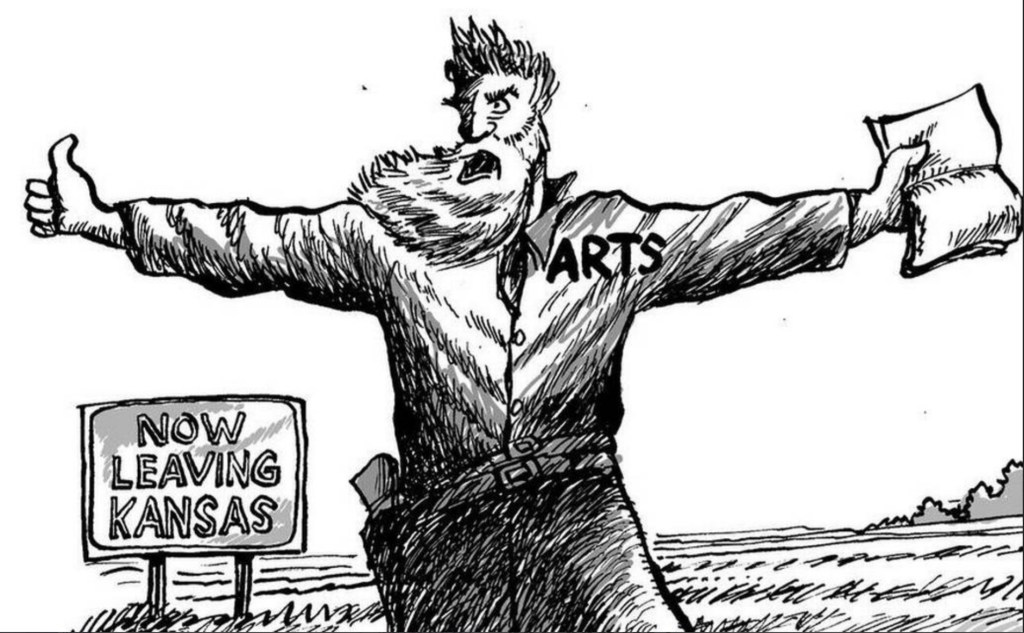
In a post a few years ago entitled “The National Endowment for Rich Farts”, I discussed a point that should be rather obvious: federal funding of the arts too often subsidizes the upper class, catering to their artistic tastes and underwriting a means through which they conduct social and professional networking. The topic is back in the news, with reports that the incoming Trump Administration, at the recommendation of the Department of Government Efficiency (DOGE), will attempt to eliminate funding for the Corporation for Public Broadcasting.

Great Big Stuff and Crowding Out

To opponents of federal arts funding, public radio is probably the bête noire of arts organizations due to its left-wing political orientation and the general affluence of its subscriber base. However, public arts funding goes way beyond subsidies for public radio.

Large nonprofits receive the bulk of government arts funding. Despite claims to the contrary, these organizations won’t go broke without the gravy provided by public funding. The federal government contributes about 3% of the revenue taken in by non-profit arts organizations, according to Americans For the Arts. These organizations are already heavily subsidized: their surpluses are tax exempt and private contributions are tax deductible. Tax deductions are worth more to those in high income-tax brackets, and involvement in such visible organizations is highly prized by elites.

Furthermore, there is no evidence that additional government funding “multiplies” private giving. If anything, increases in public funding reduce private giving (and see here).

Public Funds for Private Gain

It’s often argued that government should subsidize the arts because art has the qualities of a public good, but that’s a false premise. A good can be classified as “public” only when its consumption is non-exclusive and non-rivalrous. Can individuals be excluded from enjoying music? Of course. Can they be excluded from viewing a theatrical performance, a film, or any other piece of visual art? Generally yes, and art exhibitions and artistic performances are nearly always subject to paid and limited attendance.

In some contexts art is, or can be made, less excludable. Architecture can be admired (or detested) by anyone on the street. So can public monuments and street art. A concert or play can be performed free of charge, perhaps at a large, outdoor venue. Amplification and large video monitors can make a big difference in terms of non-exclusion. Museums can offer admission to the general public at no charge. And we can broaden the definition of a work to include copies or reproductions that might be available via public display or broadcast (on NPR!).

All these steps will help increase exposure to the arts. But you can’t make it mandatory. People will always self-exclude because they can. So, in which cases should taxpayers bear the costs of art, and of making it less exclusive? On the spectrum of legitimate functions of government, it’s hard to rank this sort of activity highly.

A claim less absurd than the public goods argument is that art has some positive spillover effects, or externalities. It should therefore be subsidized or underwritten with public funds lest it be underprovided. Unfortunately, the spillover effects of a piece of art (where relevant) are not always positive. After all, tastes vary considerably. One man’s art can be another man’s annoyance or provocation. This undermines the case for public funding, at least for art that is controversial in nature.

Perhaps a better interpretation of art externalities is that exposure to the arts has positive spillover effects. Thus, additional art confers benefits to society above and beyond the edification of those exposed to it. Perhaps it makes us nicer and more interesting, but that’s a highly speculative rationale for public funding.

Less questionably, more art and more exposure to the arts does enrich society in ways that have nothing to do with external benefits. Culture and arts are by-products of normal social interactions between private individuals. The benefits of art exposure (and art education) are largely accrued privately. When artistic knowledge is shared to nourish or broaden one’s network, the benefits flow from private social interactions that arise naturally, rather than as a consequence of phantom external benefits.

Public Funding and Agitprop

The selection of recipients and projects for government grants or subsidies is especially prone to influence by entrenched political interests. That is indeed the case when it comes to federal agencies that offer grants for the arts.

The same danger looms when government provides a venue or manages aspects of a presentation of art, including curation of content. It’s an avenue through which art can become politicized. The problem, however, is not so much that a particular work might have political implications. As Samuel Andreyev, a Canadian composer says:

“Like any other subject, it is possible for political subjects to be handled sensitively by an artist, provided there is a strong enough element of abstraction and symbolism so that the work does not become merely journalistic.”

Andreyev makes a good point, but government funding and direction can create incentives to politicize art, encouraging more blatant expressions of political viewpoints at the expense of taxpayers.

I’ve certainly admired art despite subtle political implications with which I differed. One can hardly imagine a treatment of the human condition that would not invite tangential political commentary. Still, politicization of art should always be left as a private exercise, not one over which the government of a free society wields influence.

Do Markets Undervalue Art?

What about the artists themselves? The premise that artists deserve subsidies relies on the questionable presumption that the value of their work exceeds its commercial or market value. Thus, taxpayers are asked to pay handsomely for art that is not valued as highly by private buyers.

Artists who benefit from government arts funding are often well established professionally. Less fortunate artists scrape by, finding what market they can while working side gigs. In fact, many less celebrated artists work at their craft on a part-time basis while earning most of their income from day jobs. Should the government support these artists, or artists having few opportunities to promote their work?

It’s not clear that public funding should override the private market’s basis of valuation for established or unestablished artists. However, some government funding finds its way into less celebrated corners of the art world. This report uses data at the census tract level to show that arts organizations located in low income tracts, while receiving less, still get a disproportionate share of federal grant dollars relative to their share of the population. This finding should be viewed cautiously, as data at this level of aggregation has limitations. The findings do not imply that “starving artists” receive a disproportionate share of those dollars. Nor do they prove that federal grants benefit low-income individuals disproportionately via improved access to the arts. Again, the findings are based on the location of organizations. And again, large organizations receive the bulk of these grants.

Drawing the Line

So where do we draw the line on taxpayer subsidies for the arts? The standard, public-goods justification is false. While externalities may exist, they are not always positive, and it is hardly the state’s proper role to fund art that “challenges” notions about good and bad art. In that vein, just as law tends to be ineffective when it lacks consensus, public arts funding breeds dissent when the art is controversial.

The legitimacy of public arts funding ultimately depends on whether the art itself has a true public purpose. To varying degrees, this might include the architecture and interior design of public buildings, landscaping of parks, as well as certain monuments and statuary. Even within these disciplines, the selection of form, content, and the artists who will execute the work can be controversial. That might be unavoidable, though controversy will be minimized when the content of publicly-funded art remains within cultural norms.

Beyond those limited purposes, funding art at the federal level is difficult to justify. That role simply does not fall within the constitutionally-enumerated powers of the federal government. The tenuous rationale for subsidies implies that art is undervalued, despite the existence of a vibrant private ecosystem for art, including private support foundations and markets. To the extent that public subsidies line the pockets of elites or support art that would otherwise fail a market test, they represent a wasteful misallocation of resources.

Funding art might seem less troublesome at lower levels of government, where elected representatives and policymakers are in more intimate contact with voters and taxpayers. Still, the same economic reservations apply. At local levels, institutions like community orchestras and concerts series might be broadly supported. Publicly-funded museums, theatrical venues, and other facilities might be accepted by voters as well. If parents have educational choices and expect schools to teach art, it should be funded at public schools, so long as the content stays within cultural norms and is age-appropriate. Of course, all of these matters are up to local voters.

The greatest danger of public funding for the arts is that it tends to be utilized as a tool of political propaganda. Having the state select winners and losers in the arts invites politicization, undermining freedom and our system of government. On that point, Thomas Jefferson once made this observation:

“To compel a man to furnish contributions of money for the propagations of opinions which he disbelieves and abhors, is sinful and tyrannical.“

Government Failure as a Root Cause of Market Failure

10 Monday Jul 2023

Posted by Nuetzel in Government Failure, Market Failure

≈ Leave a comment

Tags

Capital Formation, central planning, Chevron Doctrine, Competitive Equilibrium, Corruption, crowding out, Declaration of Independence, Don Boudreaux, External Benefits, External Costs, Government Failure, Inflation, John Cochrane, Labor Supply, Market Failure, Michael Munger, monopoly power, Pareto Superiority, Peter Boettke, Price Controls, Protectionism, Redistribution, Regulatory Capture, rent seeking, Risk-Free Asset, Side Payments, Social Security, State Capacity, Tax Distortions, Thomas Jefferson, Treasury Debt, William R. Keech

We’re told again and again that government must take action to correct “market failures”. Economists are largely responsible for this widespread view. Our standard textbook treatments of external costs and benefits are constructed to demonstrate departures from the ideal of perfectly competitive market equilibria. This posits an absurdly unrealistic standard and diminishes the power and dramatic success of real-world markets in processing highly dispersed information, allocating resources based on voluntary behavior, and raising human living standards. It also takes for granted the underlying institutional foundations that lead to well-functioning markets and presumes that government possesses the knowledge and ability to rectify various departures from an ideal. Finally, “corrective” interventions are usually exposited in economics classes as if they are costless!

Failed Disgnoses

This brings into focus the worst presumption of all: that government solutions to social and economic problems never fail to achieve their intended aims. Of course that’s nonsense. If defined on an equivalent basis, government failure is vastly more endemic and destructive than market failure.

Related to this point, Don Boudreaux quotes from Peter Boettke’s Living Economics:

“According to ancient legend, a Roman emperor was asked to judge a singing contest between two participants. After hearing the first contestant, the emperor gave the prize to the second on the assumption that the second could be no worse than the first. Of course, this assumption could have been wrong; the second singer might have been worse. The theory of market failure committed the same mistake as the emperor. Demonstrating that the market economy failed to live up to the ideals of general competitive equilibrium was one thing, but to gleefully assert that public action could costlessly correct the failure was quite another matter. Unfortunately, much analytical work proceeded in such a manner. Many scholars burst the bubble of this romantic vision of the political sector during the 1960s. But it was [James] Buchanan and Gordon Tullock who deserve the credit for shifting scholarly focus.”

John Cochrane sums up the whole case succinctly in the “punchline” of a recent post:

“The case for free markets never was their perfection. The case for free markets always was centuries of experience with the failures of the only alternative, state control. Free markets are, as the saying goes, the worst system; except for all the others.”

Tracing Failures

We can view the relation between market failure and government failure in two ways. First, we can try to identify market failures and root causes. For example, external costs like pollution cause harm to innocent third parties. This failure might be solely attributable to transactions between private parties, but there are cases in which government engages as one of those parties, such as defense contracting. In other cases government effectively subsidizes toxic waste, like the eventual disposal of solar panels. Another kind of market failure occurs when firms wield monopoly power, but that is often abetted by costly regulations that deliver fatal blows to small competitors.

The second way to analyze the nexus between government and market failures is to first examine the taxonomy of government failure and identify the various damages inflicted upon the operation of private markets. That’s the course I’ll follow below, though by no means is the discussion here exhaustive.

Failures In and Out of Scope

An extensive treatment of government failure was offered eight years ago by William R. Keech and Michael Munger. To start, they point out what everyone knows: governments occasionally perpetrate monstrous acts like genocide and the instigation of war. That helps illustrate a basic dichotomy in government failures:

“… government may fail to do things it should do, or government may do things it should not do.’

Both parts of that statement have numerous dimensions. Failures at what government should do run the gamut from poor service at the DMV, to failure to enforce rights, to corrupt bureaucrats and politicians skimming off the public purse in the execution of their duties. These failures of government are all too common.

What government should and should not do, however, is usually a matter of political opinion. Thomas Jefferson’s axioms appear in a single sentence at the beginning of the Declaration of Independence; they are a tremendous guide to the first principles of a benevolent state. However, those axioms don’t go far in determining the range of specific legal protections and services that should and shouldn’t be provided by government.

Pareto Superiority

Keech and Munger engage in an analytical exercise in which the “should and shouldn’t” question is determined under the standard of Pareto superiority. A state of the world is Pareto superior if at least one person prefers it to the current state (and no one else is averse to it). Coincidentally, voluntary trades in private markets always exploit Pareto superior opportunities, absent legitimate external costs and benefits.

The set of Pareto superior states available to government can be expanded by allowing for side payments or compensation to those who would have preferred the current state. Still, those side payments are limited by the magnitude of the gains flowing to those who prefer the alternative (and if those gains can be redistributed monetarily).

Keech and Munger define government failure as the unexploited existence of Pareto superior states. Of course, by this definition, only a benevolent, omniscient, and omnipotent dictator could hope to avoid government failure. But this is no more unrealistic than the assumptions underlying perfectly competitive market equilibrium from which departure are deemed “market failures” that government should correct. Thus, Keech and Munger say:

“The concept of government failure has been trapped in the cocoon of the theory of perfect markets. … Government failure in the contemporary context means failing to resolve a classic market failure.”

But markets must operate within a setting defined by culture and institutions. The establishment of a social order under which individuals have enforceable rights must come prior to well-functioning markets, and that requires a certain level of state capacity. Keech and Munger are correct that market failure is often a manifestation of government failure in setting and/or enforcing these “rules of the game”.

“The real question is … how the rules of the game should be structured in terms of incentives, property rights, and constraints.”

The Regulatory State and Market Failures

Government can do too little in defining and enforcing rights, and that’s undoubtedly a cause of failure in markets in even the most advanced economies. At the same time there is an undeniable tendency for mission creep: governments often try to do too much. Overregulation in the U.S. and other developed nations creates a variety of market failures. This includes the waste inherent in compliance costs that far exceed benefits; welfare losses from price controls, licensing, and quotas; diversion of otherwise productive resources into rent seeking activity, anti-competitive effects from “regulatory capture”; Chevron-like distortions endemic to the administrative judicial process; unnecessary interference in almost any aspect of private business; and outright corruption and bribe-taking.

Central Planning and Market Failures

Another category of government attempting to “do too much” is the misallocation of resources that inevitably accompanies efforts to pick “winners and losers”. The massive subsidies flowing to investors in various technologies are often misdirected. Many of these expenditures end up as losses for taxpayers, and this is not the only form in which failed industrial planning takes place. A related evil occurs when steps are taken to penalize and destroy industries in political disfavor with thin economic justification.

Other clear examples of government “planning” failure are protectionist laws. These are a net drain on our wealth as a society, denying consumers of free choice and saddling the country with the necessity to produce restricted products at high cost relative to erstwhile trading partners.

There are, of course, failures lurking within many other large government spending programs in areas such as national defense, transportation, education, and agriculture. Many of these programs can be characterized as centrally planning. Not only are some of these expenditures ineffectual, but massive procurement spending seems to invite waste and graft. After all, it’s somebody else’s money.

Redistribution and Market Failures

One might regard redistribution programs as vehicles for the kinds of side payments described by Keech and Munger. Some might even say these are the side payments necessary to overcome resistance from those unable to thrive in a market economy. That reverses the historical sequence of events, however, since the dominant economic role of markets preceded the advent of massive redistribution schemes. Unfortunately, redistribution programs have been plagued by poor design, such as the actuarial nightmare inherent in Social Security and the destructive work incentives embedded in other parts of the social safety net. These are rightly viewed as government failures, and their distortionary effects spill variously into capital markets, labor markets and ultimately product markets.

Taxation and Market Failures

All these public initiatives under which government failures precipitate assorted market failures must be paid for by taxpayers. Therefore, we must also consider the additional effects of taxation on markets and market failures. The income tax system is rife with economic distortions. Not only does it inflict huge compliance costs, but it alters incentives in ways that inhibit capital formation and labor supply. That hampers the ability of input markets to efficiently meet the needs of producers, inhibiting the economy’s productive capacity. In turn, these effects spill into output market failures, with consequent losses in .social welfare. Distortionary taxes are a form of government failure that leads to broad market failures.

Deficits and Market Failure

More often than not, of course, tax revenue is inadequate to fund the entire government budget. Deficit spending and borrowing can make sense when public outlays truly produce long-term benefits. In fact, the mere existence of “risk-free” assets (Treasury debt) across the maturity spectrum might enhance social welfare if it enables improvements in portfolio diversification that outweigh the cost of the government’s interest obligations. (Treasury securities do bear interest-rate risk and, if unindexed, they bear inflation risk.)

Nevertheless, borrowing can reflect and magnify deleterious government efforts to “do too much”, ultimately leading to market failures. Government borrowing may “crowd out” private capital formation, harming economy-wide productivity. It might also inhibit the ability of households to borrow at affordable rates. Interest costs of the public debt may become explosive as they rise relative to GDP, limiting the ability of the public sector to perform tasks that it should *actually* do, with negative implications for market performance.

Inflation and Market Failure

Deficit spending promotes inflation as well. This is more readily enabled when government debt is monetized, but absent fiscal discipline, the escalation of goods prices is the only remaining force capable of controlling the real value of the debt. This is essentially the inflation tax.

Inflation is a destructive force. It distorts the meaning of prices, causes the market to misallocate resources due to uncertainty, and inflicts costs on those with fixed incomes or whose incomes cannot keep up with inflation. Sadly, the latter are usually in lower socioeconomic strata. These are symptoms of market failure prompted by government failure to control spending and maintain a stable medium of exchange.

Conclusion

Markets may fail, but when they do it’s very often rooted in one form of government failure or another. Sometimes it’s an inadequacy in the establishment or enforcement of property rights. It could be a case of overzealous regulation. Or government may encroach on, impede, or distort decisions regarding the provision of goods or services best left to the market. More broadly, redistribution and taxation, including the inflation tax, distort labor and capital markets. The variety of distortions created when government fails at what it should do, or does what it shouldn’t do, is truly daunting. Yet it’s difficult to find leaders willing to face up to all this. Statism has a powerful allure, and too many elites are in thrall to the technocratic scientism of government solutions to social problems and central planning in the allocation of resources.

End of Snowfalls Is Greatly Exaggerated

03 Monday Feb 2020

Posted by Nuetzel in Uncategorized

≈ Leave a comment

Tags

Baby Boomers, Climate Change, Climate models, Gen X, global warming, Millenials, NOAA, Snowfalls, The Independent, Thomas Jefferson

Snowcover Anomoly

Everyone seems to think it snowed more in their youth than in recent years, but that’s generally incorrect, at least for for late-stage baby boomers, Gen Xers, and Millenials. Gregory Wrightstone thought the same thing as he reflected on his youth in Pittsburgh, but after checking snowfall records he was surprised to find an upward trend. In “Warming and the Snows of Yesteryear“, Wrightstone says his look at the records from other areas showed similar upward trends. The chart above from NOAA shows the Northern Hemisphere has experienced mostly positive snowfall anomalies over the past 20 years. So, the truth is that snowfalls have not decreased over the last 50+ years, contrary to our fond memories of big snows in childhood. Interestingly, Thomas Jefferson thought the same thing in 1801, but I’m not sure whether he was right.

We’ve been told by climate alarmists that “snowfalls are a thing of the past” due to global warming (The Independent in March, 2000). If anything, however, snowfalls have increased, and big snowfalls still happen. As with so many climate predictions over the years, this too is a bust. Most of those predictions have relied on predictive models fitted with an inadequate historical record of data, and the models are inadequately specified to capture the complexities of global climate trends. Don’t bet the house on them, and don’t presume to bet my house on them either, please!

Stumbling Into the Hamilton Safe Space

21 Monday Nov 2016

Posted by Nuetzel in Constitution, Progressivism

≈ Leave a comment

Tags

Alexander Hamilton, Brandon Dixon, Donald Trump, Fourth Wall, Hamilton The Musical, Mike Pence, Reese Waters, Sanctuary Cities, St. Patrick's Day, Steven Van Zant, Tendentious Art, The E-Street Band, Thomas Jefferson

img_3741

An incident at the curtain call of Friday night’s performance of Hamilton, The Musical in New York has attracted more attention than it deserves, or perhaps it’s attracted attention for the wrong reasons. Vice President-Elect Mike Pence attended the show, and the word spread to the cast. One of the actors, Brandon Dixon, read a message to Pence from the stage which had been written by the show’s producers. By that time, Pence’s Secret Service detail was ushering him out of The Richard Rogers Theater, apparently the usual protocol, but one of the producers said Pence stopped to listen. Here is the message that Dixon read, according to this Twitter link:

“You know, we have a guest in the audience this evening — Vice President-elect Pence, I see you walking out but I hope you hear just a few more moments. There’s nothing to boo, ladies and gentlemen, There’s nothing to boo. We’re all here sharing a story of love. We have a message for you, sir, we hope that you will hear us out. And I encourage everyone to pull out you phones and tweet and post because this message needs to be spread far and wide.

Vice President-elect Pence, we welcome you and we truly thank you for joining us here at ‘Hamilton: An American Musical.’ We really do. We, sir, we are the diverse America who are alarmed and anxious that your new administration will not protect us, our planet, our children, our parents or defend us and uphold our inalienable rights, sir. But we truly hope this show has inspired you to uphold our American values and work on behalf of all of us. All of us.

Thank you truly for seeing this show. this wonderful American story told by a diverse group of men, women of different colors, creeds and orientations.“

Donald Trump overreacted to the situation, tweeting that Dixon and the cast should apologize to Pence. This is typical Trump, making a bigger story of something that could have passed with less controversy. Pence, left to his own devices,  would have let it pass. He said later that he was not offended. And I’m sure the cast of Hamilton was under no illusion that Pence would accept their advice on anything.

Dixon’s message itself was respectful, more or less, though it was not “a conversation”, as he later claimed. It was a lecture. It seemed designed to show Pence up, but Pence listened politely. Less “respectful” were audience members who greeted Pence with boos as he entered the theater (there were cheers as well), and when Dixon mentioned his name at the curtain call. At least Dixon admonished them. However, there are reports, which I’ve been unable to confirm, that some of the show’s actors directed their lines at Pence. If true, such a confrontational delivery broke the “fourth wall” for purposes that do not elevate the show. On something of a light note, someone suggested that the incident might prompt Trump to build a “fourth wall”. Heh! No, Dixon’s lecture did not break the fourth wall — he read the statement after the show had ended.

Some artists thought the Hamilton cast went too far. Here is Steven Van Zant, guitarist for The E-Street Band and an avowed progressive who, for what it’s worth, happens to agree with Trump that the cast should apologize to Pence:

“When artists perform the venue becomes your home. The audience are your guests. It is nothing short of the same bullying tactic we rightly have criticized Trump for in the past. It’s taking unfair advantage of someone who thought they were a protected guest in your home. You don’t single out an audience member and embarrass him from the stage. [This was] a terrible precedent to set.“

I have a number of friends and acquaintances in my city’s theatre community. Their opinion is divided, but a clear majority are defending the cast of Hamilton. They stress that theatre has always been a vehicle for social commentary and social change. There is certainly an extent to which that’s true, and Hamilton is nothing if not a social statement. Of course, the lecture was not part of the show, but for what it’s worth, my view is that such commentary is more successful as art, and more likely to provoke sincere thought, when it is weaved into the art or story in subtle ways. I also believe that approach is truer to the history of theatrical social commentary. Personally, I don’t like tendentious art, and I’ve always felt that artists who make their political views too explicit cheapen their work. But that’s just me. One theatre friend thought that Dixon (and the producers) had crossed a line, using the curtain call to get on a soapbox to instruct a single member of the audience as to the proper interpretation of the art he had just witnessed.

Another theatre friend commented that theater should educate, entertain and edify, a view that probably gives the average playwright credit for more knowledge than they deserve. As it happens, there are several historical distortions in the book of Hamilton, which I covered in this post on Sacred Cow Chips about five months ago. While the show is a smashing success as entertainment, it contains some unadulterated propaganda about Alexander Hamilton, Thomas Jefferson, the meaning of the Constitution, and certain events that took place around the time of our nation’s founding. It is a failure at educating.

Incidentally, Brandon Dixon is not quite the virtuous SJW that many would have us believe. His Twitter history shows a rather aggressive attitude toward women, and white women in particular:

“St. Patty’s day weekend is like Christmas for black dudes who like white chicks. Happy holidays boys.
@reesewaters
#seasonsgreetings
“

Evidentally, Brandon fancies himself quite the stallion, a sure sign of his deep respect for women.

The incident at The Richard Rogers is most interesting to me because it reveals an irony: the extent to which the writer, producers and actors of Hamilton lack an understanding of our system of government and individual rights. The president (and especially the vice president) do not hold the power to strip individuals of their rights. Granted, the GOP will have a slight majority in Congress and on the Supreme Court, but that does not mean that Trump will be unrestrained. The divisions of power and the constitutional checks and balances promulgated by the likes of Jefferson and Hamilton will serve to protect the rights of diverse Americans. And in two years, control of either the Senate or the House of Representatives might swing back to Democrats.

The Hamilton cast has an insufficient grasp of another fact: one person’s constitutional rights can come into conflict with the rights of others. If they so infringe, it is not enough to assert that you must have the freedom to exercise your rights. You can try, but these are matters for the courts to decide, and those decisions usually hinge on possible accommodations and whether the government has a “compelling interest” in protecting one right at the expense of another.

One other note to the Hamilton cast: while illegal immigrants share in many of the individual rights protected under the Constitution, they do not share fully in all of those rights. In particular, Trump might not need congressional support or help from the courts to enforce existing immigration law. If it’s any reassurance, he seems to have moderated his position on illegals, focusing his rhetoric on “sanctuary cities” and illegals having criminal records.

Perhaps the “elite” Broadway theatre kids of Hamilton can be forgiven if they have the wrong impression about executive power after watching Barack Obama over the last eight years. Hamilton would not have approved. Thankfully, what can be done with “a pen and a phone” can probably be undone with “a pen and a phone”. Now get back out there and have fun, kids!

Hamilton, Jefferson & Miranda’s Propaganda

12 Sunday Jun 2016

Posted by Nuetzel in Constitution, Slavery

≈ 2 Comments

Tags

13th Amendment, Abraham Lincoln, Alexander Hamilton, Bank of the United States, Ben Affleck, Central Bank, Charles Kessler, Commerce Clause, Corwin Amendment, Declaration of Independence, Hamilton on Broadway, James Madison, James Monroe, King George, Lin-Manuel Miranda, Manumission, Maria Reynolds, Michelle DuRoss, Necessary and Proper Clause, Raymond Burr, Ron Chernow, Spencer Kornhaber, State's Rights, The Atlantic, The Federalist Papers, Thomas Jefferson, Three-Fifths Compromise, Warren Meyer, Yeoman Farmer

image

I know too well to take any history I get from the theatre with a grain of salt! Nevertheless, I’d really like to see Hamilton on Broadway. It’s a hugely successful musical by Lin-Manuel Miranda about the life of Alexander Hamilton, one of our nation’s founding fathers, inspired by the book Alexander Hamilton by Ron Chernow. I’ve heard much of the show’s music, infused with R&B and rap/hip-hop; it’s more appealing to me than I’d ever have expected of rap. The show has been nominated for a record 16 Tony Awards (the ceremony is tonight), and of course it’s a very hot ticket. The last time I checked, the cheapest seats available were about $650 each for the last row in the house, and that was about 45 days out! With a party of four, that’s a cool $2,600 for an evening of theatre. I think we’ll wait for the touring production to roll through the midwest next year.

In Hamilton, all of the founding fathers are cast as people of color, a controversial decision that led to a recent uproar over a casting notice encouraging non-white performers to audition for leads. The casting of the founding fathers is an interesting artistic decision. One writer, Spencer Kornhaber in The Atlantic,  says that the “colorblind” casting:

“… is part of the play’s message that Alexander Hamilton’s journey from destitute immigrant to influential statesman is universal and replicable….“

That’s admirable, as far as it goes. I believe Kornhaber comes closer to Miranda’s  true motivation for the casting decision a paragraph later:

“… movements like Black Lives Matter, and renewed calls for the consideration of reparations, are built on the idea that ‘all’ remains an unfulfilled promise—and that fulfillment can only come by focusing on helping the specific populations that suffer greatest from America’s many inequalities rooted in oppression. … While Hamilton does not explicitly take a side, the simple fact of its casting suggests which way it probably leans.“

In broad strokes, the following is true about the drafting of the U.S. Constitution and arguments over its adoption: Alexander Hamilton favored provisions that tipped power in favor of the central government at the expense of the states, while Thomas Jefferson favored more stringent limits on central powers and strong states’ rights, or federalism as it is commonly known. It’s also true that over the years, Hamilton’s constitutional legacy tended to receive little emphasis in historical narratives relative to Jefferson’s. In the musical, Hamilton is portrayed as a hero to those who would benefit from a powerful and benevolent central government, particularly slaves, while Jefferson is portrayed in less flattering terms. Miranda’s casting implies that the relative emphasis on federal power versus states rights would surely have been reversed had the founding fathers been people of color.

A friend of mine saw the show before it became quite so hot. His kids are “theatre kids”, as mine were up to a certain age. I have great respect for my friend’s intellect and I am sympathetic to his political orientation, which I’d describe as libertarian with strong Randian influences. Here is his brief review of Hamilton:

“I loved Hamilton — it was a great night of theater. I even like the music — which is rap/hip-hop style that I haven’t found enjoyable, at least until now. My biggest concern about the play is its portrayal of Jefferson and Madison, who don’t come off well. Jefferson is a party boy more interested in partying in Paris than in seriously running a new nation. Both are portrayed as instigators in digging up dirt on Hamilton to use against him politically. Yes, they would have benefited from Hamilton’s womanizing scandals, but did they actively seek out that kind of trash? The play says yes…

And of course the play takes the position, I’d argue, that nothing Jefferson writes or says can be taken seriously because he is a slaveholder….the Bank of the U.S. is regarded by the play as a wonderful creation, thanks to Hamilton.“

I’ve read a number of accounts confirming Miranda’s treatment of Jefferson in the show, and the influence it apparently has on viewers without much background in political thought, American history, and the U.S. Constitution. I’ve lost the link, but one writer quoted his teenage daughter as saying “That Jefferson, he’s the WORST!”

There are a number of historical inaccuracies in Miranda’s book of Hamilton. An important fact contradicting the show’s vilification of Jefferson is that he, Madison and Aaron Burr:

“…did not approach Hamilton about his affair [as represented in the show], it was actually James Monroe and Frederick Muhlenberg in 1792. Monroe was a close friend of Jefferson’s and shared the information of Hamilton’s affair with him. In 1796, journalist James Callendar broke the story of Hamilton’s infidelity. Hamilton blamed Monroe, and the altercation nearly ended in a duel. “

In no way did Chernow implicate Jefferson as a participant in blackmail against Hamilton over the affair with an “emotionally unstable” Maria Reynolds. That is entirely Miranda’s invention. His fictionalized Jefferson is a conniving devil, a disgraceful misrepresentation.

Let’s get one other thing out of the way: it is not reasonable to condemn individuals or their actions of 220 years ago outside the context of general attitudes and practices of that period. That’s not to condone those attitudes and practices, however. Last year, I quoted Warren Meyer on this point:

“Meyer mentions the recent incident involving Ben Affleck, who asked the host of a PBS documentary to omit any mention of a slave-owning Affleck ancestor:

‘So an ancestor held opinions about slavery we all would find horrifying today. But given the times, I can bet that pretty much every relative of Affleck’s of that era, slaveholder or no, held opinions (say about women) that we would likely find offensive today.’“

By all accounts, Chernow’s book about Hamilton is an excellent biography, but not without its faults. Charles Kessler states that Chernow relies on other biographies rather than original source material, and that Chernow misrepresents the attitudes of Jefferson and James Madison on commerce; like Hamilton, they viewed it as a “civilizing influence of the highest order“. I’m the first to vouch for the importance of well-functioning capital markets, but apparently Chernow is under the mistaken impression that capitalism itself is intricately tied to powerful banks, particularly central banks like the Federal Reserve! And Chernow exaggerates the difference in the views of Jefferson and Hamilton on the Constitution itself. Here is Kessler:

“A huge gulf remains between Hamilton’s loyalty to what he called a ‘limited Constitution’ and today’s ‘living Constitution,’ which seems capable of justifying virtually any activity that the federal government sees fit to undertake.“

Both Jefferson and Hamilton recognized that abolition would have represented a huge obstacle to forming a new nation. And there was the related problem, recognized by both men, of whether and how to compensate slave owners in the event of abolition. It should go without saying that a failure to reach an agreement between the colonies at the Constitutional Convention would not have led to abolition of slavery by other means. The contrary is implicit in any argument that the constitutional compromise was wholly unjust. It might have been hoped that forming a union would establish a framework within which dialogue on the issue could continue, though ultimately, a fractured union and a war was necessary to finally  emancipate the slaves.

Yes, Jefferson held slaves and had a strong economic interest in keeping them. In his circle of wealthy landowners, slavery was considered a normal part of life. However, Jefferson also publicly advocated various plans to free slaves, one as early as 1779. Here is a clause from Jefferson’s rough draft of the Declaration of Independence, before it was revised by other members of the Committee of Five and by Congress, in reference to “his present majesty”, King George:

“he has waged cruel war against human nature itself, violating it’s most sacred rights of life & liberty in the persons of a distant people who never offended him, captivating & carrying them into slavery in another hemisphere, or to incur miserable death in their transportation thither. this piratical warfare, the opprobrium of infidel powers, is the warfare of [the] Christian king of Great Britain, determined to keep open a market where MEN should be bought & sold, he has prostituted his negative for suppressing every legislative attempt to prohibit or to restrain this execrable commerce ….“

While the clause was explicitly critical of trade in slaves, as distinct from ownership, it reveals the thinking of a man who was very progressive for his time. As for outright abolition, it is easy today to be critical of Jefferson’s proposals, which called for gradualism and, later, even deportation of freed slaves to Santo Domingo. Those proposals were based in part on fear shared by many authorities of an economic crisis and civil disorder if slaves were freed en masse. Jefferson certainly did not view slaves as equals to white men, but that was not unusual in those times; he did call for training them in certain skills as a condition of granting them freedom.

Hamilton’s record on slavery is not quite as heroic as Miranda’s musical would have you believe. He was highly ambitious and something of a social climber, so he was reluctant to air his views publicly regarding abolition. He married into a prominent New York slaveholding family, and there are records of his role in returning slaves captured by the British to their previous owners. From historian Michelle DuRoss (linked above):

“… when the issue of slavery came into conflict with his personal ambitions, his belief in property rights, or his belief of what would promote America’s interests, Hamilton chose those goals over opposing slavery. In the instances where Hamilton supported granting freedom to blacks, his primary motive was based more on practical concerns rather than an ideological view of slavery as immoral.“

Hamilton’s is known to have advocated manumission: freeing slaves who agreed to serve in the fight against the British. That position was a practical matter, as it would help in the war effort, and it might have played on the patriotic instincts of slaveowners who would otherwise insist on compensation. His mentor, George Washington, himself a reluctant slave owner, undoubtedly saw the practical value of manumission.

Hamilton’s real constitutional legacy came in two parts: first was his strong support for the Constitution during the ratification process and his (anonymous) contributions to The Federalist Papers. Later came his relatively broad interpretation of provisions granting certain powers to the federal government: the power to issue currency, the commerce clause and the “necessary and proper clause”. He also proposed a few ideas that were never adopted, such as lifetime terms in office for the president and members of the Senate. He did not propose any constitutional provision for the abolition of slavery or for granting full constitutional rights to slaves.

Hamilton was a major proponent of establishing a so-called national bank, known as the Bank of the United States when it was chartered in 1793. This allowed the new country to issue currency and was used as a way to eliminate war debts that were, by then, greatly diminished in value. Hamilton’s central bank meant great rewards to any investor who held the debt, especially those who had purchased the debt at a steep discount. Unfortunately, this was tantamount to monetizing government debt, or paying off debt by imposing an inflation tax (which reached 72% in the bank’s first five years of operation). The establishment of the bank also removed a major restraint on the growth of the federal government. Moreover, Hamilton was a protectionist, advocating tariffs on foreign goods and subsidies to domestic producers. It is little wonder that some have called him the “father of crony capitalism”.

Jefferson was quite possibly a bon vibrant in the best sense of the term, as opposed to the “party boy” depicted by Miranda. He was a man of great intellect, capable and actively conversant in philosophy, science and the practical arts. He wrote the Declaration of Independence, itself a forceful testimonial to natural rights. His constitutional legacy was powerful if indirect: he was a mentor to James Madison, who wrote the first draft of the Constitution. Jefferson was an advocate of majoritarian rule but also sought to protect individual rights against a tyranny of the majority. To that end, he advocated government limited in function to the protection of rights. In short, he was a classical liberal.

There were certainly contradictions between Jefferson’s philosophy and actions. Slaveholding was one, as already noted, but that was not unusual among southern aristocrats of the time, and Jefferson at least recognized the ethical dilemma and publicly offered policy solutions. But as a slaveholder, he made an odd spokesperson for the interests of the “yeoman farmer”, an agrarian individualist in the popular mind and a myth that persists to this day. Jefferson also advocated protectionist policies, such as an embargo on U.S. exports starting in 1807.

Yes, there were abolitionists at the time of our nation’s founding. Both Hamilton and Jefferson were quite sympathetic to the principle of abolition, but both recognized the practical difficulty of pushing it forward without endangering the founding of the nation, and both had personal and probably selfish reasons to avoid fighting that battle. The musical Hamilton glosses over this reality in the case of Hamilton himself, and at the same time condemns Jefferson. Miranda might just as well condemn Abraham Lincoln for his initial support of the original 13th (Corwin) Amendment in the early 1860s, which was never ratified. Ultimately, in 1865, a different 13th Amendment was ratified, accomplishing what would have been evident from the original text of the Constitution but for the so-called “three-fifths compromise”. That provision essentially counted a slave as 3/5s of a “free person” for purposes of apportioning representation and taxes, an idea originally proposed by Madison and revived by Alexander Hamilton himself!

I will still see the musical Hamilton when I get an opportunity. Lin-Manuel Miranda is a man of great talent, but he has misrepresented crucial facts about the Founders of the nation. Those interested in the truth, including those who teach our children, should not take it seriously as an account of history.

Follow Sacred Cow Chips on WordPress.com

Recent Posts

  • Immigration and Merit As Fiscal Propositions
  • Tariff “Dividend” From An Indigent State
  • Almost Looks Like the Fed Has a 3% Inflation Target
  • Government Malpractice Breeds Health Care Havoc
  • A Tax On Imports Takes a Toll on Exports

Archives

  • December 2025
  • November 2025
  • October 2025
  • September 2025
  • August 2025
  • July 2025
  • June 2025
  • May 2025
  • April 2025
  • March 2025
  • February 2025
  • January 2025
  • December 2024
  • November 2024
  • October 2024
  • September 2024
  • August 2024
  • July 2024
  • June 2024
  • May 2024
  • April 2024
  • March 2024
  • February 2024
  • January 2024
  • December 2023
  • November 2023
  • August 2023
  • July 2023
  • June 2023
  • May 2023
  • April 2023
  • March 2023
  • February 2023
  • January 2023
  • December 2022
  • November 2022
  • October 2022
  • September 2022
  • August 2022
  • July 2022
  • June 2022
  • May 2022
  • April 2022
  • March 2022
  • February 2022
  • January 2022
  • December 2021
  • November 2021
  • October 2021
  • September 2021
  • August 2021
  • July 2021
  • June 2021
  • May 2021
  • April 2021
  • March 2021
  • February 2021
  • January 2021
  • December 2020
  • November 2020
  • October 2020
  • September 2020
  • August 2020
  • July 2020
  • June 2020
  • May 2020
  • April 2020
  • March 2020
  • February 2020
  • January 2020
  • December 2019
  • November 2019
  • October 2019
  • September 2019
  • August 2019
  • July 2019
  • June 2019
  • May 2019
  • April 2019
  • March 2019
  • February 2019
  • January 2019
  • December 2018
  • November 2018
  • October 2018
  • September 2018
  • August 2018
  • July 2018
  • June 2018
  • May 2018
  • April 2018
  • March 2018
  • February 2018
  • January 2018
  • December 2017
  • November 2017
  • October 2017
  • September 2017
  • August 2017
  • July 2017
  • June 2017
  • May 2017
  • April 2017
  • March 2017
  • February 2017
  • January 2017
  • December 2016
  • November 2016
  • October 2016
  • September 2016
  • August 2016
  • July 2016
  • June 2016
  • May 2016
  • April 2016
  • March 2016
  • February 2016
  • January 2016
  • December 2015
  • November 2015
  • October 2015
  • September 2015
  • August 2015
  • July 2015
  • June 2015
  • May 2015
  • April 2015
  • March 2015
  • February 2015
  • January 2015
  • December 2014
  • November 2014
  • October 2014
  • September 2014
  • August 2014
  • July 2014
  • June 2014
  • May 2014
  • April 2014
  • March 2014

Blogs I Follow

  • Passive Income Kickstart
  • OnlyFinance.net
  • TLC Cholesterol
  • Nintil
  • kendunning.net
  • DCWhispers.com
  • Hoong-Wai in the UK
  • Marginal REVOLUTION
  • Stlouis
  • Watts Up With That?
  • Aussie Nationalist Blog
  • American Elephants
  • The View from Alexandria
  • The Gymnasium
  • A Force for Good
  • Notes On Liberty
  • troymo
  • SUNDAY BLOG Stephanie Sievers
  • Miss Lou Acquiring Lore
  • Your Well Wisher Program
  • Objectivism In Depth
  • RobotEnomics
  • Orderstatistic
  • Paradigm Library
  • Scattered Showers and Quicksand

Blog at WordPress.com.

Passive Income Kickstart

OnlyFinance.net

TLC Cholesterol

Nintil

To estimate, compare, distinguish, discuss, and trace to its principal sources everything

kendunning.net

The Future is Ours to Create

DCWhispers.com

Hoong-Wai in the UK

A Commonwealth immigrant's perspective on the UK's public arena.

Marginal REVOLUTION

Small Steps Toward A Much Better World

Stlouis

Watts Up With That?

The world's most viewed site on global warming and climate change

Aussie Nationalist Blog

Commentary from a Paleoconservative and Nationalist perspective

American Elephants

Defending Life, Liberty and the Pursuit of Happiness

The View from Alexandria

In advanced civilizations the period loosely called Alexandrian is usually associated with flexible morals, perfunctory religion, populist standards and cosmopolitan tastes, feminism, exotic cults, and the rapid turnover of high and low fads---in short, a falling away (which is all that decadence means) from the strictness of traditional rules, embodied in character and inforced from within. -- Jacques Barzun

The Gymnasium

A place for reason, politics, economics, and faith steeped in the classical liberal tradition

A Force for Good

How economics, morality, and markets combine

Notes On Liberty

Spontaneous thoughts on a humble creed

troymo

SUNDAY BLOG Stephanie Sievers

Escaping the everyday life with photographs from my travels

Miss Lou Acquiring Lore

Gallery of Life...

Your Well Wisher Program

Attempt to solve commonly known problems…

Objectivism In Depth

Exploring Ayn Rand's revolutionary philosophy.

RobotEnomics

(A)n (I)ntelligent Future

Orderstatistic

Economics, chess and anything else on my mind.

Paradigm Library

OODA Looping

Scattered Showers and Quicksand

Musings on science, investing, finance, economics, politics, and probably fly fishing.

  • Subscribe Subscribed
    • Sacred Cow Chips
    • Join 128 other subscribers
    • Already have a WordPress.com account? Log in now.
    • Sacred Cow Chips
    • Subscribe Subscribed
    • Sign up
    • Log in
    • Report this content
    • View site in Reader
    • Manage subscriptions
    • Collapse this bar
 

Loading Comments...