• About

Sacred Cow Chips

Sacred Cow Chips

Tag Archives: Tyler Cowen

Private Incentives and Infrastructure

10 Tuesday Jan 2017

Posted by Nuetzel in infrastructure, Markets

≈ 2 Comments

Tags

central planning, Donald Trump, Exclusivity of Benefits, infrastructure, Infrastructure Tax Credit, Lawrence Summers, Material Infrastructure, Private Infrastructure, Public goods, Public-Private Partnership, Randall O'Toole, Trump Infrastructure Plan, Tyler Cowen, User Fees, Walter Buhr
motorway-to-hell


Material infrastructure is fixed plant and equipment providing services considered basic to the functioning of society. That definition leaves plenty of room for interpretation, however. For example, it does not limit the meaning of “infrastructure” to facilities necessary for the provision of “public goods”, for which benefits are non-exclusive. And it encompasses facilities used by firms in certain competitive markets, such as some forms of telecommunication. The character of infrastructure tends to change over time, as new technologies lead to changes in our way of life (e.g., the cellular network). That’s even more evident when infrastructure is defined more broadly, as Walter Buhr does in “What Is Infrastructure?” His definition of material infrastructure encompasses all facilities enabling “the activation or mobilization of the economic agents’ potentialities.”

Infrastructure ≠ Government

There is a popular fallacy that infrastructure is the exclusive province of government. Infrastructure often does provide some public, non-exclusive benefits, but the willingness of users to pay is the key test of private benefits. As it happens, most infrastructure needs can be met privately and partly, if not fully, supported by user fees. That follows from the high degree of exclusivity of benefits yielded by the infrastructure. Today, privately-owned infrastructure includes communication networks, power generation and distribution, some water and sewer systems, toll roads, ports, and landfills. The presumed monopolistic nature of some infrastructural services probably encourages the notion that infrastructure must be public, but that view is largely unjustified: the services may be “monopolized” only to the extent that the relevant market is defined narrowly, such as road travel, rather than transportation. Indeed, certain kinds of infrastructure functions in markets that are fairly competitive (e.g., wireless networks).

The great thing about most private infrastructure is that owner-operators have an incentive to put it up and keep it up. So it kind of takes care of itself. I say “kind of” because there is always a degree of public involvement, from land use and environmental approval to construction permits, to licensing, to spectrum auctions, to rate regulation, and many other varieties of oversight. Aside from those considerations, if there is a need for infrastructure that is commercially-viable, the project is likely to be proposed by private interests. The funds necessary to pay for construction can be raised from private investors, rather than taxpayers. It’s not at all strange to say that private infrastructure is highly advantageous from a public finance perspective.

There are risks to private infrastructure developers, but those risks are too often borne publicly. A new facility, be it a water treatment plant or a road, might not prove to be profitable once a new revenue stream or reduction in operating costs is realized. Given those circumstances, private interests might seek additional incentives from public authorities to ensure profitbility. To the extent that the shortfall is due to an error in pricing administered by a public regulatory authority, it might be reasonable to make adjustments in the owner-operator’s favor. However, to the extent that demand falls short of the owner-operator’s expectations, it might be better to let the firm fail. That would allow the assets to be sold at a discount to a new operator who can make the cheaper investment profitable. No bailouts!

Trumpian Infrastructure Incentives

The coming Trump Administration is known to have certain steps in mind for encouraging infrastructure development. While the tax plan that has been discussed has a few questionable features, any policy that reduces corporate tax rates would increase the return to existing and prospective private infrastructure, and the profitability of private operation of public infrastructure. In addition, a proposal mentioned explicitly by Trump is a corporate tax credit for infrastructure development.

Here is where a more precise definition of infrastructure would be helpful. Would traditional categories of infrastructure investment by power, telecommunication, and water treatment companies qualify automatically? Moreover, the long timelines required in the planning and installation of most infrastructure might make it difficult to distinguish between new plans and those already in the works. Will the administration establish a bright line between infrastructure investment and run-of-the-mill corporate spending on new plant and equipment? Perhaps any form of corporate investment will qualify. These are questions that remain unanswered as we await Trump’s inauguration.

There is another public-finance dimension of the Trump infrastructure credit. Public infrastructure projects, such as roads, are frequently difficult for governments to fund because they face limits on the debt they can issue. This is emphasized by Randall O’Toole in a recent piece on the Trump credit. Instead of issuing its own debt, a government can take advantage of a large private road builder’s ability to raise funds in the capital market, agreeing to compensate the contractor over time. Thus, taxpayers will be obligated to pay-off the contractor’s debt. The term “Public-Private Partnership” has been invoked in this connection.

Private Incentives Or Central Planning?

I am never averse to reduced tax rates to the extent that taxation always distorts economic incentives. However, selective targeting of tax benefits at certain industries, specific forms of business organization (like corporations), or specific activities like capital investment is overt central planning. Overriding market incentives in this way is not desirable. (Neither are proposals to subsidize exporters and penalize importers. Tyler Cowen at the Marginal Revolution provides some salient quotes from Lawrence Summers on this point.) At this stage, Trump’s tax plan looks like central planning gone berserk.

Ideally, private investment and private infrastructure should be judged on its real merits, not on the prejudices of a central authority. To that end, I believe the Trump Administration’s intent to roll back regulatory distortions is commendable. A case in point is nuclear power generation. Despite the constant outcry against the burning of fossil fuels, there has been little emphasis on encouraging investment in new nuclear capacity. The lengthy approval process and costly regulatory requirements discourage this zero-carbon form of energy production relative to other forms of energy investment.

Users Are the Cost-Causers

I should note that O’Toole speaks favorably of “targeting” certain kinds of public infrastructure, but I think his point is that private operation of infrastructure, if not ownership, will allow markets to do the targeting more efficiently than government ever could. In particular, he notes that politicians tend to prefer new projects to the maintenance and repair of existing infrastructure, independent of the actual merit. Would relying on private operation and user fees encourage better maintenance?

“Unlike infrastructure paid for out of tax dollars, user-fee-funded projects tend to be well maintained because the agencies that manage them know they have to keep them in good shape to continue earning revenues.“

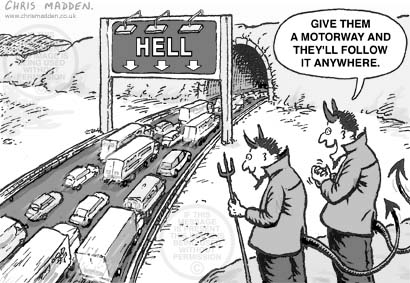
The cartoon above satirizes the consequences of providing free access to a costly facility. User fees encourage more rational patterns of use. For example, it is folly to think that projects like light rail can be financially viable when free alternatives exist. Specific highway routes under high demand must be priced in order for commuters to make rational decisions about the alternatives available to them, and for providers of transportation facilities, whether public or private, to rationally balance the resources dedicated to supporting various modes of travel.

Lower tax and regulatory burdens under the Trump infrastructure plan offer some encouragement for private development and operation of infrastructure projects. As a by-product, the plan might encourage greater reliance on user fees as a method of defraying the costs of infrastructure and promoting a more efficient allocation of resources toward infrastructure needs. However, there are unanswered questions about the details of the plan, and some of its heavy-handy features should be dispensed with.
Unequal Pay For Unequal Work

25 Thursday Feb 2016

Posted by Nuetzel in Labor Markets

≈ Leave a comment

Tags

BLS, Claudia Golden, DOL, FiveThirtyEight, Gender Discrimination, Gender Gap, High-Risk Occupations, Job Flexibility, Mark Perry, Millennial Pay Gap, Mutually Beneficial Trade, Non-Wage Compensation, Obama Discrimination Data Mandate, Occupational Choice, Pay Differentials, Risk Aversion, STEM, The Economist, Tyler Cowen

equal-pay-cartoon

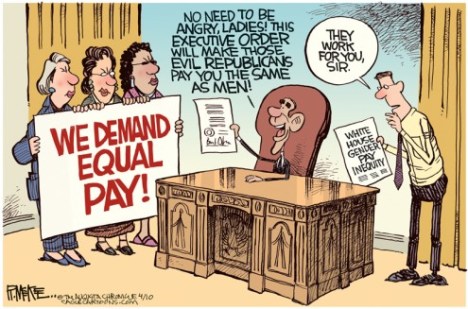
Debates on social issues are often plagued by facile comparisons that distort the underlying facts. The alleged gender pay gap involves such comparisons. The Obama Administration proposed new rules last month intended to address a difference in median earnings between men and women, demanding data reports on various demographics from firms with 100+ employees. Mark Perry points out that the pay gap in the Obama White House is about the same as the national difference. Can there be any reasonable explanation for these disparities?

One key to understanding the debate is that the difference in aggregate pay between men and women (17% in 2014, according to the Bureau of Labor Statistics) is not a divergence in pay for equal work! However, that is the gist of the fraudulent narrative so often heard from the White House and elsewhere. The truth: 17% is the difference in the medians of two large distributions of working adults, one for men, one for women, covering all occupational categories. The discrepancy, which has declined sharply over the past 35 years, is explained today by fewer hours worked among women and “differences in educational attainment, work experience, and occupational choice.” These differences are well known, but gender-gap warriors conveniently overlook the following facts, as established by the Department of Labor:

  • There is more part-time work among women;
  • Women lose more experience to childbirth, child care and elder care;
  • Women demand more job flexibility and non-wage benefits (and that costs);
  • Women are disproportionately under-represented in dangerous occupations;
  • Women are disproportionately under-represented in STEM fields (Science, Technology, Engineering, Math);

Interestingly, the last point may have more to do with a broader range of talents possessed by females who are skilled at math, relative to men, which leads to a greater variety of career options. An implication: non-STEM occupational choices by women are often voluntary and not the result of discrimination. And those choices are often driven by considerations other than cash remuneration.

As to the risk of physical danger, in 2010, men were almost 12 times as likely as women to suffer fatal injuries on the job. There is no question that high-risk occupations have higher wages. Apparently, women choose not to pursue opportunities in these occupations. An earlier study found that single parents, male and female, were the most risk averse in their choice of occupation, and that married women with children are more risk averse than married men with children. Of course, it is possible that some employers have requirements in terms of physical strength that favor men. Either way, the job-risk gap almost certainly contributes to the measured-wage gender gap, but it has little to do with gender discrimination per se.

Earnings are sensitive to factors such as full-time / part-time status, continuous job tenure, and the likelihood of extended leaves of absence. This is supported by a research finding cited in The Economist, that partners in lesbian relationships tend to out-earn married straight females. The division of responsibilities in the home is surely part of the story: lesbian couples tend to split chores more equally than straight couples. Millennial couples (ages 25-34) are also more likely to split household chores equally; the gender pay gap for millennials is much narrower than for older age cohorts, and it is nonexistent for childless millennials. Millennial women have more than closed the education gap as well.

When gender differences in hours, tenure, absences, education, and job hazards are considered, as well as the full menu of compensating non-wage benefits available, the wage gap is essentially nonexistent. Yet President Obama’s proposed data mandate would carry high compliance costs and likely cost jobs as well. The purpose of the regulation is to make it easier for various groups to sue employers on the basis of wage discrimination. But observation of such a gap, wherever it might exist, is not prime facie evidence of discrimination; it is more than likely to be the result of private, voluntary agreement.

Is it possible that certain attitudes or behavioral characteristics of women generalize to poorer outcomes, relative to men, in negotiations? Tyler Cowan reports on research that suggests as much, based on “laboratory” experiments in which participants played repeated games involving actual rewards. In one experiment, the rewards depended on the acceptance of an offer to share a pot, and both men and women made lower offers to female partners than to males. However, when the partner was a woman, females were markedly stingier in their offers than males. Those women are tough! But seldom are real-world “deals” so one-dimensional, and controlling for all considerations of value is often impossible. In any case, trades rarely take place when the parties don’t find them to be mutually beneficial.

Fortunately, in labor markets, when differentials in skills and experience matter, discrimination is practiced only under a self-inflicted penalty on the discriminator. In the case of wage-based gender discrimination, the employer will tend to overpay for equivalently-skilled male help. Discrimination of this sort impairs a firm’s ability to attract the best employees and harms its competitive position. Nevertheless, the extent to which the market’s self-regulation confers benefits on individual participants depends upon their vigilance: buyer beware (caveat emptor) and seller beware (caveat venditor) are keys to real economic freedom. Most importantly, in all things, beware government edicts. Markets are the best regulator.

Sidebar: I was referred to an article on FiveThirtyEight by my friend John Crawford. The main subject matter of the article is off-topic and its conclusions are incorrect (I might post on it soon), but many of the charts are interesting; the third chart is really fascinating! It shows that women, by age 30, tend to belong to households that are higher in the income distribution than men who come from the same point in the distribution of household-income in childhood. This is true at every point in the childhood household-income distribution! Are there advantage(s) for women that can account for this? A few guesses: a lower rate of incarceration of women by age 30; women have higher marriage rates by age 30; women “marry up” more than men, both in terms of the ages and incomes of their spouses; women who don’t marry live with their parents more than men do (?). There could be other explanations, and the relationship may not hold at later ages. Still, it’s noteworthy that such a reverse “gender gap” exists in the data.

I close with a quote from Harvard’s Claudia Golden, from “A Grand Gender Convergence: Its Last Chapter” (HT: Marginal Revolution):

“The gap is much lower than it had once been and the decline has been largely due to an increase in the productive human capital of women relative to men. Education at all levels increased for women relative to men and the fields that women pursue in college and beyond shifted to the more remunerative and career-oriented ones. Job experience of women also expanded with increased labor force participation. The portion of the difference in earnings by gender that was once due to differences in productive characteristics has largely been eliminated. 

What, then, is the cause of the remaining pay gap? Quite simply the gap exists because hours of work in many occupations are worth more when given at particular moments and when the hours are more continuous. That is, in many occupations earnings have a nonlinear relationship with respect to hours. A flexible schedule comes at a high price, particularly in the corporate, finance and legal worlds.“

Authoritarian Designs

31 Sunday Jan 2016

Posted by Nuetzel in Progressivism, racism, Uncategorized

≈ Leave a comment

Tags

Bernie Sanders, Child Quotas, CRISPR, Davis Bacon Act, Eugenics, Friedrich Hayek, John Stewart Mill, Jonah Goldberg, Kevin Drum, Minimum Wage, Mother Jones, Obamacare Effectiveness Research, Progressivism, racism, Scientism, Sterilization, Tyler Cowen

eugenics certificate

Why condemn today’s progressives for their movement’s early endorsement of eugenics? Kevin Drum at Mother Jones thinks this old association is now irrelevant. He furthermore believes that eugenics is not an important issue in the modern world. Drum’s remarks were prompted by Jonah Goldberg’s review of Illiberal Reformers, a book by Thomas Leonard on racism and eugenicism in the American economics profession in the late 19th century. Tyler Cowen begs to differ with Drum on both counts, but for reasons that might not have been obvious to Drum. Eugenics is not a bygone, and its association with progressivism is a reflection of the movement’s broader philosophy of individual subservience to the state and, I might add, the scientism that continues to run rampant among progressives.

Cowen cites John Stewart Mill, one of the great social thinkers of the 19th century, who was an advocate for individual liberty and a harsh critic of eugenics. Here is a great paragraph from Cowen:

“The claim is not that current Progressives are evil or racist, but rather they still don’t have nearly enough Mill in their thought, and not nearly enough emphasis on individual liberty. Their continuing choice of label seems to indicate they are not much bothered by that, or maybe not even fully aware of that. They probably admire Mill’s more practical reform progressivism quite strongly, or would if they gave it more thought, but they don’t seem to relate to the broader philosophy of individual liberty as it surfaced in the philosophy of Mill and others. That’s a big, big drawback and the longer history of Progressivism and eugenics is perhaps the simplest and most vivid way to illuminate the point. This is one reason why the commitment of the current Left to free speech just isn’t very strong.“

Eugenics is not confined to the distant past, as Cowen notes, citing more recent “progressive” sterilization programs in Sweden and Canada, as well as the potential use of DNA technologies like CRISPR in “designing” offspring. That’s eugenics. So is the child quota system practiced in China, sex-selective abortion, and the easy acceptance of aborting fetuses with congenital disorders. Arguably, Obamacare “effectiveness research” guidelines cut close to eugenicism by proscribing certain treatments to individuals based upon insufficient “average benefit”, which depends upon age, disability, and stage of illness. Obamacare authorizes that the guidelines may ultimately depend on gender, race and ethnicity. All of these examples illustrate the potential for eugenics to be practiced on a broader scale and in ways that could trample individual rights.

Jonah Goldberg also responded to Drum in “On Eugenics and White Privilege“. (You have to scroll way down at the link to find the section with that title.) Goldberg’s most interesting points relate to the racism inherent in the minimum wage and the Davis-Bacon Act, two sacred cows of progressivism with the same original intent as eugenics: to weed out “undesirables”, either from the population or from competing in labor markets. It speaks volumes that today’s progressives deny the ugly economic effects of these policies on low-skilled workers, yet their forebears were counting on those effects.

Scientism is a term invoked by Friedrich Hayek to describe the progressive fallacy that science and planning can be used by the state to optimize the course of human affairs. However, the state can never command all the information necessary to do so, particularly in light of the dynamism of information relating to scarcity and preferences; government has trouble enough carrying out plans that merely match the static preferences of certain authorities. Historically, such attempts at planning have created multiple layers of tragedy, as individual freedoms and material well-being were eroded. Someone should tell Bernie Sanders!

Eugenics fit nicely into the early progressive view, flattering its theorists with the notion that the human race could be made… well, more like them! Fortunately, eugenics earned its deservedly bad name, but it continues to exist in somewhat more subtle forms today, and it could take more horrific forms in the future.

Two earlier posts on Sacred Cow Chips dealt at least in part with eugenics: “Child Quotas: Family as a Grant of Privilege“, and “Would Heterosexuals Select For Gay Genes?“.


.

Borkians Preserve Federal Obamacare Subsidies

29 Monday Jun 2015

Posted by Nuetzel in Obamacare

≈ Leave a comment

Tags

ACA, Administrative State, Affordable Care Act, Chief Justice Roberts, Damon Root, Ilya Shapiro, Judicial Activism, Judicial Restraint, King vs. Burwell, Obamacare, Randy Barnett, Robert Bork, Robert Laszlewski, SCOTUS, SCOTUSblog, Tyler Cowen

ACA Supremes cartoon

I have mixed feelings about the Supreme Court’s King vs. Burwell decision upholding federal subsidies for health insurance purchased in states that did not establish their own exchanges. My biggest concerns are that the decision gives a pass to the unchecked exercise of executive fiat as well as congressional carelessness (“lassitude”, to use Justice Scalia’s term), and the smearing of the separation of legislative and judicial powers. I admit that I was eager to see the exchanges unravel under the weight of their own lousy economics. However, the economics remain lousy even with the ruling, which will become more evident as major subsidies to health insurers expire over the next 18 months. It will be interesting to watch as the process of escalating premia plays out. I’m relieved that the Obamacare opposition in Congress (primarily Republicans) is now off the hook. These legislators never coalesced around an alternative and would have received a good portion of the blame for any further disruptions in the insurance “market” had the decision gone the other way. Probably their best approach would have been to extend the subsidies to all exchanges, at least for the remainder of Obama’s term. As Tyler Cowen notes, an extension would have occurred:

“… only after a lot of political stupidity and also painful media coverage. So on net I take this to be good news, although arguably it is bad news that it is good news.“

On the merits of health care policy, given the failure to put forward a better plan, what would have been gained over the next 18 months from a ruling for the plaintiffs? Not much.

Cowen links to a Robert Laszlewski post emphasizing the fragile economic and political condition of Obamacare:

“Obamacare has only enrolled about 40% of the subsidy eligible market in two years worth of open enrollments. That level of consumer support does not make Obamacare either financially sustainable or politically sustainable. The surveys say the 40% who have enrolled like their plans. Of course they do, they are the poorest with the biggest subsidies and the lowest deductibles. The working and middle-class have most often not signed up for Obamacare because it costs too much and delivers too little.

That Obamacare is not financially sustainable is evidenced by the first wave of big 2016 rate increases by so many large market share insurers. The next wave of rate increases a year from now will also be large and will be in the middle of the 2016 election.“

The SCOTUS decision flies in the face of the roles and responsibilities assigned to the branches of government by the Constitution. The implication of the ruling is that a law means whatever the executive branch says it means, even when it says the opposite unambiguously. This goes too far in granting executive power to “reimagine” legislation, and the Left may well come to regret it as a precedent. Executive rulings in implementing laws is nothing new, but one hopes for the courts to keep a tight rein on this discretion in an era when the regulatory environment is growing increasingly complex.

A Randy Barnett post at SCOTUSblog quotes Chief Justice Roberts’ opinion:

“Congress passed the Affordable Care Act to improve health insurance markets, not to destroy them. If at all possible, we must interpret the Act in a way that is consistent with the former, and avoids the latter.“

Improve health care markets? Not destroy them? Wait… I’m confused! But seriously, at this point in the process, Justice Roberts must be confused about actual outcomes. An objective assessment of Obamacare would include an accounting for the many individuals whose policies were cancelled against their wishes, premium escalation, and the fact that the ACA has fallen well short of expectations for reducing the number of uninsured; the law has certainly not improved markets. Barnett describes Roberts’ apparent philosophy on this point thusly:

“... the Chief Justice seems to be telling us that he is once again putting a thumb on the scale for the government here as he did in his solo opinion in NFIB. Rather than assessing the constitutionality of the law as written – or enforcing it according to its terms – the court will rewrite the law to suit the government.” 

This is not merely “legislative deference”, it is legislative rescue and a rewriting of the law. And Barnett points out that the Courts should provide a check on bad legislation, not serve as enablers.

Damon Root offers an excellent clarification of Roberts’ thinking: the strand of conservative judicial philosophy calling for deference to legislative intent is often attributed to Robert Bork. This obviously conflicts with the notion that conservatives are judicial activists. I discussed judicial activism here a few months ago, including Randy Barnett’s assertion that the term seems to be invoked as a pejorative almost any time someone doesn’t like a court decision. If it means preserving the Constitution, then count me as an activist.

Ilya Shapiro sums up the “intent” of the legislation and the “deferential” position taken by the court in King vs. Burwell:

“Roberts explains his transmogrification by finding it ‘implausible that Congress meant the Act to operate in this manner,’ to deny subsidies to millions of people as part of legislation intended to expanded coverage. But it’s hardly implausible to think that legislation that still says that states ‘shall’ set up exchanges—the drafters forgot to fix this bit after lawyers pointed out that Congress can’t command states to do anything—would effectively give states an offer nobody thought they’d refuse. It was supposed to be a win-win: states rather than the federal government would run health care exchanges (yay federalism!) and all those who need subsidies to afford Obamacare policies would get them (yay universal healthcare!).

But a funny thing happened on the way to utopia, and only 14 states (plus D.C.) took that too-tempting offer, perhaps having been burned too many times before by the regulations that accompany any pots of “free” federal money. And that’s why we ended up with King v. Burwell: Obamacare the reality doesn’t accomplish Obamacare the dream.“

We’ll watch to see how badly Obamacare fares over the next two years. And we’ll hope that eventually Congress can fashion a new health care plan that creates more choice, reduces taxes, increases competition and reduces coercive rules and regulatory burdens.

Community College Free-For-All

12 Monday Jan 2015

Posted by Nuetzel in Uncategorized

≈ Leave a comment

Tags

college for all, Community college, Digital Journal, Free education, grade inflation, misallocation of resources, Peter Theil, Reason, Scott Shackford, Tyler Cowen

Funny-Obama-Photo-With-Bear

Obama keeps puffing on the horn of taxpayer plenty, this time proposing free tuition at community colleges for all comers. This is a misapplication of the empirical observation that earned income is positively related to the level of education.

Supporters of “college for all” naively assume that enabling college enrollment will always translate into actual learning and success on the job market, or that college is always a good idea. Those assumptions are incorrect. Not everyone is capable of benefitting from higher education. It is a disfavor to them, and to their more academically competitive peers, to encourage them to enter an environment in which they are likely to fail or benefit less than in other pursuits, and where they will absorb scarce educational resources such as facilities, equipment, and instructor time and effort. And if less capable individuals are allowed to “succeed” under more relaxed standards, the degrees they earn will be degraded. Moreover, as Peter Theil has emphasized, we tend to think “too highly of higher eduction,” as if it is always one’s best option. In fact, that may not be true for even the most talented individuals, who may be capable of accomplishing greater things without it, and sooner!

But what real costs and benefits can be expected from Obama’s latest proposed giveaway? Scott Shakford at Reason summarizes and critiques the program, explaining that community college administrators are likely to be the chief beneficiaries. Shakford also notes that the program is likely to encourage grade inflation, based on the minimum GPA requirements built into the program. This op-ed in the Digital Journal points out that Obama’s plan will also encourage grade inflation at the high-school level, so as not to “unfairly” deny students their new opportunity to matriculate into community college.

Shakford at Reason puts the total cost to taxpayers at $34 billion, but it is based on an administration estimate that 9 million students could attend community college free-of-charge. It is not clear whether that number is net of those already attending for free. Tyler Cowen offers links to some good discussions of the plan, one of which notes that community college is already free on average for low income students via Pell grants. Higher income students obviously stand to gain, however, so the plan’s targeting of benefits is perverse. Community college completion rates are already quite low, and Cowen notes that the rate for marginal students pulled in by Obama’s program is likely to be even lower, which would further diminish the value of the degree on the labor market.

“Free stuff” always sounds so good and well-intentioned that is it difficult for many to oppose. But free stuff generally means that resources must be diverted from more highly-valued uses for little or no gain. After all, the value of the freebie to beneficiaries of a politician’s scheme can be minimal and they’ll still be takers. Taxes to fund the diversion of resources creates other perverse incentives.

Funding the education of promising but needy students may be quite worthwhile, but offering a free post-secondary education for all will grossly misallocate resources and carry a high social cost.

Newer posts →
Follow Sacred Cow Chips on WordPress.com

Recent Posts

  • The Case Against Interest On Reserves
  • Immigration and Merit As Fiscal Propositions
  • Tariff “Dividend” From An Indigent State
  • Almost Looks Like the Fed Has a 3% Inflation Target
  • Government Malpractice Breeds Health Care Havoc

Archives

  • January 2026
  • December 2025
  • November 2025
  • October 2025
  • September 2025
  • August 2025
  • July 2025
  • June 2025
  • May 2025
  • April 2025
  • March 2025
  • February 2025
  • January 2025
  • December 2024
  • November 2024
  • October 2024
  • September 2024
  • August 2024
  • July 2024
  • June 2024
  • May 2024
  • April 2024
  • March 2024
  • February 2024
  • January 2024
  • December 2023
  • November 2023
  • August 2023
  • July 2023
  • June 2023
  • May 2023
  • April 2023
  • March 2023
  • February 2023
  • January 2023
  • December 2022
  • November 2022
  • October 2022
  • September 2022
  • August 2022
  • July 2022
  • June 2022
  • May 2022
  • April 2022
  • March 2022
  • February 2022
  • January 2022
  • December 2021
  • November 2021
  • October 2021
  • September 2021
  • August 2021
  • July 2021
  • June 2021
  • May 2021
  • April 2021
  • March 2021
  • February 2021
  • January 2021
  • December 2020
  • November 2020
  • October 2020
  • September 2020
  • August 2020
  • July 2020
  • June 2020
  • May 2020
  • April 2020
  • March 2020
  • February 2020
  • January 2020
  • December 2019
  • November 2019
  • October 2019
  • September 2019
  • August 2019
  • July 2019
  • June 2019
  • May 2019
  • April 2019
  • March 2019
  • February 2019
  • January 2019
  • December 2018
  • November 2018
  • October 2018
  • September 2018
  • August 2018
  • July 2018
  • June 2018
  • May 2018
  • April 2018
  • March 2018
  • February 2018
  • January 2018
  • December 2017
  • November 2017
  • October 2017
  • September 2017
  • August 2017
  • July 2017
  • June 2017
  • May 2017
  • April 2017
  • March 2017
  • February 2017
  • January 2017
  • December 2016
  • November 2016
  • October 2016
  • September 2016
  • August 2016
  • July 2016
  • June 2016
  • May 2016
  • April 2016
  • March 2016
  • February 2016
  • January 2016
  • December 2015
  • November 2015
  • October 2015
  • September 2015
  • August 2015
  • July 2015
  • June 2015
  • May 2015
  • April 2015
  • March 2015
  • February 2015
  • January 2015
  • December 2014
  • November 2014
  • October 2014
  • September 2014
  • August 2014
  • July 2014
  • June 2014
  • May 2014
  • April 2014
  • March 2014

Blogs I Follow

  • Passive Income Kickstart
  • OnlyFinance.net
  • TLC Cholesterol
  • Nintil
  • kendunning.net
  • DCWhispers.com
  • Hoong-Wai in the UK
  • Marginal REVOLUTION
  • Stlouis
  • Watts Up With That?
  • Aussie Nationalist Blog
  • American Elephants
  • The View from Alexandria
  • The Gymnasium
  • A Force for Good
  • Notes On Liberty
  • troymo
  • SUNDAY BLOG Stephanie Sievers
  • Miss Lou Acquiring Lore
  • Your Well Wisher Program
  • Objectivism In Depth
  • RobotEnomics
  • Orderstatistic
  • Paradigm Library
  • Scattered Showers and Quicksand

Blog at WordPress.com.

Passive Income Kickstart

OnlyFinance.net

TLC Cholesterol

Nintil

To estimate, compare, distinguish, discuss, and trace to its principal sources everything

kendunning.net

The Future is Ours to Create

DCWhispers.com

Hoong-Wai in the UK

A Commonwealth immigrant's perspective on the UK's public arena.

Marginal REVOLUTION

Small Steps Toward A Much Better World

Stlouis

Watts Up With That?

The world's most viewed site on global warming and climate change

Aussie Nationalist Blog

Commentary from a Paleoconservative and Nationalist perspective

American Elephants

Defending Life, Liberty and the Pursuit of Happiness

The View from Alexandria

In advanced civilizations the period loosely called Alexandrian is usually associated with flexible morals, perfunctory religion, populist standards and cosmopolitan tastes, feminism, exotic cults, and the rapid turnover of high and low fads---in short, a falling away (which is all that decadence means) from the strictness of traditional rules, embodied in character and inforced from within. -- Jacques Barzun

The Gymnasium

A place for reason, politics, economics, and faith steeped in the classical liberal tradition

A Force for Good

How economics, morality, and markets combine

Notes On Liberty

Spontaneous thoughts on a humble creed

troymo

SUNDAY BLOG Stephanie Sievers

Escaping the everyday life with photographs from my travels

Miss Lou Acquiring Lore

Gallery of Life...

Your Well Wisher Program

Attempt to solve commonly known problems…

Objectivism In Depth

Exploring Ayn Rand's revolutionary philosophy.

RobotEnomics

(A)n (I)ntelligent Future

Orderstatistic

Economics, chess and anything else on my mind.

Paradigm Library

OODA Looping

Scattered Showers and Quicksand

Musings on science, investing, finance, economics, politics, and probably fly fishing.

  • Subscribe Subscribed
    • Sacred Cow Chips
    • Join 128 other subscribers
    • Already have a WordPress.com account? Log in now.
    • Sacred Cow Chips
    • Subscribe Subscribed
    • Sign up
    • Log in
    • Report this content
    • View site in Reader
    • Manage subscriptions
    • Collapse this bar
 

Loading Comments...