• About

Sacred Cow Chips

Sacred Cow Chips

Author Archives: Nuetzel

AI Won’t Repeal Scarcity, Tradeoffs, Or Jobs

04 Monday Aug 2025

Posted by Nuetzel in Artificial Intelligence, Labor Markets

≈ 2 Comments

Tags

Absolute Advantage, AI Capital, Artificial Intelligence, Baby Bonds, Comparative advantage, Complementary Inputs, Human Touch, Opportunity cost, Robitics, Scarcity, Tradeoffs, Type I Civilization, Universal Basic Income, Universal Capital Endowments

As of February 2026, I’m adding this short preamble to a few older posts on the subject of AI and future prospects for human labor. In the original post below (and a few others), I overstated the case that the law of comparative advantage would assure a continued role for humans in production. I still think the case is strong, mind you, but now I’m convinced that the outcome depends on elasticities of input substitution and how those elasticities might shift given the advent of AI-augmented capital. You can read my most recent thoughts on the matter here.

____________________________________________

Every now and then I grind my axe against the proposition that AI will put humans out of work. It’s a very fashionable view, along with the presumed need for government to impose “robot taxes” and provide everyone with a universal basic income for life. The thing is, I sense that my explanations for rejecting this kind of narrative have been a little abstruse, so I’m taking another crack at it now.

Will Human Workers Be Obsolete?

The popular account envisions a world in which AI replaces not just white-collar technocrats, but by pairing AI with advanced robotics, it replaces workers in the trades as well as manual laborers. We’ll have machines that cure, litigate, calculate, forecast, design, build, fight wars, make art, fix your plumbing, prune your roses, and replicate. They’ll be highly dextrous, strong, and smart, capable of solving problems both practical and abstract. In short, AI capital will be able to do everything better and faster than humans! The obvious fear is that we’ll all be out of work.

I’m here to tell you it will not happen that way. There will be disruptions to the labor market, extended periods of joblessness for some individuals, and ultimately different patterns of employment. However, the chief problem with the popular narrative is that AI capital will require massive quantities of resources to produce, train, and operate.

Even without robotics, today’s AIs require vast flows of energy and other resources, and that includes a tremendous amount of expensive compute. The needed resources are scarce and highly valued in a variety of other uses. We’ll face tradeoffs as a society and as individuals in allocating resources both to AI and across various AI applications. Those applications will have to compete broadly and amongst themselves for priority.

AI Use Cases

There are many high-value opportunities for AI and robotics, such as industrial automation, customer service, data processing, and supply chain optimization, to name a few. These are already underway to a significant extent. To that, however, we can add medical research, materials research, development of better power technologies and energy storage, and broad deployment in delivering services to consumers and businesses.

In the future, with advanced robotics, AI capital could be deployed in domains that carry high risks for human labor, such as construction of high rise buildings, underwater structures, and rescue operations. This might include such things as construction of solar platforms and large transports in space, or the preparation of space habitats for humans on other worlds.

Scarcity

There is no end to the list of potential applications of AI, but neither is there an end to the list of potential wants and aspirations of humanity. Human wants are insatiable, which sometimes provokes ham-fisted efforts by many governments to curtail growth. We have a long way to go before everyone on the planet lives comfortably. But even then, peoples’ needs and desires will evolve once previous needs are satisfied, or as technology changes lifestyles and practices. New approaches and styles drive fashions and aesthetics generally. There are always individuals who will compete for resources to experiment and to try new things. And the insatiability of human wants extends beyond the strictly private level. Everyone has an opinion about unsatisfied needs in the public sphere, such as infrastructure, maintenance, the environment, defense, space travel, and other dimensions of public activity.

Futurists have predicted that the human race will seek to become a so-called Type I civilization, capable of harnessing all of the energy on our planet. Then there will be the quest to harness all the energy within our solar system (a Type II civilization). Ultimately, we’ll seek to go beyond that by attempting to exploit all the energy in the Milky Way galaxy. Such an expansion of our energy demands would demonstrate how our wants always exceed the resources we have the ability to exploit.

In other words, scarcity will always be with us. The necessity of facing tradeoffs won’t ever be obviated, and prices will always remain positive. The question of dedicating resources to any particular application of AI will bring tradeoffs into sharper relief. The opportunity cost of many “lesser” AI and robotics applications will be quite high relative to their value to investors. Simply put, many of those applications will be rejected because there will be better uses for the requisite energy and other resources.

Tradeoffs

Again, it will be impossible for humans to accomplish many of the tasks that AI’s will perform, or to match the sheer productivity of AIs in doing so. Therefore, AI will have an absolute advantage over humans in all of those tasks.

However, there are many potential applications of AI that are of comparatively low value. These include a variety of low-skill tasks, but also tasks that require some dexterity or continuous judgement and adjustment. Operationalizing AI and robots to perform all these tasks, and diverting the necessary capital and energy away from other uses, would have a tremendously high opportunity cost. Human opportunity costs will not be so high. Thus, people will have a comparative advantage in performing the bulk if not all of these tasks.

Sure, there will be novelty efforts and test cases to train robots to do plumbing or install burglar alarm systems, and at some point buyers might wish to have robots prune their roses. Some people are already amenable to having humanoid robots perform sex work. Nevertheless, humans will remain competitive at these tasks due to the comparatively high opportunity costs faced by AI capital.

There will be many other domains in which humans will remain competitive. Once more, that’s because the opportunity costs for AI capital and other resources will be high. This includes many of the skilled trades, caregivers, and a great many management functions, especially at small companies. Their productivity will be enhanced by AI tools, but those jobs will not be decimated.

The key here is understanding that 1) capital and resources generally are scarce; 2) high value opportunities for AI are plentiful; and 3) the opportunity cost of funding AI in many applications will be very high. Humans will still have a comparative advantage in many areas.

Who’s the Boss?

There are still other ways in which human labor will always be required. One in particular involves the often complementary nature of AI and human inputs. People will have roles in instructing and supervising AIs, especially in tasks requiring customization and feedback. A key to assuring AI alignment with the objectives of almost any pursuit is human review. These kinds of roles are likely to be compensated in line with the complexity of the task. This extends to the necessity of human leadership of any organization.

That brings me to the subject of agentic and fully autonomous AI. No matter how sophisticated they get, AIs will always be the product of machines. They’ll be a kind of capital for which ownership should be confined to humans or organizations representing humans. We must be their masters. Disclaiming ownership and control of AIs, and granting agentic AIs the same rights and freedoms as people (as many have imagined) is unnecessary and possibly dangerous. AIs will do much productive work, but that work should be on behalf of human owners, and human labor will be deployed to direct and assess that work.

AIs (and People) Needing People

The collaboration between AIs and humans described above will manifest more broadly than anything task-specific, or anything we can imagine today. This is typical of technological advance. First-order effects often include job losses as new innovations enhance productivity or replace workers outright, but typically new jobs are created as innovations generate new opportunities for complementary products and services both upstream in production or downstream among ultimate users. In the case of AI, while much of this work might be performed by other AIs, at a minimum these changes will require guidance and supervision by humans.

In addition, consumers tend to have an aesthetic preference for goods and services produced by humans: craftsmen, artists, and entertainers. For example, if you’ve ever shopped for an oriental rug, you know that hand-knotted rugs are more expensive than machine-weaved rugs. Durability is a factor as well as uniqueness, the latter being a hallmark of human craftspeople. AI might narrow these differences over time, but the “human touch” will always have value relative to “comparable” AI output, even at a significant disadvantage in terms of speed and uncertainty regarding performance. The same is true of many other forms, such as sports, dance, music, and the visual arts. People prefer to be entertained by talented people, rather than highly-engineered machines. The “human touch” also has advantages in customer-facing transactions, including most forms of service and high-level sales/financial negotiations.

Owning the Machines

Finally, another word about AI ownership. An extension of the fashionable narrative that AIs will wholly replace human workers is that government will be called upon to tax AI and provide individuals with a universal basic income (UBI). Even if human labor were to be replaced by AIs, I believe that a “classic” UBI would be the wrong approach. Instead, all humans should have an ownership stake in the capital stock. This is wealth that yields compound growth over time and produces returns that make humans less reliant on streams of labor income.

Savings incentives (and negative consumption incentives) are a big step in encouraging more widespread ownership of capital. However, if direct intervention is necessary, early endowments of capital would be far preferable to a UBI because they will largely be saved, fostering economic growth, and they would create better incentives than a UBI. Along those lines, President Trump’s Big Beautiful Bill, which is now law, has established “Baby Bonds” for all American children born in 2025 – 2028, initially funded by the federal government with $1,000. Of course, this is another unfunded federal obligation on top of the existing burden of a huge public debt and ongoing deficits. Given my doubts about the persistence of AI-induced job losses, I reject government establishment of both a UBI and universal endowments of capital.

Summary

Capital and energy are scarce, so the tremendous resource requirements of AI and robotics means that the real world opportunity costs of many AI applications will remain impractically high. The tradeoffs will be so steep that they’ll leave humans with comparative advantages in many traditional areas of employment. Partly, these will come down to a difference in perceived quality owing to a preference for human interaction and human performance in a variety of economic interactions, including patronization of the art and athleticism of human beings. In addition, AIs will open up new occupations never before contemplated. We won’t be out of work. Nevertheless, it’s always a good idea to accumulate ownership in productive assets, including AI capital, and public policy should do a better job of supporting the private initiative to do so.

Attack Private Sector With Tariffs, Then Attack Pricing

26 Saturday Jul 2025

Posted by Nuetzel in Tariffs, Tax Incidence

≈ 1 Comment

Tags

Amazon, Beige Book, Capitalism, Chad Wolf, Consumer Sovereignty, Costco, Eating Tariffs, Free Markets, Import Competing Goods, Mussolini, New Right, Price Gouging, Profit Motive, Protectiinism, Retail Margins, Target, Tariffs, Tax Incidence, WalMart

An opinion piece caught my eye written by one Chad Wolf. It’s entitled: “Retailers caught red-handed using Trump’s tariffs as cover for price gouging”. A good rule is to approach allegations of “price gouging” with a strong suspicion of economic buffoonery. You tend to hear such gripes just when prices should rise to discourage over-consumption and encourage production. The Wolf article, however, typifies the kind of attack on capitalism we hear increasingly from the “new right” (and see this).

Wolf, a former Homeland Security official in the first Trump Administration, says that large retailers like Walmart and Target are ripping off American consumers by raising prices on goods that are, in his judgement, “unaffected” by tariffs.

We’ll get into that, but first a quick disclaimer: I have no connection to Walmart or Target. Sure, I’ve shopped at those stores and I’ve filled a few prescriptions at a Walmart pharmacy. Maybe I have an ETF with an interest, but I have no idea.

Competition and Consumer Choice

Of course, no one forces consumers to shop at Walmart or Target. Those stores compete with a wide variety of outlets, including Costco and Amazon, the latter just a few clicks away. In a market, sellers price goods at what the market will bear, which ultimately serves to signal scarcity: a balancing between the cost of required resources and the value assigned by buyers. Unfortunately, in the case of tariffs, buyers and sellers of imports must deal with an artificial form of scarcity designed to extract revenue while benefitting other interests.

Wolf touts the “gift” of a free market for American businesses, as if private rights flow from government beneficence. He then decries a so-called betrayal by large retailers who would “price gouge” the American consumer in an effort to protect their profit margins. The free market is indeed a great thing! But his indignance is highly ironic as a pretext for defending tariffs and protectionism, given their destructive effect on the free operation of markets.

Broader Impacts

Wolf might be unaware that tariffs have an impact on a large number of domestically-produced goods that are not imported, but nevertheless compete with imports. When a tariff is charged to buyers of imports, producers of domestic substitutes experience greater demand for their products. That means the prices of these import-competing goods must rise. Furthermore, the effect can manifest even before tariffs go into effect, as consumers begin to seek out substitutes and as producers anticipate higher input costs.

Obviously, tariffs also impinge on producers who rely on imports as inputs to production. It’s not clear that Wolf understands how much tariffs, which represent a direct increase in costs, hurt these firms and their competitive positions.

“Expected” Does Not Mean “Unaffected”

Wolf cites the Federal Reserve’s Beige Book report (which he calls a “study”) to support his claim that businesses are gouging buyers for goods “unaffected” by tariffs. Here is one quote he employs:

“A heavy construction equipment supplier said they raised prices on goods unaffected by tariffs to enjoy the extra margin before tariffs increased their costs,” the Beige Book report said.“

Read that again carefully! Apparently Wolf, and whoever added this to the Fed’s Beige Book, thinks that being “unaffected by tariffs” includes firms whose future costs, including replacement of inventories, will be affected by tariffs! He goes on to say:

“… Walmart has already issued price hikes under the guise of tariff costs.“

The examples at his “price hikes” link were for Chinese goods in April and May, after Trump announced 145% tariffs on China in April. In mid-May, Trump said China would face a lower 30% tariff rate during a 90-day “pause” while a trade agreement was negotiated. It is now 55%, but the point is that retailers were forced to play a guessing game with respect to inventory replacement costs due to uncertainty imposed by Trump. They had a sound reason for marking up those items.

Fibbing on the Margin

Here’s an excerpt from Wolf’s diatribe that demonstrates his cluelessness even more convincingly:

“We all know many of these large retailers are sitting on comfortable, even expanded, profit margins because of the price hikes from COVID-19 that never came down. But it’s not enough for them. They want to fleece the American consumer and blame it on President Trump’s America First agenda.“

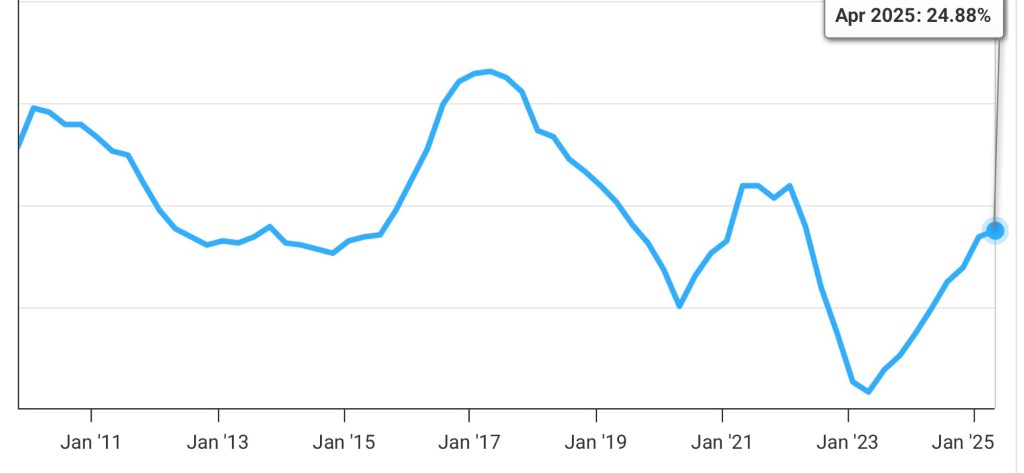
So let’s take a look at those profit margins that “never came down” after the pandemic, but in a longer historical context. Here are gross margins for Walmart since 2010:

Walmart’s margin today is about the same as the average for discount stores, and it is lower than for department stores, retailers of household and personal products, groceries, and footwear. Furthermore, it is lower today than it was ten years ago. While the margin increased a little during the pandemic, it fell in its aftermath, contrary to Wolf’s assertion. That the company has rebuilt margins steadily since 2023 should be viewed not as an indictment, but perhaps as a testament to improved managerial performance.

Wolf goes on to quote a former Walmart CEO who says that the 25 basis point increase in the gross margin in the latest quarter (from ~24.7% to 24.94%) indicates that the chain can “manage” the tariff impact. Of course it can, but that would not constitute “price gouging”.

A Trump Lackey

Of course, Wolf is taking his cues from Donald Trump, who has been bullying American businesses to “eat” the cost of his tariff onslaught, rather than passing them along to the ultimate buyers of imported goods. However, private businesses should not be expected to take orders from the President. This is not Mussolini’s Italy. Moreover, anyone familiar with tax incidence will understand that sellers are likely to eat some portion of a tariff (sharing the burden with buyers) without jawboning from the executive branch. That’s because buyers demand less at higher prices and sellers wish to avoid losing profitable sales, to the extent they can. But the dynamics of this adjustment process might take time to play out.

It’s also worth noting that a retailer might attempt to hold the line on certain prices in an uncertain cost environment. This uncertainty is a real cost inflicted by Trump. Meanwhile, pointing to increased prices for domestic goods, even if they are truly unaffected by tariffs, proves nothing without knowledge of the relevant cost and market conditions for those goods. It certainly doesn’t prove an “unpatriotic” attempt to cross subsidize imported goods.

In fact, one might say it’s unpatriotic for the federal government to restrict the market choices faced by American consumers and businesses, and for the President to tell American sellers that they better “eat” the cost of tariffs (or else?). And say, what happened to the contention that tariffs aren’t taxes?

Conclusion

Attacks on sellers attempting to recoup tariff costs are unfair and anti-capitalist. They are also somewhat disdainful of the economic sovereignty of American consumers, though not as much as the tariffs themselves. In the case described above, Chad Wolf would have us believe that sellers should not act on their expectations of near-term tariff increases. He also fails to recognize the impact of tariffs on import-competing goods and the cost of tariffs borne by producers who must rely on imported goods as inputs to production. Even worse, Wolf misrepresents some of the evidence he uses to make his case.

More generally, American businesses should not be bullied into taking a hit just because they serve customers who wish to buy imported goods. There is nothing unpatriotic about the freedom to choose what to goods to buy, what goods to stock, and how to maintain profitability in the face of government interference.

June Budget Surplus and Wishful Tariff Thinking

21 Monday Jul 2025

Posted by Nuetzel in Deficits, Tariffs

≈ Leave a comment

Tags

Balanced Budget, Budget Surplus, Calendar Adjustments, Donald Trump, Economic Freedom, MAGA, Protectionism, Tariffs

The federal government ran a budget surplus of $27 billion in June, much to the surprise of nearly everyone. The Trump Administration and MAGA-friendly media were eager to credit a big revenue boost from higher tariffs, which… ahem … they have assured us are not really taxes. In any case, to attribute the June surplus to tariffs is flatly ridiculous. The truth is these “non-tax” magic revenue generators made a relatively small contribution to the apparent shift in the government’s fiscal position in June. And I say “apparent” because the surplus itself was something of a mirage.

Yes, tariffs brought in a total of almost $27B during June, which is about the same as the surplus recorded, but that was purely coincidental. It does not imply that tariffs “created” a surplus. Nor does it suggest that tariffs might just be able to balance the federal budget. Not a chance!

Here is one of two other sides of the story: the Treasury reported that the budget balance this June improved from a year ago by a total of $89 billion, from a deficit of $72B in June of 2024 to the aforementioned surplus of $27B in June 2025. Outlays were lower by about $38B this June, accounting for almost 43% of the improvement. Receipts were about $59B higher, with tariffs increasing by $20B relative to June 2024. So tariffs contributed just over a third of the boost in receipts. Altogether then, tariffs accounted for 22.5% of the improvement in the June budget balance between 2024 and 2025. That version of the story, as far as it goes, does not support the contention that tariffs “caused” the budget surplus in June, only that tariff revenue was a contributing factor.

Let’s dig a little deeper, however. Were it not for so-called “calendar adjustments” made by the Treasury, it would have reported a deficit of $70B in June. The reason? The first day of June fell on a Sunday this year, so certain payments were shifted to the last prior business day: Friday, May 30. That reduced June outlays substantially. Moreover, an extra business day in June 2025 added revenue. So the surplus in June was, in essence, an artifact of the calendar and had little to do with tariff revenue.

Incidentally, no one should be surprised by the growth of tariff revenue collected in June. When a tax rate more than triples (from a pre-Trump average of about 3% to 10% plus in June — net of tariff exclusions), one should expect revenue from that tax to increase substantially (and it was probably exaggerated by the extra business day).

Oh wait! Did I say tax?

With time, buyers will adjust and scale back their import purchases, reducing the revenue impact of the tariff hikes. However, we still don’t know how high tariffs will go. That means we could see substantially higher tariff revenue, though the demand response and a likely negative impact on incomes will cut into those gains. Either way, the revenue potential of tariffs is limited. Some estimates put the revenue impact of Trump’s tariffs at less than $250B annually. That seems conservative, but it’s significant revenue if it holds up. Still, it won’t come close to balancing a federal budget that’s almost $2 trillion in the hole. It certainly doesn’t justify a headlong dive into protectionism, which amounts to taking a crap on the economic freedom and prosperity of the American public.

Stablecoin Digital Dollar Substitutes

16 Wednesday Jul 2025

Posted by Nuetzel in Crypto, Monetary Policy

≈ Leave a comment

Tags

100% Reserves, Anti-CBDC Surveillance State Act, Anti-Money Laundering, Blockchain, CBDC, CLARITY Act, Crypto Week, Crypto-Currencies, Dave Friedman, Digital Assets, Disintermediation, Dollarization, GENIUS Act, Know Your Customer, Monetary Control, Payment Stablecoins, Scott Sumner, STABLE Act, Stablecoins, Taurus, Terra/Luna, Tether, Zero Knowledge Proofs

Stablecoins are a very hot topic, and not only among crypto enthusiasts. This is “Crypto Week” in Congress, but current activity in the stablecoin (SC) space ranges from an explosion of transactions and issuance by banks and other institutions, plans for issuance by other businesses like large retailers, the introduction of new embedded SC features, laws affirming the right of use in non-crypto transactions, regulatory maneuvers, and central bank scrutiny.

The Digital Money Realm

An SC is a digital asset convertible to currency at a value pegged to some other asset with a stable market value. SCs are almost all pegged to the dollar, but they can be algorythmically pegged to a basket of currencies, Treasury securities, gold, silver, or other commodities, or a combination of various kinds of assets. Still, it’s thought that the growth of SCs will reinforce the dollar’s position as the world’s dominant currency.

SCs had their genesis and are still primarily used for settlement of transaction involving crypto-currencies and cross-border transactions. They function as a store of value and provide investors exposure to the underlying asset(s), but they are increasingly seen as transactions media as well. They offer a direct channel to instant settlement without other intermediaries and with low transaction costs.

Unfortunately, the purported stability of SCs has not always held up. In 2022, the collapse of the SC Terra/Luna demonstrated that a run on an SC is a real risk. Pending legislation in the U.S. will attempt to address this risk (see below). Tether is the dominant SC on the market today, and its issuer, Tether Ltd., claims to back it with 100% fiat currency reserves. However, those claims have come under suspicion with concerns about the true liquidity of their backing. Tether has other problems, including money laundering allegations. The bills now under consideration in the Congress would require a major change in the way Tether and other SC issuers do business in the U.S.

Crypto-Week Pending Legislation

SC issuers hold levels of reserves against their outstanding value, but currently only under various state regulations. That’s likely to change soon. Bipartisan legislation is moving through Congress: the so-called GENIUS Act was approved by the Senate in June; the STABLE Act in the House has many similar provisions.

The GENIUS and STABLE bills would require public disclosure, frequent audits, and establish 100 percent reserve requirements for so-called “payment” SCs. The bills also stipulate that reserves must be held in highly liquid assets like U.S. dollars, money market fund shares, and Treasury securities maturing within 93 days. This is likely a disappointment to “hard money” partisans who’d like to see SCs backed by precious metals. Both bills would also prohibit interest-bearing SCs, obviously an impediment to risk-taking by issuers and also a nod to banks hoping to avoid new competitive pressures. Altogether, the bills would make SCs more currency-like and less vehicles for saving or speculation of any kind.

A third piece of federal legislation, the so-called CLARITY Act, would sort out the regulatory roles of different federal agencies pertaining to digital assets.

CBDC

Central banks like the Federal Reserve have taken a keen interest in SCs, which amount to an alternative monetary system. Advocates of a Central Bank Digital Currency (CBDC) maintain that it would have greater stability and public trust than privately-issued SCs. No doubt a CBDC would facilitate investigation of fraud and money laundering, and supporters say it would help preserve the sovereignty of the U.S. monetary system.

However, a CBDC is off the table in the U.S. for the foreseeable “political” future. President Trump has issued an executive order (EO) prohibiting the development or issuance of a CBDC in the U.S. The EO asserts that a CBDC would not promote stability and in fact would do the opposite.

Opposition to a CBDC revolves around several issues: 1) it would cause an atrophy in the private development of digital assets and SCs in the U.S.; 2) a CBDC would create grave concerns about surveillance and potential use of the CBDC as an input to a social credit tool; 3) the alleged risk of a CBDC to the stability of the banking system. #3 is apparently in reference to possible disintermediation when a CBDC is substituted for traditional bank deposits — but SCs have been noted for that same risk.

Neither the GENIUS Act nor the STABLE Act explicitly prohibits a CBDC, which has riled a few conservatives. However, there are provisions in the GENIUS Act that effectively rule a CBDC out at a “retail” and consumer level.

A fourth piece of legislation, the Anti-CBDC Surveillance State Act, would prohibit the Federal Reserve from “… testing, studying, developing, creating, or implementing a central bank digital currency and bar the banks from using such a currency to implement monetary policy.” The bill was passed by the House of Representatives in May, but it has yet to clear the Senate. Some House members might like to have its major provisions incorporated into the current SC legislation, but that remains to be seen, and if such a revision was passed by the House it would require another Senate vote in any case.

Not Quite Like Cash

As a “programmable” currency, a CBDC could be used to control transactions deemed impermissible by a future “regime”. This would be a manifestation of what Dave Friedman calls “The Convergence of AI and the State”. His concerns extend to privately-issued SC’s as well, inasfar as SCs and other payment systems have us “sleepwalking into a cashless society”.

Privacy has been a downside to SCs and all blockchain transactions from the start, but there are several technological extensions that could protect SC transactions and accounts from nosy governments or nefarious actors. Taurus, a crypto custodian, has launched a Stablecoin contract for businesses with privacy features using so-called zero knowledge proofs that would satisfy “Know Your Customer” requirements and anti-money laundering laws, but without revealing amounts paid or the recipient’s identity. Still, there are legitimate concerns regarding access by regulators, and law enforcement could ultimately gain access to account and transaction data given a reasonable suspicion of wrongdoing. This will almost certainly be addressed in any SC legislation that makes it to Trump’s desk.

Macro Policy Implications

Will broader adoption of SCs compromise the ability of central banks to conduct monetary policy? Scott Sumner says no:

“The Fed will still control the monetary base, and they have almost unlimited ability to adjust both the supply and the demand for base money.  This means they will be able to react to the creation of money substitutes as required to prevent any impact on macroeconomic objectives such as employment and the price level.”

When Sumner’s says the Fed controls the demand for base money, he refers to the interest rate the Fed pays on bank reserves.

As noted above, however, it’s widely feared that public substitution of SCs for bank deposits could drain bank reserves, adding variability to the broader demand for monetary assets, thus weakening the relationship between policy actions, the money stock, and other key variables.

Even if this is correct and Summer is wrong, the Federal Reserve should be treated as a special (but very important) case. That’s because the dollar is the dominant global currency, almost all SCs are backed by dollars, and essentially all SCs used in the U.S. will be backed by dollar-denominated assets should GENIUS-type legislation become law. That severely limits any potential disintermediation that SCs might otherwise cause. Control of bank reserves should be manageable, and therefore SCs will not meaningfully weaken the Fed’s control of base money or the transmission of monetary policy.

Things are not so simple for countries having home currencies that play a minor role internationally. SC’s backed by other currencies or assets are then more likely to weaken the central bank’s control of domestic monetary assets. In fact, SCs might create greater vulnerability to “dollarization” in some countries, which would weaken the efficacy of domestic monetary control. If Sumner is correct, the existence of SCs would still add a layer of variability for these central banks, making policy adjustments more complex and error-prone.

Conclusion

Stablecoins are already huge in the crypto world and they are making inroads to the broader financial sector, factor payments, and everyday consumer decisions. Naturally they have attracted a great deal of interest in policy circles, both for their benefits and the risks they present. The purported liquidity and stability of SCs, together with a few prior missteps, make the legislation now before Congress a key to broader adoption, particularly the provisions on reserves and transparency. While not strictly a part of the legislation, the incorporation of privacy features will enhance the value of SCs to all users.

Conservatives and libertarians undoubtedly will welcome the proscription on development of a digital currency by the Fed. Private SCs backed by dollar reserves should allow the Fed to maintain ample control over the monetary base and the supply of monetary assets. Moreover, the growth of dollar-backed SCs will strengthen the dollar’s dominance in international trade and finance. However, while stablecoins can and do reduce transaction costs in a variety of circumstances, dollar-backed SCs cannot be better stores of value than the dollar itself, which we know has had its shortcomings over the years.

Why We Can’t Have Nice Low Rates In the U.S.

08 Tuesday Jul 2025

Posted by Nuetzel in Interest Rates, Monetary Policy

≈ Leave a comment

Tags

Bank of Japan, Donald Trump, European Central Bank, Federal Reserve, Fiscal policy, Inflation, Interest Rates, Investor Expectations, Real Interest Rates, Swiss National Bank, Treasury Debt, Zohran Mamdani

Donald Trump’s latest volley against the Federal Reserve accuses the central bank of fixing interest rates at artificially high levels compared to rates in other developed countries. He repeatedly demands that the Fed make a large cut to its federal funds rate target, in the apparent belief that other rates will immediately fall with it. While a highly imperfect analogy, that’s a bit like saying that long-term parking in New York City would be cheaper if only hourly rates were cut to what’s charged in Omaha, and with only favorable consequences. Don’t tell Mamdani!

Trump believes the Fed’s restrictive monetary policy is preventing the economy from achieving its potential under his policies. He also argues that the Fed’s “high-rate” policy is costing the federal government and taxpayers hundreds of billions in excessive interest on federal debt. High rates can certainly impede growth and raise the cost of debt service. The question is whether there is a policy that can facilitate growth and reduce borrowing costs without risking other objectives, most notably price stability.

Delusions of Control

The financial community understands that the Fed does not directly control rates paid by the Treasury on federal debt. The Fed has its most influence on rates at the short end of the maturity spectrum. Rates on longer-term Treasury notes and bonds are subject to a variety of market forces, including expected inflation, the expected future path of federal deficits, and the perceived direction of the economy, to name a few. The Fed simply cannot dictate investor sentiments and expectations, and the ongoing flood of new Treasury debt complicates matters.

Another fundamental lesson for Trump is that cross-country comparisons of interest rates are meaningless outside the context of differing economic conditions. Market interest rates are driven by things that vary from one country to another, such as expected inflation rates, economic policies, currency values, and the strength of the home economy. Differences in rates are always the result of combinations of circumstances and expectations, which can be highly varied.

A Few Comparisons

A few examples will help reinforce this point. Below, I compare the U.S. to a few other countries in terms of recent short-term central bank rate targets and long-term market interest rates. Then we can ask what conditions explain these divergencies. For reference, the current fed funds rate target range is 4.25 – 4.5%, while 10-year Treasury bonds have traded recently at yields in the same range. Current U.S. inflation is roughly 2.5%.

It’s important to remember that markets attempt to price bonds to compensate buyers for expected future inflation. Currently, the 10-year “breakeven” inflation implied by indexed Treasury bonds is about 2.35% (but it is closer to 3% at short durations). That means unindexed Treasury bonds yielding 4.4% offer an expected real yield just above 2%. Accounting for expected inflation often narrows the gap between U.S. interest rates and foreign rates, but not always.

Switzerland: The Swiss National Bank maintains a policy rate of 0%; the rate on 10-year Swiss government bonds has been in the 0.5 – 0.7% range. Why can’t we have Swiss-like interest rates in the U.S.? Is it merely intransigence on the part of the Fed, as Trump would have us believe?

No. Inflation in Switzerland is near zero, so in terms of real yields, the gap between U.S. and Swiss rates is closer to 1.4%, rather than 3.8%. But what of the remaining difference? Swiss government debt, even more than U.S. Treasury debt, attracts investors due to the nation’s “safe-haven” status. Also, U.S. yields are elevated by our ballooning federal debt and uncertainties related to trade policy. Economic growth is also somewhat stronger in the U.S., which tends to elevate yields.

These factors give the Fed reason to be cautious about cutting its target rate. It needs evidence that inflation will continue to trend down, and that policy uncertainties can be resolved without reigniting inflation.

Euro Area: The European Central Bank’s (ECB) refinancing rate is now 2.15%. Meanwhile, the 10-year German Bund is yielding around 2.6%, so both short-term and long-term rates in the Euro area are lower than in the U.S. In this case, the difference relative to U.S. rates is not large, nor is it likely attributable to lower expected inflation. Instead, sluggish growth in the EU helps explain the gap. Federal deficits and the ongoing issuance of new Treasury debt also keep U.S. yields higher. Treasury yields may also reflect a premium for volatility due to heavier reliance on foreign investors and private funds, who tend to be price sensitive.

Japan: The Bank of Japan’s (BOJ) policy rate is currently 0.5%. Yields on Japanese 10-year government bonds have recently traded just below 1.5%. Expected inflation in Japan has been around 2.5% this year, which means that real yields are sharply negative. The BOJ has tightened policy to bring inflation down. The nearly 3% gap between U.S. and Japanese bond yields reflects very weak economic growth in Japan. In addition, despite a very high debt to GDP ratio, the depressed value of the yen discourages investment abroad, helping to sustain heavy domestic holdings of government debt.

Blame and Backfire

Trump might well understand the limits of the Fed’s control over interest rates, but if he does, then this is exclusively a case of scapegoating. Cross-country differences in interest rates represent equilibria that balance an array of complex conditions. These range from disparate rates of inflation, the strength of economic growth, currency values, fiscal imbalances, and the character of the investor base. .

Investor expectations obviously play a huge role in all this. A central bank like the Fed cannot dictate long-term yields, and it can do much more harm than good by attempting to push the market where it does not want to go. That type of aggressiveness can spark changes in expectations that undermine policy objectives. It’s childish and destructive to insist that interest rates can and should be as low in the U.S. as in countries facing much different circumstances.

The Mystery of the “Missing” Tariff Inflation

03 Thursday Jul 2025

Posted by Nuetzel in Inflation, Tariffs

≈ Leave a comment

Tags

Bonded Warehouses, Dollar Exchange Rate, Donald Trump, Federal Reserve, Imported Inflation, Inflation, Liberation Day, Neil Kashkari, PCE Price Index, Stagflation, Tariffs

Seemingly everyone wants to know: where is this tariff inflation you economists speak of? Even my pool guy asked me! We haven’t seen it yet, despite the substantial tariffs imposed by the Trump Administration. The press has been wondering about this for almost two months, and some of the MAGA faithful are celebrating the resounding success of the tariffs in this and other respects. Not so fast, grasshoppers!

There are a couple of aspects to the question of tariff inflation. One has to do with the meaning of inflation itself. Strictly speaking, inflation is a continuing positive rate of increase in the price level. Certain purists say it is a continuous positive rate of increase in the money supply, which I grant is least a step beyond what most people understand as inflation. Rising prices over any duration is a good enough definition for now, but I’ll return to this question below in the context of tariffs.

There is near-unanimity among economists that higher tariffs will increase the prices of imports, import-competing goods, and goods requiring imported materials as inputs. Domestic importers pay the tariffs, so they face pressure on their profit margins unless they can pass the cost onto their customers. But so far, since Donald Trump made his “Liberation Day” tariff announcement, we’ve seen very little price pressure. What explains this stability, and will it last?

Several factors have limited the price response to tariffs thus far:

— Some importers are “eating” the tariffs themselves, at least for now, and they might continue to pay a share of the tariffs with smaller margins.

— Cargo moves slowly: According to Neil Kashkari of the Minneapolis Fed:

“… cargo loaded onto ships in Asia on April 4 was not subject to the reciprocal tariffs, while cargo loaded April 5 was. Cargo coming from Asia can take up to 45 days to make it to U.S. ports and then must be transported to distribution centers and then on to customers. It is possible that goods from Asia subjected to high tariffs are only now making their way to customers. These two factors suggest the economic effects of increased tariffs could merely be delayed.“

— Data on prices is reported with a lag. We won’t know the June CPI and PPI until July 15, and the PCE price index (and its core measure, of most importance to the Fed) won’t be reported until July 31, and will be subject to revisions in subsequent months.

— Importers stocked up on inventories before tariffs took effect, and even before Trump took office. Once these are depleted, new supplies will carry a higher cost. That’s likely over the next few months.

— Uncertainty about the magnitude of the new tariffs. Trump has zig-zagged a number of times on the tariff rates he’ll impose on various countries, and real trade agreements have been slow in coming. This makes planning difficult. Nevertheless, inventories are likely to carry a higher replacement cost, but adjusting price creates a danger of putting oneself at a competitive disadvantage and alienating customers. Many businesses would prefer to wait for a clearer read on the situation before committing to a substantial price hike.

— Tariff exemptions have reduced the average tariffs assessed thus far to about 10%, well below the 15% official average. This will reduce the impact on prices and margins, but it is still a huge increase in tariffs and another source of uncertainty that should give importers pause in any effort to recoup tariffs by repricing.

— Importers are storing goods in “bonded warehouse“ to delay the payment of tariffs. This helps importers buy time before committing to pricing decisions.

— Kashkari notes that businesses can find ways to alter trade routes so as to lower the tariffs they pay. For example, he says some goods are being routed to take advantage of the relatively favorable terms of the free trade agreement between the U.S., Mexico, and Canada.

So it’s still too early to have seen much evidence of price pressure from Trump’s tariffs. However, that pressure is likely to become more obvious over the summer months. The expectation that tariffs should have already shown up in prices is just one of several errors of those critical of the Federal Reserve’s patience in easing policy.

Is there a sound reason to expect higher tariffs to produce a continuing inflation? Or instead, should we expect a “one-time” increase in the price level without further complications? Tariffs could generate an ongoing inflation if accompanied by an increase in the rate of money growth, or at least enough money growth to create expectations of higher inflation. Thus, if the Federal Reserve seeks to “accommodate” tariffs by easing monetary policy, that might lead to more widespread inflation. That could be difficult to rein-in, to the extent that higher inflation gets embedded into expectations.

Tariffs are excise taxes, and while they put upward pressure on the prices of imports and import-competing goods, they may have a contractionary effect on economic activity. Tighter budgets might lead to softer prices in other sectors of the economy and moderate the impact of tariffs on the overall price level.

The Fed’s reluctance to ease policy has been reinforced by another development. It’s usually argued that tariffs will strengthen the domestic currency due to the induced reduction in demand for foreign goods (and thus the need for foreign currency). Instead, the dollar has declined more than 9% against the Euro since “Liberation Day”, and the overall U.S. dollar index experienced its steepest first-half decline in 50 years. A lower dollar stimulates exports and depresses imports, but it also can lead to “imported” inflation (in this case, apart from the direct impact of tariffs). Uncertainty regarding tariffs deserves some of the blame for the dollar sell-off, but the fiscal outlook and rising debt levels have also done their part.

The upshot is that Trump’s tariffs are likely to cause a one-time increase in the price level with possibly a mild contractionary effect on the real economy. So it’s a somewhat stagflationary effect. It won’t be disastrous, but the tariffs can be made more inflationary than they “need be”. That’s why Trump is foolish to persist in haranguing the Fed for not rushing to ease policy.

Juneteenth Marred By An Economic Fallacy

28 Saturday Jun 2025

Posted by Nuetzel in Economic Development, Slavery

≈ Leave a comment

Tags

1619 Project, Abolition, Antebellum South, Capital Deepening, Civil War, Coercion, Emancipation, Juneteenth, Nathan Nunn, Phil Magness, Redistribution, Reparatiins, Rod D. Martin, Slavery, Welfare Loss

The Juneteenth holiday (June 19th) marks the anniversary of the abolition of slavery in the U.S. It should be viewed as a celebration of basic human rights. However, in purely economic terms, slavery was (and still is in many parts of the world) a complete revocation of property rights (self-ownership). But not only was slave-holding the worst sort of theft, it represented a total suspension of the labor market mechanism and had dire consequences for long-term economic development, especially in the south.

Government sanction of slaveholding in the southern U.S. and an extremely low effective wage for slaves promoted an excessive and inefficient dependence on, and utilization of, the low-cost input: slave labor. As a result, slavery created an obstacle to economic development, innovation, and capital deepening. The overall impact on the U.S. was to reduce economic welfare and development, and the dysfunction was obviously concentrated in the south.

That hasn’t stopped some activists from making the claim that slavery enabled the success of American capitalism. For example, this book contends that:

“… the expansion of slavery in the first eight decades after American independence drove the evolution and modernization of the United States.“

The so-called 1619 Project has promoted this narrative as well. Interestingly, this is similar to claims made prior to emancipation by defenders of slavery.

Of course, one can’t overemphasize the injustices suffered by American slaves, like those of other enslaved peoples throughout history. But it is foolhardy to attribute the long-term economic success of the American economy to slavery. Even today, 160 years after emancipation, it’s a safe bet that most Americans would be better off without its legacy.

To be clear I’ll outline several assertions I’m making here. First, if slaves had been free workers, they would have enjoyed freedoms and captured the value of their labors from the start. (Though it is not clear how many Africans would have come to America voluntarily as free workers, had they been given the opportunity. Some, however, were already enslaved.)

Under this counterfactual, more efficient pricing of labor would have led to deeper capital. At the same time, while many black non-slaves would still have worked in agriculture, blacks would have been more dispersed occupationally, working at tasks that best suited individual skills. The resulting efficiency gains would have been magnified by virtue of working in combination with more capital assets, enhancing productivity. And these workers would have been free to build their own human capital through education and work experience. Meanwhile, government would not have wasted resources enforcing slave ownership, and plantation owners (and other slave holders) would have made more rational resource allocation decisions. All these factors would have produced a net gain in welfare and improved economic development from at least the time of the nation’s founding.

There is no question that enslavement and the welfare losses suffered by slaves (and many of their descendants) far outweighed the gains captured by those who employed slave labor, as well as those who consumed or otherwise made use of the product of slave labor. A proper economic accounting of these losses acknowledges that slaves were denied their worker surplus and their ability to earn an opportunity cost, and they were often punished or tortured as a means of coercing greater effort. This serves to emphasize the implausibility of the argument that the America reaped net economic benefits from slavery.

Slavery was so powerful an institution that it permeated southern culture and perceptions of status. Wealth was tied-up in slave-chattel, and the free labor made for a handsome return on investment. Thus, both economic and cultural factors acted to lock producers into an unending series of short-run input decisions.

Furthermore, as Phil Magness explains in a letter to the Editor in the Wall Street Journal:

“… slavery’s economics … largely depended on government support. Fugitive slave patrols, military expenditures to fend off the threat of slave revolts and censorship of abolitionist materials by the post office were necessary to secure the institution’s economic position. These policies transferred the burden of enforcing the slave system from the plantation masters on to the taxpaying public.“

Meanwhile, the distortions to the cost of labor slowed the adoption of a variety of production techniques, including horse-drawn cultivators and harrows, steel plows, and steam-powered machinery. In other words, planters had little incentive to modernize production. Other technologies commonly used in the north during that era could have been applied in the south, but only to its much smaller share of acreage dedicated to grain crops.

Southern agricultural practices were “frozen in place”, as Rod D. Martin puts it. Ultimately, had southern planters adopted labor-saving technologies, and had southern governments shifted resources away from protecting slavery as an institution toward more diversified economic development, the antebellum economy would have experienced more rapid growth.

Growth in demand for cotton exports was certainly a boon to the south during the years preceding the Civil War, but the reliance on cotton was such that the southern economy was heavily exposed to risks of draught and other shocks. Furthermore, the lack of industrialization meant that southern states captured little of the final value of the textiles produced with cotton. The inadequacy of transportation infrastructure in the south was another serious detriment to long-term growth.

The work of Nathan Nunn, which is cited by Martin, generally supports the hypothesis that slavery retards economic growth. Nunn found a strong negative correlation between slave use and later economic development across different “New World” economies, as well as U.S. states and counties.

Martin goes so far as to say that the Union’s victory over the Confederacy was due in large part to economic under-development attributable to slavery in the south. That narrative has been challenged by a few scholars who claimed that the south was actually wealthier than the north. The owners of large southern plantations were quite well off, of course, but estimates of their wealth are unreliable, and in any case slaves themselves were highly illiquid “assets”. That meant planters would have been hard pressed to raise the capital needed for investment in labor-saving technologies, even if they’d had proper incentives to do so.

On the whole, there is no question the north was far more industrialized, diversified, and prosperous than the south. It was also much larger in terms of population and total output. Thus, Martin’s assertion that slavery explains why the south lost the Civil War is probably a bit too sweeping.

Nevertheless, the slavery “ecosystem” helps explain the south’s historic under-development. It was characterized by artificially cheap labor, illiquidity, a lack of diversification, a rigid social hierarchy based on the aberrant ownership of human chattel, and state subsidization of slave owners. These conditions restricted the supply of investment capital in the south. This was a drag on economic development before the Civil War. Those characteristics, along with the direct costs of the war itself, go a long way toward explaining the south’s lengthy period of depressed conditions after the Civil War as well.

It’s certainly not a knock on the slave population prior to emancipation to say that they were not responsible for the success of American capitalism. It’s a knock on the institution of slavery itself. Our wealth and the bounties produced by today’s economy are not supercharged by the efforts of slave labor in the distant past. If anything, our prosperity would be far greater had slavery never been practiced on U.S. soil.

I oppose reparations as a form of redistribution partly because most prospective payers today have absolutely no connection to slave-holding in antebellum America. It’s ironic that certain activists now argue for reparations based on imagined economic benefits once used to defend slavery itself.

Indecorously Jaw-Boning an Unhurried Fed

21 Saturday Jun 2025

Posted by Nuetzel in Inflation, Monetary Policy

≈ 1 Comment

Tags

Budget Reconciliation, Donald Trump, Fed Funds Rate, Federal Open Market Committee, FOMC, Inflation, Jerome Powell, Policy Uncertainty, Quantitative Tightening, Tariffs

President Trump engaged in one of his favorite pastimes on June 18 while the Federal Reserve Open Market Committee (FOMC) was concluding its meeting on the direction of monetary policy. He publicly called Fed Chairman Jerome Powell “stupid” for not having cut rates already, and later said the Fed’s board was “complicit”.

“”I don’t know why the Board doesn’t override this Total and Complete Moron!“

Trump also tagged Powell with one of his trademark appellations: “Too Late”. Yep, that’s how Trump says he refers to Powell.

Later that day, the Fed once again announced that it had decided to leave unchanged its target range for the interest rate on federal funds. Powell described the overall tenor of current Fed policy as mildly restrictive, but FOMC members still “expect” (loosely speaking) two quarter-point cuts in the funds rate by year end.

Of course, Powell and the FOMC really were far too late in recognizing that inflation was more than transitory in 2021-22. Now, with inflation measures tapering but still higher than the Fed’s 2% target, Trump says “Too Late” Powell and the Fed are again behind the curve. Of course, because the central bank is outside the President’s direct control, it makes a convenient scapegoat for whatever might ail the Trump economy, and Trump frets that unnecessarily high rates will cost the U.S. Treasury hundreds of billions in interest on new and refinanced federal debt.

The President has no appreciation for the value of an independent central bank, as opposed to one captive to the fiscal whims of Presidents and Congress. Despite his frequent criticism of inflationary sins of the past, Trump doesn’t understand the dangers of a central bank that could be bullied into inflating away government debt.

The day after the Fed’s meeting, Trump said rates should be cut immediately by a huge 2.5%! As the Donald might say, no one’s ever seen anything like it!

Trump, however, is delusional to think the Fed can engineer reductions in the spectrum of interest rates by aggressively slashing its fed funds target. The Fed does not control long-term interest rates, nor is that part of the Fed’s formal mandate. In fact, an aggressively large reduction in the fed funds rate is likely to backfire, feeding expectations of higher inflation and a selloff in credit markets.

Let me reiterate: the Fed does not control long-term interest rates. Short-term rates are more heavily influenced by the Fed’s rate actions, and by expectations of Fed policy, but the Fed is likewise influenced by those very expectations. In fact, the Fed often follows market rates rather than leading them. In any case, a general truth is that long-term interest rates go where market forces direct them, not where the Fed might try to push them.

Today the Fed is attempting to walk a line between precipitating divergent and potentially negative outcomes. It wants to see clear evidence that inflation is settling down at roughly the 2% target. Also, the Fed is wary that Trump’s tariffs might generate a near-term spike in prices. Under those circumstances, prematurely easing policy could rekindle more permanent inflationary pressures. It seems clear that the Fed currently judges inflation as the dominant risk.

At the same time, the real economy shows mixed signals. Clear signs of a downturn would likely prompt the Fed to cut its fed funds target sooner. After the latest meeting, the Fed announced that it had reduced its own forecast for real GDP growth in 2025 to just 1.4%. Recent employment gains have been moderate, but jobless claims are trending up. The unemployment rate is low, but the labor force has declined over the past few months, which incidentally might be putting upward pressure on wages.

Policy uncertainty was a major theme in the Fed’s June rate decision. Tariffs loom large and would be a threat to continued growth if producers, facing weak demand, were unable to pass the cost of tariffs through to customers, undermining their profit margins. Prospects for passage of the budget reconciliation bill create more uncertainty, providing another rationale to stand pat without cutting the funds rate.

Again, Jerome Powell says that Fed policy is “modestly restrictive” at present. In fact, estimates of the “policy neutral” Fed funds rate are in the vicinity of 2.75%, well below the current target range of 4.25-4.50. However, the money supply (M2) has drifted up over the past year and by May was up 4.4% from a year earlier. That would be consistent with 2% inflation and better than 2% real growth, the latter being higher than the FOMC’s expectation.

Another consideration is that the Fed has nearly ended its quantitative tightening (QT) program, having recently trimmed the passive runoff of maturing securities in its portfolio to just $5 billion per month. This leads to less downward pressure on bank reserves and less upward pressure on the fed funds rate. In other words, policy has already shifted toward greater support for money growth. But out of caution, the Fed wants to defer reductions in the funds rate to avoid undermining the central bank’s inflation-fighting credibility.

Jerome Powell and the FOMC probably could not care less about Trump’s exhortations to reduce interest rates. For one thing, it is beyond the Fed’s power to force down rates that could spur housing and other economic activity. And Trump should be grateful: such a reckless attempt would risk great harm to markets and the economy, not to mention Trump’s economic agenda. Better to wait until near-term inflation risks and policy uncertainty clear up.

Trump can jawbone as aggressively as he wants. He cannot fire Powell, though he keeps saying he “should”. However, no matter what actions the Fed takes, he will almost certainly not reappoint Powell to lead the Fed when Powell’s term expires next May. Sadly, Trump will try to appoint a replacement he can rely upon to do his bidding. Let’s hope the Senate stands in his way to preserve Fed independence.

Pros and Cons of the “Big Beautiful Bill”

16 Monday Jun 2025

Posted by Nuetzel in Federal Budget, Fiscal policy

≈ Leave a comment

Tags

Big Beautiful Bill, Budget Baseline, Budget Reconciliation, Congressional Budget Office, Deficit Reduction, DOGE, Dominic Pino, Donald Trump, Elon Musk, EV Subsidies, filibuster, Homeland Security, Mandatory Spending, Medicaid, No Tax On Overtime, No Tax On Tips, Rand Paul, SALT Deduction, Senior Deduction, Social Security, Supplemental Nutritional Assistance Program, Tax Cuts and Jobs Act

The GOP’s “Big Beautiful Bill” (BBB) has generated its share of controversy, not least between President Trump and his erstwhile ally Elon Musk. It is a budget reconciliation bill that was passed by a single vote in the House of Representatives. It’s now up to the Senate, which is sure to alter some of the bill’s provisions. That will require another vote in the House before it can head to Trump’s desk for a signature.

Slim But “Reconciled” Majority

As a reconciliation bill, the BBB is not subject to filibuster in the Senate, and only a simple majority is required for approval, not a 60% supermajority. Obviously, that’s why the GOP used the reconciliation process.

I hate big bills, primarily because they tend to provide cover for all sorts of legislative mischief and pork. However, the reconciliation process imposes limits on what kinds of budgetary changes can be included in a bill. A reconciliation bill can alter only mandatory spending programs like Medicaid and other entitlements, but not discretionary or non-mandatory spending. Social Security is an entitlement, but it would be off limits in a typical reconciliation bill (owing to an arcane rule). Reconciliation bills can also address changes in revenue and the debt limit.

The BBB includes provisions to reduce Medicaid outlays such as work requirements, denial of benefits to illegal aliens, and controls on fraud. These are projected to cut spending by nearly $700 billion. Of course, this is a controversial area, but efforts to impose better controls on entitlements are laudable.

Elon Musk criticized the bill’s failure to aggressively rein-in deficit spending, prompting what was probably his first public feud with Trump. At the time, it wasn’t clear whether Musk really understood the limits of reconciliation. If he had, he might at least have been mollified by the effort to tackle Medicaid waste and fraud. Entitlement programs like Medicaid are, after all, at the very root of our fiscal imbalances.

Extending Trump’s Tax Cuts

The Congressional Budget Office (CBO) says that BBB will reduce tax revenue by $3.8 trillion over the next ten years. The Trump tariffs are not addressed in the BBB, but those won’t come close to offsetting this projected revenue loss.

The CBO’s score compares spending and tax revenue to “current law”. Thus, the baseline assumes that the 2017 tax cuts under the Tax Cuts and Jobs Act (TCJA) expire in 2026. With spending cuts under the BBB, primary federal deficits (non-interest) are projected to rise $2.4 billion over that time. With interest costs on the higher federal debt, the increase in deficits rises to about $3 trillion. I’ll briefly address some of the major provisions below, including their budget impacts.

Spending Cuts

In addition to Medicaid, other significant cuts in spending in the BBB include reductions in benefits under the Supplemental Nutritional Assistance Program (food stamps, -$267b). This includes tighter work requirements, eligibility rules, and higher matching requirements for states. Also included in BBB are more stringent student loan repayment rules and changes in other education funding programs (-$350b).

Other spending categories would increase. The bill would authorize an additional $144 billion for Armed Services and $79 billion for Homeland Security, including $50 billion for the border wall. Senator Rand Paul has called the border security provisions excessive, though many of those favoring greater fiscal discipline also believe defense is underfunded, so they probably don’t oppose these particular items.

Voting Tax Incentives

In terms of revenue, the BBB would extend the provisions of the TCJA. The deduction for state and local taxes (SALT) would be extended and increased to $40,000 at incomes less than $500,000. This would have a combined revenue impact of -$787 billion. No wonder deficit hawks are upset! A larger SALT deduction creates an even greater subsidy for states imposing high tax burdens on their residents. There’s an expectation, however, that this provision will be dialed back to some extent in the Senate version of the BBB.

There are also provisions to eliminate taxes on overtime (-$124b) and tip income (-$40b), and to increase the standard deduction for seniors (-$66b). As I’ve written before, these are all terribly distortionary policies. They would treat different kinds of income differently, create incentives to reclassify income, and impose a highly complex administrative burden on the IRS. The senior deduction creates an incremental revenue hole as a function of Social Security benefit payments. This is the wrong way to address the needs of a system that is insolvent. These policies were selected primarily with vote buying in mind.

The timing of some of these provisions differs. Some would expire after 2028, while others would be permanent. Apparently, the Senate version of the bill is likely to include immediate and permanent expensing of business investment, which would encourage economic growth.

Another notable change would eliminate subsidies and tax credits for EVs (+$191b). Some claim this was at the heart of Musk’s diatribes against the BBB. However, Musk has supported elimination of both EV subsidies and mandates for many years. He stated as much to legislators on Capital Hill last December, so this theory regarding Musk’s opposition to BBB doesn’t wash.

Defining a Baseline

Advocates of extending the TCJA say the CBO’s baseline case is inappropriate, and that the proper baseline should incorporate the continued tax provisions of the TCJA. Again, the extension increases the ten-year deficit by $3.8 trillion, but that total includes the revenue effects of other provisions. Perhaps $3 trillion might be a more accurate upward adjustment to baseline deficits. In that case, the BBB would actually reduce ten-year deficits by $0.2 trillion.

Another criticism is that the CBO does not attempt to estimate dynamic changes in revenue induced by policy. Those in support of extending the TCJA believe that this static treatment unfairly discounts the revenue potential of pro-growth policies.

I don’t have a problem with the alternative baseline, but the fact is that deficits will still be problematic. Over the 2025-2034 time frame, a baseline incorporating an extension of TCJA would yield deficits in excess of $20 trillion. That includes mounting interest costs, which might overwhelm serious efforts at fiscal discipline in the unlucky event of an updraft in interest rates. Of course, these large, ongoing deficits raise the likelihood of inflationary pressure. The recent downgrade in the credit rating assigned to U.S. Treasuries by Moody’s is an acknowledgement that bondholder wealth could well be undermined by future attempts to “inflate away” the real value of the debt.

Debt Ceiling

In addition to its direct budgetary effects, the BBB calls for a $5 trillion increase of the federal debt limit. I admit to mixed feelings about this large increase in borrowing authority. Frequent debt limit negotiations tend to create lots of political theater and chew up scarce legislative time. Moreover, it’s easy to conclude that they usually accomplish little in terms of restraining deficit spending. Dominic Pino argues otherwise, citing historical examples in which the debt limit “was paired with” reforms and spending restraint. In other words, despite its apparent impotence, Pino asserts that deficits would have been much higher without it. I’m still skeptical, however, that frequent showdowns over the debt ceiling have much value given entitlements that are seemingly beyond legislative control. In the end, elected representatives must respect the judgement of credit markets and face consequences at the ballot box.

Final Thoughts on BBB

Superficially, the Big Beautiful Bill looks like an abomination to deficit hawks. The GOP decided to structure it as a reconciliation bill to strengthen its odds of passage. That decision sharply limited its potential for spending restraint. Other legislation will be required to make the kinds of rescissions necessary to eliminate wasteful spending identified by DOGE.

As for the bill itself, the effort to extend the 2017 Trump tax cuts was widely expected. That, in and of itself, is neutral with respect to a more reasonable baseline assumption. Elimination of EV tax subsidies is a big plus, as are the permanent incentives for business investment. Unfortunately, Trump and his congressional supporters also propose to create the additional fiscal burdens of no taxes on tips and overtime pay, as well as an increased standard deduction for seniors. The ill-advised increase in the SALT deduction was a compromise to ensure the support of certain blue-state republicans, but with any luck it will be curtailed by the Senate.

On the spending side, the big item is Medicaid. Reforms are long past due for a system so riddled with waste. In addition, there are new rules in the BBB that would reduce SNAP outlays and increase student loan repayments. Outlays for defense, Homeland Security, and border security would increase, but these were known to be Trump priorities. Too bad they’ve been paired with several wasteful tax policies.

But even with those flaws, the BBB would reduce deficits marginally relative to a baseline that incorporates extension of the TCJA. Yes, excessive ongoing deficits still have to be dealt with, but spending reductions on the discretionary side of the budget were out of the question this time due to reconciliation rules. They will have to come later, but that sort of legislation will face tough political headwinds, as will Social Security and Medicare reform. arever introduced.

My Foolish Hopes For Free Trade Bargaining

24 Saturday May 2025

Posted by Nuetzel in Central Planning, Free Trade

≈ 2 Comments

Tags

Balance of Payments, Big Beautiful Bill, central planning, Coercion, Cronyism, Donald Trump, Eric Boehm, Fiscal Restraint, Foreign Investment, Free trade, Liberation Day, National Security, Non-Tariff Barriers, Price Pressures, Punitive Tariffs, Reciprocal Tariffs, Retaliatory Tariffs, Selective Tariffs, Tariff Exceptions, Tariff Incidence, Trade Deals, Trade Deficit

Just a few weeks back I engaged in wishful speculation that Trump’s drastic imposition of “reciprocal” and punitive tariffs could actually prove to be a free-trade play, but only if the U.S. used its universally dominant position in trade wisely at the bargaining table. I worried, however, that any notion Trump might have along those lines was eclipsed by his antipathy for otherwise harmless trade deficits. Another bad indicator was his conviction that manipulating tariffs could restore “fairness” in trade relations while raising revenue to pay for the selective tax cuts he promised for tips, overtime wages, and social security benefits.

Aside from that, I won’t repeat all of Trump’s fallacies about trade (and see here and here) except where they’ve impinged on recent developments.

One Raw Deal

My hopes for reduced trade barriers were dashed when the first “deal” (or really a “Memorandum of Understanding”) was announced with the United Kingdom. The U.S. runs a trade surplus with the UK, so one might think Trump would find it unnecessary to levy tariffs on U.S. imports from the UK. No dice! Clearly this was not motivated by the trade deficit bogeyman of Trump’s fever dreams. The White House stated that buyers of goods from the UK will pay the minimum 10% tariff (up from 3.3% before Trump took office).

Trump simply likes tariffs. Apparently he’s never given much thought to their incidence, which falls largely on domestic consumers and businesses. The MAGA faithful are in blissful denial that such a burden exists, despite ample evidence of its reality.

As Eric Boehm notes, the U.S. received a few concessions on British tariffs under the deal, but the reductions only amount to about a 2% equivalent. There are sharp reductions in special tariffs on U.S. agricultural products, especially meat. There are also exceptions to tariffs on certain British goods, like autos (up to 100,000 units). The selective nature of the concessions on both sides underscores the cronyist underpinnings of this style of economic governance, which amounts to ad hoc central planning.

Also troubling is the misleading spin the Administration attempted to put on news coverage of the deal. They claimed to have reduced tariffs of goods imported from the UK, which is true only in comparison to post-“Liberation Day” tariff levels established in early April. In fact, the baseline tariff now applied to most UK goods sold in the U.S. has more than tripled since last year! As Boehm states, American consumers and businesses are paying a lot more for this “deal” than their British counterparts.

Raw Deals To Be?

The “deal” with China is worse, partly because it’s only a 90-day pause in implementation (pending negotiation), and partly because the “reciprocal” tariff rate of 30% applied to Chinese goods is much higher than before Trump imposed the punitive rates. Still worse, the 10% tariff on U.S. exports to China applied during the pause is also much higher. What a deal! And it could get worse. These tariff hikes have little to do with “national security” and they are regressive, having disproportionately large burdens on lower-income consumers and small businesses.

The only other agreement announced thus far is with India. It is not a “trade deal” at all, but a so-called “Terms of Reference On Bilateral Trade Agreement”. It is a “roadmap” for future negotiations. Perhaps it will come together quickly, but it’s hard to expect much after the UK agreement.

Uniting Western Civilization

Just this week we had another hardball move by Trump: a 50% tariff on goods from the European Union starting in June, up from an average of about 3.8% on a trade-weighted basis. The new tariff rate is also higher than the 10% baseline tariff in place since the 90-day pause was announced in April. Trump claims the EU has been levying tariffs of 39% on U.S. goods, which might include what the Administration would call effective tariffs from non-tariff barriers to trade. Or it might refer to retaliatory tariffs announced by the EU in response to Trump’s Liberation Day announcement, but all of those have been paused. In any case, the World Trade Organization says EU tariffs on US goods average 4.8%. Quite a difference!

The move against the EU is much like Trump’s earlier ploy with China, but he says he’s “not looking for a deal”. He also says talks with the EU are “going nowhere”, though the Polish Trade Minister reassures that talks are “ongoing”. The outcome is likely to be a disappointment for anyone (like me) hoping for freer trade. The EU will probably make commitments to buy something from the U.S., maybe beef or liquified natural gas. But U.S. tariffs on EU goods will be higher than in the past.

So, thus far we have only one “deal” (such as it is), one roadmap for negotiations to follow, and a bunch of pauses pending negotiation (China included). The Trump team says about 100 countries hope to negotiate trade deals, but that is a practical impossibility. Even Trump says “… it’s not possible to meet the number of people that want to see us.” But it could be easy: just drop all U.S. trade barriers and allow protectionist countries to tax their own citizens, denying them access to free choice.

Bullying Enemies, Allies and Producers

Higher U.S. tariffs will put some upward pressure on the prices of imports and import-competing goods. We haven’t seen this play out just yet, but it’s early. In a defensive move, Trump is attempting to bully and shame domestic companies such as WalMart for attempting to protect their bottom lines in the face of tariffs. He also warned automakers about their pricing before carving out an exception for them. And now Apple has been singled-out by Trump for a special 25% tariff after it had announced plans to move assembly of iPhones to India, rather than in the U.S.

You better stay on Trump’s good side. This is a loathsome kind of interference. It encourages firms to seek favors in the form of tariff exemptions or to accept what amounts to state expropriation of profits. Cronyism and coercion reign.

Swamped By Spendthrifts?

The market seems to believe the negative impact of tariffs on economic growth will be more than offset by other stimulative forces. This includes the extension of Trump’s 2017 tax cuts. The so-called “big beautiful bill” passed by the House of Representatives also includes new tax breaks on tip and overtime pay, and an increase in the deduction for state and local taxes. While the bill reduces the growth of federal spending, there is disappointment that spending wasn’t reduced. The Senate might pass a version with more cuts, but the market sees nothing but deficits going forward. This is not the sort of “fiscal restraint” the market hoped for, particularly with escalating interest costs on the burgeoning federal debt.

Conflicting Goals

Trump has bargained successfully for some major investments in the U.S. by wealthy nations like Saudi Arabia and Dubai, as well as a few major manufacturing and technology firms. That’s wonderful. He doesn’t understand, however, that strong foreign investment in the U.S. will encourage larger trade deficits. That’s because foreign capital inflows raise incomes, which increase demand for imports. In addition, the capital inflows cause the value of the dollar to appreciate, making imports cheaper but exports more expensive for foreigners. It would be a shame if Trump reacted to these eventualities by doubling down on tariffs.

Conclusion

Alas, my hopes that Trump’s bellicose trade rhetoric was mere posturing were in vain. He could have used our dominant trading position to twist arms for lower trade barriers all around. While I worried that he massively misunderstood the meaning of trade deficits, and that he viewed higher tariffs as a magic cure, I should have worried much more!

← Older posts
Newer posts →
Follow Sacred Cow Chips on WordPress.com

Recent Posts

  • Warsh and Fed Confront a Crossroads On Policies
  • Isotopes Point To Natural CO2 Origins
  • Is “Global Temperature” a Fiction?
  • ESG Contortions: Virtue, Returns, and Politics
  • Grading Trump II, So Far

Archives

  • June 2026
  • May 2026
  • April 2026
  • March 2026
  • February 2026
  • January 2026
  • December 2025
  • November 2025
  • October 2025
  • September 2025
  • August 2025
  • July 2025
  • June 2025
  • May 2025
  • April 2025
  • March 2025
  • February 2025
  • January 2025
  • December 2024
  • November 2024
  • October 2024
  • September 2024
  • August 2024
  • July 2024
  • June 2024
  • May 2024
  • April 2024
  • March 2024
  • February 2024
  • January 2024
  • December 2023
  • November 2023
  • August 2023
  • July 2023
  • June 2023
  • May 2023
  • April 2023
  • March 2023
  • February 2023
  • January 2023
  • December 2022
  • November 2022
  • October 2022
  • September 2022
  • August 2022
  • July 2022
  • June 2022
  • May 2022
  • April 2022
  • March 2022
  • February 2022
  • January 2022
  • December 2021
  • November 2021
  • October 2021
  • September 2021
  • August 2021
  • July 2021
  • June 2021
  • May 2021
  • April 2021
  • March 2021
  • February 2021
  • January 2021
  • December 2020
  • November 2020
  • October 2020
  • September 2020
  • August 2020
  • July 2020
  • June 2020
  • May 2020
  • April 2020
  • March 2020
  • February 2020
  • January 2020
  • December 2019
  • November 2019
  • October 2019
  • September 2019
  • August 2019
  • July 2019
  • June 2019
  • May 2019
  • April 2019
  • March 2019
  • February 2019
  • January 2019
  • December 2018
  • November 2018
  • October 2018
  • September 2018
  • August 2018
  • July 2018
  • June 2018
  • May 2018
  • April 2018
  • March 2018
  • February 2018
  • January 2018
  • December 2017
  • November 2017
  • October 2017
  • September 2017
  • August 2017
  • July 2017
  • June 2017
  • May 2017
  • April 2017
  • March 2017
  • February 2017
  • January 2017
  • December 2016
  • November 2016
  • October 2016
  • September 2016
  • August 2016
  • July 2016
  • June 2016
  • May 2016
  • April 2016
  • March 2016
  • February 2016
  • January 2016
  • December 2015
  • November 2015
  • October 2015
  • September 2015
  • August 2015
  • July 2015
  • June 2015
  • May 2015
  • April 2015
  • March 2015
  • February 2015
  • January 2015
  • December 2014
  • November 2014
  • October 2014
  • September 2014
  • August 2014
  • July 2014
  • June 2014
  • May 2014
  • April 2014
  • March 2014

Blogs I Follow

  • Passive Income Kickstart
  • OnlyFinance.net
  • TLC Cholesterol
  • Nintil
  • kendunning.net
  • DCWhispers.com
  • Hoong-Wai in the UK
  • Marginal REVOLUTION
  • Stlouis
  • Watts Up With That?
  • American Elephants
  • The View from Alexandria
  • The Gymnasium
  • A Force for Good
  • Notes On Liberty
  • troymo
  • SUNDAY BLOG Stephanie Sievers
  • Miss Lou Acquiring Lore
  • Your Well Wisher Program
  • Objectivism In Depth
  • RobotEnomics
  • Orderstatistic
  • Paradigm Library
  • Scattered Showers and Quicksand
  • Jam Review

Blog at WordPress.com.

Passive Income Kickstart

OnlyFinance.net

TLC Cholesterol

Nintil

To estimate, compare, distinguish, discuss, and trace to its principal sources everything

kendunning.net

The Future is Ours to Create

DCWhispers.com

Hoong-Wai in the UK

A Commonwealth immigrant's perspective on the UK's public arena.

Marginal REVOLUTION

Small Steps Toward A Much Better World

Stlouis

Watts Up With That?

The world's most viewed site on global warming and climate change

American Elephants

Defending Life, Liberty and the Pursuit of Happiness

The View from Alexandria

In advanced civilizations the period loosely called Alexandrian is usually associated with flexible morals, perfunctory religion, populist standards and cosmopolitan tastes, feminism, exotic cults, and the rapid turnover of high and low fads---in short, a falling away (which is all that decadence means) from the strictness of traditional rules, embodied in character and inforced from within. -- Jacques Barzun

The Gymnasium

A place for reason, politics, economics, and faith steeped in the classical liberal tradition

A Force for Good

How economics, morality, and markets combine

Notes On Liberty

Spontaneous thoughts on a humble creed

troymo

SUNDAY BLOG Stephanie Sievers

Escaping the everyday life with photographs from my travels

Miss Lou Acquiring Lore

Gallery of Life...

Your Well Wisher Program

Attempt to solve commonly known problems…

Objectivism In Depth

Exploring Ayn Rand's revolutionary philosophy.

RobotEnomics

(A)n (I)ntelligent Future

Orderstatistic

Economics, chess and anything else on my mind.

Paradigm Library

OODA Looping

Scattered Showers and Quicksand

Musings on science, investing, finance, economics, politics, and probably fly fishing.

Jam Review

"If you get confused, listen to the music play."

  • Subscribe Subscribed
    • Sacred Cow Chips
    • Join 128 other subscribers
    • Already have a WordPress.com account? Log in now.
    • Sacred Cow Chips
    • Subscribe Subscribed
    • Sign up
    • Log in
    • Report this content
    • View site in Reader
    • Manage subscriptions
    • Collapse this bar

Loading Comments...