• About

Sacred Cow Chips

Sacred Cow Chips

Category Archives: Labor Markets

AI Won’t Repeal Scarcity, Tradeoffs, Or Jobs

04 Monday Aug 2025

Posted by Nuetzel in Artificial Intelligence, Labor Markets

≈ 1 Comment

Tags

Absolute Advantage, AI Capital, Artificial Intelligence, Baby Bonds, Comparative advantage, Complementary Inputs, Human Touch, Opportunity cost, Robitics, Scarcity, Tradeoffs, Type I Civilization, Universal Basic Income, Universal Capital Endowments

Every now and then I grind my axe against the proposition that AI will put humans out of work. It’s a very fashionable view, along with the presumed need for government to impose “robot taxes” and provide everyone with a universal basic income for life. The thing is, I sense that my explanations for rejecting this kind of narrative have been a little abstruse, so I’m taking another crack at it now.

Will Human Workers Be Obsolete?

The popular account envisions a world in which AI replaces not just white-collar technocrats, but by pairing AI with advanced robotics, it replaces workers in the trades as well as manual laborers. We’ll have machines that cure, litigate, calculate, forecast, design, build, fight wars, make art, fix your plumbing, prune your roses, and replicate. They’ll be highly dextrous, strong, and smart, capable of solving problems both practical and abstract. In short, AI capital will be able to do everything better and faster than humans! The obvious fear is that we’ll all be out of work.

I’m here to tell you it will not happen that way. There will be disruptions to the labor market, extended periods of joblessness for some individuals, and ultimately different patterns of employment. However, the chief problem with the popular narrative is that AI capital will require massive quantities of resources to produce, train, and operate.

Even without robotics, today’s AIs require vast flows of energy and other resources, and that includes a tremendous amount of expensive compute. The needed resources are scarce and highly valued in a variety of other uses. We’ll face tradeoffs as a society and as individuals in allocating resources both to AI and across various AI applications. Those applications will have to compete broadly and amongst themselves for priority.

AI Use Cases

There are many high-value opportunities for AI and robotics, such as industrial automation, customer service, data processing, and supply chain optimization, to name a few. These are already underway to a significant extent. To that, however, we can add medical research, materials research, development of better power technologies and energy storage, and broad deployment in delivering services to consumers and businesses.

In the future, with advanced robotics, AI capital could be deployed in domains that carry high risks for human labor, such as construction of high rise buildings, underwater structures, and rescue operations. This might include such things as construction of solar platforms and large transports in space, or the preparation of space habitats for humans on other worlds.

Scarcity

There is no end to the list of potential applications of AI, but neither is there an end to the list of potential wants and aspirations of humanity. Human wants are insatiable, which sometimes provokes ham-fisted efforts by many governments to curtail growth. We have a long way to go before everyone on the planet lives comfortably. But even then, peoples’ needs and desires will evolve once previous needs are satisfied, or as technology changes lifestyles and practices. New approaches and styles drive fashions and aesthetics generally. There are always individuals who will compete for resources to experiment and to try new things. And the insatiability of human wants extends beyond the strictly private level. Everyone has an opinion about unsatisfied needs in the public sphere, such as infrastructure, maintenance, the environment, defense, space travel, and other dimensions of public activity.

Futurists have predicted that the human race will seek to become a so-called Type I civilization, capable of harnessing all of the energy on our planet. Then there will be the quest to harness all the energy within our solar system (a Type II civilization). Ultimately, we’ll seek to go beyond that by attempting to exploit all the energy in the Milky Way galaxy. Such an expansion of our energy demands would demonstrate how our wants always exceed the resources we have the ability to exploit.

In other words, scarcity will always be with us. The necessity of facing tradeoffs won’t ever be obviated, and prices will always remain positive. The question of dedicating resources to any particular application of AI will bring tradeoffs into sharper relief. The opportunity cost of many “lesser” AI and robotics applications will be quite high relative to their value to investors. Simply put, many of those applications will be rejected because there will be better uses for the requisite energy and other resources.

Tradeoffs

Again, it will be impossible for humans to accomplish many of the tasks that AI’s will perform, or to match the sheer productivity of AIs in doing so. Therefore, AI will have an absolute advantage over humans in all of those tasks.

However, there are many potential applications of AI that are of comparatively low value. These include a variety of low-skill tasks, but also tasks that require some dexterity or continuous judgement and adjustment. Operationalizing AI and robots to perform all these tasks, and diverting the necessary capital and energy away from other uses, would have a tremendously high opportunity cost. Human opportunity costs will not be so high. Thus, people will have a comparative advantage in performing the bulk if not all of these tasks.

Sure, there will be novelty efforts and test cases to train robots to do plumbing or install burglar alarm systems, and at some point buyers might wish to have robots prune their roses. Some people are already amenable to having humanoid robots perform sex work. Nevertheless, humans will remain competitive at these tasks due to the comparatively high opportunity costs faced by AI capital.

There will be many other domains in which humans will remain competitive. Once more, that’s because the opportunity costs for AI capital and other resources will be high. This includes many of the skilled trades, caregivers, and a great many management functions, especially at small companies. Their productivity will be enhanced by AI tools, but those jobs will not be decimated.

The key here is understanding that 1) capital and resources generally are scarce; 2) high value opportunities for AI are plentiful; and 3) the opportunity cost of funding AI in many applications will be very high. Humans will still have a comparative advantage in many areas.

Who’s the Boss?

There are still other ways in which human labor will always be required. One in particular involves the often complementary nature of AI and human inputs. People will have roles in instructing and supervising AIs, especially in tasks requiring customization and feedback. A key to assuring AI alignment with the objectives of almost any pursuit is human review. These kinds of roles are likely to be compensated in line with the complexity of the task. This extends to the necessity of human leadership of any organization.

That brings me to the subject of agentic and fully autonomous AI. No matter how sophisticated they get, AIs will always be the product of machines. They’ll be a kind of capital for which ownership should be confined to humans or organizations representing humans. We must be their masters. Disclaiming ownership and control of AIs, and granting agentic AIs the same rights and freedoms as people (as many have imagined) is unnecessary and possibly dangerous. AIs will do much productive work, but that work should be on behalf of human owners, and human labor will be deployed to direct and assess that work.

AIs (and People) Needing People

The collaboration between AIs and humans described above will manifest more broadly than anything task-specific, or anything we can imagine today. This is typical of technological advance. First-order effects often include job losses as new innovations enhance productivity or replace workers outright, but typically new jobs are created as innovations generate new opportunities for complementary products and services both upstream in production or downstream among ultimate users. In the case of AI, while much of this work might be performed by other AIs, at a minimum these changes will require guidance and supervision by humans.

In addition, consumers tend to have an aesthetic preference for goods and services produced by humans: craftsmen, artists, and entertainers. For example, if you’ve ever shopped for an oriental rug, you know that hand-knotted rugs are more expensive than machine-weaved rugs. Durability is a factor as well as uniqueness, the latter being a hallmark of human craftspeople. AI might narrow these differences over time, but the “human touch” will always have value relative to “comparable” AI output, even at a significant disadvantage in terms of speed and uncertainty regarding performance. The same is true of many other forms, such as sports, dance, music, and the visual arts. People prefer to be entertained by talented people, rather than highly-engineered machines. The “human touch” also has advantages in customer-facing transactions, including most forms of service and high-level sales/financial negotiations.

Owning the Machines

Finally, another word about AI ownership. An extension of the fashionable narrative that AIs will wholly replace human workers is that government will be called upon to tax AI and provide individuals with a universal basic income (UBI). Even if human labor were to be replaced by AIs, I believe that a “classic” UBI would be the wrong approach. Instead, all humans should have an ownership stake in the capital stock. This is wealth that yields compound growth over time and produces returns that make humans less reliant on streams of labor income.

Savings incentives (and negative consumption incentives) are a big step in encouraging more widespread ownership of capital. However, if direct intervention is necessary, early endowments of capital would be far preferable to a UBI because they will largely be saved, fostering economic growth, and they would create better incentives than a UBI. Along those lines, President Trump’s Big Beautiful Bill, which is now law, has established “Baby Bonds” for all American children born in 2025 – 2028, initially funded by the federal government with $1,000. Of course, this is another unfunded federal obligation on top of the existing burden of a huge public debt and ongoing deficits. Given my doubts about the persistence of AI-induced job losses, I reject government establishment of both a UBI and universal endowments of capital.

Summary

Capital and energy are scarce, so the tremendous resource requirements of AI and robotics means that the real world opportunity costs of many AI applications will remain impractically high. The tradeoffs will be so steep that they’ll leave humans with comparative advantages in many traditional areas of employment. Partly, these will come down to a difference in perceived quality owing to a preference for human interaction and human performance in a variety of economic interactions, including patronization of the art and athleticism of human beings. In addition, AIs will open up new occupations never before contemplated. We won’t be out of work. Nevertheless, it’s always a good idea to accumulate ownership in productive assets, including AI capital, and public policy should do a better job of supporting the private initiative to do so.

On Noah Smith’s Take Re: Human/AI Comparative Advantage

13 Thursday Jun 2024

Posted by Nuetzel in Artificial Intelligence, Comparative advantage, Labor Markets

≈ 3 Comments

Tags

Absolute Advantage, Agentic AI, Alignment, Andrew Mayne, Artificial Intelligence, Comparative advantage, Compute, Decreasing Costs, Dylan Matthews, Fertility, Floating Point Operations Per Second, Generative AI, Harvey Specter, Inequality, National Security, Noah Smith, Opportunity cost, Producer Constraints, Substitutability, Superabundance, Tyler Cowen

I was happy to see Noah Smith’s recent post on the graces of comparative advantage and the way it should mediate the long-run impact of AI on job prospects for humans. However, I’m embarrassed to have missed his post when it was published in March (and I also missed a New York Times piece about Smith’s position).

I said much the same thing as Smith in my post two weeks ago about the persistence of a human comparative advantage, but I wondered why the argument hadn’t been made prominently by economists. I discussed it myself about seven years ago. But alas, I didn’t see Smith’s post until last week!

I highly recommend it, though I quibble on one or two issues. Primarily, I think Smith qualifies his position based on a faulty historical comparison. Later, he doubles back to offer a kind of guarantee after all. Relatedly, I think Smith mischaracterizes the impact of energy costs on comparative advantages, and more generally the impact of the resources necessary to support a human population.

We Specialize Because…

Smith encapsulates the underlying phenomenon that will provide jobs for humans in a world of high automation and generative AI: “… everyone — every single person, every single AI, everyone — always has a comparative advantage at something!” He tells technologists “… it’s very possible that regular humans will have plentiful, high-paying jobs in the age of AI dominance — often doing much the same kind of work that they’re doing right now …”

… often, but probably transformed in fundamental ways by AI, and also doing many other new kinds of work that can’t be foreseen at present. Tyler Cowen believes the most important macro effects of AI will be from “new” outputs, not improvements in existing outputs. That emphasis doesn’t necessarily conflict with Smith’s narrative, but again, Smith thinks people will do many of the same jobs as today in a world with advanced AI.

Smith’s Non-Guarantee

Smith hedges, however, in a section of his post entitled “‘Possible’ doesn’t mean guaranteed”. This despite his later assertion that superabundance would not eliminate jobs for humans. That might seem like a separate issue, but it’s strongly intertwined with the declining AI cost argument at the basis of his hedge. More on that below.

On his reluctance to “guarantee” that humans will have jobs in an AI world, Smith links to a 2013 Tyler Cowen post on “Why the theory of comparative advantage is overrated”. For example, Cowen says, why do we ever observe long-term unemployment if comparative advantage rules the day? Of course there are many reasons why we observe departures from the predicted results of comparative advantage. Incentives are often manipulated by governments and people differ drastically in their capacities and motivation.

But Cowen cites a theoretical weakness of comparative advantage: that inputs are substitutable (or complementary) by degrees, and the degree might change under different market conditions. An implication is that “comparative advantages are endogenous to trade”, specialization, and prices. Fair enough, but one could say the same thing about any supply curve. And if equilibria exist in input markets it means these endogenous forces tend toward comparative advantages and specializations balancing the costs and benefits of production and trade. These processes might be constrained by various frictions and interventions, and their dynamics might be complex and lengthy, but that doesn’t invalidate their role in establishing specializations and trade.

The Glue Factory

Smith concerns himself mainly with another one of Cowen’s “failings of comparative advantage”: “They do indeed send horses to the glue factory, so to speak.” The gist here is that when a new technology, motorized transportation, displaced draft horses, there was no “wage” low enough to save the jobs performed by horses. Smith says horses were too costly to support (feed, stables, etc…), so their comparative advantage at “pulling things” was essentially worthless.

True, but comparing outmoded draft horses to humans in a world of AI is not quite appropriate. First, feedstock to a “glue factory” better not be an alternative use for humans whose comparative advantages become worthless. We’ll have to leave that question as an imperative for the alignment community.

Second, horses do not have versatile skill sets, so the comparison here is inapt due to their lack of alternative uses as capital assets. Yes, horses can offer other services (racing, riding, nostalgic carriage rides), but sadly, the vast bulk of work horses were “one-trick ponies”. Most draft horses probably had an opportunity cost of less than zero, given the aforementioned costs of supporting them. And it should be obvious that a single-use input has a comparative advantage only in its single use, and only when that use happens to be the state-of-the-art, or at least opportunity-cost competitive.

The drivers, on the other hand, had alternatives, and saw their comparative advantage in horse-driving occupations plunge with the advent of motorized transport. With time it’s certain many of them found new jobs, perhaps some went on to drive motorized vehicles. The point is that humans have alternatives, the number depending only on their ability to learn a crafts and perhaps move to a new location. Thus, as Smith says, “… everyone — every single person, every single AI, everyone — always has a comparative advantage at something!” But not draft horses in a motorized world, and not square pegs in a world of round holes.

AI Producer Constraints

That brings us to the topic of what Smith calls producer-specific constraints, which place limits on the amount and scope of an input’s productivity. For example, in my last post, there was only one super-talented Harvey Specter, so he’s unlikely to replace you and keep doing his own job. Thus, time is a major constraint. For Harvey or anyone else, the time constraint affects the slope of the tradeoff (and opportunity costs) between one type of specialization versus another.

Draft horses operated under the constraints of land, stable, and feed requirements, which can all be viewed as long-run variable costs. The alternative use for horses at the glue factory did not have those costs.

Humans reliant on wages must feed and house themselves, so those costs also represent constraints, but they probably don’t change the shape of the tradeoff between one occupation and another. That is, they probably do not alter human comparative advantages. Granted, some occupations come with strong expectations among associates or clients regarding an individual’s lifestyle, but this usually represents much more than basic life support. In the other end of the spectrum, displaced workers will take actions along various margins: minimize living costs; rely on savings; avail themselves of charity or any social safety net as might exist; and ultimately they must find new positions at which they maintain comparative advantages.

The Compute Constraint

In the case of AI agents, the key constraint cited by Smith is “compute”, or computer resources like CPUs or GPUs. Advancements in compute have driven the AI revolution, allowing AI models to train on increasingly large data sets and levels of compute. In fact, by one measure of compute, floating point operations per second (FLOPs), compute has become drastically cheaper, with FLOPs per dollar almost doubling every two years. Perhaps I misunderstand him, but Smith seems to assert the opposite: that compute costs are increasing. Regardless, compute is scarce, and will always be scarce because advancements in AI will require vast increases in training. This author explains that while lower compute costs will be more than offset by exponential increases in training requirements, there nevertheless will be an increasing trend in capabilities per compute.

Every AI agent will require compute, and while advancements are enabling explosive growth in AI capabilities, scarce compute places constraints on the kinds of AI development and deployment that some see as a threat to human jobs. In other words, compute scarcity can change the shape of the tradeoffs between various AI applications and thus, comparative advantages.

The Energy Constraint

Another producer constraint on AI is energy. Certainly highly complex applications, perhaps requiring greater training, physical dexterity, manipulation of materials, and judgement, will require a greater compute and energy tradeoff against simpler applications. Smith, however, at one point dismisses energy as a differential producer constraint because “… humans also take energy to run.” That is a reference to absolute energy requirements across inputs (AI vs. human), not differential requirements for an input across different outputs. Only the latter impinge on tradeoffs or opportunity costs facing an inputs. Then, the input having the lowest opportunity cost for a particular output has a comparative advantage for that output. However, it’s not always clear whether an energy tradeoff across outputs for humans will be more or less skewed than for AI, so this might or might not influence a human comparative advantage.

Later, however, Smith speculates that AI might bid up the cost of energy so high that “humans would indeed be immiserated en masse.” That position seems inconsistent. In fact, if AI energy demands are so intensive, it’s more likely to dampen the growth in demand for AI agents as well as increase the human comparative advantage because the most energy-intensive AI applications will be disadvantaged.

And again, there is Smith’s caution regarding the energy required for human life support. Is that a valid long-run variable cost associated with comparative advantages possessed by humans? It’s not wrong to include fertility decisions in the long-run aggregate human labor supply function in some fashion, but it doesn’t imply that energy requirements will eliminate comparative advantages. Those will still exist.

Hype, Or Hyper-Growth?

AI has come a long way over the past two years, and while its prospective impact strikes some as hyped thus far, it has the potential to bring vast gains across a number of fields within just a few years. According to this study, explosive economic growth on the order of 30% annually is a real possibility within decades, as generative AI is embedded throughout the economy. “Unprecedented” is an understatement for that kind of expansive growth. Dylan Matthews in Vox surveys the arguments as to how AI will lead to super-exponential economic growth. This is the kind of scenario that would give rise to superabundance.

I noted above that Smith, despite his unwillingness to guarantee that human jobs will exist in a world of generative AI, asserts (in an update) at the bottom of his post that a superabundance of AI (and abundance generally) would not threaten human comparative advantages. This superabundance is a case of decreasing costs of compute and AI deployment. Here Smith says:

“The reason is that the more abundant AI gets, the more value society produces. The more value society produces, the more demand for AI goes up. The more demand goes up, the greater the opportunity cost of using AI for anything other than its most productive use. 

“As long as you have to make a choice of where to allocate the AI, it doesn’t matter how much AI there is. A world where AI can do anything, and where there’s massively huge amounts of AI in the world, is a world that’s rich and prosperous to a degree that we can barely imagine. And all that fabulous prosperity has to get spent on something. That spending will drive up the price of AI’s most productive uses. That increased price, in turn, makes it uneconomical to use AI for its least productive uses, even if it’s far better than humans at its least productive uses. 

“Simply put, AI’s opportunity cost does not go to zero when AI’s resource costs get astronomically cheap. AI’s opportunity cost continues to scale up and up and up, without limit, as AI produces more and more value.”

This seems as if Smith is backing off his earlier hedge. Some of that spending will be in the form of fabulous investment projects of the kinds I mentioned in my post, and smaller ones as well, all enabled by AI. But the key point is that comparative advantages will not go away, and that means human inputs will continue to be economically useful.

I referenced Andrew Mayne in my last post. He contends that the income growth made possible by AI will ensure that plenty of jobs are available for humans. He mentions comparative advantage in passing, but he centers his argument around applications in which human workers and AI will be strong complements in production, as will sometimes be the case.

A New Age of Worry

The economic success of AI is subject to a number of contingencies. Most important is that AI alignment issues are adequately addressed. That is, the “self-interest” of any agentic AI must align with the interests of human welfare. Do no harm!

The difficulty of universal alignment is illustrated by the inevitability of competition among national governments for AI supremacy, especially in the area of AI-enabled weaponry and espionage. The national security implications are staggering.

A couple of Smith‘s biggest concerns are the social costs of adjusting to the economic disruptions AI is sure to bring, as well as its implications for inequality. Humans will still have comparative advantages, but there will be massive changes in the labor market and transitions that are likely to involve spells of unemployment and interruptions to incomes for some. The speed and strength of the AI revolution may well create social upheaval. That will create incentives for politicians to restrain the development and adoption of AI, and indeed, we already see the stirrings of that today.

Finally, Smith worries that the transition to AI will bring massive gains in wealth to the owners of AI assets, while workers with few skills are likely to languish. I’m not sure that’s consistent with his optimism regarding income growth under AI, and inequality matters much less when incomes are rising generally. Still, the concern is worthy of a more detailed discussion, which I’ll defer to a later post.

AGIs, Human Labor, and the Reciprocal Nature of Comparative Advantages

28 Tuesday May 2024

Posted by Nuetzel in Artificial Intelligence, Labor Markets

≈ 3 Comments

Tags

Absolute Advantage, AGI, Andrew Mayne, Artificial General Intelligence, Comparative advantage, Dyson Spheres, Energy Demand, Fusion Reactors, Megastructures, Opportunity cost, Production Possibilities Curve, Reason Magazine, Reciprocality, Scarcity, Specialization, Super-Abundance

You might know someone so smart and multi-talented that they are objectively better at everything than you. Let’s call him Harvey Specter. Harvey’s prospects on the labor market are very good. Economists would say he has an absolute advantage over you in every single pursuit! What a bummer! But obviously that doesn’t mean Harvey can or should do everything, while you do nothing.

Fears of Human Obsolescence

That’s the very situation many think awaits workers with the advent of artificial general intelligence (AGI), and especially with the marriage of AGI and advanced robotics (also see here). Any job a human can do, AGI or AGI robots of various kinds will be able to do better, faster, and in far greater quantity. The humanoid AGI robots will be like your talented acquaintance Harvey, but exponentiated. They won’t need much “sleep” or downtime, and treating wear and tear on their “health” will be a simple matter of replacing components. AGI and its robotic manifestations will have an absolute advantage in every possible endeavor.

But even with the existence of super-human AGI robots, I claim that work will be available to you if you want or need it. You won’t face the same set of pre-AGI opportunities, but there will be many opportunities for humans nonetheless. How can that be if AGI robots can do everything better? Won’t they be equipped to meet all of our material needs and wants?

Specter of the Super Productive

Let’s return to the example of you and Harvey, your uber-talented acquaintance. You’ll each have an area of specialization, but on what basis? Harvey has his pick of very lucrative and stimulating opportunities. You, however, are limited to a less dazzling array of prospects. There might be some overlap, and hard work or luck can make up for large differences, but chances are you’ll specialize in something that requires less talent than Harvey. You might wind up in the same profession, but Harvey will be a star.

Where will you end up? The answer is you and Harvey will find your respective areas of specialization based on comparative advantages, not absolute advantages. Relative opportunity cost is the key here, or its inverse: how much do you expect to gain from a certain area of specialization relative to the rewards you must forego.

For example, Harvey doesn’t sacrifice much by shunning less challenging areas of specialization. That is, he faces a low opportunity cost, while his chosen area offers great rewards for his talent.

You, on the other hand, might not have much to gain in Harvey’s line of work, if you can get it. You might be a flop if you do! Realistically, you forego very little if you instead pursue more achievable success in a less daunting area. You’ll be better off choosing an option for which your relative gains are highest, or said differently, where your relative opportunity cost is low.

A Quick Illustration

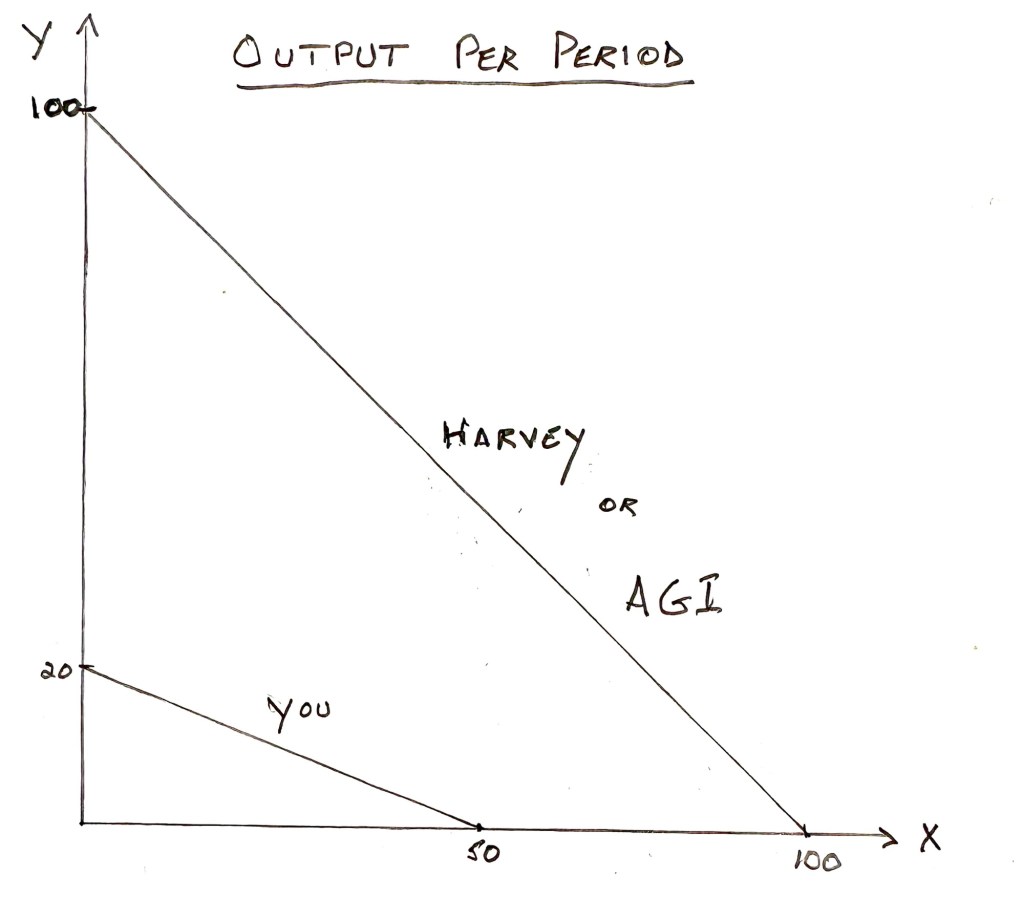
If you’re unwilling to slog through a simple numerical example, skip this section and the graph below. The graph was produced the old fashioned way: by a human being with a pencil, paper, ruler, and smart phone camera.

Here goes: Harvey can produce up to 100 units of X per period or 100 units of Y, or some linear combination of the two. Harvey’s opportunity costs are constant along this tradeoff between X and Y because it’s a straight line. It costs him one unit of Y output to produce every additional unit of X, and vice versa.

You, on the other hand, cannot produce X or Y as well as Harvey in an absolute sense. At most, you can produce up to 50 units of X per period, 20 units of Y, or some combination of the two along your own constant cost (straight line) tradeoff. You sacrifice 5/2 = 2.5 units of X to produce each unit of Y, so Harvey has the lower opportunity cost and a comparative advantage for Y. But it only costs you 2/5 = 0.4 units of Y to produce each additional unit of X, so you have a comparative advantage over Harvey in X production.

Reciprocal Advantages

In the end, you and Harvey specialize in the respective areas for which each has their lowest relative opportunity cost and a comparative advantage. If he has a comparative advantage in one area of production, and unless your respective tradeoffs have identical slopes (unlikely), the reciprocal nature of opportunity costs dictates that you have a comparative advantage in the other area of production.

Obviously, Harvey’s formidable absolute advantage over you in everything doesn’t impinge on these choices. In the real world, of course, comparative advantages play out across many dimensions of output, but the principle is the same. And once we specialize, we can trade with one another to mutual advantage.

No Such Thing As a Free AGI Robot

That brings us back to AGI and AGI robots. Like Harvey, they might well have an absolute advantage in every area of specialization, or they can learn quickly to achieve such an advantage, but that doesn’t mean they should do everything!

Just as in times preceding earlier technological breakthroughs, we cannot even imagine the types of jobs that will dominate the human and AGI work forces in the future. We already see complementarity between humans and AGI in many applications. AGI makes those workers much more productive, which leads to higher wages.

However, substitution of AGIs for human labor is a dominant theme of the many AGI “harm” narratives. In fact, substitution is already a reality in many occupations, like coding, and substitution is likely to broaden and intensify as the marriage of AGI and robotics gains speed. But that will occur only in industries for which the relative opportunity costs of AGIs, including all of the ancillary resources needed to produce them, are favorable. Among other things, AGI will require a gigantic expansion in energy production and infrastructure, which necessitates a massive exploitation of resources. Relative opportunity costs in the use of these resources will not always favor the dominance of AGIs in production. Like Harvey, AGIs and their ancillary resources cannot do everything because they cannot have comparative advantages without reciprocal comparative disadvantages.

Super-Abundance vs. Scarcity

Some might insist that AGIs will lead to such great prosperity that humans will no longer need to work. All of our material wants will be met in a new age of super-abundance. Despite the foregoing, that might suggest to some that AGIs will do everything! But here I make another claim: our future demands on resources will not be satisfied by whatever abundance AGIs make possible. We will still want to do more, whether we choose to construct fusion reactors, megastructures in space (like Dyson spheres or ring worlds), terraform Mars, undertake interstellar travel, perfect asteroid defense, battle disease, extend longevity, or improve our lives in ways now imagined or unimagined.

As a result, scarcity will remain a major force. To that extent, resources will have competing uses, they will face opportunity costs, and they will have comparative advantages vis a vis alternative uses to which they can be put. Scarcity is a reality that governs opportunity costs, and that means humans will always have roles to play in production.

Concluding Remarks

I wrote about human comparative advantages once before, about seven years ago. I think I was groping along the right path. The only other article I’ve seen to explicitly mention a comparative advantage of human labor vs. AGIs in the correct context is by Andrew Mayne in the most recent issue of Reason Magazine. It’s almost a passing reference, but it deserves more because it is foundational.

Harvey Specter shouldn’t occupy his scarce time performing tasks that compromise his ability to deliver his most rewarding services. Likewise, before long it will become apparent that highly productive AGI assets, and the resources required to build and operate them, should not be tied up in activities that humans can perform at lesser sacrifice. That’s a long way of saying that humans will still have productive roles to play, even when AGI achieves an absolute advantage in everything. Some of the roles played by humans will be complimentary to AGIs in production, but human labor will also be valuable as a substitute for AGI assets in other applications. As long as AGI assets have any comparative advantages, humans will have reciprocal comparative advantages as well.

Missouri Prop B: the Unintended Consequences of Wishful Thinking

04 Sunday Nov 2018

Posted by Nuetzel in Labor Markets, Living Wage, Minimum Wage, Uncategorized

≈ Leave a comment

Tags

Anti-Poverty Programs, Automation, David Macpherson, Disparate impact, Fringe Benefits, Living Wage, Marginal Productivity, Minimum Wage, Missouri Proposition B, The Show Me Institute, Unskilled Labor, William Evan

Proposition B sounds really good to many Missouri voters: all we have to do to help low-wage workers is declare that they must be paid a higher wage. That’s the pitch, of course. But voters should hear the cruel truth about the unintended consequences of this well-intentioned and ill-considered proposition on the ballot this week:

  1. Businesses are likely to increase prices to compensate for a higher mandated wage, which hurts all consumers, but especially the poor.
  2. Some low-skilled job losses or lost hours are assured, and they will hit the very least-skilled the hardest. No matter the legal minimum, the real minimum wage is always zero.
  3. Such job losses have long-term consequences: lost job experience that the least-skilled desperately need to get ahead.
  4. The harms will have a disparate impact on minorities.
  5. Large employers can substitute capital for low-skilled labor: automated kiosks to take orders and increasingly sophisticated robots to perform tasks. Again, the real minimum wage is always zero. As I’ve said before on this blog, automate no job before its time. But that’s what Prop B will encourage.
  6. Employers can make other compensatory changes. That includes reduced fringe benefits and break times, increased production quotas, and less desirable shifts for minimum wage workers.
  7. A large share of the presumed beneficiaries of a higher minimum wage are not impoverished. Many are teenagers or young adults living with their parents.
  8. All of the preceding points argue that an increase in the minimum wage is not an effective method of targeting poverty reduction. In fact, the harm it inflicts is targeted at the most needy. 
  9. Small employers have less flexibility than large employers, and Prop B would place them at a competitive disadvantage. To that extent, a higher wage floor is most damaging to “mom & pop”, locally-owned businesses, and their employees. Again, the real minimum wage is always zero.

At least 24 earlier posts appear on this blog covering the topic of minimum wages. You can see most of them here. The points above are explored in more detail in those posts.

William Evan and David MacPherson of the Show-Me Institute have estimated the magnitude of the harms that are likely to result if Prop B is approved by voters on November 6, and they are significant. The voters of Missouri should not be seeking ways to make the state’s business environment less competitive.

Voters should keep in mind that wages in an unfettered market reflect the realities of labor demand and labor supply. Wages and other forms of compensation reflect the actual quantity, quality and productivity of available labor supplies. And for unskilled labor, which is often supplied by those who lack experience, a wage that matches their marginal productivity is one that provides that valuable experience. The last thing they need is for tasks requiring little skill to be performed by more experienced employees, or by machines. We cannot wish away these realities, and we cannot declare them suspended by law. Such efforts will have winners and losers, of course, though the former might not ever recognize the ephemeral nature of their gains. And as long as there is freedom of private decision-making, the consequences of such legal efforts will cause harm to those least able to withstand it.

BS Bernie Blames Bezos

12 Wednesday Sep 2018

Posted by Nuetzel in Labor Markets, Living Wage, Price Mechanism, Welfare State

≈ Leave a comment

Tags

Amazon, Bernie Sanders, Freedom of Contract, Jeff Bezos, Living Wage, Ro Khanna, Social Safety Net, Stop BEZOS Act, Welfare State

Bernie Sanders keeps probing for ways to create a backdoor minimum income, and he’s eager to loot successful job creators and their customers in the process. Last month I wrote about the folly of his proposed legislation that would offer federal job guarantees to all. A new Sanders bill, introduced jointly with Rep. Ro Khanna (D – CA), is an equally bad idea called the Stop BEZOS Act, or the “Stop Bad Employers by Zeroing Out Subsidies Act”. It’s pretty obvious that the selection of the acronym preceded the naming of the bill. Imagine the fun his Senate staffers had with that! The logical flaws embedded in the title of the act are bad enough. The effort to garner attention by using the title to smear the name of a famous technology entrepreneur is sickening.

Jeff Bezos, of course, is the founder and CEO of Amazon, the online retailer, as well as the owner of the Washington Post. Amazon has been rewarded by consumers for its excellent service and aggressive pricing, and it is now valued at about $1 trillion. That makes Bezos a very wealthy man, and it is no coincidence that Sanders has chosen to make an example of him in an effort to inflame envy and classist passions.

While some details of the bill remain sketchy, firms with more than 500 workers would face a 100% tax on every dollar of federal benefits received by those employees. But the tax would apply only to “low-wage” employees, however that is defined, and not simply any employee receiving federal benefits. If the bill became law (and it won’t any time soon), it would require a costly federal administrative apparatus to coordinate between several agencies, including the IRS. Beyond the tax itself, the compliance costs for firms won’t be cheap, and it will create terrible incentives: if you own a business, you would have a strong incentive to avoid hiring workers with little experience or weak skills, or anyone you might deem likely to be a recipient of federal aid. If you have 499 employees, you’ll probably think hard about how to execute future growth plans. Nothing could do more to improve the return to investment in automation.

Is Amazon really a “bad” employer? That’s what the title of the Sanders bill says. In fact, the company has been accused of harsh labor practices in its fulfillment centers. Life for corporate managers is said to be no picnic, and labor turnover at Amazon is high. Nonetheless, the wages it pays attract plenty of applicants. Unskilled labor does not command a high wage, and that is no fault of an employer willing to provide them with work and experience. Yet the bill would punish those employers, as well as employers having part-time workers drawing federal aid.

An absence of punishment can hardly be described as a “subsidy”, as the bill’s title suggests. But that is exactly how leftists think, at least when they do the punishing. In this respect, the bill’s title is an assault on logic and a misuse of language. It would also represent a violation of constitutional principles like property rights and freedom of contract.

The idea of taxing employers to recoup any public aid received by their workers is intended to affect a de facto “living wage”. However, one benefit of an independent social safety net, as opposed to a living wage tied to that net, is that the former largely preserves the operation of labor markets, despite creating some nasty labor-supply incentives. Wage rates that approximate the value of worker productivity allow efficient matching of jobs with workers having the requisite skills, even if the skills are relatively low-grade. Those wages also minimize distortions in the economics of production within firms and across different industries. Furthermore, prices faced by buyers should reflect the real resource costs associated with demands for various goods. They should not be inflated by political decisions about the level of federal welfare benefits. Quite simply, preserving labor market efficiency enhances the ability of the economy to allocate resources to the uses for which they are most highly-valued.

There are independent questions about whether the structure and level of benefits provided by the welfare state are appropriate. Those are matters of legitimate policy debate, and those benefits must be funded by taxpayers, but they should be funded in the least distortionary way possible. Bernie Sanders imagines that the burden of those taxes can simply be imposed on large employers with no further consequences, but he is badly mistaken. Consumers will shoulder a significant part of that burden under his latest scheme. And, of course, Sanders’ beef with Bezos is a cynical political ploy. It amounts to cheap scapegoating intended to promote another one of Sanders’ bad policy ideas.

Right-to-Work Promotes Employment, Wage Growth

06 Monday Aug 2018

Posted by Nuetzel in Labor Markets, Right to Work

≈ Leave a comment

Tags

Bryan Caplan, Don Boudreaux, Economic Policy Institute, Gallup, James Sherk, Jeffrey Eisenach, Mark Mix, Missouri Right to Work, Proposition A, Right to Work, Union Density, Unions, Wages

The economic evidence is quite clear that state right-to-work (RtW) laws do not reduce wages, though a few seem desperate to convince us otherwise. In fact, RtW has proven to be an unambiguous economic tonic for states that have enacted such laws (though perhaps not for union lobbyists). Note that this has nothing to do with comparisons of nominal wage levels in RtW vs. non-RtW states, as organizations like the left-wing Economic Policy Institute (EPI) are wont to make. Adjusting for the cost of living often shows a different result. Either way, the recency of RTW laws in many states means that those differences tend to be legacy effects and are not useful as a gauge of the incremental impact of RtW laws.

It’s no coincidence that RtW laws have gained favor as a mechanism for encouraging economic growth in historically low-wage states. The efforts have been largely successful. Jeffrey Eisenach reported the following findings in 2015:

  • “RTW laws directly affect economic performance through their impact on business location decisions, especially in heavily unionized industries such as manufacturing. Other things being equal, businesses are more likely to locate in states with RTW laws. There is also evidence that RTW laws have a direct, positive effect on employment, output, and personal income.
  • RTW laws do not lead to lower average wages in either unionized or non-unionized industries. There is some evidence that the long-run effect of RTW laws is to raise wage rates as a result of increased productivity.
  • RTW laws also affect economic performance indirectly through lower rates of union density. The weight of the evidence indicates that lower union density is associated with higher levels of employment, increased investment and R&D spending, and increased innovation.”

Mark Mix reports similar evidence, including more rapid employment growth and larger wage gains in RtW states. And James Sherk addresses some of the myths surrounding RtW, including the misleading narrative that RtW reduces wages and that RtW is unpopular among the American public. Indeed, Sherk quotes a Gallup poll finding that Americans support right-to-work laws by more than a 3 to 1 margin, though it’s not clear how well the average American understands the issue.

A disturbing aspect of the opposition to RtW is an effort to disparage the business community by characterizing private enterprise as exploitative. I leave you with some wisdom from Bran Caplan on that point (HT: Don Boudreaux):

“Businesses produce and deliver virtually all of the wonderful, affordable products that we enjoy. Contrary to millennia of economic illiterates, businesses rarely do so by ‘exploiting’ their workers. Instead, businesses provide gentle but much-needed leadership. Left to our own economic devices, most of us are virtually useless; we don’t know how to produce much, and we don’t know how to find customers.  Businesspeople solve these problems: They recruit workers, organize them to vastly raise their productivity, then put these products in the hands of customers all over the world. Yes, they’re largely in it for the money; but – unlike every government on Earth – business rarely puts a gun to your head. Businesses assemble teams of volunteers to meet the needs of willing consumers – and succeed wildly.” (emphasis Caplan’s)

Right-To-Work Prop A: Freedom of Speech, Association and Contract

30 Monday Jul 2018

Posted by Nuetzel in Labor Markets, Right to Work, Unions

≈ Leave a comment

Tags

Andrew Wilson, Daniel J. Mitchell, Fifth Amendment, First Amendment, Fourteenth Amendment, Freedom of Association, Freedom of Contract, Freedom of Speech, Missouri 2018 Proposition A, Monopsony, Political Action Committees, Right to Work, Show-Me Institute, Steve Spillman, Union Activism, Union Dues

I’d be angry if my employer forced me to contribute to the company’s Political Action Committee (PAC), and that view is shared by many of my colleagues. It would be illegal, of course, at least as a condition of employment. I love my job, but I give nothing to the PAC because I do not trust it to properly represent my political preferences. That goes for political contributions and lobbying activity that might benefit the company and, by extension, my own economic interests. I simply do not believe the company will refrain from corporatist practices, and I do not under any circumstances want my contributions lavished on politicians with whom I have policy differences.

In my home state of Missouri, unions and their political allies insist that union dues payments should be a condition of employment in unionized workplaces. Like PACs, unions are major political contributors, and I’d be surprised if there weren’t a large number of union members who object to the use of their dues for political contributions and activism. Of course, most of that activism is broadly anti-capitalist. This, quite simply, constitutes compelled speech and is a violation of employees’ First Amendment free-speech rights. Forced membership is a violation of the worker’s freedom of association under the Fourteenth Amendment.

Unions are also presumed to represent the interests of workers in negotiating with management, but not everyone wants that representation, especially given the corruption that has often plagued unions over the years and the poor economic performance of unionized industries in general. That last statement applies to public employee unions no less than private sector unions. Prohibiting non-union workers from employment at a unionized firm violates their freedom of contract under the Fifth and Fourteenth Amendments. I agree, however, that an employee refusing to join a union should not automatically be entitled to the wages and benefits negotiated by the union in collective bargaining with the employer. That should be strictly between the non-union employee and the firm.

Missouri Proposition A, which is on the state’s August 7 ballot, is a referendum on a right-to-work (RtW) law already passed by the general assembly and signed by the governor last year. I’ve discussed reasons why some libertarians have expressed disagreement with this kind of legislation—primarily because it denies an employer the right to hire workers exclusively from a unionized pool of labor. As Daniel J. Mitchell has noted, right-to-work laws are a second-best, compensatory solution to other forms of government intervention in labor markets that essentially grant unions monopsony privileges. Furthermore, giving primacy to an employer’s right to deal exclusively with a union ignores the rights of non-union workers and the rights of union members who do not wish to contribute to a union’s political activities. Trampling on the latter stands in contrast to the established protection of my rights against coerced contributions to my employer’s PAC.

The standard economic argument in favor of RtW laws hinges on the favorability of a state’s business environment and its competitiveness with other states. Andrew Wilson explains how and why Prop A will create jobs in Missouri. He notes that over the ten years ending in 2014:

“…average job growth in the 22 states with RTW laws in place for most or all of that time was more than twice as fast (at 9.1 percent) as in the 28 forced-union states. The RTW states also had considerably faster growth in personal income (at 54.7 percent compared to 43.5 percent) and a much stronger economic growth (50.7 percent compared to 38.0 percent).”

Wilson also remarks on a historical phenomenon which pro-union forces refuse to acknowledge: unions have undermined the competitive position of the industries upon which their members rely. It’s a classic principal-agent problem. Workers appoint an agent for representation, but the agent acts independently to maximize its own gains, often at the expense of the workers. RtW applies discipline to the process, reinforcing the union’s incentive to put members’ interests above of its own. After all, nearly all employers have to compete for workers, and private employers have to compete in product markets. Union workers have been exempt from competition only to the extent that their wage demands have not undermined the business’ competitive position, but they frequently have.

The real rub, according to RtW opponents, is that business interests will simply “crush” unions under RtW and impose lower wages and poor work conditions on workers. But as I alluded above, there are employers that prefer to work with a union for a variety of reasons. Second, suppose that new employees of a unionized firm refuse to join the union, or that some union members opt out. That’s a pretty strong indication that union membership is an unattractive proposition. Whose fault is that?

I favor Proposition A because workers should not be forced to accept representation by any third party, firms should not be forced to hire exclusively from those willing to do so, and because workers should not be required to contribute to union political initiatives. But as Steve Spellman writes, unions could do much to enhance their value to both workers and firms, attracting membership and gaining advantages in bargaining with employers:

“If unions focused on providing helpful, outsourced H.R. functions to companies, such as worker recruitment, drug screening and taking care of all that labor-law-compliance paperwork, it would sure change their reputation. As would standing up for its members, while also taking necessary (and fair) disciplinary actions instead of covering up for the occasional bad apple (even if that is only one worker out of 1,000). … If we can dream a little here, unions could also be best positioned to stand up for workers who are discriminated against, for whatever reason, rather than waiting on the law to catch up with our evolving society.”

Bernie’s Backdoor Minimum Wage Hike

30 Monday Apr 2018

Posted by Nuetzel in Labor Markets, Minimum Wage, Welfare State

≈ Leave a comment

Tags

Apprentice Wages, Bard College, Bernie Sanders, Bob Bryan, Cyclical Unemployement, David Byrge, Frictional Unemployment, Iowahawk, Levy Economics Institute, Matt Welch, Minimum Wage, On-The-Job Training, Scott Shackford, Structural Unemployment, The Business Insider, Works Progress Administration

Bernie Sanders’ latest jobs plan is a political fantasy, but also a fantasy insofar as he imagines such a program could improve job market outcomes and the U.S. economy. Sanders wants the government to guarantee a job to anyone who is unemployed and pay them a wage of $15 an hour. But what job roles will be identified and by whom? Will the unemployed be required to accept these jobs or else lose other benefits? Which unemployed workers will come forward voluntarily for “workfare”? What will qualify them for particular roles? How many public-sector workers will be diverted from their existing responsibilities to administer the program and manage these new workers? How much will the program cost? How will the above-market wages and administration of the program be funded? These questions deal only with the first-order mechanics of the Sanders proposal. What will be the second-order effects on the private economy?

Scott Shackford delves into these and other gory consequences that are likely under the Sanders plan, most of which should be obvious to anyone with a modicum of economic literacy. Apparently, that does not include the so-called economists at the Levy Economics Institute at Bard College, who produced a “study” on guarantees of public sector jobs that manages to prove their ignorance of basic economic principles.

The headline for this proposal is about jobs, but the real motive is to impose wage controls through the backdoor. The plan is announced at a time of full employment (now 4.1%), traditionally defined as an unemployment rate of roughly 4%. That level accounts for “frictional unemployment”, which recognizes that job transitions and the normal market process of matching worker skills with jobs are not instantaneous. It’s true that certain segments of the labor force typically experience higher than average unemployment. So Perhaps i should give Bernie the benefit of the doubt by stipulating that the program is geared toward addressing cyclical and structural unemployment, or that it’s intended to benefit minorities. But if the goal is to keep everyone working all the time, it is impossible in view of the informational frictions, skill mismatches, and mobility issues that characterize the labor market. Workers would have difficulty conducting a job search were they employed in Sanders workfare program, and that sacrifice would be particularly costly for skilled workers seeking employment at wages greater than $15/hour.

Again, all “guaranteed” jobs under the Sanders plan are to pay a wage of at least $15/hour. Low-skilled workers whose productivity is not consistent with such a wage can thumb their noses at private employers. Either pay your low-skilled workers $15 or lose them. This is Sanders’ way of implementing a de facto federal minimum wage without actually requiring employers to pay that rate by diktat. Of course, under the plan, the taxpayer is on the hook for the excess of wage payments over and above the value of these workers’ productive contributions. The bulk of those workers lack the skills and job experience to contribute value commensurate with that wage rate, and sometimes they lack even the temperament and comportment necessary to make a sufficient contribution to output, or to keep steady work absent the gift of a wage from government.

But that’s not the worst of it: Sanders’ program is cloaked in terms suggesting that it would have countercyclical effects: government hiring would increase in association with increases in the unemployment rate, and vice versa, or so we are told. But “vice versa” is a stretch: government programs have a tendency to be self-perpetuating. And this program creates instability by allowing government to compete for workers on a distorted basis. The private sector will lose workers as the government gains workers. The tax bill and its burden on the private sector will lead to business failures, still fewer private workers, and still more public-sector workfare. And as the government displaces private activity, good luck to consumers finding the plentiful goods and services to which they are accustomed. The Sanders program is a prescription for economic and social decline.

Public sector competition for workers under Sander’s plan would be distorted because work would be assigned by special interests, not by market demand. Bob Bryan of The Business Insider has the following details:

“Sanders’ plan would create 12 districts within the US that would approve jobs plans from municipalities, states, and American Indian tribal governments and then pass those plans along to the Labor Department for final approval.”

Thus, a new administrative layer of government, 12 districts, would be created wielding the authority to winnow the pool of projects for a new category of spending. In the parlance of public budgeting, this spending would be called an “entitlement” because the spending would be programmatic rather than discretionary. State and local governments would create wish lists, and their wishes would then be constrained by the decisions of district authorities and the Labor Department. Those decisions, however, would very likely be responsive to special interests. Like most administrative decisions, the spending allocations would be guided by politics, not economics.

Shackford quotes the Levy Institute:

“A local artist collective employs painters, actors, musicians, and stage hands to run year-round productions for the community. They organize school outreach programs, run summer camps, and offer free art, music, and literacy classes for disadvantaged/special needs youths. They collaborate with local schools in offering art enrichment programs.”

Those aren’t Sanders words, but he might well entertain such notions. Should we all just agree that the government ought to tax us more heavily and spend the proceeds on supporting local, “unemployed” artists (I use quotes because many artists are not fully employed at their art for lack of demand, and they often work at other jobs from which they would quickly separate given a flow of government funds for their art). Usually those who insist on such things belong to the very interests who would benefit from the programs. One can argue that the “external benefits” of the arts justify public expenditure, but there is no objective measure of those benefits, and those who benefit directly will always want more. Therefore, the Sanders program, like so many other public initiatives, would violate standards of governmental fiduciary duty to taxpayers.

What about construction and repair of public infrastructure? Those projects should be chosen and initiated on their merits and on taxpayers’ willingness to fund them, not because there are people unemployed at the moment. What’s more, construction and maintenance of infrastructure requires various levels of skills that might not be readily available in a pool of unemployed workers.

Regardless of the specifics, the jobs program promoted by Sanders substitutes a wholly unrelated goal, jobs, for the underlying rationale of particular projects. As such, Sanders’ proposal would provide opportunities for special interests to collect rents without a programatic justification for the expense to taxpayers. Shackford says:

“… the examples in the Levy study seem like descriptions of programs that certain types of local government-connected people with very particular ideas would like to see the government doing. Their plan leans heavily on the assumption that all these unemployed or underemployed people would happily do the grunt work that aligns with left-leaning environmental and public policy project goals. The report openly uses the Works Progress Administration of the New Deal as a model to support it. …

But how does one determine what a community needs while ignoring market responses? Why should taxpayers fund community plays if they have no interest in actually sitting through them? This report makes it very clear that the task falls to local public institutions and job centers, not market demands. That necessarily means it will be driven, much like this report is, by the interests of the people who are in charge of the programs or have the most influence over the programs. That these programs could end up as a corrupt breeding ground for government cronyism and nepotism in who gets assigned for which jobs is utterly absent from the study.“

Here is more from Bryan:

“The plan would also utilize job training centers to train and connect workers with jobs on the new projects.”

This is either another new agency or a demand on private job training organizations. Presumably the training would be free to the trainee, in addition to the $15/hour paid during the training period. I would have fewer objections to an explicit job training program than to the sprawling job-making and wage-paying authority called for in Sanders’ plan. Unfortunately, the absence of apprentice wage levels in the U.S. often eliminates the best training of all: on-the-job training.

Shackford wonders whether workers hired under the program could ever be fired for cause:

“I mean, given how hard it is to fire bad teachers or dangerous cops, it’s worth wondering whether people who get these jobs will continue to get paid if they fail to show up for their job trimming the hedges of their community skate park or surveying people about their food insecurities. (According to the Post, Sanders’ plan calls for something sinisterly called the Division of Progress Investigation to handle discipline.)“

The program could employ as many as 15 million people if the Levy Institute study can be taken as a guide. That would represent a huge increase in government employment. Presumably, the burden would be spread across federal, state and local governments, all of which are facing degrees of fiscal crisis.

Bernie Sanders’ jobs program is ill-defined, but we know enough about it to safely conclude that it is economically preposterous. It will compete with job search activity that is necessary to the function of the labor market; lure low-skill workers away from their current employers, or indeed from their highest valued uses; require massive public borrowing and ultimately higher taxes; compromise other functions of government by diluting fundamental program goals and diverting human and other resources; place further strain on government budgets at all levels; lead to business failures; and lead to a permanently larger role for government in the economy. Governments, of course, do not operate under market discipline, so the program would degrade the overall productive potential of the U.S. economy. 

As David Byrge, aka Iowahawk, says about Sanders:

“Who better to get America back to work than a guy who was actually fired from a Vermont hippie commune for being too lazy.”

For a fairly thorough compendium of Sanders’ policy proposals over the years, here is Matt Welch on “Bernie’s Bad Ideas“.

Taxes and the Labor “Discount”: What Could Go Wrong?

29 Wednesday Nov 2017

Posted by Nuetzel in Labor Markets

≈ 2 Comments

Tags

BEA, Bureau of Economic Analysis, CBO, Congressional Budget Office, Federal Discount, Federal Wages, Labor Discount, Labor Supply, Pass-Through Income, Private Sector Wages, Procyclical Effect, The CATO Institute, Tyler Cowan

A supposed labor market distortion that I’d never considered is that government receives a “discount” on labor services because public employees’ income tax liability is returned to the very government coffers from which they are paid. Tyler Cowen regards this as a “wacky” idea, but not easy to refute. Suppose the income tax rate is 20%. If the government pays a worker $10, then $2 is returned to that same government via the tax. The net cost to government is just $8. But a tax “discount” on cost is not unique to government, though the form it takes may differ.

Who Gets a Labor “Discount”?

Does it cost a private employer more than government to pay a worker $10? It depends on the situation. Maybe more, maybe less. If the private employer pays the same 20% tax rate on its profits, the wage payment creates a tax deduction worth $2 in avoided tax. The net cost is $8, so there is no difference. However, a firm must be profitable to get that deduction, so unprofitable startups, strugglers, and nonprofits do not get the same wage “discount” as government. Of course, losses can be carried forward to reduce taxes if the firm ever becomes profitable, and non-profits have tax advantages of their own.

The value of the tax deduction (the private “discount”) depends on the tax rate paid by the firm. A profitable C corporation with a marginal tax rate of 35% (under current law) gets a steeper discount than a small businessperson in the 28% tax bracket. To some extent, a steeper discount subsidizes the cost of hiring employees who are highly compensated. A highly successful pass-through entity like a sole proprietorship, partnership or S corporation can face the highest individual marginal rates, so the “discount” for such a firm could be the largest relative to wages.

Economic Distortions

There are a couple of potential distortions involved here: one is the standard wedge driven between the value of workers’ marginal product and the after-tax wage they receive. This discourages labor supply. There is a second distortion to the extent that the “discount” gives government and profitable firms an artificial competitive advantage of over unprofitable buyers of labor services. Furthermore, the loss of the labor discount for firms falling into unprofitable positions imparts an undesirable procyclical element into the tax system, potentially aggravating episodes of under-production and high unemployment.

The government’s labor “discount” may reduce the available supply of labor to the private sector. Government does not operate under the profit motive, and unlike private firms, it need not concern itself with efficiency standards for survival. Government production does not face a market test, so it is difficult to measure worker productivity, which is the key to the efficient pricing and use of labor in the private sector. The penalty to government for paying an above-market wage is zero.

The same “discount” argument can be made for government contracts with private firms. The profits earned on those contracts are taxed by the government payer, so the total cost to the government is essentially discounted. Contracts between private firms are on the same footing if the payer is profitable, since the paying firm can deduct its costs from taxable profits. A payer that is not profitable is at a disadvantage. The government “discount” might not be the primary reason to suspect that government contracting is subject to distortion and inflated values, but it is a reason nevertheless. One could be forgiven for thinking that the “discount” creates additional leeway for graft!

Does the government labor “discount” really impinge on the federal agency budget process? I doubt that anyone having a critical role in the Congressional or executive budget process thinks much about it, to say nothing of agency hiring and compensation managers. Yet spending levels may “bake-in” a certain amount of over-payment of wages or fat in government contracts. In any case, historically, federal spending has not been tightly constrained by the flow of tax revenue.

Federal Wages vs. Private Wages

There is empirical evidence on government vs. private wages. These data are of interest in their own right, but since so much of the private sector receives the same tax “discount” as government, it’s not clear that it should cause much if any differential in pay. The Congressional Budget Office (CBO) compared differences in compensation from 2005-2010 and again from 2011-2015 and found that federal wages and benefits exceeded private sector wages and benefits over both periods. The gap decreased with increases in education. For workers with a bachelor’s degree or less (71% of the CBO’s latest federal workforce sample), the gap was substantial. The difference was just a few thousand dollars for those with a master’s degree. The professional degree/Ph.D. category stood in fairly sharp contrast to the others, with private workers having a fairly large advantage. It is possible that the most highly-educated category, being the most scarce and probably the most specialized, has unique market characteristics. It should also be noted that the sample of federal workers was about 4 years older, on average, than the private sector sample, which might have skewed the results.

The CATO Institute used data from the U.S. Bureau of Economic Analysis (BEA) and found that federal civilian workers earned 80% more than private sector workers in 2016. The CATO report cites several other studies, including the CBO’s, which consistently find that federal workers earn more. This could be partly attributable to the government labor discount, bureaucratic laxity, the heavy unionization of the federal work force, and even the geographical distribution of federal workers.

Discount My Taxes, Please

The worst aspect of the tax “discount” on federal and many private-sector wage payments is the taxation itself. However, the fact that some firms and organizations don’t qualify for the discount represents a significant distortion. To some extent, labor input is discouraged for unprofitable startup firms, firms struggling for survival, and of course the non-profit sector. These organizations are at a distinct disadvantage in terms of resource allocation relative to those who qualify for the “discount”.

Nevertheless, this unevenly applied discount may be an unfortunate mathematical implication of a public sector with income-taxing and spending powers. The discount on wages and contract payments provides additional margin along which government can be wasteful. A partial solution is to maintain whatever firewalls exist between taxing and spending authorities, but that won’t unwind past distortions. Of course, the best solution is to shrink government: reduce taxes and reduce the federal role in everything from infrastructure to public health, dismantle the administrative state, and reduce military spending. I didn’t really need another reason to warn of the dangers of big government, but count this one as duly noted!

Mr. Musk Often Goes To Washington

31 Monday Jul 2017

Posted by Nuetzel in Automation, Labor Markets, Technology

≈ 1 Comment

Tags

Absolute Advantage, Comparative advantage, DeepMind, Elon Musk, Eric Schmidt, Facebook, Gigafactory, Google, Mark Zuckerberg, OpenAI, rent seeking, Ronald Bailey, SpaceX, Tesla

Elon Musk says we should be very scared of artificial intelligence (AI). He believes it poses an “existential risk” to humanity and  calls for “proactive regulation” of AI to limit its destructive potential. His argument encompasses “killer robots”: “A.I. & The Art of Machine War” is a good read and is consistent with Musk’s message. Military applications already involve autonomous machine decisions to terminate human life, but the Pentagon is weighing whether decisions to kill should be made only by humans. Musk also focuses on more subtle threats from machine intelligence: It could be used to disrupt power and communication systems, to manipulate human opinion in dangerous ways, and even to sow panic via cascades of “fake robot news”, leading to a breakdown in civil order. Musk has also expressed a fear that AI could have disastrous consequences in commercial applications with runaway competition for resources. He sounds like a businessmen who really dislikes competition! After all, market competition is self-regulating and self-limiting. The most “destructive” effects occur only when competitors come crying to the state for relief!

Several prominent tech leaders and AI experts have disputed Musk’s pessimistic view of AI, including Mark Zuckerberg of Facebook and Eric Schmidt, chairman of Google’s parent company, Alphabet, Inc. Schmidt says:

“My question to you is: don’t you think the humans would notice this, and start turning off the computers? We’d have a race between humans turning off computers, and the AI relocating itself to other computers, in this mad race to the last computer, and we can’t turn it off, and that’s a movie. It’s a movie. The state of the earth currently does not support any of these scenarios.“

Along those lines, Google’s AI lab known as “DeepMind” has developed an AI off-switch, otherwise known as the “big red button“. Obviously, this is based on human supervision of AI processes and on ensuring the interruptibility of AI processes.

Another obvious point is that AI, ideally, would operate under an explicit objective function(s). This is the machine’s “reward system”, as it were. Could that reward system always be linked to human intent? To a highly likely non-negative human assessment of outcomes? Improved well-being? That’s not straightforward in a world of uncertainty, but it is at least clear that a relatively high probability of harm to humans should impose a large negative effect on any intelligent machine’s objective function.

Those kinds of steps can be regarded as regulatory recommendations, which is what Musk has advocated. Musk has outlined a role for regulators as gatekeepers who would review and ensure the safety of any new AI application. Ronald Bailey reveals the big problem with this approach:

“This may sound reasonable. But Musk is, perhaps unknowingly, recommending that AI researchers be saddled with the precautionary principle. According to one definition, that’s ‘the precept that an action should not be taken if the consequences are uncertain and potentially dangerous.’ Or as I have summarized it: ‘Never do anything for the first time.’“

Regulation is the enemy of innovation, and there are many ways in which current and future AI applications can improve human welfare. Musk knows this. He is the consummate innovator and big thinker, but he is also skilled at leveraging the power of government to bring his ideas to fruition. All of his major initiatives, from Tesla to SpaceX, to Hyperloop, battery technology and solar roofing material, have gained viability via subsidies.

But another hallmark of crony capitalists is a willingness to use regulation to their advantage. Could proposed regulation be part of a hidden agenda for Musk? For example, what does Musk mean when he says, “There’s only one AI company that worries me” in the context of dangerous AI? His own company(ies)? Or another? One he does not own?

Musk’s startup OpenAI is a non-profit engaged in developing open-source AI technology. Musk and his partners in this venture argue that widespread, free availability of AI code and applications would prevent malicious use of AI. Musk knows that his companies can use AI to good effect as well as anyone. And he also knows that open-source AI can neutralize potential advantages for competitors like Google and Facebook. Perhaps he hopes that his first-mover advantage in many new industries will lead to entrenched market positions just in time for the AI regulatory agenda to stifle competitive innovation within his business space, providing him with ongoing rents. Well played, cronyman!

Any threat that AI will have catastrophic consequences for humanity is way down the road, if ever. In the meantime, there are multiple efforts underway within the machine learning community (which is not large) to prevent or at least mitigate potential dangers from AI. This is taking place independent of any government action, and so it should remain. That will help to maximize the potential for beneficial innovation.

Musk also asserts that robots will someday be able to do “everything better than us”, thus threatening the ability of the private sector to provide income to individuals across a broad range of society. This is not at all realistic. There are many detailed and nuanced tasks to which robots will not be able to attend without human collaboration. Creativity and the “human touch” will always have value and will always compete in input markets. Even if robots can do everything better than humans someday, an absolute advantage is not determinative. Those who use robot-intensive production process will still find it advantageous to use labor, or to trade with those utilizing more labor-intensive production processes. Such are the proven outcomes of the law of comparative advantage.

← Older posts
Follow Sacred Cow Chips on WordPress.com

Recent Posts

  • Immigration and Merit As Fiscal Propositions
  • Tariff “Dividend” From An Indigent State
  • Almost Looks Like the Fed Has a 3% Inflation Target
  • Government Malpractice Breeds Health Care Havoc
  • A Tax On Imports Takes a Toll on Exports

Archives

  • December 2025
  • November 2025
  • October 2025
  • September 2025
  • August 2025
  • July 2025
  • June 2025
  • May 2025
  • April 2025
  • March 2025
  • February 2025
  • January 2025
  • December 2024
  • November 2024
  • October 2024
  • September 2024
  • August 2024
  • July 2024
  • June 2024
  • May 2024
  • April 2024
  • March 2024
  • February 2024
  • January 2024
  • December 2023
  • November 2023
  • August 2023
  • July 2023
  • June 2023
  • May 2023
  • April 2023
  • March 2023
  • February 2023
  • January 2023
  • December 2022
  • November 2022
  • October 2022
  • September 2022
  • August 2022
  • July 2022
  • June 2022
  • May 2022
  • April 2022
  • March 2022
  • February 2022
  • January 2022
  • December 2021
  • November 2021
  • October 2021
  • September 2021
  • August 2021
  • July 2021
  • June 2021
  • May 2021
  • April 2021
  • March 2021
  • February 2021
  • January 2021
  • December 2020
  • November 2020
  • October 2020
  • September 2020
  • August 2020
  • July 2020
  • June 2020
  • May 2020
  • April 2020
  • March 2020
  • February 2020
  • January 2020
  • December 2019
  • November 2019
  • October 2019
  • September 2019
  • August 2019
  • July 2019
  • June 2019
  • May 2019
  • April 2019
  • March 2019
  • February 2019
  • January 2019
  • December 2018
  • November 2018
  • October 2018
  • September 2018
  • August 2018
  • July 2018
  • June 2018
  • May 2018
  • April 2018
  • March 2018
  • February 2018
  • January 2018
  • December 2017
  • November 2017
  • October 2017
  • September 2017
  • August 2017
  • July 2017
  • June 2017
  • May 2017
  • April 2017
  • March 2017
  • February 2017
  • January 2017
  • December 2016
  • November 2016
  • October 2016
  • September 2016
  • August 2016
  • July 2016
  • June 2016
  • May 2016
  • April 2016
  • March 2016
  • February 2016
  • January 2016
  • December 2015
  • November 2015
  • October 2015
  • September 2015
  • August 2015
  • July 2015
  • June 2015
  • May 2015
  • April 2015
  • March 2015
  • February 2015
  • January 2015
  • December 2014
  • November 2014
  • October 2014
  • September 2014
  • August 2014
  • July 2014
  • June 2014
  • May 2014
  • April 2014
  • March 2014

Blogs I Follow

  • Passive Income Kickstart
  • OnlyFinance.net
  • TLC Cholesterol
  • Nintil
  • kendunning.net
  • DCWhispers.com
  • Hoong-Wai in the UK
  • Marginal REVOLUTION
  • Stlouis
  • Watts Up With That?
  • Aussie Nationalist Blog
  • American Elephants
  • The View from Alexandria
  • The Gymnasium
  • A Force for Good
  • Notes On Liberty
  • troymo
  • SUNDAY BLOG Stephanie Sievers
  • Miss Lou Acquiring Lore
  • Your Well Wisher Program
  • Objectivism In Depth
  • RobotEnomics
  • Orderstatistic
  • Paradigm Library
  • Scattered Showers and Quicksand

Blog at WordPress.com.

Passive Income Kickstart

OnlyFinance.net

TLC Cholesterol

Nintil

To estimate, compare, distinguish, discuss, and trace to its principal sources everything

kendunning.net

The Future is Ours to Create

DCWhispers.com

Hoong-Wai in the UK

A Commonwealth immigrant's perspective on the UK's public arena.

Marginal REVOLUTION

Small Steps Toward A Much Better World

Stlouis

Watts Up With That?

The world's most viewed site on global warming and climate change

Aussie Nationalist Blog

Commentary from a Paleoconservative and Nationalist perspective

American Elephants

Defending Life, Liberty and the Pursuit of Happiness

The View from Alexandria

In advanced civilizations the period loosely called Alexandrian is usually associated with flexible morals, perfunctory religion, populist standards and cosmopolitan tastes, feminism, exotic cults, and the rapid turnover of high and low fads---in short, a falling away (which is all that decadence means) from the strictness of traditional rules, embodied in character and inforced from within. -- Jacques Barzun

The Gymnasium

A place for reason, politics, economics, and faith steeped in the classical liberal tradition

A Force for Good

How economics, morality, and markets combine

Notes On Liberty

Spontaneous thoughts on a humble creed

troymo

SUNDAY BLOG Stephanie Sievers

Escaping the everyday life with photographs from my travels

Miss Lou Acquiring Lore

Gallery of Life...

Your Well Wisher Program

Attempt to solve commonly known problems…

Objectivism In Depth

Exploring Ayn Rand's revolutionary philosophy.

RobotEnomics

(A)n (I)ntelligent Future

Orderstatistic

Economics, chess and anything else on my mind.

Paradigm Library

OODA Looping

Scattered Showers and Quicksand

Musings on science, investing, finance, economics, politics, and probably fly fishing.

  • Subscribe Subscribed
    • Sacred Cow Chips
    • Join 128 other subscribers
    • Already have a WordPress.com account? Log in now.
    • Sacred Cow Chips
    • Subscribe Subscribed
    • Sign up
    • Log in
    • Report this content
    • View site in Reader
    • Manage subscriptions
    • Collapse this bar
 

Loading Comments...