• About

Sacred Cow Chips

Sacred Cow Chips

Tag Archives: Brian Albrecht

Some Dimensions Of the AI/Data Center Freakout

25 Thursday Jun 2026

Posted by Nuetzel in Artificial Intelligence, Government Failure

≈ Leave a comment

Tags

AI, AI Alignment, AI Land Use, AI Power Consumption, AI Regulation, Andy Masley, Anthropic, Bernie Sanders, Brian Albrecht, Capital Deepening, Chinese Communist Party, Comparative advantage, Dario Amodei, Data Centers, Dean Ball, Donald Trump, Elon Musk, Fable, Friedrich Hayek, Google, Luddites, Mythos, National Security, NIMBY, OpenAI, Rebecca Lowe, Sam Altman, Sam Altman (OpenAI), Sovereign Wealth Fund, Sundar Pichai, Superabundance, The Fatal Conceit, Timnit Gebru, Water Cooling, xAI
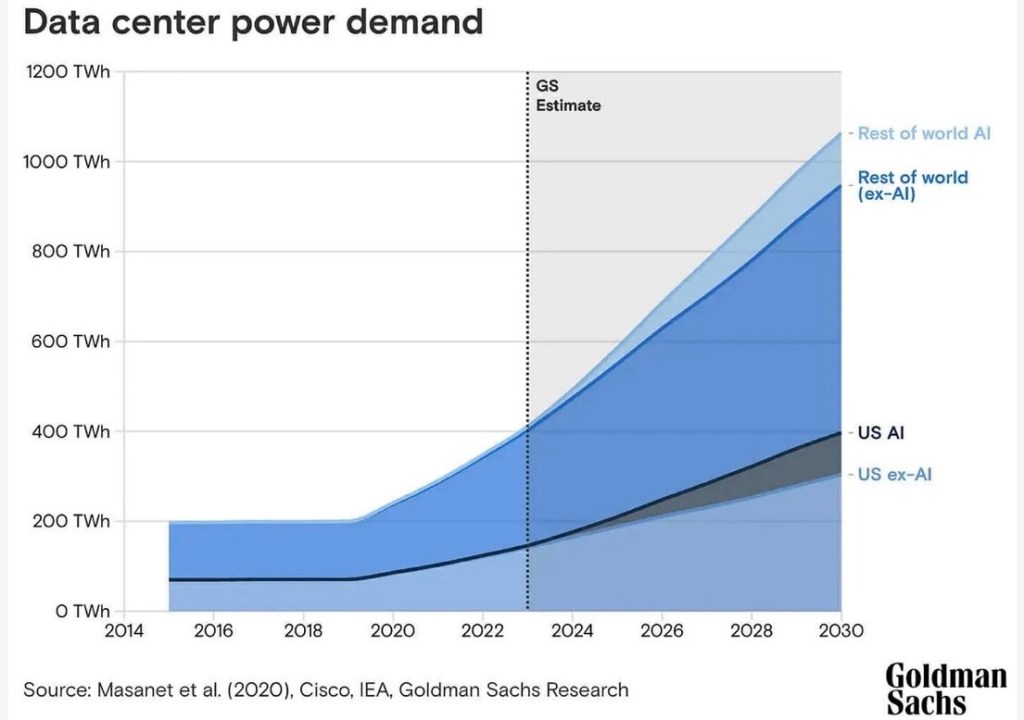
Bad policy ideas are circulating that have been conceived amid hysteria over AI. These are interventionist approaches to the development and deployment of AI models, ranging from direct confiscation of AI capital, taxes on the flow of compute, various forms of regulation, and state and local efforts to forbid the construction of data centers. All of these actions would unnecessarily inhibit achievement of AI’s enormous potential benefits and present unnecessary national security challenges as well.

Land Use and Displacement

Emotionally I’m probably just as NIMBY as the next guy when it comes to developments in my vicinity that might offend my personal aesthetics or intrude on my privacy. But at a more rational level, I object to developments that will inflict external costs on me. I happen to live in a private community that provides some buffer against incursions of those kinds, but I deeply sympathize with anyone who finds their property will soon be next door to a large or obnoxious industrial, commercial or government facility, and I despise the use of eminent domain for almost any purpose.

But let’s step back and consider the case in which an owner of private property receives what they feel is just compensation on the sale of their land to a data center developer. This property might be in your close proximity, but you can’t prevent your neighbor from selling unless it’s by way of a larger political process to revoke his property rights. Of course, you can help organize or join a resistance group in an attempt to stop the development. That’s perfectly reasonable if you fear the prospect of having your property stranded in the middle of a new industrial or commercial development.

Ultimately, such efforts are likely to influence negotiations between communities and developers. In fact, developers of data centers can often be persuaded to work with communities in addressing public concerns, and some developers are eager to do so.

Water and Power Consumption

Aside from land use, potential displacement, and aesthetic issues (including plain-old NIMBYism), other underlying concerns exciting local opposition to data centers have to do with predicted strains on water and power supplies. These are no doubt critical issues in certain localities. However, on the whole these concerns are vastly overblown, as elucidated by Andy Masley at this link. In particular, water use by data centers is on the same order of magnitude as other industrial uses. Contrary to some claims, any water pollution by data centers is usually confined to the construction phase, if at all, and in that respect is very much like any other construction project. And as Masley points out, a data center can generate tax revenue for use in reducing water scarcity.

It should also be noted that data centers house the computational power of the entire internet. As the chart (from Masley) at the top of this post shows, AI represents an incremental need that is still relatively small relative to total data center power use. Incidentally, water cooling rather than air cooling reduces a data center’s power consumption.

Nevertheless, the power consumption of data centers is indeed a matter of critical importance and controversy. Referring again to the chart at the top, it’s evident that data center power usage is growing rapidly. However, developers are increasingly planning to produce their own power off-grid, often colocating with their power sources to minimize transmission costs. This includes locating alongside natural gas basins, installing wind and solar collection facilities nearby, and coming soon, incorporating modular nuclear reactors. The latter would provide base-load, dispatchable, zero-carbon power for data centers. Of course, modular reactors will be costly and might eat into returns from developing data centers, but other power sources are costly as well, and it is the one sure dispatchable, zero-carbon, off-grid solution.

Water and energy supplies for data centers are key to enabling broad contributions of AI to consumer welfare, productivity growth, and national security. Local interests should weigh other benefits that construction of data centers will bring to a community. Construction jobs and permanent data center jobs are obviously important considerations, as well as the aforementioned increases in local tax revenue.

State Regulation and Litigation

Of course, AI controversies are playing out at the national and state levels as well. First, there is the issue of AI regulation. AI legislation in all 50 states attempts to regulate various “threatening” aspects of AI. These bills address topics such as fraud prevention (e.g., deep fakes), chatbot safety, and restrictions on automated AI decisioning (e.g., hiring, insurance coverage and claims adjudication).

There is litigation and potential litigation at the state level related to alleged abuses by Open AI’s ChatGPT. These concern the use of customer data and alleged encouragement of self-harm, among other matters. And the New York legislature has passed a bill calling for a one-year moratorium on AI data center development.

These regulatory and legal efforts at the state and local level raise the prospect of fragmented treatment of AI in different jurisdictions that would be disruptive and costly for both AI companies and users. Federalist principles aside, economic efficiency argues for a more uniform approach to many concerns about AI. But whether it’s at the federal, state, or local level, tight regulatory control of AI risks compromising the healthy competitive development of AI technology and the industry. That’s because politicians and bureaucrats cannot possess the knowledge of evolving competition, scarcity, and market incentives only revealed by free market processes.

Rooting for Regulation

Unfortunately, modern-day Luddites at the national level are calling for a moratorium on AI development. In fact, in 2023, fears of AI misalignment with human interests brought even Elon Musk to call for a six-month “pause” on development. Today, a number of industry insiders call for a “slowdown”, if only other countries go along with it (fat chance!).

Yes, AI is improving… fast, but the most consequential threats have to do with security protocols. Anthropic, in particular, almost begged for government control over its Mythos product, which recently gripped the AI and cybersecurity communities with its advanced ability to identify software vulnerabilities. The Fable version is said to incorporate “guardrails”, but reportedly Fable is vulnerable to “jailbreaks”. In what should not have surprised Anthropic after its own warnings, the federal government imposed export controls, restricting access by foreign nationals. And now, Anthropic has withdrawn availability of the models worldwide..

Be Careful What You Ask For

Perhaps Anthropic got what it deserved, but sadly, the Trump Administration seems to have crossed a threshold from a “light touch” approach to regulating AI to something more severe. Let’s hope the Mythos/Fable affair doesn’t presage a permanent transition from private governance to state control. That would inhibit development and present risks likely to rattle some of AI’s most important customers, .

The last link cites Timnit Gebru’s critique that AI labs have made a huge miscalculation:

“She argues that AI labs have consistently used ‘dangerous AI’ narratives for marketing, investor appeal, and competitive advantage, only for the narrative to backfire when actual state power intervenes. (on X)”

It’s possible that Anthropic and a few of its competitors have fallen for the same mistaken notion that central planning by government bureaucrats can improve upon market processes. Statists on the right and the left have been eager to join the chorus for regulatory control.

Fatal Conceit

Dean Ball channels Friedrich Hayek in the following tweet on the mistaken impression that government must impose a “strategy” and “plan” AI.

“I think part of it, at least vis a vis US/China competition, is that US and western chattering classes find it hard to believe that the market-driven outcome of frontier AI could possibly be right. They basically believe, in their hearts, that the Chinese system, with its ‘industrial strategy,’ has eclipsed capitalism. So they harbor the same inferiority complex toward the Chinese system that many Americans once harbored toward the EU’s system. Their heuristic is that the industrial strategists of China have grasped the whole picture of the technological competition in a way that US industrialists, with their ‘profit maximizing incentives,’ could not possibly have matched. And so any outcome in the economy that is not the result of ‘strategy’ is therefore prima facie worse than what the ‘strategists’ have concocted. They also believe the Chinese strategists possess awesome powers of foresight and the ability to evade all tendencies of financial and economic gravity, due of course to ‘strategy,’ really it’s almost a kind of orientalism.”

National security is an important consideration, of course, but AI development should not be hamstrung for fear of the ever-present need for improved encryption or by the prospect of threats from autonomous weapons systems. Indeed, AI can and should be put to use defending against all such threats to national security without compromising its promise as a revolutionary technology with a wide range of applications. Again, Trump’s purported intent to encourage U.S. AI development is undercut by his fixations on controlling trade and “taking stakes”. And do foreign customers want to deal with this confusing state of affairs? Or simply go to China?

AI and Capital Redistribution

Another nest of controversies has to do with the widespread presumption that AI will be negative for labor markets. Prescriptions from the populist left and right include various kinds of AI taxation, redistribution, and even nationalization.

Bernie Sanders and Donald Trump both want a sovereign wealth fund, and Sanders wants to fund it with a one-time 50% tax on AI stock. Sanders, the High Prince of Economic Parasites, is sponsoring a bill he claims would allow the American public to take a role in determining the future of AI, whatever that means. What he hopes to create is a mechanism for wealth redistribution, since the fashionable view is that AI will be a catastrophe for labor. While the AI industry is far from profitable at the moment, many AI stocks have soared in value. And Sanders’ target “AI industry” might fairly broad, including chip manufacturers and other producers of AI infrastructure.

If the public wants to kill AI investment in the U.S., tank equity markets, and give politicians an excuse for more profligate spending, then Sander’s bill is a grand idea. It would be an outright expropriation of wealth. The impacts on economic growth, productivity, American competitiveness, and national security would be unambiguously negative. And lest you think such a redistribution is necessary to compensate for job losses caused by AI, that issue is far from settled. In fact, it’s highly likely that the job realignment certain to take place will result in growth from a variety of occupations previously unimagined, just as technological advances have in the past.

The Compute Tax

Others (including Sanders) have also broached the idea of a “compute tax”, or as Brian Albrecht explains:

“… a levy on computational resources. Think GPU hours, processing power, data center electricity, or some similar proxy for AI work.”

Albrecht believes the real intent is to tax the stock of physical AI capital, as opposed to a flow of input services rendered for AI. But consider the number of goods and services whose values are likely to be enhanced by the use of AI as an input. And also consider the innovation and discovery that will be made possible by AI. Albrecht wisely questions the logic of adding to the cost and discouraging this value added via taxation. In the context of killing the golden goose, he cites two rules of optimal taxation: don’t tax intermediate goods and don’t tax capital. When the supply of capital is elastic, he notes, taxing it is more likely to harm workers than to help them. And one can reasonably argue that the external benefits expected to flow from AI would justify a compute subsidy rather than a tax. Finally, Albrecht cautions that a compute tax, unless it is very broad and at a very high rate, won’t raise much revenue.

Trump’s Confusion

Bernie Sanders deserves plenty of condemnation for his infantile, class-warfare rhetoric and interventionist approach to economic policy, including state ownership of the means of production. But in practice Donald Trump isn’t much better. He’s been busy partially nationalizing several different industries, including steel, semiconductors, nuclear energy, rocket motors, quantum computing, and critical mineral supplies, often with direct reins on business decisions (e.g., the “Golden Share” in U.S. Steel). Now, he’s angling to acquire equity stakes in AI companies. The Senate Armed Services Committee is ready to help him out with a bill that would establish a Department of Defense Equity Investment Account at the Treasury.

These are all part of the sovereign wealth fund Trump has decided is in the fiscal and national security interests of the U.S. Again, government ownership stakes in private companies invite cronyism, political interference, and regulatory capture. In the case of AI, it is an invitation to censorship and government surveillance. Moreover, spare government funds would be better spent paying down our burgeoning public debt, reducing government obligations and interest expense at zero risk. In contrast, the value of private equity stakes and their returns are fully at risk, while leaving government debt, interest expenses, and interest rate rollover risks in place.

Trump is now inveigling the likes of Sam Altman (OpenAI), Dario Amodei (Anthropic), Sundar Pichai (Google), and even Elon Musk (xAI) to accept his vision of public ownership of AI stock. It’s effectively a trap and a prescription for competitive failure, but Trump doesn’t get it.

Superabundance?

Many AI industry leaders have indeed bought into some version of an AI wealth transfer, primarily because they accept the notion of superabundance along with heavy losses of remunerative work for humans. But in fact they don’t understand the economics of capital deepening and the contradictions implied by their position.

First, savings and funds available for capex are scarce, and any given project for AI buildout must compete with many other valued uses. The working world will not be monopolized by AI robots any time soon, even given dramatic cost reductions. AI may well increase the productivity of human workers (along with their wages) in greater proportion than other forms of physical capital. But some forms of labor are likely to be in surplus, and that will cause the wages in those occupations to become more competitive relative to the cost of potential AI-augmented substitutes. In fact, occupations in which humans are more competitive than machines will persist. Here is Albrecht on this point:

“And comparative advantage always pops up fighting against [human job losses]. When automation makes some things cheap, the things that remain expensive tend to be the things that are hard to automate. And the things that are hard to automate are, almost by definition, the things where humans still have comparative advantage. The saved dollar drifts toward where humans are still worth paying. That’s not optimism. That’s what comparative advantage means.“

A second contradiction of the superabundance job-loss narrative is, as I’ve said, that there will be many inventive new occupations available for humans. At worst, job losses will be a transitional phenomenon. Third, superabundance itself implies drastically lower prices, which would ultimately benefit wage earners and consumers, obviating the need for government intervention on their behalf.

I had to laugh when I read this quote of Rebecca Lowe, who has an amusing and sensible reaction to the “AI will take all the jobs” narrative:

“I think a large part of this is you don’t really get experts in their particular domains writing about AI. Instead, you get ‘the AI expert’, and they want to reinvent the wheel. You see this when they write about economics, or when they write about philosophy. You talk to an AI person and suddenly they’re like, ‘I’ve just discovered this thing!’ And it turns out they’re talking about, like, supply and demand. And you’re like, oh my God.”

CCP Interference

I’ll briefly touch on one other controversy: whether the anti-AI/data center furor is being instigated by the Chinese in an attempt to undermine U.S. leadership in AI. The House Energy and Commerce Committee claims to have evidence that strongly suggests the CCPs involvement in attempts to hamstring substantial U.S. leadership in AI. Apparently no details on that evidence have been made public, however. It would not be surprising or uncharacteristic of the CCP, and if true would constitute another tension in the attempt to safeguard national security while avoiding government obstruction in AI development.

Summary

Artificial intelligence is animating economic controversies at the local, state and federal levels. Like other forms of industrial development, opponents are roused by claims of strains on local resources as well as displacement of property owners. Some of these claims are exaggerated or can be resolved via negotiation or technological solutions.

There are also fears that AI can be used in a variety of nefarious ways. There may be legitimate dangers, and AI companies themselves are actively working to address so called “alignment” issues. Nevertheless, there are increasing calls for state and/or federal regulation of AI. These proposals must be approached cautiously or they could easily derail U.S. progress on perhaps the most promising technologies to ever come down the line. That would indeed represent an economic and national security failure.

Finally, fear that AI will lead to large-scale job losses and widening inequality has prompted calls for taxes on AI capital, or even partial nationalization, with redistribution of future profits to the public. This would be a colossal mistake. Nothing could stanch AI development more effectively than such a policy. Unfortunately, even Donald Trump has called for the government to take equity stakes in AI companies pursuant to “national priorities” and supposedly for the benefit of American taxpayers. In fact, this partial nationalization has already begun. This is a prescription for destructive regulation, planning failures, and corruption.

The key lesson in all this is that we’ll all be better off if government stays out of the way of AI development.

The Coexistence of Labor and AI-Augmented Capital

30 Friday Jan 2026

Posted by Nuetzel in Artificial Intelligence, Labor Markets

≈ 4 Comments

Tags

AI-Augmented Capital, Artificial Intelligence, Brian Albrecht, ChatGPT, Comparative advantage, Corner Solution, Deployment Risks, Dwarkesh Patel, Elasticity of Substitution, Erik Schiskin, Factor Intensity, Grok, Labor Demand, Marginal Product, Opportunity cost, Perfect Complements, Perfect Substitutes, Philip Trammell, Reciprocal Advantages, Ronald W. Jones, Scarcity, Substitutability, Technology Shocks

I’m an AI enthusiast, and while I have econometric experience and some knowledge of machine learning techniques, I’m really just a user — I really lack deep technical expertise in the area of AI. However, I use it frequently for research related to my hobbies and to navigate the kinds of practical issues we all encounter day-to-day. With one good question, AI can transform what used to require a series of groping web searches into a much more efficient process and informative result. In small ways like this and in much greater ways, AI will bring dramatically improved levels of productivity and prosperity to the human race.

Still, the fear that AI will be catastrophic for human workers is widely accepted. Some claim it’s already happening in the workplace, but the evidence is thin (and see here and here). While it’s certain that some workers will be displaced from their jobs by AI, ultimately new opportunities (and some old ones) will be available.

I’ve written several posts (here, here, here, and here) in which I asserted that a pair of phenomena would ensure continuing employment opportunities for humans in the presence of AI: an ongoing scarcity of resources relative to human wants, and the principle of comparative advantage. Unfortunately, the case I’ve made for the latter was flawed in one critical way: reciprocal comparative advantages across different factors of production are not guaranteed. In trade relationships, trading partners have reciprocal cost advantages with respect to the goods they exchange, and I extended the same principle to factors of production in different sectors. Unfortunately, that analogy with trade does not always hold up, in part because the owners of productive inputs don’t fully engage in direct trade with one another.

Thus, so-called reciprocity of opportunity costs cannot guarantee future employment for humans in a world with AI-augmented capital. Nevertheless, there is a strong case that reciprocity of comparative advantages will exist, whether labor and capital are (less than perfect) complements or substitutes. This is likely to hold up even though human labor and AI-augmented capital could well become more substitutable in the future.

Below, I’ll start by reviewing the principles of scarcity, opportunity costs, and input selection. Then I’ll turn to a couple of other rationales for a more sanguine outlook for human jobs in a world with widely dispersed AI in production. Finally, I’ll provide more detail on whether reciprocal input opportunity costs are likely to exist in a world with AI-augmented capital, and the implications for continued human employment.

Scarcity and Advantages

Scarcity must exist for a resource to carry a positive price. That price is itself a measure of the resource’s degree of scarcity as determined by both demand and supply. And ultimately an input’s price reflects its opportunity cost, or the reward foregone on its next-best use.

Labor and capital are both scarce inputs. Successful integration of AI into the capital stock will make capital more productive, but it will not eliminate the fundamental scarcity of capital. There will always be more use cases than available capital, and particular uses will always have positive opportunity costs.

If capital is more productive than labor in a particular use, then capital has an absolute advantage over labor in that line of production. If capital and labor are perfect substitutes in producing good X, then capital can be substituted for labor at a constant rate, say 1 unit of capital for every 2 units of labor, in a straight line without any change in output.

One might expect the producer in this scenario to choose to employ only capital in production. That’s the general argument put forward by AI pessimists. They appeal to a presumed, future absolute advantage of AI (or AI combined with robotics) in each and every line of production. In fact, the pessimists treat the AI robots of the future as perfect substitutes for labor. That’s not a foregone conclusion, however, and even if it were, absolute advantages are not reliable guides to economic decision-making.

Physical tradeoffs in a line of production are one thing, but opportunity costs are another, as they depend on rewards in other lines of production. In the example above, if a unit of capital costs slightly less than two units of labor, then it would indeed be rational to employ all capital and zero labor in producing good X. Then, capital has not just an absolute advantage in X, but also a sufficient cost advantage over labor (or else labor would be more highly valued elsewhere). In this example, the labor share of income from producing X is zero. The capital share is 100%.

Income Shares

The simple case just described is the same as the one examined by Brian Albrecht in his recent analysis of “Capital In the 22nd Century”, an essay by Philip Trammell and Dwarkesh Patel. The controversial conclusion in the latter essay is that capital taxation will be necessary in a world of strong AI, because labor’s share of income will approach zero.

Albrecht is rightfully skeptical. He examines the case of capital and labor as perfect substitutes, as above, and the “corner solution” with all capital and no labor in production.

Albrecht notes that empirical estimates show that capital and labor are not even close to perfect substitutes. In fact, on an economy-wide basis, capital and labor have a fairly high degree of complementarity. But this varies across sectors, and Albrecht acknowledges that substitutability might increase in a world of strong AI.

Without getting ahead of myself, I’ll note here again that AI is likely to dramatically enhance human productivity across tasks. In cases of less than perfect substitution, automation increases the marginal product of labor. In addition, humans benefit from the high degree of complementarities across many tasks, which create limits on deployment opportunities and scaling of AI.

Returns To AI Capital

Albrecht covers a second avenue through which AI-augmented capital could displace labor: rapid growth in the capital stock fueled by stubbornly high returns to capital. While Albrecht’s main interest is in whether capital taxation will one day be necessary, his analysis is obviously a useful reference for thinking about whether labor will be completely displaced by AI-augmented capital.

Again, capital is a scarce resource. For it to grow unbounded in AI-augmented forms, its real yield (and marginal product) must always and forever resist diminishing returns while also exceeding rates of time preference. It also must stay ahead of depreciation on an ever-expanding stock of existing capital. Albrecht is of the opinion that AI-augmented capital might be especially prone to rapid obsolescence. For that matter, it remains to be seen whether the many moving parts of humanoid robots will be highly vulnerable to wear and tear in the field. Perhaps the use of AI in materials research and robotics design can ease those physical constraints.

There are other obstacles to complete AI dominance in the labor market. Institutions of almost all kinds will always face AI deployment risks. On this point, an interesting piece is “Persuasion of Humans Is the Bottleneck”. The author, Erik Schiskin, says that in addition to investment in physical capital:

“AI deployment is capital-intensive in a different way: admissibility—what institutions can rely on, defend, insure, audit, and appeal without taking unbounded tail risk.“

Of course, this too increases the cost of AI deployment.

A “One-Good” Analysis Is Inadequate

Albrecht essentially confines his analysis of inputs and incomes shares to a world in which thee is only one kind of final output, and yet he makes the following assertion:

“Remember this is a model of the whole economy, so that would mean there’s not a single thing produced that humans have a comparative advantage.“

That kind of aggregation is not possible in a world with comparative advantages, however. A mental model with only one good cannot describe a world with opportunity costs. Capital and labor are both scarce resources. Their alternate uses cannot be buried within a single aggregation without appealing to the “idle state” as an alternative use.

With more than one good, the opportunity cost of using an addition unit of capital to produce good X is what must be foregone when that unit of capital is not deployed to its next-best use producing some other good.

And to return to our earlier example, if capital is the exclusive input to the production of Good X, that’s because 1) capital is perfectly substitutable for labor in that line of production; 2) capital is more productive than labor in producing good X; and 3) capital’s relative cost for producing good X is sufficiently low to favor its use.

Factor Intensities

Now I’ll revisit my earlier rationale that for labor’s continuing role in a world with AI-augmented capital. I began to have doubts about how input substitutability might play out as AI is deployed (see other views here and here, as well as Albrecht’s post). So I enlisted the assistance of two AI tools, Grok and ChatGPT, to help identify relevant economic literature bearing on the durability of the “reciprocity” phenomenon given a technical shock. There were differences in the conclusions of the two AI tools when certain embedded assumptions were overlooked or not initially made plain. Considerable push-back against these analyses by yours truly helped to align the conclusions. I’ll be skipping over lots of gory details, but I’d welcome any and all feedback from readers with insight into the issues, or with deeper knowledge of this type of economic research.

Reciprocal input opportunity costs (and comparative advantages) depend on parameters that help determine factor intensity and income shares. A paper by Ronald W. Jones in 1965 helped delineate conditions that preserve the relative rankings of factor intensities across sectors in a closed economy. Those conditions can be extended to the context of reciprocal input opportunity costs. I’ll briefly discuss those conditions in the next couple of sections.

For now, it’s adequate to say that when capital’s comparative advantage in one sector is offset to some degree by a reciprocal comparative advantage for labor in another, we need not conclude that human labor will become obsolete given a positive shock to the productivity of capital. Again, however, in earlier posts I mistakenly asserted that this kind of reciprocity was a more general phenomenon. It is not, and I should have known that. That said, the specifics of the conditions are of interest in the context of AI-augmented capital.

Non-Reciprocity

First, let’s cover cases that are the least conducive to reciprocal opportunity costs: when capital and labor are perfect substitutes in the production of all goods, and when they are perfect complements in the production of all goods. While there are many cases in which inputs are used in fixed proportions in the short run, or where one input can easily be substituted for another in a particular task, it’s still safe to say we don’t generally live in either of those worlds. Nevertheless, they are instructive to consider as extreme cases.

The case of perfect substitutes was discussed above in connection with Albrecht’s post. Then cost minimization yields corner solutions involving 100% capital and zero labor for both goods if capital is everywhere more productive (relative to its cost) than labor. There is no reciprocity of input opportunity costs across goods except by coincidence, and labor will be unemployed.

The other case certain to have non-reciprocal opportunity costs (except by coincidence) is when capital and labor are perfect complements. Then, the rigidity of resource pairings lead to indeterminate input prices and an inability to absorb unemployed resources. However, note that if perfect complementarity were to persist under strong AI, as unlikely as that seems, it would not lead to a capital share of 100%.

A Paradox of Substitutability

Now I turn to more plausible ranges of substitutabilty. There’s a notion that capital with AI enhancements will become more substitutable for labor than it has been historically. And if that’s the case, there’s a fear that humans will be out of work and produce a zero labor share of income. This same line of thinking holds that future prospects for human employment and labor income are better if capital and labor remain somewhat complementary.

That framing of the future of work and its dependence on complementarity vs. substitutability is fairly intuitive. Paradoxically, however, a higher degree of substitutability might not have any impact on human comparative advantages, or might even strengthen them, as long as the elasticity of substitution is not highly asymmetric across sectors.

The Ronald Jones paper referenced above shows that under certain conditions, factor intensities for different goods will retain their relative rankings after a shock to factor prices or technology. By implication, comparative advantages will be preserved as well. So if capital has a greater intensity in producing X than in producing Y, that ranking must preserved after a shock if capital and labor are to retain their reciprocal comparative advantages. Jones shows this is satisfied when the inputs in both sectors are equally substitutable, or when changes in substitutability across sectors are equal. If those changes are not greatly different, then reversals in factor intensity are unlikely and reciprocity is usually preserved. Therefore, if augmenting capital with AI increases the elasticity of substitutability between capital and labor broadly, there is a good chance that many reciprocal comparative advantages will be preserved.

Another general guide implied by the Jones paper is that factor intensities and reciprocal comparative advantages are more likely to be preserved when production technologies differ, input proportions are stable, and differences in substitutability are similar or differ only moderately.

Empirically, elasticities of substitution between capital and labor vary across industries but are typically well within a range of complementarity (0.3 to 0.7). Starting from these positions, and given increases in substitutability via AI-augmented capital, factor proportions aren’t likely to change drastically, and rankings of capital intensity aren’t likely to be altered greatly, thus preserving comparative advantages for most sectors.

Restating the Last Section

Starting from a world in which inputs have reciprocal comparative advantages (and reciprocal opportunity costs), a technological advance like the augmentation of capital via AI might or might not preserve reciprocity. The return on capital will increase, and widespread capital deepening is likely to drive up the rental rate of a unit of capital relative to its higher marginal product. If capital intensities increase in all sectors, but relative rankings of capital intensities are preserved, then labor will retain comparative advantages despite the possible absolute advantages of AI-augmented capital. Labor’s share of income will certainly not fall to zero.

If the substitutability of capital and labor increase, ongoing reciprocity can be preserved if the change in substitutability does not differ greatly across sectors. This is true even for large, but broad, increases in substitutability. However, should large increases in substitutability be concentrated to some sectors but not others, reciprocity could fail more broadly. If greater substitutability implies greater dispersion in substitutabilities, then reciprocity is likely to be less stable.

Of course, regardless of the considerations above, there are certain to disruptions in the labor market. Classes of workers will be forced to leverage AI themselves, find new occupations, or reprice their services. Nevertheless, once the dynamics have played out, labor will still have a significant role in production.

Recapping the Whole Post

Here are a few things we know:

Capital will remain scarce, even more so if its return reaches impressive heights via AI augmentation. Another way of saying this is that interest rates would have to rise in order to induce saving. Depreciation and obsolescence of capital will reinforce that scarcity, and there are now and always will be too many valued uses for capital to become a free good.

Capital and labor are not perfect substitutes in most tasks and probably won’t be, even given strong AI-augmentation.

Capital and labor are not perfect complements, though they have been complementary historically. Their complementarity might well be moderated by AI.

Besides capital scarcity, there will be a continuing series of bottlenecks to AI deployment, some of which will demand human involvement.

We start our transition to a world of AI-augmented capital with different inputs having comparative advantages in producing some goods and not others. In general, at the outset, there is a reciprocity of input comparative advantages and opportunity costs across sectors, much as reciprocal opportunity costs exist in cross-country trade relationships.

A technological shock like the introduction of strong AI will alter these relationships. However, as long as factor intensities in different sectors maintain their rank ordering, reciprocal opportunity costs will still exist.

If substitutability increases with the introduction of AI-augmented capital, reciprocal opportunity costs will be preserved as long as the changes in the degree of substitutability do not differ greatly across sectors.

My earlier contention that reciprocal opportunity costs were the rule was incorrect. However, it’s safe to say that reciprocity will persist to one degree or another, even if more weakly, as the transition to AI goes forward. That means labor will still have a role in production, despite many areas in which AI-augmented capital will have an absolute advantage. And we haven’t even discussed preferences for “the human touch” and the likelihood that AI will spawn new opportunities for human labor as yet unimagined.

A Cooked-Up “Crisis” In U.S. Manufacturing

05 Monday May 2025

Posted by Nuetzel in Liberty

≈ 1 Comment

Tags

Brian Albrecht, Data Security, Don Boudreaux, Donald Trump, Economic Security, Health Security, Jeff Jacoby, Job Security, National Security, Protectionism, Ross Douthat, Strategic Goods, Tariffs, Trade Barriers, Tyler Cowen, Veronique de Rugy

Supporters of President Trump’s hard line on trade make so many false assertions that it’s hard to keep up. I’ve addressed several of these in earlier posts and I’ll address two more fallacies here: 1) that the U.S. manufacturing sector is in a state of crisis; and 2) that tariffs played a key role in promoting economic growth in the U.S. during the so-called gilded age of the late 19th and early 20th centuries.

Security

First, let’s revisit one tenet of protectionism: national security demands self-sufficiency. This undergirds the story that we must produce physical “things”, in addition to often higher-valued services, to be a great nation, or even to survive!

Of course, protecting industries critical to national security might seems like a natural concession to make, even for those supportive of liberalized trade. Ross Douthat says this:

“I think trying to reshore some manufacturing and decouple more from China makes sense from a national security standpoint, even if it costs something to G.D.P. and the stock market.“

Unfortunately, this kind of rationale is far too malleable. There is never a clearly defined limiting principle. Someone decides which goods are “critical” to national security, and this deliberation becomes the subject of much political jockeying and favor-seeking. But wait! Economic security is also cited as an adequate excuse for trade protections! And how about data security? Health security? Job security? Always there is insistence that “security” of one sort or another demands that we provide for our own needs. For definitive proof, take a look at this nonsense! Give them an inch and they’ll take a mile.

Pretty soon you “protect” such a wide swath of industries in a quest for self-sufficiency that the entire economy is unmoored from opportunity costs, comparative advantages, and the information about scarcities provided by market prices. Absolute “security” comes at the cost of transforming the economy’s productive machinery into a complacent hulk rivaling the inefficiency of Soviet industrial planning. Competition is the solution, but not limited to firms under the same set of protective trade barriers.

Manufacturing Is Mostly Fine

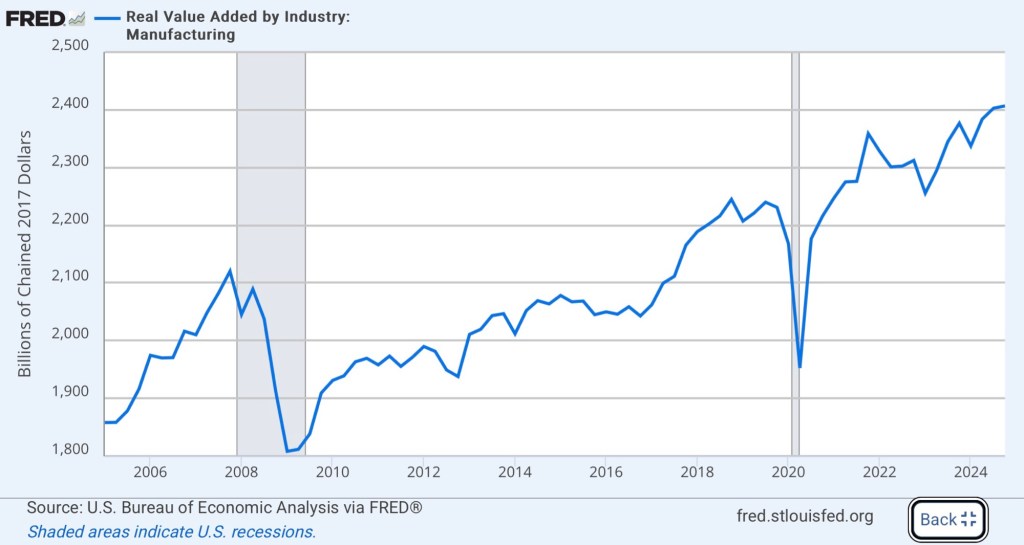
Trade warriors, including members of Trump’s team, insist that our decline as a nation is being hastened by a crisis in manufacturing. However, value added in U.S. manufacturing is at an all-time high.

There has been a long-term decline in manufacturing employment, but not manufacturing output. In fact, manufacturing output has doubled since 1980. As Jeff Jacoby notes, “the purpose of manufacturing is to make things, not jobs.” If our overarching social goal was job security, we’d have revolted long ago against the tremendous reduction in agricultural employment experienced over the past century. We’d rely on switchboard operators to load web pages, and we’d dig trenches and tunnels with spoons (to paraphrase Milton Friedman).

The secular decline in manufacturing employment is a consequence of growth in manufacturing productivity. Economy-wide, this phenomenon allows real income and our standard of living to grow.

Take That Job and …

It’s also significant that few Americans have much interest in factory work. It’s typically less dangerous than in times past, but many of today’s factory jobs are still physically challenging and relatively risky. Perhaps that helps explain why nearly half-a-million jobs in manufacturing are unfilled.

Jacoby describes the transition that has changed the face of American manufacturing:

“… US plants have largely turned away from making many of the low-tech, labor-intensive consumer items they once specialized in — sneakers, T-shirts, small appliances, toys. Those jobs have mostly gone overseas, and trying to bring them back by means of a trade war would be ruinous. Yet America remains a global manufacturing powerhouse — highly skilled, highly innovative, and highly efficient.“

And yet, even as wages in manufacturing have grown, many factory jobs do not pay as well as positions requiring far less strenuous toil in the services sector. It’s also true that the best manufacturing jobs in the U.S. today require high-level skills, which are in short supply. These factors help explain why manufacturers believe finding qualified workers is one of their biggest challenges.

Isolating Weak Sectors

There are specific sectors within manufacturing that have fared poorly, including textiles, furniture, metals, and low-end electronics. The loss of competitiveness that drove those sectoral declines is not a new development. It has, however, devastated communities in the U.S. that were heavily dependent on these industries. These misfortunes are regrettable, but trade barriers are not an effective prescription for revitalizing depressed areas.

Meanwhile, other manufacturing sectors have enjoyed growth, such as computers, aerospace, and EVs. While we’ve seen a decline in the number of manufacturing firms, the performance of U.S. manufacturing in the 21st century can be described as mixed at the very worst.

The author of this piece seems to accept the false notion that U.S. manufacturing is moribund, but he knows tariffs aren’t an effective way to strengthen domestic goods production. He has a number of better suggestions, including a commitment to infrastructure investment, reforms to education and health, and reconfiguring certain corporate income tax policies. Unfortunately, his ideas on tariffs are sometimes as mistaken as Trump’s,

The Gilded Age

Finally, the other false assertion noted in the opening paragraph is that tariffs somehow spurred economic growth in the late 19th and early 20th centuries. Brian Albrecht corrects this protectionist fallacy, which lies at the root of many defenses of Trump’s tariffs. Albrecht cites favorable conditions for growth that were sufficient to overwhelm the negative effects of tariffs, including:

“… explosive population growth, mass European immigration, rapid technological innovation, westward expansion, abundant natural resources, high literacy rates, and stable property rights.”

While cross-country comparisons indicate a positive correlation between tariffs and growth during the 1870 – 1920 period, those differences were caused by other forces that dominated tariffs. Cross-industry research discussed by Albrecht indicates that tariffs on manufactured goods during the gilded era reduced labor productivity and stimulated the entry of smaller, less productive firms. Likewise, natural experiments find that tariffs allowed inefficient firms to survive and discouraged innovation.

Conclusion

The U.S. manufacturing sector is not in any sort of crisis, and its future growth won’t be powered by attempts to restore the sort of low-value production offshored over the past several decades. What protectionists interpret as failure is the natural progression of a technically advanced market-based civilization, where high-value services account for greater shares of growing total output. Of course, low-value production is sometimes “crowded out” in this process, depending on its trade-ability and comparative advantages. The logic of the process is encapsulated by Veronique de Rugy’s recent discussion of iPhone production (HT: Don Boudreaux):

“Then there’s [Commerce Secretary Howard] Lutnick, pining for a world where Americans flood back into massive factories to assemble iPhones. This is nostalgic industrial cosplay masquerading as economic strategy. Yes, iPhones aren’t assembled by Americans. But this isn’t a failure; it’s a feature of smart economic specialization. We design the iPhone here. That’s the high-value, high-margin part. The sophisticated chips, software, architecture, and intellectual property are all created in the U.S. The marketing is done here, too. That’s most of the value of the iPhone. The lower-value labor-intensive assembly work is done abroad because those tasks are more efficiently performed abroad.“

There is certainly no crisis in U.S. manufacturing. That narrative is driven by a combination of politics, rent seeking, and misplaced nostalgia.

Follow Sacred Cow Chips on WordPress.com

Recent Posts

  • Some Dimensions Of the AI/Data Center Freakout
  • Warsh and Fed Confront a Crossroads On Policies
  • Isotopes Point To Natural CO2 Origins
  • Is “Global Temperature” a Fiction?
  • ESG Contortions: Virtue, Returns, and Politics

Archives

  • June 2026
  • May 2026
  • April 2026
  • March 2026
  • February 2026
  • January 2026
  • December 2025
  • November 2025
  • October 2025
  • September 2025
  • August 2025
  • July 2025
  • June 2025
  • May 2025
  • April 2025
  • March 2025
  • February 2025
  • January 2025
  • December 2024
  • November 2024
  • October 2024
  • September 2024
  • August 2024
  • July 2024
  • June 2024
  • May 2024
  • April 2024
  • March 2024
  • February 2024
  • January 2024
  • December 2023
  • November 2023
  • August 2023
  • July 2023
  • June 2023
  • May 2023
  • April 2023
  • March 2023
  • February 2023
  • January 2023
  • December 2022
  • November 2022
  • October 2022
  • September 2022
  • August 2022
  • July 2022
  • June 2022
  • May 2022
  • April 2022
  • March 2022
  • February 2022
  • January 2022
  • December 2021
  • November 2021
  • October 2021
  • September 2021
  • August 2021
  • July 2021
  • June 2021
  • May 2021
  • April 2021
  • March 2021
  • February 2021
  • January 2021
  • December 2020
  • November 2020
  • October 2020
  • September 2020
  • August 2020
  • July 2020
  • June 2020
  • May 2020
  • April 2020
  • March 2020
  • February 2020
  • January 2020
  • December 2019
  • November 2019
  • October 2019
  • September 2019
  • August 2019
  • July 2019
  • June 2019
  • May 2019
  • April 2019
  • March 2019
  • February 2019
  • January 2019
  • December 2018
  • November 2018
  • October 2018
  • September 2018
  • August 2018
  • July 2018
  • June 2018
  • May 2018
  • April 2018
  • March 2018
  • February 2018
  • January 2018
  • December 2017
  • November 2017
  • October 2017
  • September 2017
  • August 2017
  • July 2017
  • June 2017
  • May 2017
  • April 2017
  • March 2017
  • February 2017
  • January 2017
  • December 2016
  • November 2016
  • October 2016
  • September 2016
  • August 2016
  • July 2016
  • June 2016
  • May 2016
  • April 2016
  • March 2016
  • February 2016
  • January 2016
  • December 2015
  • November 2015
  • October 2015
  • September 2015
  • August 2015
  • July 2015
  • June 2015
  • May 2015
  • April 2015
  • March 2015
  • February 2015
  • January 2015
  • December 2014
  • November 2014
  • October 2014
  • September 2014
  • August 2014
  • July 2014
  • June 2014
  • May 2014
  • April 2014
  • March 2014

Blogs I Follow

  • Passive Income Kickstart
  • OnlyFinance.net
  • TLC Cholesterol
  • Nintil
  • kendunning.net
  • DCWhispers.com
  • Hoong-Wai in the UK
  • Marginal REVOLUTION
  • Stlouis
  • Watts Up With That?
  • American Elephants
  • The View from Alexandria
  • The Gymnasium
  • A Force for Good
  • Notes On Liberty
  • troymo
  • SUNDAY BLOG Stephanie Sievers
  • Miss Lou Acquiring Lore
  • Your Well Wisher Program
  • Objectivism In Depth
  • RobotEnomics
  • Orderstatistic
  • Paradigm Library
  • Scattered Showers and Quicksand
  • Jam Review

Blog at WordPress.com.

Passive Income Kickstart

OnlyFinance.net

TLC Cholesterol

Nintil

To estimate, compare, distinguish, discuss, and trace to its principal sources everything

kendunning.net

The Future is Ours to Create

DCWhispers.com

Hoong-Wai in the UK

A Commonwealth immigrant's perspective on the UK's public arena.

Marginal REVOLUTION

Small Steps Toward A Much Better World

Stlouis

Watts Up With That?

The world's most viewed site on global warming and climate change

American Elephants

Defending Life, Liberty and the Pursuit of Happiness

The View from Alexandria

In advanced civilizations the period loosely called Alexandrian is usually associated with flexible morals, perfunctory religion, populist standards and cosmopolitan tastes, feminism, exotic cults, and the rapid turnover of high and low fads---in short, a falling away (which is all that decadence means) from the strictness of traditional rules, embodied in character and inforced from within. -- Jacques Barzun

The Gymnasium

A place for reason, politics, economics, and faith steeped in the classical liberal tradition

A Force for Good

How economics, morality, and markets combine

Notes On Liberty

Spontaneous thoughts on a humble creed

troymo

SUNDAY BLOG Stephanie Sievers

Escaping the everyday life with photographs from my travels

Miss Lou Acquiring Lore

Gallery of Life...

Your Well Wisher Program

Attempt to solve commonly known problems…

Objectivism In Depth

Exploring Ayn Rand's revolutionary philosophy.

RobotEnomics

(A)n (I)ntelligent Future

Orderstatistic

Economics, chess and anything else on my mind.

Paradigm Library

OODA Looping

Scattered Showers and Quicksand

Musings on science, investing, finance, economics, politics, and probably fly fishing.

Jam Review

"If you get confused, listen to the music play."

  • Subscribe Subscribed
    • Sacred Cow Chips
    • Join 128 other subscribers
    • Already have a WordPress.com account? Log in now.
    • Sacred Cow Chips
    • Subscribe Subscribed
    • Sign up
    • Log in
    • Report this content
    • View site in Reader
    • Manage subscriptions
    • Collapse this bar

Loading Comments...