• About

Sacred Cow Chips

Sacred Cow Chips

Category Archives: Uncategorized

Monstrous Mathematics: Selling Abortion As Fiscal Austerity

06 Friday Jul 2018

Posted by Nuetzel in Uncategorized

≈ Leave a comment

Nuetzel's avatarSacred Cow Chips

The pro-choice Left says, “Massive welfare benefits will be necessary to support the babies you’d force women to carry to term.” The remark is viewed as an argument clincher among pro-choicers, but it’s not a persuasive defense of abortion rights. In fact, it’s quite beside the point: human lives are at stake. The “welfare defense” suggests that there must be a valid tradeoff between public aid and lives that can otherwise be saved. Or indeed, between publicly-funded abortions and future public aid. By that logic, perhaps EMS service should be suspended in impoverished neighborhoods so that welfare payments might be reduced. These kinds of monstrous tradeoffs are not remotely on the table.

(The commentary that follows does not pertain to abortions that might be necessary to preserve a woman’s life or health, or in the case of pregnancies caused by rape.)

An operative assumption underlying the left’s suggestion is that additional…

View original post 799 more words

The Destructive Pooling of Risks and Outcomes

29 Friday Jun 2018

Posted by Nuetzel in Health Insurance, Obamacare, Uncategorized

≈ 2 Comments

Tags

Benefit Mandates, Catastrophic Coverage, Death Spiral, Flood Planes, Free Riders, High-Risk Pool, Individual Mandate, Insurability Rider, Obamacare, Portability, Pre-Existing Conditions, Rate Regulation, Social Safety Net

Forcing health insurers to cover pre-existing conditions at standard rates is like asking home insurers to cover homes in flood plains at standard rates. If the government says home insurers must do so, standard rates will rise as well as the cost of homeownership. Lenders generally won’t accept homes as collateral unless they are adequately insured against flooding, and by raising the cost of insurance, the government requirement that all must share in the burden of high flood risk would discourage homeownership generally. But you’ll get a break if you’re in a flood plain! Coercive government regulations like rate regulation and coverage mandates have destructive (but predictable) consequences.

The difference between flood plains and health conditions is that sooner or later, a lot of us will be burdened with the latter. The trick is to get underwritten for health insurance before that happens. If the government says that health insurers must offer standard rates to those already afflicted with serious health conditions, à la Obamacare, standard rates will rise, which will induce some potential buyers to opt out. In fact, it will lead the youngest and healthiest potential buyers to opt out. This is the genesis of the so-called insurance death spiral.

Some then ask why the government shouldn’t prevent opt-outs by requiring all individuals to carry health insurance… an individual mandate. Perhaps doubling down on government coercion via compelled coverage might rectify the ill effects of rate regulation. However, requiring low-risk individuals to pay rates that exceed their willingness to pay cross-subsidizes individuals who belong in a different risk pool. Aside from it’s doubtful constitutionality and infringement on individual liberty, this policy forces low-risk individuals to insure and pay as if they are high-risk, and high-risk individuals to pay as if they are low risk, and it leaves the task of pricing to the arbitrary decisions of bureaucrats. It may also lead to massive distortions in the use of medical resources.

Direct Subsidies Are Better

There is a better way to provide coverage for individuals with pre-existing conditions, one that does not destroy the risk-mitigating function of health insurance markets. High-risk individuals can be covered through a combination of self-paid standard premiums and a direct public subsidy that does not distort the market’s social function in pricing risk. Such a subsidy would be funded by individuals in their roles as taxpayers, not as premium payers. Now, I’m the last person to advocate big-government solutions to social and economic problems, but this approach requires only that government serve as a pass-through entity. Government need not play any role in providing or regulating health care, and it should not interfere with the pricing of risk in private markets for health insurance.

Insurability Protection

The high-risk segment’s reliance on subsidies can be minimized over time with certain innovations. In particular, healthy individuals should be able to purchase riders protecting their future insurability at standard rates. Their premium would include a component reflecting the discounted expected costs of developing health conditions in the future. The additional premium could even be structured as level payments over time. People will develop health conditions, of course, a few much sooner than others, but without an incremental impact on their future premiums, as the additional risk  would be covered by the cost of the rider for future insurability.

To see how the situation would evolve, suppose that the standard risk pool includes everyone free of pre-existing conditions, young and old, with guaranteed future insurability. The high-risk segment is already afflicted with conditions and mostly reliant on the direct subsidies discussed above, but that segment will shrink over time as the population ages and mortality takes its toll. Therefore, the proportion of individuals reliant on subsidies will decline. Meanwhile, the standard risk pool transforms into a combination of healthy and sick, but it is actuarily sustainable without subsidies. Of course, some fraction of individuals will always be born with serious health conditions, though one day prospective parents could conceivably purchase future insurability protection for their children at conception… well, perhaps just a little after. The point is that the initial level of subsidies should be transitional. For a permanently small share of individuals, however, it will be a part of the social safety net.

To extend the foregoing, there is considerable latitude in the composition of “standard risks” and the willingness of individual buyers to pay premiums that might reflect interpersonal differences. For example, individuals should be free to self-insure, foregoing participation in the insurance market altogether. If they do so, the insured risk pool will e of lower quality. Some people might prefer to purchase insurance covering catastrophic health events only, paying for health maintenance out-of-pocket as well as care for conditions less immediately threatening. Health maintenance is not really a risk anyway, but more of a constant, so excluding it from insurance contracts is sensible. In fact, less “comprehensive” insurance coverage keeps the cost of coverage down, encouraging wider participation and enhancing the quality of the risk pool.

Mandates

These insurability riders might not accomplish much under a regime of mandated comprehensive benefits. That would increase the cost of coverage as well as the cost of the insurability rider, making it more likely that healthy individuals would opt-out. That brings us back to the “elephant in the room”: whether a so-called individual mandate is required to ensure that 1) the “standard” risk pool is of high quality; and 2) the uninsured don’t “free-ride” by capturing the public subsidy once their health deteriorates for any reason. But again, the availability of less comprehensive coverage will keep premiums low and help to accomplish both objectives. Moreover, free-riders whose health fails could always be denied the public subsidy if they had been uninsured over a period of any length prior to their diagnosis. That would leave them with several less attractive alternatives: pay high-risk-pool premiums out of their own pockets, or rely on assistance from family, friends, charitable organizations and providers.

Dumb Intervention

Requiring insurers to cover pre-existing health conditions at standard rates is destructive to insurance markets. It imposes liabilities for more certain, costly events in a market for which sustainable operation depends on the pooling of events of similar risk. It harms consumers directly by increasing the cost of mitigating those risks. It worsens the uninsured free-rider problem, causing additional deterioration in the risk pool and adding more cost pressure. It also may lead to increases in out-of-pocket deductibles and copayment rates as insurers attempt to manage high claim levels. And it invites further regulatory intervention, as policymakers engage in misguided attempts to “fix” problems created by the original intervention (while blaming the market, of course).

A further question is whether the alternative I have outlined would involve federal subsidies or state outlays funded in part by federal block grants. I prefer the latter, but either way, it is less costly and distortionary to pay for insuring against the costs of pre-existing conditions via direct subsidies to needy individuals as part of the social safety net than by destroying insurance markets.

Inferior Schools, Venom For Reformers

28 Monday May 2018

Posted by Nuetzel in Regulation, School Choice, Socialism, Uncategorized

≈ Leave a comment

Tags

Betsy DeVos, charter schools, Common Core, Corey A. DeAngelis, Disparate impact, Don Boudreaux, Education Week, Educational Equity, Every Student Succeeds Act, Henry Brown, Horace Mann, John Stossel, Kevin Currie-Knight, monopoly, Nancy Thorner, No Child Left Behind Act, Public Schools, Robert P. Murphy, School Choice

We all want better K-12 education in the U.S., which has an extremely uneven — even dismal — record of student outcomes. The U.S. ranks below the OECD average in both math and science scores, despite spending 35% more per student than the OECD average. Yet there is a faction that leaps to the defense of the status quo with such viciousness that its members deride sensible reform proposals as classist and racist. Then, of course, they call for additional spending! These antics reveal their self-interest in doubling down on the status quo.

An obvious starting point for reform, and one that would save taxpayers roughly $40 billion (K-12), is to dismantle a federal education bureaucracy that adds little value to educational outcomes. Another element is expanding the set of alternatives available to parents over the way their children are educated. Betsy DeVos, President Trump’s Secretary of Education, favors both of these steps as general principles, though she lacks direct control over either, especially school choice.

Both of these steps are fiercely resisted by the public educational establishment and teachers unions. And no wonder! Who wants to lose their privileged monopoly power over a local market? The public school establishment does not wish to be troubled by demands that schools respond to competitive forces, that teachers be rewarded based on performance, or that schools should be answerable to parents and taxpayers. As for the federal role, the public school cartel seems to welcome federal money, even if it means that the feds impose control in the process.

Choice

For those skeptical of reforming public schools by allowing choice, Don Boudreaux proposed a useful thought experiment that I discussed in my earlier post “Public Monopolists Say Don’t Be Choosy“. It examines a hypothetical world in which supermarkets are structured like public schools. Consumers pay for their food via local taxes and must shop at one local public supermarket, and only one, at which food products are available at no additional marginal cost. However, parents are free to pay their taxes and pay for food elsewhere, at a private supermarket. Most thinking people would probably agree that this is a spectacularly bad idea. Public supermarkets would deteriorate relative to private supermarkets. Rural and inner city supermarkets would likely suffer the most. Public supermarket worker unions would lobby for higher food taxes. And of course proposals for supermarket choice would be met with hysteria. Read the earlier post for more discussion of the likely consequences.

One of the arguments often made in favor of today’s public school monopoly is that K-12 education should be regarded as a necessity, but few would take that as a compelling reason to grant government a monopoly in the retail food business. A better argument for government schools, were it strictly true, would be that education is a public good, yielding significant non-exclusive benefits to the community. And in truth there are some external benefits to society from an educated citizenry. The primary benefits of an education, however, are exclusive to the student. Kevin Currie-Knight offers an excellent treatment of the education-as-public-good question, and he concludes otherwise. And the public-good argument does not imply that parents should be denied choice in their selection of a school for their children. Ultimately, the policy question hinges on whether government schools, as currently structured, do a good job in educating students, and as Corey A. DeAngelis points out, they do not.

There is no shortage of evidence that school choice is beneficial for students and society in several respects, including academic outcomes for students and schools, racial integration, fiscal impacts, and parental satisfaction. This paper by MIT researchers found that school choice improved educational outcomes for special education students and those who were not proficient in English. This essay in Education Week, signed by nine educational researchers, emphasized the preponderance of positive findings on school choice and some additional dimensions of improvement on which they hope the education research community will focus.

The promise of choice is seldom greeted objectively by the public education establishment and its reflexive allies. To their dishonor, distortions of fact and ad hominem attacks on choice advocates are almost the rule. For example, John Stossel writes the following in “Why the Left Hates Betsy DeVos“:

“When she spoke at the Kennedy School of Government, students held up signs calling her a ‘white supremacist.’ … When she tried to visit a school, activists physically blocked her way. … The haters claim DeVos knows little about education, only got her job because she gave money to Republican politicians, and hates free public education.“

Of course, public education is not free! But it is a disgrace that someone so dedicated to the cause of improved education should be treated this way. The DeVos family has given over a billion dollars to various causes over the years, much of it to educational initiatives, and even those gifts, somehow, are seen by critics as a pretext for vilifying Betsy DeVos. But she knows much more about the poor performance of public schools than her critics care to discuss, as well as the dynamism and improvement that choice and competition can bring to education. Her critics disparage the performance of charter schools in DeVos’s home state of Michigan even while the facts show that they have performed well.

The idea that charter schools “hurt” public schools by creating educational choice is the very weakest protest a monopolist can put forward. These critics conveniently overlook the fact that most charter schools are in fact public schools! More importantly, an erstwhile monopolist must respond by adding value for consumers! If it fails to do so, it must be closed or reorganized. THAT is a good idea!

Monopoly public schools do not earn a profit in the way of monopolistic business enterprises, but remember that perhaps the greatest social costs imposed by monopolies are languid effort and a poor product. This is not to dismiss the great efforts of many teachers who toil under trying circumstances, though the current system also tends to protect bad teachers. And much of the waste in government schools is caused by bloated bureaucracy and costs imposed on teachers and schools of complying with regulation. 

The Federal Bureaucracy

Another priority of Secretary DeVos is to reduce the federal role in education. Hurry, please! The unpopular Common Core standards, implemented in 2009, proved a failure. Test scores declined for student cohorts expected to benefit the most (those in the lowest percentiles). At the last link, Nancy Thorner discusses more recent legislation:

“It was in December of 2015 that Congress passed the Every Student Succeeds Act (ESSA), that replaced the often criticized No Child Left Behind Act (NCLB). ESSA, in contrast to NCLB, signified a clear move away from federally prescribed standards. In fact, ESSA expressly forbid federal regulators from attempting to ‘influence, incentivize, or coerce’ states to adopt the Common Core.”

That’s progress, but 36 states plus DC still use those standards. Curriculum mandates are only one area of federal school regulation that must be addressed. “Educational equity” is also mandated along several dimensions, requiring schools to devote a disproportionate share of resources to various subsets of students who might not benefit from the extra instructional intensity. Then there are the administrative costs of demonstrating compliance with these mandates, not to mention the virtual prohibition under these mandates of developing innovative, local solutions to the problem of educating their charges.

There is well-deserved pushback against federal control over school discipline, which requires schools to implement policies that avoid disparate impacts on certain minorities (African Americans, Latino, and special-ed children) such that they are no more likely to receive detention, suspension, or expulsion than the general student population. This is an absurdity, potentially requiring schools to go light on offenders should they happen to belong to a minority. Even worse, if the enforcement of discipline results in an observable bias in favor of any minority, it is likely to be noticed by the minority students themselves, creating a negative behavioral incentive and potentially stoking resentment among non-minority students.

In April, President Trump signed an executive order authorizing a review of federal education rules imposed on states and local school districts. Again, central regulation is costly: it involves rule-making at the federal level to interpret enabling legislation, then review by state departments of education where specific policies are designed, which are then passed down to school districts and individual schools, who must review and attempt to implement the policies, and who then must report back on their success or failure in meeting the mandates. Resources are consumed at every level. In the end, the process creates increased complexity, and the policies have proven to be of questionable value to the goal of good education. While spending on education has soared over the past 30 years, student achievement has remained static, and the same disparities of outcome remain.

Secular Statism

Robert P. Murphy provides a brief history of U.S. public schooling. It is a fascinating take on the history of secularization of education in America. It is the story of the substitution of state for private institutions, including family and church, in the development and socialization of children. Murphy offers a telling quote:

“Thus Henry Brown, second only to Horace Mann in championing state education, commented, ‘No one at all familiar with the deficient household arrangements and deranged machinery of domestic life, of the extreme poor, and ignorant, to say nothing of the intemperate—of the examples of rude manners, impure and profane language, and all the vicious habits of low bred idleness—can doubt, that it is better for children to be removed as early and as long as possible from such scenes and examples.'”

Whoa! The K – 12 public education system, as it now stands, is striking in its failure to benefit the children and families it is intended to serve. Critics of meaningful reform do not acknowledge the abysmal condition and performance of many government schools in America today, except to insist that they need more money. These critics, including the educational bureaucracy, teachers unions, and misguided statists generally, behave as if they accept the attitudes expressed by Henry Brown. They have no respect for private decision makers — families, churches, private schools of any stripe, and private markets in general. They do not understand the power of incentives and competition to allocate resources efficiently and maximize well-being. But they know how to disparage, defame, and propagate hateful rhetoric for those with a true interest in creating a better educational system for all.

Secession and Other Remedies for Intrastate Revolt

14 Monday May 2018

Posted by Nuetzel in Federalism, Regulation, Tyranny, Uncategorized

≈ Leave a comment

Tags

Federal Supremacy, Federalism, Glenn Reynolds, Guarantee Clause, Representative Democracy, Republican Government, State Secession, Supremacy Clause

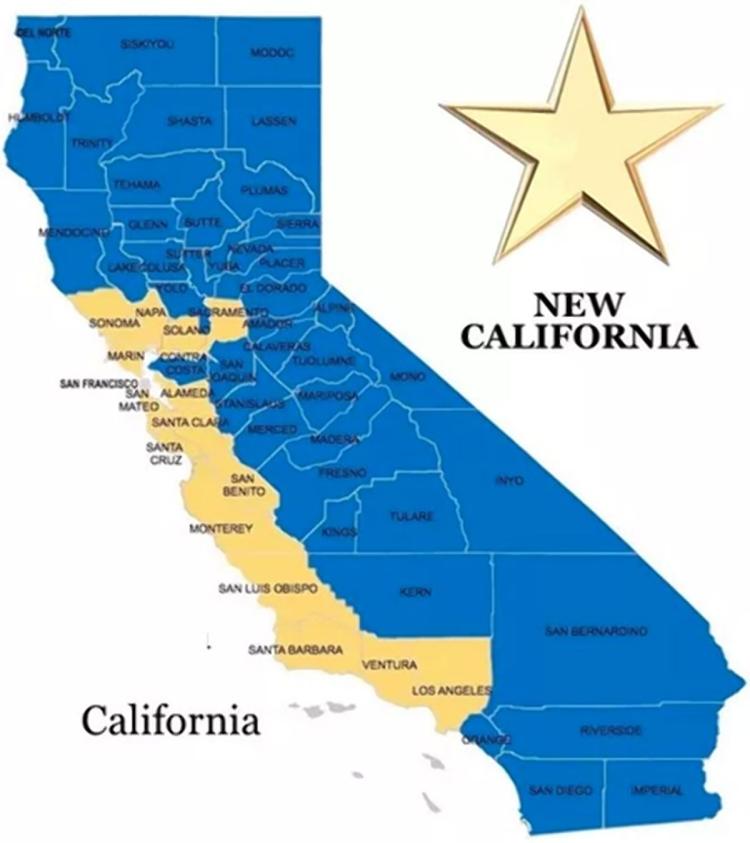
How many states will we have in the Union in twenty years? Probably 50, but there’s an outside chance that the number will be 55 plus. That could include a split of upstate New York from New York City, downstate Illinois from Chicagoland, eastern from western Washington State, eastern from western Oregon (or eastern Oregon combining with Idaho), and a division of California into as many as six states, as one proposal has it. There are secessionist movements alive in all of those states and it has happened before, as Glenn Reynolds notes in his recent paper “Splitsylvania: State Secession and What to Do About It“.

The origins of state boundaries and state governments were probably based on combinations of natural geographic features and confluent economic and political interests existing at the time. It would be surprising if those factors remained in static alignment over time, however. For various reasons, West Virginia seceded from Virginia many years ago, and Tennessee was once part of North Carolina. But to the extent that interests diverge within states, would a series of secessions promote better representative government? Reynolds’ approach to this question is fairly even-handed, though he apparently leans toward less disruptive solutions to the kinds of grievances voiced by secessionists.

Secession is a complex process; it obviously involves a major task in establishing a new state governmental apparatus. Also, legislative roadblocks to secession movements exist at both the state and federal levels. Nevertheless, there is great disaffection among rural interests in the states mentioned above for the policies they say are forced upon them by “urban elites”, as Reynolds calls them. At present, the secession of rural areas would tend to benefit republicans at the federal level, as two new Senate seats would be created to offset the seats held by democrats elected in more urban areas. Conceivably, however, the same process could work in reverse in other states, such as Texas. Even the proposal for six Californias seems designed to at least neutralize any possible negative impact on democrats in national politics.

Reynolds’ paper outline a few ways in which interests represented by legislative minorities, such as rural populations, could be better served without a step so drastic as secession. State regulation is often what rankles secessionists. To add fuel to the fire, states are free to adopt rules that are more strict than rules established under federal legislation, if they so choose, but never rules that are less strict. Today this applies to wages, working conditions, gun regulation, and environmental law. Reynolds suggests turning this on its head:

“The federal government’s legislative role has traditionally been the opposite: To use (as in the case of the 1964 Civil Rights Act) a national majority to ensure that local majorities can’t oppress local minorities. I thus suggest that federal laws regulating these key subject-matter areas be recast to pre-empt more restrictive state laws, meaning that urban regions would be unable to impose stricter laws on less- powerful rural areas. If this seems too inflexible, perhaps that pre-emption should in some cases be defeasible at the county level; if the government of a county affirmatively wants to accept stricter state regulations, then it may do so, but if not, then the federal regulations are a ceiling, as well as a floor.”

Reynolds contends that this approach would be relatively easy to defend against state challenges. The idea that federal rules provide minimum standards of regulation is only one interpretation of the Supremacy Clause of Article VI of the Constitution. There is no reason why federal legislation cannot be written in the way Reynolds describes. Moreover, Reynolds asserts that the Guarantee Clause of Article IV, which assures that mandates are to be established according to republican principles, could be used to buttress this argument. But he offers another remedy to curb secessionism among rural voters that states could exercise:

“There is nothing to stop a state from being mindful of the differences between urban and rural areas when crafting legislation or regulations, after all. States could adopt a local-option regulatory scheme relating to key subject areas on their own, and by doing so would lighten their footprint in rural areas and lessen the likelihood of festering resentments.”

Perhaps that’s hoping for too much. State majorities are unlikely to cede power to rural minorities, but it’s nice to imagine that sort of cooperation. There is no question that this sort of state regulatory approach would protect local interests from the tyranny of one-size-fits-all state regulation, but it wouldn’t eliminate the burdens created by the standard interpretation of federal supremacy.

In general, federal preemption of stricter state laws is no less consistent with the principles of federalism than federal pre-emption of more lenient state laws. One could even argue that the best way to apply federal supremacy depends on the issue, so there is some symmetry in Reynolds’ proposal. In terms of representative democracy, it is less an evil than federal preemption of less restrictive laws. It does what a democratic republic is supposed to do: protect minorities from the tyranny of a majority.

Secession from states is an intriguing possibility. Perhaps it is even the best approach in some cases. Nevertheless, Reynolds’ suggestions for revising federal and state regulatory approaches would be less costly and would avoid a nationwide race to subdivide states in order to gain a federal political advantage.

A Voluntary Redistribution of Sex

11 Friday May 2018

Posted by Nuetzel in Free markets, Prohibition, Redistribution, Uncategorized

≈ 1 Comment

Tags

Abigail Hall, Alex Tabarrok, Incel, Involuntary Celibate, Lux Alptraum, Prohibition, Prostitution, Redistribution of Sex, Robin Hanson, Ross Douthat, Sex Robots

“Incels” have received plenty of bad publicity since the horrifying van attack in Toronto two weeks ago. It was preceded in 2014 by a killing rampage in California perpetrated by an individual with a similar profile. In case you haven’t heard, an incel is an involuntary celibate, either male or female, though male incels have garnered nearly all of the recent attention. Whatever their other characteristics, incels share a loneliness and an unmet desire for intimacy with other human beings.

Lux Alptraum shares her views about the differences between male and female incels. She blames “angry, straight men” and “toxic masculinity” for both the violence that’s recently come to be associated with incels and the relative inattention paid to the plight of female incels. I value her perspective on the issue of female incels. There are obviously extreme misogynists among males in the incel “community”. Some are so enraged by their plight that they engage in on-line bullying, and a plainly deranged segment of incels, including the perpetrators of the crimes mentioned above, have advocated violent retribution against those they deem responsible for their low sexual status. That means just about anyone who can find a partner.

Alptraum paints male incels with a very broad brush, however. Similarly, various leftist writers have categorized incels as predominantly “right wing” and even racist, but involuntary celibacy and misogyny do not lie conveniently along a two-dimensional political spectrum. Incels are present in many groups, crossing racial, religious, and political lines. There are incels among the transgendered and undoubtedly in the gay community. Gay individuals can exist in relative isolation in towns across America. Physical disabilities may condemn individuals to involuntary celibacy. And not all incels are “ugly”; instead, they may suffer from severe social awkwardness. But there are bound to be incels who live quiet lives, unhappy, but adjusted to their circumstances, more or less.

The recent focus on incels has prompted some interesting questions. Ross Douthat’s opinion piece in The New York Times asks whether anyone has a “right to sex”, as some incels have asserted. Robin Hanson discusses the idea of a “redistribution of sex“, noting in a follow-up post that governments throughout history have influenced the distribution of sex through policies enforcing monogamy, for example, or banning prostitution. Voluntary agreements to exchange sex for remuneration are one way to alter the distribution. In fact, to demonstrate the lengths to which a government could go to redistribute sex and intervene against “sex inequality”, Hanson mentions policies of cash redistribution, funded by taxpayers, to compensate incels for the services of prostitutes. There are examples of such benefits for the disabled. Here is Alex Tabarrok on that subject:

“In the UK charities exist to help match sex workers with the disabled. Similar services are available in Denmark and in the Netherlands and in those countries (limited) taxpayer funds can be used to pay for sexual disability services.”

Subsidies and charity aside, it’s easy to understand why prohibition of sexual services for hire would be seen as an injustice by those unable to find partners willing to grant sexual benefits. From a libertarian perspective, trade in sex should be regarded as a natural right, like the freedom to engage in any other mutually beneficial transaction, so long as it does no harm to third parties. One’s body is one’s own property, and it should not be for government — or others — to decide how it will be used.

Laws against prostitution do great harm to society and to the individuals involved in the sex business. Forget about ending prostitution. That will never happen. According to  Abigail Hall, there are about 1 million prostitutes working in the U.S. They almost all work underground, with the exception of those operating in legal brothels in Nevada. Prohibition keeps the price up, but the workers capture a low share of those returns. Their bosses are harsh masters relative to those in legal businesses. These workers cannot report crimes against them, so they are often subject to the worst kinds of abuse. Illegality usually means they don’t have access to good health care, which places customers at greater risk. Legalizing (or decriminalizing) prostitution would reduce or eliminate these problems. From Hall:

“By legalizing the sex trade, we would allow those involved in the sex trade to come out from the shadows, use legitimate business practices and legal channels, and decrease the likelihood that women will be trafficked by violent groups of criminals. … As prostitution becomes a legitimate profession, it allows for prostitutes to be more open with their doctors about their sexual history and seek treatment for STIs and other problems.”

Many object that prostitution exploits women, legal or not, and that it exploits low-income women disproportionately. But there will be voluntary sellers as long as there is a market, again, legal or not. And there will be a market. As for a disparate impact on the poor, Hall says:

“The fact that those who select prostitution as a profession may be poor is inconsequential…. It may be true that some women who work as prostitutes would strongly prefer another profession. Even if this is the case, women who voluntarily choose prostitution as a means of income should be allowed to practice their profession in the safest environment possible.”

The ongoing development of “sex robots” offers an avenue through which incels might enjoy activity that approximates sex with a human being. These robots are becoming increasingly realistic, and their costs are likely to decline dramatically in coming years. For incels with a congenital inability to interact with other human beings, this option might be far preferable to hiring the services of a prostitute. And the introduction of both male and female sex robots into senior care facilities might reduce the likelihood that sexually aggressive residents will abuse others. It happens.

Free markets are amazing in their ability to maximize the well being of both consumers and producers of a good or service. Trades are mutually beneficial and therefore are voluntary, and price signals redirect resources to their most valued uses. The prohibition on prostitution, however, has made it a very dangerous business for practitioners and customers alike. Prohibition has led to dominance by organized crime interests and local strong-men and -women. It has also thickened the intersection of prostitution with other prohibited activities, such as the drug trade. This creates a toxic criminal environment within which women are trapped and abused. Legalizing prostitution would liberate these individuals and create safer conditions for them and their customers. Private solutions would still be available to those who wish to keep prostitution out of their buildings or neighborhoods. And legalization is one way that sex could be made safely and voluntarily accessible to incels. Perhaps, one day soon, the availability of sex robots will help incels satisfy their desires as well. Some incels will still harbor strong resentment toward those for whom sex is not out of reach. Nevertheless, it is reasonable to ask whether such a “voluntary redistribution of sex” would not produce unambiguous social benefits. To deny these benefits to groups like the disabled, or really to anyone with a physical or emotional inability to find a willing partner, and to insist that sex workers be exposed to danger and abuse, is not just priggish, but cruel.

Don’t Cry for the Former Taxi Monopoly

23 Friday Mar 2018

Posted by Nuetzel in competition, monopoly, Technology, Uncategorized

≈ Leave a comment

Tags

Cartel, Consumer Surplus, Creative Destruction, Human capital, Lyft, Mark Perry, Ride sharing, Taxi Medallions, Taxi Monopoly, Uber, Warren Meyer

It would be odd to argue that innovation is not unequivocally positive, that its costs will exceed its benefits. Certainly there are downsides: human capital invested in the methods and technologies supplanted by an innovation is devalued, jobs may be lost, retraining becomes necessary, and even consumers must get used to new ways of doing things, which is not costless. But most of these costs are temporary. And when an innovation eliminates an incumbent’s monopoly, the former monopolist’s profit ends up back in the pockets of consumers.

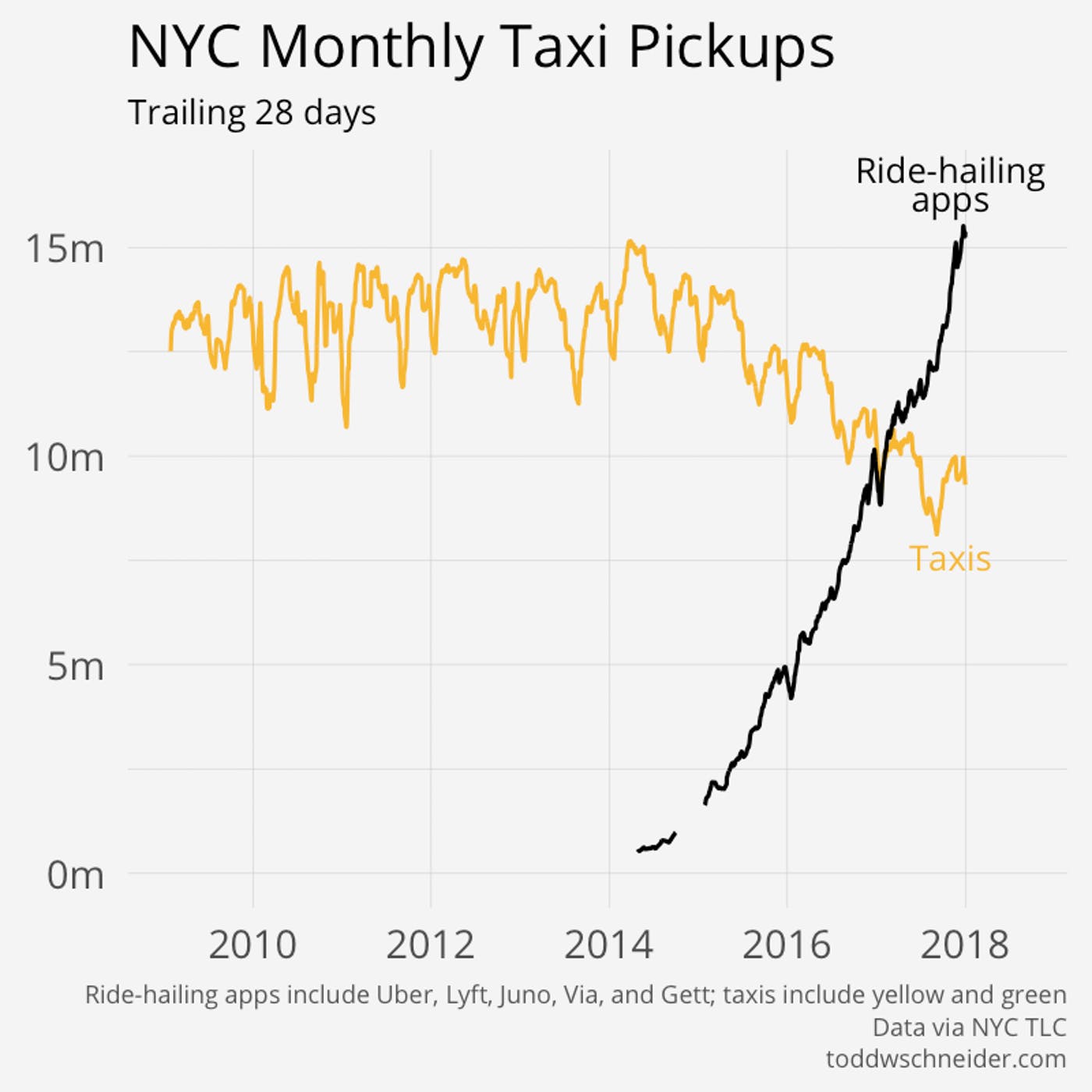
People do seem to focus excessively on the downside of innovation without carefully tallying the benefits. For example, this article focuses on the loss of New York City taxi pickups since ride sharing services like Uber and Lyft began to have an impact in 2014. Mark Perry reproduces a chart from that article, which is featured above. The number of monthly taxi rides in NYC has fallen by about one-third since then, from an average of 13+ million to about 9 million in 2017. In fact, Perry reports that the market for taxi medallions has tanked since then as well, with plunging medallion prices and many medallions sold out of bankruptcy and foreclosure. But don’t be too quick to shed tears for a monopoly lost.

The same chart shows the massive upside to ride sharing, as discussed here by Warren Meyer. The size of the total market has nearly doubled, from about 13 million per month to roughly 24 million (adding the two lines together). And it was a quick transition! That’s what happens when real competition is introduced to a market: prices fall and quantity increases, with an attendant increase in the welfare of consumers. That increase always exceeds the loss suffered by the former monopolist or cartel (as the case may be), which was earning excessive profits at the expense of consumers before the innovation had a market impact. And many former taxi drivers have made the switch to ride sharing providers, and they seem to prefer it for the flexibility and autonomy it offers. Yes, the best innovations benefit workers as well as consumers.

Competition can bloom when government opens markets to competitors or when an innovation creates new alternatives for consumers. In the case of ride sharing, both were necessary. For many years, NYC restricted the supply of taxi medallions, which kept taxi fares artificially high. The formal approval of ride sharing services in the city was not uncontested. But once it was approved, consumers took advantage of superior dispatching and payment technologies enabled by their smart phones, as well as security features and rating systems, not to mention lower fares. Again, these developments have contributed massively to consumer well-being, which is ultimately the point of all economic activity. Traditional taxis have to try to keep up. The ride sharing industry has inflicted the kind of creative destruction for which consumers are quite grateful.

5G Wireless: The NSA Wants You On Its Plan

30 Tuesday Jan 2018

Posted by Nuetzel in infrastructure, National Security, Privacy, Uncategorized

≈ Leave a comment

Tags

5G Wireless, Ajit Pai, central planning, FCC, incentives, Markets, National Security Council, Nationalized Wireless, Net Neutrality, NSA, Privacy, Scott Shackford, Wireless Infrastructure

Please no, Mr. President, do not even flirt with putting the federal government in charge of building and operating a new 5G wireless network! Sure, you’ll hate to disappoint the hawks on the National Security Council (NSC), but please let this remain outside the scope of your infrastructure plan!! For one thing, the private sector already has it underway, and the task is not straightforward. Excessive government involvement would almost surely botch the job. Let’s face it: while shrill calls for central planning of one form or another are constantly heard from leftists and populists, the government is really lousy at it. But then good central economic planning is impossible, given the impossibility of knowing and tracking the vast and dynamic information flows necessary to get it done, not to mention knowing and executing the appropriate responses to that information. There is a better tool for that called “markets”.

Scott Shackford reports that the chairman of the FCC, Ajit Pai, reacted with swift condemnation to the 5G discussions taking place within the NSC. Do read the whole Shackford piece. Apparently, there are some in the NSC who imagine government being good at building, maintaining, and securing a wireless network. This despite the antiquated nature of the federal government’s information systems and, as Shackford notes, their poor security. There is also the potential threat that communications over such a network would be subject to monitoring by nosey law enforcement and other public officials. If national security always implies state control, I’ll take less, but I don’t believe that’s the case for a minute.

The government tends to be a poor custodian of infrastructure — really public assets in general, and there is a reason: incentives are lacking. Private communication networks keep improving thanks to private incentives, like the prices and profits that promote efficient behavior and the market pressures to offer data plans that private users value. The government, on the other hand, struggles even to maintain the interstate highway system, which is simple technology by comparison. But statists tend to view the lack of private incentives as a feature: it’s free! And as a consequence, it is over-utilized and under-maintained. Ultimately the taxpayer is on the hook for capital costs and any upkeep that can be mustered, not the user, but the user suffers the degraded quality of those assets. A nationalized wireless network and its users would suffer the same fate.

Private infrastructure like wireless networks is best encouraged by eliminating regulatory roadblocks to private construction and operation of those assets. That includes the welcome rollback of the stifling network neutrality rules. Low taxes also help, not to say special incentives for wireless carriers.

Tragic Harvey Flooding Was a Known Risk

31 Thursday Aug 2017

Posted by Nuetzel in Flood Insurance, Global Warming, Subsidies, Uncategorized

≈ Leave a comment

Tags

Climate Change, David Conrad, Federal Flood Insurance, Houston, Hurricane Frequency, Hurricane Harvey, Landfalling Hurricanes, Michael Grunwald, National Wildlife Federation, Roger Pielke Jr., Roy Spencer

Houston-flood-1935

The photo above is downtown Houston during the flood of 1935, which I lifted from a post on Roy Spencer’s blog. The rate of rainfall from Hurricane Harvey in Houston is not unprecedented, according to Spencer. The geographic breadth and duration of the heavy rainfall might be, but ready comparisons are difficult on that basis, even for the 100 years of recorded rainfall in East Texas. The tragic severity of the flood damage is probably unprecedented as well, though the full tally won’t be in for some time. The severity is a consequence of four factors: the breadth of the rainfall, its duration, the growth of the Houston metro area, and the unnecessary development of low-lying areas that can no longer provide effective drainage and absorption of rainfall due to impervious cover.

Harvey was (and is) a big storm, but an unusual aspect of Harvey was the way it stalled after making landfall:

“The exact same tropical system moving at, say, 15 mph might have produced the same total amount of rain, but it would have been spread over a wide area, maybe many states, with no flooding disaster. This is usually what happens with landfalling hurricanes. … Instead, Harvey stalled after it came ashore and so all of the rain has been concentrated in a relatively small portion of Texas around the Houston area. In both cases, the atmosphere produced the same amount of rain, but where the rain lands is very different.“

Spencer also notes that Harvey is in no way evidence of global warming, as many in the media have implied:

“Roger Pielke Jr. has pointed out that the U.S. has had only four Category 4 (or stronger) hurricane strikes since 1970, but in about the same number of years preceding 1970 there were 14 strikes. So we can’t say that we are experiencing more intense hurricanes in recent decades. … Going back even earlier, a Category 4 hurricane struck Galveston in 1900, killing between 6,000 and 12,000 people. That was the greatest natural disaster in U.S. history. … And don’t forget, we just went through an unprecedented length of time – almost 12 years – without a major hurricane (Cat 3 or stronger) making landfall in the U.S.“

As for the role of development in the severity of the flooding, Spencer says:

“Major floods are difficult to compare throughout history because the ways in which we alter the landscape. For example, as cities like Houston expand over the years, soil is covered up by roads, parking lots, and buildings, with water rapidly draining off rather than soaking into the soil. The population of Houston is now ten times what it was in the 1920s. The Houston metroplex area has expanded greatly and the water drainage is basically in the direction of downtown Houston.”

Short memories and inaccurate assessments of flood potential might have encouraged excessive building in low-lying areas in and around Houston. However, the profligate extension of federal flood insurance to properties in those areas played a large role. Here is Michael Grunwald:

“Nearly two decades before the storm’s historic assault on homes and businesses along the Gulf Coast of Texas this week, the National Wildlife Federation released a groundbreaking report about the United States government’s dysfunctional flood insurance program, demonstrating how it was making catastrophes worse by encouraging Americans to build and rebuild in flood-prone areas.“

Houston played a noteworthy role in the report quoted by Grunwald:

“‘Houston, we have a problem,’ declared the report’s author, David Conrad. The repetitive losses from even modest floods, he warned, were a harbinger of a costly and potentially deadly future. ‘We haven’t seen the worst of this yet,’ Conrad said.

Climate alarmists would be well-advised to read Spencer’s piece on Harvey. It offers  excellent historical and climatological context. It’s also interesting to read some of the venomous ad hominem sprayed in Spencer’s direction by alarmist trolls in the comments section. Spencer knows too well, however, that “floods aren’t just due to the weather“. Let’s hope that the Houston area won’t be encouraged to rebuild in low-lying areas by prospective subsidies from a federal flood insurance program in need of drastic reform.

Paris Climate Dance: a Concon

07 Wednesday Jun 2017

Posted by Nuetzel in Global Warming, Redistribution, Uncategorized

≈ Leave a comment

Tags

AGW, Anthropomorphic Global Warming, Axial Tilt, Barack Obama, Carbon Concentration, Carbon Forcing Models, Carbon Intensity, Climate Feedbacks, Dementors, Donald Trump, Green Climate Fund, Harry Potter, Jeffrey Tucker, Paris Climate Accord, Paris Climate Summit, Steven Allen

Ah, Paris, we bid you adieu. For both scientific and economic reasons, the Paris Climate Accord is pure numbskullery. We should all be grateful that President Trump has decided to revoke the expensive promises made by Barack Obama under the agreement in a willful effort to appease the world’s rent seekers.

From a scientific perspective, the accord’s prescriptions are premised on a partial effect: absent any feedbacks, carbon emissions would raise the atmospheric temperature slightly. But feedback effects are massively important, as anyone familiar with the climate models’ terrible track record of predictive performance might guess. Water vapor, cloud formation, wind currents, and the response of the Earth’s biomass are just some of the effects that impinge on the relationship between atmospheric carbon and temperatures. In addition, carbon forcings are relatively minor compared to the energy impulses delivered by natural sources, including solar activity and the Earth’s varying axial tilt. Paleoclimate data shows that the world has been this warm before, and warmer.

The economic case against the Paris Accord is even stronger. The very idea that authorities would impose huge material sacrifices on mankind in an effort to prevent a threat for which the evidence is so weak should give pause to any rational individual. Beyond that, however, the real function of the accord was not so much carbon mitigation as it was a shift in the distribution of wealth. This quote of Steven Allen, in a scathing assessment of the agreement, is instructive (forgive his mid-sentence switch to sarcasm):

“Mainly, it’s about taking money from taxpayers and consumers and businesspeople and electricity ratepayers and giving it to crony capitalists, and taking money from people in relatively successful countries and giving that money to rich people in poor countries, to the benefit of members of governing elites who support the Paris deal for the good of humanity and not at all because they expect to line their pockets with it.“

World carbon emissions were expected to keep rising at least through 2030 under the agreement. The subsidies it promised to crony capitalists in the renewable energy industry were to generously fund technologies that are not economically viable without government support, to the detriment of relatively clean-burning fossil fuels, not to mention nuclear power. The U.S. promised to reduce absolute carbon emissions, but the world’s greatest emitter of carbon dioxide, China, promised only to seek to limit emissions per unit of GDP, but not until sometime down the road. That means China’s level of emissions might not reverse, given the rapid growth of the Chinese economy. India’s commitment is similar. And Russia promised a reduction relative to a depressed 1990 level of emissions, which means they have plenty of room for growth.

As for the U.S., where absolute carbon emissions have been decreasing since 2007, the Paris Accord relied on so-called “voluntary” limits to be imposed by federal mandates. Financial demands were made by developing countries under the deal: $100 billion per year. And who would pay for that? Taxpayers in the developed countries, of course. One can only imagine the lust of unaccountable third-world officialdom for those funds. Thus far, the U.S. has paid only $1 billion into the so-called Green Climate Fund, and at least half of that was taken from a State Department account from which disbursal did not require Congressional approval.

Jeffrey Tucker, who is anything but a fan of Donald Trump, minced no words in his assessment of the Paris “treaty”. Here are a few selected quotes:

“The Paris Agreement is a ‘voluntary’ agreement because its architects knew it would never pass the US Senate as a treaty. Why? Because the idea of the agreement is that the US government’s regulatory agencies would impose extreme mandates on its energy sector: how it should work, what kinds of emissions it should produce, the best ways to power our lives (read: not fossil fuels), and hand over to developing world regimes billions and even trillions of dollars in aid, a direct and ongoing forcible transfer of wealth from American taxpayers to regimes all over the world, at the expense of American freedom and prosperity. …

The exuberant spokespeople talked about how ‘the United States’ had ‘agreed’ to ‘curb its emissions’ and ‘fund’ the building of fossil-free sectors all over the world. It was strange because the ‘United States’ had not in fact agreed to anything: not a single voter, worker, owner, or citizen. Not even the House or Senate were involved. This was entirely an elite undertaking to manage property they did not own and lives that were not theirs to control. …

The Paris Agreement is no different in its epistemological conceit than Obamacare, the war on drugs, nation-building, universal schooling, or socialism itself. They are all attempts to subvert the capacity of society to manage itself on behalf of the deluded dreams of a few people with power and their lust for controlling social and economic outcomes.“

The popular fascination with climate scare stories has provided a useful channel of influence for would-be central planners and redistributionists. These social dementors reject the proposition that science is a process of continuing challenge and testing, thereby subverting the very notion of scientific inquiry. They make the laughable claim that 170 years of temperature data, much of which is quite sketchy, is sufficient to draw strong conclusions about the trends and dynamics of the climate on a four billion year-old planet.

Even worse, the climate alarmists insist that they have a monopoly on scientific knowledge, despite a significant share of skeptics in the climate science community. But in pursuit of that monopoly, the alarmists have gone so far as to undermine the integrity of the peer review process in the climate literature and to manipulate temperature data to exaggerate recent records. They have promoted the false claims that cyclonic storm energy has increased with carbon concentration and that sea levels are rising at an increasing rate. (Coastal property values don’t seem to reflect those concerns.) They would have us confuse actual climate data with model predictions, and they continue to offer prescriptions based on carbon-forcing models after many years of terrible forecast performance. They claim that a small increment (one part per 10,000) to the concentration of a trace atmospheric gas will dominate other forces exerting far greater variations in energy. They ignore the benefits that an increase in nourishing carbon dioxide and warming can provide. And they make the anthropocentric claim that a costly sacrifice by mankind, in an attempt to reduce that trace gas slightly if at all, will pay off reliably by reducing global temperatures, despite the very modest claims on those grounds by the Paris Accord itself.

Here is a link to 17 earlier posts on Sacred Cow Chips having to do with the hypothesis of anthropomorphic global warming, including this one written in late 2015, at the time of the Paris Climate Summit.

The Renewable Energy Jobs Hoax

30 Tuesday May 2017

Posted by Nuetzel in Renewable Energy, Subsidies, Uncategorized

≈ Leave a comment

Tags

Fossil fuels, Government Subsidies, infrastructure, James Taylor, Job Creation, Jobs Objective, Marginal cost, Mark Zuckerberg, Renewable energy, Renewable Energy Subsidies, Tariffs, Tim Worstall

James Taylor at Forbes reveals the dishonest math behind the claim that renewable energy generates more jobs than “conventional energy”, i.e., fossil fuels. It’s a simple trick, as Taylor explains:

“… renewable energy advocates create the broadest possible definition of workers ‘supported’ by the solar power industry, falsely claim that the solar power industry ’employed’ all these workers, and then compare that to the narrowest possible definition of just a single segment of workers ‘directly’ employed in the ‘extraction’ component of the much larger natural gas industry.“

Taylor notes that, “In reality, renewable energy isn’t even in the same universe of job creation as conventional energy.” He goes on to cite the report on which these claims are based and picks it apart. The renewable energy job assertions are obviously self-intereseted, as rent seeking lobbyists know that the political class is dominated by easy marks for renewable energy wonder-stories.

Of course Taylor is correct that the claims about renewable energy jobs are false in the aggregate sense. However, it might or might not be true in the marginal sense, and that’s clearly the sense in which the claim is intended to be taken, despite the fact that the data used is not marginal in nature. If true, it’s not a selling point for renewable energy subsidies because “more jobs” represents a greater marginal cost.

And that brings us to an even more critical issue missed by Taylor: public policy should not be based on the objective of direct job creation. Jobs are a cost, not a benefit. We value the finished goods, not the inputs required to produce them. If you don’t quite get that, imagine two bids for the construction of new kitchen in your home. Same plans, same completion date, similarly brilliant customer reviews of the competing contractors. Without knowing the actual bids, if one contractor tells you it’s a three-man job and the other says it’s a four-man job, you’ll be pretty certain which bid you’ll want to accept.

Ah, but you say, that’s not a fair comparison, because I’m paying for it. Yes you are, just as taxpayers (and more generally society) must pay for the subsidies that lobbyists wheedle out of politicians. Or you say, Ah, but we want more renewable jobs because we want renewable energy, ’cause it’s just right. Maybe, maybe not, but if that’s so, then the idea that the cost is higher because more jobs are required per unit of energy is not a good rationale.

It’s often the case that public policy aimed at “creating jobs” is not accompanied by higher output, lower prices, or even… more jobs! For example, tariffs on foreign goods give an advantage to American producers, but at the cost of job losses in import industries and higher domestic prices that harm consumers more broadly, and thereby reduce jobs. When certain industries or firms are subsidized by the government, the taxpayer is harmed directly, not to mention suppliers of alternatives. This is true at the local and national levels: politicians love to talk about job creation when they offer incentives for new facilities or relocations to their jurisdictions, but these subsidies may put other local firms at a competitive disadvantage and leave taxpayers holding the bag for public services supplied to the recipient firm. When government undertakes large taxpayer-funded infrastructure projects, which might or might not boost productivity, the taxes are damaging and the projects are often poorly planned and lack effective cost controls. Jobs are not a reason to support such projects.

Similar points have been discussed in the past here on Sacred Cow Chips, with links to articles emphasizing the distinction between direct jobs created and economic welfare like this one. “Jobs” should never be a policy objective in and of itself. As Tim Worstall explains in a brief review of Mark Zuckerberg’s recent commencement address at Harvard, jobs simply are not the point! Policy must have a better rationale than the high cost of the labor input!

← Older posts
Newer posts →
Follow Sacred Cow Chips on WordPress.com

Recent Posts

  • A Warsh Policy Scenario At the Federal Reserve
  • The Coexistence of Labor and AI-Augmented Capital
  • The Case Against Interest On Reserves
  • Immigration and Merit As Fiscal Propositions
  • Tariff “Dividend” From An Indigent State

Archives

  • February 2026
  • January 2026
  • December 2025
  • November 2025
  • October 2025
  • September 2025
  • August 2025
  • July 2025
  • June 2025
  • May 2025
  • April 2025
  • March 2025
  • February 2025
  • January 2025
  • December 2024
  • November 2024
  • October 2024
  • September 2024
  • August 2024
  • July 2024
  • June 2024
  • May 2024
  • April 2024
  • March 2024
  • February 2024
  • January 2024
  • December 2023
  • November 2023
  • August 2023
  • July 2023
  • June 2023
  • May 2023
  • April 2023
  • March 2023
  • February 2023
  • January 2023
  • December 2022
  • November 2022
  • October 2022
  • September 2022
  • August 2022
  • July 2022
  • June 2022
  • May 2022
  • April 2022
  • March 2022
  • February 2022
  • January 2022
  • December 2021
  • November 2021
  • October 2021
  • September 2021
  • August 2021
  • July 2021
  • June 2021
  • May 2021
  • April 2021
  • March 2021
  • February 2021
  • January 2021
  • December 2020
  • November 2020
  • October 2020
  • September 2020
  • August 2020
  • July 2020
  • June 2020
  • May 2020
  • April 2020
  • March 2020
  • February 2020
  • January 2020
  • December 2019
  • November 2019
  • October 2019
  • September 2019
  • August 2019
  • July 2019
  • June 2019
  • May 2019
  • April 2019
  • March 2019
  • February 2019
  • January 2019
  • December 2018
  • November 2018
  • October 2018
  • September 2018
  • August 2018
  • July 2018
  • June 2018
  • May 2018
  • April 2018
  • March 2018
  • February 2018
  • January 2018
  • December 2017
  • November 2017
  • October 2017
  • September 2017
  • August 2017
  • July 2017
  • June 2017
  • May 2017
  • April 2017
  • March 2017
  • February 2017
  • January 2017
  • December 2016
  • November 2016
  • October 2016
  • September 2016
  • August 2016
  • July 2016
  • June 2016
  • May 2016
  • April 2016
  • March 2016
  • February 2016
  • January 2016
  • December 2015
  • November 2015
  • October 2015
  • September 2015
  • August 2015
  • July 2015
  • June 2015
  • May 2015
  • April 2015
  • March 2015
  • February 2015
  • January 2015
  • December 2014
  • November 2014
  • October 2014
  • September 2014
  • August 2014
  • July 2014
  • June 2014
  • May 2014
  • April 2014
  • March 2014

Blogs I Follow

  • Passive Income Kickstart
  • OnlyFinance.net
  • TLC Cholesterol
  • Nintil
  • kendunning.net
  • DCWhispers.com
  • Hoong-Wai in the UK
  • Marginal REVOLUTION
  • Stlouis
  • Watts Up With That?
  • American Elephants
  • The View from Alexandria
  • The Gymnasium
  • A Force for Good
  • Notes On Liberty
  • troymo
  • SUNDAY BLOG Stephanie Sievers
  • Miss Lou Acquiring Lore
  • Your Well Wisher Program
  • Objectivism In Depth
  • RobotEnomics
  • Orderstatistic
  • Paradigm Library
  • Scattered Showers and Quicksand
  • Jam Review

Blog at WordPress.com.

Passive Income Kickstart

OnlyFinance.net

TLC Cholesterol

Nintil

To estimate, compare, distinguish, discuss, and trace to its principal sources everything

kendunning.net

The Future is Ours to Create

DCWhispers.com

Hoong-Wai in the UK

A Commonwealth immigrant's perspective on the UK's public arena.

Marginal REVOLUTION

Small Steps Toward A Much Better World

Stlouis

Watts Up With That?

The world's most viewed site on global warming and climate change

American Elephants

Defending Life, Liberty and the Pursuit of Happiness

The View from Alexandria

In advanced civilizations the period loosely called Alexandrian is usually associated with flexible morals, perfunctory religion, populist standards and cosmopolitan tastes, feminism, exotic cults, and the rapid turnover of high and low fads---in short, a falling away (which is all that decadence means) from the strictness of traditional rules, embodied in character and inforced from within. -- Jacques Barzun

The Gymnasium

A place for reason, politics, economics, and faith steeped in the classical liberal tradition

A Force for Good

How economics, morality, and markets combine

Notes On Liberty

Spontaneous thoughts on a humble creed

troymo

SUNDAY BLOG Stephanie Sievers

Escaping the everyday life with photographs from my travels

Miss Lou Acquiring Lore

Gallery of Life...

Your Well Wisher Program

Attempt to solve commonly known problems…

Objectivism In Depth

Exploring Ayn Rand's revolutionary philosophy.

RobotEnomics

(A)n (I)ntelligent Future

Orderstatistic

Economics, chess and anything else on my mind.

Paradigm Library

OODA Looping

Scattered Showers and Quicksand

Musings on science, investing, finance, economics, politics, and probably fly fishing.

Jam Review

"If you get confused, listen to the music play."

  • Subscribe Subscribed
    • Sacred Cow Chips
    • Join 128 other subscribers
    • Already have a WordPress.com account? Log in now.
    • Sacred Cow Chips
    • Subscribe Subscribed
    • Sign up
    • Log in
    • Report this content
    • View site in Reader
    • Manage subscriptions
    • Collapse this bar
 

Loading Comments...