Bernie Sanders and the Brutal Bros

Tags

, , , , , , , , , , , , , , , , , , , ,

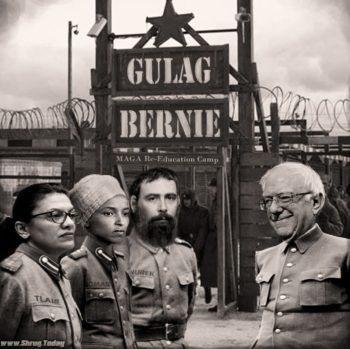
Some of Bernie Sanders’ most devoted fans have an unfortunate brutalitarian streak. The violent strain of so-called Bernie Bros aren’t as isolated as one might hope. First, of course, there was James Hodgkinson, the BB who attempted to assassinate Republican members of Congress at a congressional baseball game practice, seriously injuring Rep. Steve Scalise. Now, campaign field organizers for Sanders in Iowa and South Carolina have been captured on film proposing gulags, re-education camps, sentencing billionaires to hard labor, and shooting or beheading those opposed to Sanders’ policies. And much more. And they say this in all seriousness. What nice people have been assigned positions of responsibility within the Sanders campaign organization! Watch it for yourself at the link above.

Should we be surprised? No: these are advocates of forced collectivism, and if their favorable perspective on coercive power wasn’t enough of a tip-off, recent history suggests that many among them are truly ready and willing to do violence. The brutal and murderous history of collectivist regimes the world over demonstrates the tendency well enough. Stalin, Mao, Pol Pot, Castro and too many other leftist tyrants left bodies strewn in their wake as they sought to enforce their ideology. It’s no coincidence that the American Left holds the murderous Che Guevara in such high esteem. Black Lives Matter and Antifa have both perpetrated violent acts, and members of the Leftist media have openly advocated physical attacks on their political opponents. And then we have these Bernie Bros.

I feel compelled to review a bit of background on Bernie Sanders, the batty old communist who has managed to convince large numbers of poorly educated “intellectuals” that he knows the path to utopia. The nicer ones imagine that he’s a man of the people, though he hasn’t worked a day in his life at anything except agitation and rent seeking. He is an inveterate public mooch. His life history as a politician and as a person is rather unflattering.

I’ve used this Iowahawk (David Burge) quote about Sanders before:

Who better to get America back to work than a guy who was actually fired from a Vermont hippie commune for being too lazy.”

Apparently, Barack Obama is not a Bernie Bro:

Obama has told people in private that Sanders is both temperamentally and politically unfit to beat Trump in the 2020 general election, these people say. Among his concerns are Sanders’ strident form of politics and confrontational manners where he was known not to seek compromise during his long years in the US senate.”

And say what you will about Hillary Clinton, but her opinion of Sanders comports with much of what we know about The Bern:

He was in Congress for years. He had one senator support him. Nobody likes him, nobody wants to work with him, he got nothing done.”

At least the Bernie Bros have taken their masks off before getting too far. Give Leftists power and they all will.

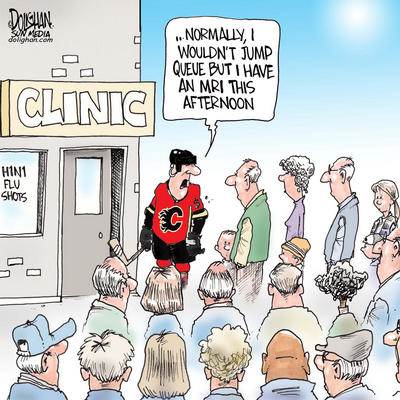
Single-Payer: Queue Up and Die Already

Tags

, , , , , , , , , , , , , , , , , , , , , , , ,

I constantly hear this sort of naive remark about health care in “other major countries”, and while Chris Pope’s rejoinder below should chasten the ignorant, they won’t listen (emphasis is mine):

“[Bernie] Sanders recently argued that ‘our idea is to do what every other major country on earth is doing,’ but this claim is … fictitious. In fact, there is not a single country in the world that offers comprehensive coverage with an unlimited choice of providers, fully paid for by taxpayers, without insurer gatekeeping, service rationing, or out-of-pocket payments. In reality, there is a direct trade-off between ease of access to providers and the cost borne by individuals in out-of-pocket expenses.”

Pope’s statement pretty much strips bare the fiction of “universal” coverage, a concept too loosely defined to be of any real use except as a rhetorical device. It also highlights the non-monetary costs inflicted on consumers by non-price rationing of care. The presumption that government must provide universal health care coverage and that all other developed countries actually have that arrangement is incorrect.

Pope has another article at the Manhattan Institute site, written late last year, on the lessons we can learn on health care from experience abroad under various payer systems. This offers a more detailed comparison of the structure of the U.S. payment system versus seven other countries, including Canada, the U.K., Australia, and Germany. Single-payer tends to be the “gold standard” for the Left, but the only systems that “approximate” single-payer are in Canada and the U.K. Here is one blurb about Canada:

Canadians have easy access to general practitioners, but getting an appointment to see a specialist is more difficult than in all the other nations studied in this report. The Canadian medical system provides the least hospital care, delivers consistently fewer outpatient procedures, and provides much less access to modern diagnostic technology.

Canadians also have limited access to drugs, according to Pope. And out-of-pocket (OOP) spending is about the same as in the U.S. At the first link above, Pope says:

Canadians spend less on health care than Americans mostly because they are not allowed to use as much — not because they are getting a better deal. … Waiting lists are generally seen as the single-payer budgeter’s friend, as some patients will return to health by themselves, others will be discouraged from seeking treatment, and a large proportion of the most expensive cases will die before any money is due to be spent on them.”

Pope says this about the U.K. at the second link:

U.K. hospitals often lack cutting-edge technology, and mortality after major emergency hospitalizations compares poorly with that of other nations in this report. Access to specialists is very limited, and the system falls well short of most other nations in the delivery of outpatient surgery.” 

Waiting times in the U.K. tend to be long, but in exchange for all these shortcomings in care, at least OOP costs are low. Relative to other payment systems, single payer seems to be the worst in several respects.

The other systems described by Pope are:

  • “dual payer” in Australia and France, with public entitlements and the choice of some private or supplemental coverage;
  • “competing payer” in Switzerland, Germany, and the Netherlands, whereby subsidies can be used to purchase coverage from private plans (and in Germany some “quasi-public” plans; and
  • “segmented payer” in the U.S., with two public plans for different segments of the population (Medicare for the elderly and Medicaid for the non-elderly poor), employer-sponsored coverage primarily from larger employers, individually-purchased private coverage, and subsidies to providers for “uncompensated care” for the uninsured.

Here is what Pope says about the various “multi-payer” systems:

“Dual-payer and competitive-payer systems blend into each other, according to the extent of the public entitlement in dual-payer countries …

… limitations in access to care are closely tied to the share of the population enrolled in private insurance—with those in Britain and Canada greatly limited, Australians facing moderate restrictions, and those in the other countries studied being more able to get care when they need it. 

The competing-payer model ideally gives insurers the freedom and responsibility to procure health-care services in a way that attracts people to their plans by offering them the best benefits and the lowest medical costs. While all competing-payer systems fall short of this ideal, in practice they consistently offer good access to high-quality medical care with good insurance protection. The competing-payer model is, therefore, best understood as an objective that is sought rather than yet realized—and countries including Germany, the Netherlands, France, and the U.S., which have experienced the most significant health-care reform over recent years, are each moving toward it.”

The U.S. has very high health care costs as a percent of GDP, but OOP costs are roughly in line with the others (except the Swiss, who face very high OOP costs). The U.S. is wealthier than the other countries reviewed by Pope, so a large part of the cost gap can be attributed to demand for health care as a luxury good, especially late in life. Insured U.S. consumers certainly have access to unrivaled technology and high-quality care with minimal delays.

Several countries, including the U.S., are plagued by a lack of competition among hospitals and other providers. Government regulations, hospital subsidies, and pricing rules are at the root of this problem. Third-party payments separate consumers from the pricing consequences of their health-care decisions, which tends to drive up costs. If that weren’t enough, the tax deductibility of employer-paid insurance premiums in the U.S. is an subsidy ironically granted to those best-able to afford coverage, which ultimately heightens demand and inflates prices.

Notably, unlike other countries, there is no longer an individual mandate in the U.S. or any penalty for being uninsured, other than the potential difficulty in qualifying for coverage with pre-existing conditions. Consumers who lack employer-sponsored or individual coverage, but have incomes too high to qualify for Medicaid or premium subsidies, fall into a gap that has been the bane of would-be reformers. There are a few options for an immediate solution: 1) force them to get insured with another go at an individual mandate; 2) offer public subsidies to a broader class; 3) let them rely on emergency-room services (which cannot turn them away) or other forms of uncompensated care; 4) allow them to purchase cheap temporary and/or catastrophic coverage at their own expense; 5) allow portability of coverage for job losers. Recently, the path of least political resistance seems to have been a combination of 3, 4, and 5. But again, the deficient option preferred by many on the Left: single-payer. Again, from Pope:

Single-payer systems share the common feature of limiting access to care according to what can be raised in taxes. Government revenues consistently lag the growth in demand for medical services resulting from increased affluence, longevity, and technological capacity. As a result, single-payer systems deliver consistently lower quality and access to high-cost specialty care or surgical procedures without reducing overall out-of-pocket costs. Across the countries in this paper, limitations in access to care are closely tied to the share of the population enrolled in private insurance—with those in Britain and Canada greatly limited…”

The Wealth of Space Colonies

Tags

, , , ,

Pilgrim colonies in outer space will fare better under the liberal order of capitalism than socialism. Both forms of social organization require some form of governance: various rules regulating or prohibiting behavior and a system for adjudicating violations. Socialist pilgrims would be subject to central decision-making in all or most social affairs, as well as common property ownership and equally-shared rewards from effort of any kind. These are the classic conditions under which a tragedy of the commons can be expected, which would jeopardize the very survival of the colonists. In contrast, capitalist pilgrims would be subject to rules defining property rights; individuals would be free to make various production decisions and contract freely with one another, and perhaps only a portion of the rewards for effort would be shared equally via taxation. In other words, a great deal of the governance that takes place under capitalism would be of a private nature, just as it is on Earth in the advanced economies.

The authoritarian impulses of mission sponsors and planners might hold sway for a time, but they will ultimately clash with the long-term survival imperative. That might give way to a “discovery process” whereby authorities elect to conduct experiments to test various forms of social organization and degrees of individual autonomy. Rand Simberg has a pretty good idea about what those experiments would turn up. In “Socialists in Space“, he covers the history of the U.S. space program as a “command” model. A shift toward more private space activity is still underway, of course, but the power of competition and private enterprise to reduce costs is already evident. The subtitle to Simberg’s article extends that point: “Opening a frontier is hard. Its even harder when you’re a socialist“. He cites the cogent example of the pilgrim colony established by the passengers on the Mayflower:

When the Plymouth Company adopted the settlement’s initial economic rules, it stated that “all profits & benefits that are got by trade, traffic, trucking, working, fishing, or any other means” were to be placed in the common stock of the colony, and that ‘all such persons as are of this colony, are to have their meat, drink, apparel, and all provisions out of the common stock.’ In other words, to use a phrase from a subsequent century: From each according to his ability, to each according to his needs.

About half the settlement died of starvation in the first winter. It was only after the colony changed its rules to allow people to keep the product of their own efforts, for their consumption or for sale, that they finally had the first bountiful harvest. This wasn’t a unique event; many of the early English settlements, including Jamestown a few years earlier, had to learn the lesson the hard way.”

Lest you object that many Native American civilizations lived for centuries under harsh conditions despite their collectivist forms of governance, it is something of a myth that those tribes always treated property as common. In fact, as Terry L. Anderson wrote in 1997:

“... while there were exceptions that led to the tragedy of the commons, generally American Indians understood the importance of incentives. Property rights, supplemented by customs and traditions where appropriate, often produced the incentives that were needed to husband resources in what was frequently a hostile environment.”

Simberg goes on to discuss the kinds of necessities, or actually opportunities, that are likely to arise in space. Entrepreneur-capitalists will exploit these more successfully than socialist workers ever could. That includes uses of extraterrestrial materials, agriculture, manufacturing, and terraforming solutions. There will be successes and failures, but the efforts will be diversified and the probability of success, and survival in an environment of extreme scarcity, will be improved by the superior structure of incentives for agents having ownership. There will be some dependency on the mission’s sponsoring organization for a considerable period of time, which might dictate certain “terms of trade”. Nonetheless, a liberal order is ultimately the surest way to make a colony prosper on any body or man-made structure in the universe.

We have seen repeatedly that the most effective means of achieving common objectives like ending privation, or indeed, survival, is individual liberty. Freedom and voluntary trade unlock growth in prosperity, thus providing the means for achieving broader social objectives (like the colony’s survival) and the provision of public goods.

For the foreseeable future, it is likely that missions into space, from launch to arrival and initial encampment, will be central planned, but the planning need not be the responsibility of any national government. Again, private space missions are a reality and are growing as a share of launches and payload. After all, the Mayflower itself was a private merchant vessel. The transit itself involves a singular overriding goal: to reach the destination safely, which is subject to high risks of catastrophe and thinly-tested technologies. Thus, it’s reasonable to expect a command structure to be more effective in transit than a crew of autonomous decision makers. Like the Mayflower, passengers will have limited freedoms while on board and during the initial stages of their settlement.

That may differ for more extended the missions. Just as there are likely to be greater benefits from personal autonomy in permanent settlements on moons and planets, the same would be true on multi-generational journeys to other star systems.

International treaties regarding activities and claims on resources in outer space are an area of controversy, according to Simberg. Some hope to use treaties to collectivize space, demanding “collective property rights” and equity in the use of extraterrestrial resources. I wrote about related topics last year in “Space, Property Rights, and Scarcity“, quoting a few uninformed comments by purported experts on space law about scarcity, capitalism, and the “global commons” theory of rights in outer space. Fortunately, there is considerable resistance to their socialist designs. Harvesting resources from outer space will be greatly encouraged by private incentives, much to the benefit of all mankind. And successful colonization of other worlds demands liberalized social arrangements that rely on private incentives. Fortunately, as Simberg says, the “current administration has repeatedly stated that space is not in fact a commons“.


Scorning the Language of the Left

Tags

, , , , , , , , , , , , , , , , , , , , , , , , ,

It’s hard not to ridicule some the language adopted by our lefty friends, and it can be fun! But it’s not just them. We hear it now from employers, schools, and otherwise sensible people too eager to signal their modernity and virtue. Lionel Shriver dissects some of this “Lefty Lingo” in an entertaining piece in Harper’s. It’s funny, but it aroused my contempt for the smugness of the “wokescenti” (a term Shriver attributes too Meghan Daum) and my pity for those “normals” simply desperate to project progressive sophistication.

Here are a few of Shriver’s observations:

“Privilege”: makes you incapable of understanding that which you criticize.

Whereas a privilege can be acquired through merit—e.g., students with good grades got to go bowling with our teacher in sixth grade—privilege, sans the article, is implicitly unearned and undeserved. The designation neatly dispossesses those so stigmatized of any credit for their achievements while discounting as immaterial those hurdles an individual with a perceived leg up might still have had to overcome (an alcoholic parent, a stutter, even poverty). For privilege is a static state into which you are born, stained by original sin. Just as you can’t earn yourself into privilege, you can’t earn yourself out of it, either. … . it’s intriguing that the P-bomb is most frequently dropped by folks of European heritage, either to convey a posturing humility (“I acknowledge my privilege”) or to demonize the Bad White People, the better to distinguish themselves as the Good White People.

Meanwhile, it isn’t clear what an admission of privilege calls you to do, aside from cower. That tired injunction ‘Check your privilege’ translates simply to ‘S.T.F.U.’—and it’s telling that ‘Shut the fuck up’ is now a sufficiently commonplace imperative to have lodged in text-speak.”

“Cisgender”: “Cis-” is a linguistic shell game whereby the typical case is labelled cis-typical.

Denoting, say, a woman born a woman who thinks she’s a woman, this freighted neologism deliberately peculiarizes being born a sex and placidly accepting your fate, and even suggests that there’s something a bit passive and conformist about complying with the arbitrary caprices of your mother’s doctor. Moreover, unless a discussion specifically regards transgenderism, in which case we might need to distinguish the rest of the population (‘non-trans’ would do nicely), we don’t really need this word, except as a banner for how gendercool we are. It’s no more necessary than words for ‘a dog that is not a cat,’ a ‘lamppost that is not a fire hydrant,’ or ‘a table that is actually a table.’ Presumably, in order to mark entities that are what they appear to be, we could append ‘cis’ to anything and everything. ‘Cisblue’ would mean blue and not yellow. ‘Cisboring’ would mean genuinely dull, and not secretly entertaining after all.”

Microaggression“: Anything you say that bothers them, even a little.

… a perverse concoction, implying that the offense in question is so minuscule as to be invisible to the naked eye, yet also that it’s terribly important. The word cultivates hypersensitivity.”

“_____-phobic”: the typical use of this suffix in identity politics stands “phobia” on its head. To be fair, however, it started with a presumption that people hate that which they fear. Maybe also that they fear and hate that which they don’t care for, but we’ll just focus on fear and hate. For example, there is the notion that men have deep fears about their own sexuality. Thus, the prototypical gay-basher in film is often compensating for his own repressed homosexual longings, you see. And now, the idea is that we always fear “otherness” and probably hate it too. Both assertions are tenuous. At least those narratives are rooted in “fear”, but it’s not quite the same phenomenon as hate, and yet “phobic” seems to have been redefined as odium:

The ubiquitous ‘transphobic,’ ‘Islamophobic,’ and ‘homophobic’ are also eccentric, in that the reprobates so branded are not really being accused of fearfulness but hatred.”

LGBTQ“: Lumping all these “types” together can be misleading, as they do not always speak in unison on public policy. But if we must, how about “Let’s Go Back To ‘Queer'”, as Shriver suggests. The LGBs I know don’t seem to mind it as a descriptor, but maybe that’s only when they say it. Not sure about the trannies. There is a great Libertarian economist who is transsexual ( Dierdre McCloskey), and somehow “queer” doesn’t seem quite right for her. Perhaps she’s just a great woman.

The alphabet soup of ‘LGBTQ’ continues to add letters: LGBTQIAGNC, LGBTQQIP2SAA, or even LGBTIQCAPGNGFNBA. A three-year-old bashing the keyboard would produce a more functional shorthand, and we already have a simpler locution: queer.”

“Problematic”, “Troubling” and “Inappropriate”: I’m sure some of what I’ve said above is all three. I must confess I’ve used these terms myself, and they are perfectly good words. It’s just funny when the Left uses them in the following ways.

Rare instances of left-wing understatement, ‘problematic’ and ‘troubling’ are coyly nonspecific red flags for political transgression that obviate spelling out exactly what sin has been committed (thereby eliding the argument). Similarly, the all-purpose adjectival workhorse ‘inappropriate’ presumes a shared set of social norms that in the throes of the culture wars we conspicuously lack. This euphemistic tsk-tsk projects the prim censure of a mother alarmed that her daughter’s low-cut blouse is too revealing for church. ‘Inappropriate’ is laced with disgust, while once again skipping the argument. By conceit, the appalling nature of the misbehavior at issue is glaringly obvious to everyone, so what’s wrong with it goes without saying.”

Here are a few others among my favorites:

Patriarchy“: This serves the same function as “privilege” but is directed more specifically at the privilege enjoyed by males. Usually white, heterosexual males. It seeks to preemptively discredit any argument a male might make, and often it is used to discredit Western political and economic thought generally. That’s because so much of it was the product of the patriarchy, don’t you know! And remember, it means that males are simply incapable of understanding the plight of females … and children, let alone queers! Apparently fathers are bad, especially if they’re still straight. Mothers are good, unless they stand with the patriarchy.

Hate Speech“: This expression contributes nothing to our understanding of speech that is not protected by the Constitution. If anything its use is intended to deny certain kinds of protected speech. Sure, originally it was targeted at such aberrations as racist or anti-gay rhetoric, assuming that always meant “hate”, but even those are protected as long as they stop short of “fighting words”. There are many kinds of opinions that now seem to qualify as “hate speech” in the eyes of the Identitarian Left, even when not truly “hateful”, such as church teachings in disapproval of homosexuality. There is also a tendency to characterize certain policy positions as “hate speech”, such as limits on immigration and opposition to “living wage” laws. Hypersensitivity, once more.

Sustainability“: What a virtue signal! It’s now a big game to characterize whatever you do as promoting “sustainability”. But let’s get one thing straight: an activity is sustainable only if its benefits exceed its resource costs. That is the outcome sought by voluntary participants in markets, or they do not trade. Benefits and costs “estimated” by government bureaucrats without the benefit of market prices are not reliable guides to sustainability. Nor is Lefty politics a reliable guide to sustainability. Subsidies for favored activities actually undermine that goal.

There are many other Lefty catch phrases and preferred ways of speaking. We didn’t even get to “safe space”, “social justice”, and the pronoun controversy. Shriver closes with some general thoughts on the lefty lingo. I’ll close by quoting one of those points:

The whole lexicon is of a piece. Its usage advertises that one has bought into a set menu of opinions—about race, gender, climate change, abortion, tax policy, #MeToo, Trump, Brexit, Brett Kavanaugh, probably Israel, and a great deal else. Reflexive resort to this argot therefore implies not that you think the same way as others of your political disposition but that you don’t think. You have ordered the prix fixe; you’re not in the kitchen cooking dinner for yourself.”

 

Feckless Greens Burn Aussie Bush

Tags

, , , , , , , , , , , , , , , , , , , , , , , , , , ,

The raging Australian bush fires have been expansive and deadly. Country-wide, over 12 million acres have burned over the past few months, an area approaching twice the size of Massachusetts. The burnt areas in some regions rival or exceed individual fires of the past, such as the Black Friday fire of 1939, which burned about 5 million acres. As bad as the recent fires have been, note that various outlets in the U.S. have felt it necessary to exaggerate the size of the burnt area (also see here). And the season’s burnt area has not even approached the total for 1974-1975, when over 250 million acres burned.

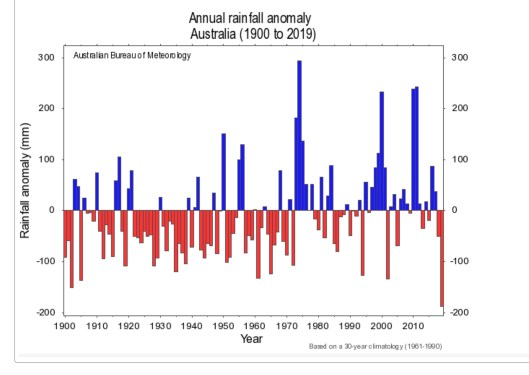
So what causes these bush fires? Dry weather and plenty of fuel from dead vegetation create the hazard, of course. A spark is needed, as from lightning, an accident, an arsonist, or perhaps even a blistering sun, but warm temperatures are unnecessary. Nevertheless, the narrative we hear year-in and year-out is that global warming is to blame for wildfires. My commentary on the climate-change hubbub over the 2018 California fires is here. As for Australia’s fires, there is similarly ample evidence that climate change or warming has nothing to do with it. Rather, as in California, there is a pattern of mismanagement of forests and brush combined with population growth, accidents, and arson, and of course a dry spell. This dry spell has been severe, but the trend in Australia over the past 120 years has been toward more precipitation, not less, and the past 25 years have been relatively rainy. The rain comes with a downside, however: it encourages growth in vegetation, much of which dies every dry season, leaving plenty of fuel for fires. And the fuel has been accumulating.

Mike Shedlock at Mishtalk offers some pertinent observations. First, he quotes James Morrow in the Wall Street Journal:

Byzantine environmental restrictions prevent landholders from clearing scrub, brush and trees. State governments don’t do their part to reduce the fuel load in parks. Last November a former fire chief in Victoria slammed that state’s ‘minimalist approach’ to hazard-reduction burning in the off-season. That complaint is heard across the country.

Prescribed burns have been in decline and focused on areas adjacent to suburbs, leaving vast areas of accumulating fuel. This is a product of wrongheaded conservation efforts and resistance to CO2 emissions. These policymakers haven’t done favors for Australia or the world on either count. Shedlock reinforces this point with the following statement from Patrick Michaels and Myron Ebell:

Australia has been ready to explode for years. David Packham, former head of Australia’s National Rural Fire Research Centre, warned in a 2015 article in the Age that fire fuel levels had climbed to their most dangerous levels in thousands of years. He noted this was the result of ‘misguided green ideology.'”

Eucalyptus trees grow thickly in many fire-prone areas of Australia, and Shedlock says these trees act as a multiplier on the fire hazard. Yet these trees remain a favorite landscape feature for suburbians even in fire-prone areas. He quotes Marc Lallanilla in LiveScience:

Fallen eucalyptus leaves create dense carpets of flammable material, and the trees’ bark peels off in long streamers that drop to the ground, providing additional fuel that draws ground fires up into the leaves, creating massive, fast-spreading ‘crown fires’ in the upper story of eucalyptus forests. … Additionally, the eucalyptus oil that gives the trees their characteristic spicy fragrance is a flammable oil: This oil, combined with leaf litter and peeling bark during periods of dry, windy weather, can turn a small ground fire into a terrifying, explosive firestorm in a matter of minutes. That’s why eucalyptus trees — especially the blue gums (Eucalyptus globulus) that are common throughout New South Wales — are sometimes referred to wryly as ‘gasoline trees.’

The introduction of non-native invasive grasses has also been blamed for increasing the fuel load in the bush. And as incredible as it may seem, certain birds native to Australia are spreading bushfires by carrying and dropping burning sticks in grasslands to flush out prey. Birds are indeed tool users! The Whistling Kite and the Black Kite are sometimes called “arson raptors”, according to Leslie Eastman at this link.

The hypothesis that climate warming from CO2 emissions is the cause of the bushfires is undermined by all of the above. Then, of course, there are the arsonists and accidental fires. Over 180 people have been arrested for setting recent brushfires intentionally in New South Wales alone, and 103 others in Queensland. (Also see here.) Jim Steele reports that human ignitions account for 66% of bush fires, while just 11% are caused by lightning. Population growth has brought more people into close proximity with the bush, which increases the exposure of humans to fire danger and might well add to the number of accidents and potential arsonists. Obviously, human and avian arson, and accidents, are not within the line of causation that climate alarmists have in mind.

Roy Spencer addresses some of the inconsistencies in the claimed link between climate warming and the Australian bushfires. First, of course, is the trend in rainfall. Climate models based on CO2 forcings predict no long-term trend in Australia’s rainfall, but again, rainfall has increased in Australia during the era of accelerated forcings. Interestingly, the fires of 1974-75 occurred during a period that was quite rainy, but that rain might have added so much to the annual vegetation cycle that it exacerbated the effect of dry season. Temperatures in Australia were quite warm in 2019, but the climate models cannot account for that variation, especially as Australian temperatures are subject to high variability from year-to-year. It’s been hotter before, though the temperature records in Australia have been subject to some controversial “editing”. Finally, Spencer notes that global wildfire activity has been in decline for many years, despite the mild warming we’ve experienced over the past 50 years (also see here).

Australia has bush fires every year, and this year has been particularly bad, but it might not reach the proportions of the fires in 1974-75. The causes are: poor burn management practices, or sometimes neglect and no burn management at all, allowing dead vegetation to accumulate to dangerous levels; arson, which has been implicated in a large number of fires this year; and 2019 was a very dry year. The contention that global warming or climate change is responsible for these bush fires is a dangerous distraction from reforms that can minimize fire hazards in the future.

For additional reading of interest, see Australia Fires … and Misfires” by Willis Eschenbach and The Mathematics of Connectivity and Bush Fires: A Note From David Ward” a post from Jennifer Marohasy’s blog.

3 Cheers, No Tears for Strike on Master of Iranian Terror

Tags

, , , , , , , , , , , , , , , , , , , , , , , ,

Note: As I finish this post, Iran has fired missiles at U.S. bases in Iraq, so we know a bit more about their response to the killing of Qassim Soleimani. Tonight’s response by Iran looks to have been impotent. There are risks of other kinds of action, of course. We shall see.
Last week’s killing of Iranian General Qassim Soleimani was not prompted solely by the attack on the U.S. embassy in Iraq by Kataeb Hezbollah, the Iranian-backed militia. Iran, perhaps the largest state-sponsor of terrorism in the world, has been guilty of provocation and aggression in Iraq, Syria, Saudi Arabia and elsewhere under Soleimani’s direction for many years. And he was reviled for his ruthless treatment of protestors within Iran’s borders. In recent weeks there had been a series of rocket attacks on U.S. bases, and there was “chatter” that much more was planned. It’s been noted that the presence of so-many high-level officials in one place at the time of the attack on Soleimani indicated that something big was in the works. This Reuters article gives some insight into Soleimani’s suspicious activities in the weeks prior to his death, of which the U.S. was surely aware. While the attack on the U.S. embassy provided additional pretext (as if it was needed), all of this indicates that Soleimani’s assassination was not an impulsive decision, but deliberated, contrary to assertions by critics of President Trump’s decision to act. It was both retaliatory and preemptive. Soleimani’s travels and whereabouts were well known, and it’s highly likely that a “decapitation” had been planned as a contingency for some time. This report in Politico provides details of the decision making leading up to the strike. The attack was executed brilliantly by all accounts.

The U.S. had retaliated to earlier rocket attacks with strikes against Kataeb Hezbollah positions. That the strike on Soleimani was more than retaliation and an act of self-defense against additional threats is, I believe, the flaw in arguments against the strike like the one Tyler Cowen seemed to make in Bloomerg (though his main point was different). The value of the strike goes far beyond retaliation. This was not intended to be another volley in an ongoing series of “tits-for-tats”.

In addition to Soleimani, several other high-level Iranian military personnel were killed. This undoubtedly disrupted plans that would have threatened U.S. soldiers and assets, yet some describe the strike as an “impulsive” act on Trump’s part, and an “act of war”, as if unprovoked. And as if Iran had not been warring on the U.S. for the past 40 years. What to make of those who take this position?  Of course, most are reflexively anti-Trump, refusing to evaluate the decision on it’s own merits. They pretend that Soleimani and the Iranian overseers of the stooge government in Iraq have legitimacy. Anderson Cooper actually compared Soleimani to Charles De Gaulle. It would be more accurate to compare him to the murderous Che Guevara, but then again, many on the Left worship Che’s memory as well! These fools will tell you that Soleimani was “worshipped” in Iran. In fact, there are a great many Iranians who are quietly celebrating his death.

Middle East analyst Avi Melamed does not mince words in describing the impact Soleimani has had on the Middle East (emphasis his):

Some argue that the assassination of Soleimani will increase tensions in the Middle East. This outlook confuses cause and effect: Tensions in the Middle East have intensified over the past decade because of the violent Iranian aggression which Soleimani spearheaded. Aggression which has led to Syria’s destruction and the disintegration of Lebanon and Iraq. Aggression that threatens maritime routes and safe passage in the Arab (Persian) Gulf and the Red Sea, a direct attack on Saudi Arabia’s oil facilities that spiked oil prices and compromised the world’s oil supply. Aggression that has fueled and intensified tensions – including direct military confrontations – between Iran and its proxies and Israel.

General Soleimani and the Al-Quds force led the escalation in the region in the service of the hegemonic vision of the Iranian Mullah regime. Their actions have so far claimed the lives of hundreds of thousands of people, led to the destruction of states, the disintegration of cities, and caused a wave of millions of refugees. Killing Soleimani is not the cause of the escalation – but the result.”

Malamed expected Iran to take retaliatory actions in Iraq, where it already has a strong military presence and good reconnaissance. Missiles have now been fired at U.S. bases from Iran (as of tonight), but with few or no casualties. It remains to be seen how effective a response the Iranians can mount. Any short-term U.S. casualties should probably not be viewed as incremental, given the high likelihood of casualties had Soleimani lived. Perhaps Iran will fire missiles at Israel from western Iraq or Syria, or at Saudi Arabian oil assets, as it did last September. Or it might make a bold military intervention in Iraq to strengthen its control there, which Iran considers crucial to its own security.

Al Monitor believes the assassination “leaves Iran with very few options to retaliate” with any strength, at least in the short-run:

… the economic hardship in Iran — in addition to the challenges the government is facing internally — would not allow Tehran to increase the tension. Iran’s past conduct against Israel strikes on Iranian bases in Syria also shows it will not seek revenge if its national security and interests are in danger. … This all indicates that Iran and its proxies in the region most likely would not seek revenge in the near future and — in regard to Iraq, in particular — would not lead Iraq to fall into a civil war or mass destruction, because it would lose even more in Iraq if it takes such a risk.”

So despite the brash talk, Iran is weak and spread thin across commitments outside its borders, and the regime has real fear of retaliation by its enemies that can only have been reinforced by the strike against Soleimani. Of what other retaliatory actions is Iran capable, assuming the regime can survive in the longer run? And assuming the Mullah regime itself is willing to take existential risks? It has threatened actions against civilians in the West. Can it bring down planes? Can it bomb targets in the U.S.? Can it develop or buy a small nuclear device? It can try any of those things, of course, but with uncertain odds and with risks it might not want to take. Survival is of the utmost importance to the regime, and it is already on shaky ground.

Trump’s critics claim that he authorized the “decapitation” without a plan for its aftermath. Trump has made clear his intent to “punch back twice as hard”, as it were, in response to any additional force from Iran. This is, first and foremost, a game of deterrence. Beyond that, however, and despite talk of “changing the Iranian regime’s behavior”, it appears that the larger plan pursued by Trump is to continue undermining the regime with sanctions and targeted strikes, if necessary. “Maximum pressure”. But there will be no World War III. The markets seem pretty comfortable about that as well, including the oil market.

I do take issue with Trump’s mention of the possibility of striking “cultural sites” in Iran, though he seems to have retracted it. On that point, however, I fully agree with Tyler Cowan (linked above). The only plausible rationale for such a statement is to frighten Iran’s leadership, especially if it has located military and intelligence functions within cultural sites.

Trump still maintains that our ultimate goal should be withdrawal from Iraq. That assumes stabilization in the region and fair elections, which would be well-served by a weaker Iran or a regime change there. As Victor Davis Hanson explains, the Middle East is of declining importance in world energy markets and trade generally. That’s one reason we’re unlikely to ever again send a huge ground force to the region, and it’s a good reason to scale back our presence in the Middle East generally.

The World At Less War

Tags

, , , , , , , ,

War is hell, but the good news is we’ve seen a global trend toward less of it over the past 20 years, according to the just-released annual report from StrategyPage:

“Overall things are a lot more peaceful than the headlines or Internet chatter would have you believe. Like most major trends, world peace just kind of sneaked up on everyone and a lot of people have not noticed.”

These misperceptions can be attributed to the enhanced coverage of even incidents that are minor by historical standards, and the ready access to information in the internet age. Perceptions are heavily manipulated by the media, which often feeds on “scare stories”.

The StrategyPage report covers the recent evolution of conflicts in various parts of the globe. The warring that persists tends to be concentrated in certain kinds of societies:

“While there are still a few stone-age cultures left on the planet [with conflicts] there are also several more advanced ones that are cursed with a culture of medieval mayhem. These have come to be called failed states and the most active ones, Somalia and Afghanistan are often in the news. There are still a few imperial powers in the headlines. … The troublesome empires currently in the news include China, Russia, Iran, Turkey the Islamic Caliphate. Turkey, Russia and Iran are technically democracies but for the moment the imperial ways are ascendant and the main cause of problems with their neighbors.”

The report cites statistics on both “human development” and corruption, noting the association of war-making and terrorism with low levels of the former and high levels of the latter:

Wars tend to be found in nations that are poorly (if at all) governed. This usually means corrupt rulers and a corrupt economy that is unable to provide for the welfare of the people. The nations mired in war and general mayhem tend to be those that score lowest on international surveys of well-being and lack of corruption. For example, the ten nations suffering the most terrorism deaths rank lowest in the Human Development Index the UN has compiled annually during the last 29 years…. The least corrupt nations have been most successful in leaving tribalism behind. The major reason tribalism survives is because, when lacking the presence of effective (high [corruption index]) nation-state a tribal government is usually the best alternative.”

There is an interesting discussion in the report about the similarities between modern-day fascist China and ascendant Naziism in Germany in the 1930s. Both can be described as market economies overseen by dictatorial, socialist regimes, together with strong militaries, territorial ambitions, and a large majority invested in feelings of racial superiority:

China has similar goals to 1930s Germany. China has territorial claims on neighbors and wants more territory and resources for its huge population. The Chinese believe in the racial superiority of the Han ethnic group (which most Chinese belong to) and of historical destiny to rule the largest possible empire. Until the 18th century China was the largest nation-state on the planet but then went into decline for two centuries. Most Chinese agree that it is time for China to once again be the most powerful state in the world. This is causing problems.”

Here are a some of the other statistics quoted in the report:

“Since the end of the Cold War in 1991 deaths from wars and large scale civil disorder (which is often recorded as some kind of war) have led to a sharp (over 20 percent so far) drop in violence worldwide. This occurred despite increasingly active and lethal Islamic terror groups.

… most war deaths are not caused by terrorists and even in 2014 (a peak year for Islamic death cults seeking to revive the Caliphate), terrorism-related deaths (mostly Islamic terrorism) accounted for 20 percent of all war-related deaths. Islamic terrorism gets the most publicity but less glamorous disputes do most of the killing.

Global Islamic terrorism-related deaths have fallen by over 50 percent since 2014 when there were 35,000. Global deaths hit 19,000 in 2017 and under 16,000 for 2018. These deaths are still declining. This activity is most visible in the GTI (Global Terrorism Index), which counts all forms of terrorism.

In 2018 worldwide terrorism deaths declined 15 percent to 15,952. This decline is, so far, a four year trend …”

The StrategyPage report is encouraging in many ways. There is no question that international conflict could escalate quickly under certain circumstances. And there are heavy risks involved in the presence of nuclear weapons. An implication is the importance of preventing warring regimes, such as the religious dictatorship in Iran, from acquiring nuclear capabilities and threatening other nations with terror. The large players who possess nuclear weapons, for their part, are extremely cautious when it comes to the prospect of a “fighting war” with one another.

Ultimately, one hopes that economic advancement and the opportunities promised by modernity will dampen conflict within and between more backward societies. But as the report points out, there will always be adherents of failed, repressive dogmas, and these factions are often the agents of provocation and war-making. They cannot always be ignored. They should not be appeased.

Poverty Propaganda Smears the U.S.

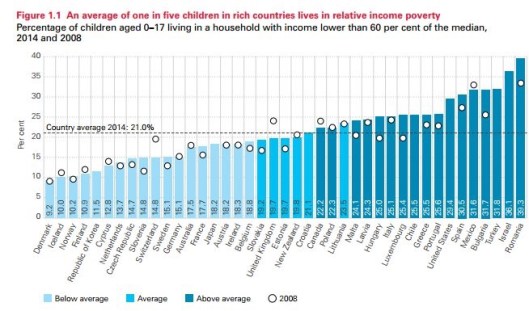
Fake poverty statistics are a popular tool among America’s critics, both internal and external. Warren Meyer has a great post on these misleading metrics, which seem to be presented with the utmost sincerity by their proponents. Or are they?

A mis-step in these calculations is in taking relativism to absurd lengths: Relative median incomes are of interest across countries, of course, or at any fixed percentile. But how about comparisons of incomes relative to median income across countries? As Meyer ably explains, that kind of comparison is not only meaningless but actually misleading.  The chart at the top of this post is an example of what he means, taken from statistics published by the World Economic Forum (WEF):

Relative child poverty is a metric based on the country’s median income — how many kids live in families with income that is X% of the median. 

If you click on the source [WEF], the headline presents this as ‘These rich countries have high levels of child poverty.’ The implication is that the US has more child poverty than Latvia or Poland or Cyprus or Korea and only slightly less child poverty than Mexico and Turkey.  But does it really mean this? No. This chart is a measure of income equality, NOT the absolute well-being of children.

Many of the countries ahead of the US are there not because their poor are well off, but because their median income is so much lower than ours. In fact, you will notice the lack of African and Asian countries in this. I will bet a lot of money that certain countries in Africa and Asia everyone knows to be dirt poor would beat out the US in this, thus making the bankruptcy of this metric obvious.

Take Denmark in the #1 spot. It looks like 20% more kids in the US live in poverty than in Denmark. But per the OECD, the US has a median income 41% higher than Denmark. So what it really means is the US has 20% more kids living under an income bar that is set 41% higher. How can this possibly have any meaning whatsoever, except to someone who wants to make the US look bad?”

So the metric seems designed to take advantage of the compression of incomes in poor countries to make them look better than they really are in terms of child poverty.

This is not an isolated example. Meyer offers other examples of distorted poverty statistics that would show 0% relative poverty if everyone earned exactly $1 per year! He also cites Census Bureau statistics showing roughly constant levels of poverty in the U.S. over 60 years while ignoring the impact of taxes and transfer payments. Correcting that “oversight” results in substantial declines in poverty.

Meyer closes with a postscript reminding us of the ongoing human progress in overcoming penury:

Well, in 1820, 94 percent of the world’s population lived in extreme poverty (less than $1.90 per day adjusted for purchasing power). In 1990 this figure was 34.8 percent, and in 2015, just 9.6 percent. … In the last quarter century, more than 1.25 billion people escaped extreme poverty – that equates to over 138,000 people … being lifted out of poverty every day.

The credit goes to free market capitalism.

Keeping My Resolution Starts With the Bee

Tags

, , , , , , , , , , , ,

I’m too lazy to check the archives right now, but I’m sure I’ve said this once before: I resolve to mix in more brief posts in the new year. My blogging hours (sometimes minutes) are limited on a day-to-day basis, so it’s taking too many days to wrap-up posts. My son says I should break them into parts. Maybe, but that won’t reduce the time I spend on a given topic.

Another motive for my resolution: I see so many items I’d like to share here, but I put them off in order to get back to a draft. I have to go where the whiffs of inspiration take me in a given session. But then… I either forget the short items or something else comes along to excite my long-windedness.

So, here is my first “short-form” blog share of 2020, from the Babylon Bee in early 2017:  

Culture In Which All Truth Is Relative Suddenly Concerned About Fake News

The piece reminded me of when poor Kellyanne Conway was castigated by the Left for using the expression “alternative facts” in reference to attendance at Trump’s inauguration. She’ll be fine, of course, but the photo comparison favored by the Left used an early pre-ceremony photo for Trump in 2017 and a peak-crowd photo for Obama in 2009. The Obama crowd was almost certainly larger than the real Trump crowd, but the whole thing was sort of a big “so what?”, especially given the well known political leanings of the local population.

Both Left and Right have been selectively reporting and distorting news (and editing photos) for a long time, the rise of so-called “fact checkers” notwithstanding. Alternative “facts” indeed! But our leftist friends are constant champions of relativism, often to the point of kookiness, while blissfully unaware that their “truths” and “facts” are severely shaded.

This was supposed to be short! Gah! More fake news! With that, here are some choice quotes from the Bee:

One Oregon man, who rejects the idea that humanity can even be sure the universe exists in any meaningful sense, was nonetheless disturbed by the idea that websites could publish completely false information, for anyone in the world to read. …

Tech conglomerates such as Facebook and Google have vowed to meet the trend head-on, assuring the public that they are taking bold steps to filter out any news that contradicts the version of truth that they decide is acceptable.”

The Impaired Impeachment

Tags

, , , , , , , , , , , , , , , ,

biden-impeach-trump

To avoid defections in their ranks, House Democrats had to pare back so much on the counts for impeaching Donald Trump that they laid bare the raw political motives for bringing the action. Not that their motives needed clarification. They’ve been dying to find grounds on which to impeach Trump since the day of his election. They also know the Senate will not remove Trump from office. Now, the real point is to stain the President as he seeks re-election, and that should strike anyone as an illegitimate purpose.

The two impeachment counts, abuse of power and obstruction of Congress, are flimsy. Proof of the first would require infallible mind-reading skills. It’s doubtful that the Democrats are any better at that than their inability to follow the simple facts of the case. During the controversial phone call with Ukrainian President Zelensky, Trump clearly expressed interest in whether the Ukraine would investigate possible interference in the 2016 U.S. presidential election, and whether the Bidens had been involved, given their involvement with Ukrainian organizations that may have had connections to the Steele dossier. That’s a fair question and a legitimate area of inquiry for the chief executive. It can’t be helped that Joe Biden happens to be running for the Democrat presidential nomination in 2020, as if running for office was enough to absolve one of crime.

The second impeachment count against Trump relies on vacating the constitutional privileges accorded to the chief executive, privileges to which President Obama, and others before him, generously availed themselves (also see here).

House Speaker Nancy Pelosi now has opted to delay transmitting the impeachment articles to the Senate. She said it was important for the House to wrap up their proceedings quickly, so much so that her party could not be bothered to bring a court challenge against Trump’s assertion of executive privilege. But now, Pelosi insists that she must be assured the Senate trial will be conducted “fairly”, as if the proceedings in the House were remotely fair to the President.

One of the House Democrats’ own expert witnesses asserts that the President’s impeachment is not official until the articles are transmitted to the Senate. That might be, but he overlooks the Supreme Court’s 1993 ruling in Nixon vs. the United States in which the Court said that no trial is required for the Senate to acquit anyone impeached by the House, and it may do so without judicial review. So, the Senate can acquit the President now, without a trial and without waiting for Speaker Pelosi to transmit the “charges”, should Senate Majority Leader Mitch McConnell decide to bring it to a vote. Of course, he might not want to as a matter of optics as well as pressure from an incensed Trump to air all of the laundry.

Like the misguided impeachment itself, Pelosi’s motive for holding the transmittal in abeyance is political. Democrats, quite possibly unaware of the Senate’s power under Nixon, and facing their comeuppance, might hope the public forgets the charade that took place in the House and blame Republicans for an “unfair” Senate process that would let Trump off the hook. Or, Pelosi might be hoping for a weakening of Republican resolve on establishing rules for a trial in the Senate, but even that calculation is chancy. It’s even possible Pelosi imagines she can delay the transfer through the 2020 election, hoping to use the House impeachment again and again as a cudgel with which to batter Trump’s re-election chances. Fat chance!

Or is the delay a form of damage control? Does it have something to do with Joe Biden’s vulnerability? He is perhaps at greater risk under a Senate impeachment trial of Trump than Trump himself. Biden is the one who gloated publicly of how he cowed the Ukrainians into dropping an investigation of Burisma, the gas company for which his son Hunter was a board member, by threatening to withhold loan guarantees. Quid Pro Joe!

Biden’s has stated that he would not comply with a subpoena to appear before the Senate in the matter of the Trump impeachment, apparently confusing Trump’s status as the executive with privilege with his own status as an out-of-office candidate for the Democrat nomination. Oh, wait! Now Biden says he would appear after all! Is the contrast between Trump’s phone conversation with the Ukrainian President and Biden’s gloating admission pertinent? You bet!

Or perhaps Pelosi believes it’s unwise to hand the impeachment counts over to the Senate with John Durham’s investigation still hanging in the balance. Durham is looking into the efforts of U.S. intelligence agencies to spy on the Trump campaign in 2016. An ill-timed and damaging outcome for the Obama Administration could make the impeachment trial into a catastrophic event for Biden and other Democrats.

The Democrats’ have brought their longstanding lust for impeaching Trump to fruition only to find that they’ve miscalculated. First, Trump is practically guaranteed an acquittal, so the whole effort was and is a waste of time. Second, public opinion is far from rallying to the Dems cause. According to Gallup, Trump’s approval now is higher than Obama’s at the same point in his presidency, and support for impeachment hasn’t responded as the Democrats had hoped. In fact, if anything, support has eroded, especially in swing states, and the effort has strengthened Trump’s base of support. I would argue that it’s much worse for Democrats than the polls show. Many anti-Democrats, like me, actively avoid participating in polls. That’s partly because the framing of questions is often biased, and partly because I don’t want to be bothered. Finally, the Democrats seem not to fathom the political risks they face with impeachment: 28 Democrat representatives from districts Trump won in 2016 may now face stiffer odds against reelection in 2020, having cast their votes for impeachment. More critically, there are severe risks of a Senate trial to the Bidens, potentially other Obama Administration officials, and the Clintons.

Note: An acknowledgement goes to the Legal Insurrection blog and A.F. Branco for the cartoon at the top.