Poverty Propaganda Smears the U.S.

Fake poverty statistics are a popular tool among America’s critics, both internal and external. Warren Meyer has a great post on these misleading metrics, which seem to be presented with the utmost sincerity by their proponents. Or are they?

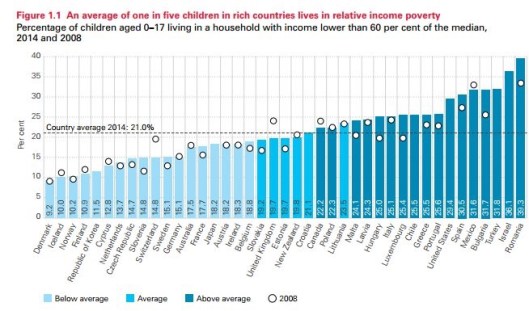
A mis-step in these calculations is in taking relativism to absurd lengths: Relative median incomes are of interest across countries, of course, or at any fixed percentile. But how about comparisons of incomes relative to median income across countries? As Meyer ably explains, that kind of comparison is not only meaningless but actually misleading.  The chart at the top of this post is an example of what he means, taken from statistics published by the World Economic Forum (WEF):

Relative child poverty is a metric based on the country’s median income — how many kids live in families with income that is X% of the median. 

If you click on the source [WEF], the headline presents this as ‘These rich countries have high levels of child poverty.’ The implication is that the US has more child poverty than Latvia or Poland or Cyprus or Korea and only slightly less child poverty than Mexico and Turkey.  But does it really mean this? No. This chart is a measure of income equality, NOT the absolute well-being of children.

Many of the countries ahead of the US are there not because their poor are well off, but because their median income is so much lower than ours. In fact, you will notice the lack of African and Asian countries in this. I will bet a lot of money that certain countries in Africa and Asia everyone knows to be dirt poor would beat out the US in this, thus making the bankruptcy of this metric obvious.

Take Denmark in the #1 spot. It looks like 20% more kids in the US live in poverty than in Denmark. But per the OECD, the US has a median income 41% higher than Denmark. So what it really means is the US has 20% more kids living under an income bar that is set 41% higher. How can this possibly have any meaning whatsoever, except to someone who wants to make the US look bad?”

So the metric seems designed to take advantage of the compression of incomes in poor countries to make them look better than they really are in terms of child poverty.

This is not an isolated example. Meyer offers other examples of distorted poverty statistics that would show 0% relative poverty if everyone earned exactly $1 per year! He also cites Census Bureau statistics showing roughly constant levels of poverty in the U.S. over 60 years while ignoring the impact of taxes and transfer payments. Correcting that “oversight” results in substantial declines in poverty.

Meyer closes with a postscript reminding us of the ongoing human progress in overcoming penury:

Well, in 1820, 94 percent of the world’s population lived in extreme poverty (less than $1.90 per day adjusted for purchasing power). In 1990 this figure was 34.8 percent, and in 2015, just 9.6 percent. … In the last quarter century, more than 1.25 billion people escaped extreme poverty – that equates to over 138,000 people … being lifted out of poverty every day.

The credit goes to free market capitalism.

Keeping My Resolution Starts With the Bee

Tags

, , , , , , , , , , , ,

I’m too lazy to check the archives right now, but I’m sure I’ve said this once before: I resolve to mix in more brief posts in the new year. My blogging hours (sometimes minutes) are limited on a day-to-day basis, so it’s taking too many days to wrap-up posts. My son says I should break them into parts. Maybe, but that won’t reduce the time I spend on a given topic.

Another motive for my resolution: I see so many items I’d like to share here, but I put them off in order to get back to a draft. I have to go where the whiffs of inspiration take me in a given session. But then… I either forget the short items or something else comes along to excite my long-windedness.

So, here is my first “short-form” blog share of 2020, from the Babylon Bee in early 2017:  

Culture In Which All Truth Is Relative Suddenly Concerned About Fake News

The piece reminded me of when poor Kellyanne Conway was castigated by the Left for using the expression “alternative facts” in reference to attendance at Trump’s inauguration. She’ll be fine, of course, but the photo comparison favored by the Left used an early pre-ceremony photo for Trump in 2017 and a peak-crowd photo for Obama in 2009. The Obama crowd was almost certainly larger than the real Trump crowd, but the whole thing was sort of a big “so what?”, especially given the well known political leanings of the local population.

Both Left and Right have been selectively reporting and distorting news (and editing photos) for a long time, the rise of so-called “fact checkers” notwithstanding. Alternative “facts” indeed! But our leftist friends are constant champions of relativism, often to the point of kookiness, while blissfully unaware that their “truths” and “facts” are severely shaded.

This was supposed to be short! Gah! More fake news! With that, here are some choice quotes from the Bee:

One Oregon man, who rejects the idea that humanity can even be sure the universe exists in any meaningful sense, was nonetheless disturbed by the idea that websites could publish completely false information, for anyone in the world to read. …

Tech conglomerates such as Facebook and Google have vowed to meet the trend head-on, assuring the public that they are taking bold steps to filter out any news that contradicts the version of truth that they decide is acceptable.”

The Impaired Impeachment

Tags

, , , , , , , , , , , , , , , ,

biden-impeach-trump

To avoid defections in their ranks, House Democrats had to pare back so much on the counts for impeaching Donald Trump that they laid bare the raw political motives for bringing the action. Not that their motives needed clarification. They’ve been dying to find grounds on which to impeach Trump since the day of his election. They also know the Senate will not remove Trump from office. Now, the real point is to stain the President as he seeks re-election, and that should strike anyone as an illegitimate purpose.

The two impeachment counts, abuse of power and obstruction of Congress, are flimsy. Proof of the first would require infallible mind-reading skills. It’s doubtful that the Democrats are any better at that than their inability to follow the simple facts of the case. During the controversial phone call with Ukrainian President Zelensky, Trump clearly expressed interest in whether the Ukraine would investigate possible interference in the 2016 U.S. presidential election, and whether the Bidens had been involved, given their involvement with Ukrainian organizations that may have had connections to the Steele dossier. That’s a fair question and a legitimate area of inquiry for the chief executive. It can’t be helped that Joe Biden happens to be running for the Democrat presidential nomination in 2020, as if running for office was enough to absolve one of crime.

The second impeachment count against Trump relies on vacating the constitutional privileges accorded to the chief executive, privileges to which President Obama, and others before him, generously availed themselves (also see here).

House Speaker Nancy Pelosi now has opted to delay transmitting the impeachment articles to the Senate. She said it was important for the House to wrap up their proceedings quickly, so much so that her party could not be bothered to bring a court challenge against Trump’s assertion of executive privilege. But now, Pelosi insists that she must be assured the Senate trial will be conducted “fairly”, as if the proceedings in the House were remotely fair to the President.

One of the House Democrats’ own expert witnesses asserts that the President’s impeachment is not official until the articles are transmitted to the Senate. That might be, but he overlooks the Supreme Court’s 1993 ruling in Nixon vs. the United States in which the Court said that no trial is required for the Senate to acquit anyone impeached by the House, and it may do so without judicial review. So, the Senate can acquit the President now, without a trial and without waiting for Speaker Pelosi to transmit the “charges”, should Senate Majority Leader Mitch McConnell decide to bring it to a vote. Of course, he might not want to as a matter of optics as well as pressure from an incensed Trump to air all of the laundry.

Like the misguided impeachment itself, Pelosi’s motive for holding the transmittal in abeyance is political. Democrats, quite possibly unaware of the Senate’s power under Nixon, and facing their comeuppance, might hope the public forgets the charade that took place in the House and blame Republicans for an “unfair” Senate process that would let Trump off the hook. Or, Pelosi might be hoping for a weakening of Republican resolve on establishing rules for a trial in the Senate, but even that calculation is chancy. It’s even possible Pelosi imagines she can delay the transfer through the 2020 election, hoping to use the House impeachment again and again as a cudgel with which to batter Trump’s re-election chances. Fat chance!

Or is the delay a form of damage control? Does it have something to do with Joe Biden’s vulnerability? He is perhaps at greater risk under a Senate impeachment trial of Trump than Trump himself. Biden is the one who gloated publicly of how he cowed the Ukrainians into dropping an investigation of Burisma, the gas company for which his son Hunter was a board member, by threatening to withhold loan guarantees. Quid Pro Joe!

Biden’s has stated that he would not comply with a subpoena to appear before the Senate in the matter of the Trump impeachment, apparently confusing Trump’s status as the executive with privilege with his own status as an out-of-office candidate for the Democrat nomination. Oh, wait! Now Biden says he would appear after all! Is the contrast between Trump’s phone conversation with the Ukrainian President and Biden’s gloating admission pertinent? You bet!

Or perhaps Pelosi believes it’s unwise to hand the impeachment counts over to the Senate with John Durham’s investigation still hanging in the balance. Durham is looking into the efforts of U.S. intelligence agencies to spy on the Trump campaign in 2016. An ill-timed and damaging outcome for the Obama Administration could make the impeachment trial into a catastrophic event for Biden and other Democrats.

The Democrats’ have brought their longstanding lust for impeaching Trump to fruition only to find that they’ve miscalculated. First, Trump is practically guaranteed an acquittal, so the whole effort was and is a waste of time. Second, public opinion is far from rallying to the Dems cause. According to Gallup, Trump’s approval now is higher than Obama’s at the same point in his presidency, and support for impeachment hasn’t responded as the Democrats had hoped. In fact, if anything, support has eroded, especially in swing states, and the effort has strengthened Trump’s base of support. I would argue that it’s much worse for Democrats than the polls show. Many anti-Democrats, like me, actively avoid participating in polls. That’s partly because the framing of questions is often biased, and partly because I don’t want to be bothered. Finally, the Democrats seem not to fathom the political risks they face with impeachment: 28 Democrat representatives from districts Trump won in 2016 may now face stiffer odds against reelection in 2020, having cast their votes for impeachment. More critically, there are severe risks of a Senate trial to the Bidens, potentially other Obama Administration officials, and the Clintons.

Note: An acknowledgement goes to the Legal Insurrection blog and A.F. Branco for the cartoon at the top.

Inequality and Inequality Propaganda

Tags

, , , , , , , , , , , , , , , , , , , , , , , , , ,

I’m an “inequality skeptic”, first, with respect to its measurement and trends; and second, with respect to its consequences. Economic inequality in the U.S. has not increased over the past 60 years as often claimed. And some degree of ex post inequality, in and of itself, has no implication for real economic well-being at any point on the socioeconomic spectrum, the growls of class-warmongers aside. So I’m not just a skeptic. I’m telling you the inequality narrative is BS! The media has been far too eager to promote distorted metrics that suggest widening disparities and presumed injustice. Left-wing politicians such as Bernie Sanders, Elizabeth Warren, and Alexandra Ocasio-Cortez pounce on these reports with opportunistic zeal, fueling the flames of class warfare among their sycophants.

Measurement

Comparisons of income groups and their gains over time have been plagued by a number of shortcomings. Jeff Jacoby reviews issues underlying the myth of a widening income gap. Today, the top 1% earns about the same share of income as in the early 1960s, according to a recent study by two government economists, Gerald Auten and David Splinter.

Jacoby recounts distortions in the standard measures of income inequality:

  • The comparisons do not account for tax burdens and redistributive government transfer payments, which level incomes considerably. As for tax burdens, the top 1% paid more taxes in 2018 than the bottom 90% combined.
  • The focus of inequality metrics is typically on households, the number of which has expanded drastically with declines in marriage rates, especially at lower income levels. Incomes, however, are more equal on a per capital basis.
  • The use of pension and retirement funds like IRAs and 401(k) plans has increased substantially over the years. The share of stock market value owned by retirement funds increased from just 4% in 1960 to more than 50% now. As Jacoby says, this has “democratized” gains in asset prices.
  • A change in the tax law in 1986 led to reporting of more small business income on individual returns, which exaggerated the growth of incomes at the high-end. That income had already been there.
  • People earn less when they are young and more as they reach later stages of their careers. That means they move up through the income distribution over time, yet the usual statistics seem to suggest that the income groups are static. Jacoby says:

Contrary to progressive belief, America is not divided into rigid economic strata. The incomes of the wealthy often decline, while many taxpayers go from being poor at one point to not-poor at another. Research shows that more than one-tenth of Americans will make it all the way to the top 1 percent for at least one year during their working lives.”

Mark Perry recently discussed America’s record middle-class earnings, emphasizing some of the same subtletles listed above. A middle income class ($35k-$100k in constant dollars) has indeed shrunk over the past 50 years, but most of that decrease was replaced by growth in the high income strata (>$100k), and the lower income class (<$35k) shrank almost as much as the middle group in percentage terms.

Causes

What drives the inequality we actually observe, after eliminating the distortions mentioned above? The reflexive answer from the Left is capitalism, but capitalism fosters great social and economic mobility relative to authoritarian or socialist regimes. That a few get fabulously rich under capitalism is often a positive attribute. A friend of mine contends that most of the great fortunes made in recent history involve jobs for which the product or service produced is highly scalable. So, for example, on-line software and networks “scale” and have produced tremendous fortunes. Another way of saying this is that the marginal cost of serving additional customers is near zero. However, those fortunes are earned because consumers extract great value from these products or services: they benefit to an extent exceeding price. So while the modern software tycoon is enriched in a way that produces inequality in measured income, his customers are enriched in ways that aren’t reflected in inequality statistics.

Mutually beneficial trade creates income for parties on only one side of a given transaction, but a surplus is harvested on both sides. For example, an estimate of the consumer surplus earned in transactions with the Uber ride-sharing service in 2015 was $1.60 for every dollar of revenue earned by Uber! That came to a total of $18 billion of consumer surplus in 2015 from Uber alone. These benefits of free exchange are difficult to measure, and are understandably ignored by official statistics. They are real nevertheless, another reason to take those statistics, and inequality metrics, with a grain of salt.

Certain less lucrative jobs can also scale. For example, the work of a systems security manager at a bank produces benefits for all customers of the bank, and at very low marginal cost for new customers. Conversely, jobs that don’t scale can produce great wealth, such as the work of a highly-skilled surgeon. While technology might make him even more productive over time, the scalability of his efforts are clearly subject to limits. Yet the demand for his services and the limited supply of surgical skills leads to high income. Here again, both parties at the operating table make gains (if all goes well), but only one party earns income from the transaction. These examples demonstrate that standard metrics of economic inequality have severe shortcomings if the real objective is to measure differences in well-being. 

Economist Robert Samuelson asserts that “workaholics drive inequality“, citing a recent study by Edward E. Leamer and J. Rodrigo Fuentes that appeals to statistics on incomes and hours worked. They find the largest income gains have accrued to earners with high educational attainment. It stands to reason that higher degrees, and the longer hours worked by those who possess them, have generated relatively large income gains. Samuelson also cites the ability of these workers to harness technology. So far, so good: smart, hard-working students turn into smart, hard workers, and they produce a disproportionate share of value in the marketplace. That seems right and just. And consumers are enriched by those efforts. But Samuelson dwells on the negative. He subscribes to the Ludditical view that the gains from technology will accrue to the few:

The Leamer-Fuentes study adds to our understanding by illuminating how these trends are already changing the way labor markets function. … The present trends, if continued, do not bode well for the future. If the labor force splits between well-paid workaholics and everyone else, there is bound to be a backlash — there already is — among people who feel they’re working hard but can’t find the results in their paychecks.

That conclusion is insane in view of the income trends reviewed above, and as a matter of economic logic: large income gains might accrue to the technological avant guarde, but those individuals buy things, generating additional demand and income gains for other workers. And new technology diffuses over time, allowing broader swaths of the populace to capture value both in consumption and production. Does technology displace some workers? Of course, but it also creates new, previously unimagined opportunities. The history of technological progress gives lie to Samuelson’s perspective, but there will always be pundits to say “this time it’s different”, and it probably sounds heroic to their ears.

Consequences

The usual discussions of economic inequality in media and politics revolve around an egalitarian ideal, that somehow we should all be equal in an absolute and ex post sense. That view is ignorant and dangerous. People are not equal in terms of talent and their willingness to expend effort. In a free society, the most talented and motivated individuals will produce and capture more value. Attempts to make it otherwise can only interfere with freedoms and undermine social welfare across the spectrum. This post on the Declination blog, “The Myth of Equality“, is broader in its scope but makes the point definitively. It quotes the Declaration of Independence:

We hold these truths to be self-evident, that all men are created equal, that they are endowed by their Creator with certain unalienable Rights, that among these are Life, Liberty and the Pursuit of Happiness.”

The poster, “Thales”, goes on to say:

The context of this was within an implied legal framework of basic rights. All men have equal rights granted by God, and a government is unjust if it seeks to deprive a man of these God-given rights. … This level of equality is both the basis for a legal framework limiting the power of government, and a reference to the fact that we all have souls; that God may judge them. God, being omniscient, can be an absolute neutral arbiter of justice, having all the facts, and thus may treat us with absolute equality. No man could ever do this, though justice is often better served by man at least making a passing attempt at neutrality….”

Attempts to go beyond this concept of ex ante equality are doomed to failure. To accept that inequalities must always exist is to acknowledge reality, and it serves to protect rights and opportunities broadly. To do otherwise requires coercion, which is violent by definition. In any case, inequality is not as extreme as standard metrics would have us believe, and it has not grown more extreme.

Hospital Price Insanity

Tags

, , , , , , , , , , , , , , , , , , ,

Almost nothing is less transparent than hospital pricing. If you’re shopping for a procedure, you probably won’t hear about the negotiated prices worked out with large insurers…. you’re likely to be quoted something much higher. A high price is billed to an insurer, but the excess above their negotiated prices is “disallowed” via contractual adjustment. You and/or your small insurer might not get the same deal. As Robert Laszewski says:

The chargemaster is complete nonsense that really doesn’t matter — unless you are an uninsured person and you’re getting these huge bills driving you toward bankruptcy. The biggest irony of the U.S. healthcare system is that only the uninsured — often people who don’t have a lot of money — are the only ones the hospital expects to pay these incredibly inflated prices!”

An uninsured patient might be billed at the higher rate, but of course few end up paying. But there is harm in this arrangement, and it extends well beyond the uninsured. You might not be surprised to learn that the government is right in the middle of it. Read on…

What a Racket!

There’s some slight of hand going on in hospital pricing that creates perverse incentives. Who has something to gain from a huge gap between the full price and the hospital’s allowable charge? The answer is both the hospital and insurers, and that’s true whether the hospital is for-profit or nonprofit. When the list price and the size of the discount increase, the insurer gets to brag to employer-plan sponsors about the great savings it negotiates. In an episode on EconTalk, Dr. Keith Smith, a partner in the ultra-competitive and cash-only Surgery Center of Oklahoma, says (only partly in jest) that the conversation between the insurer and hospital might go something like this:

Now, what the insurers actually do is ask the hospital administrators, ‘Can you do a brother a favor and actually charge $200,000 for that, so that our percentage savings actually looks larger?‘”

This does two things for the insurer: it impresses employers as prospective plan sponsors, and it might also earn the insurer a bonus known as Claims Repricing, whereby the employer pays a commission on the discounts the insurer “negotiates”.

What about the hospitals? How do they benefit from this kind of arrangement? By inflating the “list price” of procedures, the hospital creates the appearance of a write-down or loss on a substantial share of the care it provides, despite the fact that its real costs are far below list prices and usually below the discounted “allowable amounts” negotiated with insurers as well. The appearance of loss serves to benefit the hospitals because they are compensated by the government on that basis through so-called Disproportionate Share Hospital (DSH) payments. These are, ostensibly, reimbursements for so-called uncompensated care.

This would not be such a travesty if the prices approximated real costs, but they don’t, and the arrangement creates incentives to inflate. The DSH payments to hospitals are used in a variety of ways, as Smith notes:

Yeah; and before we get to feeling too sorry for the hospitals, all of the ones I know of claiming to go broke have a crane in front of them building onto their Emergency Room. …

So, I don’t know: again, the hospitals that are complaining about this, they are buying out physician practices, they’re buying out competitors. They seem to have a whole lot of money. They’re not suffering. Now, what they have done is used the situation you described–the legitimate non-payer–they’ve used that as a propaganda tool, I would argue, to develop a justification for cost shifting where they charge us all a whole lot more to make up for all the money that they’re losing. But they really need a lot of this red ink to maintain the fiction of their not-for-profit status.”

Non-profit hospitals are also entirely tax-exempt (income and property taxes), despite the fact that many use their “free cash flows” in ways similar to for-profit hospitals. The following describes a 2015 court ruling in New Jersey:

The judge stated ‘If it is true that all non-profit hospitals operate like the hospital in this case… then for purposes of the property tax exemption, modern non-profit hospitals are essentially legal fictions.’ Judge Bianco found that the hospital ‘operated and used the property for a profit-making purpose’ by, in part, providing substantial loans, capital, and subsidies to for-profit entities, including physician groups.

The bad incentives go beyond all this. Smith adds the following:

Waste in a big hospital system is actually encouraged, many times because hospitals are paid based on what they use…. So, to the extent that the hospital uses a lot of supplies, that typically raises and increases the amount of revenue that they receive.”

Hospitals have been shielded from competition for years by the government. As Chris Pope explains, hospital pricing is designed “to accommodate rather than to constrain the growth of hospital costs“. This encourages hospitals that are inefficient in terms of costs, quality of care, and over-investment in equipment. Conversely, duplicated facilities and equipment simply add costs and don’t encourage competition given the cost-plus nature of hospital pricing and government efforts to prevent entry by more efficient operators. These restrictions include “Certificates of Need” for new entrants, and the ban on physician-owned hospitals in the Affordable Care Act (ACA). At the same time, the ACA encouraged hospital consolidation by rewarding the formation of so-called Accountable Care Organizations, which are basically exempt from anti-trust review. In the end, any reductions in administrative costs that consolidation might offer are swamped by the anti-consumer force of monopoly power.

Mandated Transparency?

The lack of price transparency really isn’t the root problem, in my view, but it is undesirable. Can government action to create transparency foster a more competitive market for the services hospitals offer? A recent Trump Administration Executive Order would require that hospitals publicly post prices for 300 “shoppable” services or procedures. The effective date of this order was recently delayed by a year, to January 2021. Hospital trade groups have challenged the order in court on the grounds that the First Amendment protects private businesses from being compelled to reveal details of privately-negotiated deals for complex services. While I try to be a faithful defender of constitutional rights, I find this defense rather cynicical. I’m not sure the First Amendment was intended to aid in concealing dishonest schemes for private benefit at the expense of taxpayers and consumers.

Avik Roy likes the price transparency rule. It would require the posting of gross charges for procedures as well as specific negotiated prices. The executive order would also require Medicare to pay no more to hospital-owned clinics than to independent clinics for the same procedure, which is laudable. Roy is sanguine about the ability of these rules to bring more competition to the market. He predicts a more level playing field for small insurers in negotiating discounts, and he thinks the order would spur development of on-line tools to assist consumers.

John C. Goodman is mildly skeptical of the benefits of a transparency mandate (also see here). Consumers with decent levels of coverage aren’t terribly motivated to make hospital price comparisons, especially if it means a delay in treatment. Also, Goodman points out a few ways in which hospitals try to “game” transparency requirements that already exist. John Cochrane worries about gaming of the rules as well. Competition and price discipline are better prescriptions for price transparency and might be better addressed by eliminating the incentives for third-party payment arrangements, like the unbalanced tax deductibility of health insurance premiums, but that kind of reform isn’t on the horizon. Goodman concedes that many procedures are “shoppable”, and he does not minimize the extent to which pricing varies within local hospital markets.

Conclusion

The most insane thing about hospital revenue generation is its reliance on fictitious losses. And hospitals, profit and non-profit, have a tendency to spend excess cash in ways that fuel additional growth in cost and prices. Sadly, beyond their opacity, hospital prices do not reflect the true value of the resources used by those institutions.

In my view, the value of price transparency does not hinge on whether the average health care consumer is sensitive to hospital prices, but on whether the marginal consumer is sensitive. That includes those willing to pay for services out-of-pocket, such as those who seek care at the Surgery Center of Oklahoma. Third-party payers lacking significant market power would undoubtedly prefer to have more information on pricing as well. Mandated price transparency won’t fix all of the dysfunctions in the delivery and payment for health care. That would require more substantial free-market reforms to the insurance and health care industries, which ideally would involve replacing price subsidies with direct payments to the uninsured. The transparency mandate itself might or might not intrude on domains over which privacy is protected by the Constitution, a question that has already been brought before the courts. Nonetheless, transparency would lead to better market information for all participants, which might help rationalize pricing and encourage competitive forces.


Mean, Humorless Profs By Gender

Tags

, , , , , , , ,

Do college kids disrespect female professors and cut male professors extra slack? Or do female professors act in ways that earn disrespect relative to their male counterparts? The data described here don’t answer those questions, but they do show that consistent asymmetries exist. The results summarize certain features of student evaluations by gender of professor, and while seemingly incredible, they deserve further scrutiny.

The Study

The study in the Chronicle of Higher Education covered 14 million evaluations housed at RateMyProfessor.com. Word frequencies from student evaluations indicate that female professors are perceived less frequently as “brilliant” and “funny” than male professors, and more frequently as “mean” and “rude”. Directionally, the result applied to every area of study without exception. What could be driving such a gap?

First, the scale of measurement needs a closer look. If evaluations average 50 words, let’s say, then 500 single uses of a word per million words would amount to once in every 20 evaluations. That’s a little easier to digest. It’s clear from the charts that “funny” and “rude” are used more frequently than “brilliant” and “mean”, regardless of the professor’s gender. But the bulk of evaluations do not use any of those words. That’s an important qualification, and yet the results are so strikingly consistent that it’s hard to deny that differences exist, at least between extremes within the male and female faculty cohorts.

Explanations

For the moment, suppose the students’ perceptions are accurate in some objective sense. If so, perhaps some women in academia overcompensate in an effort to be taken seriously in a world dominated by males. Males don’t dominate all subject areas, however, and even in areas of study more likely to have high female representation. females are still evaluated more harshly on these criteria. In fact, a perusal of the subject areas might even suggest that some of these particular gender gaps are smaller in STEM fields, which are traditionally dominated by males. Still, the overcompensation hypothesis might have a grain of truth, even if “overcompensation” by female profs is merely a form of ongoing rebellion against traditional gender roles. For the same reason, maybe “severe” female personalities self-select for academic jobs in greater proportion than males, though I’m not sure that holds up.

If the student perceptions are incorrect, what’s driving them? Are expectations for women in academia simply more demanding? Such that many female profs fail to live up across a broad range of dimensions? There is strong support for the proposition that student evaluations are biased against female profs. If students are somehow conditioned to think that a female prof will be inferior, she might have to outperform her male counterparts along various dimensions simply to stay even. That might well explain the regular patterns of words used by some students.

Other Qualifications and Contradictions

The word frequencies described above aren’t definitive by any means, even if you put great stock in student evaluations. In fact, using the interactive tool provided by the authors of the study, the word “nice” appears relatively often and in consistently higher numbers for female than for male profs. And, with consistent but very low frequency, the word “moron” is used to describe more male profs than females. Maybe there’s greater variance across female professors in the “niceness” dimension, and more variance across males in the “smarts” dimension (and some research suggests that the latter is true). I’m not so sure about the “funniness” dimension, but I know some very funny women!

It would be helpful to know the breakdown of word frequencies by student gender. What I often hear from female acquaintances is that women are harder on other women than on men. In relationships involving asymmetric power, this is the so-called “Queen Bee Syndrome“, a phenomenon having some empirical support.

There could be other biases baked into the study, such as a predominance of angry reviewers, but I’m not sure that would explain a bias against female profs. Finally, it’s possible the RateMyProfessors site attracts more male reviewers. A rough (and amusing) feel for the proportion of male and female reviewers might be gleaned by entering the word “hot” into the tool (!). As expected, the mostly male engineers are much more likely to use that expression as a description of female profs, but reviewers in most fields are fairly balanced in their choice of that word.

Conclusion

The word frequencies may well reflect the adoption of harsher standards by some students for female profs relative to male profs, and there may be female profs who “overcompensate”. And maybe more women with relatively “thick-skin” are attracted to the ranks of the professoriate. College students can be a tough crowd, but it’s important to remember that they are mostly young. Teachers can and should refine their approach in ways that might produce greater learning and satisfaction. But more than anything else, the results reinforce the conclusion that institutions should be cautious about the weight they place on student evaluations in assessing faculty performance.


Statists Might Like To Vaccinate Against Many Things

Tags

, , , , , , , , , , , , , , , , , , , ,

The vaccine debate illustrates a widespread misunderstanding about the meaning of an “advanced society”. It does not mean that difficult social problems must be dealt with always and everywhere in a uniform way, as supporters of vaccine mandates seem to assume. Instead, it often means that society can respect differences in the preferences of individuals by allowing varied approaches to problem-solving across jurisdictions, as well as across public and private institutions. This latter notion of advancement respects individual freedom and facilitates experiential social learning. But is that varied approach wise in a world of communicable diseases?

One standard of “community” protection assumes that vaccines work with a high degree of certainty within groups of individuals, especially with a second booster. The share of the population vaccinated against most common childhood diseases is fairly high. In fact, these shares mostly exceed their respective “community protection thresholds” — the percentage required to prevent a particular disease from spreading. That means achieving so-called “herd immunity”. Of course, that will not be true across many local subgroups. Nevertheless, if one accepts this standard, a runaway contagion in the U.S. is an extremely remote possibility, affording some flexibility for respecting preferences for and against vaccination.

My Friend, the Vaccine Resistor

One of my best friends is a passionate vaccine resistor (VR). I won’t say he’s “vaccine hesitant” because that doesn’t come close to his position. I won’t call him an “anti-vaxxer” because he doesn’t mind if others avail themselves of vaccines (and besides, the term has taken on such derogatory connotation. He’s a fine fellow, very smart, lots of fun to be with, and we have plenty of mutual interests. We’ve argued about vaccinations before, and a few other medical and nutritional issues, but we mostly stay out of each others’ ways on these topics.

But I recently witnessed my pal get into a “debate” on social media with a mutual acquaintance and some of her connections. She happens to be a nurse. She’d posted a photo of an attractive young woman in a t-shirt imprinted, “Vaccines Cause Adults”. My buddy spoke up and said “Not for everyone!’, and he posted a link to an article that he felt supported his position. Of course, a number of barbed responses came his way. Okay, some of those were fair debate points, though barbed, but others were quite derisive, ad hominem attacks on him. He responded by posting links to more articles and research, which might not have been productive. It’s usually a waste of time to argue with people on social media. But to his great credit he maintained his equanimity. The episode made me feel a bit sad. People can be such assholes on social media. I was put off by the nurse’s refusal to moderate . That’s a typical pattern: posters allow their other friends to hurl terrible insults at anyone who disagrees, even when it’s an old friend. Mind you, I stayed on the sidelines in this case, except that I originally “liked” the nurse’s meme.

Later, I had a private exchange with my friend. I’m on board with vaccinations. I believe that widespread immunization contributes to public health, but I told him there are certain points on which I can sympathize with VRs. Without knowing the details, he encouraged me to write a blog post on the subject. I’m not sure he’ll like the results. However, as noted above, I’m willing to make a few concessions to my buddy’s side of the argument, and I wish we could identify a path that would settle the debate.

My Standpoint

This is one part my pal won’t like. Are VRs anti-science? First, VR’s come in several varieties. Some might resist only some vaccines and not others. But VRs do not disavow empiricism, as they claim their own set of empirical findings to support their position, however one might regard the research quality. 

I believe many VRs are misled by a serious post hoc ergo propter hoc fallacy: after this, therefore because of this. For example, for many observers, the purported link between autism and the measles, mumps and rubella vaccine was put to rest when the British medical journal Lancet retracted the original article supporting that claim as faulty. That doesn’t wash with more radical VRs, many of whom seem to have someone on the autism spectrum in their own families. They are understandably sensitive, but please forgive me: that suggests a need to find some external explanation, a source of blame not related to genetics.

Radical VRs are selective proponents of the precautionary principle: any risk of harm from a vaccine delivered in any amount is too great a risk. They seem reluctant to acknowledge the reality of a dose-response relationship, which bears on the risks of exposure to certain compounds often present in vaccine formulations. VRs will not acknowledge that vaccines present a manageable risk. And then there are the misleading references to disease incidence counts, as opposed to disease incidence rates, that are all too common (though my friend is almost certainly innocent on this count).

Vaccine resistance is not a new phenomenon, as the cartoon above from 1802 illustrates. Certain people will always find the idea of injecting germs into their systems deeply unsettling. Of course, that’s a very natural basis of resistance. A person’s body is their own property, after all. My default position is that an individual’s control over their own body is inviolable, and parents should always be the first authority over decisions about their children. The real issue, however, is the question of whether unvaccinated children inflict external costs on others.

Points of Contention

The major objections of VRs fall into several categories: 1) preservatives; 2) multiple viruses; 3) vulnerable infants; 4) contra-indications; 5) inefficacy; and 6) free choice. There may be others, but I’ll go with those.

Preservatives: Some vaccines still use a form of mercury, but a much more innocuous variant than the one VRs found so objectionable a few decades ago. Still, they object. And they object to many other compounds used in minute quantities as preservatives, such as formaldehyde, which occurs naturally in our bodies. I think the following test is helpful: if it were proposed that VRs take new versions of the vaccines that had zero preservatives, many would still refuse, especially if they were asked to pay the additional cost of providing them in that form. Thus, preservatives are revealed to be something of a side show.

Multiple Viruses: VRs object to the administration of vaccines that inoculate against several viruses in one dose or within a short window of time. This objection has some plausibility, since an injection of several different “bugs’ at once might place excessive stress on the body, even if the risk is still small. But again, would VRs volunteer to take single strain vaccines in a schedule over a lengthier period of time? Probably not.

Vulnerable Infants: VRs say it’s too risky to vaccinate infants in their first few months of life. This too is a plausible objection, and it would seem like a relatively easy concession to make in the interests of compromise … except, it won’t ever be good enough. Radical VRs will not agree to having their children vaccinated at any age.

Contra-Indications: There are undoubtedly genetic factors that pre-dispose certain individuals to an adverse reaction to certain vaccines. These might be rare, so an effort to compromise by requiring a thorough genetic profile before vaccination would be costly. I believe profiling is a reasonable demand for individuals to make, however, provided they pay the cost themselves.

Inefficacy: My friend posted an intriguing article about the drastic declines that occurred in the incidence of various diseases before the introduction of vaccines to prevent those diseases. This might not be the same link, but it makes the same argument. That doesn’t mean vaccines don’t work, of course. There is a vast literature that shows that they do. Bing it! And in cases such as smallpox, the use of “folk applications” of puss to a small scratch in the skin were in use long before the vaccine was available. Nevertheless, the VRs contend that the historical rates of disease incidence provide evidence against vaccinating. They also contend that diseases like measles are not serious enough to warrant precautions like vaccines. Measles can be deadly, though not as deadly as the flu.

Free Choice: This is the point on which I’m most sympathetic to VRs. Again, we own our own bodies and should have authority over our own minor children, yet communicable diseases seem to be a classic case of externality. Susceptible individuals may inflict a cost on others by refusing vaccination or segregation. Other people own their bodies too, and they have a right to avoid exposure. They too can isolate themselves or take precautions as they deem necessary. If both parties wish to participate in society, then both hold rights they allege to be threatened by the other. That complicates the task of reconciling these interests in private, voluntary ways, and yet they often are reconciled privately.

Solutions?

The debate today often revolves around mandatory vaccination, which would be an extreme measure relying on the coercive power of the state. The rationale is that even a vaccinated majority would be subject to an unnecessarily high risk of infection when in frequent contact with an unvaccinated minority. It’s difficult to endorse such broad intrusiveness when we’re dealing with a negative externality of such minute probability. And such a policy is not at all defensible without exceptions for individuals for whom a vaccine is contra-indicated.

Tolerating differences in vaccination rules across cities, school districts, or even states, may be a reasonable approach to settling the debate in the long run. These variations allow empirical evidence to accumulate on the efficacy of different vaccine regimes. It also allows individuals and families to “vote with their feet”, migrating to jurisdictions that best suit their preferences. These are the basic foundations of federalism, a principle of great usefulness in preserving freedoms while addressing regional differences of opinion on contentious issues.

Michigan has a policy allowing unvaccinated children to attend schools, but a waiver must be obtained requiring the child’s parents to attend a vaccine education program. The policy is credited with increasing vaccination rates. The problem is that VRs tend to view this requirement as an infringement on their rights. Advocates of the policy might argue that the situation should be viewed as an arms-length, voluntary exchange between two parties, in this case a family and a public entity. The vaccine education program is just the price one must pay in lieu of vaccination. The exchange is not arms length, however, as it would be if the school were a private entity. The VR parents who refuse the waiver are not rebated for taxes paid for local schools. In fact, like all taxes, the payment is coerced.

It’s not always necessary to appeal to some form of government action, even at local levels. For example, private schools may require vaccination among enrollees, and private businesses, especially health care providers, may require staff to be vaccinated. Life and health insurers may wish to price risk differently for the unvaccinated. VRs might object that they are subject to discrimination by institutions requiring immunization, or who price discriminate in favor of the immunized, but VRs are free to form competitive institutions, even on small scales or as mutual companies. To the extent that such private rules are unjustified, the institutions who discriminate are likely to learn or lose eventually. That’s the beauty of market solutions. In these ways, non-coercive private governance is far preferable to action by the state.

Dr. Jeffrey Singer is an advocate of immunization who opposes mandatory vaccine laws, as he explained a few years ago in “Vaccination and Free Will“. He suggested elsewhere, in “Seeking Balance In Vaccination Laws“, that schools, instead of requiring immunization, could mitigate the risk of a contagion by insisting that unvaccinated children be held out of school when a particular threat arises and remain out until it passed. That’s a reasonable idea, but I suspect many pro-vax parents would fear that it doesn’t go far enough in protecting against the introduction of a disease by an unvaccinated child.

Conclusion

Recent increases in the incidence of diseases such as measles, mumps and whooping cough are extremely troubling. Whether these outbreaks bear any relationship to patterns of vaccination in the population is certainly a valid question. To the extent that more families and individuals wish to be immunized, and that private institutions wish to take action to increase vaccination rates within their sphere of influence, I’m all for it. Vaccination laws are a different matter.

Political action at the local level might mean that school districts and other public entities will require vaccinations or vaccine education programs. Alternatives exist for those refusing to vaccinate, but broad mandatory vaccination is too coercive. Such measures carry significant costs, not least of which is a loss of liberty and normalization of losses of liberty. It’s not clear that a vaccination mandate at the national level, or even a state vaccination mandate, can offer benefits sufficient to justify those costs. Nudges are irritating and may be costly, but forcible intrusions are way out-of-bounds. Unfortunately, there are parties that simply can’t resist the temptations of behavioral control, and that’s worthy of resistance. Let’s continue to muddle through with an essentially federalist approach to vaccination policy. I regard that as a hallmark of an advanced society.


Rx Drug Prices Are Falling, But You’re Aging

Tags

, , , , , , , , , , , , ,

Ask anyone on the street about prescription drug prices, or ask anyone in the press, and you’ll probably hear they are out of control. That contention is false. The conventional wisdom is typified by this exaggerated BS about insulin pricing … actually, you can find a vial of the kind I used for many years for about $25 without much difficulty.

Individual experience differs, of course. Yes, there are new drugs on the market that are exorbitant; there are older drugs still under patent that are pricey too. Those represent a fairly small part of the total market, however, and one on which policymakers should tread lightly if they hope to foster the development of new, life-saving drugs. Newer insulin varieties are not in that class, and those varieties don’t always incorporate meaningful improvements for patients.

Getting Old Is Hell

In fact, prescription drug prices have been declining for a number of years. The real problem is we’re always getting older! In a report from the Progressive Policy Institute, Michael Mandel describes what he calls the prescription drug escalator. Alex Tabarrok has a good summary of the article. The chart at the top of this post, from Mandel, shows that the number of drugs prescribed rises steadily with one’s age. The total bill rises along with age, which may create the perception that you’re paying higher prices. Unsurprisingly, more of each health-care dollar spent out-of-pocket  (OOP) goes to prescribed medications as you age, and more goes to prescription drugs as health declines. As Mandell says, the increases experienced by individuals are a matter of utilization as opposed to pricing..

Generic Dominance

Tabarrok notes that generic drugs account for somewhere between 80-90% of all prescriptions, and generic costs have been falling for some time. He links to one of his earlier posts on generics and to this study by the National Bureau of Economic Research, which states:

“… direct-out-of-pocket CPI for generic prescription drugs decline[d] by about 50% between 2007 and 2016 …”

Average OOP prescription costs peaked in 2006, according to Mandel’s data. Tabarrok quotes Mandell:

May 2019 research report from the Agency for Healthcare Research and Quality reported that average out-of-pocket spending for prescribed medications, among persons who obtained at least one prescribed medication, declined from $327 in 2009 to $238 by 2016, a decrease of 27 percent. Data from the Bureau of Labor Statistics Consumer Expenditure Survey shows that average household spending on prescription drugs fell by 11% between 2013 and 2018.

Moreover, OECD data shows that average out-of-pocket spending on prescribed medicines in the United States ($143 per capita in 2017) is actually lower than countries such as Canada ($144), Korea ($156), Norway ($178), and Switzerland ($215).”

The declines in OOP drug costs came despite a shift in health-care payment responsibilities from insurers to consumers in recent years — OOP costs would have declined much more had the shift not occurred, according to Mandel. As he says, consumers now have more “skin in the game”, and apparently they act on it.

Another basis of the misperception about escalating drug prices has to do with the way they are reported. Mandel says:

List prices are the published prices that manufacturers charge to wholesalers. Net prices reflect the revenues that drug manufacturers receive, net of rebates and discounts to prescription benefit managers, insurance companies, and hospitals.

Studies of list prices invariably show very strong growth. For example the IQVIA Institute for Human Data Science found that the list price of the average brand rose from $364.92 to $657.08 since 2014, an 80% increase. Similarly, a widely cited recent study based on list prices found that from 2008–16, the costs of oral and injectable brand-name drugs increased annually by 9.2 percent and 15.1 percent, respectively. … By contrast, net prices and net pharma revenue have been growing much more slowly, once rebates and discounts are accounted for.” 

The Pricey Segment

There are a variety of circumstances that bear on the pricing of individual drugs. Clearly, non-generic drugs are subject to more upward price pressure and give rise to anecdotes that feed misperceptions about the overall trajectory of drug prices. These are either new drugs or older ones sold under extended patents, which are sometimes granted for even minor changes in a drug’s chemical makeup.

Some new drugs are life-saving breakthroughs targeting rare diseases. The unfortunate truth is that drug development is a very costly enterprise, often stretching well over a decade in the U.S. under the FDA’s approval process. Moreover, U.S. consumers actually subsidize the cost of drugs for European consumers, where drugs are typically subject to price ceilings or are directly negotiated by government. By the time drugs go to market, development is treated as a fixed cost; even the low prices in Europe cover the marginal cost of production, so pharmaceutical manufacturers don’t mind selling there as long as their development overhead is paid by someone. That’s the rub.

Drug development costs are heavily influenced by public policy, often to the detriment of consumers. The FDA’s drug approval process is in dire need of reform, and patent extensions should be severely curtailed. As an advocate of free trade, I also favor a lifting of restrictions on imports of drugs to the U.S.

Conclusion

You’re likely to see more physicians as you age, they’re likely to prescribe more drugs, and you’re likely to pay more for prescriptions OOP. That’s the escalator in action. You can minimize the slope of your personal prescription escalator by taking good care of yourself and using generics when possible, but the slope is often beyond a person’s control. Nevertheless, over the past 13 years in the U.S.,  most of those experiencing higher OOP costs have this escalator, i.e., aging, to thank… it’s drug utilization, not pricing.

A relatively small but important share of the market has experienced price escalation. Newer, highly specialized drugs can carry high price tags. Patents give drug manufacturers considerably more pricing power, and drug companies have sought to maintain “evergreen” patents by manipulating their formulations. U.S. import quotas and restrictive pricing abroad have left consumers in the U.S. holding the bag for a large share of drug development costs. These shortcomings can be addressed via streamlined drug approval, patent reform, and lifting import restrictions.

A critical policy prescription is to liberate market forces and foster competition in the pharmaceuticals industry. Price controls in the U.S. would eliminate all incentives for new breakthroughs, leading progress in many areas of treatment to a stand-still. Price controls merely substitute the arbitrary decisions of politicians and bureaucrats for the market’s ability to balance dynamic consumer needs, medical expertise, and the costs faced by sellers.


HyperBoondoggle

Tags

, , , , , , , , , , , , , , , ,

The hyperloop: if you think the Delmar Loop Trolley in St. Louis, MO was a boondoggle, just wait till the state starts hemorrhaging cash for the proposed hyperloop test track, and later a possible route connecting St. Louis, Columbia, and Kansas City. The hyperloop would rely on magnetic levitation (maglev) technology that has been used for trains in some parts of the world, though always on relatively short routes. For a hyperloop, however, the maglev system keeps carrier “pods” suspended in a near-vacuum tube extending the length of the route, eliminating friction and air resistance. Proponents say the pods will move at top speeds of 700 miles an hour, traversing the state in about 30 minutes. And they say it will be a very green machine.

Richard Branson’s Virgin Hyperloop One wants to build the 15-mile test track, which is projected to cost $300 – $500 million. That range is centered just a bit higher than the cost of the Loop Trolley on a per-mile basis, and for a project with major technological uncertainties, that leaves me just a bit wary. The 250-mile cross-state route is now pegged at between $7.3 and $10.4 billion, according to the recent report issued by the state’s “Blue-Ribbon Panel on Hyperloop”. It’s likely to cost much more by the time they get around to building it, if they do at all, and if it actually works.

Hyperbole?

My skepticism about hyperloops is based in part on the hucksterism that often characterizes appeals for public funding of large projects, and hyperloop hucksterism has already taken place. For example, in 2013 Elon Musk estimated that a Hyperloop system would cost about $11.5 million per mile. By 2016, the mid-point estimate for a route in the San Francisco Bay Area was over $100 million per mile. A friendlier route in Dubai is expected to cost $52 million per mile. So to be conservative, we saw 5x to 10x higher costs in a matter of three years. But now, Virgin One says it can construct a route in Missouri for less than the per-mile cost of the Dubai line. Well, the state Department of Transportation already owns the rights of way over significant stretches of the route (but not everywhere because the tube must be straighter than the highway).

The hyperbolic claims for hyperloop technology include speed, projected passenger fares, and ridership. According to Innovation Origins, the so-called feasibility study for the Missouri hyperloop did not assess the technology or even address the fact that no working hyperloop has ever been built or proven at full scale over any distance longer than a kilometer or so. The consultants who prepared the “study” merely assumed it would work. No test pod within a vacuum tube has achieved more than a fraction of the promised speed. The tubes were not long enough to achieve top speeds, they say, but that raises another issue: creating near-vacuum conditions in a sizable tube over very long distances. At the Innovation Origin link above, they estimate that the Missouri tube would occupy over 1 million cubic meters of space, which is at least 30 times larger than the most expansive man-made vacuum space now in existence.

The Ride

As for the passenger experience, 30 minutes to traverse the state of Missouri would be impressive, but what about comfort? First, expanding the tube’s circumference and the girth of the pods would have a disproportionate impact on cost, so conditions might either be more cramped than the promotional photos would have you believe, or the number of passenger seats per pod might be reduced. Second, rapid acceleration from zero to 700 mph would subject humans to fairly large G-forces over several minutes. Deceleration at the end of the trip might be even worse. Negotiating even mild curves would also require reduced speed and subsequent re-acceleration to avoid uncomfortably high radial G-forces. All that means the ride could be a bit uncomfortable. That also means the average speed between Kansas City and St. Louis would be significantly less than 700 mph, especially with a stop in Columbia. G-forces might not be much of a concern for freight traffic, unless it’s fresh produce.

Safety

Then there’s the vulnerability of the system. Willis Eschenbach goes into detail on some technical problems that make the hyperloop risky, such as the pressure on the tubes themselves. It would be about 20,000 pounds per square meter of tube surface, all subject to significant thermal expansion and contraction over the course of a day, with large pods racing through joints and rounding curves. Any fault or crack at any point in the tube surface would cause catastrophic deceleration of pods along the entire length of the tube. The integrity of the pressurized pods themselves is also a safety issue. And what about an earthquake? Or a loss of control and fiery pile-up of vehicles traveling on I-70 near the tubes. Or any number of other foolish or intentional sources of damage to the tube along its route?

Throughput

One of Eschenbach’s most interesting critiques has to do with passenger throughput. Musk’s original plan called for 28-passenger pods departing every 30 seconds: 3,300 passengers per hour. That would represent a substantial addition to total cross-state transportation capacity. At full utilization (which of course is unlikely), that would exceed current estimated totals for daily travel between St. Louis, Columbia, and Kansas City. And while that capacity might reduce pressure to expand other modes, such as adding an extra lane to I-70, it would not offer an excuse to eliminate highway, rail, or airport infrastructure, nor would it eliminate the need to maintain it.

Musks’s assumption might be too optimistic, however: for safety, the time between pod departures might have to be longer. than 30 seconds. Eschenbach asserts 80 that seconds would be more reasonable, which would slash capacity by about 60% relative to Musk’s estimate. And that doesn’t account for potential bottlenecks at stops where pods must be depressurized and repressurized. And if substantially heavier freight pods are intermingled with passenger pods, as anticipated, the required intervals between departures might have to be longer.

Economics

Few large transportation projects are self-funding. Typically, user fees fail to cover operating costs, let alone capital costs. The projected fares quoted by proponents of the Missouri hyperloop are low: “cheaper than the price of gas to drive” cross-state. Perhaps we could say about $25, based on that statement. That won’t make much of a dent in the cost of construction.

The hyperloop’s economic viability for freight traffic is questionable as well, though freight traffic seems to be a fallback position among boosters when confronted with the uncertainties of passenger travel via hyperloop. The Blue-Ribbon report says the expected cost of freight via hyperloop might range from $1.40 per mile to $2.80 on the high end, putting the mid-point well above the $1.69 per mile average cost of shipping by truck. Will speed make the hyperloop a competitive alternative for shippers? In fact, freight via hyperloop might be much worse than rail or truck in solving the “last mile” problem. That’s because the speeds that are its presumed advantage also mean fewer terminals are possible. The system would have to rely as heavily on integration with other modes of transportation as any other form of long-distance carriage, and perhaps more.

The last-mile problem eats into hyperloop’s presumed environmental advantages, which are not as clear cut as its enthusiasts would have you believe. Maintaining a vacuum in a gargantuan tube will not be a low-energy proposition, nor will powering the magnetic levitation/propulsion system, with or without a vacuum. Pressurized, climate-controlled pods will require still more power, and that’s to say nothing of the energy required to fabricate one-inch thick steel cylinders, huge magnets, and the rest of the support infrastructure. Reassurances that hyperloop will be powered exclusively by “green” technologies should be taken with a grain of salt. 

Virginia Postrel believes that regulation might be the biggest threat to the success of hyperloop, though she seems a bit optimistic about the actual economics of the technology. Safety will be a major concern for regulators. The technology will be subject to common carrier rules, and there will be other hurdles at the federal, state and local levels. And what of the health effects of prolonged exposure to those powerful magnetic forces? They may be insignificant, but the question will come up and possibly litigated.

Conclusion

A hyperloop cannot be built and operated without a significant and ongoing investment of public funds. The hoped-for public-private partnership needed to build the system would require major investors, and brave investors. Promoters say the project is not unlike efforts to build the railroads in the 19th century, which must have seemed like a daunting task at the time, and one involving huge financial risk. Fair enough, but the railroads stood to benefit in that age from a huge pent-up desire to exploit distant resources. The Missouri hyperloop is not quite comparable in that respect. It might be attractive mainly as a novelty, much like the Loop Trolley. Moreover, it didn’t take long for the railroads to become desperate rent-seekers, unable to profit from their heavily-subsidized investments without further public intervention on their behalf.

The hyperloop is a truly seductive idea. It’s the sort of thing that even small government types find irresistible, but there is little doubt that taxpayers will pay dearly. It’s not clear to me that the project will create meaningful social benefits or address compelling social risks. Therefore, let’s be cautious about making huge public commitments until this technology is farther along in development and the benefits can be estimated with greater certainty.

Yes, The Left Eats Its Own

Tags

, , , , , , , , , ,

Here’s a piece worth reading, published this weekend in The NY Times: “Those People We Tried To Cancel? They’re All Hanging Out Together“, by John McDermott. It provides some great illustrations of caretakers of “woke” culture forming circular firing squads. That’s exactly where social justice warriors have led themselves.

One very sore victim of cancellation is a conservative named David Marcus who, in his life before cancellation, worked in the New York theatre scene for years. Marcus  writes in The Federalist that he found McDermott’s article disgusting because it doesn’t convey the real damage done by this sort of treatment. I’m not sure that’s a fair criticism of the article, though it’s true that McDermott can’t resist taking swipes at a few individuals, including Dave Chappelle and Scarlett Johansson (“provocative or clueless or callous“).

The article adds value, however, in showing that there’s life after intellectual tyranny, speech suppression, and “othering”, especially if you just don’t give a damn about the self-annointed thought police. Many of them will have their own days of reckoning just around the corner. It doesn’t take long in that sort of poisoned environment. Of course, they might go after poor McDermott first!