Hillary’s (C)mail Fail

Tags

, , , , , , , , , , , , , , , , , , ,

Clinton email

Hillary Clinton’s classified email scandal might look like a minor distraction once facts about the suspicious dealings of the Clinton Foundation are unraveled. I’ll cover the foundation later this week. In this post, I’ll review some considerations relevant to the email case. This is the second in a three-part series of posts on Hillary’s more recent foibles, following the first installment on her role in the Benghazi disaster.

Hillary Clinton’s “grossly negligent” misuse of classified email during her tenure as Secretary of State was harshly criticized by FBI Director James Comey last week. Nevertheless, the Bureau declined to recommend an indictment to the Department of Justice (DOJ) based on their inability to prove mens rea, or any awareness of guilt or an intent to do harm. It is doubtful that Clinton had any intent to harm the country. At a minimum, however, Comey’s statements implied that she did not take security seriously.

The basis of any claim that Clinton lacked awareness of her security responsibilities is shaky, to say the least. Clinton’s private email stunt was a willful effort to avoid legitimate scrutiny, such as FOIA requests. The IT expert who set up her private servers and other devices pled the Fifth Amendment to avoid self-incrimination! There have been reports that Clinton asked aides to remove classified markings (also see here). All we have from the State Department on that allegation is a denial. Clinton repeatedly lied to the public and to Congress (under oath) about classified material and the number of devices she used. She also lied to a federal judge (under oath) about having turned over all work-related emails to the State Department. Many of those emails were deleted, leaving suspicious gaps in the pattern of traffic. Indeed, Clinton’s actions in the case give every appearance of an effort to obstruct justice.

Some of the missing emails will come to light. Wikileaks has released a trove of Clinton’s emails showing additional classified material. There are also pending civil cases related to the emails in which the plaintiffs wish to subpoena Mrs. Clinton. Needless to say, her lawyers are making every effort to stop the subpoenas.

Jacob Sullum at Reason discusses Comey’s decision in the context of mens rea. He notes that Clinton’s offenses were certainly prosecutable under the letter of the law. Despite denials from Clinton apologists, the case of a Navy operations specialist in 1992 is instructive. The defendant in that case claimed that willingness to mishandle classified information was not sufficient for a conviction, but the military court disagreed under the same provision of the law referenced by Comey:

… the court turned to the subsection at issue in Mrs. Clinton’s case: ‘Section 793(f) has an even lower threshold, punishing loss of classified materials through ‘gross negligence’ and punishing failing to promptly report a loss of classified materials.’

Nevertheless, Sullum thinks Comey’s defense of mens rea protections for individuals accused of certain violations of law is admirable, and I agree (except Comey’s second clause in the quote below, regarding “in that statute in particular“, is not strictly true). The explosion of federal law, especially regulatory law, makes this more crucial than ever from a libertarian perspective. Here is Comey:

‘The protection we have as Americans is that the government in general, and in that statute in particular, has to prove before [it] can prosecute any of us that we did this thing that’s forbidden by the law, and when we did it, we knew we were doing something that was unlawful. We don’t have to know the code number, but [the government must show] that we knew we were doing something that was unlawful.’

For background on the issue of a defendant’s willingness to violate the law, Paul Rosenzweig of the Heritage Foundation has a great article called  “Ignorance of the Law Is No Excuse But It Is In Reality“. By that title, Rosenzweig means that there are so many federal crimes today that ignorance of the law very often should be a valid excuse. However, the contention that Hillary Clinton was ignorant of the law regarding her duties in handling classified information is dubious at best.

Unfortunately, Clinton’s interview with the FBI just days before Comey’s announcement was not conducted by Comey, was not made under oath, and was not recorded. That leaves significant doubt about the seriousness of the FBI’s effort to learn the truth about the record, or any contradictions in the record, that might shed light on Clinton’s awareness or intent to violate the law. And Attorney General Loretta Lynch, after a “personal” meeting with Bill Clinton, recused herself and her office from prosecutorial duties prior to Comey’s announcement, stating that she would accept the FBI’s recommendation without examining the case. That step casts doubt on her seriousness as an independent prosecutor. Hillary skates, for now.


Beastly Hillary Benghazi Baggage

Tags

, , , , , , , , , , , , ,

HillaryDifference

The Clinton Can-o’-Worms is just as slimy and writhing as ever. We’ve heard about Hillary’s misadventures for decades: defending the rapist of a 12-year-old girl and later gloating (on tape) about the light sentence she’d helped arrange; dismissal from the staff of the House Judiciary Committee for lying during the Watergate case, and the shady Whitewater land deal. The most recent trio of scandals include 1) questionable decisions and misleading public statements in the Benghazi affair; 2) exposing national security to compromise via her private servers; and perhaps the biggest of the biggies: 3) suspicious relationships between the Clinton Foundation and foreign governments with whom she dealt as Secretary of State for four years. I’ll discuss Benghazi in this post, but I’ll return to Clinton’s grossly negligent email handling and the Clinton Foundation pay-to-play activity in the next few days.

The Benghazi attack in 2011 was at least in part a reaction to arms shipments that Libyan Ambassador Chris Stevens was attempting to arrange. This is believed to have involved weapons belonging to Libyan rebels, some of them jihadists, and to the deposed Libyan regime of Muammar Gaddafi. Apparently, Stevens mission was to work to get those arms into the hands of Syrian rebels, many of whom turned out to be jihadists as well, of course. Apparently there were Libyans who wanted to see those arms stay at home. Stevens and three other Americans lost their lives in the attack. It turns out that Stevens had asked repeatedly for additional security in Benghazi, but the requests ware denied by Clinton’s State Department. When the attack went down, requests for aid in the form of air support and even a tactical team were denied, despite the fact that “assets” were within reach. “Stand down” was the order of the day, in keeping with the Obama Administrations “no boots on the ground” policy.

It is now clear that the attack was planned, but Mrs. Clinton, who knew the facts, told the American public that the attack was precipitated by an amateur video critical of radical Islamists. Why the misleading statements? The Benghazi mission was politically sensitive, of course. In addition, an objective during the presidential election season was to play down terrorism, to propagate the myth that the terrorists were “on the run” under Obama. There is no doubt that Clinton lied to the American people in this case, but apparently her supporters think that’s unimportant in a leader.

A recent defense of Clinton and the administration has it that aid should never have been expected for the Americans in Benghazi during the 13 hours of the siege. After all, according to this reasoning, Ambassador Stevens and the other personnel knew it was a risky mission. Well, so much for “leave no man behind“, which has a long and honorable tradition in the military. Soldiers on patrol often accept great risk, yet no one would suggest their acceptance of risk as an excuse to refuse them aid when in dire need.

While it is true that the host country is presumed to be responsible for providing the first line of security for foreign diplomats, that was not realistic in Libya at the time. The guards and contractors attached to the mission in Benghazi were obviously inadequate to defend the staff under the circumstances. Military assets are in place to respond under just such a contingency. Given the nature of Stevens’ mission, which was apparently to transfer arms to parties intended to serve as sub rosa U.S. military proxies in Syria, the military should have been allowed to honor the “leave no man behind” imperative. Unfortunately, the administration’s political objectives, and the terrorists, won the day in Benghazi. Hillary Clinton was complicit in this.

Race and Crime, Cops and Race

Tags

, , , , , , , ,

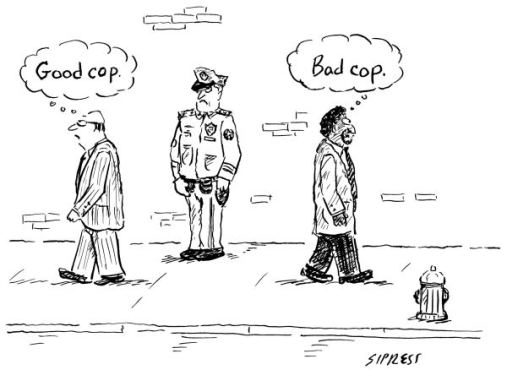
Good Cop Bad Cop

Blacks are arrested in the U.S. at a disproportionately high rate relative to their share of the population, and they are killed by police at a disproportionately high rate as well. Does that prove that police target blacks unfairly? No, it depends on additional considerations not revealed by a simple comparison of police actions against blacks to their representation in the overall population.

This matter was put into perspective earlier this year by Heather Mac Donald in the Wall Street Journal (the link is to a Google search that should get around the WSJ paywall). Her analysis relies in part on a data base of fatal police shootings in 2015-16 maintained by the Washington Post, available here. Some of the most telling points noted by Mac Donald were the following:

  •  “… in 2015 officers killed 662 whites and Hispanics, and 258 blacks. (The overwhelming majority of all those police-shooting victims were attacking the officer, often with a gun.)” The most recent data for 2016 are incomplete, but of the 509 police shootings recorded so far this year, the proportion involving blacks appears to be roughly consistent with the 2015 figures.
  • There were 6,095 black homicide deaths in 2014—the most recent year for which such data are available—compared with 5,397 homicide deaths for whites and Hispanics combined. Almost all of those black homicide victims had black killers.
  • Over the past decade, according to FBI data, 40% of cop killers have been black. Officers are killed by blacks at a rate 2.5 times higher than the rate at which blacks are killed by police.
  • According to the Bureau of Justice Statistics, blacks were charged with 62% of all robberies, 57% of murders and 45% of assaults in the 75 largest U.S. counties in 2009, though they made up roughly 15% of the population there.
  • Such a concentration of criminal violence in minority communities means that officers will be disproportionately confronting armed and often resisting suspects in those communities, raising officers’ own risk of using lethal force.
  • A March 2015 Justice Department report on the Philadelphia Police Department found that black and Hispanic officers were much more likely than white officers to shoot blacks based on “threat misperception”—that is, the mistaken belief that a civilian is armed.
  • A 2015 study by University of Pennsylvania criminologist Greg Ridgeway … found that, at a crime scene where gunfire is involved, black officers in the New York City Police Department were 3.3 times more likely to discharge their weapons than other officers at the scene.

It is a tragic fact that the black community is plagued disproportionately by crime and violence. However, that has nothing to do with the manner in which police perform their duties when confronted with danger. Rather, it has to do with historical inequities, poor educational institutions, dismal economic opportunities, and a number of misguided government policies. The latter include minimum wages that diminish opportunities for black workers to gain job experience, anti-poverty initiatives that destroy work incentives and undermine family structure, a failed public school system, and the misguided war on drugs. Drug prohibition ensnares those who face insidious alternatives to legal market activity, which is often unavailable. Unfortunately, all of these policies have a disproportionate effect on the black community.

Any assessment of police conduct must acknowledge the circumstances under which officers work. If a particular demographic is disproportionately involved in crime, and affected by crime, then it is reasonable to expect that police action will be disproportionately focused on that group. This is not prima facie evidence of racism in police work. Quite the contrary: it is evidence that the police are fulfilling their obligation to protect innocents within that demographic, even if other institutions are aggravating the social dysfunction.


Our Stardust Scrutiny, A Reverie Thus Far In Vain

Tags

, , , , , , ,

smbc_klingons

The Fermi paradox juxtaposes the fact that we’ve heard no signal from extraterrestrial life against claims that life must be common in the universe. The paradox, named after physicist Enrico Fermi, is not so inscrutable given 1) the immense distances in interstellar space; 2) the likelihood that few civilizations have survived long enough to attain a high level of advancement; and 3) the slim chance (until recently, perhaps) of detecting messages from a distant civilization.

These points are addressed in recent paper by Evan Solomonides and Yervant Terzian of Cornell University entitled “A Probabilistic Analysis of the Fermi Paradox” (the full PDF is available for download on the upper right at the link). The authors note that the first broadcast from Earth that could be detected beyond the planet took place roughly 80 years ago. Unfortunately, it was Hitler’s commentary on the superiority of arian athletes at the 1936 Olympics. That seems a shame, but then it’s unlikely that the recipients can interpret the signal at all. Still, the authors estimate that by now, that broadcast will have reached over 8,000 stars and over 3,500 earth-like planets within an 80 light-year sphere around the Earth. That might sound like a lot, but it is an infinitesimal fraction of the Milky Way galaxy. There is roughly a zero chance that an advanced civilizations exists within a population of potentially habitable planets that small.

How Common Is Life?

Solomonides and Terzian extend their analysis using a version of the so-called Drake equation, which relies on a series of assumed probabilities to calculate the number of of active, intelligent civilizations in the galaxy, call it N. However, the authors assert that their version of the Drake equation yields an estimate of N for the entire history of the galaxy, but it looks very much as if they’ve simply redefined the equation’s terms. They use the equation to specify a relation between 1) the average length of communication history for all intelligent civilizations; and 2) the total area of all spheres of coverage, which is dependent on N. They assert that as of today, this combined area must encompass less than one-half of the galaxy because that implies that we are less likely to have heard a signal from extraterrestrials than not to have heard one. And we haven’t. However, this seems like a thin foundation from which to draw implications, and it is based on an expectation. Even if those spheres covered 90% of the galaxy or more, it would not rule out the silence we’ve “heard” to date. Nevertheless, the authors use this inequality to derive a lower and upper bound on the number of intelligent, communicating civilizations in Milky Way history.

Expanding Broadcast Spheres

Again, Solomonides and Terzian define “spheres of communication” extending into space as far in light years as the length of a civilization’s broadcasting history in earth-years. Earth’s sphere of communication now extends outward by 80 light years. But imagine that a long-extinct civilization on the other side of the galaxy sent messages about 30,000 years ago. The signal might be reaching us just now. But if that civilization’s broadcasting history lasted 1,000 years before an untimely extinction, its broadcast sphere would be like a hollow, expanding dumpling, now almost as wide as the galaxy itself but with dough walls a constant 1,000 light-years thick. Only the walls contain broadcast information, so the areas of spheres like these are not simply additive. The hollow “inner spheres” must be subtracted to get the total broadcast area.

Revisiting the Duration of Broadcasts

The communication spheres defined by Solomonides and Terzian are “disks” rather than spheres, because collapsing the galaxy into two dimensions simplifies the analysis. They do not appear to allow for the sort of hollowness implied by an older, advanced civilization with a limited survival time. That matters in terms the history relevant to our failure to detect signals thus far. If a civilization’s broadcasting history is of short duration relative to its distance from Earth, then its communication sphere has thin broadcast walls. If that now-extinct civilization originated signals on the other side of the galaxy more than about 35,000 years ago, the signals would be irrelevant to “our” Fermi paradox because by now, Earth is almost certainly inside the wall of its expanding broadcast “dumpling”. The signal passed us by before we were advanced enough to have thought about it. So the relevant history of the galaxy, for purposes of identifying the broadcasting histories of civilizations we might have heard from by now, goes back a bit farther than the total width of the galaxy, which is roughly 32,600 light years. The relevant history might be 35,000 years, give or take, not the 13 billion years since the galaxy’s birth. At least that limits one dimension of the problem.

I find the following sentence somewhat troublesome because Solomonides and Terzian seem to focus on the length of broadcasting histories only with reference to the present time:

The planar area of the galactic disk reached by communication from any intelligent civilization (assuming such civilizations are uniformly dispersed throughout the galaxy) can be modeled as the area of N disks with radius Lh (average length of broadcasting history in years)…

Some of those N disks are probably hollow. The idea that civilizations are commonplace may not mean that they all exist contemporaneously, and while the authors must understand that point, the description above implies that all disks are saturated with broadcasted information from center to outer rim rather than hollow.

Solomonides and Terzian then attempt to place the radius of earth’s own minuscule broadcast disk within the hypothetical distribution of all such discs within the galaxy:

… we know that humanity was almost certainly not the (or even one of the) first species in the galaxy to develop broadcasting technology, nor one of the last. Put statistically, it can be said with a high degree of confidence that humanity is somewhere in the median 90% of the population of galactic species as far as broadcasting history is concerned. That is to say, we are not among the first nor last 5% of civilizations to develop this technology. … Taking a very conservative estimate, we posit that we have been broadcasting for 5% as long as the average communicative species has been, and as such this upper limit on the average is approximately 1600 years. This can be substituted back into the inequality derived previously to give an idea of the frequency of life that our apparent loneliness suggests.

A couple of notes on this statement: First, it assumes that the lengths of broadcasting histories are distributed uniformly from 0 to 1,600 years. Second, it seems to preclude any history of broadcasts prior to 1,600 years ago. If that is the case, then the number of civilizations they consider are what I’d call “near contemporaneous”. The authors do not seem to be accounting for all history after all.

Few Neighbors Or Many?

The authors go on to calculate lower and upper bounds on the number of communicating civilizations in the Milky Way, but again, in light of the quotes above, the implied existence of civilizations seems to be near-contemporaneous. Perhaps that’s okay for arriving at a lower bound. Again, Solomonides and Terzian assume that our 80 years of communication history puts us below 95% of all other communicating civilizations. Therefore, the longest history among such civilizations would be just 1,600 years. Because we have heard nothing, there must be great distances between relatively few civilizations: only about 210, according to Solomonides and Terzian.

In light of the relevant history of the Milky Way, 1,600 years seems outrageously short for the longest communication history. To my way of thinking, broadcast histories, whatever their number, must be distributed over the entire galaxy and over a time span of about 33,000 years. If extinctions shorten the duration of those histories, then it is possible that we’ve simply missed the outer walls of a number of broadcast disks that have already reached us. In that case, civilizations must be sparse both spatially and over time. Unfortunately, the authors’ lower bound for the number of communicating civilizations must be taken as an estimate for civilizations whose existence is near-contemporaneous with our own. However, that does not fit as neatly into an explanation of the Fermi paradox as the authors would like.

For an upper bound on the number of communicating civilizations, the authors assume that we are on the verge of hearing from another civilization in response to our initial communication. If so,  then we have a very close, neighboring civilization about 40 light years away, which implies an outrageously high frequency of civilizations in the galaxy: about 78 million, according to the authors. The upper bound relies on an assumption that it’s necessary for Earth to receive a response to our communication, as opposed to receiving an independent communication from afar. Perhaps the signal/response requirement is imposed for reasons of estimating a more densely populated galaxy for the upper bound.

The lower and upper bounds imply that life is either rare or ubiquitous; the authors claim that either is an unreasonable violation of the so-called “mediocrity principle”, which posits that our civilization is “run-of-the-mill”: the first is a violation because we are rare; the second is a violation because we’ve somehow managed to avoid hearing anything despite the denseness of communicating civilizations in the Milky Way.

Great Filters

It’s reasonable to question the assumption that an advanced civilization’s broadcast history would be of relatively short duration. The galaxy is a hazardous place, however, presenting extreme natural threats to any planet finding itself in a “Goldilocks zone” near its host star and capable of harboring life over an extended period. Threats range from interloping space rocks to variations in a planet’s exposure to radiation. Then, there are hazards to life arising from natural conditions on the planet itself, such as extreme volcanic activity and perhaps natural toxins. Finally, the development of technology brings hazards as well, including the possibility of chemical, biological and nuclear calamities. All of these constitute “Great Filters” that may prevent civilizations from reaching a stage of advancement sufficient for interstellar travel and colonization of other worlds.

Can such hazards be expected to put a halt to a representative civilization’s broadcasting, and within how many earth centuries? In some cases, it’s likely to be as few as 10 or 20 centuries, but even if extinction is common, there are also likely to be a few civilizations making it to the far right tail of the survival distribution. Those few civilizations, or even one, could have begun broadcasting so long ago that their communication spheres are much larger than the galaxy itself. We might just hear them if they exist, but perhaps that argues that they do not.

Detection and and Understanding

Beyond the limits of communication spheres, another compelling reason for our failure to detect signals from other civilizations is signal degradation over great distances. According to Solomonides and Terzian, signal strength weakens with the inverse square of distance. Even today, messages of extremely distant origin might be impossible for us to discern, let alone understand.

Though a handful of these signals have been designed to be picked up by extraterrestrial intelligence (…. i.e. Fibonacci, the prime numbers, the squares, all broadcast in binary), the vast majority would be indecipherable. This is because an alien civilization would need to first decode binary into sound (and figure out our tone encryption method) or video (with very specific, inconsistent formats), and if they could somehow do that, they would then need to decode the resulting 3,000 human languages … into something they could parse successfully.

Given sufficiently well-equipped listening centers here on Earth, detection becomes something of a mathematical exercise. Over the past 10-15 years, there have been advances in developing algorithms to extract signals from an otherwise noisy background.

Conclusion

With plausible assumptions, the Drake equation yields the conclusion that the galaxy may be populated with a large number of intelligent civilizations, larger still if we count those existing at any time over the past 35,000 years. The Solomonides and Terzian paper shows that the lack of detection on Earth is not very surprising, but in a limited context. The silence might be even less surprising if many of the historical civilizations had a broadcasting age of limited duration, generating hollow broadcasting spheres, because the walls of many of those spheres would have passed us by long before our own radio age. Therefore, the Fermi paradox does not seem to be such a paradox after all.


God Save the Brexit

Tags

, , , , , , , , , ,


The British might have a bumpy transition to full independence following last week’s Brexit vote, but the European Union (EU) may now face a challenge to its very existence: the outcome of the British referendum amounts to a revolt against overbearing rule by a distant, authoritarian central government. The vote demonstrates resentment by many Brits to absurd regulation of many aspects of life, to the loss of sovereignty inherent in EU membership, and to the EU’s controversial immigration policies. Other members of the EU may face popular exit movements of their own, as sentiment in France and elsewhere is running strongly against the Union. Economist Joel Kotkin writes the following in his assessment of the Brexit vote:

In the last economic expansion, something close to 70 percent of all the new jobs created went to non-U.K. citizens. …  In the media and polite circles in both parties, opposition to EU immigration has been widely denounced as racist. But, in reality, UKIP’s [U.K. Independence Party] leader, Nigel Farage, has spoken positively about continuing migration, largely non-white, from the Commonwealth, particularly for skilled workers. In contrast, Cameron’s failure to slow down the largely unregulated EU migration may have been the single largest factor behind the Brexit result.

This was a vote for self-determination and also a vote for cultural identity. The left has been quick to call it racism, but Tyler Cowan, himself in the Remain camp, thinks that label is misleading in important ways:

 “Quite simply, the English want England to stay relatively English, and voting Leave was the instrument they were given. …  Much has been made of the supposed paradox that opposition to immigration is highest where the number of immigrants is lowest. Yes, some of that is the racism and xenophobia of less cosmopolitan areas, but it would be a big mistake to dismiss it as such or even to mainly frame it as such. Most of all it is an endowment effect. Those are the regions which best remember — and indeed still live — some earlier notion of what England was like. And they wish to hold on to that, albeit with the possibility of continuing evolution along mostly English lines. … The regularity here [comparing England to Denmark and Japan] is that the coherent, longstanding nation states are most protective of their core identities. Should that come as a huge surprise?

Megan McArdle also takes a stab at illuminating the disconnect between those who believe in forging a European “nation” and those who prefer independence:

Surrendering traditional powers and liberties to a distant state is a lot easier if you think of that state as run by ‘people like me,’ … particularly if that surrender is done in the name of empowering ‘people who are like me’ in our collective dealings with other, farther ‘strangers who aren’t.’ … The EU never did this work. When asked ‘Where are you from?’ almost no one would answer ‘Europe,’ because after 50 years of assiduous labor by the eurocrats, Europe remains a continent, not an identity.

Those who had hoped for Britain to remain in the EU include elites who stood to gain from crony capitalism that benefits from heavy regulation, as well as collectivists whose naive ideals dictate government planning and a borderless world. Others may have hoped to profit from another upshot of a remain vote: the U.K., unlike other member states, still has its own currency and its own monetary authority (the Bank of England — BOE); as Paul Craig Roberts says, a British commitment to the EU, and adoption of the euro, would have greatly diminished London as a financial center, bringing potentially significant windfalls to major U.S. financial institutions.

Great Britain has its own economic problems, of course, and there is no guarantee that exit from the EU will pave an easy road to prosperity. The country is attempting to reign in budget deficits, but relatively slow economic growth is making that more difficult. The steep slide in the value of the pound after the Brexit vote will stimulate exports, but it makes imported goods more costly and has inflationary consequences. That makes the BOE’s job of conducting monetary policy tricky. Fears of a post-Brexit liquidity crisis and recession must be balanced against the inflationary impact of the cheaper pound.

Even worse, with or without the EU, politics in the U.K. tends increasingly toward statism. This is from Sohrab Ahmari in his article “Illiberalism: The Worldwide Crisis“:

Then there is Britain, where the hard-left wing of Labour has taken over the party. Rising to the leadership in the aftermath of last year’s electoral rout, Jeremy Corbyn has broken the party’s peace with free enterprise and individual responsibility—the main reformist achievement of Tony Blair’s New Labour. The party once again longs for socialism and speaks the language of class warfare at home, while anti-Americanism, pacifism, and blame-the-West attitudes dominate its foreign policy. at home.

From my perspective, the worst-case scenario for Britain is that post-Brexit economic policy will be marked by a continued drift toward government activism, and that “softening the Brexit blow” will be an additional pretext. I believe the British have something to gain from Brexit, but much of it will be frittered away by giving things over to government control. But then again, perhaps homegrown authoritarianism is preferable to imported varieties.

Unfortunately, the exit itself will be a bonanza to the rent-seeking class, as negotiation of its terms with the EU, and implementing the exit, promise to be complex exercises involving an army of technocrats. They should not be too eager to make regulatory concessions to the EU, or anyone else, in order to maintain close ties. The best approach would be to reduce trade barriers unilaterally, blunting the impact of the cheap pound on import prices while enjoying the favorable effect on exports.

My hope is that Brexit will prove to be an economic and cultural tonic for the U.K. in the long run. It would be far better for the country to use its power of self-governance to the good of private individuals, steering clear of government domination of economic activity and excessive regulation. Authorities should cultivate a light touch, allowing markets in the U.K. to do what they do best: promote the general welfare.


Warm, Contented Civilizations

Tags

, , , , , , , , , , ,

image

Human civilizations have experienced many of their worst trials during periods of cooling and cold temperatures over the past 8,000 – 10,000 years. These were episodes associated with droughts as well. Conversely, civilizations have tended to prosper during warm, wet periods. These associations between human progress and the natural environment are discussed in a pair of articles by Andy May: “Climate and Human Civilization Over the Past 18,000 Years“, and  “Climate and Human Civilization for the Past 4,000 Years“. The articles are part climate science, part history, and part anthropology, with many fascinating details.

May presents large charts that can be downloaded, and they are especially interesting to ponder. He uses historical temperature proxies from Antarctica and Greenland to construct the charts, along with more recent data on measured surface temperatures in Greenland. According to May, the proxies are highly correlated with other proxy data from less extreme latitudes. Several important takeaways are the following:

  1. Warm periods in the historical record are associated with wet conditions, and cold periods are associated with dry conditions. This is intuitive, as warm air holds more moisture than cold air.
  2. There are estimates of temperatures going back more than 800 million years; apparent cyclical regularities in temperatures have lasted as long 150 million years. Cycles within cycles are evident: a 100,000 year cycle is prominent as well as a 25,000 year cycle (see #4 below).
  3. Today’s temperatures are not as high as those prevailing during about 200 years of the so-called Roman Warm Period, or during a span of similar length in the so-called Minoan Warm Period, about 3,300 years ago. Today’s temperatures are much lower than estimates for much of the earth’s pre-human history.
  4. The southern hemisphere has more volatile temperatures than the northern hemisphere due to the tilt of the earth’s axis at perihelion in January, when the earth is closest to the sun. That means the southern hemisphere tends to have warmer summers and colder winters. That will reverse over the next 10,000 years, and then it will reverse again. There is more land mass in the north, however, so it’s not clear that less extreme weather in the north helps explain the hugely lopsided distribution of development and population in that hemisphere.
  5. Recent increases in sea levels have been small relative to the years following the Little Ice Age. Projected increases over the next 50 years are of a magnitude that should be easily manageable for most coastal areas.
  6. Atmospheric carbon concentration seems to lag major increases in temperatures by about 800 years, raising a question of causality. Today’s carbon concentration is low relative to earlier epochs; it has been increasing for thousands of years, clearly independent of human activity, and is now near 400,000 year highs.
  7. Civilizations have blossomed with warm temperatures and they have collapsed or hit extended periods of retarded progress with declines in temperatures. Human agriculture was born as temperatures rose out of the depths of a glacial period about 10,000-12,000 years ago. Rome flourished during a warm cycle and collapsed as it waned. The Vikings settled in Greenland and Newfoundland during the Medieval Warm Period and were eliminated by the Little Ice Age. May cites a number of other examples of temperature cycles bringing on major shifts in the course of human progress. There are many possible explanations for the decline of past civilizations, but extremely low temperatures, droughts, and lengthy periods of weather inhospitable to agriculture have been important.

The fashion today is to insist that only dramatic changes in our use of energy can avert a global warming catastrophe. It is not clear that any effort by humans to manipulate global temperatures can overcome the natural forces that are always driving temperature change. For that matter, it is not clear that carbon dioxide is a bad thing, or that diverting vast quantities of resources to reduce it would be wise. CO2 is certainly not a pollutant in the normal sense of the word. Here is an excerpt from May’s conclusion in his “4,000 years” article, which speaks volumes:

First, there is no perfect temperature. Man, even in pre-industrial times, adapted to a variety of temperatures and he has always done better in warm times and worse in cold times. Second, why would anyone want to go back to the pre-industrial climate? The Washington Post says the goal of the Paris Climate Conference was get the world to agree to limit global warming to less than two degrees above pre-industrial temperatures. Pre-industrial times? That’s the Little Ice Age, when it snowed in July, a time of endless war, famine and plague. According to the Greenland ice core proxy data, temperatures 180 years ago were nearly the coldest seen since the end of the last glacial period 10,000 years ago! Why measure our success in combating anthropogenic warming, if there is any such thing, from such an unusually cold time?

Mobility, Safety Nets & Sticky Webs

Tags

, , , , , , , , , , , , , , , , , , , , , , , , , , , ,

image

We’re unlikely to reduce the share of the U.S. population living in economic dependency under the current policy regime. So many aspects of tax law, regulation and aid programs are designed as if to perpetuate or perhaps even worsen the situation. I’ve discussed this topic before on Sacred Cow Chips in “Degrees of Poverty and the Social Safety Trap“, and “Minority Politics and the Redistributionist Honey Trap“.

Many supporters of aggressive anti-poverty efforts take umbrage at any suggestion that government aid might discourage the poor from engaging in productive activities. They imagine an implication that the poor are “lazy”, perfidious or otherwise undeserving of assistance. Whether that is a misunderstanding or merely rhetorical bite-back, the fact is that it is rational to respond to incentives and there is no shame in doing so. Unfortunately, many assistance programs contain incentive traps or income “cliffs” that discourage work effort. This applies to food stamps, rent subsidies, Obamacare subsidies, and many more of the 120+ federal aid programs and other state and local programs.

Here’s a new example from a research abstract posted at Marginal Revolution: The Medicaid expansion had very negative effects on labor force participation. The funding for Medicaid expansion at the state level was authorized by the Affordable Care Act (ACA) — aka Obamacare, but only about half the states went along with it. From the abstract:

I find a significant negative relationship between Medicaid expansion and labor force participation, in which expanding Medicaid is associated with 1.5 to 3 percentage point drop in labor force participation.

The direction of impact is hardly unique, and as Tyler Cowen notes at the link:

Work is good for most people, and it is even better for their future selves, and their future children too.

The negative impact of Obamacare is more massive than the estimate above might suggest. Veronique de Rugy at Reason.com discusses how “Federal Programs Keep People Poor“. While most of her article is about the negative impact of high marginal tax rates on the employment prospects of the poor, she also recalls an ugly CBO estimate of the ACA’s impact:

In 2014, the Congressional Budget Office—Congress’ official fiscal scorekeeper—revised its original estimate to report that because of the law, by 2024 the equivalent of 2.5 million Americans who were otherwise willing and able to work will have exited the labor force.

There are several different channels through which the negative effects of the ACA operate: Small employers are incented to limit their hiring and the hours of employees, and federal subsidies (and sometimes state benefits) are available to individuals only so long as they remain below certain income thresholds. Again, this is typical of many government aid programs (the Earned Income Tax Credit (EITC) being an exception). More from de Rugy:

When the government takes away a person’s benefits as his income goes up, it has the same effect as a direct tax. And remember, when you tax something, you usually get less of it. That means these programs can actually hinder income mobility: In order to continue receiving their government cash, individuals are forced to limit the amount they earn. Thus, they have an incentive not to try to climb the income ladder by putting in extra hours or signing up for job training and educational programs.

Mises Wire recently carried a reprint of an essay by the great Henry Hazlitt, “How To Cure Poverty“. The gist of Hazlitt’s argument is that government largess simply cannot create wealth for society, but only diminish it. The mere process of redistributing the current “pie” consumes resources, but that is minor compared to the future reduction in the size of the pie brought on by the terrible incentives inherent in income taxation and many government benefit programs:

The problem of curing poverty is difficult and two-sided. It is to mitigate the penalties of misfortune and failure without undermining the incentives to effort and success. … The way to cure poverty is … through … the adoption of a system of private property, freer trade, free markets, and free enterprise. It was largely because we adopted this system more fully than any other country that we became the most productive and hence the richest nation on the face of the globe. Through this system more has been done to wipe out poverty in the last two centuries than in all previous history.

Harvard professors Edward Glaeser and Andrei Schleifer have written about “The Curley Effect: The Economics of Shaping the Electorate“, which posits that redistributive policies that are harmful to constituents can be rewarding to politicians. The paper deals with policies that encourage emigration of affluent voters away from cities, but which nevertheless reward politicians by increasing the proportion of their political base in the remaining constituency. It seems to apply very well to many major cities in the U.S. However, it certainly applies more broadly, across states and nations, when affluent people and their capital are mobile while the less affluent are not, especially when benefits are at stake. It’s no secret that promises of benefits are often attractive to voters in the short run, even if they are harmful and unsustainable in the long run.

The welfare state appears to have helped to sustain many of the poor at an improved standard of living after accounting for benefits, or it has prevented them from falling into “deep poverty”. However, it hasn’t succeeded in lifting the poor out of dependency on the state. Pre-benefit poverty rates are about the same as they were the late 1960s. In addition, Christopher Jencks observes that the “Very Poor” have in fact become poorer. That’s discussed in his review of “$2.00 a Day: Living on Almost Nothing in America” by Kathryn Edin and Luke Shaefer. Jencks presents statistics showing that those in the lowest two percentiles of the income distribution have suffered a fairly sharp decline in income since 1999. Many of these extremely poor individuals do not avail themselves of benefits for which they could qualify. In addition, the EITC requires earned income. A job loss is a wage loss and, if it goes on, a loss of EITC benefits. Unfortunately, work requirements are more difficult to meet in the presence of wage floors and other distortions imposed by heavy-handed regulation.

A guaranteed national income has become a hot topic recently. Michael Tanner weighs in on “The Pros and Cons…” of such a program. There are many things to like about the idea inasmuch as it could sweep away many of the wasteful programs piled upon each other over the years. It is possible to construct a sliding-scale guarantee that would retain positive incentives for all, as Milton Friedman demonstrated years ago with his negative income tax concept. However, as Tanner points out, there are many details to work out, and the benefits of the switch would depend upon the incentive structure built into the guarantee. As a political plaything, it could still be dangerous to the health of the economy and an impediment to income mobility. Don Boudreaux has registered objections to a guaranteed income, one of which is based on strengthening the wrongheaded argument that we derive all rights from government. Even more interesting is David Henderson’s take on a basic income guarantee. He finds that the budgetary impact of a $10,000 guarantee would equate to a 30% increase in government spending, and that assumes that it replaces all other assistance programs! Henderson also discusses the public choice aspects of income guarantees, as well as moral objections, and he concludes that there are strong reasons to reject the idea on libertarian grounds.

The economy is riddled with too many subsidies, penalties and bad incentives that distort the behavior of various groups. The well-to-do often benefit from subsidies that are every bit as distortionary as those inherent in many public assistance programs. They should all be swept away to restore a dynamic economy with the potential to lift even more out of poverty. There could be a role for a guaranteed income on the grounds that it is better than what we’ve got. But we should recall the words of Hazlitt, who reminded us that we’ve come so far on the strength of property rights, private initiative, and free trade. Left unfettered, those things can take us much farther than the ugly pairing of beneficence and coercion of the government behemoth.


Suicides Happen, Guns or Not

Tags

, , , , , , , , , , , , , ,

heads

Gun-rights deniers often assert that access to guns increases the suicide rate, a question recently addressed by Ryan McMaken on the Mises Wire blog. He shows conclusively that suicide rates across countries are not related to gun laws. While gun ownership in the U.S. is extensive, and most gun deaths in the U.S. are suicides, the U.S. suicide rate is in the middle of the pack for OECD countries. Most of those countries have more restrictive gun laws. In fact, the U.S. suicide rate is lower than in Austria, Finland, France, Belgium, and Japan. Gun ownership rates are extremely low in Austria, France, and Japan. Therefore, suicide rates appear to be unrelated to legal gun ownership and the restrictiveness of gun laws. These facts, and simple logic, suggest that an individual in a state of extreme desperation has alternative means of taking their own life.

The most nuanced argument that guns encourage suicides is based on a dichotomy of premeditated suicides versus suicides of impulsivity or passion. Most impulsive suicides, according to this view, are carried out with faster, less painful and more reliable methods, which would include the use of guns. That’s based in part on interviews with suicide survivors and the mental health records of non-survivors. However, it would not be surprising to learn that survivors actually had less intent to begin with; a comparison is impossible because we can’t ask the non-survivors. And whether a mental health record, or the absence of one, is always  a reliable guide to the degree of impulsivity is open to question. So while there are differences in the mental health records of firearm suicide victims versus those who have used less reliable methods, the conclusions seem to rest on fairly unreliable measures of impulsivity or on survivor-only samples. Researchers don’t have much choice in the matter, but drawing conclusions based only on survivors is prone to severe bias.

McMaken shows that guns account for most suicides only among those of age 55 and above, a group that is likely to be the least impulsive. Teenagers might be expected to be the most impulsive, but they tend to have lowest rates of suicide by firearms. However, a teen might not have ready access to a gun even if one is in the home. The teenage suicide rate is even less related to gun ownership across countries. New Zealand, Ireland, Finland and Canada come in much higher than the U.S. on this sad measure, and Australia, Japan, Switzerland, Belgium and Sweden are above the U.S.

At the previous link, the “British coal-gas story” is told to argue that cutting off a common means of suicide will lead to a permanent reduction in suicides. In this case, a changeover from coal gas for heating and cooking to natural gas is alleged to have led to a permanent decrease in total suicides in Great Britain in the 1960s, as death by “sticking your head in the oven” was no longer very reliable. However, other research has found compensatory increases in other forms of suicide, so the coal-gas lesson is suspect.

Harvard study (circa 2007) by criminologists Don B. Kates and Gary Mauser focused on the ties between guns, murder and suicide; they concluded that suicide does not bear a relationship to gun possession. The authors examined cross-country and within-country data:

There is simply no relationship evident between the extent of suicide and the extent of gun ownership. People do not commit suicide because they have guns available. In the absence of fire‐ arms, people who are inclined to commit suicide kill themselves some other way.”

Suicide is a manifestation of despair so deep that the victim simply cannot get on with life. Guns have nothing to do with that anguish. It may be true that failed attempts often lead to a renewal of spirit, but survivors still have a high rate of suicidal recidivism. Moreover, the question of the depth of the original intent for survivors is open to question. Those choosing guns for suicide might think it’s the best alternative, but clearly other alternatives will be chosen when guns are unavailable. The claim that access to guns makes people more vulnerable to taking their own lives is not supported by the data.

Anti-Gun Babes Up In Arms

Tags

, , , , , , , , , , , , , , , , , , , , , , , , , , , , , ,

image

Passion for various forms of gun control was inflamed by the tragic murder of 49 patrons (with 53 injured) at the Pulse nightclub in Orlando, Florida in the early hours of last Sunday morning. A man with ties to radical Islam was the perpetrator, but that’s not convenient to the left’s narrative, so scapegoats for the massacre run the gamut from guns to transgender bathroom laws to Christian “intolerance”, as opposed to the intolerance of a bat-shit crazy Islamic extremist. The Soopermexican notes the following:

It’s really amazing how liberals [sic] are finding a way to blame Christians for the actions of the Orlando terrorist, who was, 1) gay, 2) Muslim, 3) Democrat, and 4) racist. … But then that’s what they did that time when a crazed liberal gay activist tried to shoot up the Family Research Council. Remember that? He literally said he wanted to kill everyone and then ‘smear Chick-Fil-A in the victim’s faces.’

In case there’s any misunderstanding, I include that quote NOT to denigrate gays, Muslims, or Democrats, but to emphasize the absurdity of blaming Christians for the Orlando shootings. To get a sense of the infectious silliness going around in leftist circles over the slaughter, read this account of a vigil for the Pulse victims held in Columbia, MO by several student organizations near the main campus of the University of Missouri, at which Latino activists scolded the gay activist crowd for being “too white” and for paying insufficient attention to racial issues. Of course, it’s true that many of the Orlando victims were Latino, but after all, the vigil was for them, too, not just the white victims.

The left despises private gun ownership, or perhaps private anything except for their own privileges. Gun-blame feels so compassionate to them, and in this case, it conveniently avoids any mention of the killer’s ethnicity and radical ideology. Agitators say that “assault weapons” must be banned, but they are generally unable to articulate a precise definition. More thorough background checks are another favorite “solution”, but that’s based on an article of faith that such checks would be effective. Without proof that background checks actually work, and there is none, it still seems like a good idea to the “do something” crowd. Then, there are those whose real agenda is to ban guns outright, despite the fact that gun bans are counterproductive and infringe on the rights of law-abiding citizens.

Most of those who wish to ban assault weapons think they are referring to guns that fire repeatedly when the trigger is pulled. In other words, they believe that assault weapons are fully automatic weapons. But fully automatic weapons have been banned in the U.S. since 1934! Semi-automatic weapons require the trigger to be pulled to fire each bullet but load the next bullet automatically. James B. Jacobs of the NYU School of Law gives a fairly detailed description of the distinction between so-called assault weapons and other firearms, which essentially comes down to appearance:

‘Assault weapons’ are semiautomatic firearms designed to look like military rifles. They are not military rifles—sometimes called assault rifles24—such as the U.S. Army’s M-16 … that can be fired in automatic or semiautomatic mode, or Russia’s AK-47, Germany’s HK G36 assault rifle, and Belgium’s FN Fal assault rifle. In contrast to assault rifles, these semiautomatic look-alikes do not fire automatically. Functionally, they are identical to most other semiautomatics. … Practically all modern rifles, pistols, and shotguns are semiautomatics; non-semiautomatic long guns include bolt action, slide action, and breach loaders; non-semiautomatic pistols are called revolvers.

Jacobs discusses the futility of a ban on assault weapons and offers accounts of some historical assault weapon bans that were ineffective. Those outcomes were due in part to the flimsy distinction between assault weapons and other guns, as well as the fact that assault weapons are used in a relatively small percentage of gun crimes and in few mass shootings (also see here). This is corroborated by a recent paper appearing in the journal Applied Economics in which the authors report:

… common state and federal gun laws that outlaw assault weapons are unrelated to the likelihood of an assault weapon being used during a public shooting event. Moreover, results show that the use of assault weapons is not related to more victims or fatalities than other types of guns. However, the use of hand guns, shot guns and high-capacity magazines is directly related to the number of victims and fatalities in a public shooting event. Finally, the gunman’s reported mental illness is often associated with an increase in the number of victims and fatalities.

Another contention made by ill-informed opponents of gun rights is that mass shootings are never stopped by citizens with guns. That is simply not true, but it is good propaganda because foiled shooting attempts tend to receive much less notice than actual mass shootings. This article by Eugene Volokh provides a list of confirmed incidents in which a mass shooting was averted by a citizen carrying a gun. This situation has its counterpart in the left’s denial that defensive gun uses (DGUs) occur more frequently than gun crimes. DGUs are difficult to count because they often go unreported and may not even require the firing of a shot.

Another mistake is the continued advocacy for “gun-free zones” (such as the Pulse nightclub) within which even guards are not allowed to carry firearms. Andrew Napolitano rightly labels these “killing zones”.

More stringent background checks are another favorite solution of gun-rights opponents. However, actual background checks have done nothing to stop the most vicious mass shootings that have occurred over the past few years. This is another testament to the naiveté of relying on government to protect you, in this case, a government information system. Sheldon Richman has explained the futility of background checks thusly:

… people with criminal intent will find ways to buy guns that do not require a check. Proponents of background checks seem to think that a government decree will dry up the black market. But why would it? Sales will go on beyond the government’s ability to monitor them. Out of sight, out of government control. … Thus the case against mandating ‘universal’ background checks withstands scrutiny. This measure would not keep criminally minded people from acquiring guns, but it would give a false sense of security to the public by promising something they cannot deliver.

Advocates of assault weapon bans and wider background checks are inclined to characterize gun rights supporters as paranoid. As Volokh explained last year, however, there is strong reason to believe that the pro-gun lobby has correctly assessed the motives among the opposition as more extreme. Volokh notes that an ineffectual ban, like the 1994-2004 assault weapon ban and many other gun bans internationally, cannot outweigh the interests of society in protecting a basic liberty.

And as to basic liberties, Rolling Stone offers a wonderful illustration of the left’s disregard for individual rights and constitutional protections in an angry missive to gun rights supporters: “4 Pro-Gun Arguments We’re Sick of Hearing“. The author not only holds the Second Amendment in distain: vogue left-think has it that the entire Constitution is tainted because the framers were unable to agree on abolition 230 years ago (at a time when slave ownership was commonplace among the aristocracy). The fact that many of the founders were sympathetic to abolition makes little difference to these critics. They say the Constitution is not a legitimate framework for governance, despite its extremely liberal point of view on issues of individual rights. Apparently,  Rolling Stone would be just fine with abrogating the free speech rights of gun advocates.

Over the past 20 years or so, case law has increasingly viewed the Second Amendment as “ordinary constitutional law“, meaning that it protects individuals’ right to bear arms. The “well-regulated militia” limitation written into the Second Amendment is no longer accepted by the courts and most legal scholars as a limitation on individual rights. The militias it references were state militias raised from the civilian population, and the armaments they used were generally owned by the same civilians. In any case, there is no time limitation imposed on gun ownership by the Second via that clause. An earlier discussion of these issues was provided by Eugene Volokh in “The Commonplace Second Amendment“.

All this is quite apart from the Ninth Amendment, which states that nothing in the Constitution should be interpreted as limiting rights that are unenumerated. That would include self-defense, and ownership of a gun for that purpose is well advised. The Wikipedia entry on the Ninth Amendment says:

One of the arguments the Federalists gave against the addition of a Bill of Rights, during the debates about ratification of the Constitution, was that a listing of rights could problematically enlarge the powers specified in Article One, Section 8 of the new Constitution by implication. For example, in Federalist 84, Alexander Hamilton asked, ‘Why declare that things shall not be done which there is no power to do?’

In other words, we do not derive our rights from government or the majoritarian passions of the moment.

Finally, the debate in Congress this week has centered on whether individuals on the FBI’s Terrorist Watch List should be denied the right to purchase a gun. That might seem like a no-brainier, but it raises legitimate concerns about civil liberties. There are about 700,000 people on that list (some reports put the number much higher), many of them U.S. citizens; some of them are there by mistake. Individuals on the list have not been convicted of a crime and are therefore entitled to due process under the Fifth and Fourteenth Amendments. Watch Rep. Trey Gowdy’s passionate defense of due process to a DHS official this past week. When the ACLU and congressional republicans agree on the tyrannical nature of a restriction like this, you just can’t dismiss it out-of-hand. Such a change in the law cannot be justified without a fast and effective process giving citizens on the list a right of challenge.

The left is bereft of competence on the matter of guns, gun rights and the Constitution generally. They consistently demonstrate a dismissive view of individual liberties, whether that involves guns, religion, property, speech or due process. The tragedy in Orlando deserves more than ill-informed, knee-jerk conclusions. The most productive approach to terror risks involves individuals able to protect themselves and help watch out for others. That’s consistent with the position of the gay gun-rights group Pink Pistols. More power to them!


Hamilton, Jefferson & Miranda’s Propaganda

Tags

, , , , , , , , , , , , , , , , , , , , , , , , , , , ,

image

I know too well to take any history I get from the theatre with a grain of salt! Nevertheless, I’d really like to see Hamilton on Broadway. It’s a hugely successful musical by Lin-Manuel Miranda about the life of Alexander Hamilton, one of our nation’s founding fathers, inspired by the book Alexander Hamilton by Ron Chernow. I’ve heard much of the show’s music, infused with R&B and rap/hip-hop; it’s more appealing to me than I’d ever have expected of rap. The show has been nominated for a record 16 Tony Awards (the ceremony is tonight), and of course it’s a very hot ticket. The last time I checked, the cheapest seats available were about $650 each for the last row in the house, and that was about 45 days out! With a party of four, that’s a cool $2,600 for an evening of theatre. I think we’ll wait for the touring production to roll through the midwest next year.

In Hamilton, all of the founding fathers are cast as people of color, a controversial decision that led to a recent uproar over a casting notice encouraging non-white performers to audition for leads. The casting of the founding fathers is an interesting artistic decision. One writer, Spencer Kornhaber in The Atlantic,  says that the “colorblind” casting:

“… is part of the play’s message that Alexander Hamilton’s journey from destitute immigrant to influential statesman is universal and replicable….

That’s admirable, as far as it goes. I believe Kornhaber comes closer to Miranda’s  true motivation for the casting decision a paragraph later:

… movements like Black Lives Matter, and renewed calls for the consideration of reparations, are built on the idea that ‘all’ remains an unfulfilled promise—and that fulfillment can only come by focusing on helping the specific populations that suffer greatest from America’s many inequalities rooted in oppression. … While Hamilton does not explicitly take a side, the simple fact of its casting suggests which way it probably leans.

In broad strokes, the following is true about the drafting of the U.S. Constitution and arguments over its adoption: Alexander Hamilton favored provisions that tipped power in favor of the central government at the expense of the states, while Thomas Jefferson favored more stringent limits on central powers and strong states’ rights, or federalism as it is commonly known. It’s also true that over the years, Hamilton’s constitutional legacy tended to receive little emphasis in historical narratives relative to Jefferson’s. In the musical, Hamilton is portrayed as a hero to those who would benefit from a powerful and benevolent central government, particularly slaves, while Jefferson is portrayed in less flattering terms. Miranda’s casting implies that the relative emphasis on federal power versus states rights would surely have been reversed had the founding fathers been people of color.

A friend of mine saw the show before it became quite so hot. His kids are “theatre kids”, as mine were up to a certain age. I have great respect for my friend’s intellect and I am sympathetic to his political orientation, which I’d describe as libertarian with strong Randian influences. Here is his brief review of Hamilton:

I loved Hamilton — it was a great night of theater. I even like the music — which is rap/hip-hop style that I haven’t found enjoyable, at least until now. My biggest concern about the play is its portrayal of Jefferson and Madison, who don’t come off well. Jefferson is a party boy more interested in partying in Paris than in seriously running a new nation. Both are portrayed as instigators in digging up dirt on Hamilton to use against him politically. Yes, they would have benefited from Hamilton’s womanizing scandals, but did they actively seek out that kind of trash? The play says yes…

And of course the play takes the position, I’d argue, that nothing Jefferson writes or says can be taken seriously because he is a slaveholder….the Bank of the U.S. is regarded by the play as a wonderful creation, thanks to Hamilton.

I’ve read a number of accounts confirming Miranda’s treatment of Jefferson in the show, and the influence it apparently has on viewers without much background in political thought, American history, and the U.S. Constitution. I’ve lost the link, but one writer quoted his teenage daughter as saying “That Jefferson, he’s the WORST!”

There are a number of historical inaccuracies in Miranda’s book of Hamilton. An important fact contradicting the show’s vilification of Jefferson is that he, Madison and Aaron Burr:

…did not approach Hamilton about his affair [as represented in the show], it was actually James Monroe and Frederick Muhlenberg in 1792. Monroe was a close friend of Jefferson’s and shared the information of Hamilton’s affair with him. In 1796, journalist James Callendar broke the story of Hamilton’s infidelity. Hamilton blamed Monroe, and the altercation nearly ended in a duel. “

In no way did Chernow implicate Jefferson as a participant in blackmail against Hamilton over the affair with an “emotionally unstable” Maria Reynolds. That is entirely Miranda’s invention. His fictionalized Jefferson is a conniving devil, a disgraceful misrepresentation.

Let’s get one other thing out of the way: it is not reasonable to condemn individuals or their actions of 220 years ago outside the context of general attitudes and practices of that period. That’s not to condone those attitudes and practices, however. Last year, I quoted Warren Meyer on this point:

Meyer mentions the recent incident involving Ben Affleck, who asked the host of a PBS documentary to omit any mention of a slave-owning Affleck ancestor:

‘So an ancestor held opinions about slavery we all would find horrifying today. But given the times, I can bet that pretty much every relative of Affleck’s of that era, slaveholder or no, held opinions (say about women) that we would likely find offensive today.’

By all accounts, Chernow’s book about Hamilton is an excellent biography, but not without its faults. Charles Kessler states that Chernow relies on other biographies rather than original source material, and that Chernow misrepresents the attitudes of Jefferson and James Madison on commerce; like Hamilton, they viewed it as a “civilizing influence of the highest order“. I’m the first to vouch for the importance of well-functioning capital markets, but apparently Chernow is under the mistaken impression that capitalism itself is intricately tied to powerful banks, particularly central banks like the Federal Reserve! And Chernow exaggerates the difference in the views of Jefferson and Hamilton on the Constitution itself. Here is Kessler:

A huge gulf remains between Hamilton’s loyalty to what he called a ‘limited Constitution’ and today’s ‘living Constitution,’ which seems capable of justifying virtually any activity that the federal government sees fit to undertake.

Both Jefferson and Hamilton recognized that abolition would have represented a huge obstacle to forming a new nation. And there was the related problem, recognized by both men, of whether and how to compensate slave owners in the event of abolition. It should go without saying that a failure to reach an agreement between the colonies at the Constitutional Convention would not have led to abolition of slavery by other means. The contrary is implicit in any argument that the constitutional compromise was wholly unjust. It might have been hoped that forming a union would establish a framework within which dialogue on the issue could continue, though ultimately, a fractured union and a war was necessary to finally  emancipate the slaves.

Yes, Jefferson held slaves and had a strong economic interest in keeping them. In his circle of wealthy landowners, slavery was considered a normal part of life. However, Jefferson also publicly advocated various plans to free slaves, one as early as 1779. Here is a clause from Jefferson’s rough draft of the Declaration of Independence, before it was revised by other members of the Committee of Five and by Congress, in reference to “his present majesty”, King George:

he has waged cruel war against human nature itself, violating it’s most sacred rights of life & liberty in the persons of a distant people who never offended him, captivating & carrying them into slavery in another hemisphere, or to incur miserable death in their transportation thither. this piratical warfare, the opprobrium of infidel powers, is the warfare of [the] Christian king of Great Britain, determined to keep open a market where MEN should be bought & sold, he has prostituted his negative for suppressing every legislative attempt to prohibit or to restrain this execrable commerce ….

While the clause was explicitly critical of trade in slaves, as distinct from ownership, it reveals the thinking of a man who was very progressive for his time. As for outright abolition, it is easy today to be critical of Jefferson’s proposals, which called for gradualism and, later, even deportation of freed slaves to Santo Domingo. Those proposals were based in part on fear shared by many authorities of an economic crisis and civil disorder if slaves were freed en masse. Jefferson certainly did not view slaves as equals to white men, but that was not unusual in those times; he did call for training them in certain skills as a condition of granting them freedom.

Hamilton’s record on slavery is not quite as heroic as Miranda’s musical would have you believe. He was highly ambitious and something of a social climber, so he was reluctant to air his views publicly regarding abolition. He married into a prominent New York slaveholding family, and there are records of his role in returning slaves captured by the British to their previous owners. From historian Michelle DuRoss (linked above):

… when the issue of slavery came into conflict with his personal ambitions, his belief in property rights, or his belief of what would promote America’s interests, Hamilton chose those goals over opposing slavery. In the instances where Hamilton supported granting freedom to blacks, his primary motive was based more on practical concerns rather than an ideological view of slavery as immoral.

Hamilton’s is known to have advocated manumission: freeing slaves who agreed to serve in the fight against the British. That position was a practical matter, as it would help in the war effort, and it might have played on the patriotic instincts of slaveowners who would otherwise insist on compensation. His mentor, George Washington, himself a reluctant slave owner, undoubtedly saw the practical value of manumission.

Hamilton’s real constitutional legacy came in two parts: first was his strong support for the Constitution during the ratification process and his (anonymous) contributions to The Federalist Papers. Later came his relatively broad interpretation of provisions granting certain powers to the federal government: the power to issue currency, the commerce clause and the “necessary and proper clause”. He also proposed a few ideas that were never adopted, such as lifetime terms in office for the president and members of the Senate. He did not propose any constitutional provision for the abolition of slavery or for granting full constitutional rights to slaves.

Hamilton was a major proponent of establishing a so-called national bank, known as the Bank of the United States when it was chartered in 1793. This allowed the new country to issue currency and was used as a way to eliminate war debts that were, by then, greatly diminished in value. Hamilton’s central bank meant great rewards to any investor who held the debt, especially those who had purchased the debt at a steep discount. Unfortunately, this was tantamount to monetizing government debt, or paying off debt by imposing an inflation tax (which reached 72% in the bank’s first five years of operation). The establishment of the bank also removed a major restraint on the growth of the federal government. Moreover, Hamilton was a protectionist, advocating tariffs on foreign goods and subsidies to domestic producers. It is little wonder that some have called him the “father of crony capitalism”.

Jefferson was quite possibly a bon vibrant in the best sense of the term, as opposed to the “party boy” depicted by Miranda. He was a man of great intellect, capable and actively conversant in philosophy, science and the practical arts. He wrote the Declaration of Independence, itself a forceful testimonial to natural rights. His constitutional legacy was powerful if indirect: he was a mentor to James Madison, who wrote the first draft of the Constitution. Jefferson was an advocate of majoritarian rule but also sought to protect individual rights against a tyranny of the majority. To that end, he advocated government limited in function to the protection of rights. In short, he was a classical liberal.

There were certainly contradictions between Jefferson’s philosophy and actions. Slaveholding was one, as already noted, but that was not unusual among southern aristocrats of the time, and Jefferson at least recognized the ethical dilemma and publicly offered policy solutions. But as a slaveholder, he made an odd spokesperson for the interests of the “yeoman farmer”, an agrarian individualist in the popular mind and a myth that persists to this day. Jefferson also advocated protectionist policies, such as an embargo on U.S. exports starting in 1807.

Yes, there were abolitionists at the time of our nation’s founding. Both Hamilton and Jefferson were quite sympathetic to the principle of abolition, but both recognized the practical difficulty of pushing it forward without endangering the founding of the nation, and both had personal and probably selfish reasons to avoid fighting that battle. The musical Hamilton glosses over this reality in the case of Hamilton himself, and at the same time condemns Jefferson. Miranda might just as well condemn Abraham Lincoln for his initial support of the original 13th (Corwin) Amendment in the early 1860s, which was never ratified. Ultimately, in 1865, a different 13th Amendment was ratified, accomplishing what would have been evident from the original text of the Constitution but for the so-called “three-fifths compromise”. That provision essentially counted a slave as 3/5s of a “free person” for purposes of apportioning representation and taxes, an idea originally proposed by Madison and revived by Alexander Hamilton himself!

I will still see the musical Hamilton when I get an opportunity. Lin-Manuel Miranda is a man of great talent, but he has misrepresented crucial facts about the Founders of the nation. Those interested in the truth, including those who teach our children, should not take it seriously as an account of history.