Statists Can’t Imagine Liberty

Tags

, , , , , , , , ,

Evolution+of+the+left

Imagine all the people, living for today AND tomorrow, free to do whatever the hell they want, creating, trading, investing, growing, playing, praying, partying. But any human initiative to improve upon the harsh conditions of the natural world is apparently offensive to the nihilistic sensibilities of those on the Left (as are a host of other freedoms). That attitude is often expressed by gentry leftists, already living quite comfortably, without recognition that the statist policies they advocate would render the same conditions unattainable for most others and probably unsustainable for themselves. The hypocrisy is glaring. Here are links to a few recent articles and posts illustrating the duplicity of the Left.

Jonah Goldberg has some fun with a recent piece on the many double standards of the Left. According to Don Boudreaux, this piece is flawed only in Goldberg’s use of the term “liberal” rather than the more accurate “statist”:

If you work from the dogmatic assumption that liberalism is morally infallible and that liberals are, by definition, pitted against sinister and — more importantly — powerful forces, then it’s easy to explain away what seem like double standards. Any lapse, error, or transgression by conservatives is evidence of their real nature, while similar lapses, errors, and transgressions by liberals are trivial when balanced against the fact that their hearts are in the right place. Despite controlling the commanding heights of the culture — journalism, Hollywood, the arts, academia, and vast swaths of the corporate America they denounce — liberals have convinced themselves they are pitted against deeply entrenched powerful forces and that being a liberal is somehow brave. Obama, the twice-elected president of the United States, to this day speaks as if he’s some kind of underdog.

To digress briefly, Boudreaux elaborates on the true meaning of liberalism here.

This essay by Walter Russell Mead, “The Liberal Retreat,” describes the state of the leftist agenda after six years of the Obama Administration. It is written from more of a conservative point of view than my preferred libertarian position, but it is very much on-target in its assertion that the “body politic” is not buying into the leftist agenda. We are post-“peak Left”:

Shell-shocked liberals are beginning to grasp some inconvenient truths. No gun massacre is horrible enough to change Americans’ ideas about gun control. No UN Climate Report will get a climate treaty through the U.S. Senate. No combination of anecdotal and statistical evidence will persuade Americans to end their longtime practice of giving police officers extremely wide discretion in the use of force. No ‘name and shame’ report, however graphic, from the Senate Intelligence Committee staff will change the minds of the consistent majority of Americans who tell pollsters that they believe that torture is justifiable under at least some circumstances. No feminist campaign will convince enough voters that the presumption of innocence should not apply to those accused of rape.

It is a point of no small irony that many on the Left express apprehension about the prospect of normalized relations between the U.S. and Cuba. Heaven forbid that this process might introduce the fruits of capitalism to Cuban shores. Here’s an interesting (and disturbing) take on Castro’s Hipster Apologists:

Flickering across my computer screen, elements of the left were uniting with elements of the right, insisting that Cuba remain in the cold, a museum of the Cold War isolated from both the glories and evils of American culture. One lefty tweeter even complained that an invasion of icky American tourists would undermine ‘family values’ in Cuba.

American universities are hotbeds of egalitarian philosophy as well as identity politics. Here’s a good example of the consequences of this sort of leftist mind freeze in an opinion piece by an economics professor at the University of Wisconsin, W. Lee Hansen, on an initiative to use grading quotas at the school:

I would argue to the contrary that many students will suffer academically if they receive the artificial boost of higher grades than they actually earned just because they happen to be in a ‘targeted group.’ Students need accurate feedback on how they’re doing, not inflated grades that boost their egos.

I would also argue that the university’s reputation will be diminished by these efforts at equalizing grades between groups. Pressures to eliminate grading gaps will lead to the ‘dumbing down’ of courses and, even more likely, grade inflation for targeted minority students. This pretend solution won’t make the university better for anyone.

Any university making use of grading quotas deserves scorn. It’s sad that a great institution like Wisconsin-Madison would stoop to such a practice. Then again, egalitarian philosophy and identity politics deserve scorn. These are ideas that ultimately breed envy, hatred and social failure.

Alluring Apocalypse Keeps Failing To Materialize

Tags

, , , , , , , , , , ,

6HM3_bad_predictions

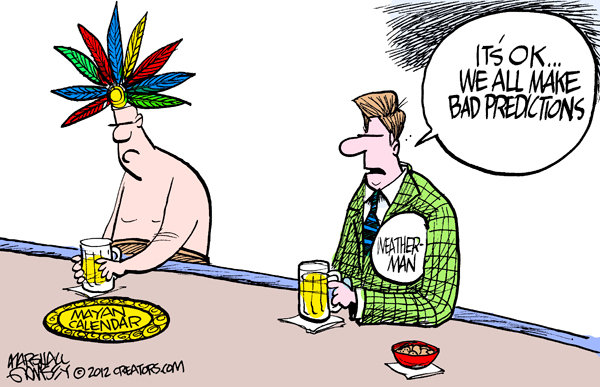
Past predictions issued by the global warming community have been spectacularly bad. So bad that “climate change” has replaced “global warming” as the preferred label among adherents. The modelers have constructed something of a false reality, often confusing model predictions with actual data in their “findings”, but faithful followers do not grasp the fiction of that modeled world. Climate models incorporating carbon forcing effects have a poor track record, consistently over-predicting temperatures. Predictions of more severe weather have also failed to pan out. To the contrary, severe weather events such as hurricanes and severe tornadoes have been in a quiet period.

The exaggerated claims extend to such topics as sea-level changes, ocean temperatures, sea ice extent, and a variety of other issues. Some recent warnings are particularly outrageous: A recent study published by the World Health Organization (WHO) claims that anthropomorphic global warming (AGW) will kill 5 million people over the two decades beginning in 2030. It is discussed here at the CATO blog, which quotes a rebuttal by Indur M. Goklany:

Firstly, [the WHO study] uses climate model results that have been shown to run at least three times hotter than empirical reality (0.15◦C vs 0.04◦C per decade, respectively), despite using 27% lower greenhouse gas forcing.

Secondly, it ignores the fact that people and societies are not potted plants; that they will actually take steps to reduce, if not nullify, real or perceived threats to their life, limb and well-being. …

Finally, the WHO report assumes, erroneously, if the IPCC’s Fifth Assessment Report is to be believed, that carbon dioxide levels above 369 ppm – today we are at 400ppm and may hit 650ppm if the scenario used by the WHO is valid – will have no effect on crop yields.

So, not only does the WHO study exaggerate risks, but when it comes to human survival, it’s policy prescriptions may have the wrong sign! That is, a warmer climate is more likely to result in improved crop yields, nutrition, and human welfare.

CATO provides further evidence of humanity’s ability to adapt from a recent study of heat stress mortality in the U.S. The CATO author states:

… the U.S. population has, ‘become more resilient to heat over time’—in this case from 1987 to 2005—led by the country’s astute senior citizens. This discovery, coupled with many other similar findings from all across the world (Idso et al., 2014), adds yet another nail in the coffin of failed IPCC projections of increased heat related mortality in response to the so-called unprecedented warming of the past few decades.

A so-called “Friday Funny” post from Watt’s Up With That (also linked at the first CATO post above) provides a wonderful compendium of “Over a Century’s Worth of Eco-Climate Predictions and Disinformation,” containing such jewels as the following quotes:

David Brower, a founder of the Sierra Club: ‘Childbearing should be a punishable crime against society, unless the parents hold a government license. …’

Presidential candidate Barack Obama, January 2008: ‘Under my plan of a cap-and-trade system, electricity rates would necessarily skyrocket. Coal powered plants, you know, natural gas, you name it, whatever the plants were, whatever the industry was, they would have to retrofit their operations. That will cost money. They will pass that money on to consumers.’

Chicago Tribune August 9, 1923: ‘Scientist says Arctic ice will wipe out Canada.’

Kenneth E.F. Watt in ‘Earth Day,’ 1970: ‘If present trends continue, the world will be … eleven degrees colder by the year 2000. This is about twice what it would take to put us in an ice age.’

Michael Oppenheimer in ‘Dead Heat’, 1990: ‘(By) 1995, the greenhouse effect would be desolating the heartlands of North America and Eurasia with horrific drought, causing crop failures and food riots… (By 1996) The Platte River of Nebraska would be dry, while a continent-wide black blizzard of prairie topsoil will stop traffic on interstates, strip paint from houses and shut down computers…’

Many other bone-headed predictions appear at the link. Sacred Cow Chips has a few previous posts on the topic of AGW.

Needless to say, the media and many pundits love a disaster scenario. The climate warmists seem to understand this and are eager to offer a steady flow of propaganda for the media to offer to the public. They encourage acceptance of an energy poor world and ultimately greater poverty and human suffering. They also encourage an acceptance of state authority and coercive force as the ultimate guarantor of human survival, despite the tenuous evidence of climate risk and a long track record of government failure in addressing social problems.

Keynesian Bull Chips

Tags

, , , , , , , , , ,

stimulus-bull

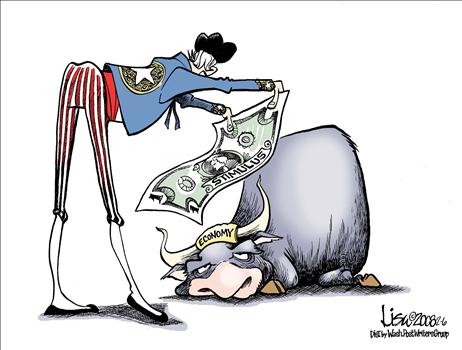
Keynesians have some unfortunate propensities. Quick to blame insufficient private demand for economic ills, they propose to ratchet government to higher levels to make up for the supposed shortfall. That diagnosis is often debatable; the prescription may be a palliative at best and destructive at worst. A fashion among Keynesians is to invoke warnings about the dangers of deflation, a hobgoblin providing additional cover for expansionary monetary and fiscal policy. Then, the mantra of infrastructure spending is invoked, ignoring the many political, regulatory and technical obstacles to efficient execution of favored infrastructure initiatives, even as promising but disfavored private infrastructure projects are blocked. This form of activism is thus revealed as simple statist, agenda-driven politics.

John Cochrane covers these and other pathologies of the Keynesian mindset in “An Autopsy for the Keynesians.” His wsj.com op-ed might be gated, but you can also try the first link given here. From Cochrane:

Stimulus advocates: Can you bring yourselves to say that the Keystone XL pipeline, LNG export terminals, nuclear power plants and dams are infrastructure? Can you bring yourselves to mention that the Environmental Protection Agency makes it nearly impossible to build anything in the U.S.? How can you assure us that infrastructure does not mean “crony boondoggle,” or high-speed trains to nowhere?

Keynesians warn that policymakers must actively mitigate the risk of deflation, but there are strong reasons to believe that deflation is more friend than foe. Cochrane makes that point in this post on the CATO Institute web site, distinguishing between deflations precipitated by financial crises and those induced by gains in productivity or other positive shifts in aggregate supply, such as the current oil supply boom, which involve healthy declines in the price level

This post by Christopher Casey at the von Mises Institute discusses the monetary causes of “bad” deflations. Jerry Jordan emphasizes some conceptualizations of money as a factor of production here, noting that stable money, as an input complementary to capital and labor, tends to boost the economy’s productivity (and reduces prices):

It is important to note that a condition of “rising purchasing power of money” is most commonly described by the pejorative “deflation.” This unfortunate custom has caused most observers to believe that a gradually falling “price level” is as bad, or even worse than, a gradually rising “price level.” Our analysis concludes there can be—and historical experience has demonstrated—“virtuous deflations” during periods of rapidly rising productivity.

Government’s Siren Song of Mortgage Risk

Tags

, , , , , , , , , , ,

subprime

What’s not to like about cheap, easy housing credit? It would be hard to criticize if it developed in response to real risks and rewards in a free market, devoid of interference by public authorities. Lenders with their own capital at risk tend to keep their pencils sharp when assessing collateral and borrower repayment capacity; borrowers respond to rate incentives by adjusting the timing of their consumption and their borrowing demands. This helps keep the extension of credit at manageable levels relative to earning power, and discourages destructive boom and bust cycles in housing prices. Conceivably, such arrangements could give rise to a more stable and prosperous economy with relatively, realistically easy credit as a by-product. If so, I’m all for it.

Unfortunately, that is not the sort of housing finance market we have in the U.S. In particular, bank lending often carries little real risk to anyone but taxpayers. Depositors who fund bank lending are almost always 100% federally-insured. As for bank capital, large institutions may be rational to regard themselves as too-big-to-fail, meaning that federal authorities will come forward with bailout money should they fall on hard times. Borrowers are encouraged by mortgage agency buyers (Fannie Mae and Freddie Mac) whose implicit federal guarantees reduce the nominal cost of borrowing, and whose standards of credit quality tend to move procyclically. Borrowers are subsidized by the tax deductibility of interest costs. Bankruptcy laws and foreclosure rules make collecting on bad debts more difficult. Finally, there is always pressure on lenders to engage proactively in high-risk community lending.

When risks are meaningless to market participants and rewards are inflated, the normal self-regulatory function of the market is suspended. Who cares about mistakes when you don’t have to pay the consequences? But society ultimately pays in misallocated resources, higher taxes and unstable markets. And while the costs to lenders and borrowers are blunted, most don’t get off scot-free: other consequences may include falling housing prices, widespread personal bankruptcies and damaged credit, foreclosures, stricter regulatory oversight, and a prolonged follow-on episode of hard credit.

The expansion of credit leading up to the housing crisis was marked by the rise of non-traditional mortgage products, which typically involve risky collateral and borrowers with tenuous credit. Interest-only mortgages reduce the borrower’s monthly payments, but the borrower fails to build their equity cushion over time. Payment option adjustable rate mortgages (ARMs) can be criticized on the same grounds, except they are arguably worse. Subprime mortgages are characterized by high loan-to-value ratios and tend to be marketed to borrowers with less than stellar credit histories.

Arnold Kling reviews a new book by Peter Wallison on the role of “non-traditional” mortgages in the financial crisis. Wallison highlights the culpability of government in encouraging the subprime lending boom, especially Fannie and Freddie. He also points to the failure of government to institute real reforms to prevent the recurrence of such a crisis:

Congress mandated regulation of practices that played no role in the crisis, either because legislators wanted to mislead the public or were themselves misled. Meanwhile, they did not confront the issue of what do about Freddie Mac and Fannie Mae, and they left the door open for the return of nontraditional mortgages. Indeed, Melvin L. Watt, the recently appointed regulator of Freddie Mac and Fannie Mae, is once again calling for the loosening of underwriting standards.

The drift back to risky lending is underway. Dodd-Frank will not stop it or end “too-big-to-fail” risk-taking and cronyism. The best advice to potential borrowers is to emphasize adverse personal and economic scenarios when evaluating a loan offer, and try to resist the temptation to over-invest in housing. AS voters, we  should demand an end to destructive government intervention in housing markets and home lending.

The Incredible Glibness of Being Gruber

Tags

, , , , , , , , ,

Gruber Comic

Jonathan Gruber is apparently a man of contradictions. He told a congressional committee last week that he “did not write any part of the Affordable Care Act.” He was asked at the hearing why he had claimed in 2012 that he did write part of the law. According to Peter Suderman, writing in Reason, Gruber replied “that it was ‘an effort to seem more important than I was,’ and that he was ‘speaking glibly.’” Video evidence of Gruber’s glibbery keeps stacking up in the wake of his sworn testimony.  He made the same “glib” claim at least twice in 2010 and again in 2012. In those videos, Gruber seemed pleased to issue disclaimers to his econ classes at MIT and other audiences that he “helped write” the ACA (Obamacare). From Suderman:

There is no way to reconcile his multiple past statements with the statements he made this week while under oath. Either Gruber spent two years lying about his role in writing the law, or he was lying this week in his sworn congressional testimony.

Now, Gruber has been subpoenaed again by the House Oversight Committee, this time in relation to his work and the income he earned as an Obamacare advisor. However, the subpoena covers all documents and exchanges with government employees, including work product, the results of economic model simulations, and any communications related to contracts and the funding of his research. Poor Gruber is in hot water. Lying to Congress, if that charge were pressed, could earn him up to five years in prison.

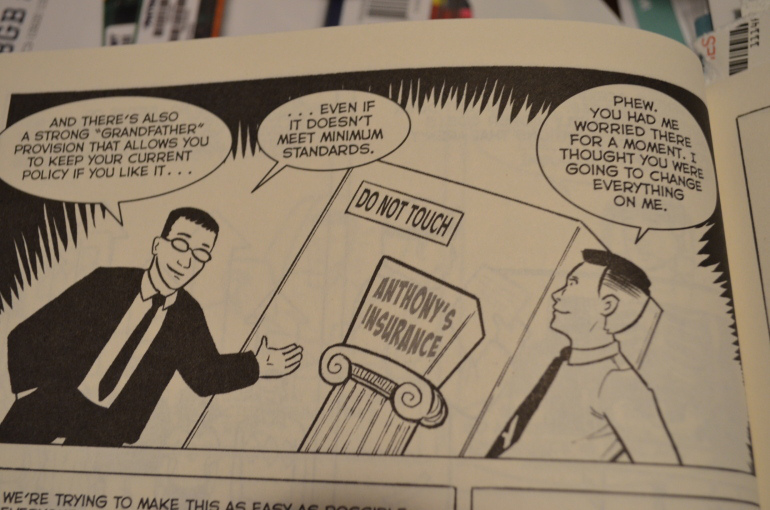
Of greater importance is that he very likely furnished the administration, as the law was being drafted, with economic projections showing that some existing private health plans would be cancelled. In his testimony last week, he admitted that his model simulations showed as much. Of course, President Obama was quite glib in his repeated assertions that “if you like your health plan, you can keep your health plan.” From Reason:

Shouldn’t that mean that Gruber knew that administration’s repeated promises that those who like their health plans could keep their plans under the law weren’t true? 

Gruber was asked about the promise…. ‘I interpreted the administration’s comments as saying that for the vast majority of Americans the law would not affect the productive health insurance arrangements that they have,’ he said. ‘I did not see a problem with the administration’s statement.’

Of course he didn’t. Gruber is, after all, someone who argued that ‘lack of transparency’ was key to passing the health law.

In fact, on the question of lost coverage, Gruber’s own comic book on the ACA made the same assurances as the Administration. See the frame at the top of this post! More contradiction.

Another crucial point is that Gruber claimed to have written the part of the ACA related to state health insurance exchanges. He stated on multiple occasions (captured on video) that the federal health insurance subsidies created by the ACA were intended as incentives for states to create their own exchanges. The “plain language of the law” is consistent with that claim; it is explicit in providing for subsidies only when a policy is purchased through a state exchange, not a federal exchange. Next year, the Supreme Court will hear the case King vs. Burwell, which turns upon whether the law itself disqualifies ACA insurance buyers in 36 states from collecting federal subsidies. Gruber’s videos appear to be quite damaging to the government’s case.

The State and The Invisible Future Lost

Tags

, , , , , , ,

lost-opportunities-clotilde-espinosa

Lost opportunities can have far reaching consequences. Our society routinely destroys economic opportunities as a matter of policy. This includes immediate discouragement of economic activity via tax disincentives and regulatory obstacles as well as lost capital investment and innovation.  And it includes actions that grant protected status for monopolists, a steady by-product of the regulatory state. Don Boudreaux at Cafe Hayek posts a letter from a reader and his own thoughts on these points. From the letter:

California has 3,754 wineries and they provide good wines for customers, jobs for employees, profits for owners, and fun places to visit. Imagine if Prohibition had never ended or if regulations were such that a mere five wineries produced all the wine for the entire country. Who would have known what we would have been missing?

The damage of such policies goes on and on, and the negative effects compound with the passage of time. But those effects are seldom visible when policies are made. We never observe the bounty of the counterfactual when a new plant or shop isn’t built, a new shift isn’t added, a new company isn’t formed, a price increase isn’t discouraged by competition, or when inventions and discoveries aren’t made. From Boudreaux:

The unseen includes also, and more importantly, the greater and better and completely different goods and services, the newer and safer and less-resource-intensive ways of production, and the more full prospects for human flourishing and the heightened hopes and the improved and expanded life-style options that human creativity – unleashed by free markets and governed by open competition and private property rights – makes possible.

Technology and the advance of knowledge is a process that builds upon itself. The achievements of recent decades were impossible for us to have imagined beforehand, but much more might have been possible. Looking forward, the opportunities lost to today’s stultifying policies will become more staggering as the decades pass, losses much greater than we can imagine today.

Live Long and Prosper With Fossil Fuels

Tags

, , , , , , ,

AltFuelReindeer

Do your friends have even a clue as to the massive cost of eliminating fossil fuels? What it would mean for their way of life? Perhaps they do, but it’s not polite to admit to such obvious truths in many circles. Alex Epstein cares enough to tell the world about the spectacular benefits and currently dismal alternatives to fossil fuels in his new book, The Moral Case For Fossil FuelsHis thesis and and a few of his arguments are reviewed in a pair of posts by Bryan Caplan, who really likes the book. According to Caplan:

Epstein’s book has two key claims. His first claim is descriptive: Laymen and experts alike greatly underestimate the benefits of fossil fuels and greatly overestimate their costs… .

Epstein’s second key claim is normative: Human well-being is the one fundamentally morally valuable thing. Unspoiled nature is only great insofar as mankind enjoys it… .

Both claims strike me as reasonable, though the first is true only as a generalization about modern energy mythology, punditry and statist philosophy. In fact, one might say that society acts as if it understands the benefits of fossil fuels very well, as evidenced by our emphasis on maintaining a high and/or growing standard of living supported by these energy sources. Yet the popular misconceptions are a reality, and we persist in choosing leaders who favor policies that handicap fossil fuels and human well-being.

Caplan offers some choice quotes from Epstein’s book. I repeat only three. The first is on the benefits of plentiful energy:

Energy is what we need to build sturdy homes, to purify water, to produce huge amounts of fresh food, to generate heat and air-conditioning, to irrigate deserts, to dry malaria-infested swamps, to build hospitals, and to manufacture pharmaceuticals, among many other things. And those of us who enjoy exploring the rest of nature should never forget that energy is what enables us to explore to our heart’s content, which preindustrial people didn’t have the time, wealth, energy, or technology to do.

The second quote might seem controversial to some, but it is unequivocally true:

“[W]hen we look at the data, a fascinating fact emerges: As we have used more fossil fuels, our resource situation, our environment situation, and our climate situation have been improving, too.

The third quote is about the drawbacks of some prominent alternative energy sources:

Traditionally in discussions of solar and wind there are two problems cited: the diluteness problem and the intermittency problem. The diluteness problem is that the sun and the wind don’t deliver concentrated energy, which means you need a lot of materials per unit of energy produced…

Such resource requirements are a big cost problem, to be sure, and would be one even if the sun shone all the time and the wind blew all the time. But it’s an even bigger problem that the sun and wind don’t work that way. That’s the real problem– the intermittency problem, or more colloquially, the unreliability problem. As we saw in the Gambian hospital, it is of life and death importance that energy be reliable.

There is no doubt that technology will someday bring better and cleaner energy sources, but we are nowhere close. The flow of subsidies to weak alternatives destroys resources, and the subsidies themselves skew heavily toward the upper end of the wealth distribution. And of course, popular fears about nuclear energy have limited our ability to diversify. For the indefinite future, we would do well to embrace plentiful and cheap fossil fuels, especially to help reduce poverty and poor living conditions in the developing world.

There Oughta NOT Be a Law

Tags

, , , , , , , , , , , , , , , , , ,

image

We have too many laws and too many busy-bodies wishing to force others into conformity with their own moral and  behavioral strictures. It is more excessive in some jurisdictions than others, but the unnecessary criminalization of harmless behavior is a spreading canker. The death of Eric Garner  in New York City exemplifies the horrible consequences, an aspect which sets it apart from the death of Michael Brown in Ferguson, Missouri. Last week, Mark Perry posted links and summaries of three essays on Garner’s death “and what it teaches us about over-criminalization, government force, police brutality, the regulatory superstate, and the violence of the state.

Both the Brown and Garner cases involved tobacco products, a primary target of busy-bodies worldwide. Garner was choked to death by police who restrained him for violating a law against selling individual cigarettes (“loosies”). Brown, then a suspect in a strong-arm convenience store theft of Swisher cigarillos, was shot by an officer claiming that Brown charged him in the street after a physical altercation moments earlier. Both incidents are said to have involved excessive force by police toward African Americans, but grand juries refused to indict the officers in both cases. Whether excessive force was used against Brown or Garner, or whether racism was involved, a major contrast is that the Garner case involved the enforcement of a law that seems ridiculously petty.

The three links provided by Perry are from:

    • J.D. Tuccille, who argues that over-regulation of behavior not only leads to conflict but also encourages corruption in law enforcement.
    • Randy Soave, who discusses the incentive structure faced by police and the extent of over-regulation, “from cigarettes to sodas of a certain size, unlicensed lemonade stands, raw milk, alcohol (for teens), marijuana, food trucks, taxicab alternatives, and even fishing supplies (in schools)“.
    • Jonah Goldberg, who elaborates on a simple truism: if you pass a new law, it must be enforced. Enforcement means force, and force is what government is all about. Therefore, if you insist on more detailed control over others, you can expect some violence.

Michael Munger makes the same point, condemning both the left and the right for their failure to understand the simple but far-reaching flaw in our polity:

The left is outraged that the state is not doing exactly what the left expects from an idealized, unicorn state. In fact, the state is actually made up of actual human-style people, and people are flawed. The left wants to rely on abstract systems, and then be perpetually astonished when things go really wrong. It’s not bad people that are the problem. The THING, the thing itself is the abuse, folks…. The right is just denying that there is a problem, the system is working, the jury has spoken, etc.

In “Worse Than Racism,” Eric Raymond discusses Garner’s death in the context of Alexis de Tocqueville’s  “soft despotism,” our penchant for promulgating rules for others “all justified in soothing ways to achieve worthy objectives. Such as discouraging people from smoking by heavily taxing cigarettes. Eric Garner died in a New York minute because ‘soft despotism’ turned hard enough to kill him in cold blood.

Raymond presses hard:

Every one of the soft despots who passed that law should be arraigned for the murder of Eric Garner. They directed the power of the state to frivolous ends, forgetting – or worse, probably not caring – that the enforcement of those ‘small complicated rules’ depends on the gun, the truncheon, and the chokehold. 

But we are all accessories before the fact. Because we elected them. We ceded them the power to pass oh, so many well-intentioned laws, criminalizing so much behavior that one prominent legal analyst has concluded the average American commits three inadvertent felonies a day.

Finally, here’s an interesting connection: research  advocating high taxation of cigarettes  was published in 2008 by none other than Jonathan Gruber. Yes, the architect of Obamacare who often gloated on camera at academic conferences about the clever lack of transparency in the health care law and the stupidity of the American voter. He was also busy providing a rationale for the morality meddlers to more heavily tax and regulate “unacceptable” behavior. It is fitting and ironic that such an infamous elitist as Gruber has a connection to the soft despotism that led to the death of Eric Garner.

Labels For The Authoritarian Left

Tags

, , , , , , , , , , , , , , ,

nolabels

Who said this? “I have put into practice what these peddlers and pen pushers have timidly begun … the whole of National Socialism [was] based on Marx.” And this? “What Marxism, Leninism and Stalinism failed to accomplish, we shall be in a position to achieve.” And this? “How, as a socialist, can you not be an anti-Semite?

You probably know or can guess that it was none other than Adolf Hitler. But if you persist in thinking that the National Socialist German Workers’ Party was not really, truly a party of socialists, you are wrong. Daniel Hannan discusses the connection at length in “Leftists become incandescent when reminded of the socialist roots of Nazism.” Before you accuse Hannan (or me) of violating Godwin’s Law, read his piece. He’s simply noting an historical fact. He’s most sensitive about use of the term “right-wing” as a synonym for “authoritarian,” but in fact it may be authoritarian along some dimensions.

Still, it shouldn’t be much of a surprise to learn that the authoritarian Nazi regime was packed with socialists. Socialism is a philosophy based on the preeminence of society over the individual, emphasizing public provision of goods and services, and control (if not ownership) of the means of production. In such a regime, central authority must supplant decentralized decision-making to a significant extent. The word “authoritarian” is fitting. From Hannan:

In fact, authoritarianism was the common feature of socialists of both National and Leninist varieties, who rushed to stick each other in prison camps or before firing squads. Each faction loathed the other as heretical, but both scorned free-market individualists as beyond redemption. …

Authoritarianism – or, to give it a less loaded name, the belief that state compulsion is justified in pursuit of a higher goal, such as scientific progress or greater equality – was traditionally a characteristic of the social democrats as much as of the revolutionaries.

The Italian etymology of “fascism”, implying the strength of a “bundle” relative to individual pieces, also suggests the socialist roots of the totalitarian regimes in Nazi Germany and in Italy under Mussolini. Left-wing fascists or right-wing socialists? Take your pick. In a strong sense, the labels applied today make no sense, including the modern misuse of the term “liberal” to describe a preference for a strong central government. Perhaps labels are unavoidable, but words usually have meaning apart from the latest political usage. Unfortunately, distorting or co-opting words for political purposes has a long and dishonorable tradition.

Subsidies Are For Suckled Statists

Tags

, , , , , , , , ,

ethanol-corn-money

Who told Congress the following? “We oppose ALL subsidies, whether existing or proposed, including programs that benefit us, which are principally those that are embedded in our economy, such as mandates.

And this? “[We don’t] view these as ‘benefits’ even if they are in industries we’re in. They are wasteful and market distorting, and allow other firms to run businesses that aren’t making money any other way.

This principled stand against one major type of crony capitalism was taken by none other than Koch Industries. According to this Free Beacon article:

The company owned by billionaire philanthropists Charles and David Koch, as well as groups frequently associated with the fraternal libertarians, are pushing Congress to let 55 tax breaks expire, including several that provide billions in tax relief for corporations such as Koch Industries.

They are similarly opposed to regulatory cronyism that restrains competition and the sort of public largess favoring lucrative contract awards for large corporate entities. These are the same Koch brothers typically demonized by the Left (but not always), as if their political contributions were an effort to garner public subsidies. Clearly that is not the case. Moreover, Left-leaning billionaires such as Tom Steyer, Michael Bloomberg and George Soros are far more prolific political contributors than the Koch brothers. And what do these corporatists want for their money? Surely not a smaller government; they’d like a big fat administrative state from which their many corporate interests can suckle.

Some kinds of subsidies are transparently wasteful, such as tax breaks for already-profitable businesses or bailouts to firms that have made bad decisions, or to firms in dying industries. More fundamentally, all public subsidies circumvent the unforgiving cost-benefit calculus imposed by the market, misdirecting resources via signals distorted by the visible fists of government. This often allows activity to continue that would otherwise be judged wasteful or unsustainable, or excessive investment of resources into particular activities. Self-interested politicians and public officials, however, often justify these subsidies by asserting the existence of external benefits unrecognized by market valuations. Too often, these assertions rely on value judgements. Regardless, the supposed benefits are never easily measured. Our experience with pervasive cronyism and waste in government should always lead us to insist on a skeptical evaluation of proposed subsidies. Rent-seeking behavior is usually at the root of such initiatives.