• About

Sacred Cow Chips

Sacred Cow Chips

Tag Archives: Bernie Sanders

Progs Give New Meaning To “Tax Distortions”

16 Tuesday Apr 2019

Posted by Nuetzel in Taxes

≈ Leave a comment

Tags

Andrew Wilford, Bernie Sanders, CATO Institute, Chris Edwards, Christine Elba, Kamala Harris, Matthew Yglesias, National Taxpayers Union Foundation, Progressive Taxes, Tax Distortions, Tax Policy Center, Tax Refunds

Tax day has come and gone, but I’m struck by 1) the incredible misconceptions people express about the change in their tax liabilities caused by the 2018 income tax legislation; and 2) the confusion about how our progressive income tax system actually works! Some of these misapprehensions are encouraged by progressives who would rather misinform the public than evaluate policy on its own terms. I am not a fan of our income tax system, nor all aspects of the 2018 tax law, but let’s at least discuss it honestly.

First, a substantial majority of taxpayers paid lower taxes on their 2018 income than they would have under prior tax rules (also see here). However, as I’ve observed before, many people conflate the change in the amount of their tax refund with the change in their taxes paid. And again, the progressive media hasn’t helped to allay this misconception, as noted by Vox cofounder Matthew Yglesias when he tweeted this:

“Nobody likes to give themselves credit for this kind of messaging success, but progressive groups did a really good job of convincing people that Trump raised their taxes when the facts say a clear majority got a tax cut.”

Even worse, members of Congress misrepresent the facts with little media backlash. For example, Andrew Wilford of the National Taxpayers Union Foundation reports the following:

“… the tax cut actually made the tax code more progressive, not less.  … Of course, none of this stopped Democrats such as Sen. Kamala Harris (D-Calif.) from claiming that the TCJA was a “middle-class tax hike.” Nor did it prevent three separate Democratic senators from claiming that the average family making up to $86,000 would see a tax hike of $794, despite the fact that the source for this claim clarified that this tax hike would apply to only 6.5 percent of households in this income bracket.”

It’s amazing just how drastically our income tax system is misunderstood or often misrepresented by the media. Apparently, it’s considered politically advantageous to do so. Chris Edwards offers the following quote from Christine Elba in the Washington Post:

“Meanwhile, the wealthier among us (remember: corporations are people, too!) are able to hire tax lawyers, consultants and accountants to clue them in on lightly advertised but heavily lobbied for loopholes that allow them to pay a lower tax rate or even no taxes at all.”

That is simply not a fair characterization of our income tax system. Edwards goes on to demonstrate the progressive nature of U.S. income taxes based on information from the Tax Policy Center. Not only do statutory federal income tax rates rise with income, but so do average effective tax rates, which account for the effects of deductions, credits and exclusions. In fact, average effective rates are negative in the lowest income groups and are zero on balance for the lowest 50% of earners. And average effective rates keep rising in the top quintile, moving up through the top 10%, 5%, 1% and 0.1%. Ms. Elba is clearly confused. And if she is aware of the pernicious double-taxation of corporate income, she probably would never admit it.

Apparently the current state of income tax progressivity is not enough to satisfy statists and redistributionists, who take license to lie about it in order to make their case for higher taxes on the rich, and even the not-so-rich. But here’s some advice for Bernie Sanders, Kamala Harris, and others who insist that, while they are rich, they desperately want to pay more taxes: you are free to do so without penalty. Better yet, give it to a good charity instead!

The Excellent Electoral College

05 Friday Apr 2019

Posted by Nuetzel in Constitution, Democracy

≈ 1 Comment

Tags

Athenian Democracy, Athens, Bernie Sanders, Beto O'Rourke, Constitutional convention, Donald Trump, Edward Conway, Electoral College, Elizabeth Warren, Jon Gabriel, Quora, Tyranny of the Majority

So lacking is the average American’s knowledge of civics that they often react in shock to the suggestion that the United States was never intended to be a pure democracy. But unchecked democracy is not a system that can be counted upon to maintain stability, something the founders knew when they fashioned the country as a constitutional republic. This point bears emphasis given the recent calls to abolish the Electoral College (EC) by such Democrat luminaries as Elizabeth Warren and Beto O’Rourke. Others, like Socialist-cum-Democrat Bernie Sanders, say they want to “assess” the EC.

Jon Gabriel describes the EC as one of a series of stabilizing checks and balances embedded in our system of government. It served the purpose of balancing interests across diverse regional economies and sub-cultures:

“By distributing our presidential choice among 51 individual elections, nominees must appeal to a wide variety of voters with a wide variety of interests. Farmers in Wisconsin are important, as are retirees in Florida, factory workers in Pennsylvania, and shopkeepers in Arizona. White Evangelicals need to be courted in Charlotte, as do Latino Catholics in Mesa.

If the Electoral College were abandoned, party frontrunners would camp out exclusively in urban areas. The pancake breakfasts in Des Moines and Denver would be replaced with mammoth rallies in Los Angeles and New York City.”

So diverse were these interests in the late 1700s that it’s reasonable to assume that the Constitutional Convention would have failed without the creation of the EC. Today, no less, our country would be unlikely to survive the EC’s elimination. Why, for example, would voters in Missouri wish to allow the preferences of east and west coast voters to dominate federal policy-making?

Gabriel provides some interesting history giving emphasis to the notion of a tyranny of the majority under pure democracy:

“The world’s first democracy was ancient Athens, which allowed around 30,000 free adult male citizens to choose their leaders. They made up less than 15 percent of the population, but it was the most egalitarian political innovation to date.

Athen’s unbridled democracy, however, led to the very extremes that sowed its decline and defeat at the hands of enemies. This note from Edward Conway on Quora is instructive (his is the third commentary at the link; most of the others are helpful, but his is most succinct):

“… ancient Athenian democracy was purely a matter of votes: if you wanted to win a court case, or pass a law, or tax a group, or go to war, or massacre a large number of people, the only check was whether you could convince a majority of the citizens to vote in your favor. While there were means of checking individual people (see: Ostracon), this did nothing to check the power of the crowds, as it only removed one focus of this power.

Thus Athenian democracy never moved beyond the initial ‘UNLIMITED POWER!’ stage. Anyone who could convince the crowd to follow them had unchecked authority until they lost control of the crowd.

This led, predictably, to excesses: ‘Let’s attack Sparta!’, ‘Let’s invade Sicily!’, ‘Let’s ostracize our best general!’, etc.“

It’s interesting that the Athenian military was staffed by plebeians who found imperialistic actions to be profitable. Naturally, they voted to devote more resources to military incursions… until they were defeated. Allowing a large faction to vote on their own pay, and the taxes on others necessary to pay for it, can be a glaring defect of democracy. We see manifestations of the same phenomenon today in congressional pay raises and expansion of federal benefits for large segments of the population who pay no taxes.

Back to Gabriel:

As the saying goes, democracy is four wolves and a lamb voting on what to have for lunch. The Founders looked to Athens less as a political model than an object lesson in what not to do.

James Madison said that democracies are ‘incompatible with personal security or the rights of property; and have in general been as short in their lives as they have been violent in their deaths.’

The EC was a stroke of political genius: It allowed the delegates at the Constitutional Convention to reach a consensus, something that would probably be just as difficult to accomplish today as it was then. The EC transforms one federal election into 51 local elections, reducing the feasibility of tampering by the party in power at the federal level. It also reduces the incentive for electoral fraud in a national race because a greater margin of victory within a state cannot gain the votes of additional electors.

The noise regarding the EC is coming from just one side of the political aisle: Donald Trump’s electoral victory in 2016, and his reasonably good prospects for reelection in 2020, have inflamed the passions of Democrats, who are now grasping at any and all ways in which they might tilt the playing field their way. Relative to electoral votes, popular votes are heavily concentrated in the coastal “blue” states. Such a change in the rules of the game would certainly stand to benefit Democrats. Therefore, the debate looks suspiciously like it has nothing to do with “good governance” and electoral integrity, and everything to do with raw politics.

It’s useful to remember that the EC was an essential incentive for gaining the buy-in of smaller states to join the Union. It remains vitally important to states whose interests would likely be neglected if presidential politics was dominated by the coastal states. Fortunately, the founders invested the EC with durability: rescinding it would require a constitutional amendment. That could happen if two-thirds of the state legislatures agree to convene a constitutional convention. Or, it could be proposed by a two-thirds majority in both houses of Congress, then ratified by three-fourths of the state legislatures. Ain’t gonna happen.


Socialism and Authoritarianism: Perfectly Complementary

19 Wednesday Sep 2018

Posted by Nuetzel in Socialism, Tyranny

≈ Leave a comment

Tags

Adolf Hitler, Authoritarianism, Bernie Sanders, Bolshevism, Capitalism, Corporatism, Elizabeth Warren, fascism, German Reich, Marxism, National Socialism, Nazi Party, Paul Jossey, Socialism, The Federalist

The socialist left and the Marxist hard left both deny their authoritarian progenitors. Leftists are collectivists, many of whom subscribe to an explicit form of corporatism with the state having supreme power, whether as a permanent or transitional arrangement on the path to full state ownership of the means of production. Collectivism necessarily requires force and the abrogation of individual rights. At this link, corporatism, with its powerful and interventionist state, is aptly described as “de facto nationalization without being de jure nationalization” of industry. To the extent that private ownership is maintained (for the right people), it is separated from private control and is thus a taking. But the word corporatism itself is confusing to some: it is not capitalism by any means. It essentially means “to group”, and it is a form of social control by the state. (And by the way, it has nothing to do with the legal business definition of a corporation.)

Of course, leftists distance themselves from the brutality of many statist regimes by asserting that authoritarianism is exclusively a right-wing phenomenon, conveniently ignoring Stalin, Castro, Mao, Pol Pot, and other hard lefties too numerous to mention. In fact, leftists assert that fascism must be right-wing because it is corporatist and relies on the force of authority. But again, both corporatism and fascism are collectivist philosophies and historically have been promoted as such by their practitioners. Furthermore, these leftist denials fly in the face of the systemic tendency of large governments to stanch dissent. I made several of these points four years ago in “Labels For the Authoritarian Left“.

I find this link from The Federalist fascinating because the author, Paul Jossey, provides quotes of Hitler and others offering pretty conclusive proof that the Nazi high command was collectivist in the same vein as the leftists of today. Here are a few of Jossey’s observations:

“Hitler’s first ‘National Workers’ Party’ meeting while he was still an Army corporal featured the speech ‘How and by What Means is Capitalism to be Eliminated?’

The Nazi charter published a year later and coauthored by Hitler is socialist in almost every aspect. It calls for ‘equality of rights for the German people’; the subjugation of the individual to the state; breaking of ‘rent slavery’; ‘confiscation of war profits’; the nationalization of industry; profit-sharing in heavy industry; large-scale social security; the ‘communalization of the great warehouses and their being leased at low costs to small firms’; the ‘free expropriation of land for the purpose of public utility’; the abolition of ‘materialistic’ Roman Law; nationalizing education; nationalizing the army; state regulation of the press; and strong central power in the Reich.”

Are you feeling the Bern? Does any of this remind you of the “Nasty Woman”, Liz Warren? Here is more from Jossey:

“Hitler repeatedly praised Marx privately, stating he had ‘learned a great deal from Marxism.’ The trouble with the Weimar Republic, he said, was that its politicians ‘had never even read Marx.’ He also stated his differences with communists were that they were intellectual types passing out pamphlets, whereas ‘I have put into practice what these peddlers and pen pushers have timidly begun.’

It wasn’t just privately that Hitler’s fealty for Marx surfaced. In ‘Mein Kampf,’ he states that without his racial insights National Socialism ‘would really do nothing more than compete with Marxism on its own ground.’ Nor did Hitler eschew this sentiment once reaching power. As late as 1941, with the war in bloom, he stated ‘basically National Socialism and Marxism are the same’ in a speech published by the Royal Institute of International Affairs.

Nazi propaganda minister and resident intellectual Joseph Goebbels wrote in his diary that the Nazis would install ‘real socialism’ after Russia’s defeat in the East. And Hitler favorite Albert Speer, the Nazi armaments minister whose memoir became an international bestseller, wrote that Hitler viewed Joseph Stalin as a kindred spirit, ensuring his prisoner of war son received good treatment, and even talked of keeping Stalin in power in a puppet government after Germany’s eventual triumph.”

Some contend that the Nazis used the term “socialist” in a purely cynical way, and that they hoped to undermine support for “real socialists” by promising a particular (and perverse) vision of social justice to those loyal to the Reich and the German nation. After all, the Bolsheviks were political rivals who lacked Hitler’s nationalistic fervor. Hitler must have thought that his brand of “socialism” was better suited to his political aspirations, not to mention his expansionist visions. Those not loyal to the Reich, including Jews and other scapegoats, would become free slave labor to the regime and its loyal corporate cronies. (It’s striking that much of today’s Left, obviously excepting Bernie Sanders, seems to share the Nazis’ antipathy for Jews.)

Socialism, corporatism and fascism are close cousins and are overlapping forms of statism, and they are all authoritarian by their practical nature. It’s incredible to behold leftists as they deny that the National Socialists Workers Party practiced a brand of socialism. Perhaps the identification of the Nazis as a fascist regime has led to confusion regarding their true place along the ideological spectrum, but that too is puzzling. In their case, a supreme corporatist state enabled its most privileged advocates to exploit government power for private gain, and that’s the essence of fascism and the archetypical outcome of socialism.

BS Bernie Blames Bezos

12 Wednesday Sep 2018

Posted by Nuetzel in Labor Markets, Living Wage, Price Mechanism, Welfare State

≈ Leave a comment

Tags

Amazon, Bernie Sanders, Freedom of Contract, Jeff Bezos, Living Wage, Ro Khanna, Social Safety Net, Stop BEZOS Act, Welfare State

Bernie Sanders keeps probing for ways to create a backdoor minimum income, and he’s eager to loot successful job creators and their customers in the process. Last month I wrote about the folly of his proposed legislation that would offer federal job guarantees to all. A new Sanders bill, introduced jointly with Rep. Ro Khanna (D – CA), is an equally bad idea called the Stop BEZOS Act, or the “Stop Bad Employers by Zeroing Out Subsidies Act”. It’s pretty obvious that the selection of the acronym preceded the naming of the bill. Imagine the fun his Senate staffers had with that! The logical flaws embedded in the title of the act are bad enough. The effort to garner attention by using the title to smear the name of a famous technology entrepreneur is sickening.

Jeff Bezos, of course, is the founder and CEO of Amazon, the online retailer, as well as the owner of the Washington Post. Amazon has been rewarded by consumers for its excellent service and aggressive pricing, and it is now valued at about $1 trillion. That makes Bezos a very wealthy man, and it is no coincidence that Sanders has chosen to make an example of him in an effort to inflame envy and classist passions.

While some details of the bill remain sketchy, firms with more than 500 workers would face a 100% tax on every dollar of federal benefits received by those employees. But the tax would apply only to “low-wage” employees, however that is defined, and not simply any employee receiving federal benefits. If the bill became law (and it won’t any time soon), it would require a costly federal administrative apparatus to coordinate between several agencies, including the IRS. Beyond the tax itself, the compliance costs for firms won’t be cheap, and it will create terrible incentives: if you own a business, you would have a strong incentive to avoid hiring workers with little experience or weak skills, or anyone you might deem likely to be a recipient of federal aid. If you have 499 employees, you’ll probably think hard about how to execute future growth plans. Nothing could do more to improve the return to investment in automation.

Is Amazon really a “bad” employer? That’s what the title of the Sanders bill says. In fact, the company has been accused of harsh labor practices in its fulfillment centers. Life for corporate managers is said to be no picnic, and labor turnover at Amazon is high. Nonetheless, the wages it pays attract plenty of applicants. Unskilled labor does not command a high wage, and that is no fault of an employer willing to provide them with work and experience. Yet the bill would punish those employers, as well as employers having part-time workers drawing federal aid.

An absence of punishment can hardly be described as a “subsidy”, as the bill’s title suggests. But that is exactly how leftists think, at least when they do the punishing. In this respect, the bill’s title is an assault on logic and a misuse of language. It would also represent a violation of constitutional principles like property rights and freedom of contract.

The idea of taxing employers to recoup any public aid received by their workers is intended to affect a de facto “living wage”. However, one benefit of an independent social safety net, as opposed to a living wage tied to that net, is that the former largely preserves the operation of labor markets, despite creating some nasty labor-supply incentives. Wage rates that approximate the value of worker productivity allow efficient matching of jobs with workers having the requisite skills, even if the skills are relatively low-grade. Those wages also minimize distortions in the economics of production within firms and across different industries. Furthermore, prices faced by buyers should reflect the real resource costs associated with demands for various goods. They should not be inflated by political decisions about the level of federal welfare benefits. Quite simply, preserving labor market efficiency enhances the ability of the economy to allocate resources to the uses for which they are most highly-valued.

There are independent questions about whether the structure and level of benefits provided by the welfare state are appropriate. Those are matters of legitimate policy debate, and those benefits must be funded by taxpayers, but they should be funded in the least distortionary way possible. Bernie Sanders imagines that the burden of those taxes can simply be imposed on large employers with no further consequences, but he is badly mistaken. Consumers will shoulder a significant part of that burden under his latest scheme. And, of course, Sanders’ beef with Bezos is a cynical political ploy. It amounts to cheap scapegoating intended to promote another one of Sanders’ bad policy ideas.

Perspective on U.S. Health Care Spending & Outcomes

05 Sunday Aug 2018

Posted by Nuetzel in Health Care, Health Insurance

≈ Leave a comment

Tags

Bernie Sanders, Charles Blahous, John Cochrane, Joseph Walker, Life Expectancy, Mahdi Barakat, Medicare For All, Mercatus Center, Obesity, Random Critical Analysis, SwedenCare

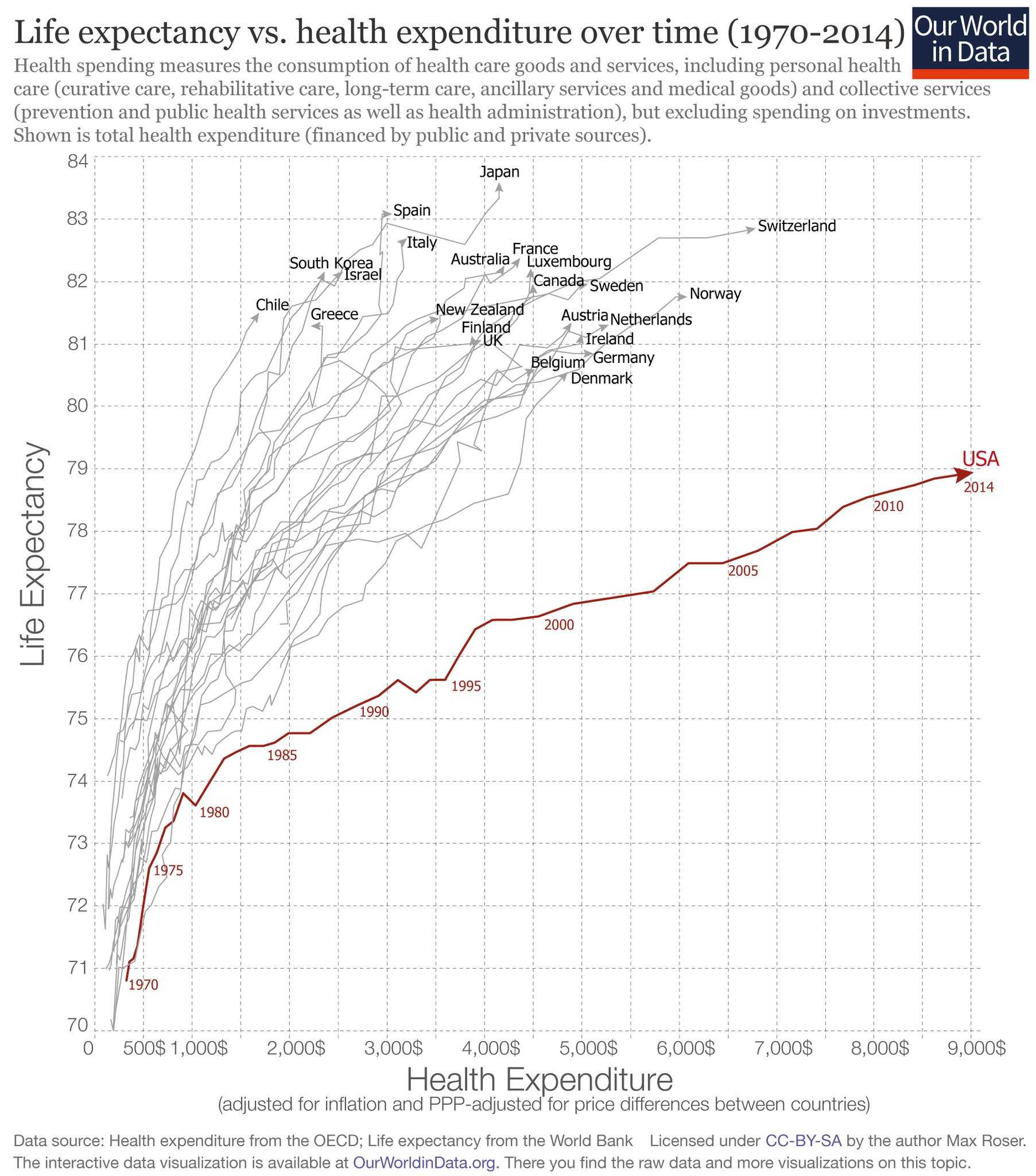
The U.S. spends a lot on health care, and our health care system is frequently criticized for poor health outcomes. The chart below is an example of evidence used to buttress this argument. It shows combinations of health care spending and life expectancy over time for the OECD countries. The U.S. appears to be a severe outlier and inferior to the other countries. A variation on this chart appeared on the home page of The Wall Street Journal this week. It accompanied (but was not part of) a good article by Joseph Walker in which he used 12 other charts in an effort to explain why the U.S. spends so much on health care. (Sorry, this link is probably gated.) Walker discusses several important cost factors, including third-party payments, tax treatment, and the deployment of expensive technology in the U.S. However, the claim that the U.S. is really an outlier is worth examining on other grounds.

The chart’s construction suggests that a reliable link should exist between health care spending and life expectancy, but there are several reasons to question whether that is the case. U.S. life expectancy has been held down historically by high rates of smoking, but reduced smoking rates should help moderate the U.S. life expectancy gap in coming years. Obesity in the U.S. is a more persistent problem, especially for the poor, and an even bigger contributor to low U.S. life expectancy than smoking at present. (See this report for evidence on the contributions of smoking and obesity to shorter life expectancy for older adults.) Other contributors to low life expectancy in the U.S. include high motor-vehicle deaths and homicides, the latter attributable in large part to the war on drugs. All of these factors contribute to higher health care spending and directly reduce life expectancy.

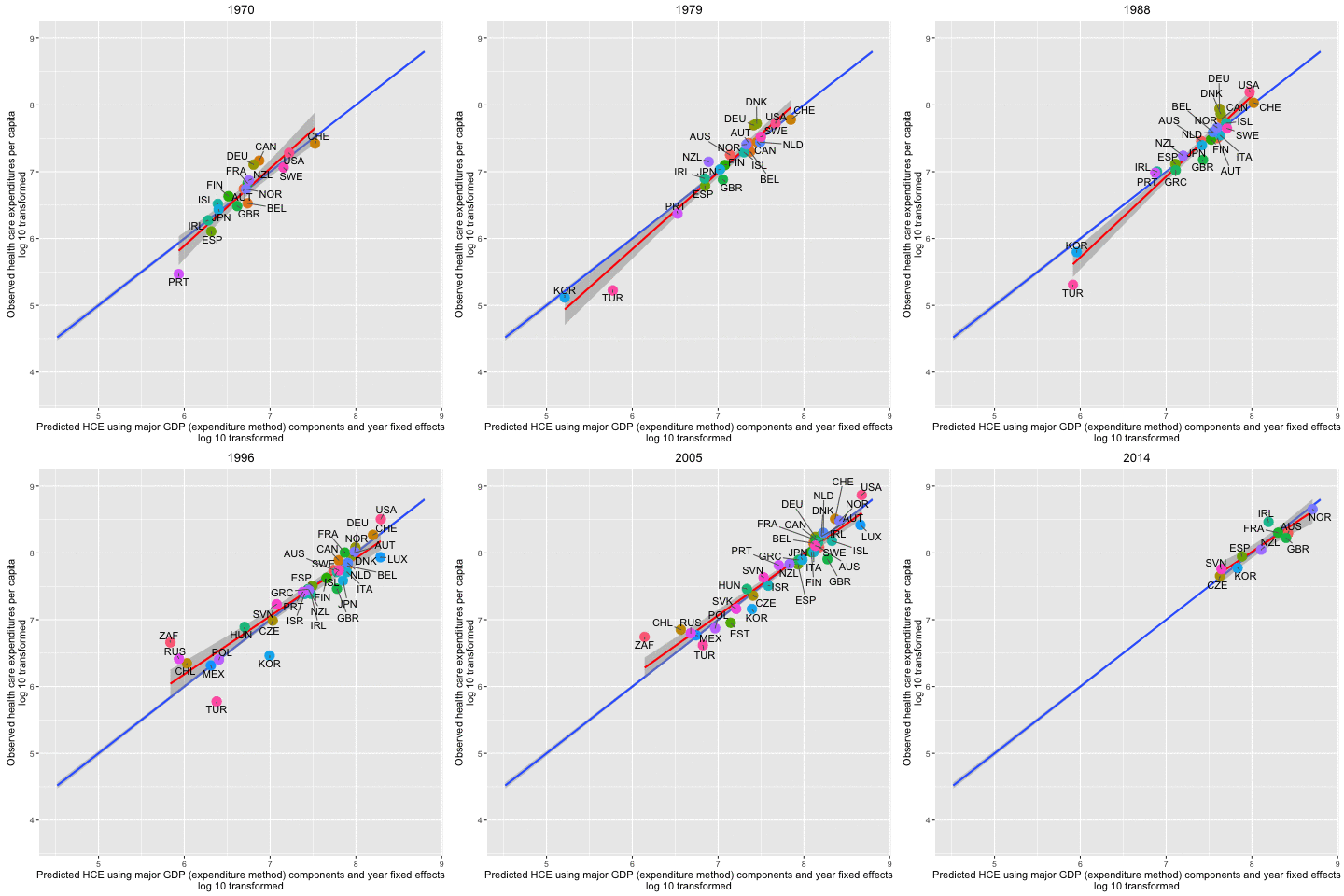
The status of the U.S. as an outlier in terms of health care spending is questioned on the Random Critical Analysis blog (RCA). The author’s detailed analysis includes the following points among many others of interest:

  • Health care is a superior good: as income rises, spending on health care rises faster;
  • The U.S. has a much higher standard of living than any of its peer nations;
  • U.S. consumption spending relative to GDP is an “outlier”, like health care spending relative to GDP;
  • Consumption is a stronger predictor of health care spending than income;
  • Relative to consumption, health care spending in the U.S. is not an outlier, nor is spending on pharmaceuticals, physician/nursing compensation, and the levels of health price indices.

Take a look at the following sequence from the RCA blog linked above (the animation might not be visible on a phone):

So the argument that the U.S. health care system is inferior to peer countries based on cross-county spending comparisons and life expectancy, to the extent that it holds up at all, is subject to strong qualifications. Inferior lifestyle choices, diets, and lack of exercise might be problematic in the U.S., but the healthcare system cannot be faulted based on spending levels relative to other OECD countries.

In fact, the superiority of the U.S. health care system in many areas is not even in dispute. As Mahdi Barakat points out, wait times for care, cancer survival rates, and stroke mortality are all clearly better in the U.S. than in many peer countries:

“Lives are indeed saved by the many types of superior medical outcomes that are often unique to the US. This is not to mention the innumerable lives saved each year around the world due to medical innovations that are made possible through vibrant US markets.”

Barakat compares dubious progressive claims that up to 45,000 American lives are lost each year due to a lack of insurance with the likely incremental lives lost if various performance measures in the U.S. were equivalent to those in other countries:

  • 25,000 additional female deaths per year with Canada’a wait times for care (no estimate for additional male deaths is given by Mahdi’s source);
  • 64,000 additional stroke deaths each year with the UK’s overall stroke mortality;
  • 72,000 additional cancer deaths each year with the UKs survival rates.

Theoretically, the national spending figures could be adjusted for the cost of queuing, i.e. wait times. While Obamacare certainly increased wait times in the U.S., the adjustment would likely reduce or eliminate the spending advantages that several OECD countries appear to have over the U.S.

The performance of health care systems in many countries with single-payer systems or universal care is subject to challenge, as some of the statistics offered by Barakat demonstrate. In “The Truth About SwedenCare“, Klaus Bernpaintner expresses his dismay at the romanticized view of health care in Sweden among so many Americans. His effort to convey the truth about Sweden’s stultifying health care bureaucracy is illuminating. There are few private physician practices in Sweden. Care is generally rationed and waits are lengthy, and it is delivered by disinterested, centrally-assigned providers.

“For non-emergency cases in Sweden, you must go to the public ‘Healthcare Central.’ This is always the starting point for anything from the common flu to brain tumors. You must go to your assigned Central, according to your healthcare district. Admission is by appointment only. Usually they have a 30-minute window every morning, when you call to claim one of the budgeted slots. Make sure to call early or they run out. Rarely will you get an appointment for the same day. You will be assigned a general practitioner, probably one you have never met before; likely one who does not speak fluent Swedish; and very likely one who hates his job. If you have a serious condition, you will be started on a path of referrals to experts. This process can take months.”

Bernpaintner calls this Sweden’s health care “bread line”, where people go to die. He mentions several other nightmarish features of health care in Sweden that Americans should hope to avoid. In particular, we should resist calls for a single-payer system, like Bernie Sanders’ Medicare-For-All proposal. An analysis by Charles Blahous of the Mercatus Center at George Mason University has shown that it would increase federal spending by $32.6 trillion over ten years. This estimate is basically in-line with others mentioned by Blahous. Much of the additional federal spending would represent a transition away from private spending, a process that would be massively disruptive. However, the study gives the plan the benefit of several doubts by accepting the assumptions made by Sanders: 1) a huge saving in prescription drug costs; 2) a huge saving in administrative costs; 3) providers will happily accept Medicare reimbursement levels; and 4) new immigrants will not be attracted by an essentially free health care program. Fat chance. But given all of these questionable assumptions, total health care spending would fall even as the government takes on the massive new outlays. Take away just fantasy #3 and total national health care spending would rise, a swing of $700 billion by 2031.

John Cochrane makes a useful distinction between two conceptions of universally-accessible coverage: one that all must use vs. one that all can use. (He calls them both forms of single-payer systems, though that usage sounds a bit awkward to me.) The voluntary form is preferable for several reasons: it can preserve choice in terms of coverage and providers; while the public-payer’s share must be funded, it demands little or nothing in the way of cross-subsidized pricing; and it does not imply that government must act as a single “price setter”. Cochrane warns of the possible consequences of a universally-mandated single payer:

“Not only is there some sort of single easy to access health care and insurance scheme for poor or unfortunate people, but you and I are forbidden to escape it, to have private doctors, private hospitals, or private insurance outside the scheme. Doctors are forbidden to have private cash paying customers. That truly is a nightmare, and it will mean the allocation of good medical care by connections and bribes.”

The presumption that universal health care will improve quality and save lives is unsupported by any real evidence. Its proponents incorrectly assume that the uninsured do not get care at all. Providers might go uncompensated, but the uninsured can often get needed care with more immediacy than they could with the lengthy wait times typical of many single-payer systems. The quality of care is likely to deteriorate under a single-payer system given the stresses placed on providers, the highly regulated conditions under which they would be forced to operate, and restricted treatment options. And of course a single-payer system would suspend the price mechanism and any semblance of competition in the health care marketplace.

The health care system in the U.S. has massive problems, but they were created and exacerbated by a series of governmental intrusions on the marketplace over many years. A flourishing market requires choice for consumers and competition between providers—in both health care delivery and insurance coverage. It also requires a roll-back of regulation on providers and insurers. But as Cochrane emphasizes, such a marketplace can exist apart from a voluntary, tax-funded payer-of-last-resort.

Bernie’s Backdoor Minimum Wage Hike

30 Monday Apr 2018

Posted by Nuetzel in Labor Markets, Minimum Wage, Welfare State

≈ Leave a comment

Tags

Apprentice Wages, Bard College, Bernie Sanders, Bob Bryan, Cyclical Unemployement, David Byrge, Frictional Unemployment, Iowahawk, Levy Economics Institute, Matt Welch, Minimum Wage, On-The-Job Training, Scott Shackford, Structural Unemployment, The Business Insider, Works Progress Administration

Bernie Sanders’ latest jobs plan is a political fantasy, but also a fantasy insofar as he imagines such a program could improve job market outcomes and the U.S. economy. Sanders wants the government to guarantee a job to anyone who is unemployed and pay them a wage of $15 an hour. But what job roles will be identified and by whom? Will the unemployed be required to accept these jobs or else lose other benefits? Which unemployed workers will come forward voluntarily for “workfare”? What will qualify them for particular roles? How many public-sector workers will be diverted from their existing responsibilities to administer the program and manage these new workers? How much will the program cost? How will the above-market wages and administration of the program be funded? These questions deal only with the first-order mechanics of the Sanders proposal. What will be the second-order effects on the private economy?

Scott Shackford delves into these and other gory consequences that are likely under the Sanders plan, most of which should be obvious to anyone with a modicum of economic literacy. Apparently, that does not include the so-called economists at the Levy Economics Institute at Bard College, who produced a “study” on guarantees of public sector jobs that manages to prove their ignorance of basic economic principles.

The headline for this proposal is about jobs, but the real motive is to impose wage controls through the backdoor. The plan is announced at a time of full employment (now 4.1%), traditionally defined as an unemployment rate of roughly 4%. That level accounts for “frictional unemployment”, which recognizes that job transitions and the normal market process of matching worker skills with jobs are not instantaneous. It’s true that certain segments of the labor force typically experience higher than average unemployment. So Perhaps i should give Bernie the benefit of the doubt by stipulating that the program is geared toward addressing cyclical and structural unemployment, or that it’s intended to benefit minorities. But if the goal is to keep everyone working all the time, it is impossible in view of the informational frictions, skill mismatches, and mobility issues that characterize the labor market. Workers would have difficulty conducting a job search were they employed in Sanders workfare program, and that sacrifice would be particularly costly for skilled workers seeking employment at wages greater than $15/hour.

Again, all “guaranteed” jobs under the Sanders plan are to pay a wage of at least $15/hour. Low-skilled workers whose productivity is not consistent with such a wage can thumb their noses at private employers. Either pay your low-skilled workers $15 or lose them. This is Sanders’ way of implementing a de facto federal minimum wage without actually requiring employers to pay that rate by diktat. Of course, under the plan, the taxpayer is on the hook for the excess of wage payments over and above the value of these workers’ productive contributions. The bulk of those workers lack the skills and job experience to contribute value commensurate with that wage rate, and sometimes they lack even the temperament and comportment necessary to make a sufficient contribution to output, or to keep steady work absent the gift of a wage from government.

But that’s not the worst of it: Sanders’ program is cloaked in terms suggesting that it would have countercyclical effects: government hiring would increase in association with increases in the unemployment rate, and vice versa, or so we are told. But “vice versa” is a stretch: government programs have a tendency to be self-perpetuating. And this program creates instability by allowing government to compete for workers on a distorted basis. The private sector will lose workers as the government gains workers. The tax bill and its burden on the private sector will lead to business failures, still fewer private workers, and still more public-sector workfare. And as the government displaces private activity, good luck to consumers finding the plentiful goods and services to which they are accustomed. The Sanders program is a prescription for economic and social decline.

Public sector competition for workers under Sander’s plan would be distorted because work would be assigned by special interests, not by market demand. Bob Bryan of The Business Insider has the following details:

“Sanders’ plan would create 12 districts within the US that would approve jobs plans from municipalities, states, and American Indian tribal governments and then pass those plans along to the Labor Department for final approval.”

Thus, a new administrative layer of government, 12 districts, would be created wielding the authority to winnow the pool of projects for a new category of spending. In the parlance of public budgeting, this spending would be called an “entitlement” because the spending would be programmatic rather than discretionary. State and local governments would create wish lists, and their wishes would then be constrained by the decisions of district authorities and the Labor Department. Those decisions, however, would very likely be responsive to special interests. Like most administrative decisions, the spending allocations would be guided by politics, not economics.

Shackford quotes the Levy Institute:

“A local artist collective employs painters, actors, musicians, and stage hands to run year-round productions for the community. They organize school outreach programs, run summer camps, and offer free art, music, and literacy classes for disadvantaged/special needs youths. They collaborate with local schools in offering art enrichment programs.”

Those aren’t Sanders words, but he might well entertain such notions. Should we all just agree that the government ought to tax us more heavily and spend the proceeds on supporting local, “unemployed” artists (I use quotes because many artists are not fully employed at their art for lack of demand, and they often work at other jobs from which they would quickly separate given a flow of government funds for their art). Usually those who insist on such things belong to the very interests who would benefit from the programs. One can argue that the “external benefits” of the arts justify public expenditure, but there is no objective measure of those benefits, and those who benefit directly will always want more. Therefore, the Sanders program, like so many other public initiatives, would violate standards of governmental fiduciary duty to taxpayers.

What about construction and repair of public infrastructure? Those projects should be chosen and initiated on their merits and on taxpayers’ willingness to fund them, not because there are people unemployed at the moment. What’s more, construction and maintenance of infrastructure requires various levels of skills that might not be readily available in a pool of unemployed workers.

Regardless of the specifics, the jobs program promoted by Sanders substitutes a wholly unrelated goal, jobs, for the underlying rationale of particular projects. As such, Sanders’ proposal would provide opportunities for special interests to collect rents without a programatic justification for the expense to taxpayers. Shackford says:

“… the examples in the Levy study seem like descriptions of programs that certain types of local government-connected people with very particular ideas would like to see the government doing. Their plan leans heavily on the assumption that all these unemployed or underemployed people would happily do the grunt work that aligns with left-leaning environmental and public policy project goals. The report openly uses the Works Progress Administration of the New Deal as a model to support it. …

But how does one determine what a community needs while ignoring market responses? Why should taxpayers fund community plays if they have no interest in actually sitting through them? This report makes it very clear that the task falls to local public institutions and job centers, not market demands. That necessarily means it will be driven, much like this report is, by the interests of the people who are in charge of the programs or have the most influence over the programs. That these programs could end up as a corrupt breeding ground for government cronyism and nepotism in who gets assigned for which jobs is utterly absent from the study.“

Here is more from Bryan:

“The plan would also utilize job training centers to train and connect workers with jobs on the new projects.”

This is either another new agency or a demand on private job training organizations. Presumably the training would be free to the trainee, in addition to the $15/hour paid during the training period. I would have fewer objections to an explicit job training program than to the sprawling job-making and wage-paying authority called for in Sanders’ plan. Unfortunately, the absence of apprentice wage levels in the U.S. often eliminates the best training of all: on-the-job training.

Shackford wonders whether workers hired under the program could ever be fired for cause:

“I mean, given how hard it is to fire bad teachers or dangerous cops, it’s worth wondering whether people who get these jobs will continue to get paid if they fail to show up for their job trimming the hedges of their community skate park or surveying people about their food insecurities. (According to the Post, Sanders’ plan calls for something sinisterly called the Division of Progress Investigation to handle discipline.)“

The program could employ as many as 15 million people if the Levy Institute study can be taken as a guide. That would represent a huge increase in government employment. Presumably, the burden would be spread across federal, state and local governments, all of which are facing degrees of fiscal crisis.

Bernie Sanders’ jobs program is ill-defined, but we know enough about it to safely conclude that it is economically preposterous. It will compete with job search activity that is necessary to the function of the labor market; lure low-skill workers away from their current employers, or indeed from their highest valued uses; require massive public borrowing and ultimately higher taxes; compromise other functions of government by diluting fundamental program goals and diverting human and other resources; place further strain on government budgets at all levels; lead to business failures; and lead to a permanently larger role for government in the economy. Governments, of course, do not operate under market discipline, so the program would degrade the overall productive potential of the U.S. economy. 

As David Byrge, aka Iowahawk, says about Sanders:

“Who better to get America back to work than a guy who was actually fired from a Vermont hippie commune for being too lazy.”

For a fairly thorough compendium of Sanders’ policy proposals over the years, here is Matt Welch on “Bernie’s Bad Ideas“.

Liar-Left, Daft-Left Bellow: It’s the Unkindest Tax Cut of All

08 Friday Dec 2017

Posted by Nuetzel in Health Insurance, Taxes

≈ Leave a comment

Tags

Bernie Sanders, Bubble Tax, Cross Subsidies, David Harsanyi, Individual Mandate, Insurability, Jeffrey Tucker, Medical Expense Deduction, Medicare, Obamacare, Paygo, Penalty Tax, Progressive Left, Snopes, Standard Deduction, Tax Reform, Veronique de Rugy

A misapprehension of progressive leftists is that the tax reform bills under debate by the GOP will revoke something from the needy: the poor, cancer patients, the working class, the aged, you name it. Well, that is a misapprehension held by many earnest leftists, but it amounts to deceitful rhetoric from others. David Harsanyi, in an article about the Left’s penchant for corrupting the English language, attempts to set the record straight:

“Whenever the rare threat of a passable Republican bill emerges, we learn from Democrats that thousands, or perhaps millions, of lives are at stake. …

… the most obvious and ubiquitous of the Left’s contorted contentions about the tax bill deliberately muddles the concept of giving and the concept of not taking enough. This distortion is so embedded in contemporary rhetoric that I’m not sure most of the foot soldiers even think it’s odd to say anymore. …  Whatever you make of the separate tax bills the House and Senate have passed, though, the authors do not take one penny from anyone. In fact, no spending is being cut (unfortunately). Not one welfare program is being block-granted. Not one person is losing a subsidy. It’s just a wide-ranging tax cut without any concurrent spending cuts.“

The Left may have a basic math incompetency, or maybe they know better when they insist that the GOP plans will inflict a new burden on the middle class. The middle class actually receives larger reductions in taxes than higher strata. Veronique de Rugy highlighted this point recently:

“President Trump’s intention to give a real tax break to the middle class is counter-productive considering the middle class barely shoulders any of the income tax as it is. The top 10 percent of income earners—households making $133K [or more], not $1 million as most assume—currently pay more than 70 percent of all income tax revenue. The middle quintile pays, on average, 2.6 percent of the federal income tax.

And yet, in both the House and Senate plans the middle class receives the largest tax relief by reducing their marginal tax rates, increasing the child tax credit and doubling the standard deduction. The result is fewer taxpayers would be paying income tax at all, problematic from a small government perspective. It also means a more progressive income tax code than it already is.

The House plan also effectively jacks up the top marginal rate for some high earners by using a 39.6 percent bubble rate on the first $90K earned by single taxpayers making $1 million and married taxpayers making $1.2 million and a 12 percent rate like everyone else.“

I have listened to horror stories about school teachers who, in the past, were able to deduct supplies they purchased for their students. Now, the cruel GOP is trying to take that away! This argument neatly ignores the doubling of the standard deduction. Many teachers will find that it no longer makes sense to itemize deductions, and they will come out ahead. But for the sake of argument, suppose a teacher earning $50,000 itemizes and spends $2,500 on unreimbursed supplies for their students every year. At the Senate plan’s new rate in that bracket, the lost deduction will cost the teacher $550, but about $300 would be saved via rate reductions for every $10,000 of taxable income. The teacher is likely to come out ahead even if he unwisely passes on the improved standard deduction.

Liberal thought-whisperers have goaded their minions into believing that the GOP intends to cut Medicare funds by $25 billion a year going forward. The bills under discussion would do no such thing. However, in a rare gesture of fiscal responsibility, President Obama in 2010 signed the Statutory Pay-As-You-Go Act (Paygo), which may require automatic reductions in outlays when spending or tax changes lead to an increase in federal debt. The act has never been enforced, and Republican leadership in both houses insists that Paygo can and will be waived. Clearly, the GOP’s intent is not to allow the Paygo cuts to take place. Even the left-leaning Snopes.com is reasonably neutral on this point. But if Paygo takes hold, the lefties will have themselves to blame.

At the last link, Snopes also touches on one actual provision of the Senate tax plan, the repeal of the Obamacare individual mandate, or rather, the repeal of the “penalty tax” imposed by the IRS on uninsured individuals. The Supreme Court ruled that it is a tax in 2012, at the time giving rise to a mixture of delight and embarrassment on the Left. The ruling saved Obamacare, but the Left had been loath to call the penalty a tax. The supposed rub here is that repeal of the mandate will be greeted enthusiastically by many young and healthy individuals. Freed from coercion, many of them will elect to go without coverage, leading to a deterioration of the exchange risk pools and causing premiums paid by the remaining exchange buyers to rise. However, the critics conveniently ignore the fact that Obamacare individual subsidies will automatically ratchet upward with increases in the premium on the Silver Plan. So the panic related to this portion of the Senate tax bill is misplaced.

One other point about the mandate: because it coerces the payment of cross-subsidies by the young and healthy to higher-risk insurance buyers, the mandate distorts the pricing of risk, the incentives to insure, and the use of resources in the provision of health insurance and health care itself. This is how the proper function of a market is destroyed. And this is how resources are wasted. Good riddance to the mandate. The high-risk population should be subsidized directly, not through distorted pricing, at least until such time as a market for future insurability can be established. As Jeffrey Tucker has said, repeal of the mandate is a very good first step.

The loss of the medical expense deduction is not a done deal. While the House plan eliminates the deduction, the Senate plan reduces the minimum medical expense requirement from 10% to just 7.5% of qualified income, so it is more generous than under current law. I’ve seen bloggers commit basic misstatements of facts on this and other provisions, such as confusing this limit with a total limit on the amount of the medical deduction. This deduction tends to benefit higher-income individuals who itemize deductions, which will represent a higher threshold under the increased standard deduction. Of course, this deduction appeals to our sense of fairness, but like all the complexities in the tax code, it comes with costs: not only does it add to compliance costs and create a need for higher tax rates, but it subsidizes demand for medical care, much like the tax breaks available on employer-provided health care, and it therefore inflates health care costs for everyone. To the extent that these deductions and many others are still in play, the GOP plans fall short of real tax reform.

The GOP tax bills certainly have their shortcomings. I hope some of them are rectified in conference. The bills do not offer extensive simplification of the tax code, and they would not be truly historic: in real terms, an earlier version of the House bill would have been the fourth biggest cut in U.S. history relative to GDP, and I believe the version that passed the House is smaller. However, many of the arguments mounted by the Left against the bills are without merit and are often deceitful. The Left strongly identifies with the zero-sum philosophy inherent in collectivism, and the misleading arguments I’ve cited are plausible to the less-informed among that crowd. That brings me back to David Harsanyi’s point, discussed at the top of this post: “intellectuals” on the progressive Left find value in corrupting the meaning of words and phrases like “budget cuts”, “giving” and “taking”:

“Everyone tends to dramatize the consequences of policy for effect, of course, but a Democratic Party drifting towards Bernie-ism is far more likely to perceive cuts in taxation as limiting state control and thus an attack on all decency and morality.“

“There is a parallel explanation for the hysterics. With failure comes frustration, and frustration ratchets up the panic-stricken rhetoric. It’s no longer enough to hang nefarious personal motivations on your political opponents — although it certainly can’t hurt! — you have to corrupt language and ideas to imbue your ham-fisted arguments with some kind of basic plausibility.“

Weighing Tax Reform vs. Spending and Deficits

05 Tuesday Dec 2017

Posted by Nuetzel in Taxes

≈ Leave a comment

Tags

Bernie Sanders, Brian Reidl, Dan Mitchell, Deficit Spending, GOP Tax Reform, Jeffrey Tucker, Joint Committee on Taxation, Quantria/Inforum, Ricardian Equivalence, Tax Trigger, Veronique de Rugy

The tax reform legislation likely to come out of the House and Senate reconciliation process will be far from ideal, but it will be much better than current tax law in several respects (see my last several posts listed in the left-hand margin). One complaint raised by Democrats and others, however, is that the GOP tax compromise will lead to higher budget deficits. Of course they are right, but Democrats fail as legitimate critics given their hypocrisy on the issue of deficit spending. And chronic deficits are ultimately a symptom of government excess. Deficits exist when the polity is unwilling to support the explicit taxes necessary to pay for the spending that politicians are willing and able to authorize.

Nevertheless, there is near-universal consensus that the tax plans passed by the House and Senate would add to the deficit if either were to become law, the biggest exception to that consensus being Republican leadership. The Joint Committee on Taxation (JCT) has estimated that the Senate plan would add $1.4 trillion to the deficit without the benefit of economic feedback. That shrinks to about $1 trillion with the dynamic feedback effect of resultant economic growth. Others believe the gap would be smaller, however. The Tax Foundation, for example, estimates the net cost in tax revenue at $500 billion. Veronique de Rugy quotes a dynamic score by Quantria/Inforum that would put the revenue loss at about $300 billion, based on the starting JCT static estimate. The Tax Foundation, as noted by de Rugy, believes the JCT errs in treating the U.S. economy as a closed economy in which business funding is limited to a fixed pool of domestic saving, and in assuming that the Federal Reserve would attempt to offset the economic growth spurred by the tax cuts. These JCT assumptions mute the economic and revenue responses to tax changes.

But whether you believe the JCT’s estimates or the others, the impact is relatively minor compared to the existing fiscal shortfalls brought on by government excess. Brian Riedl puts the proposed tax cuts in perspective. The 10-year deficit was already projected at $10 trillion, with little apparent concern from Democrats. Riedl notes that the opposition has repeatedly shown itself unwilling to address fiscal problems such as Obama’s deficit legislation, Bernie Sander’s $30 trillion health care plan, and a shortfall in Social Security and Medicare funding of $82 trillion over the next three decades:

“Critics who are unwilling to confront these mammoth spending deficits are in no position to lecture others on the deficit implications of a (comparatively modest) $2 trillion tax cut.“

Jeffrey Tucker, whose posts I usually enjoy, seems to assert that deficits are not worthy of great concern. He offers a negative and somewhat muddled assessment of Ricardian equivalence, the idea that deficit spending is neutral because the expectation of future taxes discourages private spending. Tucker’s position is rooted in impatience with the rhetoric of revenue neutrality, but I think his real point might not be too far from Reidl’s. To his credit, Tucker condemns “fiscal profligacy”. He says:

“To be sure, this is not a defense of fiscal irresponsibility. Debts and deficits are terrible. Fiscal conservatism is a good thing. The budget should always be balanced. But there is one proviso: none of this should happen at the expense of the wealth creators in society: you, me, and the business sector. Government should bear responsibility for its own profligacy.“

I will interpret that last remark generously to mean that Tucker would cut spending to shrink deficits, but he also advocates for the sale of federal assets, which I generally support.

Concern by some Republicans over the deficit effects of tax reform prompted a debate during the Senate negotiations over a so-called “trigger” that would have increased taxes automatically if revenue fell short of certain benchmarks. At the last link, Ryan Bourne explains what a bad idea that would have been. A future revenue shortfall could be attributed to any number of future developments, not all of which would be compatible with a tax hike as a fix. The trigger would also create uncertainty, dampening the positive revenue effects that would otherwise be operative. It’s a relief that the trigger idea was abandoned by the GOP.

Despite the corrosive effects of big government and excessive spending, there is a relatively painless solution to closing the fiscal gap, with or without GOP tax reform. (I use the word “painless” guardedly, because big government inflicts distortions and costs well beyond mere spending levels.) Dan Mitchell has updated his calculations showing that the annual deficit would be eliminated by a decline in the budgeted annual growth of spending from 5.49% to 2.67% over ten years, starting in 2019. That hardly seems draconian, but watch: progressives and even relatively reflective Democrats would call such growth reductions “heartless cuts”. Such is the intellectual integrity of the left.

The House GOP Tax Plan’s Disparate Treatment of Income Sources

09 Thursday Nov 2017

Posted by Nuetzel in Taxes

≈ 2 Comments

Tags

Bernie Sanders, Bubble Tax, corporate income tax, Double Taxation, FICA Tax, House GOP Tax Plan, Investment Incentives, Obamacare Surtax, Pass-Through Income, Scott Sumner, Tax Burden, Tax Incentives

Update: In writing the following post, I neglected to devote sufficient attention to the rules that would govern taxation of pass-through income under the House GOP tax plan. Those rules significantly alter some of the conclusions below. Those rules are discussed in a later post: Stumbling Through Pass-Through Tax Reform.

Double taxation of corporate income is a feature of the U.S. income tax code that is partially addressed in the tax reform bill proposed by the House GOP. Corporate income is taxed to the firm and again to owners on their receipt of dividends or when a company’s growth results in capital gains. Ultimately, the total rate of taxation matters more than whether it is implemented as single or double taxation of income flows. However, there is an unfortunate tendency to view corporate taxes as if they are levied on entitites wholly separate from their owners, so double taxation carries a stench of politically sneakiness. It also creates multiple distortions in the decisions of investors and the separately managed firms they own.

Non-corporate income taxation is reduced by the House plan even more substantially than the cut in taxes on corporate-derived income. However, the plan does not reduce taxes on high-earning professionals, many of whom are situated similarly to successful business owners and investors from an economic perspective.

Tax Burdens and Distortions

The federal corporate tax is not borne 100% by shareholders, as discussed in the previous post on Sacred Cow Chips. Some part of the burden is borne by labor via reduced wages. It is difficult to correct for this distortion in terms of calculating an effective marginal tax rate on corporate income. For example, suppose a new 35% tax would reduce corporate income from $100 to $65. The firm finds, however, that it can reduce wage payments by half of the expected tax payment, or $17.50. The firm would now earn $117.50 before tax and $76.38 after tax. Relative to the new level of pre-tax income, the tax rate is still 35%. It is no less than that by way of the reduction in wages, though the impact on the firm’s pre-tax income is mitigated.

The discussion here of tax rates, and even double taxation, is not intended as commentary on tax fairness. It might or might not be fair that the burden of the tax is shared with labor. Instead, the issue is the magnitude of the economic distortions caused by taxes. Tax rates themselves are a reasonable starting point for such a discussion, and they are easy to measure. Lower tax rates beget fewer distortions in economic outcomes than high tax rates. Low rates provide greater incentives to save and invest in productive assets, which enhances labor productivity, wages, and economic growth. Indeed, businesses go to great lengths to avoid taxes altogether, if possible, but typically those are non-productive uses of resources, which demonstrates the very distortions at issue.

Current and Proposed Marginal Tax Rates

Under current law, the top personal income tax rate on dividends is 20%. It is 23.8% if we include the Obamacare surtax. Adding that to the corporate rate yields the effective top tax rate paid by shareholders: 23.8% + 35% = 58.8%. The GOP bill does not alter the 23.8% top rate on dividends or capitals gains. By virtue of the corporate tax reduction, however, the plan would reduce the overall top rate on shareholders to 23.8% + 20% = 43.8%.

The income earned by investors in pass-through entities like proprietorships, partnerships and S-corporations is taxed as personal income under current law at rates ranging from 15% to 39.6% (43.4% at the top, including the surtax). Thus, under present law, the owner of a pass-through company is taxed less heavily at the top rate than the owner of a public company (43.4% vs. 58.8%). (I am ignoring the 15.3% FICA payroll tax owed by self-emloyed individuals in proprietorships or partnerships on incomes up to $127,200, and 2.9% above that level. The combined tax rates would be almost equal even if we include the FICA tax.)

The tax on pass-through business income would be reduced under the GOP bill via a cap of 25% on federal business income taxes. Presumably, this cap would nullify the House plan’s “bubble tax” of 6% on personal income between $1.2 million and $1.6 million of income, as well as the Obamacare surtax. Thus, the tax advantage for pass-through entities over corporations would be somewhat wider under the House plan than under current law (25% vs. 43.4%). (The FICA tax on owners of proprietorships and partnerships would not quite equalize the overall marginal tax rates over a certain income range.)

In addition, the House plan rewards the owners of pass-through businesses relative to individuals earning high levels of wage and salary income. If anything, the bill would penalize these individuals. For example, while the owner of a high-earning pass-through would face a 25% tax rate, a high-earning professional or corporate employee would pay the top marginal rate (39.6%) plus the surtax (3.8%) and possibly the bubble tax (6%). This is one reason why Scott Sumner says it looks as if the House plan was designed by Bernie Sanders!

The Upshot

The tax system should be neutral across different sources of income. Divergent effective tax rates on owners of corporations, pass-throughs, and high wage-earning individuals is undesirable and introduces arbitrary elements into private decision-making. If anything, the House GOP tax plan exacerbates those differences. By cutting marginal tax rates, it would reduce the magnitude of business tax distortions both for corporate and pass-through organizations and their owners, but the relative advantage of pass-throughs would increase relative to corporations, and owners of corporations and pass-throughs benefit relative to high-earning individuals. Let’s hope this is fixed as the bill evolves, but more balanced reductions in rates would require higher rates on business owners than contemplated in the current plan.

Parks, Prisons and Profits

30 Friday Sep 2016

Posted by Nuetzel in Government, Profit Motive

≈ Leave a comment

Tags

Ann Althouse, Bernie Sanders, Coyote Blog, Cronyism, Hillary Clinton, incentives, Morality of Profit, Netflix, Occupancy Guarantees, Orange Is the New Black, Private Operators, Private Park Operations, Private Prisons, Profit Motive, Reason Foundation, Sasha Volokh, The Volokh Conspiracy, Warren Meyer

img_3117

One of my favorite pastimes is tallying the economic and social death wishes espoused by leftists, populists and other statists. A frequent theme of their entreaties is the presumed ugliness of profits sought by private businesses. Their expressed distaste is usually couched in terms suggesting that profits are a certainty, which of course they are not. Profits are always at risk unless protected by government. The critics are sometimes focused on lines of business that involve public assets or a supposed public purpose, such as education. Two other examples of that nature recently came up in my news feed: privately-operated prisons and private management of public parks.

The complaints heard about these kinds of business operations are based on ill-founded notions about the function of profit: that it is appropriate for resources to earn rewards only in some endeavors and not others, regardless of the property invested and the risks assumed by the enterprise. Another fallacy is that somehow, as if by magic, the motives and competence of public employees are beyond question. In fact, the ineffective and sometimes perverse incentives faced by public institutions and employees tend to undermine effective performance. That’s the underlying reason why privatization of services is often in the public interest. The detractors of profit usually rely on anecdotal evidence of poor performance by private managers without any objective basis of comparison.

Warren Meyer at Coyote Blog discusses the common misconception held by many regarding the relative morality of profits and wages. His comments are in the context of the company he owns and manages, which operates public parks under contract with the US Forest Service (USFS) and other public agencies, collecting revenue via entry and camping fees. Meyer (and I) find it astonishing that the aversion to private park operations is so common:

“The most typical statement I hear from USFS employees that summarizes this opposition — and it is quite common to hear it — is that ‘It is wrong to make a profit on public lands.’ …. This general distaste for profit, which is seen as “dirty” in contrast to wages which are relatively ‘clean’ (at least up to some number beyond which they are dirty again), is not limited to the USFS or even to government agencies in general, but permeates much of the public.“

Meyer goes on to describe a conversation he had with a USFS District Ranger. I provide a few excerpts below:

“Me: If you think it’s wrong to make money on public lands, I assume you must volunteer, else you too would be making money on public lands.
Ranger: No, of course I get paid.
Me: Well, I know what I make for profit in your District, and I have a good guess what your salary probably is, and I can assure you that you make at least twice as much as me on these public lands.
Ranger: But that is totally different.
Me: How? … My profit is similar to your wage in that it is the way I get paid for my effort on this land — efforts that are generally entirely in harmony with yours as we are both trying to serve visitors and protect the natural resources here. But unlike your wage, my profit is also a return on the investment I have made. Every truck, uniform, and tool we use comes out of my profit, whereas you get all the tools you need paid for by your employer above and beyond your salary. Further, your salary is virtually guaranteed to you, short of some staggering malfeasance. Even if you do a bad job you likely would just get shunted to a less interesting staff position at the same salary, rather than fired. On the other hand if I do a bad job, or if one of my employees slips up, or even if some absolutely random occurrence entirely outside my control occurs (like, say, a flood that closes our operations) my profit can completely evaporate, or even turn into a loss. So like you, I get paid for my efforts here on public lands, but I have to take risk and make investments that aren’t required of you. So what about that makes my profit less honorable than your wage?
Ranger: Working on public lands should be a public service, not for profit
Me: Well, I think you are starting to make the argument again that you should be volunteering and not taking a salary. But leaving that aside, why is profit inconsistent with service to the public?”

Privatization is not inconsistent with service to the public except under one circumstance highlighted by Meyer in a postscript. The ranger might have asked:

“How do we know your profits are not just the rents from a corrupt, cronyist government contracting process?“

Of course, if that were true, it would not necessarily be worse than a park operated exclusively by a public agency with no incentive to operate efficiently. The key here is to have effective review of the contracting process and good performance incentives in place. Meyer notes that his company serves millions of visitors each year at high service levels for a cost that is low relative to government-operated parks, and the company receives excellent reviews. More power to him! Profits are not synonymous with graft. Unfortunately, the purely emotional “feeling” that profits are immoral or dishonorable is amplified by the public nature of park assets, and that idea won’t ever be purged from the populist mind.

Ann Althouse brought similar thoughts to mind in describing Hillary Clinton’s weakly-reasoned condemnation of privately-operated prisons. Here’s Hillary at the first presidential debate early this week, after expressing approval of the Obama Administration’s decision to phase out most privately-operated federal prisons:

“You shouldn’t have a profit motivation to fill prison cells with young Americans.“

You can almost hear Althouse, a law professor at the University of Wisconsin, laughing at the idea that operators of private correctional facilities have any ability “to fill prison cells”. That’s not how our justice system works, Hillary! Some argue that “occupancy guarantees” in private prison contracts give prosecutors an incentive to seek harsh sentences, but that is a tenuous argument, especially with prisons generally over-crowded as they are. And it isn’t as if private prisons are free of oversight. Althouse contends that Hillary Clinton’s position is a concession to the left made necessary by earlier outrage that the Clinton campaign had accepted contributions from the private prison industry, itself prompted by a Bernie Sanders’ attack on that point.

Reason Magazine commented on Sanders’ condemnation of private prisons last year, which then housed only about 12 percent of the federal prison population. Reason noted that closing private federal prisons would contribute to over-crowding at publicly-operated facilities. Sanders also proposed forcing state and local governments to close private prisons under their jurisdictions within two years. Not only would that action ignore objective measures of performance and cost, it would violate established contracts and constitute an outrageous overreach of federal authority.

The Administration’s decision to phase out private prisons was subjected to an even-handed critique by Sasha Volokh (younger brother of Eugene) in August. Volokh covers the evidence on costs and quality of private versus publicly-operated prisons. He finds that the DOJ memo announcing the decision to phase out private operators exaggerates cost and quality differences that favor government operations, and discounts evidence that favors private prisons. Reminiscent of Warren Meyer’s notes on privately-operated parks, Volokh stresses the importance of creating appropriate incentives for operators. Current quality incentives are weak, and he believes there is vast room for improvement:

“It might seem surprising, but private prisons have almost never been evaluated on their performance and compensated on that basis. …. In light of that, maybe it’s even surprising that private prisons have done as well as they have in the comparative studies. Be that as it may, the advent of performance-based contracting could open up possibilities for substantial quality improvements. This could work in the public sector too (bonus payments for public prison wardens?), but the private sector is probably better situated to take advantage of monetary incentives.“

The Reason Foundation published a report earlier this year entitled “Private Prisons: Quality Corrections at a Lower Cost“. The study reveals the leftist critique of private prisons to be a sham. Here are the two major takeaways:

“Private prisons save money-10 to 15 percent average savings on operations costs, based on fourteen independent cost comparison studies.

Private prisons provide at least the same quality services that government prisons do-based on six independent quality comparison studies, rates of American Correctional Association accreditation, recidivism comparison studies, contract terminations, and prisoner and correctional officer lawsuits.“

People often get their “facts” from questionable sources. As to privately-operated correctional facilities, I’ve heard critics state that people should watch the fictional Netflix serial “Orange Is the New Black” to gain a proper understanding of the horrors of private prisons. And many seem eager to accept that narrative without any knowledge of the facts. That’s probably because they have been taught that profits are “dirty”, that public purposes like the operations of parks and prisons are so pure of public purpose that private operators can have no legitimate role, and that government operation can be counted upon for quality and efficiency. Now doesn’t that sound oxymoronic?


← Older posts
Newer posts →
Follow Sacred Cow Chips on WordPress.com

Recent Posts

  • A Warsh Policy Scenario At the Federal Reserve
  • The Coexistence of Labor and AI-Augmented Capital
  • The Case Against Interest On Reserves
  • Immigration and Merit As Fiscal Propositions
  • Tariff “Dividend” From An Indigent State

Archives

  • February 2026
  • January 2026
  • December 2025
  • November 2025
  • October 2025
  • September 2025
  • August 2025
  • July 2025
  • June 2025
  • May 2025
  • April 2025
  • March 2025
  • February 2025
  • January 2025
  • December 2024
  • November 2024
  • October 2024
  • September 2024
  • August 2024
  • July 2024
  • June 2024
  • May 2024
  • April 2024
  • March 2024
  • February 2024
  • January 2024
  • December 2023
  • November 2023
  • August 2023
  • July 2023
  • June 2023
  • May 2023
  • April 2023
  • March 2023
  • February 2023
  • January 2023
  • December 2022
  • November 2022
  • October 2022
  • September 2022
  • August 2022
  • July 2022
  • June 2022
  • May 2022
  • April 2022
  • March 2022
  • February 2022
  • January 2022
  • December 2021
  • November 2021
  • October 2021
  • September 2021
  • August 2021
  • July 2021
  • June 2021
  • May 2021
  • April 2021
  • March 2021
  • February 2021
  • January 2021
  • December 2020
  • November 2020
  • October 2020
  • September 2020
  • August 2020
  • July 2020
  • June 2020
  • May 2020
  • April 2020
  • March 2020
  • February 2020
  • January 2020
  • December 2019
  • November 2019
  • October 2019
  • September 2019
  • August 2019
  • July 2019
  • June 2019
  • May 2019
  • April 2019
  • March 2019
  • February 2019
  • January 2019
  • December 2018
  • November 2018
  • October 2018
  • September 2018
  • August 2018
  • July 2018
  • June 2018
  • May 2018
  • April 2018
  • March 2018
  • February 2018
  • January 2018
  • December 2017
  • November 2017
  • October 2017
  • September 2017
  • August 2017
  • July 2017
  • June 2017
  • May 2017
  • April 2017
  • March 2017
  • February 2017
  • January 2017
  • December 2016
  • November 2016
  • October 2016
  • September 2016
  • August 2016
  • July 2016
  • June 2016
  • May 2016
  • April 2016
  • March 2016
  • February 2016
  • January 2016
  • December 2015
  • November 2015
  • October 2015
  • September 2015
  • August 2015
  • July 2015
  • June 2015
  • May 2015
  • April 2015
  • March 2015
  • February 2015
  • January 2015
  • December 2014
  • November 2014
  • October 2014
  • September 2014
  • August 2014
  • July 2014
  • June 2014
  • May 2014
  • April 2014
  • March 2014

Blogs I Follow

  • Passive Income Kickstart
  • OnlyFinance.net
  • TLC Cholesterol
  • Nintil
  • kendunning.net
  • DCWhispers.com
  • Hoong-Wai in the UK
  • Marginal REVOLUTION
  • Stlouis
  • Watts Up With That?
  • American Elephants
  • The View from Alexandria
  • The Gymnasium
  • A Force for Good
  • Notes On Liberty
  • troymo
  • SUNDAY BLOG Stephanie Sievers
  • Miss Lou Acquiring Lore
  • Your Well Wisher Program
  • Objectivism In Depth
  • RobotEnomics
  • Orderstatistic
  • Paradigm Library
  • Scattered Showers and Quicksand
  • Jam Review

Blog at WordPress.com.

Passive Income Kickstart

OnlyFinance.net

TLC Cholesterol

Nintil

To estimate, compare, distinguish, discuss, and trace to its principal sources everything

kendunning.net

The Future is Ours to Create

DCWhispers.com

Hoong-Wai in the UK

A Commonwealth immigrant's perspective on the UK's public arena.

Marginal REVOLUTION

Small Steps Toward A Much Better World

Stlouis

Watts Up With That?

The world's most viewed site on global warming and climate change

American Elephants

Defending Life, Liberty and the Pursuit of Happiness

The View from Alexandria

In advanced civilizations the period loosely called Alexandrian is usually associated with flexible morals, perfunctory religion, populist standards and cosmopolitan tastes, feminism, exotic cults, and the rapid turnover of high and low fads---in short, a falling away (which is all that decadence means) from the strictness of traditional rules, embodied in character and inforced from within. -- Jacques Barzun

The Gymnasium

A place for reason, politics, economics, and faith steeped in the classical liberal tradition

A Force for Good

How economics, morality, and markets combine

Notes On Liberty

Spontaneous thoughts on a humble creed

troymo

SUNDAY BLOG Stephanie Sievers

Escaping the everyday life with photographs from my travels

Miss Lou Acquiring Lore

Gallery of Life...

Your Well Wisher Program

Attempt to solve commonly known problems…

Objectivism In Depth

Exploring Ayn Rand's revolutionary philosophy.

RobotEnomics

(A)n (I)ntelligent Future

Orderstatistic

Economics, chess and anything else on my mind.

Paradigm Library

OODA Looping

Scattered Showers and Quicksand

Musings on science, investing, finance, economics, politics, and probably fly fishing.

Jam Review

"If you get confused, listen to the music play."

  • Subscribe Subscribed
    • Sacred Cow Chips
    • Join 128 other subscribers
    • Already have a WordPress.com account? Log in now.
    • Sacred Cow Chips
    • Subscribe Subscribed
    • Sign up
    • Log in
    • Report this content
    • View site in Reader
    • Manage subscriptions
    • Collapse this bar
 

Loading Comments...