• About

Sacred Cow Chips

Sacred Cow Chips

Tag Archives: Data Centers

The Rise of the GOP “Common Good” Socialists

02 Wednesday Sep 2026

Posted by Nuetzel in Capitalism, Socialism

≈ Leave a comment

Tags

central planning, China Shock, Common Good Capitalism, Covenant Capitalism, Data Centers, Democratic Socialists of America, Don Boudreaux, Donald Trump, Financialization, Government Equity Stakes, Industrial Policy, Interventionism, J.D. Vance, Josh Hawley, Lindsay Craig, Living Wage, MAGA, Marco Rubio, National Review Institute, Nationalism, NIMBYism, Oren Cass, Protectionism, Share Buybacks, Stakeholder Capitalism, Veronique de Rugy

Socialism has gained ground among democrats at a feverish pitch, and “mere socialism” and “democratic socialism” do not convey the tenor of the movement. The Democratic Socialists of America (DSA) wants not just bigger government: the majority of its governing board would like to completely dismantle our governing institutions and replace them with a communist state. While the DSA is formally independent, it doesn’t field candidates as a party. Instead, it essentially operates as a faction of the Democrats, who have long given cover to the far left. There are still plenty of moderate democrats who see the DSA as anathema and a threat to their electoral hopes.

New Ground On the Right

While the socialists’ ascendance among democrats is getting all the media coverage, a different trend is more remarkable: the outright embrace of socialist policies by an influential wing of the Republican Party. This despite the GOP’s rhetorical tradition as the party of “small government”, which of course it has failed to live up to. Pay no attention to the House resolution condemning socialism “in all its forms”, which was narrowly passed this week. The bill does put opposing representatives on record as having failed to condemn socialism. Otherwise it’s fairly meaningless, especially in the context of “GOP socialism”, which has gone largely unrecognized as such, or willfully ignored, by most republicans. In any case, the resolution is more focused on calling for the enactment of the SAVE America Act (Voter ID) than on socialism itself.

The government equity stakes launched by the Trump Administration are but one manifestation of this statist philosophical trap into which republicans began to stumble several years ago: “Common Good Capitalism” (CGC). Vice President Marco Rubio is widely credited with coining that name in a 2019 speech at Catholic University. In policy terms, it overlaps with MAGA dogma in several areas, but not all. Oren Cass, who is the “chief economist” of American Compass (and he is not an economist), was probably most instrumental in the development of CGC. It’s not all socialism, of course. Every ideological offshoot has its nuances. While often cited for its compatibility with religious policy motives, it’s nevertheless a mishmash of populist-nationalist, postliberal “DO SOMETHING” ideas that would grant a far greater role for the state in economic and social affairs. There are variations of CGC: Senator Josh Hawley calls his own version “covenant capitalism”, which suggests an even heavier emphasis on themes of family and faith.

Burned At the Equity Stake

Veronique de Rugy calls out GOP hypocrisy regarding socialism and state ownership of the means of production in a recent article “The GOP Is Warning About Socialism While Quietly Embracing It”. Trump’s aggressive effort to acquire equity stakes is now at 30 companies plus a giant Venezuelan oil development interest held by … the Pentagon? (A defense bill pending in the Senate would authorize the Department of War to take equity stakes in key contractors, but this deal seems to have happened without it.) I’m passionately opposed to government equity stakes and a federal sovereign wealth fund. I’ve discussed it on this blog several times (here and here, for example).

De Rugy covers several failings of state ownership in private companies:

  • Concentrated power over economic decisions in the hands of shifting partisan interests. Influence here extends well beyond the government’s share of ownership;
  • Every government policy tool influences the value of its equity stake, creating conflicts of interest between government, private shareholders, and taxpayers;
  • Irresponsible use of public funding in a time of severe fiscal imbalance;
  • Inefficient allocation of capital to politically-favored and often boneheaded uses; efficient uses tend not to require public money;
  • These firms might well be too state-invested and state-controlled to fail, so taxpayer bailouts become a much greater possibility.

Government equity stakes ultimately provide a subsidy to select firms and penalize others based on political considerations. They offer some of the worst shortfalls of central planning. And if there is spare change rattling around at the Treasury, which is unlikely, it would be better deployed in paying down the existing federal debt. That gets you an immediate and ongoing reduction in now burgeoning interest costs, less rate risk as debt rolls over, and it avoids reliance on the tenuous equity returns on shares of companies subject to heavy government control.

Cloaked Collectivism

Trump’s equity stakes fit seamlessly with the policy agenda of CGC. The following is taken from the web site of the Common Good Capitalism Movement:

“Common Good Capitalism is when in a free market economy individuals and organizations freely choose to give priority to the common good and second priority to profit or mission. They can act alone. Or they can join in an association with competitors to reach agreements to voluntarily raise the level labor, environmental, and social playing field beyond what governments have demanded of them while continuing to compete as a secondary priority.”

That sounds so nice! Be very, very good and generous to everyone, at your owners’ expense, and then join hands with your competitors. Then we’ll either buy-in or simply leave you alone. Sure they will!

The GOP is enamored with the vacuous concept of “common good” for electoral purposes. It’s certainly alluring to populist instincts. Thus, many republicans have come to believe in an array of policies that incorporate practices involving more than a small degree of statism. It’s partly based on the myth of a shrinking middle class and that the affordability of the American dream is out of reach for many Americans.

Pieces of a Platform

So let‘s review a few positions and tenets now associated with CGC. These appear in no particular order, but several are intended by their advocates to encourage American self-sufficiency and national security:

  • Industrial policy is promoted by CGC devotees as a tool for achieving the common good. They favor interventions that would favor small businesses, and they believe active industrial policy can promote job growth, national self-reliance, and national security. Equity stakes in private companies fall under this heading, which may include coercive reviews or approvals for certain business activities. Industrial policy is a form of central economic planning, and it often boils down to the picking of winners and losers by the state.
  • Protectionism, including tariffs, presumed to encourage reindustrialization and high-wage job growth, self-sufficiency, and national security. This is the wrong approach, and it too is a form of statist central economic planning. Its proponents don’t seem to realize that Trump’s tariffs represent a huge tax increase on consumers as well as firms that rely on imported inputs.
  • “Stakeholder capitalism“, they say, is necessary to ensure that businesses weigh not only the interests of their owners, but more importantly their workers and “communities”, broadly defined. No one should expect firms pursuing such ends to maximize value, and buyers should not expect them to produce superior products. Codified stakeholder capitalism would represent an abrogation of the property rights of actual shareholders. The identification of “stakeholders” has no limiting principle, so it’s an open invitation to loot.
  • Data center derangement has crept into the talking points made by many republicans and the CGC faithful. This is mostly run-of-the mill anti-development activism, not socialism per se. Plain old NIMBYism can be a visceral response to almost any development, and an honest aesthetic revulsion, but data center developers are more than willing to negotiate compromises that bring massive benefits to communities. Almost everything you hear about the external costs inflicted by data center is fictitious. Should data center opponents prevail in slowing the buildout of information infrastructure, it would be a blow to prospects for U.S. leadership in AI, economic growth, competitiveness, and national security. I think more moderate voices within the CGC movement recognize these dangers.
  • Price controls just might be put to broader use in the hope of serving the “common good”: living wage arguments have been welcomed into the CGC intellectual milieu, despite the unproductive and often destructive results of minimum wage legislation. Trump has been railing against the oil companies for supposedly profiting off American consumers. Probably just jawboning, but price ceilings might not be out of the question. Commodity price ceilings seem to be only a mild flirtation of CGC, so let’s hope Trump doesn’t normalize the idea. However, Trump and Josh Hawley have proposed capping credit card interest rates, a sure path to limiting the availability of credit to the most credit-challenged consumers. You can quibble here, but the revocation of pricing authority is every bit as much a taking as a levy on asset values.
  • CGC is union-friendly, which is unusual for a movement dominated by republicans. It insists that broad-based collective bargaining will promote more prosperous and stable families. I support the right to collective bargaining for all except public employees, and with the qualification that workers should have complete freedom of representation. However, unions raise business costs and introduce rigidities that ultimately make unionized firms less competitive and less innovative, so the hoped-for stability is likely to be short-lived for many workers.
  • Another tenet of CGC is to restrict legal immigration, despite the aging U.S. population, an insolvent pay–as-you-go public retirement system, and birth rates below replacement levels. Imposing sharp limits on immigration is a nationalist position, or even nativist, though some notorious socialists were and are both nativistic and nationalistic. Either way, this is an intrusive, statist position, and it is often xenophobic. But to be clear, I am not arguing for open borders or any form of illegal entry. Rather, I advocate for liberalized legal immigration based on merit.
  • To its credit, CGC is more oriented toward “sound money” and an independent Federal Reserve than is the Trump Administration. Trump almost seems to prefer replacing Fed authority with money printing at the whim of the executive, and in support of a far broader economic role for the state.
  • CGC calls for restrictions on certain private financial decisions, such as outlawing share buybacks and private equity. This would represent another intrusion into private affairs. This is connected to CGC’s disdain for the “financialization” of the American economy. The ban would come on top of Trump’s 1% tax of share repurchases and prohibition of buybacks by defense contractors. However, there is evidence that legalizing share repurchases tends to stimulate corporate investment by redirecting investor funds from “mature firms” to newer, relatively cash-strapped firms having unfunded growth opportunities. An implication is that prohibiting buybacks is more like shooting yourself in the foot. It would be another coercive intrusion into the private sphere, a “taking” of private decision-making authority and a form of social control.
  • The CGC movement would like to use the tax code to achieve social objectives such as family formation. These steps would include higher per-child tax credits, subsidies (family income supports), and private business mandates (e.g., required paid parental leave). I‘m all for family formation, but whether you call this socialist or authoritarian, these incentives should remain private, not subject to the whims of the state.
  • Investment incentives: I’m loath to criticize policies that improve investment incentives, such as immediate expensing of investments of physical capital. On the other hand, were it not for the existence of a distortionary tax system that double-taxes corporate income, business tax breaks would be wholly unnecessary. So let’s start with the root problem by reforming business taxation, not doubling down on distortions. Furthermore, the reliance on so-called tax subsidies represents another avenue through which government manipulates the character of economic activity, with impacts that persist for years. Central planning!
  • Perceptions of the “national interest” are always in flux, shaped by current politics and those holding power. But among CGC adherents, their view of today’s national interest must always take priority over market efficiency. This is used to justify a wide range of policies: tariffs, equity stakes, manufacturing subsidies, often based on claims that a fictitious “China Shock” has hollowed out American manufacturing. Please… this is a weak excuse for state intervention. And though the argument might not be uniquely inspired by socialism, the “national interest” makes a convenient talking point for any socialist.
  • Finally, MAGA and CGC have somewhat divergent views on regulation and intervention. MAGA, despite its embrace of government planning and its apparent rejection of fiscal conservatism, at least continues its efforts to reduce regulatory burdens on the private sector. In some cases, CGC might do that too, but CGC embraces a variety of interventions under a variety of circumstances to change business incentives or safeguard against what they judge to be violations against public welfare. CGC’s approach to managing the business environment might include antitrust actions, efforts to discourage plant or office closures, and restrictions on certain business practices such as H-1B visas and non-compete agreements. This is in addition to items discussed above, like discouraging “financialization”, strict oversight of private equity, enforcing a balanced labor bargaining environment, and fostering representation of stakeholders in corporate decision-making.

But here’s a fundamental truth, courtesy of Don Boudreaux in a 2024 letter to the National Review Institute’s then-President Lindsay Craig, regarding Oren Cass‘ advocacy for CGC:

“… one of the merits of the liberal market order is that it allows each of us to pursue our individual ends absent any need to agree on, or to aim for, anything called the ‘common good.’ …

“… Because of the diversity of individuals’ particular interests, ends, and understandings of ‘the good,’ to impose any specific ‘common good’ goal of the sort that Mr. Cass favors necessarily requires coercing the majority of people to abandon their own ends in order to assist in the pursuit of the particular ends enforced by those who currently hold political power.”

If not socialism, many of the positions listed above are at odds with the ideals of small government, individual liberty, and free market capitalism. But it’s not the least unfair to say many of them veer into socialism. The extent to which the collectivist mindset, often disguised as mere populism, has permeated republican circles is rather astonishing. I should be happy they haven’t proposed anything as socially suicidal as a wealth tax… yet!

Vance and Rubio

In leadership circles, Trump has areas of agreement as well as departures from CGC, but it’s a different story among his most likely successors to the helm of the party and the presidency. Vice President J.D. Vance is an ardent critic of capitalism, and strongly believes that the state must intervene to correct the “failures” of the market economy. I empathize with his outrage over the plant closures and economic decline that have afflicted certain communities. He experienced the effects himself growing up, but his current diagnosis assigns blame to the market order. He does not acknowledge that buyer preferences and high costs made operating those plants unviable in the first place. Market competition can both reward and punish, but it is a process that ultimately improves the general welfare. Government planning is wholly incapable of replacing the market process, and government (and taxpayers) cannot be called upon to preserve former income levels or even a former way of life.

Vance has a beef with the pursuit of measured economic growth. In his view, it comes at the expense of the traditional values he most cherishes. For example, unpaid household work is not counted in official GDP statistics, nor is elder care at home. Therefore, says Vance, the statistics themselves contain a bias against single-income and multi-generational households. Those measurement issues have long been acknowledged by economists, but he goes so far as to suggest that policy should ignore the official statistics. He has slammed holiday shifts for retail workers as exploitive. And he believes that trade deficits represent a threat to the nation (complete nonsense) and strongly supports tariffs on imports of foreign goods.

Marco Rubio is another potential CGC contender for the presidency in 2028, and he’s given credit for bringing CGC into broad discussion within the GOP. His version strikes me as hewing closer to MAGA principles than Vance does. Rubio’s take on GCG is quite focused on national security and Sino-American trade and relations. He is strongly for tight control of immigration. He supports deregulation and free market principles, with qualifications. But he also says free markets must guarantee “dignified work” to all working or job-seeking Americans at decent wages. What exactly does “dignified work” mean? And how does one simply wave away frictions in the job market that will always persist. What does “decent wages” mean? Is Rubio suggesting a mandated living wage?

Rubio statements are riddled with misconceptions about economic and technological issues. For example, his anti-trade arguments are just as moronic as Trump’s; his emphasis on redirecting activity toward production in the “physical economy” is vapid (except perhaps in markets with implications for national security); he supports more industrial policy despite a history of central planning failures; his comparison of stock buybacks to dividend income for shareholders is daft; he holds a childish view of internet development as a social media phenomenon; and far too broadly, he characterizes U.S. innovation as historically driven by defense and public-private partnerships. On the whole, Rubio might seem to have a healthier market orientation than Vance, but he still talks like an interventionist in many respects.

Conclusion

The whole CGC attack on free markets reflects a poor understanding of basic economics. It requires massive value judgements that stand in contrast to the values that emerge from the impersonal, voluntary interactions of many participants in free markets. Just as damning is CGC’s failure to recognize the many opportunities for rent seeking and corruption are enabled by government intervention. But to drive all this home, I’ll close with another quote from Don Boudreaux, which I took from a 2023 post on his blog:

“In reality, the best economic system for promoting the common good is what I, in these discussions, call ‘capitalism unprefixed’ – that is, capitalism as understood and championed by people such as Hayek and Friedman. Not only is there no need for government to interfere with capitalism unprefixed in order to ensure that the common good is served, such interference is far too likely to bestow unearned benefits on politically favored groups, or to satisfy the particular ideological preferences of politically influential intellectuals, all at the larger expense – material and nonmaterial – of the people as a whole.

“If ‘common good capitalism’ means anything other than capitalism unprefixed, its pursuit necessarily requires government to elevate the particular preferences of some individuals over those of other individuals – a move that mocks the meaning of ‘common good’ as understood by true liberals.

“In short, ‘common good capitalism’ implies the ability of ‘common good capitalists’ to determine which particular ends are, and which aren’t, consistent with the common good, and the right of these ‘capitalists’ to commandeer the state to impose their determination on everyone.“
Some Dimensions Of the AI/Data Center Freakout

25 Thursday Jun 2026

Posted by Nuetzel in Artificial Intelligence, Government Failure

≈ 1 Comment

Tags

AI, AI Alignment, AI Land Use, AI Power Consumption, AI Regulation, Andy Masley, Anthropic, Bernie Sanders, Brian Albrecht, Capital Deepening, Chinese Communist Party, Comparative advantage, Dario Amodei, Data Centers, Dean Ball, Donald Trump, Elon Musk, Fable, Friedrich Hayek, Google, Luddites, Mythos, National Security, NIMBY, OpenAI, Rebecca Lowe, Sam Altman, Sam Altman (OpenAI), Sovereign Wealth Fund, Sundar Pichai, Superabundance, The Fatal Conceit, Timnit Gebru, Water Cooling, xAI

Bad policy ideas are circulating that have been conceived amid hysteria over AI. These are interventionist approaches to the development and deployment of AI models, ranging from direct confiscation of AI capital, taxes on the flow of compute, various forms of regulation, and state and local efforts to forbid the construction of data centers. All of these actions would unnecessarily inhibit achievement of AI’s enormous potential benefits and present unnecessary national security challenges as well.

Land Use and Displacement

Emotionally I’m probably just as NIMBY as the next guy when it comes to developments in my vicinity that might offend my personal aesthetics or intrude on my privacy. But at a more rational level, I object to developments that will inflict external costs on me. I happen to live in a private community that provides some buffer against incursions of those kinds, but I deeply sympathize with anyone who finds their property will soon be next door to a large or obnoxious industrial, commercial or government facility, and I despise the use of eminent domain for almost any purpose.

But let’s step back and consider the case in which an owner of private property receives what they feel is just compensation on the sale of their land to a data center developer. This property might be in your close proximity, but you can’t prevent your neighbor from selling unless it’s by way of a larger political process to revoke his property rights. Of course, you can help organize or join a resistance group in an attempt to stop the development. That’s perfectly reasonable if you fear the prospect of having your property stranded in the middle of a new industrial or commercial development.

Ultimately, such efforts are likely to influence negotiations between communities and developers. In fact, developers of data centers can often be persuaded to work with communities in addressing public concerns, and some developers are eager to do so.

Water and Power Consumption

Aside from land use, potential displacement, and aesthetic issues (including plain-old NIMBYism), other underlying concerns exciting local opposition to data centers have to do with predicted strains on water and power supplies. These are no doubt critical issues in certain localities. However, on the whole these concerns are vastly overblown, as elucidated by Andy Masley at this link. In particular, water use by data centers is on the same order of magnitude as other industrial uses. Contrary to some claims, any water pollution by data centers is usually confined to the construction phase, if at all, and in that respect is very much like any other construction project. And as Masley points out, a data center can generate tax revenue for use in reducing water scarcity.

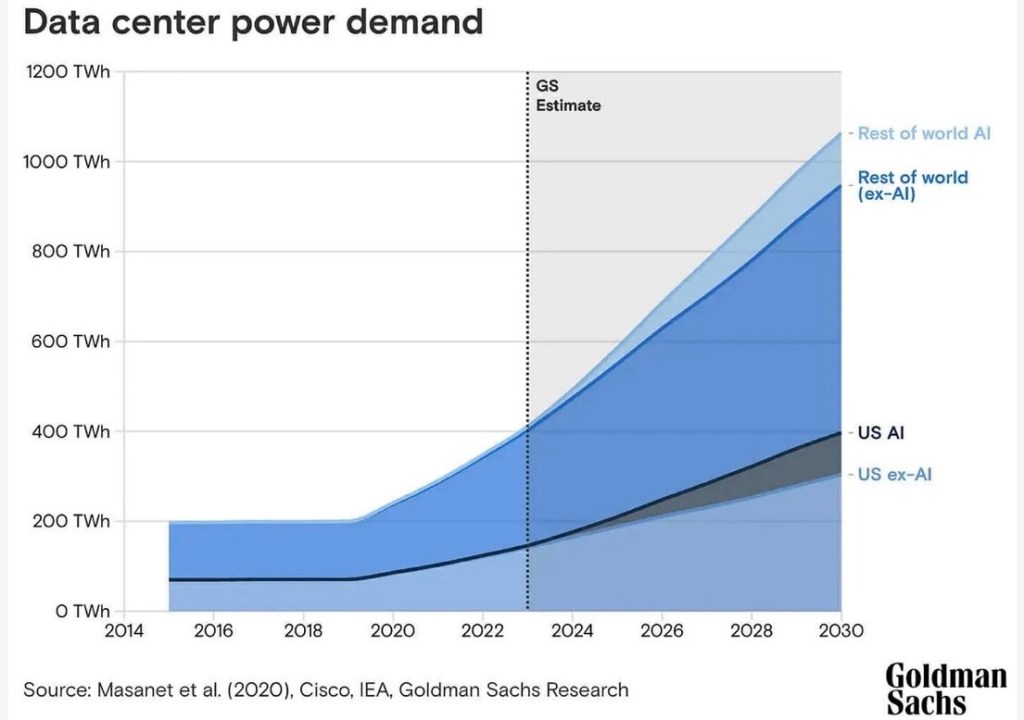
It should also be noted that data centers house the computational power of the entire internet. As the chart (from Masley) at the top of this post shows, AI represents an incremental need that is still relatively small relative to total data center power use. Incidentally, water cooling rather than air cooling reduces a data center’s power consumption.

Nevertheless, the power consumption of data centers is indeed a matter of critical importance and controversy. Referring again to the chart at the top, it’s evident that data center power usage is growing rapidly. However, developers are increasingly planning to produce their own power off-grid, often colocating with their power sources to minimize transmission costs. This includes locating alongside natural gas basins, installing wind and solar collection facilities nearby, and coming soon, incorporating modular nuclear reactors. The latter would provide base-load, dispatchable, zero-carbon power for data centers. Of course, modular reactors will be costly and might eat into returns from developing data centers, but other power sources are costly as well, and it is the one sure dispatchable, zero-carbon, off-grid solution.

Water and energy supplies for data centers are key to enabling broad contributions of AI to consumer welfare, productivity growth, and national security. Local interests should weigh other benefits that construction of data centers will bring to a community. Construction jobs and permanent data center jobs are obviously important considerations, as well as the aforementioned increases in local tax revenue.

State Regulation and Litigation

Of course, AI controversies are playing out at the national and state levels as well. First, there is the issue of AI regulation. AI legislation in all 50 states attempts to regulate various “threatening” aspects of AI. These bills address topics such as fraud prevention (e.g., deep fakes), chatbot safety, and restrictions on automated AI decisioning (e.g., hiring, insurance coverage and claims adjudication).

There is litigation and potential litigation at the state level related to alleged abuses by Open AI’s ChatGPT. These concern the use of customer data and alleged encouragement of self-harm, among other matters. And the New York legislature has passed a bill calling for a one-year moratorium on AI data center development.

These regulatory and legal efforts at the state and local level raise the prospect of fragmented treatment of AI in different jurisdictions that would be disruptive and costly for both AI companies and users. Federalist principles aside, economic efficiency argues for a more uniform approach to many concerns about AI. But whether it’s at the federal, state, or local level, tight regulatory control of AI risks compromising the healthy competitive development of AI technology and the industry. That’s because politicians and bureaucrats cannot possess the knowledge of evolving competition, scarcity, and market incentives only revealed by free market processes.

Rooting for Regulation

Unfortunately, modern-day Luddites at the national level are calling for a moratorium on AI development. In fact, in 2023, fears of AI misalignment with human interests brought even Elon Musk to call for a six-month “pause” on development. Today, a number of industry insiders call for a “slowdown”, if only other countries go along with it (fat chance!).

Yes, AI is improving… fast, but the most consequential threats have to do with security protocols. Anthropic, in particular, almost begged for government control over its Mythos product, which recently gripped the AI and cybersecurity communities with its advanced ability to identify software vulnerabilities. The Fable version is said to incorporate “guardrails”, but reportedly Fable is vulnerable to “jailbreaks”. In what should not have surprised Anthropic after its own warnings, the federal government imposed export controls, restricting access by foreign nationals. And now, Anthropic has withdrawn availability of the models worldwide..

Be Careful What You Ask For

Perhaps Anthropic got what it deserved, but sadly, the Trump Administration seems to have crossed a threshold from a “light touch” approach to regulating AI to something more severe. Let’s hope the Mythos/Fable affair doesn’t presage a permanent transition from private governance to state control. That would inhibit development and present risks likely to rattle some of AI’s most important customers, .

The last link cites Timnit Gebru’s critique that AI labs have made a huge miscalculation:

“She argues that AI labs have consistently used ‘dangerous AI’ narratives for marketing, investor appeal, and competitive advantage, only for the narrative to backfire when actual state power intervenes. (on X)”

It’s possible that Anthropic and a few of its competitors have fallen for the same mistaken notion that central planning by government bureaucrats can improve upon market processes. Statists on the right and the left have been eager to join the chorus for regulatory control.

Fatal Conceit

Dean Ball channels Friedrich Hayek in the following tweet on the mistaken impression that government must impose a “strategy” and “plan” AI.

“I think part of it, at least vis a vis US/China competition, is that US and western chattering classes find it hard to believe that the market-driven outcome of frontier AI could possibly be right. They basically believe, in their hearts, that the Chinese system, with its ‘industrial strategy,’ has eclipsed capitalism. So they harbor the same inferiority complex toward the Chinese system that many Americans once harbored toward the EU’s system. Their heuristic is that the industrial strategists of China have grasped the whole picture of the technological competition in a way that US industrialists, with their ‘profit maximizing incentives,’ could not possibly have matched. And so any outcome in the economy that is not the result of ‘strategy’ is therefore prima facie worse than what the ‘strategists’ have concocted. They also believe the Chinese strategists possess awesome powers of foresight and the ability to evade all tendencies of financial and economic gravity, due of course to ‘strategy,’ really it’s almost a kind of orientalism.”

National security is an important consideration, of course, but AI development should not be hamstrung for fear of the ever-present need for improved encryption or by the prospect of threats from autonomous weapons systems. Indeed, AI can and should be put to use defending against all such threats to national security without compromising its promise as a revolutionary technology with a wide range of applications. Again, Trump’s purported intent to encourage U.S. AI development is undercut by his fixations on controlling trade and “taking stakes”. And do foreign customers want to deal with this confusing state of affairs? Or simply go to China?

AI and Capital Redistribution

Another nest of controversies has to do with the widespread presumption that AI will be negative for labor markets. Prescriptions from the populist left and right include various kinds of AI taxation, redistribution, and even nationalization.

Bernie Sanders and Donald Trump both want a sovereign wealth fund, and Sanders wants to fund it with a one-time 50% tax on AI stock. Sanders, the High Prince of Economic Parasites, is sponsoring a bill he claims would allow the American public to take a role in determining the future of AI, whatever that means. What he hopes to create is a mechanism for wealth redistribution, since the fashionable view is that AI will be a catastrophe for labor. While the AI industry is far from profitable at the moment, many AI stocks have soared in value. And Sanders’ target “AI industry” might fairly broad, including chip manufacturers and other producers of AI infrastructure.

If the public wants to kill AI investment in the U.S., tank equity markets, and give politicians an excuse for more profligate spending, then Sander’s bill is a grand idea. It would be an outright expropriation of wealth. The impacts on economic growth, productivity, American competitiveness, and national security would be unambiguously negative. And lest you think such a redistribution is necessary to compensate for job losses caused by AI, that issue is far from settled. In fact, it’s highly likely that the job realignment certain to take place will result in growth from a variety of occupations previously unimagined, just as technological advances have in the past.

The Compute Tax

Others (including Sanders) have also broached the idea of a “compute tax”, or as Brian Albrecht explains:

“… a levy on computational resources. Think GPU hours, processing power, data center electricity, or some similar proxy for AI work.”

Albrecht believes the real intent is to tax the stock of physical AI capital, as opposed to a flow of input services rendered for AI. But consider the number of goods and services whose values are likely to be enhanced by the use of AI as an input. And also consider the innovation and discovery that will be made possible by AI. Albrecht wisely questions the logic of adding to the cost and discouraging this value added via taxation. In the context of killing the golden goose, he cites two rules of optimal taxation: don’t tax intermediate goods and don’t tax capital. When the supply of capital is elastic, he notes, taxing it is more likely to harm workers than to help them. And one can reasonably argue that the external benefits expected to flow from AI would justify a compute subsidy rather than a tax. Finally, Albrecht cautions that a compute tax, unless it is very broad and at a very high rate, won’t raise much revenue.

Trump’s Confusion

Bernie Sanders deserves plenty of condemnation for his infantile, class-warfare rhetoric and interventionist approach to economic policy, including state ownership of the means of production. But in practice Donald Trump isn’t much better. He’s been busy partially nationalizing several different industries, including steel, semiconductors, nuclear energy, rocket motors, quantum computing, and critical mineral supplies, often with direct reins on business decisions (e.g., the “Golden Share” in U.S. Steel). Now, he’s angling to acquire equity stakes in AI companies. The Senate Armed Services Committee is ready to help him out with a bill that would establish a Department of Defense Equity Investment Account at the Treasury.

These are all part of the sovereign wealth fund Trump has decided is in the fiscal and national security interests of the U.S. Again, government ownership stakes in private companies invite cronyism, political interference, and regulatory capture. In the case of AI, it is an invitation to censorship and government surveillance. Moreover, spare government funds would be better spent paying down our burgeoning public debt, reducing government obligations and interest expense at zero risk. In contrast, the value of private equity stakes and their returns are fully at risk, while leaving government debt, interest expenses, and interest rate rollover risks in place.

Trump is now inveigling the likes of Sam Altman (OpenAI), Dario Amodei (Anthropic), Sundar Pichai (Google), and even Elon Musk (xAI) to accept his vision of public ownership of AI stock. It’s effectively a trap and a prescription for competitive failure, but Trump doesn’t get it.

Superabundance?

Many AI industry leaders have indeed bought into some version of an AI wealth transfer, primarily because they accept the notion of superabundance along with heavy losses of remunerative work for humans. But in fact they don’t understand the economics of capital deepening and the contradictions implied by their position.

First, savings and funds available for capex are scarce, and any given project for AI buildout must compete with many other valued uses. The working world will not be monopolized by AI robots any time soon, even given dramatic cost reductions. AI may well increase the productivity of human workers (along with their wages) in greater proportion than other forms of physical capital. But some forms of labor are likely to be in surplus, and that will cause the wages in those occupations to become more competitive relative to the cost of potential AI-augmented substitutes. In fact, occupations in which humans are more competitive than machines will persist. Here is Albrecht on this point:

“And comparative advantage always pops up fighting against [human job losses]. When automation makes some things cheap, the things that remain expensive tend to be the things that are hard to automate. And the things that are hard to automate are, almost by definition, the things where humans still have comparative advantage. The saved dollar drifts toward where humans are still worth paying. That’s not optimism. That’s what comparative advantage means.“

A second contradiction of the superabundance job-loss narrative is, as I’ve said, that there will be many inventive new occupations available for humans. At worst, job losses will be a transitional phenomenon. Third, superabundance itself implies drastically lower prices, which would ultimately benefit wage earners and consumers, obviating the need for government intervention on their behalf.

I had to laugh when I read this quote of Rebecca Lowe, who has an amusing and sensible reaction to the “AI will take all the jobs” narrative:

“I think a large part of this is you don’t really get experts in their particular domains writing about AI. Instead, you get ‘the AI expert’, and they want to reinvent the wheel. You see this when they write about economics, or when they write about philosophy. You talk to an AI person and suddenly they’re like, ‘I’ve just discovered this thing!’ And it turns out they’re talking about, like, supply and demand. And you’re like, oh my God.”

CCP Interference

I’ll briefly touch on one other controversy: whether the anti-AI/data center furor is being instigated by the Chinese in an attempt to undermine U.S. leadership in AI. The House Energy and Commerce Committee claims to have evidence that strongly suggests the CCPs involvement in attempts to hamstring substantial U.S. leadership in AI. Apparently no details on that evidence have been made public, however. It would not be surprising or uncharacteristic of the CCP, and if true would constitute another tension in the attempt to safeguard national security while avoiding government obstruction in AI development.

Summary

Artificial intelligence is animating economic controversies at the local, state and federal levels. Like other forms of industrial development, opponents are roused by claims of strains on local resources as well as displacement of property owners. Some of these claims are exaggerated or can be resolved via negotiation or technological solutions.

There are also fears that AI can be used in a variety of nefarious ways. There may be legitimate dangers, and AI companies themselves are actively working to address so called “alignment” issues. Nevertheless, there are increasing calls for state and/or federal regulation of AI. These proposals must be approached cautiously or they could easily derail U.S. progress on perhaps the most promising technologies to ever come down the line. That would indeed represent an economic and national security failure.

Finally, fear that AI will lead to large-scale job losses and widening inequality has prompted calls for taxes on AI capital, or even partial nationalization, with redistribution of future profits to the public. This would be a colossal mistake. Nothing could stanch AI development more effectively than such a policy. Unfortunately, even Donald Trump has called for the government to take equity stakes in AI companies pursuant to “national priorities” and supposedly for the benefit of American taxpayers. In fact, this partial nationalization has already begun. This is a prescription for destructive regulation, planning failures, and corruption.

The key lesson in all this is that we’ll all be better off if government stays out of the way of AI development.

Follow Sacred Cow Chips on WordPress.com

Recent Posts

  • Data Center Power Price Confusion
  • The Rise of the GOP “Common Good” Socialists
  • Trial Lawyers Reveal Preference For Less Safety
  • Funding Private Social Security Accounts
  • Chinese State, CCP, Cronies Exploit Wage Earners

Archives

  • September 2026
  • August 2026
  • July 2026
  • June 2026
  • May 2026
  • April 2026
  • March 2026
  • February 2026
  • January 2026
  • December 2025
  • November 2025
  • October 2025
  • September 2025
  • August 2025
  • July 2025
  • June 2025
  • May 2025
  • April 2025
  • March 2025
  • February 2025
  • January 2025
  • December 2024
  • November 2024
  • October 2024
  • September 2024
  • August 2024
  • July 2024
  • June 2024
  • May 2024
  • April 2024
  • March 2024
  • February 2024
  • January 2024
  • December 2023
  • November 2023
  • August 2023
  • July 2023
  • June 2023
  • May 2023
  • April 2023
  • March 2023
  • February 2023
  • January 2023
  • December 2022
  • November 2022
  • October 2022
  • September 2022
  • August 2022
  • July 2022
  • June 2022
  • May 2022
  • April 2022
  • March 2022
  • February 2022
  • January 2022
  • December 2021
  • November 2021
  • October 2021
  • September 2021
  • August 2021
  • July 2021
  • June 2021
  • May 2021
  • April 2021
  • March 2021
  • February 2021
  • January 2021
  • December 2020
  • November 2020
  • October 2020
  • September 2020
  • August 2020
  • July 2020
  • June 2020
  • May 2020
  • April 2020
  • March 2020
  • February 2020
  • January 2020
  • December 2019
  • November 2019
  • October 2019
  • September 2019
  • August 2019
  • July 2019
  • June 2019
  • May 2019
  • April 2019
  • March 2019
  • February 2019
  • January 2019
  • December 2018
  • November 2018
  • October 2018
  • September 2018
  • August 2018
  • July 2018
  • June 2018
  • May 2018
  • April 2018
  • March 2018
  • February 2018
  • January 2018
  • December 2017
  • November 2017
  • October 2017
  • September 2017
  • August 2017
  • July 2017
  • June 2017
  • May 2017
  • April 2017
  • March 2017
  • February 2017
  • January 2017
  • December 2016
  • November 2016
  • October 2016
  • September 2016
  • August 2016
  • July 2016
  • June 2016
  • May 2016
  • April 2016
  • March 2016
  • February 2016
  • January 2016
  • December 2015
  • November 2015
  • October 2015
  • September 2015
  • August 2015
  • July 2015
  • June 2015
  • May 2015
  • April 2015
  • March 2015
  • February 2015
  • January 2015
  • December 2014
  • November 2014
  • October 2014
  • September 2014
  • August 2014
  • July 2014
  • June 2014
  • May 2014
  • April 2014
  • March 2014

Blogs I Follow

  • Passive Income Kickstart
  • OnlyFinance.net
  • TLC Cholesterol
  • Nintil
  • kendunning.net
  • DCWhispers.com
  • Hoong-Wai in the UK
  • Marginal REVOLUTION
  • Stlouis
  • Watts Up With That?
  • American Elephants
  • The View from Alexandria
  • The Gymnasium
  • A Force for Good
  • Notes On Liberty
  • troymo
  • SUNDAY BLOG Stephanie Sievers
  • Miss Lou Acquiring Lore
  • Your Well Wisher Program
  • Objectivism In Depth
  • RobotEnomics
  • Orderstatistic
  • Paradigm Library
  • Scattered Showers and Quicksand
  • Jam Review

Blog at WordPress.com.

Passive Income Kickstart

OnlyFinance.net

TLC Cholesterol

Nintil

To estimate, compare, distinguish, discuss, and trace to its principal sources everything

kendunning.net

The Future is Ours to Create

DCWhispers.com

Hoong-Wai in the UK

A Commonwealth immigrant's perspective on the UK's public arena.

Marginal REVOLUTION

Small Steps Toward A Much Better World

Stlouis

Watts Up With That?

The world's most viewed site on global warming and climate change

American Elephants

Defending Life, Liberty and the Pursuit of Happiness

The View from Alexandria

In advanced civilizations the period loosely called Alexandrian is usually associated with flexible morals, perfunctory religion, populist standards and cosmopolitan tastes, feminism, exotic cults, and the rapid turnover of high and low fads---in short, a falling away (which is all that decadence means) from the strictness of traditional rules, embodied in character and inforced from within. -- Jacques Barzun

The Gymnasium

A place for reason, politics, economics, and faith steeped in the classical liberal tradition

A Force for Good

How economics, morality, and markets combine

Notes On Liberty

Spontaneous thoughts on a humble creed

troymo

SUNDAY BLOG Stephanie Sievers

Escaping the everyday life with photographs from my travels

Miss Lou Acquiring Lore

Gallery of Life...

Your Well Wisher Program

Attempt to solve commonly known problems…

Objectivism In Depth

Exploring Ayn Rand's revolutionary philosophy.

RobotEnomics

(A)n (I)ntelligent Future

Orderstatistic

Economics, chess and anything else on my mind.

Paradigm Library

OODA Looping

Scattered Showers and Quicksand

Musings on science, investing, finance, economics, politics, and probably fly fishing.

Jam Review

"If you get confused, listen to the music play."

  • Subscribe Subscribed
    • Sacred Cow Chips
    • Join 128 other subscribers
    • Already have a WordPress.com account? Log in now.
    • Sacred Cow Chips
    • Subscribe Subscribed
    • Sign up
    • Log in
    • Report this content
    • View site in Reader
    • Manage subscriptions
    • Collapse this bar
Loading Comments...