• About

Sacred Cow Chips

Sacred Cow Chips

Tag Archives: Climate Change

Amazon Fire Fraud

02 Monday Sep 2019

Posted by Nuetzel in Forest Fires, Global Greening

≈ Leave a comment

Tags

Al Gore, Alexander Hammond, Amazon Basin, Amazon Fires, Brazil, Climate Change, Coyote Blog, Deforestation, FEE, Global Fire Emissions Database, Jair Bolsonaro, Leonardo DiCaprio, Michael Shellenberger, P.T. Barnum, Reforestation, Sugar Cane, U.S. Ethanol Mandates, Warren Meyer

Leftist activists recently pounced on another opportunity to mischaracterize events, this time in the Amazon Basin, where recent fires were held to be unprecedented. The fires were also characterized as evidence of a massive conspiracy between capitalists and the new government of President Jair Bolsonaro to open the rain forest to commercial exploitation. Warren Meyer squares away the facts at this Coyote Blog post, which is where I found the chart above. Forest clearing in Brazil has been much lower over the past 10 years than during period 1988-2008. It stepped-up somewhat during the first half of 2019, but it still ran at a rate well below 2008. A key reason for the increase is fascinating, but I’ll merely tease that for now.

As for the fires, Meyer provides the following quote about this year’s fires from NASA in a statement accompanying a satellite photo:

“As of August 16, 2019, satellite observations indicated that total fire activity in the Amazon basin was slightly below average in comparison to the past 15 years. Though activity has been above average in Amazonas and to a lesser extent in Rondônia, it has been below average in Mato Grosso and Pará, according to the Global Fire Emissions Database.“

So what was the cause of all the alarm? Meyer points to a August 22 story in the Washington Post, though WaPo might not have been the first. The article was either poorly researched and “fact checked” or it was a deliberate attempt to raise alarm. The sloppy story was picked up elsewhere, of course, and distorted memes spread on social media condemning the Brazilian government and capitalism generally.

The burning that is taking place has been started by farmers preparing land for crops, a process that occurs every year. Meyer quotes the New York Times on this point, which noted that very little of the burning was taking place in old-growth forests.

What’s really ironic and crazy about all this is that U.S. environmental policy is responsible for some of the burning that is taking place in the Amazon. Meyer notes that U.S. ethanol mandates have subsidized a years-long trend of increased sugar cane production in the Amazon Basin. Of course, burning is a regular part of the normal sugar cane harvest. Moreover, that production has contributed to land clearance, offsetting some of the forces that have brought the rate of deforestation in Brazil down overall.

The whole episode dovetails with the ongoing narrative that fires are burning out of control across the globe due to climate change. We heard similar propaganda last year after several large fires in California. Michael Shellenberger does his best to set the record straight, demonstrating that the annual land area burned worldwide has declined by 25% since 2003. He contrasts that record with the hopelessly errant reporting by major media organizations.

As P.T. Barnum once said, a sucker’s born every minute. He might as well have been talking about the armies of well-meaning but gullible greenies who fall for every scare story told by the likes of Al Gore and Leonardo DiCaprio. And scare stories are exactly what these tales of a global conflagration amount to. Meanwhile, as Alexander Hammond explains, global reforestation has taken hold. In what is apparently a paradox to some, this is largely the result of economic growth. Hammond discusses the logical connections between economic development and environmental goods, including reforestation and biodiversity. The bottom line is that the best policies for reforestation are not those imposing obstacles to growth, as the environmental Left would have it. Rather, it is policies that promote development and income growth, which are generally more compatible with individual liberty, that will encourage growth in the world’s forests.

A Carbon Tax Would Be Fine, If Only …

01 Friday Mar 2019

Posted by Nuetzel in Environment, Global Warming, Taxes

≈ Leave a comment

Tags

A.C. Pigou, Carbon Dividend, Carbon Tax, Climate Change, Economic Development, External Cost, Fossil fuels, Green New Deal, IPCC, John Cochrane, Michael Shellenberger, Pigouvian Tax, Quillette, Renewable energy, Revenue Neutrality, Robert P. Murphy, Social Cost of Carbon, Warren Meyer, William D. Nordhaus

I’ve opposed carbon taxes on several grounds, but I admit that it might well be less costly as a substitute for the present mess that is U.S. climate policy. Today, we incur enormous costs from a morass of energy regulations and mandates, prohibitions on development of zero-carbon nuclear power, and subsidies to politically-connected industrialists investing in corn ethanol, electric cars, and land- and wildlife-devouring wind and solar farms. (For more on these costly and ineffective efforts, see Michael Shellenberger’s “Why Renewables Can’t Save the Planet” in Quillette.) Incidentally, the so-called Green New Deal calls for a complete conversion to renewables in unrealistically short order, but with very little emphasis on a carbon tax.

The Carbon Tax

Many economists support the carbon tax precisely because it’s viewed as an attractive substitute for many other costly policies. Some support using revenue from the tax to pay a flat rebate or “carbon dividend” to everyone each year (essentially a universal basic income). Others have pitched the tax as a revenue-neutral replacement for other taxes that are damaging to economic growth, such as payroll taxes or taxes on capital. Economic growth would improve under the carbon tax, or so the story goes, because the carbon tax is a tax on a “bad”, as opposed to taxes on “good” factors of production. I view these ideas as politically naive. If we ever get the tax, we’ll be lucky to get much regulatory relief in the bargain, and the revenue is not likely to be offset by reductions in other taxes.

But let’s look a little closer at the concept of the carbon tax, and I beg my climate-skeptic friends to stick with me for a few moments and keep a straight face. The tax is a way to attach an explicit price to the use of fuels that create carbon emissions. The emissions are said to inflict social or external costs on other parties, costs which are otherwise ignored by consumers and businesses in their many decisions involving energy use. The carbon tax is a so-called Pigouvian tax: a way to “internalize the externality” by making fossil fuels more expensive to burn. The tax itself involves no prohibitions on behavior of any kind. Certain behaviors are taxed to encourage more “desirable” behavior.

Setting the Tax

But what is the appropriate level of the tax? At what level will it approximate the true “social cost of carbon”? Any departure from that cost would be sub-optimal. Robert P. Murphy contrasts William D. Nordhaus’ optimal carbon tax with more radical levels, which Nordhaus believes would be needed to meet the goals of the United Nation’s Intergovernmental Panel on Climate Change (IPCC). Nordhaus won the 2018 Nobel Prize in economics for his work on climate change. Whatever one might think of the real risks of climate change, Nordhaus’ clearly recognizes the economic downsides to mitigating against those risks.

Nordhaus has estimated that the social cost of carbon will be $44/ton in 2025 (about $0.39 per gallon of gas). He claims that a carbon tax at that level would limit increases in global temperature to 3.5º Celsius by 2100. He purports to show that the costs of a $44 carbon tax in terms of reduced economic output would be balanced by the gains from limiting climate warming. Less warming would require a higher tax with fewer incremental rewards, and even more incremental lost output. The costs of the tax would then outweigh benefits. For perspective, according to Nordhaus, a stricter limit of 2.5º C implies a carbon tax equivalent to $2.50 per gallon of gas. The IPCC, however, prescribes an even more radical limit of 1.5º C. That would inflict a huge cost on humanity far outweighing the potential benefits of less warming.

A Carbon Tax, If…

Many economists have come down in favor of a carbon tax under certain qualifications: revenue-neutrality, a “carbon dividend”, or as a pre-condition to deregulation of carbon sources and de-subsidization of alternatives. John Cochrane discusses a carbon tax in the context of the “Economists’ Statement on Carbon Dividends” (Cochrane’s more recent thoughts are here):

“It’s short, sweet, and signed by, as far as I can tell, every living CEA chair, every living Fed Chair, both Democrat and Republican, and most of the living Nobel Prize winners. … It offers four principles 1. A carbon tax, initially $40 per ton. 2. The carbon tax substitutes for regulations and subsidies and (my words) the vast crony-capitalist green boondoggle swamp, which is chewing up money and not saving carbon. 3. Border adjustment like VAT have [sic] 4. ‘All the revenue should be returned directly to U.S. citizens through equal lump-sum rebates.'”

Rather than a carbon dividend, Warren Meyer proposes that a carbon tax be accompanied by a reduction in the payroll tax, an elimination of all subsidies, mandates, and prohibitions, development of more nuclear power-generating capacity, and contributions to a cleanup of Chinese and Asian coal-power generation. That’s a lot of stuff, and I think it exceeds Meyer’s normal realism with respect to policy issues.

My Opposition

Again, I oppose the adoption of a carbon tax for several reasons, despite my sympathy for the logic of Pigouvian taxation of externalities. At the risk of repeating myself, here I elaborate on my reasons for opposition:

Government Guesswork: First, Nordhaus’ estimates notwithstanding, we do not and cannot know the climate/economic tradeoffs with any precision. We can barely measure global climate, and the history of what measures we have are short and heavily manipulated. Models purporting to show the relationship between carbon forcing and global climate climate change are notoriously unreliable. So even if we can agree on the goal (1.5º, 2.5º, 3.5º), and we won’t, the government will get the tradeoffs wrong. I took the following from a comment on Cochrane’s blog, a quote from A.C. Pigou himself:

“It is not sufficient to contrast the imperfect adjustments of unfettered enterprise with the best adjustment that economists in their studies can imagine. For we cannot expect that any State authority will attain, or even wholeheartedly seek, that ideal. Such authorities are liable alike to ignorance, to sectional pressure, and to personal corruption by private interest. A loud-voiced part of their constituents, if organized for votes, may easily outweigh the whole.”

Political Hazards: Second, we won’t get the hoped-for political horse trade made explicit in the “Economists’ Statement …” discussed above. As a political matter, the setting of the carbon tax rate will almost assuredly get us a rate that’s too high. Experiences with carbon taxes in Australia, British Columbia, and France have been terrible thus far, sowing widespread dissatisfaction with the resultant escalation of energy prices.

Economic Growth: Neither is it a foregone conclusion that a revenue-neutral carbon tax will stimulate economic growth, and it might actually reduce output. As Robert P. Murphy explains in another post, the outcome depends on the structure of taxes prior to the change. The substitution of the carbon tax will increase output only if it replaces taxes on a factor of production (labor or capital) that is overtaxed prior to the change. That undermines a key selling point: that the carbon tax would necessarily produce a “double dividend”: a reduction in carbon emissions and higher economic growth. Nevertheless, I’d allow that revenue neutrality combined with elimination of carbon regulation and “green” subsidies would be a good bet from an economic growth perspective.

Overstated Risks: Finally, I oppose carbon taxes because I’m unconvinced that the risk and danger of global warming are as great as even Nordhaus would have it. In other words, the external costs of carbon don’t amount to much. Our recorded temperature history is extremely short and is therefore not a reliable guide to the long-term nature of the systemic relationships at issue. Even worse, temperature records are manipulated to exaggerate the trend in temperatures (also see here, here and here). There is no evidence of an uptrend in severe weather events, and the dangers of sea level rise associated with increasing carbon concentrations also have been greatly exaggerated. Really, at some point one must take notice of the number of alarming predictions and doomsday headlines from the past that have not been borne out even remotely. Furthermore, higher carbon concentrations and even warming itself would be of some benefit to humanity. In addition to a greener environment, the benefits include more rapid economic growth, improved agricultural yields, and a reduction in the salient danger of cold-weather deaths.

Economic Development: The use of fossil fuels has helped to enable strong growth in incomes in developed economies. It has also given us energy alternatives such as nuclear power as well as research into other alternatives, albeit with very mixed success thus far. And while a carbon tax would create an additional incentive to develop such alternatives, a U.S. tax would not accomplish much if any global temperature reduction. Such a tax would have to be applied on a global scale. Talk about a political long-shot! Increasing the price of carbon emissions also has enormous downsides for the less developed world. These fragile economies would benefit greatly from development of fossil fuel energy, enabling reductions in poverty and the income growth necessary to someday join in the prosperity of the developed economies. This, along with liberalization of markets, is the affordable way to bring economic success to these countries, which in turn will enable them to consider the energy alternatives that might come to fruition by that time. Fighting the war on fossil fuels in the underdeveloped world is nothing if not cruel.


The Disastrous Boomerang Effect of Fire Suppression

15 Thursday Nov 2018

Posted by Nuetzel in Environment, Wildfires

≈ Leave a comment

Tags

Biomass Harvesting, Camp Fire, Climate Change, Donald Trump, Fire Suppression, Forest Fires, Forest Management, George E. Gruell, PG&E, Prescribed Burns, Sierra Nevada, Spontaneous Combustion, Timber Harvest, U.S. Forest Service, Warren Meyer, Wildfires

We can lament the tragic forest fires burning in California, but a discussion of contributing hazards and causes is urgent if we are to minimize future conflagrations. The Left points the finger at climate change. Donald Trump, along with many forestry experts, point at forest mismanagement. Whether you believe in climate change or not, Trump is correct on this point. However, he blames the state of California when in fact a good deal of the responsibility falls on the federal government. And as usual, Trump has inflamed passions with unnecessarily aggressive rhetoric and threats:

“There is no reason for these massive, deadly and costly forest fires in California except that forest management is so poor. Billions of dollars are given each year, with so many lives lost, all because of gross mismanagement of the forests. Remedy now or no more Fed payments.”

Trump was condemned for his tone, of course, but also for the mere temerity to discuss the relationship between policy and fire hazards at such a tragic moment. Apparently, it’s a fine time to allege causes that conform to the accepted wisdom of the environmental Left, but misguided forest management strategy is off-limits.

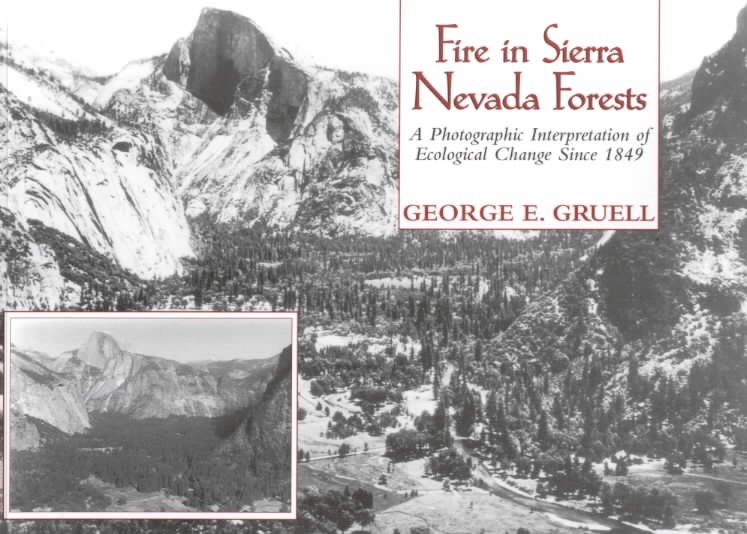
The image at the top of this post is from the cover of a book by wildlife biologist George E. Gruell, published in 2001. The author includes hundreds of historical photos of forests in the Sierra Nevada range from as early as 1849. He pairs them with photos of the same views in the late 20th century, such as the photo inset on the cover shown above. The remarkable thing is that the old forests were quite thin by comparison. The following quote is from a review of the book on Amazon:

“Even the famed floor of Yosemite is now mostly forested with conifers. I myself love conifers but George makes an interesting point that these forests are “man made” and in many ways are unhealthy from the standpoint that they lead to canopy firestorms that normally don’t exsist when fires are allowed to naturally burn themselves out. Fire ecology is important and our fear of forest fires has led to an ever worsening situation in the Sierra Nevada.”

I posted this piece on forest fires and climate change three months ago. There is ample reason to attribute the recent magnitude of wildfires to conditions influenced by forest management policy. The contribution of a relatively modest change in average temperatures over the past several decades (but primarily during the 1990s) is rather doubtful. And the evidence that warming-induced drought is the real problem is weakened considerably by the fact that the 20th century was wetter than normal in California. In other words, recent dry conditions represent something of a return to normal, making today’s policy-induced overgrowth untenable.

Wildfires are a natural phenomenon and have occurred historically from various causes such as lightning strikes and even spontaneous combustion of dry biomass. They are also caused by human activity, both accidental and intentional. In centuries past, Native Americans used so-called controlled or prescribed burns to preserve and restore grazing areas used by game. In the late 19th and early 20th centuries, fire suppression became official U.S. policy, leading to an unhealthy accumulation of overgrowth and debris in American forests over several decades. This trend, combined with a hot, dry spell in the 1930s, led to sprawling wildfires. However, Warren Meyer says the data on burnt acreage during that era was exaggerated because the U.S. Forest Service insisted on counting acres burned by prescribed burns in states that did not follow its guidance against the practice.

The total acreage burned by wildfires in the U.S. was minimal from the late 1950s to the end of the century, when a modest uptrend began. In California, while the number of fires continued to decline over the past 30 years, the trend in burnt acreage has been slightly positive. Certainly this year’s mega-fires will reinforce that trend. So the state is experiencing fewer but larger fires.

The prior success in containing fires was due in part to active logging and other good forest management policies, including prescribed burns. However, the timber harvest declined through most of this period under federal fire suppression policies, California state policies that increased harvesting fees, and pressure from environmentalists. The last link shows that the annual “fuel removed” from forests in the state has declined by 80% since the 1950s. But attitudes could be changing, as both the state government and environmentalists (WSJ, link could be gated) are beginning to praise biomass harvesting as a way to reduce wildfire risk. Well, yes!

The reason wildfire control ever became a priority is the presence of people in forest lands, and human infrastructure as well. Otherwise, the fires would burn as they always have. Needless to say, homes or communities surrounded by overgrown forests are at great risk. In fact, it’s been reported that the massive Camp Fire in Northern California was caused by a PG&E power line. If so, it’s possible that the existing right-of-way was not properly maintained by PG&E, but it may also be that rights-of-way are of insufficient width to prevent electrical sparks from blowing into adjacent forests, and that’s an especially dangerous situation if those forests are overgrown.

Apparently Donald Trump is under the impression that state policies are largely responsible for overgrown and debris-choked forests. In fact, both federal and state environmental regulations have played a major role in discouraging timber harvesting and prescribed burns. After all, the federal government owns about 57% of the forested land in California. Much of the rest is owned privately or is tribal land. Trump’s threat to withhold federal dollars was his way of attempting to influence state policy, but the vast bulk of federal funds devoted to forest management is dedicated to national forests. A relatively small share subsidizes state and community efforts. Disaster-related funding is and should be a separate matter, but Trump made the unfortunate suggestion that those funds are at issue. Nevertheless, he was correct to identify the tremendous fire hazard posed by overgrown forests and excessive debris on the forest floor. Changes to both federal and state policy must address these conditions.

For additional reading, I found this article to give a balanced treatment of the issues.

Climate Change, Hurricanes and Noisy Statistics

22 Friday Sep 2017

Posted by Nuetzel in Global Warming

≈ Leave a comment

Tags

AGW, Atlantic Multi-Decadal Oscillation, Climate Change, Cool the Past, East Anglia University, El Nino, Fabius Maximus, global warming, Hurricane Harvey, Hurricane Irma, Hurricane Maria, Michael Mann, NOAA, Roger Pielke Sr, Roy Spencer, Ryan Maue, Sea Surface Temperatures, Signal-to-Noise, Statistical Noise, Storm Intensity, Watt's Up With That?

IMG_4919

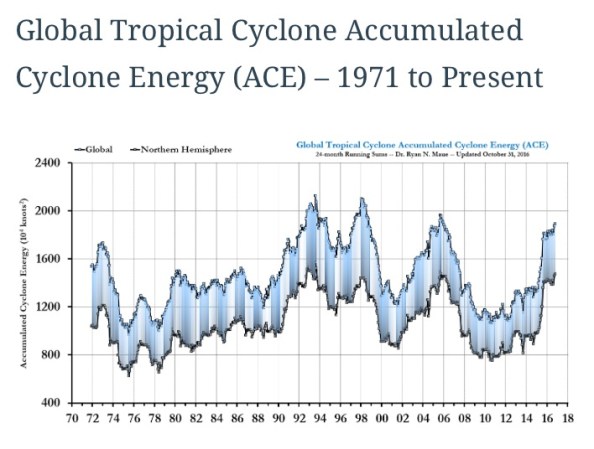
The nasty spate of hurricanes this year has been a catch-up of sorts following a decade of subdued activity. In fact, global hurricane activity has been flat to declining in frequency since 1970. Until the recent increase, hurricane activity had been trending down in terms of 24-month cumulative energy since the 1990s, as the chart above shows. The historical data on the number of U.S. landfalls extends back to 1900, and it has had a negative trend as well. Nevertheless, we hear from climate alarmists that Hurricanes Harvey and Irma, which ended a drought of record length in U.S hurricane landfalls, and now presumably Maria, were a consequence of anthropomorphic global warming (AGW), er… climate change.

The implication is that increases in the atmospheric concentration of CO2 led to these hurricanes or their high intensity. Apparently, the paucity of hurricane activity over the previous ten years can be waved off as a fluke. A further implication of the alarmist view is that the longer negative trends in hurricane frequency and energy can be ignored in the context of any relation to CO2 concentration. But how so? One confounding factor I’ve seen mentioned blames El Nino warming in the Pacific, and a consequent increase in Atlantic wind shear, for the long lull in activity after 2005. That has a ring of plausibility, but a closer look reveals that actual El Nino activity during those years was hardly impressive, with the exception of 2015-16.

More historical data can be seen in the charts on the tropical cyclone page on the Watts Up With That? blog. (The charts in question start about two-thirds of the way down the page.) Hurricane expert Ryan Maue compiled a number of these charts, including the one above. He authored an editorial in the Wall Street Journal this week bemoaning the climate-change hype surrounding Harvey and Irma (if the link doesn’t work, it is available at the WSJ’s Opinion page on Facebook, posted on 9/17). Maue believes that both the climate science community and the media share in the blame for that hype. But he also says the following:

“Although a clear scientific consensus has emerged over the past decade that climate change influences hurricanes in the long run, its effect upon any individual storm is unclear.“

Maue provides a link to this NOAA web site offering cautious support for the proposition that there is a link between global warming and hurricane intensity, though the data it cites ends about ten years ago, so it does not capture the recent lull. Also, some of the information it provides is based on modeled global temperatures and hurricane activity through 2100. As is well-known by now, or should be, long-term climate forecasts based on carbon forcings are notoriously inaccurate, and NOAA admits that the association between those predicted temperatures and future hurricanes is tenuous:

“It is premature to conclude that human activities–and particularly greenhouse gas emissions that cause global warming–have already had a detectable impact on Atlantic hurricane or global tropical cyclone activity.“

Perhaps the idea that there is consensus regarding the relationship between climate change and hurricanes is more of a stretch than Maue and NOAA let on. Here is a summary of 30 peer-reviewed studies showing no connection to either hurricane frequency or intensity. Most of these studies are more recent than the end of the data record cited by NOAA. And in fact, many of these studies find support for a negative link between global temperatures and hurricane activity.

One of the prominent alarmists in the climate research community is Penn State’s Michael Mann, who has famously claimed that hurricanes are more frequent now than at any time in the past 1,000 years. He based his conclusions on highly speculative hurricane “proxies” identified in layers of sediment. Mann’s claims and research technique have been called into questioned by other climate scientists, who have arrived at contrary results in their own research. Lest anyone forget, Mann was implicated in a  data manipulation fraud related to the East Anglia climate scandal. Though cleared by a group of tenured professors at his own university, there are a number of climate scientists who believe Mann violated scientific standards.

The claim that global warming will cause hurricanes to become increasingly intense relies on elevated sea surface temperatures. This year, temperatures in the Gulf of Mexico are elevated and are said to have had a role in strengthening Harvey as it approached the Gulf Coast. Texas, however, has experienced as many landfalls of major hurricanes with cooler Gulf waters as with warmer waters. And Irma strengthened in a part of the Atlantic without such warm temperatures. Instead, minimal wind shear was implicated as a factor contributing to Irma’s strength.

In general, Atlantic temperatures have been relatively warm since the late 1990s, a fact that most scientists would at least partially attribute to the “Atlantic multi-decadal oscillation“, a regular cycle in water temperatures that repeats with a period of multiple decades. Potentially adding to that temperature increase is a controversial change in NOAA’s calibration of sea surface temperatures, as an increasing share of those readings are taken from buoys rather than ship-board measurement. There is some suspicion that NOAA’s adjustments “cool the past” more than is justified, a suspicion that was heightened by allegations from one whistle-blowing NOAA scientist early this year. Then, there is the contention that the sea surface temperature makes little difference if it is matched by an increase in air temperature.

Overall, NOAA says the combination of frequency and intensity of tropical cyclones will increase by 2%-11% over the rest of this century. As Roy Spencer notes, that is not a terribly alarming figure given the risks people have always willingly accepted by living in coastal areas. In any case, the range is based on models of climate behavior that are of questionable reliability. And like past temperature predictions produced by carbon-forcing climate models, it is likely to be a gross overestimate. Here is Roger Pielke, Sr., who is quoted in this wide-ranging post on hurricanes and climate at the Fabius Maximus web site:

“Model projections of hurricane frequency and intensity are based on climate models. However, none have shown skill at predicting past (as hindcasts) variations in hurricane activity (or long term change in their behavior) over years, decades, and longer periods. Thus, their claim of how they will change in the future remains, at most, a hypothesis (i.e. speculation). When NOAA, IPCC and others communicate to the media and public, to be scientifically honest, they should mention this.”

Despite the spike in activity this year, strong hurricanes are intermittent and fairly rare. Establishing reliable statistical connections with other forces is difficult with emergent events like hurricanes. Moreover, the degree of error in measuring global or regional temperature itself is much larger than is generally acknowledged, and the global warming “signal” is very weak. As we say in the statistical analysis business, noisy data are compatible with diverse hypotheses. The relationship between hurricanes and climate change is a prime example.

Tragic Harvey Flooding Was a Known Risk

31 Thursday Aug 2017

Posted by Nuetzel in Flood Insurance, Global Warming, Subsidies, Uncategorized

≈ Leave a comment

Tags

Climate Change, David Conrad, Federal Flood Insurance, Houston, Hurricane Frequency, Hurricane Harvey, Landfalling Hurricanes, Michael Grunwald, National Wildlife Federation, Roger Pielke Jr., Roy Spencer

Houston-flood-1935

The photo above is downtown Houston during the flood of 1935, which I lifted from a post on Roy Spencer’s blog. The rate of rainfall from Hurricane Harvey in Houston is not unprecedented, according to Spencer. The geographic breadth and duration of the heavy rainfall might be, but ready comparisons are difficult on that basis, even for the 100 years of recorded rainfall in East Texas. The tragic severity of the flood damage is probably unprecedented as well, though the full tally won’t be in for some time. The severity is a consequence of four factors: the breadth of the rainfall, its duration, the growth of the Houston metro area, and the unnecessary development of low-lying areas that can no longer provide effective drainage and absorption of rainfall due to impervious cover.

Harvey was (and is) a big storm, but an unusual aspect of Harvey was the way it stalled after making landfall:

“The exact same tropical system moving at, say, 15 mph might have produced the same total amount of rain, but it would have been spread over a wide area, maybe many states, with no flooding disaster. This is usually what happens with landfalling hurricanes. … Instead, Harvey stalled after it came ashore and so all of the rain has been concentrated in a relatively small portion of Texas around the Houston area. In both cases, the atmosphere produced the same amount of rain, but where the rain lands is very different.“

Spencer also notes that Harvey is in no way evidence of global warming, as many in the media have implied:

“Roger Pielke Jr. has pointed out that the U.S. has had only four Category 4 (or stronger) hurricane strikes since 1970, but in about the same number of years preceding 1970 there were 14 strikes. So we can’t say that we are experiencing more intense hurricanes in recent decades. … Going back even earlier, a Category 4 hurricane struck Galveston in 1900, killing between 6,000 and 12,000 people. That was the greatest natural disaster in U.S. history. … And don’t forget, we just went through an unprecedented length of time – almost 12 years – without a major hurricane (Cat 3 or stronger) making landfall in the U.S.“

As for the role of development in the severity of the flooding, Spencer says:

“Major floods are difficult to compare throughout history because the ways in which we alter the landscape. For example, as cities like Houston expand over the years, soil is covered up by roads, parking lots, and buildings, with water rapidly draining off rather than soaking into the soil. The population of Houston is now ten times what it was in the 1920s. The Houston metroplex area has expanded greatly and the water drainage is basically in the direction of downtown Houston.”

Short memories and inaccurate assessments of flood potential might have encouraged excessive building in low-lying areas in and around Houston. However, the profligate extension of federal flood insurance to properties in those areas played a large role. Here is Michael Grunwald:

“Nearly two decades before the storm’s historic assault on homes and businesses along the Gulf Coast of Texas this week, the National Wildlife Federation released a groundbreaking report about the United States government’s dysfunctional flood insurance program, demonstrating how it was making catastrophes worse by encouraging Americans to build and rebuild in flood-prone areas.“

Houston played a noteworthy role in the report quoted by Grunwald:

“‘Houston, we have a problem,’ declared the report’s author, David Conrad. The repetitive losses from even modest floods, he warned, were a harbinger of a costly and potentially deadly future. ‘We haven’t seen the worst of this yet,’ Conrad said.

Climate alarmists would be well-advised to read Spencer’s piece on Harvey. It offers  excellent historical and climatological context. It’s also interesting to read some of the venomous ad hominem sprayed in Spencer’s direction by alarmist trolls in the comments section. Spencer knows too well, however, that “floods aren’t just due to the weather“. Let’s hope that the Houston area won’t be encouraged to rebuild in low-lying areas by prospective subsidies from a federal flood insurance program in need of drastic reform.

The Greening-Carbon Nexus

17 Saturday Dec 2016

Posted by Nuetzel in Environment, Global Warming

≈ 2 Comments

Tags

Atmospheric Carbon Concentration, Climate Change, Climate Consensus, David Henderson, Global Greening, global warming, Harrison H. Schmitt, Matt Ridley, Pollution, Rand Paul, Rodney W. Nichols, Roy Spencer, Thomas Malthus

carbon_sequestration

Satellite records show that our world is experiencing a remarkable “greening” in the 21st century, to the seeming chagrin of the environmental left. There is now more vegetation than two decades ago, and greener vegetation, across as much as 50% of the Earth’s vegetated surface area. That area is expanding as well, and the creeping greenery has improved soil moisture levels in some drylands. This bodes well for agricultural productivity, putting another nail in Malthus’ coffin. The satellite studies have concluded that most of the enhanced vegetation is attributable to greater concentration of CO2 in the atmosphere, as opposed to warming or other possible causes. An interesting feedback is that the enhanced vegetation increases natural absorption of CO2, providing an enhanced carbon sink. This, in turn, has caused a pause in the growth of atmospheric carbon cencentration.

The environmental left knows these developments tend to undermine their preferred narrative that human emissions of CO2 must be reduced — at any cost. In fact, already there are warnings that global greening will “outgrow its benefit” as the greater volume of plants begins to decay, releasing carbon. You just can’t make some people happy! But not all of the carbon release from plant decay adds to atmospheric carbon — some is soil-bound — so the greening should provide a fairly durable carbon sink.

Global greening was one of the major motifs in Matt Ridley’s 2016 Global Warming Policy Foundation Lecture. Ridley covered various evidence of greening, but he also discussed the failure of a large contingent of climate researchers to follow a legitimate scientific approach to the study of climate change. Instead, they have politicized their field of study, committing a few noteworthy frauds along the way:

“It is irresponsible not to challenge the evidence properly, especially if the policies pursued in its name are causing suffering. Increasingly, many people would like to outlaw, suppress, prosecute and censor all discussion of what they call ‘the science’ rather than engage in debate. …

No wonder that I talk frequently to scientists who are skeptical, but dare not say so openly. That is a ridiculous state of affairs. We’re told that it’s impertinent to question “the science” and that we must think as we are told. But arguments from authority are the refuge of priests. Thomas Henry Huxley put it this way: ‘The improver of natural knowledge absolutely refuses to acknowledge authority, as such. For him, scepticism is the highest of duties; blind faith the one unpardonable sin’. 

What keeps science honest, what stops it from succumbing entirely to confirmation bias, is that it is decentralized, allowing one lab to challenge another.“

It is all too true that policies advanced in the interests of curbing a slight warming trend cause real suffering, and the pain is heavily concentrated on the most impoverished. The presumed benefits of activist climate-change policies are speculative, at best. They have little chance of reversing atmospheric carbon concentration on their own.

Ridley makes note of the substantial evidence that sensitivity of the climate to airborne carbon concentration is low. This has become increasingly evident with the unfolding of a consistent record of over-forecasts of global temperatures by climate forcing models. Roy Spencer provides insights about these models in a recent discussion of global warming and “dodgy science” on his blog.

There is a widespread myth that 97 percent of climate scientists believe human activity is the main cause of global warming. In fact, that claim was based on a paper counting citations, not scientists; the methods used in the study and the citations themselves were also questionable. I have reviewed that evidence here on Sacred Cow Chips. David Henderson reviewed it here. A large number of studies find fault with so-called “consensus” pronouncements. They should always be viewed with suspicion.

There is also a lively debate underway over whether CO2 should be considered a pollutant! I exhale, therefore I pollute? To the extent that fecal matter is considered a pollutant, is it fair that to say that CO2 is, too? After all, both are anthropogenic. No, they are not even close in terms of an immediate threat to human health. As a philosophical matter, the idea that anything done by man is “unnatural” denies the fact that we are a very part of nature. Obviously, CO2 is not in the same class as pollutants like sulfur dioxide, ammonia, carbon monoxide or toxic metals. Today, these pollutants are very common in many parts of the world, and they are very threatening to human life. Effective mitigation technologies are available, but instead, in the developed West, we fixate on an increase in CO2 concentration of 100 parts per million over many decades, the climate implications of which are de minimis.

Rand Paul’s Facebook page has an ungated link to a WSJ.com commentary by Rodney W. Nichols and Harrison H. Schmitt on “The Phony War Against CO2”. Their commentary provokes questions as to the motives of the environmental left, and certain members of the research community, in shilling for the cause. That we would fight the greening of the globe, and the potential agricultural benefit it could bring, is bizarre. To devote enormous resources to an endeavor that is largely futile is a waste and a tragedy.


The Broken-Climate Canard

19 Thursday May 2016

Posted by Nuetzel in Global Warming

≈ Leave a comment

Tags

AGW, Al Gore, Anthropomorphic Global Warming, Climate Alarmism, Climate Causality, Climate Change, CO2, Coyote Blog, Draught Severity, Hurricane Katrina, Little Ice Age, Measurement Technology Bias, Publication Bias, Tornadic Activity, Warren Meyer, Weather or Climate Change

MovieDisaster

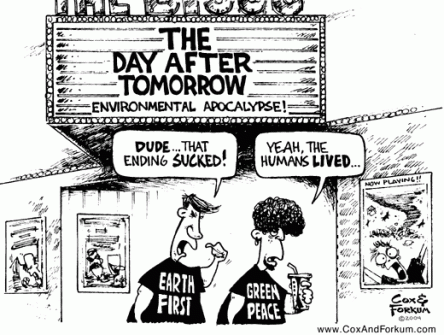
In the imagination of the climate alarmist, almost everything portends an approaching catastrophe. A hurricane? Tornado? Draught? Warm spell? Cold spell? Blizzard? Bad harvest? To their way of thinking, these are all signs that CO2 is damaging the climate. Obviously, these are weather events that imply nothing in the absence of corroborating evidence, though you wouldn’t know it from listening to the precaution pols. Warren Meyer at Coyote Blog has posted another in his series of essays on this topic, this time called “Are We Already Seeing Climate Change?” He provides links to the earlier installments — all interesting. In this installment, he covers five topics under the heading “Manufacturing A Sense that the Climate Is Broken”, which I think would have made a better title for his post. I’ll try to summarize the five points briefly, but do read the whole thing:

Publication Bias:  This quote speaks for itself: “Every single tail-of-the-distribution weather event from around the world is breathlessly reported, leaving the impression among viewers that more such events are occurring, even when there is in fact no such trend. Further, since weather events can drive media ratings, there is an incentive to make them seem scarier.”

Claiming a Trend From One Data Point: This is the kind of error to which I alluded in the first paragraph. Think of Al Gore’s reaction to Hurricane Katrina. The charts offered by Meyer in this section are very nice. There is no upward trend in any of the following: hurricane energy; severe tornadic activity; the incidence of draughts or draught severity; heat waves; extremely hot days; and there is no abatement in the upward trend in crop yields. In fact, there is no trend in high temperature records in the U.S. The upward trend in average surface temperatures in the U.S. is entirely due to warmer nighttime temperatures.

Measurement Technology Bias: We now have the technology to measure various aspects of the climate from space. We can track polar ice extent with much more precision. Doppler radar technology and weather chasers have helped to identify more small tornados than we’d have known of 50 years ago. But when events seem noteworthy to alarmists, they draw extreme conclusions. To their great chagrin, these phenomena are often products of our enhanced ability to measure things.

What Is Normal?: This is related to measurement bias. Our detailed records on surface temperatures go back about 150 years, which is an extremely short slice of history. Temperature proxies from earlier eras, such as ice cores and fossilized tree rings, tell us that the recent past is not all that unusual. Moreover, we also know that glacier melting and sea level increases have been happening for much longer than the buildup of CO2. Those trends began near the end of the “Little Age Age”, around 1800. And there is evidence that these types of developments have happened before. Alarmists, however, assume that what we’ve witnessed in the recent past is unprecedented.

Collapsing Causality in a Complex System To a Single Variable:  “With all the vast complexity of the climate, are we really to believe that every unusual weather event is caused by a 0.013 percentage point change (270 ppm to 400 ppm) in the concentration of one atmospheric gas?” Not likely! Here Meyer helps put the recent temperature trends in perspective: they are tiny relative to their annual variation, which occurs both across seasons and within days.

The public seems to regard the co-called climate catastrophe with more skepticism today than perhaps ten years ago. Not only do the facts contradict the dire predictions of carbon-forcing climate models and alarmist scare stories, but people also recognize that the costs of attempting to avoid a global warming trend are massive and, well, probably not worth it. Moreover, they rightly suspect unworthy political motives in the alarmist community. If some carbon-induced warming is an eventuality, and that’s an “if”, it might well prove to be beneficial for people and the planet. Relax!


Would You Tax Coastal Development?

14 Monday Dec 2015

Posted by Nuetzel in Central Planning, Global Warming

≈ Leave a comment

Tags

Carbon forcing, central planning, Climate Alarmism, Climate Change, Coastal development, Coastal tax, Federal Flood Insurance, FEMA, Glacier Melts, Glenn Reynolds, Pigouvian subsidies, Pigouvian Taxes, Robin Hanson, Sea Ice Extent, Strait of Gibraltar, Subsidies, Taxing development

Sea Level

If sea levels are truly rising due to climate change, then public policy should stop encouraging new development in coastal areas. Stipulating that this threat is real for the moment, serious and damaging encroachment of the seas might be 50 years away or more. By that time, many of today’s coastal buildings will be gone, or at least candidates for replacement, under realistic assumptions about the average lives of structures. A relatively low-cost approach to the threat of rising seas would be to stop building along the most vulnerable coasts right now and move new development inland. Yet no one wants to do that, least of all coastal property owners. But there is little discussion of this alternative even among the true believers of a coming global warming apocalypse. Why not?

This and related questions have been asked recently by several writers, including Glenn Reynolds and economist Robin Hanson. There are alternatives to discouraging new construction along coasts. Other expensive abatement projects can be pursued, now and later, such as sea walls or even adding land mass excavated from the sea floor or inland. In fact, the prospect of damming the Strait of Gibraltar to protect Mediterranean coastlines has been discussed. The expense of such an unprecedented public works project is what prompted Hanson’s post. To the extent that such remedial projects are not funded privately, they represent social costs arising from coastal development.

The federal government still subsidizes flood insurance on many coastal properties, though efforts to phase-out this FEMA program have been underway for a few years. However, governments seem only too willing to undertake the investment in public infrastructure and ongoing maintenance made necessary by new coastal development. And like other development projects, tax abatements and other subsidies are still granted for coastal development. Why do these policies escape notice from coastal green elites?  Public outlays with private beneficiaries along threatened coasts are an immediate drain on resources, relieving private developers and property buyers of shoreline risk.

Reynolds (perhaps tongue-in-cheek) and Hanson suggest that new development should be taxed in coastal areas. That, and ending subsidies for development along coasts, is an economically and ecologically defensible alternative to the public expense of ubiquitous sea walls. However, a coastal tax might not be in the immediate interests of elites  who claim that mankind faces an insurmountable global warming problem. Better to put off these sorts of remedial measures, especially while you can tax and regulate fossil fuels, and maybe live on the coast!

The position of the warmist community is that carbon emitters must cease and desist, in the hope that the seas will stop rising. They are willing to destroy entire industries (fossil fuels) in pursuit of their goals, but are unlikely to achieve them without inflicting drastic economic harm. If greens are so amenable to central control of economic activity and individual behavior (so long as they are at the controls), it would be prudent to take precautions now that will help to minimize the damage later. Discouraging coastal development with taxes and denial of subsidies is the sort of classic intervention that any Pigouvian planner should love. There is even evidence that sea levels have been much higher at times in the past. An earnest central planner might say that coastal development should always be discouraged to mitigate the risk of destruction.

I am skeptical of alarmist claims, including those related to rising sea levels. In fact, the connection between carbon emissions, global temperatures and sea levels is not well established, and whether sea levels are rising due to human activity is a matter of some dispute. Furthermore, global sea ice extent is not declining dramatically, if at all, and the storied glacier melts have been greatly exaggerated. Climate activists pursue their agenda despite the gross inaccuracy of past carbon-forcing forecasts, the gaping uncertainty surrounding model predictions going forward, and the crushing expense of the measures they advocate. The expense, however, is not one that activists expect to compromise their own standard of living. They either assume that it will be borne by others or that their draconian prescriptions will usher in an era of “sustainability”, powered by new, renewable energy sources. Not many of these alarmists would boast that their policies can quickly reverse the sea level rises they’ve told us to fear, but they dare not suggest taxes on coastal development until they see more convincing evidence. At least that much is sensible, if ironic!

Climate Negotiators To Discuss Economic Cannibalism

18 Wednesday Nov 2015

Posted by Nuetzel in Global Warming

≈ 1 Comment

Tags

AGW, Anthropomorphic Global Warming, Bjorn Lomborg, Carbon Emissions, Climate Change, COP 21, Don Boudreaux, economic growth, Foundation For a Positive Planet, Global Carbon Budget, Industrial Pollution, IPCC, Kuznets Curve, Manhattan Institute, Natural Pollution, Oren Cass

globalwarming_vodka_500

There is virtually zero chance that the coming round of international talks on climate change will produce a substantive agreement. The United Nations’ 21st Conference of the Parties (COP 21) on Climate Change is scheduled will be held in Paris, France from November 30 to December 11. The failure of earlier conferences to produce a meaningful pact informs us of the low odds of success: this conference, like the others, will be unproductive in any real sense. As in the past, there are severely conflicting objectives among the parties. Oren Cass explains the reasons in a recent report from the Manhattan Institute, “Leading Nowhere: The Futility and Farce of Global Climate Negotiations“:

“… there is no plausible path to an agreement premised on collective action or compensation: developing nations that must bear the brunt of emissions reductions in any successful scenario cannot achieve those reductions while pursuing rapid economic growth; developed nations cannot sufficiently compensate developing ones for forgoing such growth. Evidence from recent negotiations, as well as preparations for the next round of talks, reinforces this conclusion. … [A] third path to an agreement—coercion—has received little attention. No group of nations appears prepared to employ the approach and risk subsequent conflict.“

Even the President of the Foundation For a Positive Planet asks, “What Purpose Does COP 21 Still Serve?”

It’s worth emphasizing that the the developing world will account for 79% of the world’s cumulative carbon emissions by 2100 under a moderate growth scenario developed by the Intergovernmental Panel on Climate Change (IPCC). Cass points out that even if the world’s developed countries ceased all carbon emissions immediately, developing countries would face an impossible task in cutting emissions sufficiently to stay within the IPCC’s estimated “safe carbon budget” for the globe. The best that can be said is that the IPCC might be trying to set the bar high for negotiators, although that would make claims of success at COP 21 difficult. Perhaps that’s fine for activists, because they’ll have an ongoing “crisis” to meet their insatiable need for doomsaying.

Relatively impoverished developing countries will not wish to sacrifice their own economic growth at the altar of climate worship without compensation. In fact, redistribution might be a better description than compensation, which just might be the real point of the conference for many developing countries. Promises of carbon reductions are not guarantees in any case. Future compensation to the developing world, if any, should be contingent on actual results. But no matter the outcome of the negotiations, the importance of cheap words will be exaggerated.

The magnitude of any negotiated reductions in carbon emissions will be inadequate to put much of a dent in actual, climate outcomes, but they will be costly. Writing in the Wall Street Journal, Bjorn Lomborg describes estimates of lost global output due to proposed carbon cutbacks of $1 – $2 trillion each year by 2030 and beyond. That’s roughly 1% – 2% of projected real GDP. of course, there is considerable uncertainty around those estimates and even more around the magnitude of the possible climate effects. Lomborg estimates a best-case outcome amounting to a reduction in global temperatures of a fraction of a degree Fahrenheit. That difference could easily be swamped by natural climate effects. Worth it?

Indeed, imposed limits on economic growth will compound the difficulty of improving carbon efficiency and would consign third-world populations to an impoverished existence in both economic and environmental terms.

President Obama has promised significant carbon reduction in the U.S. However, the COP 21 negotiations do not fall under the “fast-track” authority that Obama was granted by Congress last May over trade agreements. Instead, the hoped-for climate agreement has been characterized as an update to a 1992 treaty to avoid a Congressional ratification process. In addition, Obama has already issued executive orders to push forward the climate measures he has promised to other parties to COP 21. So much for the separation of powers. However, a number of states are not taking it lying down. In fact, 24 states and others have filed suit against the new regulations, asking the D.C. Circuit Court to stay the regulatory plan while the case moves through the courts.

Anthropomorphic global warming (AGW) has been a preoccupation of the alarmist left since the late 20th century, when surface temperatures trended upward for a few decades. Climate change (10 posts at this link), on the other hand, is and always has been a fact of life, but the satellite temperature record has been trendless since the mid 1990s, while the alarmist climate models have predicted significant warming. Beyond the predictions themselves, there is little to suggest that some warming would constitute a disaster for mankind, and perhaps it would be a boon.

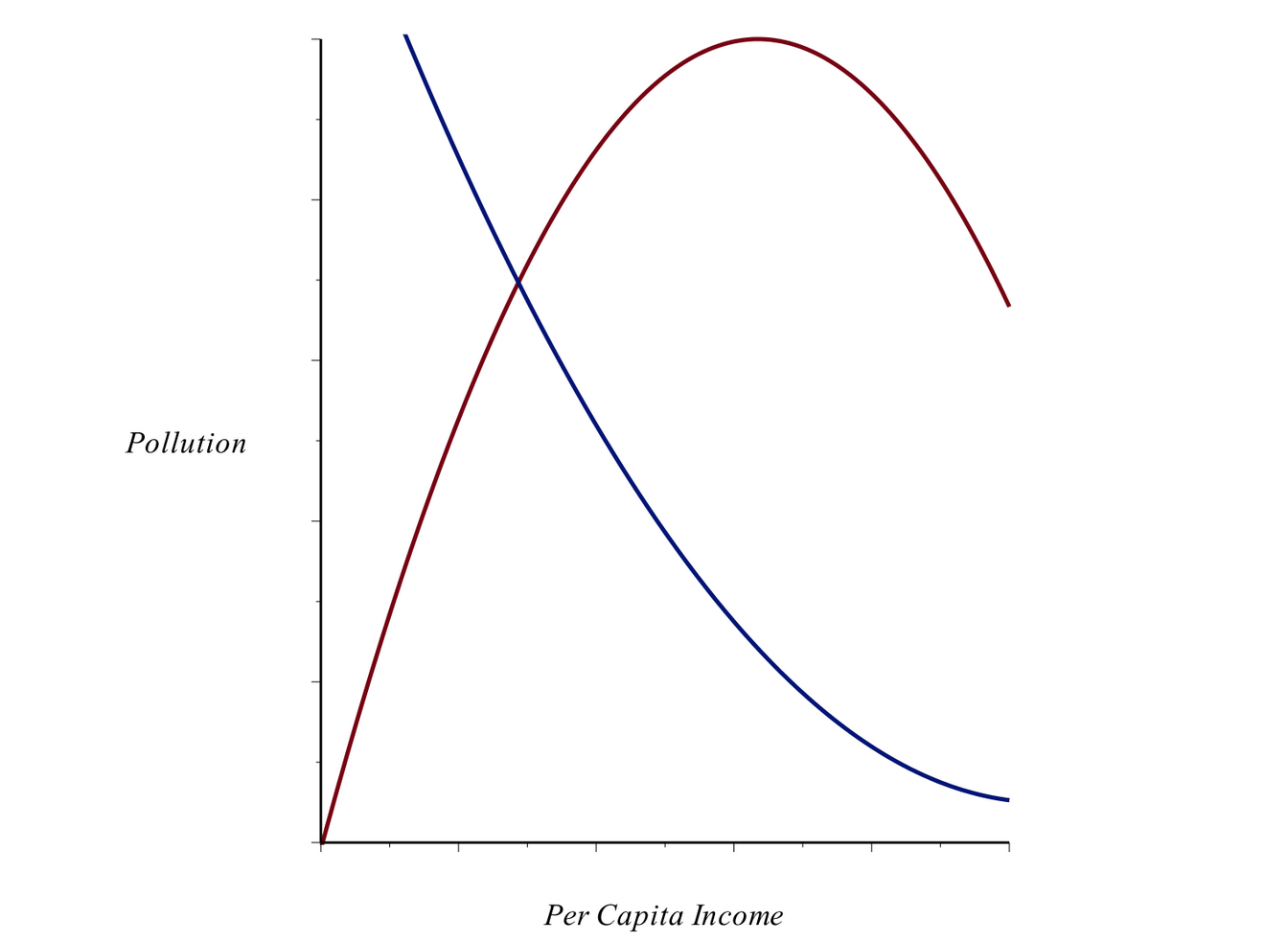
Nevertheless, even if we stipulate that carbon emissions must be reduced, there is an innocuous alternative to government regulatory intrusions and taxes for achieving that end: the enhanced carbon efficiency and technological innovation that economic growth makes possible. One of my favorite bloggers, economist Don Boudreaux, explains the logic of this alternative in this excellent post: “Economic Growth and Pollution Abatement“. He takes a “broad view” of pollution, not simply carbon or other industrial pollutants, because there are many forms of “natural” pollution that inflict greater misery than carbon ever will. With that in mind, Boudreaux appeals to the following relationships between pollution and income (or production):

Pollution Chart

Here is his description of the chart:

“The red curve in the nearby graph is the standard environmental Kuznets curve. This red curve shows the relationship between per-capita income and industrial pollutants. The blue curve shows the relationship between per-capita income and what we might, as a short-hand, call “naturally occurring pollutants” (that is, filth such as bacteria, mud on indoor floors, and rodent and bird droppings from the ceiling of one’s home).“

The red curve implies that a cleaner environment is a “luxury good”. I would also point out that the ascent of the red line at relatively low income levels will be muted by the substitution of cleaner fuels for primitive forms such as dung- and wood-burning, often burned indoors. This is consistent with Boudreaux’s point, though in a way that is not directly addressed by his explanation of the chart:

“… my hypothesis – which I believe is borne out by the historical record – is that people almost immediately start to consume greater cleanliness as they become wealthier.“

The combination of the two lines in the chart shows that economic growth is not unambiguously “bad” for the environment. It has certainly proven to be a good thing in terms of human health and welfare. As a consequence, developing countries should not be so foolish as to sacrifice economic growth for immediate carbon reductions. On the other hand, they may well make “promises” in exchange for massive compensation.

Neither should the world be singularly focused on immediate carbon reductions, because economic growth will be accompanied by improvements in carbon efficiency and the development of technologies far superior to today’s wasteful renewables. The activists attending COP 21 hope to improve the world, but they would saddle humanity with unnecessary burdens. I pity the denizens of countries whose leaders force costly authoritarian energy policies upon them in an effort to set, or comply with, a radical agenda. Oh, wait, that might be us! But I am optimistic that any agreement reached in Paris, if there is any, won’t hold or won’t matter.

Carbon Farce Meets Negative Forcings

22 Saturday Aug 2015

Posted by Nuetzel in Global Warming, Technology

≈ 2 Comments

Tags

Carbon Capture, Carbon Forcing Models, Carbon Nanotubes, Climate Change, crony capitalism, Fossil fuels, Green Cronies, MIT Technology Review, Nanotechnology, Negative Forcing, Peter Yeadon, Shape Shifting, Variable Transparency

NanoMan copy

A new technology is being refined that could reverse years of carbon forcings, given sufficiently wide application, and do so at a profit. That profit should not require the kind of costly subsidies that are now routinely paid to green crony capitalists. Instead, the profit should derive from real market demand for a valuable material. The MIT Technology Review covers the technology under “… How To Suck Carbon From The Air, Make Stuff From It“. It makes possible a form of carbon capture that produces carbon nanotubes, a promising material already in use but having much wider potential. From the second link above:

“Carbon nanotubes are a great example of how useful materials are being developed. This material is said to be one hundred times stronger than steel because of its ‘molecular perfection’ as explained in the paper ‘Year 2050: Cities in the Age of Nanotechnology’ by Peter Yeadon. In addition, because carbon atoms can bond with other matter; such material can be an ‘insulator, semi-conductor or conductor of electricity’”.

Carbon nanotubes have remarkable properties that will revolutionize fabrics and allow buildings to have incredible strength, “transient features” such as variable transparency, and shape shifting. The new technology is said to be more efficient than existing methods of producing carbon nanotubes, and probably much cheaper.

The first link above quotes the developers on the technology’s massive potential for carbon capture:

“They calculate that given an area less than 10 percent of the size of the Sahara Desert, the method could remove enough carbon dioxide to make global atmospheric levels return to preindustrial levels within 10 years, even if we keep emitting the greenhouse gas at a high rate during that period.“

That area is twice the size of California, but a much more modest deployment would certainly reduce the political pressure to decrease carbon emissions. The extent would depend upon the demand for nanotubes, which is expected to grow dramatically in the presence of declining costs. Perhaps we’ll want more carbon emissions if nanotube materials come into widespread use. That would be a welcome development in the developing world, where fossil fuels hold the potential to lift millions out of poverty, as they have for advanced countries in the past. However, such a change would require elites to acknowledge and yield to the supremacy of markets over politics.

A technology capable of such significant carbon capture obviously constitutes a negative carbon “forcer”. Therefore, another implication is that climate models with a heavy emphasis on carbon forcings may be rendered moot. Those models have persistently generated over-predictions of global temperatures, so a deemphasis is already long overdue.

Another hat tip to my buddy John Crawford, who recently has fed me some great information. John should accept my invitation to guest-blog on SCC sometime soon, or start his own blog!

← Older posts
Newer posts →
Follow Sacred Cow Chips on WordPress.com

Recent Posts

  • The Case Against Interest On Reserves
  • Immigration and Merit As Fiscal Propositions
  • Tariff “Dividend” From An Indigent State
  • Almost Looks Like the Fed Has a 3% Inflation Target
  • Government Malpractice Breeds Health Care Havoc

Archives

  • January 2026
  • December 2025
  • November 2025
  • October 2025
  • September 2025
  • August 2025
  • July 2025
  • June 2025
  • May 2025
  • April 2025
  • March 2025
  • February 2025
  • January 2025
  • December 2024
  • November 2024
  • October 2024
  • September 2024
  • August 2024
  • July 2024
  • June 2024
  • May 2024
  • April 2024
  • March 2024
  • February 2024
  • January 2024
  • December 2023
  • November 2023
  • August 2023
  • July 2023
  • June 2023
  • May 2023
  • April 2023
  • March 2023
  • February 2023
  • January 2023
  • December 2022
  • November 2022
  • October 2022
  • September 2022
  • August 2022
  • July 2022
  • June 2022
  • May 2022
  • April 2022
  • March 2022
  • February 2022
  • January 2022
  • December 2021
  • November 2021
  • October 2021
  • September 2021
  • August 2021
  • July 2021
  • June 2021
  • May 2021
  • April 2021
  • March 2021
  • February 2021
  • January 2021
  • December 2020
  • November 2020
  • October 2020
  • September 2020
  • August 2020
  • July 2020
  • June 2020
  • May 2020
  • April 2020
  • March 2020
  • February 2020
  • January 2020
  • December 2019
  • November 2019
  • October 2019
  • September 2019
  • August 2019
  • July 2019
  • June 2019
  • May 2019
  • April 2019
  • March 2019
  • February 2019
  • January 2019
  • December 2018
  • November 2018
  • October 2018
  • September 2018
  • August 2018
  • July 2018
  • June 2018
  • May 2018
  • April 2018
  • March 2018
  • February 2018
  • January 2018
  • December 2017
  • November 2017
  • October 2017
  • September 2017
  • August 2017
  • July 2017
  • June 2017
  • May 2017
  • April 2017
  • March 2017
  • February 2017
  • January 2017
  • December 2016
  • November 2016
  • October 2016
  • September 2016
  • August 2016
  • July 2016
  • June 2016
  • May 2016
  • April 2016
  • March 2016
  • February 2016
  • January 2016
  • December 2015
  • November 2015
  • October 2015
  • September 2015
  • August 2015
  • July 2015
  • June 2015
  • May 2015
  • April 2015
  • March 2015
  • February 2015
  • January 2015
  • December 2014
  • November 2014
  • October 2014
  • September 2014
  • August 2014
  • July 2014
  • June 2014
  • May 2014
  • April 2014
  • March 2014

Blogs I Follow

  • Passive Income Kickstart
  • OnlyFinance.net
  • TLC Cholesterol
  • Nintil
  • kendunning.net
  • DCWhispers.com
  • Hoong-Wai in the UK
  • Marginal REVOLUTION
  • Stlouis
  • Watts Up With That?
  • Aussie Nationalist Blog
  • American Elephants
  • The View from Alexandria
  • The Gymnasium
  • A Force for Good
  • Notes On Liberty
  • troymo
  • SUNDAY BLOG Stephanie Sievers
  • Miss Lou Acquiring Lore
  • Your Well Wisher Program
  • Objectivism In Depth
  • RobotEnomics
  • Orderstatistic
  • Paradigm Library
  • Scattered Showers and Quicksand

Blog at WordPress.com.

Passive Income Kickstart

OnlyFinance.net

TLC Cholesterol

Nintil

To estimate, compare, distinguish, discuss, and trace to its principal sources everything

kendunning.net

The Future is Ours to Create

DCWhispers.com

Hoong-Wai in the UK

A Commonwealth immigrant's perspective on the UK's public arena.

Marginal REVOLUTION

Small Steps Toward A Much Better World

Stlouis

Watts Up With That?

The world's most viewed site on global warming and climate change

Aussie Nationalist Blog

Commentary from a Paleoconservative and Nationalist perspective

American Elephants

Defending Life, Liberty and the Pursuit of Happiness

The View from Alexandria

In advanced civilizations the period loosely called Alexandrian is usually associated with flexible morals, perfunctory religion, populist standards and cosmopolitan tastes, feminism, exotic cults, and the rapid turnover of high and low fads---in short, a falling away (which is all that decadence means) from the strictness of traditional rules, embodied in character and inforced from within. -- Jacques Barzun

The Gymnasium

A place for reason, politics, economics, and faith steeped in the classical liberal tradition

A Force for Good

How economics, morality, and markets combine

Notes On Liberty

Spontaneous thoughts on a humble creed

troymo

SUNDAY BLOG Stephanie Sievers

Escaping the everyday life with photographs from my travels

Miss Lou Acquiring Lore

Gallery of Life...

Your Well Wisher Program

Attempt to solve commonly known problems…

Objectivism In Depth

Exploring Ayn Rand's revolutionary philosophy.

RobotEnomics

(A)n (I)ntelligent Future

Orderstatistic

Economics, chess and anything else on my mind.

Paradigm Library

OODA Looping

Scattered Showers and Quicksand

Musings on science, investing, finance, economics, politics, and probably fly fishing.

  • Subscribe Subscribed
    • Sacred Cow Chips
    • Join 128 other subscribers
    • Already have a WordPress.com account? Log in now.
    • Sacred Cow Chips
    • Subscribe Subscribed
    • Sign up
    • Log in
    • Report this content
    • View site in Reader
    • Manage subscriptions
    • Collapse this bar
 

Loading Comments...