• About

Sacred Cow Chips

Sacred Cow Chips

Tag Archives: Donald Trump

The Dreaded Social Security Salvage Job

24 Friday Mar 2023

Posted by Nuetzel in Privatization, Social Security

≈ Leave a comment

Tags

Angus King, Bernie Sanders, Bill Cassidy, COLAs, Discretionary Spending, Donald Trump, Entitlement State, Federal Asset Sales, FICA Tax, George W. Bush, Insolvency, Internal Rate of Return, Joe Manchin, John Kennedy, Lump-Sum Payouts, Medicare, Mike Pence, Non-Discretionary Spending, OASDI, Opt-Out, Paygo, Payroll Tax, Present Value, Private Accounts, Privatization, Redistribution, Robert Shiller, Seeking Alpha, Social Security, Social Security Trust Fund, Todd Henderson, Universal Basic Income

Government budget negotiations never fail to frustrate anyone of a small-government persuasion. We have a huge, ongoing federal budget deficit. Spending’s gone bat-shit out of control over the past several years and too few in Congress are willing to do anything about it. Democrats would rather see politically-targeted tax increases. While some Republicans advocate spending cuts, the focus is almost entirely on discretionary spending. Meanwhile, the entitlement state is off the table, including Social Security reform.

Fiscal Indiscretion

Sadly, non-discretionary outlays (entitlements) today make a much larger contribution to the deficit than discretionary spending. That includes the programs like Social Security (SS) and Medicare, in which spending levels are programmatic and not subject to annual appropriations by Congress. When these programs were instituted there were a large number of workers relative to retirees, so tax contributions exceeded benefit levels for many decades. The revenue excesses were placed into “trust funds” and invested in Treasury debt. In other words, surpluses under non-discretionary SS and Medicare programs were used to finance discretionary spending!

The aging of Baby Boomers ultimately led to a reversal in the condition of the trust funds. Fewer workers relative to retirees meant that annual payroll tax collections were not adequate to cover annual benefits, and that meant drawing down the trust funds. Current projections by the system trustees call for the SS Trust Fund to be exhausted by 2035. Once that occurs, benefits will automatically be reduced by roughly 20% unless Congress acts to shore up the system before then.

A Few Proposals

I’ve written about the need for SS reform on several occasions (though the first article at that link is not germane here). It seems imperative for Congress and the President to address these shortfalls. By all appearances, however, many Republicans have put the issue aside. For his part, Joe Biden has apparently accepted the prospect of an automatic reduction in benefits in 2035, or at least he’s willing to kick that can down the road. He has, however, endorsed taxes on high earners to fund Medicare. Senator John Kennedy (R-LA) suggests raising the retirement age, or at least raise the minimum age at which one may claim benefits (now 62). Senators Bill Cassidy (R-La.) and Angus King (I-Maine) were working on a compromise that would create an investment fund to fortify the system, but the specifics are unclear, as well as how much that would accomplish.

Meanwhile, Senator Bernie Sanders (S-VT) proposes to expand SS benefits by $2,400 a year and add funding by extending payroll taxes to earners above the current limit of $160,000. Senator Joe Manchin (D-WV) has endorsed the latter as a “quick fix”.

There is also at least one proposal in Congress to end the practice of taxing a portion of SS benefits as income. I have trouble believing it will gain wide support, despite the clear double-taxation involved.

Then there are always discussions of reducing benefits at higher income levels or even means-testing benefits. In fact, it would be interesting to know what proportion of current benefits actually function as social insurance, as opposed to a universal entitlement. The answer, at least, could serve as a baseline for more fundamental reforms, including changes in the structure of payroll taxes, voluntary lump-sum payouts, and private accounts.

More Radical Views

There are a few prominent voices who claim that SS is sustainable in its current form, but perhaps with a few “no big deal” tax increases. Oh, that’s only about a $1 trillion “deal”, at least for both Medicare and SS. More offensive still are the scare tactics used by opponents of SS reform any time the subject comes up. I’m not aware of any serious reform proposal made over the past two decades that would have affected the benefits of anyone over the age of 55, and certainly no one then-eligible for benefits. Yet that charge is always made: they want to cut your SS benefits! The Democrats made that claim against George W. Bush, torpedoing what might have been a great accomplishment for all. And now, apparently Donald Trump is willing to use such accusations to damage any rival who has ever mentioned reform, including Mike Pence. Will you please cut the crap?

The System

The thing to remember about SS is that it is currently structured as a pay-as-you-go (PAYGO) system, despite the fact that benefits are defined like many creaky private pensions of old. SS benefits in each period are paid out of current “contributions” (i.e., FICO payroll taxes) plus redemptions of government bonds held in the Trust Fund. Contributions today are not “invested” anywhere because they are not enough to pay for current benefits under PAYGO.

The Trust Fund was accumulated during the years when favorable demographics led to greater FICO contributions than benefit payouts. The excess revenue was “invested” in Treasury bonds, which meant it was used to fund deficits in the general budget. It’s been about 15 years since the Trust Fund entered a “draw-down” status, and again, it will be exhausted by 2035.

SSA Says It’s a Good Deal

A participant’s expected “rate of return” on lifetime payroll tax payments depends on several things: lifetime earnings, age at which benefits are first claimed, life expectancy at that time, marital status, relative earning levels within two-earner couples, and the “full retirement age” for the individual’s birth year. Payroll tax payments, by the way, include the employer’s share because that is one of the terms of a hire. A high rate of return is not the same as a high level of benefits, however. In fact, relative to career income, SS has a great deal of progressivity in terms of rates of return, but not much in terms of benefit levels.

The Social Security Administration (SSA) has calculated illustrative real internal rates of return (IRR) for many categories of earners given certain assumptions. (An IRR is a discount rate that equalizes the present value (PV) of a stream of payments and the PV of a stream of payoffs.) The SSA’s most recent update of this exercise was in April 2022. The report references Old Age, Survivors, and Disability Insurance (OASDI), but the focus is exclusively on seniors.

Three basic scenarios were considered: 1) current law, as scheduled, despite its unsustainability; 2) a payroll tax increase from 12.4% (not including the Medicare tax) to 15.96% starting in 2035, when the Trust Fund is exhausted; and 3) a reduction in benefits of 22% starting in 2035.

The authors of the report conclude that “… the real value of OASDI benefits is extraordinarily high.” This theme has been echoed by several other writers, such as here and here. This conclusion is based on a comparison to returns earned by investments that SSA judges to have comparably low risk.

I note here that I’ve made assertions in the past about relative SS returns based on nominal benefits, rather than inflation-adjusted values. Those comparisons to private returns might have seemed drastic because they were expressed in terms of hypothetical future nominal values at the point of retirement. The gaps are not as large in real terms or if we consider SS returns broadly to include those accruing to low career earners. Medium and high earners tend to earn lower hypothetical returns from SS.

A Mixed Bag

SSA’s calculated IRRs are highest for one-earner couples followed by two-earner couples. Single males do relatively poorly due to their higher mortality rates. Low earners do very well relative to higher earners. Earlier birth years are associated with higher IRRs, but these are not as impressive for cohorts who have not yet claimed benefits. The ranges of birth years provided in the report make this a little imprecise, but I’ll focus on those born in 1955 and later.

Of course the returns are highest under the current law hypothetical than for the scenarios involving a benefit reduction or a payroll tax hike. The current law IRRs can be viewed as baselines for other calculations, but otherwise they are irrelevant. The system is technically insolvent and the scheduled benefits under current law can’t be maintained beyond 2034 without steps to generate more revenue or cut benefits. Those steps will reduce IRRs earned by hypothetical SS “assets” whether they take the form of higher payroll taxes, lower benefits, a greater full retirement age, or other measures.

The tax hike doesn’t have much impact on the IRRs of near-term retirees. It falls instead on younger cohorts with some years of employment (and payroll tax payments) remaining. The effect of a cut in benefits is spread more evenly across age cohorts and the reductions in IRRs is somewhat larger.

With higher payroll taxes after 2034, the average IRRs for birth years of 1955+ range from about 0.5% up to about 6.25%. The returns for single females and two-earner couples are roughly similar and fall between those for single males on the low end and one-earner couples on the high end. In all cases, low earners have much higher IRRs than others.

The reduction in benefits produces returns for the 1955+ age cohorts averaging small, negative values for high-earning single men up to 5.5% to 6% for low-earning, one-earner couples.

But On the Whole…

The IRR values reported by SSA are quite variable across cohorts. Individuals or couples with low earnings can usually expect to “earn” real IRRs on their contributions of better than 3% (and above 5% in a few cases). Medium earners can expect real returns from 1% to 3% (and in some cases above 4%). Many of the returns are quite good for a safe “asset”, but not for high earners.

Again, SSA states that these are real returns, though they provide no detail on the ways in which they adjust the components used in their IRR formula to arrive at real returns. Granting the benefit of the doubt, we saw persistently negative real returns on a range of safe assets in the not-very-distant past, so the IRRs are respectable by comparison.

Qualifications

There are many assumptions in the SSA’s analysis that might be construed as drastic simplifications, such as no divorce and remarriage, uniform career duration, and no relationship between earnings and mortality. But it’s easy to be picky. Many of the assumptions discernible from the report seem to be reasonable simplifications in what could otherwise be an unruly analysis. Nonetheless, there are a few assumptions that I believe bias the IRRs upward (and perhaps a few in the other direction).

In fact, SSA is remarkably non-transparent in their explanation of the details. Repeated checking of SSA’s document for clear answers is mostly futile. Be that as it may, I’m forced to give SSA the benefit of the doubt in several respects. One is the reinvestment of cumulative remaining contributions at the IRR throughout the earning career and retirement. A detailed formula with all components and time subscripts would have been nice.

… And Major Doubts

As to my misgivings, first, the IRRs reported by SSA are based on earners who all reach the age of 65. However, roughly 14% – 15% of individuals who live to be of working age die before they reach the age of 65. Most of those deaths occur in the latter part of that range, after many years of contributions and hypothetical compounding. That means the dollar impact of contributions forfeited at death before age 65 is probably larger than the unweighted share of individuals. These individuals pay-in but receive no retirement benefit in SSA’s IRR framework, although some receive disability benefits for a period of time prior to death. It wouldn’t bother my conscience to knock off at least a tenth of the quoted returns for this consideration alone.

A second major concern surrounds the method of calculating benefits and discounted benefits. SSA assumes that benefits continue for the expected life of the claimant as of age 65. If life expectancy is 19 years at age 65, then “expected” benefits are a flat stream of benefit payments for 19 years. Discounting each payment back to age 65 at the IRR yields one side of the present value equality. This constant cash flow (CCF) treatment is likely to overstate the present value of benefits. Instead of CCFs, each payment should be weighted by the probability that the claimant will be alive to receive it with a limit at some advanced age like 100. CCF overcounts present values up to the expected life, but it undercounts present values beyond the expected life because the assumed CCF benefits then are zero!! Weighting benefit payments by the probability of survival to each age produces continuing additions to the PV, but increasing mortality and decaying discount factors become quite substantial beyond expected life, leading to relatively minor additions to PV over that range. The upshot is that the CCFs employed by SSA overstate PVs by front-loading all benefits earlier in retirement. For a given PV of contributions, an overstated PV of benefits requires a higher (and overstated) IRR to restore the PV equality, and this might be a substantial source of upward bias in SSA’s calculations.

Third, when comparing an SS “asset” to private returns, a big difference is that private balances remaining at death become assets of the earner’s estate. Meanwhile, a single beneficiary forfeits their SS benefits at death (except for a small death benefit), while a surviving spouse having lower benefits receives ongoing payments of the decedent’s benefits for life. This consideration, however, in and of itself, means that private plans have a substantial advantage: the “expected” residual at death can be “optimized” at zero or some higher balance, depending on the strength of the earner’s bequest motive.

Finally, in a footnote, the SSA report notes that their treatment of income taxes on Social Security benefits for claimants with higher incomes might bias some of the IRRs upward. That seems quite likely.

It would be difficult to recast SSA’s report based on adjustments for all of these qualifications. However, it’s likely that the IRRs in the SSA report are sharply overstated. That means many more beneficiaries with medium and higher earnings records would have returns in the 0% to 2% range, with more IRRs in the negative range for singles. Low earners, however, might still get returns in a range of 3% to 5%.

The SSA analysis attempts to demonstrate some limits to the risks faced by participants, given the scenarios involving a payroll tax increase or a benefits reduction in 2035. Nevertheless, there are additional political risks to the returns of certain classes of current and future retirees. For example, payroll taxes could be made much more progressive, benefits could be made subject to means testing, or indexing of benefits could be reduced. In fact, there are additional demographic risks that might confront retirees several decades ahead. Continued declines in fertility could further undermine the system’s solvency, requiring more drastic steps to shore up the system. As a hypothetical asset, by no means is SS “risk-free”.

Better Returns

Now let’s consider returns earned by private assets, which represent investments in productive capital. For stocks, these include the sum of all dividends and capital gains (growth in value). For compounding purposes, we assume that all returns are reinvested until retirement. Remember that private returns are much less variable over spans of decades than over durations of a few years. Over the course of 40 year spans (SSA’s career assumption), private returns have been fairly stable historically, and have been high enough to cushion investors from setbacks. Here is Seeking Alpha on annualized returns on the basket of stocks in the S&P 500:

“… the return on the S&P 500 since the beginning of valuation in 1928, is 10.22%, whereas the inflation-adjusted return on the market since that time is 7.01%…”

That real return would generate benefits far in excess of SS for most participants, but it’s not an adequate historical perspective on market performance. A more complete picture of real returns on the S&P, though one that is still potentially flawed, emerges from this calculator, which relies on data from Robert Shiller. The returns extend back to 1871, but the index as we know it today has existed only since 1957. The earlier returns tend to be lower, so these values may be biased:

Real stock market returns over rolling 40-year time spans varied considerably over this longer period. Still, those kind of stock returns would be superior to the IRRs in the SSA report going forward in all but a few cases (and then only for low and very low earners).

Most workers facing a choice between investing at these rates for 40 years, with market risk, and accepting standard SS benefits, uncertain as they are, couldn’t be blamed for choosing stocks. In fact, if we think of contributions to either type of plan as compounding to a hypothetical sum at retirement, the stock investments would produce a “pot of gold” several times greater in magnitude than SS.

However, we still don’t have a fair comparison because workers choosing a stock plan would essentially engage in a kind of dollar-cost averaging over 40 years, meaning that investments would be made in relatively small amounts over time, rather than investing a lump-sum at the beginning. This helps to smooth returns because purchases are made throughout the range of market prices over time, but it also means that returns tend to be lower than the 40-year rolling returns shown above. That’s because the average contribution is invested for only half the time.

To be very conservative, if we assume that real stock returns average between 5% and 6% annually, $1 invested every year would grow to between $131 – $155 after 40 years in constant dollars. At returns of 1% to 2% from SS, which I believe are typical of the IRRs for many medium earners, the cumulative “pot” would grow to $49 – $60. Assuming that the tax treatment of the stock plan was the same as contributions and benefits under SS, the stock plan almost triples your money.

Dealing With the Transition

Privatization covers a range of possible alternatives, all of which would require federal borrowing to pay transition costs. Unfortunately, the Achilles heel in all this is that now is a bad time to propose more federal borrowing, even if it has clear long-term benefits to future retirees.

Todd Henderson in the Wall Street Journal suggests a seeding of capital provided by government at birth along with an insurance program to smooth returns. Another idea is to offer an inducement to delay retirement claims by allowing at least a portion of future benefits to be taken as a lump sum. If retirees can privately invest at a more advantageous return, they might be willing to accept a substantial discount on the actuarial value of their benefits.

In fact, there is evidence that a majority of participants seem to prefer distributions of lump sums because they don’t value their future benefits at anything like that suggested by the SSA analysis. In fact, many participants would defer retirement by 1 – 2 years given a lump sum payment. Discounts and/or delayed claims would reduce the ultimate funding shortfall, but it would require substantial federal borrowing up front.

Additional federal borrowing would also be required under a private option for investing one’s own contributions for future dispersal. The impact of this change on the system’s long-term imbalances would depend on the share of earners willing to opt-out of the traditional SS program in whole or in part. More opt-outs would mean a smaller long-term obligations for the traditional system, but it would be hampered by a costly transition over a number of years. Starting from today’s PAYGO system, someone still has to pay the benefits of current retirees. This would almost certainly mean federal borrowing. Spreading the transition over a lengthy period of time would reduce the impact on credit markets, but the borrowing would still be substantial.

For example, perhaps earners under 35 years of age could begin opting out of a portion or all of the traditional program at their discretion, investing contributions for their own future use. Thus, only a small portion of contributions would be diverted in the beginning, and amounts diverted would contribute to the nation’s available pool of saving, helping to keep borrowing costs in check. By the time these younger earners reach retirement age, nearly all of today’s retirees will have passed on. Ultimately, the average retiree will benefit from higher returns than under the traditional program, but since they won’t be (fully) paying the benefits of current or near-term retirees, the public must come to grips with the bad promises of the past and fund those obligations in some other way: reduced benefits, taxes, or borrowing.

Another objection to privatization is financial risk, particularly for lower-income beneficiaries. Limiting opt-outs to younger earners with adequate time for growth would mitigate this risk, along with a reversion to the traditional program after age 45, for example. Some have proposed limiting opt-outs to higher earners. Bear in mind, however, that the financial risk of private accounts should be weighed against the political and demographic risk already inherent in the existing system.

One more possibility for bridging the transition to private, individually-controlled accounts is to sell federal assets. I have discussed this before in the context of funding a universal basic income (which I oppose). The proceeds of such sales could be used to pay the benefits of current and near-term retirees so as to allow the opt-out for younger workers. Or it could be used to pay off federal debt accumulated in the process. The asset sales would have to proceed at a careful and deliberate pace, perhaps stretching over several decades, but those sales could include everything from the huge number of unoccupied federal buildings to vast tracts of public lands in the west, student loans, oil and gas reserves, and airports and infrastructure such as interstate highways and bridges. Of course, these assets would be more productive in private hands anyway.

The Likely Outcome

Will any such privatization plan ever see the light of day? Probably not, and it’s hard to guess when anything will be done in Washington to address the insolvency we already face. Instead, we’ll see some combination of higher payroll taxes, higher payroll taxes on high earners through graduated payroll tax rates or by lifting the earnings cap, reduced benefits on further retirees, limits on COLAs to low career earners, and means-tested benefits. Some have mentioned funding Social Security shortfalls with income taxes. All of these proposals, with the exception of automatic benefit cuts in 2035, would require acts of Congress.


Tariffs, Content Quotas, and What Passes for Patriotism

10 Friday Mar 2023

Posted by Nuetzel in Free Trade, Protectionism

≈ Leave a comment

Tags

budget deficits, Buy American, CCP, CHIPS Act, Comparative advantage, Consumer Sovereignty, Content Restrictions, Critical Supply Chains, Domestic Content, Donald Trump, Dumping, Export Markets, Federal Procurement, Foreign Trade, Free trade, George Will, Import Waivers, Joe Biden, Made-In-America Laws, Mercantilism, National Security, Nationalism, Patriotism, Price Competition, Price Preference, Protectionism, Tariffs, Trade Retaliation, Universal Baseline Tariffs, Uyghur Muslims

If there’s one simple lesson in economics that’s hard to get across it’s the destructive nature of protectionism. The economics aren’t hard to explain, but for many, the lessons of protectionist failure just don’t want to sink in. Putting aside matters of national security, the harms of protectionism to the domestic economy are greater than any gains that might inure to protected firms and workers. Shielding home industries and workers from foreign competition is generally not smart nor an act of patriotism, but that sentiment seems fairly common nonetheless.

The Pathology of Protectionism

Jingoistic slogans like “Buy American” are a pitch for voluntary loyalty to American brands. I’m all for voluntary action. Still, that propaganda relies on shaming those who find certain foreign products to have superior attributes or to be more economical. This feeds a psychology of economic insularity and encourages those who favors trade barriers, which is one of the earliest species of failed central planning.

The cognitive resistance to a liberal trade regime might have to do with the concentrated benefits of protectionist measures relative to the more diffuse (but high) costs it imposes on society. Some of the costs of protectionism manifest only with time, which makes the connection to policy less obvious to observers. Or again, obstructing trade and taxing “others” in the hope of helping ourselves may simply inflame nationalist passions.

Both Democrats and Republicans rally around policy measures that tilt the playing field in favor of domestic producers, often severely. And again, this near unanimity exists despite innumerable bouts with the laws of economics. I mean, how many times do you have to be beaten over the head to realize that this is a mistake? Unfortunately, politicians just don’t live in the long-term, they leap to defend powerful interests, and they seldom pay the long-term consequences of their mistakes.

Joe Biden’s “Buy American”

The Biden Administration has pushed a “Made In America” agenda since the President took office, It’s partly a sop to unions for their election support. Much of it had to do with tightening waivers granted under made-in-America laws (dating back to 1933) governing foreign content in goods procured by the federal government. The most recent change by Biden is an increase in the requirement for domestic content to 60% immediately and gradually to 75% from there. Also, “price preferences” will be granted to domestic producers of goods to strengthen supply chains identified as “critical”, including active pharmaceutical ingredients, certain minerals including rare earths and carbon fibers, semiconductors and their advanced packaging, and large capacity batteries such as those used in EVs.

There’s a strong case to be made for developing domestic supplies of certain goods based on national security considerations. That can play a legitimate role where defense goods or even some kinds of civilian infrastructure are involved, but Biden’s order applies much more broadly, including protections for industries that are already heavily subsidized by taxpayers. For example, the CHIPS Act of 2022 included $76 billion of subsidies and tax credits to the semiconductor industry.

George Will describes the cost of protectionism and Biden’s “Buy American”:

“‘Buy American,’ like protectionism generally, can protect some blue-collar jobs — but at a steep price: A Peterson Institute for International Economics study concludes that it costs taxpayers $250,000 annually for each job saved in a protected industry. And lots of white-collar jobs are created for lawyers seeking waivers from the rules. And for accountants tabulating U.S. content in this and that, when, say, an auto component might cross international borders (U.S., Canadian, Mexican) five times before it is ready for installation in a vehicle.”

Biden’s new rules will increase the cost of federal procurement. They will squeeze out contracts with foreign suppliers whose wares are sometimes the most price-competitive or best-suited to a project. This is not a prescription for spending restraint, and it comes at a time when the federal budget is under severe strain. Here’s George Will again:

“This will mean more borrowing, not fewer projects. Federal spending is not constrained by a mere shortage of revenue. So, Biden was promising to increase the deficit. And this policy, which elicited red-and-blue bonhomie in the State of the Union audience, also will give other nations an excuse to retaliate (often doing what they want to do anyway) by penalizing U.S. exporters of manufactured goods. ….. Washington lobbyists for both will prosper.”

Domestic manufacturers who find their contracting status “protected” from foreign competition will face less incentive to perform efficiently. They can relax, rather than improve or even maintain productivity levels, and they’ll feel less pressure to price competitively. Those domestic firms providing goods designated by the government as “critical” will be advantaged by the “price preferences” granted in the rules, leading to a less competitive landscape and higher prices. Thus, Biden’s “Buy American” order is likely to mean higher prices and more federal spending. This is destructive and counter to our national interests.

Donald Trump’s Tariffs

In a recent set of proposals trialed for his presidential election campaign, Donald Trump called for “Universal Baseline Tariffs” on imported goods. In a testament to how far Trump has stumbled down the path of economic ignorance, his campaign mentions “patriotic protectionism” and “mercantilism for the 21st century”. Good God! Trump might be worse than Biden!

This isn’t just about China, though there are some specific sanctions against China in the proposal. After all, these new tariffs would be “universal”. Nevertheless, the Trump campaign took great pains to cloak the tariffs in anti-China rhetoric. Now, I’m very unfavorably disposed to the CCP and to businesses who serve or rely on China and (by implication) the CCP. Certainly, in the case of China, national security may dictate the imposition of certain forms of protectionism, slippery slope though it might be. Nevertheless, that is not what universal tariffs are about.

One destructive consequence of imposing tariffs or import quotas is that foreign governments are usually quick to retaliate with tariffs and quotas of their own. Thus, export markets are shut off to American producers in an escalating trade conflict. That creates serious recession risks or might reinforce other recessionary forces. Lost production for foreign markets and job losses in the affected export industries are the most obvious examples of protectionist harm.

Then consider what happens in protected industries in the U.S. and the negative repercussions in other sectors. The prices charged for protected goods by domestic producers rise for two reasons: more output is demanded of them, and protected firms have less incentive to restrain pricing. Just what the protectionists wanted! In turn, with their new-found, government-granted market power, protected firms will compete more aggressively for workers and other inputs. That puts non-protected firms in a bind, as they’ll be forced to pay higher wages to compete with protected firms for labor. Other inputs may be more costly as well, particularly if they are imported. These distortions lead to reduced output and jobs in non-protected industries. It also means American consumers pay higher prices for both protected and unprotected goods.

Consumers not only lose on price. They also suffer a loss of consumer sovereignty to a government wishing to manipulate their choices. When choices are curtailed, consumers typically lose on other product attributes they value. It also curtails capital inflows to the U.S. from abroad, which can have further negative repercussions for U.S. productivity growth.

When imports constitute a large share of a particular market, it implies that foreign nations have a comparative advantage in producing the good in question. In other words, they sacrifice less to produce the good than we would sacrifice to produce it in the U.S. But if country X has a comparative advantage in producing good X, it means it must have a comparative disadvantage in producing certain other goods, let’s say good Y. (That is, positive tradeoffs in one direction necessarily imply negative tradeoffs in the other.) It makes more economic sense for other countries (country Y, or perhaps the U.S.) to produce good Y, rather than country X, since country Y sacrifices less to do so. And that is why countries engage in trade with each other, or allow their free citizens to do so. It is mutually beneficial. It makes economic sense!

To outlaw or penalize opportunities for mutually beneficial trade will only bring harm to both erstwhile trading partners, though it might well benefit specific interests, including some third parties. Those third parties include opportunistic politicians wishing to leverage nationalist sentiments, their cronies in protected industries, and the bureaucrats, attorneys, and bean counters who manage compliance.

When Is Trade Problematic?

Protectionists often accuse other nations of subsidizing their export industries, giving them unfair advantages or dumping their exports below cost on the U.S. market. There are cases in which this happens, but all such self-interested claims should be approached with a degree of skepticism. There are established channels for filing complaints (and see here) with government agencies and trade organizations, and specific instances often prompt penalties or formal retaliatory actions.

There are frequently claims that foreign producers and even prominent American businesses are beneficiaries of foreign slave labor. A prominent example is the enslavement of Uyghur Muslims in China, who reportedly have been used in the manufacture of goods sold by a number of big-name American companies. This should not be tolerated by these American firms, their customers, or by the U.S. government. Unfortunately, there is a notable lack of responsiveness among many of these parties.

Much less compelling are assertions of slave labor based on low foreign wage rates without actual evidence of compulsion. This is a case of severely misplaced righteousness. Foreign wage rates may be very low by American standards, but they typically provide for a standard of living in the workers’ home country that is better than average. There is no sin in providing jobs to foreign workers at a local wage premium or even a discount, depending on the job. In fact, a foreign wage that is low relative to American wages is often the basis for their comparative advantage in producing certain goods. Under these innocent circumstances, there is no rational argument for producing those goods at much higher cost in the U.S.

Very troublesome are the national security risks that are sometimes attendant to foreign trade. When dealing with a clear adversary nation, there is no easy “free trade” answer. It is not always clear or agreed, however, when international relations have become truly adversarial, and whether trade can be usefully leveraged in diplomacy.

Conclusion

As I noted earlier, protectionism has appeal from a nationalist perspective, but it is seldom a legitimate form of patriotism. It’s not patriotic to limit the choices and sovereignty of the individual, nor to favor certain firms or workers by shielding them from competition while penalizing firms requiring inputs from abroad. We want our domestic industries to be healthy and competitive. Shielding them from competition is the wrong approach.

So much of the “problem” we have with trade is the infatuation with goals tied to jobs and production. Those things are good, but protectionists focus primarily on first-order effects without considering the damaging second-order consequences. And of course, jobs and production are not the ultimate goals of economic activity. In the end, we engage in economic activity in order to consume. We are a rich nation, and we can afford to consume what we like from abroad. It satisfies wants, it brings market discipline, and it leads to foreign investment in the American economy.

Biden and Trump share the misplaced objectives of mercantilism. They are both salesmen in the end, though with strikingly different personas. Salesmen want to sell, and I’m almost tempted to say that their compulsion causes them see trade as a one-way street. Biden is selling his newest “Buy American” rules not only as patriotic, but as a national security imperative. The former is false and the latter is largely false. In fact, obstructions to trade make us weaker. They will also contribute to our fiscal imbalances, and that contributes to monetary and price instability.

Like “Buy American”, Trump’s tariffs are misguided. Apparently, Trump and other protectionists wish to tax the purchases of foreign goods by American consumers and businesses. In fact, they fail to recognize tariffs as the taxes on Americans that they are! And tariffs represent a pointed invitation to foreign trading partners to impose tariffs of their own on American goods. You really can’t maximize anything by foreclosing opportunities for gain, but that’s what protectionism does. It’s astonishing that such a distorted perspective sells so well.

Government Action and the “Your Worst Enemy” Test

03 Saturday Dec 2022

Posted by Nuetzel in Big Government, Censorship

≈ 3 Comments

Tags

Big government, Censorship, Donald Trump, Elon Musk, Michael Munger, Munger Test, Nancy Pelosi, regulation, Social Media, Twitter, Unicorn Governance, Your Worst Enemy Test

A couple of weeks back I posted an admittedly partial list of the disadvantages, dysfunctions, and dangers of the Big Government Mess seemingly wished upon us by so many otherwise reasonable people. A wise addition to that line of thinking is the so-called Munger Test articulated by Michael Munger of Duke University. Here, he applies the test to government involvement in social media content regulation:

“If someone says “The STATE should do X” (in this case, decide what is true and what can be published in a privately-owned space), they need to make a substitution.

Instead of “The STATE” substitute “Donald Trump,” and see if you still belief it. (Or “Nancy Pelosi”, if you want).”

If approached honestly, Munger’s test is sure to make a partisan think twice about having government “do something”, or do anything! In a another tweet, Munger elaborates on the case of Twitter, which is highly topical at the moment:

“In fact, the reporters and media moguls who are calling for the state to hammer Twitter, and censor all those other ‘liars’, naively believe that they have a 1000 Year Reich.

You don’t. 𝙔𝙤𝙪 𝙘𝙖𝙣 𝙤𝙣𝙡𝙮 𝙜𝙞𝙫𝙚 𝙩𝙝𝙚 𝙎𝙩𝙖𝙩𝙚 𝙥𝙤𝙬𝙚𝙧𝙨 𝙩𝙝𝙖𝙩 𝙮𝙤𝙪 𝙛𝙖𝙫𝙤𝙧 𝙜𝙞𝙫𝙞𝙣𝙜 𝙩𝙤 𝙮𝙤𝙪𝙧 𝙬𝙤𝙧𝙨𝙩 𝙚𝙣𝙚𝙢𝙮. Deal with it.”

The second sentence in that last paragraph is an even more concise statement of the general principle behind the Munger Test, which we might dub the “Worst Enemy Test” with no disrespect to Munger. He proposed the test (immodestly named, he admits) in his 2014 article, “Unicorn Governance”, in which he offered a few other examples of its application. The article is subtitled:

“Ever argued public policy with people whose State is in fantasyland?”

The answer for me is yes, almost every time I talk to anyone about public policy! And as Munger says, that’s because:

“Everybody imagines that ‘The STATE’ is smart people who agree with them. Once MY team controls the state, order will be restored to the Force.”

So go ahead! Munger-test all your friends’ favorite policy positions the next time you talk!

But what about the case of “regulating” Twitter or somehow interfering with its approach to content moderation? More on that in my next post.

Let’s Suppress Fraudulent Votes

11 Thursday Aug 2022

Posted by Nuetzel in Corruption, Election Fraud

≈ 1 Comment

Tags

000 Mules, 2, 2020 Census Miscount, 2020 Election, Census Bureau, Center for Tech and Civic Life, Christopher Steele, Department of Justice, Donald Trump, Drop Boxes, Election Fraud, Election Supervisors, FBI, FISA Court, Fulton County Georgia, George Soros, Gretchen Windmere, Hillary Clinton, Mar-a-Lago, Maricopa County Arizona, Mark Zuckerberg, Matt Margolis, Priscilla Chan, Robert Mueller, Robert Zimmerman, Russia Hoax, Sandy Berger, Zuck Bucks, Zuckerbucks

No matter how you feel about the 2020 presidential election, whether you think it was conducted fairly or that it was “stolen” from Donald Trump, you should at least come to grips with the reality that our electoral process is quite vulnerable to manipulation. Most voters agree that election fraud is a problem. A recent poll found that 56% of likely voters agree that “every state should require that ballots be available immediately after elections for bipartisan voter reviews to enhance election confidence and transparency. Only 23% are against ballot reviews…”. So these respondents also agree that compromises to the integrity of elections should be addressed.

Local Fraud, National Scope

There is plenty of evidence that the 2020 election was manipulated by agents both inside and outside the government, if only the mainstream press could be bothered to look at it. Nuts and bolts election fraud is largely a local phenomenon, though there is likely some coordination at higher levels. Robert Zimmerman provides this summary of the election fraud in the 2020 election in Fulton County (Atlanta), Georgia:

Fulton County and its elections are controlled by democrats, much as in other large cities. Localized fraud in deep blue urban centers doesn’t have much if any effect on local races, but it throws statewide and national races into doubt. Of these deep blue enclaves, Zimmerman says:

“… the government is essentially a one-party Democrat operation. Many election districts in these cities have no Republican election judges at all. If the Democrats wish to commit election fraud, there is no one looking over their shoulder to question them, with some districts actually taking aggressive action in 2020 to illegally keep Republican poll watchers out. … Thus we saw strong evidence in all of these cities of pro-Democrat ballot-stuffing, of all types, from fake ballots to ballots counted multiple times to evidence the votes on the ballots themselves were changed by computer.”

In Wisconsin, the State Supreme Court finally ruled last month that the placement of hundreds of drop boxes in its largest cities was illegal. Those unsupervised drop boxes made it a simple matter for hundreds of “mules” to deposit stacks of fraudulent ballots, not to mention enabling other kinds of ballot harvesting on a massive scale. This was not limited to Wisconsin. Zimmerman also discusses Arizona’s Maricopa County (Phoenix), where there were a host of different issues casting doubt on the legitimacy of the 2020 election results. The race in Arizona was very close, and this kind of vote tampering likely threw the state into Biden’s column:

If you doubt the ease with which “mishaps” occur when ballots are counted, take a look at the following tweet from three weeks ago:

The point is that it’s amazingly easy for fraud to occur given the lax standards of accountability often seen in elections, particularly in one-party jurisdictions.

The New Front

Will the Left seize control of elections or leverage that control more aggressively, particularly in deep blue areas? With that control, they can reinforce their ability to swing elections for statewide offices and electoral votes, and they are certainly trying. The link just above describes some well-funded organizations channeling funds to support progressive candidates running for down-ballot positions with supervisory authority over local elections and their procedures. Charities founded by billionaire George Soros, Hilary Clinton, and Mark Zuckerberg are just some of the players involved. This activity has its parallel in Soros’ successful efforts to fund the campaigns of radical leftists for prosecutor jobs in many cities.

There is also the matter of private grants to local election offices, ostensibly to support the “health” of voters and election workers, but mostly used to “get out the vote”. This was the approach used by the activist group funded by Zuckerberg and his wife, Priscilla Chan:

“In 2020, the Chan Zuckerberg Initiative gave $350 million to the Center for Tech and Civic Life, a left-leaning group that distributed grants to mostly Democrat-dominated precincts, driving up the vote. The Zuckerbergs’ grants, dubbed Zuckerbucks, helped finance drop boxes and expanded mail-in balloting, among other activities.”

Pennsylvania recently prohibited private election grants in order to reduce outside influence on elections, a wise response to the violations of state law that occurred in the 2020 election. The ban covers nonprofits like the Center for Tech and Civic Life. Zuckerberg asserts that the organization distributed more grants to Republican jurisdictions (anywhere Trump won in 2020) than elsewhere, but that claim is dubious based on the amounts of those donations:

“… Republican jurisdictions were far more likely to receive grants of less than $50,000, which would likely not be enough to materially change election practices in the recipient jurisdiction.”

Pennsylvania is not alone in its bid to restore integrity by banning these grants. At least 20 states have passed similar laws since the 2020 election, with varying degrees of stringency. That’s good news, but it won’t stop tampering by officials elected with the aid of organizations intent on controlling election procedures.

Corrupting Federal Institutions

There have been, and still are, machinations at levels much higher than local election authorities. The FBI engaged in election sabotage in 2020 to destroy Donald Trump, a sitting U.S. President. This occurred on at least two fronts. There was the staged plot to kidnap Michigan Governor Gretchen Windmere in October 2020, with all hands attempting to implicate Trump and his supporters. Trump’s prospects fell in Michigan after the announcement of this foiled “kidnapping”, which was subsequently discovered to be a plot by the FBI to entrap a few rubes. Equally disturbing was the flagrant attempt by the Justice Department before the election to discount evidence that Hunter Biden had been engaged in influence peddling for years. That discounting continues to this day, of course.

These maneuvers followed the FBI’s complicity in the Russia Hoax, which was conceived in opposition research by Hillary Clinton’s campaign in 2016. The agency made use of a dossier compiled by ex-British spy Christopher Steele on behalf of a Clinton campaign contractor. Despite strong suspicions that the dossier was fabricated as well as politically motivated, it was used to obtain clearance from a FISA Court to surveil Trump’s presidential campaign. The FBI continued its misrepresentation of the Steele dossier throughout the Mueller investigation, which ultimately found no evidence of collusion between the Trump campaign and Russia

Today, we know the FBI and the Department of Justice are still at it. Their attempts to destroy Trump, just 80 days ahead of the 2022 midterms, are transparently motivated by politics, culminating in the raid on Trump’s private residence at Mar-a-Lago in search of “classified documents”. It is also likely a fishing expedition that they hope might turn up evidence of a “planned insurrection”. Note that neither Hillary Clinton nor Sandy Berger (President Clinton’s National Security Advisor) had their private residences raided despite personal and illegal possession of classified documents. The hypocrisy is jaw dropping, but it seems clear the Mar-a-Lago raid was another example of efforts within federal law enforcement to influence elections.

Another recent example of likely election influencing within a federal institution is how the Census Bureau managed to “significantly” miscount the populations of 14 states in the 2020 Census. Five of the six undercounted states were “red” states. Six of the eight over-counted states were “blue” states, including New York. The admission of the miscount by the Census Bureau occurred after redistricting took place, a process that surely would have been impacted by the count. So the Democrats picked up congressional seats by virtue of the miscounting. In addition, according to Matt Margolis, the miscounts will give the next democrat presidential candidate nine extra votes in the Electoral College.

Efforts to wholly eliminate the Electoral College are another example of the Left’s efforts to seize control of the Executive Branch, once and for all. The popular vote would be replaced and control ceded to a group of highly populated coastal states. As I’ve written before, the Electoral College was an arrangement necessary to obtain the agreement of all states to join the union. There is no doubt that many states would insist upon a similar arrangement today if we were to do it all over again.

Conclusion

There is very real potential for ongoing election tampering and vote fraud in elections, and the Left has demonstrated a wholehearted willingness to engage in this effort. Much of this activity takes place at the local level in jurisdictions in which election supervision is controlled by one party. The looser the rules, the greater potential there is for abuse. This also explains the motivation to pour resources into electing certain candidates to offices with supervisory power over elections. Also disturbing is the complicity of federal law enforcement in attempts to influence presidential elections. Our Republic cannot withstand the unbridled partisanship we’ve witnessed in the election process. Addressing these problems is likely to require a major clean-up and reorganization of the FBI and possibly the DOJ, but restoring the integrity of those institutions will probably require significant election successes for Republicans in 2022 and 2024. Yes, there really is a deep state!

Full Blame for Monstrous Aggression On Putin

14 Monday Mar 2022

Posted by Nuetzel in Foreign Policy, Propaganda

≈ Leave a comment

Tags

Anders Fogh Rasmussen, Barack Obama, Bashar Assad, Bio-weapons, Biolabs, Chechnya Invasion, Chemical Weapons, Claire Berlinski, De-Nazification, Dmitry Utkin, Donald Trump, George Kennan, Georgia Invasion, Hillary Clinton, Holodomer Genicide, Joe Biden, John Mearscheimer, Kyle Becker, Malaysian Airlines, Matt Vespa, Melanie Willis, NATO, Russian Federal Security Service, Russian Imperial Movement, Stephen Kotkin, Syria, Thermobaric Weapons, Ukraine, Ukraine Invasion, USSR, Vladimir Putin, Volodymyr Zelensky, Wagner Group, WMDs

One would think condemnation of Vladimir Putin’s invasion of Ukraine would be easy for anyone who cares about human rights. This action and the threats he’s made against the West are the work of a psychotic. Yet there are some who place the ultimate blame for his behavior on the West and on NATO in particular. These reactions range from “This is all our fault” to “He’s evil, but we should not have provoked him”. Other reactions are much wilder, such as “We’re hiding something in Ukraine” to “We orchestrated this whole thing.” I am a small-government classical liberal, and no one trusts government power less than I do. However, I certainly place more trust in Western governments than in Russia’s authoritarian regime. If the West deserves any blame here, it’s because we made it easy for Putin.

Authoritarian Longings

For certain Western conservatives who’ve developed a man-crush on the “strong leader” Putin, the first thing you should understand is that he is an inveterate gangster and thug. Brute force fascism has always defined his approach to governance and foreign policy. That’s how this so-called “genius” came to power: three Russian apartment buildings were bombed in 1999, an act believed to have been instigated by the Russian Federal Security Service, of which he was head. Putin blamed Chechen rebels, prompting an attack on Chechnya that led to his ascendency.

Even among more moderate voices we hear statements like this:

“Russia has an existential interest in keeping NATO away from his border.”

Existential? “His” border? NATO may have expanded to include members from Eastern Europe, but that didn’t change its basic defensive posture nor the Putin regime’s expansionist goals. Objectively, it might have been more in Russia’s existential interest to be less belligerent and avoid the kind of rogue-state trap it’s now sprung on itself.

There are a few so-called leading intellectuals in the West who have condemned NATO eastward expansion as the root cause of Russia’s vengeful mind set, such as George Kennan and John Mearsheimer. However, Russian scholar Stephan Kotkin says they have it all backwards:

“The problem with their argument is that it assumes that, had nato not expanded, Russia wouldn’t be the same or very likely close to what it is today. What we have today in Russia is not some kind of surprise. It’s not some kind of deviation from a historical pattern. Way before nato existed—in the nineteenth century—Russia looked like this: it had an autocrat. It had repression. It had militarism. It had suspicion of foreigners and the West. This is a Russia that we know, and it’s not a Russia that arrived yesterday or in the nineteen-nineties. It’s not a response to the actions of the West. There are internal processes in Russia that account for where we are today.

I would even go further. I would say that nato expansion has put us in a better place to deal with this historical pattern in Russia that we’re seeing again today.”

Former NATO Secretary-General Anders Fogh Rasmussen agrees with that assessment, noting several early attempts at outreach to Russia:

“Russia is not a victim. We have reached out to Russia several times during history…. First, we approved the NATO Russia Founding Act in 1997…. Next time, it was in 2002, we reached out once again, established something very special, namely the NATO-Russia Council. And in 2010, we decided at a NATO-Russia summit that we would develop a strategic partnership between Russia and NATO.”

Nazis At the Kremlin

Putin contends that Ukraine must be “de-Nazified”, which is bizarre given the large Jewish population of Ukraine and its representation in leadership. Putin’s claim is also complete projection, as Melanie Willis has written:

“It is in fact Putin himself who has unleashed neo-Nazism on Ukraine using the Wagner Group. This is a private army of mercenaries financed by pro-Kremlin oligarchs. It’s led by Dmitry Utkin, a former Russian military intelligence officer sporting Waffen-SS tattoos who allegedly named his outfit after Hitler’s favourite composer.

Far-right extremists comprise the core of this group, which has committed horrific atrocities across Africa, the Middle East and Ukraine as a front for Russian imperial policy. …

The Russian Imperial Movement, which has fought in Ukraine, was designated a terrorist organisation by the US in 2020 for training and funding neo-Nazi terrorists across the world in its military camps, which operate under the Russian security services’ eye.”

Love Letters To Soviet Monsters

As if to emphasize his bona fides as a vicious authoritarian, Putin lionizes the failed Soviet empire, as if to forgive the horrors perpetrated by the communists: millions of lives lost to the engineered Ukrainian famine of the Holodomer genocide in the 1930s, the widespread raping of Russian, Polish, German women by members of the Red Army at the end of World War II, the millions confined to concentration camps over the entire Soviet era, and the repression, murder, or exile of many others. And this is to say nothing of the long economic nightmare inflicted by communist central planners, including the denial of property rights to ordinary people in the USSR and its satellite states.

Also recall that Putin’s army has made a practice of bombing civilian targets in separate conflicts starting with Chechnya in 1999, Georgia in 2008, and Syria in 2015. Cluster bombs and thermobaric weapons were used against residential areas in all three of these actions, the first two of which were Russian invasions of sovereign nations, and the third was on behalf of the Bashar Assad regime. It’s no surprise that we’re now seeing atrocities committed at Putin’s behest in Ukraine, and it could get far worse.

NATO: Not All About Russia

Another thing to understand: NATO’s original and ongoing purpose goes far beyond simply defending against Soviet and now Russian aggression. Claire Berlinski has a good post on this subject. She quotes “A Short History of NATO”:

“In fact, the Alliance’s creation was part of a broader effort to serve three purposes: deterring Soviet expansionism, forbidding the revival of nationalist militarism in Europe through a strong North American presence on the continent, and encouraging European political integration.”

Much of Europe was reduced to rubble after World War II, with many millions of soldiers and civilians dead. Homelessness and hunger were everywhere. Berlinski points to outbreaks of “militant nationalism” that plagued Europe in the wake of earlier crises.

“The enormity of the destruction transferred the responsibility for preserving Western civilization to the United States. …

Americans who resent Europeans for being reluctant to militarize and for placing so much importance on political integration should remember that this is the world we created. We insisted upon this. Europe had no choice. It’s very strange for Americans suddenly to view the United States’ greatest military and foreign policy achievement as a failure. It was the United States’ plan for Europe to focus on economic growth rather than maintaining large conventional armies …”

Indeed, this point was lost on Donald Trump. There is no question that European states should pay up to their commitments to NATO, and today more balance in those commitments is probably well-advised. However, as Berlinski notes, even when the Berlin Wall fell and the USSR dissolved, NATO’s role in ensuring European stability was still paramount. One might even say it ultimately required NATO expansion to the Eastern European states. And no, Russia was never promised that NATO would not expand to the east. That is a complete myth promoted by Putin and the Russian misinformation apparatus.

The rise of Russian belligerence over the past two decades meant that all three components of NATO’s original mission remained relevant. And through all that, NATO’s posture has remained defensive, not offensive. Yet many in the West have fallen for a continuing barrage of Russian propaganda and misinformation that the U.S. should withdraw from the alliance. On that, Berlinski says,

“It’s an idea very much like unilateral nuclear disarmament.”

The West Did Not Impede Putin

As a staunch Russian nationalist, Putin has always been butt-hurt about the fall of the USSR. And let’s not fool ourselves into thinking he hasn’t been coddled to a significant degree by the West, even as he grew bolder in his provocations and bullying. I already discussed NATO’s attempts to reach out to Putin before 2010. This article recounts, from a series of tweets by Kyle Becker, the subsequent course of affairs. Becker notes the following:

  • As Secretary of State under Barack Obama, Hillary Clinton approved the Uranium One deal giving Russia 20% of U.S. reserves.
  • In early 2010, the new START treaty left Russia with huge tactical nuclear advantages, and the agreement had very weak enforcement mechanisms.
  • Obama’s incredible hot-mic moment in 2012 caught him promising “more flexibility” to the Russians on ballistic missile defense after the November election.
  • The 2014 takeover of the Crimean Parliament and the subsequent rigged referendum to leave Ukraine was met with ineffective sanctions.
  • Missiles fired by pro-Russian forces took down a Malaysian Airlines flight over the Dunbas region in 2014. Earlier, Obama had denied Ukraine access to equipment that would have defended against anti-aircraft fire, and might have prevented the tragedy.

Even more recently, Joe Biden in January practically issued a pass to Russia on action against Ukraine: “It’s one thing if it’s a minor incursion…” Well then! Townhall’s Matt Vespa says:

“Russia is invading because they’ve been getting away with using brute force for years, coupled with an eight-year administration in the United States that did all it could to weaken everyone around them. Obama did nothing when Crimea was seized. He did nothing when Russians established themselves in the Middle East… For a solid decade, the use of force has worked, and Biden being Obama’s former VP, he sees a continuation of that weakness. Putin was right in that regard, gaming out the West’s response to a senile U.S. president. What he did not expect was the tenacity of the Ukrainian resistance.”

The Biolabs Pretext

What about those biolabs in the Ukraine? Putin’s propaganda machine went into high gear to characterize the labs as threats of biological warfare on Russia’s border. Many Western populists and conservatives thought this seemed like a rational pretext for Putin’s actions, but without a shred of proof. We really don’t know what’s happening there, but biolabs are not exactly uncommon, and the vast preponderance of biological and virological research is benign. The mere existence of those facilities is certainly not synonymous with “bio-weapons” research, as many have taken for granted. And, of course, a biolab in the West is likely to be engaged in bio-defense research as well. You can be sure, however, that Putin has contemplated the use of bio-weapons against Ukraine.

Conclusion

Vladimir Putin has made ominous threats against NATO countries, but if he didn’t have a huge stockpile of nuclear weapons he’d be merely a bad actor from a low-tier industrial society, and without the clout to frighten the entire world. His belligerence is long-standing and quite out-of-hand, and it is unlikely to stop with Ukraine should he succeed in crushing it. That seems to be his intent. NATO and the West did not do anything to justify Putin’s conspiratorial fantasies. In fact, the West coddled Putin for far too long, to our detriment and to the horror of the Ukrainian people.

I’m trying to maintain some optimism that Putin’s miscalculations in this invasion will eventually lead to Russian defeat. At the very least, it may be impossible for his occupying forces to maintain control without disastrous consequences to them. That might eventually lead to a withdrawal, much as it did in Afghanistan. Meanwhile, Western leaders still hope to find an “off-ramp” for Putin allowing him to save face and perhaps settle for small gains in the separatist regions. If so, I won’t be surprised to see repeat offenses from Putin in the future, either in Ukraine or elsewhere.

Voting Rights Doublespeak

18 Tuesday Jan 2022

Posted by Nuetzel in Voter Fraud, Voting Rights

≈ Leave a comment

Tags

Absentee Voting, Antifa, Armed Resistance, Ballot Harvesting, Ballot Security, BLM, Capitol Riot, Domestic Terror, Donald Trump, Early Voting, FBI, filibuster, Freedom To Vote Act, George Wallace, Glenn Reynolds, Insurrection, Joe Biden, Joseph M. Hanneman, LARP, Legal Insurrection, Mail-In Voting, Marco Rubio, NASA, Oathkeepers, Patrick Eddington, PATRIOT Act, Proud Boys, Ray Epps, Robert Byrd, Russian Collusion, Sedition, Transfer of Power, Voter ID, Voter Suppression, Voting Rights Act

The so-called insurrection that took place on January 6, 2021 (J6) has obsessed Democrats seeking to ram through a “voting rights” bill that they hope will advantage them in future elections. Oh, and to legitimize proposed new powers for agencies in the fight against “domestic terror”, and to somehow disqualify Donald Trump from holding the presidency again. We can thank a couple of moderate Democrats for shutting down the election bill, at least for the time being, by refusing to eliminate the filibuster.

The Real Threat to Voting Rights

If your real aim is to undermine ballot security and make it easier to cheat, you’d have to work hard to beat the election bill pushed by the Biden Administration: the Freedom To Vote Act (FVA). In their fashion, however, the Left prefers to stake-out phony rhetorical high-ground, replete with spurious charges against the opposition alleging racism and subversive, anti-democratic intent. Joe Biden demonstrated this vividly during his ill-advised speech in Georgia last week.

Here is a fairly thorough summary of the FVA, including an earlier version passed by the House last March. The overarching thrust of the bill is to substitute federal for state authority over the election process. States would not be permitted to demand that voters produce photo IDs. The bill would also require automatic voter registration at the department of motor vehicles and other government agencies, on-line registration, same-day registration, more days of early voting, excuse-free, notary-free, and witness-free absentee ballots, and extended counting of late-arriving ballots.

Democrats in the House of Representatives have now used a NASA funding bill as a shell for all these federally-prescribed protocols. Reportedly, this bill would legalize ballot harvesting nationwide, but that does not appear to be the case. Nevertheless, it includes all of the other provisions cited above, and many others.

While Congress certainly has the power to regulate elections, states were given the primary authority for conducting elections under the Constitution:

“The Times, Places and Manner of holding Elections for Senators and Representatives, shall be prescribed in each State by the Legislature thereof; but the Congress may at any time by Law make or alter such Regulations, except as to the Places of chusing Senators.”

The Voting Rights Act of 1965 helped secure minority voting rights that plainly exist under the Constitution, and it prescribed federal review of certain changes in state voting procedures (some aspects of which were struck down by the Supreme Court). However, never before has such sweeping federal authority been proposed as to the range of mechanics involved in casting and counting ballots. Ballot security would be compromised by several provisions of the legislation.

While voter registration should be relatively painless, it should not be so painless that non-citizens find it easy to register. That is likely to be the case under automatic voter registration. Surely many non-citizens have much to recommend them, but they have not yet demonstrated their commitment to the nation through earned citizenship. The right to vote is a benefit of citizenship; it serves as an inducement to learn about our system of government through the naturalization process. These individuals might not be interested in going to the trouble, however, or they might be loyal to a foreign power. Do we really want such individuals to have a vote? And to the extent that their interest is focused on public benefits, they surely do not have an equal claim to natural-born but similarly-situated Americans.

Voter ID is a safeguard against voter fraud, and a huge majority of Americans support it, including majorities of minorities. The very idea that a photo ID requirement would “suppress” the legitimate votes of minorities is based on the presumption that those voters might have difficulty obtaining identification such as a drivers license or other government ID. Oh really? We can safely file that contention under “the bigotry of low expectations”.

Extensive use of absentee ballots was intended to facilitate voting during pandemic restrictions that were expected to reduce the safety and efficiency of polling places. However, most developed countries ban “mail-in voting”, regarding it as a prescription for voter fraud. That threat seems all too real given the lax standards proposed in the FVA.

The Threat to Political Opposition

The House investigative committee looking into the January 6th melee may recommend new intelligence powers for the federal government. Those powers aren’t needed to investigate the Capitol riot: the FBI has been in possession of teams of video evidence, and it has broad powers under the PATRIOT Act and other measures. Here’s Patrick Eddington from the link above:

“… the FBI already has unbelievably sweeping authority to surveil individual Americans or domestic groups without ever having to go before a judge to get a warrant.

Under an investigative category known as an assessment, FBI agents can search commercial and government databases (including databases containing classified information), run confidential informants, and conduct physical surveillance, all without a court order.”

The simple truth is that certain congressional Democrats and the Biden Administration are attempting to use the Capitol riot as an excuse to turn federal law enforcement against their political enemies. The claim by Biden, the guy who bragged of being mentored by Klansman Robert Byrd, and the same man who praised George Wallace on several occasions, is that his opponents are “domestic terrorists” and/or “white supremacists”. We’ve seen quite enough of this chicanery already. Having suffered through a lengthy “Russian collision” charade, a willingness to completely ignore massive riots and property destruction by BLM and Antifa activists in 2020, and an orchestrated attempt to treat concerned parents of schoolchildren as “domestic terrorists”, we’re expected to believe that these stooges need more power?

The J6 Fiasco

And that brings us back to the Capitol riot. It was, as Glenn Reynolds has said, a clownshow and a mess. But speaking of insurrection, let’s hope the FBI is keeping its eye on violent leftists as well, who perpetrated some unquestionably treasonous escapades in the not very distant past. From Legal Insurrection:

“…leftist rioters … attempted to stop the peaceful transition of power during President Trump’s inauguration. … did anti-Trump leftists riot, attack and injure police, set cars and buildings on fire… …

… the multi-day May, 2020 assault on the White House that left at least 60 Secret Service agents wounded and forced President Trump to be whisked away to a bunker for his personal safety.”

Even more dangerous leftist attacks on the Capitol building have been perpetrated, such as bombings by the Weather Underground in 1971 and the Armed Resistance in 1983.

Many people were hurt in the J6 riot through no real fault of their own, including Ashli Babbitt, who was shot and killed by a Capitol police officer shortly after she attempted to stop attackers from smashing windows. Nevertheless, those who breached the Capitol building were mostly a bunch of hapless goofballs encouraged to run amuck by certain instigators. Among those were the Oathkeepers, a gang who marched around in stack formation wearing gear that looked vaguely militaristic. They brought no weapons to the Capitol (though they had some stashed in the VA suburbs). Apparently, one of them did assist a crowd in barging through a door to the Capitol. Their activities on J6 have been described by one pundit as LARP — live action role playing. Nevertheless, there was much talk among them of interfering with the transfer of power to “the usurper”, as they called Joe Biden. And now, eleven of them have been charged with insurrection and sedition. Members of the Proud Boys were also at the Capitol, some of whom fought with police.

But what really happened to make things go off the rails on January 6th? This article by Joseph M. Hanneman offers an excellent discussion of the events of that afternoon, and the subsequent investigation. He notes the mysterious absence of a number of individuals involved in the breach of the Capitol and grounds from the FBI’s “Seeking Information” list of over 1,500 photos. That includes one Ray Epps, whose incitement was otherwise fairly well-documented. Some suspect certain parties with no interest in seeing Donald Trump remain in office actually encouraged the rioters, up to and including the FBI. Would that surprise anyone after the Whitmer kidnapping operation or the Russian collusion hoax?

The vast majority of the crowd on J6 came to the Capitol grounds to conduct a peaceful protest in the vain hope for congressional action to put a hold on the counting of electors pending state election audits, investigations, and court challenges. Many of those arrested were denied due process, and were held for months with no charges filed.

As for the “threat to the nation” posed by the crowd on J6, I found this Marco Rubio quote to be apropos:

“I don’t care how many candlelight vigils and musical performances you have from the cast of Hamilton, you’re not going to convince most normal and sane people that our government last year was almost overthrown by a guy wearing a Viking hat and speedos.”

Conclusion

Democrats still hope to vote to eliminate the Senate filibuster and then pass the FVA. That is a pipe dream at this point, but they would come to regret eliminating the filibuster in due course. They have used it themselves to defeat legislation hundreds of times in the recent past. The filibuster has its shortcomings, particularly its inability to restrain executive power. Nevertheless, it has never been more critical as protection against a tyrannical (and slim) majority in Congress.

The Freedom To Vote Act is doomed to failure. Still, no one should forget the mendacious rhetoric employed by Joe Biden and the leftist Democrat leadership in Congress on the issue of election integrity. Nor should anyone forget their dishonorable, anti-democratic intent to devalue legitimate voting rights.

Banished Illusions: They Screwed the People and the Country

22 Thursday Jul 2021

Posted by Nuetzel in Constitution, Corruption, Election Fraud

≈ Leave a comment

Tags

Adam Schiff, Biden Inc. Hunter Biden, Big Tech, Brett Kavanaugh, Capitol Police, COVID, Darryl Cooper, DNC, Donald Trump, Election Fraud, Insurrection, James Comey, John Brennan, MartyrMade, Pay-For-Play, Propaganda, Tyler O’Neil, Voting Procedures

There’s no shortage of nincompoops buying into the legitimacy of the Biden presidency and the bullshit narrative about “an insurrection” at the U.S. Capitol building on January 6th. I’m sure they’re quite content in their ignorance — they refuse to even consider the evidence available regarding the lack of ballot integrity in Arizona, Georgia, Pennsylvania, Texas, and elsewhere, and they continue to pretend the January 6th debacle was a real threat to our democracy, rather than a largely peaceful group of wide-eyed goofballs who were mostly waved through the barricades by the Capitol Police.

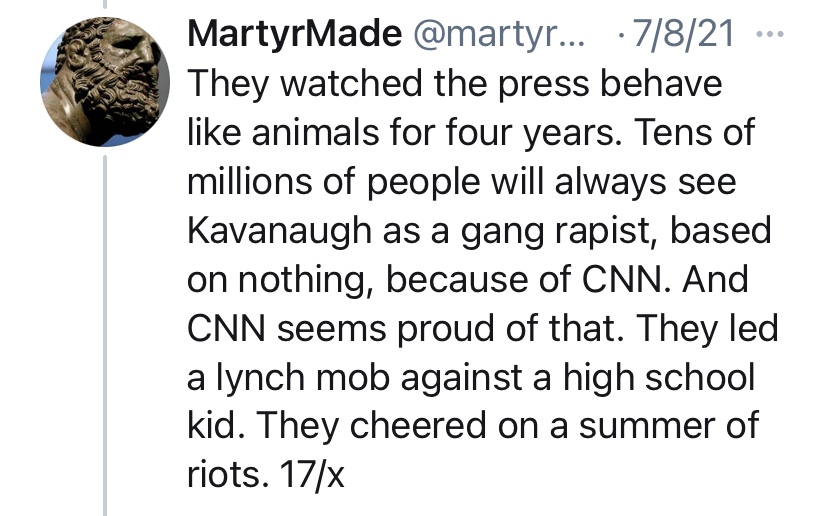
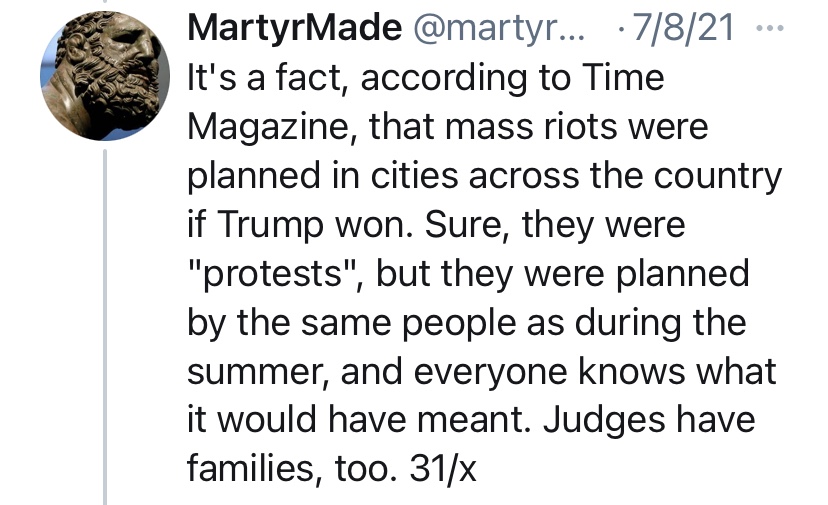
One of the best summaries I’ve read about the attitudes of those who feel disenfranchised by the 2020 election is this series of tweets by the of the MartyrMade podcast, Darryl Cooper. His tweets are also discussed here by Tyler O’Neil. It is Cooper’s “general theory” on the perspective of “Boomer tier” Trump supporters, as he calls them. Last year’s fraudulent election was only the culmination of events going back to the investigation of Donald Trump’s 2016 campaign. The whole thread is interesting, but you must get past a little “soft cover” at the start that might have been intended to distract the speech police at Twitter. I’ll try to summarize here:

  • The intelligence community spied on the Trump campaign in 2016, and that’s a major transgression! The DNC was involved too, actually paying for fabricated evidence. James Comey falsely denied any knowledge of that fact. John Brennan and Adam Schiff also lied shamelessly in this affair.
  • By the time Trump supporters realized all the noise was fake, they naively expected justice to be served. But no, and so their faith in certain institutions was shaken.
  • The gaslighting continued, and the whole thing consumed energy and had a chilling effect on participation in the Trump Administration. This was an active kind of subversion crossing “all institutional boundaries”.
  • The participation of the press was the poison icing on the cake. The press is now viewed by much of the country as a propaganda arm of “The Regime”.
  • Many aren’t sure whether the election was fixed, but if it was, they know they’d be lied to about it. 
  • Voting procedures in many jurisdictions were changed using COVID as a pretext. 
  • The press smoke-screened the Biden, Inc. scandals, including evidence of pay-for-play and incredibly lurid information on Hunter Biden’s laptop. Instead, the press played-up gossip about Trump. 
  • Trump people rightly felt betrayed by the very institutions they’ve always trusted, but they voted in record numbers, and we’re not convinced all were counted.
  • “But when the four critical swing states went dark at midnight, they knew.”
  • Conspiracy theories abounded, but media and tech shut down discussion of real anomalies. Had the election gone Trump’s way, they would have cried foul! 
  • The courts were handcuffed by fear of political violence and retribution.

I agree with substantially all of Cooper’s thread. Our experience since Donald Trump became an active politician has been disillusioning in several respects: it has shown how flimsy our constitutional rights and our republic are when the wrong actors come to dominate certain institutions. It also shows how malleable are the “facts” that we are asked to accept by these actors. We are seemingly helpless to defend the rule of law, the Constitution, and social norms when an intransigent minority decides it can simply ignore them. This is how tyranny is borne.

Election integrity is not an outlandish objective. Neither is demanding fair treatment of diverse viewpoints from social media, Big Tech, and educational institutions. And neither is it outlandish to demand safe communities and adequate police protection; that our borders be enforced; that our public health officials speak honestly about risks; and that we should never, under any circumstances, be judged, punished, or rewarded based on the color of our skin. These are just a few of the things we must demand, and never take “no” for an answer.

On Quitting Facebook

22 Friday Jan 2021

Posted by Nuetzel in Censorship, Social Media

≈ 4 Comments

Tags

Amazon, Antifa, Big Tech, BLM, Cartman, Censorship, Chinese Communist Party, Deactivation, Deplatforming, Donald Trump, Facebook, First Amendment, Gab, Google, Instagram, Market Power, Messenger, MeWe, Parler, Rumble, Sacred Cow Chips, Section 230, Shadow Bans, Signal, Telecommunications Act, Telegram, Third Reich, Twitter, Weimar Republic, WhatsApp

Cartman is awesome! Haha! But really, that kind of reaction to the dominant social media platforms is well deserved, especially given their recent behavior. Listen to this: my wife’s church held a service of hymns and prayer for “healing the nation” on Tuesday. The church’s IT administrator posted an advance notice about the service on the church’s Facebook wall. There was nothing overtly political about the notice or the service itself. Nevertheless, somehow FB deemed the notice subversive and blocked it! We are not dealing with decent or reasonable people here. They are pigs, and we don’t have to do business with them.

FaceHook

A number of years ago, a woman told me FB was “the Devil!” She was very good natured and I laughed at the time. But there are many reasons for people to wean themselves from social media, or at least from certain platforms. The web abounds with testimony on lives improved by quitting FB, for example, and there are forums for those who’ve quit or would like to. There’s also plenty of practical advice on “how to leave”, so there is definitely some interest in getting out.

Ditching FB offers a certain freedom: you can eliminate the compulsion to check your news feed and escape those feelings of obligation to “like” or comment on certain posts. These are distractions that many can do without. No more efforts to “unsee” expressions of foot fetish narcissism! Free of the pathetic virtue signals that seem to dominate the space. And quitting might be especially nice if you’re keen on cutting ties with certain “frenemies”. Almost all of us have had a few. This study found that quitting FB results in less time online (surprise!) and more time with family and friends (pre-COVID lockdowns, of course). It also found that quitting leads to less political polarization! Imagine that!

There’s no question that FB helped me make new friends and reconnect with old ones. It also led to overdue severing of ties with a few toxic individuals. I know I’m likely to lose contact with people I truly like, and that’s too bad, but in most cases I must leave it up to them to stay in touch (read on). Obviously, there are many ways to stay in contact with friends you really want to keep.

FacePurge

As for politics (and seemingly every aspect of life has been politicized), now is a very good time to quit FB if you believe in free expression, the value of diverse opinion, and a free marketplace of ideas. FB doesn’t want that. As the episode at my wife’s church demonstrates, FB has been brazenly selective in suppressing opinion, like other prominent social media platforms. It was obvious well before the presidential election, and it has become intolerable since.

How To Defacebook

There are voices that counsel patience with the tech giants. They recommend a strategy of diversification across platforms, without necessarily quitting any of them. I can understand why certain people might prefer that route. It’s well nigh impossible to migrate an extended family to another platform, for example. However, juggling several accounts can be a problem of time management. And for me, this all boils down to a matter of disgust. It’s time to stick it to FB.

This rest of this post offers some practical advice on quitting FB and more thoughts on how and why I’m doing it. This will also appear on some speech-friendly platforms, so if you see it there and you haven’t quit FB, do it! You’re already halfway there.

The first decision is whether to quit outright or deactivate. Many don’t have the fortitude to stay away if they merely deactivate, and maybe they just need a break. For others, FB has earned an enmity that can only be satisfied by leaving for good. Count me among the latter.

You should reclaim all of your data before you quit: you can download it to a zip file, which will include all of your photos, chats, “About” information, your friends’ birthdays, etc… While it’s been claimed that shutting your account will cleanse Facebook of all your data, that’s not entirely the case. For example, your friends might still retain chats in which you participated. In fact, I’m not convinced all of your data isn’t permanently in FB’s possession, if not the NSA’s, but we might never know.

You should also change your login credentials on other online accounts linked to FB. You should be able to identify some or maybe all of those by looking at the password section in “Settings”. I’m not sure whether scrolling though and checking all the apps listed in Settings will help — it didn’t help me identify anything that the password section did not.

It’s a good idea to keep Messenger up for a while in case any of your friends want to inquire or find a way to stay in touch. That’s fine, but to really rid yourself of FB, you must part with Messenger eventually. Of course, you’ll lose Instagram and WhatsApp when you quit FB. I don’t use those, so it won’t be a problem for me.

Then there are the “I’m Going To Quit!” status updates, sometimes laced with sadness or anger. I haven’t found those particularly appealing in the past… I’ve often wondered if they were merely ploys to get attention. But things have changed. I will add this post to my wall and leave it there for a few days. My *noble* intent is to help others quit, and to do my small part to foster a more competitive social media environment. Another way to communicate your departure would be to use Messenger to inform selected friends, but that’s more work. And by the way, in anticipation of my stop date, I’ve been culling my friends list more aggressively than ever.

Once you pull the trigger and click “Delete”, your account will remain active for a few days. Don’t be a sucker. Delete the app on your phone. Wait it out. Forget about it!

Not OurBook

Again, there was never a better time to dump FB. Beyond any emotionally corrosive aspects of social media, the last straw should be the selective censorship of political views, shadow bans, outright bans, and deletion of groups. Lately, it’s been like witnessing the early transition from Weimar to the Third Reich. We can only hope the full transition will remain unfulfilled.

For a company protected from liability under Section 230 of the Telecommunications Act, FB’s refusal to respect First Amendment rights and to abide diversity of opinion is shocking. Don’t tell me about fact checking! Facebook fact checkers are politically motivated hacks, and the new “oversight board” is not likely to help you and me. The presumption underlying Section 230 is that these platforms are not publishers, but having abandoned all pretense of impartiality, they should not be entitled to immunity. Moreover, they have tremendous market power, and they are colluding in an effort to consolidate political power and protect their dominant market position.

Big Tech, and not just FB, has been flagrant in this hypocrisy. These firms have deplatformed individuals who’ve questioned the legitimacy of the presidential election, and there is plenty to question. But they refuse to censor Antifa and BLM rioters, antisemites, state terrorists, and genocidal tyrants from around the world, including the Chinese Communist Party. More recently, FB and other platforms have condemned supporters of President Trump, as if that support was equivalent to endorsing those who stormed the Capital on June 6th. And even if it were, would an objective arbiter not also condemn leftist violence? How about equal condemnation of the Antifa and BLM rioters who ravaged American cities throughout last summer? Or those who rioted at the time of Trump’s inauguration?

The social media platforms won’t do that. FB is bad, but Twitter is probably the worst of them all. I quit using Google years ago due to privacy concerns, but also because it became obvious to me that it’s search results are heavily biased. Amazon pulled the rug out from under Parler, and I will quit using Amazon when my Prime membership is up for renewal unless Jeff Bezos starts singing a different tune by then. These companies are anticompetitive, but there are other ways to buy online, and there is plenty of other video programming.

Let’s Book

The power of Big Tech is not absolute. Remember, there are alternatives if you choose to quit or diversify: check out MeWe, Clouthub, Rumble (video hosting), Gab, Signal, and Telegram, for example (see this interesting story on the latter two). And Parler, of course, if it manages to find a new hosting service or wins some kind of emergency relief against Amazon.

Message me for my contact information or my identity on other platforms, or you can always find my ruminations at SacredCowChips.net. You can even share them on FB (if they’ll let you), at the risk of alienating your “woke” friends! So long.

Not My President, Not Your’s Either

24 Thursday Dec 2020

Posted by Nuetzel in Censorship, Election Fraud, Leftism

≈ Leave a comment

Tags

Alexandria Ocasio-Cortez, Angela Davis, Barack Obama, Bernie Sanders, Black Lives Matter, Donald Trump, Foreign Influence, Hing Kong, Hunter Biden, Joe Biden, Taiwan, Uhyger Muslims, Xi Jinping

Now why would I say such a thing? Well, 1) the presidential election was rife with fraud, as many of us feared would be the case (and see here); 2) the supposed winner, Joe “The Plagiarist” Biden, is a figurehead, and he will remain in the White House only as long as he toes the line set down by the Left; and 3) the figurehead is badly compromised by Chinese and other foreign influence: Chairman Xi Jinping of the Chinese Communist Party (CCP) is undoubtedly pleased that such a pliant American president will be taking office.

Those who deny the fraud that took place in the election keep insisting “there’s no evidence!” In fact, there is ample evidence to convince any fair-minded person that massive fraud took place across a number of states (see here, here, here and here). We knew that massive adoption of mail-in ballots was an invitation to fraud. There are many hundreds of affidavits (yes, they constitute evidence) stating that Republican election officials and poll watchers were obstructed in their attempts to observe the counting process on and after Election Day, and worse. There is video evidence of activities coincident with late-night lockouts of Republican poll watchers and outrageous, instant jumps in Biden’s vote totals. There is definitive evidence of process “shortcuts” in several states that led to a large number of unverified ballots. These shortcuts were often taken in contravention of state law. There were failed chains of custody for thousands of ballots across several states. There were dead and out-of-state voters. There were irregularities associated with vote tabulations by Dominion machines. There are hand recounts in a few counties that demonstrate miscounting of ballots. And of course, there was a willful effort to suppress this information by the news media, and outright censorship of this information by social media platforms.

No matter what has or will happen in the courts, state legislatures, or Congress, a large share of the voting public believes there was fraud in this election. In fact, a significant share of democrats believe the election was stolen from President Trump! The fraud goes beyond the electoral process as well. Polls show a substantial number of Biden voters would not have voted for him had they known about the escapades of Hunter Biden and Joe’s role as the family cash cow. The mainstream media and social media platforms also deliberately suppressed the information about Hunter Biden’s pay-for-play scandal prior to the election. And that came after months of avoiding any real scrutiny of Biden’s policy agenda and his fitness as a candidate. Instead, the media asked Joe tough questions about his favorite ice cream.

Not your president? The Hunter Biden saga creates doubt about who Joe Biden is likely to serve as President. To whom is Joe beholden for “taking care” of “the big guy’s” family? How about Hunter’s deals in the Ukraine and Russia? How heavily was the CCP involved in Hunter’s business ventures? How much is Joe compromised by these unfortunate ties? What kind of compromises might it be worth to Joe to avoid further exposure? Should the Biden Administration overlook the plight of the Uhygers? Turn the cheek on Hong Kong? Sacrifice Taiwan? Allow Chinese technology to be embedded in U.S. communications hardware? Cede international rights in the South China Sea? Perhaps Joe will be Chairman Xi’s President. And perhaps others hold cards, such as the hostile Iranian regime. Not our president.

Finally, if you *think* you voted for Joe as president, be aware that he is, even now, a doddering figurehead, a puppet of the Left whose strings might well be clipped when he demonstrates even a hint of incapacity. It might not be long. Perhaps the Left will adopt Hunter’s imbroglio as an excuse to take Joe down. It seems more than a little suspicious that the media, post-election, has finally begun to talk about Hunter’s miscues and Joe’s “possible” involvement.

But even if Joe remains in the Oval Office through a first term, just who will be in charge? Joe? No, he is captive to the interests that helped put him there. We might just as well call him “Any-Way-the-Wind-Blows Joe”. Angela Davis, former VP of the Communist Party USA, said during the primaries that she supported Biden because he:

“… can be most effectively pressured into allowing more space for the evolving anti-racist movement.”

Well, Joe better not compromise with anyone or accept any policy that Angela Davis deems “racist”.

Let’s consider a few influences expected to be paramount in pulling Joe’s strings: Barack Obama, Alexandria Ocasio-Cortez, Julian Castro, and Black Lives Matter. Bernie Sanders will also loom large, and of course Kamala Harris will be there to push the leftist agenda, and she’ll be waiting in the wings when Joe loses his tentative grip on the reins of the progressive machine. Joe better not resist these forces: he can be manipulated, and if he strays from the path, he and his presidency can be cancelled.

If you are a member of the Marxist wing of the coalition, you might have him just where you want him. If you are a member of the CCP, then he might be your president. But he is not the president of the disenfranchised voters whose majority was outstripped by the mailed ballot fraud. And if you are a centrist Democrat, you should awaken to the reality of the hard-left movement with which you’ve joined forces. Do not accept it as a legitimate governing force. No, Joe Biden will not be your president.

As I’ve noted in the past, apologists willing to look past Joe Biden’s domestic and foreign controllers and the fraudulent election are not to be trusted. Indeed, they have been willing to look past Biden’s personal status as a fraud, from his many lies about his family to his admitted plagiarism, to his denial of sexual aggression toward female staffers. In summary, I can’t put it any better than Newt Gingrich does here:

“… I have no interest in legitimizing the father of a son who Chinese Communist Party members boast about buying. Nor do I have any interest in pretending that the current result is legitimate or honorable. It is simply the final stroke of a four-year establishment-media power grab. It has been perpetrated by people who have broken the law, cheated the country of information, and smeared those of us who believe in America over China, history over revisionism, and the liberal ideal of free expression over cancel culture.”

Benford’s Law and Election Fraud Detection

12 Thursday Nov 2020

Posted by Nuetzel in Election Fraud

≈ 1 Comment

Tags

Allegheny County, Benford’s Law, Chicago, Donald Trump, Election Fraud, First-Digit Testr, Fulton County, Golden Age of Gaia, Joe Biden, Leading Digit Test, MIlwaukee, Recounts, Second-Digit Test, Test Statistic, Walter Mebane

Like many others, I strongly suspect widespread ballot fraud in the presidential election, as well as miscounting due to software problems in certain jurisdictions. I therefore fully support the legal challenges and recounts now getting underway. However, there is one indicator of fraud, now widely cited by Republicans, in which I have no confidence as applied. It’s a statistical tool based on Benford’s Law, which can serve as a signal of voter fraud. I mentioned it briefly in my last post. At the risk of getting ahead of myself, here’s what I said then:

“… Benford’s Law … is a “forensic” test of fraud based on statistical theory, but I do not trust the form in which it’s been invoked thus far. Violations have been cited in several counties over the past few days. However, a violation of this law obviously doesn’t constitute direct evidence of fraud, and the test is a reliable indicator only when the number of voters in different precincts vary by orders of magnitude (there must be a mix of [numbers in the] 10s, 100s, 1,000s, 10,000s). With precinct sizes, that is often not the case. There is a more reliable form of Bedford’s law, but I have not seen its application to any results in this election.“

The last link above is to a paper by Walter Mebane of the University of Michigan. I’ll refer to his work below, including some post-election tests he’s conducted.

First Digits

Benford’s Law holds that many collections of numbers encountered in nature or human affairs (populations of ant colonies, accounting data) will have a large proportion of leading digits that are low numbers. For example, the number 1 will tend to appear as the leading digit about 30% of the time; the number 2 will be the leading digit about 18% of the time, while the number 9 will be the leading digit less than 5% of the time. The broader the range of the numbers, the more accurately they will conform to Benford’s Law. As I stated above, a range of numbers covering several orders of magnitude will approximate Benford’s Law fairly well, while a range confined to a single order of magnitude generally won’t conform unless its distribution is extremely skewed toward the low end of the range.

What does that have to do with election fraud? If the number of votes across different voting precincts cover several orders of magnitude (for example, single digits, 10s, 100s, and 1,000s), they should conform to Benford’s Law. The distribution of first digits across precincts should look a lot like the chart above. If they don’t conform, it’s an indication that votes may have been altered or added. That’s because Benford’s Law tends to break down when an independent process leads to additive changes to the original numbers (rather than multiplicative changes, such as population growth).

So again, there have been claims that several cities had presidential voting patterns suggesting violations of Benford’s Law for Joe Biden, but not for Donald Trump and other candidates. These were Milwaukee, WI, Chicago, IL, and Allegheny County, PA. Subsequently I saw similar claims about other cities and counties, such as Fulton County, GA.

The chart below shows the results for Milwaukee. I show only three of the candidates’ distributions of first digits, but the other candidates, who garnered relatively few votes, look much like the one on the far right. The chart shows that Joe Biden’s distribution looks nothing like Benford’s Law would suggest, while Trump’s does. The assertion is that Biden’s pattern is a sign of fraudulent voting.

The problem with these claims is that the size of the precincts and variations in votes across wards might not support the validity of Benford’s Law. I looked at the 327 election wards in the City of Milwaukee, which range in size from just a few voters to several thousand, but most have less than 1,000 voters. The average turnout of registered voters across wards was over 78%, and the average number of ballots cast per ward was 757. Biden received almost 80% of the votes in Milwaukee, or about 595 per ward; Trump received an average of 148.

(I should note that in seven wards there were controversial, post-election upward adjustments in the number of registered voters, where voter turnout had originally been calculated as greater than 100%. Needless to say, that is rather suspicious. However, I disclose now that the data were collected after these adjustments were made.)

What’s important in the application of Benford’s Law is the distribution of votes across wards. Biden’s distribution of votes across wards in Milwaukee was concentrated between 186 and 1,196 (the middle 90% of his distribution of ward votes), and again, centered at 595. For Trump, 90% of his ward vote totals were between 14 and 412. It should be no surprise that a large share of Biden’s vote totals would have leading digits of 4, 5, and 6, while Trump had lower leading digits. So the charts of leading digits for Milwaukee are really artifacts of the narrow distributions of ward votes for these candidates. Broader distributions covering several orders of magnitude would provide first-digit analysis more capable of indicating fraud, if it occurred.

Second Digits

The other Benford-type test of fraud mentioned above is based on the second digit of vote totals, and it is not sensitive to the width of the vote distributions. The typical pattern of second digits is much less pronounced than first digits, but there is still a smooth decline from smaller to larger second digits. I found the two charts below on the Golden Age of Gaia site, of all places. They contrast the frequency of second digits from the Biden and Trump vote totals by precinct for ballots in Allegheny County, PA. The usual pattern of second digits is plotted along the orange line, but whoever prepared these charts mislabelled the horizontal axes (they should run from zero to nine).

Joe Biden’s frequencies are irregular, with significant differences for some values of the second digit. Trump’s pattern is more typical. However, I learned today that Walter Mebane had performed a few second-digit tests on Allegheny County and Milwaukee. He calculates an overall test statistic for the full set of second-digit values and finds the statistics for those counties to be within a certain reasonable range, or at least he felt they could be explained by other factors.

Visually, however, there is a sharp contrast between the Biden and Trump charts. And the data has been in flux, so it’s not clear that the charts correspond to exactly the same data tested by Mebane.

In the end, these tests offer no real guidance in this case. All tests of this kind offer circumstantial evidence, at best, and they are invalid under some circumstances. As Mebane said in his 2006 paper:

“… to prevent election fraud, appropriate practices need to be used while the election is being conducted. Insecure or opaque voting technology or election administration procedures should not be used. The election environment should not foment chaos and confusion. Not only should elections be secure and fair, but everyone should know they are secure and fair.“

Chaos and confusion…. yes, that sounds about like the 2020 election environment. Mebane is obviously aware of the limitations of the statistics in which he specializes. Nevertheless, these tests are broadly used in a variety of applications. Crazy results raise suspicions, but sometimes they are not the best leads in pursuing claims of election fraud. There are plenty of other red flags in the present case. The states now in dispute are close, and most of those votes will be subject to recount anyway.

← Older posts
Newer posts →
Follow Sacred Cow Chips on WordPress.com

Recent Posts

  • The Rise of the GOP “Common Good” Socialists
  • Trial Lawyers Reveal Preference For Less Safety
  • Funding Private Social Security Accounts
  • Chinese State, CCP, Cronies Exploit Wage Earners
  • Some Dimensions Of the AI/Data Center Freakout

Archives

  • September 2026
  • August 2026
  • July 2026
  • June 2026
  • May 2026
  • April 2026
  • March 2026
  • February 2026
  • January 2026
  • December 2025
  • November 2025
  • October 2025
  • September 2025
  • August 2025
  • July 2025
  • June 2025
  • May 2025
  • April 2025
  • March 2025
  • February 2025
  • January 2025
  • December 2024
  • November 2024
  • October 2024
  • September 2024
  • August 2024
  • July 2024
  • June 2024
  • May 2024
  • April 2024
  • March 2024
  • February 2024
  • January 2024
  • December 2023
  • November 2023
  • August 2023
  • July 2023
  • June 2023
  • May 2023
  • April 2023
  • March 2023
  • February 2023
  • January 2023
  • December 2022
  • November 2022
  • October 2022
  • September 2022
  • August 2022
  • July 2022
  • June 2022
  • May 2022
  • April 2022
  • March 2022
  • February 2022
  • January 2022
  • December 2021
  • November 2021
  • October 2021
  • September 2021
  • August 2021
  • July 2021
  • June 2021
  • May 2021
  • April 2021
  • March 2021
  • February 2021
  • January 2021
  • December 2020
  • November 2020
  • October 2020
  • September 2020
  • August 2020
  • July 2020
  • June 2020
  • May 2020
  • April 2020
  • March 2020
  • February 2020
  • January 2020
  • December 2019
  • November 2019
  • October 2019
  • September 2019
  • August 2019
  • July 2019
  • June 2019
  • May 2019
  • April 2019
  • March 2019
  • February 2019
  • January 2019
  • December 2018
  • November 2018
  • October 2018
  • September 2018
  • August 2018
  • July 2018
  • June 2018
  • May 2018
  • April 2018
  • March 2018
  • February 2018
  • January 2018
  • December 2017
  • November 2017
  • October 2017
  • September 2017
  • August 2017
  • July 2017
  • June 2017
  • May 2017
  • April 2017
  • March 2017
  • February 2017
  • January 2017
  • December 2016
  • November 2016
  • October 2016
  • September 2016
  • August 2016
  • July 2016
  • June 2016
  • May 2016
  • April 2016
  • March 2016
  • February 2016
  • January 2016
  • December 2015
  • November 2015
  • October 2015
  • September 2015
  • August 2015
  • July 2015
  • June 2015
  • May 2015
  • April 2015
  • March 2015
  • February 2015
  • January 2015
  • December 2014
  • November 2014
  • October 2014
  • September 2014
  • August 2014
  • July 2014
  • June 2014
  • May 2014
  • April 2014
  • March 2014

Blogs I Follow

  • Passive Income Kickstart
  • OnlyFinance.net
  • TLC Cholesterol
  • Nintil
  • kendunning.net
  • DCWhispers.com
  • Hoong-Wai in the UK
  • Marginal REVOLUTION
  • Stlouis
  • Watts Up With That?
  • American Elephants
  • The View from Alexandria
  • The Gymnasium
  • A Force for Good
  • Notes On Liberty
  • troymo
  • SUNDAY BLOG Stephanie Sievers
  • Miss Lou Acquiring Lore
  • Your Well Wisher Program
  • Objectivism In Depth
  • RobotEnomics
  • Orderstatistic
  • Paradigm Library
  • Scattered Showers and Quicksand
  • Jam Review

Blog at WordPress.com.

Passive Income Kickstart

OnlyFinance.net

TLC Cholesterol

Nintil

To estimate, compare, distinguish, discuss, and trace to its principal sources everything

kendunning.net

The Future is Ours to Create

DCWhispers.com

Hoong-Wai in the UK

A Commonwealth immigrant's perspective on the UK's public arena.

Marginal REVOLUTION

Small Steps Toward A Much Better World

Stlouis

Watts Up With That?

The world's most viewed site on global warming and climate change

American Elephants

Defending Life, Liberty and the Pursuit of Happiness

The View from Alexandria

In advanced civilizations the period loosely called Alexandrian is usually associated with flexible morals, perfunctory religion, populist standards and cosmopolitan tastes, feminism, exotic cults, and the rapid turnover of high and low fads---in short, a falling away (which is all that decadence means) from the strictness of traditional rules, embodied in character and inforced from within. -- Jacques Barzun

The Gymnasium

A place for reason, politics, economics, and faith steeped in the classical liberal tradition

A Force for Good

How economics, morality, and markets combine

Notes On Liberty

Spontaneous thoughts on a humble creed

troymo

SUNDAY BLOG Stephanie Sievers

Escaping the everyday life with photographs from my travels

Miss Lou Acquiring Lore

Gallery of Life...

Your Well Wisher Program

Attempt to solve commonly known problems…

Objectivism In Depth

Exploring Ayn Rand's revolutionary philosophy.

RobotEnomics

(A)n (I)ntelligent Future

Orderstatistic

Economics, chess and anything else on my mind.

Paradigm Library

OODA Looping

Scattered Showers and Quicksand

Musings on science, investing, finance, economics, politics, and probably fly fishing.

Jam Review

"If you get confused, listen to the music play."

  • Subscribe Subscribed
    • Sacred Cow Chips
    • Join 128 other subscribers
    • Already have a WordPress.com account? Log in now.
    • Sacred Cow Chips
    • Subscribe Subscribed
    • Sign up
    • Log in
    • Report this content
    • View site in Reader
    • Manage subscriptions
    • Collapse this bar
Loading Comments...