The world doesn’t ordinarily revolve around tariffs, but so much has happened to make tariffs into an economic and political linchpin of the moment. Donald Trump put them in the spotlight, of course, and while he’s still seeing roses, things won’t turn out entirely the way he hopes. At the tariff levels he’s instituted, this shouldn’t be too surprising.
While tariff revenue is helping to shave the federal budget deficit, the tax falls largely on the backs of American consumers and businesses with all the attending distortions that entails. Sadly, the extra revenue also seems to have offered a handy excuse to put spending cuts on the back burner. Tariffs and tariff uncertainty have businesses attempting to compromise between reduced margins and price hikes. Thinning margins due to tariffs have played a role in the weak employment numbers we’ve seen over the past few months. And tariffs, at least until now, have quite rightly reinforced the Federal Reserve’s cautious stance toward easing policy. However, the weak labor market has likely convinced the Fed to cut its short-term interest rate target, despite inflation stubbornly remaining well above the Fed’s 2% objective. That upward price pressure will remain.
Now, the legal battle over Trump’s tariff authority is about to reach a climax. That’s what I’ll focus on here. The Supreme Court has agreed to fast track the challenge to the President’s discretion to impose retaliatory tariffs unilaterally. There are two cases at hand: V.O.S. Selections, Inc. v. Trump, and Learning Resources, Inc., et al. v. Donald Trump et al. In both cases, small business plaintiffs contend that Trump’s invocation of the International Emergency Economic Powers Act (IEEPA) is unwarranted, and that “most” of the tariff actions taken by Trump have usurped Congress’ power of the purse under Article I of the Constitution. Here’s Ilya Somin, who is a Volokh Conspiracy regular and one of the attorneys representing the plaintiffs:
“… IEEPA doesn’t even mention tariffs and has never previously been used to impose them, that there is no ‘unusual and extraordinary threat’ of the kind required to invoke IEEPA, the major questions doctrine, the constitutional nondelegation doctrine, and more.“
This isn’t the first time a U.S. president has imposed tariffs unilaterally, but it is easily the most drastic such action. Historically, nearly all tariffs were levied by acts of Congress. Prior to Trump II, perhaps the broadest tariff imposed by a President was Richard Nixon’s brief 10% surcharge on all imports, but that was lifted quickly. Presidents Johnson and Obama imposed some selective tariffs. All of these episodes seem piddling compared to Trump’s tariffs, which are both sweeping and in many cases painfully selective.
Eric Boehm notes that when it comes to major constitutional questions, the Court has taken the position that
“… executive power should be construed narrowly, not broadly …. Rather than tying itself into knots to affirm nearly unlimited executive powers over commerce, the Supreme Court should tell the Trump administration to get permission from Congress before imposing new tariffs.“
I believe that will be the general shape of the outcome here. Maybe there’s a way for the Court to allow the tariffs to stand until Congress decides to “man up”, acting one way or the other. SCOTUS would probably like to do just that! Or maybe the Court could stay the lower court’s injunction until the case is heard by the Court in full on the regular docket, or until Congress acts.
There’s a decent chance, however, that Trump’s tariffs will be struck down, leaving it up to tariff supporters in Congress to lay down statutory rules rather than put up with the impulsive craziness we’ve witnessed thus far. If the Court lets the tariffs stand, it leaves the door open for new tests on the limits of executive discretion. Here is Greg Ip at the link:
“There would also be no end to uncertainty. ‘Unlike most other tariff authorities, these tariffs are not enshrined in statute, there’s no process to change them, and they can change very rapidly, in a day, without much notice, as we’ve seen,’ said Greta Peisch, a trade attorney at Wiley Rein and former general counsel for the U.S. trade representative.“
We’ve already seen strong hints that the Administration would like to force businesses to eat the cost of the tariffs rather than pass them along to consumers in higher prices. There hasn’t been any formal action of this kind by the Administration, at least not yet. Still, one can hardly blame businesses who might perceive an implicit threat if they fail to comply. That kind of bullying represents an a massive abuse of power. The Court could do everyone a big favor by clarifying that the authority to impose tariffs rests with Congress.
Just a few weeks back I engaged in wishful speculation that Trump’s drastic imposition of “reciprocal” and punitive tariffs could actually prove to be a free-trade play, but only if the U.S. used its universally dominant position in trade wisely at the bargaining table. I worried, however, that any notion Trump might have along those lines was eclipsed by his antipathy for otherwise harmless trade deficits. Another bad indicator was his conviction that manipulating tariffs could restore “fairness” in trade relations while raising revenue to pay for the selective tax cuts he promised for tips, overtime wages, and social security benefits.
My hopes for reduced trade barriers were dashed when the first “deal” (or really a “Memorandum of Understanding”) was announced with the United Kingdom. The U.S. runs a trade surplus with the UK, so one might think Trump would find it unnecessary to levy tariffs on U.S. imports from the UK. No dice! Clearly this was not motivated by the trade deficit bogeyman of Trump’s fever dreams. The White House stated that buyers of goods from the UK will pay the minimum 10% tariff (up from 3.3% before Trump took office).
Trump simply likes tariffs. Apparently he’s never given much thought to their incidence, which falls largely on domestic consumers and businesses. The MAGA faithful are in blissful denial that such a burden exists, despite ample evidence of its reality.
As Eric Boehm notes, the U.S. received a few concessions on British tariffs under the deal, but the reductions only amount to about a 2% equivalent. There are sharp reductions in special tariffs on U.S. agricultural products, especially meat. There are also exceptions to tariffs on certain British goods, like autos (up to 100,000 units). The selective nature of the concessions on both sides underscores the cronyist underpinnings of this style of economic governance, which amounts to ad hoc central planning.
Also troubling is the misleading spin the Administration attempted to put on news coverage of the deal. They claimed to have reduced tariffs of goods imported from the UK, which is true only in comparison to post-“Liberation Day” tariff levels established in early April. In fact, the baseline tariff now applied to most UK goods sold in the U.S. has more than tripled since last year! As Boehm states, American consumers and businesses are paying a lot more for this “deal” than their British counterparts.
Raw Deals To Be?
The “deal” with China is worse, partly because it’s only a 90-day pause in implementation (pending negotiation), and partly because the “reciprocal” tariff rate of 30% applied to Chinese goods is much higher than before Trump imposed the punitive rates. Still worse, the 10% tariff on U.S. exports to China applied during the pause is also much higher. What a deal! And it could get worse. These tariff hikes have little to do with “national security” and they are regressive, having disproportionately large burdens on lower-income consumers and small businesses.
The only other agreement announced thus far is with India. It is not a “trade deal” at all, but a so-called “Terms of Reference On Bilateral Trade Agreement”. It is a “roadmap” for future negotiations. Perhaps it will come together quickly, but it’s hard to expect much after the UK agreement.
Uniting Western Civilization
Just this week we had another hardball move by Trump: a 50% tariff on goods from the European Union starting in June, up from an average of about 3.8% on a trade-weighted basis. The new tariff rate is also higher than the 10% baseline tariff in place since the 90-day pause was announced in April. Trump claims the EU has been levying tariffs of 39% on U.S. goods, which might include what the Administration would call effective tariffs from non-tariff barriers to trade. Or it might refer to retaliatory tariffs announced by the EU in response to Trump’s Liberation Day announcement, but all of those have been paused. In any case, the World Trade Organization says EU tariffs on US goods average 4.8%. Quite a difference!
The move against the EU is much like Trump’s earlier ploy with China, but he says he’s “not looking for a deal”. He also says talks with the EU are “going nowhere”, though the Polish Trade Minister reassures that talks are “ongoing”. The outcome is likely to be a disappointment for anyone (like me) hoping for freer trade. The EU will probably make commitments to buy something from the U.S., maybe beef or liquified natural gas. But U.S. tariffs on EU goods will be higher than in the past.
So, thus far we have only one “deal” (such as it is), one roadmap for negotiations to follow, and a bunch of pauses pending negotiation (China included). The Trump team says about 100 countries hope to negotiate trade deals, but that is a practical impossibility. Even Trump says “… it’s not possible to meet the number of people that want to see us.” But it could be easy: just drop all U.S. trade barriers and allow protectionist countries to tax their own citizens, denying them access to free choice.
Bullying Enemies, Allies and Producers
Higher U.S. tariffs will put some upward pressure on the prices of imports and import-competing goods. We haven’t seen this play out just yet, but it’s early. In a defensive move, Trump is attempting to bully and shame domestic companies such as WalMart for attempting to protect their bottom lines in the face of tariffs. He also warned automakers about their pricing before carving out an exception for them. And now Apple has been singled-out by Trump for a special 25% tariff after it had announced plans to move assembly of iPhones to India, rather than in the U.S.
You better stay on Trump’s good side. This is a loathsome kind of interference. It encourages firms to seek favors in the form of tariff exemptions or to accept what amounts to state expropriation of profits. Cronyism and coercion reign.
Swamped By Spendthrifts?
The market seems to believe the negative impact of tariffs on economic growth will be more than offset by other stimulative forces. This includes the extension of Trump’s 2017 tax cuts. The so-called “big beautiful bill” passed by the House of Representatives also includes new tax breaks on tip and overtime pay, and an increase in the deduction for state and local taxes. While the bill reduces the growth of federal spending, there is disappointment that spending wasn’t reduced. The Senate might pass a version with more cuts, but the market sees nothing but deficits going forward. This is not the sort of “fiscal restraint” the market hoped for, particularly with escalating interest costs on the burgeoning federal debt.
Conflicting Goals
Trump has bargained successfully for some major investments in the U.S. by wealthy nations like Saudi Arabia and Dubai, as well as a few major manufacturing and technology firms. That’s wonderful. He doesn’t understand, however, that strong foreign investment in the U.S. will encourage larger trade deficits. That’s because foreign capital inflows raise incomes, which increase demand for imports. In addition, the capital inflows cause the value of the dollar to appreciate, making imports cheaper but exports more expensive for foreigners. It would be a shame if Trump reacted to these eventualities by doubling down on tariffs.
Conclusion
Alas, my hopes that Trump’s bellicose trade rhetoric was mere posturing were in vain. He could have used our dominant trading position to twist arms for lower trade barriers all around. While I worried that he massively misunderstood the meaning of trade deficits, and that he viewed higher tariffs as a magic cure, I should have worried much more!
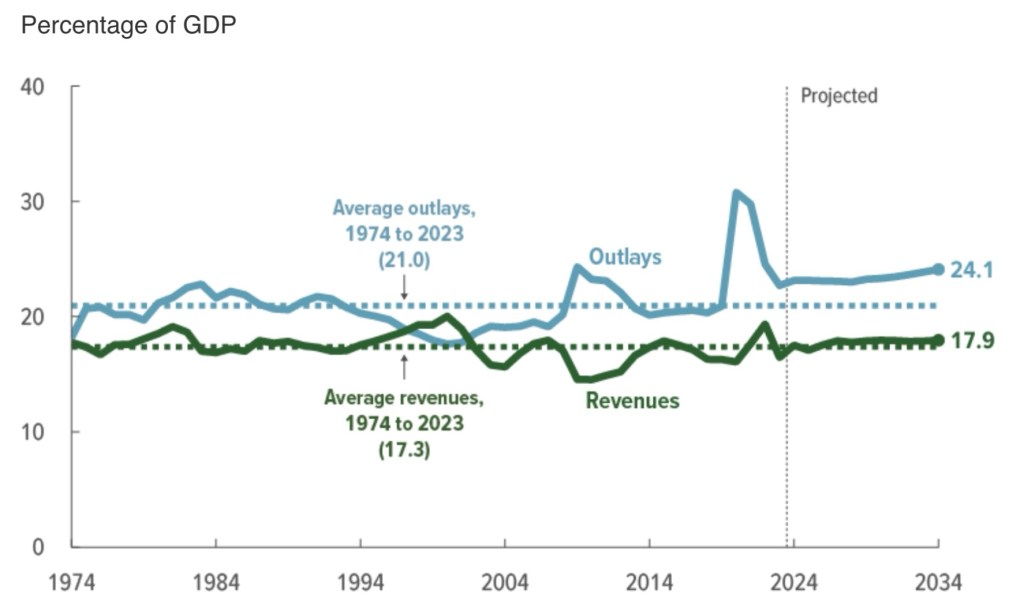
The chart above makes a convincing case that we have a spending problem at the federal level. Really, we’ve had a spending problem for a long time. But at least tax revenue today remains reasonably well-aligned with its 50-year historical average as a share of GDP. Not spending. Even larger deficits opened up during the pandemic and they haven’t returned to pre-pandemic levels.
We’ve seen Joe Biden break spending records. His initiatives, often with questionable merit, have included the $1.8 trillion American Rescue Plan and the nearly $0.8 trillion Infrastructure Investment and Jobs Act, along with several other significant spending initiatives such as the Promise to Address Comprehensive Toxics Act and the subsidy-laden CHIPS Act. Meanwhile, emergency spending has become a regular occurrence on Biden’s watch. More recently, he’s made repeated efforts to forgive massive amounts of student loans despite the Supreme Court’s clear ruling that such gifts are unconstitutional.
Indeed, while Biden keeps pretty busy spinning tales of his days driving an 18-wheeler, cannibals devouring his Uncle Bosie Finnegan, his upbringing in black churches, synagogues, or in the Puerto Rican community, he still finds time to dream up ways for the government to spend money it doesn’t have. Or his kindly puppeteers do.
Biden’s New Budget
Eric Boehm expressed wonderment at Biden’s fiscal 2025 budget not long after its release in March. He was also mystified by the gall it took to produce a “fact sheet” in which the White House congratulated itself on fiscal responsibility. That’s how this Administration characterizes deficits projected at $16 trillion over the next ten years. No joke!
Furthermore, the Administration says the record spending will be “paid for”. Well, yes, with tax increases and lots of borrowing! There are a great many fabulist claims made by the White House about the budget. This link from the Office of Management and Budget includes a handy list of propaganda sheets they’ve managed to produce on the virtues of their proposal.
The Congressional Budget Office (CBO) projects ten-year deficits under current law that are $3 trillion higher than Biden’s proposed budget. That’s the basis of the White House’s boast of fiscal restraint. But the difference is basically paid for with a couple of accounting tricks (see below). More charitably, one could say it’s paid for with higher taxes, aided by the assumption of slightly faster economic growth. The latter will be a good trick while undercutting incentives and wages with a big boost to the corporate tax rate.
The revenue projected by the While House from those taxes does not come anywhere close to eliminating the gap shown in the CBO’s chart above. Federal spending under Biden’s budget grows at about 4% annually, just a bit slower than nominal GDP. Thus, the federal share of GDP remains roughly constant and only slightly higher than the CBO’s current projection for 2034. Nevertheless, spending relative to GDP would continue at an historically high rate. Over the next decade, it would average more than 3% higher than its 50-year average. That would be about $1.3 trillion in 2034!
Meanwhile, the ratio of tax revenue to GDP under Biden’s proposal, as they project it, would average slightly higher than its 50-year average, reaching a full percentage point above by 2034 (and higher than the CBO baseline). That’s probably optimistic.
There is little real effort in this budget to reduce federal deficits, with Treasury borrowing rates now near 15-year highs. Interest expense has grown to an alarming share of spending. In fact, it’s expected to exceed spending on defense in 2024! Perhaps not coincidentally, the White House assumes a greater decline in interest rates than CBO over the next 10 years.
Treats or Tricks?
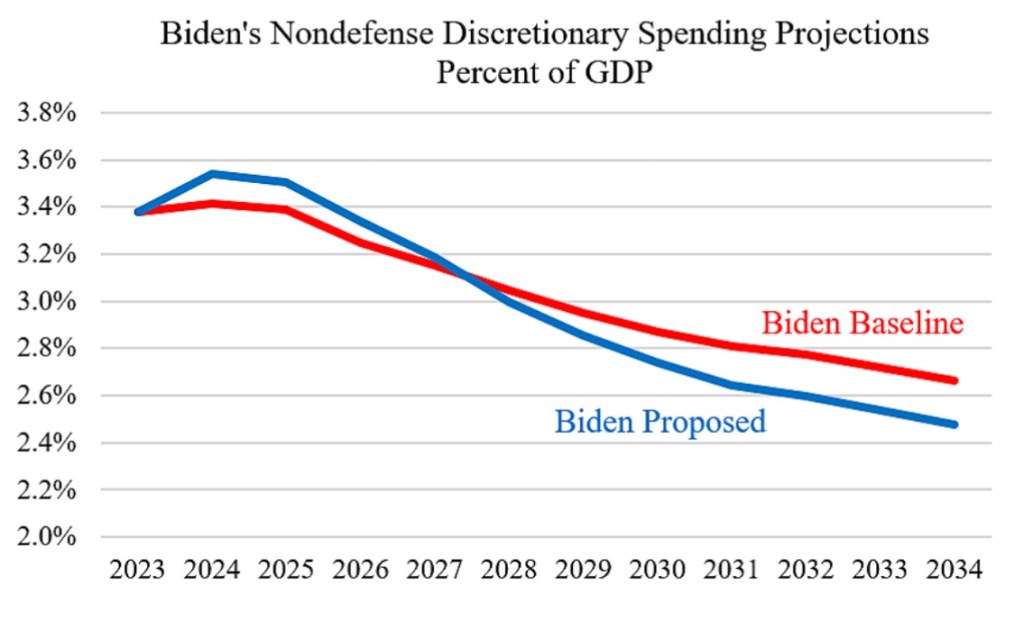
The situation is likely worse than the White House depicts, given that its budget incorporates assumptions that look generous to their claim of fiscal restraint. First, they frontload nondefense discretionary spending, allowing Biden to make extravagant promises for the near-term while pushing off steep declines in budget commitments to the out-years. The sharp reductions in this category of spending pares more than $2 trillion from the 10-year deficit. From the link above:
Biden also proposes to restore the expanded the child tax credit — for one year! How handy from a budget perspective: heroically call for an expanded credit (for a year) while avoiding, for the time being, the addition of a couple of trillion to the 10-year deficit.
Code Red
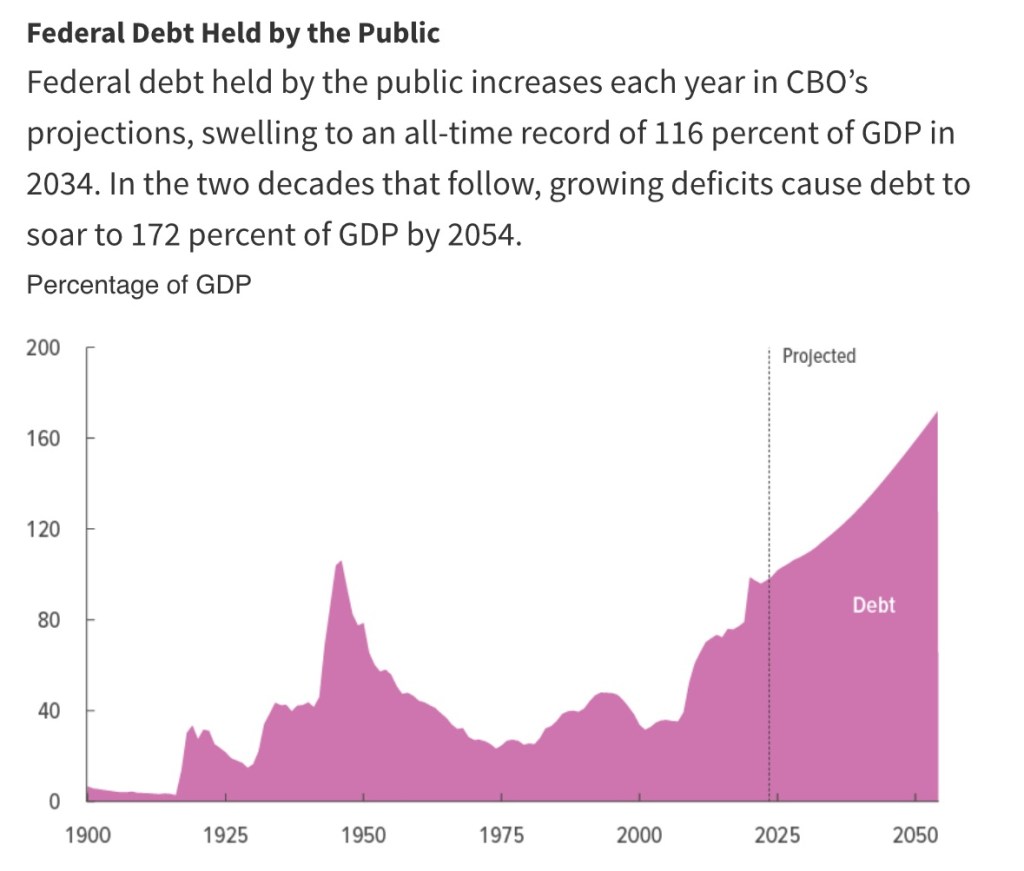
So where does this end? The ratio of federal debt to GDP will resume its ascent after a slight decline from the pandemic high. Here is the CBO’s projection:
The Biden budget shows a relatively stable debt to GDP ratio through 2034 due to the assumptions of slightly faster GDP growth, lower Treasury borrowing rates, and the aforementioned “fiscal restraint”. But don’t count on it!
The government’s growing dominance over real resources will have negative consequences for growth in the long-term. Purely as a fiscal matter, however, it must be paid for in one of three ways: revenue from explicit taxes, federal borrowing, or an implicit tax on the public more commonly known as the inflation tax. The last two are intimately related.
Bond investors always face at least a small measure of default risk even when lending to the U.S. Treasury. There is almost no chance the government would ever default outright by failing to pay interest or principal when due. However, investors hold an expectation that the value of their bonds will erode in real terms due to inflation. To compensate, they demand an “inflation premium” in the interest rate they earn on Treasury bonds. But an upside surprise to inflation would constitute a “soft default” on the real value of their bonds. This occurred during and after the pandemic, and it was triggered by a burgeoning federal deficit.
Brief Mechanics
John Cochrane has explained the mechanism by which acts of fiscal profligacy can be transmitted to the price of goods. The real value of outstanding federal debt cannot exceed the expected real value of future surpluses (a present value summed across positive and negative surpluses). If expected surpluses are reduced via some emergency or shock such that repayment in real terms is less likely, then the real value of government debt must fall. That means either interest rates or the price level must rise, or some combination of the two.
The Federal Reserve can prevent interest rates from rising (by purchasing bonds and increasing the money supply), but that leaves a higher price level as the only way the real value of debt can come into line. In other words, an unexpected increase in the path of federal deficits would be financed by money printing and an inflation tax. The incidence of this unexpected “implicit” tax falls not only to bondholders, but also on the public at large, who suffer an unexpected decline in the purchasing power of their nominal assets and incomes. This in turn tends to free-up real resources for government absorption.
Government Debt Is Risky
It appears that investors expect the future deficits now projected by the CBO (and the White House) to be paid down someday, to some extent, by future surpluses. That might seem preposterous, but markets apparently aren’t surprised by the projected deficits. After all, fiscal policy decisions can change tremendously over the course of a few years. But it still feels like excessive optimism. Whatever the case, Cochrane cautions that the next fiscal emergency, be it a new pandemic, a war, a recession, or some other crisis, is likely to create another huge expansion in debt and a substantial increase price level. Joe Biden doesn’t seem inclined to put us in a position to deal with that risk very effectively. Unfortunately, it’s not clear that Donald Trump will either. And neither seems inclined to seriously address the insolvencies of Social Security and Medicare. If unaddressed, those mandatory obligations will become real crises over the next decade.
The “Inflation Reduction Act” (IRA) is about as fatuous a name for pork-barrel spending and taxes as its proponents could have dreamt up! But that’s the preposterous appellation given to the reconciliation bill congressional Democrats hope to approve. Are we to believe that Congress suddenly recognizes the inflationary effects of governments deficits? Well, the trouble is the projected revenue enhancements (taxes) and cost savings are heavily backloaded. It’s mostly spending up front, which is exactly how we got to this point. There are a number of provisions intended to increase domestic energy production in the hope of easing cost-push, supply-side price pressures. However, provisions relating to fossil fuel production are dependent on green energy projects in the same locales. So, even if we get more oil, we’ll still be pissing away resources on wind and solar technologies that will never be reliable sources of power. Even worse, the tax provisions in the bill will have burdens falling heavily on wage earners, despite the Administration’s pretensions of taxing only rich corporations and their shareholders.
The Numbers
The IRA (itself an irritating acronym) would add $433 billion of new federal outlays through 2031 (*investments*, because seemingly every federal outlay is an “investment” these days). At least that’s the deal that Chuck Schumer and Joe Manchin agreed to. As the table below shows, these outlays are mostly for climate initiatives, but the figure includes almost $70 billion of extended Obamacare subsidies. There is almost $740 billion of revenue enhancements, which are weighted toward the latter half of the ten-year budget window.
The deal reduces the federal budget deficit by about $300 billion over ten years, but that takes a while… somewhat larger deficits are projected through 2026. I should note that the Congressional Budget Office has issued a new score this week that puts the savings at a much lower $102 billion. However, that “new” score does not reflect the changes demanded by Kyrsten Sinema (R-AZ).
Spending
Budget projections are usually dependent on assumptions about the duration of various measures, among many other things like economic growth. For example, the increased Obamacare subsidies are an extension, and the scoring assumes they end in 2026. It’s hard to believe they won’t be extended again when the time comes. Over ten years, that would cut the deficit reduction roughly in half.
The bill is laden with green energy subsidies intended to reduce CO2 emissions. They will accomplish little in that respect, but what the subsidies will do is enrich well-healed cronies while reducing the stability of the electric grid. Tax credits for electric vehicles will be utilized primarily by wealthier individuals, though there are tax credits for energy-efficient appliances and the like, which might benefit a broader slice of the population. And while there are a few provisions that might address supplies of fossil fuels and investment in nuclear energy, these are but a sop to Joe Manchin and misdirection against critics of Joe Biden’s disastrous energy policies.
Revenue
Should we be impressed that the Democrats have proposed a bill that raises revenue more than spending? For their part, the Democrats insist that the bill will impose no new taxes on those with taxable incomes less than $400,000. That’s unlikely, as explained below. As a matter of macroeconomic stability, with the economy teetering on the edge of recession, it’s probably not a great time to raise taxes on anyone. However, Keynesians could say the same thing about my preferred approach to deficit reduction: cutting spending! So I won’t press that point too much. However, the tax provisions in the IRA are damaging not so much because they depress demand, but because they distort economic incentives. Let’s consider the three major tax components:
1. IRS enforcement: this would provide about $80 billion in extra IRS funding over 10 years. It is expected to result in a substantial number of additional IRS tax audits (placed as high as 1.2 million). Democrats assert that it will raise an additional $400 billion, but the CBO says it’s likely to be much lower($124 billion). This will certainly ensnare a large number of taxpayers earning less than $400,000 and impose substantial compliance costs on individuals and businesses. A simplified tax code would obviate much of this wasteful activity, but our elected representatives can’t seem to find their way to that obvious solution. In any case, pardon my suspicions that this increase in funding to enforce a Byzantine tax code might be used to weaponize the IRS against parties harboring disfavored political positions. Shades of Lois Lerner!
2. Carried Interest: Oops! Apparently the Democrat leadership just bought off Kyrsten Sinema by eliminating this provision and replacing it with another awful tax…. See #3 below. The next paragraph briefly discusses what the tax change for carried interest would have entailed:
The original bill sought to end the favorable tax treatment of “carried interest”, which is earned by private equity managers but is akin to the “sweat equity” earned by anyone making a contribution to the value of an investment without actually contributing a proportionate amount of capital. I’ve written about this before here. Carried interest income is taxed at the long-term capital gains tax rate, which is usually lower than tax rates on ordinary income. This treatment is really the same as for any partnership that allocates gains to partners, but populist rhetoric has it that it is used exclusively by nasty private equity managers. Changing this treatment for private equity firms would represent gross discrimination against firms that make a valuable contribution to the market for the ownership control of business enterprises, which helps to discipline the management of resources in the private sector.
3. Tax on Corporate Stock Buy-Backs: it’s not uncommon for firms to use cash they’ve generated from operations to repurchase shares of stock issued in past. Unaccountably, Democrats regard this as a “wasteful” activity designed to unfairly enrich shareholders. However, it is a perfectly legitimate way for firms to return capital to owners. The tax would create an incentive for managers to choose less efficient alternatives for the use of excess funds. In any case, the unrestricted freedom of owners to empower managers to repurchase shares is a fundamental property right.
A tax on corporate stock buybacks can result in the triple taxation of corporate profits. Profits are taxed at the firm level, and if the firm uses after-tax profits to repurchases shares, then the profits are taxed again, and further, any gain to shareholders would be subject to capital gains tax. This is one more violation of the old principle that income should be taxed once and only once.
The proposed excise tax on buy-backs now added to the IRA is *expected* to raise more revenue than the carried interest revision would have, but adjustments to behavior have a way of stymying expectations. Research has demonstrated that firms who buy back their shares often outperform their peers. But again, there are always politicians who wish to create more frictions in capital markets because firms and investors are easy political marks, and because these politocos do not understand the key role of capital markets in allocating resources efficiently between uses and across time.
4. Corporate taxes: Imposing a minimum tax rate of 15% on corporate book income above $1 billion is a highly controversial part of the IRA. While supporters contend that the burden would fall only on wealthy shareholders, in fact the burden would be heavily distributed across lower income ranges. First, a great many working people are corporate shareholders through their individual or employer-sponsored savings plans. Second, corporate employees shoulder a large percentage of the burden of corporate taxes via reduced wages and benefits. Here’s Brad Polumbo on the incidence of the corporate tax burden:
“William C. Randolph of the Congressional Budget Office found that for every dollar raised by the corporate tax, approximately 70 cents comes out of workers’ wages. Further confirming this finding, research from the Kansas City Federal Reserve concluded that a 10% increase in corporate taxes reduces wages by 7%.”
This again demonstrates the dishonesty of claims that no one with an income below $400,000 will be taxed under the IRA. In addition, almost 50% of the revenue from this minimum tax will come from the manufacturing sector:
As Eric Boehm states at the last link, “So much for improving American manufacturers’ competitiveness!” Incidentally, it’s estimated that the bill would cause differential increases in the effective corporate tax on investments in equipment, structures, and inventories. This is not exactly a prescription for deepening the stock of capital or for insulating the American economy from supply shocks!
5. Medicare Drug Prices: A final source of deficit reduction is the de facto imposition of price controls on certain prescription drugs under Medicare Part D. A small amount of savings to the government are claimed to begin in 2023. However, the rules under which this will be administered probably won’t be established for some time, so the savings may well be exaggerated. It’s unclear when the so-called “negotiations” with drug companies will begin, but they will take place under the threat of massive fines for failing to agree to CMS’s terms. And as with any price control, it’s likely to impinge on supply — the availability of drugs to seniors, and it is questionable whether seniors will reap any savings on drugs that will remain available.
Do Words Have No Meaning?
The IRA’s vaunted anti-inflationary effects are a pipe dream. A Wharton Study found that the reduction in inflation would be minuscule:
“We estimate that the Inflation Reduction Act will produce a very small increase in inflation for the first few years, up to 0.05 percent points in 2024. We estimate a 0.25 percentage point fall in the PCE price index by the late 2020s. These point estimates, however, are not statistically different than zero, thereby indicating a very low level of confidence that the legislation will have any impact on inflation.”
Over 230 economists have weighed in on the poor prospects that the IRA will achieve what its name suggests. And let’s face it: not even the general public has any confidence that the IRA will actually reduce inflation:
Conclusion
The Inflation Reduction Act is a destructive piece of legislation and rather galling in its many pretenses. I’m all for deficit reduction, but the key to doing so is to cut the growth in spending! Reducing the government’s coerced absorption of resources relative to the size of the economy prevents “crowding out” of private, voluntary, market-tested activity. It also prevents the need for greater tax distortions that undermine economic performance.
The federal government has played host to huge pandemic relief bills over the past two years. Then we have Joe Biden’s move to forgive student debt, a benefit flowing largely to higher income individuals having accumulated debt while in graduate programs. And then, Congress passed a bill to subsidize chip manufacturers who were already investing heavily in domestic production facilities. All the while, the Biden Administration was doing everything in its power to destroy the fossil fuel industry. So now, Democrats hope to follow-up on all that with a bill stuffed with rewards for cronies in the form of renewable energy subsidies, financed largely on the backs of the same individuals who they’ve sworn they won’t tax! The dishonesty is breathtaking! This crowd is so eager to do anything before the midterm elections that they’ll shoot for the nation’s feet!
There is understandable controversy over the prospect of more mail-in voting, but it’s reasonable to believe that some additional mail-in or postal voting may be necessary in light of the pandemic. Social distancing reduces the volume of activity that polling places can handle in a single day, and administrative decisions about the voting process can’t be deferred until late October in order to observe the state of the pandemic and make last-minute changes. Most states already permit voters to request a mail-in ballot for a variety of reasons: travel, illness, or other exigencies are usually sufficient, if a reason is even required. In the context of the pandemic, such a request should certainly be granted to those most concerned about contracting the coronavirus. So the option to vote by mail seems reasonable, at least in the abstract, as long as those who prefer to cast their ballots in person can do so.
“Universal” mail-in voting is another story, but the term first requires some qualification. I construe “universal” in this case to mean voting by citizens of the United States, a right protected and reserved to citizens by the 19th Amendment to the Constitution. That also means voters must be registered and must comply with state requirements for identification, if any, before receiving a ballot. In other words, under current state laws, a voter might be required to appear before an election authority to obtain a ballot for return by mail. The proponents of universal postal mail, however, seem to think states should simply mail ballots to the addresses of all registered voters. Many proponents go further, suggesting that all individuals of voting age should be mailed ballots.
The first major problem with a large expansion of postal voting is administrative complexity. It would represent a significant challenge for many jurisdictions to arrange in short order. It’s bound to create major delays in counting and reporting results, and it is likely to create doubt as to the reliability of the official election results. Here are some administrative issues and examples worth considering:
This recent experiment by CBS revealed delays in the official receipt of mailed ballots, a problem that will be more acute given plans in some jurisdictions to send ballots to postal voters only a week prior to the November election. The study also revealed some mis-sorting and misplacement of returned ballots. It concluded that a percentage of voters is likely to be “disenfranchised” by mail-in voting.
In early August, primary balloting by mail in Atlantic County, NJ was said to be especially problematic. Signatures on ballots were difficult to match to DMV records signed on “screen”; there was an extra step in delivering ballots to a central post office location and then on to election officials, causing delays; the voter registration system was plagued by technical glitches related to heavy demand for updated records; and there was insufficient time between sending ballots to voters and the deadline.
New York City’s primary election in June was similarly afflicted with a high rate of invalid mailed ballots. “The city BOE received 403,103 mail-in ballots for the June 23 Democratic presidential primary. … But the certified results released Wednesday revealed that only 318,995 mail-in ballots were counted. … That means 84,108 ballots were not counted or invalidated — 21 percent of the total. … One out of four mail-in ballots were disqualified for arriving late, lacking a postmark or failing to include a voter’s signature, or other defects. The Post reported Tuesday that roughly 30,000 mail-in ballots were invalidated in Brooklyn alone. … The high invalidation rate provides more proof that election officials and the Postal Service were woefully underprepared to handle and process the avalanche of mail-in ballots that voters were encouraged to fill out to avoid having to go to the polls during the coronavirus pandemic, critics said.”
From the New York Times, “In the last presidential election, 35.5 million voters requested absentee ballots, but only 27.9 million absentee votes were counted, according to a study [NYT link is bad] by Charles Stewart III, a political scientist at the Massachusetts Institute of Technology. He calculated that 3.9 million ballots requested by voters never reached them; that another 2.9 million ballots received by voters did not make it back to election officials; and that election officials rejected 800,000 ballots. That suggests an overall failure rate of as much as 21 percent.”
The problem of rejected mail-in ballots is all too common throughout the country. For example, redistricting can cause mail-in voters to cast their votes in the wrong precinct at a higher rate; people move frequently, especially low-income voters, so updating voter rolls is a tremendous challenge; and voters often fail to follow instructions carefully, and there is no one at hand to offer assistance.
Again, these are just the administrative problems. The upshot is that mail-in voting is likely to introduce uncertainties and delays in determining election outcomes, and is likely to result in numerous legal challenges as well.
This piece by Eric Boehm in Reason is skeptical of our ability to vote by mail without major complications of that kind. Boehm then turns to the question of mail-in ballots and fraud, however, quoting a variety of experts who claim that election fraud is a miniscule problem and that fraud has not had a partisan bias in the past. But partisan bias is not really the critical issue… fraud is, party by party, district by district, and state by state.
Despite Boehm’s protestations and widespread denial in the news media, election fraud is a “thing”. More importantly, the risk of election fraud is a thing. It’s instructive that two U.S. Senators (Ron Wyden (OR) and Amy Klobuchar (MN)) have introduced legislation that not only would authorize more widespread voting by mail, but “ballot harvesting” as well. The latter is the practice of visiting homes and “offering” to collect residents’ postal ballots for delivery to collection points. It has been a flagrant form of vote fraud in the past.
So what is our experience with fraud? Here is a “sampling” of 1,290 cases of election fraud, many of which involved absentee ballots and ballot harvesting. Detail on most of these cases can be found here.
The following testimonial reinforces the ease with which fraud can be perpetrated via mail-in voting:”I know because I did it“:
“Last year, a political operative working for North Carolina Republican congressional candidate Mark Harris was charged with fraud for directing a group of people to fill out as many as one thousand absentee ballot requests on behalf of voters — most of whom were unaware the ballots were being requested. … These people then collected the ballots and filled them out themselves. …
Also in 2019, a Democratic city clerk in Southfield, Michigan, was arrested and charged with six felonies for falsifying absentee ballot records to say that 193 of the ballots in one election were missing signatures or a return date, when in fact they had both. The correct records were found in the trash can in her office.
… J. Christian Adams of the Public Interest Legal Foundation (PILF) says if states aren’t careful, they’ll be issuing ‘an open invitation to fraud. … There are two big problems with vote by mail,’ Adams told InsideSources. ‘Number one … people voting the ballot for other people through undue influence. … The second one — the voter rolls are a mess.’ … Adams’ organization has sued several states and counties for refusing to maintain accurate voter rolls, allowing the names of thousands of dead voters, felons and non-citizens to remain in the system.”
Fraud risk always exists even if detected and proven levels of fraud are low, and the level of risk scales with the extent to which ballots are cast by mail. The sudden, massive expansion in mail-in voting now contemplated by some would create unprecedented opportunities for fraud.
Consider the 28 million mail-in ballots that went missing between 2012 and 2018, roughly 20% of mail-in ballots issued during those years. According to Logan Churchwell of PILF:
“So what do people that really focus on the election process do about that? They go into ballot harvesting. If there’s so many ballots out there in the wind unaccounted for by election officials, surely some manpower could be dedicated to go bring them in. And that’s another part of the system where you have weaknesses and risk.”
It takes only a small percentage of the vote to swing many elections, so ballot harvesting, enabled by more widespread voting-by-mail, is a serious threat to the integrity of the democratic process. The last link cites a few reports that should give mail voting proponents some pause:
“There’s little doubt that as the number of mail-in ballots increases, so does fraud. A 2012 report in The New York Times noted that voter fraud involving mail-in ballots ‘is vastly more prevalent than the in-person voting fraud that has attracted far more attention, election administrators say. In Florida, absentee-ballot scandals seem to arrive like clockwork around election time.’ According to a Wall Street Journal report on voter exploitation in Hispanic communities in Texas, mail-in ballots have ‘spawned a mini-industry of consultants who get out the absentee vote, sometimes using questionable techniques.’ Poor, elderly, and minority communities are most likely to be preyed upon by so-called ballot ‘brokers.’
Concerns about fraud in mail-in ballots were serious enough that a 2008 report produced by the CalTech/MIT Voting Technology Project recommended that states ‘restrict or abolish on-demand absentee voting in favor of in-person early voting.'”
It’s no coincidence that most countries in the European Union restrict mail-in voting to those who are unable to vote in-person, such as those working or studying abroad, as well as the sick and elderly. There are exceptions, of course, but many of these developed countries reject the notion that mail-in voting is worth the risks.
It’s reasonable to expect many cautious voters to request ballots for return by mail. But at a minimum, any large-scale transition to postal voting should be done with care for the security and integrity of the voting process. It is not an exercise to be done in haste, as proponents now demand. The result of such a drastic change would be significant delays, legal challenges, and reduced confidence in the outcome of elections. And there will almost certainly be fraud. As in almost all things, a voluntary option subject to jurisdictional risk controls is far preferable to either mandatory or “universal” postal voting.
The two-for-one regulatory order issued by the Trump White House in January raises some practical difficulties in implementation. It requires that federal agencies eliminate two regulatory rules for every new rule promulgated, both in terms of the number of rules and any incremental regulatory costs imposed. Two out for every one in. Questions surrounding the meaning of “a regulation”, how to define incremental costs, and whether a particular rule is actually mandated by legislation are not trivial. Nevertheless, the spirit of this order is admirable and it serves as the leading edge of the Administration’s attempt to roll back the scope and impact of excessive government authority.
The cost of regulation is vast. Economists at the Mercatus Center at George Mason University have estimated the total cumulative cost of regulation in the U.S., finding that regulation has reduced economic growth by 0.8 percent per year since 1980. Without the additional regulatory growth since 1980, the U.S. economy would have been about 25 percent larger than it was in 2012. That’s a $4 trillion shortfall, or roughly $13,000 per person.
While regulation and administrative control over the private economy takes an increasing toll on economic growth and human welfare, the problem goes beyond economic considerations: administrative agencies have “progressively” usurped not just legislative but also judicial power. The concentration of executive, legislative and judicial power constitutes a “fourth branch of government“, a development inimical to the principles enshrined in our Constitution and a prescription for slow-boil tyranny. It facilitates rent seeking and corporatism just as surely as it creates a ruling class of individuals who act on their personal and arbitrary inclinations. We are ruled by men backed by police power, not impartial laws.
“Government agencies regulate Americans in the full range of their lives, including their political participation, their economic endeavors, and their personal conduct. Administrative power has thus become pervasively intrusive. But is this power constitutional?
A similar sort of power was once used by English kings, and this book shows that the similarity is not a coincidence. In fact, administrative power revives absolutism. On this foundation, the book explains how administrative power denies Americans their basic constitutional freedoms, such as jury rights and due process. No other feature of American government violates as many constitutional provisions or is more profoundly threatening. As a result, administrative power is the key civil liberties issue of our era.“
Two previous posts on Sacred Cow Chips have dealt with Hamburger’s work. The first, “Hamburger Nation: An Administrative Nightmare“(1) provides the following explanation of his position:
“Hamburger examines the assertion that rule-making must be delegated by Congress to administrative agencies because legislation cannot reasonably be expected to address the many details and complexities encountered in the implementation of new laws. Yet this is a delegation of legislative power. Once delegated, this power has a way of metastasizing at the whim of agency apparatchiks, if not at the direction of the chief executive. If you should want to protest an administrative ruling, your first stop will not be a normal court of law, but an administrative review board or a court run by the agency itself! You’ll be well advised to hire an administrative attorney to represent you. Eventually, and at greater expense, an adverse decision can be appealed to the judicial branch proper.“
The exercise of rule-making authority, and even extra-legal legislative action by the administrative state, has economic costs that are bad enough. Hamburger also emphasizes the breakdown of the separation of executive and judicial powers inherent in the enforcement and adjudication of disputes under administrative law. This was the subject of the second Sacred Cow Chips post referenced above: “Courts and Their Administrative Masters“. It reviewed an unfortunate standard established by court precedent involving judicial (“Chevron”) deference to administrative agency fact-finding and even interpretation of law. While the decisions of administrative courts, which are run by the agencies themselves, can be appealed to the judicial branch, such appeals often amount to exercises in futility.
“…courts apply a test of judgement as to whether the administrative agency’s interpretation of the law is “reasonable”, even if other “reasonable” interpretations are possible. This gets particularly thorny when the original legislation is ambiguous with respect to a certain point.
…the courts should not abdicate their role in reviewing an agency’s developmental evidence for any action, and the reasonability of an agency’s applications of evidence relative to alternative courses of action. Nor should the courts abdicate their role in ruling on the law itself.“
This paper on Judicial Deference to Agencies by Evan D. Bernick of Georgetown Law makes the case that judicial deference is a violation of the constitutional separation of powers, concluding that:
“… in cases involving administrative deprivations of core private rights to ‘life, liberty, or property,’ fact deference violates Article III’s vesting of ‘[t]he judicial power’ in the federal courts; constitutes an abdication of the duty of independent judgment that Article III imposes upon federal judges; and violates the Fifth Amendment by denying litigants ‘due process of law,’ which requires (1) judicial proceedings in an Article III court prior to any individualized deprivation of ‘life, liberty, or property’; and (2) fact-finding by independent, impartial fact-finders.“
Inez and Jarrett Stepman in Townhall note that there are almost three million well-paid federal employees with job security that would make most private sector workers envious.
“Though the abolishment of the spoils system [which allowed civil service hiring and firing based on political party] was meant to mitigate corruption and incompetence, it has resulted in a toxic combination of enhanced agency power and an entrenched civil servant class with its own institutional—and frequently political—interests, virtually unaccountable to the president or any other elected official.“
The Stepmans discuss legislation that might stem the usurpation of lawmaking power by the administrative state. They are convinced that the administrative state must be reigned-in. Ironically, expanded executive authority means that the process of reversal is not that difficult in many cases. By way of example, here’s a piece on the ease of undoing certain Obama era regulations. Executive orders, or “the pen and the phone” in Obama’s charming parlance, lack legitimate legislative authority and can be reversed by new executive orders. I firmly believe that reversing the earlier orders is the right thing to do at the moment, but the unchecked authority that makes it possible (and the supremacy of the administrative state) is a source of economic instability, and it must end. Eric Boehm makes this point eloquently in Reason at the last link above:
“New policies that affect wide swaths of the economy and reshape entire business models should go through Congress, or at the very least should be subject to the public rulemaking process. Guidance documents and other ‘dark matter’ regulations that by-pass those processes can be un-made as quickly as they were made, leaving businesses to deal with an ever-changing and unpredictable regulatory state that does not really help anyone, no matter which side you’re on in any individual policy fight.“
~~~~~~~~~~~~~~~~~~~~~~~~~~~~~~~~~~~~~~~~~~~~~~~~~
(1) The principle title “Hamburger Nation” was intended as a play on Glenn Reynolds’ paper “Ham Sandwich Nation: Due Process When Everything Is a Crime“, in which he discussed the judicial implications of over-criminalization and regulatory overreach.
In advanced civilizations the period loosely called Alexandrian is usually associated with flexible morals, perfunctory religion, populist standards and cosmopolitan tastes, feminism, exotic cults, and the rapid turnover of high and low fads---in short, a falling away (which is all that decadence means) from the strictness of traditional rules, embodied in character and inforced from within. -- Jacques Barzun






 Sacred Cow Chips