• About

Sacred Cow Chips

Sacred Cow Chips

Tag Archives: Free Markets

Attack Private Sector With Tariffs, Then Attack Pricing

26 Saturday Jul 2025

Posted by Nuetzel in Tariffs, Tax Incidence

≈ 1 Comment

Tags

Amazon, Beige Book, Capitalism, Chad Wolf, Consumer Sovereignty, Costco, Eating Tariffs, Free Markets, Import Competing Goods, Mussolini, New Right, Price Gouging, Profit Motive, Protectiinism, Retail Margins, Target, Tariffs, Tax Incidence, WalMart
An opinion piece caught my eye written by one Chad Wolf. It’s entitled: “Retailers caught red-handed using Trump’s tariffs as cover for price gouging”. A good rule is to approach allegations of “price gouging” with a strong suspicion of economic buffoonery. You tend to hear such gripes just when prices should rise to discourage over-consumption and encourage production. The Wolf article, however, typifies the kind of attack on capitalism we hear increasingly from the “new right” (and see this).

Wolf, a former Homeland Security official in the first Trump Administration, says that large retailers like Walmart and Target are ripping off American consumers by raising prices on goods that are, in his judgement, “unaffected” by tariffs.

We’ll get into that, but first a quick disclaimer: I have no connection to Walmart or Target. Sure, I’ve shopped at those stores and I’ve filled a few prescriptions at a Walmart pharmacy. Maybe I have an ETF with an interest, but I have no idea.

Competition and Consumer Choice

Of course, no one forces consumers to shop at Walmart or Target. Those stores compete with a wide variety of outlets, including Costco and Amazon, the latter just a few clicks away. In a market, sellers price goods at what the market will bear, which ultimately serves to signal scarcity: a balancing between the cost of required resources and the value assigned by buyers. Unfortunately, in the case of tariffs, buyers and sellers of imports must deal with an artificial form of scarcity designed to extract revenue while benefitting other interests.

Wolf touts the “gift” of a free market for American businesses, as if private rights flow from government beneficence. He then decries a so-called betrayal by large retailers who would “price gouge” the American consumer in an effort to protect their profit margins. The free market is indeed a great thing! But his indignance is highly ironic as a pretext for defending tariffs and protectionism, given their destructive effect on the free operation of markets.

Broader Impacts

Wolf might be unaware that tariffs have an impact on a large number of domestically-produced goods that are not imported, but nevertheless compete with imports. When a tariff is charged to buyers of imports, producers of domestic substitutes experience greater demand for their products. That means the prices of these import-competing goods must rise. Furthermore, the effect can manifest even before tariffs go into effect, as consumers begin to seek out substitutes and as producers anticipate higher input costs.

Obviously, tariffs also impinge on producers who rely on imports as inputs to production. It’s not clear that Wolf understands how much tariffs, which represent a direct increase in costs, hurt these firms and their competitive positions.

“Expected” Does Not Mean “Unaffected”

Wolf cites the Federal Reserve’s Beige Book report (which he calls a “study”) to support his claim that businesses are gouging buyers for goods “unaffected” by tariffs. Here is one quote he employs:

“A heavy construction equipment supplier said they raised prices on goods unaffected by tariffs to enjoy the extra margin before tariffs increased their costs,” the Beige Book report said.“

Read that again carefully! Apparently Wolf, and whoever added this to the Fed’s Beige Book, thinks that being “unaffected by tariffs” includes firms whose future costs, including replacement of inventories, will be affected by tariffs! He goes on to say:

“… Walmart has already issued price hikes under the guise of tariff costs.“

The examples at his “price hikes” link were for Chinese goods in April and May, after Trump announced 145% tariffs on China in April. In mid-May, Trump said China would face a lower 30% tariff rate during a 90-day “pause” while a trade agreement was negotiated. It is now 55%, but the point is that retailers were forced to play a guessing game with respect to inventory replacement costs due to uncertainty imposed by Trump. They had a sound reason for marking up those items.

Fibbing on the Margin

Here’s an excerpt from Wolf’s diatribe that demonstrates his cluelessness even more convincingly:

“We all know many of these large retailers are sitting on comfortable, even expanded, profit margins because of the price hikes from COVID-19 that never came down. But it’s not enough for them. They want to fleece the American consumer and blame it on President Trump’s America First agenda.“

So let’s take a look at those profit margins that “never came down” after the pandemic, but in a longer historical context. Here are gross margins for Walmart since 2010:
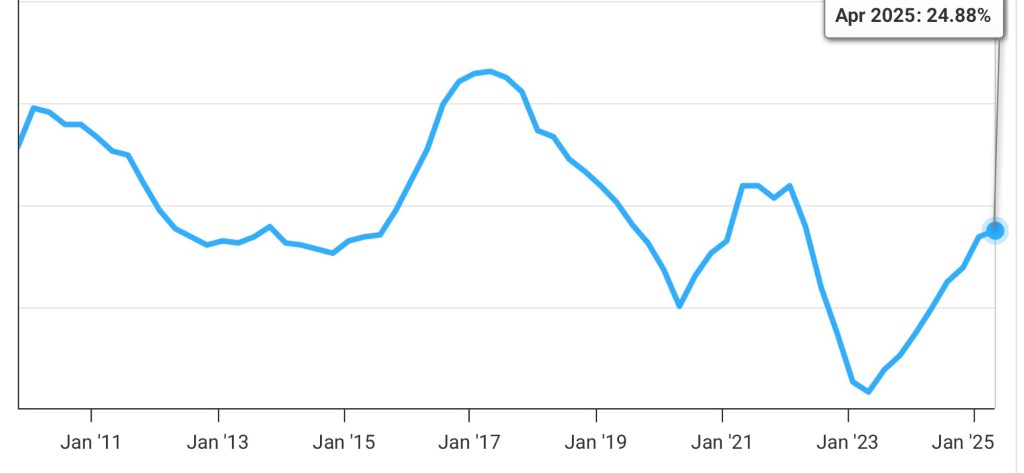
Walmart’s margin today is about the same as the average for discount stores, and it is lower than for department stores, retailers of household and personal products, groceries, and footwear. Furthermore, it is lower today than it was ten years ago. While the margin increased a little during the pandemic, it fell in its aftermath, contrary to Wolf’s assertion. That the company has rebuilt margins steadily since 2023 should be viewed not as an indictment, but perhaps as a testament to improved managerial performance.

Wolf goes on to quote a former Walmart CEO who says that the 25 basis point increase in the gross margin in the latest quarter (from ~24.7% to 24.94%) indicates that the chain can “manage” the tariff impact. Of course it can, but that would not constitute “price gouging”.

A Trump Lackey

Of course, Wolf is taking his cues from Donald Trump, who has been bullying American businesses to “eat” the cost of his tariff onslaught, rather than passing them along to the ultimate buyers of imported goods. However, private businesses should not be expected to take orders from the President. This is not Mussolini’s Italy. Moreover, anyone familiar with tax incidence will understand that sellers are likely to eat some portion of a tariff (sharing the burden with buyers) without jawboning from the executive branch. That’s because buyers demand less at higher prices and sellers wish to avoid losing profitable sales, to the extent they can. But the dynamics of this adjustment process might take time to play out.

It’s also worth noting that a retailer might attempt to hold the line on certain prices in an uncertain cost environment. This uncertainty is a real cost inflicted by Trump. Meanwhile, pointing to increased prices for domestic goods, even if they are truly unaffected by tariffs, proves nothing without knowledge of the relevant cost and market conditions for those goods. It certainly doesn’t prove an “unpatriotic” attempt to cross subsidize imported goods.

In fact, one might say it’s unpatriotic for the federal government to restrict the market choices faced by American consumers and businesses, and for the President to tell American sellers that they better “eat” the cost of tariffs (or else?). And say, what happened to the contention that tariffs aren’t taxes?

Conclusion

Attacks on sellers attempting to recoup tariff costs are unfair and anti-capitalist. They are also somewhat disdainful of the economic sovereignty of American consumers, though not as much as the tariffs themselves. In the case described above, Chad Wolf would have us believe that sellers should not act on their expectations of near-term tariff increases. He also fails to recognize the impact of tariffs on import-competing goods and the cost of tariffs borne by producers who must rely on imported goods as inputs to production. Even worse, Wolf misrepresents some of the evidence he uses to make his case.

More generally, American businesses should not be bullied into taking a hit just because they serve customers who wish to buy imported goods. There is nothing unpatriotic about the freedom to choose what to goods to buy, what goods to stock, and how to maintain profitability in the face of government interference.
That Word “Liberal” … I Don’t Think That Means What You Think It Means

03 Wednesday Jan 2024

Posted by Nuetzel in Conservatism, Liberalism, Socialism

≈ Leave a comment

Tags

Adam Smith, Capitalism, Classical Liberal, Conservatism, Consumer Sovereignty, Corporatism, Free Markets, Freedom of Speech, Friedrich Hayek, Liberalism, Libertarianism, MAGA, monopoly, Monopsony, Nate Silver, Natural Rights, Non-Aggression Principle, Perfect Competition, Progressivism, Property Rights, Public goods, Religious Freedom, Right to Life, Scott Sumner, social engineering, Socialism, State Capacity, State Religion, statism, The Wealth of Nations

Leftism has taken on new dimensions amid its preoccupation with identity politics, victimhood, and “wokeness”. Traditional socialists are still among us, of course, but “wokeists” and “identitarians” have been on the progressive vanguard of late, rooting for the deranged human butchers of Hamas and the dismantling of liberal institutions. This didn’t happen overnight, of course, and traditional socialists are mostly fine with it.

An older story is the rebranding of leftism that took place in the U.S. during the first half of the 20th century, when the word “liberal” was co-opted by leftists. Before that, a liberal orientation was understood to be antithetical to the collectivist mindset long associated with the Left. Note also that liberalism retains its original meaning even today in much of Europe. Often we hear the term “classical liberal” to denote the “original” meaning of liberalism, but the modifier should be wholly unnecessary.

Liberalism Is Not “In-Betweenism”

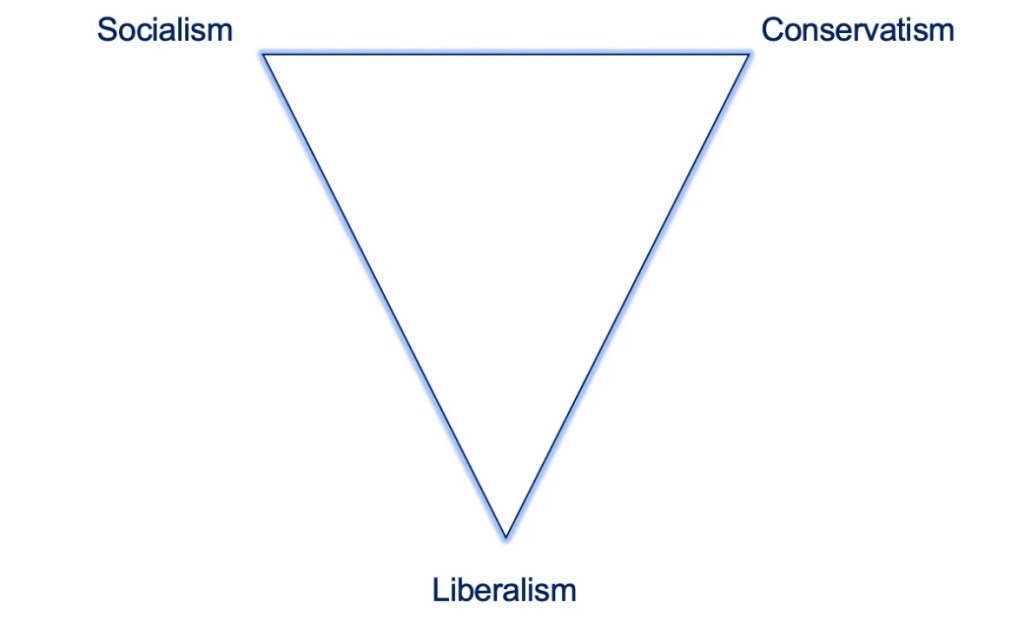
In this vein, Nate Silver presents a basic taxonomy of political orientation in a recent Substack post. It includes the diagram above, which distinguishes between socialism, conservatism, and liberalism. Silver draws on a classic essay written by Friedrich Hayek in 1945, “Why I am Not a Conservative”, in which Hayek discussed the meaning of the word “liberal” (and see here). Liberalism’s true emphasis is a tolerance for individual rights and freedoms, subject to varying articulations of the “nonaggression principle”. That is, “do as you like, but do no harm to others”.

We often see a linear representation distinguishing between so-called progressives on the left and conservatives on the right. Of course, a major hallmark of leftist thinking is extreme interventionism. Leftists or progressives are always keen to detect the slightest whiff of an externality or the slightest departure from the perfectly competitive market ideal. They seem eager to find a role for government in virtually every area of life. While it’s not a limiting case, we can substitute socialism or statism for progressivism on the far left, as Silver does, whereby the state takes primacy in economic and social affairs.

Conservatism, on the other hand, is a deep resistance to change, whether institutional, social, and sometimes economic. Conservatives too often demonstrate a willingness to use the coercive power of the state to prevent change. Hayek noted the willingness of both socialists and conservatives to invoke state power for their own ends.

Similarly, religious conservatives often demand state support beyond that afforded by the freedom to worship in the faith of one’s choice. They might strongly reject certain freedoms held to be fundamental by liberals. Meanwhile, socialists often view mere religious freedom as a threat to the power of the state, or at least they act like it (e.g. see here for an example).

Like conservatives, dedicated statists would doubtless resist change if it meant a loss of their own power. That is, they’d wish to preserve socialist institutions. On this point, witness the vitriol from the Left over what it perceives as threats to the public school monopoly. Witness also the fierce resistance among public employees to reducing the scale of the administrative state, and how advocates of entitlements fiercely resist decreases in the growth rate of those expenditures.

Silver, like Hayek, objects to the traditional, linear framework in which liberals are thought to occupy a range along a line between socialism and conservatism. He objects to that because real liberals value individual liberty as a natural human right, a viewpoint typically abhored by both socialists and conservatives. There is nothing “in between” about it! And of course, conservatives and progressives are equally guilty in their mistaken use of the word “liberal”.

Mapping Political Preferences

Liberty, statism, and conservatism are not exactly orthogonal political dimensions. Larger government almost always means less economic liberty. At a minimum, state dominance implies a social burden associated with public monopoly and monopsony power, as well as tax and welfare-state incentive problems. These features compromise or corrupt the exercise of basic rights. On the other hand, capitalism and its concomitant reliance on consumer sovereignty, individual initiative, free exchange and secure property rights is most in harmony with true liberalism.

For conservatives, resistance to change in support of a traditionally free market economy might offer something of a contradiction. In one sense, it corresponds to upholding market institutions. However, free markets allow new competitors and new technologies to undermine incumbents, who conservatives sometimes wish to defend through regulatory or protectionist measures. And conservatives are almost always too happy to join in the chorus of “price gouging” in response to the healthy operation of the free market in bringing forth supplies.

All that is to say that preferences involving liberty, statism, and traditionalism are not independent of one another. They cannot simply be mapped onto a three-dimensional space. At least the triangular representation gets liberalism out of the middle, but it’s difficult to visualize other ideological positions there. For example, “state religionism” could lie anywhere along the horizontal line at the top or even below it if certain basic liberties are preserved. Facism combines elements of socialism and a deformed version of capitalism that is properly called corporatism, but where would it fall within the triangle?

Big Government Liberalism?

Silver says he leans heavily toward a “big government” version of liberalism, but big government is hard to square with broad liberties. Granted, any well-functioning society must possess a certain level of “state capacity” to defend against private or public violations of individual rights, adjudicate disputes, and provide true public goods. It’s not clear whether Silver’s preferences lie within the bounds of those ambitions. Still, he deserves credit for his recognition that liberalism is wholly different from the progressive, socialist vision. It is the opposite.

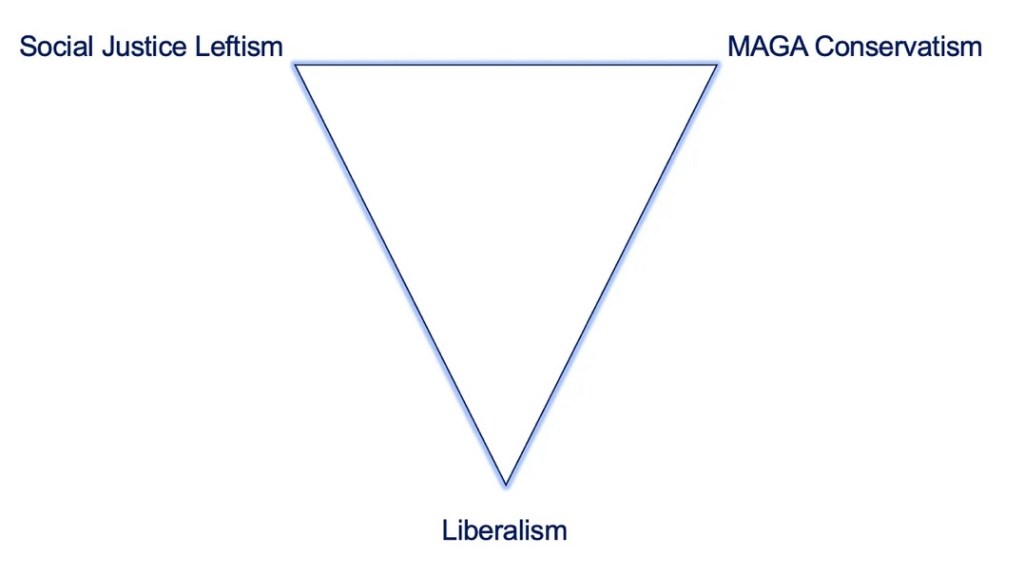
The “New” Triangle

Silver attempts to gives the triangular framework a more contemporary spin by replacing conservatism with “MAGA Conservatism” and socialism with “Social Justice Leftism” (SJL), or “wokeism”. Here, I’m treating MAGA as a “brand”. Nothing below is intended to imply that America should not be a great nation.

The MAGA variant of conservatism emphasizes nationalism, though traditional conservatives have never been short on love of nation. For that matter, as a liberal American, it’s easier to forgive nationalist sentiments than it is the “Death to America” refrain we now hear from some SJLs.

The MAGA brand is also centered around a single individual, Donald Trump, whose rhetoric strikes many as nativistic. And Trump is a populist whose policy proposals are often nakedly political and counterproductive.

SJL shares with socialism an emphasis on various forms of redistribution and social engineering, but with a new focus on victimhood based on classes of identity. Of SJL, Silver says:

“Proponents of SJL usually dislike variations on the term ‘woke’, but the problem is that they dislike almost every other term as well. And we need some term for this ideology, because it encompasses quite a few distinctive features that differentiate it both from liberalism and from traditional, socialist-inflected leftism. In particular, SJL is much less concerned with the material condition of the working class, or with class in general. Instead, it is concerned with identity — especially identity categories involving race, gender and sexuality, but sometimes also many others as part of a sort of intersectional kaleidoscope.”

The gulf between liberals and SJLs couldn’t be wider on issues like free speech and “equity”, and equality of opportunity. MAGAns, on the other hand, have some views on individual rights and responsibility that are largely consistent with liberals, but reflexive populism often leads them to advocate policies protecting rents, corporate welfare, and protectionism.

Divided Liberalism

Liberalism emphasizes limited government, individual autonomy, and free exchange. However, there are issues upon which true liberals are of divided opinion. For example, one such area of controversy is the conflict between a woman’s right to choose and the fetal right to life. Many true liberals disagree over whether the rights of a fetus outweigh its mother’s right to choose, but most would concede that the balance shifts to the fetus at some point well short of birth (putting aside potential dangers to the mother’s life). Open borders is another area that can divide true liberals. On one side, the right to unrestricted mobility is thought to supersede any public interest in enforcing borders and limiting the flow of immigrants. On the other side, questions of national sovereignty, national security, as well as social and state capacity to absorb immigrants take primacy.

Don’t Call Lefties “Liberal”… They’re Not!

True liberalism (including most strains of libertarianism) recognizes various roles that a well-functioning state should play, but it also recognizes the primacy of the individual and individual rights as a social underpinning. As Hayek noted, true liberals are not resistant to change per se, unlike conservatives. But modern progressives demand changes of the worst kind: that the state should intervene to pursue their favored objectives, laying claim to an ever-greater share of private resources. This requires government coercion on a massive scale, the antithesis of liberalism. It’s time to recognize that “progressives” aren’t liberals in any sense of the word. For that matter, they don’t even stand for progress.

I’ll close with a quote from Adam Smith that I cribbed from Scott Sumner. Unfortunately, Sumner does not give the full reference, but I’ll take his word that Smith wrote this 20 years before the publication of The Wealth of Nations:

“Little else is requisite to carry a state to the highest degree of opulence from the lowest barbarism, but peace, easy taxes, and a tolerable administration of justice; all the rest being brought about by the natural course of things. All governments which thwart this natural course, which force things into another channel, or which endeavour to arrest the progress of society at a particular point, are unnatural, and to support themselves are obliged to be oppressive and tyrannical.”

Feel the Nutzenfreude: Joy In Success of Others

06 Sunday Feb 2022

Posted by Nuetzel in Free markets, Human Welfare

≈ Leave a comment

Tags

David Sedaris, Duke University, Economic Efficiency, Exploitation, Free Markets, Freundschaftsbeziehungen, Gleichschaltung, Mark Twain, Marxism, Michael Munger, Nutzenfreude, Nutzenschmerz, Paretian, Pareto Improvements, Pareto Optimality, Privilege, Property Rights, Schadenfreude, Scottish Enlightenment, Social Justice, Tradenfreude, Tradenschmerz

Michael Munger is a professor of economics at Duke University who has coined a term for the distaste we observe, in some quarters, for the success of others. He calls it Nutzenschmerz, a conjunction of the German words “nutzen” (benefit) and “schmerz” (pain).

According to Munger, nutzenschmertz is an impulse of “indignant outrage over someone getting” … “an undeserved benefit”. Of course, “undeserved” is a key word here. I suspect those inflicted with nutzenschmerz apply definitions as flexible and arbitrary as the envy from which they suffer. Nutzenschmerz is a special kind of envy, however, because it doesn’t necessarily imply a personal want of the benefit. It’s simply a condemnation of another’s good fortune. Munger applies an additional twist to the definition, which I discuss below. As a mnemonic device, it might be helpful to think of nutzenschmerz as a hatred for anyone who “gets their nut”!

People of good spirit believe success in others is something to admire, at least if it doesn’t come at someone else’s expense. Perhaps success is more admirable as the fruit of hard work and talent, as opposed to dumb luck. But good luck is nothing to be ashamed of, and it’s often said we make our own luck. Well, maybe only lucky people say that! “Luck” doesn’t necessarily come at the expense of others, however, and no one “loses” things they have no right to expect.

Furthermore, one’s success, lucky or otherwise, often inures to the benefit of others in the form of better products, new jobs, and higher income. For example, if I were to find a deposit of some rare earth mineral on my property while digging a well, I’d consider myself quite lucky. I would then hire people to mine it. The new supplies of the mineral would be used in industry, bringing more plentiful supplies of certain products to consumers. New jobs! Cheaper products!

Economists have a particular framework for discussing “successes” of this kind. If a change occurs from which everyone benefits and no one loses, economists say the change is a Pareto improvement. If only only a few benefit and no one is made worse off, it is a weak Pareto improvement. When all such opportunities have been exhausted, we have reached a state of Pareto optimality. Free markets generally move society toward that state, externalities aside. This is an aspect of what’s meant when we say markets promote economic efficiency. And when technology, tastes, or resource availability change, as they do constantly, new opportunities arise for Pareto improvements.

The Left is selectively intolerant of success and even Pareto improvements from luck or effort. The attitude is usually couched in terms of undeserved “privilege” or some form of “exploitation”. They exempt their own gains, of course, especially when they find themselves in a position to pick winners (and that enterprise almost always involves picking losers as well). In fact, they are probably inclined to celebrate success that owes to subsidies for politically favored activities, which clearly come at the expense of others and are not Paretian in any sense. Social justice warriors demand a free pass on coveting what belongs to others, and they are often just as contemptible of successful effort as they are of dumb luck. Whatever it is you have, or have achieved, don’t expect them to respect it … or your right to have it.

The word Nutzenschmerz amuses me partly because the original German form of my name begins with the letters “Nütz“. Also, like Munger, I’ve always been charmed by the German linguistic practice of stringing words together, like the more familiar Schadenfreude, which means to take pleasure in the misfortunes of others. Or Freundschaftsbeziehungen (friendship demonstrations). Mark Twain said some German words are so long they have perspective! David Sedalis once commented that he heard lots of long words in Germany, but one of the few that stuck was Lebensabschnittspartner:

“This doesn’t translate to ‘lover’ or ‘life partner’ but, rather, to ‘the person I am with today,’ the implication being that things change, and you are keeping yourself open.”

Then, of course, take Gleichschaltung (the standardization of political, economic, and social institutions in authoritarian states). Er … no, please, not that!

In addition to nutzenschmirz, Munger has coined the term Tradenfreude, meaning “joy … at observing the ‘well-contrived machine’ of commercial society, with everyone trading with everyone else for conveniences and necessities.” By extension, he adds Tradenschmerz, meaning the hatred reserved for free markets by many leftists.

Nutzenschmerz is an emotive force that shapes the Marxist psyche. It could be dismissed as incidental to a shallow grasp of the mutually beneficial nature of voluntary trade. However, it also demonstrates a fundamental disrespect for property rights. It’s a rejection of the very things that motivate human action, and which enable cooperation on a scale unprecedented over nearly all of human history preceding the Scottish Enlightenment.

I propose that we should all practice a philosophy of Nutzenfreude, by which I mean taking pleasure in the Paretian successes of others. It might be vicarious, or it might signal the genesis of new opportunities for the rest of us! The thing is, those successes all represent human progress to one degree or another, from which we all derive incremental benefits. That doesn’t mean we shouldn’t be watchful for harms or externalities, but neither should we regard every success with suspicion, or worse, nutzenschmerz!

Do as Munger says: fight nutzenschmerz! And revel in nutzenfreude!

Do You Chronically Feel Cheated?

24 Tuesday Aug 2021

Posted by Nuetzel in Markets

≈ Leave a comment

Tags

Buyer’s Remorse, Classism, Comparative advantage, Consumer Surplus, Excise Taxes, Frank C. Keil, Free Markets, Intervention, Jiewen Zhang, Marxism, Mercantilism, monopoly, Producer Surplus, Reservation Price, Samuel B.G. Johnson, statism, Subsidies, Surplus, Use Value, Zero-Sum Thinking

Economists are rightfully astonished when people act as if they’ve come up losers in almost every transaction they make. It’s often when they’re on the buying end, but here’s the paradox: almost all transactions are voluntary, a major exception being the coerced payment of taxes. There are few private transactions in which free choice is absent. A truly voluntary choice is an absolute proof of gain. In those trades, buyers reveal that they assign less value to choices not made, and foregone choices almost always exist, including the possibility of doing nothing. By their very nature, voluntary transactions are mutually beneficial. So why do people feel cheated so often?

Free To Lose?

Yes, we are free to choose and free to lose! But this isn’t about cases in which a product proves defective or quickly becomes obsolete. Nor is it about making a purchase only to learn of a discount later. Those are ex post events that might have been impossible to foresee. Here, I refer only to the decision made on the day and hour of the purchase, including any assessment of risk. 

A recent study confirmed a pervasive “loser’s” mentality in transactions: “Win–win denial: The psychological underpinnings of zero-sum thinking”, by Samuel B.G. Johnson, Jiewen Zhang, and Frank C. Keil. They also found that people judge the seller as the “winner” in most transactions. The authors considered a few explanations for these findings discussed in psychological literature, such as socially-ingrained mercantilist attitudes and a tendency to zero-sum thinking.

Roots of “Never-a-Buyer-Be” Phobia

Mercantilism was borne of zero-sum thinking — a belief in a hard limit to total wealth. Under those circumstances, accumulating gold or other hard assets was seen as preferable to spending on imports of goods from other nations. Imports meant gold had to be shipped out, but exports of goods brought it in. 

That uncompromising view led to efforts by government on behalf of domestic industries to stanch imports, and it ultimately led to decline. One nation cannot buy another’s goods indefinitely without corresponding flows of goods in the other direction. Nations gain from trade only by producing things in which they have a comparative advantage and selling them to others. In turn, they must purchase goods from others in which they do NOT have a comparative advantage. It’s cheaper that way! And it’s a win-win prescription for building worldwide wealth.

If You Gotta Have It…

People do have a tendency to regret money spent on things they reluctantly feel they must have. They suffer a kind of advance buyer’s remorse, but it stems from having to part with money, which represents all those other nice things one might have had, covering an infinite range of possibilities. This is the same fallacy inherent in mercantilism. The fact is, we purchase things we must have because they represent greater value than doing without. The phantom satisfaction of opportunities foregone are simply not large enough to keep us from doing the “right” thing in these situations.

The Contest For Surplus

There’s a more basic reason why people feel swindled after having engaged in mutually beneficial trade. The seller collects more revenue than marginal cost, and the buyer pays less than the item’s full “use value”. The latter is the buyer’s reservation price: the most they’d be willing to pay under the circumstances. The seller’s gain (over cost) plus the buyer’s gain (under reservation price) is the total “surplus” earned in the exchange. It’s the surplus that’s up for grabs, and both buyer and seller might view the exchange as a contest over its division. Competitive instincts and thrift being what they are, both sides want a larger share of the spoils!

So there truly is a sort of zero-sum game in play. You can try to bargain to capture more of the surplus, but not every seller will do so, often as a matter of policy or reputation. Or you can spend more time and incur greater personal cost by shopping around. Ultimately, if the offer you face is less than your “reservation price”, you’ll extract an absolute benefit from the exchange. Both you and the seller are better off than without it. You both do it voluntarily, and it’s mutually beneficial. Whatever the division of the surplus, you haven’t really lost anything, even if you have the gnawing feeling you might have been able to find a better bargain and captured more surplus.

Exceptions?

You might think the parties to a stock trade cannot both win. However, buyers and sellers have different reasons for making stock trades, which usually involve other needs and differing expectations. Ex ante, both sides of these trades earn a surplus, unless either the seller or buyer is at the losing end of a previous option trade now forcing them to buy or sell the stock.

There are other cases worthy of debate: buyers in monopolized or captive markets are unlikely to collect much of the surplus. Buyers at an informational disadvantage will gain less surplus as well, and they might incur greater risk to any gain whatsoever. Excise taxes allow government to capture some of the surplus, while government subsidies deliver “fake” surplus to the buyer and seller that comes at the expense of taxpayers. Now I feel cheated!

Beware Marxist Sympathies

Buyers and sellers both benefit by virtue of voluntary exchange. The gains might not be divided equally, but the false perception that buyers always get the “short end of the bargain” is a fundamental misunderstanding about how markets work. It also undermines support for basic freedoms allowing autonomous economic decisions and activity, and it strengthens the hand of statists who would fetter the operation of free markets. Like short-sighted mercantilists, those who would intervene in markets create obstacles to human cooperation and the creation of wealth. In fact, the idea that buyers are always cheated is a classist, Marxist notion. Policies acting upon that bias are rife with unintended consequences: small and large market interventions often strike at property rights, which ultimately inhibits the supply of goods and harms consumers. 

April 22: Happy Human Achievement Day!

21 Sunday Apr 2019

Posted by Nuetzel in Free markets, Free Trade, Human Welfare, Uncategorized

≈ Leave a comment

Tags

Disease, Don Boudreaux, Earth Day, Fossil fuels, Free Markets, Human Ingenuity, Human Progress, Literacy, Marion Tupy, Paul Driessen, Poverty

By way of celebrating human ingenuity, I’ll be driving 600 miles on Monday in a beautiful sedan powered by high-octane fuel. I’ll be clothed in incredibly comfortable fibers and have access to a great variety of listening amusements via satellite. The celebration will continue when I arrive home. I’ll enjoy the comfort of climate-control, electric power, modern plumbing, a refrigerator and pantry full of agricultural bounty, delicious wine, and even more incredible access to entertainment and intellectual pursuits. But it’s not just the goods and technology I’ll celebrate. I’ll also raise a glass to the fabulous, free-market institutions that have made all this possible, effectively allowing us to trade with specialized producers all around the world at low cost, and at prices that signal the true scarcities of resources… ill-considered tariffs aside.

In honor of mankind’s great achievements, I bring you additional testimony from Don Boudreaux, who provides some juicy tidbits to mark our progress. Here is more from Marion Tupy at humanprogess.org. And one more link is from Paul Driessen, who last Thanksgiving wrote of the the many developments since 1800 that have drastically improved human well being, including the ability to exploit fossil fuels that are extremely clean-burning and efficient relative to primitive energy sources.

What riches we enjoy today! Contrary to the claims of doomsayers, busybodies, and self-appointed enforcers of an austere existence, our prospects for continued improvement in human standards of living are excellent. The long arc of technological progress has made the effective abundance of resources greater and more sustainable than ever. As the many charts in Tupy’s article demonstrate, long-term trends in real incomes, poverty, literacy, longevity and the incidence of disease are quite favorable. We owe all that to the spread of human ingenuity, freedom, and voluntary exchange. That’s truly progressive!

How Empowered Bleeding Hearts Do Harden

01 Friday Feb 2019

Posted by Nuetzel in Collectivism, Socialism, The Road To Serfdom, Tyranny

≈ Leave a comment

Tags

Authoritarianism, Banality of Evil, Bleeding Hearts, Bryan Caplan, Collectivism, Confiscation, Free Markets, Hugo Chavez, Natural Rights, Social Democracy, Tyranny of the Majority, Venezuela

Here’s an empirical regularity: altruists attaining power to collectivize society’s productive machinery do not stay nice for long. In fact, aggressive pursuit of their goals might compel them to participate in brutal tyranny. But why? What happens to these sweet egalitarians who are, after all, imbued with the most earnest desire to elevate the common man by equalizing the fruits of society’s bounty?

Bryan Caplan offers Venezuela as Exhibit A in “A Short Hop from Bleeding Heart to Mailed Fist“:

“When Hugo Chavez began ruling Venezuela, he sounded like a classic bleeding-heart – full of pity for the poor and downtrodden. Plenty of people took him at his words – not just Venezuelans, but much of the international bleeding-heart community. … Almost every Communist dictatorship launches with mountains of humanitarian propaganda. Yet ultimately, almost everyone who doesn’t fear for his life wakes up and smells the tyranny.”

Venezuela’s collapse is merely the most recent in a long history of socialist debacles. Authoritarians certainly come in other stripes, but collectivists seem especially prone to the development of vicious alter-egos. But again, why?

Caplan knows the answer, and in something of a dialectical exercise, he proposes several explanations for the nice-to-nasty phenomenon. It’s not the infiltration of “bad guys”. Plenty of evidence suggests that the same people are at both ends of the transition, and for now let’s give the benefit of the doubt to the nicest elements of the avant guarde, or even those who go simply along on the basis of their idealism. It’s implausible that such humanitarian souls could believe it will be necessary, at the outset, to crush their opposition by force. Moreover, that approach risks immediate outcomes that are far too dire. Might an authoritarian or militaristic turn be necessary to deter hostile foreign actors who might attempt to foil collectivization? If so, it still doesn’t explain why subjugation of domestic citizens is ultimately accepted as a legitimate use of force by sincere altruists.

Caplan moves on to more compelling explanations of the disorder. Perhaps the expression of bleeding heart intentions is propaganda from the very start. Perhaps the rhetoric is really just hate speech disguised as noble intent. Surely those two explanations comport with the behavior of those having uglier motives for collectivism: envy and vengeance. And while those elements are certain to be active in any socialist front, they don’t explain why the bleeders also abecome beaters.

The best explanation for the horrid metamorphosis of empowered altruists is that egalitarian policies simply do not work very well. Caplan says:

“Bleeding-heart policies work so poorly that only the mailed fist can sustain them. In this story, the bleeding hearts are at least initially sincere. If their policies worked well enough to inspire broad support, the bleeding hearts would play nice. Unfortunately, bleeding-heart policies are exorbitantly expensive and often directly counter-productive. Pursued aggressively, they predictably lead to disaster. At this point, a saintly bleeding heart will admit error and back off. A pragmatic bleeding heart will compromise. The rest, however, respond to their own failures with rage and scapegoating. Once you institutionalize that rage and scapegoating, the mailed fist has arrived.” [Caplan’s emphasis]

The compulsory nature of policies advocated by leftists makes their system of social organization inherently unstable. With the imposition of every rule limiting the operation of private markets, with every compromise of the price mechanism, and with every new confiscatory policy, the economy becomes more feeble and inflexible. As several commenters on Caplan’s post note, socialists are people who simply do not understand economics.

The path to collectivism always involves promises that are impossible to keep. Personal concerns must be renounced in favor of the collective. Individuals are denied their freedom to act on creative impulses and their ability to cooperate freely with others in pursuit of personal well-being. Those are human rights that are quite unnatural to part with. That means it is impossible to achieve the collective without an implicit or explicit threat of enforcement through violent police power. Bleeding hearts will actually participate in the inevitable tyranny because they are so convinced of the righteousness of their cause.

Whether you call it socialism or social democracy makes no difference. The latter merely cloaks tyranny in a majoritarian dominance that would have enraged our nation’s founders. They understood the despotism inherent in allowing a majority to dictate the existence of basic rights. However, the bleeding hearts are always sure they know “what’s right” without weighing implications beyond the injustice du jour. That demands the application of force. And when confronted with the catastrophic results of their peremptory whimsy, they have no choice but to use still more force.

The banality of evil is truly a progressive disease. Fortunately, we have a preventive vaccine: the U.S. Constitution. But it will work only if we’re wise enough to rely on the framer’s original intent.


Lighten Up For Human Achievement Hour!

25 Saturday Mar 2017

Posted by Nuetzel in Free markets, Human Welfare

≈ Leave a comment

Tags

Chelsea Follett, Competitive Enterprise Institute, Earth Hour, Fracking, Free Markets, Human Achievement Hour, Human Ingenuity, HumanProgress.org, Lowering Emissions

idea-light-bulb

Tonight, Saturday March 25th from 8:30 to 9:30, I’ll be doing my part to celebrate humankind’s ascendence over the bare subsistence and misery that was ubiquitous until just the last few centuries. Human Achievement Hour is sponsored by the Competitive Enterprise Institute (CEI) to celebrate the incredible technological miracles  brought forth by human ingenuity and free markets:

“Originally launched as the counter argument to the World Wide Fund for Nature’s Earth Hour, where participants renounce the environmental impacts of modern technology by turning off their lights for an hour, Human Achievement Hour challenges people to look forward rather than back to the dark ages.

Symbolically or not, Earth Hour is a misguided effort that completely ignores how modern technology allows societies to develop new and more sustainable practices, like helping people around the world be more eco-friendly and better conserve our natural resources.

While Earth Hour supporters may suggest rolling brown-outs in India are desirable, we respectfully disagree. Instead of sitting in the dark, Human Achievement Hour promotes new ideas and celebrates the technology and innovation that will help solve the world’s environmental challenges.”

The following are suggestions from CEI as to how you can participate in the celebration. I’ll take them up on the third and sixth items on this list, just as I have for the past several years.

  • Use your phone or computer to connect with friends and family
  • Watch a movie or your favorite television show
  • Drink a beer or cocktail
  • Drive a car or take a ride-sharing service
  • Take a hot shower
  • Or, in true CEI fashion, celebrate reliable electricity that has saved lives, by bringing heat and air conditioning to people around the world, and keep your lights on for an hour

Light up the night! Here are a couple of links with information on the worldwide progress in improving human living conditions:

The Human Progress Blog

Thank Fracking For Reduced Emissions

We are winning the war against starvation, disease and poverty around the globe, though progress can seem frustratingly gradual in real time. Nevertheless, over the sweep of history, we are winning the battle in a dramatic way.

Willing Exchange With Capitalists

18 Wednesday May 2016

Posted by Nuetzel in Capitalism, Marxism

≈ Leave a comment

Tags

Capitalism, competition, Free Markets, Gary Galles, Government Monopoly, Karl Marx, Labor Theory of Value, Legitimized Coercion, Leonard Read, Liberalism, Limits on Government, Market Power, Marxism, Misuse of Words, Patrick Barron, Robert Murphy, Social Organization, statism, The Beacon, Voluntary Exchange, Willing Exchange

marx1

Now and then I’m inspired to blog on the misshapen language of political discourse. I recently wrote about the misuse of words by the American left, including their use of the term “liberalism”. This time, the particular word in play is “capitalism”, which I use to describe the ideal laissez faire economic order. I have always viewed it as a force for good. Real capitalism means free markets, consumer choice, strong private property rights, rewards to private initiative, and competition among producers. Even under conditions of concentrated market power, capitalism is preferable to government monopoly. Nevertheless, Gary Galles writes at The Beacon that capitalism is an inferior description of the laissez-faire ideal than”willing exchange“, or alternatively, unforced or voluntary exchange. Perhaps he has a point.

Capital and labor are the primary factors of production and both must be compensated. Labor earns a wage and capital earns a profit. Generally, the more capital a worker has available on the job, the greater the worker’s productivity and the greater the worker’s wage. However, any profit or return to capital is viewed by the left as an undeserved rent. The question of compensation is quite aside from the valuable social role profits play in directing resources to their most valued uses. Robert Murphy’s drives this home in an excellent recent essay entitled “There’s No Such Thing As Excessive Profits“. Here, here! In another post related to the crucial social role played by capital and profit, Patrick Barron explains “Why We Need Private Property To Deal With Scarce Resources“.

Again, any return to capital, normal or extra-normal, is seen by the left as a reward that should flow to labor in a just world. That is the upshot of Karl Marx’s labor theory of value. Thus, owners of capital are characterized as “takers”. Galles notes the belief that Marx coined the term “capitalism” in order to:

“…falsely imply that the system benefited capitalists at others’ expense, when, in fact, workers have been the greatest gainers from all the productivity enhancements the system has generated.“

He quotes Leonard Read on the value of “willing versus unwilling exchange” as an effective way to delineate and contrast the positions of adherents of laissez faire and statism:

“Standing for willing exchange, on the one hand, or for unwilling exchange, on the other, more nearly accents our ideological differences than does the employment of the terms in common usage…there is a minimum of verbal facade to hide behind.

Willing exchange…has not yet been saddled with emotional connotations …Further, its antithesis, unwilling exchange…no one, not even a protagonist, proudly acknowledges he favors that; it does offense to his idealism.

If we cut through all the verbiage used to report and analyze political and economic controversy…much of it boils down to a denial of willing and the insistence upon unwilling exchange. …

The concept of willing exchange unseats Napoleonic behavior—all forms of authoritarianism—and enthrones the individual. The consumer becomes king. Individual freedom of choice rules economic affairs… [It] is for me, and a willing seller, to decide; it is no one else’s business!“

The hallmark of the state as an actor is coercion. After all, it derives its power via “legitimized” coercion. Individuals are bound under its authority to participate in involuntary exchanges and to make do with a constrained set of willing exchanges. As much as we might amuse ourselves with the notion that our Constitution keeps the state in check, it grows and grows, and where it stops, nobody knows. One wonders how strongly the demonization of so-called “capitalists” plays into this process.

I often refer to voluntary exchange in one form or another. The term recommends itself by virtue of its implication of mutual benefit among parties. Nevertheless, I would have a difficult time abandoning the term “capitalism” in my writing. Here’s the thing: capitalism and free markets have had tremendous success over the last two centuries in improving material conditions and ending human poverty around the globe. Meanwhile, Marxism as a philosophy, and collectivism as a form of social organization, have done nothing to recommend themselves to humankind. So the joke’s on Marx, though we haven’t heard the last of the efforts to besmirch capitalism.

Bernie, Breadlines and Bumpkins

05 Tuesday Apr 2016

Posted by Nuetzel in Capitalism, Socialism

≈ Leave a comment

Tags

Bernie Sanders, Breadlines, Chronic Shortages, First Amendment, Food Rationing, Free College Tuition, Free Markets, Gains From Trade, Living Wage, Matt Welch, Medicare, Press Crackdown, Reason.com, Sandanistas, Scandinavia, Totalitarian Regimes, Universal Pre-K

12923208_223278574701995_2096558007828525663_n

For sheer stupidity, you can’t top the remarks made in this video by Bernie Sanders, uttered as an adult, praising the fact that consumers in socialist countries must stand in line to receive food rations! Here is his distorted logic:

“It’s funny, sometimes American journalists talk about how bad a country is, that people are lining up for food. That is a good thing! In other countries people don’t line up for food: the rich get the food and the poor starve to death.“

I try to avoid derogation of individuals in favor of demonstrating the weakness of their words or ideas. I must admit that it’s hard to maintain both ends of that policy in Mr. Sanders’ case. He’s never availed himself of the well-known laws of economics that invalidate his primitive views. For example, he doesn’t grasp that the price system in a market economy provides incentives for conservation and for extra production when supplies are short. In Sanders’ mind, that mechanism is unacceptable because it means someone will profit. Of course, the cooperative nature of markets and voluntary exchange is lost on Sanders. Part of that cooperation is the willingness of buyers to reward able sellers, giving them the incentive to meet future demands. And they do!

Sanders doesn’t understand the universal tendency of government to waste resources. The state’s command over resources derives from coercive power, and it lacks the discipline and incentives for efficiency that are always present in markets. Sanders has not reflected on the shackles the regulatory state places on the productive, private sector. He imagines that government can be trusted because good-hearted people, like him, will always be in charge under a socialist state, and they will design the way forward. Yes, with the aid of their coercive power.

As for breadlines, Sanders has never assimilated the fact that the widespread, plentiful food supplies available in capitalist societies are unprecedented historically. Or that socialist systems have always been typified by chronic shortages of food and other consumer goods. Those are simply empirical facts, on one hand, but they are not accidents. Sanders hasn’t noticed these “details”, remaining immersed in a wild fantasy that prosperity is possible under socialism. Don’t point to Scandinavia as a counterargument, as Sanders supporters are wont to do. There, democratic socialism has wrongly been credited for prosperity that owes more to wealth created under capitalism, before those countries began to feed on themselves.

Bread lines are awful, but they aren’t the worst of it. Mr. Sanders has also praised certain tyrannical regimes, as well as the crackdown on the press under the communist Sandinista regime in Nicaragua. Here is a quote in Reason from Michael Moynihan, a former Reason editor who has uncovered a treasure trove of material on Sanders’ past pronouncements:

“When challenged on the Sandinistas’ incessant censorship, Sanders had a disturbing stock answer: Nicaragua was at war with counterrevolutionary forces, funded by the United States, and wartime occasionally necessitated undemocratic measures.“

Well, the First Amendment may be passe, and the revolution is at hand, eh?

Another Reason article by Matt Welch covers ten of “Bernie’s Bad Ideas“, most of which are grounded in an understanding of economics that can only be described as child-like: the “living” wage, free college tuition, universal pre-K education, opposition to international trade, and Medicare for all are just a few of Sanders’ nitwitted plans. I’ve written about many of these topics on Sacred Cow Chips in the past (a few of those posts are linked in the last sentence). Sanders’ supporters are seduced by the falsehood that government can reward the “deserving” justly for something, in some way, by some miracle, without destroying the incredible font of (under-appreciated) prosperity that is the market economy.

To end on a high note, as it were, here’s a fun Facebook page called “Bernie Sanders Bread Line” with some interesting takes on the lunatic ravings of the socialist candidate. All of those memes ring true, including the one at the top of this post.


Corporatists of the World Unite!

01 Wednesday Jul 2015

Posted by Nuetzel in Big Government

≈ Leave a comment

Tags

Benito Mussolini, Capitalism, Classical Liberalism, Corporatism, Edmund S. Phelps, Free Markets, Jason Brennan, Liberalism, Max Borders, Neoliberalism, rent seeking, Thayer Watkins, The Freeman

Corporatism Santa

As a classical liberal, I’m fascinated by the ongoing confusion of the Progressive Left over the meaning of the word liberalism. To be “liberal” is to support individual autonomy, self-determination, and freedom from coercion by the state. True liberalism necessarily implies a minimal state apparatus because the state can only derive authority from its power to coerce. Confusion over the meaning of liberalism was covered in “Labels For the Authoritarian Left” on Sacred Cow Chips last year.

A similar confusion surrounds use of the word corporatism and its relationship to progressivism on the one hand, and liberalism on the other. I came across this excellent essay by Max Borders in The Freeman that begins with a discussion of the term neoliberalism. Lately this has been invoked as an derogatory reference to classical liberalism, except that the users don’t really understand the latter. In fact, as Borders points out, one prominent author describes free market advocacy as something more akin to cronyism, complete with state support and bailouts, which is contradictory on its face. But it is consistent with the doctrine of corporatism. Borders offers this quote from Thayer Watkins:

“In the last half of the 19th century people of the working class in Europe were beginning to show interest in the ideas of socialism and syndicalism. Some members of the intelligentsia, particularly the Catholic intelligentsia, decided to formulate an alternative to socialism which would emphasize social justice without the radical solution of the abolition of private property.

The result was called Corporatism. The name had nothing to do with the notion of a business corporation except that both words are derived from the Latin word for body, corpus.“

Sounds like innocent beginnings, but enforcing “social justice” within this framework demands a substantial role for the state and an intricate set of relationships between the state and private parties. That provides opportunities for accumulating economic power and wealth by manipulating any arm of government that legislates, adjudicates, purchases, licenses, regulates or levies taxes. That is, any arm of government! Such rent-seeking activity gives rise to a symbiosis between the state and powerful private economic actors, and that is the essence of modern corporatism as practiced by Mussolini, George W. Bush and Obama and their governments. Borders quotes economics Nobel laureate Edmund Phelps:

“The managerial state has assumed responsibility for looking after everything from the incomes of the middle class to the profitability of large corporations to industrial advancement. This system . . . is . . . an economic order that harks back to Bismarck in the late nineteenth century and Mussolini in the twentieth: corporatism.“

Borders closes with a discussion of Jason Brennan’s admonition: “Dear Left: Corporatism is Your Fault”, which dishes the bald truth.

“When you create complicated tax codes, complicated regulatory regimes, and complicated licensing rules, these regulations naturally select for larger and larger corporations. We told you that would happen. Of course, these increasingly large corporations then capture these rules, codes, and regulations to disadvantage their competitors and exploit the rest of us.“

Corporatism has nothing to do with the corporate form of business organization per se. Granted, limited liability is an artificial construct created by the state, and it is a hallmark of that form, so it’s fair to cite it as an example of corporatism. But corporatism in its systemic sense represents the larger web of non-market dependencies between the state and powerful economic actors, corporate in form or not. Both sides benefit from these relationships and, in many direct and indirect ways, compromise the integrity of the voluntary market mechanism and harm smaller actors who rely on it.

This is not a state of affairs that meets with the approval of classical liberals, free marketeers and fans of real capitalism, the so-called “neoliberals” of Leftist fiction. The Left purports to hate corporatism too, but they don’t understand its genesis and are fully oblivious to the real reasons for its progression. Instead, in their ignorance, they pass the blame onto “neoliberals”.

← Older posts
Follow Sacred Cow Chips on WordPress.com

Recent Posts

  • The Case Against Interest On Reserves
  • Immigration and Merit As Fiscal Propositions
  • Tariff “Dividend” From An Indigent State
  • Almost Looks Like the Fed Has a 3% Inflation Target
  • Government Malpractice Breeds Health Care Havoc

Archives

  • January 2026
  • December 2025
  • November 2025
  • October 2025
  • September 2025
  • August 2025
  • July 2025
  • June 2025
  • May 2025
  • April 2025
  • March 2025
  • February 2025
  • January 2025
  • December 2024
  • November 2024
  • October 2024
  • September 2024
  • August 2024
  • July 2024
  • June 2024
  • May 2024
  • April 2024
  • March 2024
  • February 2024
  • January 2024
  • December 2023
  • November 2023
  • August 2023
  • July 2023
  • June 2023
  • May 2023
  • April 2023
  • March 2023
  • February 2023
  • January 2023
  • December 2022
  • November 2022
  • October 2022
  • September 2022
  • August 2022
  • July 2022
  • June 2022
  • May 2022
  • April 2022
  • March 2022
  • February 2022
  • January 2022
  • December 2021
  • November 2021
  • October 2021
  • September 2021
  • August 2021
  • July 2021
  • June 2021
  • May 2021
  • April 2021
  • March 2021
  • February 2021
  • January 2021
  • December 2020
  • November 2020
  • October 2020
  • September 2020
  • August 2020
  • July 2020
  • June 2020
  • May 2020
  • April 2020
  • March 2020
  • February 2020
  • January 2020
  • December 2019
  • November 2019
  • October 2019
  • September 2019
  • August 2019
  • July 2019
  • June 2019
  • May 2019
  • April 2019
  • March 2019
  • February 2019
  • January 2019
  • December 2018
  • November 2018
  • October 2018
  • September 2018
  • August 2018
  • July 2018
  • June 2018
  • May 2018
  • April 2018
  • March 2018
  • February 2018
  • January 2018
  • December 2017
  • November 2017
  • October 2017
  • September 2017
  • August 2017
  • July 2017
  • June 2017
  • May 2017
  • April 2017
  • March 2017
  • February 2017
  • January 2017
  • December 2016
  • November 2016
  • October 2016
  • September 2016
  • August 2016
  • July 2016
  • June 2016
  • May 2016
  • April 2016
  • March 2016
  • February 2016
  • January 2016
  • December 2015
  • November 2015
  • October 2015
  • September 2015
  • August 2015
  • July 2015
  • June 2015
  • May 2015
  • April 2015
  • March 2015
  • February 2015
  • January 2015
  • December 2014
  • November 2014
  • October 2014
  • September 2014
  • August 2014
  • July 2014
  • June 2014
  • May 2014
  • April 2014
  • March 2014

Blogs I Follow

  • Passive Income Kickstart
  • OnlyFinance.net
  • TLC Cholesterol
  • Nintil
  • kendunning.net
  • DCWhispers.com
  • Hoong-Wai in the UK
  • Marginal REVOLUTION
  • Stlouis
  • Watts Up With That?
  • Aussie Nationalist Blog
  • American Elephants
  • The View from Alexandria
  • The Gymnasium
  • A Force for Good
  • Notes On Liberty
  • troymo
  • SUNDAY BLOG Stephanie Sievers
  • Miss Lou Acquiring Lore
  • Your Well Wisher Program
  • Objectivism In Depth
  • RobotEnomics
  • Orderstatistic
  • Paradigm Library
  • Scattered Showers and Quicksand

Blog at WordPress.com.

Passive Income Kickstart

OnlyFinance.net

TLC Cholesterol

Nintil

To estimate, compare, distinguish, discuss, and trace to its principal sources everything

kendunning.net

The Future is Ours to Create

DCWhispers.com

Hoong-Wai in the UK

A Commonwealth immigrant's perspective on the UK's public arena.

Marginal REVOLUTION

Small Steps Toward A Much Better World

Stlouis

Watts Up With That?

The world's most viewed site on global warming and climate change

Aussie Nationalist Blog

Commentary from a Paleoconservative and Nationalist perspective

American Elephants

Defending Life, Liberty and the Pursuit of Happiness

The View from Alexandria

In advanced civilizations the period loosely called Alexandrian is usually associated with flexible morals, perfunctory religion, populist standards and cosmopolitan tastes, feminism, exotic cults, and the rapid turnover of high and low fads---in short, a falling away (which is all that decadence means) from the strictness of traditional rules, embodied in character and inforced from within. -- Jacques Barzun

The Gymnasium

A place for reason, politics, economics, and faith steeped in the classical liberal tradition

A Force for Good

How economics, morality, and markets combine

Notes On Liberty

Spontaneous thoughts on a humble creed

troymo

SUNDAY BLOG Stephanie Sievers

Escaping the everyday life with photographs from my travels

Miss Lou Acquiring Lore

Gallery of Life...

Your Well Wisher Program

Attempt to solve commonly known problems…

Objectivism In Depth

Exploring Ayn Rand's revolutionary philosophy.

RobotEnomics

(A)n (I)ntelligent Future

Orderstatistic

Economics, chess and anything else on my mind.

Paradigm Library

OODA Looping

Scattered Showers and Quicksand

Musings on science, investing, finance, economics, politics, and probably fly fishing.

  • Subscribe Subscribed
    • Sacred Cow Chips
    • Join 128 other subscribers
    • Already have a WordPress.com account? Log in now.
    • Sacred Cow Chips
    • Subscribe Subscribed
    • Sign up
    • Log in
    • Report this content
    • View site in Reader
    • Manage subscriptions
    • Collapse this bar
 

Loading Comments...