• About

Sacred Cow Chips

Sacred Cow Chips

Tag Archives: Glenn Reynolds

Bad Idea: Campaign Finance Reform

25 Friday Jan 2019

Posted by Nuetzel in Campaign Finance, Free Speech

≈ Leave a comment

Tags

501(c) Organizations, Campaign Finance Reform, Citizens United, Dark Money, David Harsanyi, Disclosure Requirements, Federal Election Commission, First Amendment, Free Speech, Glenn Reynolds, Independent Expenditure Committees, Jeffrey Milyo, Nancy Pelosi, Revolving Door Tax, Ron Paul, Social Welfare Organizations, Super PACs, Term Limits

Everyone seems to hate money in politics, and nearly everyone says campaign finance reform is needed to eliminate political corruption… nearly. Money in politics is blamed for allowing powerful interests to “buy” seats in the legislature, or in executive positions, as well as “tit-for-tat” influence over pieces of legislation. But not so fast: attempts at campaign finance regulation in the past have been largely unsuccessful in achieving their goals. Furthermore, campaign finance reforms may have perverse consequences, which I’ll discuss below. More importantly, while “taking money out of politics” sounds noble to many, it starkly implies abrogation of First Amendment rights. Far from “leveling the playing field”, there is a great danger that it would lead to suppression of minority opinions. For those reasons. it’s better to consider other means of ensuring that elected officials behave even-handedly in attending to their duties.

Protected Speech

Former Congressman Ron Paul is highly skeptical that any good can come of campaign finance legislation:

“…campaign finance reform legislation does not limit the influence of powerful special interests. Instead, it violates the First Amendment and burdens those seeking real change in government.”

Here is David Harsanyi on the same point:

“Reducing the power of ‘special interests’ in Washington is always a popular issue with voters. The problem, of course, is that every voter considers another group a special interest. … specific campaign finance reform legislation is always about inhibiting someone’s speech.”

Government attempts to curb speech are bad enough, but there is also interest in subsidizing speech arising from certain quarters. Harsanyi is rightly critical of a House bill that proposes to do just that, and Nancy Pelosi has promised to bring the bill to the floor. Among other things, it would authorize a 6-to-1 federal match of small-dollar campaign donations so as to promote “grass-roots” electoral efforts. It is quite simply a bad idea to create a mechanism whereby government bureaucrats can manipulate campaign funding, potentially favoring certain kinds of speech, via the explicit use of funds from taxpayers who might well blanche at the thought of funding certain campaigns.

The bill would also impose new disclosure requirements on large contributions to 501(c)(4) organizations, which qualify as “social welfare” groups under the tax code, and whose “primary” purpose is not campaign-related. To this he says:

“… this obsession with eliminating anonymity is also a transparent attempt to chill speech and undermine minority opinions.”

Let’s face it: to complain about the use of money in promoting speech is to complain about speech itself. We can all speak out loud, but one can’t hope to spread a message broadly without bringing resources to bear on the effort. That’s true whether you are printing, broadcasting, or spreading messages on social media. It almost always takes staff, including creative talent, equipment, media buying power, and usually office space. If you don’t have the requisite resources then you must hustle, press flesh, cajole members of the media, and join with other like-minded individuals, especially those who might agree to commit resources.

Barring a monopoly on speech, choosing a particular scale at which speech becomes unacceptable is itself a denial of the right to free speech. And that right can be exercised by individuals and by associations of individuals. As to the latter, the form of association makes no difference: the union, nonprofit, and for-profit corporate forms are all valid associations through which individuals can speak as one, just as all for-profit media corporations have always exercised their First Amendment rights. That was the Supreme Court’s ruling in Citizen’s United vs. Federal Election Commission (FEC) in 2009, which remains oddly controversial. Again, if you think the ability to speak from a large platform is too much, then you are also willing to restrict speech by for-profit newspapers and television networks, and you are a tyrant.

Money and Electoral Success

In any case, virtually all campaign contributions originating in the for-profit corporate sector come from employee political action committees (PACs), not from corporations themselves. And since Citizen’s United, there’s been little uptick in campaign contributions from for-profit corporations. In fact, according to this report on campaign finance, unions have been much more aggressive than businesses in leveraging the Citizen’s United decision. The report also demonstrates the unsurprising fact that incumbents tend to spend much more on elections than their challengers. However, the authors note that across incumbents, greater spending is associated with lower vote shares, while the reverse is true across challengers. That just means, however, that incumbents must spend a lot to defeat a serious challenger.

Jeffrey Milyo made the last point more than 15 years ago:

“Most systematic studies, however, find no effect of marginal campaign spending on the electoral success of candidates … How can this be so? The best explanation to date is that competent candidates are adept at both convincing contributors to give money and convincing voters to give their vote. Consequently, the finding that campaign spending and electoral success are highly correlated exaggerates the importance of money to a candidate’s chances of winning.”

There is also a lack of evidence that politicians trade their votes for campaign contributions:

“… donors tend to give to like-minded candidates. Of course, if candidates choose their policy positions in anticipation of a subsequent payoff in campaign contributions, there would be no real distinction between accepting bribes and accepting contributions from like-minded voters. However, studies of legislative behavior indicate that the most important determinants of an incumbent’s voting record are constituent interests, party, and personal ideology.”

A tremendous disparity exists between public perceptions of the importance of money in political campaigns and the actual magnitude of campaign spending. Again, from Milyo:

“If campaign contributions do not buy favors, then why is so much money spent on politics? In fact, scholars of American politics have long noted how little is spent on politics. Consider that large firms spend ten times as much on lobbying as their employees spend on campaign contributions through PACs, as individuals, or in the form of unregulated contributions to political parties (i.e., soft money).”

Milyo’s article was written well before the Citizen’s United decision. At the time it was still illegal for corporations to make campaign contributions, but that seems to have made little difference.

In an Appeals Court decision in 2010, Independent Expenditure Committees (Super PACs) won the right to accept contributions from corporations and individuals beyond federal limits. Super PACs, however, are technically prohibited from coordinating their activities with political candidates for federal office. In fact, Super PACs have been known at times to work at cross-purposes to the political parties whose candidates they generally favor. Furthermore, there is very little evidence that corporate contributions provide more than a small share of Super PAC funds, not even via “dark money” contributions via 501(c) organizations.

Futile Reforms 

Ron Paul (linked above) notes that powerful interests will always find ways to support policies by which they stand to profit. Those interests often benefit from regulatory policies that create burdens for smaller competitors, spending programs that bring fat government contracts, and subsidies in support of favored activities or technologies. However, restricting campaign finance is a particularly troubling and ineffective approach to combating these efforts. As Milyo says:

“The consensus among academic researchers is that money is far less important in determining either election or policy outcomes than conventional wisdom holds it to be. Consequently, the benefits of campaign finance reforms have also been exaggerated.”

Beyond the lack of evidence that reform is needed, Milyo argues that restrictions on campaign contributions may have nasty unintended consequences. First, cross-sectional studies across states have shown that limits on contributions lead to less electoral competition and lower voter turnout. Second, less campaign advertising reduces interest and awareness of candidate positions among voters, also suppressing turnout. Finally, there is a real danger that incumbents can manipulate reform legislation in order to create electoral barriers to potential challengers.

Alternatives

There may be better ways to reduce the influence of moneyed interests on policy than campaign finance reforms. Term limits obviously shorten the duration of the incumbent advantage as well as corrupt actions by any office-holder who is somehow “bought and paid-for”. Most Libertarians favor term limits to reduce corruption and encourage the kinds of “citizen legislators” idealized by the nation’s founders. Others make an opposing argument that it is our electoral duty to remove legislators from office at the ballot box, and therefore term limits were left out of the Constitution for good reason. Still others say that term limits might make corrupt politicians too keen to act quickly.

Another idea is based on the “revolving door tax” often mentioned by Glenn Reynolds. Not infrequently, government bureaucrats are offered lucrative positions with firms whom they regulate, or they take on these firms as private clients once they leave government. Needless to say, this creates perverse incentives for self-interested public servants. Reynolds suggests an additional tax on subsequent income earned after accepting such an offer. Extending the idea to politicians would mean an additional tax on income earned by any former office-holder accepting work for a firm or industry specifically targeted for benefits under legislation they sponsored during their term. There is much detail to be fleshed out, but the idea is fascinating.

Conclusion

Campaign finance reform is futile: there will always be creative ways around it, so it generally doesn’t reap rewards. Campaign funding itself is rather ineffectual at the margin in generating electoral gains. Moreover, campaign finance reform is an endeavor that is almost guaranteed to run afoul of our First Amendment protections of free speech. In addition, the result may a reversion to a less-informed and less interested electorate, lower voter turnout, as well as manipulation of the reform process itself.
The Court and Kavanaugh

08 Monday Oct 2018

Posted by Nuetzel in Supreme Court

≈ Leave a comment

Tags

Anthony Kennedy, Brett Kavanaugh, Due Process, Glenn Reynolds, Metadata Collection, National Security, PATRIOT Act, Privacy, Roev. Wade, Second Amendment, Supreme Court

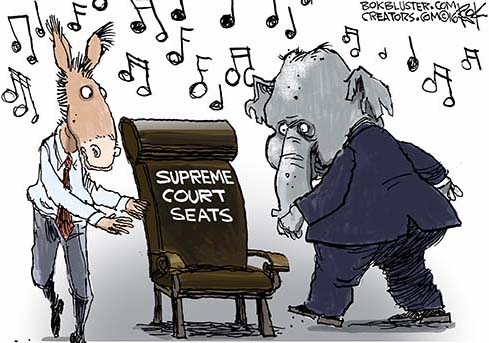
There are both great and hysterically negative expectations for Brett Kavanaugh’s seating on the Supreme Court, depending on one’s perspective. The changes are likely to be much less dramatic than many think, however, according to Glenn Reynolds in his Sunday column. As he says, most cases before the Supreme Court are decided by easy majorities, and that won’t change. On split decisions, Kavanaugh will be less of a “swing vote” than Anthony Kennedy, no doubt, and he will have influence over the choice of cases to be heard by the Court because the selection of a case requires only four justices.

Reynolds thinks Kavanaugh is not as conservative as partisans hope or fear. For example, Reynolds believes he is unlikely to vote to overturn Roe vs. Wade, when and if that question comes before the Court. There may be shifts on narrower questions, such as an earlier definition of fetal viability (in recognition of improved medical technology) and greater protection against arrangements that facilitate illegal funding of abortions by federal taxpayers. Reynolds acknowledges, however, that Kavanaugh is a stronger advocate of Second Amendment rights than Kennedy, so those protections are less likely to be eroded.

Reynolds’ also notes a shift that is likely to take place in legal academia:

“Strange new respect for judicial minimalism. As Harvard Law professor Adrian Vermeule remarked, ‘Law review editors: brace for a tidal wave of legal academic theories supporting judicial minimalism, Thayerianism, and strong — very strong — theories of precedent. Above all: the Court must do nothing without bipartisan agreement, otherwise it is illegitimate.’ The past half-century’s enthusiasm for judicial activism will vanish, as legal academia turns on a dime to promote theories that will constrain the court until a left-leaning majority returns, at which point they’ll turn on a dime again.”

That is all too likely. My liberal friends insist that the four justices on the left are free of political bias. Don’t laugh! I’ll be happy if Kavanaugh, as a justice, sticks to his traditional originalist philosophy on constitutional interpretation. I’m under no illusion that the left side of the bench takes the original meaning of the Constitution seriously.

My own concerns about Kavanaugh have to do with his earlier work in the Bush White House on issues related to national security, including work on the PATRIOT Act. In fairness, that work took place at a time when the horrors of 9/11 were still fresh in our minds. However, years later he wrote a favorable judicial opinion on metadata collection by the government. It’s disturbing that Kavanaugh has ever shown a willingness to relinquish the rights to privacy and due process as a routine matter of national security. The founders’ intent was to protect individual rights from the threat of tyranny, so they expressly limited the power of government through the Constitution. Those who would claim that threats to national security are so compelling as to supersede individual rights are perhaps the very tyrants the Constitution was meant to foil. Nevertheless, my hope is that Kavanaugh, having come face-to-face with those who would prefer to deny privacy and due process rights when it suits them, has gained additional respect for these protections.

The Due Process Right To Plea Bargain

16 Thursday Aug 2018

Posted by Nuetzel in Criminal Justice, Over-Criminalization

≈ Leave a comment

Tags

Civil Justice, Criminal Justice, Due Process, Glenn Reynolds, Ham Sandwich Nation, Jeffrey Stein, Kevin Sharp, Minimum Sentences, Over-criminalization, p-value, Plea Bargaining, Sixth Amendment, Stephen L. Carter, Trial Penalty, Walter Pavlo

Our criminal justice system is not the exemplar of due process we’d like to think. Instead, the deck is often stacked against defendants because prosecutorial incentives, mandatory minimum sentences and plea bargaining interact in perverse ways. This is exacerbated by our tendency to demand laws against every behavior that offends us, some that are redundant, some with lower burdens of proof, and some that are just silly. Civil justice is subject to excesses as well, as claims of victimhood are bounded only by the fertile imaginations of plaintiffs’ attorneys, but that’s a subject for another day.

Prosecutors tend to be ambitious, which is not necessarily a bad thing. But the U.S. is unique in electing prosecutors, and a “tough-on-crime” message is often successful at the polls. This magnifies the incentive for aggressive prosecution to achieve a high rate of conviction and lengthy sentences. Of course, defendants are often at a disadvantage in terms of the quality of their legal representation, but beyond that are a variety of prosecutorial tactics that can be used in pursuit of these goals.

A nexus between several factors has made the criminal justice system much harsher for defendants. Multiple charges on related and even unrelated crimes, often with harsh mandatory minimum sentences, can help secure a guilty plea on the original charge. The prosecution gets a conviction and avoids the cost of a trial, but the due process rights of the defendant are compromised in the process. Former Federal District Court Judge Kevin Sharp resigned from the bench because he could no longer tolerate the abuses done by mandatory minimum sentences. He offers a couple of examples:

“Antonio was driving down the street and, without being too graphic, he and his girlfriend were engaged in an activity that caused him to cross slightly over the double-yellow line. The police saw it and pulled him over. The police suspected his girlfriend was a prostitute, so they split Antonio and his girlfriend up and asked them questions. The police realized based on her answers that she in fact was Antonio’s girlfriend. Then, the police said, ‘OK, we are going to let you go. Oh, by the way, do you mind if we search your car?’ Antonio, forgetting that he had an unloaded pistol under the front seat of his car, responded, ‘No, go ahead.’ Antonio was charged with being a felon in possession of a firearm. Because he was convicted as an adult in his prior crimes, his mandatory minimum sentence was 15 years. …

Members of Congress, in their desire to be elected and reelected, often show how tough on crime they can be, and they say, ‘Look, mandatory minimums are necessary so that we can take discretion away from the judges.’ But these legislators have not taken away discretion, they have just moved it to the prosecutor, who has a dog in the hunt.“

The so-called “trial penalty” is the subject of a study on the disparate sentences offered in plea deals versus those likely to be imposed if the defendant goes to trial. This disparity is truly a threat to the Sixth Amendment right to a fair trial. Over 97% of federal criminal cases are now settled by plea, and again, rejecting a plea deal can carry considerable risk for a defendant. In fact, in discussing this study, Walter Pavlo puts things starkly: innocent people are pleading guilty. He quotes this finding:

“There is ample evidence that federal criminal defendants are being coerced to plead guilty because the penalty for exercising their constitutional rights is simply too high to risk.”

“How to make an innocent client plead guilty” is the topic of Jeffrey Stein’s confessional on the topic:

“... according to the National Registry of Exonerations, 15 percent of all exonerees — people convicted of crimes later proved to be innocent — originally pleaded guilty. That share rises to 49 percent for people exonerated of manslaughter and 66 percent for those exonerated of drug crimes.

You tell your client that they would probably win at trial, but if they lose, they will go to prison. The plea promises some meaningful benefit: getting out of jail sooner, avoiding deportation, not losing a job, seeing a daughter before her next birthday. But your client would have to accept responsibility for a crime they may not have committed.

The final stage happens in court. Your client has signed the paperwork admitting to something you believe in your gut they did not do. Maybe they acted in self-­defense. Maybe they were standing near the actual perpetrator and were presumed guilty by association because of the color of their skin. Maybe they were the victim of an honest misidentification.”

An episode in South Carolina indicating possible manipulation by prosecutors involved a grand jury, which is convened to hear preliminary evidence in a case and decide whether the defendant should be indicted on charges brought by the prosecution. This particular grand jury approved 904 indictments in a single day, averaging 39 seconds per indictment! In response, 27 defense attorneys filed a motion to have the indictments thrown out. It’s impossible to imagine that all of those cases received serious deliberation. Instead, the grand jury appears to have served as a rubber-stamp for the prosecution.

Over-criminalization is another major factor contributing to the erosion of due process rights. As Glenn Reynolds says, the next step should be fewer laws. This earlier paper by Reynolds made the point more forcefully: “Ham Sandwich Nation: Due Process When Everything Is a Crime” (free download):

“Overcriminalization has thus left us in a peculiar place: Though people suspected of a crime have extensive due process rights in dealing with the police, and people more charged with a crime have even more extensive due process rights in court, the actual decision whether or not to charge a person with a crime is almost completely unconstrained. Yet, because of overcharging and plea bargains, that decision is probably the single most important event in the chain of criminal procedure.

Reynolds offers a number of remedies, including replacement of absolute immunity for prosecutors with “qualified good-faith immunity”, pro-rata allocation of defense costs based on the ratio of convictions to the number of charges, and requiring that earlier plea offers be revealed to the jury at trial.

Today, the many laws we have against victimless behavior overburden the justice system. Have you ever: purchased a large soda? Used recreational drugs? Purchased raw milk? Engaged in oral sex? Played fantasy sports? Used a plastic straw? Vaped? Paid for a sex toy? Sold lemonade from a stand without a permit? Purchased a Happy Meal? Given food to a homeless person? These are just a few activities that are, or soon-to-be, illegal in certain jurisdictions, and I mentioned only one case having to do with licensure. I have not even mentioned crimes promulgated by federal regulators.

In “Enforcing the Law Is Inherently Violent“, Conor Friedersdorf quotes Yale Law Professor Stephen L. Carter:

“Every law is violent. We try not to think about this, but we should.  On the first day of law school, I tell my Contracts students never to argue for invoking the power of law except in a cause for which they are willing to kill. They are suitably astonished, and often annoyed. But I point out that even a breach of contract requires a judicial remedy; and if the breacher will not pay damages, the sheriff will sequester his house and goods; and if he resists the forced sale of his property, the sheriff might have to shoot him.

This is by no means an argument against having laws. … It is an argument for a degree of humility as we choose which of the many things we may not like to make illegal. Behind every exercise of law stands the sheriff – or the SWAT team – or if necessary the National Guard. Is this an exaggeration? Ask the family of Eric Garner, who died as a result of a decision to crack down on the sale of untaxed cigarettes. That’s the crime for which he was being arrested. Yes, yes, the police were the proximate cause of his death, but the crackdown was a political decree.”

Yes, we need “a degree of humility as we choose which of the many things we may not like to make illegal.” We have over-crowded prisons and we have failed to protect the due process rights of the accused. A conviction should require proof of guilt beyond a reasonable doubt. In statistical terms, that would mean a very low p-value. Instead, our system has devolved into one in which defendants presumed innocent are forced to reckon with myriad risks, exaggerated by “kitchen sink” prosecutors and mandatory minimum sentences. The tradeoffs facing defendants are so unfavorable that few cases ever go to trial. The plea bargaining system often reduces the burden of proof to a matter of gamesmanship. For prosecutors, it’s like shooting fish in a barrel.

Secession and Other Remedies for Intrastate Revolt

14 Monday May 2018

Posted by Nuetzel in Federalism, Regulation, Tyranny, Uncategorized

≈ Leave a comment

Tags

Federal Supremacy, Federalism, Glenn Reynolds, Guarantee Clause, Representative Democracy, Republican Government, State Secession, Supremacy Clause

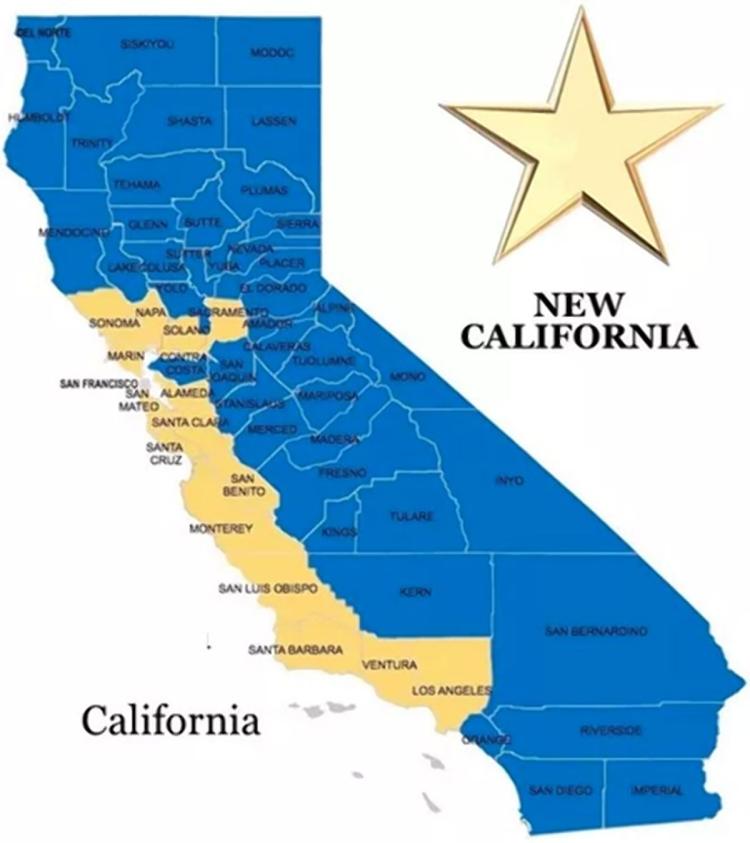
How many states will we have in the Union in twenty years? Probably 50, but there’s an outside chance that the number will be 55 plus. That could include a split of upstate New York from New York City, downstate Illinois from Chicagoland, eastern from western Washington State, eastern from western Oregon (or eastern Oregon combining with Idaho), and a division of California into as many as six states, as one proposal has it. There are secessionist movements alive in all of those states and it has happened before, as Glenn Reynolds notes in his recent paper “Splitsylvania: State Secession and What to Do About It“.

The origins of state boundaries and state governments were probably based on combinations of natural geographic features and confluent economic and political interests existing at the time. It would be surprising if those factors remained in static alignment over time, however. For various reasons, West Virginia seceded from Virginia many years ago, and Tennessee was once part of North Carolina. But to the extent that interests diverge within states, would a series of secessions promote better representative government? Reynolds’ approach to this question is fairly even-handed, though he apparently leans toward less disruptive solutions to the kinds of grievances voiced by secessionists.

Secession is a complex process; it obviously involves a major task in establishing a new state governmental apparatus. Also, legislative roadblocks to secession movements exist at both the state and federal levels. Nevertheless, there is great disaffection among rural interests in the states mentioned above for the policies they say are forced upon them by “urban elites”, as Reynolds calls them. At present, the secession of rural areas would tend to benefit republicans at the federal level, as two new Senate seats would be created to offset the seats held by democrats elected in more urban areas. Conceivably, however, the same process could work in reverse in other states, such as Texas. Even the proposal for six Californias seems designed to at least neutralize any possible negative impact on democrats in national politics.

Reynolds’ paper outline a few ways in which interests represented by legislative minorities, such as rural populations, could be better served without a step so drastic as secession. State regulation is often what rankles secessionists. To add fuel to the fire, states are free to adopt rules that are more strict than rules established under federal legislation, if they so choose, but never rules that are less strict. Today this applies to wages, working conditions, gun regulation, and environmental law. Reynolds suggests turning this on its head:

“The federal government’s legislative role has traditionally been the opposite: To use (as in the case of the 1964 Civil Rights Act) a national majority to ensure that local majorities can’t oppress local minorities. I thus suggest that federal laws regulating these key subject-matter areas be recast to pre-empt more restrictive state laws, meaning that urban regions would be unable to impose stricter laws on less- powerful rural areas. If this seems too inflexible, perhaps that pre-emption should in some cases be defeasible at the county level; if the government of a county affirmatively wants to accept stricter state regulations, then it may do so, but if not, then the federal regulations are a ceiling, as well as a floor.”

Reynolds contends that this approach would be relatively easy to defend against state challenges. The idea that federal rules provide minimum standards of regulation is only one interpretation of the Supremacy Clause of Article VI of the Constitution. There is no reason why federal legislation cannot be written in the way Reynolds describes. Moreover, Reynolds asserts that the Guarantee Clause of Article IV, which assures that mandates are to be established according to republican principles, could be used to buttress this argument. But he offers another remedy to curb secessionism among rural voters that states could exercise:

“There is nothing to stop a state from being mindful of the differences between urban and rural areas when crafting legislation or regulations, after all. States could adopt a local-option regulatory scheme relating to key subject areas on their own, and by doing so would lighten their footprint in rural areas and lessen the likelihood of festering resentments.”

Perhaps that’s hoping for too much. State majorities are unlikely to cede power to rural minorities, but it’s nice to imagine that sort of cooperation. There is no question that this sort of state regulatory approach would protect local interests from the tyranny of one-size-fits-all state regulation, but it wouldn’t eliminate the burdens created by the standard interpretation of federal supremacy.

In general, federal preemption of stricter state laws is no less consistent with the principles of federalism than federal pre-emption of more lenient state laws. One could even argue that the best way to apply federal supremacy depends on the issue, so there is some symmetry in Reynolds’ proposal. In terms of representative democracy, it is less an evil than federal preemption of less restrictive laws. It does what a democratic republic is supposed to do: protect minorities from the tyranny of a majority.

Secession from states is an intriguing possibility. Perhaps it is even the best approach in some cases. Nevertheless, Reynolds’ suggestions for revising federal and state regulatory approaches would be less costly and would avoid a nationwide race to subdivide states in order to gain a federal political advantage.

Administrative Supremacy, Lost Checks and Balances

16 Friday Jun 2017

Posted by Nuetzel in Regulation

≈ 1 Comment

Tags

Administrative State, Chevron Deference, Cost of Regulation, Due Process, Eric Boehm, Evan D. Bernick, Executive Power, Fourth Branch, George Mason University, Glenn Reynolds, Inez Stepman, Jarrett Stepman, Judicial Deference, Mercatus Center, Philip Hamburger, Reason.com, Regulatory Dark Matter, Separation of Powers, Townhall, Two-For-One Regulatory Order

The two-for-one regulatory order issued by the Trump White House in January raises some practical difficulties in implementation. It requires that federal agencies eliminate two regulatory rules for every new rule promulgated, both in terms of the number of rules and any incremental regulatory costs imposed. Two out for every one in. Questions surrounding the meaning of “a regulation”, how to define incremental costs, and whether a particular rule is actually mandated by legislation are not trivial. Nevertheless, the spirit of this order is admirable and it serves as the leading edge of the Administration’s attempt to roll back the scope and impact of excessive government authority.

The cost of regulation is vast. Economists at the Mercatus Center at George Mason University have estimated the total cumulative cost of regulation in the U.S., finding that regulation has reduced economic growth by 0.8 percent per year since 1980. Without the additional regulatory growth since 1980, the U.S. economy would have been about 25 percent larger than it was in 2012. That’s a $4 trillion shortfall, or roughly $13,000 per person.

While regulation and administrative control over the private economy takes an increasing toll on economic growth and human welfare, the problem goes beyond economic considerations: administrative agencies have “progressively” usurped not just legislative but also judicial power. The concentration of executive, legislative and judicial power constitutes a “fourth branch of government“, a development inimical to the principles enshrined in our Constitution and a prescription for slow-boil tyranny. It facilitates rent seeking and corporatism just as surely as it creates a ruling class of individuals who act on their personal and arbitrary inclinations. We are ruled by men backed by police power, not impartial laws.

Glenn Reynolds writes that unelected rule makers and central planners are able to manipulate decisions across a broad swath of the economy and society. He quotes a new book by Philip Hamburger of Columbia Law School called “The Administrative Threat“:

“Government agencies regulate Americans in the full range of their lives, including their political participation, their economic endeavors, and their personal conduct. Administrative power has thus become pervasively intrusive. But is this power constitutional?

A similar sort of power was once used by English kings, and this book shows that the similarity is not a coincidence. In fact, administrative power revives absolutism. On this foundation, the book explains how administrative power denies Americans their basic constitutional freedoms, such as jury rights and due process. No other feature of American government violates as many constitutional provisions or is more profoundly threatening. As a result, administrative power is the key civil liberties issue of our era.“

Two previous posts on Sacred Cow Chips have dealt with Hamburger’s work. The first, “Hamburger Nation: An Administrative Nightmare“(1) provides the following explanation of his position:

“Hamburger examines the assertion that rule-making must be delegated by Congress to administrative agencies because legislation cannot reasonably be expected to address the many details and complexities encountered in the implementation of new laws. Yet this is a delegation of legislative power. Once delegated, this power has a way of metastasizing at the whim of agency apparatchiks, if not at the direction of the chief executive. If you should want to protest an administrative ruling, your first stop will not be a normal court of law, but an administrative review board or a court run by the agency itself! You’ll be well advised to hire an administrative attorney to represent you. Eventually, and at greater expense, an adverse decision can be appealed to the judicial branch proper.“

The exercise of rule-making authority, and even extra-legal legislative action by the administrative state, has economic costs that are bad enough. Hamburger also emphasizes the breakdown of the separation of executive and judicial powers inherent in the enforcement and adjudication of disputes under administrative law. This was the subject of the second Sacred Cow Chips post referenced above: “Courts and Their Administrative Masters“. It reviewed an unfortunate standard established by court precedent involving judicial (“Chevron”) deference to administrative agency fact-finding and even interpretation of law. While the decisions of administrative courts, which are run by the agencies themselves, can be appealed to the judicial branch, such appeals often amount to exercises in futility.

“…courts apply a test of judgement as to whether the administrative agency’s interpretation of the law is “reasonable”, even if other “reasonable” interpretations are possible. This gets particularly thorny when the original legislation is ambiguous with respect to a certain point.

…the courts should not abdicate their role in reviewing an agency’s developmental evidence for any action, and the reasonability of an agency’s applications of evidence relative to alternative courses of action. Nor should the courts abdicate their role in ruling on the law itself.“

This paper on Judicial Deference to Agencies by Evan D. Bernick of Georgetown Law makes the case that judicial deference is a violation of the constitutional separation of powers, concluding that:

“… in cases involving administrative deprivations of core private rights to ‘life, liberty, or property,’ fact deference violates Article III’s vesting of ‘[t]he judicial power’ in the federal courts; constitutes an abdication of the duty of independent judgment that Article III imposes upon federal judges; and violates the Fifth Amendment by denying litigants ‘due process of law,’ which requires (1) judicial proceedings in an Article III court prior to any individualized deprivation of ‘life, liberty, or property’; and (2) fact-finding by independent, impartial fact-finders.“

Inez and Jarrett Stepman in Townhall note that there are almost three million well-paid federal employees with job security that would make most private sector workers envious.

“Though the abolishment of the spoils system [which allowed civil service hiring and firing based on political party] was meant to mitigate corruption and incompetence, it has resulted in a toxic combination of enhanced agency power and an entrenched civil servant class with its own institutional—and frequently political—interests, virtually unaccountable to the president or any other elected official.“

The Stepmans discuss legislation that might stem the usurpation of lawmaking power by the administrative state. They are convinced that the administrative state must be reigned-in. Ironically, expanded executive authority means that the process of reversal is not that difficult in many cases. By way of example, here’s a piece on the ease of undoing certain Obama era regulations. Executive orders, or “the pen and the phone” in Obama’s charming parlance, lack legitimate legislative authority and can be reversed by new executive orders. I firmly believe that reversing the earlier orders is the right thing to do at the moment, but the unchecked authority that makes it possible (and the supremacy of the administrative state) is a source of economic instability, and it must end. Eric Boehm makes this point eloquently in Reason at the last link above:

“New policies that affect wide swaths of the economy and reshape entire business models should go through Congress, or at the very least should be subject to the public rulemaking process. Guidance documents and other ‘dark matter’ regulations that by-pass those processes can be un-made as quickly as they were made, leaving businesses to deal with an ever-changing and unpredictable regulatory state that does not really help anyone, no matter which side you’re on in any individual policy fight.“

~~~~~~~~~~~~~~~~~~~~~~~~~~~~~~~~~~~~~~~~~~~~~~~~~

(1) The principle title “Hamburger Nation” was intended as a play on Glenn Reynolds’ paper “Ham Sandwich Nation: Due Process When Everything Is a Crime“, in which he discussed the judicial implications of over-criminalization and regulatory overreach.


Fraud-Free Voting Fallacy

26 Thursday Jan 2017

Posted by Nuetzel in Democracy, Voter Fraud

≈ 1 Comment

Tags

ACORN, DiscoverTheNetworks.org, Donald Trump, Ed Driscoll, Electoral College, Electoral Studies, Fake News, Glenn Reynolds, Hillary Clinton, Immigration policy, Instapundit, Pew Center on the States, Voter Fraud, Voter ID


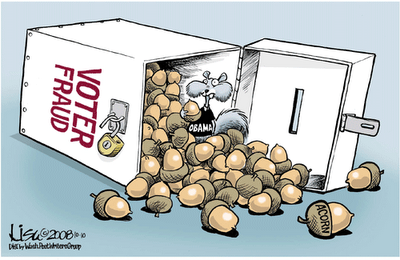
acorn-voter-fraud

I posted the following on December 1, 2016. It seems timely today. The bottom line: voter fraud is very unlikely to have swung the popular vote in favor of Hillary Clinton, but it is all too common.

Democrats have long asserted that voter fraud is rare. Recently, we heard from them that questioning the results of an election would “undermine democracy”. In fact, voter fraud is routinely characterized by the left as “fake news“, and even worse, as a racist narrative! How convenient. But in the wake of the Donald Trump victory, we’ve been hearing about electronic voter fraud from the same crowd that’s been imagining Ruskiis under their beds for months (to steal a phrase from Glenn Reynolds). Fear not: voting machines are not connected to the internet!

This week, however, Donald Trump stirred the pot once again by tweeting that he would have won the popular vote if not for the “millions” of illegal votes for Hillary Clinton. Hilarity ensued, and not only on the left. All the pundits say that Trump has no data to support his claim. He probably never looked for it, and he probably doesn’t care. As Ed Driscoll notes at Instapundit, perhaps “stray voltage” is simply part of his plan.

Trump’s claim really does sound outrageous, but a review of the recent history of actual and potential election fraud shows that it might not be as radically far-fetched as we’ve been told. DiscovertheNetworks.org (DTN) provides a three-part compilation of voter fraud research and cases spanning the last 30 years. Pertinent detail on each case or finding is provided, and each item is sourced. The cases span the country and include fraudulent voter registration efforts, dead and ineligible voters (including pets) on the rolls, multiple registrations across jurisdictions, homeless voters casting multiple votes, fraudulent absentee ballots, vote buying, voter impersonation, and failure to provide absentee ballots to deployed military personnel. ACORN, by the way, is well-represented on the list.

Many of the cases on DTN’s list involve anywhere from a handful of fraudulent votes to several hundred. Of course, it’s likely that only a small percentage of fraudulent votes are ever detected. But there are cases on the list of fraudulent registrations numbering in the thousands, and counts of ineligible voters appearing on voter rolls numbering in the hundreds of thousands and even millions.

One of the studies cited by DTN was commissioned by The Pew Center on the States, published in 2012. It found that there were 24 million invalid or “significantly inaccurate” voter registrations in the U.S. And just before every election, said the report, election officials are inundated with a flood of new and often questionable registrations.

Another study cited by DTN appeared in the journal Electoral Studies in 2014. It said “… based upon extrapolations from the portion of the sample with a verified vote … 6.4 percent of non-citizens voted in 2008 ….” The authors admit that there are reasons to think 6.4% is an under-estimate. That’s especially true given the focus on immigration policy in this year’s presidential campaign. But if that percentage was repeated in this year’s election, and given 24 million non-citizen residents in the U.S. (legal and illegal), then roughly 1.4 million non-citizen votes would be included to the 2016 popular vote total. The researchers acknowledge that this group tends to vote heavily for democrats. The overlap between these votes and those arising from the other kinds of voter fraud by Pew is certainly not complete, so the fraudulent vote total is likely to be well north of 1.4 million.

The electoral college was designed to discourage voter fraud in states dominated by a single party. Vote margins beyond a simple majority provide no incremental reward in the electoral college, the reasoning goes. That doesn’t mean election fraud doesn’t occur in those states or that it isn’t motivated in part by presidential politics. Moreover, state and local races can still be contested in so-called “one-party” states and may be subject to manipulative efforts. In such cases, presidential votes might well ride on the coattails of candidates for state and local offices.

The recent tide of republican success in congressional races and at the state level does not suggest that election fraud is benefitting democrats in more highly contested states. Perhaps it goes the other way or is roughly balanced between the parties in those states. But most people who believe Trump’s tweet would probably say that fraud must be concentrated in heavily “blue” states like California and New York. If so, it would be unbalanced fraud.

The magnitude of voter fraud in the presidential election is plausibly in the range of 1 – 2 million and it could be even higher based on the research and other information cited above. That total, however, is split between the parties. For the sake of argument, if 2 million fraudulent ballots are cast and republicans garner 30%, or 600,000 fraudulent votes, then the contribution to the democrat vote margin is just 800,000 (1,400,000 – 600,000). Hillary Clinton’s popular vote margin was 2.9 million (less than the margin in California alone). Given that total, Trump’s claim is a real stretch, but his “guess” at the number of fraudulent votes is probably well within an order of magnitude. That might be surprising to some detractors.

What should be obvious is that voter fraud is a major problem in the U.S., and it undoubtedly swings some races at state and local levels. I have been lukewarm with respect to voter ID laws, but I am persuaded that they are a necessary step in the quest for electoral integrity. (Whether IDs must be government-issued is a separate matter.) The argument that these laws are discriminatory is true to the extent that we wish to prevent ineligible individuals from voting. That’s a good thing. The argument that it is racist is sheer stupidity: citizenship should bring privileges. That is not a position on immigration policy. Voter ID laws place a simple burden on citizens to prove that they are legitimately entitled to full participation in the democratic process. If you can’t be troubled to identify yourself, you should expect multiple obstacles to sharing in the fruits of modern society.

Postscript: I just ran across this post, which makes some of the same points I’ve discussed above, but it says that there are roughly 20 million adult non-citizens in the U.S. today.

Fraud-Free Voting Fallacy

01 Thursday Dec 2016

Posted by Nuetzel in Democracy

≈ Leave a comment

Tags

ACORN, DiscoverTheNetworks.org, Donald Trump, Ed Driscoll, Electoral College, Electoral Studies, Fake News, Glenn Reynolds, Hillary Clinton, Immigration policy, Instapundit, Pew Center on the States, Voter Fraud, Voter ID


acorn-voter-fraud

Democrats have long asserted that voter fraud is rare. Recently, we heard from them that questioning the results of an election would “undermine democracy”. In fact, voter fraud is routinely characterized by the left as “fake news“, and even worse, as a racist narrative! How convenient. But in the wake of the Donald Trump victory, we’ve been hearing about electronic voter fraud from the same crowd that’s been imagining Ruskiis under their beds for months (to steal a phrase from Glenn Reynolds). Fear not: voting machines are not connected to the internet!

This week, however, Donald Trump stirred the pot once again by tweeting that he would have won the popular vote if not for the “millions” of illegal votes for Hillary Clinton. Hilarity ensued, and not only on the left. All the pundits say that Trump has no data to support his claim. He probably never looked for it, and he probably doesn’t care. As Ed Driscoll notes at Instapundit, perhaps “stray voltage” is simply part of his plan.

Trump’s claim really does sound outrageous, but a review of the recent history of actual and potential election fraud shows that it might not be as radically far-fetched as we’ve been told. DiscovertheNetworks.org (DTN) provides a three-part compilation of voter fraud research and cases spanning the last 30 years. Pertinent detail on each case or finding is provided, and each item is sourced. The cases span the country and include fraudulent voter registration efforts, dead and ineligible voters (including pets) on the rolls, multiple registrations across jurisdictions, homeless voters casting multiple votes, fraudulent absentee ballots, vote buying, voter impersonation, and failure to provide absentee ballots to deployed military personnel. ACORN, by the way, is well-represented on the list.

Many of the cases on DTN’s list involve anywhere from a handful of fraudulent votes to several hundred. Of course, it’s likely that only a small percentage of fraudulent votes are ever detected. But there are cases on the list of fraudulent registrations numbering in the thousands, and counts of ineligible voters appearing on voter rolls numbering in the hundreds of thousands and even millions.

One of the studies cited by DTN was commissioned by The Pew Center on the States, published in 2012. It found that there were 24 million invalid or “significantly inaccurate” voter registrations in the U.S. And just before every election, said the report, election officials are inundated with a flood of new and often questionable registrations.

Another study cited by DTN appeared in the journal Electoral Studies in 2014. It said “… based upon extrapolations from the portion of the sample with a verified vote … 6.4 percent of non-citizens voted in 2008 ….” The authors admit that there are reasons to think 6.4% is an under-estimate. That’s especially true given the focus on immigration policy in this year’s presidential campaign. But if that percentage was repeated in this year’s election, and given 24 million non-citizen residents in the U.S. (legal and illegal), then roughly 1.4 million non-citizen votes would be included to the 2016 popular vote total. The researchers acknowledge that this group tends to vote heavily for democrats. The overlap between these votes and those arising from the other kinds of voter fraud by Pew is certainly not complete, so the fraudulent vote total is likely to be well north of 1.4 million.

The electoral college was designed to discourage voter fraud in states dominated by a single party. Vote margins beyond a simple majority provide no incremental reward in the electoral college, the reasoning goes. That doesn’t mean election fraud doesn’t occur in those states or that it isn’t motivated in part by presidential politics. Moreover, state and local races can still be contested in so-called “one-party” states and may be subject to manipulative efforts. In such cases, presidential votes might well ride on the coattails of candidates for state and local offices.

The recent tide of republican success in congressional races and at the state level does not suggest that election fraud is benefitting democrats in more highly contested states. Perhaps it goes the other way or is roughly balanced between the parties in those states. But most people who believe Trump’s tweet would probably say that fraud must be concentrated in heavily “blue” states like California and New York. If so, it would be unbalanced fraud.

The magnitude of voter fraud in the presidential election is plausibly in the range of 1 – 2 million and it could be even higher based on the research and other information cited above. That total, however, is split between the parties. For the sake of argument, if 2 million fraudulent ballots are cast and republicans garner 30%, or 600,000 fraudulent votes, then the contribution to the democrat vote margin is just 800,000. Hillary Clinton’s popular vote margin was 2.1 million (less than the margin in California alone). Given that total, Trump’s claim is a real stretch, but his “guess” at the number of fraudulent votes is probably well within an order of magnitude. That might be surprising to some detractors.

What should be obvious is that voter fraud is a major problem in the U.S., and it undoubtedly swings some races at state and local levels. I have been lukewarm with respect to voter ID laws, but I am persuaded that they are a necessary step in the quest for electoral integrity. (Whether IDs must be government-issued is a separate matter.) The argument that these laws are discriminatory is true to the extent that we wish to prevent ineligible individuals from voting. That’s a good thing. The argument that it is racist is sheer stupidity: citizenship should bring privileges. That is not a position on immigration policy. Voter ID laws place a simple burden on citizens to prove that they are legitimately entitled to full participation in the democratic process. If you can’t be troubled to identify yourself, you should expect multiple obstacles to sharing in the fruits of modern society.

Postscript: I just ran across this post, which makes some of the same points I’ve discussed above, but it says that there are roughly 20 million adult non-citizens in the U.S. today.

May You Live For a Thousand Years

27 Tuesday Sep 2016

Posted by Nuetzel in Human Welfare, Life Extension, Progressivism

≈ Leave a comment

Tags

Alex Tabarrok, Ayn Rand, City Journal, Cyborgization, Glenn Reynolds, Human Ingenuity, Human Progress, Jemima Lewis, Julian Simon, Larry Ellison, Life Extension, Marian Tupy, Mark Zuckerberg, Peter Theil, Priscilla Chan, quality of life, Robert Malthus, The Club of Rome, The Limits to Growth, The Telegraph

didnt-expect-to-live-this-long

What if human life expectancy doubles over the next 50 years? Triples? Mark Zuckerberg and many others with money to spend, such as Peter Theil and Larry Ellison, want to accomplish that and more. For example, Zuckerberg and his wife Priscilla Chan have pledged $3 billion over the next decade to “rid the world of disease”. The implications are fascinating to ponder. In developed countries, most of the life extension would come from reducing mortality in adulthood and late in life, simply because childhood mortality has already reached very low levels. Assuming that the additional years are healthful, the dynamics of population growth and the labor force would change. Family structure could take new directions, especially if extended fertility takes place along with life extension. The coexistence of six, nine, or more generations might make one’s descendants virtual strangers. And it might be possible for an individual to have children who are younger than the great-grandchildren of progeny conceived early in one’s adulthood. For love or money, your great-grandchild might couple with an individual a generation or more ahead of you. Scandalous!

Some pundits foresee dark implications for humanity. Alex Tabarrok comments on some musings in The Telegraph by Jemima Lewis, providing the following Lewis quote:

“We’d better hope they don’t succeed. What would it do to the human race if we were granted eternal health, and therefore life? Without any deaths to offset all the births, we would have to make room on earth for an extra 208,400 people a day, or 76,066,000 a year – and that’s before those babies grow old enough to reproduce themselves.

Within a month of Mr Zuckerberg curing mortality, the first wars over water resources would break out. Within a year, the World Health Organisation would be embarking on an emergency sterilisation programme. Give it a decade and we’d all be dead from starvation, apart from a handful of straggle-bearded tech billionaires, living in well-stocked bunkers under San Francisco.“

Of course, people will still die in accidents and from some illnesses that cannot be anticipated; some people will always engage in self-destructive behavior; and there will always be natural calamities that will take human life, such as earthquakes and hurricanes. Nevertheless, life-extending technologies will increase the human population, all else equal. I say bring it on! But Lewis’ attitude is that increasing life expectancy is a bad thing, contrary to our almost uniformly positive experience with longer lives thus far, including improvements in the quality of life for aging seniors. More fundamentally, her view is that people are a liability, a collection of helpless gobblers, rather than valuable resources with the promise of providing themselves with an increasingly rich existence.

Lewis’ article demonstrates a special brand of ignorance, now common to many on the left, going back at least to the time of Robert Malthus, at about the turn of the 19th century. Malthus’ pessimism about the world’s ability to provide for the needs of an expanding population is well known, and wrong. The Club of Rome‘s report “The Limits To Growth“, published in 1972, pretty much continued in the Malthusian tradition. That report predicted increasing shortages and mass starvation. Of course, the Club erred both empirically and theoretically, as Julian Simon forcefully argued in the 1980s and 1990s. The crux of Simon’s argument was the existence of a renewable resource of vast promise: human ingenuity:

“Because of increases in knowledge, the earth’s ‘carrying capacity’ has been increasing throughout the decades and centuries and millennia to such an extent that the term ‘carrying capacity’ has by now no useful meaning. These trends strongly suggest a progressive improvement and enrichment of the earth’s natural resource base, and of mankind’s lot on earth.“

There are certain conditions that must be in place for the planet to provide for ongoing advances in human well-being. Markets must be operative in order for prices to provide accurate signals about the relative scarcity of different resources. When particular resources become more scarce, their prices provide an incentive to use existing substitutes and innovative alternatives. Competition facilitates and helps perfect this process, as new producers continuously seek to introduce innovations. Needless to say, the more restrictions imposed by government, and the more the state gets involved in picking favorites and protecting incumbents, the less effective this process becomes.

From a global perspective, the human race has done quite well in eliminating poverty during the industrial era. Impressive measures of progress across many dimensions are chronicled at the Human Progress blog, where Marian Tupy writes of “Looking Forward To the Future“. These improvements fly in the face of predictions from the environmental left, and they demonstrate that humanity is likely to find many ways in which extended lifespans can be both enjoyed and contribute to the world’s productive potential.

Extended lifespans will bring changes in the way we think about our working years and retirement. Both parts of our lives are likely to be extended. Job experience utilizing incumbent technologies will become less scarce, and will thus command a lower premium. Continuing education will increase in importance with new waves of technology. There will be changes in the time patterns of saving and investment and the design of retirement benefits offered by employers, but long periods of compounding might reduce the pressure to save aggressively. Bequest motives would almost surely change. Mechanisms like family endowments benefitting members of an extended family via education funding, medical technology and end-of-life care might become common.

There will have to be many changes in our physical makeup to ensure that life extension buys mostly “quality time”. For example, it’s probably not possible for many parts of the human body to function reliably after a century of use. The technologies of skeletal, organ and muscle replacement, or rejuvenation, will have to advance significantly to ensure a reasonable quality of life in an older population. The bodies of older humans will either be cyborgized or freshly regenerated as life extension becomes a reality.

As more radical life extension begins in earnest, it’s likely to begin as the exclusive province  of the rich. However, like everything else, the technologies and benefits will eventually diffuse to the broader population as long as competitive pressures are present in the relevant markets. It will be a matter of choice, and perhaps the most unhappy among us will choose to forego these opportunities. However, such technologies, to the extent that they become a reality, would have the potential to improve the physical well- being of almost anyone.

Dramatically extending the human life span will bring dramatic change and many social challenges, but ending disease is a worthy goal, and one that most certainly will benefit mankind. Tabarrok casts Jenima Lewis as an Ayn Rand villain, though he must realize that she is simply ignorant of the forces that create growth and an improving existence. Unfortunately, she is one of many on the left enamored with a perspective that is “anti-mind, anti-man, anti-life” (to quote Tabarrok quoting Rand).

For additional reading on the left’s anti-human agenda, see this Fred Siegel piece in the City Journal, “Progressives Against Progress” (HT: Glenn Reynolds).


Big-Time Regulatory Rewards

26 Tuesday Jul 2016

Posted by Nuetzel in Big Government, Central Planning, Regulation

≈ Leave a comment

Tags

Cronyism, Daniel Mitchell, Glenn Reynolds, Guy Rolnik, Harvard Business Review, Industrial Policy, James Bessen, Matt Ridley, Mercatus Center, Regdata, regressivity

Government Control

Why does regulation of private industry so often inure to the benefit of the regulated at the expense of consumers? In the popular mind, at least, regulating powerful market players restrains “excessive” profits or ensures that their practices meet certain standards. More often than not, however, regulation empowers the strongest market players at the expense of the very competition that would otherwise restrain prices and provide innovative alternatives. The more complex the regulation, the more likely that will be the result. Smaller firms seldom have the wherewithal to deal with complicated regulatory compliance. Moreover, regulatory standards are promulgated by politicians, bureaucrats, and often the most powerful market players themselves. If ever a system was “rigged”, to quote a couple of well-known presidential candidates, it is the regulatory apparatus. Pro-regulation candidates might well have the voters’ best interests at heart, or maybe not, but the losers are usually consumers and the winners are usually the dominant firms in any regulated industry.

The extent to which our wanderings into the regulatory maze have rewarded crony capitalists — rent seekers — is bemoaned by Daniel Mitchell in “A Very Depressing Chart on Creeping Cronyism in the American Economy“. The chart shows that about 40% of the increase in U.S. corporate profits since 1970 was generated by rent-seeking efforts — not by activities that enhance productivity and output. The chart is taken from an article in the Harvard Business Review by James Bessen of Boston University called “Lobbyists Are Behind the Rise in Corporate Profits“. Here are a couple of choice quotes from the article:

“Lobbying and political campaign spending can result in favorable regulatory changes, and several studies find the returns to these investments can be quite large. For example, one study finds that for each dollar spent lobbying for a tax break, firms received returns in excess of $220. …regulations that impose costs might raise profits indirectly, since costs to incumbents are also entry barriers for prospective entrants. For example, one study found that pollution regulations served to reduce entry of new firms into some manufacturing industries.”

“This research supports the view that political rent seeking is responsible for a significant portion of the rise in profits [since 1970]. Firms influence the legislative and regulatory process and they engage in a wide range of activity to profit from regulatory changes, with significant success. …while political rent seeking is nothing new, the outsize effect of political rent seeking on profits and firm values is a recent development, largely occurring since 2000. Over the last 15 years, political campaign spending by firm PACs has increased more than thirtyfold and the Regdata index of regulation has increased by nearly 50% for public firms.“

A good explanation of Bessen’s findings is provided by Guy Rolnik, including an interview with Bessen. Law Professor Glenn Reynolds of the University of Tennessee put his finger on the same issue in an earlier article entitled “Why we still don’t have flying cars“. One can bicker about the relative merits of various regulations, but as Reynolds points out, the expansion of the administrative and regulatory state has led to a massive diversion of resources that is very much a detriment to the intended beneficiaries of regulation:

“… 1970 marks what scholars of administrative law (like me) call the ‘regulatory explosion.’ Although government expanded a lot during the New Deal under FDR, it wasn’t until 1970, under Richard Nixon, that we saw an explosion of new-type regulations that directly burdened people and progress: The Clean Air Act, the Clean Water Act, National Environmental Policy Act, the founding of Occupation Safety and Health Administration, the creation of the Environmental Protection Agency, etc. — all things that would have made the most hard-boiled New Dealer blanch.

Within a decade or so, Washington was transformed from a sleepy backwater (mocked by John F. Kennedy for its ‘Southern efficiency and Northern charm’) to a city full of fancy restaurants and expensive houses, a trend that has only continued in the decades since. The explosion of regulations led to an explosion of people to lobby the regulators, and lobbyists need nice restaurants and fancy houses.“

Matt Ridley hits on a related point in “Industrial Strategy Can Be Regressive“, meaning that government planning and industrial regulation have perverse effects on prices and economic growth that hit the poor the hardest. Ridley, who is British, discusses regressivity in the context of his country’s policy environment, but the lessons are general:

“The history of industrial strategies is littered with attempts to pick winners that ended up picking losers. Worse, it is government intervention, not laissez faire, that has done most to increase inequality and to entrench wealth and privilege. For example, the planning system restricts the supply of land for housebuilding, raising property prices to the enormous benefit of the haves (yes, that includes me) at the expense of the have-nots. … 

Why are salaries so high in financial services? Because there are huge barriers to entry erected by government, which hands incumbent firms enormous quasi-monopoly advantages and thereby shelters them from upstart competition. Why are cancer treatments so expensive? Because governments give monopolies called patents to the big firms that invent them. Why are lawyers so rich? Because there is a government-licensed cartel restricting the supply of them.“

Ridley’s spirited article gives emphasis to the fact that the government cannot plan the economy any more than it can plan the way our tastes and preferences will evolve and respond to price incentives; it cannot plan production any more than it can anticipate changes in resource availability; it cannot dictate technologies wisely any more than it can predict the innumerable innovations brought forth by private initiative and market needs; it almost never can regulate any better than the market can regulate itself! But government is quite capable of distorting prices, imposing artificial rules, picking suboptimal technologies, consuming resources, and rewarding cronies. One should never underestimate the potential for regulation, and government generally, to screw things up!

Anti-Gun Babes Up In Arms

17 Friday Jun 2016

Posted by Nuetzel in Gun Control, Gun Rights

≈ 1 Comment

Tags

ACLU, Alexander Hamilton, Andrew Napolitano, Applied Economics, Assault Weapons, Background checks, Defensive Gun Uses, DGUs, Due Process, Eugene Volokh, Fully-Automatic Guns, Glenn Reynolds, Gun Blame, Gun-Free Zones, Individual Right to Bear Arms, James B. Jacobs, Killing Zones, Mass Shootings, Mizzou, Ninth Amendment, Ordinary Constitutional Law, Pink Pistols, Pulse Nightclub, Rolling Stone Magazine, Second Amendment, Semi-Automatic Guns, Soopermexican, Terror Watch List, Trey Gowdy, Unenumerated Rights, Well-Regulated Militia

image

Passion for various forms of gun control was inflamed by the tragic murder of 49 patrons (with 53 injured) at the Pulse nightclub in Orlando, Florida in the early hours of last Sunday morning. A man with ties to radical Islam was the perpetrator, but that’s not convenient to the left’s narrative, so scapegoats for the massacre run the gamut from guns to transgender bathroom laws to Christian “intolerance”, as opposed to the intolerance of a bat-shit crazy Islamic extremist. The Soopermexican notes the following:

“It’s really amazing how liberals [sic] are finding a way to blame Christians for the actions of the Orlando terrorist, who was, 1) gay, 2) Muslim, 3) Democrat, and 4) racist. … But then that’s what they did that time when a crazed liberal gay activist tried to shoot up the Family Research Council. Remember that? He literally said he wanted to kill everyone and then ‘smear Chick-Fil-A in the victim’s faces.’“

In case there’s any misunderstanding, I include that quote NOT to denigrate gays, Muslims, or Democrats, but to emphasize the absurdity of blaming Christians for the Orlando shootings. To get a sense of the infectious silliness going around in leftist circles over the slaughter, read this account of a vigil for the Pulse victims held in Columbia, MO by several student organizations near the main campus of the University of Missouri, at which Latino activists scolded the gay activist crowd for being “too white” and for paying insufficient attention to racial issues. Of course, it’s true that many of the Orlando victims were Latino, but after all, the vigil was for them, too, not just the white victims.

The left despises private gun ownership, or perhaps private anything except for their own privileges. Gun-blame feels so compassionate to them, and in this case, it conveniently avoids any mention of the killer’s ethnicity and radical ideology. Agitators say that “assault weapons” must be banned, but they are generally unable to articulate a precise definition. More thorough background checks are another favorite “solution”, but that’s based on an article of faith that such checks would be effective. Without proof that background checks actually work, and there is none, it still seems like a good idea to the “do something” crowd. Then, there are those whose real agenda is to ban guns outright, despite the fact that gun bans are counterproductive and infringe on the rights of law-abiding citizens.

Most of those who wish to ban assault weapons think they are referring to guns that fire repeatedly when the trigger is pulled. In other words, they believe that assault weapons are fully automatic weapons. But fully automatic weapons have been banned in the U.S. since 1934! Semi-automatic weapons require the trigger to be pulled to fire each bullet but load the next bullet automatically. James B. Jacobs of the NYU School of Law gives a fairly detailed description of the distinction between so-called assault weapons and other firearms, which essentially comes down to appearance:

“‘Assault weapons’ are semiautomatic firearms designed to look like military rifles. They are not military rifles—sometimes called assault rifles24—such as the U.S. Army’s M-16 … that can be fired in automatic or semiautomatic mode, or Russia’s AK-47, Germany’s HK G36 assault rifle, and Belgium’s FN Fal assault rifle. In contrast to assault rifles, these semiautomatic look-alikes do not fire automatically. Functionally, they are identical to most other semiautomatics. … Practically all modern rifles, pistols, and shotguns are semiautomatics; non-semiautomatic long guns include bolt action, slide action, and breach loaders; non-semiautomatic pistols are called revolvers.“

Jacobs discusses the futility of a ban on assault weapons and offers accounts of some historical assault weapon bans that were ineffective. Those outcomes were due in part to the flimsy distinction between assault weapons and other guns, as well as the fact that assault weapons are used in a relatively small percentage of gun crimes and in few mass shootings (also see here). This is corroborated by a recent paper appearing in the journal Applied Economics in which the authors report:

“… common state and federal gun laws that outlaw assault weapons are unrelated to the likelihood of an assault weapon being used during a public shooting event. Moreover, results show that the use of assault weapons is not related to more victims or fatalities than other types of guns. However, the use of hand guns, shot guns and high-capacity magazines is directly related to the number of victims and fatalities in a public shooting event. Finally, the gunman’s reported mental illness is often associated with an increase in the number of victims and fatalities.“

Another contention made by ill-informed opponents of gun rights is that mass shootings are never stopped by citizens with guns. That is simply not true, but it is good propaganda because foiled shooting attempts tend to receive much less notice than actual mass shootings. This article by Eugene Volokh provides a list of confirmed incidents in which a mass shooting was averted by a citizen carrying a gun. This situation has its counterpart in the left’s denial that defensive gun uses (DGUs) occur more frequently than gun crimes. DGUs are difficult to count because they often go unreported and may not even require the firing of a shot.

Another mistake is the continued advocacy for “gun-free zones” (such as the Pulse nightclub) within which even guards are not allowed to carry firearms. Andrew Napolitano rightly labels these “killing zones”.

More stringent background checks are another favorite solution of gun-rights opponents. However, actual background checks have done nothing to stop the most vicious mass shootings that have occurred over the past few years. This is another testament to the naiveté of relying on government to protect you, in this case, a government information system. Sheldon Richman has explained the futility of background checks thusly:

“… people with criminal intent will find ways to buy guns that do not require a check. Proponents of background checks seem to think that a government decree will dry up the black market. But why would it? Sales will go on beyond the government’s ability to monitor them. Out of sight, out of government control. … Thus the case against mandating ‘universal’ background checks withstands scrutiny. This measure would not keep criminally minded people from acquiring guns, but it would give a false sense of security to the public by promising something they cannot deliver.“

Advocates of assault weapon bans and wider background checks are inclined to characterize gun rights supporters as paranoid. As Volokh explained last year, however, there is strong reason to believe that the pro-gun lobby has correctly assessed the motives among the opposition as more extreme. Volokh notes that an ineffectual ban, like the 1994-2004 assault weapon ban and many other gun bans internationally, cannot outweigh the interests of society in protecting a basic liberty.

And as to basic liberties, Rolling Stone offers a wonderful illustration of the left’s disregard for individual rights and constitutional protections in an angry missive to gun rights supporters: “4 Pro-Gun Arguments We’re Sick of Hearing“. The author not only holds the Second Amendment in distain: vogue left-think has it that the entire Constitution is tainted because the framers were unable to agree on abolition 230 years ago (at a time when slave ownership was commonplace among the aristocracy). The fact that many of the founders were sympathetic to abolition makes little difference to these critics. They say the Constitution is not a legitimate framework for governance, despite its extremely liberal point of view on issues of individual rights. Apparently,  Rolling Stone would be just fine with abrogating the free speech rights of gun advocates.

Over the past 20 years or so, case law has increasingly viewed the Second Amendment as “ordinary constitutional law“, meaning that it protects individuals’ right to bear arms. The “well-regulated militia” limitation written into the Second Amendment is no longer accepted by the courts and most legal scholars as a limitation on individual rights. The militias it references were state militias raised from the civilian population, and the armaments they used were generally owned by the same civilians. In any case, there is no time limitation imposed on gun ownership by the Second via that clause. An earlier discussion of these issues was provided by Eugene Volokh in “The Commonplace Second Amendment“.

All this is quite apart from the Ninth Amendment, which states that nothing in the Constitution should be interpreted as limiting rights that are unenumerated. That would include self-defense, and ownership of a gun for that purpose is well advised. The Wikipedia entry on the Ninth Amendment says:

“One of the arguments the Federalists gave against the addition of a Bill of Rights, during the debates about ratification of the Constitution, was that a listing of rights could problematically enlarge the powers specified in Article One, Section 8 of the new Constitution by implication. For example, in Federalist 84, Alexander Hamilton asked, ‘Why declare that things shall not be done which there is no power to do?’“

In other words, we do not derive our rights from government or the majoritarian passions of the moment.

Finally, the debate in Congress this week has centered on whether individuals on the FBI’s Terrorist Watch List should be denied the right to purchase a gun. That might seem like a no-brainier, but it raises legitimate concerns about civil liberties. There are about 700,000 people on that list (some reports put the number much higher), many of them U.S. citizens; some of them are there by mistake. Individuals on the list have not been convicted of a crime and are therefore entitled to due process under the Fifth and Fourteenth Amendments. Watch Rep. Trey Gowdy’s passionate defense of due process to a DHS official this past week. When the ACLU and congressional republicans agree on the tyrannical nature of a restriction like this, you just can’t dismiss it out-of-hand. Such a change in the law cannot be justified without a fast and effective process giving citizens on the list a right of challenge.

The left is bereft of competence on the matter of guns, gun rights and the Constitution generally. They consistently demonstrate a dismissive view of individual liberties, whether that involves guns, religion, property, speech or due process. The tragedy in Orlando deserves more than ill-informed, knee-jerk conclusions. The most productive approach to terror risks involves individuals able to protect themselves and help watch out for others. That’s consistent with the position of the gay gun-rights group Pink Pistols. More power to them!


← Older posts
Newer posts →
Follow Sacred Cow Chips on WordPress.com

Recent Posts

  • The Case Against Interest On Reserves
  • Immigration and Merit As Fiscal Propositions
  • Tariff “Dividend” From An Indigent State
  • Almost Looks Like the Fed Has a 3% Inflation Target
  • Government Malpractice Breeds Health Care Havoc

Archives

  • January 2026
  • December 2025
  • November 2025
  • October 2025
  • September 2025
  • August 2025
  • July 2025
  • June 2025
  • May 2025
  • April 2025
  • March 2025
  • February 2025
  • January 2025
  • December 2024
  • November 2024
  • October 2024
  • September 2024
  • August 2024
  • July 2024
  • June 2024
  • May 2024
  • April 2024
  • March 2024
  • February 2024
  • January 2024
  • December 2023
  • November 2023
  • August 2023
  • July 2023
  • June 2023
  • May 2023
  • April 2023
  • March 2023
  • February 2023
  • January 2023
  • December 2022
  • November 2022
  • October 2022
  • September 2022
  • August 2022
  • July 2022
  • June 2022
  • May 2022
  • April 2022
  • March 2022
  • February 2022
  • January 2022
  • December 2021
  • November 2021
  • October 2021
  • September 2021
  • August 2021
  • July 2021
  • June 2021
  • May 2021
  • April 2021
  • March 2021
  • February 2021
  • January 2021
  • December 2020
  • November 2020
  • October 2020
  • September 2020
  • August 2020
  • July 2020
  • June 2020
  • May 2020
  • April 2020
  • March 2020
  • February 2020
  • January 2020
  • December 2019
  • November 2019
  • October 2019
  • September 2019
  • August 2019
  • July 2019
  • June 2019
  • May 2019
  • April 2019
  • March 2019
  • February 2019
  • January 2019
  • December 2018
  • November 2018
  • October 2018
  • September 2018
  • August 2018
  • July 2018
  • June 2018
  • May 2018
  • April 2018
  • March 2018
  • February 2018
  • January 2018
  • December 2017
  • November 2017
  • October 2017
  • September 2017
  • August 2017
  • July 2017
  • June 2017
  • May 2017
  • April 2017
  • March 2017
  • February 2017
  • January 2017
  • December 2016
  • November 2016
  • October 2016
  • September 2016
  • August 2016
  • July 2016
  • June 2016
  • May 2016
  • April 2016
  • March 2016
  • February 2016
  • January 2016
  • December 2015
  • November 2015
  • October 2015
  • September 2015
  • August 2015
  • July 2015
  • June 2015
  • May 2015
  • April 2015
  • March 2015
  • February 2015
  • January 2015
  • December 2014
  • November 2014
  • October 2014
  • September 2014
  • August 2014
  • July 2014
  • June 2014
  • May 2014
  • April 2014
  • March 2014

Blogs I Follow

  • Passive Income Kickstart
  • OnlyFinance.net
  • TLC Cholesterol
  • Nintil
  • kendunning.net
  • DCWhispers.com
  • Hoong-Wai in the UK
  • Marginal REVOLUTION
  • Stlouis
  • Watts Up With That?
  • Aussie Nationalist Blog
  • American Elephants
  • The View from Alexandria
  • The Gymnasium
  • A Force for Good
  • Notes On Liberty
  • troymo
  • SUNDAY BLOG Stephanie Sievers
  • Miss Lou Acquiring Lore
  • Your Well Wisher Program
  • Objectivism In Depth
  • RobotEnomics
  • Orderstatistic
  • Paradigm Library
  • Scattered Showers and Quicksand

Blog at WordPress.com.

Passive Income Kickstart

OnlyFinance.net

TLC Cholesterol

Nintil

To estimate, compare, distinguish, discuss, and trace to its principal sources everything

kendunning.net

The Future is Ours to Create

DCWhispers.com

Hoong-Wai in the UK

A Commonwealth immigrant's perspective on the UK's public arena.

Marginal REVOLUTION

Small Steps Toward A Much Better World

Stlouis

Watts Up With That?

The world's most viewed site on global warming and climate change

Aussie Nationalist Blog

Commentary from a Paleoconservative and Nationalist perspective

American Elephants

Defending Life, Liberty and the Pursuit of Happiness

The View from Alexandria

In advanced civilizations the period loosely called Alexandrian is usually associated with flexible morals, perfunctory religion, populist standards and cosmopolitan tastes, feminism, exotic cults, and the rapid turnover of high and low fads---in short, a falling away (which is all that decadence means) from the strictness of traditional rules, embodied in character and inforced from within. -- Jacques Barzun

The Gymnasium

A place for reason, politics, economics, and faith steeped in the classical liberal tradition

A Force for Good

How economics, morality, and markets combine

Notes On Liberty

Spontaneous thoughts on a humble creed

troymo

SUNDAY BLOG Stephanie Sievers

Escaping the everyday life with photographs from my travels

Miss Lou Acquiring Lore

Gallery of Life...

Your Well Wisher Program

Attempt to solve commonly known problems…

Objectivism In Depth

Exploring Ayn Rand's revolutionary philosophy.

RobotEnomics

(A)n (I)ntelligent Future

Orderstatistic

Economics, chess and anything else on my mind.

Paradigm Library

OODA Looping

Scattered Showers and Quicksand

Musings on science, investing, finance, economics, politics, and probably fly fishing.

  • Subscribe Subscribed
    • Sacred Cow Chips
    • Join 128 other subscribers
    • Already have a WordPress.com account? Log in now.
    • Sacred Cow Chips
    • Subscribe Subscribed
    • Sign up
    • Log in
    • Report this content
    • View site in Reader
    • Manage subscriptions
    • Collapse this bar
 

Loading Comments...