• About

Sacred Cow Chips

Sacred Cow Chips

Tag Archives: Kamala Harris

Promises and Policies: Grading the Candidates

29 Tuesday Oct 2024

Posted by Nuetzel in Election

≈ Leave a comment

Tags

2024 Election, Abortion, Abraham Accords, Barack Obama, Capitalism, Climate Change, Corporatism, DEI, Dobbs, Donald Trump, Elon Musk, fascism, Federal Reserve, First Amendment, Fossil fuels, Housing, Hysteria, Immigration, Inflation, Israel, Joe Biden, Kamala Harris, Medicaid, Medicare, Obamacare, Renewable energy, Second Amendment, Social Security, Supreme Court, Tariffs, Tax Policy, Ukraine, Vladimir Putin
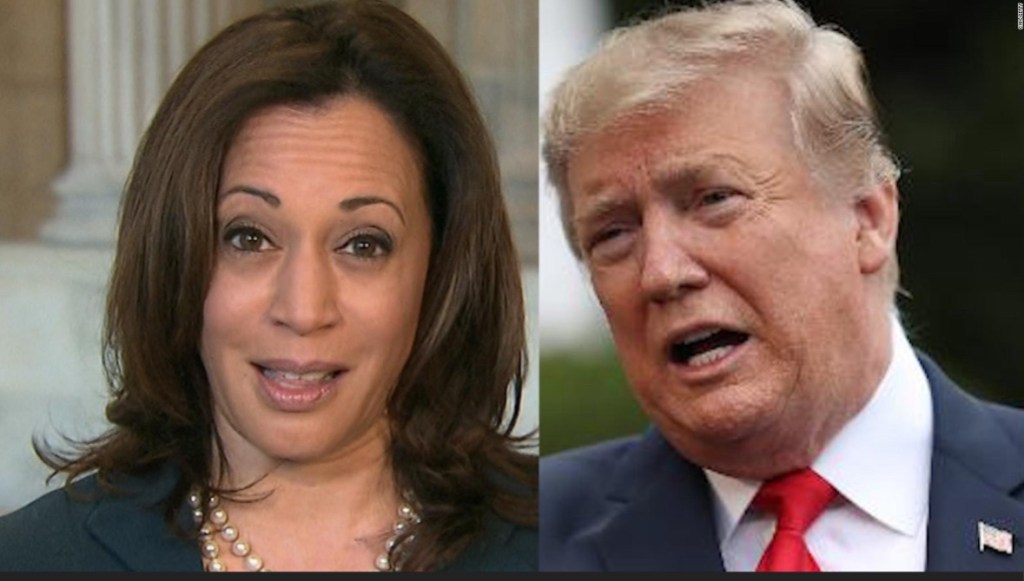
Wow! We’re less than a week from Election Day! I’d hoped to write a few more detailed posts about the platforms and policies of Kamala Harris and Donald Trump, but I was waylaid by Hurricane Milton. It sent us scrambling into prep mode, then we evacuated to the Florida Panhandle. The drive there and back took much longer than expected due to the mass exodus. On our return we found the house was fine, but there was significant damage to an exterior structure and a mess in the yard. We also had to “de-prep” the house, and we’ve been dealing with contractors ever since. It was an exhausting episode, but we feel like we were very lucky.

Now, with less than a week left till the election, I’ll limit myself to a summary of the positions of the candidates in a number of areas, mostly but not all directly related to policy. I assign “grades” in each area and calculate an equally-weighted “GPA” for each candidate. My summaries (and “grades”) are pretty off-the-cuff and not adequate treatments on their own. Some of these areas are more general than others, and I readily admit that a GPA taken from my grade assignments is subject to a bit of double counting. Oh well!

Role of Government: Kamala Harris is a statist through and through. No mystery there. Trump is more selective in his statist tendencies. He’ll often favor government action if it’s politically advantageous. However, in general I think he is amenable to a smaller role for the public than the private sector. Harris: F; Trump: C

Regulation: There is no question that Trump stands for badly needed federal regulatory reform. This spans a wide range of areas, and it extends to a light approach to crypto and AI regulation. Trump plans to appoint Elon Musk as his “Secretary of Cost Cutting”. Harris, on the other hand, seems to favor a continuation of the Biden Administration’s heavy regulatory oversight. This encourages a bloated federal bureaucracy, inflicts high compliance costs on the private sector, stifles innovation, and tends to concentrate industrial power. Harris: F; Trump: A

Border Policy: Trump wants to close the borders (complete the wall) and deport illegal immigrants. Both are easier said than done. Except for criminal elements, the latter will be especially controversial. I’d feel better about Trump’s position if it were accompanied by a commitment to expanded legal immigration. We need more legal immigrants, especially the highly skilled. For her part, Harris would offer mass amnesty to illegals. She’d continue an open border policy, though she claims to want certain limits on illegal border crossings going forward. She also claims to favor more funds for border control. However, it is not clear how well this would translate into thorough vetting of illegal entrants, drug interdiction at the border, or sex trafficking. Harris: D; Trump: B-

Antitrust: Accusations of price gouging by American businesses? Harris! Forty three corporations in the S&P 500 under investigation by the DOJ? The Biden-Harris Administration. This reflects an aggressively hostile and manipulative attitude toward the business community. Trump, meanwhile, might wheedle corporations to act on behalf of certain of his agendas, but he is unlikely to take such a broadly punitive approach. Harris: F; Trump: B-

Foreign Policy: Harris is likely to continue the Biden Administration’s conciliatory approach to dealing with America’s adversaries. The other side of that coin is an often tepid commitment to longtime allies like Israel. Trump believes that dealing from a position of strength is imperative, and he’s willing to challenge enemies with an array of economic and political sticks and carrots. He had success during his first term in office promoting peace in the Middle East. A renewed version of the Abraham Accords that strengthened economic ties across the region would do just that. Ideally, he would like to restore the strength of America’s military, about which Harris has less interest. Trump has also shown a willingness to challenge our NATO partners in order to get them to “pay their fair share” toward the alliance’s shared defense. My major qualification here has to do with the candidates’ positions with respect to supporting Ukraine in its war against Putin’s mad aggression. Harris seems more likely than Trump to continue America’s support for Ukraine. Harris: D+; Trump: B-

Trade: Nations who trade with one another tend to be more prosperous and at peace. Unfortunately, neither candidate has much recognition of these facts. Harris is willing to extend the tariffs enforced during the Biden Administration. Trump, however, is under the delusion that tariffs can solve almost anything that ails the country. Of course, tariffs are a destructive tax on American consumers and businesses. Part of this owes to the direct effects of the tax. Part owes to the pricing power tariffs grant to domestic producers. Tariffs harm incentives for efficiency and the competitiveness of American industry. Retaliatory action by foreign governments is a likely response, which magnifies the harm.

To be fair, Trump believes he can use tariffs as a negotiating tool in nearly all international matters, whether economic, political, or military. This might work to achieve some objectives, but at the cost of damaging relations more broadly and undermining the U.S. economy. Trump is an advocate for not just selective, punitive tariffs, but for broad application of tariffs. Someone needs to disabuse him of the notion that tariffs have great revenue-raising potential. They don’t. And Trump is seemingly unaware of another basic fact: the trade deficit is mirrored by foreign investment in the U.S. economy, which spurs domestic economic growth. Quashing imports via tariffs will also quash that source of growth. I’ll add one other qualification below in the section on taxes, but I’m not sure it has a meaningful chance.

Harris: C-; Trump: F

Inflation: This is a tough one to grade. The President has no direct control over inflation. Harris wants to challenge “price gougers”, which has little to do with actual inflation. I expect both candidates to tolerate large deficits in order to fulfill campaign promises and other objectives. That will put pressure on credit markets and is likely to be inflationary if bond investors are surprised by the higher trajectory of permanent government indebtedness, or if the Federal Reserve monetizes increasing amounts of federal debt. Deficits are likely to be larger under Trump than Harris due in large part to differences in their tax plans, but I’m skeptical that Harris will hold spending in check. Trump’s policies are more growth oriented, and these along with his energy policies and deregulatory actions could limit the inflationary consequences of his spending and tax policies. Higher tariffs will not be of much help in funding larger deficits, and in fact they will be inflationary. Harris: C; Trump: C

Federal Reserve Independence: Harris would undoubtedly like to have the Fed partner closely with the Treasury in funding federal spending. Her appointments to the Board would almost certainly lead to a more activist Fed with a willingness to tolerate rapid monetary expansion and inflation. Trump might be even worse. He has signaled disdain for the Fed’s independence, and he would be happy to lean on the Fed to ease his efforts to fulfill promises to special interests. Harris: D; Trump: F

Entitlement Reform: Social Security and Medicare are both insolvent and benefits will be cut in 2035 without reforms. Harris would certainly be willing to tax the benefits of higher-income retirees more heavily, and she would likely be willing to impose FICA and Medicare taxes on incomes above current earning limits. These are not my favorite reform proposals. Trump has been silent on the issue except to promise no cuts in benefits. Harris: C-; Trump: F

Health Care: Harris is an Obamacare supporter and an advocate of expanded Medicaid. She favors policies that would short-circuit consumer discipline for health care spending and hasten the depletion of the already insolvent Medicare and Medicaid trust funds. These include a $2,000 cap on health care spending for Americans on Medicare, having Medicare cover in-home care, and extending tax credits for health insurance premia. She supports funding to address presumed health care disparities faced by black men. She also promises efforts to discipline or supplant pharmacy benefit managers. Trump, for his part, has said little about his plans for health care policy. He is not a fan of Obamacare and he has promised to take on Big Pharma, whatever that might mean. I fear that both candidates would happily place additional controls of the pricing of pharmaceuticals, a sure prescription for curtailed research and development and higher mortality. Harris: F; Trump: D+

Abortion: The Supreme Court’s 2022 decision in Dobbs v. Jackson essentially relegated abortion law to individual states. That’s consistent with federalist principles, leaving the controversial balancing of abortion vs. the unborn child’s rights up to state voters. Geographic differences of opinion on this question are dramatic, and Dobbs respects those differences. Trump is content with it. Meanwhile, Harris advocates for the establishment of expanded abortion rights at the federal level, including authorization of third trimester abortions by “care providers”. And Harris does not believe there should be religious exemptions for providers who do not wish to offer abortion services. No doubt she also approves of federally funded abortions. Harris: F; Trump: A

Housing: The nation faces an acute housing shortage owing to excessive regulation that limits construction of new or revitalized housing. These excessive rules are primarily imposed at the state and local level. While the federal government has little direct control over many of these decisions, it has abetted this regulatory onslaught in a variety of ways, especially in the environmental arena. Harris is offering stimulus to the demand side through a $25,000 housing tax credit for first-time home buyers. This will succeed in raising the cost of housing. She has also called for heavier subsidies for developers of low-income housing. If past is prologue, this might do more to line the pockets of developers than add meaningfully to the stock of affordable housing. Harris also favors rent controls, a sure prescription for deterioration in the housing stock, and she would prohibit software allowing landlords to determine competitive neighborhood rents. Trump has called for deregulation generally and would not favor rent controls. Harris: F; Trump B

Taxes: Harris has broached several wildly destructive tax proposals. Perhaps the worst of these is to tax unrealized capital gains, and while she promises it would apply only to extremely wealthy taxpayers, it would constitute a wealth tax. Once that line is crossed, the threat of widening the base becomes a very slippery slope. It would also be a strong detriment to domestic capital investment and economic growth. Harris would increase the top marginal personal tax rate and the corporate tax rate, which would discourage investment and undermine real wage growth. She’d also increase estate tax rates. As discussed above, she unwisely calls for a $25,000 tax credit for first-time homebuyers. She also wants to expand the child care tax credit to $6,000 for families with newborns. A proposed $50,000 small business tax credit would allow the federal government to subsidize and encourage risky entrepreneurial activity at taxpayers’ expense. I’m all for small business, but this style of industrial planning is bonkers. She would sunset the Trump (TCJA) tax cuts in 2026.

Finally, Harris has mimicked Trump in calling for no taxes on tips. Treating certain forms of income more favorably than others is a recipe for distortions in economic activity. Employers of tip-earning workers will find ways to shift employees’ income to tips that are mandatory for patrons. It will also skew labor supply decisions toward occupations that would otherwise have less economic value. But Trump managed to find an idea so politically seductive that Harris couldn’t resist.

Trump’s tax plans are a mixed bag of good and bad ideas. They include extending his earlier tax cuts (TCJA) and restoring the SALT deduction. The latter is an alluring campaign tidbit for voters in high-tax states. He would reduce the corporate tax rate, which I strongly favor. Corporate income is double-taxed, which is a detriment to growth as well as a weight on real wages. He would eliminate taxes on overtime income, another example of favoring a particular form of income over others. Wage earners would gain at the expense of salaried employees, so one could expect a transition in the form employees are paid over time. Otherwise, the classification of hours as “overtime” would have to be standardized. One could expect existing employees to work longer hours, but at the expense of new jobs. Finally, Trump says Social Security benefits should not be taxed, another kind of special treatment by form of income. This might encourage early retirement and become an additional drain on the Social Security Trust Fund.

The higher tariffs promised by Trump would collect some revenue. I’d be more supportive of this plank if the tariffs were part of a larger transition from income taxes to consumption taxes. However, Trump would still like to see large differentials between tariffs and taxes imposed on the consumption of domestically-produced goods and services.

Harris: F; Trump C+

Climate Policy: This topic has undergone a steep decline in relative importance to voters. Harris favors more drastic climate interventions than Trump, including steep renewable subsidies, EV mandates, and a panoply of other initiatives, many of which would carry over from the Biden Administration. Harris: F; Trump: B

Energy: Low-cost energy encourages economic growth. Just ask the Germans! Consistent with the climate change narrative, Harris wishes to discourage the use of fossil fuels, their domestic production, and even their export. She has been very dodgy with respect to restrictions on fracking. Her apparent stance on energy policy would be an obvious detriment to growth and price stability (or I should say a continuing detriment). Trump wishes to encourage fossil fuel production. Harris: F; Trump: A

Constitutional Integrity: Harris has supported the idea of packing the Supreme Court, which would lead to an escalating competition to appoint more and more justices with every shift in political power. She’s also disparaged the Electoral College, without which many states would never have agreed to join the Union. Under the questionable pretense of “protecting voting rights”, she has opposed steps to improve election integrity, such voter ID laws. And operatives within her party have done everything possible to register non-citizens as voters. Harris: F; Trump: A

First Amendment Rights: Harris has called for regulation and oversight of social media content and moderation. A more descriptive word for this is censorship. Trump is generally a free speech advocate. Harris: F; Trump A-

Second Amendment Rights: Harris would like to ban so-called “assault weapons” and high-capacity magazines, and she backs universal background checks for gun purchases. Trump has not called for any new restrictions on gun rights. Harris: F; Trump: A

DEI: Harris is strongly supportive of diversity and equity initiatives, which have undermined social cohesion and the economy. That necessarily makes her an enemy of merit-based rewards. Trump has no such confusion. Harris: F; Trump: A

Hysteria: The Harris campaign has embraced a strategy of demonizing Donald Trump. Of course, that’s not a new approach among Democrats, who have fabricated bizarre stories about Trump escapades in Russia, Trump as a pawn of Vladimir Putin, and Russian manipulation of the 2016 Trump campaign. Congressional democrats spent nearly all of Trump’s first term in office trying to find grounds for impeachment. Concurrently, there were a number of other crazy and false stories about Trump. The current variation on “Orange Man Bad” is that Trump is a fascist and a Nazi, and that all of his supporters are Nazis. And that Trump will use the military against his domestic political opponents, the so-called “enemy within”. And that Trump will send half the country’s populace to labor camps. The nonsense never ends, but could anything more powerfully ignite the passions of violent extremists than this sort of hateful rhetoric? Would it not be surprising if at least a few leftists weren’t interested in assassinating “Hitler” himself. This is hysteria, and one has to wonder if that is not, in fact, the intent.

Can any of these people actually define the term fascist? Most fundamentally, a fascist desires the use of government coercion for private gain (of wealth or power) for oneself and/or one’s circle of allies. By that definition, we could probably categorize a great many American politicians as fascists, including Barack Obama, Joe Biden, Donald Trump, and a majority of both houses of Congress. That only demonstrates that corporatism is fundamental to fascist politics. Less-informed definitions of fascism conflate it with everything from racism (certainly can play a part) and homophobia (certainly can play a part) to mere capitalism. But take a look at the demographics of Trump’s supporters and you can see that most of these definitions are inapt.

Is the Trump campaign suffering from any form of hysteria? It’s shown great talent at poking fun at the left. Of course, Trump’s reactions to illegal immigration, crime, and third-trimester abortions are construed by leftists to be hysterical. I mean, why would anyone get upset about those kinds of things?

Harris: F; Trump: A

“Grade Point Average”

I’m sure I forgot an area or two I should have covered. Anyway, the following are four-point “GPAs” calculated over 20 categories. I’m deducting a quarter point for a “minus” grade and adding a quarter point for a “plus” grade. Here’s what I get:

Harris: 0.44; Trump: 2.68

Hmmm
Joy-Politik Weird Trick: Anti-Business, Anti-Labor

01 Tuesday Oct 2024

Posted by Nuetzel in corporate taxes, Tax Incidence

≈ Leave a comment

Tags

Capital Flight, Capital-Labor Ratio, Class Struggle, Corporate Imcome Tax, Elasticity, Greedflation, Kamala Harris, Tax Incidence, Unrealized Capital Gains

Workers nationwide are assured that great joy will prevail if Kamala Harris retains her grip on the reins of power next year. Finally, greedy employers and rich people generally will have to “pay their fair share”. While slower job growth and stagnating real wages might dampen the enthusiasm, Harris offers vague assurances that “metrics” will demonstrate how her policies pay for themselves, achieving positive returns on investment (ROI). That creates an attractive buzz and it takes a lot of chutzpah, but she probably wouldn’t know an ROI if it bit her in the ass.

Tax “Big Greed”

This installment of my “Joy-Politik” series covers another federal tax proposal put forward by Harris. In my last post, I discussed her plan to tax unrealized capital gains, which is inimical to investment incentives, a healthy capital base, and economic growth. Here I discuss her proposal: to increase the corporate income tax rate from 21 percent to 28 percent (and increase the alternative minimum tax rate for corporations from 15% to 21%).

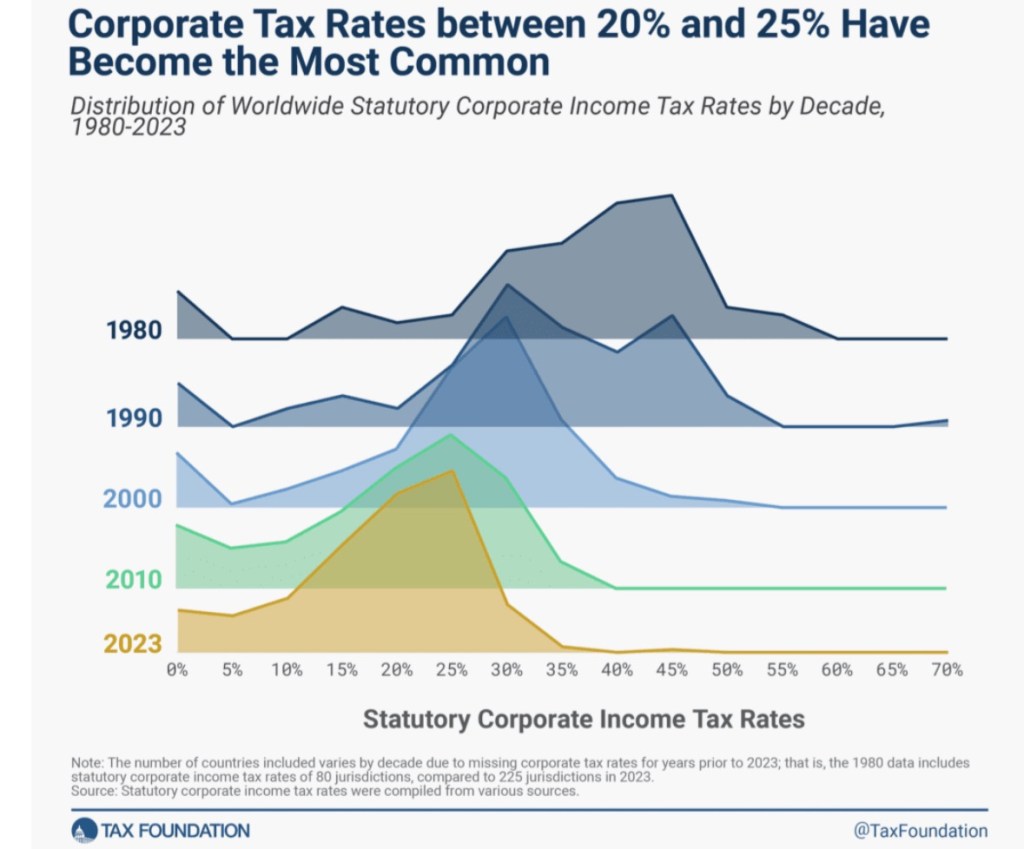
The chart at the top of this post shows that corporate statutory tax rates have trended down quite a bit over the past 40+ years. That’s a strong indicator of competition for corporate investment capital. It’s intense because governments know capital investment produces jobs, higher wages, and economic growth. U.S. corporate taxes today are competitive within the distribution, and they are below the international average. A hike to 28% would push the U.S. to a much less competitive level.

But here’s Harris’ rhetorical move: insist that the income of corporations must be taxed heavily, even punitively, for the benefit of the masses! While you’re at it, deride these greedy companies for causing inflation. The thinking is that a corporation’s shareholders will have to pay the tax. That’s who they’re after, and they can’t resist the left-populist optics!

Tax Incidence

Let’s put aside the “class struggle” premise and the political joy of bashing the rich; let’s also put aside the mistaken attribution of inflation to corporate greed. Beyond all that, Harris (and many others) makes a fundamental error in thinking that shareholders will bear the full burden of the tax. Anyone with a passing familiarity with tax incidence knows that the burden of the tax will be shared by the firm’s workers, customers, and shareholders. That’s because firms attempt to pass the tax along to consumers in higher prices and employees in lower wages.

Corporations cannot avoid tax incidence entirely. All parties (the firms, their consumers, workers, and shareholders) respond with some degree of elasticity. Ultimately, the interplay between their responses will yield a behavioral compromise whereby each of the three groups shoulders a portion of the burden.

Workers have limited mobility, but the supply of capital to a country is fairly elastic. Capital will deploy to locales where the returns net of taxes are most favorable. So capital tends to flee from jurisdictions in which it is more heavily penalized. This reduces the amount of capital available to each worker (tools, machinery, information/computing resources), ultimately leading to reduced productivity and wages.

As of 2021, even the federal government’s tax studies assumed that workers bore 20% – 25% of the burden of a corporate tax increase. However, the true labor share is likely to be higher. An abundance of research (for example, see here, here, and here) supports this conclusion. The full range of estimates runs from 15% – 100%. A number of studies suggest a range of 50% – 100%, with 70% seen as a reasonable midpoint. That means wages can be expected to decline in the wake of a corporate tax hike, and labor ultimately bears more than two-thirds of the increased corporate rate hike. With this in mind, no one should mistake Harris’ anti-corporate policy stance as labor-friendly. Quite the contrary!

Broad Economic Effects

The macroeconomic effects of the corporate tax hike are unfavorable, according to a Tax Foundation report:

“Raising the corporate income tax rate to 28 percent is the largest driver of the negative effects, reducing long-run GDP by 0.6 percent, the capital stock by 1.1 percent, wages by 0.5 percent, and full-time equivalent jobs by 125,000.“

The report’s estimates of losses for the entire Harris tax package through 2034 exclude a few provisions such as the new minimum tax on unrealized gains of high income earners. Therefore, the negative impacts are likely larger. But even without that, the losses in the report are a 2% decline in GDP, a 1.2% loss of wages, a 3% decline in the capital stock, and 786,000 fewer jobs.

Conclusion

Kamala Harris makes a great show of her desire to stick it to the rich for their “fair share.” In this case, the motives of corporations are demonized and presented as a natural vehicle through which the rich can be targeted. That effort would be worse than futile. The bulk of the incidence of the change in the corporate income tax rate would fall on workers. Even worse, the impact on jobs, the capital stock, and GDP are all likely to be negative. Rewarding workers by punishing their employers is a negative sum proposition, not a joyous thing.

Joy-Politik: Taxing Unrealized Capital Gains

25 Wednesday Sep 2024

Posted by Nuetzel in Wealth Taxes

≈ 1 Comment

Tags

Alex Tabarrok, Billionaire Tax, Capital Flight, Jason Furman, Joe Biden, Kamala Harris, Michael Munger, Moore v. United States, Notional Equity Interest, Sam Altman, Tyler Cowen, ULTRA, Unrealized Capital Gains, Wealth Tax

Kamala Harris’ campaign platform lifts several tax provisions from Joe Biden’s ill-fated campaign. The most pernicious of these are lauded by observers on the Left for their “fairness”, but they dismiss some rather obvious economic damage these provisions would inflict. Here, I’ll cover Harris’ proposal to tax unrealized capital gains of the rich in two different ways:

  1. A minimum 25% “billionaire tax” on the “incomes” of taxpayers with net worth exceeding $100 million. This definition of income would include unrealized capital gains.
  2. A tax of 28% at the time of death on unrealized capital gains in excess of $5 million ($10 million for joint returns).

Why Bother?

To get a whiff of the complexity involved, take a look at the description on pp. 79 – 85 of this document, to which the Harris proposal seems to correspond. It’s not fully fleshed out, but it’s easy to imagine the lucrative opportunities this would create for tax attorneys and accountants, to say nothing of job openings at the IRS!

On the other hand, there’s little chance these proposals would be approved by Congress, no matter which party holds a majority. Harris knows that, or at least her advisors do. That taxation of unrealized gains is even part of the conversation in a presidential election year tells us how normalized the idea has become within the Democrat Party, which seems to have lost all regard for private property rights. These are classist proposals designed to garner the votes of the “tax-the-rich” crowd, who either aren’t aware or haven’t come to grips with the fact that the U.S. already has a very progressive income tax system. “The rich” already pay a disproportionately high share of taxes.

Taxable Income

These provisions would complicate and corrupt the income tax code by distorting the definition of income for tax purposes. The Internal Revenue Code has always been consistent in defining taxable income as realized income. One might use the expression “mark-to-market taxation” to characterize a tax on unrealized gains from tradable assets. It’s much more difficult to estimate unrealized gains on non-tradable or infrequently traded investments, for which there is no ready market value.

There is one type of income that some believe to be taxed as unrealized. A few weeks ago, in a post about Sam Altman’s infatuation with a wealth tax, I cited a recent Supreme Court decision that has been mistakenly interpreted as favoring income taxation of unrealized gains or a wealth tax. In fact, Moore v. United States involved the undistributed profits of a foreign pass-through entity (i.e., not a C corporation) for purposes of the mandatory repatriation tax. The foreign firm’s profits were realized, and its pass-through status meant that the U.S. owners had also, by definition, realized the profits. So this case did not set a precedent or create an exception to the rule that income taxation applies only to realized income.

Forced Sales

Tradable assets with easily recorded market values will often have unrealized gains in a given year. While tax payments might be spread over the current and future tax years, these taxes could necessitate asset sales to pay the taxes owed. If unrealized losses are treated symmetrically, they would require either future deductions or possibly credits for prior tax payments.

Estimates of unrealized gains on illiquid or private investments like closely-held business interests, artwork, or real estate are highly uncertain and subject to dispute. A large tax liability on such an asset could be especially burdensome. Cash must be raised, which might require a forced sale of other assets. And again, these valuations often come with great complexity and exorbitant administrative costs, not just for the IRS, but especially for taxpayers.

Economic Downsides

As I noted above, additional taxes on unrealized gains would create an obvious need for liquidity, if not immediately then at death. With or without careful planning, sales of assets by wealthy investors to pay the tax would undermine market values of equity (and other assets), producing a broader loss of wealth economy-wide.

Avoidance schemes would be heavily utilized. For example, a wealthy investor could borrow heavily against assets so as to offset unrealized gains with deductible debt-service costs.

Capital flight is likely to be intense if a Harris tax regime began to take shape in Congress. This might be the best avoidance scheme of all. The U.S. is likely to experience massive capital outflows. Furthermore, investment in new physical capital will decline, ultimately leading to lower productivity and real wages.

Entrepreneurial activity would also take a hit. In a critique of Jason Furman’s effort to justify Harris’ proposal, Tyler Cowen asks why we should be so eager to “whack” venture capital. He also quotes an email from Alex Tabarrok on the detrimental policy effects on rapidly growing start-ups:

“What’s really going on is that you are divorcing the entrepreneur from their capital at precisely the moment that the team is likely most productive. Separation of capital from entrepreneur could negatively impact the company’s growth or the entrepreneur’s ability to manage effectively. The entrepreneur could lose control, for example. If you wait until the entrepreneur realizes the gain that’s the time that the entrepreneur wants out and is ready to consume so it’s closer to taxing consumption and better timed in the entrepreneurial growth process.“

Or the entrepreneur might just decide that a startup would be more rewarding in a tax-friendly environment, perhaps somewhere overseas.

Interest Rates and Tax Receipts

Tabarrok notes in a separate post that much of the variation in stock prices is caused by changes in interest rates. Investors use market rates to determine discount rates at which a firm’s future cash flows can be valued. Thus, changes in rates engender changes in stock prices, capital gains, and capital losses.

A decline in interest rates can raise market valuations without any change in dividends. However, a long-term investor would see no change in pre-tax income or consumption, so the tax could force a series of premature sales. A change in a firm’s expected growth rate would also create an unrealized gain (or loss), but the tax would undermine U.S. equity values. Taxing an actual increase in the dividend is one thing, but taxing a change in expectations of future dividends is another. As Tabarrok puts it, “It’s taxing the chickens before the eggs have hatched.“

Dangerous Narrative, Dangerous Policy

A final objection to taxing unrealized capital gains is that it would cross the line into a form of wealth taxation. Assets come in many forms, but the only time realized values can be discerned are when they are traded. That goes for collectibles, homes, boats, and the full array of financial assets. A corollary is that a very large percentage of wealth is unrealized.

A tax on unrealized gains would be the proverbial camel’s nose under the tent and another incursion into the private realm. So often in the history of taxation we’ve seen narrow taxes expand into broad taxes. This is one more opportunity for the state to extend its dominance and control.

I’ve written in the past about the economic dangers of a wealth tax. First, every dollar of income used to purchase capital is already taxed once. In that sense, the cost basis of wealth would be double taxed under a wealth tax. Second, the supply of capital is highly elastic. This implies a high propensity for capital flight, shallowing of productive physical capital, and reduced productivity and real wages. Avoidance schemes would rapidly be put into play. Given these limitations, the revenue raising potential of a wealth tax is unlikely to live up to expectations. Finally, a wealth tax is unconstitutional, but that won’t stop the Left from pushing for one, especially if they first get a tax on unrealized gains. Even if they are unsuccessful now, the conversation tends to normalize the idea of a wealth tax among low-information voters, and that is a shame.

JoyPolitik: Greed, Gouging, and Gullability

18 Wednesday Sep 2024

Posted by Nuetzel in Inflation, Price Controls

≈ 1 Comment

Tags

Antitrust, Greed, Ham Sandwich Nation, Hoarding, Inflation, Interventionism, Kamala Harris, Mark-Ups, Market Concentration, Markets, Michael Munger, Monetary policy, Predatory Pricing, Price Fixing, Price Gouging, Price Rationing, Shortages, Supply Shocks

Economic ignorance and campaign politics seem to go hand-in-hand, especially when it comes to the rhetoric of avowed interventionists. They love “easy” answers. If they get their way, negative but predictable consequences are always “unintended” and/or someone else’s fault. Unfortunately, too many journalists and voters like “easy” answers, and they repeatedly fall for the ploy.

This post highlights one of many bad ideas coming out of the Kamala Harris campaign. I probably won’t have time to cover all of her bad ideas before the election. There are just too many! I hope to highlight a few from the Trump campaign as well. Unfortunately, the two candidates have more than one bad idea in common.

Price Gouging

Here I’ll focus on Harris’ destructive proposal for a federal ban on “price gouging”. Unfortunately, she has yet to define precisely what she means by that term. On its face, she’d apparently support legislation authorizing the DOJ to go after grocers, gas stations, or other sellers in visible industries charging prices deemed excessive by the federal bureaucracy. This is a form of price control and well in keeping with the interventionist mindset.

As Michael Munger has said, when you charge “too much” you are “gouging”; when you charge “too little” you are “predatory”; and when you charge the same price as competitors you’ve engaged in a price fixing conspiracy. The fact that Harris’ proposal is deliberately vague is an even more dangerous invitation to arbitrary caprice by federal enforcers. It might be hard to price a ham sandwich without breaking such a law.

The great advantage of the price system is its impersonal coordination of the actions of disparate agents, creating incentives for both buyers and sellers to direct resources toward their most valued uses. Price controls of any kind short circuit that coordination, inevitably leading to shortages (or surpluses), misallocations, and diminished well being.

Inflation As Aggregate Macro Gouging

Aside from vote buying, Harris has broader objectives than the usual “anti-gouging” sentiment that accompanies negative supply shocks. She’s faced mounting pressure to address prices that have soared during the Biden Administration. The inflation during and after the COVID pandemic was induced by supply shortfalls first and then a spending/money-printing binge by the federal government. The pandemic induced shortages in some key areas, but the Treasury and the Fed together engineered a gigantic cash dump to accommodate that shock. This stimulated demand and turned temporary dislocations into permanently higher prices.

There were howls from the Left that greed in the private sector was to blame, despite plentiful evidence to the contrary. Blaming “price gouging” for inflated prices dovetails with Harris’ proclivity to inveigh against “corporate greed”. It’s typical leftist blather intended to appeal to anyone harboring suspicions of private property and the profit motive.

The profit motive is a compelling force for social good, motivating the performance of large corporations and small businesses alike. Diatribes against “greed” coming from the likes of a career politician with no private sector experience are not only unconvincing. They reveal childlike misapprehensions regarding economic phenomena.

More substantively, some have noted that mark-ups rose during and after the pandemic, but these markups are explained by normal cyclical fluctuations and the growing dominance of services in the spending mix. High margins are difficult to sustain without persistently high levels of demand. The Fed’s shift toward monetary restraint has dissipated much of that excessive demand pressure, but certainly not enough to bring prices back to pre-pandemic levels, which would require a severe economic contraction.

Claims that concentration among sellers has risen in some markets are also cited as evidence that greedy, price-gouging corporations are fueling inflation. If that is a real concern, then we might expect Harris to lean more heavily on antitrust policy. She should be circumspect in that regard: antitrust enforcement is too often used for terrible reasons (and also see here). In any case, rising market concentration does not necessarily imply a reduction in competitive pressures. Indeed, it might reflect the successful efforts of a strong competitor to please customers, delivering better value via quality and price. Moreover, mergers and acquisitions often result in stronger challenges to dominant players, energizing innovation, improved quality, and price competition.

If Harris is serious about minimizing inflation she should advocate for fiscal and monetary restraint. We’ve heard nothing of that from her campaign, however. No credible plans other than vaguely-defined price controls and promises to tax and spend our way to a joyful “opportunity economy”.

Disaster Supply Gouging

There is already a federal law against hoarding “scarce items” in times of war or national crisis and reselling at more than the (undefined) “prevailing market price”. There are also laws in 34 states with varying “anti-gouging” provisions, mostly applicable during emergencies only. These laws are counterproductive as they tend to “gouge” the flow of supplies.

In the aftermath of terrible storms or earthquakes, there are almost always shortages of critical goods like food, water, and fuel, not to mention specialized manpower, machinery, and materials needed for cleanup and restoration. As I pointed out some time ago, retailers often fail to adjust their prices under these circumstances, even as shelves are rapidly emptied. They are sometimes prohibited from repricing aggressively. If not, they are conflicted by the predictable hoarding that empties shelves, the higher costs of replenishing inventory, and the knowledge that price rationing creates undeservedly bad public relations. So retailers typically act with restraint to avoid any hint of “gouging” during crises.

Disasters often disrupt production and create physical barriers that hinder the very movement of goods. When prices are flexible and can respond to scarcity on the ground, suppliers can be very creative in finding ways to deliver badly needed supplies, despite the high costs those are likely to entail. Private sellers can do all this more nimbly and with greater efficiency than government, but they need price incentives to cover the costs and various risks. Price controls prevent that from happening, prolonging shortages at the worst possible time.

The chief complaint of those who oppose this natural corrective mechanism is that higher prices are “unfair”. And it is true that some cannot afford to pay higher prices induced by severe scarcity. The answer here is that government can write checks or even distribute cash, much as the government did nationwide during the pandemic. That’s about the only thing at which the state excels. Then people can afford to pay prices that reflect true levels of scarcity. If done selectively and confined to a regional level, the broader inflationary consequences are easily neutralized.

Instead, the knee-jerk reaction is to short-circuit the price mechanism and insist that available supplies be rationed equally. That might be a fine way for retailers to respond in the short run. Share the misery and prevent hoarding. But supplies will run low. When the shelves are empty, the price is infinite! That’s why sellers must have flexibility, not prohibitions.

Blame Game

Harris is engaged in a facile blame game at both the macro and micro level. She claims that inflation could be controlled if only corporations weren’t so greedy. Forget that they must cover their own rising costs, including the costs of compensating risk-averse investors. For that matter, she probably hasn’t gathered that a return to capital is a legitimate cost. Like many others, Harris seems ignorant of the elevated costs of bringing goods to market following either unpredictable disasters or during a general inflation. She also lacks any understanding of the benefits of relying on unfettered markets to bridge short-term gaps in supply. But none of this is surprising. She follows in a long tradition of ignorant interventionism. Let’s hope we have enough voters who aren’t that gullible.

Portents of Harris-Biden Nation

22 Thursday Oct 2020

Posted by Nuetzel in Politics

≈ Leave a comment

Tags

#MeToo, Anthony Weiner, Antifa, Barack Obama, Black Lives Matter, Court Packing, Critical Race Theory, Donald Trump, Green New Deal, Harvey Weinstein, Hunter Biden, Jeffrey Toobin, Joe Biden, Kamala Harris, Lockdowns, Marxism, Nancy Pelosi, Public Health, Scientism

Joe Biden is a weak figurehead, a one-time moderate faltering over a coalition of leftists. If you wonder why Nancy Pelosi floated legislation to establish a committee on “presidential capacity,” don’t think so much about her loathing for Donald Trump; think about poor Joe Biden. He might be shunted aside just as soon as the power grab isn’t too obvious. They know well how Barack Obama famously said, “Don’t underestimate Joe’s ability to f*ck things up.” But whether Joe Biden is in control of anything, think about who he stands with:

The Violent Left: Marxist Antifa and Marxist BLM; opposed to law and order; burning cities; spewing eliminationist rhetoric; hissing n*g**r at black cops;

Police Defunders: won’t acknowledge good policing is needed more than ever, especially in minority communities;

“Ministers of Truth”: social media platforms exerting control over what we say and what we see;

Re-Educators: democrats push for a “Truth and Reconciliation Commission” to address the “issue” of Trump supporters;

Critical Race Theorists: a Marxist front whereby every word and action is viewed in the context of racial bias and victimization; they want reparations; on your knees.

The Scientistic: who labor under the delusion that “science” should guide all administrative and political decisions. Or someone’s version of science. The very idea is antithetical to the scientific domain, which deals only with falsifiable hypotheses. Few matters of value can be addressed using the tools of science exclusively, nor can they address matters of ethics.

Fear Mongers: would rule by precaution; risks are always worth exaggerating to existential proportions;

Lockdown Tyrants: refuse to acknowledge the steep public health costs of lockdowns; stripping individual liberties indefinitely, including the right to contract, free practice of religion, and assembly;

Insurrectionists: who fabricated a Russian collusion hoax to subvert the 2016 election, and later to overthrow a sitting president;

Gun Confiscators: they will if we let them;

Abortionists: would use federal tax dollars to fund the murder of millions of babies late into pregnancy, primarily black babies;

Fluid-Genderists: insist that children should be encouraged to explore transgenderism;

Taxers: won’t stop with punitive taxes on the wealthy and employers; it’s just not easy to milk high earners in a way that’s sufficient to pay for the fiscal debauchery demanded by the Biden-Harris constituency. Joe says he will raise taxes by $3.4 trillion.

Spenders: $2 trillion of new federal education outlays, including universal pre-K and free community college; the Green New Deal (see below). After all, the democrats are the party that can’t tell the difference between a cut in spending and a reduction in spending growth. If you think Trump is a big spender, their plans are astonishing;

Green New Dealers: would spend trillions to restrict energy choices, transfer U.S. wealth overseas in the name of international carbon reduction, and reduce our standard of living;

Redistributionists: would tax job creators not simply for the benefit of supporting the needy, but for anyone regardless of need (see UBI); this extends to plans to bail out blue states and cities with insolvent public employee pension funds;

Interventionists: would regulate all phases of life, including straws, sugary drinks, and your fireplace; they will burden private initiative; create artificial, politically-favored winners skilled at manipulating regulatory rules for competitive reasons; and create losers who are typically too small to handle the burden;

Medical Socialists: will strip your private health insurance, dictate the care you may receive, fix prices, and regulate physicians and other providers. You’ll love the care abroad, if you can afford to get out when your sick.

Public School Monopolists: poorly performing, beholden to teachers’ unions, unresponsive to taxpayers and often parents; they would happily revoke school choice;

Federal Suburb Rezoners: demanding low-income housing in every community;

Court Packers: to destroy the independent judiciary;

Iran Apologists: give them cash on the tarmac, let them develop their “peaceful” nuclear program; alienate the rest of the Middle East;

Grifters: marketing their influence as public servants for private gain; never exclusive to one side of the aisle, but the Biden family has certainly traded on Joe to enrich themselves;

Smear Merchants: fabricated allegations against Brett Kavanaugh; impugned Amy Coney Barrett’s religious faith;

Perverts: Harvey Weinstein, Anthony Weiner, Jeffrey Toobin, Hunter Biden, and Bill Clinton, to name just a few; even Joe has his #MeToo accusers;

I could go on and on, but Harris-Biden voters should get a strong taste of their compatriots from the list above. It reflects the overriding prescriptive, bullying, and sometimes violent nature of the Left. They’d have you think all material goods can be free. Presto! They presume to have the knowledge and wisdom to plan the economy and your life better than you, Better than free markets and free people. What they’ll need is a lot of magic, or it won’t go well. You’ll get poverty and tears. I’m not sure Joe has the desire or the wherewithal to rein in his coalition of idiots.

Progs Give New Meaning To “Tax Distortions”

16 Tuesday Apr 2019

Posted by Nuetzel in Taxes

≈ Leave a comment

Tags

Andrew Wilford, Bernie Sanders, CATO Institute, Chris Edwards, Christine Elba, Kamala Harris, Matthew Yglesias, National Taxpayers Union Foundation, Progressive Taxes, Tax Distortions, Tax Policy Center, Tax Refunds

Tax day has come and gone, but I’m struck by 1) the incredible misconceptions people express about the change in their tax liabilities caused by the 2018 income tax legislation; and 2) the confusion about how our progressive income tax system actually works! Some of these misapprehensions are encouraged by progressives who would rather misinform the public than evaluate policy on its own terms. I am not a fan of our income tax system, nor all aspects of the 2018 tax law, but let’s at least discuss it honestly.

First, a substantial majority of taxpayers paid lower taxes on their 2018 income than they would have under prior tax rules (also see here). However, as I’ve observed before, many people conflate the change in the amount of their tax refund with the change in their taxes paid. And again, the progressive media hasn’t helped to allay this misconception, as noted by Vox cofounder Matthew Yglesias when he tweeted this:

“Nobody likes to give themselves credit for this kind of messaging success, but progressive groups did a really good job of convincing people that Trump raised their taxes when the facts say a clear majority got a tax cut.”

Even worse, members of Congress misrepresent the facts with little media backlash. For example, Andrew Wilford of the National Taxpayers Union Foundation reports the following:

“… the tax cut actually made the tax code more progressive, not less.  … Of course, none of this stopped Democrats such as Sen. Kamala Harris (D-Calif.) from claiming that the TCJA was a “middle-class tax hike.” Nor did it prevent three separate Democratic senators from claiming that the average family making up to $86,000 would see a tax hike of $794, despite the fact that the source for this claim clarified that this tax hike would apply to only 6.5 percent of households in this income bracket.”

It’s amazing just how drastically our income tax system is misunderstood or often misrepresented by the media. Apparently, it’s considered politically advantageous to do so. Chris Edwards offers the following quote from Christine Elba in the Washington Post:

“Meanwhile, the wealthier among us (remember: corporations are people, too!) are able to hire tax lawyers, consultants and accountants to clue them in on lightly advertised but heavily lobbied for loopholes that allow them to pay a lower tax rate or even no taxes at all.”

That is simply not a fair characterization of our income tax system. Edwards goes on to demonstrate the progressive nature of U.S. income taxes based on information from the Tax Policy Center. Not only do statutory federal income tax rates rise with income, but so do average effective tax rates, which account for the effects of deductions, credits and exclusions. In fact, average effective rates are negative in the lowest income groups and are zero on balance for the lowest 50% of earners. And average effective rates keep rising in the top quintile, moving up through the top 10%, 5%, 1% and 0.1%. Ms. Elba is clearly confused. And if she is aware of the pernicious double-taxation of corporate income, she probably would never admit it.

Apparently the current state of income tax progressivity is not enough to satisfy statists and redistributionists, who take license to lie about it in order to make their case for higher taxes on the rich, and even the not-so-rich. But here’s some advice for Bernie Sanders, Kamala Harris, and others who insist that, while they are rich, they desperately want to pay more taxes: you are free to do so without penalty. Better yet, give it to a good charity instead!

Follow Sacred Cow Chips on WordPress.com

Recent Posts

  • Immigration and Merit As Fiscal Propositions
  • Tariff “Dividend” From An Indigent State
  • Almost Looks Like the Fed Has a 3% Inflation Target
  • Government Malpractice Breeds Health Care Havoc
  • A Tax On Imports Takes a Toll on Exports

Archives

  • December 2025
  • November 2025
  • October 2025
  • September 2025
  • August 2025
  • July 2025
  • June 2025
  • May 2025
  • April 2025
  • March 2025
  • February 2025
  • January 2025
  • December 2024
  • November 2024
  • October 2024
  • September 2024
  • August 2024
  • July 2024
  • June 2024
  • May 2024
  • April 2024
  • March 2024
  • February 2024
  • January 2024
  • December 2023
  • November 2023
  • August 2023
  • July 2023
  • June 2023
  • May 2023
  • April 2023
  • March 2023
  • February 2023
  • January 2023
  • December 2022
  • November 2022
  • October 2022
  • September 2022
  • August 2022
  • July 2022
  • June 2022
  • May 2022
  • April 2022
  • March 2022
  • February 2022
  • January 2022
  • December 2021
  • November 2021
  • October 2021
  • September 2021
  • August 2021
  • July 2021
  • June 2021
  • May 2021
  • April 2021
  • March 2021
  • February 2021
  • January 2021
  • December 2020
  • November 2020
  • October 2020
  • September 2020
  • August 2020
  • July 2020
  • June 2020
  • May 2020
  • April 2020
  • March 2020
  • February 2020
  • January 2020
  • December 2019
  • November 2019
  • October 2019
  • September 2019
  • August 2019
  • July 2019
  • June 2019
  • May 2019
  • April 2019
  • March 2019
  • February 2019
  • January 2019
  • December 2018
  • November 2018
  • October 2018
  • September 2018
  • August 2018
  • July 2018
  • June 2018
  • May 2018
  • April 2018
  • March 2018
  • February 2018
  • January 2018
  • December 2017
  • November 2017
  • October 2017
  • September 2017
  • August 2017
  • July 2017
  • June 2017
  • May 2017
  • April 2017
  • March 2017
  • February 2017
  • January 2017
  • December 2016
  • November 2016
  • October 2016
  • September 2016
  • August 2016
  • July 2016
  • June 2016
  • May 2016
  • April 2016
  • March 2016
  • February 2016
  • January 2016
  • December 2015
  • November 2015
  • October 2015
  • September 2015
  • August 2015
  • July 2015
  • June 2015
  • May 2015
  • April 2015
  • March 2015
  • February 2015
  • January 2015
  • December 2014
  • November 2014
  • October 2014
  • September 2014
  • August 2014
  • July 2014
  • June 2014
  • May 2014
  • April 2014
  • March 2014

Blogs I Follow

  • Passive Income Kickstart
  • OnlyFinance.net
  • TLC Cholesterol
  • Nintil
  • kendunning.net
  • DCWhispers.com
  • Hoong-Wai in the UK
  • Marginal REVOLUTION
  • Stlouis
  • Watts Up With That?
  • Aussie Nationalist Blog
  • American Elephants
  • The View from Alexandria
  • The Gymnasium
  • A Force for Good
  • Notes On Liberty
  • troymo
  • SUNDAY BLOG Stephanie Sievers
  • Miss Lou Acquiring Lore
  • Your Well Wisher Program
  • Objectivism In Depth
  • RobotEnomics
  • Orderstatistic
  • Paradigm Library
  • Scattered Showers and Quicksand

Blog at WordPress.com.

Passive Income Kickstart

OnlyFinance.net

TLC Cholesterol

Nintil

To estimate, compare, distinguish, discuss, and trace to its principal sources everything

kendunning.net

The Future is Ours to Create

DCWhispers.com

Hoong-Wai in the UK

A Commonwealth immigrant's perspective on the UK's public arena.

Marginal REVOLUTION

Small Steps Toward A Much Better World

Stlouis

Watts Up With That?

The world's most viewed site on global warming and climate change

Aussie Nationalist Blog

Commentary from a Paleoconservative and Nationalist perspective

American Elephants

Defending Life, Liberty and the Pursuit of Happiness

The View from Alexandria

In advanced civilizations the period loosely called Alexandrian is usually associated with flexible morals, perfunctory religion, populist standards and cosmopolitan tastes, feminism, exotic cults, and the rapid turnover of high and low fads---in short, a falling away (which is all that decadence means) from the strictness of traditional rules, embodied in character and inforced from within. -- Jacques Barzun

The Gymnasium

A place for reason, politics, economics, and faith steeped in the classical liberal tradition

A Force for Good

How economics, morality, and markets combine

Notes On Liberty

Spontaneous thoughts on a humble creed

troymo

SUNDAY BLOG Stephanie Sievers

Escaping the everyday life with photographs from my travels

Miss Lou Acquiring Lore

Gallery of Life...

Your Well Wisher Program

Attempt to solve commonly known problems…

Objectivism In Depth

Exploring Ayn Rand's revolutionary philosophy.

RobotEnomics

(A)n (I)ntelligent Future

Orderstatistic

Economics, chess and anything else on my mind.

Paradigm Library

OODA Looping

Scattered Showers and Quicksand

Musings on science, investing, finance, economics, politics, and probably fly fishing.

  • Subscribe Subscribed
    • Sacred Cow Chips
    • Join 128 other subscribers
    • Already have a WordPress.com account? Log in now.
    • Sacred Cow Chips
    • Subscribe Subscribed
    • Sign up
    • Log in
    • Report this content
    • View site in Reader
    • Manage subscriptions
    • Collapse this bar
 

Loading Comments...