• About

Sacred Cow Chips

Sacred Cow Chips

Tag Archives: Mortgage Interest Deduction

Progressives: Paul Doesn’t Want Peter’s Money? What a Hypocrite!

08 Thursday Feb 2018

Posted by Nuetzel in Big Government, Federal Budget

≈ Leave a comment

Tags

Blue States, Federal Transfers, Medicaid, Medicare, Megan McArdle, Mortgage Interest Deduction, Progressive Income Tax, Red States, Social Security, State and Local Tax Deduction, Tax Cuts and Jobs Act

Red & Blue States

I’ve heard the following assertion over and over: blue states are “doners” of federal tax revenue and red states are donees. In other words, states dominated by Democrats contribute more than they take from the federal budget, while Republican states take more than they contribute. But the facts are somewhat ambiguous. And to the extent that it is true, policies that would improve the net position of blue states would be very unpopular with the progressive Left. Furthermore, progressives expose their confusion regarding the ethics of sound governance by calling the red state opposition to an expansive  federal government “hypocritical”.

The relative positions of red and blue states in terms of federal dollars is the topic of an excellent article by Megan McArdle, whom I haven’t featured on this blog for a while. Originally, the claim that blue states “gave” to red states via the federal budget was based on data from 2005, but a lot of fiscal water has passed under (and over) the bridge since then. Also, the original presentation used state totals of federal outlays minus revenues without accounting for differences in the size of state populations. Many blue states are relatively populous, so some the state rankings may shift when expressed on a per capita basis. McArdle reproduces a chart from a report by the New York State Comptroller using 2013 data:

“… deep-blue New Jersey is the biggest donor state. But red-blooded Wyoming is the next biggest, and North Dakota makes the list too. There is certainly a preponderance of blue states at that end of the spectrum, but it’s not a clear ‘Donor states are blue’ story. And if we match the 2013 data to the closest election (2012) we find that New Mexico, the biggest net recipient, went for Obama in 2012, as did Virginia, Maryland, Maine and Hawaii. What’s driving the net subsidies isn’t anything as simple as political identification.“

Wyoming and North Dakota contributed lots of federal revenue from taxes arising from the fracking boom.

McArdle goes on to consider policies that would reduce the flow of budget dollars to donee states:

“Most of the transfers do not come from ‘red state welfare’ like agricultural subsidies. They derive from Social Security, Medicare, Medicaid, unemployment insurance, food stamps, welfare, the maintenance of the national highway system, the purchase of goods and services for the federal government, and the operation of federal facilities and lands.

If blue state liberals consider this out of whack, what do they want to change?

  • Do they want to move toward a flatter, less progressive federal tax code?
  • Do they want to cut Social Security, Medicare and Medicaid?
  • Do they want to return unemployment insurance and similar entitlement programs entirely to the states?
  • Do they want to hand over the national parks to the states, or privatize them?
  • Would they like to downsize the federal workforce?
  • Should we redistribute military bases from red states to blue? (Those relocations might meaningfully alter the state electorate, making it easier for Republicans to get elected. …)“

Of course not! But like McArdle, I’m of the opinion that many of the policy changes on that list, or at least reforms of existing policies, are in order. Perhaps the allure of steeply progressive federal taxes has faded for blue state Democrats with the new reality of the Tax Cuts and Jobs Act. The law restricts deductions for mortgage interest, a hit on those borrowing against high-end homes. It also limits deductions for state and local taxes, eliminating a federal tax subsidy to high-earners living in states with high taxes. State and local politicians who support high taxes will no longer receive a “discount”, courtesy of taxpayers in  other states, on the natural political liability of high taxes.

The categorization of blue states and red states as federal donors and donees is not quite as unambiguous as most Leftists imagine. Be that as it may, the flows of revenue and spending between the federal government and states is a consequence of demographics, regional business environments, and many other factors, but most of all the set of policies promulgated over the years in Washington DC. An objective assessment of the federal government’s largess indicates that most of those policies are in need of drastic reform, yet statists resist, demand more, and act as if “red states rubes” should be grateful for the dysfunction and the federal cash it brings. To progressives, it is hypocritical to oppose an expansive federal government on this basis. The absurdity of that claim is self-evident, but such is the confused state of progressive discourse. Perhaps a better adjective for red state opposition to federal profligacy would be “principled”.


The Socially Seductive Tax Deduction

20 Monday Nov 2017

Posted by Nuetzel in Taxes

≈ Leave a comment

Tags

Edward Glaeser, Externalities, Home ownership, Jesse Shapiro, Medical Expense Deduction, Mortgage Interest Deduction, NBER, SALT, State & Local Tax Deduction, Student Loan Interest Deduction, Tax Deductions, Tax Foundation, Tax Reform

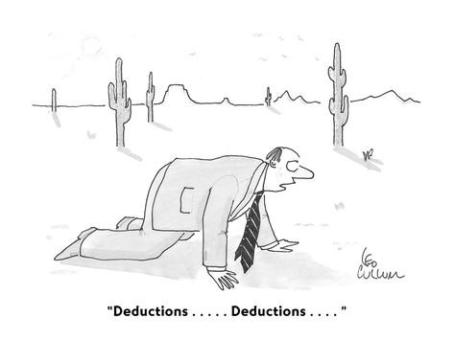
deductions desert

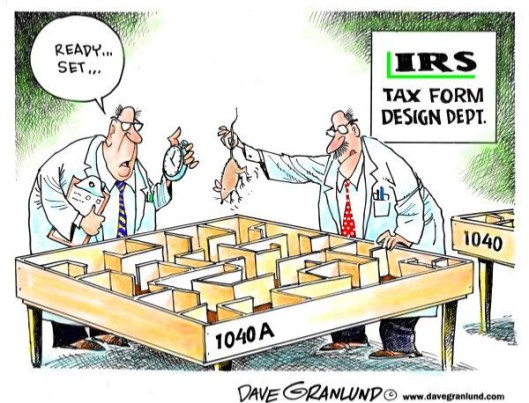
The rat’s nest that is the federal income tax code is a testament to the counter-productive nature of central economic planning. Not only does the tax code force citizens to waste time and other resources on compliance activities. It also encourages us to direct resources into uses that would not be worthwhile in the absence of tax incentives, uses that are not worthwhile in a societal context.

A general rationale for many provisions of the tax code is that they serve some “worthwhile” public purpose. A special tax provision is created to subsidize activities contributing to that purpose. Since that reduces the flow of revenue, tax rates must increase as an offset. However, high tax rates are damaging to economic health in and of themselves. They blunt incentives and drive wedges between the values and rewards that guide all economic decisions.

The competing tax plans under debate in the House and Senate would eliminate or pare back deductions to varying degrees, enabling a reduction in tax rates. I applaud steps in that direction, though a consequence of doing so piecemeal is to invite later tinkering of the sort that got us into this mess in the first place. Both the House and Senate bills are piecemeal. Here is a run-down of some of the deductions that are under review in the GOP plans:

State and Local Tax (SALT) Deductions: this deduction prevents the imposition of federal “taxes on taxes”, which is a worthwhile consideration. However, SALT also gives lower levels of government a “discount” on tax burdens they impose on their citizens, thereby forcing that burden to be shared by members of other jurisdictions. According to the Tax Foundation:

“The deduction favors high-income, high-tax states like California and New York, which together receive nearly one-third of the deduction’s total value nationwide. Six states—California, New York, New Jersey, Illinois, Texas, and Pennsylvania—claim more than half of the value of the deduction.“

Defenders of this deduction note peremptorily that it is used by taxpayers in all fifty states, as if that should come as a surprise. Well of course it is! And those who are taxed most heavily benefit the most from this deduction, and those benefits are most concentrated in high-tax states. The House GOP bill would limit the SALT deduction to $10,000, while the Senate version would eliminate it entirely.

Mortgage Interest (MI) Deduction: Long ago, the idea took hold that ownership of a home was of greater inherent value than mere occupancy. It’s obviously true that owners have greater rights than renters over use of a property. Those benefits are internalized, and owner-occupants might well be more inclined than renters to take pride in, care for, and improve a property. That suggests a social or external benefit from home ownership, one that at least benefits others in the vicinity of a given property.

The MI deduction creates an incentive for debt-financed home ownership, but only for the minority of taxpayers who can benefit from itemizing deductions. It therefore tends to subsidize the housing choices of those at higher levels of income and those with larger homes. It has contributed little, if anything, to the homeownership rate. Here are Edward Glaeser and Jesse Shapiro describing the findings of their NBER Working Paper:

“Externalities from living around homeowners are far too small to justify the deduction. … the home mortgage interest deduction is a particularly poor instrument for encouraging homeownership since it is targeted at the wealthy, who are almost always homeowners. The irrelevance of the deduction is supported by the time series which shows that the ownership subsidy moves with inflation and has changed significantly between 1960 and today, but the homeownership rate has been essentially constant.“

This deduction has fostered a massive over-investment in housing relative to other assets and forms of consumption. The House tax bill would allow a deduction on interest payments for up to $500,000 of mortgage debt, but this limit would apply only to new mortgages. The Senate bill would not alter the deduction in any way. These steps are severely limited in their reform ambitions.

Medical Expense Deduction: To take this deduction, you must 1) be an itemizer; and 2) have eligible medical expenses exceeding 10% of adjusted gross income (AGI). Then, you can deduct only the excess above 10%. A relatively small percentage of taxpayers actually take this deduction, mostly wealthy, older individuals or couples. It can be argued that the deduction encourages overuse of medical resources in some cases, but there are certainly others in which it provides relief from the hardship of an illness requiring expensive care. On the other hand, the deduction might serve to discourage the purchase of supplemental Medicare coverage by individuals who can afford it but are willing to bet that they won’t need it. Part of that bet is covered by the deduction.

The House bill would repeal this deduction in its entirety. The Senate bill would leave it untouched.

Student Loan Interest Deduction: Currently, up to $2,500 of student loan interest can be deducted “above the line” by non-itemizers, but only if their AGI is within certain limits. Higher education is often claimed to have social (external) benefits. To some extent, the student loan interest deduction helps bring the cost of an eduction to within reach of a broader swath of the citizenry. These considerations provide the rationale for public subsidies for funding tuition and other costs with debt. The tax deduction is only one of many forms of education subsidies. Another is provided by the below-market rates at which students are able to borrow from the federal government.

The social benefits of higher education are strongly associated with the value it adds for the individual. It can be argued that as a society, we may have pushed college education well beyond that point. A large number of indebted students decide, too late, that continued enrollment has little value, so they drop out and often default on their federally-subsidized debt. Moreover, these loan subsidies stimulate the demand for college education, which leads to a certain amount of escalation in tuition and fees. These ill effects make elimination of this deduction a tempting way to broaden the income-tax base, enabling a reduction in tax rates.

The House bill eliminates the deduction for student loan interest, but the Senate bill leaves it intact.

Conclusion: There are plenty of shortcomings in both the House and Senate versions of tax reform. Three liberalizing goals of reform are tax simplification, elimination of provisions that benefit special interests, and of course lower rates. Most of the complexities in the tax code benefit special interests in one way or another. The deductions discussed above fall into that category and necessitate higher tax rates on personal income. That in turn makes the deductions more valuable to those who claim them. In terms of the liberalizing goals of reform, the House tax bill is wider ranging than the Senate version, though the Senate bill’s complete elimination of the SALT deduction is better.

A Trump Tax Reform Tally

03 Wednesday May 2017

Posted by Nuetzel in Big Government, Taxes, Trump Administration

≈ 1 Comment

Tags

Alternative Minimum Tax, Border Adjustment Tax, C-Corporation, Capex Expensing, Capital Tax, Carry Forward Rules, Child Care Tax Credit, Don Boudreaux, Double Taxation, Goldman Sachs, Immigration, Interest Deductibility, Kevin D. Williamson, Mortgage Interest Deduction, Pass-Through Income, Protectionism, Qualified Dividends, Revenue Neutrality, S-Corporation, Shikha Dalmia, Standard Deduction, Tax Burden, Tax Incentives, tax inversion, Tax Reform, Tax Subsidies, Territorial Taxes, Thomas Sowell, Trump Tax Plan

IMG_4199

The Trump tax plan has some very good elements and several that I dislike strongly. For reference, this link includes the contents of an “interpretation” of the proposal from Goldman Sachs, based on the one-page summary presented by the Administration last week as well as insights that the investment bank might have gleaned from its connections within the administration. At the link, click on the chart for an excellent summary of the plan relative to current law and other proposals.

At the outset, I should state that most members of the media do not understand economics, tax burdens, or the dynamic effects of taxes on economic activity. First, they seem to forget that in the first instance, taxpayers do not serve at the pleasure of the government. It is their money! Second, Don Boudreaux’s recent note on the media’s “taxing” ignorance is instructive:

“In recent days I have … heard and read several media reports on Trump’s tax plan…. Nearly all of these reports are juvenile: changes in tax rates are evaluated by the media according to changes in the legal tax liabilities of various groups of people. For example, Trump’s proposal to cut the top federal personal income-tax rate from 39.6% to 35% is assessed only by its effect on high-income earners. Specifically, of course, it’s portrayed as a ‘gift’ to high-income earners.

… taxation is not simply a slicing up of an economic pie the size of which is independent of the details of the system of taxation. The core economic case for tax cuts is that they reduce the obstacles to creative and productive activities.“

Boudreaux ridicules those who reject this “supply-side” rationale, despite its fundamental and well-established nature. Thomas Sowell makes the distinction between tax rates and tax revenues, and provides some history on tax rate reductions and particularly “tax cuts for the rich“:

“… higher-income taxpayers paid more — repeat, MORE tax revenues into the federal treasury under the lower tax rates than they had under the previous higher tax rates. … That happened not only during the Reagan administration, but also during the Coolidge administration and the Kennedy administration before Reagan, and under the G.W. Bush administration after Reagan. All these administrations cut tax rates and received higher tax revenues than before.

More than that, ‘the rich’ not only paid higher total tax revenues after the so-called ‘tax cuts for the rich,’ they also paid a higher percentage of all tax revenues afterwards. Data on this can be found in a number of places …“

In some cases, a proportion of the increased revenue may have been due to short-term incentives for asset sales in the wake of tax rate reductions. In general, however, Sowell’s point stands.

Kevin Williamson offers thoughts that could be construed as exactly the sort of thing about which Boudreaux is critical:

“It is nearly impossible to cut federal income taxes in a way that primarily benefits low-income Americans, because high-income Americans pay most of the federal income taxes. … The 2.4 percent of households with incomes in excess of $250,000 a year pay about half of all federal income taxes; the bottom half pays about 3 percent.”

The first sentence of that quote highlights the obvious storyline pounced upon by simple-minded journalists, and it also emphasizes the failing political appeal of tax cuts when a decreasing share of the population actually pays taxes. After all, there is some participatory value in spreading the tax burden in a democracy. I believe Williamson is well aware of the second-order, dynamic consequences of tax cuts that spread benefits more broadly, but he is also troubled by the fact that significant spending cuts are not on the immediate agenda: the real resource cost of government will continue unabated. We cannot count on that from Trump, and that should not be a big surprise. Greater accumulation of debt is a certainty without meaningful future reductions in the growth rate of spending.

Here are my thoughts on the specific elements contained in the proposal, as non-specific as they might be:

What I like about the proposal:

  • Lower tax rate on corporate income (less double-taxation): The U.S. has the highest corporate tax rates in the developed world, and the corporate income tax represents double-taxation of income: it is taxed at the corporate level and again at the individual level, perhaps not all at once, but when it is actually received by owners.
  • Adoption of a territorial tax system on corporate income: The U.S. has a punishing system of taxing corporate income wherever it is earned, unlike most of our trading parters. It’s high time we shifted to taxing only the corporate income that is earned in the U.S., which should discourage the practice of tax inversion, whereby firms transfer their legal domicile overseas.
  • No Border Adjustment Tax (BAT): What a relief! This was essentially the application of taxes on imports but tax-free exports. Whatever populist/nationalist appeal this might have had would have quickly evaporated with higher import prices and the crushing blow to import-dependent businesses. Let’s hope it doesn’t come back in congressional negotiations.
  • Lower individual tax rates: I like it.
  • Fewer tax brackets: Simplification, and somewhat lower compliance costs.
  • Fewer deductions from personal income, a broader tax base, and lower compliance costs. Scrapping deductions for state and local taxes in exchange for lower rates will end federal tax subsidies from low-tax to high-tax states.
  • Elimination of the Alternative Minimum Tax: This tax can be rather punitive and it is a nasty compliance cost-causer.

What I dislike about the proposal:

  • The corporate tax rate should be zero (with no double taxation).
  • Taxation of cash held abroad, an effort to encourage repatriation of the cash for reinvestment in the U.S. Taxes on capital of any kind are an act of repeated taxation, as the income used to accumulate capital is taxed to begin with. And such taxes are destructive of capital, which represents a fundamental engine for productivity and economic growth.
  • Retains the mortgage interest and charitable deductions: Both are based on special interest politics. The former leads to an overallocation of resources to owner-occupied housing. Certainly the latter has redeeming virtues, but it subsidizes activities conferring unique benefits to large donors.
  • Increase in the standard deduction: This means fewer “interested” taxpayers. See the  discussion of the Kevin Williamson article above.
  • We should have just one personal income tax bracket, not three: A flat tax would be simpler and would reduce distortions to productive incentives.
  • Tax relief for child-care costs: More special interest politics. Subsidizing market income relative to home activity, hired child care relative to parental care, and fertility is not an appropriate role for government. To the extent that public aid payments are made, they should not be contingent on how the money is spent.
  • Many details are missing: Almost anything could happen with this tax “plan” when the real negotiations begin, but that’s politics, I suppose.

Mixed Feelings:

  • Descriptions of the changes to treatment of pass-through” income seem confused. There is only one kind of tax applied to the income of pass-through entities like S-corporations, and it is the owner’s individual tax rate. Income from C-corporations, on the other hand, is taxed twice: once at a 15% corporate tax rate under the Trump plan, and a second time when it is paid to investors at an individual tax rate, which now range from 15% to almost 24% for “qualified dividends” (most dividend payments), but are likely to range up to 35% for “ordinary” dividends under the plan. So effectively, double-taxed C-corporate income would be taxed at total rates ranging from 30% to 50% after tallying both the C-corp tax and the individual tax. (This is a simplification: C-corp income paid as dividends would be taxed to the corporation and then immediately to the shareholder at their individual rate, while retained corporate income would be taxed later).

Presumably, the Trump tax plan is to reduce the rate on “pass-through” income to just 15% at the individual level, regardless of other income. (It is not clear how that would effect brackets or the rate of taxation on other components of individual income.) Is that good? Yes, to the extent that lower tax rates allow individuals to keep more of their hard-earned income, and to the extent that such a change would help small businesses. S-corps have always had an advantage in avoiding double taxation, however, and this would not end the differential taxation of S and C income, which is distortionary. It might incent business owners to shift income away from salary payments to profit, however, which would increase the negative impact on tax revenue.

  • Interest deductibility and expensing of capital expenditures are in question. Interest deductibility puts debt funding on an equal footing with equity funding only if the double tax on C-corp income is fully repealed. Immediate expensing of “capex” would certainly provide an investment incentive (as long as “excess” expenses can be carried forward), and for C-corporations, it would certainly bring us closer to elimination of the double-tax on income (the accounting matching principle be damned!).
  • There is no commitment to shrink government, but that’s partly (only partly) a function of having abandoned revenue neutrality. It’s also something that has been promised for the next budget year.
  • The tax reform proposal represents a departure from insistence on revenue neutrality: On the whole, I find this appealing, not because I like deficits better than taxes, but because there may be margins along which tax policy can be improved if unconstrained by neutrality, assuming that the incremental deficits are less damaging to the economy than the gains. The political landscape may dictate that desirable changes in tax policy can be made more easily in this way.

Shikha Dalmia wonders whether a real antidote for “Trumpism” might be embedded within the tax reform proposal. If the reforms are successful in stimulating non-inflationary economic growth, a “big if” on the first count, the popular preoccupations inspired by Trump with immigration policy, the “wall” and protectionism might just fade away. But don’t count on it. On the whole, I think the tax reform proposal has promise, though some of the good parts could vanish before a bill hits Trump’s desk, and some of the bad parts could get worse!

How We Hinder Mobility

06 Monday Feb 2017

Posted by Nuetzel in Labor Markets, Mobility

≈ Leave a comment

Tags

CityLab, David Schleicher, Defined Benefit Vesting, Fannie Mae, Freddie Mac, Geographic entry barriers, Geographic exit barriers, Immigration policy, Joel Kotkin, Medicaid, Mobility, Mortgage Interest Deduction, Occupational Licencing, Rent Controls, Richard Florida, Ronald Bailey, SNAP, Structural Unemployment, TANF, Tax Revaluation, Transfer Taxes, Zoning laws

moving


A plethora of regulations and subsidies established by governments at all levels is making it more difficult for Americans to move, especially from one state to another. Yale Law Professor David Schleicher identifies these barriers to mobility and writes that they compromise the nation’s ability to match jobs with workers. Thus, these laws beget economic immobility as well. His paper, “Stuck in Place: Law and the Economic Consequences of Residential Stability“, describes a number of the barriers:

“Land-use laws and occupational licensing regimes limit entry into local and state labor markets; differing eligibility standards for public benefits, public employee pension policies, homeownership subsidies, state and local tax regimes, and even basic property law rules reduce exit from states and cities with less opportunity; and building codes, mobile home bans, federal location-based subsidies, legal constraints on knocking down houses and the problematic structure of Chapter 9 municipal bankruptcy all limit the capacity of failing cities to ‘shrink’ gracefully, directly reducing exit among some populations and increasing the economic and social costs of entry limits elsewhere.“

To get a sense of the magnitude of declines in mobility over the past three decades, see Figure 3 in this discussion about mobility by Richard Florida at CityLab. The percentage of homeowners who move declined from almost 10% annually in the late 1980s to about 5% in 2016. The biggest declines occurred during the periods of economic weakness in 2001 and 2008. For renters, the percentage of movers declined from just above 35% in 1988 to less than 24% in 2016.

Workers who might otherwise migrate to jurisdictions with better economic opportunities often cannot do so. Schleicher notes that low-income workers suffer the most from these obstacles, which he divides into entry and exit barriers. Most of the obstacles he cites are compelling, though at times his emphasis veers toward enabling more effective government management of the macroeconomy, which is very unappealing to my libertarian instincts.

Entry Barriers

Schleicher emphasizes two major ways in which entry barriers are created. One is the spread and severity of land use restrictions such as zoning and construction laws, which have become so severe in some areas of the country that they have led to drastic inflation in housing prices. In a review of Schliecher’s paper, Ronald Bailey at Reason.com illustrates the disparities created by this process:

“According to the Trulia real estate market analysis, the median house price in San Francisco is $1.2 million, with a median rent of $4,100 a month; in Youngstown it’s $93,000, with a median rent of $650. In other words, a Youngstown worker who sold his home for full price would receive enough money to rent a place in San Francisco for 22 months.“

The contrast in the economies of these two cities is stark. The San Francisco Bay Area has experienced vibrant job growth over the past several years, while Youngstown has been struggling for decades. Given the difference in housing prices and rents, it would be almost impossible for a worker from Youngstown to pursue an opportunity in the Bay Area without a accepting a severe decline in their standard of living. Joel Kotkin makes a similar point in discussing the high cost of housing in some areas, but his focus is on the difficult prospects for economic mobility and homeownership among Millennials.

The second major entry barrier discussed by Schleicher takes the form of occupational licensing laws. They differ across states but have multiplied since the 1950s. According to Richard Florida (linked above), the share of American workers subject to some form of licensing requirement rose from just 5% in the 1950s to 25% by 2008. Schleicher cites low rates of interstate mobility among professions that typically require a license to practice. Veterans of those occupations tend to have an established book of business, however, so it’s reasonable to expect fewer distant moves. Nevertheless, the cost of obtaining a license in a new state and differing licensure requirements are likely to inhibit the mobility of licensed professionals.

Exit Barriers

One of the most interesting sections in Schleicher’s paper is on exit barriers. Locations are always “sticky” to the extent that local ties exist or develop over time, both between people and between people and local institutions. But some institutions create ties that are severely binding. For example, state and local government employees are often enrolled in defined benefit plans with lengthy vesting periods. Remaining in one system throughout a career can be a huge advantage. Other exit barriers involve differences in eligibility and levels of aid under federal programs managed by states such as Medicaid, Temporary Assistance to Needy Families (TANF), and the Supplemental Nutrition Assistance Program (SNAP — food stamps). Beyond the actual benefits at stake, administrative costs and delays in re-enrollment might hinder a needy family’s attempt to make an interstate move.

Local and state law on property transfers can also impinge on mobility. Real estate transfer taxes in some states certainly create an incentive to stay put. Also, while tax reassessments occur with regularity in most jurisdictions, some impose limits on the amount of the annual change in valuation, requiring a full tax revaluation on resale, so a seller must forego such a tax discount. Rent controls reward renters who stay in place, creating another exit barrier. And rent controls prevent entry as well, as they invariably reduce the supply of quality housing, thereby inflating the rents of vacated apartments available to new residents.

Finally, federal policies designed to encourage homeownership create exit barriers across the country. Ownership of a residence increases the “stickiness” of any locale, but the loss of a mortgage interest income-tax deduction adds to the sacrifice of a move to a rental unit in a more expensive location. So does the interest rate subsidy inherent in the implicit federal guarantee against default on mortgages securitized by Fannie Mae and Freddie Mac. Finally, when local economies are in a state of decline, home prices usually follow. Consequently, owners are likely to suffer reduced or negative equity in their homes and may be “locked in”, unable to pay off their mortgage on a sale, and therefore unable to leave their current residence.

Rent Seeking and Good Intentions

Some of the policies discussed above are the handiwork of those powerful enough to enlist government power in their own self-interest. That includes zoning laws, by which property owners can prevent land uses they deem undesirable. It also includes occupational licensing, a political avenue through which established business interests limit competition by new entrants. Of course, licensure is typically sold to voters as consumer protection, a claim that is often dubious.

Other policies that hinder mobility can be characterized as well-intentioned, like the old-style, defined benefit plans still in use by many state and local governments, or federal subsidies for homeownership. Many such policies are, or have been, promoted on the basis of the obvious gains they create for individuals, with little thought given to the “unseen” but damaging economic consequences. Rent controls fall into this category as well, but are very damaging in the long-term.

The Labor Market Ossified

All of the mobility-limiting policies discussed by Schleicher have a detrimental effect on the performance of labor markets. Workers tend to get stuck in depressed areas, where their value as human resources is diminished even while employers in other markets face limited supplies of qualified labor. This leads to higher structural unemployment, lower growth in output, and more difficulty for the private sector in meeting the needs of consumers than otherwise be possible.

I haven’t dealt with one other national policy dealing explicitly with geographic mobility: immigration. Restrictions on legal immigration and the issuance of green cards are often sought by interests hoping to protect Americans from competition for jobs. Suspending competition is never a good idea, however, as it leads to higher prices and undermines consumer interests. To the extent that businesses face a shortage of qualified talent to fill particular jobs, as is often the case, such restrictive policies are unequivocally damaging to the economy for the same reasons as barriers to interstate migration. Liberalized immigration allows more foreigners with peaceful, productive and often entrepreneurial intent to contribute to the country’s ability to create wealth.

Prescriptions

What can be done to promote interstate mobility? Here is a list that is undoubtedly incomplete: encourage state and local governments to end rent controls; liberalize zoning laws; reevaluate construction restrictions; liberalize occupational licensing; reduce real estate transfer taxes and smooth the timing of tax revaluations. Governments should also transition from defined benefit to defined contribution benefit plans, a step that would also allow them to avoid persistent overoptimism about their ability to meet future pension obligations. As long as states manage federal aid programs and have leeway in setting eligibility requirements and their share of benefits, there will be exit barriers to low-income recipients. Perhaps states should be required to coordinate benefits, with strict time limits, when recipients move interstate to pursue employment opportunities. Finally, subsidies encouraging homeownership should be phased out, including the federal tax deduction for mortgage interest and full privatization of Fannie Mae and Freddie Mac. A neutral stance with respect to homeownership would allow the market to seek an optimal balance in residential property ownership without creating excessive locational anchors.

Schleicher devotes a large part of his paper to the implications of reduced mobility for macroeconomic stabilization policy. In particular, he contends that measures intended to stimulate the economy cannot be as effective when labor supplies are inflexible. That might be true, but I’m loath to endorse Keynesian activism. Still, there is no doubt that geographic stasis of the kind described by Schleicher contributes to immobility in incomes as well. The main conclusion I draw from his paper is that governments ought to be very cautious about interfering in market transactions, even when convinced that their cause is noble. The law of unintended consequences has a way of foiling the best laid plans of social engineers.

Mortgage Mania at the Fed

09 Thursday Oct 2014

Posted by Nuetzel in Uncategorized

≈ Leave a comment

Tags

Fannie Mae, Federal Reserve, Freddie Mac, Industrial Policy, Monetary Stimulus, Mortgage Interest Deduction, Mortgage Securities, Quantitative Easing, Richmond Fed, Wall Street Journal

bernanke-fed-qe

The Federal Reserve has no business distorting incentives by dabbling with billions in markets for private debt. Kudos to two officials at the Richmond Fed for making this point forcefully in the Wall Street Journal** today.

Normally, the Fed conducts monetary policy by buying or selling Treasury debt, which is thought to be neutral with respect to relative private interest rates. In other words, the Fed’s impact on the Treasury market, whatever that might be, does not encourage investment in housing at the expense of factory investment or vice versa. Since 2009, however, the Fed has attempted to support the housing and mortgage markets via massive purchases  of mortgage securities originally issued by Fannie Mae and Freddie Mac. This has the effect of reducing mortgage interest rates relative to rates on other kinds of private debt. It also constitutes a form of bailout for mortgage investors, who tend to receive favorable bids from the Fed for these assets. Free money! And more free money is dolled out by the Fed when it pays banks interest on the new reserve balances these transactions ultimately create.

One might object that the struggling mortgage market needed the Fed’s support in the wake of the housing crash. I do not accept that view because the mortgage and housing markets needed to unwind their excesses and monetary stimulus did not require mortgage purchases. But this also begs the question: what gave rise to the crisis? Over-investment in housing and a home price bubble fueled by tax-deductible interest, easy Fed monetary policy, regulatory capital standards that favored mortgage lending, prospective bailouts in case of failure, and loose bank credit standards. Those should all sound familiar. Now, the Fed believes it’s necessary to re-inflate the mortgage market via continuing asset purchases.

The Fed’s policies can be criticized on other grounds, but interfering in private debt markets should be avoided. It is an example of industrial policy that is clearly not even part of the Fed’s so-called mandate, and it ultimately means a continuing massive misallocation of resources into housing at the expense of other forms of investment.

** The article at the link should be ungated. If not, try Googling “wsj Fed’s Mortgage Favoritism.”

The Mortgage Interest Deduction Delusion

29 Saturday Mar 2014

Posted by Nuetzel in Uncategorized

≈ Leave a comment

Tags

Home ownership, Mortgage Interest Deduction, Tax Reform

Image

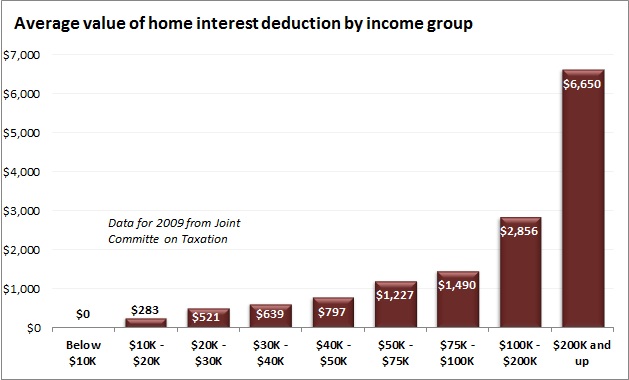
The home mortgage interest deduction does not encourage home ownership and it disproportionately benefits high-income taxpayers. A study of the MI deduction’s various impacts in National Affairs demonstrates the extent to which its benefits are skewed to high-earners, wealthy suburbs, the coasts and other areas with high real estate prices. The study also discusses the perverse incentives created by the deduction.

If you think the MI deduction helps you personally, remember that it almost certainly inflated the price you paid for your home and the amount you had to finance, and it likely has caused the income tax rate you pay to be higher than it would be in its absence. There is little or nothing to recommend the deduction as policy. Even the ostensible goal of a federally-directed increase in home ownership is of questionable value. Reform of the tax code will be politically charged, and this provision will have its share of staunch defenders. The authors discuss various alternatives and approaches to reform that could ease the transition away from the deduction.

Follow Sacred Cow Chips on WordPress.com

Recent Posts

  • The Case Against Interest On Reserves
  • Immigration and Merit As Fiscal Propositions
  • Tariff “Dividend” From An Indigent State
  • Almost Looks Like the Fed Has a 3% Inflation Target
  • Government Malpractice Breeds Health Care Havoc

Archives

  • January 2026
  • December 2025
  • November 2025
  • October 2025
  • September 2025
  • August 2025
  • July 2025
  • June 2025
  • May 2025
  • April 2025
  • March 2025
  • February 2025
  • January 2025
  • December 2024
  • November 2024
  • October 2024
  • September 2024
  • August 2024
  • July 2024
  • June 2024
  • May 2024
  • April 2024
  • March 2024
  • February 2024
  • January 2024
  • December 2023
  • November 2023
  • August 2023
  • July 2023
  • June 2023
  • May 2023
  • April 2023
  • March 2023
  • February 2023
  • January 2023
  • December 2022
  • November 2022
  • October 2022
  • September 2022
  • August 2022
  • July 2022
  • June 2022
  • May 2022
  • April 2022
  • March 2022
  • February 2022
  • January 2022
  • December 2021
  • November 2021
  • October 2021
  • September 2021
  • August 2021
  • July 2021
  • June 2021
  • May 2021
  • April 2021
  • March 2021
  • February 2021
  • January 2021
  • December 2020
  • November 2020
  • October 2020
  • September 2020
  • August 2020
  • July 2020
  • June 2020
  • May 2020
  • April 2020
  • March 2020
  • February 2020
  • January 2020
  • December 2019
  • November 2019
  • October 2019
  • September 2019
  • August 2019
  • July 2019
  • June 2019
  • May 2019
  • April 2019
  • March 2019
  • February 2019
  • January 2019
  • December 2018
  • November 2018
  • October 2018
  • September 2018
  • August 2018
  • July 2018
  • June 2018
  • May 2018
  • April 2018
  • March 2018
  • February 2018
  • January 2018
  • December 2017
  • November 2017
  • October 2017
  • September 2017
  • August 2017
  • July 2017
  • June 2017
  • May 2017
  • April 2017
  • March 2017
  • February 2017
  • January 2017
  • December 2016
  • November 2016
  • October 2016
  • September 2016
  • August 2016
  • July 2016
  • June 2016
  • May 2016
  • April 2016
  • March 2016
  • February 2016
  • January 2016
  • December 2015
  • November 2015
  • October 2015
  • September 2015
  • August 2015
  • July 2015
  • June 2015
  • May 2015
  • April 2015
  • March 2015
  • February 2015
  • January 2015
  • December 2014
  • November 2014
  • October 2014
  • September 2014
  • August 2014
  • July 2014
  • June 2014
  • May 2014
  • April 2014
  • March 2014

Blogs I Follow

  • Passive Income Kickstart
  • OnlyFinance.net
  • TLC Cholesterol
  • Nintil
  • kendunning.net
  • DCWhispers.com
  • Hoong-Wai in the UK
  • Marginal REVOLUTION
  • Stlouis
  • Watts Up With That?
  • Aussie Nationalist Blog
  • American Elephants
  • The View from Alexandria
  • The Gymnasium
  • A Force for Good
  • Notes On Liberty
  • troymo
  • SUNDAY BLOG Stephanie Sievers
  • Miss Lou Acquiring Lore
  • Your Well Wisher Program
  • Objectivism In Depth
  • RobotEnomics
  • Orderstatistic
  • Paradigm Library
  • Scattered Showers and Quicksand

Blog at WordPress.com.

Passive Income Kickstart

OnlyFinance.net

TLC Cholesterol

Nintil

To estimate, compare, distinguish, discuss, and trace to its principal sources everything

kendunning.net

The Future is Ours to Create

DCWhispers.com

Hoong-Wai in the UK

A Commonwealth immigrant's perspective on the UK's public arena.

Marginal REVOLUTION

Small Steps Toward A Much Better World

Stlouis

Watts Up With That?

The world's most viewed site on global warming and climate change

Aussie Nationalist Blog

Commentary from a Paleoconservative and Nationalist perspective

American Elephants

Defending Life, Liberty and the Pursuit of Happiness

The View from Alexandria

In advanced civilizations the period loosely called Alexandrian is usually associated with flexible morals, perfunctory religion, populist standards and cosmopolitan tastes, feminism, exotic cults, and the rapid turnover of high and low fads---in short, a falling away (which is all that decadence means) from the strictness of traditional rules, embodied in character and inforced from within. -- Jacques Barzun

The Gymnasium

A place for reason, politics, economics, and faith steeped in the classical liberal tradition

A Force for Good

How economics, morality, and markets combine

Notes On Liberty

Spontaneous thoughts on a humble creed

troymo

SUNDAY BLOG Stephanie Sievers

Escaping the everyday life with photographs from my travels

Miss Lou Acquiring Lore

Gallery of Life...

Your Well Wisher Program

Attempt to solve commonly known problems…

Objectivism In Depth

Exploring Ayn Rand's revolutionary philosophy.

RobotEnomics

(A)n (I)ntelligent Future

Orderstatistic

Economics, chess and anything else on my mind.

Paradigm Library

OODA Looping

Scattered Showers and Quicksand

Musings on science, investing, finance, economics, politics, and probably fly fishing.

  • Subscribe Subscribed
    • Sacred Cow Chips
    • Join 128 other subscribers
    • Already have a WordPress.com account? Log in now.
    • Sacred Cow Chips
    • Subscribe Subscribed
    • Sign up
    • Log in
    • Report this content
    • View site in Reader
    • Manage subscriptions
    • Collapse this bar
 

Loading Comments...