• About

Sacred Cow Chips

Sacred Cow Chips

Tag Archives: Productivity Growth

Public Debt and AI: Ain’t But One Way Crowding Out

17 Sunday Aug 2025

Posted by Nuetzel in Artificial Intelligence, Deficits

≈ Leave a comment

Tags

AI Capital Expenditures, Artificially Intelligence, Bradford S. Cohen, Carlyle, central planning, Cronyism, crowding out, Daren Acemoglu, Digital Assets, Federal Deficits, Goldman Sachs, Jason Thomas, Megan Jones, Productivity Growth, Public debt, Scarcity, Seth Benzell, Sovereign Wealth Fund, Stanford Digital Economy Lab, Tyler Cowen
There’s a hopeful narrative making the rounds that artificial intelligence will prove to be such a boon to the economy that we need not worry about high levels of government debt. AI investment is already having a substantial economic impact. Jason Thomas of Carlyle says that AI capital expenditures on such things as data centers, hardware, and supporting infrastructure account for about a third of second quarter GDP growth (preliminarily a 3% annual rate). Furthermore, he says relevant orders are growing at an annual rate of about 40%. The capex boom may continue for a number of years before leveling off. In the meantime, we’ll begin to see whether AI is capable of boosting productivity more broadly.

Unfortunately, even with this kind of investment stimulus, there’s no assurance that AI will create adequate economic growth and tax revenue to end federal deficits, let alone pay down the $37 trillion public debt. That thinking puts too much faith in a technology that is unproven as a long-term economic engine. It would also be a naive attitude toward managing debt that now carries an annual interest cost of almost $1 trillion, accounting for about half of the federal budget deficit.

Boom Times?

Predictions of AI’s long-term macro impact are all over the map. Goldman Sachs estimates a boost in global GDP of 7% over 10 years, which is not exactly aggressive. Daren Acemoglu has been even more conservative, estimating a gain of 0.7% in total factor productivity over 10 years. Tyler Cowen has been skeptical about the impact of AI on economic growth. For an even more pessimistic take see these comments.

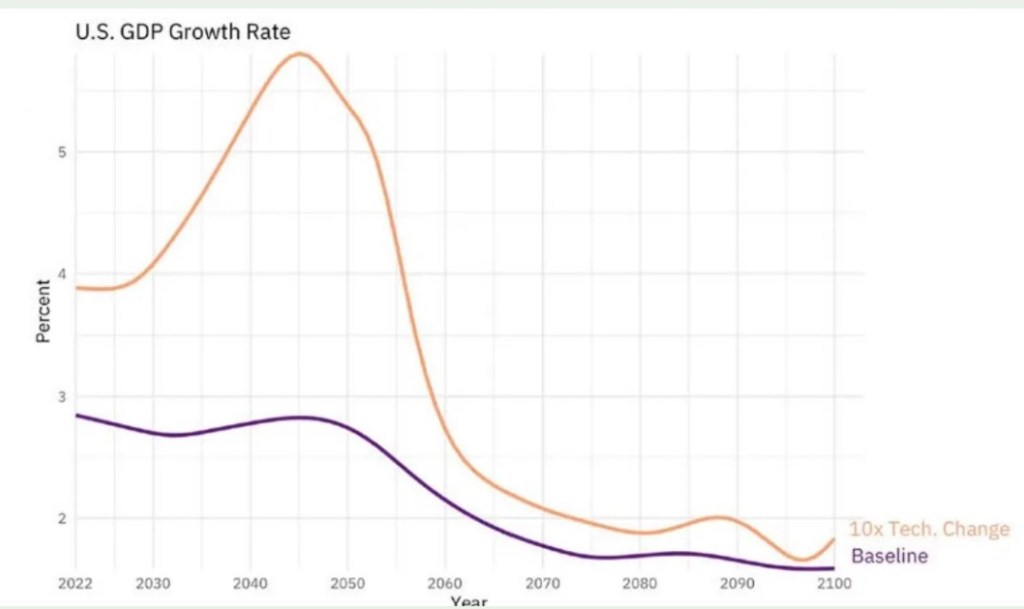
In July, however, Seth Benzell of the Stanford Digital Economy Lab discussed some simulations showing impressive AI-induced growth (see chart at top). The simulations project additional U.S. GDP growth of between 1% – 3% annually over the next 75 years! The largest boost in growth occurs now through the 2050s. This would produce a major advance in living standards. It would also eliminate the federal deficit and cure our massive entitlement insolvency, but the result comes with heavy qualifications. In fact, Benzell ultimately throws cold water on the notion that AI growth will be strong enough to reduce or even stabilize the public debt to GDP ratio.

The Scarcity Spoiler

The big hitch has to do with the scarcity of capital, which I’ve described as an impediment to widespread AI application. Competition for capital will drive interest rates up (3% – 4%, according to Benzell’s model). Ongoing needs for federal financing intensify that effect. But it might not be so bad, according to Benzell, if climbing rates are accompanied by heightened productivity powered by AI. Then, tax receipts just might keep-up with or exceed the explosion in the government’s interest obligations.

A further complication cited by Benzell lurks in insatiable demands for public spending, and politicians who simply can’t resist the temptation to buy votes via public largesse. Indeed, as we’ve already seen, government will try to get in on the AI action, channeling taxpayer funds into projects deemed to be in the public interest. And if there are segments of the work force whose jobs are eliminated by AI, there will be pressure for public support. So even if AI succeeds in generating large gains in productivity and tax revenue, there’s very little chance we’ll see a contagion of fiscal discipline in Washington DC. This will put more upward pressure on interest rates, giving rise to the typical crowding out phenomenon, curtailing private investment in AI.

Playing Catch-Up

The capex boom must precede much of the hoped-for growth in productivity from AI. Financing comes first, which means that rates are likely to rise sooner than productivity gains can be expected. And again, competition from government borrowing will crowd out some private AI investment, slowing potential AI-induced increases in tax revenue.

There’s no chance of the converse: that AI investment will crowd out government borrowing! That kind of responsiveness is not what we typically see from politicians. It’s more likely that ballooning interest costs and deficits generally will provoke even more undesirable policy moves, such as money printing or rate ceilings.

The upshot is that higher interest rates will cause deficits to balloon before tax receipts can catch up. And as for tax receipts, the intangibility of AI will create opportunities for tax flight to more favorable jurisdictions, a point well understood by Benzell. As attorneys Bradford S. Cohen and Megan Jones put it:

“Digital assets can be harder to find and more easily shifted offshore, limiting the tax reach of the U.S. government.”

AI Growth Realism

Benzell’s trepidation about our future fiscal imbalances is well founded. However, I also think Benzell’s modeled results, which represent a starting point in his analysis of AI and the public debt, are too optimistic an assessment of AI’s potential to boost growth. As he says himself,

“… many of the benefits from AI may come in the form of intangible improvements in digital consumption goods. … This might be real growth, that really raises welfare, but will be hard to tax or even measure.”

This is unlikely to register as an enhancement to productivity. Yet Benzell somehow buys into the argument that AI will lead to high levels of unemployment. That’s one of his reasons for expecting higher deficits.

My view is that AI will displace workers in some occupations, but it is unlikely to put large numbers of humans permanently out of work and into state support. That’s because the opportunity cost of many AI applications is and will remain quite high. It will have to compete for financing not only with government and more traditional capex projects, but with various forms of itself. This will limit both the growth we are likely to reap from AI and losses of human jobs.

Sovereign Wealth Fund

I have one other bone to pick with Benzell’s post. That’s in regard to his eagerness to see the government create a sovereign wealth fund. Here is his concluding paragraph:

“Instead of contemplating a larger debt, we should instead be talking about a national sovereign wealth fund, that could ‘own the robots on behalf of the people’. This would both boost output and welfare, and put the welfare system on an indefinitely sustainable path.”

Whether the government sells federal assets or collects booty from other kinds of “deals”, the very idea of accumulating risk assets in a sovereign wealth fund undermines the objective to reduce debt. It will be a struggle for a sovereign wealth fund to consistently earn cash returns to compensate for interest costs and pay down the debt. This is especially unwise given the risk of rising rates. Furthermore, government interests in otherwise private concerns will bring cronyism, displacement of market forces by central planning, and a politicization of economic affairs. Just pay off the debt with whatever receipts become available. This will free up savings for investment in AI capital and hasten the hoped-for boom in productivity.

Summary

AI’s contribution to economic growth probably will be inadequate and come too late to end government budget deficits and reduce our burgeoning public debt. To think otherwise seems far fetched in light of our historical inability to restrain the growth of federal spending. Interest on the federal debt already accounts for about half of the annual budget deficit. Refinancing the existing public debt will entail much higher costs if AI capex continues to grow aggressively, pushing interest rates higher. These dynamics make it pretty clear that AI won’t provide an easy fix for federal deficits and debt. In fact, ongoing federal borrowing needs will sop up savings needed for AI development and diffusion, even as the capital needed for AI drives up the cost of funds to the government. It’s a shame that AI won’t be able to crowd out government.

Infrastructure Or Infra-Stricture? The Democrats’ $3.5 Trillion Reconciliation Bill

16 Thursday Sep 2021

Posted by Nuetzel in Big Government, Central Planning, infrastructure, Uncategorized

≈ 3 Comments

Tags

Antonia Ocasio-Cortez, Bernie Sanders, Biden Administration, Budget Reconcilation Bill, Capital Gains, Civilian Climate Corps, Clean Energy, corporate income tax, dependency, Federal Reserve, Fossil fuels, Green Cards, infrastructure, Joe Manchin, Legal Permanent Residency, Paid Family Leave, Physical Investment, Productivity Growth, Social Infrastructure, Tax the Rich, Tragedy of the Commons, Universal Pre-School, Welfare State

The Socialist Party faithful once known as Democrats are pushing a $3.5 trillion piece of legislation they call an “infrastructure” bill. They hope to pass it via budget reconciliation rules with a simple majority in the Senate. The Dems came around to admitting that the bill is not about infrastructure in the sense in which we usually understand the term: physical installations like roads, bridges, sewer systems, power lines, canals, port facilities, and the like. These kinds of investments generally have a salutary impact on the nation’s productivity. Some “traditional” infrastructure, albeit with another hefty wallop of green subsidies, is covered in the $1.2 trillion “other” infrastructure bill already passed by the Senate but not the House. The reconciliation bill, however, addresses “social infrastructure”, which is to say it would authorize a massive expansion in the welfare state.

What Is Infrastructure?

Traditionally, public and private infrastructure are underlying assets that facilitate production or consumption in one way or another, consistent with the prefix “infra”, meaning below or within. For example, a new factory requires physical access by roads and/or rail, as well as sewer service, water, gas and/or electric supply. All of the underlying physical components that enable that factory to operate may be thought of as private infrastructure, which has largely private benefits. Therefore, it is often privately funded, though certainly not always.

Projects having many beneficiaries, such as highways, municipal sewers, water, gas and electrical trunk lines, canals, and ports may be classified as public infrastructure, though they can be provided and funded privately. Pure public infrastructure provides services that are non-rivalrous and non-excludable, but examples are sparse. Nevertheless, the greater the public nature of benefits, the greater the rationale for government involvement in their provision. In practice, a great deal of “public” infrastructure is funded by user fees. In fact, a failure to charge user fees for private benefits often leads to a tragedy of the commons, such as the overuse of free roads, imposing a heavier burden on taxpayers.

The use of the term “infrastructure” to describe forms of public support is not new, but the scope of government interventions to which the term is applied has mushroomed during the Biden Administration. Just about any spending program you can think of is likely to be labeled “infrastructure” by so-called progressives. The locution is borrowed somewhat questionably, seemingly motivated by the underlying structure of political incentives. More bluntly, it sounds good as a sales tactic!

$3.5 Trillion and Chains

Among other questionable items, the so-called budget reconciliation “infrastructure” bill allocates funds toward meeting:

“… the President’s climate change goals of 80% clean electricity and 50% economy-wide carbon emissions by 2030, while advancing environmental justice and American manufacturing. The framework would fund:
• Clean Energy Standard
• Clean Energy and Vehicle Tax Incentives
• Civilian Climate Corps
• Climate Smart Agriculture, Wildfire Prevention and Forestry
• Federal procurement of clean technologies
• Weatherization and Electrification of Buildings
• Clean Energy Accelerator
”

The resolution would also institute “methane reduction and polluter import fees”. Thus, we must be prepared for a complete reconfiguration of our energy sector toward a portfolio of immature and uneconomic technologies. This amounts to an economic straightjacket.

Next we have a series of generous programs and expansions that would encourage dependence on government:

“• Universal Pre-K for 3 and 4-year old children
• High quality and affordable Child Care
•
[free] Community College, HBCUs and MSIs, and Pell Grants
• Paid Family and Medical Leave
• Nutrition Assistance
• Affordable Housing
”

If anything, pre-school seems to have cognitive drawbacks for children. Several of these items, most obviously the family leave mandate, would entail significant regulatory and cost burdens on private businesses.

There are more generous provisions on the health care front, which are good for further increasing the federal government’s role in directing, regulating, and funding medical care:

“• new Dental, Vision, and Hearing benefit to Medicare
• Home and Community-Based Services expansion
• Extend the Affordable Care Act Expansion from the ARP
• Close the Medicaid “Coverage Gap” in the States that refused to expand
• Reduced patient spending on prescription drugs
”

Finally, we have a series of categories intended to “help workers and communities across the country recover from the COVID-19 pandemic and reverse trends of economic inequality.”

“• Housing Investments
• Innovation and R & D Upgrades
• American Manufacturing and Supply Chains Funding
• LPRs for Immigrants and Border Mangt. • Pro-Worker Incentives and Penalties
• Investment in Workers and Communities • Small Business Support

I might suggest that a recovery from the pandemic would be better served by getting the federal government out of everyone’s business. The list includes greater largess and more intrusions by the federal government. The fourth item above, grants of legal permanent residency (LPR) or green cards, would legalize up to 8 million immigrants, allowing them to qualify for a range of federal benefits. It would obviously legitimize otherwise illegal border crossings and prevent any possibility of eventual deportation.

Screwing the Pooch

How many of those measures really sound like infrastructure? This bill goes on for more than 10,000 pages, so the chance that lawmakers will have an opportunity to rationally assess all of its provisions is about nil! And the reconciliation bill doesn’t stop at $3.5T. There are a few budget gimmicks being leveraged that could add as much as $2T of non-infrastructure spending to the package. One cute trick is to add certain provisions affecting revenue or spending years from now in order to cut the bill’s stated price tag.

A number of the bill’s generous giveaways will have negative effects on productive incentives. It’s also clear that some items in the bill will supplement the far Left’s educational agenda, which is seeped in critical theory. And the bill will increase the dominance of the federal government over not only the private sector, but state and local sovereignty as well. This is another stage in the metastasis of the federal bureaucracy and the dependency fostered by the welfare state.

Taxing the Golden Goose

But here’s the really big rub: the whole mess has to be paid for. The flip side of our growing dependency on government is the huge obligation to fund it. Check this out:

“American ‘consumer units,’ as BLS calls them, spent a net total of $17,211.12 on taxes last year while spending only $16,839.89 on food, clothing, healthcare and entertainment combined,”

Democrats continue to dicker over the tax provisions of the bill, but the most recent iteration of their plan is to cover about $2.9 trillion of the cost via tax hikes. Naturally, the major emphasis is on penalizing corporations and “the rich”. The latest plan includes:

  • increasing the corporate income tax from 21% to 26.8%;
  • increasing the top tax rate on capital gains from 20% to 25%;
  • an increase in the tax rate for incomes greater than $400,000 ($450,000 if married filing jointly)
  • adding a 3% tax surcharge for those with adjusted gross incomes in excess of $5 million;
  • Higher taxes on tobacco and nicotine products;
  • halving the estate and gift tax exemption;
  • limiting deductions for executive compensation;
  • changes in rules for carried interest and crypto assets.

There are a few offsets, including the promise of tax reductions for individuals earning less than $200,000 and businesses earning less than $400,000. We’ll see about that. Those cuts would expire by 2027, which reduces their “cost” to the government, but it will be controversial when the time comes.

The Dem sell job includes the notion that corporate income belongs to the “rich”, but as I’ve noted before, the burden of the corporate income tax falls largely on corporate workers and consumers. Lower wages and higher prices are almost sure to follow. This would deepen the blade of the Democrats’ political hari-kari, but they pin their hopes on the power of alms. Once bestowed, however, those will be difficult if not impossible to revoke, and the Dems know this all too well.

The assault on the “rich” in the reconciliation bill is both ill-advised and unlikely to yield the levels of revenue projected by Democrats. Like it or not, the wealthy provide the capital for most productive investment. Taxing their returns and their wealth more heavily can only reduce incentive to do so. Those investors will seek out more tax-advantaged uses for their funds. That includes investments in non-productive but federally-subsidized alternatives. Capital gains can often be deferred, of course. These penalties also ensure that more resources will be consumed in compliance and tax-avoidance efforts. The solutions offered by armies of accountants and tax attorneys will tend to direct funds to uses that are suboptimal in terms of growth in economic capacity.

What isn’t funded by new taxes will be borrowed by the federal government or simply printed by the Federal Reserve. Thus, the federal government will not only compete with the private sector for additional resources, but the monetary authority will provide fuel for more inflation.

Fracturing Support?

Fortunately, a few moderate Democrats in both the House and the Senate are balking at the exorbitance of the reconciliation bill. Senator Joe Manchin of West Virginia has said he would like to see a package of no more than $1.5 trillion. That still represents a huge expansion of government, but at least Manchin has offered a whiff of sanity. Equally welcome are threats from radical Democrats like Senator Bernie Sanders and Rep. Antonia Ocasio-Cortez that a failure to pass the full reconciliation package will mean a loss of their support for the original $1.2 trillion infrastructure bill, much of which is wasteful. We should be so lucky! But that’s a lot of pork for politicians to walk away from.

Infra-Shackles

The so-called infrastructure investments in the reconciliation bill represent a range of constraints on economic growth and consumer well being. Increasing the government’s dominance is never a good prescription for productivity, whether due to regulatory and compliance costs, bureaucratization of decision-making, minimizing the role of price signals, pure waste through bad incentives and graft, and public vs. private competition for resources. The destructive tax incentives for funding the bill are an additional layer of constraints on growth. Let’s hope the moderate Democrats hold firm, or even better, that the tantrum-prone radical Democrats are forced to make good on their threats.

Government Economy; Government Science: You Wanted Growth?

28 Wednesday Oct 2015

Posted by Nuetzel in Central Planning, Regulation, Technology

≈ Leave a comment

Tags

Basic Science, economic growth, Innovation, John Cochrane, Matt Ridley, Productivity Growth, Public Funding of Science, regulation, Technological advance

science1

Economic growth allows us to enjoy an improving material existence and the wealth to pursue other goals as a society, such as a clean environment. Yet we often pursue other goals in ways that strangle growth, when in fact those goals and growth are fundamentally compatible.

Two articles that caught my attention today approach this issue from different but complementary perspectives. One is by John Cochrane of the University of Chicago, a lengthy piece called simply “Economic Growth“. At the outset, Cochrane asserts that the one, ultimate source of economic growth in the long-run is through advancing productivity. He notes, however, that the U.S. has been falling short in that department of late. Re-establishing growth should start with a clean-up of the many harmful public policies that have cluttered the economic landscape, especially over the last few decades. Unfortunately, politics makes this easier said than done:

“The golden rule of economic policy is: Do not transfer incomes by distorting prices or slowing competition and innovation. The golden rule of political economics seems to be: Transfer incomes by distorting prices and regulating away competition. Doing so attracts a lot less attention than on-budget transfers or subsidies. It takes great political leadership to force the political process to obey the economic rule.“

Cochrane’s discussion is wide ranging, covering a number of areas of public policy that require “weeding”, as he puts it: the regulatory arena (finance, health care, energy and the environment), tax policy, debt and deficits, the design of social programs and entitlements, labor law and regulation, immigration, education, agricultural policy, trade, and the process of infrastructure investment. There may be a year’s worth of blog posts to be drawn from Cochrane’s essay, but I think “weeding” understates the difficulty of the tasks outlined by Cochrane to reignite growth.

The second article that interested me today dealt with technological advance, which is a primary driver of productivity growth. Economists and pundits often prescribe policies that they believe will lead to transformational breakthroughs in technology. This usually manifests in advocacy for increased public funding for basic scientific research. This is a mistake, according to Matt Ridley’s great article, “The Myth of Basic Science“. In fact, one might say that he’s identified another government-nourished weed for Cochrane to pull. I found Ridley’s opening paragraph intriguing:

“Innovation is a mysteriously difficult thing to dictate. Technology seems to change by a sort of inexorable, evolutionary progress, which we probably cannot stop—or speed up much either. And it’s not much the product of science. Most technological breakthroughs come from technologists tinkering, not from researchers chasing hypotheses. Heretical as it may sound, “basic science” isn’t nearly as productive of new inventions as we tend to think.“

Ridley’s thesis (actually, he credits several others for formulating this line of thinking) is that technology growth is very much an independent process, impossible to push or steer effectively. He goes so far as to say that it can’t be stopped, but he also cites ways in which it can be inhibited.

This perspective on technology has implications for patent law, a subject that Ridley explores to some extent. It also reflects badly on government efforts to direct and stimulate advances by granting subsidies to favored technologies and more aggressive funding of  “basic science”. Government, in Ridley’s view, is largely impotent in spawning technological advance. By pushing technologies that are uneconomic, government distorts price signals, diverts resources from more productive investments, and embeds inferior technologies in the economy’s productive capital base.

But Ridley’s point has more to do with the futility of basic science as a driver of technological advance, and the strong possibility that causation often runs in the other direction:

“It is no accident that astronomy blossomed in the wake of the age of exploration. The steam engine owed almost nothing to the science of thermodynamics, but the science of thermodynamics owed almost everything to the steam engine. The discovery of the structure of DNA depended heavily on X-ray crystallography of biological molecules, a technique developed in the wool industry to try to improve textiles.

Technological advances are driven by practical men who tinkered until they had better machines; abstract scientific rumination is the last thing they do. As Adam Smith, looking around the factories of 18th-century Scotland, reported in ‘The Wealth of Nations’: ‘A great part of the machines made use in manufactures…were originally the inventions of common workmen,’ and many improvements had been made ‘by the ingenuity of the makers of the machines.’

It follows that there is less need for government to fund science: Industry will do this itself. Having made innovations, it will then pay for research into the principles behind them. Having invented the steam engine, it will pay for thermodynamics. This conclusion … is so heretical as to be incomprehensible to most economists, to say nothing of scientists themselves.“

It’s good to qualify that “industry will do this itself” only if it isn’t severely hamstrung by meddling politicians and regulators.

Ridley goes on to cite a few inconvenient historical facts that run counter to the narrative that public funding of science is a necessary condition for technical advance. He also cites empirical work suggesting that the return on publicly-funded R&D is paltry. In fact, he allows that government involvement in “basic science” may inhibit more economically viable advances and their adoption. There is no question that government often chooses unwisely without the discipline of market incentives. If it gets funded, then bad science, politically-driven “science” and ultimately nonproductive science might very well crowd-out better private science and innovation.

In a time of strained government budgets, public funding for basic science should be subjected to as much scrutiny as any other spending category. Like Ridley, I have much more faith in private tinkerers to choose wisely when it comes to the development of new technologies. Intimacy with actual markets and with the production process itself improve the odds that private developers and technologists will be more effective at boosting productivity.

Follow Sacred Cow Chips on WordPress.com

Recent Posts

  • Immigration and Merit As Fiscal Propositions
  • Tariff “Dividend” From An Indigent State
  • Almost Looks Like the Fed Has a 3% Inflation Target
  • Government Malpractice Breeds Health Care Havoc
  • A Tax On Imports Takes a Toll on Exports

Archives

  • December 2025
  • November 2025
  • October 2025
  • September 2025
  • August 2025
  • July 2025
  • June 2025
  • May 2025
  • April 2025
  • March 2025
  • February 2025
  • January 2025
  • December 2024
  • November 2024
  • October 2024
  • September 2024
  • August 2024
  • July 2024
  • June 2024
  • May 2024
  • April 2024
  • March 2024
  • February 2024
  • January 2024
  • December 2023
  • November 2023
  • August 2023
  • July 2023
  • June 2023
  • May 2023
  • April 2023
  • March 2023
  • February 2023
  • January 2023
  • December 2022
  • November 2022
  • October 2022
  • September 2022
  • August 2022
  • July 2022
  • June 2022
  • May 2022
  • April 2022
  • March 2022
  • February 2022
  • January 2022
  • December 2021
  • November 2021
  • October 2021
  • September 2021
  • August 2021
  • July 2021
  • June 2021
  • May 2021
  • April 2021
  • March 2021
  • February 2021
  • January 2021
  • December 2020
  • November 2020
  • October 2020
  • September 2020
  • August 2020
  • July 2020
  • June 2020
  • May 2020
  • April 2020
  • March 2020
  • February 2020
  • January 2020
  • December 2019
  • November 2019
  • October 2019
  • September 2019
  • August 2019
  • July 2019
  • June 2019
  • May 2019
  • April 2019
  • March 2019
  • February 2019
  • January 2019
  • December 2018
  • November 2018
  • October 2018
  • September 2018
  • August 2018
  • July 2018
  • June 2018
  • May 2018
  • April 2018
  • March 2018
  • February 2018
  • January 2018
  • December 2017
  • November 2017
  • October 2017
  • September 2017
  • August 2017
  • July 2017
  • June 2017
  • May 2017
  • April 2017
  • March 2017
  • February 2017
  • January 2017
  • December 2016
  • November 2016
  • October 2016
  • September 2016
  • August 2016
  • July 2016
  • June 2016
  • May 2016
  • April 2016
  • March 2016
  • February 2016
  • January 2016
  • December 2015
  • November 2015
  • October 2015
  • September 2015
  • August 2015
  • July 2015
  • June 2015
  • May 2015
  • April 2015
  • March 2015
  • February 2015
  • January 2015
  • December 2014
  • November 2014
  • October 2014
  • September 2014
  • August 2014
  • July 2014
  • June 2014
  • May 2014
  • April 2014
  • March 2014

Blogs I Follow

  • Passive Income Kickstart
  • OnlyFinance.net
  • TLC Cholesterol
  • Nintil
  • kendunning.net
  • DCWhispers.com
  • Hoong-Wai in the UK
  • Marginal REVOLUTION
  • Stlouis
  • Watts Up With That?
  • Aussie Nationalist Blog
  • American Elephants
  • The View from Alexandria
  • The Gymnasium
  • A Force for Good
  • Notes On Liberty
  • troymo
  • SUNDAY BLOG Stephanie Sievers
  • Miss Lou Acquiring Lore
  • Your Well Wisher Program
  • Objectivism In Depth
  • RobotEnomics
  • Orderstatistic
  • Paradigm Library
  • Scattered Showers and Quicksand

Blog at WordPress.com.

Passive Income Kickstart

OnlyFinance.net

TLC Cholesterol

Nintil

To estimate, compare, distinguish, discuss, and trace to its principal sources everything

kendunning.net

The Future is Ours to Create

DCWhispers.com

Hoong-Wai in the UK

A Commonwealth immigrant's perspective on the UK's public arena.

Marginal REVOLUTION

Small Steps Toward A Much Better World

Stlouis

Watts Up With That?

The world's most viewed site on global warming and climate change

Aussie Nationalist Blog

Commentary from a Paleoconservative and Nationalist perspective

American Elephants

Defending Life, Liberty and the Pursuit of Happiness

The View from Alexandria

In advanced civilizations the period loosely called Alexandrian is usually associated with flexible morals, perfunctory religion, populist standards and cosmopolitan tastes, feminism, exotic cults, and the rapid turnover of high and low fads---in short, a falling away (which is all that decadence means) from the strictness of traditional rules, embodied in character and inforced from within. -- Jacques Barzun

The Gymnasium

A place for reason, politics, economics, and faith steeped in the classical liberal tradition

A Force for Good

How economics, morality, and markets combine

Notes On Liberty

Spontaneous thoughts on a humble creed

troymo

SUNDAY BLOG Stephanie Sievers

Escaping the everyday life with photographs from my travels

Miss Lou Acquiring Lore

Gallery of Life...

Your Well Wisher Program

Attempt to solve commonly known problems…

Objectivism In Depth

Exploring Ayn Rand's revolutionary philosophy.

RobotEnomics

(A)n (I)ntelligent Future

Orderstatistic

Economics, chess and anything else on my mind.

Paradigm Library

OODA Looping

Scattered Showers and Quicksand

Musings on science, investing, finance, economics, politics, and probably fly fishing.

  • Subscribe Subscribed
    • Sacred Cow Chips
    • Join 128 other subscribers
    • Already have a WordPress.com account? Log in now.
    • Sacred Cow Chips
    • Subscribe Subscribed
    • Sign up
    • Log in
    • Report this content
    • View site in Reader
    • Manage subscriptions
    • Collapse this bar
 

Loading Comments...