• About

Sacred Cow Chips

Sacred Cow Chips

Tag Archives: Quarantines

Sweden’s Pandemic Policy: Arguably Best Practice

14 Monday Nov 2022

Posted by Nuetzel in Health Care, Pandemic

≈ Leave a comment

Tags

Anders Tegnell, Closures, Coronavirus, Covid-19, Deaths of Despair, European Economic Area, Excess Deaths, Joakim Book, Johan Giesecke, Latitude, Lockdowns, Non-Pharmaceutical interventions, Nordic, NPIs, Our World In Data, Oxford Stringency Index, Pandemic, Quarantines, Sweden, Vitamin D

When Covid-19 began its awful worldwide spread in early 2020, the Swedes made an early decision that ultimately proved to be as protective of human life as anything chosen from the policy menu elsewhere. Sweden decided to focus on approaches for which there was evidence of efficacy in containing respiratory pandemics, not mere assertions by public health authorities (or anyone else) that stringent non-pharmaceutical interventions (NPIs) were necessary or superior.

The Swedish Rationale

The following appeared in an article in Stuff in late April, 2020,

“Professor Johan Giesecke, who first recruited [Sweden’s State epidemiologist Anders] Tegnell during his own time as state epidemiologist, used a rare interview last week to argue that the Swedish people would respond better to more sensible measures. He blasted the sort of lockdowns imposed in Britain and Australia and warned a second wave would be inevitable once the measures are eased. ‘… when you start looking around at the measures being taken by different countries, you find very few of them have a shred of evidence-base,’ he said.

Giesecke, who has served as the first Chief Scientist of the European Centre for Disease Control and has been advising the Swedish Government during the pandemic, told the UnHerd website there was “almost no science” behind border closures and school closures and social distancing and said he looked forward to reviewing the course of the disease in a year’s time.”

Giesecke was of the opinion that there would ultimately be little difference in Covid mortality across countries with different pandemic policies. Therefore, the least disruptive approach was to be preferred. That meant allowing people to go about their business, disseminating information to the public regarding symptoms and hygiene, and attempting to protect the most vulnerable segments of the population. Giesecke said:

“I don’t think you can stop it. It’s spreading. It will roll over Europe no matter what you do.”

He was right. Sweden had a large number of early Covid deaths primarily due to its large elderly population as well as its difficulty in crafting effective health messages for foreign-speaking immigrants residing in crowded enclaves. Nevertheless, two years later, Sweden has posted extremely good results in terms of excess deaths during the pandemic.

Excess Deaths

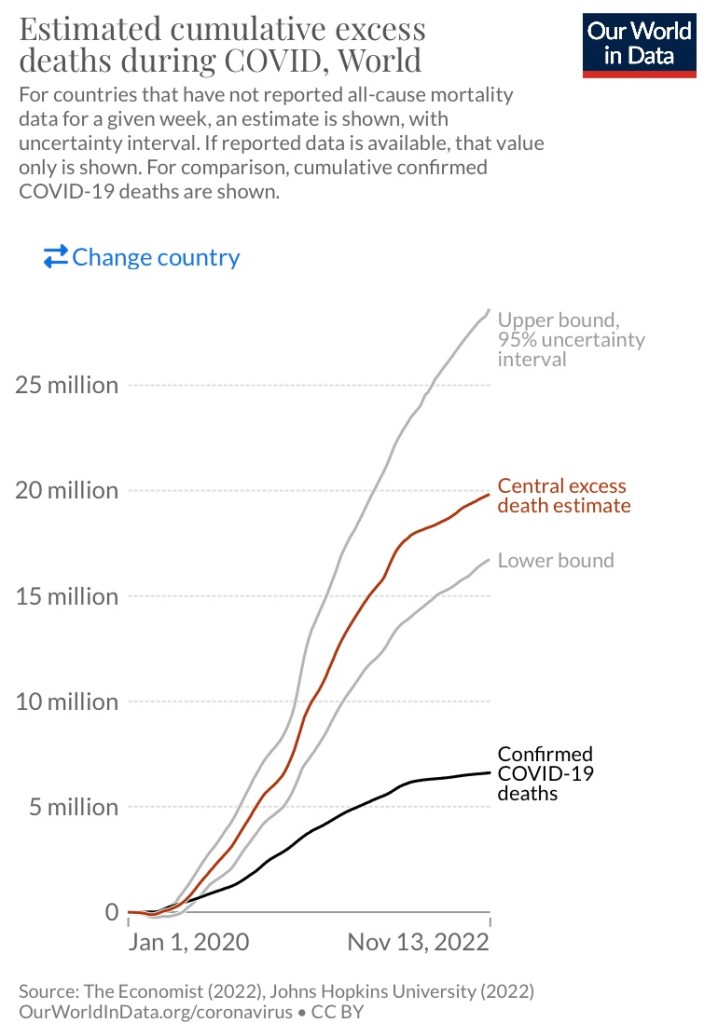
Excess deaths, or deaths relative to projections based on historical averages, are a better metric than Covid deaths (per million) for cross-country or jurisdictional comparisons. Among other reasons, the latter are subject to significant variations in methods of determining cause of death. Moreover, there was a huge disparity between excess deaths and Covid deaths during the pandemic, and the gap is still growing:
Excess deaths varied widely across countries, as illustrated by the left-hand side of the following chart:
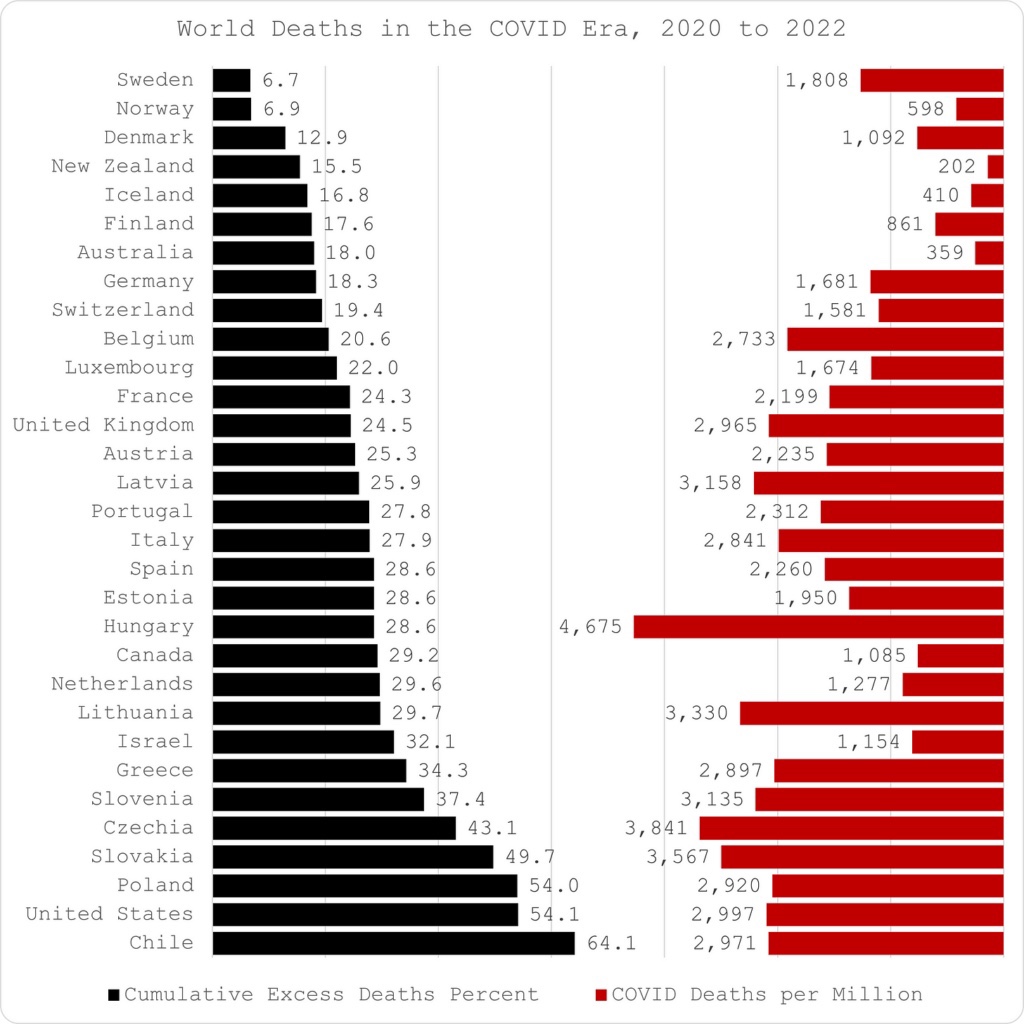
Interestingly, most of the lowest excess death percentages were in Nordic countries, but especially Sweden and Norway. That might be surprising in terms of high Nordic latitudes, which may have created something of a disadvantage in terms of sun exposure and potentially low vitamin D levels. Norway enacted more stringent public policies during the pandemic than Sweden. Globally, however, lockdown measures showed no systematic advantage in terms of excess deaths. Notably, the U.S. did quite poorly in terms of excess deaths at 8X the Swedish rate,

Covid Deaths

The right-hand side of the chart above shows that Sweden experienced a significant number of Covid deaths per million residents. The figure still compares reasonably well internationally, despite the country’s fairly advanced age demographics. Most Covid deaths occurred in the elderly and especially in care settings. Like other places, that is where the bulk of Sweden’s Covid deaths occurred. Note that U.S. Covid deaths per million were more than 50% higher than in Sweden.

NPIs Are Often Deadly

Perhaps a more important reason to emphasize excess deaths over Covid deaths is that public policy itself had disastrous consequences in many countries. In particular, strict NPIs like lockdowns, including school and business closures, can undermine public health in significant ways. That includes the inevitably poor consequences of deferred health care, the more rapid spread of Covid within home environments, the physical and psychological stress from loss of livelihood, and the toll of isolation, including increased use of alcohol and drugs, less exercise, and binge eating. Isolation is particularly hard on the elderly and led to an increase in “deaths of despair” during the pandemic. These were the kinds of maladjustments caused by lockdowns that led to greater excess deaths. Sweden avoided much of that by eschewing stringent NPIs, and Iceland is sometimes cited as a similar case.

Oxford Stringency Index

I should note here, and this is a digression, that the most commonly used summary measure of policy “stringency” is not especially trustworthy. That measure is an index produced by Oxford University that is available on the Our World In Data web site. Joakim Book documented troubling issues with this index in late 2020, after changes in the index’s weightings dramatically altered its levels for Nordic countries. As Book said at that time:

“Until sometime recently, Sweden, which most media coverage couldn’t get enough of reporting, was the least stringent of all the Nordics. Life was freer, pandemic restrictions were less invasive, and policy responses less strong; this aligned with Nordic people’s experience on the ground.”

Again, Sweden relied on voluntary action to limit the spread of the virus, including encouragement of hygiene, social distancing, and avoiding public transportation when possible. Book was careful to note that “Sweden did not ‘do nothing’”, but it’s policies were less stringent than its Nordic neighbors in several ways. While Sweden had the same restrictions on arrivals from outside the European Economic Area as the rest of the EU, it did not impose quarantines, testing requirements, or other restrictions on travelers or on internal movements. Sweden’s school closures were short-lived, and its masking policies were liberal. The late-2020 changes in the Oxford Stringency Index, Book said, simply did not “pass the most rudimentary sniff test”.

Economic Stability

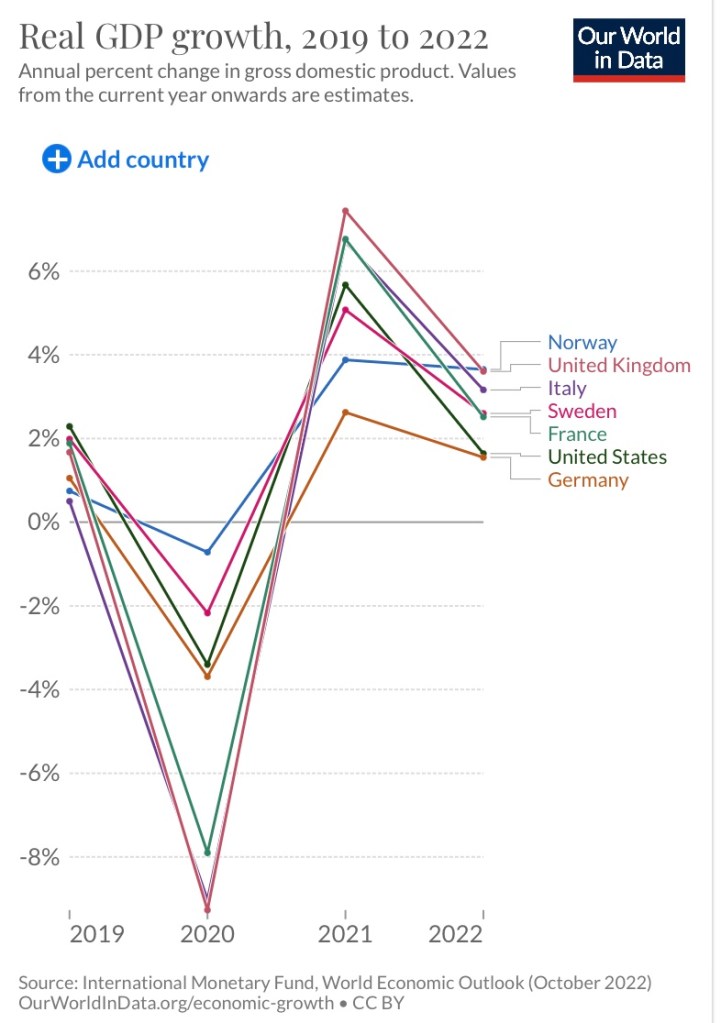
Sweden’s economy performed relatively well during the pandemic. The growth path of real GDP was smoother than most countries that succumbed to the excessive precautions of lockdowns. However, Norway’s economy appears to have been the most stable of those shown on the chart, at least in terms of real output, though it did suffer a spike in unemployment.
The Bottom Line

The big lesson is that Sweden’s “light touch” during the pandemic proved to be at least as effective, if not more so, than comparatively stringent policies imposed elsewhere. Covid deaths were sure to occur, but widespread non-Covid excess deaths were unanticipated by many countries practicing stringent intervention. That lack of foresight is best understood as a consequence of blind panic among public health “experts” and other policymakers, who too often are rewarded for misguided demonstrations that they have “done something”. Those actions failed to stop the spread in any systematic sense, but they managed to do great damage to other aspects of public health. Furthermore, they undermined economic well being and the cause of freedom. Johan Giesecke was right to be skeptical of those claiming they could contain the virus through NPIs, though he never anticipated the full extent to which aggressive interventions would prove deadly.

COVID Politics and Collateral Damage

26 Sunday Jul 2020

Posted by Nuetzel in Pandemic, Public Health

≈ 2 Comments

Tags

American Journal of Epidemiology, Andrew Cuomo, Anthony Fauci, Banality of Evil, CDC, City Journal, CMS, Donald Trump, Elective Surgery, Epidemiological Models, FDA, Gavin Newsom, Gretchen Whitmer, Harvey Risch, Hydroxychloraquin, Import Controls, Joel Zinberg, Lockdowns, Newsweek, NIH, Phil Murphy, Politico, PPE, Price Gouging, Prophylaxis, Quarantines, Steve Sisolak, The Lancet, Tom Wolf, Yale School of Public Health

Policymakers, public health experts, and the media responded to the coronavirus in ways that have often undermined public health and magnified the deadly consequences of the pandemic. Below I offer several examples of perverse politics and policy prescriptions, and a few really bad decisions by certain elected officials. Some of the collateral damage was intentional and motivated by an intent to inflict political damage on Donald Trump, and people of good faith should find that grotesque no matter their views on Trump’s presidency.

Politicized Treatment

The smug dismissal of hydroxychloraquine as Trumpian foolishness was a crime against humanity. We now know HCQ works as an early treatment and as a prophylactic against infection. It’s has been partly credited with stanching “hot spots” in India as well as contributing strongly to control of the contagion in Switzerland and in a number of other countries. According to epidemiologist Harvey Risch of the Yale School of Public Health, HCQ could save 75,000 to 100,000 lives if the drug is widely used. This is from Dr. Risch’s OpEd in Newsweek:

“On May 27, I published an article in the American Journal of Epidemiology (AJE) entitled, ‘Early Outpatient Treatment of Symptomatic, High-Risk COVID-19 Patients that Should be Ramped-Up Immediately as Key to the Pandemic Crisis.’ That article, published in the world’s leading epidemiology journal, analyzed five studies, demonstrating clear-cut and significant benefits to treated patients, plus other very large studies that showed the medication safety. …

Since [then], seven more studies have demonstrated similar benefit. In a lengthy follow-up letter, also published by AJE, I discuss these seven studies and renew my call for the immediate early use of hydroxychloroquine in high-risk patients.”

Risch is careful to couch his statements in forward-looking terms, but this also implies that tens of thousands of lives could have been saved, or patients might have recovered more readily and without lasting harm, had use of the drug not been restricted. The FDA revoked its Emergency Use Authorization for HCQ on June 15th, alleging that it is not safe and has little if any benefit. An important rationale cited in the FDA’s memo was an NIH study of late-stage C19 patients that found no benefit and potential risks to HCQ, but this is of questionable relevance because the benefit appears to be in early-stage treatment or prophylaxis. Poor research design also goes for this study and this study, while this study shared in some shortcomings (e.g., and no use of and/or controls for zinc) and a lack of statistical power. Left-wing outlets like Politico seemed almost gleeful, and blissfully ignorant, in calling those studies “nails in the coffin” for HCQ. Now, I ask: putting the outcomes of the research aside, was it really appropriate to root against a potential treatment for a serious disease, especially back in March and April when there were few treatment options, but even now?

Then we have the state governors who restricted the use of HCQ for treating C19, such as Gretchen Whitmer (MI) and Steve Sisolak (NV). Andrew Cuomo (NY) decided that HCQ could be dispensed only for hospital use, exactly the wrong approach for early stage treatment. And all of this resistance was a reaction to Donald Trump’s optimism about the promise of HCQ. Yes, there was alarm that lupus patients would be left without adequate supplies, but the medication is a very cheap, easy to produce drug, so that was never a real danger. Too much of the media and politicians have been complicit in denying a viable treatment to many thousands of C19 victims. If you were one of the snarky idiots putting it down on social media, you are either complicit or simply a poster child for banal evil.

Seeding the Nursing Homes

The governors of several states issued executive orders to force nursing homes to accept C19 patients, which was against CMS guidance issued in mid-March. The governors were Andrew Cuomo (NY), Gretchen Whitmer (MI), Gavin Newsom (CA), Tom Wolf (PA), and Phil Murphy (PA). This was a case of stupidity more than anything else. These institutions are home to the segment of the population most vulnerable to the virus, and they have accounted for about 40% of all C19 deaths. Nursing homes were ill-prepared to handle these patients, and the governors foolishly and callously ordered them to house patients who required a greater level of care and who represented an extreme hazard to other residents and staff.

Party & Protest On

Then of course we had the mayor of New York City, Bill De Blasio, who urged New Yorkers to get out on the town in early March. That was matched in its stupidity by the array of politicians and health experts who decided, having spent months proselytizing the need to “stay home”, that it was in their best interests to endorse participation in street protests that were often too crowded to maintain effective social distance. That’s not a condemnation of those who sought to protest peacefully against police brutality, but it was not a good or consistent recommendation in the domain of public health. Thankfully, the protests were outside!

Testing, Our Way Or the Highway

The FDA and CDC were guilty of regulatory overreach in preventing early testing for C19, and were responsible for many lives lost early in the pandemic. By the time the approved CDC tests revealed that the virus was ramping up drastically in March, the country was already behind in getting a handle on the spread of the virus, quarantining the infected, and tracing their contacts. There is no question that this cost lives.

Masks… Maybe, But Our Way Or the Highway

U.S. public health authorities were guilty of confused messaging on the efficacy of masks early in the pandemic. As Joel Zinberg notes in City Journal, Anthony Fauci admitted that his own minimization of the effectiveness of masks was motivated by a desire to prevent a shortage of PPE for health care workers:

“In discouraging mask use, Fauci—for decades, the nation’s foremost expert on viral infectious diseases—was not acting as a neutral interpreter of settled science but as a policymaker, concerned with maximizing the utility of the limited supply of a critical item. An economist could have told him that there was no need to misinform the public. Letting market mechanisms work and relaxing counterproductive regulations would ease shortages. Masks for health-care workers would be available if we were willing to pay higher prices; those higher prices, in turn, would elicit more mask production.”

Indeed, regulators made acquisition of adequate supplies of PPE more difficult than necessary via compliance requirements, “price gouging” rules, and import controls.

Bans on Elective Surgery

Another series of unnecessary deaths was caused by various bans on elective surgeries across the U.S. (also see here), and we’re now in danger of repeating that mistake. These bans were thought to be helpful in preserving hospital capacity, but hospitals were significantly underutilized for much of the pandemic. Add to that the fright inspired by official reaction to C19, which keeps emergency rooms empty, and you have a universe of diverse public health problems to grapple with. As I said on this blog a couple of months ago:

“… months of undiagnosed cardiac and stroke symptoms; no cancer screenings, putting patients months behind on the survival curve; deferred procedures of all kinds; run-of-the-mill infections gone untreated; palsy and other neurological symptoms anxiously discounted by victims at home; a hold on treatments for all sorts of other progressive diseases; and patients ordinarily requiring hospitalization sent home. And to start back up, new health problems must compete with all that deferred care. Do you dare tally the death and other worsened outcomes? Both are no doubt significant.”

Lockdowns

The lockdowns were unnecessary and ineffectual in their ability to control the spread of the virus. A study of 50 countries published by The Lancet last week found the following:

“Increasing COVID-19 caseloads were associated with countries with higher obesity … median population age … and longer time to border closures from the first reported case…. Increased mortality per million was significantly associated with higher obesity prevalence … and per capita gross domestic product (GDP) …. Reduced income dispersion reduced mortality … and the number of critical cases …. Rapid border closures, full lockdowns, and wide-spread testing were not associated with COVID-19 mortality per million people.”

That should have been obvious for a virus that holds little danger for prime working-age cohorts who are most impacted by economic lockdowns.

Like the moratoria on elective surgeries, lockdowns did more harm than good. Livelihoods disappeared, business were ruined, savings were destroyed, dreams were shattered, isolation set in, and it continues today. These kinds of problems are strongly associated with health troubles, family dysfunction, drug and alcohol abuse, and even suicide. It’s ironic that those charged with advising on matters pertaining to public health should focus exclusively on a single risk, recommending solutions that carry great risk themselves without a second thought. After all, the protocol in reviewing new treatments sets the first hurdle as patient safety, but apparently that didn’t apply in the case of shutdowns.

Even as efforts were made to reopen, faulty epidemiological models were used to predict calamitous outcomes. While case counts have risen in many states in the U.S. in June and July, deaths remain far below model predictions and far below deaths recorded during the spring in the northeast.

One last note: I almost titled this post “Attack of the Killer Morons”, but as a concession to what is surely a vain hope, I decided not to alienate certain readers right from the start.


Spanish Flu: No Guide for Covid Lockdowns

25 Saturday Apr 2020

Posted by Nuetzel in Pandemic

≈ Leave a comment

Tags

Cost of Lost Output, Covid-19, Cytokine Storm, Economic Costs, Excess Mortality, Herd Immunity, Life-Years, Lockdown, Non-Prescription Measures, Novel Coronavirus, Pandemic, Quarantines, Reason.com, Serological Testing, Skilled Care, Social Distancing, South Korea, Spanish Flu, World War I

The coronavirus pandemic differs in a few important ways from the much deadlier Spanish flu pandemic of 1918-19. Estimates are that as much as 1/3rd of the world’s population was infected during that contagion, and the case fatality rate is estimated to have been 10-20%. The current pandemic, while very serious, will not approach that level of lethality.

Another important difference: the Spanish Flu was very deadly among young adults, whereas the Coronavirus is taking its greatest toll on the elderly and those with significant co-morbidities. Of course, the Spanish Flu infected a large number of soldiers and sailors, many returning from World War I in confined conditions aboard transport vessels. A major reason for its deadliness among young adults, however, is thought to be the “cytokine storm“, or severe inflammatory response, it induced in those with strong immune systems.

It’s difficult to make a perfect comparison between the pandemics, but the charts below roughly illustrate the contrast between the age distribution of case mortality for the Spanish Flu in 1918, shown in the first chart, and Covid-19 in the second. The first shows a measure of “excess mortality” for each age cohort as the vertical gap between the solid line (Spanish flu) and the dashed line (the average of the seven previous seasons for respiratory diseases). Excess mortality was especially high among those between the ages of 15 and 44.

The second chart is for South Korea, where the Covid-19 pandemic has “matured” and was reasonably well controlled. We don’t yet have a good measure of excess case mortality for Covid-19, but it’s clear that it is most deadly among the elderly population. Not to say that infected individuals in younger cohorts never suffer: they are a higher proportion of diagnosed cases, severe cases are of extended duration, and some of the infected might have to deal with lasting consequences.

One implication of these contrasting age distributions is that Covid-19 will inflict a loss of fewer “life years” per fatality. If the Spanish flu’s median victim was 25 years old, then perhaps about 49 life years were lost per fatality, based on life expectancies at that time. At today’s life expectancies, it might be more like 54 years. if Covid-19’s median victim is 70 years old, then perhaps 15 life-years are lost per fatality, or about 73% less. And that assumes the the median Covid victim is of average health, so the loss of life years is probably less. But what a grisly comparison! Any loss is tragic, but it is worth noting that the current pandemic will be far less severe in terms of fatalities, excess mortality (because the elderly always die at much higher rates), and in life-years lost.

Is that relevant to the policy discussion? It doesn’t mean we should throw all caution to the wind. Ideally, policy would save lives and conserve life-years. We’d always put children on the lifeboats first, after all! But in this case, younger cohorts are the least vulnerable.

The flu pandemic of 1918-19 is often held to support the logic of non-prescription public health measures such as school closures, bans on public gatherings, and quarantines. Does the difference in vulnerabilities noted above have any bearing on the “optimal” level of those measures in the present crisis? Some argue that while a so-called lockdown confers health benefits for a Spanish flu-type pandemic in which younger cohorts are highly vulnerable, that is not true of the coronavirus. The young are already on lifeboats having few leaks, as it were.

My view is that society should expend resources on protecting the most vulnerable, in this case the aged and those with significant co-morbidities. Health care workers and “first responders” should be on the list as well. If well-targeted and executed, a Covid-19 lockdown targeted at those groups can save lives, but it means supporting the aged and afflicted in a state of relative isolation, at least until effective treatments or a vaccine prove out. A lockdown might not change living conditions greatly for those confined to skilled care facilities, but much can be done to reduce exposure among those individuals, including a prohibition on staff working at multiple facilities.

Conversely, the benefits of a lockdown for younger cohorts at low risk of death are much less compelling for Covid-19 than might be suggested by the Spanish flu experience. In fact, it can be argued that a complete lockdown denies society of the lowest-hanging fruit of earlier herd immunity to Covid-19. Younger individuals who have more social and economic contacts can be exposed with relative safety, and thus self-immunized, as their true mortality rate (including undiagnosed cases in the denominator) is almost zero to begin with.

Then we have the economic costs of a lockdown. Idle producers are inherently costly due to lost output, but idle non-producers don’t impose that cost. For Covid-19, prohibiting the labor of healthy, working age adults has scant health benefits, and it carries the high economic costs of lost output. That cost is magnified by the mounting difficulty of bringing moribund activities back to life, many of which will be unsalvageable due to insolvency.

The lockdown question is not binary. There are ways to maintain at least modest levels of production in many industries while observing guidelines on safety and social distancing. In fact, producers are finding inventive ways of maximizing both production and safety. They should be relied upon to create these solutions. The excess mortality rates associated with this pandemic will continue to come into focus at lower levels with more widespread serological testing. That will reinforce the need for individual autonomy in weighing risks and benefits. Hazards are always out there: reckless or drunk drivers, innumerable occupational hazards, and the flu and other communicable diseases. Protect yourself in any way you see fit, but if you are healthy, please do so without agitating for public support from the rest of us, and without imposing arbitrary judgments on which activities carry acceptable risk for others.


The Federal Reserve and Coronatative Easing

09 Monday Mar 2020

Posted by Nuetzel in Monetary Policy, Pandemic

≈ Leave a comment

Tags

Caronavirus, Covid-19, Donald Trump, Externality, Federal Reserve, Fiscal Actions, Flight to Safety, Glenn Reynolds, Influenza, Liquidity, Michael Fumento, Monetary policy, Network Effects, Nonpharmaceutical Intervention, Paid Leave, Pandemic, Payroll Tax, Quarantines, Scott Sumner, Solvency, Wage Assistance

Laughs erupted all around when the Federal Reserve reduced its overnight lending rate by 50 basis points last week: LIKE THAT’LL CURE THE CORANAVIRUS! HAHAHA! It’s easy to see why it seemed funny to people, even those who think the threat posed by Covid-19 is overblown. But it should seem less silly with each passing day. That’s not to say I think we’re headed for disaster. My own views are aligned with this piece by Michael Fumento: it will run its course before too long, and “viruses hate warm weather“. Nevertheless, the virus is already having a variety of economic effects that made the Fed’s action prudent.

Of course, the Fed did not cut its rate to cure the virus. The rate move was intended to deal with some of the economic effects of a pandemic. The spread of the virus has been concentrated in a few countries thus far: China, Iran, Italy, and South Korea. Fairly rapid growth is expected in the number of cases in the U.S. and the rest of the world over the next few weeks, especially now with the long-awaited distribution of test kits. But already in the U.S., we see shortages of supplies hitting certain industries, as shipments from overseas have petered. And now efforts to control the spread of the virus will involve more telecommuting, cancellation of public events, less travel, less dining out, fewer shopping trips, missed work, hospitalizations, and possibly widespread quarantines.

The upshot is at least a temporary slowdown in economic activity and concomitant difficulties for many private businesses. We’ve been in the midst of a “flight to safety”, as investors incorporate these expectations into stock prices and interest rates. Firms in certain industries will need cash to pay bills during a period of moribund demand, and consumers will need cash during possible layoffs. All of this suggests a need for liquidity, but even worse, it raises the specter of a solvency crisis.

The Fed’s power can attempt to fill the shortfall in liquidity, but insolvency is a different story. That, unfortunately, might mean either business failures or bailouts. Large firms and some small ones might have solid business continuation plans to help get them through a crisis, at least one of short to moderate duration, but many businesses are at risk. President Trump is proposing certain fiscal and regulatory actions, such as a reduction in the payroll tax, wage payment assistance, and some form of mandatory paid leave for certain workers. Measures might be crafted so as to target particular industries hit hard by the virus.

I do not object to these pre-emptive measures, even as an ardent proponent of small government, because the virus is an externality abetted by multiplicative network effects, something that government has a legitimate role in addressing. There are probably other economic policy actions worth considering. Some have suggested a review of laws restricting access to retirement funds to supplement inadequate amounts of precautionary savings.

Last week’s Fed’s rate move can be viewed as pre-emptive in the sense that it was intended to assure adequate liquidity to the financial sector and payment system to facilitate adjustment to drastic changes in risk appetites. It might also provide some relief to goods suppliers who find themselves short of cash, but their ability to benefit depends on their relationships to lenders, and lenders will be extremely cautious about extending additional credit as long as conditions appear to be deteriorating.

In an even stronger sense, the Fed’s action last week was purely reactive. Scott Sumner first raised an important point about ten days before the rate cut: if the Fed fails to reduce its overnight lending target, it represents a de facto tightening of U.S. monetary policy, which would be a colossal mistake in a high-risk economic and social environment:

“When there’s a disruption to manufacturing supply chains, that tends to reduce business investment, puts downward pressure on demand for credit. That will tend to reduce equilibrium interest rates. In addition, with the coronavirus, there’s also a lot of uncertainty in the global economy. And when there’s uncertainty, there’s sort of a rush for safe assets, people buy treasury bonds, that puts downward pressure on interest rates. So you have this downward pressure on global interest rates. Now while this is occurring, if the Fed holds constant its policy rate, it targets the, say fed funds rate at a little over 1.5 percent. While the equilibrium rates are falling, then essentially the Fed will be making monetary policy tighter.

… what I’m saying is, if the Fed actually wants to maintain a stable monetary policy, they may have to move their policy interest rate up and down with market conditions to keep the effective stance of monetary policy stable. So again, it’s not trying to solve the supply side problem, it’s trying to prevent it from spilling over and also impacting aggregate demand.”

The Fed must react appropriately to market rates to maintain the tenor of its policy, as it does not have the ability to control market rates. Its powers are limited, but it does have a responsibility to provide liquidity and to avoid instability in conducting monetary policy. Fiscal actions, on the other hand, might prove crucial to restoring economic confidence, but ultimately controlling the spread of the virus must be addressed at local levels and within individual institutions. While I am strongly averse to intrusions on individual liberty and I desperately hope it won’t be necessary, extraordinary measures like whole-city quarantines might ultimately be required. In that context, this post on the effectiveness of “non-pharmaceutical interventions” such as school closures, bans on public gatherings, and quarantines during the flu pandemic of 1918-19 is fascinating.


Follow Sacred Cow Chips on WordPress.com

Recent Posts

  • The Case Against Interest On Reserves
  • Immigration and Merit As Fiscal Propositions
  • Tariff “Dividend” From An Indigent State
  • Almost Looks Like the Fed Has a 3% Inflation Target
  • Government Malpractice Breeds Health Care Havoc

Archives

  • January 2026
  • December 2025
  • November 2025
  • October 2025
  • September 2025
  • August 2025
  • July 2025
  • June 2025
  • May 2025
  • April 2025
  • March 2025
  • February 2025
  • January 2025
  • December 2024
  • November 2024
  • October 2024
  • September 2024
  • August 2024
  • July 2024
  • June 2024
  • May 2024
  • April 2024
  • March 2024
  • February 2024
  • January 2024
  • December 2023
  • November 2023
  • August 2023
  • July 2023
  • June 2023
  • May 2023
  • April 2023
  • March 2023
  • February 2023
  • January 2023
  • December 2022
  • November 2022
  • October 2022
  • September 2022
  • August 2022
  • July 2022
  • June 2022
  • May 2022
  • April 2022
  • March 2022
  • February 2022
  • January 2022
  • December 2021
  • November 2021
  • October 2021
  • September 2021
  • August 2021
  • July 2021
  • June 2021
  • May 2021
  • April 2021
  • March 2021
  • February 2021
  • January 2021
  • December 2020
  • November 2020
  • October 2020
  • September 2020
  • August 2020
  • July 2020
  • June 2020
  • May 2020
  • April 2020
  • March 2020
  • February 2020
  • January 2020
  • December 2019
  • November 2019
  • October 2019
  • September 2019
  • August 2019
  • July 2019
  • June 2019
  • May 2019
  • April 2019
  • March 2019
  • February 2019
  • January 2019
  • December 2018
  • November 2018
  • October 2018
  • September 2018
  • August 2018
  • July 2018
  • June 2018
  • May 2018
  • April 2018
  • March 2018
  • February 2018
  • January 2018
  • December 2017
  • November 2017
  • October 2017
  • September 2017
  • August 2017
  • July 2017
  • June 2017
  • May 2017
  • April 2017
  • March 2017
  • February 2017
  • January 2017
  • December 2016
  • November 2016
  • October 2016
  • September 2016
  • August 2016
  • July 2016
  • June 2016
  • May 2016
  • April 2016
  • March 2016
  • February 2016
  • January 2016
  • December 2015
  • November 2015
  • October 2015
  • September 2015
  • August 2015
  • July 2015
  • June 2015
  • May 2015
  • April 2015
  • March 2015
  • February 2015
  • January 2015
  • December 2014
  • November 2014
  • October 2014
  • September 2014
  • August 2014
  • July 2014
  • June 2014
  • May 2014
  • April 2014
  • March 2014

Blogs I Follow

  • Passive Income Kickstart
  • OnlyFinance.net
  • TLC Cholesterol
  • Nintil
  • kendunning.net
  • DCWhispers.com
  • Hoong-Wai in the UK
  • Marginal REVOLUTION
  • Stlouis
  • Watts Up With That?
  • Aussie Nationalist Blog
  • American Elephants
  • The View from Alexandria
  • The Gymnasium
  • A Force for Good
  • Notes On Liberty
  • troymo
  • SUNDAY BLOG Stephanie Sievers
  • Miss Lou Acquiring Lore
  • Your Well Wisher Program
  • Objectivism In Depth
  • RobotEnomics
  • Orderstatistic
  • Paradigm Library
  • Scattered Showers and Quicksand

Blog at WordPress.com.

Passive Income Kickstart

OnlyFinance.net

TLC Cholesterol

Nintil

To estimate, compare, distinguish, discuss, and trace to its principal sources everything

kendunning.net

The Future is Ours to Create

DCWhispers.com

Hoong-Wai in the UK

A Commonwealth immigrant's perspective on the UK's public arena.

Marginal REVOLUTION

Small Steps Toward A Much Better World

Stlouis

Watts Up With That?

The world's most viewed site on global warming and climate change

Aussie Nationalist Blog

Commentary from a Paleoconservative and Nationalist perspective

American Elephants

Defending Life, Liberty and the Pursuit of Happiness

The View from Alexandria

In advanced civilizations the period loosely called Alexandrian is usually associated with flexible morals, perfunctory religion, populist standards and cosmopolitan tastes, feminism, exotic cults, and the rapid turnover of high and low fads---in short, a falling away (which is all that decadence means) from the strictness of traditional rules, embodied in character and inforced from within. -- Jacques Barzun

The Gymnasium

A place for reason, politics, economics, and faith steeped in the classical liberal tradition

A Force for Good

How economics, morality, and markets combine

Notes On Liberty

Spontaneous thoughts on a humble creed

troymo

SUNDAY BLOG Stephanie Sievers

Escaping the everyday life with photographs from my travels

Miss Lou Acquiring Lore

Gallery of Life...

Your Well Wisher Program

Attempt to solve commonly known problems…

Objectivism In Depth

Exploring Ayn Rand's revolutionary philosophy.

RobotEnomics

(A)n (I)ntelligent Future

Orderstatistic

Economics, chess and anything else on my mind.

Paradigm Library

OODA Looping

Scattered Showers and Quicksand

Musings on science, investing, finance, economics, politics, and probably fly fishing.

  • Subscribe Subscribed
    • Sacred Cow Chips
    • Join 128 other subscribers
    • Already have a WordPress.com account? Log in now.
    • Sacred Cow Chips
    • Subscribe Subscribed
    • Sign up
    • Log in
    • Report this content
    • View site in Reader
    • Manage subscriptions
    • Collapse this bar
 

Loading Comments...