• About

Sacred Cow Chips

Sacred Cow Chips

Tag Archives: Renewable energy

Green Climate Policy Wreaks Poverty

03 Friday Sep 2021

Posted by Nuetzel in Climate science, Environmental Fascism

≈ 6 Comments

Tags

Assessment Report #6, Carbon Emissions, Cooling the Past, Deforestation, Democratic Republic of Congo, Diablo Canyon, Disparate impact, Economic Development, Energy Poverty, Fossil fuels, Hügo Krüger, Intergovernmental Panel on Climate Change, IPCC, Jennifer Marohasy, Jim Crow Environmentalism, Joel Kotkin, Judith Curry, Michael Schellenberger, Natural Gas, Net Zero Carbon, Nuclear power, Rare Earth Minerals, Regressive Policy, Remodeled Temperatures, Renewable energy, Steve Koonin

Have no doubt: climate change warriors are at battle with humanity itself, ostensibly on behalf of the natural world. They would have us believe that their efforts to eliminate the use of fossil fuels are necessary to keep our planet from becoming a blazing hothouse. However, the global temperature changes we’ve witnessed over the past 150 years, based on the latest Assessment Report (AR6) from the Intergovernmental Panel on Climate Change (IPCC), are well within the range of historical variation.

“Remodeled” History

Jennifer Marohasy posted an informative discussion of the IPCC’s conclusions last month, putting them into a broader climatological context and focusing in particular on measurement issues. In short, discussing “global” temperatures with any exactitude is something of a sham. Moreover, the local temperature series upon which the global calculations are based have been “remodeled.” They are not direct observations. I don’t think it’s too crude to say they’ve been manipulated because the changed records are almost always in one direction: to “cool” the past.

Judith Curry is succinct in her criticism of the approach to climate change adopted by alarmist policymakers and many climate researchers: 

“In a nutshell, we’ve vastly oversimplified both the problem and its solutions. The complexity, uncertainty, and ambiguity of the existing knowledge about climate change is being kept away from the policy and public debate. The solutions that have been proposed are technologically and politically infeasible on a global scale.”

We need a little more honesty!

The Real Victims

I want to focus here on some of the likely casualties of the war on fossil fuels. Those are, without a doubt, the world’s poor, who are being consigned by climate activists to a future of abject suffering. Joel Kotkin and Hügo Krüger are spot-on in their recent piece on the inhumane implications of anti-carbon ideology.

Energy-poor areas of the world are now denied avenues through which to enhance their peoples’ well being. Attempts to fund fossil-fuel power projects are regularly stymied by western governments and financial institutions in the interests of staving off political backlash from greens. Meanwhile, far more prosperous nations power their economies with traditional carbon-based energy sources. Most conspicuously, China continues to fuel its rapid growth with coal and other fossil fuels, getting little pushback from climate activists. If you’re wondering how the composition of energy output has evolved, this time-lapse chart is a pretty good guide.

One of the most incredible aspects of this situation is how nuclear energy has been spurned, despite its status as a proven and safe solution to carbon-free power. This excellent thread by Michael Schellenberger covers the object lesson in bad public policy offered by the proposed closing of the Diablo Canyon nuclear plant in California.

In both the U.S. and other parts of the world, as Kotkin and Krüger note, it is not just the high up-front costs that lead to the rejection of these nuclear projects. The green lobby and renewable energy interests are now so powerful that nuclear energy is hardly considered. Much the same is true of low-carbon natural gas: 

“Sadly, the combination of virtue-signaling companies and directives shaped by green activists in rich countries – often based on wildly exaggerated projections, notes former Barack Obama advisor Steve Koonin – make such a gradual, technically feasible transition all but impossible. Instead, it is becoming increasingly unlikely that developing countries will be able to tap even their own gas.”

Energy is the lifeblood of every economy. Inadequate power creates obstacles to almost any form of production and renders some kinds of production impossible. And ironically, the environmental consequences of “energy poverty” are dire. Many under-developed economies are largely dependent on deforestation for energy. Without a reliable power grid and cheap energy, consumers must burn open fires in their homes for heat and cooking, a practice responsible for 50% of child pneumonia deaths worldwide, according to Kotkin and Krüger.

Green Environmental Degradation

Typically, under-developed countries are reliant on the extraction of natural resources demanded by the developed world:

“The shift to renewables in the West, for example, has increased focus on developing countries as prime sources for critical metals – copper, lithium, and rare-earth minerals, in particular – that could lead to the devastation of much of the remaining natural and agricultural landscape. … Lithium has led to the depletion of water resources in Latin America and the further entrenchment of child labor in the Democratic Republic of the Congoas the search for cobalt continues.”

Unfortunately, the damage is not solely due to dependence on resource extraction:

“The western greens, albeit unintentionally, are essentially turning the Third World into the place they send their dirty work. Already, notes environmental author Mike Shellenberger, Africans are stuck with loads of discarded, highly toxic solar panels that expose both the legions of rag-pickers and the land itself to environmental degradation – all in the name of environmentalism.”

Battering the Poor In the West

Again, wealthy countries are in far better shape to handle the sacrifices required by the climate calamitists, but it still won’t be easy. In fact, lower economic strata will suffer far more than technocrats, managers, and political elites. The environmental left leans on the insidious lever of energy costs in order to reduce demand, but making energy more costly takes a far larger bite out of the budgets of the poor. In another recent piece, “Jim Crow Returns to California,” Kotkin discusses the disparate impact these energy policies have on minorities. 

“This surge in prices derives from the state’s obsession — shared by the ruling tech oligarchs — with renewable energy and the elimination of fossil fuels. Yet as a recent Massachusetts Institute of Technology (MIT) report has shown, over-reliance on renewables is costly, because it requires the production of massive (and environmentally unfriendly) battery-storage capacity — the price of which is invariably passed on to the taxpayer.

This is not bad news for the tech oligarchs, who have been prominent among those profiting from ‘clean energy’ investments. But many other Californians, primarily those in the less temperate interior, find themselves falling into energy poverty or are dependent on state subsidies that raise electricity prices for businesses and the middle class. Black and Latino households are already forced to pay from 20 to 43% more of their household incomes on energy than white households. Last year, more than 4 million households in California (30% of the total) experienced energy poverty.”

Kotkin touches on other consequences of these misguided policies to minority and non-minority working people. In addition to jobs lost in the energy sector, a wide variety of wage earners will suffer as their employers attempt to deal with escalating energy costs. The immediate effects are bad enough, but in the long-run the greens’ plans would scale back the economy’s productive machinery in order to eliminate carbon emissions — net zero means real incomes will decline! 

Energy costs have a broad impact on consumer’s budgets. Almost every product imaginable is dependent on energy, and consumer prices will reflect the higher costs. In addition, the “green” effort to curtail development everywhere except in high-density transit corridors inflates the cost of housing, inflicting more damage on workers’ standards of living.

Tighten Your Belts

These problems won’t be confined to California if environmental leftists get their version of justice. Be prepared for economic stagnation for the world’s poor and a sharply reduced standard of living in the developed world, but quite unnecessarily. We’ll all pay in the long run, but the poor will pay much more in relative terms.
Renewable Power Gains, Costs, and Fantasies

01 Thursday Jul 2021

Posted by Nuetzel in Electric Power, Renewable Energy

≈ 2 Comments

Tags

Baseload, Blackouts, California, Combined-Cycle Gas, Dispatchable Power, Disposal Costs, Dung Burning, Energy Information Administration, External Costs, Fossil fuels, Francis Menton, Germany, Green Propaganda, Interrmittency, Levelized Costs, Modern Renewables, Peak Demand, Plant Utilization, Renewable energy, Solar Power, Texas, The Manhattan Contrarian, Willis Eschenbach, Wind Power

“Modern” renewable energy sources made large gains in providing for global energy consumption over the ten years from 2009-19, according to a recent report, but that “headline” is highly misleading. So is a separate report on the costs of solar and wind power, which claims those sources are now cheaper than any fossil fuel. The underlying facts will receive little critical examination by a hopelessly naive press, nor among analysts with more technical wherewithal. Of course, “green” activists will go on using misinformation like this to have their way with policy makers.

Extinguishing Dung Fires

The “Renewables Global Status Report” was published in mid-June by an organization called REN21: Renewables Now. Francis Menton has a good discussion of the report on his blog, The Manhattan Contrarian. The big finding is a large increase in the global use of “modern” renewable energy sources, from 8.7% of total consumption in 2009 to 11.2% in 2019. The “modern” qualifier is critical: it distinguishes renewables that made gains from those that might be considered antiquated, like dung chips, the burning of which is an energy staple in many underdeveloped parts of the world. In fact, the share of those “non-modern renewables” declined from 11.0% to 8.7%, almost fully accounting for the displacement caused by “modern renewables”. The share of fossil fuels was almost unchanged, down from 80.3% in 2009 to 80.2% in 2019. Whatever the benefits of wind, solar, and other modern green power sources, they did not make much headway in displacing reliable fossil fuel energy.

I certainly can’t argue that replacing dung power with wind, solar, or hydro is a bad thing (but there are more sophisticated ways of converting dung to energy than open flame). However, I contend that replacing open dung fires with fossil-fuel or nuclear capacity would be better than renewables from both a cost and an environmental perspective. Be that as it may, the adoption of “modern renewables” over the ten-year period was not at the expense of fossil fuels, as might be expected if the latter was at a cost disadvantage, and remember that renewables were already given an edge via intense government efforts to subsidize and even require the use of wind and solar power.

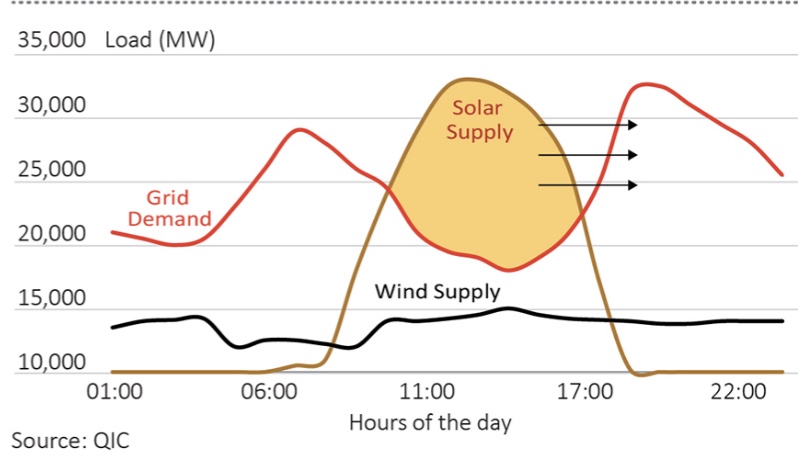
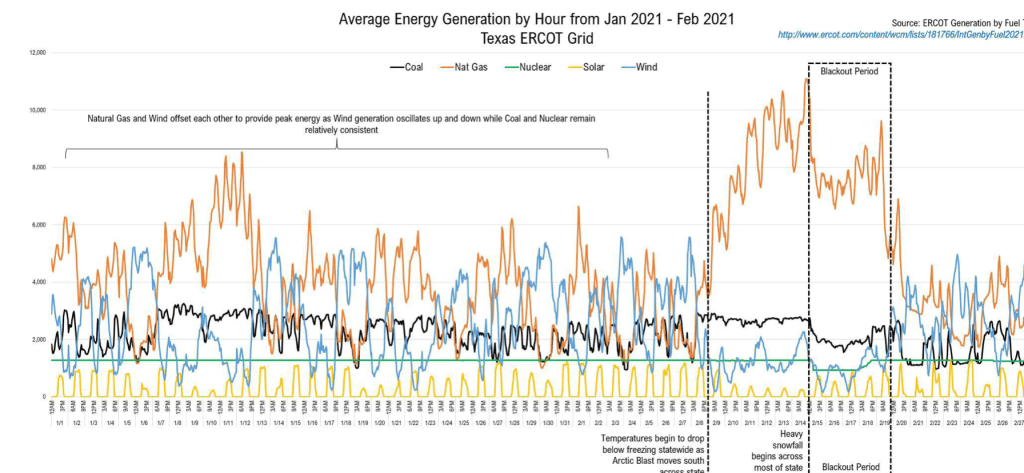
The near-term limits on our ability to substitute renewables for fossil fuels should be fairly obvious. For one thing, renewable power is intermittent, so it cannot be relied upon for baseload generation. The chart at the top of this post demonstrates this reality, though the chart is “optimistic” in the sense that planners have to consider worst-case intermittency, not merely average production by time-of-day. Reliable power sources must be maintained in order to prevent the kinds of disasters like we saw in Texas last winter when demand spiked and output from renewables plunged. This is an area of considerable denialism: a search on “intermittent renewables” gets you an unending list of rosy assessments of energy storage technologies, and very little realistic commentary on today’s needs for meeting base-load or weather-induced demands.

While renewables account for about 29% of global electricity generation, there is another limit on adoption: certain jobs just can’t be done with renewables short of major advances in battery technology. As Menton says:

“Steel mills and tractor trailer trucks and airplanes powered by solar panels? Not happening. … I think these people really believe that if governments will just do the right thing and require airplanes to run on solar panels, then it will promptly happen.”

Cost and Intermittency

Again, we’d expect to see more rapid conversion to renewable energy, at least in compatible applications, as the cost of renewables drops relative to fossil fuels. And major components of their costs have indeed dropped, so much so that the U.S. Energy Information Administration (EIA) now says they are cheaper than fossil fuels in terms of the “levelized cost” of new electric generating capacity. That’s the average cost per megawatt-hour produced over the life of a new installation. The EIA’s calculations are distorted on at least two counts, however, as Willis Eschenbach ably explains here.

The EIA’s cost figures reflect a “capacity factor” that adjusts the megawatts produced to presumed “real world” conditions. It’s more like a utilization adjustment made necessary by a variety of realities (intermittency as well as other technical imperfections) that cause output to run lower than the maximum under ideal conditions. Eschenbach reports that the factors applied by the EIA for solar and wind, at 30% and 41%, respectively, are overstated drastically, which reduces their cost estimates by overstating output. For solar, he cites a more realistic value of 14%, which would more than double the levelized cost of solar. For wind, he quotes a figure of 30%, which would increase the cost of wind power by more than a third. That puts the cost of those renewables well above that of a “combined-cycle gas” plant, which uses exhaust from gas turbines to generate additional power via steam.

The true costs of renewables are likely much higher than nuclear power as well, based on earlier comparisons of nuclear to combined-cycle gas. The EIA does not report a cost for nuclear power, however, because the report is for new capacity, and no additions of nuclear capacity are expected.

The Cost of Back-Up Capacity

Eschenbach notes a second major problem with the EIA cost comparisons. As discussed above, the intermittency of solar and wind power means that their deployment cannot provide for base loads. Other “dispatchable” power technologies, on which production can be ramped up or down at discretion, must be available to meet power needs when renewables are off-line, as is frequently the case. The more we attempt to rely on renewables, the more significant the intermittency problem becomes, as Germany, Texas, and California are discovering.

How to account for the extra cost of dispatchable power required to smooth production or meet peak demand? Renewables are simply incapable of doing so reliably, and back-up capacity ain’t free! Meeting demand at all times requires equivalent dispatchable capacity in the power mix. It requires not just dispatchable baseload capacity, but surge capacity! Meeting long-term growth in demand with renewables implies that new back-up capacity is required as well, and the levelized cost should reflect it. After all, those costs won’t be saved by virtue of adding renewable capacity, unless you plan on blackouts. Thus, the EIA’s levelized cost comparisons of wind, solar and fossil fuel electricity generation are completely phony.

Conclusion

Growth in wind and solar power increased their contribution to global energy needs to more than 11% in 2019, but their gains over the previous ten years came largely at the expense of more “primitive” renewable energy sources, not fossil fuels. And despite impressive declines in the installation costs of wind and solar power, and despite low variable costs, the economics of power generation still favors fossil fuels rather substantially. In popular discussions, this point is often obscured by the heavy subsidies granted to renewables. 

In truth, the “name-plate” capacities of wind and solar installations far exceed typical output, so installation costs are spread over less output than is widely believed. Furthermore, the intermittency of production from these renewable sources means that back-up capacity is still required, almost always from plants fired by fossil fuels. Properly considered, this represents a significant incremental cost of renewable power sources, but it is one that is routinely ignored by environmentalists and even in official reports. It’s also worth noting that “modern” renewables carry significant external costs to the environment both during the useful life of plant and at disposal (and see here). It’s tempting to say all these distortions and omissions are deliberate contributions to the propaganda in favor of government mandates for renewables.

Texas Cold Snap Scarcity: Don’t Blame Markets!

18 Thursday Mar 2021

Posted by Nuetzel in Electric Power, Price Mechanism, Renewable Energy, Shortage

≈ 4 Comments

Tags

Blackouts, Electric Reliability Council of Texas, ERCOT, February Cold Spell, Federal Energy Subsidies, Fixed-Rate Plans, Fossil fuels, Interconnection Agreements, Market Efficiency, Price Ceilings, Price Gouging, Renewable energy, Shortages, Solar Power, Supply Elasticity, Texas, Variable-Rate Plans, Wind Power, Winterization

People say the darnedest things about markets, even people who seem to think markets are good, as I do. For example, when is a market “too efficient”? In the real world we tend to see markets that lack perfect efficiency for a variety of reasons: natural frictions, imperfect information, taxes, subsidies, regulations, and too few sellers or buyers. In such cases, we know that market prices don’t properly reflect the true scarcity of a good, as they would under the competitive ideal. Nevertheless, we are usually best-off allowing market forces to approximate true conditions in guiding the allocation of resources. But what does it mean when someone asserts that a market is “too efficient”.

Not long ago I posted about the failure of Texas utility planners to maintain surge capacity. Instead, they plowed resources into renewable energy, which is intermittent and unable to provide for reliable baseline power loads. That spelled disaster when temperatures plunged in February. Wind and solar output plunged while demand spiked. Even gas- and coal-fired power generation hit a pause due to a lack of adequate winterization of generators. The result was blackouts and a huge jump in wholesale power prices, which are typically passed on to customers. The price to some consumers rose to the ceiling of $9/kwh for a time, compared to an average winter rate of 12c/kwh. A bill in the Texas Senate would reverse those charges retroactively.

I cross-linked my post on a few platforms, and a friendly commenter opined that the jump in prices occurred because “markets were too efficient”. For a moment I’ll set aside the fact that what we have here is a monopoly grid operator: “market efficiency” is not a real possibility, despite elements of competition at the retail level. There is, however, a price mechanism in play at the wholesale level and for retail customers on variable rate plans. Prices are supposed to respond to scarcity, and there is no question that power became scarce during the Texas cold snap. Higher prices are both an incentive to curtail consumption and to increase production or attract product from elsewhere. So, rather than saying the “market was too efficient”, the commenter should have said “power was too scarce”! Well duh…

If anything, the episode underscores how un-market-like were the conditions created by the Texas grid operator, the ironically-named Electric Reliability Council of Texas (ERCOT): it allowed massive resources to be diverted to unreliable power sources; it skimped on winterization; it failed to arrange interconnection agreements with power grids outside of Texas; and it charged customers on fixed-rate plans too little to provide for adequate surge capacity, while giving them no incentive to conserve under a stress scenario. ERCOT can be said to have created a situation in which power supply was highly inelastic, which means that a normal market force was short-circuited at a time when it was most needed.

ERCOT‘s mismanagement of power resources is partly a result of incentives created by the federal government. The installation of wind and solar power generation came with huge federal subsidies, which distort the cost of the energy they produce. Thus, not only were incentives in place to invest in unreliable power sources, but ERCOT forced electricity produced by fossil fuels to compete at unrealistically low prices. This predatory pricing forced several power producers into bankruptcy, compromising the state’s baseline and surge capacity.

There are plenty of distortions plaguing the “market” for electric power in Texas, all of which worsened the consequences of the cold snap. This was far from a case of “market efficiency”, as the comment on my original post asserted.

The very idea that markets and the price mechanism are “ruthlessly efficient” is a concession to those who say high prices are always “unfair” in times of crises and shortages. We hear about “price-gougers”, and the media and politicians are almost always willing to join in this narrative. Higher prices help to ease shortages, and they do so far more quickly and effectively than governments or charities can provide emergency supplies (unless, of course, a monopoly grid operator leaves the state more vulnerable to stress conditions than necessary). Conversely, price ceilings only serve to exacerbate shortages and the suffering they cause. So let’s not blame markets, which are never “too efficient”; sometimes the things we trade are just too scarce, and sometimes they are made more scarce by inept planners.

Renewables and Preempted Prosperity

10 Wednesday Jul 2019

Posted by Nuetzel in Central Planning, Renewable Energy

≈ Leave a comment

Tags

carbon Sensitivity, David Middleton, Economic Cost of Carbon, Fossil fuels, Intermittancy, John Barry, Los Angeles Eland Project, Martin Heidegger, Matt Ridley, Michael Schellenberger, Murray Bookchin, Renewable energy

Coerced conversion to renewable energy sources will degrade human living conditions. That’s certainly true relative to a voluntary conversion actuated by purely private incentives. It’s likely to be true even in an absolute sense, depending on the speed and severity of the forced transition. A coerced conversion will mean lower real incomes during the transition (one recent estimate: $42,000 total loss per U.S. household to transition by 2030), and the losses will continue after the transition, with little redeeming improvement in environmental conditions or risk.

The Reality

There are several underpinnings for the assertions above. One is that the sensitivity of global temperatures to carbon forcings is relatively low. We know all too well that the climate models relied upon by warming alarmists have drastically over-estimated the extent of warming to date. The models are excessively sensitive to carbon emissions and promote an unwarranted urgency to DO SOMETHING… with other people’s money. There is also the question of whether moderate warming is really a bad thing given that it is likely to mean fewer cold-weather fatalities, increased agricultural productivity, and significant reforestation.

Another underpinning is that the real economics of renewable energy are vastly inferior to fossil fuels and will remain so for some time to come. Proponents of renewables tend to quote efficiencies under optimal operating conditions, free of pesky details like the cost of installing a vast support infrastructure and environmental costs of producing components. Solar and wind energy are tremendously inefficient in terms of land use. One estimate is that meeting a 100% renewable energy target in the U.S. today would require acreage equivalent to the state of California. And of course rare earth minerals must be mined for wind turbines and solar panels, and fossil fuels are needed to produce materials like the steel used to build them.

But the chief renewable bugaboo is that the power generated by wind and solar is intermittent. Our ability to store power is still extremely limited, so almost all surplus energy production is lost. Therefore, intermittency necessitates redundant generating capacity, which imposes huge costs. When the winds are calm and the sun isn’t shining, traditional power sources are needed to meet demand. That redundant capacity must be maintained and kept on-line, as these facilities are even costlier to power up from a dead start.

LA Hucksterism

These issues are typified by the unrealistic expectations of Los Angeles’ plan to replace 7% of the city’s power consumption with renewables. The cost predicted by LA regulators is slightly less than 2 cents per kilowatt hour for solar and even less for battery power, which are unrealistically low. For one thing, those are probably operating costs that do not account for capital requirements. The plan promises to provide power 16 hours a day at best, but it’s not clear that the 7% estimate of the renewable share takes that into account or whether the real figure should be 4.2% of LA’s power needs. The project will require 2,600 acres for solar panels, and if it’s like other solar plant installations, the stated capacity is based on the few hours of the day when the sun’s rays are roughly perpendicular to the panels. So it’s likely that the real cost of the power will be many times the estimates, though taxpayers will subsidize 30% or more of the total. And then there is the negative impact on birds and other wildlife.

The Question of Intent

Michael Schellenberger goes so far as to say that a degraded standard of living is precisely what many fierce renewable advocates have long intended. Modern comforts are simply not compatible with 100% renewable energy any time soon, or perhaps ever given the investment involved, but a target of 100% was not really intended to be compatible with modern comforts. In fact, the renewable proposition was often intermingled with celebration of a more austere, agrarian lifestyle. Schellenberger discusses the case of Martin Heidegger, an early anti-technologist who said in 1954 that modern technology “puts to nature the unreasonable demand that it supply energy....” Of course, Heidegger was not talking about the use of solar panels. Others, like Murray Bookchin, were ultimately quite explicit about the “promise” of renewables to dial-back industrial society in favor of an agrarian ideal. And here’s a quote from a new book by John Barry, Professor of “Green Political Economy” (!) at Queen’s University Belfast:

“The first question which serves as the starting point of this chapter is to ask if the objective of economic growth is now ecologically unsustainable, socially divisive and has in many countries passed the point when it is adding to human wellbeing?”

If that’s the question, the answer is no! The quote is courtesy of David Middleton. Green Professor Barry has one thing right, however: growing anything will be tough after crowding erstwhile farm and forest land with solar panels and wind turbines. But at least someone “green” is willing to admit some economic realities, something many alarmists and politicians are loath to do.

Welfare Loss

Involuntary actions always involve a welfare loss, as “subjects” must sacrifice the additional value they’d otherwise derive from their own choices. So it is that coerced adoption of renewables implies a starker outcome than zero economic growth. Objective measurement of all welfare costs is difficult, but we know that the adoption of renewables implies measurable up-front and ongoing economic losses. Matt Ridley notes that the impact of those losses falls hardest on the poor, whose energy needs absorb a large fraction of income. This, along with fundamental impracticality and high costs, accounts for the populist backlash against radical efforts to promote renewables in some European states. The politics of forced adoption of renewables is increasingly grim, but attempts to sell a centrally-planned energy sector based on renewables continue.

Ridley is rightly skeptical of carbon doomsday scenarios, but the pressure to curb carbon emissions will remain potent. He advocates a different form of intervention: essentially a carbon tax on producers with proceeds dedicated to new, competing sequestration or carbon capture technologies. Still coercive, the tax itself requires an estimate of the “economic cost of carbon”, which is of tremendously uncertain magnitude. The tax, of course, has the potential to do real harm to the economy. On the other hand, Ridley is correct in asserting that the effort to fund competing carbon-capture projects would leverage powerful market forces and perhaps hasten breakthroughs.

Mandated Misery

The attempt to force a complete conversion to renewable energy sources is meeting increasing political challenges as its cost is revealed more clearly by experience. Alarmists have long recognized the danger of economic damage, however. Thus, they try to convince us that economic growth and our current standards of living aren’t as good as we think they are, and they continue to exaggerate claims about the promise of renewable technologies. One day, some of these technologies will be sufficiently advanced that they will be economically viable without taxpayer subsidies. The conversion to renewables should be postponed until that day, when users can justify the switch in terms of costs and benefits, and do so voluntarily without interference by government planners.

A Carbon Tax Would Be Fine, If Only …

01 Friday Mar 2019

Posted by Nuetzel in Environment, Global Warming, Taxes

≈ Leave a comment

Tags

A.C. Pigou, Carbon Dividend, Carbon Tax, Climate Change, Economic Development, External Cost, Fossil fuels, Green New Deal, IPCC, John Cochrane, Michael Shellenberger, Pigouvian Tax, Quillette, Renewable energy, Revenue Neutrality, Robert P. Murphy, Social Cost of Carbon, Warren Meyer, William D. Nordhaus

I’ve opposed carbon taxes on several grounds, but I admit that it might well be less costly as a substitute for the present mess that is U.S. climate policy. Today, we incur enormous costs from a morass of energy regulations and mandates, prohibitions on development of zero-carbon nuclear power, and subsidies to politically-connected industrialists investing in corn ethanol, electric cars, and land- and wildlife-devouring wind and solar farms. (For more on these costly and ineffective efforts, see Michael Shellenberger’s “Why Renewables Can’t Save the Planet” in Quillette.) Incidentally, the so-called Green New Deal calls for a complete conversion to renewables in unrealistically short order, but with very little emphasis on a carbon tax.

The Carbon Tax

Many economists support the carbon tax precisely because it’s viewed as an attractive substitute for many other costly policies. Some support using revenue from the tax to pay a flat rebate or “carbon dividend” to everyone each year (essentially a universal basic income). Others have pitched the tax as a revenue-neutral replacement for other taxes that are damaging to economic growth, such as payroll taxes or taxes on capital. Economic growth would improve under the carbon tax, or so the story goes, because the carbon tax is a tax on a “bad”, as opposed to taxes on “good” factors of production. I view these ideas as politically naive. If we ever get the tax, we’ll be lucky to get much regulatory relief in the bargain, and the revenue is not likely to be offset by reductions in other taxes.

But let’s look a little closer at the concept of the carbon tax, and I beg my climate-skeptic friends to stick with me for a few moments and keep a straight face. The tax is a way to attach an explicit price to the use of fuels that create carbon emissions. The emissions are said to inflict social or external costs on other parties, costs which are otherwise ignored by consumers and businesses in their many decisions involving energy use. The carbon tax is a so-called Pigouvian tax: a way to “internalize the externality” by making fossil fuels more expensive to burn. The tax itself involves no prohibitions on behavior of any kind. Certain behaviors are taxed to encourage more “desirable” behavior.

Setting the Tax

But what is the appropriate level of the tax? At what level will it approximate the true “social cost of carbon”? Any departure from that cost would be sub-optimal. Robert P. Murphy contrasts William D. Nordhaus’ optimal carbon tax with more radical levels, which Nordhaus believes would be needed to meet the goals of the United Nation’s Intergovernmental Panel on Climate Change (IPCC). Nordhaus won the 2018 Nobel Prize in economics for his work on climate change. Whatever one might think of the real risks of climate change, Nordhaus’ clearly recognizes the economic downsides to mitigating against those risks.

Nordhaus has estimated that the social cost of carbon will be $44/ton in 2025 (about $0.39 per gallon of gas). He claims that a carbon tax at that level would limit increases in global temperature to 3.5º Celsius by 2100. He purports to show that the costs of a $44 carbon tax in terms of reduced economic output would be balanced by the gains from limiting climate warming. Less warming would require a higher tax with fewer incremental rewards, and even more incremental lost output. The costs of the tax would then outweigh benefits. For perspective, according to Nordhaus, a stricter limit of 2.5º C implies a carbon tax equivalent to $2.50 per gallon of gas. The IPCC, however, prescribes an even more radical limit of 1.5º C. That would inflict a huge cost on humanity far outweighing the potential benefits of less warming.

A Carbon Tax, If…

Many economists have come down in favor of a carbon tax under certain qualifications: revenue-neutrality, a “carbon dividend”, or as a pre-condition to deregulation of carbon sources and de-subsidization of alternatives. John Cochrane discusses a carbon tax in the context of the “Economists’ Statement on Carbon Dividends” (Cochrane’s more recent thoughts are here):

“It’s short, sweet, and signed by, as far as I can tell, every living CEA chair, every living Fed Chair, both Democrat and Republican, and most of the living Nobel Prize winners. … It offers four principles 1. A carbon tax, initially $40 per ton. 2. The carbon tax substitutes for regulations and subsidies and (my words) the vast crony-capitalist green boondoggle swamp, which is chewing up money and not saving carbon. 3. Border adjustment like VAT have [sic] 4. ‘All the revenue should be returned directly to U.S. citizens through equal lump-sum rebates.'”

Rather than a carbon dividend, Warren Meyer proposes that a carbon tax be accompanied by a reduction in the payroll tax, an elimination of all subsidies, mandates, and prohibitions, development of more nuclear power-generating capacity, and contributions to a cleanup of Chinese and Asian coal-power generation. That’s a lot of stuff, and I think it exceeds Meyer’s normal realism with respect to policy issues.

My Opposition

Again, I oppose the adoption of a carbon tax for several reasons, despite my sympathy for the logic of Pigouvian taxation of externalities. At the risk of repeating myself, here I elaborate on my reasons for opposition:

Government Guesswork: First, Nordhaus’ estimates notwithstanding, we do not and cannot know the climate/economic tradeoffs with any precision. We can barely measure global climate, and the history of what measures we have are short and heavily manipulated. Models purporting to show the relationship between carbon forcing and global climate climate change are notoriously unreliable. So even if we can agree on the goal (1.5º, 2.5º, 3.5º), and we won’t, the government will get the tradeoffs wrong. I took the following from a comment on Cochrane’s blog, a quote from A.C. Pigou himself:

“It is not sufficient to contrast the imperfect adjustments of unfettered enterprise with the best adjustment that economists in their studies can imagine. For we cannot expect that any State authority will attain, or even wholeheartedly seek, that ideal. Such authorities are liable alike to ignorance, to sectional pressure, and to personal corruption by private interest. A loud-voiced part of their constituents, if organized for votes, may easily outweigh the whole.”

Political Hazards: Second, we won’t get the hoped-for political horse trade made explicit in the “Economists’ Statement …” discussed above. As a political matter, the setting of the carbon tax rate will almost assuredly get us a rate that’s too high. Experiences with carbon taxes in Australia, British Columbia, and France have been terrible thus far, sowing widespread dissatisfaction with the resultant escalation of energy prices.

Economic Growth: Neither is it a foregone conclusion that a revenue-neutral carbon tax will stimulate economic growth, and it might actually reduce output. As Robert P. Murphy explains in another post, the outcome depends on the structure of taxes prior to the change. The substitution of the carbon tax will increase output only if it replaces taxes on a factor of production (labor or capital) that is overtaxed prior to the change. That undermines a key selling point: that the carbon tax would necessarily produce a “double dividend”: a reduction in carbon emissions and higher economic growth. Nevertheless, I’d allow that revenue neutrality combined with elimination of carbon regulation and “green” subsidies would be a good bet from an economic growth perspective.

Overstated Risks: Finally, I oppose carbon taxes because I’m unconvinced that the risk and danger of global warming are as great as even Nordhaus would have it. In other words, the external costs of carbon don’t amount to much. Our recorded temperature history is extremely short and is therefore not a reliable guide to the long-term nature of the systemic relationships at issue. Even worse, temperature records are manipulated to exaggerate the trend in temperatures (also see here, here and here). There is no evidence of an uptrend in severe weather events, and the dangers of sea level rise associated with increasing carbon concentrations also have been greatly exaggerated. Really, at some point one must take notice of the number of alarming predictions and doomsday headlines from the past that have not been borne out even remotely. Furthermore, higher carbon concentrations and even warming itself would be of some benefit to humanity. In addition to a greener environment, the benefits include more rapid economic growth, improved agricultural yields, and a reduction in the salient danger of cold-weather deaths.

Economic Development: The use of fossil fuels has helped to enable strong growth in incomes in developed economies. It has also given us energy alternatives such as nuclear power as well as research into other alternatives, albeit with very mixed success thus far. And while a carbon tax would create an additional incentive to develop such alternatives, a U.S. tax would not accomplish much if any global temperature reduction. Such a tax would have to be applied on a global scale. Talk about a political long-shot! Increasing the price of carbon emissions also has enormous downsides for the less developed world. These fragile economies would benefit greatly from development of fossil fuel energy, enabling reductions in poverty and the income growth necessary to someday join in the prosperity of the developed economies. This, along with liberalization of markets, is the affordable way to bring economic success to these countries, which in turn will enable them to consider the energy alternatives that might come to fruition by that time. Fighting the war on fossil fuels in the underdeveloped world is nothing if not cruel.


The Renewable Energy Jobs Hoax

30 Tuesday May 2017

Posted by Nuetzel in Renewable Energy, Subsidies, Uncategorized

≈ Leave a comment

Tags

Fossil fuels, Government Subsidies, infrastructure, James Taylor, Job Creation, Jobs Objective, Marginal cost, Mark Zuckerberg, Renewable energy, Renewable Energy Subsidies, Tariffs, Tim Worstall

James Taylor at Forbes reveals the dishonest math behind the claim that renewable energy generates more jobs than “conventional energy”, i.e., fossil fuels. It’s a simple trick, as Taylor explains:

“… renewable energy advocates create the broadest possible definition of workers ‘supported’ by the solar power industry, falsely claim that the solar power industry ’employed’ all these workers, and then compare that to the narrowest possible definition of just a single segment of workers ‘directly’ employed in the ‘extraction’ component of the much larger natural gas industry.“

Taylor notes that, “In reality, renewable energy isn’t even in the same universe of job creation as conventional energy.” He goes on to cite the report on which these claims are based and picks it apart. The renewable energy job assertions are obviously self-intereseted, as rent seeking lobbyists know that the political class is dominated by easy marks for renewable energy wonder-stories.

Of course Taylor is correct that the claims about renewable energy jobs are false in the aggregate sense. However, it might or might not be true in the marginal sense, and that’s clearly the sense in which the claim is intended to be taken, despite the fact that the data used is not marginal in nature. If true, it’s not a selling point for renewable energy subsidies because “more jobs” represents a greater marginal cost.

And that brings us to an even more critical issue missed by Taylor: public policy should not be based on the objective of direct job creation. Jobs are a cost, not a benefit. We value the finished goods, not the inputs required to produce them. If you don’t quite get that, imagine two bids for the construction of new kitchen in your home. Same plans, same completion date, similarly brilliant customer reviews of the competing contractors. Without knowing the actual bids, if one contractor tells you it’s a three-man job and the other says it’s a four-man job, you’ll be pretty certain which bid you’ll want to accept.

Ah, but you say, that’s not a fair comparison, because I’m paying for it. Yes you are, just as taxpayers (and more generally society) must pay for the subsidies that lobbyists wheedle out of politicians. Or you say, Ah, but we want more renewable jobs because we want renewable energy, ’cause it’s just right. Maybe, maybe not, but if that’s so, then the idea that the cost is higher because more jobs are required per unit of energy is not a good rationale.

It’s often the case that public policy aimed at “creating jobs” is not accompanied by higher output, lower prices, or even… more jobs! For example, tariffs on foreign goods give an advantage to American producers, but at the cost of job losses in import industries and higher domestic prices that harm consumers more broadly, and thereby reduce jobs. When certain industries or firms are subsidized by the government, the taxpayer is harmed directly, not to mention suppliers of alternatives. This is true at the local and national levels: politicians love to talk about job creation when they offer incentives for new facilities or relocations to their jurisdictions, but these subsidies may put other local firms at a competitive disadvantage and leave taxpayers holding the bag for public services supplied to the recipient firm. When government undertakes large taxpayer-funded infrastructure projects, which might or might not boost productivity, the taxes are damaging and the projects are often poorly planned and lack effective cost controls. Jobs are not a reason to support such projects.

Similar points have been discussed in the past here on Sacred Cow Chips, with links to articles emphasizing the distinction between direct jobs created and economic welfare like this one. “Jobs” should never be a policy objective in and of itself. As Tim Worstall explains in a brief review of Mark Zuckerberg’s recent commencement address at Harvard, jobs simply are not the point! Policy must have a better rationale than the high cost of the labor input!

The Wind, The Sun, and a Load of Subsidies

17 Thursday Mar 2016

Posted by Nuetzel in Environment, Renewable Energy, Subsidies

≈ Leave a comment

Tags

Abandoned Wind Turbines, Baseline Capacity, Cronyism, Decarbonization, Energiewende, Federal Energy Regulatory Commission, Intermittency, Investor Intel, John Peterson, Peaking Capacity, Power Storage, Renewable energy, Rooftop Solar, Seeker Blog, Solar Reimbursement Rates

image


Renewable energy sources are not economically viable without subsidies, and they can impose some ugly external costs. Taxpayer subsidies for renewables like solar and wind projects are rationalized on the grounds that adoption will reduce carbon emissions and bring declining costs, ultimately saving resources by virtue of “free inputs”: the sun and the wind. But the cost of carbon emissions is highly uncertain, even speculative, and subsidies usually manage to get wasteful projects off the ground that are all too often run by political cronies. Despite the free variable inputs, these projects entail substantial resource costs that are conveniently overlooked by supporters. No wonder so many renewable outputs cannot be sustained without a continuing flow of aid.

What happens when the subsidies reach their sunset? There are thousands of abandoned wind turbines littering the U.S. (and a number of abandoned solar farms, too). There are several thousand turbines at one abandoned wind farm north of Los Angeles and another east of the Bay Area. There are many more in Hawaii, Iowa, Maine, Texas and other states. Attorneys often warn landowners that lease agreements with wind developers are risky. There are a number of ways that crony wind developers impose “external costs” on landowners. Eventual disposal is a risk, as the developers might just be inclined to take the subsidies and run.

Again, wind’s big advantages, aside from the subsidies, are that wind itself is free and produces no carbon, but other resources needed to make use of wind energy are not renewable, and producing those inputs produces CO2. To build and install the windmills requires materials (including steel and scarce rare-earth materials used in the electronic components), machinery, and of course labor and land costs. There is also a substantial investment in connecting windmills to the power grid. Ultimate disposal is a certainty, and it is not cheap. Then there is a controversial cost in terms of slaughtered avian life. Increasingly, wind turbines are thought to create health issues for people living nearby.

Solar power has the same advantages as wind in terms of a free input and no direct carbon output. In addition, the cost of solar panels has declined precipitously. Rooftop solar installations have allowed consumers to sell power back to electric utilities at certain times. In fact, without those “reimbursements” on top of the subsidies, installed on-site solar power would not be economically viable for many households and businesses. Reimbursement rates are therefore a huge controversy. Solar advocates have insisted that consumers should be reimbursed at the retail price of electricity. That is difficult to square with the fact that utilities could produce that power themselves for much less. It is especially difficult to square with the fact that the excess solar generation is often mismatched with the timing of power demand.

This brings us to the achilles heel of wind and solar power: wind and sunshine are intermittent, and not just on a daily basis, but over weeks, whole seasons and even years. This risk can be diversified geographically, but only to an extent, and effective power storage options do not presently exist and will not exist for some time, even with massive subsidies. Intermittent energy production requires the availability of other reliable power sources that are costly to turn on and off as needs dictate. It requires other “peaking” capacity to fill the “valleys” in wind and solar output, and baseline capacity is needed to provide for the less variable components of demand. Baseline capacity relies on nuclear power (which many solar advocates abhor) and carbon-emitting fossil fuels. Peaking capacity is typically provided by oil and natural gas generators. Hydro-electric power can be used as baseline or dialed back as needed, but hydro capacity is generally limited.

Renewable energy activists speak of replacing traditional power sources with wind and solar power. It is difficult enough, however, for wind and solar to replace peaking capacity, let alone baseline capacity. Peak wind and solar power production is not well-aligned with peak power demand in many areas (see the second chart at this link). The extra resources required to provide redundant facilities are significant, with ratepayers picking up the tab.

Given the current state of technology, pushing renewable energy goals even further, to the replacement of baseline capacity, is misguided at best. Yet it has been tried, with unintended but easily foreseeable consequences. Germany’s Energiewende program seeks to “decarbonize” power production without nuclear power. The costs have been very high:

“The report gives enough detail that you can see why Germany’s nuclear ban leads to a shocking cost of avoidance of $300 [/mt CO2]. … J.P. Morgan modeled a balanced deep decarbonization strategy, which using 35% nuclear, costs only $84/mt CO2. Note that the $300 is a bare-bones estimate – none of the cost of the additional transmission infrastructure required by high-renewables is included in the analysis. Even so the baseline Energiewende plan will double already second-highest in Europe current costs from $108 to $203/MWhr.“

California officials apparently want to go in the same direction. John Peterson reinforces the difficulties of integrating renewable energy capacity into the power grid in a recent post at InvestorIntel:

“The disadvantages [of intermittent power sources] include:

  • Intermittent power sources must have conventional backup for frequent periods when the wind and sun aren’t feeling particularly cooperative;
  • Cannibalization of peaking plant revenue streams results in higher electric costs for all because interest, depreciation, overhead and other fixed operating expenses must be recovered from fewer units of production;
  • When utilities pay premium prices for renewables, that indirectly increases electricity prices for all; and
  • When Federal, State and local treasuries subsidize the construction and operation of intermittent power sources, they indirectly increase everyone’s tax burden.“

The U.S. Federal Energy Regulatory Commission (FERC) is currently investigating the risk of intermittent energy sources to the reliability of the power grid.

“Power demand is relatively predictable and conventional power plants, like nuclear plants and natural gas, can adjust output accordingly. Solar and wind power, however, cannot easily adjust output. Peak power demand also occurs in the evenings, when solar power is going offline. Adding green power which only provide power at intermittent and unpredictable times [and stopping or even retiring other capacity], makes the power grid more fragile.“

Given decreasing costs, solar energy is likely to play an increasing role in power production in the future; wind production to a lesser extent. Both will depend on advances in the technology of power storage. However, there are still tremendous diseconomies that make current, widespread adoption of both wind and solar power a “Renewable Irony“. Like other attempts to centrally plan economic activity, the intentions are well and good, but execution requires mandated behavior and artificial inducements that impose heavy costs on society. Renewables should not be forced on us prematurely. They will happen voluntarily and naturally if we let them, guided by market signals as technology matures and resource scarcities evolve.


Subsidized Waste: The Renewable Irony

12 Tuesday May 2015

Posted by Nuetzel in Renewable Energy

≈ Leave a comment

Tags

Charles Frank, Christopher Helman, Elon Musk, Energy Matters, Energy storage, Energy subsidies, Lobos Motl, Renewable energy, Tesla Powerwall battery, The Brookings Institution, The Economist, Viv Forbes, Wind and solar

wind damage

The new Tesla “Powerwall” home battery is probably most noteworthy for the breathless hype it has generated. The $3,500 cost for the 10 kWh version is not cheap, and the installed price is probably closer to $7,000. The battery has a limited number of charge cycles, though Tesla has not fully disclosed all of the specifications. People of considerable expertise in this area (not me!) do not believe that Tesla’s new battery is the least bit innovative as an energy storage technology. See this post by Lobos Motl, or this one by Christopher Helman. This is not to say that Tesla has not made contributions to battery technology, only that this variation is not new, except for the marketing.

How can it pay for itself? The promise is not so much for back-up power during outages. Instead, it is an arbitrage play allowing consumers to store power during off-peak hours and avoid usage during peak-price hours. But the application (and hope) that has excited the media and well-meaning greens is efficient storage of power generated by intermittent, renewable sources. Tesla’s marketing effort certainly fostered such hopes; those with home solar panels may have Tesla sugar plums dancing in their heads.

Advocates of renewable energy can rightly claim that the costs of energy storage (and some forms of renewable power generation) have been declining. But there is still a mismatch between expectations and reality: the Tesla battery is not new technology, and it is not really cheap in terms cost per unit of energy stored and later delivered. The economic viability of intermittent sources of power obviously depends on the combined cost of storage, transmission and the power generated by a renewable source relative to other fuels, including the initial capital outlays. This is reviewed at the Energy Matters blog in “The High Cost of Renewables“, which is largely based on this paper from The Brookings Institution by Charles Frank.

It’s relevant to compare renewables such as wind and solar to nuclear energy and natural gas as replacements for “base-load” coal plants. Nuclear and gas power are often touted as viable, reduced or no-carbon solutions to providing for the energy needs. Two issues make renewables more costly than nuclear and gas in terms of installed cost per kilowatt, despite the huge up-front installation costs of nuclear. The first is the intermittency of wind and solar power generation. According to Frank’s calculations at the link above, this factor alone causes solar to be nearly four times as costly as nuclear energy, and wind to be more than 25% more costly. The second issue is that wind and solar installations have short useful lives relative to nuclear. This adds to the wind and solar cost disadvantages, but the practice of dividing costs by the number of years of useful life probably distorts the comparisons. The shorter-lived installations can be expected to involve lower costs at replacement, which should be averaged into a comparison with a longer-lived asset. Still, there is no question that renewables are more costly than gas and nuclear power.

Critics took Frank to task over certain assumptions following the publication of his paper. He offered rebuttals here, here and here in which he revised his calculations in ways that tested his critics’ assertions. Frank’s conclusions are the same:

“Taking all changes into account, my main conclusions are strengthened. Wind continues to rank number four and, by a large margin, solar number five. Gas combined cycle continues to rank number one by a large margin, although nuclear drops from two to three [behind hydroelectric power].”

This article in The Economist also emphasizes the problem of intermittency:

“… countries which have a lot of renewable generation must still pay to maintain traditional kinds of power stations ready to fire up when demand peaks. And energy from these stations also becomes more expensive because they may not run at full-blast.“

“Firing-up” a power station repeatedly consumes fuel at a greater than proportionate rate. If fossil fuels are involved, this process eats into the presumed benefits of using renewables. Of course, there are other factors that make large-scale renewable energy  “farming” undesirable, such as massive land requirements and danger to birds and even marine life. Here is another piece offering a reality check on the true costs of wind power.

Certain forms of renewable energy and energy storage technologies will continue to advance and their costs will decline over time. However, solar and wind power are currently more costly than other alternatives. The benefits of these technologies to society are highly speculative, since models of carbon-forced climate change do a poor job of explaining the actual climate. In any case, climate change, should it occur, is not unambiguously costly. In the absence of more convincing evidence, the costs of renewable energy supplies should be fully internalized by rational actors (who may have personal preferences for renewables) in private, arms-length transactions. Unfortunately, to date, the growth in the share of renewable energy production in most countries has been abetted by government subsidies, so even the aforementioned private actors are collecting rents at the expense of the rest of society. The extra costs imposed on society represent a waste of resources.

In the absence of compelling evidence of pure public benefits, new technologies should be subject to true market tests, not forced upon the public by mandates or encouraged via artificial self-interest created by subsidies. In “Green Energy Policy: ‘Nothing That Works’“, Viv Forbes discusses the real goals of the extreme green lobby, quoting several environmental radicals. Here is the “money” quote:

“… Amory Lovins of the Rocky Mountains Institute, said: ‘It would be little short of disastrous for us to discover a source of clean, cheap, abundant energy, because of what we might do with it.’“

There are a few countries that have attempted to adopt aggressive policies of renewable energy mandates. Here is a discussion of the German “Green Energy Debacle”. Australia has had its share of problems as well. And here is a warning about the implications of green policy and the imposition of “energy poverty on poor countries“.

Newer posts →
Follow Sacred Cow Chips on WordPress.com

Recent Posts

  • The Case Against Interest On Reserves
  • Immigration and Merit As Fiscal Propositions
  • Tariff “Dividend” From An Indigent State
  • Almost Looks Like the Fed Has a 3% Inflation Target
  • Government Malpractice Breeds Health Care Havoc

Archives

  • January 2026
  • December 2025
  • November 2025
  • October 2025
  • September 2025
  • August 2025
  • July 2025
  • June 2025
  • May 2025
  • April 2025
  • March 2025
  • February 2025
  • January 2025
  • December 2024
  • November 2024
  • October 2024
  • September 2024
  • August 2024
  • July 2024
  • June 2024
  • May 2024
  • April 2024
  • March 2024
  • February 2024
  • January 2024
  • December 2023
  • November 2023
  • August 2023
  • July 2023
  • June 2023
  • May 2023
  • April 2023
  • March 2023
  • February 2023
  • January 2023
  • December 2022
  • November 2022
  • October 2022
  • September 2022
  • August 2022
  • July 2022
  • June 2022
  • May 2022
  • April 2022
  • March 2022
  • February 2022
  • January 2022
  • December 2021
  • November 2021
  • October 2021
  • September 2021
  • August 2021
  • July 2021
  • June 2021
  • May 2021
  • April 2021
  • March 2021
  • February 2021
  • January 2021
  • December 2020
  • November 2020
  • October 2020
  • September 2020
  • August 2020
  • July 2020
  • June 2020
  • May 2020
  • April 2020
  • March 2020
  • February 2020
  • January 2020
  • December 2019
  • November 2019
  • October 2019
  • September 2019
  • August 2019
  • July 2019
  • June 2019
  • May 2019
  • April 2019
  • March 2019
  • February 2019
  • January 2019
  • December 2018
  • November 2018
  • October 2018
  • September 2018
  • August 2018
  • July 2018
  • June 2018
  • May 2018
  • April 2018
  • March 2018
  • February 2018
  • January 2018
  • December 2017
  • November 2017
  • October 2017
  • September 2017
  • August 2017
  • July 2017
  • June 2017
  • May 2017
  • April 2017
  • March 2017
  • February 2017
  • January 2017
  • December 2016
  • November 2016
  • October 2016
  • September 2016
  • August 2016
  • July 2016
  • June 2016
  • May 2016
  • April 2016
  • March 2016
  • February 2016
  • January 2016
  • December 2015
  • November 2015
  • October 2015
  • September 2015
  • August 2015
  • July 2015
  • June 2015
  • May 2015
  • April 2015
  • March 2015
  • February 2015
  • January 2015
  • December 2014
  • November 2014
  • October 2014
  • September 2014
  • August 2014
  • July 2014
  • June 2014
  • May 2014
  • April 2014
  • March 2014

Blogs I Follow

  • Passive Income Kickstart
  • OnlyFinance.net
  • TLC Cholesterol
  • Nintil
  • kendunning.net
  • DCWhispers.com
  • Hoong-Wai in the UK
  • Marginal REVOLUTION
  • Stlouis
  • Watts Up With That?
  • Aussie Nationalist Blog
  • American Elephants
  • The View from Alexandria
  • The Gymnasium
  • A Force for Good
  • Notes On Liberty
  • troymo
  • SUNDAY BLOG Stephanie Sievers
  • Miss Lou Acquiring Lore
  • Your Well Wisher Program
  • Objectivism In Depth
  • RobotEnomics
  • Orderstatistic
  • Paradigm Library
  • Scattered Showers and Quicksand

Blog at WordPress.com.

Passive Income Kickstart

OnlyFinance.net

TLC Cholesterol

Nintil

To estimate, compare, distinguish, discuss, and trace to its principal sources everything

kendunning.net

The Future is Ours to Create

DCWhispers.com

Hoong-Wai in the UK

A Commonwealth immigrant's perspective on the UK's public arena.

Marginal REVOLUTION

Small Steps Toward A Much Better World

Stlouis

Watts Up With That?

The world's most viewed site on global warming and climate change

Aussie Nationalist Blog

Commentary from a Paleoconservative and Nationalist perspective

American Elephants

Defending Life, Liberty and the Pursuit of Happiness

The View from Alexandria

In advanced civilizations the period loosely called Alexandrian is usually associated with flexible morals, perfunctory religion, populist standards and cosmopolitan tastes, feminism, exotic cults, and the rapid turnover of high and low fads---in short, a falling away (which is all that decadence means) from the strictness of traditional rules, embodied in character and inforced from within. -- Jacques Barzun

The Gymnasium

A place for reason, politics, economics, and faith steeped in the classical liberal tradition

A Force for Good

How economics, morality, and markets combine

Notes On Liberty

Spontaneous thoughts on a humble creed

troymo

SUNDAY BLOG Stephanie Sievers

Escaping the everyday life with photographs from my travels

Miss Lou Acquiring Lore

Gallery of Life...

Your Well Wisher Program

Attempt to solve commonly known problems…

Objectivism In Depth

Exploring Ayn Rand's revolutionary philosophy.

RobotEnomics

(A)n (I)ntelligent Future

Orderstatistic

Economics, chess and anything else on my mind.

Paradigm Library

OODA Looping

Scattered Showers and Quicksand

Musings on science, investing, finance, economics, politics, and probably fly fishing.

  • Subscribe Subscribed
    • Sacred Cow Chips
    • Join 128 other subscribers
    • Already have a WordPress.com account? Log in now.
    • Sacred Cow Chips
    • Subscribe Subscribed
    • Sign up
    • Log in
    • Report this content
    • View site in Reader
    • Manage subscriptions
    • Collapse this bar
 

Loading Comments...