• About

Sacred Cow Chips

Sacred Cow Chips

Tag Archives: rent seeking

Good Profits and Bad Profits

18 Thursday May 2017

Posted by Nuetzel in Health Care, Profit Motive

≈ Leave a comment

Tags

ACA, Affordable Care Act, Big government, Corporatism, Cronyism, Economic Rents, Health Insurance, Opportunity cost, Profit Motive, Regulatory Capture, Reinsurance, rent seeking, Risk corridors, Supra-Normal Profit

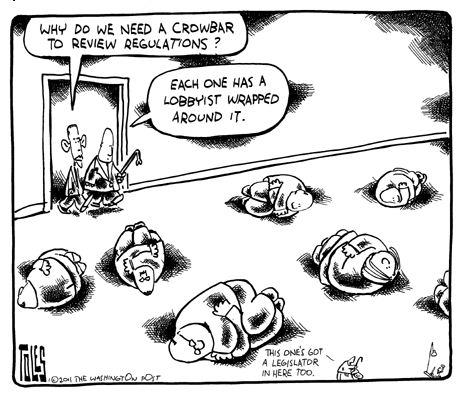
Toles-on-Regulatory-Capture

There are two faces of profit. It’s always the fashion on the left to denigrate profits and the profit motive generally, as if it serves no positive social function. This stems partly from a failure to examine the circumstances under which profits are earned: is it through competitive performance, innovation, hard-won customer loyalty, and the skill or even luck to spot an underpriced asset? Such a “good” profit might even exceed what economists call a “normal profit”, or one that just covers the opportunity cost of the owners’ capital. On the other hand, profit can be derived from what economists call “rent seeking”. That’s the dark side, but the unrecognized spirit of rent seeking seems to lurk within many discussions, as if the word profit was exclusively descriptive of evil. The “rent” in rent seeking derives from “economic rent”, which traditionally meant profit in excess of opportunity cost, or a “supra-normal” profit. But it’s impossible to know exactly how much of any given profit is extracted by rent seeking; a high profit in and of itself is not prima facie evidence of rent seeking, even though we might argue the social merits of a firm’s dominant market position.

Rent seeking takes many forms. Collusion between ostensible competitors is one, as is any predatory attempt to monopolize a market, but the term is most often associated with cronyism in government. For example, lobbying efforts might involve favors to individuals in hopes of swaying votes on regulatory matters or lucrative government contracts. Sometimes, a rent seeker wants lighter regulation. At others, a rent seeker might work the political system for more regulation in the knowledge that smaller competitors will be incapable of surviving the heavy compliance costs. Government administrators also have the authority to change fortunes with their rulings, and they are subject to the same temptations as elected officials. In fact, in the aggregate, administrative rule-making and even enforcement might outweigh prospective legislation as attractors of intense rent-seeking.

Rent seeking is big-time and it is small-time. It takes place at all levels of government, from attempts to influence zoning decisions, traffic patterns, contract awards, and even protection from law enforcement. When it’s big time, rent seeking is the very essence of what some call corporatism and more generally fascism: the enlistment of coercive government power for private gain. A pretty reliable rule is that where there’s government, there is rent-seeking behavior.

Otherwise, the profit motive serves a valuable and massive social function: resources are attracted to profitable uses because they signal the desires of potential buyers. In this way, profits assure that resources are drawn into the most-valued uses. The market interactions between new competitors, drawn by the prospect of profits, and willing buyers leads to a self-correction: supra-normal profits get competed away over time. In this way, the spontaneous actions of voluntary market participants lead to a great achievement: all mutually beneficial trades are exhausted. Profit makes this possible in the short-run and it assures that trades evolve optimally with changes in tastes, technology and resource availability. By comparison, government fares poorly when it attempts to plan outcomes in the short- or the long-run. Rent seeking is an attempt to influence and even encourage such planning, and the profits it enables impose costs on society.

Good and Bad Profits In Health Insurance

I’ve written a few posts about health insurance reform recently (see the left margin). Health care is scarce. If relying on government is the preferred alternative to private insurance, don’t count on better access to care: you won’t get it unless you’re connected. Profits earned by health insurance carriers are roundly condemned by the left. It is as if private capital utilized in arranging coverage and carrying the risk on pools of customers deserves zero compensation, that only public capital raised by coercive taxation is morally acceptable for this purpose. But aside from this obvious hogwash, is there a reason to question the insurers’ route to profitability based upon rent seeking?

The health insurers played a role in shaping the Affordable Care Act (ACA, i.e., Obamacare) and certainly had hoped to benefit from several of its provisions, even while sacrificing autonomy over product, price, coverage decisions, and payout ratios. The individual and employer mandates would force low-risk individuals to purchase extensive coverage, and essential benefits requirements would earn incremental margins. Sounds like a nice deal, but those policies were regarded by the ACA’s proponents as necessary for universal coverage, stabilizing risk, and promoting adequate coverage levels. There were other provisions, however, designed to safeguard the profitability of insurers. These included an industry risk adjustment mechanism, temporary reinsurance to help defray the cost of  covering high-risk patients, and so-called risk corridors (also temporary).

As it turned out, the ACA was not a great bet for insurers, as their risk pools deteriorated more than many expected. With the expiration of the temporary protections in Obamacare, it became evident that offering policies on the exchanges would not be profitable without large premium hikes. A number of carriers have stopped offering policies on the exchanges.

It should be no surprise that health insurance profitability has been anything but impressive over the past three years. The average industry return on equity was just 5.6% during that time frame, and it was a slightly better 6.2% in 2016, about 60% of the market-wide average. It’s difficult to conclude that insurers benefitted greatly from rent seeking activity with regard to the ACA’s passage, but perhaps that activity had a sufficient influence on policy to stabilize what otherwise might have been disastrous performance.

The critics of insurance profits are primarily interested in scapegoating as a means to promote a single-payer health care system. While some are aware of the favors granted to the industry in the design of the ACA, most are oblivious to the actual results. Even worse, they wish to throw-out the good with the bad.

The left is almost universally ignorant of the social function served by the profit motive. Profits stimulate supply, competition and innovation in virtually every area of economic life. To complain about profits in general is to wish for a primitive existence. Unfortunately, the potential for government to change the rules of the market makes it a ripe target for rent-seeking, and it creates a fog through which few discern the good from the bad.

The Fascist Roader

04 Thursday Aug 2016

Posted by Nuetzel in Central Planning, fascism

≈ 1 Comment

Tags

Barack Obama, Benito Mussolini, central planning, competition, Dodd-Frank, fascism, Industrial Concentration, Industrial Policy, Innovation, Jonah Goldberg, Obamacare, rent seeking, Sheldon Richman, Socialism, Thomas Sowell

Obamas - fascist world government


President Obama is a believer in centralized social and economic management, despite the repeated disasters that have befallen societies whose leaders have applied that philosophy in the real world. Those efforts have often taken the form of socialism, with varying degrees of government ownership of resources and productive capital. However, it is not necessary for government to own the means of production in order to attempt central planning. You can keep your capital as long as you take direction from the central authority and pay your “fair share” of the public sector burden.

A large government bureaucracy can coexist with heavily regulated, privately-owned businesses, who are rewarded by their administrative overlords for expending resources on compliance and participating in favored activities. The rewards can take the form of rich subsidies, status-enhancing revolving doors between industry and powerful government appointments, and steady profits afforded by monopoly power, as less monied and politically-adept competitors drop out of the competition for customers. We often call this “corporatism”, or “crony capitalism”, but it is classic fascism, as pioneered by Benito Mussolini’s government in Italy in the 1920s. Here is Sheldon Richman on the term’s derivation:

“As an economic system, fascism is socialism with a capitalist veneer. The word derives from fasces, the Roman symbol of collectivism and power: a tied bundle of rods with a protruding ax.“

With that in mind, here’s an extra image:

Mussolini Quote

The meaning of fascism was perverted in the 1930s, as noted by Thomas Sowell:

“Back in the 1920s, however, when fascism was a new political development, it was widely — and correctly — regarded as being on the political left. Jonah Goldberg’s great book ‘Liberal Fascism’ cites overwhelming evidence of the fascists’ consistent pursuit of the goals of the left, and of the left’s embrace of the fascists as one of their own during the 1920s. … 

It was in the 1930s, when ugly internal and international actions by Hitler and Mussolini repelled the world, that the left distanced themselves from fascism and its Nazi offshoot — and verbally transferred these totalitarian dictatorships to the right, saddling their opponents with these pariahs.“

The Obama Administration has essentially followed the fascist playbook by implementing policies that both regulate and reward large corporations, who are only too happy to submit. Those powerful players participate in crafting those policies, which usually end up strengthening their market position at the expense of smaller competitors. So we have transformational legislation under Obama such as Obamacare and Dodd-Frank that undermine competition and encourage concentration in the insurance, health care, pharmaceutical  and banking industries. We see novel regulatory interpretations of environmental laws that destroy out-of-favor industries, while subsidies are lavished on favored players pushing economically questionable initiatives. Again, the business assets are owned by private cronies, but market forces are subjugated to a sketchy and politically-driven central plan designed jointly by cronies inside and outside of government. That is fascism, and that’s the Obama approach. He might be a socialist, and that might even be the end-game he hopes for, but he’s a fascist in practice.

As Sowell points out, Obama gains some crucial advantages from this approach. For starters, he gets a free pass on any claim that he’s a socialist. And however one might judge his success as a policymaker, the approach has allowed him to pursue many of his objectives with the benefit of handy fall-guys for failures along the way:

“… politicians get to call the shots but, when their bright ideas lead to disaster, they can always blame those who own businesses in the private sector.  Politically, it is heads-I-win when things go right, and tails-you-lose when things go wrong. This is far preferable, from Obama’s point of view, since it gives him a variety of scapegoats for all his failed policies, without having to use President Bush as a scapegoat all the time.

Thus the Obama administration can arbitrarily force insurance companies to cover the children of their customers until the children are 26 years old. Obviously, this creates favorable publicity for President Obama. But if this and other government edicts cause insurance premiums to rise, then that is something that can be blamed on the “greed” of the insurance companies.The same principle, or lack of principle, applies to many other privately owned businesses. It is a very successful political ploy that can be adapted to all sorts of situations.“

Obama’s most ardent sycophants are always cooing that he’s the best president EVAH, or the coolest, or something. But the economy has limped along for much of his presidency; labor force participation is now at its lowest point since the late 1970s; and median income has fallen on his watch. He has Federal Reserve policy to thank for stock market gains that are precarious, at least for those companies not on the fascist gravy train. Obama’s budgetary accomplishments are due to a combination of Republican sequestration (though he has taken credit) and backloading program shortfalls for his successors to deal with later. Obamacare is a disaster on a number fronts, as is Dodd-Frank, as is the damage inflicted by questionable environmental and industrial policy, often invoked via executive order.  (His failures in race relations and foreign policy are another subject altogether.)

Fascism is not a prescription for rapid economic growth. It is a policy of regression, and it is fundamentally anti-innovation to the extent that government policymakers create compliance burdens and are poor judges of technological evolution. Fascism is a policy of privilege and is regressive, with rewards concentrated within the political class. That’s what Obama has wrought.


Seeding the Grapes of Graft

23 Saturday Apr 2016

Posted by Nuetzel in Big Government, rent seeking

≈ Leave a comment

Tags

Alex Tabarrok, Barriers to Entry, Corporatism, Free Market Capitalism, Government Protection, Graft, Guy Rolnik, Industrial Concentration, Koch Industries, Marginal Revolution, Natural Monopoly, Pro-Market, rent seeking, Stigler Center

Government-Bounty-Hunter

Are you investing in graft and rent-seeking activity without knowing it? Is a significant share of your saving channeled into sectors that profit from political influence over politicians, regulators and government planners? Maybe it’s no surprise, and you knew all along that your capital backs firms who manipulate the political system to extract resources beyond what they can earn through honest production. You have an interest in the success of the rent seekers, and you might well get a tax benefit to go along with it!

All this is almost certainly true if your savings are in a 401k, an IRA, a public or private pension fund, or in publicly-traded stocks. These sources of investor funding are dominated by firms that rent seek…. an indication of just how far the cancer of corporatism has gone toward completely subverting free market capitalism. It can be turned back only by ending the symbiosis between industry and government and encouraging real competition in markets.

This question of investing in rent seekers is raised by Guy Rolnik at Pro-Market (the blog of the Stigler Center at the University of Chicago Booth School of Business):

“Put another way, are we facing an economic model in which tens of millions of Americans’ pensions are relying on the ability of companies to extract rents from consumers and taxpayers?“

Rolnik’s emphasis is primarily on mergers and acquisitions, industrial concentration, diminished competition, and monopoly profits extracted by the surviving entities. As Alex Tabarrok at Marginal Revolution notes, “The Number of Publicy Traded Firms Has Halved” in the past 20 years. At the same time, the trend in business startups has been decidedly negative. While I strongly believe in the benefits of a healthy market for corporate control, these trends are a sign that the rent seekers and their enablers in government are gaining an upper hand.

Monopoly must be condoned if there are natural barriers to entry in a market, but such monopolists are generally subject to regulation of price and service levels (complex issues in their own right). If there are other legitimate economic barriers to entry such as differentiated products and strong brand reputations, there is no reason for concern, as those are signs of value creation. And given the private freedom to innovate and compete, there is little reason to suspect that above-normal profits can persist in the long run, as new risk-takers are ultimately drawn into the mix. That is how a healthy economy works and how prices direct resources to the highest-valued uses.

Rent seekers, on the other hand, always have one of the following objectives:

Government Protection: Increased concentration in an industry is a concern if there are artificial barriers to entry. One sure way to protect a market is to enlist the government’s help in locking it down. This happens in a variety of ways: tariffs and other restrictions on foreign goods, patent protection, restrictions on entry into geographic markets, implicit government guarantees against risk (too big to fail), union labor laws, and complex regulatory rules and compliance costs that small competitors can’t afford. The upshot is that if we want more competition in markets, we must reduce the size of the administrative state.

Subsidies: Another aspect of rent seeking is the quest for taxpayer subsidies. These are often channeled into politically-favored activities that can’t be sustained otherwise, and the recipients are always politically-favored firms with friends in high places. This is privilege! Look no further than the renewable energy industry to see that politically-favored, subsidized, and uneconomic activities tend to be dominated by firms with political connections. Naturally, good rent-seekers have an affinity for central planning and its plentiful opportunities for graft. With big-government control of resources you get big-time rent seeking.

Contracts: Government largess also means that big contracts are there to be won across a range of industries: construction, defense, transportation equipment, office supplies, computing, accounting and legal services and almost anything else. Because these purchases are made by an entity that uses other people’s money, incentives for efficiency are weak. And while private firms may compete for these contracts, there is no question that political connections play an important role. As government assumes control of more resources, more favorable rent-seeking opportunities always appear.

Influencing public policy is a game that is much easier for large firms to play. Moreover, the revolving door between government and industry is most active among strong players. This is not to say that large corporations don’t engage in many productive activities. They often excel in their areas of specialization and therefore earn profits that are economically legitimate. However, when government is involved as a buyer, subsidizer or regulator, the rewards are not as strongly related to productive effort. These rewards include above-normal profits, a more dominant market position, a long-term pipeline of taxpayer funding, the prestige of running a large operation with armies of highly-skilled employees engaged in compliance activities, and prestigious appointments for officers. Some of these gains from graft are shared by investors… and that’s probably you.

For society, the implications of channeling saving into rent-seeking activities are unambiguously negative. To say it differently, the private return to rent seeking exceeds the social return, and the latter is negative. Successful rent seekers artificially boost their equity returns and may simultaneously undermine returns to smaller competitors. The outcomes entail restraint of trade and misallocation of resources on a massive scale. The public-sector largess that makes it all possible gives us high rates of taxation, which retard incentives to work, save and invest. If taxes aren’t enough to cover the bloat, our central bank (the Fed) is not shy about monetizing government debt, which distorts interest rates, inflates asset prices and  inflates the prices of goods. In the aggregate, these things warp the usual tradeoff between risk and return and worsen society’s provision for the future.

How should you feel about all this? And your portfolio? As an investor, you might not have much choice. It’s not your fault, so take your private returns where you can find them. Some firms swear off rent seeking of any kind, like Koch Industries, but it is not publicly traded. You could invest in a business of your own, but know that you might compete at a disadvantage to rent seekers in the same industry. Most of all, you should vote for lower subsidies, less regulation and less government!

Socialism Is Concentrated Power

10 Thursday Mar 2016

Posted by Nuetzel in Big Government, Capitalism, Markets

≈ 1 Comment

Tags

Charles Tiebout, Chelsea German, Concentrated Power, crony capitalism, Don Boudreaux, FEE, Foundation for Economic Education, John D. Rockefeller, Marian Tupy, monopoly, Police Power, Privilege, rent seeking, Richard Rahn, State Control, Tiebout Hypothesis, Vote With Their Feet

Power

Nobody likes to defend concentrated power, yet socialists earnestly crave power concentrated in the state. And state power is absolute power. They must imagine that those wielding state power, now and always, will be the sort of nice, benevolent folks they imagine themselves to be. Well, if only more power can be concentrated in the state, it will be alright. Good luck with that! Once granted, watch out.

While this sort of magical thinking might seem naive, another paradox of leftist thinking is even more befuddling: the never-yielding distrust of capitalism and private initiative, a system under which power is largely dispersed. The attitude is more than a little misanthropic. It’s as if socialists expect us to believe that someone forces us to engage in transactions with private sellers, transactions that are always unfavorable in some way. But every transaction in a private economy is voluntary, dependent only on how both parties assess benefits relative to costs. Anyone can make a bad deal, of course, and you might get ripped off by an unscrupulous buyer or seller from time-to-time. But you are free to perform due diligence. You are free to assess risks.

The left goes so far as to blame capitalism for poverty, demonstrating a complete disconnect with reality. For a better perspective on the economic miracles made possible by capitalism, I  recommend a few timely pieces of reading: economist Richard Rahn makes note of the incredible bounty of products and technology brought to us by capitalism. This includes transformative breakthroughs in almost every area of life: communication, computing, transportation, refrigeration, safety, food, medicine and on and on:

“Almost all of the great innovations came from those in the private sector who created them out of the desire for more wealth or just intellectual curiosity. The socialist countries have produced almost nothing — except for bread lines, coercive and destructive taxation and regulation, and gulags. Yet politicians all over the world proudly proclaim themselves to be socialists and attack the capitalist wealth creators and innovators — as if the real world had never existed.“

At the Foundation for Economic Education (FEE), Chelsea German and Marian L. Tupy offer ample evidence of capitalism’s successes as they shred an absurd opinion piece in Forbes magazine claiming that  capitalism “will starve humanity“:

“Throughout most of human history, almost everyone lived in extreme poverty. Only in the last two centuries has wealth dramatically increased. Early adopters of capitalism, such as the United States, have seen their average incomes skyrocket.“

German and Tupy have a more detailed post here with statistics showing dramatic increases in the standard of living enjoyed by poor households in the U.S., increases for which capitalism is largely responsible.

Last month, Don Boudreaux reflected on the well being of average Americans today compared to an individual at the extreme high end of the wealth distribution 100 years ago. Boudreaux catalogues the many ways in which John D. Rockefeller’s comforts were drastically inferior to those available today. He concludes that trading places with Rockefeller would be a questionable deal:

“Honestly, I wouldn’t be remotely tempted to quit the 2016 me so that I could be a one-billion-dollar-richer me in 1916. This fact means that, by 1916 standards, I am today more than a billionaire. It means, at least given my preferences, I am today materially richer than was John D. Rockefeller in 1916. And if, as I think is true, my preferences here are not unusual, then nearly every middle-class American today is richer than was America’s richest man a mere 100 years ago.“

I maintain that even when power is concentrated in large private companies, the situation is far preferable to concentrated power in government. First, private companies do not have the police power necessary for absolute government authority. They cannot force you to do anything. Second, private companies do not simply shuffle resources and up-charge, as the left might have you believe; they innovate and create value as an inducement to trade, a concept that is rare in state-controlled activities. When any form of competition is present, private companies discipline each other, encouraging better quality and restraint on the prices charged for their wares. Even trading with a monopolist confers gains from trade, despite its drawbacks relative to trade in competitive markets.

Of course, government is generally not confronted with competition, unless it’s prompted by citizens who “vote with their feet”, as described by Charles Tiebout. That kind of responsiveness argues for decentralized government, however. Government services are typically monopolized, but the “terms of trade” are often worse than a monopolist would offer. It’s difficult to refuse a government service or your obligation to pay, no matter how much you abhor it, and quality usually suffers due to the extreme lack of accountability to citizen-consumers.

Capitalism gets a bad rap when private businesses engage in rent-seeking. That behavior is characterized by attempts to influence government policy for the business’ own benefit, promoting subsidies, other public spending or tax policies that go to the bottom line, and regulatory actions that disproportionally harm competitors. Those efforts put the crony in crony capitalism. But note that rent seeking is not an inherent feature of capitalism. It is enabled by the existence of activist government, its control over resources and its police power. What this means is that cronyism is fostered by power concentrated within the halls of government. In other words, private power becomes more concentrated and more impervious to competitive forces when it is favored by government. That is pure privilege.

If you dislike concentrated power, then vote for small government!


FCC Net Neutering Vs. Technological Potency

11 Friday Dec 2015

Posted by Nuetzel in Net neutrality

≈ 1 Comment

Tags

Croney Capitalism, FCC, Internet Conduct Standard, Internet freedom Act, L. Gordon Crovitz, Net Neutrality, Newscopia, Obamanet, rent seeking, Rep. Marsha Blackburn, T-Mobile Binge On, Telecommunications Act of 1996, Title II Rules, U.S. Telecom Association v. FCC, Universal Service Fee

160194_600-2

A court challenge to the FCC’s “net neutrality” rules may go a long way in preventing inflated costs, degraded service, stifled innovation and abridgment of freedoms that the rules would foist on the public. The rules are based on treating internet service providers (ISPs) as common carriers under the Title II provisions of the Telecommunications Act of 1934. The uncertain and potentially severe regulatory environment this creates has already led to reduced capital investment by service providers, limiting capacity needed to accommodate the usage demanded by consumers and businesses. The first arguments in the case, U.S. Telecom Association v. FCC, were heard last week in the U.S. Court of Appeals for DC.

A primary argument of proponents of net neutrality is their objection to unrestricted pricing of Internet traffic. The fear is that big carriers will discriminate against smaller users and content providers, shutting them out, despite the fact that the diffusion of internet services throughout society has taken place at a breakneck pace, and despite the existence of network externalities benefitting ISPs that encourage diffusion. In fact, some of the largest content providers have pushed for net neutrality with designs on avoiding the long-run marginal costs of network expansion required by their services, thus to gain a cost advantage over smaller competitors. This is a typical regulatory play: an entrenched private interest seeks to protect its market position, and its technologies, against new and potentially more innovative competitors via supplication to government rule-makers.

L. Gordon Crovitz discussed the U.S. Telecom case in the Wall Street Journal in “Obamanet Goes To Court” (gated — but Google it). Already, the FCC has cast a watchful eye on a competitive, “zero-rating” video service from T-Mobile under its “general conduct rule”. Zero-rating services are of great value to consumers who prefer low-cost access to specific internet features, like video streaming (see this Newscopia piece). Corvitz says:

“T-Mobile’s Binge On benefits consumers by giving them low-priced unlimited access to 24 video services, including Netflix, HBO and ESPN. This package is aimed at cost-conscious people who don’t have broadband. Net neutrality absolutists hate the idea, known as ‘zero rating.’ Susan Crawford, a former Obama special assistant for science, technology, and innovation policy, has written that it ‘is pernicious; it’s dangerous; it’s malignant.’”

Say what? Are consumers no longer capable of judging value against price, as they typically must in their day-to-day affairs? Do we need Big Brother to hem-in competitors in the marketplace who desire more than anything to meet a need in the market, thereby attracting buyers?

Crovitz discusses the legal issues facing the Court, most importantly the FCC’s authority to decide what is “fair” and “reasonable” under the Telecommunications Act of 1996:

“… the agency’s new ‘Internet conduct standard’ is so vague it exceeds the agency’s authority; … the White House’s intervention violated separation of powers and the notice period for new regulations; and the rules violate First Amendment protections for free speech by letting regulators decide what content broadband providers can and can’t make available…. in its rush to adopt Obamanet, the FCC failed to conduct even a cursory review of the costs of treating the Internet as a utility.“

Make no mistake, many of the complaints received by the FCC are from commercial interests attempting to strong-arm other players. “BlackBerry even asked regulators to force Netflix to stream videos on its unpopular phones.” Net neutrality amounts to a vehicle for croney capitalists to seek rents at each others’ expense through government regulatory action. That’s not how the internet has grown to become the tremendous communication, entertainment and transactional apparatus that it is today.

Rep. Marsha Blackburn (R-TN) is a vocal critic of the FCC’s rules, leads a group of 22 legislators who filed a brief in the case “arguing that Congress never granted the FCC the statutory authority to reclassify an industry on its own.” She is also one of 50 cosponsors of the Internet Freedom Act, which would make explicit the FCC’s lack of statutory authority to regulate the internet under Title II rules.

Blackburn believes that net neutrality rules represent a first move by the federal government to control content on the Internet. That could include political speech as well as central direction of internet resources, redirecting opportunities to favored “winners” (content and service providers, technology developers, and geographies) and away from players less favored by the political class.

Another consequence of the FCC’s new rules is likely to be the imposition of a “Backdoor Internet Tax” on users. That is the universal service fee that eventually would amount to $7.25 per month at today’s average broadband bill. Many younger users have no experience with that tax, having rejected landline telephone service in favor of wireless technology and voice-over-internet.

The cartoon at the top of this post is inaccurate in one important respect: it doesn’t come close to indicating the dead weight that government regulation will impose on the future development of the Internet. The FCC was not needed to promote the amazing growth we have witnessed to date. Its intervention is already creating burdens on providers and users. The likelihood of restricted choice and other freedoms, and distortions to an otherwise healthy market mechanism for allocating technological resources, should not be tolerated. We will never know the true potential of the internet if we allow the it to be tampered and hampered by a government bureaucracy.

Pundits Get Played But Earn Rents From the Trade

04 Friday Dec 2015

Posted by Nuetzel in Big Government

≈ Leave a comment

Tags

Corporatism, Influence Trading, Jeremy Shapiro, Policy Validation, rent seeking, Selling Policy, The Brookings Institution, Think Tank Influence

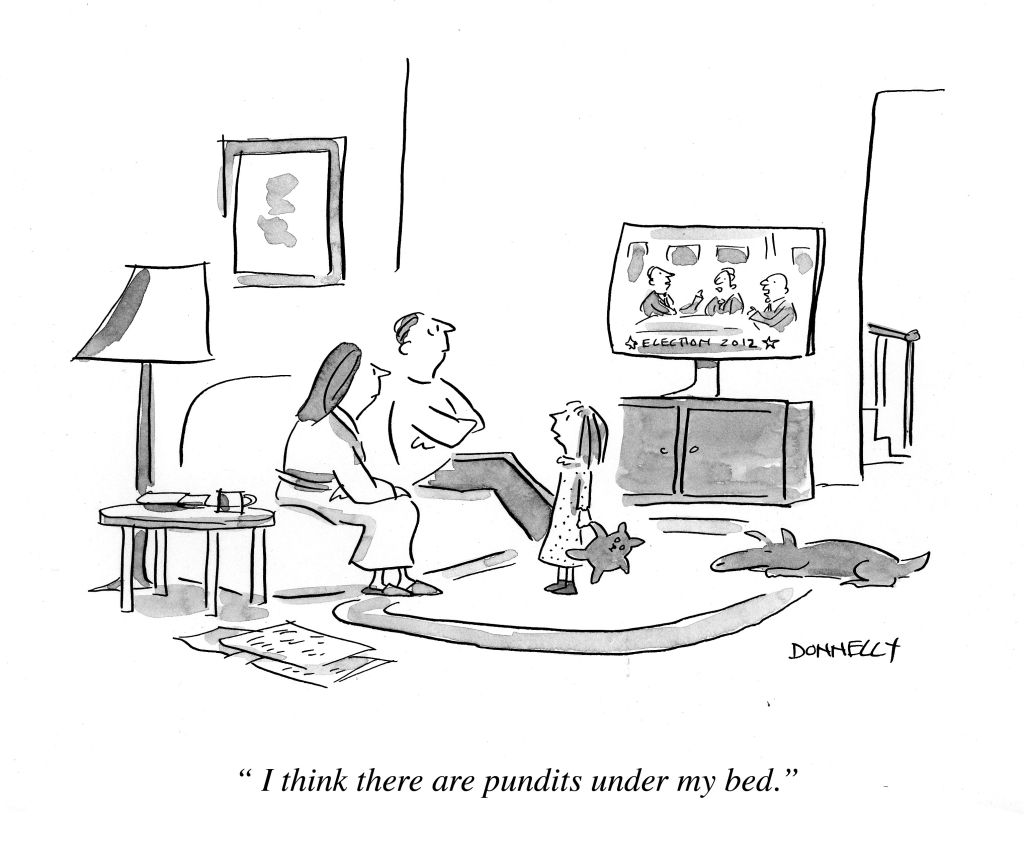
pundits-under-my-bed

Powerful officials often seek to influence “thinkers” and pundits by flattering them with access and requesting advice that ultimately is treated as superfluous. That is the upshot of this interesting post from Jeremy Shapiro at The Brookings Institution: “Who Influences Whom? Reflections on U.S. Government Outreach to Think Tanks“.

These relationships are of a different character than the symbioses often existing between government officials (elected and unelected) and private corporations and unions. The corporatist relationships that most often come to mind are infamous for bleeding taxpayers, distorting the economy and using the power of government to advance private interests. The nexus highlighted by Shapiro between officialdom and think-tank experts, as well as influencers in the media and academia, is a different corner of the rent-seeking world, but it is rent seeking nevertheless.

Shapiro, himself a former government official, describes a sequence of events that might be experienced by an outside expert leading up to an “important” meeting with a high government official. Such experts have a strong interest in their areas of study and naturally hope to promote their own views and analyses. An opportunity to provide input to a policymaker is obviously attractive to such a person. Interactions with officials also confer status on experts, who can then trade on the impressive access they’ve been granted. Invitations to meetings like these, in and of themselves, represent successful rent-seeking by policy experts, regardless of whether their policy advice is given serious consideration by public officials.

While outside experts are often called upon for real policy advice, the government official is frequently after something else; in all likelihood, the official already has a policy position:

“The government official desperately wants the thinkers to give him the benefit of the doubt when his inevitably flawed policy comes up for critical examination, as they are an important source of its ultimate evaluation by the Congress and the public. The briefings therefore tend to take place before important diplomatic meetings or foreign trips that will predictably occasion a round of media coverage on the policy in question.“

So the official hopes to engineer mutually beneficial trades with outside experts. Trades of this kind may have no real value to anyone outside of the direct parties. Shapiro’s example relates to foreign policy, but the same dynamic takes place in almost every area of government policymaking:

“The thinkers are the validators. They will write op-eds, give pithy quotes to important newspapers, and appear on network news programs.“

As Shapiro tells it, an intriguing aspect of this process is that the experts are often well aware of the circumstances. Usually, they can be counted upon to pay for their access and the esteem it bestows by offering at least subtle forms of support for the official’s policy initiative:

“The meetings, their grandeur and secrecy, are intended to foster a sense that the thinkers have been listened to and thus are somehow complicit in the policy—the illusion of inclusion. A meeting that seems to the thinker to be an opportunity to persuade is actually an opportunity to be persuaded. It doesn’t always work, of course. Fundamental positions are rarely altered and many of the supposed validators will remain fierce critics. But the biggest secret of all is that, even if the thinker does understand the real purpose, it often works at least at the margins.“

Large numbers of tremendously talented, well-compensated people are engaged in charades like this on a regular basis. We know there are beneficiaries and there are real costs, but who pays for the largess? Obviously taxpayers, but private parties pay in other ways: Media time devoted to pundits is often paid by advertisers and, ultimately, consumers. Private think tanks are supported by private contributors who expect their own views to be validated by analyses and promoted in policy debates. The activity described by Shapiro may subvert those intentions. The real cost to society, however, is the value of resources diverted from productive, private activity to support the circle of rent-jerking. The bigger the government, the bigger the circle.

Rent Seeking For Social Justice At Mizzou

15 Sunday Nov 2015

Posted by Nuetzel in Education

≈ Leave a comment

Tags

Billy Donley, Columbia MO, Concerned Student 1950, Eugene Volokh, First Amendment, Forced Diversity, Free expression, Gary Pinkel, Jason Whitlock, Jonathan Butler, Legion of Black Collegians, Missouri Students Association, Mizzou, Mizzou Tigers Football, Obamacare, Payton Head, Planned Parenthood, R. Bowen Loftin, rent seeking, Tim Wolfe, University of Missouri

Mizzou

Pre-blog postscript: In the wake of the tumultuous week discussed below, tonight Mizzou’s football team, which has struggled on the field this year, defeated a very good squad from Brigham Young University. Despite my strong misgivings about the actions of team members last week, tonight I am very proud of Mizzou, white, black and gold. Go Tigers!

~~~~~~~~~~~~~~~~~~~~~~~~~~~~~~~~~~~~~~~~~~~~~~~~~

There is weak justification at best for the uproar over supposed racism and social injustice at Mizzou (the University of Missouri’s main campus in Columbia, MO). A protest highlighted by a hunger strike by one graduate student, a boycott by football players, and the threat of a walkout by faculty in nine academic departments led to the resignation last week of the university system’s president and the Mizzou chancellor, who were accused of inadequate sensitivity to the grievances of African-American students. The broader context for the protest is a nationwide assault on free speech, especially on college campuses, with demands for “safe spaces” and “trigger warnings” to protect students from words and acts that they might find offensive. This sensitivity is unbounded, and there is no limit to the censorship and fascism it brings forth in its proponents. From such sentiments are book-burners made.

It is a shame to see a great university like Mizzou reduced to groveling at the feet of petulant children who, ostensibly, have come to be educated, and often with financial support from the school. Full disclosure: Mizzou is my alma mater, so I am especially saddened by these developments. At the end of this post, I provide details on incidents that occurred at Mizzou over nearly three months leading up to the protest. Several of the incidents involved unproven and even false claims by the protestors.

Like it or not, speech outside the classroom by students at public universities has broad protection under the First Amendment. According to Eugene Volokh:

“Most clearly, students generally may not be expelled, suspended, or otherwise disciplined for what they say in student newspapers, at demonstrations, in out-of-class conversations, and the like… even if it’s offensive, wrongheaded, racist, contemptuous, anti-government, or anti-administration. Of course, it’s not protected from university criticism. The university is itself free to publicly speak to condemn student statements that university officials find to be unsound or improper.“

There are exceptions to this protection in the case of “fighting words” and “incitement”, but that kind of offense must be proven before an individual can be punished. It is absurd to demand that a university engage in unconstitutional restrictions on speech. Even if that were legal, it is unreasonable to expect a university to effectively police all speech on campus.

The Mizzou administration did take action this semester in the only case in which an individual engaging in racist speech was identified. The offender was intoxicated and disrupted an organization’s private rehearsal (see below). Whether he used “fighting words” is unknown, but a “conduct process” is still underway in his case. In addition, mandatory diversity training for students and faculty was announced by the chancellor in early October. It appears that the president, responsible for four campuses, may have delegated responsibility for managing the controversies in Columbia to the chancellor, but the failure of the president to respond directly was taken as dismissive. But in fact, Mizzou already had processes in place to address diversity issues, and the chancellor was active in communicating the administration’s concerns and support to minority students via social media. Still, the protestors assert that they were ignored and that no action was taken, among other falsehoods (see below).

In addition to an apology and removal of the University System president for “inaction”, the protestors demanded that the University meet a number of other conditions. These included a “racial awareness and inclusion curriculum throughout all campus departments” to be vetted by “students, staff, and faculty of color.” The protesters also demanded: “an increase the percentage of black faculty and staff campus-wide to 10%“; a 10-year strategic plan to improve retention of “marginalized students“; increased funding “for the purpose of hiring additional mental health professionals — particularly those of color“; and increased “funding and personnel for the social justice centers on campus for the purpose of hiring additional professionals, particularly those of color…”

The demands of the student protestors (and their faculty supporters) represent an exercise in rent seeking. They are attempting to commandeer resources at the cost of academic and educational efforts not explicitly dedicated to the theme of diversity and inclusion. If all of the demands are met, damage will be sustained by nearly all fields of study at Mizzou.

One of my frequent complaints about the Left is their inability to understand that rewards in a market economy are not zero-sum. Instead, they are earned by creating new value to be used in trade and enjoyed by others. The rent-seeking process disrupts that flow of benefits by using the power of government to extract resources from others for one’s private benefit, which then yields a negative-sum outcome for society. However, the resources sought by the Mizzou protestors must come from a public educational system for which funding is scarce. Funds provided to Mizzou by the state of Missouri have fallen significantly over the years, yet state law prohibits tuition increases for undergraduate residents exceeding the growth in the CPI. While the protestors might view their demands as reparation for past and ongoing injustices, many are already subsidized by an institution of higher learning that is strapped, and one that is already at their disposal for purposes of building their human capital. They should avail themselves of that opportunity so they can use that capital later in positive sum activities.

I also think the protests at Mizzou are symptomatic of misplaced priorities on the Left. I highly recommend this excellent essay by Jason Whitlock, an African-American sports journalist who notes that the protests at Mizzou have been given rapt attention by the Left, while the far more serious problem of black-on-black violence receives proportionately little play.

Much like other demands for “social justice”, the Mizzou protestors do not recognize the counterproductive nature of their activities and the measures they advocate. Merit will always be relied upon as as a standard by which people judge others. In a market system, it is a fairly objective standard at that. To a truly neutral observer, diversity is fine, but it is beside the point, and forced diversity often leads to suspicions of unfair play and resentment.

I find the attitude of the protestors appalling on several levels: the lies and the rent-seeking behavior, the damage they will inflict on Mizzou and their fellow students, and their rejection of good-faith efforts to address their concerns. To cap it all off, please read the childish posts shown in this article, in which the Mizzou protestors selfishly complain that the terrorist attacks in Paris have taken attention away from them, going so far as to characterize as “racist” the relative balance of coverage. Simply disgusting!

Sadly, there have been threats of violence on campus in the wake of recent developments. This week, a white teen in Rolla, Missouri, 100 miles from Columbia, was arrested and is being held without bond for making posts on social media that threatened black students at Mizzou. At the same time, hostility and threats toward campus greeks led to a lock-down at fraternities and sororities. As to racism, there is no doubt that it exists, but Mizzou is not exceptional in that regard. On campus, I believe that more racial tension is borne out of agitation from protestors than by any racist sentiments held by others. When the protestors acknowledge examples of apparently neutral, non-racist behavior by others, they insist that the racism they are fighting at Mizzou is systemic. Appeasing these complainants requires a ongoing series of reparations in the form of financial support, control over hiring, quotas and mandatory indoctrination. But here’s a clue: the social justice rap will never win the rewards and respect that arise naturally from hard work.

MIZ – ZOU!

~~~~~~~~~~~~~~~~~~~~~~~~~~~~~~~~~~~~~~~~~~~~~~~~~

Here are key events or claims that led up to the present brouhaha at Mizzou, along with my editorial comments:

August 14: The university announced that it would no longer offer direct subsidies to graduate assistants for the purchase of health insurance. The reason? Obamacare prohibits the kind of low-cost, “individual market” policies (per IRS interpretation) offered by many schools. Mizzou, however, promised to provide a one-time fellowship to cover the economic loss suffered by grad students in the fall semester. When students threatened a walk-out, the university reinstated the subsidies, but with the proviso that a later review would be necessary. This incident had nothing to do with racism, but it inflamed passions. An African-Americam grad student named Jonathan Butler was very upset, even though his family is quite affluent and more than capable of affording his coverage.

August – September 2015: Mizzou cancelled contracts with Planned Parenthood (PP) clinics in the wake of the release of videos showing PP officials discussing the sale of fetal “tissue”. There was pressure on the school’s administration to cut ties with PP and revoke the “refer and follow” privileges of an abortion surgeon from St. Louis. These developments were very upsetting to the campus Left, and while gender-equality activists probably thought they had a legitimate gripe, the action should not be conflated with racism. Nevertheless, Jonathan Butler listed this issue as one of his grievances, and it helped to broaden support for his cause among the student Left.

October 3: The President of the Missouri Student Association, Payton Head, claimed that several men riding in the back of a pickup truck screamed racial slurs as he walked across campus. That is awful, but unless he can identify the individuals or the truck, nothing can be done about that particular incident. It was featured in Butler’s grievance letter to the university. Presumably, the school needs to racially-sensitize anyone with access to campus.

October 6: A white student, apparently drunk, interrupts a rehearsal of the Royalty Court of the Legion of Black Collegians with racial epithets. The student was identified the next day and removed from campus by the Office of Student Conduct pending the outcome of an ongoing disciplinary procedure.

October 10: The Homecoming parade is interrupted when University System President Tim Wolfe’s car is surrounded by students from an organization called Concerned Student 1950. (1950 was the first year that black students were admitted to Mizzou.) Wolfe instructs his driver to back away from the students. With more space between the car and the protestors, the driver attempts to proceed slowly to the right around the group. In this video, Jonathan Butler can then be seen rushing toward the moving car and planting his knees into the bumper. He later accused Wolfe and his driver of running into him. As the narrator on the video states, if this were an insurance case, that sort of fraud might get Butler arrested. After a short blank segment on the video, a so-called “townie” and a few other Mizzou football fans step forward to act as a barrier between Wolfe’s car and the protesters. Ultimately, Wolfe asked police to remove the protestors from the parade route. That was characterized as evidence of neglect on Wolfe’s part. Andrew McCarthy notes the following about Jonathon Butler:

“By the way, the racism is apparently so bad at Mizzou that Mr. Butler has chosen to pursue his Master’s degree (in education) there after attending the university as an undergraduate. Now in his eighth year at Mizzou, he hopes, according to NBC News, ‘to become an advocate and ‘social entrepreneur.””

October 24, 2015: Human feces is discovered on the floor of a restroom in a university residence hall; it had been used to smear a swastika on the wall. This is now confirmed by a campus police report, though no photographs of the “poop swastika” have been produced. (Apparently, a one-year-old photo of similar graffiti was circulated by protestors). The “poopetrator” has not been identified. The act could have been inspired by anti-Semitism, white supremism, simple pranksterism (albeit viciously expressed) , or quite possibly fraudulent agitation meant to incite fears on campus. The incident really did incite fears when it was communicated on social media by Residence Halls Association President Billy Donley. The poop swastika was taken as additional evidence of a bad racial climate at Mizzou, though the affair is suspect.

November 3: Butler begins a hunger strike in an impromptu “tent city” on campus. A student boycott of classes is announced the next day. I have strong doubts about Butler’s credibility (see below) and whether the hunger strike was authentic. He did not look or act like a hungry man before he ate his first post-strike sandwich, but I could be wrong.

November 8: Black football players announce their support of Butler by refusing to practice or play until President Wolfe apologizes and resigns. The next day, Coach Gary Pinkel tweets his support for the black players, and the athletic director agrees. Many of the white players also express support for the player boycott by appearing in a group photo, but it has been reported that not all of them agreed. (I personally believe that the whole lot of the boycotters were played by Butler and his organization.) On November 13, Coach Pinkel resigns, effective December 31, but the reason is a recent diagnosis of non-Hodgkins lymphoma (non-fatal). Some things are simply more important than in-fighting at the university. Coach Pinkel’s announcement, as sad as it is, may well help to defuse the immediate tensions.

November 10: President Wolfe and Chancellor R. Bowen Loftin resign. Butler ends his hunger strike with a sandwich as his friends urge him on with the expression “Yay N—–“, an utterance that may strike some as hypocritical. The football player boycott ends the next day.

On the evening of November 10 at about 11 p.m., Payton Head, the student body president, posted the following on Facebook:

“Students please take precaution. Stay away from windows in residence halls. The KKK has been confirmed to be cited on campus. I’m working with the MUPD, the state trooper [sic], and the National Guard.“

The news spread quickly. Head deleted the post by 11:30 and later apologized and accepted blame for spreading false information. Good for his accountability. His advice at that time was to trust only the @MUalert system, which had posted: “There is no immediate threat to campus. Please do not spread rumors…” 19 minutes before Head’s KKK post.

Government Wants To Gut Your Gig

24 Friday Jul 2015

Posted by Nuetzel in Big Government, Regulation

≈ Leave a comment

Tags

Bill De Blasio, Economic conservatism, Erik Sherman, Gig economy, Hillary Clinton, Megan McArdle, Overtime rules, rent seeking, Sharing economy, St. Louis Metropolitan Taxi Commission, Taskrabbit, Taxi deserts, Uber

uber-cartoonjpg

Big government is an inherently conservative enterprise when it comes to protecting  the economic status quo. It frequently acts on behalf of entrenched interests by quashing innovation and competition. This is well illustrated by resistance to the “gig economy” (or “sharing economy”) and companies like Uber and Taskrabbit. The gig economy is growing rapidly because it is often more affordable than traditional channels and it offers tremendous convenience. Enabled by the internet, customized tasks or “gigs” can be performed anywhere for anyone demanding them. My son in New York City just found a talented carpenter through an on-line app, who stopped by his apartment in the evening and mounted a big-screen TV on the wall. The service he provided was not new, but the deal was facilitated and even enhanced by technology in a way that in some cases is reordering economic relationships. The competitive pressure this can create is drawing resistance with the aid of government power.

In St. Louis, there is an ongoing conflict between the Taxicab Commission and Uber, which has not yet gained entry to the market. Three of eight members of the commission own cab companies. They have succeeded in keeping Uber and Lyft out of the market for over a year. A resolution might be possible soon, but the commission is still haggling with Uber over insurance coverage levels, fingerprints and background checks.

On the national stage, the biggest issue surrounding the gig economy is the formal relationship between workers and any company they might represent. Should those workers be treated as independent contractors or employees? Companies like Uber insist that their drivers are independent, but the government would prefer that they be treated as employees. In some cases, that would oblige employers to offer certain benefits. Erik Sherman covers this issue in “How the U.S. Just Knee-Capped the ‘Gig Economy’“. According to Uber, most of its drivers are part-time and like it that way, so it’s not clear that the government can force Uber (under current rules) to pay for extra benefits, or how many of its drivers that would affect. Still, it is instructive that the government is applying pressure in this area, potentially undermining competitive forces and voluntary relationships formed between innovative businesses and their working partners.

Big government advocates are extremely uncomfortable with the gig economy, but there are a fair number of progressives who place a high value on their ability to transact with “gigsters”. Politicians such as Hillary Clinton, who “skewered” the gig economy last week, risk fracturing their own base by advocating steps that could threaten innovative enterprises like Uber. In another statist attack on Uber, New York Mayor Bill De Blasio recently proposed to “cap” the company’s growth while the city studied its impact on traffic. Fortunately, he has backed down.

Progressives should love the value that the gig economy brings to segments of society whose members otherwise can’t afford or can’t access traditional services. For example, residents of low-income neighborhoods often find themselves living in “taxi deserts” when forced to rely on the entrenched cab companies. Megan McArdle makes this point in “Uber Serves the Poor by Going Where Taxis Don’t“. Aside from the technology angle, this is basic capitalism in action. When government steps in to restrict the conditions under which services may be offered, and raises the cost, it lends a degree of monopoly power to the entrenched providers and blocks the diffusion of services to all segments of the market. This should be seen as antithetical to the progressive agenda, but politicians and cronies don’t always see it that way.

The advantages of the gig economy have been made possible by technology, but another key element is that it has unleashed a flood of voluntary activity to fill gaps that were heretofore inadequately addressed. There have been some principled objections to the business practices of Uber and other gig sponsors, which often involve details regarding the splitting of revenue. Despite these concerns, there are benefits to workers who choose to participate, including a great deal of flexibility in choosing working hours and conditions. Second guessing their motives and the opportunity costs they face is a purely speculative and presumptuous exercise. Furthermore, on other fronts, government has been engaged in a seemingly intentional effort to make only part-time work available, as with recent changes in overtime rules and Obamacare regulations; at least the gig economy fits into that framework.

Traditional service providers, some of whom enjoyed government-enforced monopolies, have reacted to new competition by calling for protection. This rent-seeking behavior is typical in the history of regulation, which has often taken root under strong pressure for protection by entrenched interests. Progressives should reject this perverse form of economic conservatism.

Corporatists of the World Unite!

01 Wednesday Jul 2015

Posted by Nuetzel in Big Government

≈ Leave a comment

Tags

Benito Mussolini, Capitalism, Classical Liberalism, Corporatism, Edmund S. Phelps, Free Markets, Jason Brennan, Liberalism, Max Borders, Neoliberalism, rent seeking, Thayer Watkins, The Freeman

Corporatism Santa

As a classical liberal, I’m fascinated by the ongoing confusion of the Progressive Left over the meaning of the word liberalism. To be “liberal” is to support individual autonomy, self-determination, and freedom from coercion by the state. True liberalism necessarily implies a minimal state apparatus because the state can only derive authority from its power to coerce. Confusion over the meaning of liberalism was covered in “Labels For the Authoritarian Left” on Sacred Cow Chips last year.

A similar confusion surrounds use of the word corporatism and its relationship to progressivism on the one hand, and liberalism on the other. I came across this excellent essay by Max Borders in The Freeman that begins with a discussion of the term neoliberalism. Lately this has been invoked as an derogatory reference to classical liberalism, except that the users don’t really understand the latter. In fact, as Borders points out, one prominent author describes free market advocacy as something more akin to cronyism, complete with state support and bailouts, which is contradictory on its face. But it is consistent with the doctrine of corporatism. Borders offers this quote from Thayer Watkins:

“In the last half of the 19th century people of the working class in Europe were beginning to show interest in the ideas of socialism and syndicalism. Some members of the intelligentsia, particularly the Catholic intelligentsia, decided to formulate an alternative to socialism which would emphasize social justice without the radical solution of the abolition of private property.

The result was called Corporatism. The name had nothing to do with the notion of a business corporation except that both words are derived from the Latin word for body, corpus.“

Sounds like innocent beginnings, but enforcing “social justice” within this framework demands a substantial role for the state and an intricate set of relationships between the state and private parties. That provides opportunities for accumulating economic power and wealth by manipulating any arm of government that legislates, adjudicates, purchases, licenses, regulates or levies taxes. That is, any arm of government! Such rent-seeking activity gives rise to a symbiosis between the state and powerful private economic actors, and that is the essence of modern corporatism as practiced by Mussolini, George W. Bush and Obama and their governments. Borders quotes economics Nobel laureate Edmund Phelps:

“The managerial state has assumed responsibility for looking after everything from the incomes of the middle class to the profitability of large corporations to industrial advancement. This system . . . is . . . an economic order that harks back to Bismarck in the late nineteenth century and Mussolini in the twentieth: corporatism.“

Borders closes with a discussion of Jason Brennan’s admonition: “Dear Left: Corporatism is Your Fault”, which dishes the bald truth.

“When you create complicated tax codes, complicated regulatory regimes, and complicated licensing rules, these regulations naturally select for larger and larger corporations. We told you that would happen. Of course, these increasingly large corporations then capture these rules, codes, and regulations to disadvantage their competitors and exploit the rest of us.“

Corporatism has nothing to do with the corporate form of business organization per se. Granted, limited liability is an artificial construct created by the state, and it is a hallmark of that form, so it’s fair to cite it as an example of corporatism. But corporatism in its systemic sense represents the larger web of non-market dependencies between the state and powerful economic actors, corporate in form or not. Both sides benefit from these relationships and, in many direct and indirect ways, compromise the integrity of the voluntary market mechanism and harm smaller actors who rely on it.

This is not a state of affairs that meets with the approval of classical liberals, free marketeers and fans of real capitalism, the so-called “neoliberals” of Leftist fiction. The Left purports to hate corporatism too, but they don’t understand its genesis and are fully oblivious to the real reasons for its progression. Instead, in their ignorance, they pass the blame onto “neoliberals”.

The Government Inequality Machine

17 Wednesday Jun 2015

Posted by Nuetzel in Big Government

≈ Leave a comment

Tags

Beautiful Anarchy, Cronyism, Export-Import Bank, Housing Policy, Inequality, Intellectual Property Rights, Jeffrey Tucker, Kevin Erdmann, National Review, Redistribution, regulation, rent seeking, Robert P. Murphy, Scott Sumner, The Freeman, Thomas Piketty, Welfare for the Rich

Cronyism cartoon

Some perceive the government as an ideal agent of redistribution, but they fail to apprehend the many ways in which government policy undermines equality. Scott Sumner and Kevin Erdmann have written an excellent essay on this point entitled “Here’s What’s Driving Inequality” at National Review. They focus on three areas of government action with the unavoidable side-effect of upward redistribution: housing policy (at all levels of government), regulation, and excessive protections for intellectual property.

Sumner and Erdmann briefly cover Thomas Piketty’s controversial view that wealth becomes increasingly concentrated under conditions of secular stagnation. However, they note that over the past few decades:

“... almost the entire change in the share of domestic income going to capital in major developed economies was explained by rising rents on residential real estate. Non-rental capital income (including the corporate sector) still has a fairly stable share of domestic income.“

Housing policy has driven rents upward in myriad ways. For example, restrictive zoning laws, environmental regulation of new building and regulation of bank lending have all made homeownership less feasible and renting more expensive. If you’re already in your own home, you’re safe! If not, welcome to the have-nots! Here’s a story on government insurance programs that offer massive subsidies to wealthy homeowners. All these redistributional effects are compounded by a tax code that has inflated housing prices through the home mortgage interest deduction, and at the same time inflated rents via the incidence of higher taxes on rental income and real estate capital gains.

Regulation of private business activity is often viewed naively as a necessary, protective function of government, but regulation acts in perverse ways:

“Unfortunately, many government regulations tend to favor larger firms. In recent years we have seen the passage of some extremely complex regulations involving thousands of pages of rules, such as Sarbanes-Oxley, Dodd-Frank, and the Affordable Care Act. The Food and Drug Administration, the Department of Defense, and the public health-care complex tend to create opportunities for uber-firms within industries, which act as clearinghouses for public contracts and regulatory demands.”

Large firms tend to pay higher wages and salaries than small firms. By favoring large firms, regulation in turn favors their relatively high-income workers. In addition, regulation such as occupational licensing, labor regulations and local wage controls damage the health and growth potential of small firms and the mobility of individuals at the bottom of the economic ladder.

Finally, Sumner and Erdmann discuss the often bizarre extension of intellectual-property (IP) rights and the way it favors large firms:

“Copyright protections once lasted for 14 years, applied only to maps and books, and could be renewed once if the author was still alive. Now they’ve been extended to many other products, extend for 50 years after the death of the author, and last for at least 95 years for corporations. These extensions are widely seen as reflecting the lobbying power of companies such as Disney. In the high-tech sector, patents are often granted for seemingly minor and obvious innovations.“

Sacred Cow Chips featured a piece on IP several months ago called “Is The Patent a Perversion?” The Libertarian view of IP is skeptical, to say the least, and favors limited protection at most. In that post, I quoted Jeffrey Tucker of the Beautiful Anarchy blog:

“Through intellectual property laws, the state literally assigned ownership to ideas that are the source of innovation, thereby restricting them and entangling entrepreneurs in endless litigation and confusion. Products are kept off the market. Firms that would come into existence do not. Profits that would be earned never appear. Intellectual property has institutionalized slow growth and landed the economy in a thicket of absurdity.“

There is little doubt that economic mobility is not well served by excessive grants of IP rights that extend monopolies indefinitely.

Government fosters inequality in many other ways. The mere existence of a confiscatory mechanism for legal revenue collection, and a complex bureaucracy in charge of distributing the spoils and making rules, will always attract high-powered rent-seeking resources and encourage cronyism. It is a graft machine. The very complexity of the tax code creates fertile ground for transfers via obscure breaks and carve-outs, while higher tax rates on others are required to fund the exceptions. Here’s another: the Export-Import Bank, which subsidizes exports for large corporations. A nice run-down of some of the many areas of “Welfare for the Rich” was provided a few years ago by Robert P. Murphy in The Freeman.

Unfortunately, direct efforts by the government to help the poor are often mere palliatives. At the same time, many of these programs are notorious for destroying work incentives, which undermines equality and economic mobility.

Government is simply not as well-suited to promoting equality as well-functioning markets, free of government meddling and government grants of monopoly. Profits in such markets attract new resources that compete away excess returns and bid prices downward, actions that tend to promote equality. The opportunity to compete without restraint not only vitiates artificial or permanent claims to profits; along with strong property rights, it encourages invention, economic mobility and growth.

← Older posts
Newer posts →
Follow Sacred Cow Chips on WordPress.com

Recent Posts

  • The Case Against Interest On Reserves
  • Immigration and Merit As Fiscal Propositions
  • Tariff “Dividend” From An Indigent State
  • Almost Looks Like the Fed Has a 3% Inflation Target
  • Government Malpractice Breeds Health Care Havoc

Archives

  • January 2026
  • December 2025
  • November 2025
  • October 2025
  • September 2025
  • August 2025
  • July 2025
  • June 2025
  • May 2025
  • April 2025
  • March 2025
  • February 2025
  • January 2025
  • December 2024
  • November 2024
  • October 2024
  • September 2024
  • August 2024
  • July 2024
  • June 2024
  • May 2024
  • April 2024
  • March 2024
  • February 2024
  • January 2024
  • December 2023
  • November 2023
  • August 2023
  • July 2023
  • June 2023
  • May 2023
  • April 2023
  • March 2023
  • February 2023
  • January 2023
  • December 2022
  • November 2022
  • October 2022
  • September 2022
  • August 2022
  • July 2022
  • June 2022
  • May 2022
  • April 2022
  • March 2022
  • February 2022
  • January 2022
  • December 2021
  • November 2021
  • October 2021
  • September 2021
  • August 2021
  • July 2021
  • June 2021
  • May 2021
  • April 2021
  • March 2021
  • February 2021
  • January 2021
  • December 2020
  • November 2020
  • October 2020
  • September 2020
  • August 2020
  • July 2020
  • June 2020
  • May 2020
  • April 2020
  • March 2020
  • February 2020
  • January 2020
  • December 2019
  • November 2019
  • October 2019
  • September 2019
  • August 2019
  • July 2019
  • June 2019
  • May 2019
  • April 2019
  • March 2019
  • February 2019
  • January 2019
  • December 2018
  • November 2018
  • October 2018
  • September 2018
  • August 2018
  • July 2018
  • June 2018
  • May 2018
  • April 2018
  • March 2018
  • February 2018
  • January 2018
  • December 2017
  • November 2017
  • October 2017
  • September 2017
  • August 2017
  • July 2017
  • June 2017
  • May 2017
  • April 2017
  • March 2017
  • February 2017
  • January 2017
  • December 2016
  • November 2016
  • October 2016
  • September 2016
  • August 2016
  • July 2016
  • June 2016
  • May 2016
  • April 2016
  • March 2016
  • February 2016
  • January 2016
  • December 2015
  • November 2015
  • October 2015
  • September 2015
  • August 2015
  • July 2015
  • June 2015
  • May 2015
  • April 2015
  • March 2015
  • February 2015
  • January 2015
  • December 2014
  • November 2014
  • October 2014
  • September 2014
  • August 2014
  • July 2014
  • June 2014
  • May 2014
  • April 2014
  • March 2014

Blogs I Follow

  • Passive Income Kickstart
  • OnlyFinance.net
  • TLC Cholesterol
  • Nintil
  • kendunning.net
  • DCWhispers.com
  • Hoong-Wai in the UK
  • Marginal REVOLUTION
  • Stlouis
  • Watts Up With That?
  • Aussie Nationalist Blog
  • American Elephants
  • The View from Alexandria
  • The Gymnasium
  • A Force for Good
  • Notes On Liberty
  • troymo
  • SUNDAY BLOG Stephanie Sievers
  • Miss Lou Acquiring Lore
  • Your Well Wisher Program
  • Objectivism In Depth
  • RobotEnomics
  • Orderstatistic
  • Paradigm Library
  • Scattered Showers and Quicksand

Blog at WordPress.com.

Passive Income Kickstart

OnlyFinance.net

TLC Cholesterol

Nintil

To estimate, compare, distinguish, discuss, and trace to its principal sources everything

kendunning.net

The Future is Ours to Create

DCWhispers.com

Hoong-Wai in the UK

A Commonwealth immigrant's perspective on the UK's public arena.

Marginal REVOLUTION

Small Steps Toward A Much Better World

Stlouis

Watts Up With That?

The world's most viewed site on global warming and climate change

Aussie Nationalist Blog

Commentary from a Paleoconservative and Nationalist perspective

American Elephants

Defending Life, Liberty and the Pursuit of Happiness

The View from Alexandria

In advanced civilizations the period loosely called Alexandrian is usually associated with flexible morals, perfunctory religion, populist standards and cosmopolitan tastes, feminism, exotic cults, and the rapid turnover of high and low fads---in short, a falling away (which is all that decadence means) from the strictness of traditional rules, embodied in character and inforced from within. -- Jacques Barzun

The Gymnasium

A place for reason, politics, economics, and faith steeped in the classical liberal tradition

A Force for Good

How economics, morality, and markets combine

Notes On Liberty

Spontaneous thoughts on a humble creed

troymo

SUNDAY BLOG Stephanie Sievers

Escaping the everyday life with photographs from my travels

Miss Lou Acquiring Lore

Gallery of Life...

Your Well Wisher Program

Attempt to solve commonly known problems…

Objectivism In Depth

Exploring Ayn Rand's revolutionary philosophy.

RobotEnomics

(A)n (I)ntelligent Future

Orderstatistic

Economics, chess and anything else on my mind.

Paradigm Library

OODA Looping

Scattered Showers and Quicksand

Musings on science, investing, finance, economics, politics, and probably fly fishing.

  • Subscribe Subscribed
    • Sacred Cow Chips
    • Join 128 other subscribers
    • Already have a WordPress.com account? Log in now.
    • Sacred Cow Chips
    • Subscribe Subscribed
    • Sign up
    • Log in
    • Report this content
    • View site in Reader
    • Manage subscriptions
    • Collapse this bar
 

Loading Comments...