• About

Sacred Cow Chips

Sacred Cow Chips

Tag Archives: Stay-at-Home Orders

Private Social Distancing, Private Reversal

04 Monday May 2020

Posted by Nuetzel in Liberty, Pandemic, Uncategorized

≈ 1 Comment

Tags

Andrew Cuomo, Anthony Fauci, Apple Mobility, Bill De Blasio, Centre for Economic Policy Research, Donald Trump, Externalities, Forbes, Foursquare, Heterogeneity, John Koetsier, Laissez Faire, Lockdowns, Nancy Pelosi, Points of Interest, Private Governance, Safegraph, Social Distancing, Social Welfare, Stay-at-Home Orders, Vitamin D, Wal Mart, WHO
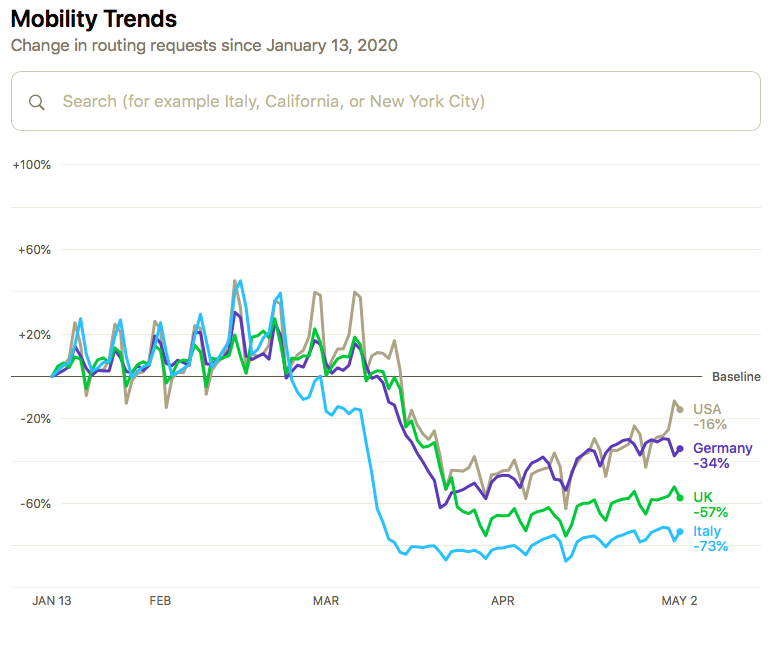
My original post on the dominance of voluntary social distancing over the mandated variety appears below. That dominance is qualified by the greater difficulty of engaging in certain activities when they are outlawed by government, or when the natural locations of activities are declared off-limits. Nevertheless, as with almost all regulation, people make certain “adjustments” to suit themselves (sometimes involving kickbacks to authorities, because regulation does nothing so well as creating opportunities for graft). Those “adjustments” often lead to much less desirable outcomes than the original, unregulated state. In the case of a pandemic, however, it’s tempting to view such unavoidable actions as a matter of compromise.

I say this now because the voluntary social distancing preceding most government lockdown orders in March (discussed in the post below) is subject to a degree of self-reversal. Apple Mobility Data suggests that something like that was happening throughout much of April, as shown in the chart at the top of this post. Now, in early May, the trend is likely to continue as some of the government lockdown mandates are being lifted, or at least loosened.

An earlier version of the chart above appeared in a Forbes article entitled, “Apple Data Shows Shelter-In-Place Is Ending, Whether Governments Want It To Or Not“. The author, John Koetsier, noted the Apple data are taken from map searches, so they may not be reliable indicators of actual movement. But he also featured some charts from Foursquare, which showed actual visits to various kinds of destinations, and some of theoe demonstrate the upward trend in activity.

In the original post below, I used SafeGraph charts lifted from a paper I described there. The four charts below are available on the SafeGraph website, which offered the services of the friendly little robot in the lower right-hand corner, but I demurred. You’ll probably need to click on the image to read the detail. They show more granular information by industry, brand, region, and restaurant categories. The upward trends are evident in quite a few of the series.
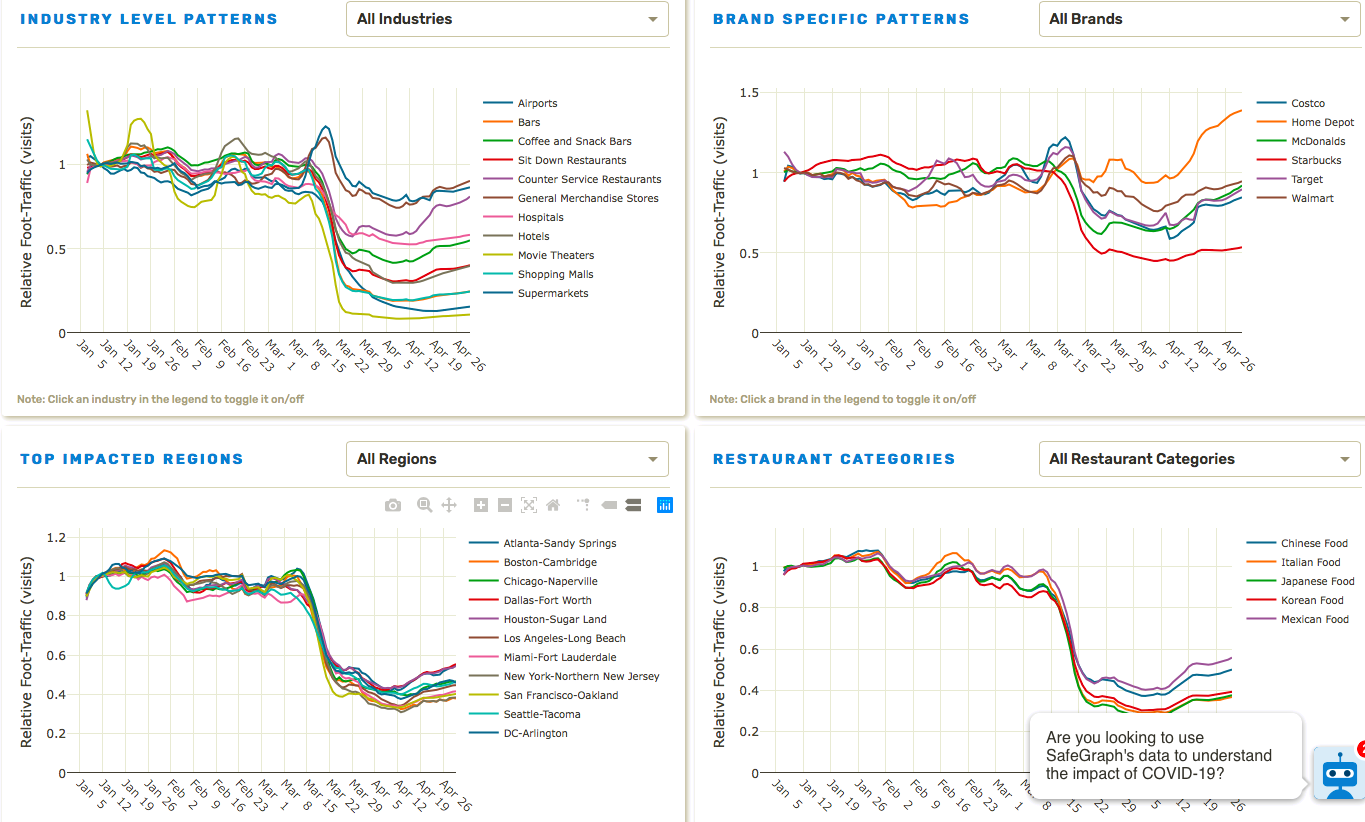
I should qualify my interpretation of the charts above and those in my original post: First, nine states did not have stay-at-home orders, though a few of those had varying restrictions on individuals and on the operation of “non-essential” businesses. The five having no orders of any kind (that I can tell) are lightly-populated, very low-density states, so the vast majority of the U.S. population was subject to some sort of lockdown measure. Second, eight states began to ease or lift orders in the last few days of April, Georgia and Colorado being the largest. Therefore, at the tail end, a small part of the increase in activity could be related to those liberalizations. Then again, it might have happened anyway.

The authoritarian impulse to shut everything down was largely unnecessary, and it did not accomplish much that voluntary distancing hadn’t accomplished already (again, see below). Healthy people need to stop cowering and take action. That includes the non-elderly and those free of underlying health conditions. Sure, take precautions, keep your distance, but get out of your home if you can. Get some sunny Vitamin D.

Committing yourself to the existence of a shut-in is not healthy, not wise, and it might destroy whatever wealth you possess if you are a working person. The data above show that people are recognizing that fact. As much as the Left wishes it were so, government seldom “knows better”. It is least effective when it uses force to suppress voluntary behavior; it is most effective when it follows consensus, and especially when it protects the rights of individuals to make their own choices where no consensus exists.

Last week’s post follows:

~~~~~~~~~~~~~~~~~~~~~~~~~~~~~~~

How much did state and local governments accomplish when they decided to issue stay-at-home orders? Perhaps not much. That’s the implication of data presented by the authors of “Internal and external effects of social distancing in a pandemic” (starts on page 22 in the linked PDF). Social distancing began in the U.S. in a series of voluntary, private actions. Government orders merely followed and, at best, reinforced those actions, but often in ham-handed ways.

The paper has a broader purpose than the finding that social distancing is often a matter of private initiative. I’ll say a bit more about it, but you can probably skip the rest of this paragraph without loss of continuity. The paper explores theoretical relationships between key parameters (including a social distancing construct) and the dynamics of a pandemic over time in a social welfare context. The authors study several alternatives: a baseline in which behavior doesn’t change in any way; a “laissez faire” path in which actions are all voluntary; and a “socially optimal” path imposed by a benevolent and all-knowing central authority (say what???). I’d offer more details, but I’ll await the coming extension promised by the authors to a world in which susceptible populations are heterogenous (e.g., like Covid-19, where children are virtually unaffected, healthy working age adults are roughly as at-risk as they are to the flu, and a population of the elderly and health-compromised individuals for which the virus is much more dangerous than the flu). In general, the paper seems to support a more liberalized approach to dealing with the pandemic, but that’s a matter of interpretation. Tyler Cowen, who deserves a hat-tip, believes that reading is correct “at the margin”.

Let’s look at some of the charts the authors present early in the paper. The data on social distancing behavior comes from Safegraph, a vendor of mobility data taken from cell phone location information. This data can be used to construct various proxies for aggregate social activity. The first chart below shows traffic at “points of interest” (POI) in the U.S. from March 8 to April 12, 2020. That’s the blue line. The red line is the percentage of the U.S. population subject to lockdown orders on each date. The authors explain the details in the notes below the chart:
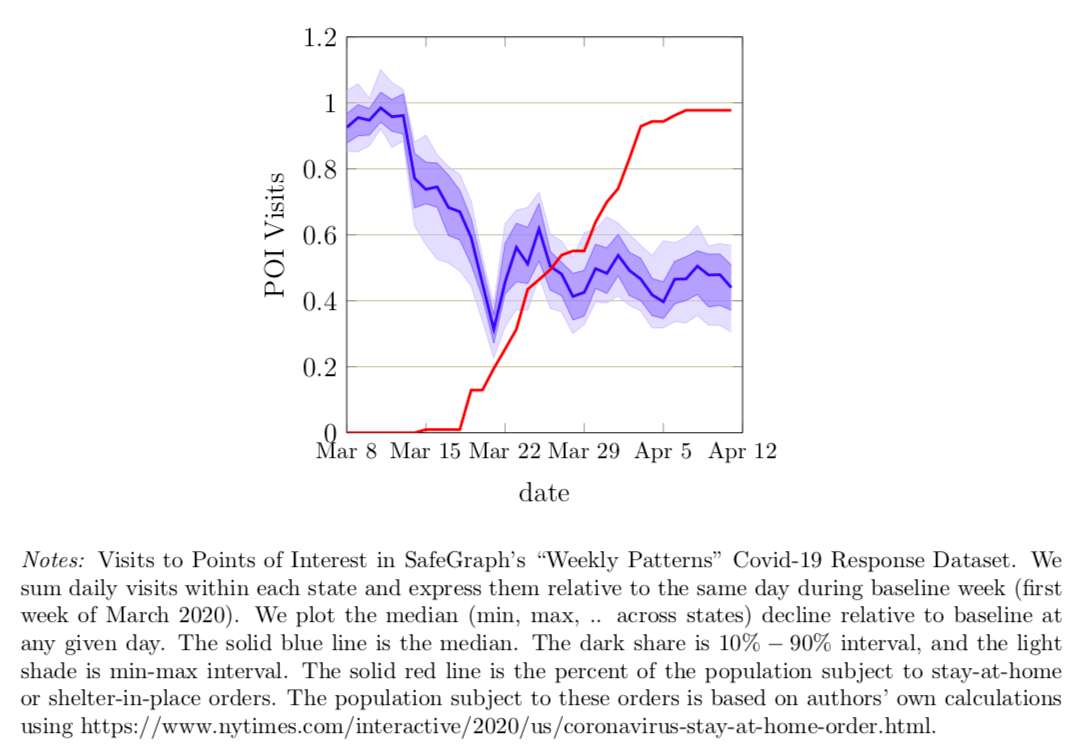
Clearly POI visits were declining sharply before any governments imposed their own orders. The next two charts show similar declines in the percent of mobile devices that leave “home” each day (“home” being the device’s dominant location during nighttime hours) and the duration over which devices were away from “home”, on average.
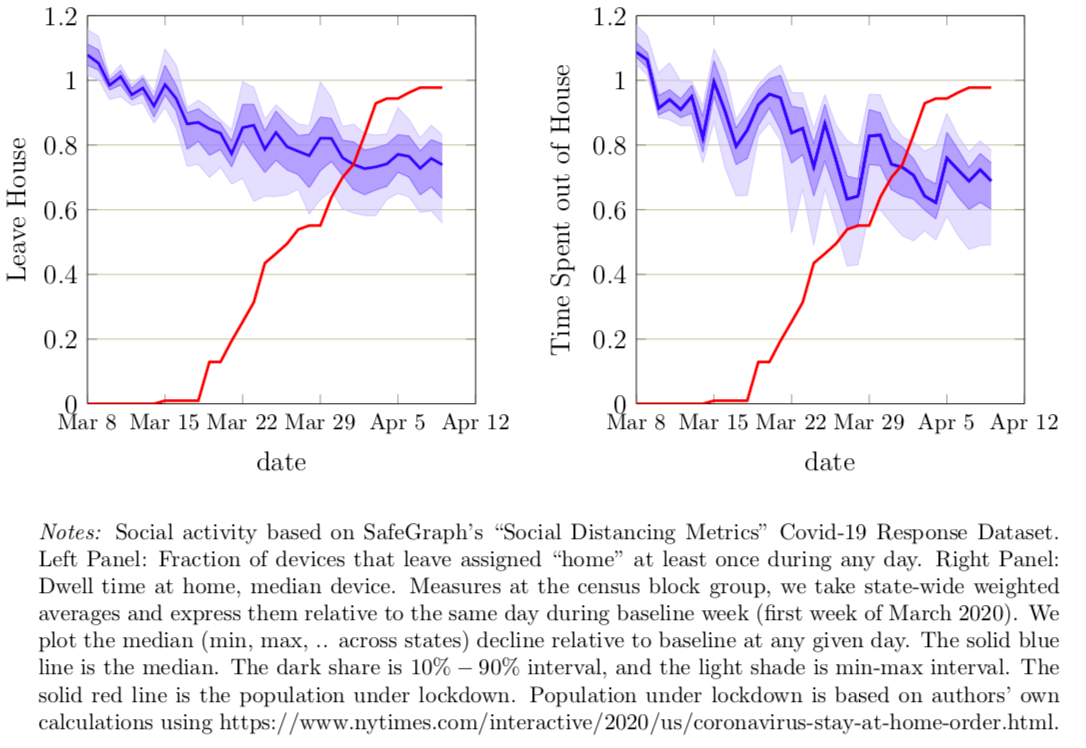
So all of these measures of social activity began declining well ahead of the government orders. The authors say private social distancing preceded government action in all 50 states. POI traffic was down almost 40% by the time 10% of the U.S. population was subject to government orders, and those early declines accounted for the bulk of the total decline through April 12. The early drops in the two away-from-home measures were 15-20%, again accounting for well over half of the total decline.

The additional declines beyond that time, to the extent they can be discerned, could be either trends that would have continued even in the absence of government orders or reinforcing effects the orders themselves. This does not imply that lockdown orders have no effects on specific activities. Rather, it means that those orders have minor incremental effects on measures of aggregate social activity than the voluntary actions already taken. In other words, the government lockdowns are largely a matter of rearranging the deck chairs, or, that is to say, their distribution.

Many private individuals and institutions acted early in response to information about the virus, motivated by concerns about their own safety and the safety of family and friends. The public sector in the U.S. was not especially effective in providing information, with such politicos as President Donald Trump, Nancy Pelosi, Andrew Cuomo, Bill De Blasio, and the mayor of New Orleans minimizing the dangers into the month of March, and some among them encouraging people to get out and celebrate at public events. Even Anthony Fauci minimized the danger in late February (not to mention the World Health Organization). In fact, “the scientists” were as negligent in their guidance as anyone in the early stages of the pandemic.

When lockdown orders were issued, they were often arbitrary and nonsensical. Grocery stores, liquor stores, and Wal Mart were allowed to remain open, but department stores and gun shops were not. Beaches and parks were ordered closed, though there is little if any chance of infection outdoors. Lawn care services, another outdoor activity, were classified as non-essential in some jurisdictions and therefore prohibited. And certain personal services seem to be available to public officials, but not to private citizens. The lists of things one can and can’t buy truly defies logic.

In March, John W. Whitehead wrote:

“We’re talking about lockdown powers (at both the federal and state level): the ability to suspend the Constitution, indefinitely detain American citizens, bypass the courts, quarantine whole communities or segments of the population, override the First Amendment by outlawing religious gatherings and assemblies of more than a few people, shut down entire industries and manipulate the economy, muzzle dissidents, ‘stop and seize any plane, train or automobile to stymie the spread of contagious disease,’…”

That is fearsome indeed, and individuals can accomplish distancing without it. If you are extremely risk averse, you can distance yourself or take other precautions to remain protected. You can either take action to isolate yourself or you can decide to be in proximity to others. The more risk averse among us will internalize most of the cost of voluntary social distancing. The less risk averse will avoid that cost but face greater exposure to the virus. Of course, this raises questions of public support for vulnerable segments of the population for whom risk aversion will be quite rational. That would certainly be a more enlightened form of intervention than lockdowns, though support should be offered only to those highly at-risk individuals who can’t support themselves.

Christopher Phelan writes of three rationales for the lockdowns: buying time for development of a vaccine or treatments; reducing the number of infected individuals; and to avoid overwhelming the health care system. Phelan thinks all three are of questionable validity at this point. A vaccine might never arrive, and Phelan is pessimistic about treatments (I have more hope in that regard). Ultimately a large share of the population will be infected, lockdowns or not. And of course the health care system is not overwhelmed at this point. Yes, those caring for Covid patients are under a great stress, but the health care system as a whole, and patients with other maladies, are currently suffering from massive under-utilization.

If you wish to be socially distant, you are free to do so on your very own. Individuals are quite capable of voluntary risk mitigation without authoritarian fiat, as the charts above show. While private actors might not internalize all of the external costs of their activities, government is seldom capable of making the appropriate corrections. Coercion to enforce the kinds of crazy rules that have been imposed during this pandemic is the kind of abuse of power the nation’s founders intended to prevent. Reversing those orders can be difficult, and the precedent itself becomes a threat to future liberty. Nevertheless, we see mounting efforts to resist by those who are harmed by these orders, and by those who recognize the short-sighted nature of the orders. Private incentives for risk reduction, and private evaluation of the benefits of social and economic activity, offer superior governance to the draconian realities of lockdowns.

Social Distancing Largely a Private Matter

26 Sunday Apr 2020

Posted by Nuetzel in Liberty, Pandemic, Uncategorized

≈ 1 Comment

Tags

Andrew Cuomo, Anthony Fauci, Bill De Blasio, Centre for Economic Policy Research, Donald Trump, Externalities, Heterogeneity, Laissez Faire, Lockdowns, Nancy Pelosi, Points of Interest, Private Governance, Safegraph, Social Distancing, Social Welfare, Stay-at-Home Orders, Wal Mart, WHO

How much did state and local governments accomplish when they decided to issue stay-at-home orders? Perhaps not much. That’s the implication of data presented by the authors of “Internal and external effects of social distancing in a pandemic” (starts on page 22 in the linked PDF). Social distancing began in the U.S. in a series of voluntary, private actions. Government orders merely followed and, at best, reinforced those actions, but often in ham-handed ways.

The paper has a broader purpose than the finding that social distancing is often a matter of private initiative. I’ll say a bit more about it, but you can probably skip the rest of this paragraph without loss of continuity. The paper explores theoretical relationships between key parameters (including a social distancing construct) and the dynamics of a pandemic over time in a social welfare context. The authors study several alternatives: a baseline in which behavior doesn’t change in any way; a “laissez faire” path in which actions are all voluntary; and a “socially optimal” path imposed by a benevolent and all-knowing central authority (say what???). I’d offer more details, but I’ll await the coming extension promised by the authors to a world in which susceptible populations are heterogenous (e.g., like Covid-19, where children are virtually unaffected, healthy working age adults are roughly as at-risk as they are to the flu, and a population of the elderly and health-compromised individuals for which the virus is much more dangerous than the flu). In general, the paper seems to support a more liberalized approach to dealing with the pandemic, but that’s a matter of interpretation. Tyler Cowen, who deserves a hat-tip, believes that reading is correct “at the margin”.

Let’s look at some of the charts the authors present early in the paper. The data on social distancing behavior comes from Safegraph, a vendor of mobility data taken from cell phone location information. This data can be used to construct various proxies for aggregate social activity. The first chart below shows traffic at “points of interest” (POI) in the U.S. from March 8 to April 12, 2020. That’s the blue line. The red line is the percentage of the U.S. population subject to lockdown orders on each date. The authors explain the details in the notes below the chart:

Clearly POI visits were declining sharply before any governments imposed their own orders. The next two charts show similar declines in the percent of mobile devices that leave “home” each day (“home” being the device’s dominant location during nighttime hours) and the duration over which devices were away from “home”, on average.

So all of these measures of social activity began declining well ahead of the government orders. The authors say private social distancing preceded government action in all 50 states. POI traffic was down almost 40% by the time 10% of the U.S. population was subject to government orders, and those early declines accounted for the bulk of the total decline through April 12. The early drops in the two away-from-home measures were 15-20%, again accounting for well over half of the total decline.

The additional declines beyond that time, to the extent they can be discerned, could be either trends that would have continued even in the absence of government orders or reinforcing effects the orders themselves. This does not imply that lockdown orders have no effects on specific activities. Rather, it means that those orders have minor incremental effects on measures of aggregate social activity than the voluntary actions already taken. In other words, the government lockdowns are largely a matter of rearranging the deck chairs, or, that is to say, their distribution.

Many private individuals and institutions acted early in response to information about the virus, motivated by concerns about their own safety and the safety of family and friends. The public sector in the U.S. was not especially effective in providing information, with such politicos as President Donald Trump, Nancy Pelosi, Andrew Cuomo, Bill De Blasio, and the mayor of New Orleans minimizing the dangers into the month of March, and some among them encouraging people to get out and celebrate at public events. Even Anthony Fauci minimized the danger in late February (not to mention the World Health Organization). In fact, “the scientists” were as negligent in their guidance as anyone in the early stages of the pandemic.

When lockdown orders were issued, they were often arbitrary and nonsensical. Grocery stores, liquor stores, and Wal Mart were allowed to remain open, but department stores and gun shops were not. Beaches and parks were ordered closed, though there is little if any chance of infection outdoors. Lawn care services, another outdoor activity, were classified as non-essential in some jurisdictions and therefore prohibited. And certain personal services seem to be available to public officials, but not to private citizens. The lists of things one can and can’t buy truly defies logic.

In March, John W. Whitehead wrote:

“We’re talking about lockdown powers (at both the federal and state level): the ability to suspend the Constitution, indefinitely detain American citizens, bypass the courts, quarantine whole communities or segments of the population, override the First Amendment by outlawing religious gatherings and assemblies of more than a few people, shut down entire industries and manipulate the economy, muzzle dissidents, ‘stop and seize any plane, train or automobile to stymie the spread of contagious disease,’…”

That is fearsome indeed, and individuals can accomplish distancing without it. If you are extremely risk averse, you can distance yourself or take other precautions to remain protected. You can either take action to isolate yourself or you can decide to be in proximity to others. The more risk averse among us will internalize most of the cost of voluntary social distancing. The less risk averse will avoid that cost but face greater exposure to the virus. Of course, this raises questions of public support for vulnerable segments of the population for whom risk aversion will be quite rational. That would certainly be a more enlightened form of intervention than lockdowns, though support should be offered only to those highly at-risk individuals who can’t support themselves.

Christopher Phelan writes of three rationales for the lockdowns: buying time for development of a vaccine or treatments; reducing the number of infected individuals; and to avoid overwhelming the health care system. Phelan thinks all three are of questionable validity at this point. A vaccine might never arrive, and Phelan is pessimistic about treatments (I have more hope in that regard). Ultimately a large share of the population will be infected, lockdowns or not. And of course the health care system is not overwhelmed at this point. Yes, those caring for Covid patients are under a great stress, but the health care system as a whole, and patients with other maladies, are currently suffering from massive under-utilization.

If you wish to be socially distant, you are free to do so on your very own. Individuals are quite capable of voluntary risk mitigation without authoritarian fiat, as the charts above show. While private actors might not internalize all of the external costs of their activities, government is seldom capable of making the appropriate corrections. Coercion to enforce the kinds of crazy rules that have been imposed during this pandemic is the kind of abuse of power the nation’s founders intended to prevent. Reversing those orders can be difficult, and the precedent itself becomes a threat to future liberty. Nevertheless, we see mounting efforts to resist by those who are harmed by these orders, and by those who recognize the short-sighted nature of the orders. Private incentives for risk reduction, and private evaluation of the benefits of social and economic activity, offer superior governance to the draconian realities of lockdowns.

Lockdown Illusions

16 Thursday Apr 2020

Posted by Nuetzel in Federalism, Liberty, Pandemic

≈ Leave a comment

Tags

CityLab, Coastal States, Coronavirus, Covid-19, Fixed Effects, International Travelers, Mood Affiliation, Pandemic, Population Density, Stay-at-Home Orders, Viral Transmission, Worldometers

Analytical sins have occurred with great regularity in popular discussions of the Covid-19 pandemic and even in more scholarly quarters. Among my pet peeves are cavalier statements about the number of cases or deaths in one country or state versus another without adjusting for population. Some of this week’s foibles also deal comparisons of the pandemic and public policy across jurisdictions, but they ignore important distinctions.

No matter how you weigh the benefits and costs of lockdowns or stay-at-home orders, there is no question that maximizing social distance can reduce the spread of the virus. But stories like this one from Kansas dispute even that straightforward conclusion. As evidence, the author presents the following table:

Now, I fully support the authority of states or local areas to make their own decisions, but this table does not constitute valid evidence that stay-at-home orders don’t reduce transmission. There are at least three reasons why the comparisons made in the table are invalid:

  1. The onset of coronavirus in these states lagged the coastal states, primarily because…
  2. These are all interior states with few direct arrivals of international travelers;
  3. These states are all more or less rural with relatively low population densities, ranking 40, 41, 42, 46, 48, 49, 52, 53, and 55 in density among all states and territories.

All of these factors lead to lower concentrations of confirmed cases and Covid deaths (though the first applies only on the front-end of the epidemic). The last two points provide strong rationale for less restrictive measures to control the spread of the virus. In fact, population density bears a close association with the incidence of Covid-19, as the table at the top of this post shows. Even within low-density states, residents of urban areas are at greater risk. That also weighs heavily against one-size-fits-all approaches to enforced distancing. But instead, the authors fall over themselves in a clumsy attempt to prove a falsehood.

Even highly-educated researchers can race to wholly unjustified conclusions, sometimes fooled by their own clever devices and personal mood affiliation. This recent study directly controls for the timing of stay-at-home orders at the county level. The researchers attempt to control for inherent differences in county transmission and other factors via “fixed effects” on case growth (which are not reported). This is an excuse for “assuming away” important marginal effects that local features and conditions might play in driving the contagion. The authors conclude that stay-at-home orders are effective in reducing the spread of coronavirus, which is fine as far as it goes. But they also leap to the conclusion that a uniform, mandatory, nationwide lockdown is the wisest course. Not only does this neglect to measure the differential impact of lockdowns by easily measured differences across counties, it also assumes that the benefits of lockdowns always exceed costs, regardless of density, demographics, and industrial composition; and that a central authority is always the best judge as to the timing and severity of a mandate.

The national crisis engendered by the coronavirus pandemic required action at all levels of government and by private institutions, not a uniform set of rules enforced by federal police power. State and local police power is dangerous enough, but better to have decisions made by local authorities who are more immediately accountable to citizens. Government certainly has a legitimate role to play in mitigating behaviors that might impose external costs on others. Providing good information about the risks of a virus might be a pivotal role for government, though governments have not acquitted themselves well in this regard during the Covid crisis.

It’s also important for federal, state and local authorities to remember that private governance is often more powerful in achieving social goals than public rule-making. People make innumerable decisions every day that weigh benefits against risks, but public authorities are prone to nudging or pushing private agents into over-precautionary states of being. It’s about time to start easing up.


Coronavirus: Framing the Next Few Weeks #3

05 Sunday Apr 2020

Posted by Nuetzel in Pandemic, Risk Management

≈ 1 Comment

Tags

80000 Hours, Chris Murray Model, Christopher Monkton, Christopher Murray, Co-morbidity, Confidence Interval, Coronavirus, Covid Tracking Project, Covid-19, Economic Restart, Indur M. Goklany, Institute for Health Metrics and Evaluation, Lockdowns, Pending Tests, Positive Test Ratio, Social Distancing, Stay-at-Home Orders, White House Coronavirus Task Force

There were a few encouraging signs of change over the past few days in the course of the coronavirus pandemic in the U.S. This is the third of my quaint efforts to provide perspective on the coronavirus pandemic with “tracking” or “framing” posts. The first two were: Coronavirus: Framing the Next Few Weeks, on March 22, and Framing Update on March 28. In both of those posts, I charted confirmed cases of Covid-19 in the U.S. along with optimistic and pessimistic scenarios. I speculated that over the course of a few weeks, social distancing would lead to a reduction in the daily number of new confirmed cases. Unfortunately, it’s not clear whether that curve has started to “bend” rightward, but new confirmed cases on Sunday, April 5 — the number of those testing positive — was down almost 30% from Saturday.

An updated version of the earlier chart appears below, accompanied by a table. The number of confirmed cases (red line) has mounted over the past week, as has the daily increase in confirmed cases, though yesterday’s number was better. The table below the chart shows that the growth rate of confirmed cases (the far right-hand column) has decelerated, but it had leveled off at about 14% over the few days before Sunday. If Sunday’s drop persists it would be encouraging. Unfortunately, even moderate growth rates are destructive when the base of confirmed cases is large. The faster the growth rate declines, the faster the curve will bend.

I did not make any changes to the original “Very Good” and “Pretty Bad” scenarios, deciding that it was better to keep them as a consistent benchmark. As of Sunday, the top of the “Very Good” curve would still be about 2.3x the North Korean experience as of Sunday night, normalized for population. The top of the “Pretty Bad” scenario (which is not visible in this “zoomed-in” version) would be about 1.4x the Italian experience thus far. South Korea’s curve flattened substantially several weeks ago, and now even Italy’s curve is showing a rightward bend. Let’s hope that continues.

The case count obviously depends on the volume of daily testing, which has been increasing rapidly. As I’ve noted before, there has been a backlog of test requests. In addition, every day there is an overhang of “pending” test results. Interestingly, the number of tests stabilized on Saturday and the number of pending test results plunged (see the next chart, which uses data from the Covid Tracking Project). We’ll see if those developments persist. It would represent a milestone because daily case counts will advance as long as tests do, and the effort to work through the backlog has been inflating the speed of the advance in confirmed cases.

Another interesting development coincident with the drop in pending tests has to do with the cumulative percentage of positive test results: it has stabilized after growing for several weeks. This might mean we’ve reached a point at which the most severe incoming cases are fewer, but we’ll have to see if the flattening persists or even declines, which would be wonderful.

I’ve been grappling with potential weaknesses of the data on confirmed cases: first, the U.S. got a late start on testing, so there was the backlog of patients requiring tests just discussed above. That was presumed to have exaggerated the acceleration in the daily totals for new cases. Second, it’s possible that a continuing transition to more rapid test results would exaggerate the daily counts of new cases. Third, It’s possible that testing criteria are being relaxed, which, despite reducing the positive test rate, would increase growth in the “official” confirmed case count. Suspected cases should be tested, of course, but the change in standards is another factor that distorts the shape of the curve.

Any published statistic has its shortcomings. All test results are subject to false positives and negatives. Hospitalizations of patients with a positive coronavirus diagnosis are subject to the measurement issues as well, though they might be driven more by the severity of symptoms and co-morbidities than a positive Covid diagnosis per se. And hospitalizations of Covid patients might be subject to inconsistencies in reporting, and so might ICU admittances. Coronavirus deaths are subject to vagaries: reporting a cause of death is dictated by various criteria when co-morbidities are involved, and those criteria differ from country to country, or perhaps even hospital to hospital and doctor to doctor! In fact, some go so far as to say that all deaths should be tracked for coronavirus plus its co-morbidities and then compared to an average of the past five to ten years to obtain an estimate of “excess deaths”, which could conceivably be negative or positive. Finally, recoveries are even more impacted by inconsistent reporting, especially because many recoveries occur at home.

I’ll be highlighting coronavirus deaths going forward, and I’ll continue to focus mainly on the U.S. and only lightly on other countries. After all, death is obviously the most negative outcome. Again, however, the count of coronavirus deaths does not account for deaths that would have occurred over the same time frame due to co-morbidities or the effect of deaths that would not have occurred absent co-morbidities.

The predictions in the chart below are from the Chris Murray Model, upon which the White House Coronavirus Task Force has focused more recently. This model was developed by Dr. Christopher Murray at the Institute for Health Metrics and Evaluation at the University of Washington. I’ll be using the forecast starting from April 2 as the basis for my “framing” of actual deaths over the next few weeks, keeping it “frozen” at that level as a new benchmark. My apologies for the absence of dates on the horizontal axis, but the origin is at March 14 and there is only a single line up through April 1. That line represents actual cumulative Covid deaths recorded in the U.S. The red line is the mean model prediction. Deaths are expected to ramp up over the next week or so, much as we’ve seen in the confirmed case count, as deaths lag behind diagnoses by anywhere from a few days up to 17 days. This model predicts an ultimate death toll of about 94,000 at the top of the mean curve (not visible on the zoomed-in chart). Above and below that line are upper (blue) and lower (green) bounds, respectively, of a “confidence interval”. It’s unlikely we’ll see cumulative deaths breach either of those bounds. The lower bound would place the ultimate death toll at about 40,000; the upper bound would place it at just under 180,000. At this point, as of Sunday, April 5, actual deaths (black) are slightly below the mean or central tendency, but that’s difficult to see in the current chart.

The ongoing lockdowns in the U.S. and around the world are exceedingly controversial. There is a very real tradeoff between the benefits of extending the length of these lockdowns and the benefits of allowing economic activity to “restart”. But do lockdowns work? Christopher Monkton offers aggregate evidence that they truly do reduce the spread of the virus in “Are Lockdowns Working?” That they would work is intuitive, and decisions to scale them back should be made cautiously for certain “high exposure” activities, and in conjunction with isolating and trace-tracking contacts of all infected individuals, as they have done successfully in countries such as Taiwan and Singapore.

There may be signs that a bend in the U.S. case curve is in the offing, perhaps over the next week or two. That timing would roughly comport with the notion that over the past three weeks, efforts at social distancing and stay-at-home orders have allowed the U.S. to limit the spread of coronavirus through the first major “round” of infections and a much more limited second round. Perhaps these efforts will largely stanch a third and subsequent rounds of infection. Ultimately, if the number of coronavirus deaths is in the neighborhood of the mean value predicted by the Murray Model, about 94,000, that would place the severity of the toll at less than two times the severity of a bad flu season, though limiting the Covid death toll will have been achieved at much higher economic cost.

There are signs elsewhere around the globe that the pandemic may be turning a corner toward more favorable trends. See “Good News About COVID-19” at 80,000hours.org for a good review.

Follow Sacred Cow Chips on WordPress.com

Recent Posts

  • The Case Against Interest On Reserves
  • Immigration and Merit As Fiscal Propositions
  • Tariff “Dividend” From An Indigent State
  • Almost Looks Like the Fed Has a 3% Inflation Target
  • Government Malpractice Breeds Health Care Havoc

Archives

  • January 2026
  • December 2025
  • November 2025
  • October 2025
  • September 2025
  • August 2025
  • July 2025
  • June 2025
  • May 2025
  • April 2025
  • March 2025
  • February 2025
  • January 2025
  • December 2024
  • November 2024
  • October 2024
  • September 2024
  • August 2024
  • July 2024
  • June 2024
  • May 2024
  • April 2024
  • March 2024
  • February 2024
  • January 2024
  • December 2023
  • November 2023
  • August 2023
  • July 2023
  • June 2023
  • May 2023
  • April 2023
  • March 2023
  • February 2023
  • January 2023
  • December 2022
  • November 2022
  • October 2022
  • September 2022
  • August 2022
  • July 2022
  • June 2022
  • May 2022
  • April 2022
  • March 2022
  • February 2022
  • January 2022
  • December 2021
  • November 2021
  • October 2021
  • September 2021
  • August 2021
  • July 2021
  • June 2021
  • May 2021
  • April 2021
  • March 2021
  • February 2021
  • January 2021
  • December 2020
  • November 2020
  • October 2020
  • September 2020
  • August 2020
  • July 2020
  • June 2020
  • May 2020
  • April 2020
  • March 2020
  • February 2020
  • January 2020
  • December 2019
  • November 2019
  • October 2019
  • September 2019
  • August 2019
  • July 2019
  • June 2019
  • May 2019
  • April 2019
  • March 2019
  • February 2019
  • January 2019
  • December 2018
  • November 2018
  • October 2018
  • September 2018
  • August 2018
  • July 2018
  • June 2018
  • May 2018
  • April 2018
  • March 2018
  • February 2018
  • January 2018
  • December 2017
  • November 2017
  • October 2017
  • September 2017
  • August 2017
  • July 2017
  • June 2017
  • May 2017
  • April 2017
  • March 2017
  • February 2017
  • January 2017
  • December 2016
  • November 2016
  • October 2016
  • September 2016
  • August 2016
  • July 2016
  • June 2016
  • May 2016
  • April 2016
  • March 2016
  • February 2016
  • January 2016
  • December 2015
  • November 2015
  • October 2015
  • September 2015
  • August 2015
  • July 2015
  • June 2015
  • May 2015
  • April 2015
  • March 2015
  • February 2015
  • January 2015
  • December 2014
  • November 2014
  • October 2014
  • September 2014
  • August 2014
  • July 2014
  • June 2014
  • May 2014
  • April 2014
  • March 2014

Blogs I Follow

  • Passive Income Kickstart
  • OnlyFinance.net
  • TLC Cholesterol
  • Nintil
  • kendunning.net
  • DCWhispers.com
  • Hoong-Wai in the UK
  • Marginal REVOLUTION
  • Stlouis
  • Watts Up With That?
  • Aussie Nationalist Blog
  • American Elephants
  • The View from Alexandria
  • The Gymnasium
  • A Force for Good
  • Notes On Liberty
  • troymo
  • SUNDAY BLOG Stephanie Sievers
  • Miss Lou Acquiring Lore
  • Your Well Wisher Program
  • Objectivism In Depth
  • RobotEnomics
  • Orderstatistic
  • Paradigm Library
  • Scattered Showers and Quicksand

Blog at WordPress.com.

Passive Income Kickstart

OnlyFinance.net

TLC Cholesterol

Nintil

To estimate, compare, distinguish, discuss, and trace to its principal sources everything

kendunning.net

The Future is Ours to Create

DCWhispers.com

Hoong-Wai in the UK

A Commonwealth immigrant's perspective on the UK's public arena.

Marginal REVOLUTION

Small Steps Toward A Much Better World

Stlouis

Watts Up With That?

The world's most viewed site on global warming and climate change

Aussie Nationalist Blog

Commentary from a Paleoconservative and Nationalist perspective

American Elephants

Defending Life, Liberty and the Pursuit of Happiness

The View from Alexandria

In advanced civilizations the period loosely called Alexandrian is usually associated with flexible morals, perfunctory religion, populist standards and cosmopolitan tastes, feminism, exotic cults, and the rapid turnover of high and low fads---in short, a falling away (which is all that decadence means) from the strictness of traditional rules, embodied in character and inforced from within. -- Jacques Barzun

The Gymnasium

A place for reason, politics, economics, and faith steeped in the classical liberal tradition

A Force for Good

How economics, morality, and markets combine

Notes On Liberty

Spontaneous thoughts on a humble creed

troymo

SUNDAY BLOG Stephanie Sievers

Escaping the everyday life with photographs from my travels

Miss Lou Acquiring Lore

Gallery of Life...

Your Well Wisher Program

Attempt to solve commonly known problems…

Objectivism In Depth

Exploring Ayn Rand's revolutionary philosophy.

RobotEnomics

(A)n (I)ntelligent Future

Orderstatistic

Economics, chess and anything else on my mind.

Paradigm Library

OODA Looping

Scattered Showers and Quicksand

Musings on science, investing, finance, economics, politics, and probably fly fishing.

  • Subscribe Subscribed
    • Sacred Cow Chips
    • Join 128 other subscribers
    • Already have a WordPress.com account? Log in now.
    • Sacred Cow Chips
    • Subscribe Subscribed
    • Sign up
    • Log in
    • Report this content
    • View site in Reader
    • Manage subscriptions
    • Collapse this bar
 

Loading Comments...