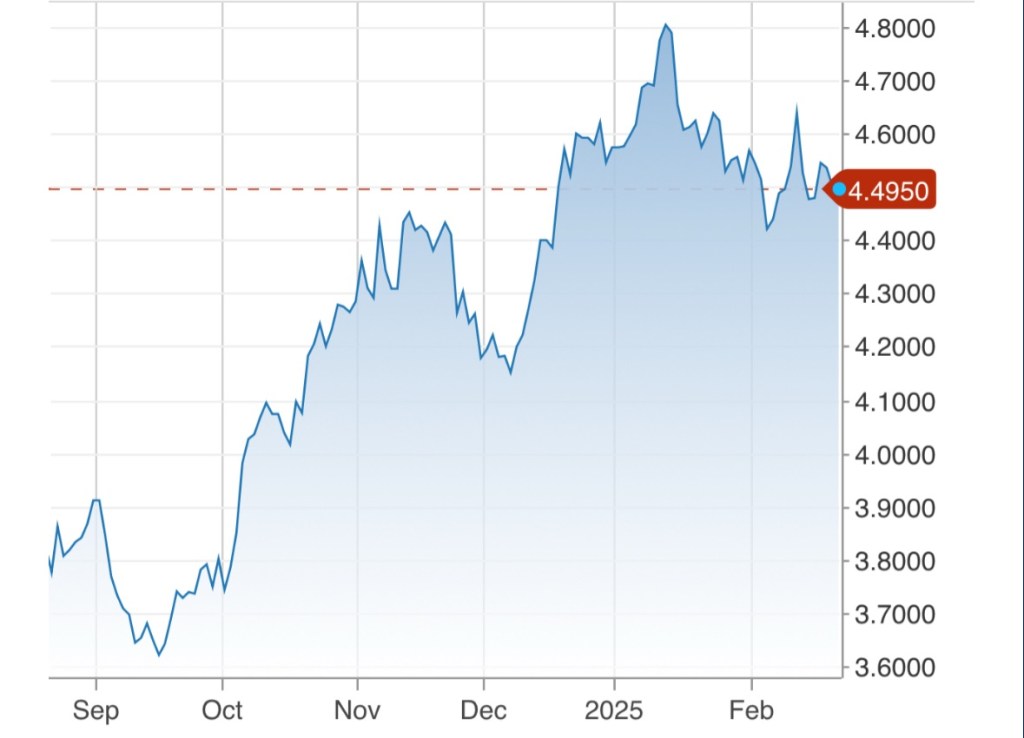
Matt Yglesias tweeted on X that “the bond market does not appear to believe in DOGE”. He included a chart much like the updated one above to “prove” his point. Tyler Cowen posted a link to the tweet on Marginal Revolution, without comment … Cowen surely must know that any such conclusion is premature, especially based on the movement of Treasury yields over the past month (or more, since the market’s evaluation of the DOGE agenda preceded Trump’s inauguration).
Of course, there is a difference between “believing” in DOGE and being convinced that its efforts should have succeeded in reducing interest rates immediately amidst waves of background noise from budget and tax legislation, court challenges, Federal Reserve missteps (this time cutting rates too soon), and the direction of the economy in general.
In this case, perhaps a better way to define success for DOGE is a meaningfully negative impact on the future supply of Treasury debt. Even that would not guarantee a decline in Treasury rates, so the premise of Yglesias’ tweet is somewhat shaky to begin with. Still, all else equal, we’d expect to see some downward pressure on yields if DOGE succeeds in this sense. But we must go further by recognizing that DOGE savings could well be reallocated to other spending initiatives. Then, the savings would not translate into lower supplies of Treasury debt after all.
Certainly, the DOGE team has made progress in identifying wasteful expenditures, inefficiencies, and poor controls on spending. But even if the $55 billion of estimated savings to date is reliable, DOGE has a long way to go to reach Musk’s stated objective of $2 trillion. There are some juicy targets, but it will be tough to get there in 17 more months, when DOGE is to stand down. Still, it’s not unreasonable to think DOGE might succeed in accomplishing meaningful deficit reduction.
But if bond traders have doubts about DOGE, it’s partly because Donald Trump and Elon Musk themselves keep giving them reasons. In my view, Musk and Trump have made a major misstep in toying with the idea of using prospective DOGE savings to fund “dividend checks” of $5,000 for all Americans. These would be paid by taking 20% of the guesstimated $2 trillion of DOGE savings. Musk’s expression of interest in the idea was followed by a bit of clusterfuckery, as Musk walked back his proposal the next day even as Trump jumped on board. PLEASE Elon, don’t give the Donald any crowd-pleasing ideas! And don’t lose sight of the underlying objective to reduce the burden of government and the public debt.
Now, Trump proposes that 60% of the savings accomplished by DOGE be put toward paying for outlays in future years. Sure, that’s deficit reduction, but it may serve to dull the sense that shrinking the federal government is an imperative. The mechanics of this are unclear, but as a first pass, I’d say the gain from investing DOGE savings for a year in low-risk instruments is unlikely to outweigh the foregone savings in interest costs from paying off debt today! Of course, that also depends on the future direction of interest rates, but it’s not a good bet to make with public funds.
Nor can the bond market be comforted by uncertainty surrounding legislation that would not only extend the Trump tax cuts, but will probably include various spending provisions, both cuts and increases. As of now, the mix of provisions that might accompany a deal among GOP factions is very much up in the air.
There is also trepidation about Trump’s aggressive stance toward the Federal Reserve. He promises to replace Jerome Powell as Fed Chairman, but with God knows whom? And Trump jawbones aggressively for lower rates. The Fed’s ill-advised rate cuts in the fall might have been motivated in part by an attempt to capitulate to the then-President Elect.
Trump’s Executive Order to create a sovereign wealth fund (SWF), which I recently discussed here, is probably not the most welcome news to bond investors. All else equal, placing tax or tariff revenue into such a fund would reduce the potential for deficit reduction, to say nothing of the idiocy of additional borrowing to purchase assets.
Finally, Trump has proposed what might later prove to be massive foreign policy trial balloons. Some of these are bound up with the creation of the SWF. They might generate revenue for the government without borrowing (mineral rights in Ukraine? Or Greenland?), but at this point there’s also a chance they’ll create massive funding needs (Gaza development?). Again, Trump seems to be prodding or testing counterparties to various negotiations… prodding diplomacy. It’s unlikely that anything too drastic will come of it from a fiscal perspective, but it probably doesn’t leave bond traders feeling easy.
At this stage, it’s pretty rash to conclude that the bond market “doesn’t believe in DOGE”. In fact, there is no doubt that DOGE is making some progress in identifying potential fraud and inefficiencies. However, bond traders must weigh a wide range of considerations, and Donald Trump has a tendency to kick up dust. Indeed, the so-called DOGE dividend will undermine confidence in debt reduction and bond prices.
Wow! We’re less than a week from Election Day! I’d hoped to write a few more detailed posts about the platforms and policies of Kamala Harris and Donald Trump, but I was waylaid by Hurricane Milton. It sent us scrambling into prep mode, then we evacuated to the Florida Panhandle. The drive there and back took much longer than expected due to the mass exodus. On our return we found the house was fine, but there was significant damage to an exterior structure and a mess in the yard. We also had to “de-prep” the house, and we’ve been dealing with contractors ever since. It was an exhausting episode, but we feel like we were very lucky.
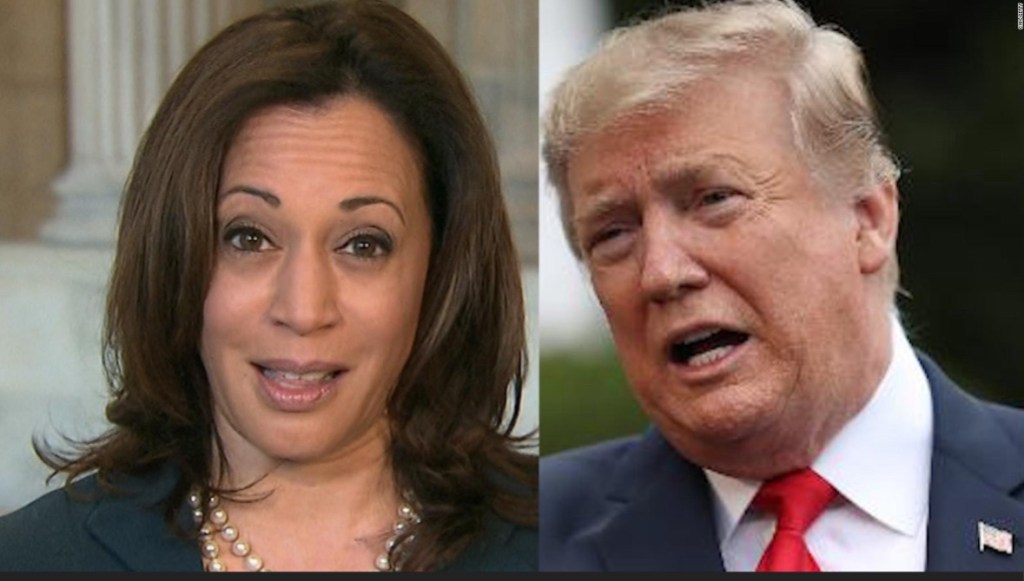
Now, with less than a week left till the election, I’ll limit myself to a summary of the positions of the candidates in a number of areas, mostly but not all directly related to policy. I assign “grades” in each area and calculate an equally-weighted “GPA” for each candidate. My summaries (and “grades”) are pretty off-the-cuff and not adequate treatments on their own. Some of these areas are more general than others, and I readily admit that a GPA taken from my grade assignments is subject to a bit of double counting. Oh well!
Role of Government: Kamala Harris is a statist through and through. No mystery there. Trump is more selective in his statist tendencies. He’ll often favor government action if it’s politically advantageous. However, in general I think he is amenable to a smaller role for the public than the private sector. Harris: F; Trump: C
Regulation: There is no question that Trump stands for badly needed federal regulatory reform. This spans a wide range of areas, and it extends to a light approach to crypto and AI regulation. Trump plans to appoint Elon Musk as his “Secretary of Cost Cutting”. Harris, on the other hand, seems to favor a continuation of the Biden Administration’s heavy regulatory oversight. This encourages a bloated federal bureaucracy, inflicts high compliance costs on the private sector, stifles innovation, and tends to concentrate industrial power. Harris: F; Trump: A
Border Policy: Trump wants to close the borders (complete the wall) and deport illegal immigrants. Both are easier said than done. Except for criminal elements, the latter will be especially controversial. I’d feel better about Trump’s position if it were accompanied by a commitment to expanded legal immigration. We need more legal immigrants, especially the highly skilled. For her part, Harris would offer mass amnesty to illegals. She’d continue an open border policy, though she claims to want certain limits on illegal border crossings going forward. She also claims to favor more funds for border control. However, it is not clear how well this would translate into thorough vetting of illegal entrants, drug interdiction at the border, or sex trafficking. Harris: D; Trump: B-
Antitrust: Accusations of price gouging by American businesses? Harris! Forty three corporations in the S&P 500 under investigation by the DOJ? The Biden-Harris Administration. This reflects an aggressively hostile and manipulative attitude toward the business community. Trump, meanwhile, might wheedle corporations to act on behalf of certain of his agendas, but he is unlikely to take such a broadly punitive approach. Harris: F; Trump: B-
Foreign Policy: Harris is likely to continue the Biden Administration’s conciliatory approach to dealing with America’s adversaries. The other side of that coin is an often tepid commitment to longtime allies like Israel. Trump believes that dealing from a position of strength is imperative, and he’s willing to challenge enemies with an array of economic and political sticks and carrots. He had success during his first term in office promoting peace in the Middle East. A renewed version of the Abraham Accords that strengthened economic ties across the region would do just that. Ideally, he would like to restore the strength of America’s military, about which Harris has less interest. Trump has also shown a willingness to challenge our NATO partners in order to get them to “pay their fair share” toward the alliance’s shared defense. My major qualification here has to do with the candidates’ positions with respect to supporting Ukraine in its war against Putin’s mad aggression. Harris seems more likely than Trump to continue America’s support for Ukraine. Harris: D+; Trump: B-
Trade: Nations who trade with one another tend to be more prosperous and at peace. Unfortunately, neither candidate has much recognition of these facts. Harris is willing to extend the tariffs enforced during the Biden Administration. Trump, however, is under the delusion that tariffs can solve almost anything that ails the country. Of course, tariffs are a destructive tax on American consumers and businesses. Part of this owes to the direct effects of the tax. Part owes to the pricing power tariffs grant to domestic producers. Tariffs harm incentives for efficiency and the competitiveness of American industry. Retaliatory action by foreign governments is a likely response, which magnifies the harm.
To be fair, Trump believes he can use tariffs as a negotiating tool in nearly all international matters, whether economic, political, or military. This might work to achieve some objectives, but at the cost of damaging relations more broadly and undermining the U.S. economy. Trump is an advocate for not just selective, punitive tariffs, but for broad application of tariffs. Someone needs to disabuse him of the notion that tariffs have great revenue-raising potential. They don’t. And Trump is seemingly unaware of another basic fact: the trade deficit is mirrored by foreign investment in the U.S. economy, which spurs domestic economic growth. Quashing imports via tariffs will also quash that source of growth. I’ll add one other qualification below in the section on taxes, but I’m not sure it has a meaningful chance.
Harris: C-; Trump: F
Inflation: This is a tough one to grade. The President has no direct control over inflation. Harris wants to challenge “price gougers”, which has little to do with actual inflation. I expect both candidates to tolerate large deficits in order to fulfill campaign promises and other objectives. That will put pressure on credit markets and is likely to be inflationary if bond investors are surprised by the higher trajectory of permanent government indebtedness, or if the Federal Reserve monetizes increasing amounts of federal debt. Deficits are likely to be larger under Trump than Harris due in large part to differences in their tax plans, but I’m skeptical that Harris will hold spending in check. Trump’s policies are more growth oriented, and these along with his energy policies and deregulatory actions could limit the inflationary consequences of his spending and tax policies. Higher tariffs will not be of much help in funding larger deficits, and in fact they will be inflationary. Harris: C; Trump: C
Federal Reserve Independence: Harris would undoubtedly like to have the Fed partner closely with the Treasury in funding federal spending. Her appointments to the Board would almost certainly lead to a more activist Fed with a willingness to tolerate rapid monetary expansion and inflation. Trump might be even worse. He has signaled disdain for the Fed’s independence, and he would be happy to lean on the Fed to ease his efforts to fulfill promises to special interests. Harris: D; Trump: F
Entitlement Reform: Social Security and Medicare are both insolvent and benefits will be cut in 2035 without reforms. Harris would certainly be willing to tax the benefits of higher-income retirees more heavily, and she would likely be willing to impose FICA and Medicare taxes on incomes above current earning limits. These are not my favorite reform proposals. Trump has been silent on the issue except to promise no cuts in benefits. Harris: C-; Trump: F
Health Care: Harris is an Obamacare supporter and an advocate of expanded Medicaid. She favors policies that would short-circuit consumer discipline for health care spending and hasten the depletion of the already insolvent Medicare and Medicaid trust funds. These include a $2,000 cap on health care spending for Americans on Medicare, having Medicare cover in-home care, and extending tax credits for health insurance premia. She supports funding to address presumed health care disparities faced by black men. She also promises efforts to discipline or supplant pharmacy benefit managers. Trump, for his part, has said little about his plans for health care policy. He is not a fan of Obamacare and he has promised to take on Big Pharma, whatever that might mean. I fear that both candidates would happily place additional controls of the pricing of pharmaceuticals, a sure prescription for curtailed research and development and higher mortality. Harris: F; Trump: D+
Abortion: The Supreme Court’s 2022 decision in Dobbs v. Jackson essentially relegated abortion law to individual states. That’s consistent with federalist principles, leaving the controversial balancing of abortion vs. the unborn child’s rights up to state voters. Geographic differences of opinion on this question are dramatic, and Dobbs respects those differences. Trump is content with it. Meanwhile, Harris advocates for the establishment of expanded abortion rights at the federal level, including authorization of third trimester abortions by “care providers”. And Harris does not believe there should be religious exemptions for providers who do not wish to offer abortion services. No doubt she also approves of federally funded abortions. Harris: F; Trump: A
Housing: The nation faces an acute housing shortage owing to excessive regulation that limits construction of new or revitalized housing. These excessive rules are primarily imposed at the state and local level. While the federal government has little direct control over many of these decisions, it has abetted this regulatory onslaught in a variety of ways, especially in the environmental arena. Harris is offering stimulus to the demand side through a $25,000 housing tax credit for first-time home buyers. This will succeed in raising the cost of housing. She has also called for heavier subsidies for developers of low-income housing. If past is prologue, this might do more to line the pockets of developers than add meaningfully to the stock of affordable housing. Harris also favors rent controls, a sure prescription for deterioration in the housing stock, and she would prohibit software allowing landlords to determine competitive neighborhood rents. Trump has called for deregulation generally and would not favor rent controls. Harris: F; Trump B
Taxes: Harris has broached several wildly destructive tax proposals. Perhaps the worst of these is to tax unrealized capital gains, and while she promises it would apply only to extremely wealthy taxpayers, it would constitute a wealth tax. Once that line is crossed, the threat of widening the base becomes a very slippery slope. It would also be a strong detriment to domestic capital investment and economic growth. Harris would increase the top marginal personal tax rate and the corporate tax rate, which would discourage investment and undermine real wage growth. She’d also increase estate tax rates. As discussed above, she unwisely calls for a $25,000 tax credit for first-time homebuyers. She also wants to expand the child care tax credit to $6,000 for families with newborns. A proposed $50,000 small business tax credit would allow the federal government to subsidize and encourage risky entrepreneurial activity at taxpayers’ expense. I’m all for small business, but this style of industrial planning is bonkers. She would sunset the Trump (TCJA) tax cuts in 2026.
Finally, Harris has mimicked Trump in calling for no taxes on tips. Treating certain forms of income more favorably than others is a recipe for distortions in economic activity. Employers of tip-earning workers will find ways to shift employees’ income to tips that are mandatory for patrons. It will also skew labor supply decisions toward occupations that would otherwise have less economic value. But Trump managed to find an idea so politically seductive that Harris couldn’t resist.
Trump’s tax plans are a mixed bag of good and bad ideas. They include extending his earlier tax cuts (TCJA) and restoring the SALT deduction. The latter is an alluring campaign tidbit for voters in high-tax states. He would reduce the corporate tax rate, which I strongly favor. Corporate income is double-taxed, which is a detriment to growth as well as a weight on real wages. He would eliminate taxes on overtime income, another example of favoring a particular form of income over others. Wage earners would gain at the expense of salaried employees, so one could expect a transition in the form employees are paid over time. Otherwise, the classification of hours as “overtime” would have to be standardized. One could expect existing employees to work longer hours, but at the expense of new jobs. Finally, Trump says Social Security benefits should not be taxed, another kind of special treatment by form of income. This might encourage early retirement and become an additional drain on the Social Security Trust Fund.
The higher tariffs promised by Trump would collect some revenue. I’d be more supportive of this plank if the tariffs were part of a larger transition from income taxes to consumption taxes. However, Trump would still like to see large differentials between tariffs and taxes imposed on the consumption of domestically-produced goods and services.
Harris: F; Trump C+
Climate Policy: This topic has undergone a steep decline in relative importance to voters. Harris favors more drastic climate interventions than Trump, including steep renewable subsidies, EV mandates, and a panoply of other initiatives, many of which would carry over from the Biden Administration. Harris: F; Trump: B
Energy: Low-cost energy encourages economic growth. Just ask the Germans! Consistent with the climate change narrative, Harris wishes to discourage the use of fossil fuels, their domestic production, and even their export. She has been very dodgy with respect to restrictions on fracking. Her apparent stance on energy policy would be an obvious detriment to growth and price stability (or I should say a continuing detriment). Trump wishes to encourage fossil fuel production. Harris: F; Trump: A
Constitutional Integrity: Harris has supported the idea of packing the Supreme Court, which would lead to an escalating competition to appoint more and more justices with every shift in political power. She’s also disparaged the Electoral College, without which many states would never have agreed to join the Union. Under the questionable pretense of “protecting voting rights”, she has opposed steps to improve election integrity, such voter ID laws. And operatives within her party have done everything possible to register non-citizens as voters. Harris: F; Trump: A
First Amendment Rights: Harris has called for regulation and oversight of social media content and moderation. A more descriptive word for this is censorship. Trump is generally a free speech advocate. Harris: F; Trump A-
Second Amendment Rights: Harris would like to ban so-called “assault weapons” and high-capacity magazines, and she backs universal background checks for gun purchases. Trump has not called for any new restrictions on gun rights. Harris: F; Trump: A
DEI: Harris is strongly supportive of diversity and equity initiatives, which have undermined social cohesion and the economy. That necessarily makes her an enemy of merit-based rewards. Trump has no such confusion. Harris: F; Trump: A
Hysteria: The Harris campaign has embraced a strategy of demonizing Donald Trump. Of course, that’s not a new approach among Democrats, who have fabricated bizarre stories about Trump escapades in Russia, Trump as a pawn of Vladimir Putin, and Russian manipulation of the 2016 Trump campaign. Congressional democrats spent nearly all of Trump’s first term in office trying to find grounds for impeachment. Concurrently, there were a number of other crazy and false stories about Trump. The current variation on “Orange Man Bad” is that Trump is a fascist and a Nazi, and that all of his supporters are Nazis. And that Trump will use the military against his domestic political opponents, the so-called “enemy within”. And that Trump will send half the country’s populace to labor camps. The nonsense never ends, but could anything more powerfully ignite the passions of violent extremists than this sort of hateful rhetoric? Would it not be surprising if at least a few leftists weren’t interested in assassinating “Hitler” himself. This is hysteria, and one has to wonder if that is not, in fact, the intent.
Can any of these people actually define the term fascist? Most fundamentally, a fascist desires the use of government coercion for private gain (of wealth or power) for oneself and/or one’s circle of allies. By that definition, we could probably categorize a great many American politicians as fascists, including Barack Obama, Joe Biden, Donald Trump, and a majority of both houses of Congress. That only demonstrates that corporatism is fundamental to fascist politics. Less-informed definitions of fascism conflate it with everything from racism (certainly can play a part) and homophobia (certainly can play a part) to mere capitalism. But take a look at the demographics of Trump’s supporters and you can see that most of these definitions are inapt.
Is the Trump campaign suffering from any form of hysteria? It’s shown great talent at poking fun at the left. Of course, Trump’s reactions to illegal immigration, crime, and third-trimester abortions are construed by leftists to be hysterical. I mean, why would anyone get upset about those kinds of things?
Harris: F; Trump: A
“Grade Point Average”
I’m sure I forgot an area or two I should have covered. Anyway, the following are four-point “GPAs” calculated over 20 categories. I’m deducting a quarter point for a “minus” grade and adding a quarter point for a “plus” grade. Here’s what I get:
One would think condemnation of Vladimir Putin’s invasion of Ukraine would be easy for anyone who cares about human rights. This action and the threats he’s made against the West are the work of a psychotic. Yet there are some who place the ultimate blame for his behavior on the West and on NATO in particular. These reactions range from “This is all our fault” to “He’s evil, but we should not have provoked him”. Other reactions are much wilder, such as “We’re hiding something in Ukraine” to “We orchestrated this whole thing.” I am a small-government classical liberal, and no one trusts government power less than I do. However, I certainly place more trust in Western governments than in Russia’s authoritarian regime. If the West deserves any blame here, it’s because we made it easy for Putin.
Authoritarian Longings
For certain Western conservatives who’ve developed a man-crush on the “strong leader” Putin, the first thing you should understand is that he is an inveterate gangster and thug. Brute force fascism has always defined his approach to governance and foreign policy. That’s how this so-called “genius” came to power: three Russian apartment buildings were bombed in 1999, an act believed to have been instigated by the Russian Federal Security Service, of which he was head. Putin blamed Chechen rebels, prompting an attack on Chechnya that led to his ascendency.
“Russia has an existential interest in keeping NATO away from his border.”
Existential? “His” border? NATO may have expanded to include members from Eastern Europe, but that didn’t change its basic defensive posture nor the Putin regime’s expansionist goals. Objectively, it might have been more in Russia’s existential interest to be less belligerent and avoid the kind of rogue-state trap it’s now sprung on itself.
There are a few so-called leading intellectuals in the West who have condemned NATO eastward expansion as the root cause of Russia’s vengeful mind set, such as George Kennan and John Mearsheimer. However, Russian scholar Stephan Kotkin says they have it all backwards:
“The problem with their argument is that it assumes that, had nato not expanded, Russia wouldn’t be the same or very likely close to what it is today. What we have today in Russia is not some kind of surprise. It’s not some kind of deviation from a historical pattern. Way before nato existed—in the nineteenth century—Russia looked like this: it had an autocrat. It had repression. It had militarism. It had suspicion of foreigners and the West. This is a Russia that we know, and it’s not a Russia that arrived yesterday or in the nineteen-nineties. It’s not a response to the actions of the West. There are internal processes in Russia that account for where we are today.
I would even go further. I would say that nato expansion has put us in a better place to deal with this historical pattern in Russia that we’re seeing again today.”
Former NATO Secretary-General Anders Fogh Rasmussen agrees with that assessment, noting several early attempts at outreach to Russia:
“Russia is not a victim. We have reached out to Russia several times during history…. First, we approved the NATO Russia Founding Act in 1997…. Next time, it was in 2002, we reached out once again, established something very special, namely the NATO-Russia Council. And in 2010, we decided at a NATO-Russia summit that we would develop a strategic partnership between Russia and NATO.”
Nazis At the Kremlin
Putin contends that Ukraine must be “de-Nazified”, which is bizarre given the large Jewish population of Ukraine and its representation in leadership. Putin’s claim is also complete projection, as Melanie Willis has written:
“It is in fact Putin himself who has unleashed neo-Nazism on Ukraine using the Wagner Group. This is a private army of mercenaries financed by pro-Kremlin oligarchs. It’s led by Dmitry Utkin, a former Russian military intelligence officer sporting Waffen-SS tattoos who allegedly named his outfit after Hitler’s favourite composer.
Far-right extremists comprise the core of this group, which has committed horrific atrocities across Africa, the Middle East and Ukraine as a front for Russian imperial policy. …
The Russian Imperial Movement, which has fought in Ukraine, was designated a terrorist organisation by the US in 2020 for training and funding neo-Nazi terrorists across the world in its military camps, which operate under the Russian security services’ eye.”
Love Letters To Soviet Monsters
As if to emphasize his bona fides as a vicious authoritarian, Putin lionizes the failed Soviet empire, as if to forgive the horrors perpetrated by the communists: millions of lives lost to the engineered Ukrainian famine of the Holodomer genocide in the 1930s, the widespread raping of Russian, Polish, German women by members of the Red Army at the end of World War II, the millions confined to concentration camps over the entire Soviet era, and the repression, murder, or exile of many others. And this is to say nothing of the long economic nightmare inflicted by communist central planners, including the denial of property rights to ordinary people in the USSR and its satellite states.
Also recall that Putin’s army has made a practice of bombing civilian targets in separate conflicts starting with Chechnya in 1999, Georgia in 2008, and Syria in 2015. Cluster bombs and thermobaric weapons were used against residential areas in all three of these actions, the first two of which were Russian invasions of sovereign nations, and the third was on behalf of the Bashar Assad regime. It’s no surprise that we’re now seeing atrocities committed at Putin’s behest in Ukraine, and it could get far worse.
NATO: Not All About Russia
Another thing to understand: NATO’s original and ongoing purpose goes far beyond simply defending against Soviet and now Russian aggression. Claire Berlinski has a good post on this subject. She quotes “A Short History of NATO”:
“In fact, the Alliance’s creation was part of a broader effort to serve three purposes: deterring Soviet expansionism, forbidding the revival of nationalist militarism in Europe through a strong North American presence on the continent, and encouraging European political integration.”
Much of Europe was reduced to rubble after World War II, with many millions of soldiers and civilians dead. Homelessness and hunger were everywhere. Berlinski points to outbreaks of “militant nationalism” that plagued Europe in the wake of earlier crises.
“The enormity of the destruction transferred the responsibility for preserving Western civilization to the United States. …
Americans who resent Europeans for being reluctant to militarize and for placing so much importance on political integration should remember that this is the world we created. We insisted upon this. Europe had no choice. It’s very strange for Americans suddenly to view the United States’ greatest military and foreign policy achievement as a failure. It was the United States’ plan for Europe to focus on economic growth rather than maintaining large conventional armies …”
Indeed, this point was lost on Donald Trump. There is no question that European states should pay up to their commitments to NATO, and today more balance in those commitments is probably well-advised. However, as Berlinski notes, even when the Berlin Wall fell and the USSR dissolved, NATO’s role in ensuring European stability was still paramount. One might even say it ultimately required NATO expansion to the Eastern European states. And no, Russia was never promised that NATO would not expand to the east. That is a complete myth promoted by Putin and the Russian misinformation apparatus.
The rise of Russian belligerence over the past two decades meant that all three components of NATO’s original mission remained relevant. And through all that, NATO’s posture has remained defensive, not offensive. Yet many in the West have fallen for a continuing barrage of Russian propaganda and misinformation that the U.S. should withdraw from the alliance. On that, Berlinski says,
“It’s an idea very much like unilateral nuclear disarmament.”
The West Did Not Impede Putin
As a staunch Russian nationalist, Putin has always been butt-hurt about the fall of the USSR. And let’s not fool ourselves into thinking he hasn’t been coddled to a significant degree by the West, even as he grew bolder in his provocations and bullying. I already discussed NATO’s attempts to reach out to Putin before 2010. This article recounts, from a series of tweets by Kyle Becker, the subsequent course of affairs. Becker notes the following:
As Secretary of State under Barack Obama, Hillary Clinton approved the Uranium One deal giving Russia 20% of U.S. reserves.
In early 2010, the new START treaty left Russia with huge tactical nuclear advantages, and the agreement had very weak enforcement mechanisms.
Obama’s incredible hot-mic moment in 2012 caught him promising “more flexibility” to the Russians on ballistic missile defense after the November election.
The 2014 takeover of the Crimean Parliament and the subsequent rigged referendum to leave Ukraine was met with ineffective sanctions.
Missiles fired by pro-Russian forces took down a Malaysian Airlines flight over the Dunbas region in 2014. Earlier, Obama had denied Ukraine access to equipment that would have defended against anti-aircraft fire, and might have prevented the tragedy.
Even more recently, Joe Biden in January practically issued a pass to Russia on action against Ukraine: “It’s one thing if it’s a minor incursion…” Well then! Townhall’s Matt Vespa says:
“Russia is invading because they’ve been getting away with using brute force for years, coupled with an eight-year administration in the United States that did all it could to weaken everyone around them. Obama did nothing when Crimea was seized. He did nothing when Russians established themselves in the Middle East… For a solid decade, the use of force has worked, and Biden being Obama’s former VP, he sees a continuation of that weakness. Putin was right in that regard, gaming out the West’s response to a senile U.S. president. What he did not expect was the tenacity of the Ukrainian resistance.”
The BiolabsPretext
What about those biolabs in the Ukraine? Putin’s propaganda machine went into high gear to characterize the labs as threats of biological warfare on Russia’s border. Many Western populists and conservatives thought this seemed like a rational pretext for Putin’s actions, but without a shred of proof. We really don’t know what’s happening there, but biolabs are not exactly uncommon, and the vast preponderance of biological and virological research is benign. The mere existence of those facilities is certainly not synonymous with “bio-weapons” research, as many have taken for granted. And, of course, a biolab in the West is likely to be engaged in bio-defense research as well. You can be sure, however, that Putin has contemplated the use of bio-weapons against Ukraine.
Conclusion
Vladimir Putin has made ominous threats against NATO countries, but if he didn’t have a huge stockpile of nuclear weapons he’d be merely a bad actor from a low-tier industrial society, and without the clout to frighten the entire world. His belligerence is long-standing and quite out-of-hand, and it is unlikely to stop with Ukraine should he succeed in crushing it. That seems to be his intent. NATO and the West did not do anything to justify Putin’s conspiratorial fantasies. In fact, the West coddled Putin for far too long, to our detriment and to the horror of the Ukrainian people.
I’m trying to maintain some optimism that Putin’s miscalculations in this invasion will eventually lead to Russian defeat. At the very least, it may be impossible for his occupying forces to maintain control without disastrous consequences to them. That might eventually lead to a withdrawal, much as it did in Afghanistan. Meanwhile, Western leaders still hope to find an “off-ramp” for Putin allowing him to save face and perhaps settle for small gains in the separatist regions. If so, I won’t be surprised to see repeat offenses from Putin in the future, either in Ukraine or elsewhere.
Why reveal your intentions when you don’t have to? That’s exactly what the Biden Administration did with respect to the question of a “no-fly zone” over Ukraine, and it might as well apply to all future incursions backed by wild threats from aggressor states possessing WMDs. This was another unforced error by Biden’s team and Secretary of State Anthony Blinken. John Cochrane writes that “strategic ambiguity” has real value in deterring an aggressor, but apparently our current leadership hasn’t thought that through. From Cochrane:
“Once again, the U.S. declares, publicly, ahead of time — ahead of the possible collapse of the Ukrainian government — what we will not do, and elevates it to a matter of principle.
Who else is listening? Well, Xi Jinping. And the Iranians. And the South Koreans, Japanese, Saudi Arabians, and more. …
We have just wrapped Taiwan up and delivered it to China.
Message to Iran: test one nuclear weapon. Invade Syria, Iraq, or whatever. The US will not respond. Message to others. Get nukes. Now.
This war isn’t just about Ukraine. It is about the kind of world we live in for the next generation.”
As Cochrane’s says, the U.S. and NATO calculated that supplying anti-tank and anti-aircraft weapons to Ukraine would not trigger Putin to make good on his larger threats. At the same time, the thinking is a no-fly zone is too chancy. It’s probably true, but there was no reason to say so. It could have and should have waited. It might have given Putin some pause, any instance of which could be of great value to the Ukrainians as they marshal their defense.
This kind of up-front pusillanimity more broadly undermines the credibility of other options we might wish to have against aggressors in the future, such as trade embargoes, naval blockades, or even conventional weapons. Nor do the particulars in this case limit the range of actions a future aggressor might make threats against. We’ve more or less revealed that whatever a future aggressor chooses to forbid, under the menace of some drastic reprisal, is off the table. Acquiescence is adopted as doctrine, and that is a huge blunder.
To avoid defections in their ranks, House Democrats had to pare back so much on the counts for impeaching Donald Trump that they laid bare the raw political motives for bringing the action. Not that their motives needed clarification. They’ve been dying to find grounds on which to impeach Trump since the day of his election. They also know the Senate will not remove Trump from office. Now, the real point is to stain the President as he seeks re-election, and that should strike anyone as an illegitimate purpose.
The two impeachment counts, abuse of power and obstruction of Congress, are flimsy. Proof of the first would require infallible mind-reading skills. It’s doubtful that the Democrats are any better at that than their inability to follow the simple facts of the case. During the controversial phone call with Ukrainian President Zelensky, Trump clearly expressed interest in whether the Ukraine would investigate possible interference in the 2016 U.S. presidential election, and whether the Bidens had been involved, given their involvement with Ukrainian organizations that may have had connections to the Steele dossier. That’s a fair question and a legitimate area of inquiry for the chief executive. It can’t be helped that Joe Biden happens to be running for the Democrat presidential nomination in 2020, as if running for office was enough to absolve one of crime.
The second impeachment count against Trump relies on vacating the constitutional privileges accorded to the chief executive, privileges to which President Obama, and others before him, generously availed themselves (also see here).
House Speaker Nancy Pelosi now has opted to delay transmitting the impeachment articles to the Senate. She said it was important for the House to wrap up their proceedings quickly, so much so that her party could not be bothered to bring a court challenge against Trump’s assertion of executive privilege. But now, Pelosi insists that she must be assured the Senate trial will be conducted “fairly”, as if the proceedings in the House were remotely fair to the President.
One of the House Democrats’ own expert witnesses asserts that the President’s impeachment is not official until the articles are transmitted to the Senate. That might be, but he overlooks the Supreme Court’s 1993 ruling in Nixon vs. the United States in which the Court said that no trial is required for the Senate to acquit anyone impeached by the House, and it may do so without judicial review. So, the Senate can acquit the President now, without a trial and without waiting for Speaker Pelosi to transmit the “charges”, should Senate Majority Leader Mitch McConnell decide to bring it to a vote. Of course, he might not want to as a matter of optics as well as pressure from an incensed Trump to air all of the laundry.
Like the misguided impeachment itself, Pelosi’s motive for holding the transmittal in abeyance is political. Democrats, quite possibly unaware of the Senate’s power under Nixon, and facing their comeuppance, might hope the public forgets the charade that took place in the House and blame Republicans for an “unfair” Senate process that would let Trump off the hook. Or, Pelosi might be hoping for a weakening of Republican resolve on establishing rules for a trial in the Senate, but even that calculation is chancy. It’s even possible Pelosi imagines she can delay the transfer through the 2020 election, hoping to use the House impeachment again and again as a cudgel with which to batter Trump’s re-election chances. Fat chance!
Or is the delay a form of damage control? Does it have something to do with Joe Biden’s vulnerability? He is perhaps at greater risk under a Senate impeachment trial of Trump than Trump himself. Biden is the one who gloated publicly of how he cowed the Ukrainians into dropping an investigation of Burisma, the gas company for which his son Hunter was a board member, by threatening to withhold loan guarantees. Quid Pro Joe!
Biden’s has stated that he would not comply with a subpoena to appear before the Senate in the matter of the Trump impeachment, apparently confusing Trump’s status as the executive with privilege with his own status as an out-of-office candidate for the Democrat nomination.Oh, wait! Now Biden says he would appearafter all! Is the contrast between Trump’s phone conversation with the Ukrainian President and Biden’s gloating admission pertinent? You bet!
Or perhaps Pelosi believes it’s unwise to hand the impeachment counts over to the Senate with John Durham’s investigation still hanging in the balance. Durham is looking into the efforts of U.S. intelligence agencies to spy on the Trump campaign in 2016. An ill-timed and damaging outcome for the Obama Administration could make the impeachment trial into a catastrophic event for Biden and other Democrats.
The Democrats’ have brought their longstanding lust for impeaching Trump to fruition only to find that they’ve miscalculated. First, Trump is practically guaranteed an acquittal, so the whole effort was and is a waste of time. Second, public opinion is far from rallying to the Dems cause. According to Gallup, Trump’s approval now is higher than Obama’s at the same point in his presidency, and support for impeachment hasn’t responded as the Democrats had hoped. In fact, if anything, support has eroded, especially in swing states, and the effort has strengthened Trump’s base of support. I would argue that it’s much worse for Democrats than the polls show. Many anti-Democrats, like me, actively avoid participating in polls. That’s partly because the framing of questions is often biased, and partly because I don’t want to be bothered. Finally, the Democrats seem not to fathom the political risks they face with impeachment: 28 Democrat representatives from districts Trump won in 2016 may now face stiffer odds against reelection in 2020, having cast their votes for impeachment. More critically, there are severe risks of a Senate trial to the Bidens, potentially other Obama Administration officials, and the Clintons.
Note: An acknowledgement goes to the Legal Insurrection blog and A.F. Branco for the cartoon at the top.
Listen, President Trump drives me crazy. His policy instincts often strike me as dangerous: trade protectionist, inflationist, and cronyist. I’m still suspicious that he might play ball with statists left and right on critical issues, when and if he perceives a political advantage in doing so. And Trump is hopelessly inarticulate and belligerent. Nevertheless, I will almost certainly vote for him in 2020 for several reasons, not least because the feasible alternatives are completely unacceptable. That view is reinforced by the behavior of the Democrat party in their effort to fabricate “high crimes and misdemeanors” on Trump’s part. That effort is not just dishonest, it is foolish, and they have a lot to lose. Their machinations are likely to blow up in their faces.
For one thing, the Democrats don’t seem to have much of a case. This time they are focused on a May 2019 phone conversation that took place between Trump and the recently-elected Ukrainian President Volodymyr Zelenskiy. The Democrats contend that Trump held up military aid in order to pressure Zelenskiy to investigate the Biden family’s activities in the Ukraine, a charge flatly denied by Zelenskiy. In fact, at the time of the call, the Ukrainians has no idea that military aid had been suspended, a fact first reported by The New York Times.
The Trump Administration released a transcript of the Zelenskiy call, which offers no evidence that a quid pro quo was offered by Trump. Even the text messages released this morning fail to support the claim. Joe Biden’s name came up during the call in connection with potential interference by the Ukraine in the 2016 U.S. presidential campaign. That’s reasonable in light of the events reported to have taken place, and it is certainly within the scope of presidential powers, as were Trump’s efforts to discuss election interference with Australia, the U.K., and other countries.
If you don’t know it already, a successful impeachment in the House of Representatives will not remove Trump from office. It will constitute a referral of charges to the Senate, which is controlled by Republicans, and a conviction requires a two-thirds majority. Ain’t gonna happen.
In the meantime, there really is no formal “impeachment” underway, despite what you think you’ve heard. This is a “proceeding” that House Speaker Nancy Pelosi really had no authority to initiate, and there is no set of rules or procedures guiding the spectacle. An impeachment investigation requires a House vote, but Democrats voted to table a resolution calling for such a vote because they really don’t want one, not yet anyway. Why? Because it would force them to go on record before they’re quite sure they want to, but more importantly it would demand due process for the accused. A House vote for an impeachment investigation would give House Republicans subpoena powers, something Democrats don’t want to take a chance on.
Again, the whole effort by the Democrats will ultimately be futile, and the trial proceedings in the Senate might be very ugly for them as well. It is likely to shed light on several matters that offer unflattering context for the impeachment effort and might well lead to criminal charges against prominent Democrats and their operatives:
Who authorized the change in requirements for whistleblower referrals from first-hand information to second-hand information, or hearsay? And when? Despite denials from left-wing fact-checkers, the Intelligence Community Inspector General’s narrative here doesn’t quite hang together. They gave the operative the wrong form? It’s been claimed that the operative provided first-hand information after all, but where is it?
Did members of Congress know about the operative’s complaint before it was formally referred to Congress? Apparently Adam Schiff, Chairman of the House Intelligence Committee, knew before the complaint was drafted, and he lied about it. Was there collaboration with the operative?
These are all troubling questions that should be investigated. We may or may not get to the bottom of it before the impeachment vote in the House, if it ever occurs. Senate Republicans will undoubtedly be interested in pursuing many of these areas of inquiry, and Joe Biden will not come out of this unscathed. There is likely considerable evidence to support claims that he used political influence to gain his son Hunter favor in the Ukraine and China.
This month, DOJ Inspector General Michael Horowitz is expected to release his report on the origins and conduct of the Russia investigation into Trump’s 2016 presidential campaign. including potential corruption of the FISA process. His report will reflect the findings of two U.S. attorneys conducting separate inquiries into various aspects of the matter. These reports are a potential disaster for Democrats. Perhaps the distraction of impeachment theatre seems desirable to them, but the longer they continue the fruitless effort to “get Trump”, which began well before he was elected, the more incompetent they look. They don’t seem to have noticed that the whole spectacle is strengthening Trump’s base of support.
Which brings me back to Trump’s belligerence, which I briefly decried above. And it’s true, I often wince, but then I often laugh out loud as well. His political opponents and the media are constantly aghast at his every unapologetic response to their attacks. I will readily admit that it’s deeply satisfying to witness him hurling the crap right back at them, right on the schnoz. In the case of the impeachment drama, his base of support and many others in the middle know the Dems richly deserve it.
In advanced civilizations the period loosely called Alexandrian is usually associated with flexible morals, perfunctory religion, populist standards and cosmopolitan tastes, feminism, exotic cults, and the rapid turnover of high and low fads---in short, a falling away (which is all that decadence means) from the strictness of traditional rules, embodied in character and inforced from within. -- Jacques Barzun




 Sacred Cow Chips