The world doesn’t ordinarily revolve around tariffs, but so much has happened to make tariffs into an economic and political linchpin of the moment. Donald Trump put them in the spotlight, of course, and while he’s still seeing roses, things won’t turn out entirely the way he hopes. At the tariff levels he’s instituted, this shouldn’t be too surprising.
While tariff revenue is helping to shave the federal budget deficit, the tax falls largely on the backs of American consumers and businesses with all the attending distortions that entails. Sadly, the extra revenue also seems to have offered a handy excuse to put spending cuts on the back burner. Tariffs and tariff uncertainty have businesses attempting to compromise between reduced margins and price hikes. Thinning margins due to tariffs have played a role in the weak employment numbers we’ve seen over the past few months. And tariffs, at least until now, have quite rightly reinforced the Federal Reserve’s cautious stance toward easing policy. However, the weak labor market has likely convinced the Fed to cut its short-term interest rate target, despite inflation stubbornly remaining well above the Fed’s 2% objective. That upward price pressure will remain.
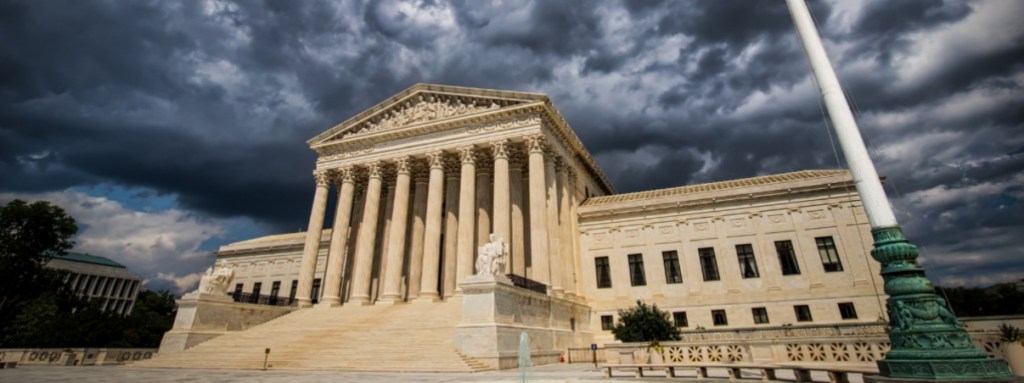
Now, the legal battle over Trump’s tariff authority is about to reach a climax. That’s what I’ll focus on here. The Supreme Court has agreed to fast track the challenge to the President’s discretion to impose retaliatory tariffs unilaterally. There are two cases at hand: V.O.S. Selections, Inc. v. Trump, and Learning Resources, Inc., et al. v. Donald Trump et al. In both cases, small business plaintiffs contend that Trump’s invocation of the International Emergency Economic Powers Act (IEEPA) is unwarranted, and that “most” of the tariff actions taken by Trump have usurped Congress’ power of the purse under Article I of the Constitution. Here’s Ilya Somin, who is a Volokh Conspiracy regular and one of the attorneys representing the plaintiffs:
“… IEEPA doesn’t even mention tariffs and has never previously been used to impose them, that there is no ‘unusual and extraordinary threat’ of the kind required to invoke IEEPA, the major questions doctrine, the constitutional nondelegation doctrine, and more.“
This isn’t the first time a U.S. president has imposed tariffs unilaterally, but it is easily the most drastic such action. Historically, nearly all tariffs were levied by acts of Congress. Prior to Trump II, perhaps the broadest tariff imposed by a President was Richard Nixon’s brief 10% surcharge on all imports, but that was lifted quickly. Presidents Johnson and Obama imposed some selective tariffs. All of these episodes seem piddling compared to Trump’s tariffs, which are both sweeping and in many cases painfully selective.
Eric Boehm notes that when it comes to major constitutional questions, the Court has taken the position that
“… executive power should be construed narrowly, not broadly …. Rather than tying itself into knots to affirm nearly unlimited executive powers over commerce, the Supreme Court should tell the Trump administration to get permission from Congress before imposing new tariffs.“
I believe that will be the general shape of the outcome here. Maybe there’s a way for the Court to allow the tariffs to stand until Congress decides to “man up”, acting one way or the other. SCOTUS would probably like to do just that! Or maybe the Court could stay the lower court’s injunction until the case is heard by the Court in full on the regular docket, or until Congress acts.
There’s a decent chance, however, that Trump’s tariffs will be struck down, leaving it up to tariff supporters in Congress to lay down statutory rules rather than put up with the impulsive craziness we’ve witnessed thus far. If the Court lets the tariffs stand, it leaves the door open for new tests on the limits of executive discretion. Here is Greg Ip at the link:
“There would also be no end to uncertainty. ‘Unlike most other tariff authorities, these tariffs are not enshrined in statute, there’s no process to change them, and they can change very rapidly, in a day, without much notice, as we’ve seen,’ said Greta Peisch, a trade attorney at Wiley Rein and former general counsel for the U.S. trade representative.“
We’ve already seen strong hints that the Administration would like to force businesses to eat the cost of the tariffs rather than pass them along to consumers in higher prices. There hasn’t been any formal action of this kind by the Administration, at least not yet. Still, one can hardly blame businesses who might perceive an implicit threat if they fail to comply. That kind of bullying represents an a massive abuse of power. The Court could do everyone a big favor by clarifying that the authority to impose tariffs rests with Congress.
The timing of this post might be awkward given the escalation of threats by Iran and its client militia groups toward Israel. But I’m posting it anyway because this blog is a way for me to get things off my chest. Read on…
In the West there is fairly broad agreement that the Palestinian people should have a sovereign state of their own. There is much less agreement over the geographic boundaries of such a state and the sequence of events that must take place in order for it to be established. Among Palestinians there is some support for a two-state solution, but it is far from a majority.
The UN Partition Plan
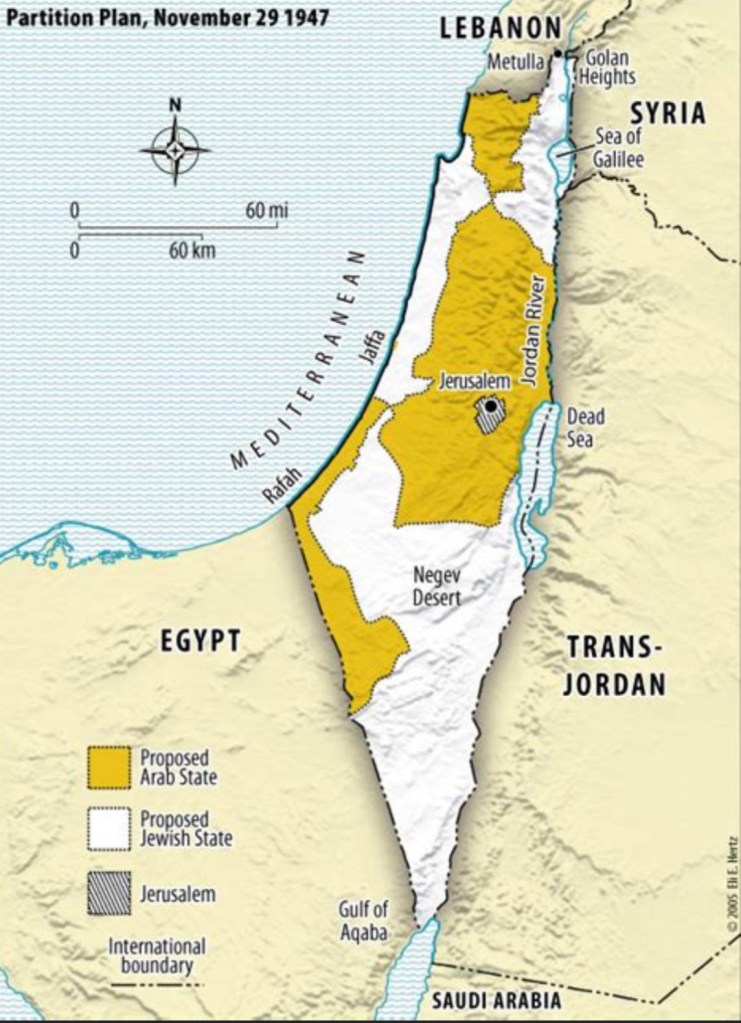
The following map might be helpful in what follows. It shows the proposed boundaries of an Israeli state and an Arab state under the Partition Plan adopted by UN Resolution in 1947. The Resolution called for replacing a League of Nations mandate for British administration of the region requiring the establishment of a Jewish homeland. Likewise, the Arab state was intended to accommodate Palestinian nationalists. Together the two states were expected to comprise an economic union.
What is striking is the discontinuity of the lands assigned to each state, and this surely contributed to almost immediate border challenges. More on that below.
The Gaza Strip is the region along the shore of the Mediterranean on the lower left, which was designated as Palestinian. The Golan Heights is the Israeli region on the upper right. The West Bank is the Palestinian region in the middle. Jerusalem and its vicinity was designated as an international zone to be administered by the UN.
Border Battles
Today, the geography of a prospective Palestinian state would certainly include the Gaza Strip. There doesn’t seem to be any great dispute there, but the West Bank is another story. In this context, it’s important to remember some key details about the history of this region since 1947. David Post writes at the Volokh Conspiracy that the Palestinian state was obliterated by other Arab states in 1948:
“The State of Palestine was strangled in its infancy, not by the Israelis, who accepted the U.N. partition plan, but by the neighboring Arab States—Egypt, Syria, and Jordan—who did not. The day after the British pulled their forces out, the Arab armies marched in, and the first Arab-Israeli War began.“
The hostilities were formally ended with the signing of three different Armistices in 1949:
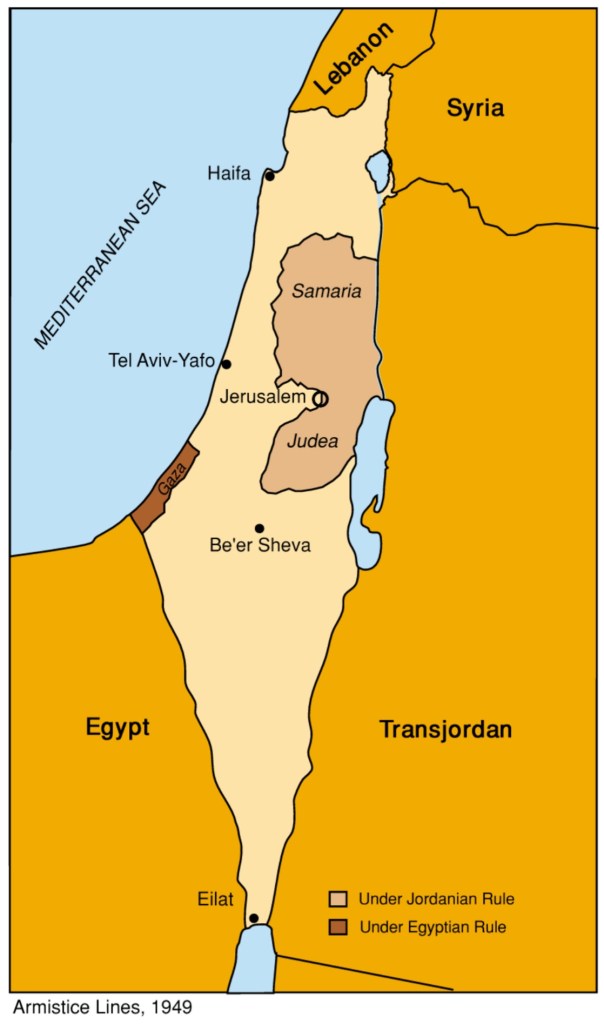
“The boundaries fixed in those agreements gave to each of the four countries involved more-or-less the territory that their armies had managed to control as of the date that ceasefires had been declared. The West Bank became part of Jordan; Gaza became part of Egypt; the Golan Heights became part of Syria. Israel got—or kept—the rest. The Palestinians, who had no army of their own, got nothing.“
Here are the boundaries under the 1949 Armistices:
The three Arab states, which refused to recognize Israel’s right to exist, attacked again in 1967. In a matter of six days and on three fronts, the Israelis drove them back and took Gaza, the West Bank, and retook the Golan Heights. Post asks:
“Why is it that only starting then, now that Israel was in control of these areas, did the world rouse itself to Palestinian grievances, and demand that ‘Palestinian lands’ be given back to the Palestinians?“
It’s worth noting that these conflicts led to the displacement of a great many Palestinians, but Israel did not provoke the attacks.
Indigenous Populations
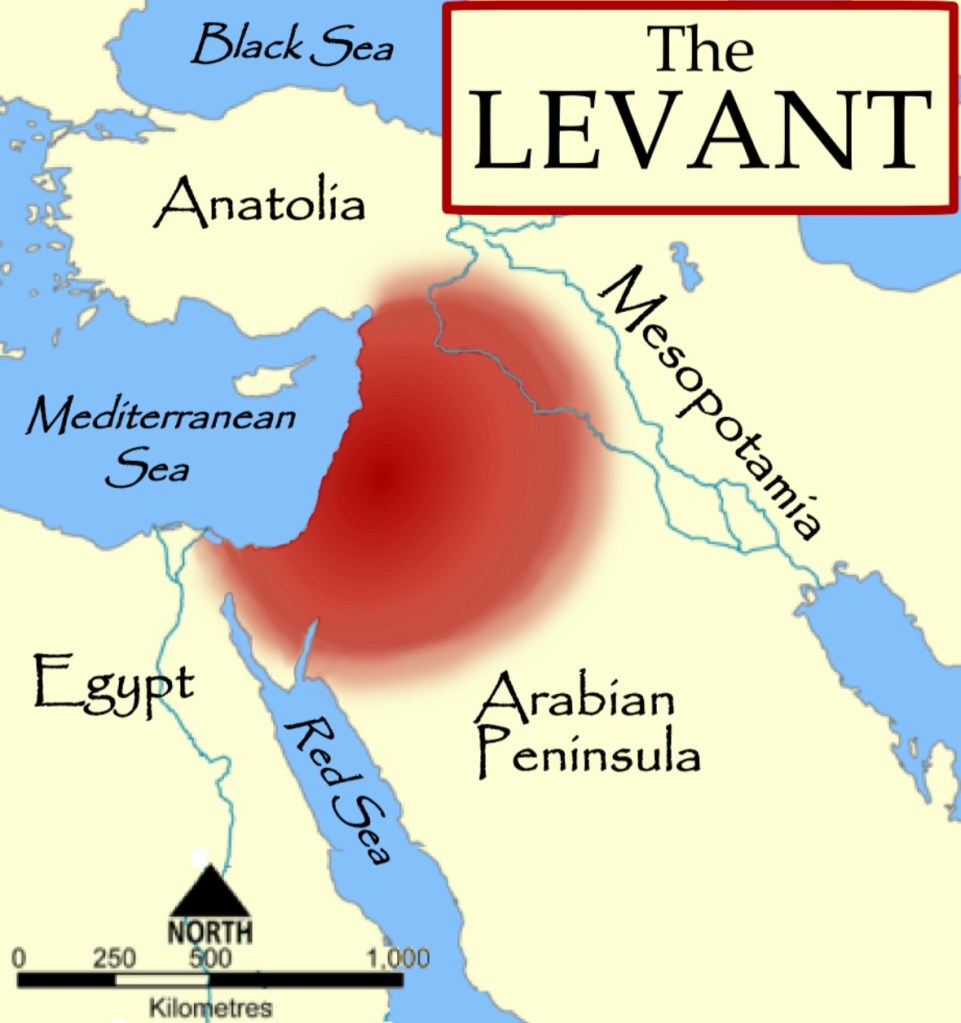
Enemies of Israel, including those in the West, go so far as to say the Israelis are not entitled to a homeland in the Levant. Even worse, they chant “from the river to the sea”, often ignorant that it is a thinly veiled call for genocide. But Jews have as great a claim to a homeland in the Levant as the Palestinians. Jacob Sullum wrote of this truth last October, in the wake of the Hamas butchery on October 7, 2023. Israeli Jews are characterized by enemies as “colonizers”. This, as Sullum says:
“… is a ‘simplistic morality tale’, that pits white European oppressors against ‘indigenous’ people, eliding Israel’s demographic roots and the ancient Jewish connection to the land. “
Sullum goes on to discuss research on the genetic origins of modern Jewish populations. For example, one paper found that the ancestors of Ashkenazi Jews, who account for almost a third of Jews in Israel, likely descended from a “diverse population in the Middle East.” And Sullum points out that Mizrahim Jews of Middle Eastern and North African origin represent almost 45% of Israeli Jews. Furthermore, another study found that Jews and Arabs in the Middle East both share high percentages of Y chromosomes with a single gene pool, which suggests a common origin. Therefore, both Palestinians and Israeli Jews have legitimate claims to a homeland in the Levant.
Israel and Gaza
Contrary to claims by Hamas supporters, there was no occupation of Gaza by Israel at the time of the October 7th massacre. Israel’s prior occupation of Gaza ended almost 20 years ago, in 2005. However, Israel has restricted the movement of goods in and out of the Gaza Strip since the 1990s. Israel and Egypt tightened the blockade on Gaza in 2007 after Hamas took control there, though it was eased in steps from 2010 – 2013. Given the uncompromising belligerence of Hamas and its proclivity for diverting resources to support aggression against Israel, it’s fair to say the blockade is, and has been, a legitimate instrument of defense, as long as Gaza is “governed” by Hamas.
Last year, less than a week after the October 7th massacre and hostage taking, the Israeli Defense Forces (IDF) began ground operations in Gaza in an effort to root out Hamas fighters, destroy their war-making infrastructure, and rescue hostages held by Hamas in Gaza. Of course, that fight goes on.
Hamas has fought against Israel’s retaliatory action in ways that have propaganda value, especially given the naïveté of much of the Western press. Its fighters are often embedded among civilians within residential areas and facilities like schools and hospitals. The use of human shields is a war crime for which Hamas bears full responsibility, and Hamas has made it clear that their aim is to kill Israelis, civilian and military alike. Hamas has made a practice of exaggerating Palestinian death counts, a distortion that has been more obvious to statisticians than journalists.
The Israeli blockade of the Gaza Strip will be tough to end without a complete surrender by Hamas and release of the hastages. Even then, the current IDF occupation is unlikely to end until efforts are well underway to flesh out the details of a new Palestinian government, if not statehood.
The West Bank
Perhaps even more thorny for an eventual two-state solution is that Israel occupies the West Bank and has established settlements that Palestinians strongly oppose. Jordan might also have designs on retaking West Bank territory, which would once again leave Palestinians as the odd people out. Israel took the land in its own defense during the Six-Day War in 1967 and kept it as a security buffer:
“… Israel insisted that it should not, and would not, simply return to the pre-war situation — the dangerous combination of precarious armistice lines and aggressive neighbors that had prevailed for 19 years. …
The idea that Israeli security depended on continued control over parts of the West Bank was held not only by Israeli officials, but also by the American Joint Chiefs of Staff. … Referring to the West Bank, they argued that Israel required a new boundary that would ‘widen the narrow portion of Israel’ and help protect Tel Aviv.“
Israel splits aspects of governance with the Palestinian Authority in parts of the West Bank, but most of the security apparatus is run by Israel.
The continued West Bank occupation is as fraught with controversy as ever. Today there is bitter resentment over new Israeli settlements and the construction of the “Separation Wall” just inside the western border of the West Bank. The situation is made all the more intractable by Hamas’ presence there amid ongoing attacks against Israeli interests.
Withdrawing from the West Bank would create a huge vulnerability for Israel, so one can hardly expect it to cede control of the entire territory. Yet it is hard to imagine an economically viable Palestinian state confined to the Gaza Strip. In fact, some feel that more than the West Bank should be in play for creating a contiguous corridor to Gaza, which would help promote a new Palestinian state’s economic viability.
Iran
Obviously Hamas is not the only threat to Israel’s security. To the north in Lebanon, Hezbollah is a well-armed adversary. And like Hamas, it receives considerable support from Iran. It’s difficult to imagine that Iran could maintain this support, not to mention its nuclear ambitions, without the flow of oil revenue made possible by U.S. acquiescence. Reaching a peaceful resolution to the conflicts between Israel and its neighbors will be very difficult without somehow neutralizing the Iranian threat. Regime change there would be key to this effort.
What Must Happen
The obstacles to establishing a peaceful, two-state solution for Palestinians and Israelis are so steep that the prospect seems almost unimaginable. A complete defeat of both Hamas and Hezbollah would be critical, and the Palestinian Authority or any other successor regime must be counted on to negotiate in good faith and with the legitimate support of the Palestinian people. Likewise, Israel must be willing to negotiate meaningful concessions, at least in terms of its occupied territories in the West Bank.
For a successful resolution, the role of other Arab states can’t be emphasized enough. These states should apply pressure to Israel’s neighbors like Syria and Jordan to rein-in their own territorial ambitions. In a positive sign, there is now growing pressure on Iran from other Arab states to end its belligerence.
A reconstituted Abraham Accords framework could strengthen diplomatic and economic ties across the region, promoting cross-investment, trade, and cultural exchange. The framework should include a mechanism to encourage aid from the Arab states and Israel to help Palestinians build a new, peaceful, and prosperous state.
Finally, a peaceful two-state solution hinges on continued U.S. support for Israel and a new Palestinian homeland. Unfortunately, in recent years we’ve witnessed adrift toward anti-Zionism (and even anti-Semitism) among Democrats. This sort of foolishness on the far Left knows no bounds. If the anti-Zionist position comes to be accepted by the mainstream of the party, it could severely compromise Israel’s leverage in negotiations.
Summary
A resolution that would ultimately bring peace to the Middle East seems remote in the midst of the current hostilities. It would require a dramatic softening of views among nearly all parties to solve the impasse over nation-state homelands for both Jews and Palestinians. In no particular order, the following are all necessary:
Israel’s neighboring states must not covet territory originally intended for the Palestinians, or for that matter the state of Israel.
Iran must butt out one way or another (in the language of high diplomacy), which would do much to neutralize militant factions like Hamas, Hezbollah, and the Houthis.
Other Arab states must come to the table along with the Israelis to negotiate economic and political accords, including aid to the Palestinian people.
The U.S. must resist internal calls from the Left to withdraw support for Israel.
More immediately, Israel must do its best to root out and defeat Hamas, Hezbollah, and the Houthis.
The Palestinian people must decide they want peace and a prosperous civilization.
Israel must show a willingness to negotiate concessions to Palestinians in the West Bank, and to aid in the rebuilding of Gaza.
Taken together that’s a very tall order! The U.S. can and should do its part to support Israel and the Palestinian people, penalize Iran, and help to bring all parties to the negotiating table. A refashioning of the Abraham Accords could contribute to peace in the region, including a stable, prosperous, and well-governed Palestinian homeland.
Hiring quotas are of questionable legal status, but for several years, some large companies have been adopting quota-like “targets” under the banner of Diversity, Equity and Inclusion (DEI) initiatives. Many of these so-called targets apply to the placement of minority candidates into “leadership positions”, and some targets may apply more broadly. Explicit quotas have long been viewed negatively by the public. Quotas have also been proscribed under most circumstances by the Supreme Court, and the EEOC’s Compliance Manual still includes rigid limits on when the setting of minority hiring “goals” is permissible.
Yet large employers seem to prefer the legal risks posed by aggressive DEI policies to the risk of lawsuits by minority interests, unrest among minority employees and “woke” activists, and “disparate impact” inquiries by the EEOC. Now, as Stewart Baker writes in a post over at the Volokh Conspiracy, employers have a new way of improving — or even eliminating — the tradeoff they face between these risks: “stealth quotas” delivered via artificial intelligence (AI) decisioning tools.
Skynet Smiles
A few years ago I discussed the extensive use of algorithms to guide a range of decisions in “Behold Our Algorithmic Overlords“. There, I wrote:
“Imagine a world in which all the information you see is selected by algorithm. In addition, your success in the labor market is determined by algorithm. Your college admission and financial aid decisions are determined by algorithm. Credit applications are decisioned by algorithm. The prioritization you are assigned for various health care treatments is determined by algorithm. The list could go on and on, but many of these ‘use-cases’ are already happening to one extent or another.”
That post dealt primarily with the use of algorithms by large tech companies to suppress information and censor certain viewpoints, a danger still of great concern. However, the use of AI to impose de facto quotas in hiring is a phenomenon that will unequivocally reduce the efficiency of the labor market. But exactly how does this mechanism work to the satisfaction of employers?
Machine Learning
As Baker explains, AI algorithms are “trained” to find optimal solutions to problems via machine learning techniques, such as neural networks, applied to large data sets. These techniques are are not as straightforward as more traditional modeling approaches such as linear regression, which more readily lend themselves to intuitive interpretation of model results. Baker uses the example of lung x-rays showing varying degrees of abnormalities, which range from the appearance of obvious masses in the lungs to apparently clear lungs. Machine learning algorithms sometimes accurately predict the development of lung cancer in individuals based on clues that are completely non-obvious to expert evaluators. This, I believe, is a great application of the technology. It’s too bad that the intuition behind many such algorithmic decisions are often impossible to discern. And the application of AI decisioning to social problems is troubling, not least because it necessarily reduces the richness of individual qualities to a set of data points, and in many cases, defines individuals based on group membership.
When it comes to hiring decisions, an AI algorithm can be trained to select the “best” candidate for a position based on all encodable information available to the employer, but the selection might not align with a hiring manager’s expectations, and it might be impossible to explain the reasons for the choice to the manager. Still, giving the AI algorithm the benefit of the doubt, it would tend to make optimal candidate selections across reasonably large sets of similar, open positions.
Algorithmic Bias
A major issue with respect to these algorithms has been called “algorithmic bias”. Here, I limit the discussion to hiring decisions. Ironically, “bias” in this context is a rather slanted description, but what’s meant is that the algorithms tend to select fewer candidates from “protected classes” than their proportionate shares of the general population. This is more along the lines of so-called “disparate impact”, as opposed to “bias” in the statistical sense. Baker discusses the attacks this has provoked against algorithmic decision techniques. In fact, a privacy bill is pending before Congress containing provisions to address “AI bias” called the American Data Privacy and Protection Act (ADPPA). Baker is highly skeptical of claims regarding AI bias both because he believes they have little substance and because “bias” probably means that AIs sometimes make decisions that don’t please DEI activists. Baker elaborates on these developments:
“The ADPPA was embraced almost unanimously by Republicans as well as Democrats on the House energy and commerce committee; it has stalled a bit, but still stands the best chance of enactment of any privacy bill in a decade (its supporters hope to push it through in a lame-duck session). The second is part of the AI Bill of Rights released last week by the Biden White House.”
What the hell are the Republicans thinking? Whether or not it becomes a matter of law, misplaced concern about AI bias can be addressed in a practical sense by introducing the “right” constraints to the algorithm, such as a set of aggregate targets for hiring across pools of minority and non-minority job candidates. Then, the algorithm still optimizes, but the constraints impinge on the selections. The results are still “optimal”, but in a more restricted sense.
Stealth Quotas
As Baker says, these constrains on algorithmic tools would constitute a way of imposing quotas on hiring that employers won’t really have to explain to anyone. That’s because: 1) the decisioning rationale is so obtuse that it can’t readily be explained; and 2) the decisions are perceived as “fair” in the aggregate due to the absence of disparate impacts. As to #1, however, the vendors who create hiring algorithms, and specific details regarding algorithm development, might well be subject to regulatory scrutiny. In the end, the chief concern of these regulators is the absence of disparate impacts, which is cinched by #2.
About a month ago I posted about the EEOC’s outrageous and illegal enforcement of disparate impact liability. Should I welcome AI interventions because they’ll probably limit the number of enforcement actions against employers by the EEOC? After all, there is great benefit in avoiding as much of the rigamarole of regulatory challenges as possible. Nonetheless, as a constraint on hiring, quotas necessarily reduce productivity. By adopting quotas, either explicitly or via AI, the employer foregoes the opportunity to select the best candidate from the full population for a certain share of open positions, and instead limits the pool to narrow demographics.
Demographics are dynamic, and therefore stealth quotas must be dynamic to continue to meet the demands of zero disparate impact. But what happens as an increasing share of the population is of mixed race? Do all mixed race individuals receive protected status indefinitely, gaining preferences via algorithm? Does one’s protected status depend solely upon self-identification of racial, ethnic, or gender identity?
For that matter, do Asians receive hiring preferences? Sometimes they are excluded from so-called protected status because, as a minority, they have been “too successful”. Then, for example, there are issues such as the classification of Hispanics of European origin, who are likely to help fill quotas that are really intended for Hispanics of non-European descent.
Because self-identity has become so critical, quotas present massive opportunities for fraud. Furthermore, quotas often put minority candidates into positions at which they are less likely to be successful, with damaging long-term consequences to both the employer and the minority candidate. And of course there should remain deep concern about the way quotas violate the constitutional guarantee of equal protection to many job applicants.
The acceptance of AI hiring algorithms in the business community is likely to depend on the nature of the positions to be filled, especially when they require highly technical skills and/or the pool of candidates is limited. Of course, there can be tensions between hiring managers and human resources staff over issues like screening job candidates, but HR organizations are typically charged with spearheading DEI initiatives. They will be only too eager to adopt algorithmic selection and stealth quotas for many positions and will probably succeed, whether hiring departments like it or not.
The Death of Merit
Unfortunately, quotas are socially counter-productive, and they are not a good way around the dilemma posed by the EEOC’s aggressive enforcement of disparate impact liability. The latter can only be solved only when Congress acts to more precisely define the bounds of illegal discrimination in hiring. Meanwhile, stealth quotas cede control over important business decisions to external vendors selling algorithms that are often unfathomable. Quotas discard judgements as to relevant skills in favor of awarding jobs based on essentially superficial characteristics. This creates an unnecessary burden on producers, even if it goes unrecognized by those very firms and is self-inflicted. Even worse, once these algorithms and stealth quotas are in place, they are likely to become heavily regulated and manipulated in order to achieve political goals.
Baker sums up a most fundamental objection to quotas thusly:
“Most Americans recognize that there are large demographic disparities in our society, and they are willing to believe that discrimination has played a role in causing the differences. But addressing disparities with group remedies like quotas runs counter to a deep-seated belief that people are, and should be, judged as individuals. Put another way, given a choice between fairness to individuals and fairness on a group basis, Americans choose individual fairness. They condemn racism precisely for its refusal to treat people as individuals, and they resist remedies grounded in race or gender for the same reason.”
Quotas, and stealth quotas, substitute overt discrimination against individuals in non-protected classes, and sometimes against individuals in protected classes as well, for the imagined sin of a disparate impact that might occur when the best candidate is hired for a job. AI algorithms with protection against “algorithmic bias” don’t satisfy this objection. In fact, the lack of accountability inherent in this kind of hiring solution makes it far worse than the status quo.
George Mason University Law Professor David Bernstein observed this week that many in the American Jewish community are panicked by Donald Trump’s election because they perceive Trump and his followers as anti-Semitic. That perception was seemingly reinforced by recent anti-Semitic acts, such as bomb threats at Jewish Community Centers and the desecration of graves at Jewish cemeteries in St. Louis, MO and Philadelphia, PA. Bernstein, who is Jewish and not a Trump supporter, wrote a piece entitled “The Great Anti-Semitism Panic of 2017“, which appeared in the Volokh Conspiracy blog sponsored by the Washington Post.
Like Bernstein, I’ve seen a number of indignant posts by Jewish friends connecting Trump and anti-Semitism, complete with comparisons to Adolf Hitler. My quick reaction is that such comparisons are not only irresponsible, they are idiotic. The ghastly implication is that Trump might entertain the idea of exterminating Jews, or any other opposition group, and it is complete nonsense.
Taking a step back, perhaps all this is related to Trump’s nationalism and his views on border security. That includes “extreme vetting” of refugees, deportation of illegal immigrants, and even the dubious argument for a border wall. While that’s not about Jews, those policies appeal to certain fringe, racist elements on the extreme right where anti-Semitism is commonplace. However, those policies also appeal to a much broader and diverse audience of voters who harbor anxieties about economic and national security, and who are neither racists nor anti-Semites.
Bernstein takes progressive Jews to task for tying any of this to anti-Semitism on the part of Trump, his Administration, or his broader base of support:
“… the origins of the fear bear only a tangential relationship to the actual Trump campaign. For example, I’ve lost track of how many times Jewish friends and acquaintances in my Facebook feed have asserted, as a matter of settled fact, that Bannon’s website Breitbart News is a white-supremacist, anti-Semitic site. I took the liberty of searching for every article published at Breitbart that has the words Jew, Jewish, Israel or anti-Semitism in it, and can vouch for the fact that the website is not only not anti-Semitic, but often criticizes anti-Semitism (though it is quite ideologically selective in which types of anti-Semitism it chooses to focus on). I’ve invited Bannon’s Facebook critics to actually look at Breitbart and do a similar search on the site, and each has declined, generally suggesting that it would be beneath them to look at such a site, when they already know it’s anti-Semitic.
There is .. a general sense among Jews, at least liberal Jews, that Trump’s supporters are significantly more anti-Semitic than the public at large. I have many times asked for empirical evidence that supports this proposition, and have so far come up empty. I don’t rule out the possibility that it’s true, but there doesn’t seem to be any survey or other evidence supporting it. Given that American subgroups with the highest proportions of anti-Semites — African Americans, first-generation Hispanic immigrants, Muslims and high school dropouts — are strong Democratic constituencies (though the latter group appears to have gone narrowly for Trump this time), one certainly can’t simply presume that Trump has a disproportionate number of anti-Semitic supporters.“
Bernstein goes on to discuss the hostility to Trump from groups like the Anti-Defamation League (ADL), hostility which he characterizes as essentially opportunistic:
“The ADL’s reticent donors are no longer reticent in the age of Trump, with the media reporting that donations have been pouring in since Trump’s victory. It’s therefore hardly in the ADL’s interest to objectively assess the threat from Trump and his supporters. Indeed, I’m almost impressed that an ADL official managed just the other day to link the JCC bomb threats to emboldened white supremacists, even though the only suspect caught so far is an African American leftist.“
He also notes the irony that progressive Jews have been shunned by many leftists, who almost uniformly condemn Zionism. Now, progressive Jews hope to renew common cause with those whose political purposes are defined by membership in groups with a history of marginalized treatment, and who now believe they are threatened by Trump. Will they be happy together? Bernstein attests that many Jews privately acknowledge the danger of “changing demographics”:
“… which is a euphemism for a growing population of Arab migrants to the United States. Anti-Semitism is rife in the Arab world, with over 80 percent of the public holding strongly anti-Semitic views in many countries.“
As a non-Jew, some would say I lack the bona fides to comment on how Jews “should” feel about Donald Trump. I was raised Catholic, but I attended a high school at which over 60% of the student population was Jewish. I was a member of a traditionally Jewish fraternity in college, where I witnessed occasional anti-Semitism from certain members of non-Jewish fraternities, and I felt victimized by it to some degree. My late brother married a Jewish woman, and he was buried according to Jewish custom. I was once stunned by a brief anti-Semitic wisecrack I overheard in the restroom at a community theatre production of the great musical Fiddler On the Roof!
So, I am connected and strongly sympathetic to the Jewish community. I am also well acquainted with white Gentiles who have had much less interaction with Jews. Those individuals span the political spectrum, and there is no doubt that racists and anti-Semites reside at both ends. I will state unequivocally that among this population, I have observed as much racism and denigration of Jews from the left as from the right. It partly reflects anti-Zionism, but there have been leftists in my acquaintance who seem to regard Jews as Shylockian, as greedy moneychangers and crooked lawyers, or as “hopelessly bourgeois”. Jews should not be blind to the hatred that still exists for them in certain quarters on the left, even if it’s easier to pretend that right-wing religious nuts are their only enemies.
Bernstein’s column was met with outrage by some Jewish progressives. In the Jewish Journal, Rob Eshman accused Bernstein of making apologies for Trumpian anti-Semitic behavior. Here is Bernstein’s response, in which he castigates Eshman for distorting both his thesis and the reaction of the Jewish community to Trump. He also notes that Eshman assigns guilt for the recent spate of anti-Semitic acts to Trump supporters where no evidence exists. That implication is a constant refrain from certain Jewish friends on my Facebook news feed. But there is ample evidence of “fake” hate crimes by progressives, as documented last week by Kevin Williamson.
Finally, it is hard to square the idea that Trump and his leadership team (which includes his Jewish son-in-law) are anti-Semitic with other evidence, such as the unequivocal support they have pledged to Israel, and their hard stand on vetting refugees from nations that are avowed enemies of the Jewish people. Yes, Bernstein is well aware of the anti-Semitic, fringe-right elements that have supported Trump, but those are not the sentiments of anyone serving in the administration, including Steve Bannon. The left has become quite blithe about observing Godwin’s Law, which states that all political opponents will eventually be called out as Nazis. Progressive Jews have taken the cue without much thought: the frequent comparisons of Donald Trump to Hitler are awful and are not compatible with healthy discourse. As Stefan Kanfer writes in City Journal in his review of the book “A Tale of Three Cities” (my emphasis added):
“… those who persist in comparing Adolf Hitler with any U.S. politician reveal themselves as members of a group just to the side of the Holocaust denier—the Holocaust trivializer. There are no lower categories.“
By what authority do unelected bureaucrats in administrative agencies increasingly make laws, enforce those laws and adjudicate violations? The fact that all of these activities take place within the executive branch of government appears to be an obvious contradiction of the separation of powers required by the first three articles of the Constitution, the principle of “Rule By Consent” of the governed, and protections of individual liberty. In a strong sense, the regulatory apparatus has grown so unwieldy that the powers routinely exercised by administrative agencies today seem beyond even the reach of elected executives. The rules promulgated by this “fourth branch” of government are essentially extralegal, a point discussed at length in Philip Hamburger’s “Is Administrative Law Unlawful“. He has also explained these issues at the Volokh Conspiracy blog in “Extralegal power, delegation, and necessity“, and “The Constitution’s repudiation of extralegal power“.
Hamburger examines the assertion that rule-making must be delegated by Congress to administrative agencies because legislation cannot reasonably be expected to address the many details and complexities encountered in the implementation of new laws. Yet this is a delegation of legislative power. Once delegated, this power has a way of metastasizing at the whim of agency apparatchiks, if not at the direction of the chief executive. If you should want to protest an administrative ruling, your first stop will not be a normal court of law, but an administrative review board or a court run by the agency itself! You’ll be well advised to hire an administrative attorney to represent you. Eventually, and at greater expense, an adverse decision can be appealed to the judicial branch proper.
This adds up to a dangerous lack of accountability and power. Marginal Revolution points out that critics of Hamburger’s book overlook the potential for harm that could be done by a “vindictive” president. But we should not lose sight of the fact that bureaucrats themselves, at any level, can be vindictive, as the IRS targeting scandal has shown. But that is only one motive for abuse of power; another motive may be more pervasive: the ability to reward those in a position to promote the self-interests of those who populate the administrative state. These are dangers that are endemic to big government. In a post entitled “Are Government Regulators More Virtuous than Everyone Else” (No!), Ivan Carrino highlights the weakness of arguments like those made by George Akerlof and Robert Shiller in “Phishing For Phools“, who call for greater government regulation on the grounds that consumers are vulnerable to manipulation by businesses. Carrino says:
“One can’t help but notice the central contradiction in this analysis. On the one hand, it is assumed that markets fail because of ‘normal human weakness.’ On the other hand, it is assumed that regulation, which must necessarily be implemented by human beings with equal or greater ‘weaknesses,’ will somehow solve the problem.
Akerlof and Shiller simultaneously demonize human beings who operate in the private sector while idealizing human beings who operate in the public sector.“
Glenn Reynolds has been a prominent critic of the administrative state. As a consequence of the vast and growing body of regulatory rules, it’s become increasingly difficult for individuals, acting on their own or as businesspeople, to know whether they are in acting in violation of administrative law. Reynolds discusses regulatory crime and over-criminalization in “You May Be Breaking The Law Right Now“, and in his great paper “Ham Sandwich Nation: Due Process When Everything is a Crime” (free download).
Hamburger’s main position is that law should be made by elected representatives, not by bureaucrats who lack direct accountability to voters. Ilya Somin believes that with time, Hamburger will have great influence on legal theorists in this regard. He compares Hamburger’s insights on administrative law to Richard Epstein’s work on takings. Epstein insisted that “almost all regulations that restrict property rights should be considered ‘takings’ that require compensation under the Fifth Amendment.” Somin notes that Epstein’s position, despite harsh criticism from certain quarters, has influenced legal thinking in a dramatic way over the years.
What’s to be done? Can a line reasonably be drawn between constitutional legislative power and delegated rule-making authority? Somin is skeptical that absolute restrictions on lawmaking by the administrative state are practical, in the sense that there will always be details that cannot be addressed in enabling legislation. Others have suggested practical paths forward: Joseph Postell attempts to give a roadmap in “From Administrative State to Constitutional Government“. A recent Glenn Reynolds op-ed, “Blow Up The Administrative State“, gives a qualified defense of Texas Governor Greg Abbot’s proposed amendments to the Constitution. Among other things, Abbot proposes to:
“–Prohibit administrative agencies … from creating federal law. –Prohibit administrative agencies … from preempting state law. –Give state officials the power to sue in federal court when … officials overstep their bounds. –Allow a two-thirds majority of the states to override a federal law or regulation.”
I would add that administrative review and adjudication should be independent of the agencies themselves. Also, Representative Mia Love (R-UT) has proposed legislation that would restrict Congress to bills focused on points directly related to a single issue (i.e., no omnibus bills), which would help to check the growth of the administrative state.
All of these measures seem consistent with Hamburger’s views. Reynolds is fully cognizant of the dangers of a constitutional convention. Nevertheless, he recognizes that Abbot’s proposals would impose harder limits on the size of government, and defends them in colorful fashion:
“A smaller government would mean fewer phony-baloney jobs for college graduates with few marketable skills but demonstrated political loyalty. It would mean fewer opportunities for tax dollars to be directed to people and entities with close ties to people in power. It would mean less ability to engage in social engineering and ‘nudges’ aimed at what are all-too-often seen as those dumb rubes in flyover country. The smaller the government, the fewer the opportunities for graft and self-aggrandizement — and graft and self-aggrandizement are what our political class is all about.“
For further reading, Michael Ramsey at The Originalism Blog posts links to several other essays by Hamburger at The Volokh Conspiracy, where he acted as a guest-blogger.
Volokh constructs a small data set for the 50 states and D.C with 2013 “Brady Scores” on gun laws, intentional homicide rates and accidental gun deaths. He discusses various measures that might be used to test the “Obama gun-law hypothesis”. Volokh rejects gun homicides because differences across states can be offset by other kinds of homicides. In addition, gun homicides may be reduced by defensive gun uses (DGUs) or the threat of DGUs. Instead, Volokh uses total homicides in one experiment and total homicides plus accidental gun deaths in another. He finds small positive correlations between tougher gun laws and both measures — a near zero association.
Volokh’s study is “quick and dirty”, so to speak, and it runs counter to the findings of some earlier cross-sectional studies. However, there are many factors that may confound any empirical association between gun laws, gun ownership rates, total guns and outcomes. That’s why other researchers insist that the question of gun-law efficacy must be assessed based on changes in outcome measures occurring after a change in gun law. These comparisons consistently show that imposition of tougher gun restrictions is not associated with declines in homicides.
More widespread ignorance of “the law” is an implication of a regulatory state growing in size and complexity. The tendency of expanding regulation to over-criminalize prompted this reexamination of the legal doctrine of “presumed knowledge of the law”, by Michael Anthony Cottone (abstract at the link, but it offers a free download of the full paper). I believe the cause of justice compels additional protections for individuals or companies against administrative accusers. Not only does this appeal to my sense of fair play, it also should incent bureaucrats to write clear rules and minimize conflicts with existing regulations. And it may discourage overaggressive bureaucrats from pursuing charges over disputes whose resolution might be subject to more reasonable compromise.
“Though extensive due process protections apply to the investigation of crimes, and to criminal trials, perhaps the most important part of the criminal process — the decision whether to charge a defendant, and with what — is almost entirely discretionary. Given the plethora of criminal laws and regulations in today’s society, this due process gap allows prosecutors to charge almost anyone they take a deep interest in.”
The “due process gap” is said to give rise to the expression, “a good prosecutor can get an indictment against a ham sandwich.” Here is a good discussion of the Reynolds paper at The Volokh Conspiracy, with additional links. Reynolds offers a number of possible remedies, including the creation of certain forms of liability for prosecutors, banning plea bargains, and limiting criminal prosecution for regulatory crimes. There are a few other interesting suggestions at the last link.
Heavy regulation of economic and social affairs places burdens on a society’s ability to prosper economically and culturally. It requires real resources to administer and imposes compliance costs on those it regulates. There are unnecessarily high social costs to a system of detailed rule-making by unelected bureaucrats who have incentives to both increase their dominion and to enhance their long-term career prospects. The latter is often accomplished via “partnership” with some of the largest regulated entities, which leads to rules favoring those entities at the expense of smaller competitors. And a large regulatory complex also offers an avenue through which the executive branch can promulgate rules based on expansive interpretations of existing law, circumventing checks on executive power enshrined in the Constitution. To these drawbacks we can add the consequences of over-criminalization. These should be addressed through limits on prosecutorial discretion and a more neutral perspective on presumed knowledge of administrative law.
It’s ironic that so many on the Left, who claim to be anti-war and humanitarian, have aligned themselves with Hamas against Israel in the current conflict. Exactly who wants to support an authoritarian, brutally intolerant, aggressively militaristic, misogynistic “government” that practices terror, sacrificing the welfare of its civilians by dedicating resources to unrelenting attacks on a neighboring state, in the process using its own civilians as human shields? Just who are their vocal supporters? And those who denigrate the Israeli effort to defend themselves? They are naive peacenik wanna-bes and, of course, a large contingent of anti-Semites, some of whom pose as peace lovers.
An intellectually honest peace lover will recognize that there is nothing inconsistent about loving peace and making a concerted effort to destroy an aggressive, attacking force. A good government must protect its people.
There were some interesting notes on the Hamas-Israeli conflict from David Bernstein at the Volokh Conspiracy over the weekend. His major points were: the conditions of Secretary of State John Kerry’s proposed cease fire were ridiculous and conflicted with Kerry’s earlier assurances; the casualty figures being reported by the media are coming from sources controlled by Hamas; the “humanitarian” deliveries of concrete to Gaza were diverted to the construction of tunnels for military use.
Under Hamas, personal status law is derived almost entirely from Sharia, which puts women at a stark disadvantage in matters of marriage, divorce, inheritance, and domestic abuse. Rape, domestic abuse, and “honor killings,” in which relatives murder women for perceived sexual or moral transgressions, are common, and these crimes often go unpunished.
Can we call this civilization? Barbarism is more accurate. Warning: 14 Ways Hamas Weaponizes Palestinian Women, Children and Animals Against Israel contains some shocking photos and videos. First, it quotes the first Hamas Charter of 1988, defining the Hamas Mission Against Israel and Jews: “Israel will exist and will continue to exist until Islam will obliterate it.” The charter goes on to quote The Prophet, Allah: “The stones and trees will say O Moslems, O Abdulla, there is a Jew behind me, come and kill him.” The link documents what can only be described as crimes against humanity by Hamas: using children to commit stone attacks, sending women and children on suicide missions, using civilians, women and children as human shields, weaponizing: animals, homes, schools, hospitals, ambulances and mosques.
We can persist in hoping that some middle ground can be found between the Israelis and the Palestinian people, but that is unlikely to happen with Hamas in charge of the Gaza Strip. In Lift the Siege On Gaza, the Israeli author makes an eloquent case that Israel must work toward opening the border with Gaza, but he recognizes that Hamas stands as a major obstacle to real peace.
The prospect of vampire re-ensoulment prompts some entertaining thoughts about economic philosophy in this post at the Volokh Conspiracy. Here is a sample:
Why presume that having more humans or human-like beings on the planet is even a problem at all? The ecological concern seems to borrow from the perspective of doomsayers like Paul Ehrlich, who have been beating the population-bomb drum for decades. And for decades, the doomsayers have been proven wrong.
And here is a classic closing sentence:
By establishing a legal market in human blood, as suggested by Enrique Guerra-Pujol in Chapter 12, we could go a long way toward creating an incentive for vampires (especially re-ensouled ones) to eschew violence in favor of remunerative work in the combined vampire-human economy, to the benefit of both the living and the dead.
In advanced civilizations the period loosely called Alexandrian is usually associated with flexible morals, perfunctory religion, populist standards and cosmopolitan tastes, feminism, exotic cults, and the rapid turnover of high and low fads---in short, a falling away (which is all that decadence means) from the strictness of traditional rules, embodied in character and inforced from within. -- Jacques Barzun



 Sacred Cow Chips