• About

Sacred Cow Chips

Sacred Cow Chips

Monthly Archives: October 2014

Vibrant Capitalism Promotes Public Health

15 Wednesday Oct 2014

Posted by Nuetzel in Uncategorized

≈ Leave a comment

Tags

Bryan Caplan, Capitalism, ebola, Economic Development, economic growth, Government Failure, health care system, liberty, Prosperity, Ron Paul, Shikha Dalmia, Travel Ban, Western Africa

Africa When it comes to “diseases of poverty,” Bryan Caplan knows that the right prescription has nothing to do with redistribution and everything to do with creating conditions that foster capitalism and economic growth. He marvels at the inattention of populist pundits and politicians to the realities of economic history:

“It’s almost like the last two centuries never happened. Quick recap: During the last two hundred years, living standards exploded even though the distribution of income remained quite unequal. How is such a thing possible? Because total production per person drastically increased. During this era, no country escaped dire poverty via redistribution, but many escaped dire poverty via increased production.”

I linked to an article yesterday about prerequisites for prosperity in my post entitled “Ending Terror With Economic Empowerment.” The author of that article, Harry Veryser, might just as well have said that those conditions are prerequisites for enhanced public health, since as Caplan notes, economic development and public health are inextricably connected.

Dr. Ron Paul makes this same general point in “Liberty, Not Government, Key To Containing Ebola.” He gives great emphasis to the destructive effect of war on the ability of any country to develop an effective health care system:

“It is no coincidence that many of those countries suffering from mass Ebola outbreaks have also suffered from the plagues of dictatorship and war. The devastation wrought by years of war has made it impossible for these countries to develop modern healthcare infrastructure. For example, the 14-year civil war in Liberia left that country with almost no trained doctors. Those who could leave the war-torn country were quick to depart. Sadly, American foreign aid props up dictators and encourages militarism in these countries.”

As Paul says, powerful government often inhibits a country’s ability to prosper and improve public health. The ebola epidemic offers a case in point, not simply with respect to controlling the spread of the disease in Western Africa, but in the counterproductive calls for government bans on travel to and from the region. Shikha Dalmia lays out the case against such a ban, which include its questionable efficacy in preventing the disease from traveling, the insurmountable obstacle the ban would present to private relief efforts, and the instability it would create in the region. Dalmia calls out Republicans for their hypocrisy in this regard:

“Republicans would do themselves and everyone else a big favor by suspending their calls for a travel ban and sticking to their alleged opposition to heavy-handed government intervention.“


Ending Terror With Economic Empowerment

14 Tuesday Oct 2014

Posted by Nuetzel in Uncategorized

≈ 1 Comment

Tags

Capitalism, Ending Terrorism, Harry Veryser, Hernando de Soto, Peru, Poverty and Terror, Properity, Shining Path

root evil

Certain institutions are under-appreciated in our society for their ability to foster prosperity. And not just under-appreciated, but often denigrated, attacked and undermined by factions favoring easy economic rents at the expense of others: this is the zero-sum crowd. This list of “10 Prerequisites for Prosperity” is offered by Harry Veryser, and it includes several such important institutions or social arrangements. (He includes a few excellent quotes from the likes of Hayek, Thomas Aquinas and Aristotle.) I find some of the prerequisites on the list to be of greater importance than others. For example, I’m not sure “leisure” deserves a place there, if only because it flows from some of the others. Nevertheless, it is a good list. Several of the pre-conditions have come under great threat in the U.S., and it is no coincidence that these threats have occurred in tandem with our society’s drift toward a collectivist dystopia.

Chronically impoverished societies are prone to instability, violent internal conflict, and even terrorism. Needless to say, these societies usually lack the prerequisites for prosperity enumerated by Veryser. Hernando de Soto writes of how creating such prerequisites can lead to more than a flourishing economy; it can also bring an end to terrorism. He witnessed such a change as a key player in Peru’s successful effort to use economic development to end the threat posed by the Shining Path guerillas in the 1980s and early 1990s. He asserts:

“The people of the “Arab street” want to find a place in the modern capitalist economy. But hundreds of millions of them have been unable to do so because of legal constraints to which both local leaders and Western elites are often blind. They have ended up as economic refugees in their own countries. 

To survive, they have cobbled together hundreds of discrete, anarchic arrangements, often called the “informal economy.” Unfortunately, that sector is viewed with contempt by many Arabs and by Western development experts, who prefer well-intended charity projects like providing mosquito nets and nutritional supplements.”

de Soto recommends that governments start by allowing entrepreneurs to build capital from the ground up, enabling them to obtain secure title to property, and by eliminating restraints on economic activity imposed by coercive authorities. Liberty can go a long way toward solving the most intractable social problems.

“As countries from China to Peru to Botswana have proved in recent years, poor people can adapt quickly when given a framework of modern rules for property and capital. The trick is to start. We must remember that, throughout history, capitalism has been created by those who were once poor.“

Due Process Is the Enemy of Racism

13 Monday Oct 2014

Posted by Nuetzel in Uncategorized

≈ Leave a comment

Tags

14th Amendment, Alan Dershowitz, Darren Wilson, Due Process, Ferguson Missouri, Jim Crow, MIchael Brown, recording police

due process casualty

There is nothing racist about upholding the 14th Amendment right to due process under the law. The tragic Michael Brown shooting this summer in Ferguson, Missouri has led to shocking calls for denial of due process to Darren Wilson, the police officer involved. The African-American community in Ferguson may have legitimate grievances with aspects of their local government, including their representation on the local police force. However, the calls for Wilson’s immediate conviction appear to be motivated by simple ignorance of the legal system.

The image above appeared in several publications as the controversy surrounding the shooting escalated. That the mainstream media, or even alternative media outlets, and politicians would make calls for immediate charges against Officer Wilson led some to ask whether due process was a casualty of the Michael Brown shooting:

“The idea that you can tell who is innocent and who is guilty by the color of their skin is a notion that was tried out for generations, back in the days of the Jim Crow South. I thought we had finally rejected that kind of legalized lynch law.”

As the quote makes clear, due process rights should be respected as a source of protection against racism in law enforcement and the prosecution of crimes. Citizens should also be aware that they have a due process right to record the police; those engaged in acts of protest or civil disobedience would be wise to do so in order to defend themselves against false accusations.

Some would argue, of course, that Michael Brown himself was denied due process in his altercation with Officer Wilson, but that unproven assertion does not trump Wilson’s right to due process. Alan Dershowitz bemoans the lack of video evidence in the Brown shooting, but he staunchly defends Officer Wilson’s due process right. It is too easy to vilify those accused or suspected of the most serious and despicable offenses; that is why due process must be respected, even if the system isn’t free of errors. Of course, even accused murderers and rapists are entitled to due process.

In the end, the verdicts that come out of the system must be respected, or there is no hope of moving closer to perfect justice. Let us hope that is remembered when the grand jury ends its deliberations over whether to charge Darren Wilson in the Brown shooting, no matter the verdict.

Can White Elephants Cheer the Public?

12 Sunday Oct 2014

Posted by Nuetzel in Uncategorized

≈ Leave a comment

Tags

Big Dig, economic growth, infrastructure, Neal Stephenson, optimism, Peter Theil, Precautionary Principle, quality of life, regulation, Technology, Virginia Postrel

infrastructure bridge

Has the American public’s sense of progress been diminished by the lack of “big projects” in recent memory? No moon shots or space elevators, no Hoover dams, no ubiquitous high-speed rail? Would these types of massive projects bring with them a new sense of optimism? Virginia Postrel doubts it, quite aside from whether such efforts would be successful in technical or economic terms. In her critique of business icon Peter Theil and science fiction writer Neal Stephenson on this point, Postrel says they confuse satisfaction from an improved quality of life in the mid-twentieth century with optimism about the future impact of iconic public investments in infrastructure and technology:

“People believed the future would be better than the present because they believed the present was better than the past. They constantly heard stories — not speculative, futuristic stories but news stories, fashion stories, real-estate stories, medical stories — that reinforced this belief. They remembered epidemics and rejoiced in vaccines and wonder drugs. They looked back on crowded urban walk-ups and appreciated neat suburban homes. They recalled ironing on sweaty summer days and celebrated air conditioning and wash-and-wear fabrics. They marveled at tiny transistor radios and dreamed of going on airplane trips.”

Postrel also points out that technology has always provoked some anxiety about the future, just as it does today. In addition, Theil and Stephenson under-appreciate noteworthy projects of the not so distant past, both public and private. That’s not to say that all of those projects were well-executed (the Big Dig?) or economically successful.

Postrel’s argument suggests that the current sense of malaise has more to do with weak economic growth and its causes. She emphasizes an excessive application of the precautionary principle. The growth of the regulatory state and arbitrary, czarist rule-making is an outgrowth of this phenomenon. As I said earlier this week, “Life’s Bleak When Your Goal Is Compliance.” Poor results of most public initiatives (e.g., public education, student loans, the war on poverty) do nothing to inspire confidence, with an increasing proportion of the population dependent on public support. Meanwhile, rewards seem to flow to well-connected cronies, a result that seems assured when resources are allocated to big public projects. There is a growing sense that not much can be accomplished without privilege or luck.

Above all, let’s hope we never take to evaluating massive projects based on their potential to foster a renewed sense of public optimism.

Mortgage Mania at the Fed

09 Thursday Oct 2014

Posted by Nuetzel in Uncategorized

≈ Leave a comment

Tags

Fannie Mae, Federal Reserve, Freddie Mac, Industrial Policy, Monetary Stimulus, Mortgage Interest Deduction, Mortgage Securities, Quantitative Easing, Richmond Fed, Wall Street Journal

bernanke-fed-qe

The Federal Reserve has no business distorting incentives by dabbling with billions in markets for private debt. Kudos to two officials at the Richmond Fed for making this point forcefully in the Wall Street Journal** today.

Normally, the Fed conducts monetary policy by buying or selling Treasury debt, which is thought to be neutral with respect to relative private interest rates. In other words, the Fed’s impact on the Treasury market, whatever that might be, does not encourage investment in housing at the expense of factory investment or vice versa. Since 2009, however, the Fed has attempted to support the housing and mortgage markets via massive purchases  of mortgage securities originally issued by Fannie Mae and Freddie Mac. This has the effect of reducing mortgage interest rates relative to rates on other kinds of private debt. It also constitutes a form of bailout for mortgage investors, who tend to receive favorable bids from the Fed for these assets. Free money! And more free money is dolled out by the Fed when it pays banks interest on the new reserve balances these transactions ultimately create.

One might object that the struggling mortgage market needed the Fed’s support in the wake of the housing crash. I do not accept that view because the mortgage and housing markets needed to unwind their excesses and monetary stimulus did not require mortgage purchases. But this also begs the question: what gave rise to the crisis? Over-investment in housing and a home price bubble fueled by tax-deductible interest, easy Fed monetary policy, regulatory capital standards that favored mortgage lending, prospective bailouts in case of failure, and loose bank credit standards. Those should all sound familiar. Now, the Fed believes it’s necessary to re-inflate the mortgage market via continuing asset purchases.

The Fed’s policies can be criticized on other grounds, but interfering in private debt markets should be avoided. It is an example of industrial policy that is clearly not even part of the Fed’s so-called mandate, and it ultimately means a continuing massive misallocation of resources into housing at the expense of other forms of investment.

** The article at the link should be ungated. If not, try Googling “wsj Fed’s Mortgage Favoritism.”

Life’s Bleak When Your Goal Is Compliance

08 Wednesday Oct 2014

Posted by Nuetzel in Uncategorized

≈ 2 Comments

Tags

Administrative State, Asset Forfeiture, Banana Republic, Compliance Costs, DOE, FDA, Fines and Taxes, Michael Greve, Regulatory State, Richard Rahn

compliant_with_the_universe

Don’t underestimate the danger and cost of giving it up to the regulatory state. It’s ability to impel behavior in the absence of any legislative mandate, and apparently without accountability to the judicial branch or any other authority, is explored by Michael Greve in “Prescription for a Banana Republic.” He does this mostly in the context of the Department of Education, but he also mentions the FDA’s practice of issuing “draft” guidance, frequently with perverse consequences. I know from my own experience in the financial industry that the problem is more general. Here’s one snippet from Greve’s article:

“Why do we permit agencies to proceed in this underhanded, unreviewable fashion? The general idea is that in choosing to proceed by “guidance” rather than formal, reviewable regulation, the agency is giving something up: the legally binding effect of its rulings. It’s not really coercing anybody, and so why bother the courts? That answer, however, wildly underestimates government’s ingenuity in giving real-world effect to supposedly informal documents.”

Richard Rahn had a piece yesterday on the closely related topic of fines and asset forfeitures imposed by regulators without any court proceeding, let alone a conviction. He quotes two former directors of the DOJ’s Asset Forfeiture and Money Laundering Office:

“Civil asset forfeiture and money-laundering laws are gross perversions of the status of government amid a free citizenry. The individual is the font of sovereignty in our constitutional republic, and it is unacceptable that a citizen should have to ‘prove’ anything to the government. If the government has probable cause of a violation of law, then let a warrant be issued. And if the government has proof beyond a reasonable doubt of guilt, let that guilt be proclaimed by 12 peers.”

Greve mentions the strong influence exerted by regulators issuing so-called “Dear Colleague” letters containing “suggested” steps that might be taken “voluntarily” to avoid falling out of compliance with often ill-defined requirements:

“Whereupon compliance officers across the country can be heard clearing their throats: I can help…. Replicate the m.o. across the full range of government services and regulation: it takes a ton of money to escape. Once you start adopting Juan Peron’s legal model, social patterns will follow. We’re well on our way.”

Nudge me when it’s over. Oh, wait!

Locavoracious Rent-Seeking

07 Tuesday Oct 2014

Posted by Nuetzel in Uncategorized

≈ 1 Comment

Tags

Alberta Farmer, Don Boudreaux, Locavorism, Pierre Desrochers, rent seeking, Sustainability, the Locavore's Dilemma, transportation costs

eat weeds

Nothing sets my BS detector on high alert quite like admonitions to “buy local” in the interests of “sustainability” and protecting the environment. I like to support local merchants and producers as much as anyone, but in the end, one should buy what they like without guilt, regardless of its place of origin. The notion that local production is always better for the environment is based on faulty logic and a simple ignorance of actual production costs. The bad economics of locavorism is exposed in a recent Don Boudreaux column, “‘Sustainable’ and Superficial:”

“… transportation consumes only a small portion of the resources required to feed us. Labor, fuel, water, irrigation equipment, tractors and other farm tools, fertilizers, pesticides, packaging and (of course) land must also be used. … the amount of resources required to eat only locally grown foods would be stupendous. Some lands and local environments are better suited than are other lands and local environments to growing particular kinds of crops.”

The following Alberta Farmer post from 2010 illustrates the kind of ignorance cloaked in snobbery that typifies the locavorism:

“With their simplistic focus on food miles, locavores ignore other factors of sustainability. I was in a very chic restaurant in Tucson, Ariz., where the smug chef righteously proclaimed that all his ingredients were locally grown. He was quite offended when I asked him about the environmental and other costs of importing all that fresh water to grow that food in the Arizona desert.”

The author notes correctly that “the locavore fad is primarily restricted to the foodie elite …” who are often willing to pay premium prices to eat fungus and roughage scrounged from local woods and creek beds. (Oh, yum!) That fact is made abundantly clear in a post referenced by Boudreaux: Pierre Desrochers, author of The Locavore’s Dilemma, describes locavorism as “famine food”. His subtitle: “Middle-class foodies are paying a fortune to eat what peasants once lived on.”

“Not surprisingly, as soon as they could do it, our ancestors tried to supplement their local fare with imports from distant places. In time, non-perishable commodities like wheat, wine, olive oil, cod, sugar, coffee, coffee, cocoa, tea, spices, frozen meat and canned vegetables, produced in the most suitable agricultural locations rather than in close vicinity to final consumers, became increasingly plentiful and affordable.”

Our ancestors sensibly embraced these new opportunities to balance and improve their diets. The reactionary mindset of today’s locavores prevents them from understanding the true nature of “sustainability,” which is best promoted by markets and a willingness to engage in trades that are mutually beneficial. In a sense, locavores promote the sort of provincialism that is characteristic of many protectionist anti-trade arguments. That kind of rhetoric often supports monopoly rents for local producers.

Don’t Mind Eating GMOs, But Sure Love Injecting Them

04 Saturday Oct 2014

Posted by Nuetzel in Uncategorized

≈ Leave a comment

Tags

Biotechnology, Bt, Chinese GMOs, ebola, genetic modification, GMOs, insulin, Leukemia, Luddites, Serelini

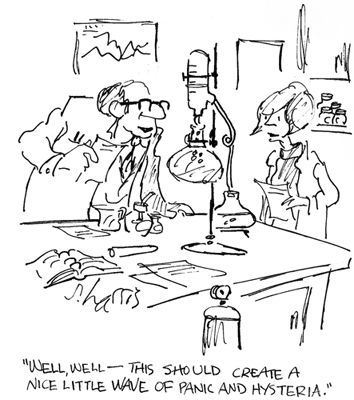
panic_and_hysteria

I have relied upon injections of genetically modified insulin hormone to keep me alive for many years. The benefits of biotechnology for mankind are supported by decades of hard experience and volumes of careful research, and there is no evidence of harm. But that can’t dissuade neo-Luddites in their efforts to foment panicked opposition to genetic modification of crops.

Another GMO horror story has been circulating about an experiment said to have been conducted at a Chinese university in which students were fed Bt rice. The claim is that an outbreak of acute leukemia ensued. This report bears all the all the earmarks of a fraud, right down to the fact that no one on campus seems to have heard about it!

Anti-GMO activists disparage critics for calling attention to the “fringe” character of the outlets promoting their views, or by diminishing opposing claims as “corporate,” when in fact the real problems are that those activists rely on badly designed and executed research and superstitions about technology. Articles about the alleged Chinese GMO experiment make false claims about prior research findings of a link between GMOs and leukemia. In fact, while the authors of that earlier research don’t admit it, their work casts more doubt on the safety of organic Bt pesticides than on GM crops expressing the Bt toxin. In other words, it’s lousy research. See here for further confirmation. This is reminiscent of other flimsy research promoted by the anti-GMO lobby, such as the notoriously bad Serelini study that used, as subjects, rats that had been bred to develop tumors.

Oddly, hysteria over GM crops does not extend to the genetically modified antibodies created to cure diseases like ebola. Synthetic human insulin is made via genetic modification too! Why no opposition? Perhaps because the activists recognize the impressive benefits of the biotechnology in this  context. The potential benefits of GM crops are no less impressive. And despite the best efforts of the anti-GMO lobby, there is no persuasive evidence that GM foods are harmful.

Fractured Households, Echoes of War, and Inequality

03 Friday Oct 2014

Posted by Nuetzel in Uncategorized

≈ Leave a comment

Tags

Distribution of income, Gini coefficient, Household structure, income inequality, Inequality, Political Calculations, Redistribution, World War II

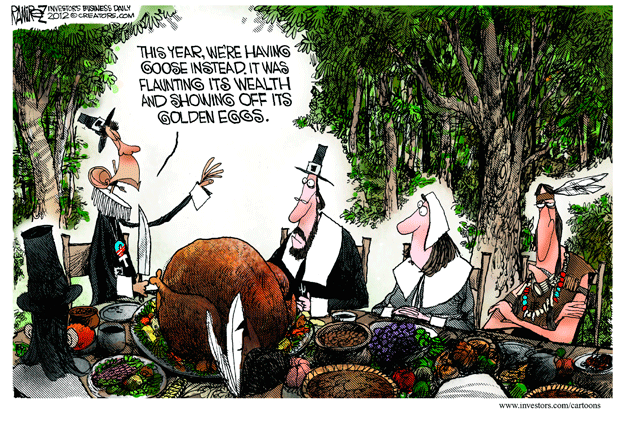
goose dinner

A friend sent me this interesting link to the “Political Calculations” blog in response to my recent post on distorted metrics of changing income inequality. The PC link is from about 10 months ago, but it is very timely nevertheless. It compares trends in three versions of the “gini coefficient” for the U.S., a common measure of inequality. A gini of zero indicates absolute equality of income across quantiles. A gini of one indicates that all income flows exclusively to the top quantile. The most interesting feature of this comparison is that the gini calculated for individual income earners has shown no trend up or down since about 1960, while the gini for households has trended upward since about 1970. This difference implies that the much-bemoaned increase in inequality is actually the result of changes in household structure, as opposed to earnings increasingly skewed toward elite individual earners.

In two follow-up posts (“The Widow’s Peak” and “The Men Who Weren’t There“), the author(s) identifies some demographic factors that were important in creating the upward trend in the household gini. Single-person households grew dramatically throughout this period, as did the number of seniors (aged 65+) living alone. The number of senior, female single-person households grew even more dramatically. Many of these women were either widows or never had good opportunities to marry because so many males in their age cohort were killed in World War II. Unfortunately, they constituted a group of very low-income households. There were other reasons for growth in the number of low-income, single-person households, such as increases in the divorce rate and perverse welfare-state incentives. The following lament by the author(s) in the last follow-up post is noteworthy:

“To us, it’s more remarkable that so many economists and politicians insist on focusing on the opposite end of the income spectrum in attempting to blame the highest income-earning Americans for that increase.”

Of course, the trends in ginis shown at the links above are subject to the same criticism made by the sabermatrician discussed in my earlier post: the comparisons over time implicitly assume that the quantiles used in the calculations are static, composed of the same sets of households or individuals, but they are not. Therefore, they tend to overstate trends toward greater inequality.

The fact that household structure has so much to do with trends measured by standard household gini coefficients, that the gini for individual earners has no trend, and that in any case, fixed quantile comparisons overstate trends in inequality, all suggest that redistributionist policies are misguided and unnecessary. And those kinds of policies tend to undermine the growth of the economy. Only policies designed to boost economic growth can help households across the income distribution to prosper. Moreover, unraveling the negative incentives built into current social programs would help to stabilize household and family structure.

Unintended Consequences: Living (Without a) Wage

02 Thursday Oct 2014

Posted by Nuetzel in Uncategorized

≈ 1 Comment

Tags

Living Wage, Mark Perry, Market Intervention, Minimum Wage, Nick Gillespie, Transfer Payments, Unintended Consequences, Wage Floors

chickensalon

Nick Gillespie makes a good case for what should be obvious to any thinking person: to help the poor, direct transfers are a better alternative than raising the minimum wage. Most people would probably agree, regardless of their views of the appropriate role of government in society, that governments are better-suited to writing checks than to complex market interventions, and labor markets are no exception. State or federal wage floors,  minimum wages, or “living wages” — whatever politically expedient name happens to be in vogue, they are the same thing — diminish employment opportunities for the least skilled members of the labor force. These workers have the most to gain from employment experience. Hence, their losses extend beyond a mere loss of current income into lost opportunities to build human capital and future income.

Mark Perry puts a fine point on the folly of raising the wage floor: “Instead of $10.10 per hour, think of the proposed minimum wage as a $5,700 annual tax per full-time unskilled worker.”

Transfers can be targeted at the poor more effectively than a living wage. First, it is relatively easy to qualify households falling below poverty-level. Second, a significant share of low-wage earners are not members of low-income households. Third, as noted above, employers can respond to wage mandates by reducing employment, but also by cutting the hours of their low-skilled employees. Both actions tend to nullify an otherwise positive impact of a higher wage floor on income.

There are few who question the need for a safety net for those truly in need, but policy should be designed to limit the need for public support. Wage floors do not promote either of those goals. However, I’d also caution that some of the transfer programs mentioned by Gillespie (food stamps and housing subsidies) are, in fact, market interventions that have unintended consequences of their own, including price distortions. Cash transfers avoid these kinds of difficulties if they are crafted to minimize negative incentives on work effort and job search activity.

Newer posts →
Follow Sacred Cow Chips on WordPress.com

Recent Posts

  • The Case Against Interest On Reserves
  • Immigration and Merit As Fiscal Propositions
  • Tariff “Dividend” From An Indigent State
  • Almost Looks Like the Fed Has a 3% Inflation Target
  • Government Malpractice Breeds Health Care Havoc

Archives

  • January 2026
  • December 2025
  • November 2025
  • October 2025
  • September 2025
  • August 2025
  • July 2025
  • June 2025
  • May 2025
  • April 2025
  • March 2025
  • February 2025
  • January 2025
  • December 2024
  • November 2024
  • October 2024
  • September 2024
  • August 2024
  • July 2024
  • June 2024
  • May 2024
  • April 2024
  • March 2024
  • February 2024
  • January 2024
  • December 2023
  • November 2023
  • August 2023
  • July 2023
  • June 2023
  • May 2023
  • April 2023
  • March 2023
  • February 2023
  • January 2023
  • December 2022
  • November 2022
  • October 2022
  • September 2022
  • August 2022
  • July 2022
  • June 2022
  • May 2022
  • April 2022
  • March 2022
  • February 2022
  • January 2022
  • December 2021
  • November 2021
  • October 2021
  • September 2021
  • August 2021
  • July 2021
  • June 2021
  • May 2021
  • April 2021
  • March 2021
  • February 2021
  • January 2021
  • December 2020
  • November 2020
  • October 2020
  • September 2020
  • August 2020
  • July 2020
  • June 2020
  • May 2020
  • April 2020
  • March 2020
  • February 2020
  • January 2020
  • December 2019
  • November 2019
  • October 2019
  • September 2019
  • August 2019
  • July 2019
  • June 2019
  • May 2019
  • April 2019
  • March 2019
  • February 2019
  • January 2019
  • December 2018
  • November 2018
  • October 2018
  • September 2018
  • August 2018
  • July 2018
  • June 2018
  • May 2018
  • April 2018
  • March 2018
  • February 2018
  • January 2018
  • December 2017
  • November 2017
  • October 2017
  • September 2017
  • August 2017
  • July 2017
  • June 2017
  • May 2017
  • April 2017
  • March 2017
  • February 2017
  • January 2017
  • December 2016
  • November 2016
  • October 2016
  • September 2016
  • August 2016
  • July 2016
  • June 2016
  • May 2016
  • April 2016
  • March 2016
  • February 2016
  • January 2016
  • December 2015
  • November 2015
  • October 2015
  • September 2015
  • August 2015
  • July 2015
  • June 2015
  • May 2015
  • April 2015
  • March 2015
  • February 2015
  • January 2015
  • December 2014
  • November 2014
  • October 2014
  • September 2014
  • August 2014
  • July 2014
  • June 2014
  • May 2014
  • April 2014
  • March 2014

Blogs I Follow

  • Passive Income Kickstart
  • OnlyFinance.net
  • TLC Cholesterol
  • Nintil
  • kendunning.net
  • DCWhispers.com
  • Hoong-Wai in the UK
  • Marginal REVOLUTION
  • Stlouis
  • Watts Up With That?
  • Aussie Nationalist Blog
  • American Elephants
  • The View from Alexandria
  • The Gymnasium
  • A Force for Good
  • Notes On Liberty
  • troymo
  • SUNDAY BLOG Stephanie Sievers
  • Miss Lou Acquiring Lore
  • Your Well Wisher Program
  • Objectivism In Depth
  • RobotEnomics
  • Orderstatistic
  • Paradigm Library
  • Scattered Showers and Quicksand

Blog at WordPress.com.

Passive Income Kickstart

OnlyFinance.net

TLC Cholesterol

Nintil

To estimate, compare, distinguish, discuss, and trace to its principal sources everything

kendunning.net

The Future is Ours to Create

DCWhispers.com

Hoong-Wai in the UK

A Commonwealth immigrant's perspective on the UK's public arena.

Marginal REVOLUTION

Small Steps Toward A Much Better World

Stlouis

Watts Up With That?

The world's most viewed site on global warming and climate change

Aussie Nationalist Blog

Commentary from a Paleoconservative and Nationalist perspective

American Elephants

Defending Life, Liberty and the Pursuit of Happiness

The View from Alexandria

In advanced civilizations the period loosely called Alexandrian is usually associated with flexible morals, perfunctory religion, populist standards and cosmopolitan tastes, feminism, exotic cults, and the rapid turnover of high and low fads---in short, a falling away (which is all that decadence means) from the strictness of traditional rules, embodied in character and inforced from within. -- Jacques Barzun

The Gymnasium

A place for reason, politics, economics, and faith steeped in the classical liberal tradition

A Force for Good

How economics, morality, and markets combine

Notes On Liberty

Spontaneous thoughts on a humble creed

troymo

SUNDAY BLOG Stephanie Sievers

Escaping the everyday life with photographs from my travels

Miss Lou Acquiring Lore

Gallery of Life...

Your Well Wisher Program

Attempt to solve commonly known problems…

Objectivism In Depth

Exploring Ayn Rand's revolutionary philosophy.

RobotEnomics

(A)n (I)ntelligent Future

Orderstatistic

Economics, chess and anything else on my mind.

Paradigm Library

OODA Looping

Scattered Showers and Quicksand

Musings on science, investing, finance, economics, politics, and probably fly fishing.

  • Subscribe Subscribed
    • Sacred Cow Chips
    • Join 128 other subscribers
    • Already have a WordPress.com account? Log in now.
    • Sacred Cow Chips
    • Subscribe Subscribed
    • Sign up
    • Log in
    • Report this content
    • View site in Reader
    • Manage subscriptions
    • Collapse this bar
 

Loading Comments...